The most famous building in Florence is the Cathedral of Santa Maria del Fiore, known commonly as the Duomo. It is an architectural and engineering wonder built as Europe was transitioning from the Middle Ages to the Renaissance.
History of Construction
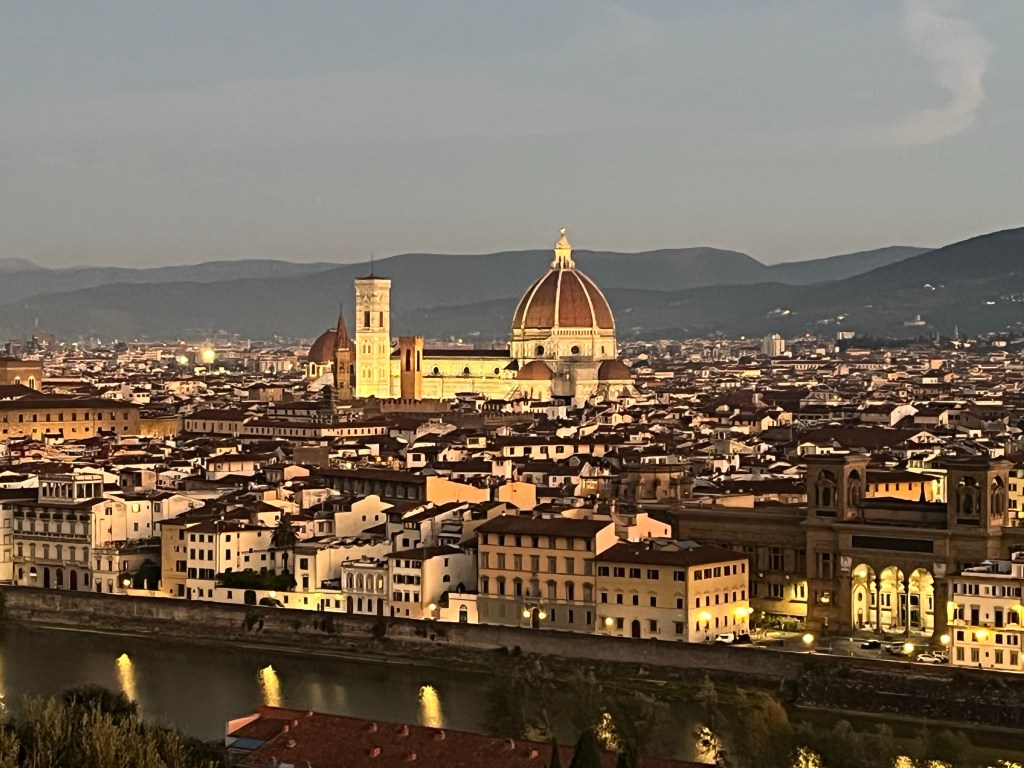
The Duomo dominates the skyline of Florence. It is 376 feet tall at the dome and the campanile is 278 feet tall. Most buildings in Florence are three to five stories tall and are a fraction of the Cathedral’s height. The Duomo is so much larger than the rest of the buildings in Florence that it’s impossible to miss.

As was the case with many cathedrals built throughout Europe, building the Duomo was a multi-generational project. The project began in 1296 overseen by the architect Arnolfo di Cambio. By 1337, the project had expanded and the plans were changed to include a dome, even though they didn’t yet have plans on how to build it. In 1418, the Architect Brunelleschi solved the dome problem and his design was chosen to finish it. The dome was completed in 1436, finally finishing the construction on the cathedral that had lasted 140 years.

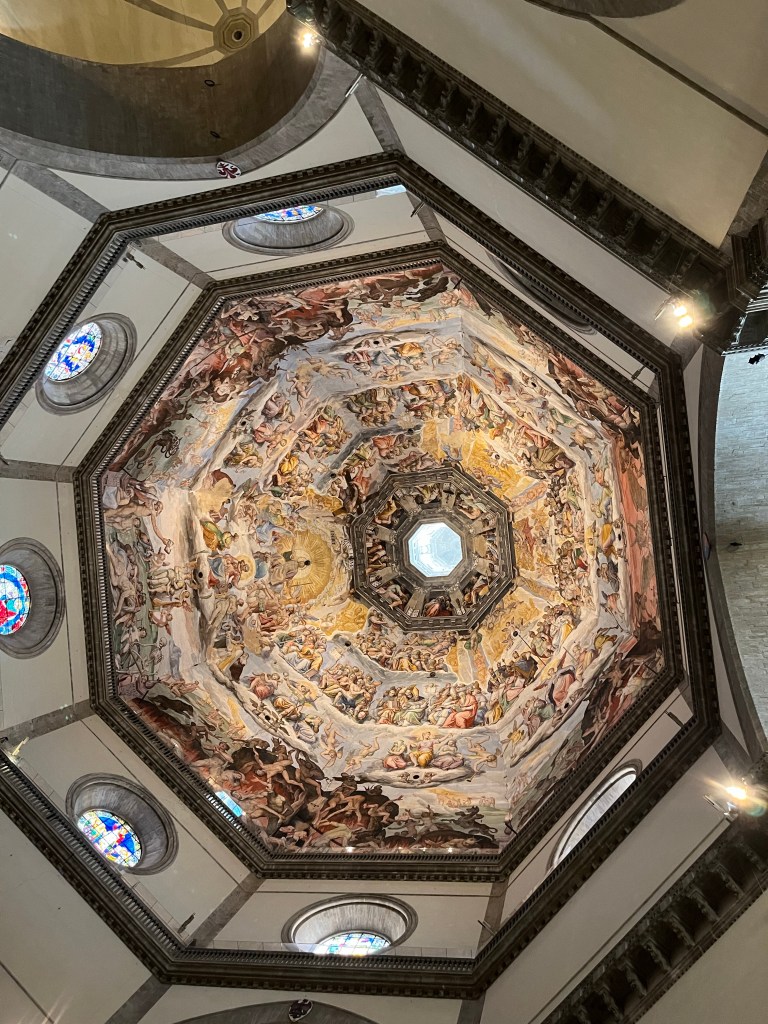
Painting the dome started in 1572 when Georgio Vasari was commissioned by the Grand Duke Cosmio I d’ Medici to depict the Last Judgment. Vasari died in 1574 and left the frescoes incomplete. Frederico Zuccari was commissioned in 1576 to finish the project which he did in 1579.
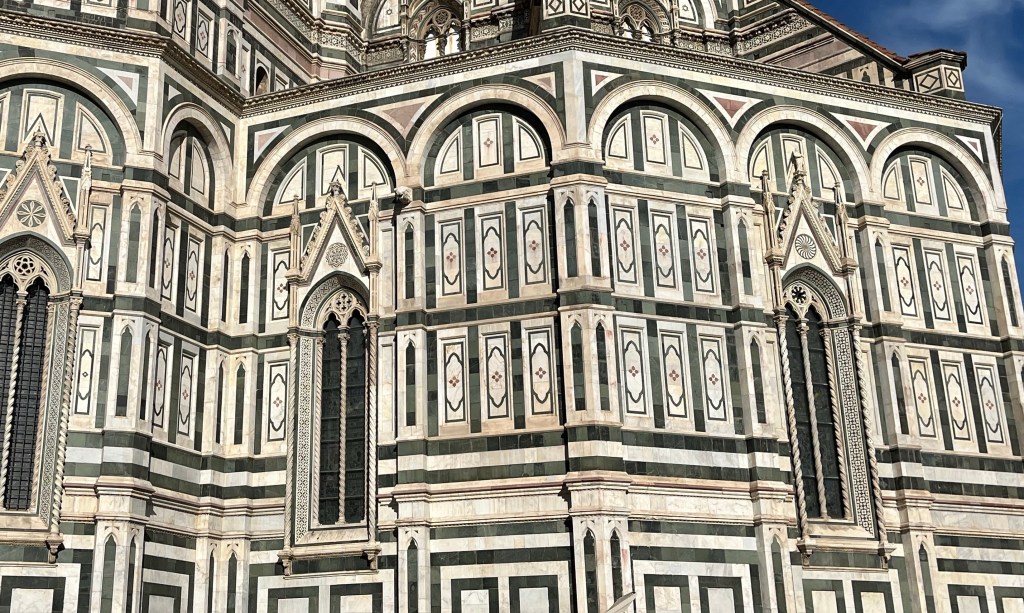
The facade of the Duomo is a striking combination of white, green and pink marble. Interestingly, the exterior is relatively new, with the work having begun on the exterior in 1871 and was completed in 1887. All of the marble was sourced nearby with the white marble being from Carrera, the green marble from Prato and the pink marble from Siena.
Even though the Baptistry and the Campanile have extremely similar marble exteriors, they had been clad in marble for centuries when the exterior work was done on the Duomo. Because of the similar marble exteriors, the Baptistry, Campanile and the Duomo feel like one cohesive project, but in fact, the Baptistry was completed in 1059 and the Campanile was completed in 1359.
Ticket Options for the Duomo
The Brunelleschi Pass provides access to climb the stairs up to the top of the dome, as well as the bell tower. It also provides access to the museum, the baptistery and the crypt of Santa Raparata. That pass is available at the Duomo website for 30 Euros.

The Giotto Pass provides everything the Brunelleschi Pass provides, except access to the top of the dome. The Giotto pass costs 20 Euros.
The Ghiberti Pass provides access to the Baptistery, the Museum and the Crypt of Santa Reparata. It costs 15 Euro. If you don’t like hiking up a ton of stairs or heights, this might be the option for you.
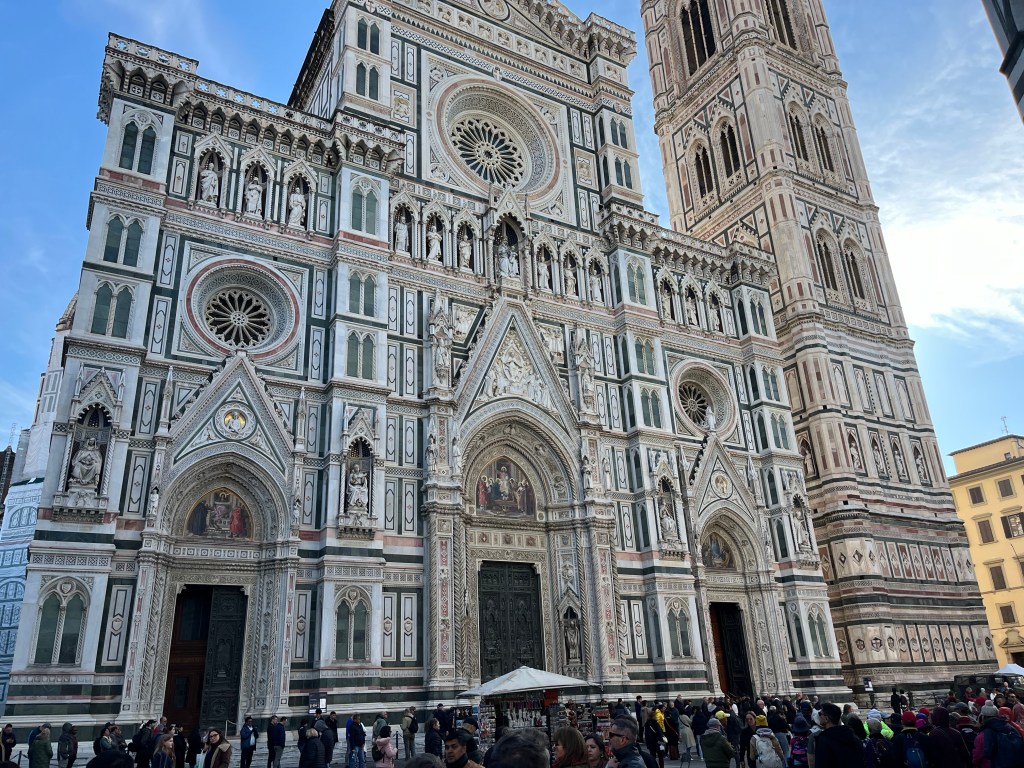
Because we didn’t have a ton of time in Florence we decided to do none of those things and just walk inside of the Cathedral. This option is completely free and can be done simply by standing in line. Even though the line was long, it moved fairly quickly and we were able to make it inside in about 20 minutes.
It’s Not as Flashy as You would Expect
When you look at the outside of the Duomo, it’s beautiful, but it’s a quite showy. The front of the Duomo has dozens of statues in the facade, along with the three toned marble exterior. The doors, the windows, every single inch of the exterior of the Duomo is intricate.

However, once we walked inside, the amount of plain light tan walls everywhere was surprising. The gray stone archways and ribs holding up the high vault ceiling are beautiful, while seeming strangely plain. There are also some beautiful stained glass windows letting light in from the outside.
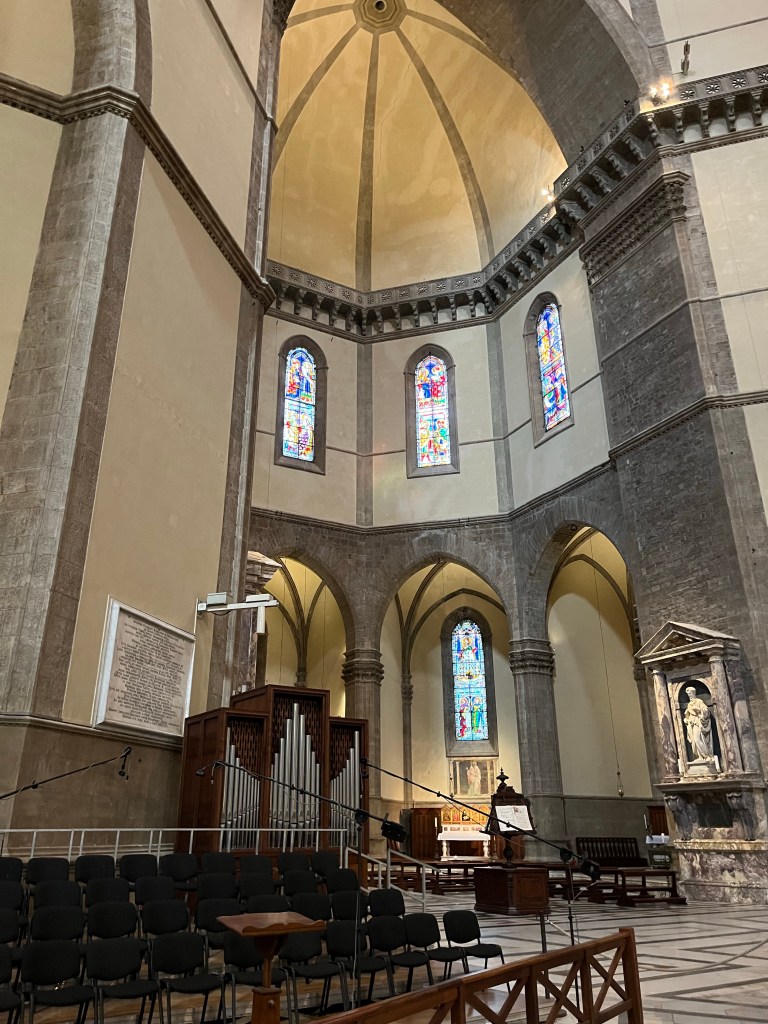
There are a series of twelve marble statues inside the Duomo, created by a variety of artists in the 16th Century. These are marvelous pieces of art and fairly large. However, because of the size of the Duomo, they aren’t immediately obvious.

Compared to many of the churches and cathedrals that I’ve visited, the inside of the Duomo seemed understated. I think that’s what I liked so much about it. From the outside, every inch of the exterior is covered with an elaborate marble cladding. The front of the Duomo has statues everywhere and the doors are enormous and elaborate.

But inside, it’s beauty is in the relative simplicity. Sure there are still stained glass windows, statues and tapestries, but when taking it in as a whole, those things complement the cathedral well instead of overwhelm it.

The one element of the inside of the cathedral that is a bit showy is the painting of the Last Judgement in Brunelleschi’s Dome. However, you need to position yourself underneath it in order to view it. You would never see it while seated in a pew during Mass.

It’s actually a perfect example of the purpose of a Cathedral. For the citizens of Florence, this is the center of their community, it is a source of their pride. The exterior shows off the craftsmanship and labor of centuries of artists, artisans and laborers. But the inside, that’s for worship. Despite, the frescoes and the statues, the focus is most definitely on the altar and the priest performing Mass and ultimately that is the most important function of a Cathedral.

 Newby to Expert Traveler