Walking the Portuguese Route of the Camino de Santiago was an unusual choice for a spring break trip. We could have chosen something a little more relaxing, like a beach vacation, but here we were, backpacks on, getting ready to head out for an adventurous, long hike across Galicia, in the northwest corner of Spain.
Following a night in Porto, a train ride to Valenca, and our first night in an albergue, Jenn and I and our two kids Alex and Emma were set to begin a journey of more than 120 kilometers to the Cathedral in Santiago de Compostela.

We started our Camino from the Albergue Sao Teotonio in Valenca. Albergues are essentially what Americans call youth hostels – basic bunk beds stacked in rows to maximize sleeping capacity and economy not comfort.

It cost 8 euros per bed a night, cash only, and we were given fitted sheets made of paper to sleep on. Each of us packed a sleeping bag liner for these conditions. It was uncomfortable and I didn’t sleep well. This was when I found out that my son was a snorer and I worried that we were keeping the other guests up. However, I don’t think this was the case since I was hearing snoring from the other guests as well. I probably only got a few hours of sleep between the uncomfortable conditions and the anticipation of starting the Camino.
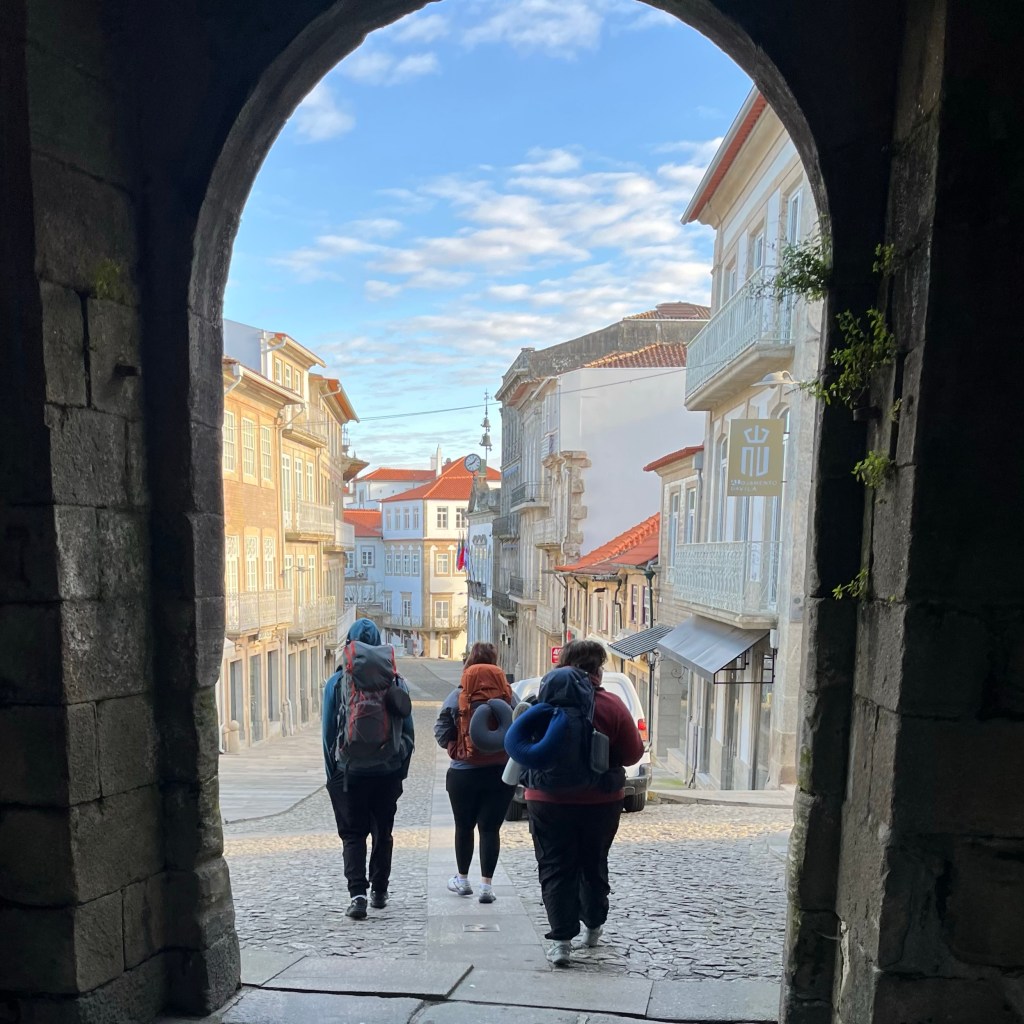
We woke up in the morning and had some coffee from the instant coffee vending machine in the common room. We readied ourselves for the first morning, made our packs as comfortable as we thought they could be, and walked out of the albergue and onto the Camino.

The trail from the albergue immediately winds through the Fortaleza de Valenca, the ancient fortified town of Valenca. It was first built in the 13th Century and has been improved many times, but the current walls are from the 17th and 18th centuries.

The town is very well preserved but is mostly bars, restaurants, and gift shops now. We lamented the fact that most pilgrims would be coming through the town at night and would have a variety of bars and restaurants to choose from and we, unfortunately, were going through in the morning when nothing was even open yet.

Leaving the castle walls of Valenca we continued down to the Minho River where we crossed into Spain for the first time. Once in Tui, we had a couple of people greet us with a “Buen Camino”, the traditional greeting of pilgrims on the Camino. One kind gentleman showed us where to find the first marker on the Spanish portion of the Portuguese route of the Camino.

We wound along the Minho River and saw a Cathedral on a hill. The route took us up the hill and finally to the Tui Cathedral where we stopped to buy pilgrim shells. Scallop shells are the traditional symbol of the Camino, with pilgrims frequently hanging them from the outside of their backpacks in order to show they are on the Camino.

There are many explanations as to why scallop shells are the traditional symbol of the Camino but my favorite explanation is that on a scallop shells there are several lines converging into one point. This is similar to the multiple paths of the Camino converging in Santiago de Compostela.

In Tui, we met our first fellow pilgrim, an English gentleman who is retired and has done multiple routes of the Camino. We had a nice chat with him and he gave us some pointers on doing a Camino. He gave us some instruction on the proper use of hiking poles, which might sound basic, but using them improperly negates much of their benefit. The whole time we were chatting, we had been walking through a rural natural area.
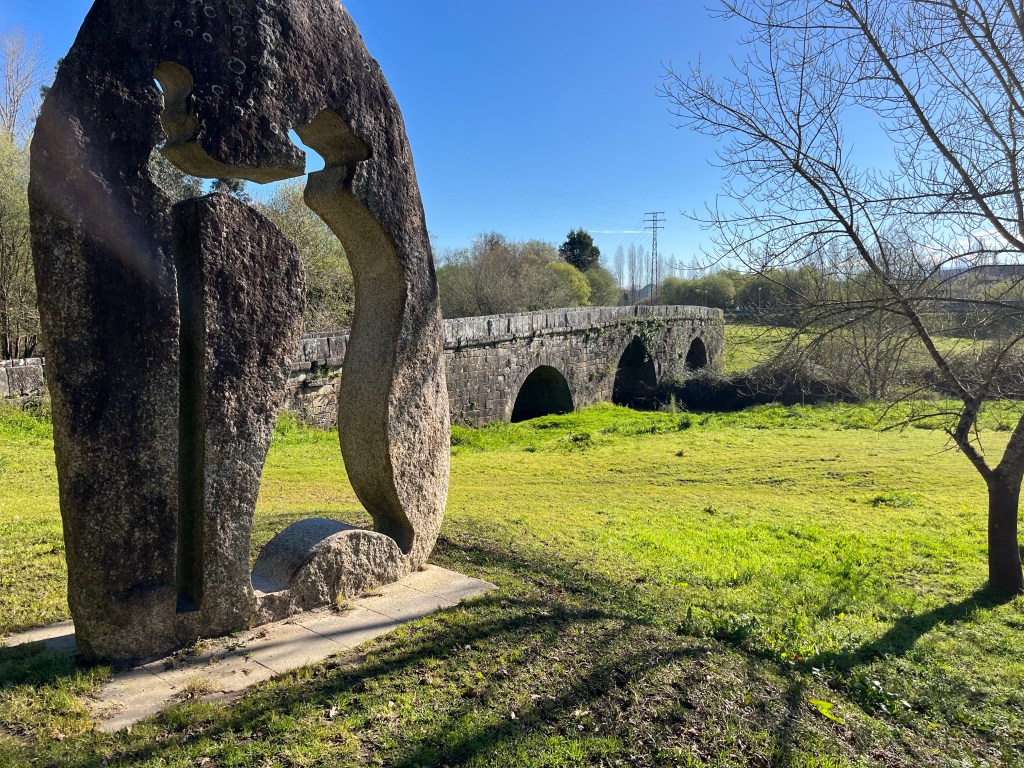
After a little while, he left us and where we had been enjoying a nice hike in nature, we were suddenly on the edge of a country road with infrequent but unnervingly fast traffic. This section may not have been that long, but it wasn’t pleasant so it seemed to last quite some time.
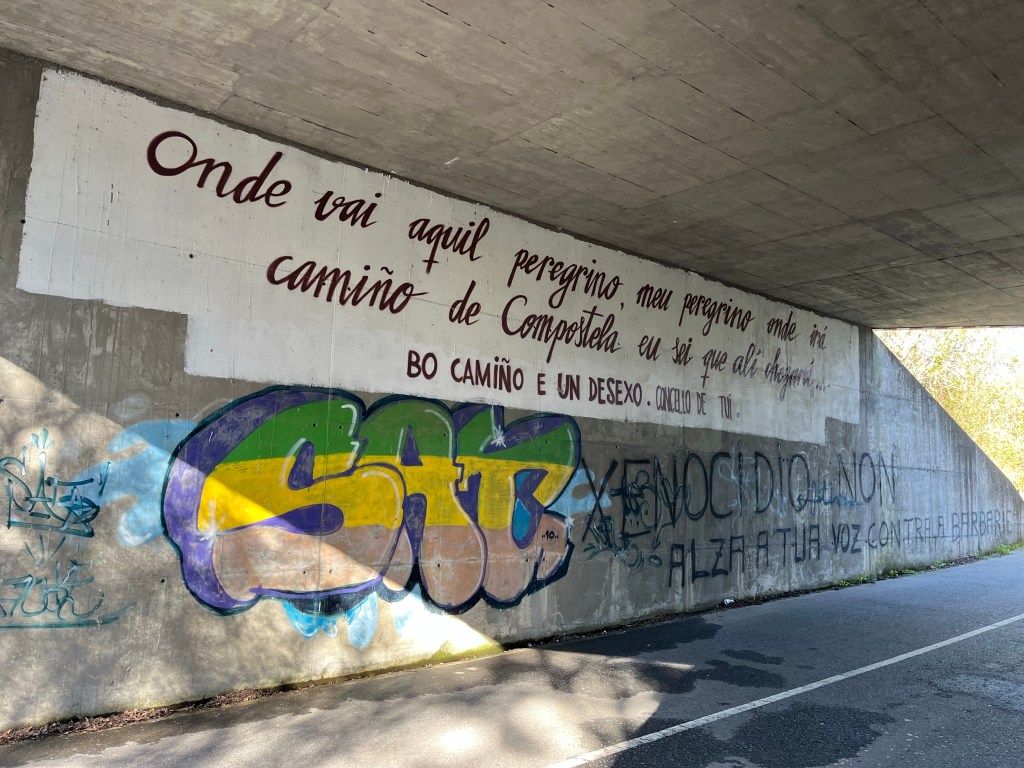
Along the road we were passed by a couple of young German women who made us feel like we were practically standing still. It was becoming clear that we were considerably slower than the other pilgrims along the route. Are we going to be able to do this? Are we in good enough shape to pull this off? The doubts were already creeping into our heads.

This is also where the weight of the pack started to bother me. We all were struggling with trying to navigate new equipment. This was the first time doing a long hike. The weight from the pack is supposed to sit on my hips, but was instead resting on my shoulders too much. We all did some equipment adjustments and while the pack didn’t seem quite right, it did seem better.
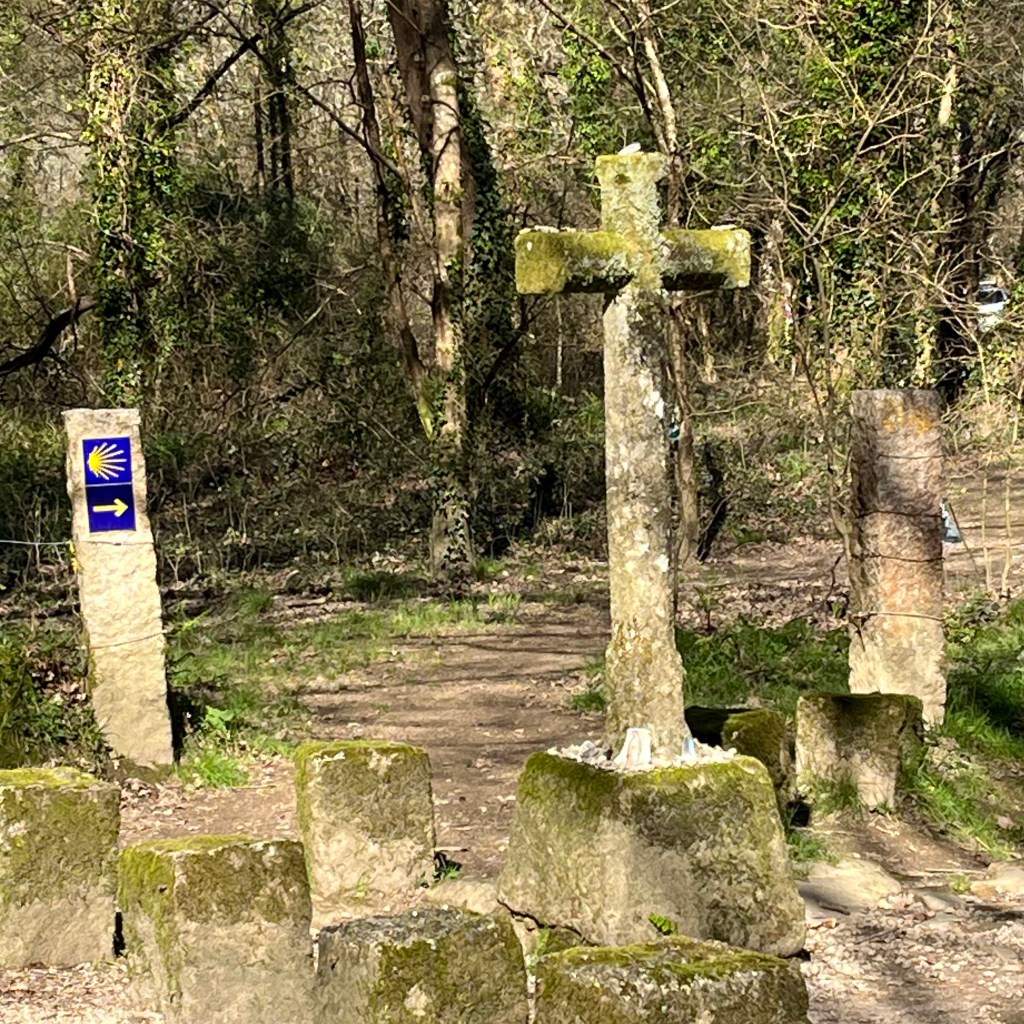
It seemed like forever before we were able to make our first stop of the day. It was about 7.5 miles along the route and we came by Ponte des Febres, a really cute cafe and albergue. We were greeted with “Oh no, it’s the bloody Americans!” We looked up to see the English gentleman sitting at a table, the two German women at another, and both guys from our albergue the night before.

We ordered croissants and Spanish Tortilla as well as some cafés con leche. We also got our first stamp in our pilgrim passport.
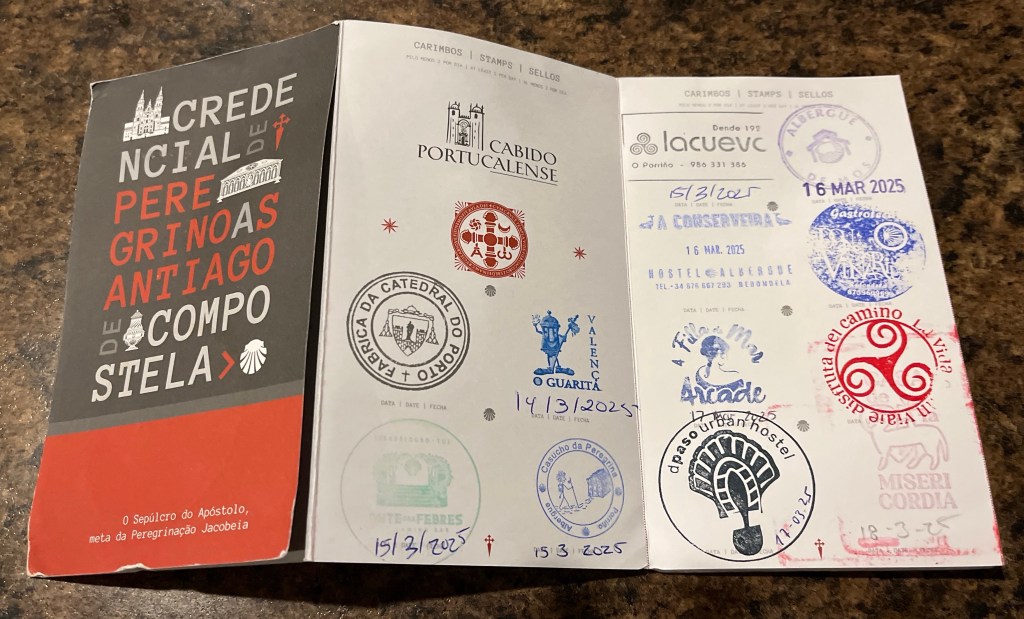
The Pilgrim passport is a book that each pilgrim carries with them to prove that they are on the Camino. Without it, you may not get admission to an albergue. Also, if you complete a 100-kilometer pilgrimage ending in Santiago de Compostela, you are awarded a certificate. You need at least two stamps per day to qualify.

From there we went to Orbanlle where we had the opportunity to choose between a more direct route through an industrial area or a more scenic route through the country. There are routes like this one on many days, they are called complementary routes.
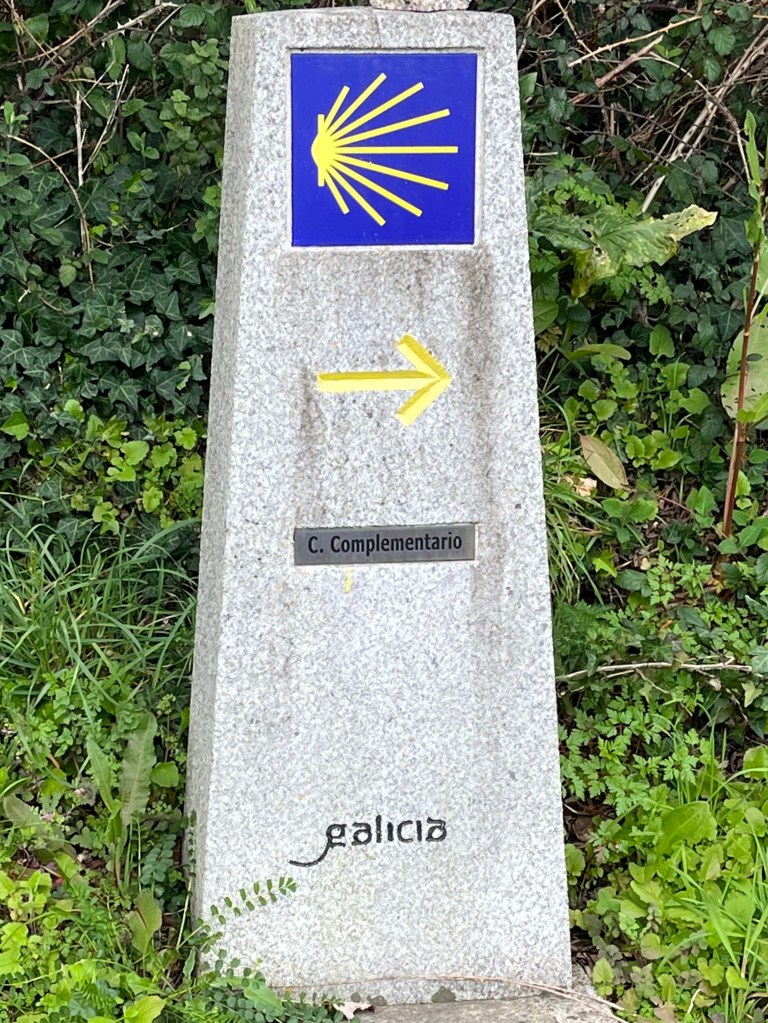
That turned out to be a pretty good choice because that was a pretty relaxing route to take. Most of it was out in the country, but it did wind through a lot of small towns along the way.

Getting really tired by this point we came across San Campio, a bar and restaurant that clearly is a favorite of locals, but also caters to pilgrims. Everyone but Alex had a beer and I ordered a giant bottle of water for the table. We also shared three sandwiches and a big plate of fries. It hit the spot and gave us enough energy to finish our trek to O Porrino.

From San Campio to our Hostel in O Porrino was about 2.5 miles and honestly most of it wasn’t very scenic, but it felt good to finish the hike. We arrived at Casucho de Peregrina, which is a nice hostel. We paid extra to have our bunks in a private room with only 4 beds. As it turned out, that was pretty unnecessary, because there was only one other pilgrim sleeping in the hostel.
While we were getting our stuff settled in our private room, I heard a familiar voice. It was the English gentleman we met earlier on the trail. It was nice to see a friendly face. Being the only other pilgrim in the hostel, he ended up sleeping in a large room full of bunks all by himself.
It had been a challenging day and I was already beginning to question whether doing a Camino was a smart way to spend a family vacation. I underestimated how much of a physical challenge this was going to be and both hoped we would finish and that we would be able to actually enjoy it.
The accommodations at the hostel were very comfortable and after a little dinner we were out cold. I guess 15 miles of hiking will do that to you.

 Newby to Expert Traveler