
I didn’t get more than a couple of hours of sleep. The wind slamming the shutters on the windows was a constant reminder of the massive challenge ahead. At this point, we were all struggling with nagging pain. The hike from Padrón to Santiago de Compostela would be our most challenging to date. In addition, the weather looked horrible. The weather app called for sustained winds of 20 miles per hour with gusts up to 40 miles per hour. The forecast also called for rain all day.
All I could think was, do we really want to spend eight or nine hours hiking in the wind and rain, limping in pain? Jenn and I decided to ask the kids what they wanted to do.
We walked into their room, told them about the weather, and asked them what they thought. Emma was conflicted and said she wanted to finish, but that it sounded terrible. She said she’d leave it up to Alex. He took one look at us and said, “I’m done,” and then he rolled over and tried to go back to sleep.
So there it was, after five days hiking the Camino, we were quitting just 17 miles from the end.
I was conflicted about it, because after all, this was supposed to be a vacation, and I felt like I spent the better part of a week torturing my family. On the other hand, there is value to completing something so physically demanding.
The Camino is a hard physical challenge that is achievable by normal people. Jenn and I have both completed these types of challenges before. Jenn has done two RAGBRAIs (a week-long 400-mile bike ride across Iowa) and a couple of half marathons. I’ve done a RAGBRAI, about ten half marathons, and a couple of full marathons.
The kids hadn’t experienced what it’s like to complete a challenge like that, and I was a little sad they wouldn’t finish. For me, those challenges are important because they build confidence and character. I hoped that quitting that close to the end didn’t invalidate any personal growth that resulted from the first five days of the Camino.
We took our time getting ready, then took the walk of shame through the rain and wind down to the train station and bought a ticket to Santiago de Compostela. We shared the complex feelings of regret for not finishing the Camino as well as the relief of not having to hike that day. I was happy, however, to have a little more time to visit with my friend Nate.
While on the train, I texted Nate to tell him we quit and we would be in Santiago de Compostela in a little bit. He said he would meet me at the Pilgrim House, which is the community center where he works.
When we met, he introduced us to the staff at the Pilgrim House and even pointed out someone from our hometown who volunteers with the organization. She was talking with Jenn and mentioned that she also works with the youth symphony orchestra in our hometown. Alex happens to be a viola player in that orchestra, so she took a picture of her and Alex and texted it to his conductor with a message: “Guess who I ran into in Spain?” It’s a small world.
We talked with them about our experiences on the Camino and what we would do differently. They have a different perspective as veterans of the Camino themselves and as people who listen to thousands of Camino stories each year. They chucked a little and said, “You spend your first Camino learning how to do a Camino.”
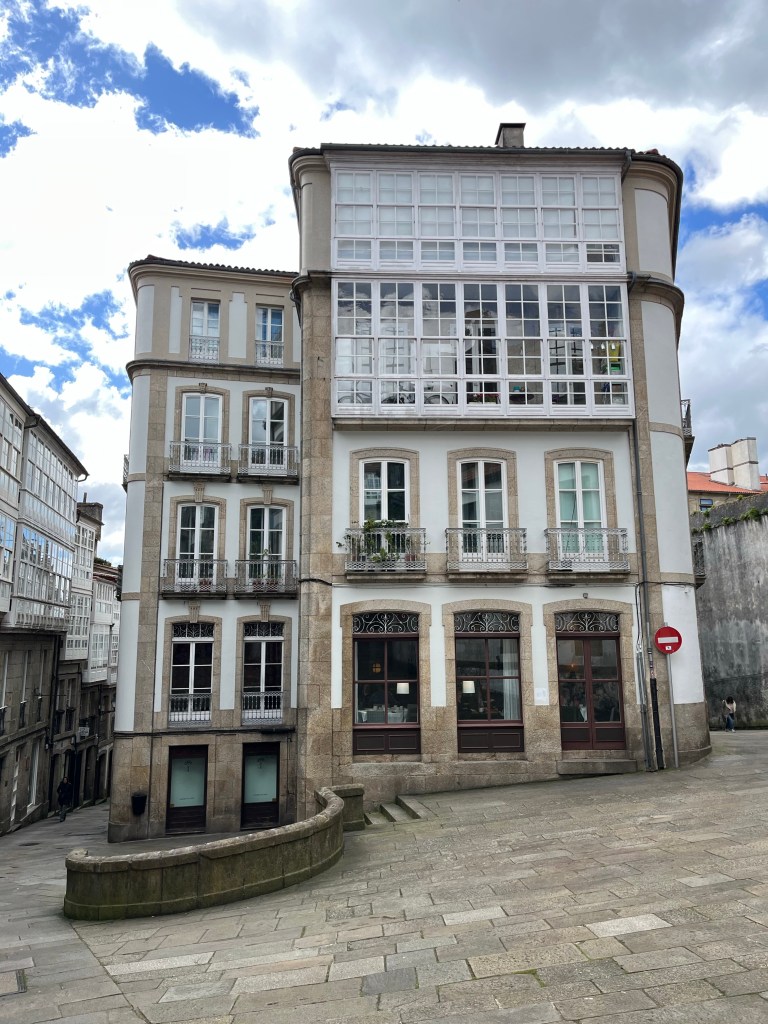
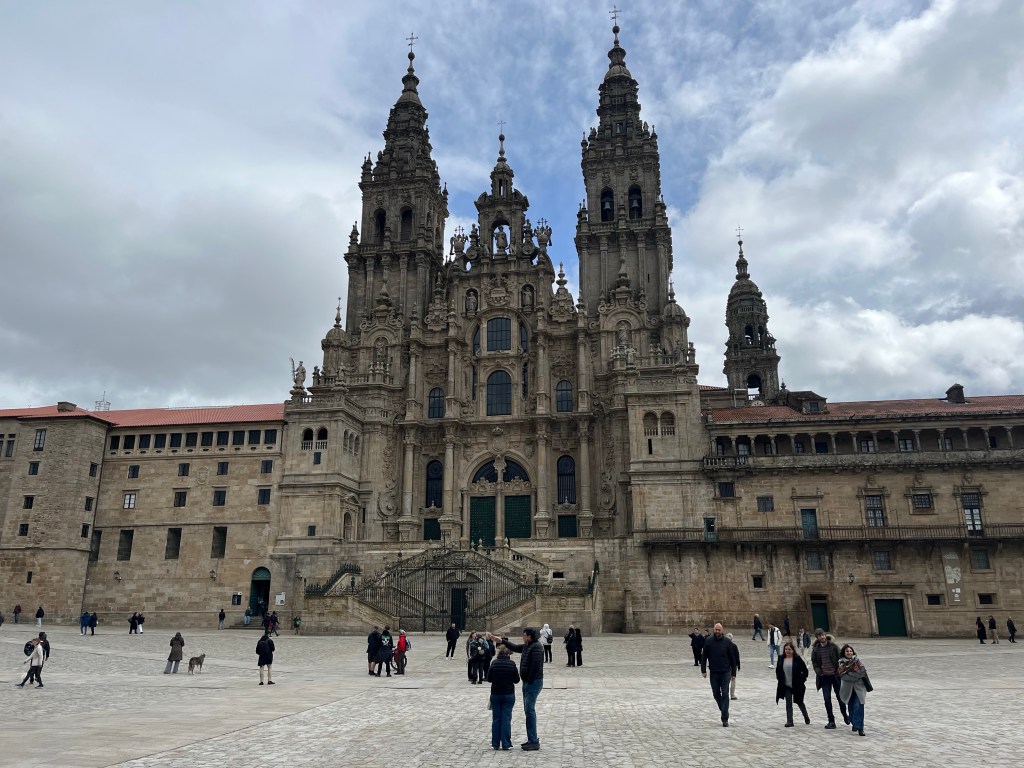
Nate gave us a tour of Santiago de Compostela, showing us his favorite coffee shop, the Cathedral, and the wonderful architecture of the city. We talked about the old days and what happened to our old friends. He talked about his family and what it was like for them to raise kids in Spain.
It was wonderful catching up with him after all these years, and if there was one blessing from having quit the Camino, it was the ability to spend a couple of hours with an old friend, thousands of miles away from where we grew up.
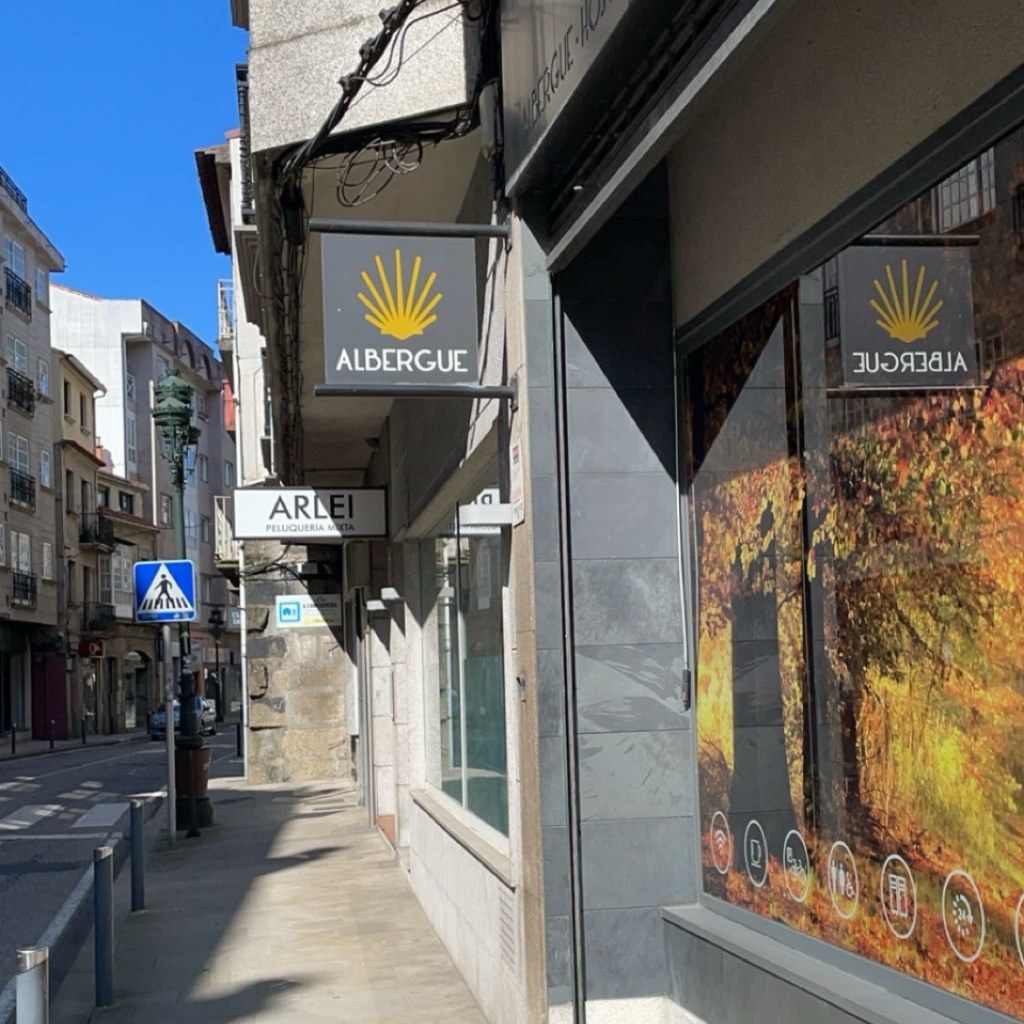
We said our goodbyes to Nate and headed to our hostel at Albergue Alda O Fogar de Teodomino. We were able to get a private room with four beds. The hostel was nearly empty. I think most people didn’t hike that day because of the weather. I assume that most people who would have finished in Santiago de Compostela that day were instead taking an off day and would finish the next day.

We checked into the hostel, and I said that I wanted to tour the Cathedral. Emma wanted to join me, while Alex and Jenn stayed back to take a nap.

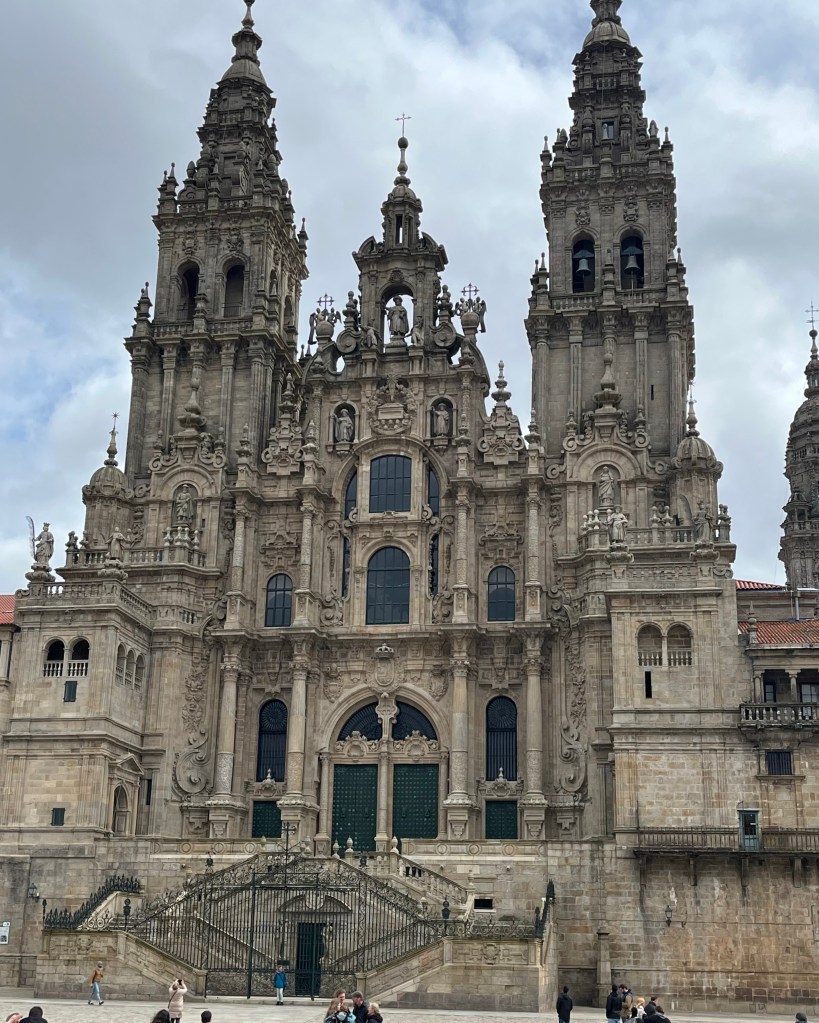
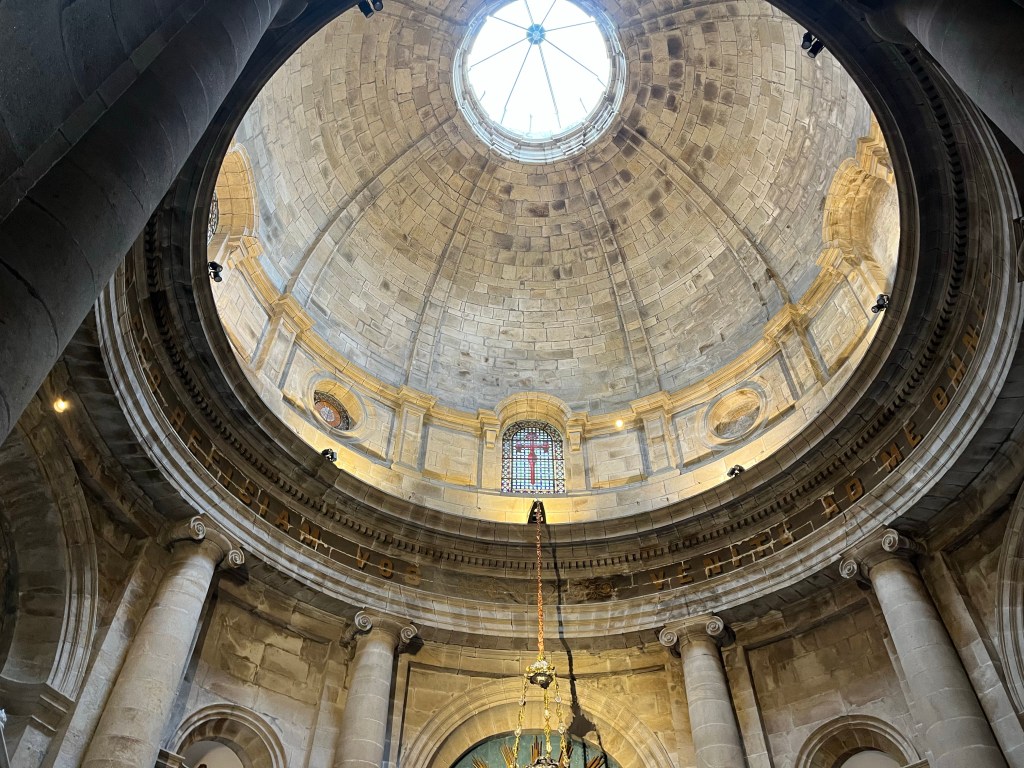
The full name of the cathedral is the Santiago de Compostela Archcathedral Basilica. Construction began in the late eleventh century, lasted well over a hundred years, and was finally completed in 1211. It was built to house the supposed remains of St James, which were discovered in the 9th Century near modern-day Padrón.

I definitely question the validity of the claims that the body of St James was discovered more than 800 years after his death, thousands of miles away from where he died. However, this discovery led to millions of pilgrims over the centuries walking the Camino to this cathedral in Santiago de Compostela.
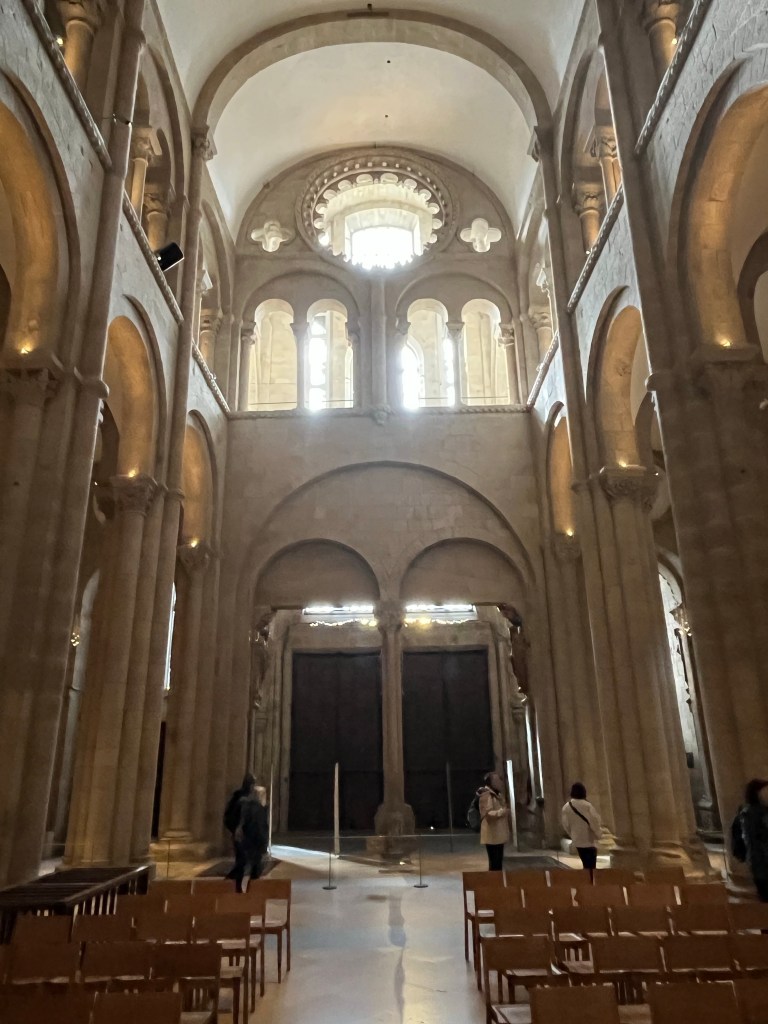
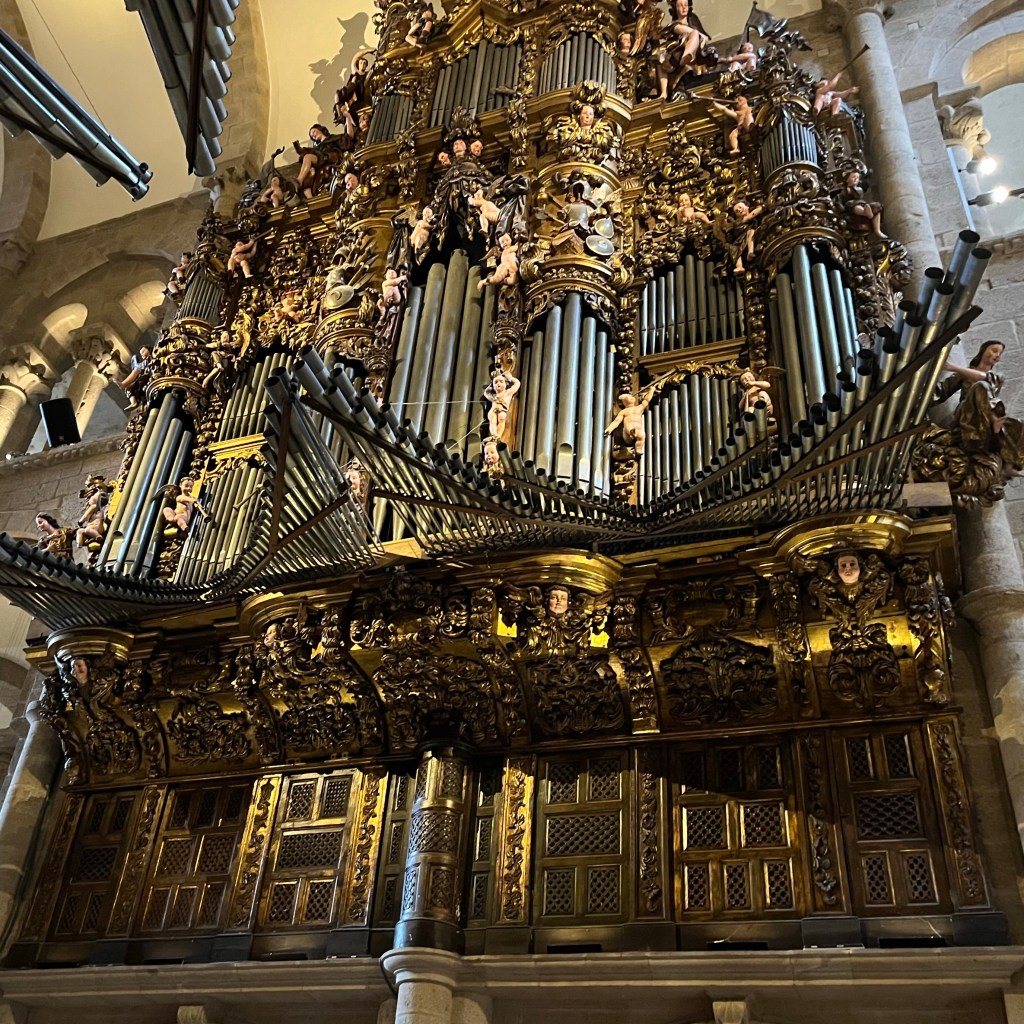
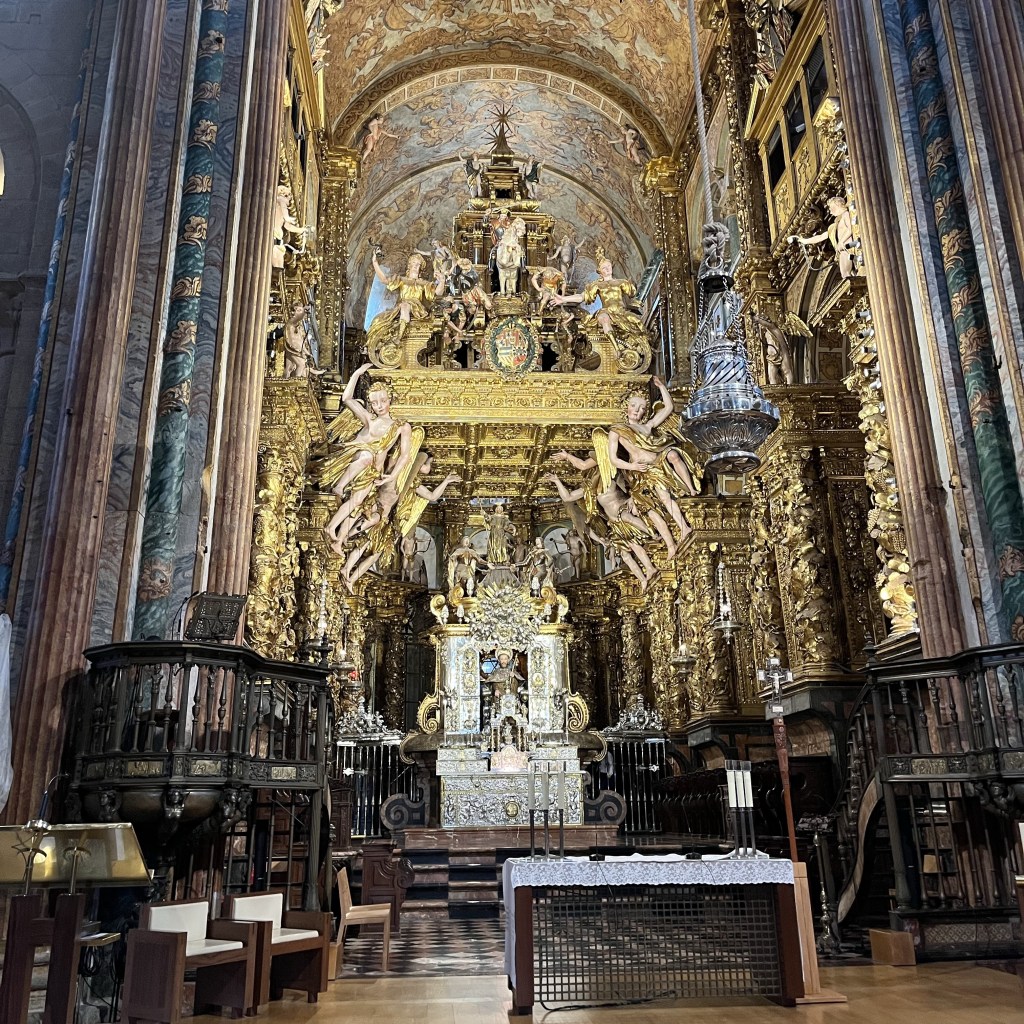
Seeing the Cathedral is the goal of every pilgrim who embarks on the Camino. As is the case with so many Cathedrals, it is lavish, with statues and artwork everywhere. The altar of the church is done in a baroque style, with gold and silver elements everywhere. There are countless golden pillars and a group of angels holding up a golden ceiling over the altar. It’s so ornate that I couldn’t really discern what the artwork was supposed to symbolize, but it is beautiful.

My favorite thing in the Cathedral was a giant incense burner called the botafumiero, which is about 5 feet tall and weighs around 180 lbs. Traditionally, it took a team of eight men with ropes to swing the burner over worshipers. The purpose of this was to cover the smell of the pilgrims who had spent the day on a long hike to the Cathedral. They now only do this on special occasions, since it’s so labor-intensive. Presumably, because of modern deodorants, it’s also not as necessary.
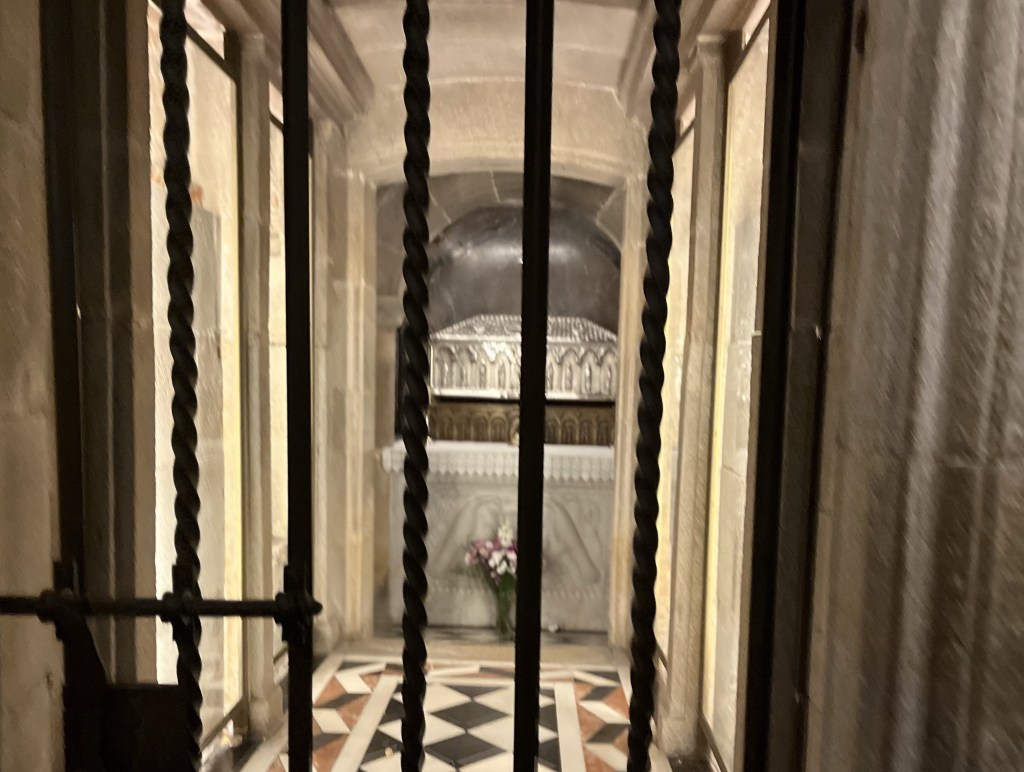
We also walked down to visit the crypt, the supposed final resting place of St James. Behind an iron gate, you can see a silver ossuary. There it is – a beautiful, yet simple box containing the remains of someone, who may or may not be St James. It is the inspiration of millions of pilgrims over centuries to take time out of their busy lives to hike for days or weeks.
I don’t buy it. I think people do it for so many reasons, but seeing a silver box can’t be the motivation for most people. For some, it’s the drive to complete a physical challenge. For others, it’s the opportunity to hike through towns, villages, farms, and forests. Some are taking time for introspection, and others are there for the camaraderie and fellowship with their fellow pilgrims.

I was there for a combination of those things, and I think that’s probably true for most pilgrims. I was also drawn by the opportunity to participate in something that draws people from around the world. According to the official pilgrim website, which keeps statistics on the number of people who complete the Camino, so far in 2025, about 37% of pilgrims were Spanish, 8% American, 7% Portuguese, and 6% were German. The remaining 42% were from various countries around the globe. It’s an amazing opportunity to spend time with a lot of wonderful, diverse people who are all working toward the same difficult goal.

The opportunities to connect with people at cafes, along the Camino, or at an albergue are endless. Those conversations also don’t feel forced. People who come to do the Camino are generally friendly.
Walking around the Cathedral, however, felt a little hollow. We hadn’t finished, and it felt like I didn’t deserve to be there. Visiting the Cathedral is a rite of passage for people who complete the Camino, and we hadn’t. Jenn and Alex didn’t even want to visit the Cathedral.
We finished up our trip to the Cathedral and met up with Jenn and Alex for dinner. At dinner, we discussed the disappointment of not finishing.
With everyone still dealing with being somewhere between sore and injured, I asked if they would like to try this again. Jenn laughed and said that she thinks we owe the kids a beach vacation for the next Spring Break trip. To my surprise, however, everyone said that they would like to do it again, but with some optional off days.
There isn’t an experience like doing a Camino. It’s real. It’s authentic. It’s a tremendous physical challenge. It’s the opportunity to meet people from around the world, as well as the chance to experience Spain in a non-touristy way. I would love to give it another try, but I definitely want to do it when I can hike for at least a couple of weeks. I definitely think it would go better the next time, now that I’ve spent my first Camino learning how to do a Camino.
































 Newby to Expert Traveler