
As soon as we arrived in Dresden, we went directly to the Frauenkirche (The Church of Our Lady). I wanted to see this beautiful church for myself. Gorgeous churches are everywhere in Europe. What makes this church special is its history and how perfectly it dovetails with modern German and world history.

Frauenkirche is a Lutheran Church built in the Baroque style and originally completed in 1743. Its distinctive architecture and 220-foot-tall dome define the Neumarkt area of Dresden. However, the story of Frauenkirche is defined by the history of Germany in the 20th Century.
The Firebombing of Dresden
On February 13th, 1945, as Allied forces were advancing on German-held territory, and the war was nearing its end, US and British forces began firebombing Dresden. Over the next three days, Allied forces dropped thousands of tons of incendiary bombs. The intense heat from the bombing killed an estimated 25,000 people and reduced much of Dresden to rubble. Part of that was the destruction of the Frauenkirche.

The End of the Cold War and Reconstruction
Following the war, Dresden was on the Soviet side of the Iron Curtain. While Dresden was being rebuilt, Frauenkirche was left as a pile of rubble in the Neumarkt neighborhood. It remained this way throughout the entire history of the German Democratic Republic, also known as East Germany. The rubble was declared a monument against war and remained that way until after German reunification.
Following reunification, funding for rebuilding the church was raised, and a plan was created for the reconstruction. Construction began in 1994 and was completed in 2005. They removed as much as they could from the rubble pile and reused around 3,800 stones. The remaining stones necessary for rebuilding the church were harvested from nearby sandstone quarries. Due to weathering and the fire damage, the salvaged stones have a darker patina than the newer stones.

On this beautiful July day, with people enjoying Neumarkt and tourists crowding the Statue of Martin Luther for selfies, it’s easy to forget about the destruction and rebirth of the Neumarkt area. The dark stones, which serve as a reminder of the firebombing, are scattered throughout the building, but two sections have a heavy concentration of the old stones.
The Rise of Nationalism
In the 19th Century, nationalism was on the rise in Europe. This movement wanted to define a country’s borders based on the ethnic, racial, and linguistic characteristics of the people inside those borders. This was in contrast to centuries of European borders defined by the marriage alliances and the conquests of monarchs.

While the formation of countries with borders based on ethnic similarities made sense, it also made unassimilated groups vulnerable. There were over 9 million Jews and around 1 million Roma, otherwise known as Gypsies, living in Europe before World War II. These groups lived among the various ethnic/national groups throughout Europe and didn’t have a specific nation state to call their own. In addition, nationalistic fervor left anyone who wasn’t living within their own nation’s borders vulnerable, like the 1.7 million Poles who lived within German borders before World War 2.
As Nationalism began to rise in Europe in the early 20th Century, a toxic blend of pride and fear began to take shape. Pride and fear are natural companions, as pride in people’s ethnic/national identity often leads to the fear of other groups, especially unassimilated groups. In the early 20th century, a book called the Protocols of the Elders of Zion circulated around Europe, which was a fabricated story of a Jewish plot for world domination. Even though the book should have been seen as an obvious lie, it was treated as factual and became required reading in some classes in Germany.
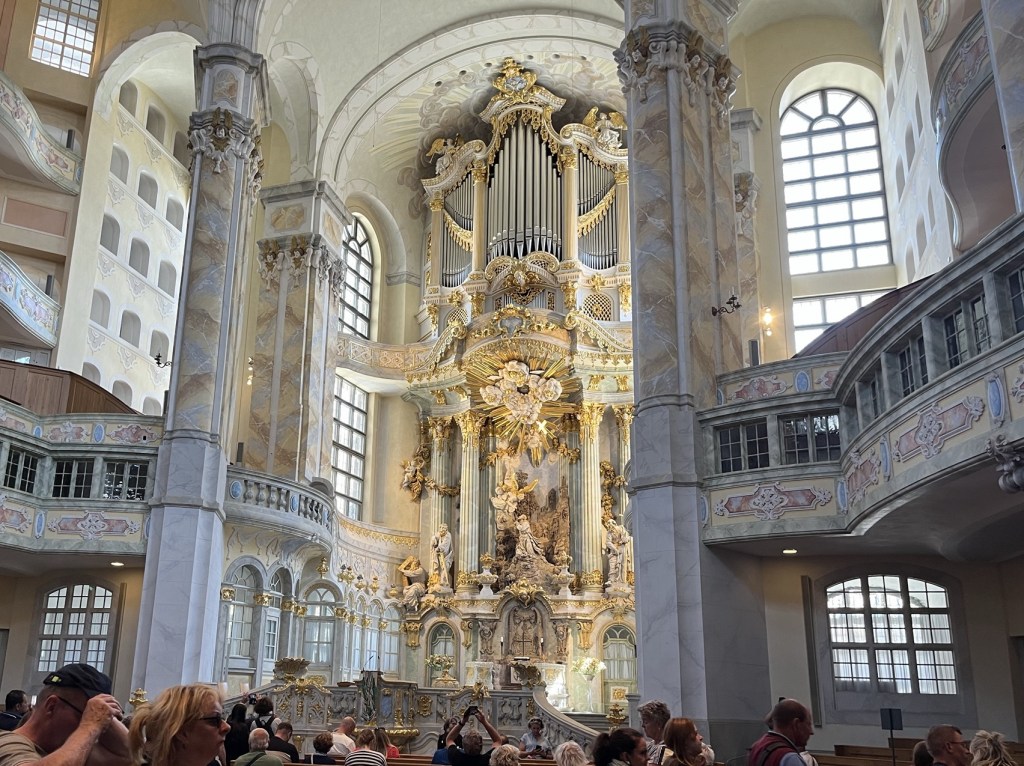
We walked around the church, admiring the Baroque architecture. We decided to take a look inside. My first reaction was that it was incredibly airy and bright, with many intricate Baroque elements and multiple balconies. It’s breathtaking.
Nationalism in the United States
Nationalism wasn’t a strictly European phenomenon. Fear of unassimilated ethnic groups has persisted throughout American history, typically when large numbers of immigrants arrived and formed their own communities. This includes Italians, Irish, Polish, Chinese, and other groups who created their communities within American cities.

In my hometown of Davenport, Iowa, the dominant immigrant group was German. There were so many Germans in the area that a German language newspaper called Der Demokrat was published from 1851 to 1918. The newspaper was shut down when the Babel Proclamation made speaking German in public illegal in Iowa.
In Germany, however, the Nationalist movement was taken to extremes as the Nazis sought to expand their borders while eliminating anything that was not exclusively German. The objective was to create a completely homogeneous German nation with expansive borders. This obviously could not be accomplished without war and ethnic cleansing, and led to World War II and the horrors of the Holocaust.
In America, World War II stoked fear of Japanese and German immigrants. Japanese-Americans were moved into internment camps, and Germans were viewed with suspicion.

After walking around the inside of the church, we headed down to the basement. The basement contains an altar and seating for additional services. It also contains multiple alcoves for private prayer and reflection.
Who Sows Fear, Reaps Weapons
The story is always the same: fear leads to hate, and hate leads to violence. Fear and hatred work by dehumanizing the perceived enemy and justifying violence against that group.

For the Germans during World War II, that fear justified the war and the campaigns of ethnic cleansing. For Americans, it meant justifying the bombing of civilian populations, like the ones in Nagasaki, Hiroshima, and Dresden.

Those justifications don’t always hold up after the fog of war clears. In 1945, according to a Gallup poll, 85% of Americans approved of the use of nuclear weapons on Nagasaki and Hiroshima as a means of ending the war. By 2005, that number had fallen to 57%.
The Cold War and New Alliances
Following World War II, enemies became allies as Western Europe began working together in military alliances and as trading partners. America and Japan, once mortal enemies, became valued trading partners and close friends. Instead, a new enemy had emerged, with the world split by the Cold War, and Dresden was on the Soviet side of the Iron Curtain, separated from their brothers and sisters in West Germany.

The Cold War defined the next 45 years of human history. There was a space race, nuclear proliferation, and the Cuban Missile Crisis – everything seemed to be defined as a competition between the West and the East, Communist and Capitalist. The entire time, Frauenkirche sat as a pile of rubble in Neumarkt, a daily reminder to the citizens of Dresden of the dangers of Nationalism.
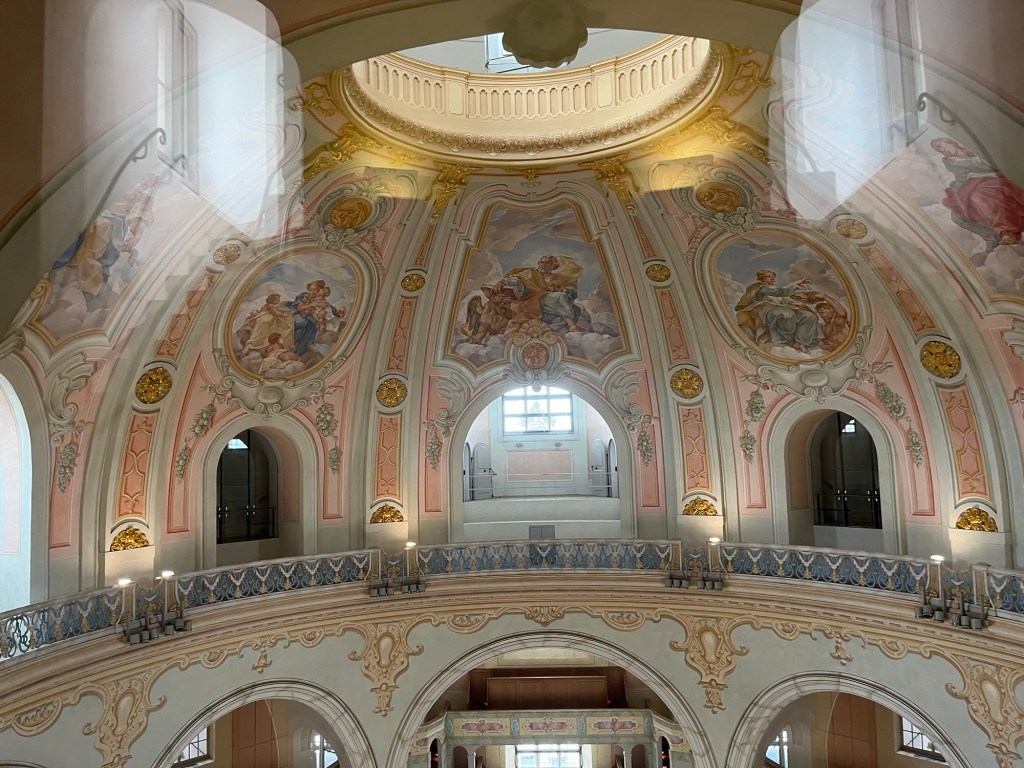
We decided to buy tickets to climb up into the dome. For 10 Euros, you can see a different perspective of the church. As you go up, you see the paintings on the inner dome. Ascending further, you can look through windows at the main dome and down through an oculus at the inner dome and the rest of the church.
Europe Unites as Frauenkirche is Rebuilt
The collapse of the Soviet Union and the fall of the Berlin Wall ushered in a new era for Europe and for the Frauenkirche. In the late 1980s and early 1990s, as Germany was going through Reunification, an aggressive fundraising campaign was conducted to raise the 180 million euros necessary to rebuild the church.
In 1993, a rubble-sorting event marked the beginning of the efforts to reconstruct the Frauenkirche. As the church’s cornerstone was stabilized in 1995, the European Union added Austria, Sweden, and Finland to raise its membership to 14 members.
Reconstruction of the Frauenkirche was completed in 2005. During the eleven years of Reconstruction, the Euro was developed and established in 11 countries. The Schengen Zone went into effect in many of the EU countries, allowing freedom of movement without border controls. By the time the Frauenkirche was completed, the European Union had expanded to 25 countries.

Nationalism had divided the continent and led to the destruction of the church. In the 60 years from rubble to reconstruction, the continent became defined by its cooperation and connections.
Since 2005, three more members have joined the European Union, and one, Great Britain, has left. Nine countries are currently listed as candidates to join the European Union. This interconnection has ended all wars between these countries, which have fought each other for centuries. The fear is gone, and with it the hatred and the violence.

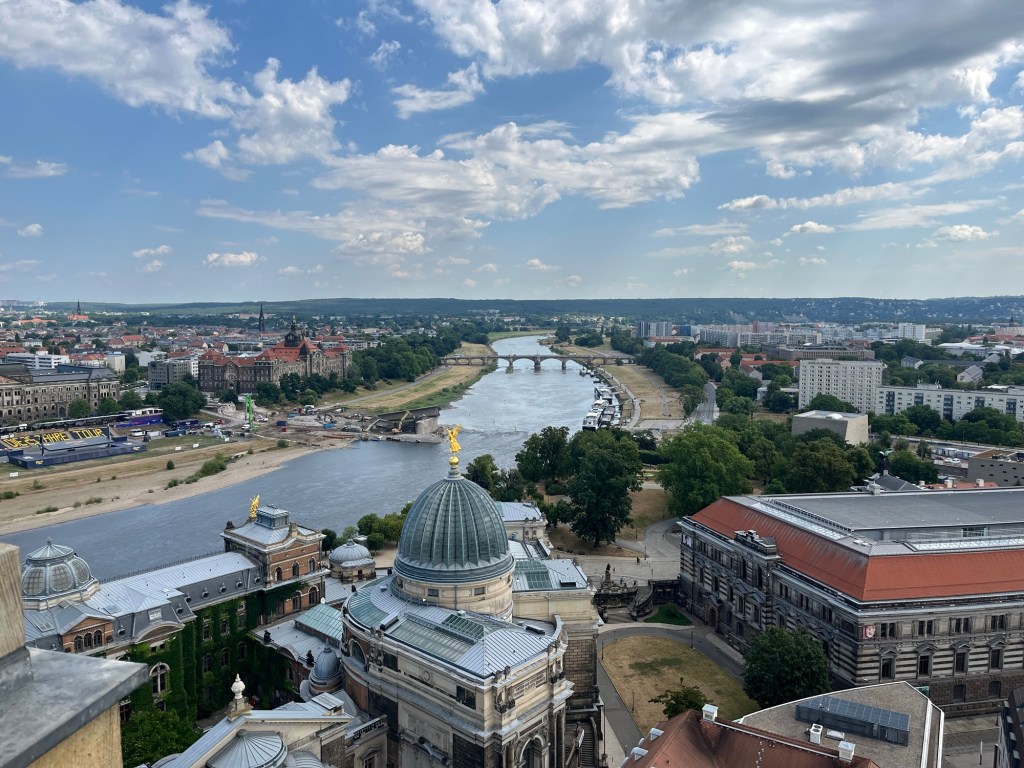
We climbed all the way to the top of the dome and walked out onto the observation deck. From the top, you could see most of Dresden. The neighborhood around Frauenkirche has also been reconstructed with shops, apartments, hotels, and restaurants. The plaza in front of the church was lively with visitors and shoppers. Neumarkt is whole again.
Tension in North America
While Europe becomes a more unified continent, North America has become more divided. A tariff war has made Canada and the United States, longtime allies and friends, suspicious of one another. In addition, statements by Donald Trump indicating that he would like Canada to be the 51st state, however unserious that sounds, have to be taken seriously by Canada because of the power imbalance between the two countries.
The relationship between the US and Mexico continues to be complicated, with the US both relying upon Mexican immigrants for cheap labor and vilifying their presence within the country.
Fear of Immigrants and the LGBTQ+ Community
Much of this is stoked by irrational fears, with immigrants being accused of drug trafficking and violent crime. Even though studies have indicated that it is likely that immigrants commit less crime than native populations in the US, the fear that immigrants worsen crime rates persists. These fears sometimes reveal themselves in strange ways, such as in the 2024 Presidential Debates, where Donald Trump accused Haitian immigrants of eating neighborhood pets. The fact that this statement didn’t disqualify him from office in the minds of voters is an indication of the public’s perception of immigrants.

Recently, the immigration debate has turned extremely dark as a detention center has been constructed on swampland in Florida. Known by its supporters as Alligator Alcatraz, its goal is to house illegal immigrants until they can be deported.
However, some of the supporters of this plan have expressed more extreme ideas. Laura Loomer, who traveled with President Trump during the 2024 campaign, recently tweeted, “The good news is, the alligators are guaranteed at least 65 million meals, if we get started now.” 65 million is the total population of all Hispanics in the US, most of whom are citizens. So, as you can see, for the most extreme members of the Republican Party, the issue of protecting the border has now moved toward ethnic cleansing.
Fear also affects the LGBTQ+ community. The LGBTQ+ community has been the target of many ridiculous accusations over the years, including the idea that same-sex marriage destroys the sanctity of straight marriage and the idea that homosexuals groom children for pedophilia. These are accusations meant to paint all LGBTQ+ individuals as a danger to society.

Another persistent fear among right-wing communities is that transgender women will use women’s restrooms to rape cisgender women. I’ve never heard of a real case where this happened, but the fear persists nonetheless. The idea is ridiculous, of course, because anyone willing to commit rape would not be deterred by laws that limit access to restrooms based on biological gender.
Lessons from the Past
Much like the lies told in the Protocols of the Elders of Zion in the early 20th Century, these lies persist in the early 21st Century. These lies are told to marginalize communities within the United States in the same way that communities were marginalized in Germany before World War II. They spread fear. Fear leads to hate, hate leads to violence.
Europe has shown what is possible when people put their fears aside and work together. They have lived through the horrors of war and chosen to work together towards a peaceful and more prosperous future.
We ended our visit to Frauenkirche, standing in front of the last remaining piece of rubble from what was the pile that lay in Dresden for decades. It was a large piece of the dome recovered from the pile, placed as a monument with a plaque containing the account of a survivor of the firebombing.
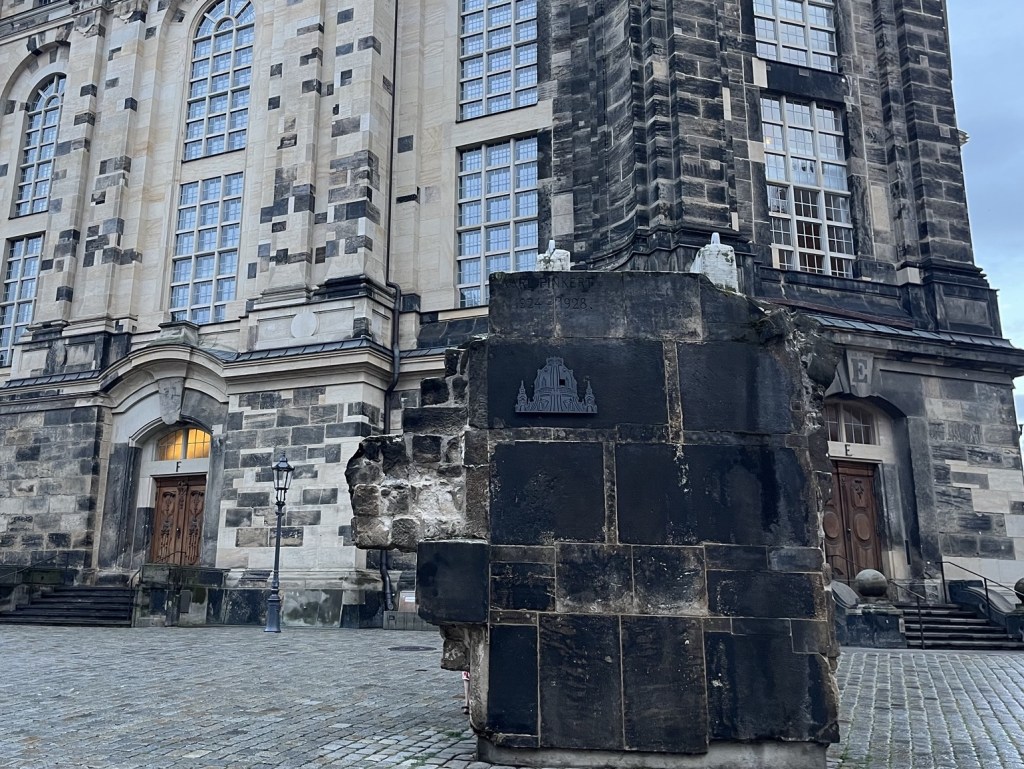
Standing in front of the monument, I was reminded of the vulnerable communities within my country and the lies and slurs they endure daily. We live in a precarious time when we must decide whether to listen to the sounds of fear and hate or embrace empathy, kindness, and love. I hoped that one day, a curious traveler wouldn’t be standing in front of a similar monument in the United States.
People should be treated with empathy and kindness regardless of their immigration status, sexual orientation, gender identity, race, religion, or disability. People are people, and love is love.
 Newby to Expert Traveler