United Airlines adds European Routes for Experienced Travelers

Airlines make announcements about new routes all the time, and most of them don’t interest me very much, but the latest press release about United expanding its seasonal routes in Europe piqued my interest. These new routes seem to be targeting American tourists who have been to Europe, perhaps multiple times, and are looking for something a little different than the normal European stops like Paris, London, or Rome.

The destinations they have chosen to expand to are places that would be on a bucket list for experienced travelers. They definitely speak to me personally, since each one of these are places where I would like to visit.

Glasgow, Scotland

Starting on May 8th, United will start a daily flight from Newark to Glasgow, Scotland. This is probably the least quirky of the destinations that United picked. Scotland is a destination that I could imagine someone traveling to on their first big international trip. The cultural and language similarities to the United States make it an easier trip. It would also appeal to people who didn’t want to visit a huge European city like London or Paris.

Glasgow and nearby Edinburgh are Scotland’s population and cultural centers. They are less than an hour’s train ride apart, making it easy to visit both cities on the same trip. Around Glasgow, there are also many castles to visit, such as Stirling Castle, Doune Castle, and Bothwell Castle.

You can also take the train from Edinburgh or Glasgow through the Scottish highlands. I once asked a Scotsman where he would recommend going if I were to visit Scotland and he was practically gushing about how beautiful train trips through the highlands are. I will definitely be taking his advise on that someday.

Glasgow, I believe, will appeal to more Americans as a destination than the other new destinations that were unveiled by United. The others may be a little more obscure, but they are fantastic destinations.

Bari, Italy

Have you ever found yourself dining outdoors at a restaurant in Florence or Rome and thought “I wish the food was better in Italy?” Probably not, but apparently the region of Puglia in Italy has food that puts other Italian food to shame. I’m not sure how this is possible, but I’m willing to give it a try.

Bari is located on the heel of the boot of Italy, along the Adriatic Sea. It is famous for its beaches, focaccia, pasta, and polenta.

From Bari, it’s about an hour by car to Alberobello, a UNESCO world heritage site known for its Trulli houses. These are unique structures made of limestone with conical roofs.

Bari is less of a tourist trap than other parts of Italy, such as Rome, Florence or Venice. This might make things a little more complicated for people who don’t speak Italian, but it is a great way to experience more authentic Italy than those major tourist destinations.

United will begin flying to Bari four times a week beginning May 1st, 2026.

Split, Croatia
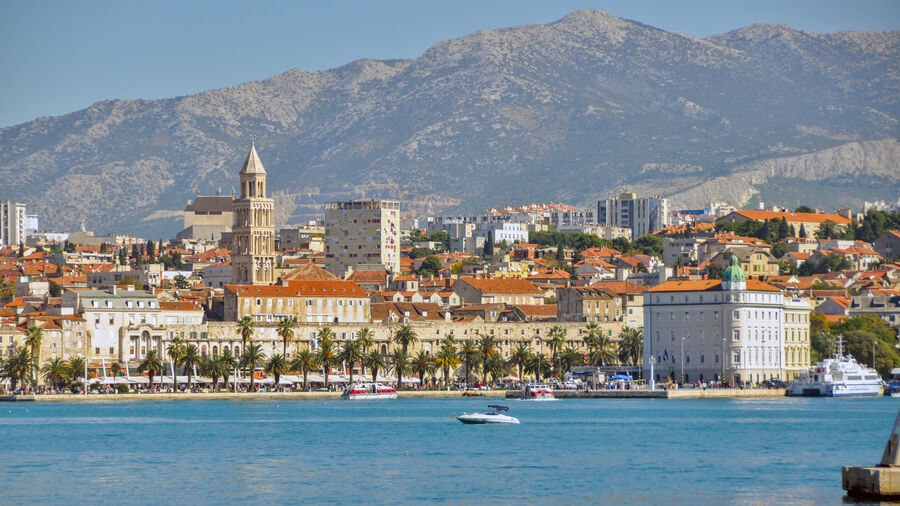
https://www.ricksteves.com/europe/croatia/split has some fantastic information about Split

As the memory of the Yugoslav Wars that took place from 1991 to 2001 fade from memory, the Balkan countries have received more and more attention for being great tourist destinations. Split, Croatia has become a popular destination for its beautiful city as well as the crystal clear, deep blue waters of the Adriatic.

From Split, you can use ferries to go to some of the amazing islands in the Adriatic, such as Brac, Vis, Bol, Korcula and Milna. You can also take the opportunity to visit the beautiful walled city of Dubrovnik.

Croatia has been growing in popularity for a while now and its no surprise to me that United Airlines wants to capitalize on the growing popularity. It’s an absolutely beautiful country, and its been on my short list for a while.

Starting April 30th, United begins seasonal direct flights from Newark to Split.

Santiago de Compostela

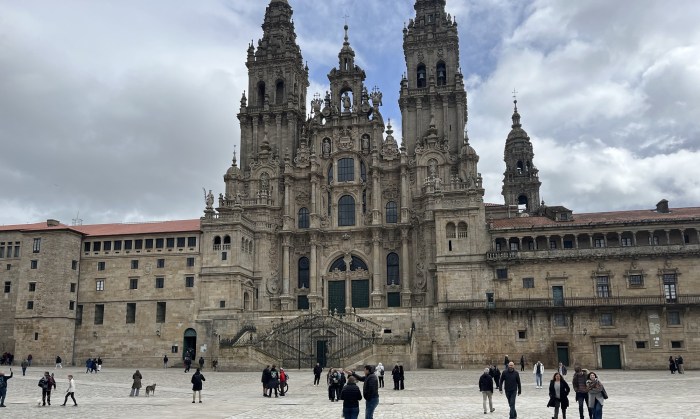
Santiago de Compostela is a fairly small community in the Galicia region of Spain. It has a population of around 100,000, The reason United Airlines would be interested in bringing direct flights there, however, is because it’s where the Camino de Santiago ends.
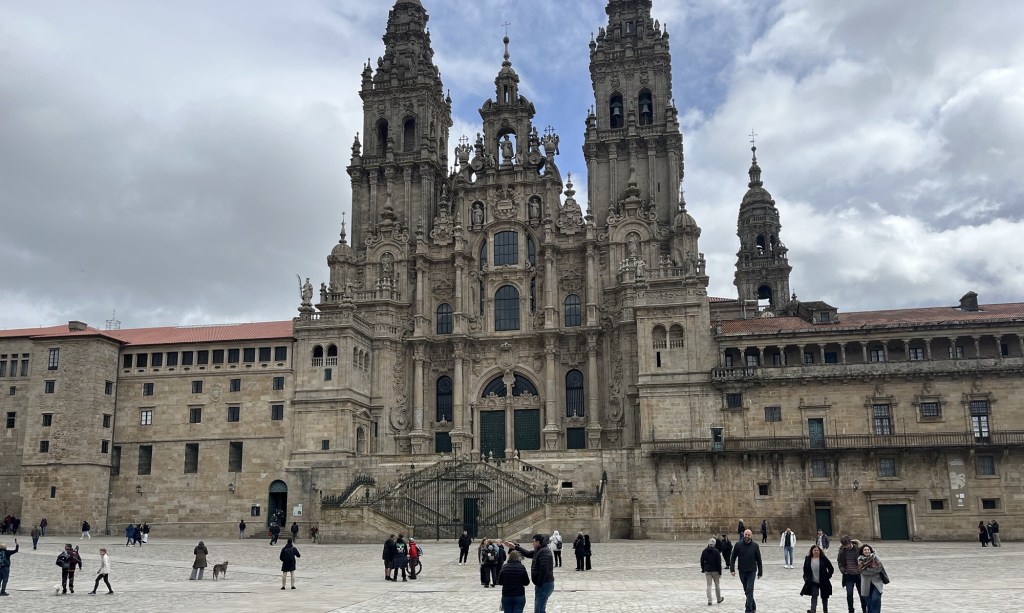
The Santiago de Compostela Archcathedral Basilica is the end point for all of the Camino de Santiago routes.

The Camino is a unique cultural experience. It consists of hiking one of multiple routes, the most famous is the French Way which starts in France and continues across Northern Spain to Santiago de Compostela. Some of these routes take over a month to complete and others a couple of weeks. Pilgrims, however, can choose to start their journey from anywhere and an official pilgrimage is anything more than 100 kilometers that ends at the Cathedral in Santiago de Compostela. Along the way there are hotels or hostels to stay at as well as a variety of pilgrim-friendly restaurants.

We had the pleasure of spending 6 days on the Portuguese route this spring and we met so many people who had done multiple Caminos. It’s an amazing way to see the Spanish countryside and really experience Galician hospitality.

For those brave souls who wish to participate in the Camino, United Airlines will start service three times per week from Newark to Santiago de Compostela on May 22nd, 2026 and continues through September 20th.

Flights out of Newark

So the good news is that these are amazing destinations but the bad news is they all originate in Newark. The Newark Airport has had all kinds of problems and I typically try to avoid flying out of there when possible. Since Newark completed reconstruction of a runway in June, I haven’t heard of as many issues in that airport, so hopefully service out of Newark is improving.

Newark has connections to more than 100 US cities on United, so you shouldn’t have too much difficulty finding connecting flights. This should make these flights accessible for much of the United States.

Award Prices

Right now, the award pricing on these flights are fairly elevated. This isn’t a surprise, since these are new routes. In the future, I would expect some award prices of these flights to dip down to United’s saver rates of around 40,000 points one-way for a flight to Europe. If you see those saver rates on one of these flights, I would also check Singapore Airlines. Often, you can book the exact same flight, if it’s a United saver award, for only 30,500 points. For more information, I have a post about how to use the Singapore Airlines partnership.

It’s also easier to get Singapore miles since they transfer from Citi Thank You points, Chase Ultimate Reward points, American Express Membership Reward points, a Capital One Venture miles. United miles can only be transferred from Chase Ultimate Rewards.

Conclusion

These newly added seasonal routes for United add great direct flights from the United States to amazing destinations that are on the radar for people who have a little experience going to Europe and would like to try something a little different. These are all fantastic choices and would make for a great vacation. These destinations certainly have me thinking about future trips.
Sunrise Jog in Venice

Running in Venice can be a challenge. The city is like a labyrinth with constant turns, dead ends, narrow passageways and bridges that can sometimes be difficult to find. If you live in Venice and are familiar with how the city is laid out, this might not be too much of a challenge, but for those of us who are on vacation, it can be tricky to find a good route that isn’t too confusing.

There is one particular route that is both beautiful and isn’t too confusing. That is to run along the south side of the the main islands from Piazza San Marco to the east as far as you can go.

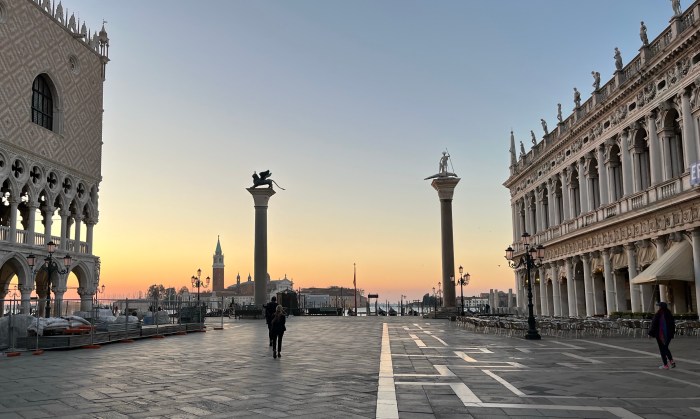
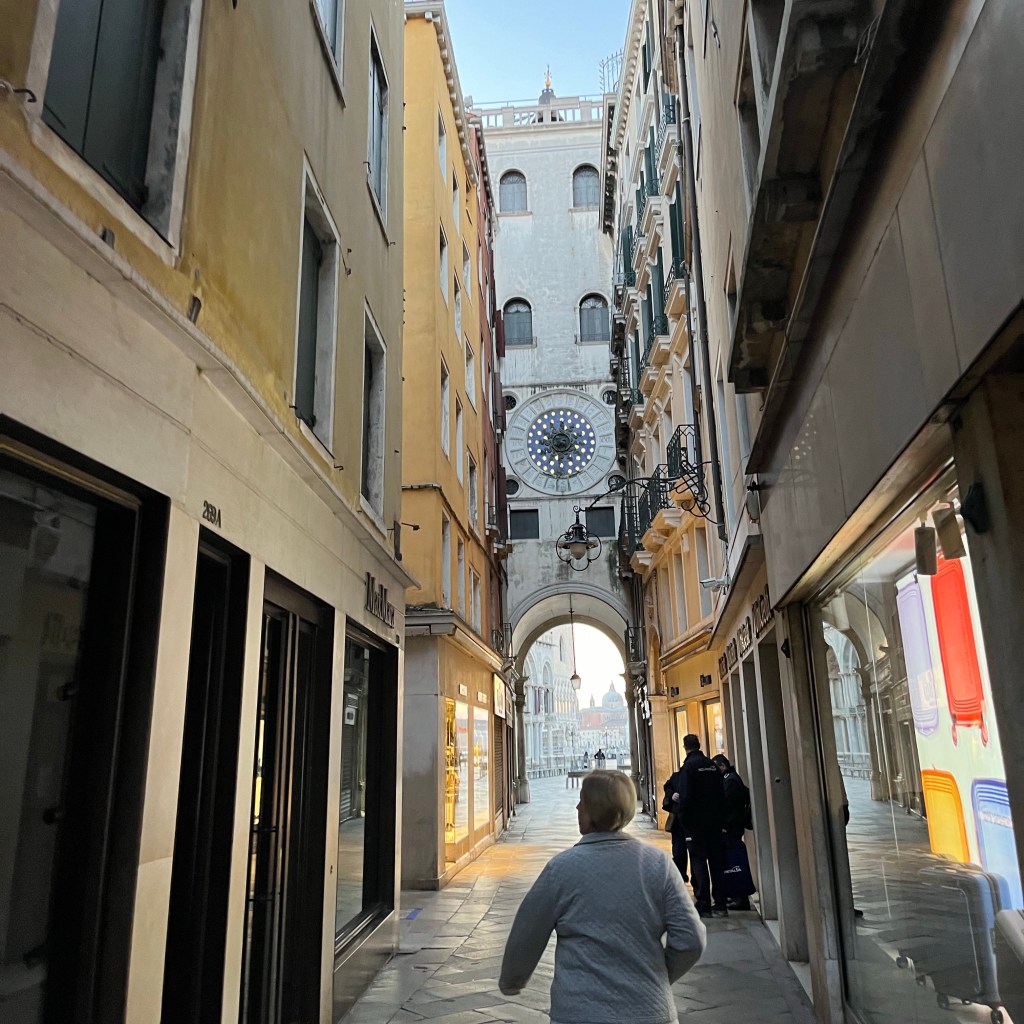
Basilica di San Marco barely visible as I approach the Piazza San Marco from under the clocktower.

I started early in the morning, before sunrise, knowing that it won’t take very long before workers and tourists fill up the streets. I like to get out early when its not too busy. Our Airbnb was near the Rialto Bridge, so the challenging thing to me, navigationally, was to run from Rialto Bridge to Piazza San Marco.

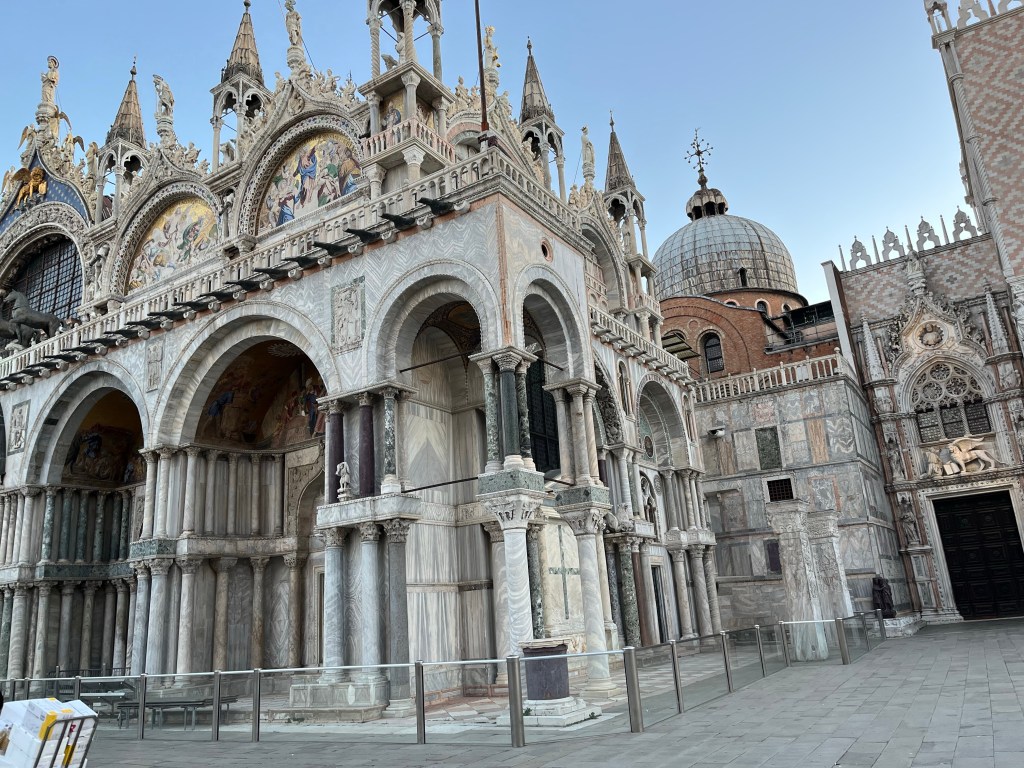
Basilica di San Marco

I wound my way through the narrow streets toward Piazza San Marco, following the signs that point the way. In a short amount of time, I saw the side of the Basilica di San Marco. It’s pretty amazing to see the Piazza early in the morning when its not completely full of people. It’s not exactly empty, but it is pretty great without all of the noise and crowds.

Two Columns, one with St Theodore and one with the Lion of Venice mark the boundary of Piazza San Marco.

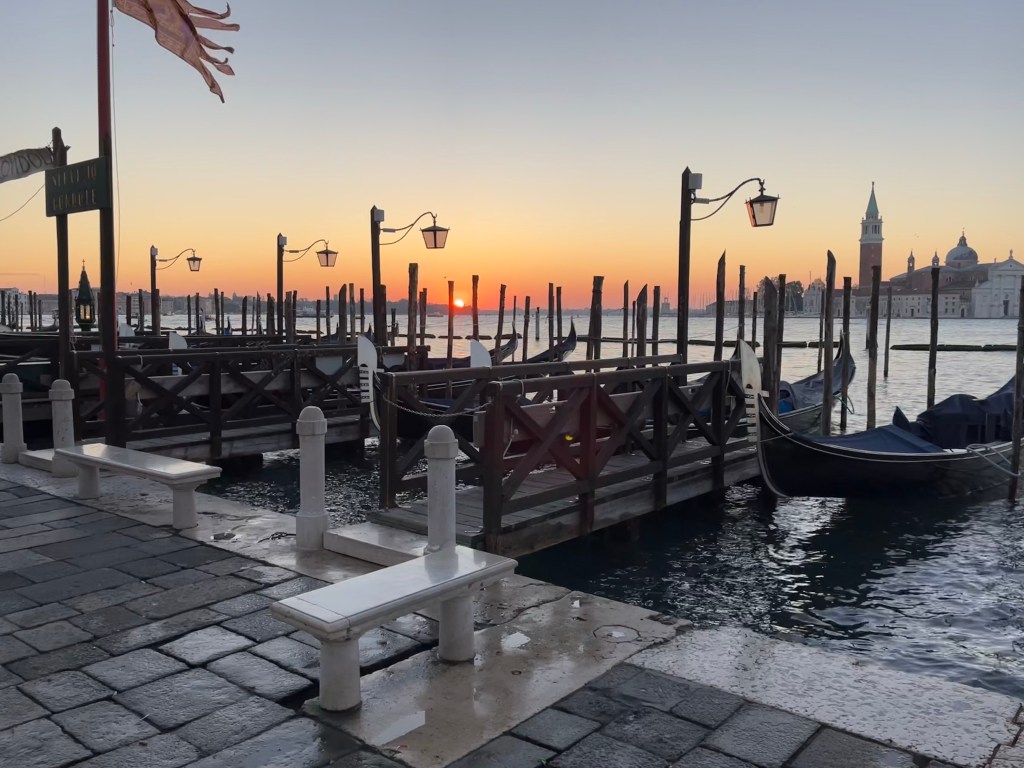
I then ran through the pillars that mark the edge of the Piazza San Marco and turned left along the water. Right outside of the Piazza is a series of docks for gondolas that aren’t yet in service.

Sunrise over Gondolas near Piazza San Marco

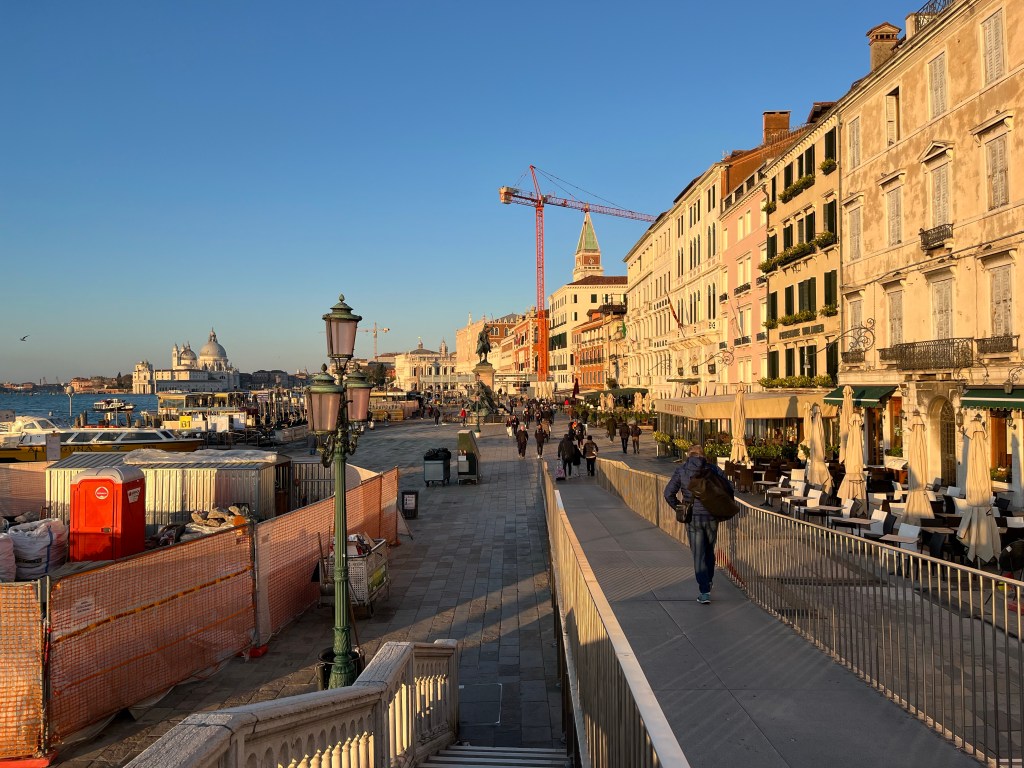
Running along the edge of the water toward the east, there is a lot of activity from all of the docks, restaurants and hotels that are getting their morning deliveries. This is normally a very busy area of Venice, and they need to get their supplies early before things get too busy.

A view of a canal from a bridge along the route.

As I ran to the east, things got calmer and calmer, until finally I reached an area with a lot of trees. It’s a place called the Giardini Della Biennale, which has 30 pavilions, each housing an art exhibit from a different country. These exhibits change and are part of a biennial art exhibition called the Venice Biennale.

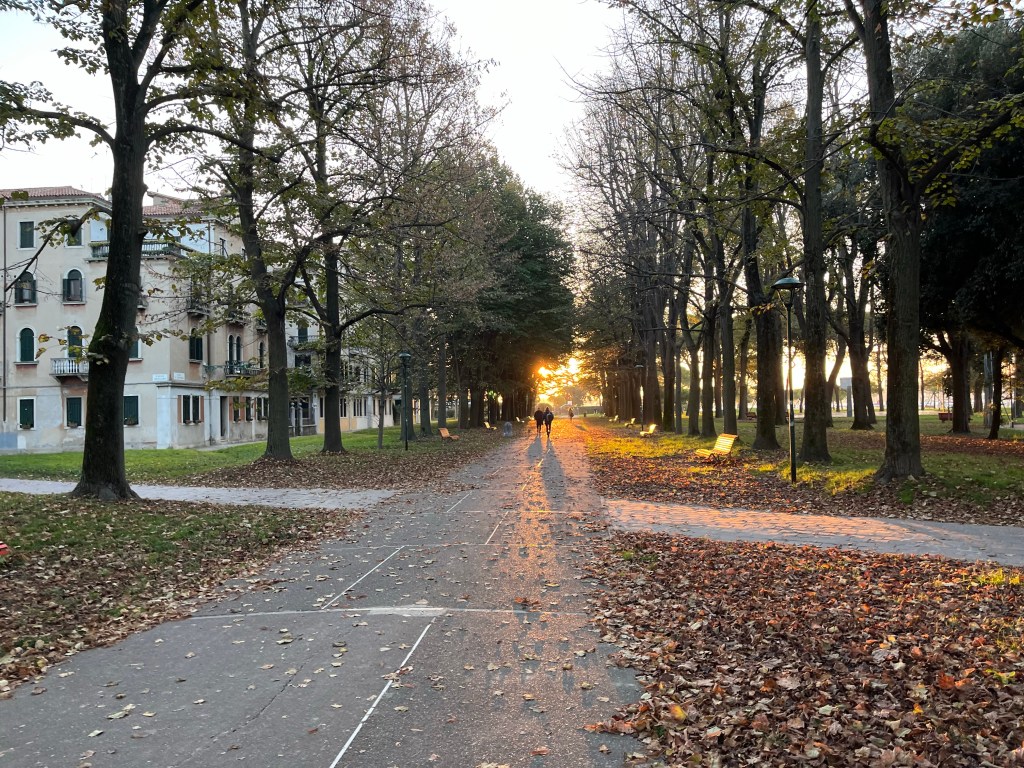
Grass and trees are rare in Venice, but you will find plenty in Parco deile Rimembranze

Moving out of the Giardini, I crossed another bridge and entered another park called the Parco deile Rimembranze. It was a nice serene park with tree lined paths. There were a number of folks walking dogs and enjoying the early morning.

Scuola Navale Militare Francisco Morosoni was the end of the line for me. Time to turn around.

It didn’t take too long before I ran out of park and I arrived at a bridge leading to a military base. Honestly, the last thing I expected to come across in Venice was a military base, but I had reached the end of the line and it was time to head back.

The waterfront area is fairly wide.

On the way back, the sun was higher in the sky, everything was a little brighter and quite a bit busier. It didn’t take very long for the area with all of the restaurants, bars and hotels to begin to fill up with people, probably people heading out for an early cappuccino.

San Giorgio Maggiore

Coming back from the east, there are fantastic views of the islands known as Guidecca. It is just a short distance across the water from the main islands. Also visible is San Georgio Maggiore, a small island that once housed the San Georgio Monastery established in 982. It’s belltower and domed church are striking from across the water.

You won’t find any elevation changes with the exception of bridges in Venice

I finished up by running back through Piazza San Marco and then back to the Airbnb. It turned out to be around 5 miles, and the portion from Piazza San Marco to the Naval Base and back is around 4 miles.

The route primarily is along the water on the South Side of Venice from the Piazza San Marco to the Naval Military School and then back.

When choosing a place to run in Venice, unless you know your way around, you’ll probably want to stick to this route. If you need to stretch out the distance, you’ll probably want to run around in the parks near the art exhibits and the Naval Base. No matter how you do it, it will be a gorgeous run – you’re in Venice after all!

Murano and The Glass Cathedral

Murano is a series of islands in the Venetian Lagoon world renowned for it’s artisan glass. In the 1200’s, a growing glass industry had emerged in Venice, but concerns had grown about the dangers of the furnaces used to make them. A law was passed in 1291, that required all glass production in the city of Venice to be produced in Murano to protect Venice from fire. This concentrated all of the production of glass to one area which persists today.

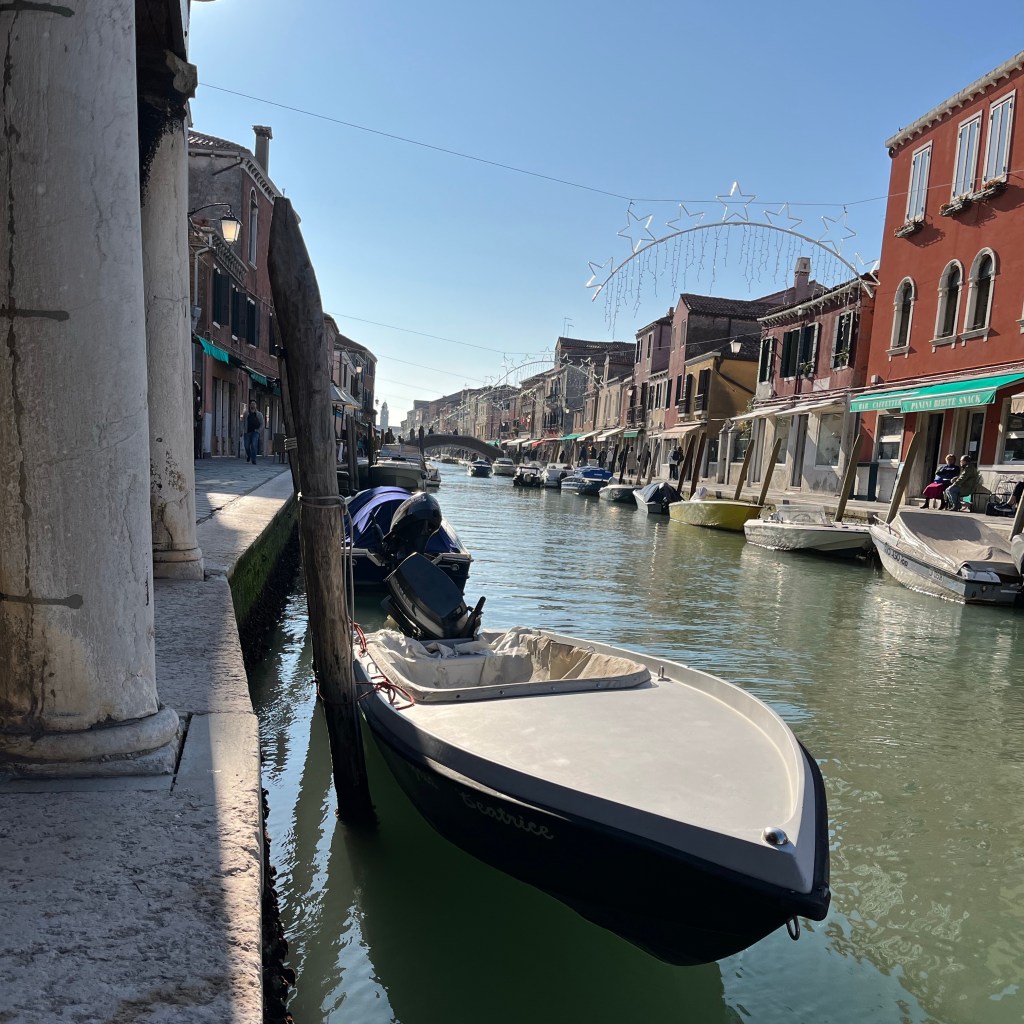
A boat parked along a canal in Murano

We didn’t have a chance to visit Murano on our first trip to Venice and I wasn’t planning to miss it on our second trip. I was interested in seeing all of the beautiful glass created on the island and get a little insight about the art while we were there.

Inside a glass shop in Murano

We took a vaporetto from the main islands of Venice to Murano and began our walk. I understood that this was an area primarily for glass production and sales, but I was still surprised by the number of shops that there were. We exited the vaporetto at the docks known as Murano Colonna and began to walk along the canal on Fondamenta dei Vetrai. We wandered along the canal, admiring all of the amazing glass work created by the artisans in Murano.

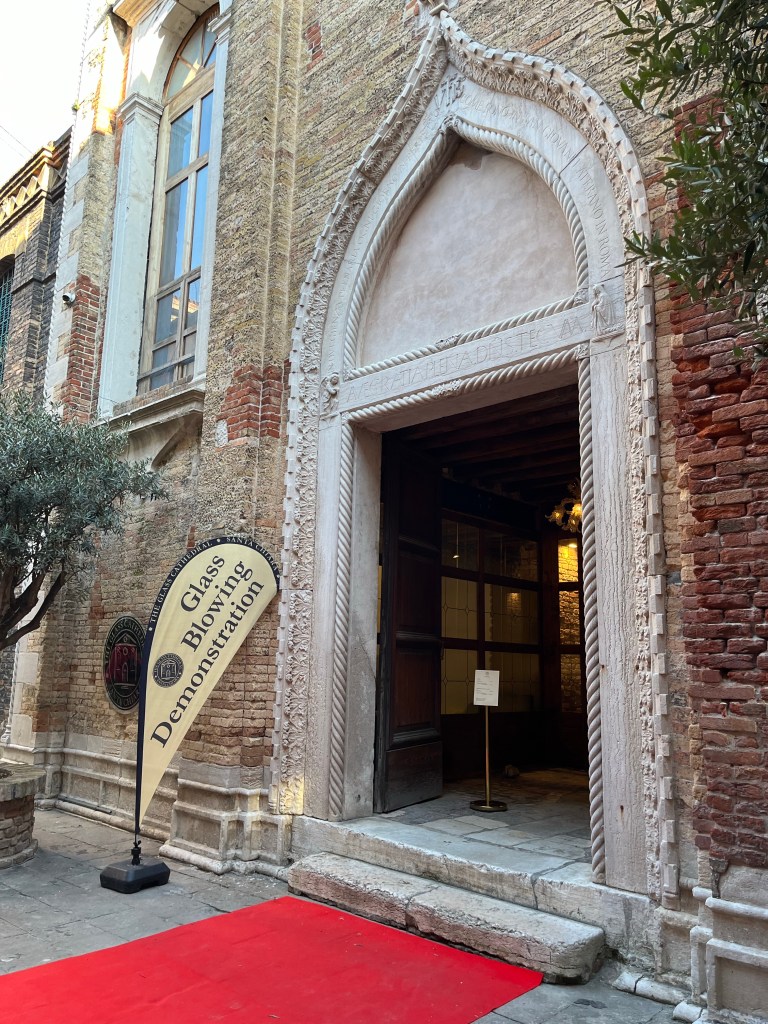
Entrance to the Glass Cathedral

After walking around a bit and shopping, we stopped for a drink and a light lunch at Rivalonga bar which is at the Hyatt Centric Murano. We had a nice view of the main canal through Murano. After the quick bite to eat, we headed to what I was really looking forward to, the glass blowing demonstration at the Glass Cathedral.

The Glass Cathedral

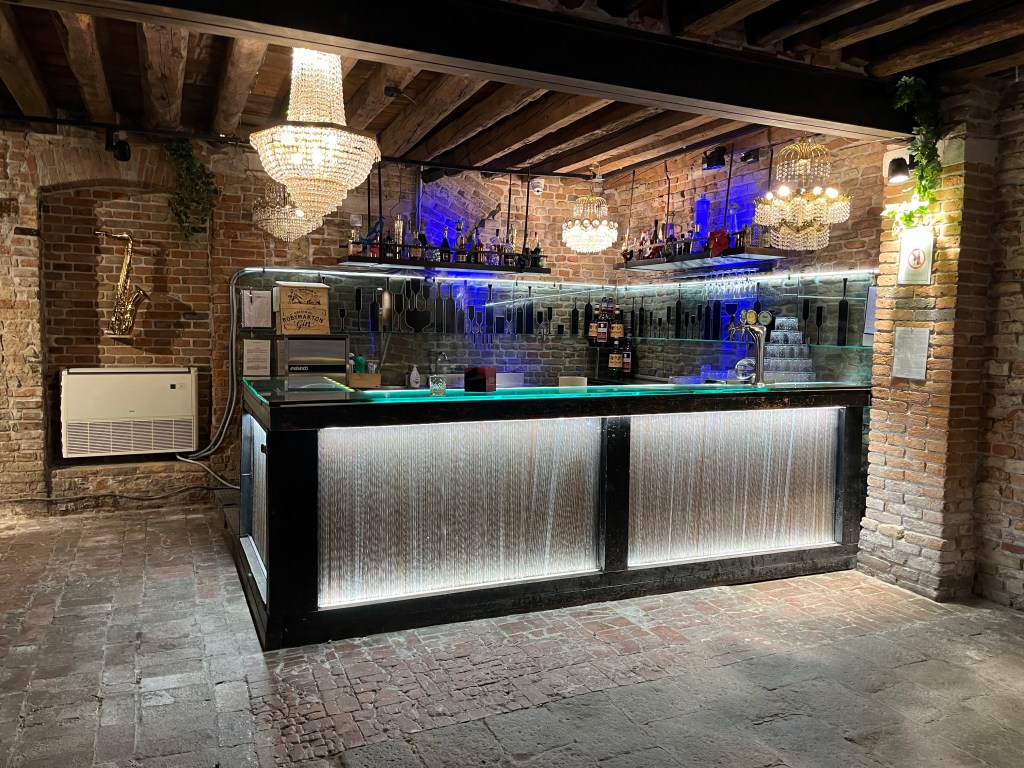
Bar at the Glass Cathedral

The Glass Cathedral is actually the Chiesa Santa Chiara, a church dating back to the 1300’s and was part of a convent for many centuries. In the 1800’s, it became a production facility for glass. Unfortunately, in the 1990s there was a fire and the roof collapsed. After years of vacancy the Belluardo family purchased it with the idea of turning the dilapidated building into a hospitality facility. In 2012, the Belluardo family began renovations of the Church and finished restorations in 2017.

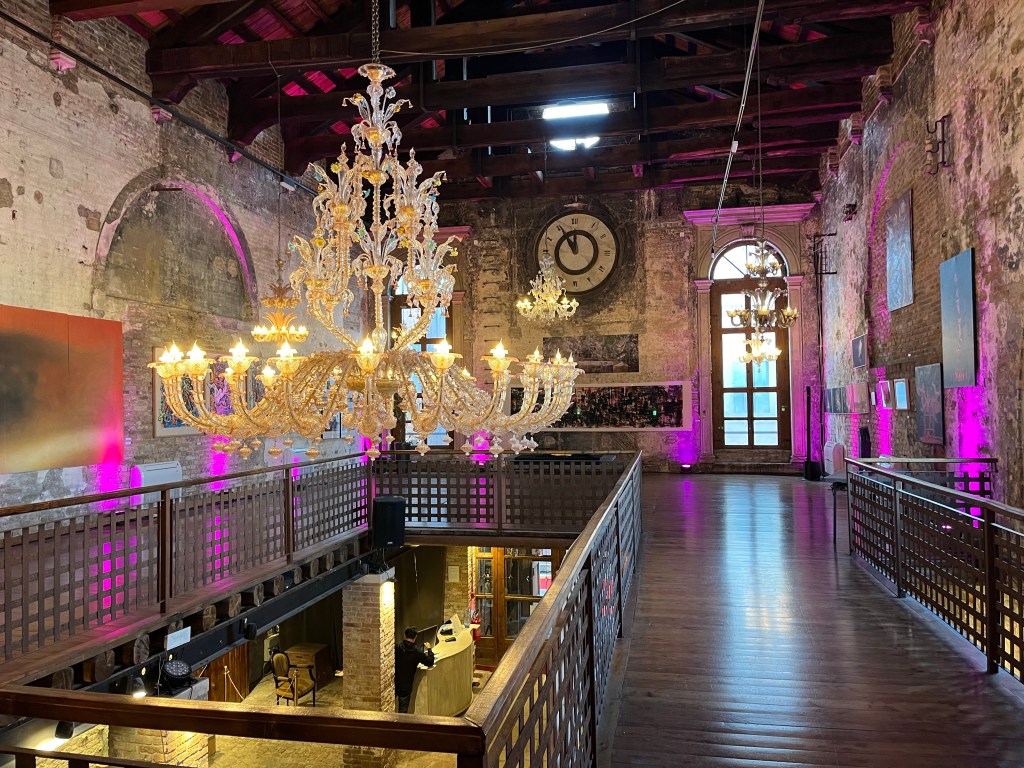
The second floor at the Glass Cathedral

The results of the renovations are spectacular. The Glass Cathedral is primarily an event center that hosts weddings and parties that can accommodate up to 300 people. What I love about this building is the fact that it blends the modern and ancient in a beautiful way. The old brickwork, wooden plank joists, and stained glass windows are accented by colored LED lights. Glass chandeliers and decorations are everywhere. It all makes for a perfect backdrop for a special event.

Metal decorations and vases in the lobby area of the Glass Cathedral.

However, for those of us who aren’t getting married in Venice, we can visit the Glass Cathedral and see a glass blowing demonstration. This of course gives you the opportunity to walk around the facility to see just how beautiful it is and to watch how artisan glass is produced.

LED lights, stained glass, and artwork on second floor of the Glass Cathedral

The Glass Blowing Demonstration

The tickets for the glass blowing demonstration were 14 Euros each, which you can buy in advance or at the door. We went ahead and purchased it when we got there. They did offer us an alcoholic beverage to enjoy during the demonstration for a small additional charge and of course I said yes.

Glass blowing artist heats up glass in oven

The demonstration is more of a performance than a demonstration. The Glass Master doesn’t explain what he’s doing, instead he is operating somewhere in the space between glass production and performance art. It is fascinating to watch.

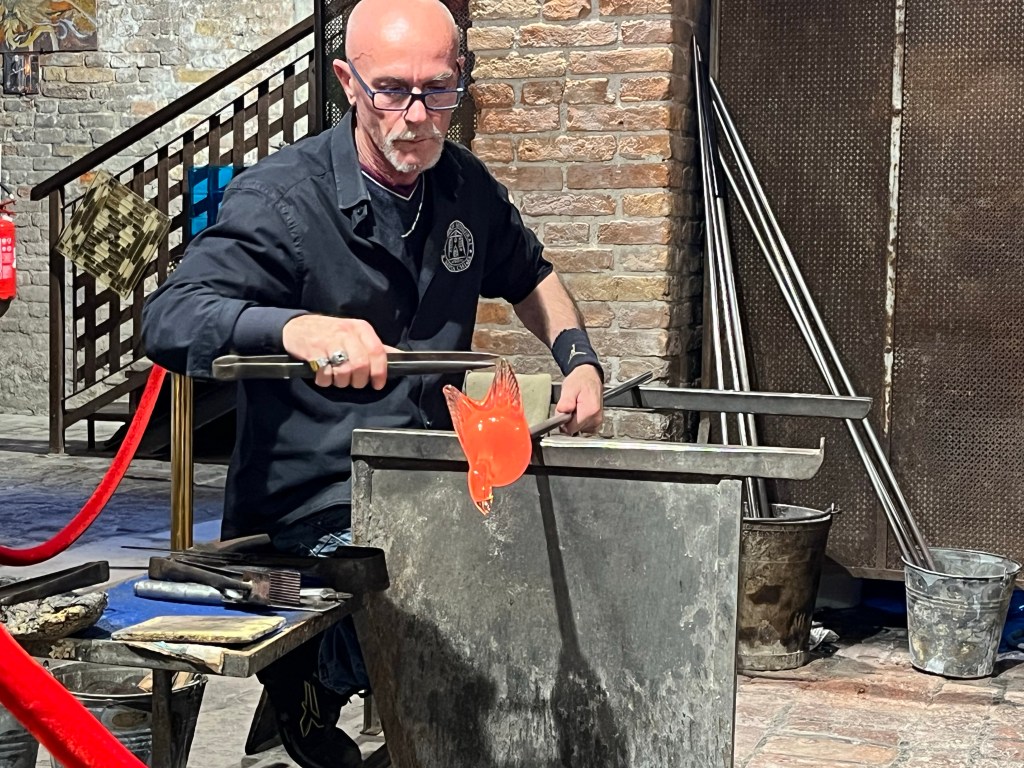
The glass master uses a tool to form the wing of a swan.

The show begins with the Glass Master putting the blow pipe into the furnace to pull out a mass of molten glass. He then proceeds to blow and turn the mass until he has shaped a pitcher. He attaches it a handle to the pitcher and also pulls the top until it forms a spout.

The Glass Master forms the tail feathers on the swan.

He continued the demonstration by making a variety of glass sculptures including a fish and a swan. All throughout, he is silently demonstrating how to use all of the available tools to create the shapes that he wants. He also demonstrated how to smoke glass and how to get various colors.

Glass figurine cools off

In the span of about 25 minutes, he created a vase, a fish and a swan. The speed and accuracy at which he worked was extremely impressive. The artist then announced the end of the demonstration and thanked us for our time.

Glass figure cools

This glass demonstration is a perfect compliment to a day in Murano. Walking around the town, gazing at all of the glass masterpieces, you wonder how they make all of this amazing art. Getting an opportunity to watch a true artisan make these pieces in real time is an great experience.

Glass for sale, probably the result of previous demonstrations

What is also great about going to this particular demonstration is that they aren’t going to hard sell you on anything. I can’t speak from experience, but I have read a number of reviews of other glass demonstrations in Murano and it appears to be common practice for a glass shop to offer free demonstrations, but expect you to buy something in return. We had no intention of buying anything because I didn’t feel like worrying about breaking it on the flight home. They do have some glass for sale at the Cathedral, but they don’t press you to purchase anything.

Going to the Glass Cathedral

Probably the best way to get to the Glass Cathedral is to take a vaporetto to the Murano Colonna docks. When you exit the boats head up along the canal to the right and cross the canal at the first bridge. There is an enormous building right at the end of that bridge and there will be multiple glass blowers doing demonstrations. You could go to any of them, but if you want to go to the Glass Cathedral you need to watch the signs carefully. We almost went to the wrong one.

A grand piano at the Glass Cathedral

You can purchase the tickets online at SantaChiaraMurano.com or you can show up and pay at the door. We went during the off-season so it wasn’t busy but if you are going during high tourist season, you might want to consider buying your tickets in advance.

Logo for the Glass Cathedral

If you plan to spend a few days in Venice there definitely is plenty to do but you should consider a trip to Murano. It is a little calmer, especially during the day, than the main islands of Venice and you will get an opportunity to really get up and personal with the Venetian glass industry. I highly recommend when you are in Murano to go to the Glass Cathedral. It will only take maybe 30 to 45 minutes of your time and you will get to see a beautiful facility and experience a glass blowing demonstration that will give you a greater appreciation for the artform.

Venice at Night

Venice is a magical city. It’s architecture, art, cuisine and its soul are constantly on display. Millions of visitors visit Venice annually to experience all that is wonderful about this nearly two thousand year old city built on marshlands in the Adriatic Sea.

Boat Traffic on Canals in Venice During the Daytime

Because of the popularity, Venice can get extremely crowded during the day. The Vaporetto boats that carry tourists and locals from port to port along the canals get completely filled. The canals themselves get so crowded with boats carrying passengers throughout the city that it can seem unfathomable that there aren’t constant crashes between boats.

Canale de Cannaregio

During the day there is a buzz about the city. It’s not the same as the noise and crowds of cities like New York or Rome, but there is an energized feel about it that gets your heart racing a little. The vendors in the kiosks, the hawkers who try to pull you into their restaurants, and the thousands of people taking selfies can feel a bit overwhelming, especially to people like me who are easily overstimulated.

San Polo District Venice Italy

But as the sun begins to set in Venice, something amazing begins. It’s almost like a someone dialing back the chaos with a dimmer switch. Many of the visitors get back on trains and head home. Tourists sit down for a big dinner before heading back to their Airbnb or their hotel. The streets empty a little and the lights begin to turn on.

Grand Canal at night from Vaporretto

During the day, you see the flaws. Paint chipping, buildings leaning and graffiti expose the age of the city. In the evening, shadows hide these imperfections while accentuating the beauty of the architecture and stone streets.

Trattoria alla Palazzina

There is something else going on in Venice and that is that even though tourism is as popular as ever, the population within the city center has fallen dramatically over time. On the main island the population has dropped by around 120,000 residents. This leaves the population on the main island below 50,000 residents. We were in Venice in November, which is low tourist season and with the population of Venice being at its lowest point probably since its founding, it was eerily quiet.

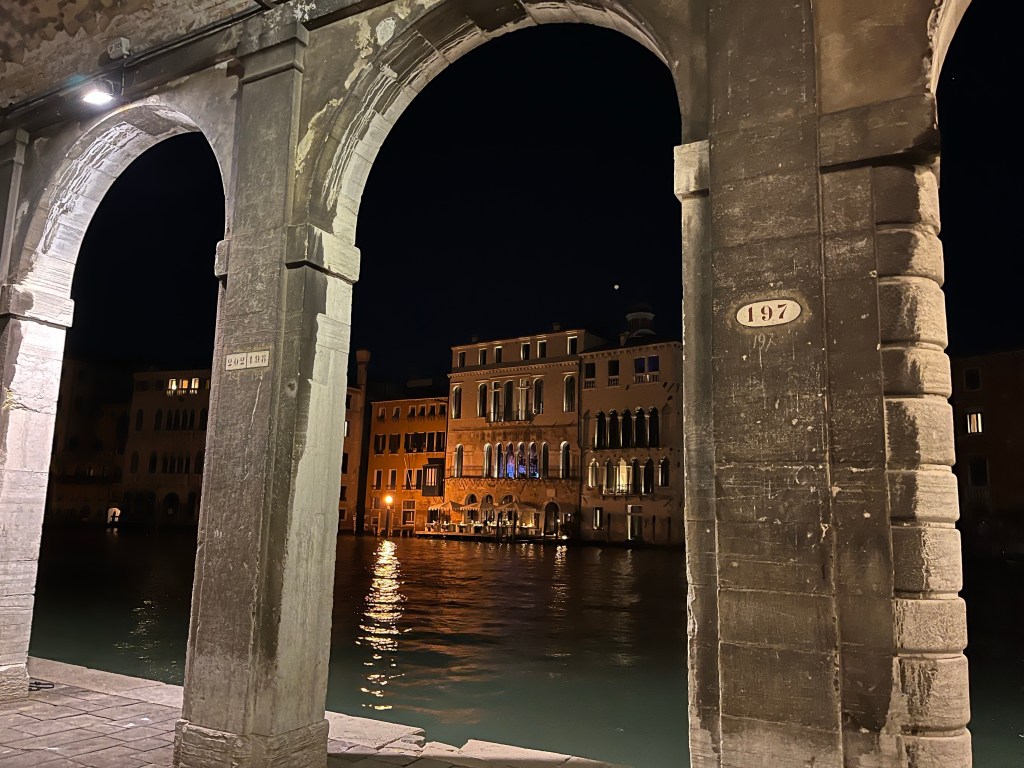
The Fondaco dei Turchi is a palazzo originally built in the 13th Century and was renovated in 1869.

Often when people think of Venice, the idea of Carnival comes to mind. It’s easy to imagine that the streets would be full of drunken costumed revelers as they move from party to party. Instead, what you see are people quietly enjoying a bottle of wine at a restaurant in a plaza.

Archway near Campo Bella Vienna

By early evening, most of the shops had closed, but the restaurants and bars remained open. We wandered around the corner and stumbled upon a crowd in a plaza enjoying wine and beer. They were gathering around a little enoteca named Al Merca. It is known for its small sandwiches, wine, aperol spritz, and great prices. We enjoyed a drink or two in the lovely Campo Bella Vienna and then walked over to the Rialto Bridge.

Barcolo Bar, next to Al Merca in Campo Bella Vienna

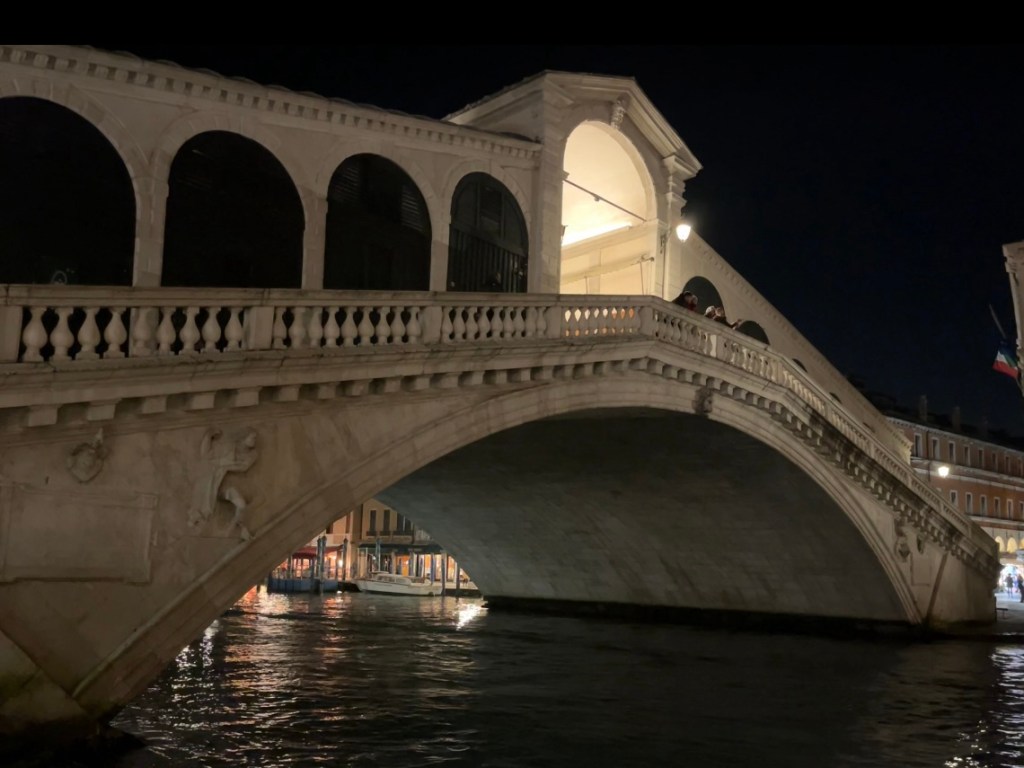
It’s difficult to enjoy the Rialto Bridge during the day, with the crowds of tourists all trying to position themselves for that perfect selfie. But at night, we were able to walk up to the apex of the bridge and rest against the stone handrail that has been smoothed to a fine polish by millions of hands that have run across it over the centuries.

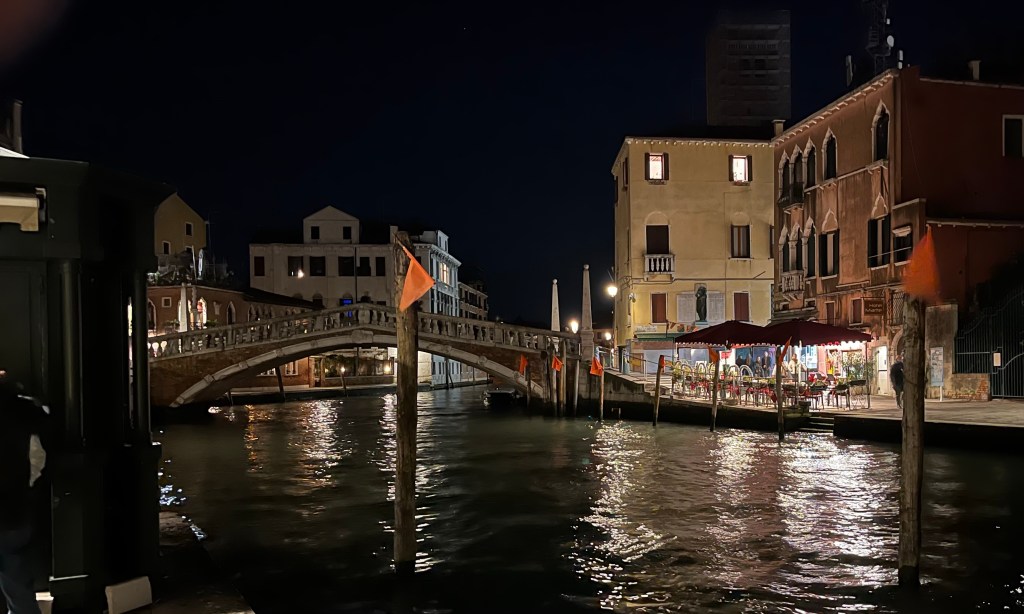
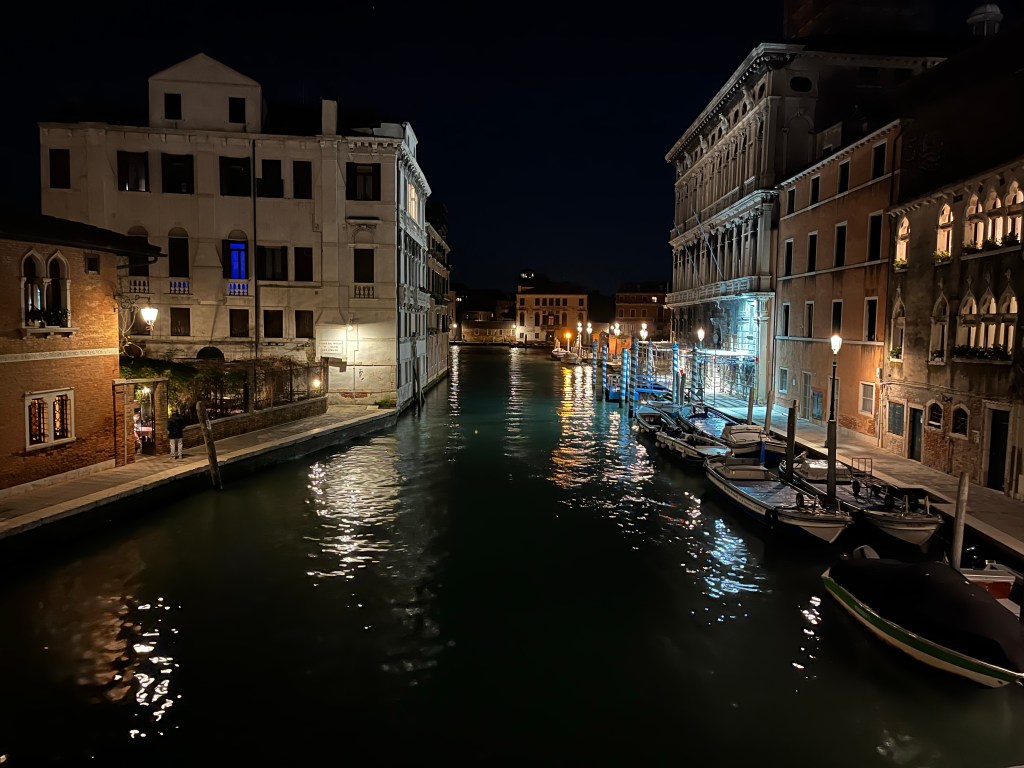
View from Ponte della Guglie

From that vantage point on the Rialto Bridge, you see the lights from the streets and buildings as they dance along the ripples on the Grand Canal. The boat traffic was all but gone with the exception of an occasional vaporetto. What seemed chaotic only a few hours prior was now serene.

Rialto Bridge at night

As the night went on, the streets continued to empty and at some point it felt like we were almost by ourselves. Whenever we would enter a plaza we would find people enjoying a restaurant or a bar, but side streets were really quiet.

Grand Canal at Night from Rialto Bridge

We eventually got tired, but stopped for a slice of thick crust pizza at Antico Forno where the shopkeeper graciously served us even though it was only 5 minutes before they closed. The crust was crispy and the tomatoes, basil and mozzarella was still surprisingly fresh. It was a perfect end to a night of exploration of Venice at night.

Pizza on Display at Antico Forno

We finished our slice and headed back to the Airbnb.

San Polo District Venice Italy

I can’t help but wonder how much the folks who do day trips to Venice are missing by not staying in the main part of the city. It’s such a different vibe in Venice at night. With the population drop in Venice, I wonder if we’re really experiencing Venice in way that nobody really has before. After this trip, I just can’t imagine visiting Venice without staying on the main island and walking it’s beautiful streets at night.

A Sunrise Jog in Florence

I love running while traveling. I spend a ridiculous amount of my life running the same roads and bike paths near my house. Over and over again – and don’t even get me started on treadmills. Any time that I get an opportunity to run in different scenery, I will take it.

Florence, Italy is a pretty nice place to run if you get a chance. There aren’t a whole lot of choices of places to run when you’re in Florence, but the views are amazing nonetheless.

Limited Route Choices

The problem with running in Florence is that much of the town is covered by a ZTL or a limited traffic zone that doesn’t allow for cars other than residents, buses or taxis to drive within that zone. As a runner, that sounds great, right? The problem is that because of the ZTL all of the garbage trucks and delivery trucks run around Florence in the morning before the ZTL goes into effect and it can get a little busy. I like to run in the morning but I don’t want to dodge delivery trucks.

You could wait until the ZTL goes into effect, at 7:30, but then the amount of pedestrians increase dramatically and you might end up dodging pedestrians during your run. This might be okay if you want to run a low intensity run and maybe you want to see a lot of the beautiful sights of Florence. But if you want to run at a higher intensity, the option is really to run along the Arno River.

My Route

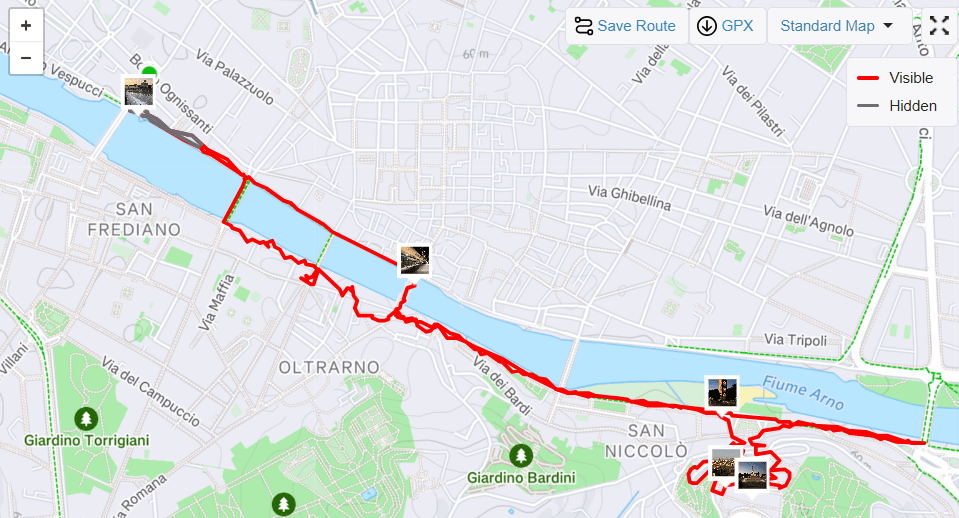
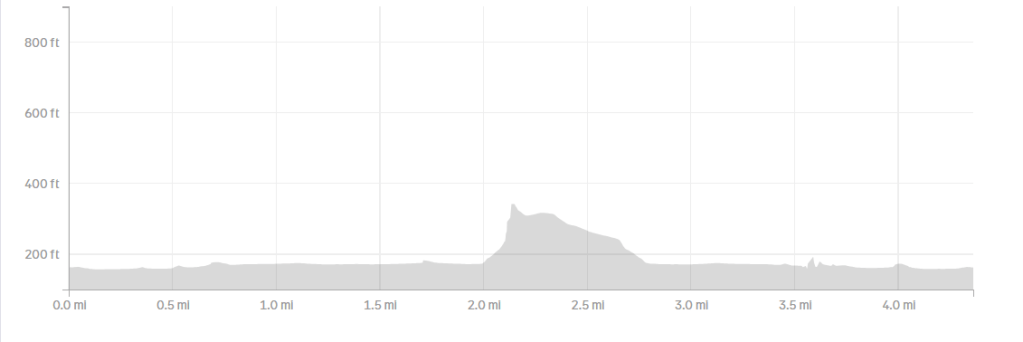
This route was a little over 4 miles with an elevation gain of 233 feet.

Our Airbnb was located south of the Firenze Santa Maria Novella train station and just a block off of the Arno river. This meant that all I had to do was take a right on the first street, and then jump on the sidewalk that runs parallel to the Arno River.

The elevation of this route was pretty much dead flat with the exception of the climb to Piazzale Michelangelo

It was before dawn in November, and the air was crisp with the temperatures in the mid 40s and very little wind. It was the kind of temperatures that is ideal for performance. My attention wasn’t on running a fast time, it was on the amazing views of Florence as it emerged from darkness.

Light reflects off of the Arno before dawn

Florence is beautifully illuminated by the lights along the Arno at night, with streetlights dancing on the ripples of the river. I continued my jog along the river heading toward the famous Ponte Vecchio. There were a few other joggers along the path. I was on the north side of the Arno heading east and the sidewalk was only a few feet wide, but the traffic was light which allowed passing in the street, when necessary.

Crossing at Ponte Vecchio

Ponte Vecchio lit up in the early morning

The previous day, I had experienced Ponte Vecchio in the afternoon with crowds of people shopping for jewelry. When I was there I noticed the shops had wooden protections for the shop windows. I was curious what the shops looked like with the wooden protections down and the crowds gone. I was not disappointed. It was truly interesting and in a way beautiful. At least as beautiful as theft protection could be.

Shops closed on Ponte Vecchio in the early morning

I crossed the Arno River at Ponte Vecchio and then continued east along the river, this time on the south side.

Looking east along the Arno River taken from sidewalk on south side of the river.

Piazzale Michelangelo

I timed my run out for one particular reason. I wanted to experience Piazzale Michelangelo at sunrise. Piazzale Michelangelo is a very popular place for people to visit at sunset, but going at sunrise allows for people to get a spectacular view of the city when very few people have even bothered to get up.

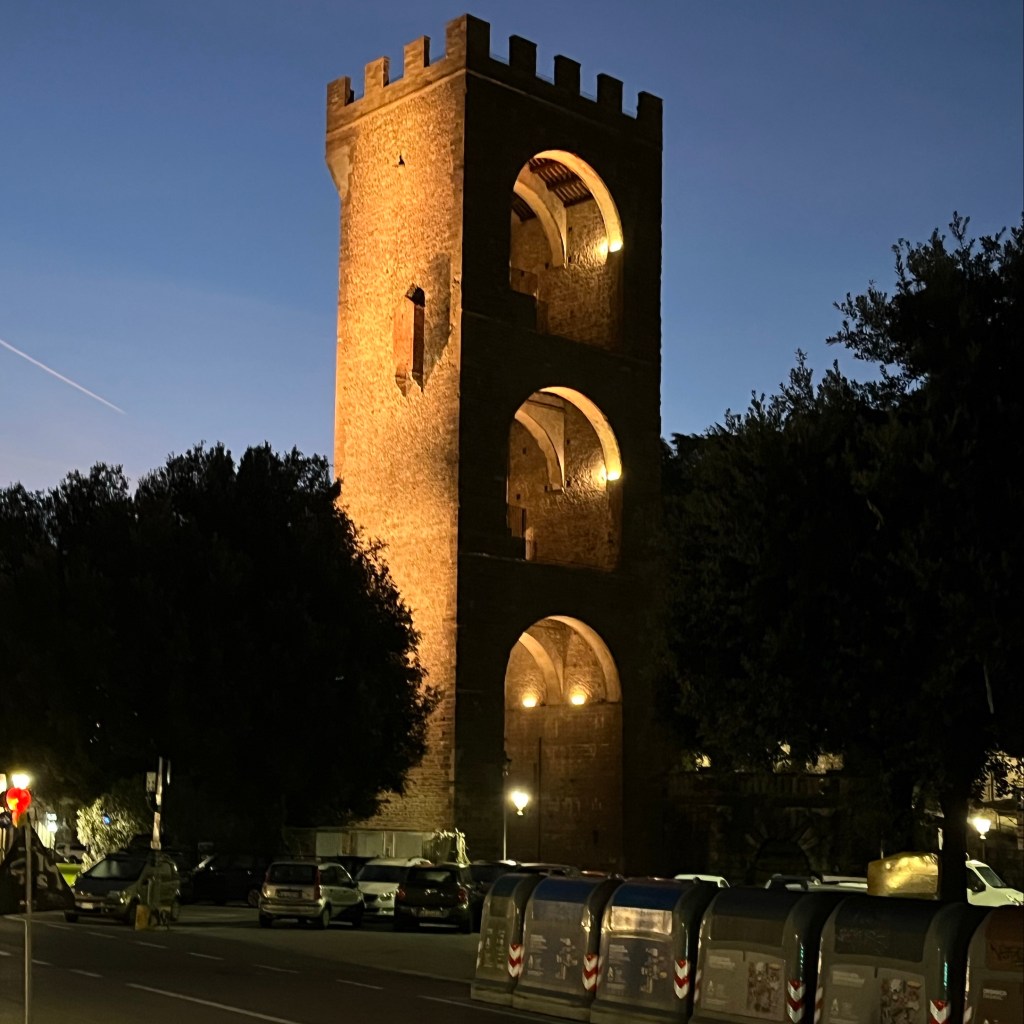
Porto San Niccolò – where you should turn to go up to Piazzale Michelangelo

The problem was, that I missed my turn. I kept running along the path and missed the turn to go up to Piazzale Michelangelo. I ended up running probably about a half mile too far, before I realized that I needed to turn around and come back to the west. I finally took my turn off at Porto San Niccolo, a tower that marks the turn up to Piazzale Michelangelo.

There is a decent amount of elevation change from the path along the Arno up to the Piazzale, so I’m ashamed to admit, I walked a little. But I worked my way up the windy road until I reached the Piazzale Michelangelo and I was not disappointed.

Bronze replica of Michelangelo’s David

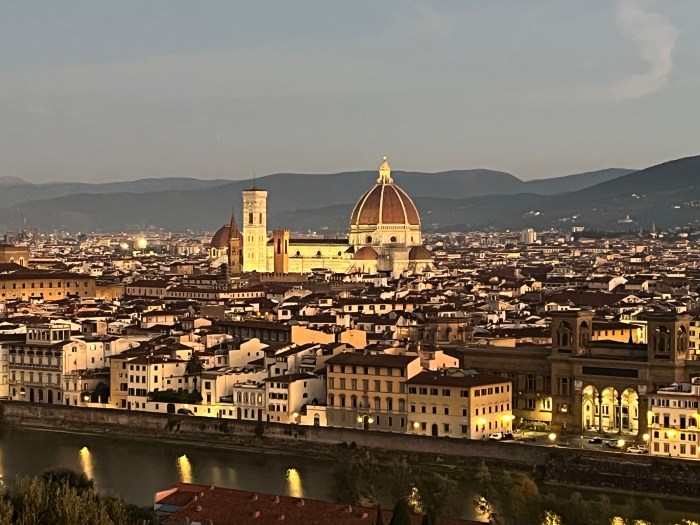
The Piazzale Michelangelo is a large plaza that has unbeatable views of the city of Florence. It has spectacular views of the Duomo with the Tuscan hills in the background. Seeing the sun rising over the city is an amazing experience and it was worth every mile and every foot of elevation on the climb.

View from Piazzale Michelangelo

After relaxing a bit in the plaza and watching the sunrise, I worked my way back to the Airbnb, this time spending more time on the south side of the Arno. Seeing essentially the same sights, but this time illuminated by the sun, instead of illuminated by streetlights created a different appreciation for the beauty of Florence.

A look at some of the old city wall

Suggestions for Routes

Based on the limited amount of running that I’ve done in Florence. I think running along the Arno might be your best bet. Running through town, you might find yourself dodging delivery trucks early in the morning or pedestrians later in the morning. If you’re not in a hurry that might not be a problem.

If you can work in a trip to Piazzale Michelangelo, you absolutely should. If you can do it at dawn or dusk, even better. There is just something magical about that location and you will not be disappointed.

Managing Crowds and Expectations in Florence

In November, we had the opportunity to spend a few days in Florence. Prior to that visit, I had talked to a few people about Florence and virtually everyone I talked to practically gushed about how much they loved the city. After spending a few days there, my feelings about Florence are a bit more complicated, and while I’m sure that I’ll return someday, I’m not rushing to schedule a return trip.

Florence at Dawn from Piazzale Michelangelo

Certainly there are some absolutely wonderful things about Florence, but something bothered me about it and I couldn’t quite understand what that was. I enjoyed our stay there but were my expectations too high to begin with?

Architecture

From a building by building, block by block perspective, I’ve never visited a city more beautiful than Florence. No matter where we were, seemingly each and every block in Florence was beautiful. In the mostly residential areas, a pretty normal building is usually four or five stories tall and made with some kind of stone and stucco combination. The majority of the buildings have commercial space on the ground floor and living quarters above. The buildings are well maintained and the neighborhoods are clean.

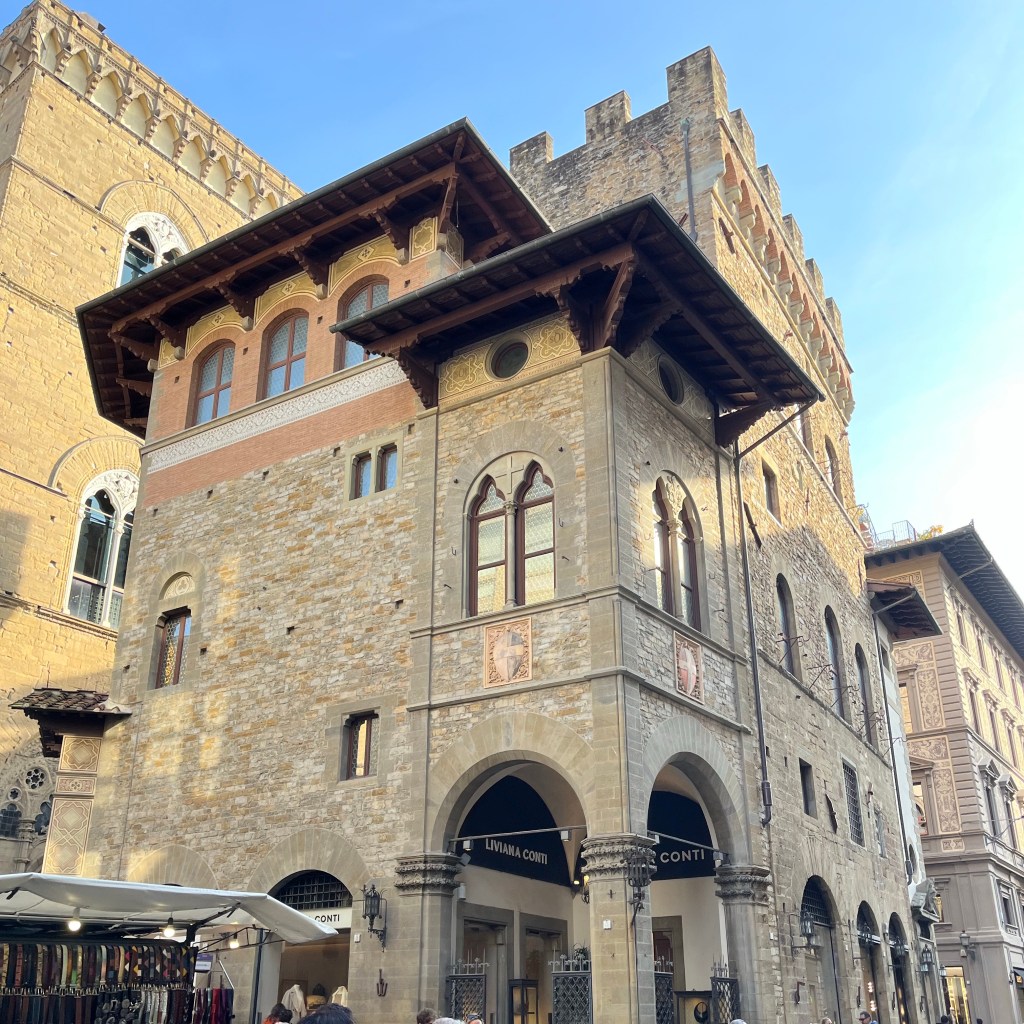
In the main commercial area of town, closer to Ponte Vecchio, the buildings become a little more elaborate, with some taking medieval castle-like elements from the nearby Palazzo Vecchio.

Liviana Conti in Florence

There are also some amazing architecturally significant landmarks in Florence, including the Duomo, Palazzo Vecchio, the Baptistery at the Cathedral, and the Basilica di Santa Croce. Many of these buildings have taken on a three toned marble exterior style with green, pink and white marble that were extracted from nearby quarries.

Baptistery at the Duomo in Florence with Typical Marble Exterior.

The combination of these buildings mean that virtually wherever you walk in Florence, you will be surrounded by beautiful architecture.

Walkability

Florence is an extremely densely populated city. The main area of the city is comparably small for the population in the area. That makes it an excellent place to walk around. Population density is always good for shops, bars and restaurants, because there are more residents and visitors to support them. It also means that, for visitors, there are a lot of places to shop, eat and drink, without having to take a car or public transportation.

Well Preserved Buildings and Narrow Cobblestone roads

It’s so walkable, in fact, that there is a huge amount of the main area of the city that you can’t drive in for much of the day. The area is called the ZTL or the “zona a traffico limitato“, which you probably don’t need to speak Italian to translate. It restricts traffic to only residents, taxis, or buses. This dramatically cuts down on the number of vehicles and because of that, the roads are mostly for bikes and pedestrians during the ZTL times.

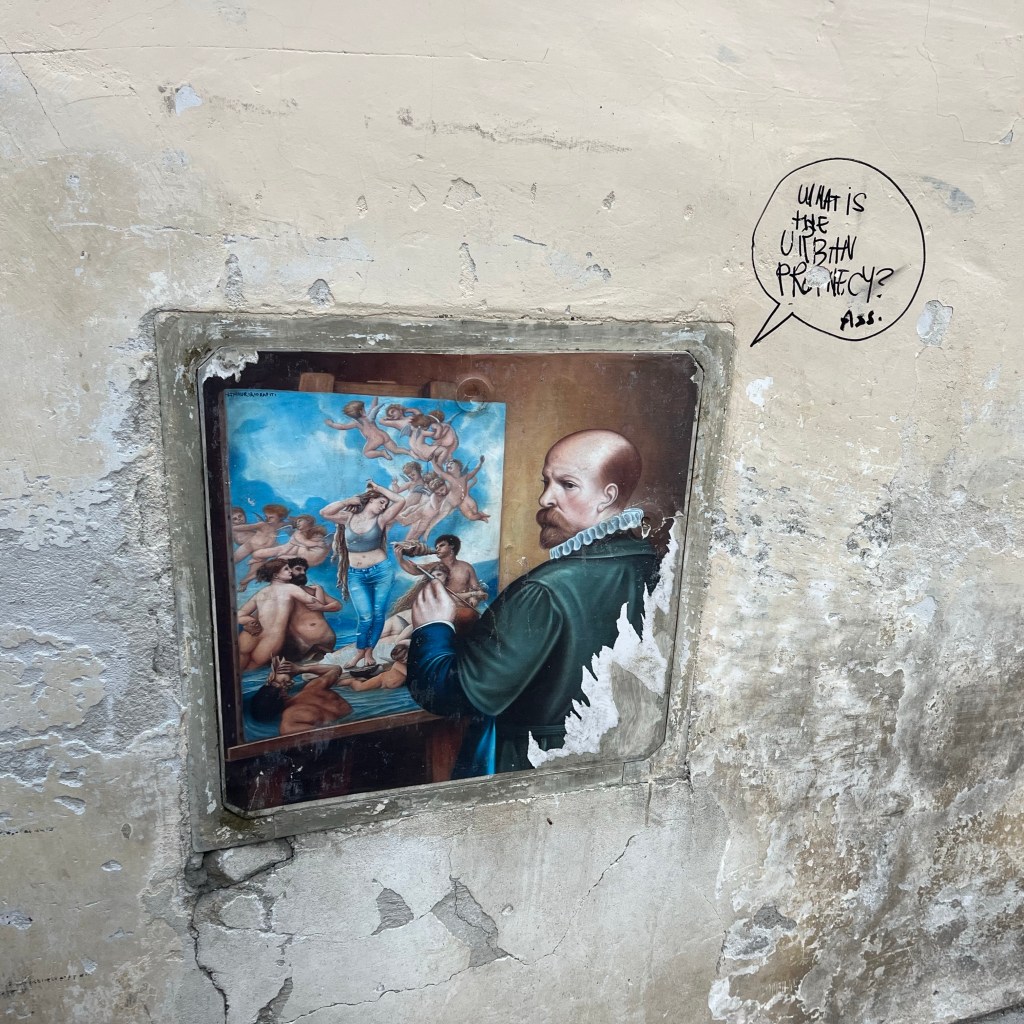
Quirky art in an alley near Palazzo Vecchio

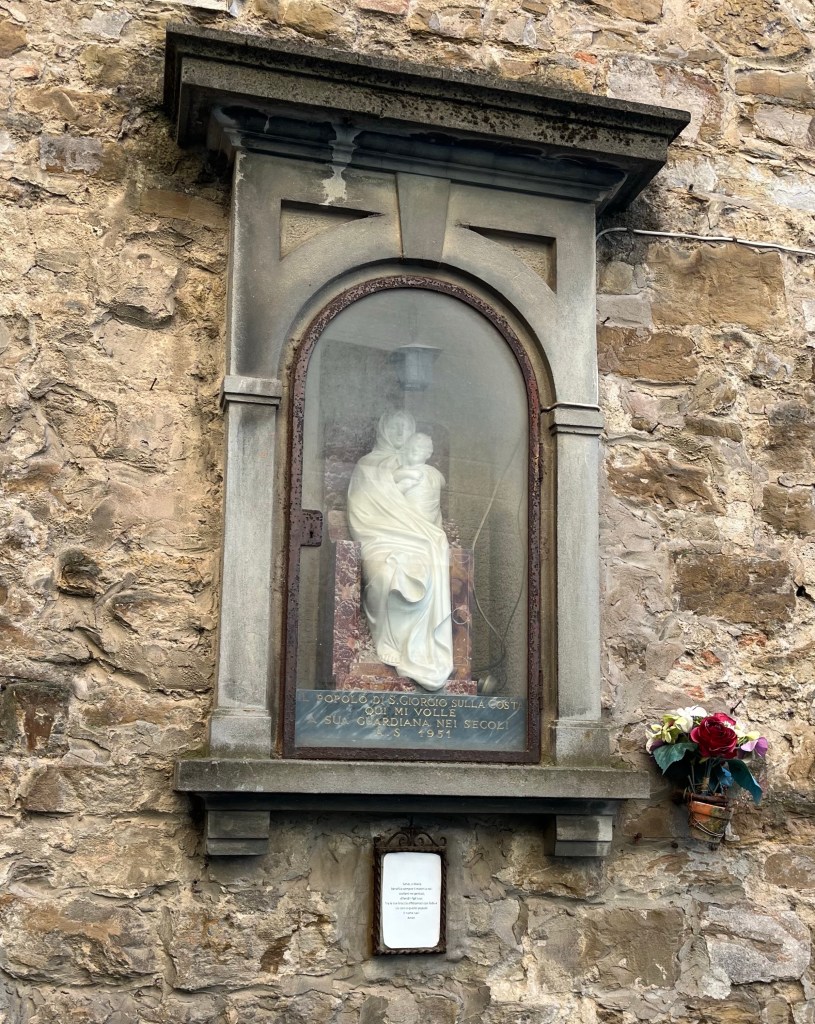
As with many European cities, there are many narrow streets and alleyways that are fun to explore on foot. That’s where you will find quirky little pieces of art, small street shrines and some of the best restaurants.

Small street shrine

Markets

The best cities to visit have great markets and Florence has some amazing ones. The most famous of those is the Ponte Vecchio which is a bridge over the River Arno. It is full of jewelry artisans. There are dozens of jewelers selling bracelets, watches and rings all along the bridge. The “Golden Street” is a fantastic place for any jewelry lover to shop.

Rows of Jewelry Shops on Ponte Vecchio

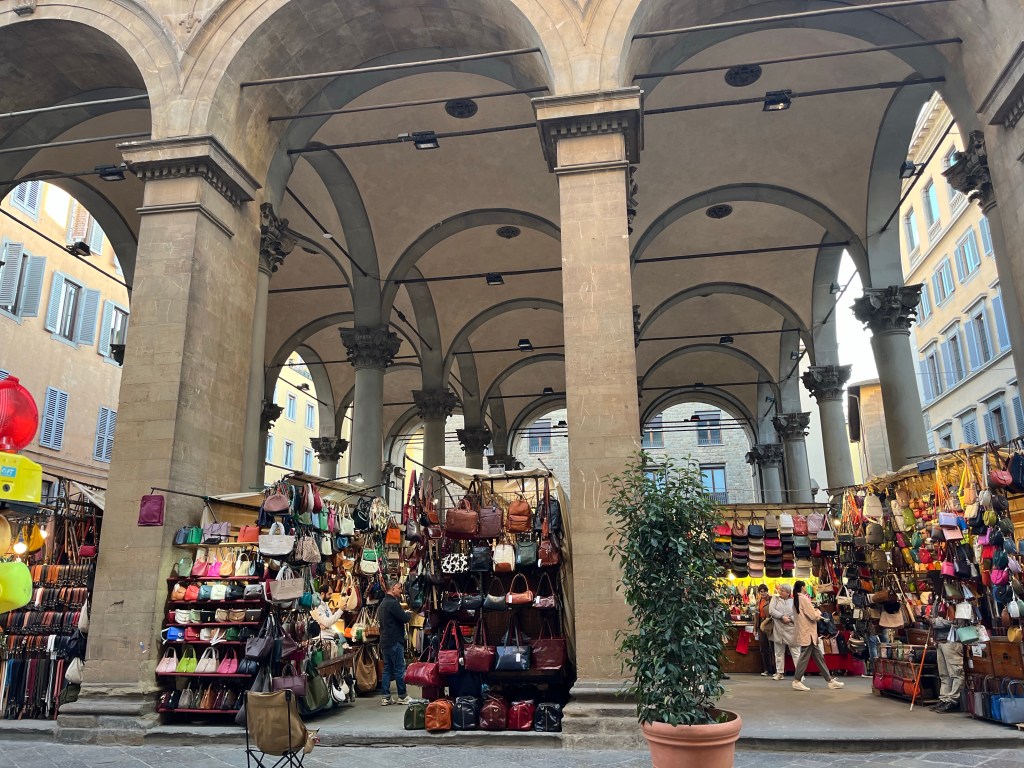
There are also a couple of great markets for shopping for leather goods. Florence is famous for it’s leather shops and you will find plenty of places to buy leather jackets, purses, wallets, belts and even backpacks. There is a covered market near Piazza della Signoria and just a few blocks north of Ponte Vecchio called Mercato de Porcellino. In addition, there is actually a bigger leather market near the Basilica di San Lorenzo called the San Lorenzo Market. There you will find block after block of leather goods.

Mercato del Porcellino

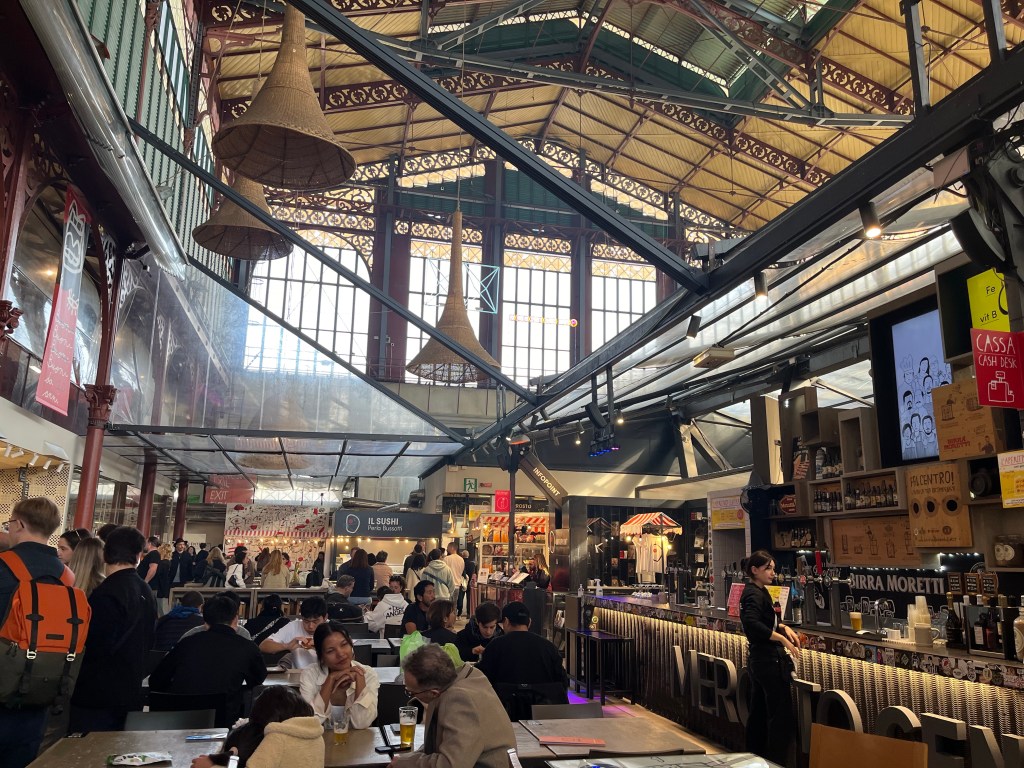
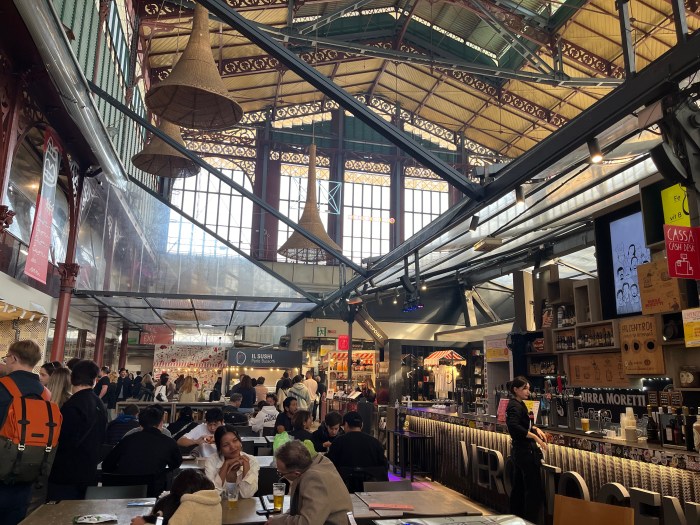
There is also a fantastic indoor food market near the San Lorenzo marked called Il Mercato Centrale. Of all of the farmer’s markets I’ve ever been to, this is my favorite. The market has two floors, the bottom is devoted to vendors selling meat, fish, vegetables, cheese and wine. The upper floor serves as a bit of a food court with the vendors selling a variety of delicious prepared food. I would not go to Florence without visiting this market.

2nd Floor at Mercato Centrale

Art

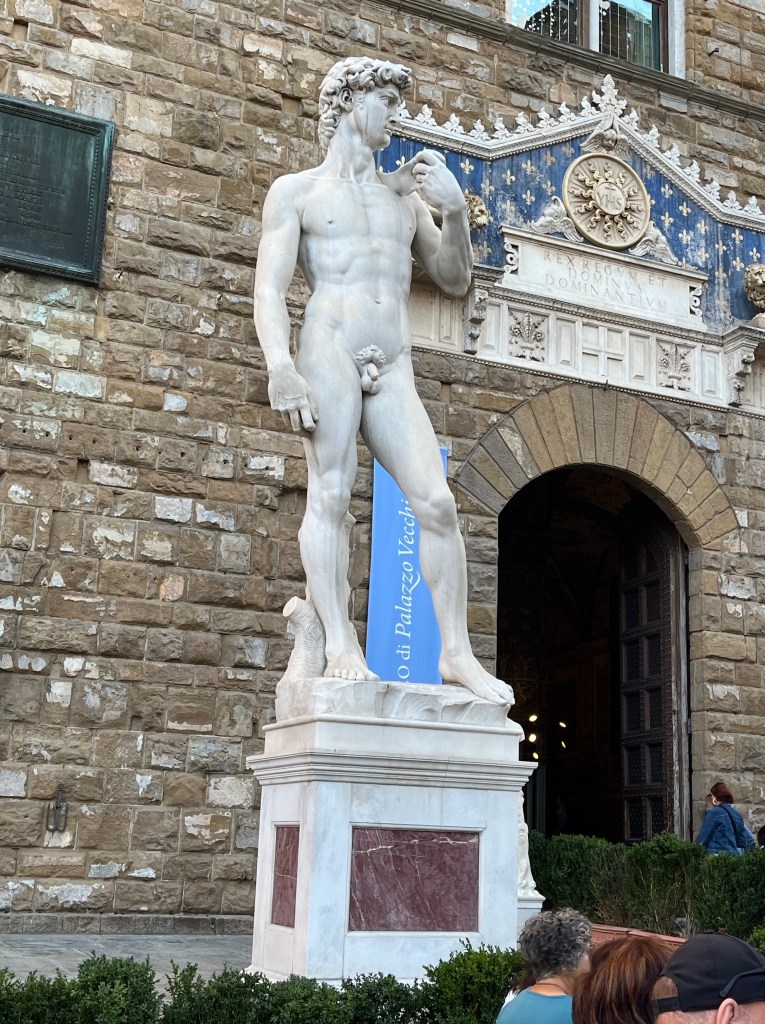
Replica of Michelangelo David residing outside of Palazzo Vecchio

You’re not going to find many places with better examples of Renaissance art than in Florence. The wealthy Medici family funded a lot of the production of art in Florence during the Renaissance. As a result, art is practically everywhere. You could spend days visiting museums such as the Uffizi Gallery, and the Accademia Gallery or you could simply wander the city and admire the statues on the Duomo, and in the Piazza della Signore. Renaissance art is in the blood of the Florence and you could spend a lifetime exploring all of it.

Fountain of Neptune at Piazza della Signoria

Shopping

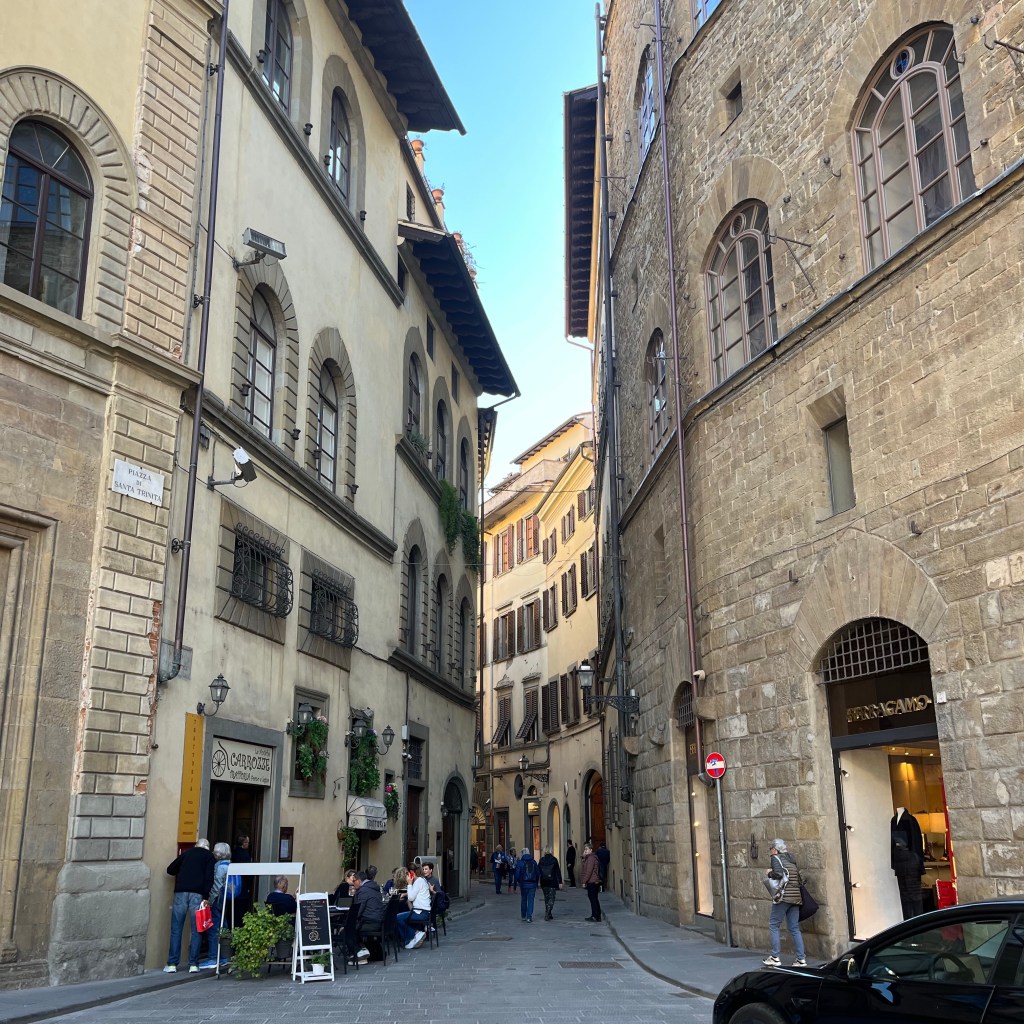
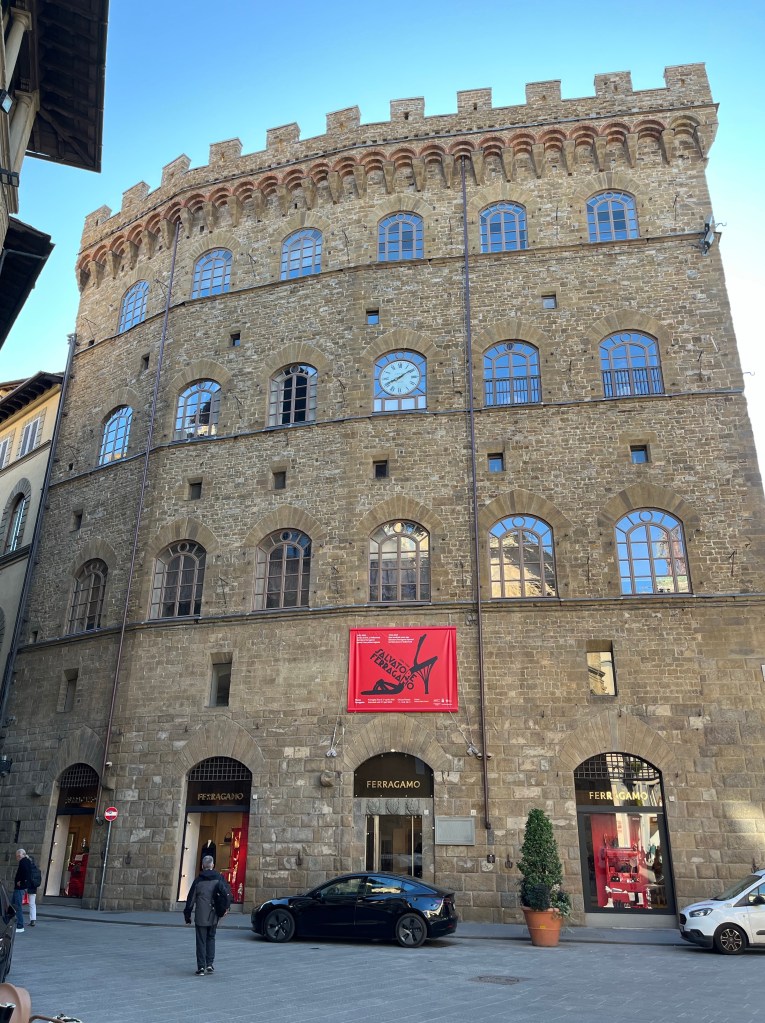
Ferragamo in Florence

Walking around Florence, you will notice some very famous and expensive luxury brands have shops catering to tourists. Brands like Fendi, Prada, Ferragamo, Tiffany and Bvlgari dominate the streets near Ponte Vecchio. This is in addition to the artisans in the jewelry and leather markets.

Crowds

We went to Florence in November, which should be low season in Florence. This did seem to be evident in the fact that we didn’t struggle to find places to eat and drink. We generally were able to get a table immediately and without a reservation.

Crowds gather around the Duomo

But even though there seemed to be plenty of capacity at bars and restaurants, the streets seemed pretty busy. There were some fairly long lines at the Duomo, and I can imagine they were equally long at the Uffizi Museum and the Accademia Gallery as it is generally advised to buy ‘skip the line’ tickets for those museums. On side streets, you could catch a bit of a breather, but walking in the area around Ponte Vecchio or the Duomo was extremely crowded, even though it was November.

Tempering our Expectations

It took me quite a bit of time to understand why I wasn’t blown away by Florence. When I thought about the architecture, history, art and the markets of Florence, it seemed like it should have been a place that I absolutely loved. Something about it bothered me and I wondered why. I had a good time. I loved so much of what Florence had to offer, but it just didn’t seem that great.

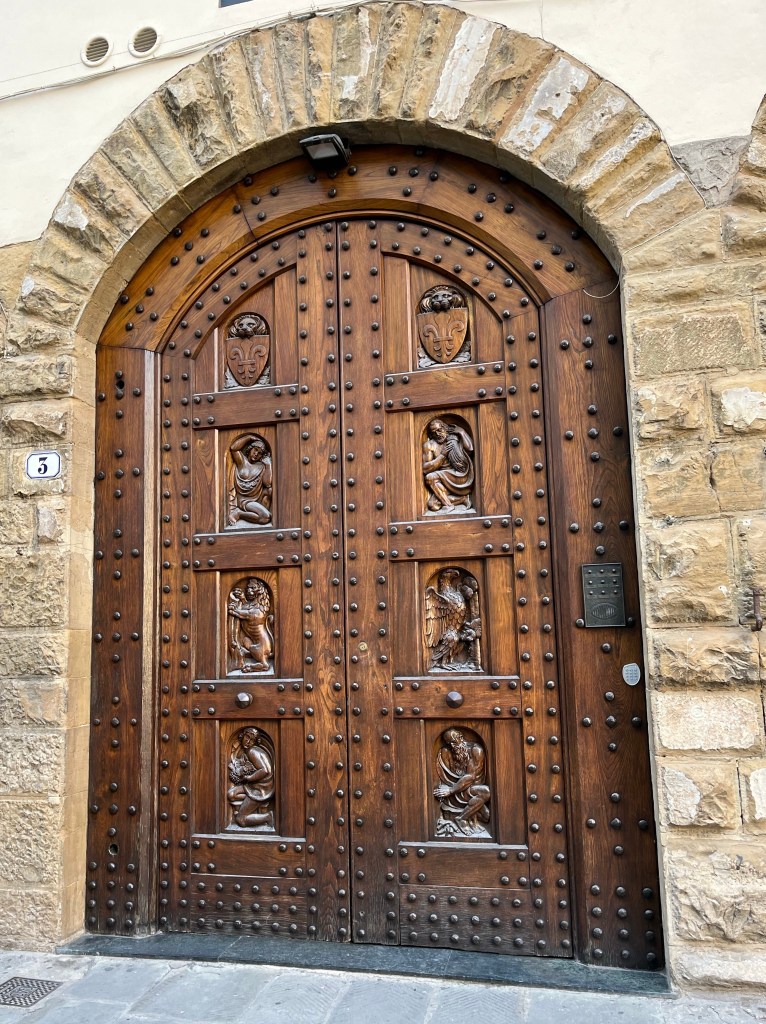
Elaborate door near Piazza Della Signoria

I think what bothered me is that Florence is a victim of its own success. Even in the off season, it was crowded and felt too touristy. For example, while the leather artisans at San Lorenzo Market and the jewelers on Ponte Vecchio felt like a natural part of Florence, seeing Tiffany’s and Prada didn’t.

Borgo Sant’Apostoli

But I think the problem was that I had an idealized version in my head of what I thought Florence should be. Of course Tiffany’s and Prada are in Florence. There are millions of visitors every year and many of them can afford to shop there. It makes sense. Sometimes, we as tourists, want everything to feel authentic but at the end of the day the crowds provide business opportunities for investors and residents.

Horse drawn carriage near Piazza della Signoria

And of course, there are going to be lines for museums and the Duomo. These are massively popular attractions in a very popular city. Yes, it will be crowded on Ponte Vecchio. No you’re probably not going to get that perfect selfie standing in front of the Statue of David, there’s going to be a crowd of people there.

Area near Arno River

I wish I had tempered my expectations a little. I think when we planned the trip, I thought that it’s off season, and we’ll get to experience everything that we want without too much wait or crowds. It just not that way, I’m not sure that there is such a thing as a true off season in Florence, because it’s just too popular of a location.

View from the Window of our Airbnb

If you can slow yourself down a little and maybe pick one museum or one major attraction per day, while expecting crowds, you should be able to really enjoy your stay. If you have time and energy to do more than one thing, than that’s a bonus. It’s obviously difficult when you make the long trip from the US to slow down and enjoy the little time you have in a location but its absolutely essential.

Before Dawn on the Arno River

“We can always come back” is a bit of a mantra for us. It takes the pressure off of treating a vacation like a checklist of things we have to do. That being said, I think we will be back to Florence, but next time, I’ll understand that there will be crowds, even in the off season, and I’ll plan accordingly. With the correct expectations, I would have truly appreciated Florence. We can always come back right?

We definitely will.

Exploring the Duomo in Florence

The most famous building in Florence is the Cathedral of Santa Maria del Fiore, known commonly as the Duomo. It is an architectural and engineering wonder built as Europe was transitioning from the Middle Ages to the Renaissance.

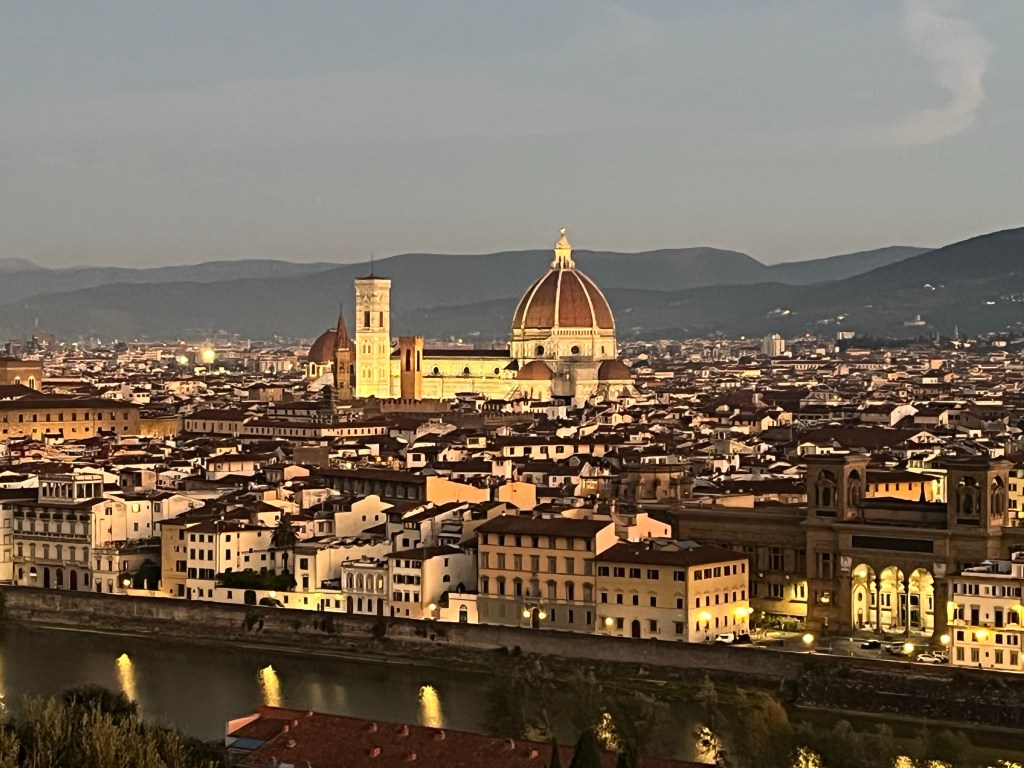
The Duomo at Sunrise taken from Piazzale Michelangelo.

History of Construction

The Duomo dominates the skyline of Florence. It is 376 feet tall at the dome and the campanile is 278 feet tall. Most buildings in Florence are three to five stories tall and are a fraction of the Cathedral’s height. The Duomo is so much larger than the rest of the buildings in Florence that it’s impossible to miss.

The Campanile is an impressive 278 feet tall.

As was the case with many cathedrals built throughout Europe, building the Duomo was a multi-generational project. The project began in 1296 overseen by the architect Arnolfo di Cambio. By 1337, the project had expanded and the plans were changed to include a dome, even though they didn’t yet have plans on how to build it. In 1418, the Architect Brunelleschi solved the dome problem and his design was chosen to finish it. The dome was completed in 1436, finally finishing the construction on the cathedral that had lasted 140 years.

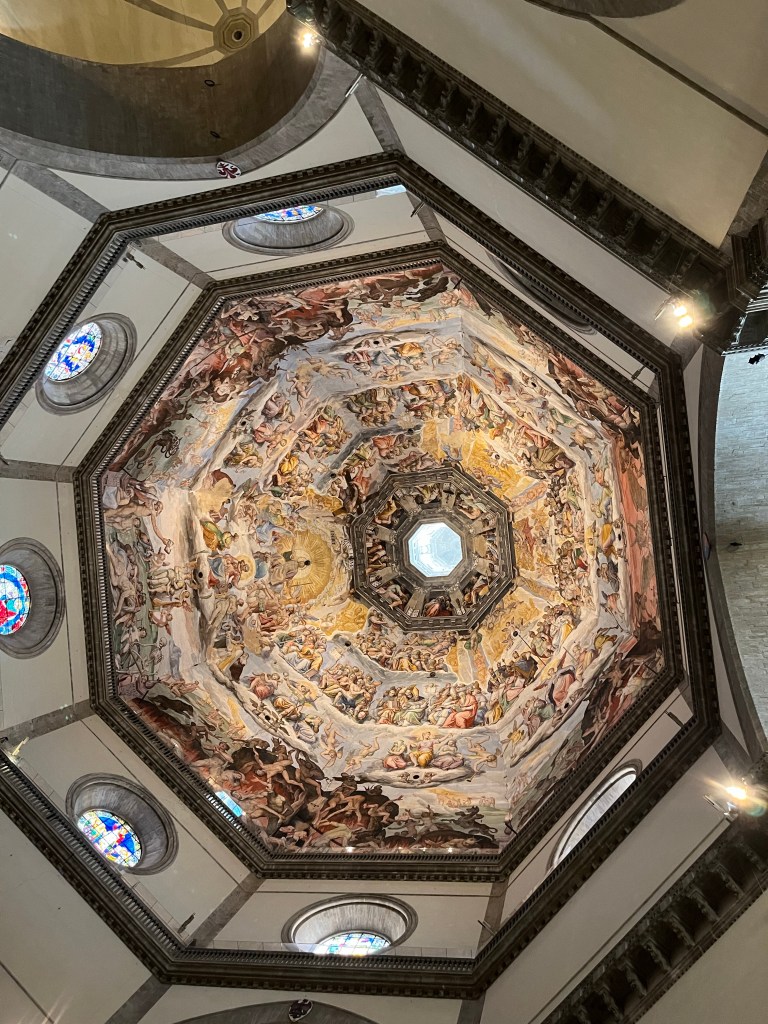
Brunelleschi’s Dome

Painting the dome started in 1572 when Georgio Vasari was commissioned by the Grand Duke Cosmio I d’ Medici to depict the Last Judgment. Vasari died in 1574 and left the frescoes incomplete. Frederico Zuccari was commissioned in 1576 to finish the project which he did in 1579.

The Last Judgment

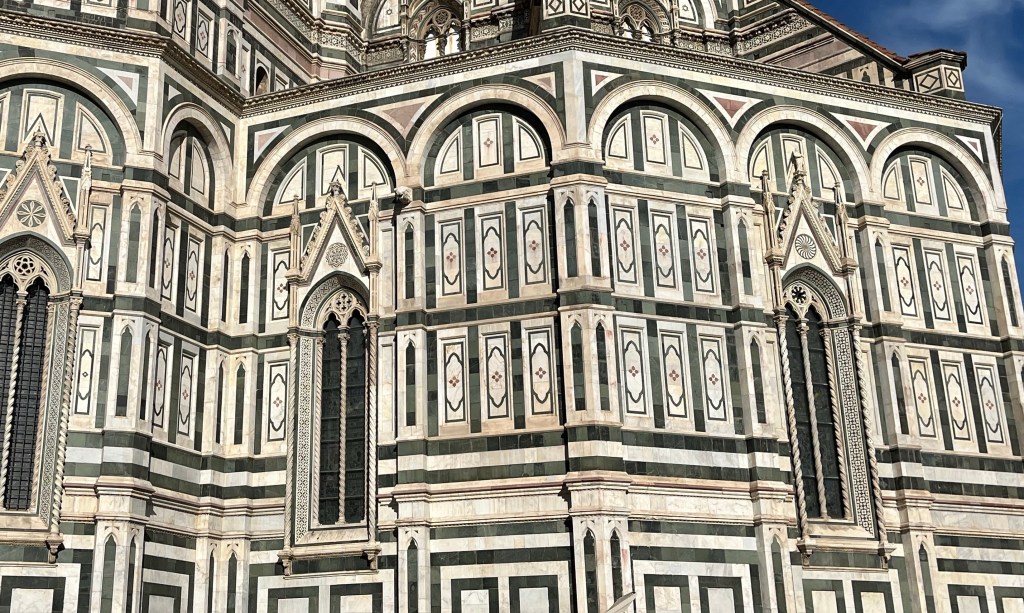
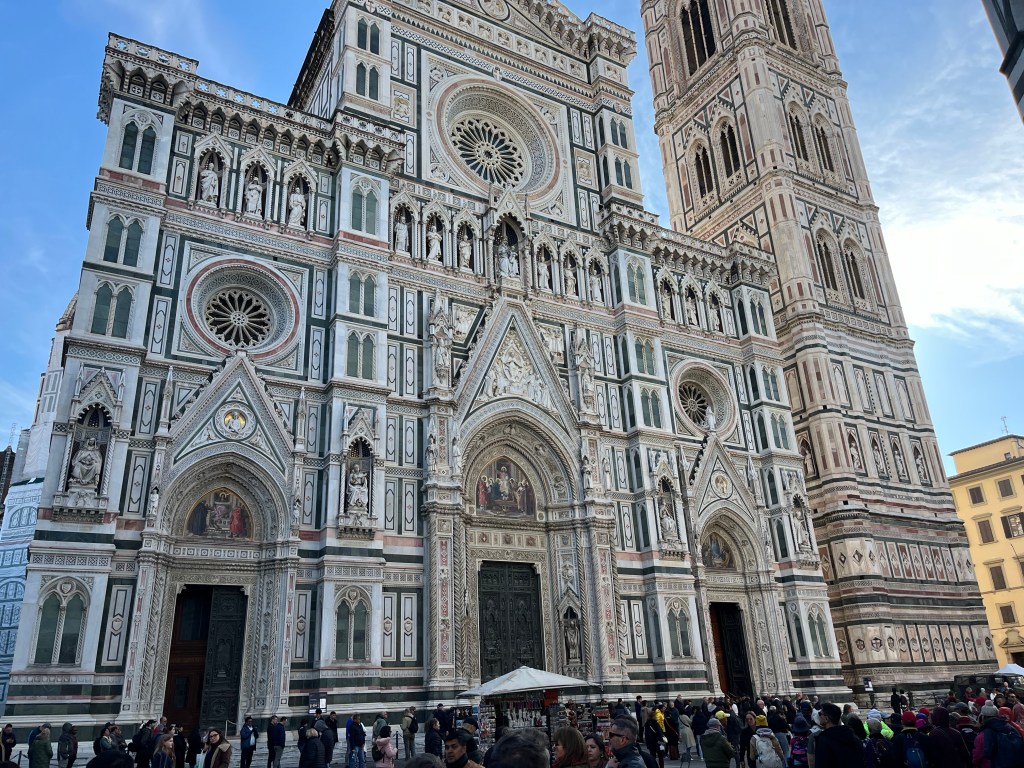
The facade of the Duomo is a striking combination of white, green and pink marble. Interestingly, the exterior is relatively new, with the work having begun on the exterior in 1871 and was completed in 1887. All of the marble was sourced nearby with the white marble being from Carrera, the green marble from Prato and the pink marble from Siena.

The intricate marble design covers the entire exterior of the Duomo

Even though the Baptistry and the Campanile have extremely similar marble exteriors, they had been clad in marble for centuries when the exterior work was done on the Duomo. Because of the similar marble exteriors, the Baptistry, Campanile and the Duomo feel like one cohesive project, but in fact, the Baptistry was completed in 1059 and the Campanile was completed in 1359.

Ticket Options for the Duomo

The Brunelleschi Pass provides access to climb the stairs up to the top of the dome, as well as the bell tower. It also provides access to the museum, the baptistery and the crypt of Santa Raparata. That pass is available at the Duomo website for 30 Euros.

Doors at the entrance to the Duomo

The Giotto Pass provides everything the Brunelleschi Pass provides, except access to the top of the dome. The Giotto pass costs 20 Euros.

The Ghiberti Pass provides access to the Baptistery, the Museum and the Crypt of Santa Reparata. It costs 15 Euro. If you don’t like hiking up a ton of stairs or heights, this might be the option for you.

Countless statues adorn the outside of the Duomo

Because we didn’t have a ton of time in Florence we decided to do none of those things and just walk inside of the Cathedral. This option is completely free and can be done simply by standing in line. Even though the line was long, it moved fairly quickly and we were able to make it inside in about 20 minutes.

It’s Not as Flashy as You would Expect

When you look at the outside of the Duomo, it’s beautiful, but it’s a quite showy. The front of the Duomo has dozens of statues in the facade, along with the three toned marble exterior. The doors, the windows, every single inch of the exterior of the Duomo is intricate.

Stone archways and ribs hold up the impressively high ceiling of the Duomo.

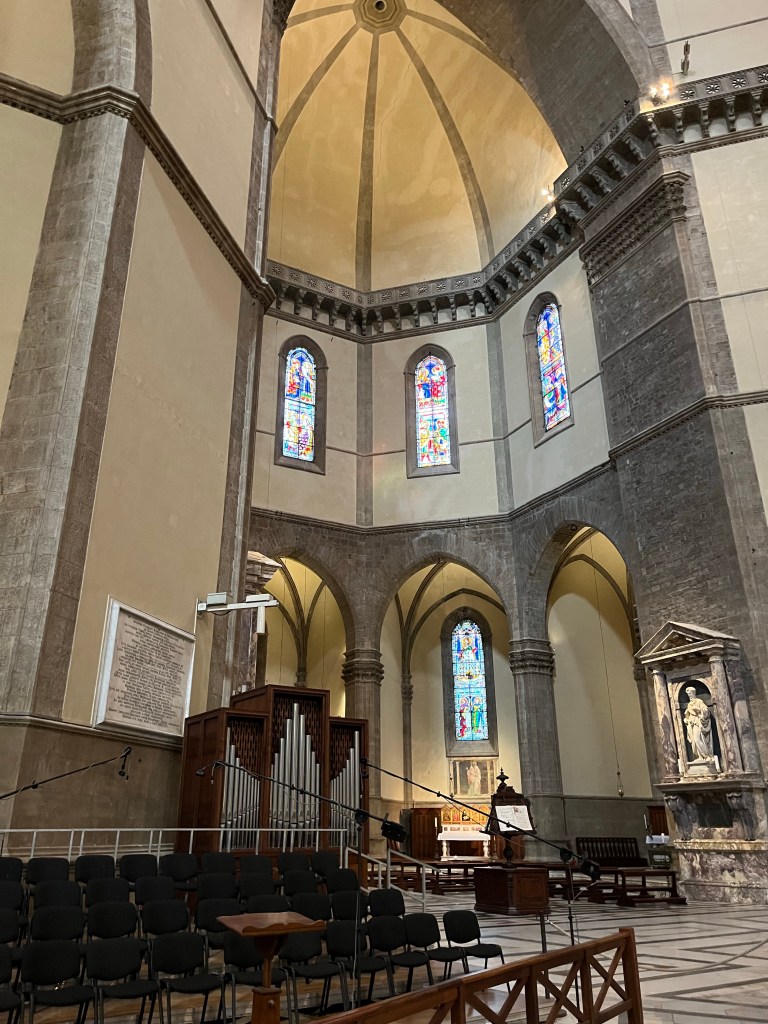
However, once we walked inside, the amount of plain light tan walls everywhere was surprising. The gray stone archways and ribs holding up the high vault ceiling are beautiful, while seeming strangely plain. There are also some beautiful stained glass windows letting light in from the outside.

Choir area to the left of Brunelleschi’s Dome

There are a series of twelve marble statues inside the Duomo, created by a variety of artists in the 16th Century. These are marvelous pieces of art and fairly large. However, because of the size of the Duomo, they aren’t immediately obvious.

Statue of St James

Compared to many of the churches and cathedrals that I’ve visited, the inside of the Duomo seemed understated. I think that’s what I liked so much about it. From the outside, every inch of the exterior is covered with an elaborate marble cladding. The front of the Duomo has statues everywhere and the doors are enormous and elaborate.

Tapestries in outer aisle

But inside, it’s beauty is in the relative simplicity. Sure there are still stained glass windows, statues and tapestries, but when taking it in as a whole, those things complement the cathedral well instead of overwhelm it.

Statue of Pope Eugene IV on the front of the Duomo

The one element of the inside of the cathedral that is a bit showy is the painting of the Last Judgement in Brunelleschi’s Dome. However, you need to position yourself underneath it in order to view it. You would never see it while seated in a pew during Mass.

Brunelleschi’s Dome

It’s actually a perfect example of the purpose of a Cathedral. For the citizens of Florence, this is the center of their community, it is a source of their pride. The exterior shows off the craftsmanship and labor of centuries of artists, artisans and laborers. But the inside, that’s for worship. Despite, the frescoes and the statues, the focus is most definitely on the altar and the priest performing Mass and ultimately that is the most important function of a Cathedral.

Exploring Vernazza: A Seaside Gem in Cinque Terre

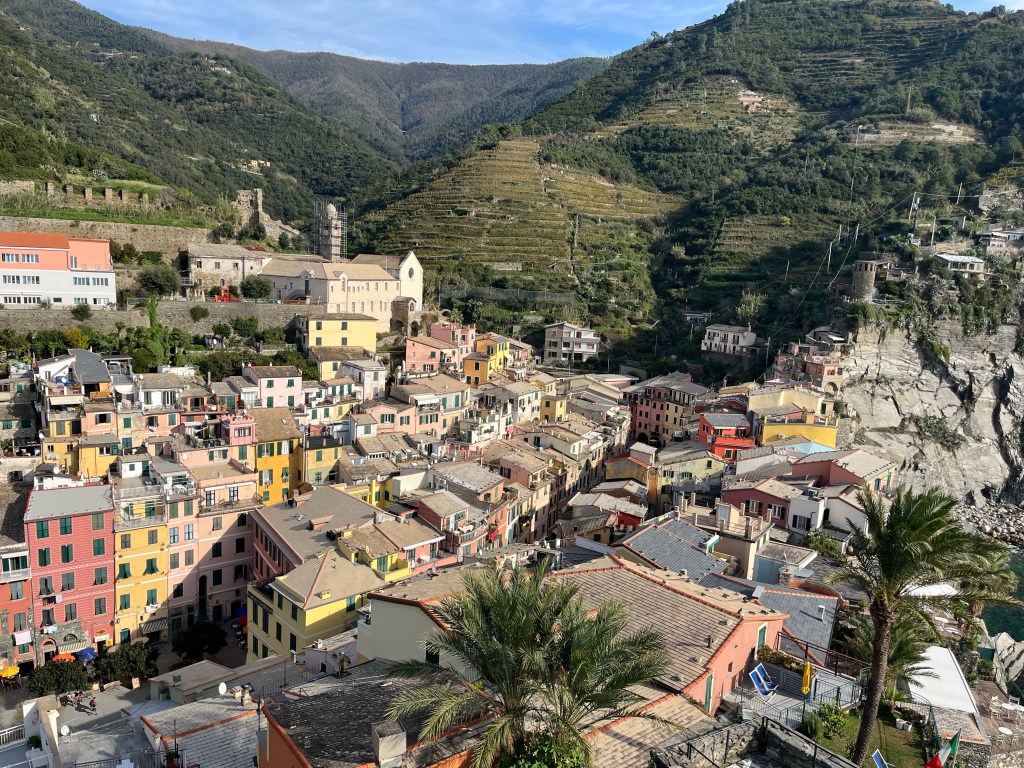
Vernazza is a gorgeous village along the coast in the Liguria Region of Italy. It is one of the five towns that make up Cinque Terre which is both an Italian national park and a UNESCO world heritage site. It has a population of about 700 and dates back almost a thousand years. Traditionally, Vernazza was a town that relied upon fishing, olive oil and wine production. Although those industries still exist today, Vernazza is now mostly a tourist destination.

Vernazza from Doria Tower

Getting to Vernazza

The only practical way to get to Vernazza is by train. Technically you can drive to Vernazza, but it takes twice as long and parking would be a challenge. To enter Cinque Terre National Park, you must enter the park through La Spezia on the south end of the park or Lavanto on the north end. You can buy a day pass for unlimited rides on the Cinque Terre Express in either of those towns. You can also buy them through the Trenitalia app.

Buildings were built into the hillside in Vernazza.

During high season (basically April through October), trains run every 20 minutes. During the off season, they run either every 30 or 60 minutes. You should keep a general idea of when the next train will arrive so that you don’t find yourself waiting too long for a train between towns.

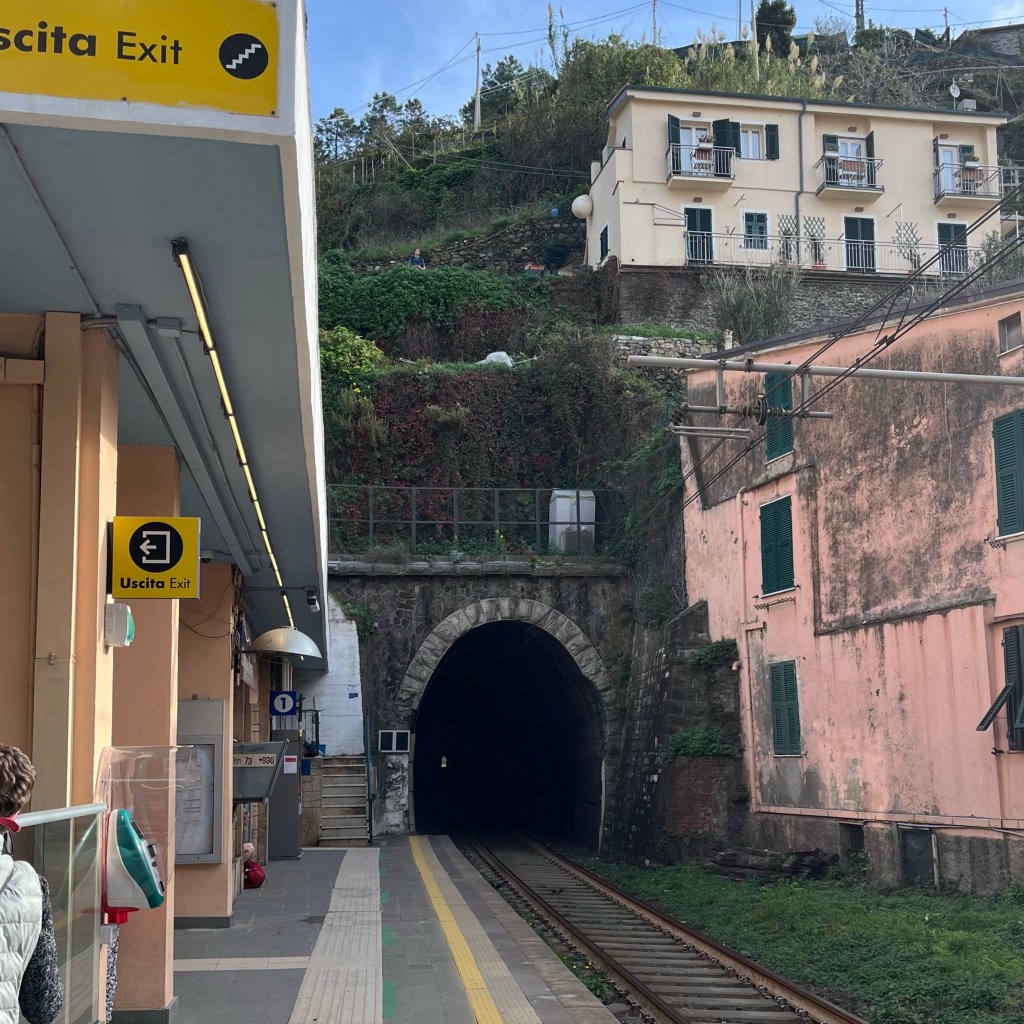
Tunnel at Vernazza Train Station

For up to date timetable and prices for the trains in Cinque Terre, visit the official website.

Experiencing Vernazza

The Cinque Terre Express lets off right in the middle of the town. From the moment you descend from the train platform, you are surrounded by four story buildings on either side and terraced vineyards behind you. In front is Via Roma, the main road through Vernazza that slowly descends into the Ligurian Sea.

Via Roma Vernazza

Walking down Via Roma, there are restaurants and gelato shops on both sides. What caught my eye was the focaccia shops. Who doesn’t love focaccia after all?

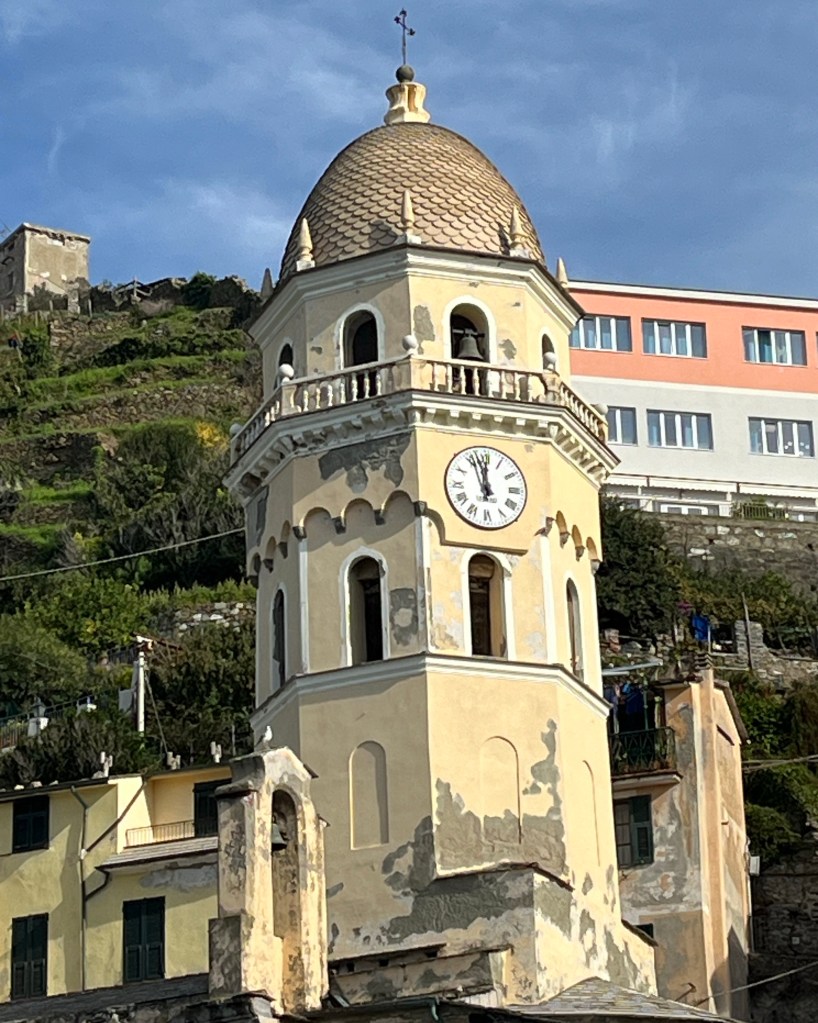
Bell Tower at Chiesa di Santa Margherita d’Antiochia

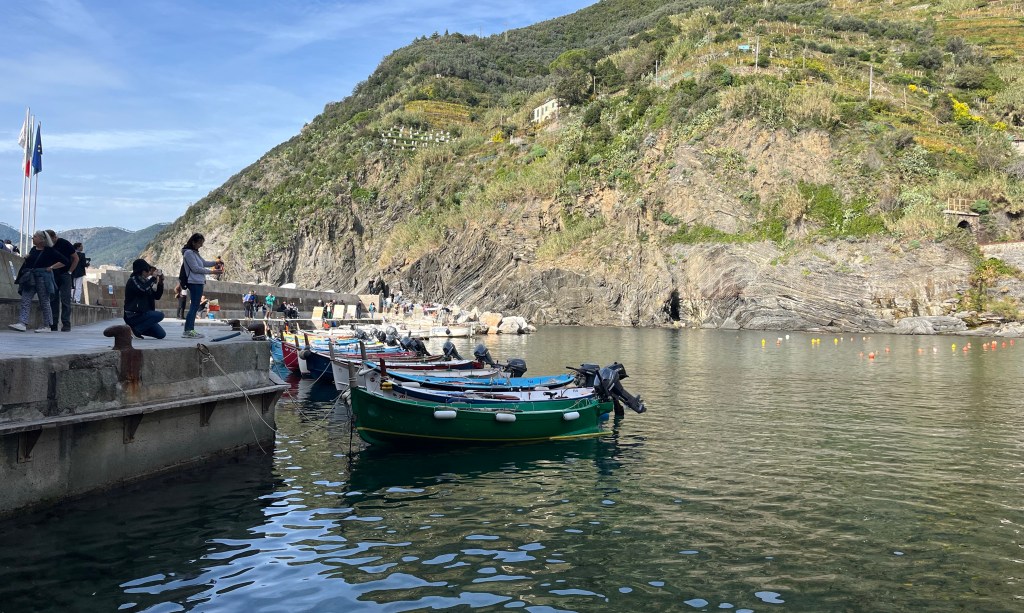
It doesn’t take too much of a walk down Via Roma before you reach the harbor which is the centerpiece of the town. There are no large boats in the marina, it’s mostly just small fishing boats.
Boats in the marina in Vernazza

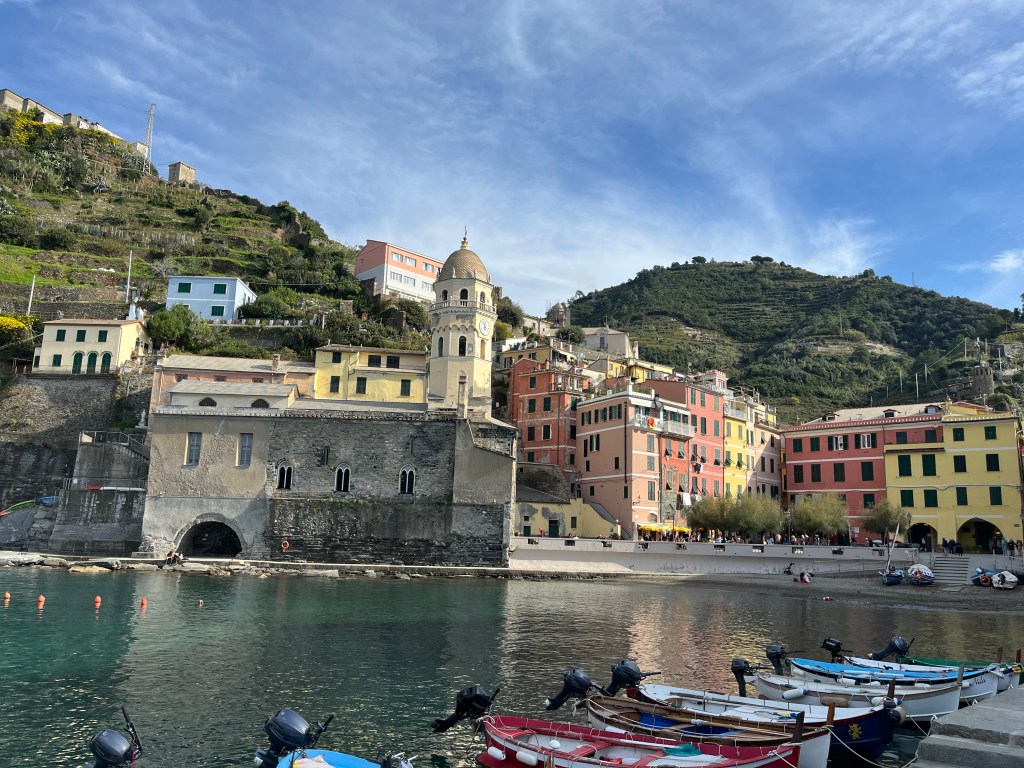
Directly in front of the marina is a plaza lined with restaurants, bars and shops. To the right is a church from the middle ages called Chiesa di Santa Margherita d’Antiochi. In the front of the plaza is a small beach and to the left is a walkway on the wing dam that protects the harbor. The boats are tied to the walkway on the wing dam.
Doria Tower

Standing in the plaza by the marina, I noticed a sign pointing up an alley that said something about a castle and I was curious. Four of us decided to find out what that was so we walked up a lot of steps through the alleyway and ended up at a ticket booth where a guy was selling entrance tickets to Castle Doria for 2 euros. We paid the two Euros and proceeded up into the castle.

View of Vernazza from top of Doria Tower

The castle itself isn’t terribly impressive other than its location. It is built in the 11th Century as a defense against pirates. It was last used during World War II, when the Germans stationed anti-aircraft weapons there.

View of Monterosso from Doria Tower

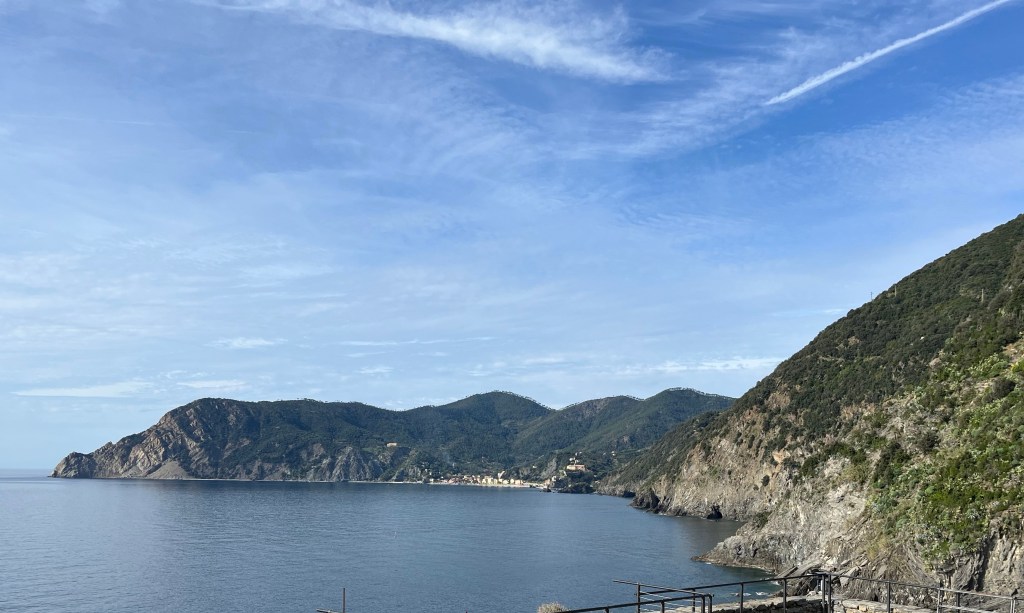
It mostly consists of a single tower and a stone platform. What makes it great is that it is perched on the side of the cliff next to Vernazza and makes for tremendous views. It not only provides a great view of Vernazza but you can also see Monterosso when looking North along the coast.

Chiesa Di Santa Margherita D’Antiochia

Following our trek to the top of Doria Tower, we walked across the plaza by the marina to take a look inside the Chiesa di Santa Margherita d’Antiochia.

Chiesa di Santa Margherita di Antiochia

The Chiesa di Santa Margherita D’Antiochia is a church built sometime around 1,300 AD. It is built directly on the marina in Vernazza. The church has gone through a series of renovations over the years, but still maintains a fairly rustic feel.

Chiesa di Santa Margarita di Antiochia

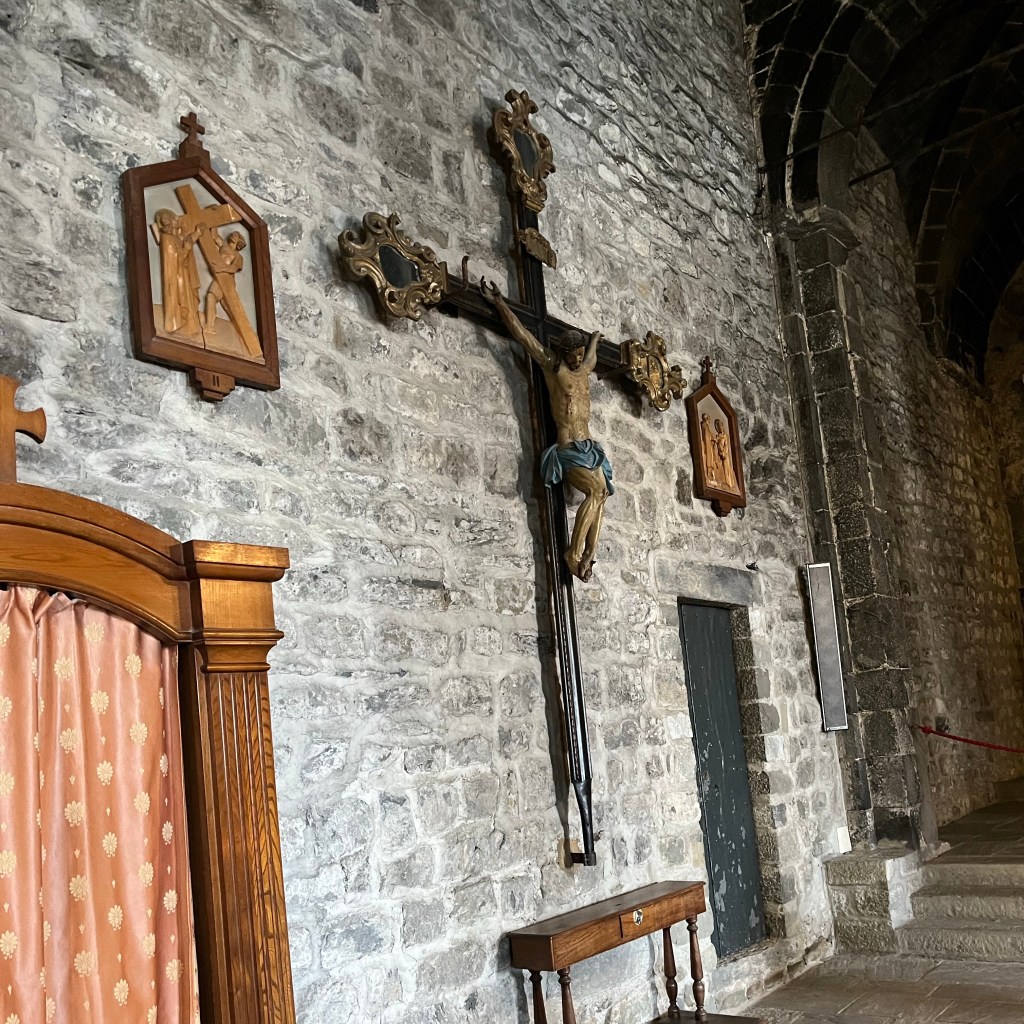
What I love about this church is the stone walls and the large stone archways holding up the wooden ceiling. I think the thing that is most striking about the church is what it lacks. You won’t see any of the giant stained glass windows, frescoes and statues that are so typical of European cathedrals and churches.

Crucifix at Chiesa do Santa Margherita D’Antiochia

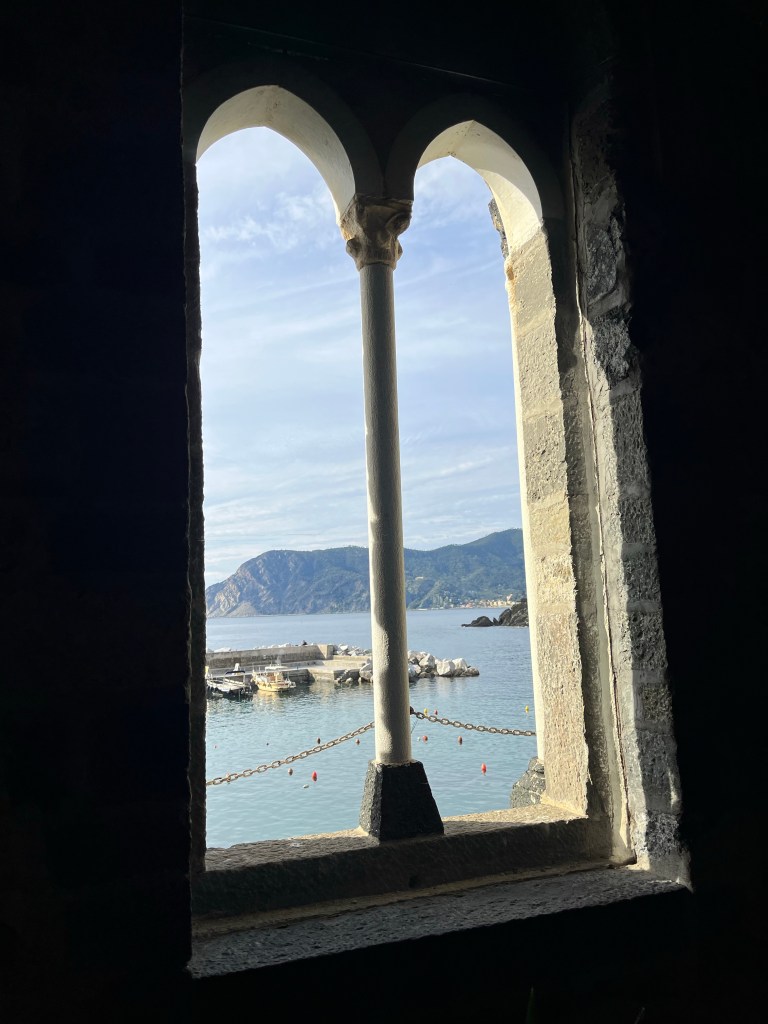
What you do notice are some plain crucifixes, some small shrines, and a fairly basic altar. There are some plain wooden pews lined in rows on a stone floor. It’s dimly lit and has only a couple of arched window openings, although without glass. It is precisely what I would imagine a pre-renaissance church to be like. It was truly a treat to visit.

Windows at Chiesa di Santa Margarita di Antiochia

Leaving too Early

After visiting the church, we stopped in for a drink at a bar by the marina. We took a table in the plaza and it was an lovely day to do so. Even though it was in November, the temperature was in the mid-60s, the sun was shining and there was very little wind. It was an ideal day to sit and enjoy a beer. We also snacked on some fried frutti di mare, which had a variety of fried octopus, squid, crab, and fish served like street food in a paper cup from one of the local shops.

After the drink and a snack we decided that we wanted to go to Monterosso for lunch so we hopped on the train to go there. That turned out to be something that we regretted a little. Monterosso is a bit of a beach town and I think visiting it in November probably isn’t seeing it when it’s at its best. Its lovely but in the end it just didn’t seem to have the same charm as Vernazza, and we quickly started to wish we had stayed a little longer in Vernazza.

Cinque Terre Should Be More Than A Day Trip

We only had three full days in Florence and we devoted one of those days to this day trip to Cinque Terre. I’m glad we went, but in the end, I think we really need to devote three days to Cinque Terre to fully appreciate it. We only visited two of the five towns and it felt rushed.

Hillside Vineyards overlook the marina in Vernazza

There is an old trail that connects the five towns and I would love to spend three days hiking between the towns and really getting to know each town more than what you can in just a few hours. Each town has it’s own unique character and breathtaking views of the Ligurian Sea.
If you plan to visit Cinque Terre, but you only have a single day, I would suggest that you pick just one town and really enjoy as much as you can. I thought Vernazza was a beautiful place, and would be a great choice if you were going to select just one town.

Cinque Terre itself, however, is one of those bucket list locations that any world traveler should visit. The old world charm, the beauty, and the fact that these amazing towns are precariously perched on hillsides overlooking the Mediterranean Sea demonstrate why this area is both a National Park and a UNESCO world heritage site. It’s just an amazing place to visit and I can’t wait to return.

Mercato Centrale in Florence is Fantastic!

We usually make it a point to visit a local market when we are traveling. For example, we’ve visited the Viktualienmarkt in Munich, the farmer’s market in Grecia Costa Rica and the St. Lawrence Market in Toronto. Of all of the markets that we’ve visited, Mercato Centrale in Florence is my favorite. If you’re planning to spend some time in Florence, this needs to be one of your stops.

Second Level of Mercato Centrale

Where is Mercato Centrale?

Mercato Centrale is about a 5 minute walk northwest of the Duomo in Florence. It’s also about a 5-10 minute walk east on Via Nationale from Santa Maria Novella Train Station.

Just outside of the Mercato Centrale is San Lorenzo Market. This market surrounds Mercato Centrale on three sides. It consists of leather vendors selling jackets, backpacks, purses and belts. These vendors tend to get a little aggressive as you’re walking through, but not too aggressive. From what I can tell, and I’m no expert, but the leather vendors appear to be primarily selling high quality leather goods made in Italy.

The Ground Floor is for High Quality Groceries

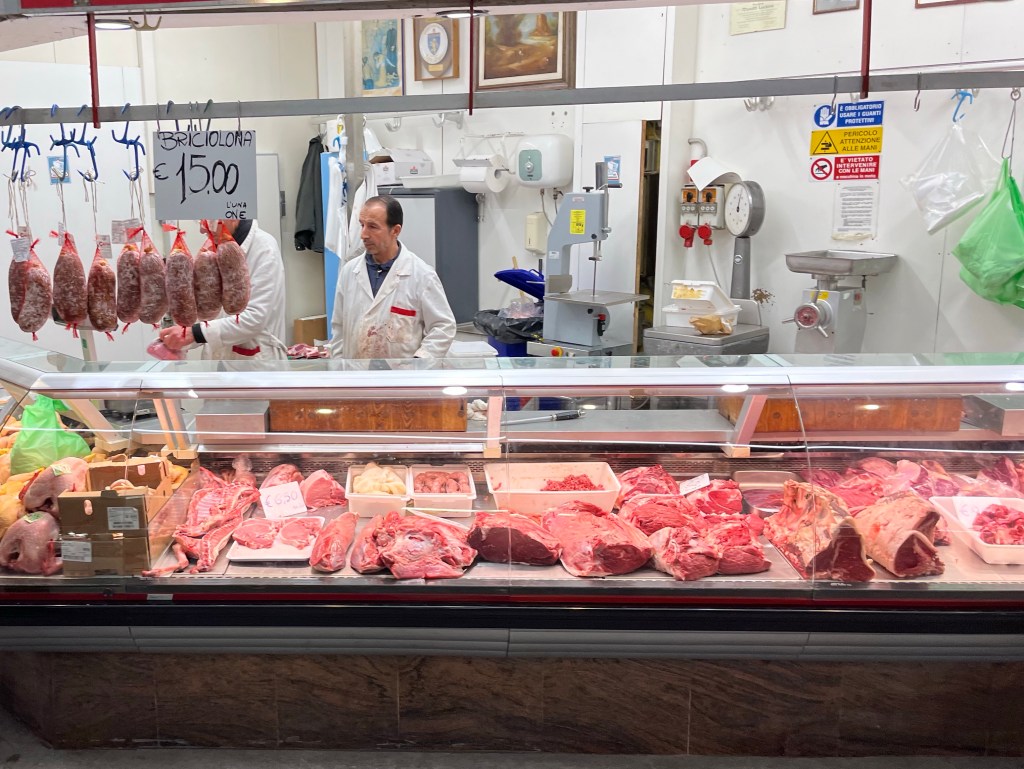
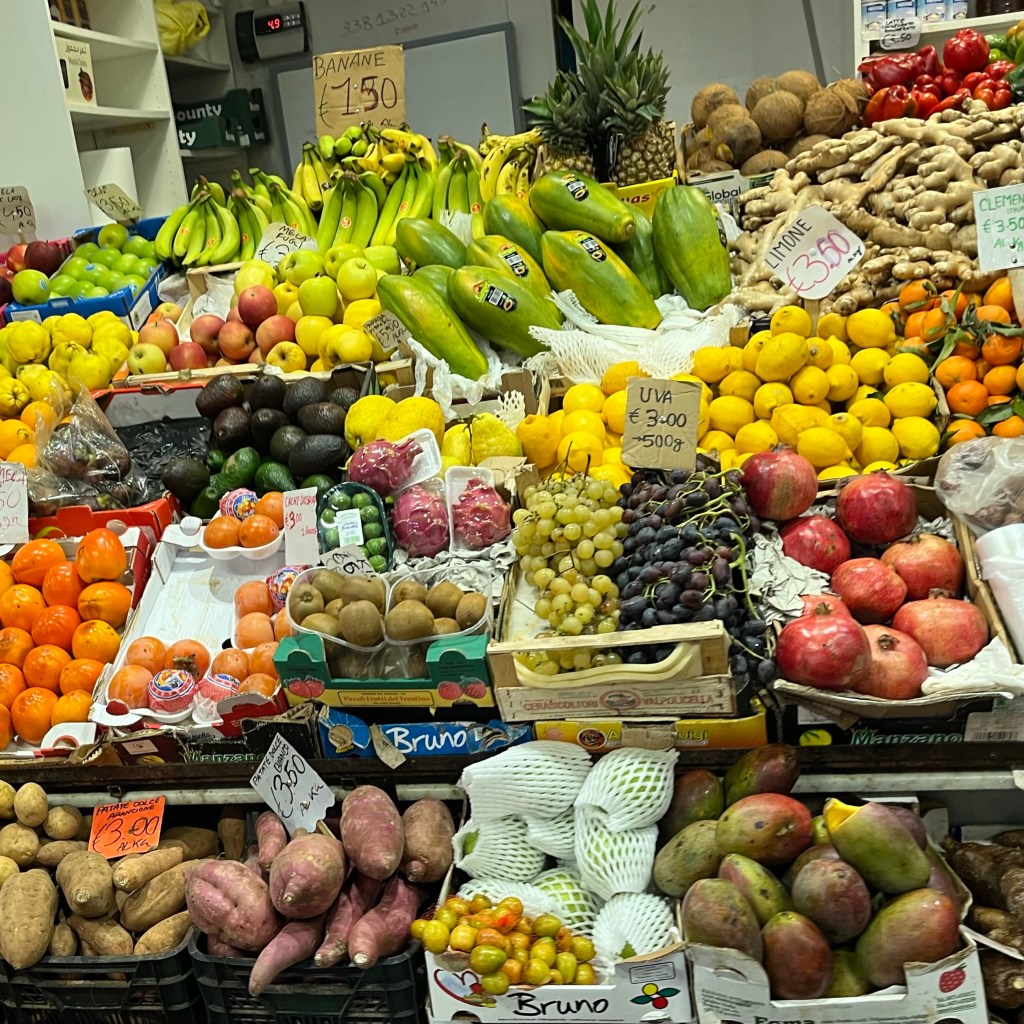
You will have to go through San Lorenzo Market to get into the Mercato Centrale building. The building is a huge two story iron and glass building with massive amounts of space for a variety of vendors. On the ground floor there are fishmongers, butchers and produce vendors as well as specialty stalls selling wine, olive oil and balsamic vinegar.

Unless you’re visiting Florence for a long period of time, and will be buying some groceries for your Airbnb, this area won’t be that useful. It is, however, fascinating to see the kinds of fresh fish, meats and produce that are available in the market. Fishmongers sell a variety of fish, as well as prawns, octopus, and clams.

Some of the available fish at a Fishmonger stall

The butchers, of course, are ready to cut meat to order. As a tourist, however, you might be more interested in picking up some cured meat that you will see hanging from the top of many of the stalls. You will also find cheesemakers in the market selling a variety of cheeses that are local to Tuscany. If you pick up a baguette from a baker at the market you can probably put together one of the best sandwiches you’ve ever made. By the way, if you have a long train ride out of Florence, putting together some sandwiches for the trip can make that train ride extra enjoyable.

Butcher at Mercato Centrale

If you’re bringing a checked bag, and would like to bring a bottle of wine home, I would suggest checking out the wine shop. Any wines that are truly local will be marked with a designation of DOC or DOCG. DOC stands for Denominazione di Origine Controllata which basically just means that it’s up to quality standards for a wine of that region. DOCG essentially means the same thing but it adds ‘Garantita’ (guaranteed) to the end meaning that it has higher standards than DOC. Also, if you don’t have room in your checked bag, you can always just drink a bottle or two, no one’s stopping you, you are in Florence after all.

Produce Vendor at Mercato Centrale

The more likely thing you might want to pack in a checked bag would be balsamic vinegar and olive oil. If you’re used to the olive oil that you find at an American supermarket, Italian olive oil is an eye opener. I’m used to the flavorless olive oil from Aldi, and essentially every restaurant we went to in Italy would have a bottle of olive oil sitting on the table that was just outstanding. People who brag about the quality of olive oil in Italy aren’t lying, seriously, grab a bottle, throw it in your suitcase, you won’t regret it (unless it breaks during the flight of course).

First Floor of Mercato Centrale

The Second Floor is for Prepared Food

All of that being said, we didn’t spend much time on the first floor. We weren’t planning to cook and I didn’t bring a checked bag, so the place that I really loved was the second level.

The second level is primarily devoted to prepared food. It’s a great place to get a snack or a full meal.

Cafeteria seating on the second floor with additional seating on the third floor

The first thing I noticed, and immediately went to, was the bar. I love craft beer, and when you’re in Italy, it’s not the easiest thing to find. However, the bar at the market has a number of beers on tap and even more in the bottle. The owner of the bar does an excellent job of choosing beers that not only cover a variety of styles, but also compliment the prepared food by the other vendors on the second level. He also has chosen beer that is of good very good quality, including some Trappist ales.

Bar at Mercato Centrale

We sat down at one of the tables, and a server came out to take a drink order. I think you can order food from the vendors from the table, but we just chose to get up and look around and order it from the counters. I wanted to get a good look at all of the available food, anyway.

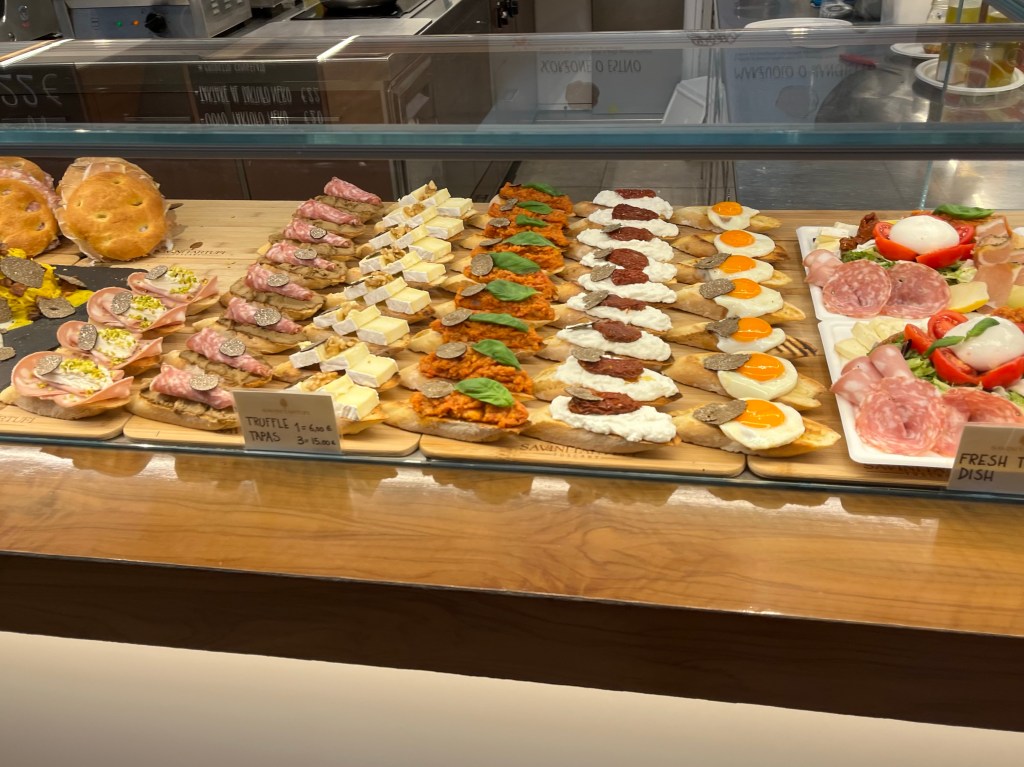
Cicchetti at Mercato Centrale

Scattered around the second level you will find vegan options, sushi, barbecue, and burgers. If you are looking for something a little more Italian, you will find crostini, arancini, and lots of sandwiches made with schiacciata and focaccia.

Sandwiches, Quiche and Baked Goods at Mercato Centrale

We visited the Mercato twice during our trip, and the first time I grabbed an arancini on the way out of the door. It was so good. It had just a little bit of ham and some cheese rolled up in a rice ball and fried. That was the first arancini I had ever tried and after that I was grabbing one wherever I found them.

On the second trip to the market, I grabbed some smaller arancini made with meat and tomato sauce and some fried stuffed olives. They were good as well, but I definitely preferred the arancini with the ham and cheese.

Lorenzo de Medici Cooking School

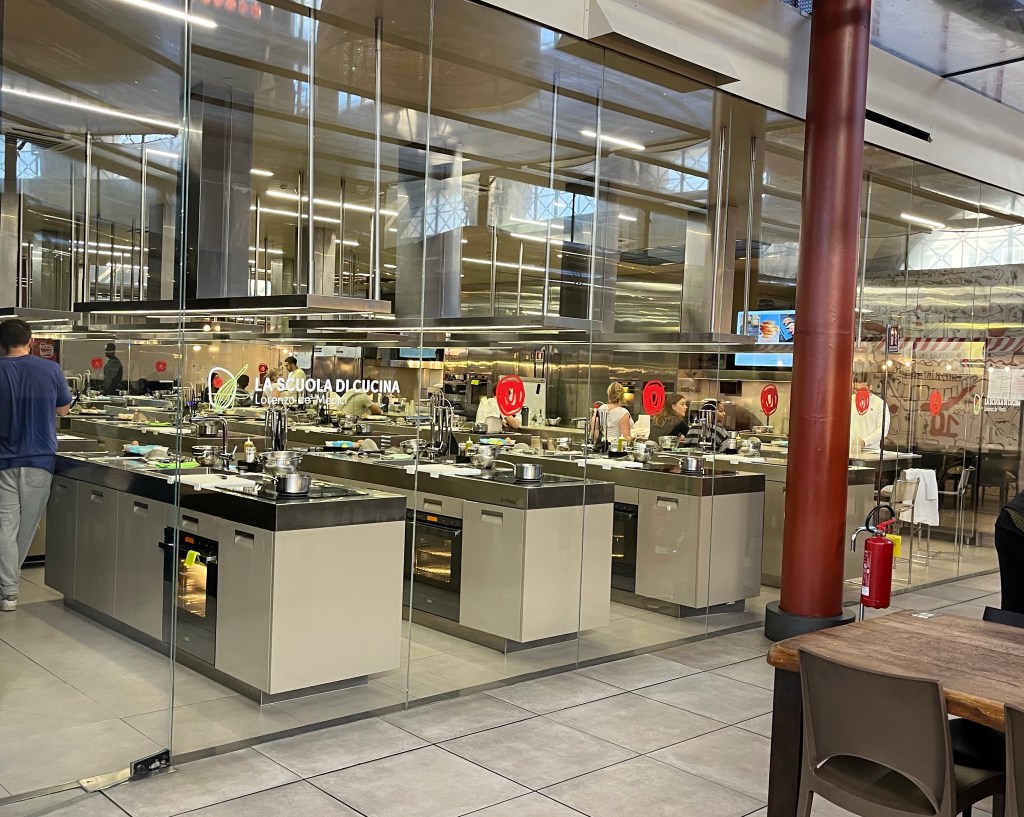
Cooking School at Mercato Centrale

Also on the second floor is the Lorenzo de Medici cooking school. The cooking school offers two hour classes that instruct students on how to make a Italian Dishes. These dishes include pasta, bread, and desserts. Most of the classes cost 80 euros to attend, but some are a little more expensive. A full list of the classes being offered can be found on their website.

Visiting Mercato Centrale is a Must

If you are going to Florence for longer than a couple of days and you love food or wine, you absolutely have to go Mercato Centrale. If you will be in Florence for a week and have access to a kitchen I would absolutely pick up some groceries from the first floor of the market. They are of high quality and you will have an opportunity to talk with the vendors to get some input on how you should use their products.

If you are like us and only have a few days in Florence, you still should go, but the second floor is where you will probably want to spend your time. There is a variety of prepared food that should allow for you to do some taste testing and really try some foods that you might not normally order in a restaurant. And, of course, if you’re a beer lover, you’ll want to check out the bar. It’s got a great selection of beer and will be a nice change of pace from all of the Italian pilsners that you’ll drink while in Italy.

Also, if you have time, you might want to check out the cooking school. If we had been in Florence longer than three days, I might’ve done a class. Who doesn’t want to learn to cook like an Italian after all?

A Wonderful Walk to Trevi Fountain

One of the main landmarks that we wanted to see while in Rome was Trevi Fountain. It was a good 40 minute walk from the Airbnb, which made it tempting to just grab an Uber to drive us there, but that’s not really what you want to do while in Rome, is it? The temperature was predicted to reach 107 degrees Fahrenheit that day, so walking did seem a little dangerous, but there’s plenty to drink on the way there. It was the right decision because the walk, as usual, was the best part.

View of the Castel Sant’Angelo from the Tiber River, a nearly 2,000 year old mausoleum finished in AD 139. It houses the ashes of the Emperor Hadrian.

We started our trek by leaving the Trastavere neighborhood just south of the Vatican and walking through a tunnel under the Pontifical Urban University. Once we left the tunnel, the Tiber was in view. Crossing the Tiber on the Ponte Principe Amedeo Savioa Aosta bridge, a beautiful view of the Ponte Vittoro Emanuele II bridge with the Castel Sant’Angelo in the background emerged. Once you cross that bridge into the Old Rome neighborhood, there is no denying the beauty and history of Rome.

We headed down the Via de Coronari, a narrow road only really appropriate for pedestrians. The narrow cobblestone road is about the size of an American alley. It’s lined with shops, cafes, restaurants and art galleries. It has a wonderful charm with planters along the sides and folks eating gelato.

A view of Piazza Navona with a quick Peroni to start off the journey.

We were looking for something to drink as it was already 106 degrees Fahrenheit and found just the place in Piazza Navona. We stopped for a quick drink and walked around the Piazza for a few moments before returning to our trek to Trevi Fountain.

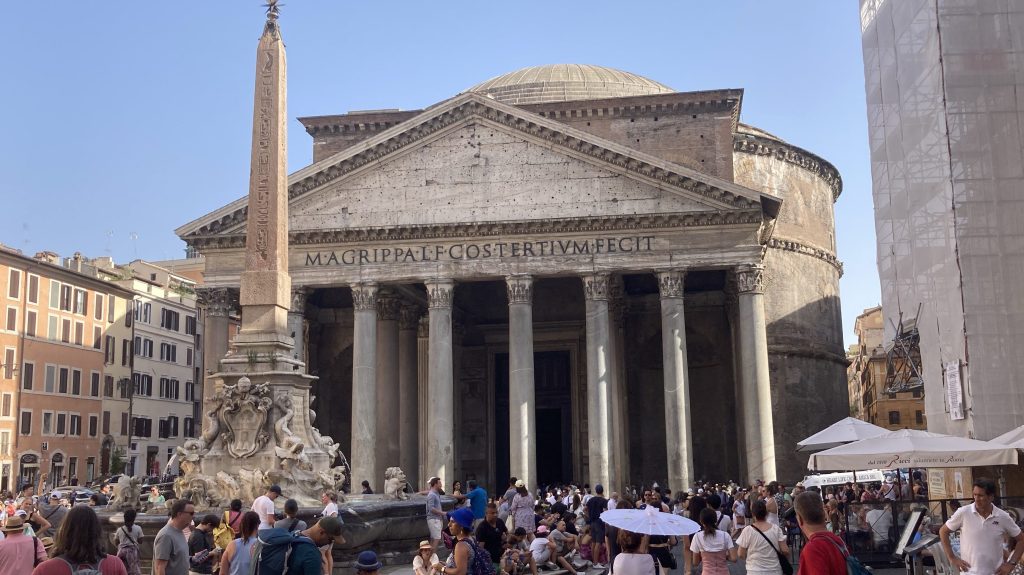
The Pantheon was completed in AD 126 under the direction of the Emperor Hadrian.

While most of what we came across was accidental, including Piazza Navona, I deliberately went a few blocks out of the way to visit the Pantheon. The Pantheon has an enormous concrete dome and was built nearly 2,000 years ago during the reign of Hadrian. It was built as a temple to all the gods, but in the 7th century was reinvented as a church to St. Mary and the martyrs. It’s an absolute wonder of structural engineering and it still stands as the largest concrete dome in the world.

Without the portico at the entrance, I think the Pantheon would look rather strange.

We didn’t walk into the Pantheon. I would have loved to but the lines looked long and we didn’t have an unlimited amount of time. To be honest, Rome is so filled with history that if we stopped to take time at every amazing or historical place, we wouldn’t have made it more than a couple of blocks.

This is, by far, the most beautiful donut I have ever eaten.

Shortly after the Pantheon, we stopped by a pastry shop, with the idea of getting a pistachio cannoli. Somehow, I said the wrong thing and ended up with a donut filled with pistachio cream. It wasn’t what I wanted but it was delicious.

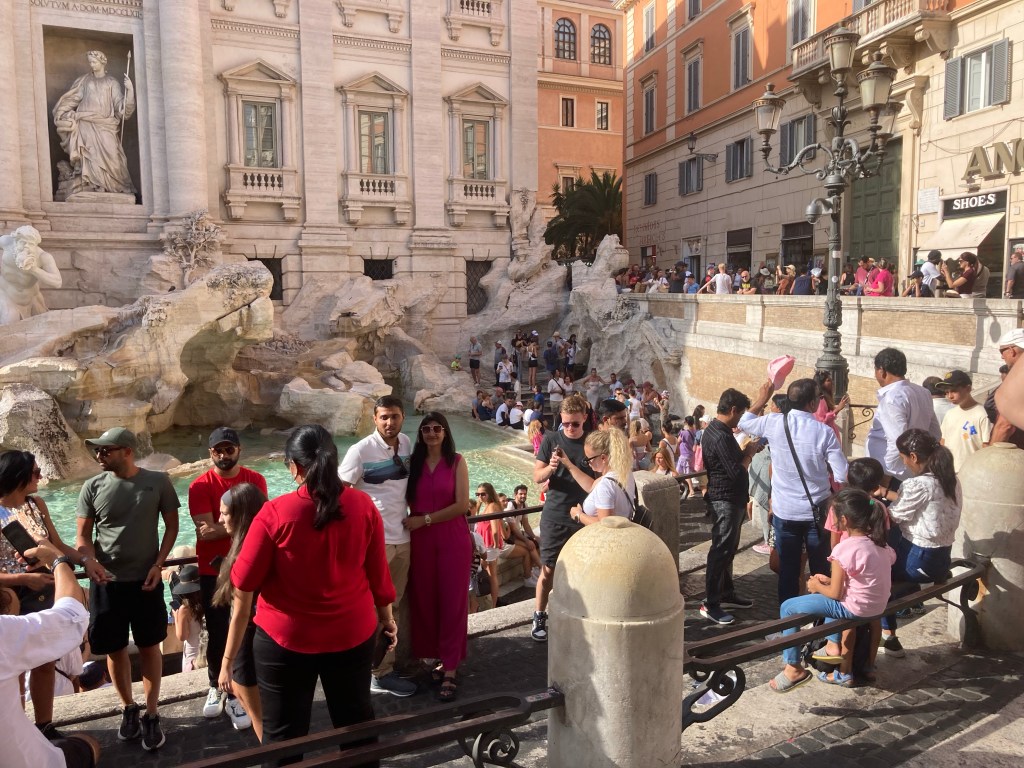
There are cascading levels with benches heading down to the fountain similar to a small theatre.

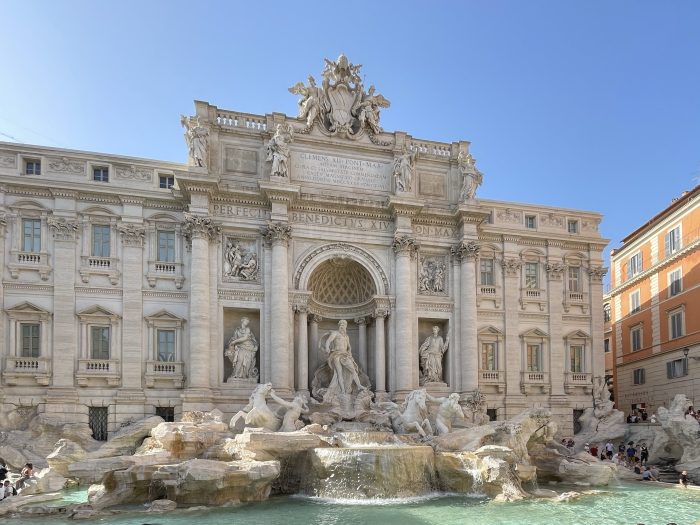
After all of our distractions, we managed to make our way to Trevi Fountain. It is every bit as beautiful as you would expect and even more crowded than I expected.

Trevi Fountain sits at one of the terminuses of the Virgin Waters aqueduct that carries water from the Alban Hills outside of Rome.

Trevi Fountain was completed in 1762 by Architect Guiseppe Pannini after being left half completed by the original architect Nicola Salvi who died in 1751. It was built at the end of one of the aqueducts that supplied Rome with water. It is made mostly of travertine stone.

The stone needed for Trevi Fountain was quarried from Tivoli, located in the hills to the east of Rome.

I can only imagine just how serene this must seem when it’s not wall to wall people, but obviously this was not the case in the middle of tourist season.

Four artists are responsible for the sculptures as well as two architects.

Across from Trevi Fountain is a beautiful Catholic Church named Santi Vincenzo e Anastasio a Fontana di Trevi. It’s a baroque church completed in 1650. Also nearby Trevi Fountain is a United Colors of Benetton which annoyed Jenn by its proximity to Trevi – hey I guess Romans like to shop for overpriced chinos close to beautiful monuments.

Santi Vincenzo e Anastasio a Fontana di Trevi Catholic Church

On our way back, we got some macaroons from Don Nino. I wish I could tell you if they were good or not, but we never actually had a chance to eat them. We ended up leaving them somewhere when we either stopped for dinner or a drink. They did look really good though.

Someday we’ll have to come back here and actually eat the macaroons instead of just buying them and depositing them in a random location.

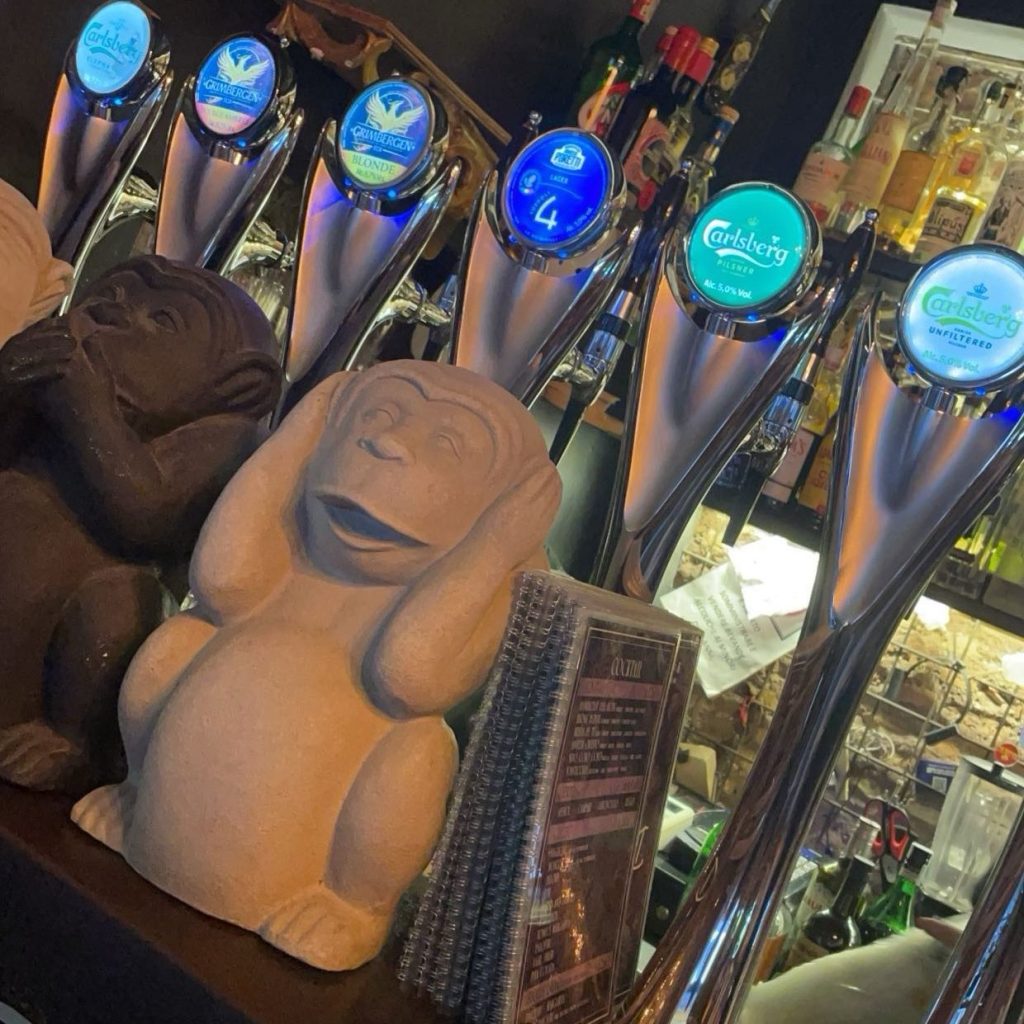
We stopped in for a quick carry out beer at Drink Art Gallery, where I’m pretty sure I got a Carlsbad beer which seemed pretty forgettable, but the bar seemed pretty cool.

These monkeys won’t talk about how many beers I drank and don’t want to hear any more of my stories.

I really enjoyed the narrow roads where all of these nice bars and restaurants were located. It made for a calm, yet beautiful and interesting walk.

Narrow cobblestone roads are the best roads. Also, that’s a McDonald’s there! If you stop at McDonald’s in Rome you are completely incapable of making rational decisions and need to sign over a Power of Attorney to someone who can.

We also stopped at a rooftop bar called La Terrazza del Cèsari where Jenn was introduced to unpitted green olives. She loved the olives but hated the extra effort involved. The sun was unrelenting up there and we quickly finished up our drinks and left. It was beautiful, but not the best place to be when its hot.

La Terrazza del Cèsari has a view of the Temple of Hadrian and a lot of roofing tiles.

We also managed to stop for a quick drink at some sports bar called La Botticella of Poggo Giovanni, you know, typical sports bar name. They had a lot of Steelers memorabilia, which checks out, because Steelers fans will live anywhere except Pittsburgh. All joking aside, that bar had a great beer selection and if we weren’t essentially on a pub crawl at this point, I would’ve liked to stay longer.

A little scrabble graffiti by https://www.wordsbywabisabi.com
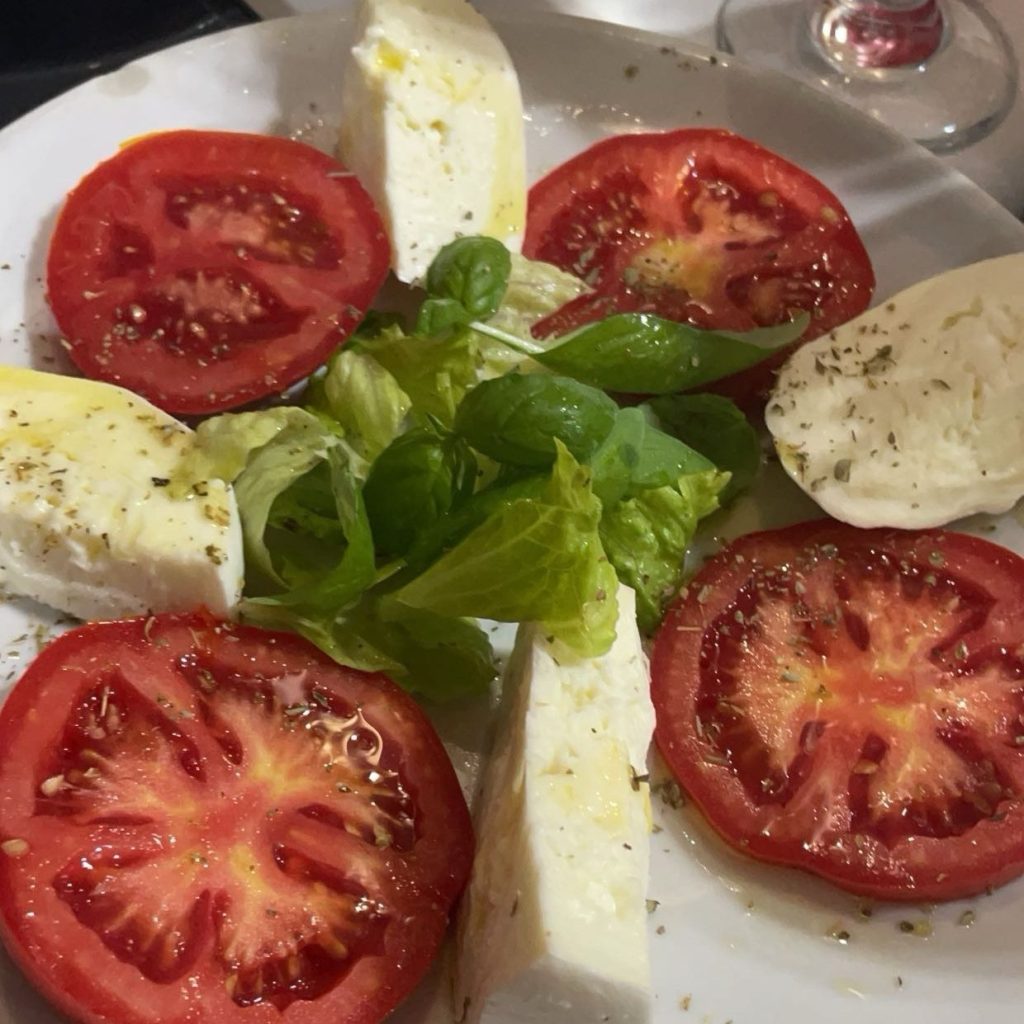
Caprese – simple and so good

We finished the evening with some pasta and antipasti from Ristorante Pizzeria Castello on Via Della Fornaci in the neighborhood where our Airbnb was. It was still really hot and the only available table was inside which was uncomfortable but the food was amazing. We had caprese, pesto pasta and cacio de pepe. Everything was typically Italian, simple, beautiful and perfectly prepared. We finished with a shot of limoncello that apparently I forgot about until I made a comment to Jenn about never trying limoncello and she laughed at me and said “Yeah, ya did.” Maybe it was delicious, I don’t know.

Cacio de Pepe pasta – I still have dreams about this pasta

This was one of my favorite days of our vacation. I honestly didn’t want to leave the air conditioned Airbnb because I knew just how hot it was going to be. We spent the morning at the Vatican and the afternoon on a nice walk to Trevi Fountain. The walk was great because we took our time and when we wanted to check out a bar, restaurant or shop, we stopped. We allowed the city to guide us instead of having a preprogrammed set of things we needed to see. I lost 10 pounds from sweating, but it was great.