Vatican Museums and Sistine Chapel

Once we decided that we were going to Rome, I knew that I wanted to visit the Sistine Chapel. It’s one of those bucket list items that so many people have to check off. My son Alex wanted to visit the Vatican City, but for a different reason – he just wanted to go to the smallest country in the world. We ended up in an Airbnb less than a mile away from the Vatican, so obviously we were going.

Approaching the colonnades in St Peter’s Square

I ended up having to buy one of those “skip the line” tickets off of an online reseller since the tickets that were sold directly from the Vatican website were gone immediately. Honestly, I tried to buy them the day they were made available and they were gone before I could buy them. It was like Taylor Swift was the Pope or something. I ended up spending more than twice the original ticket price from on online reseller which, of course, feels ridiculous for museum tickets. The tickets are $17 for adults and $8 for children through the Vatican website, but we ended up spending about $120 for 2 children and 2 adults instead of the $50 it would have cost directly. I had to search pretty hard to get those prices, a quick search on Viator will show that people are charging between $35 to $100 per ticket which is quite a markup from $17.

My desire to visit the Sistine Chapel had developed because I had grown up during the restoration of Michelangelo’s paintings in the chapel that took place between 1980 and 1994. I remember watching a PBS special about it in one of my classes in High School. It had been in the news a lot because it was weirdly controversial, with a lot of people thinking that the restoration had left the paintings brighter than they were originally. Strangely no one took high resolution photos of the Chapel in the 16th Century when it completed, so it’s really just a bunch of blow hard art critics yelling at each other.
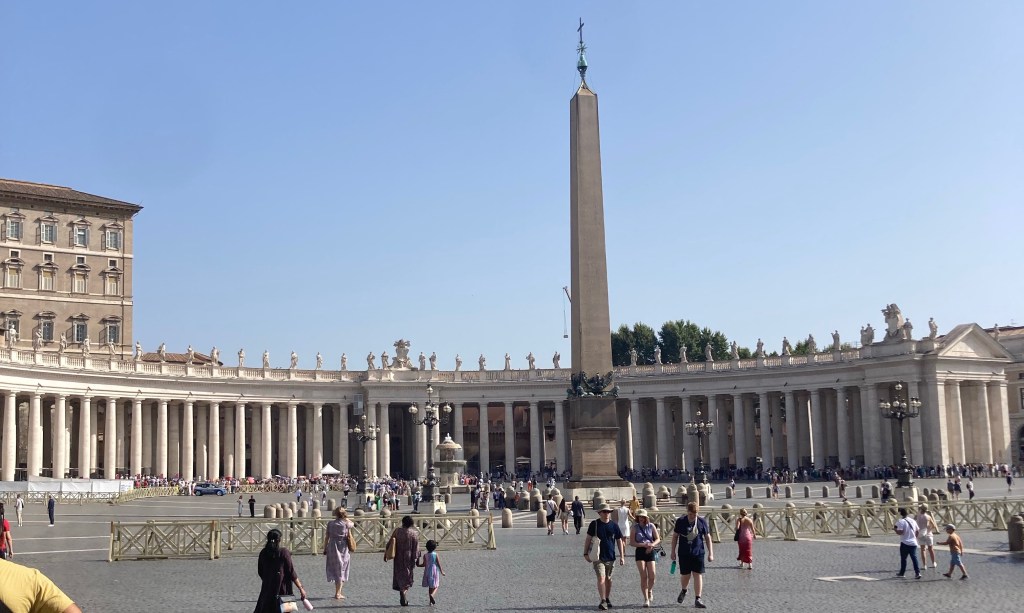
St Peter‘s Square

There was also a great episode of Animaniacs from 1993 called “Hooked on a Ceiling” where Yakko, Wacko and Dot helped Michelangelo paint the ceiling of the Sistine Chapel. It featured a number of great lines including when Yakko said to Michelangelo “Wait a minute, you expect poor innocent children to climb up that dangerous scaffolding and paint naked people all over a church? We’ll do it!” Ok, to be honest, I was probably more influenced by the Animaniacs than by PBS, but either way I was pretty excited to visit.

One of the two fountains in St Peter‘s Square

The neighborhood we stayed in was just south of the Vatican and we were able to get there by simply walking up the street. Walking into St Peter‘ Square you become almost overwhelmed by the nature of it. Colonnades line the plaza and give it its distinct shape. An Egyptian obelisk sits in the center with two fountains on either side. The plaza itself is mostly empty due to its function of being a location for the Pope to give his blessing. It’s a serene and beautiful place.

Angels Unaware – a bronze statue commemorating 105th World Migrant and Refugee Day in 2019. Artist Timothy Schmalz

I didn’t really think it would be difficult to find the entrance to the Vatican Museums, so I didn’t research it. Instead, I just assumed that we would be able to see where it was from St Peter’s Square, which turned out to be very, very wrong. It’s actually a little over a kilometer walk from the Square, and it felt the whole time that we were lost since much of the walk was outside of the Vatican walls. Once we saw the lines we knew we were heading in the right direction, but I was starting to get worried that we would miss our time slot. Once we finally got to where we were going and traded our reservation for tickets we made it into the Museums.
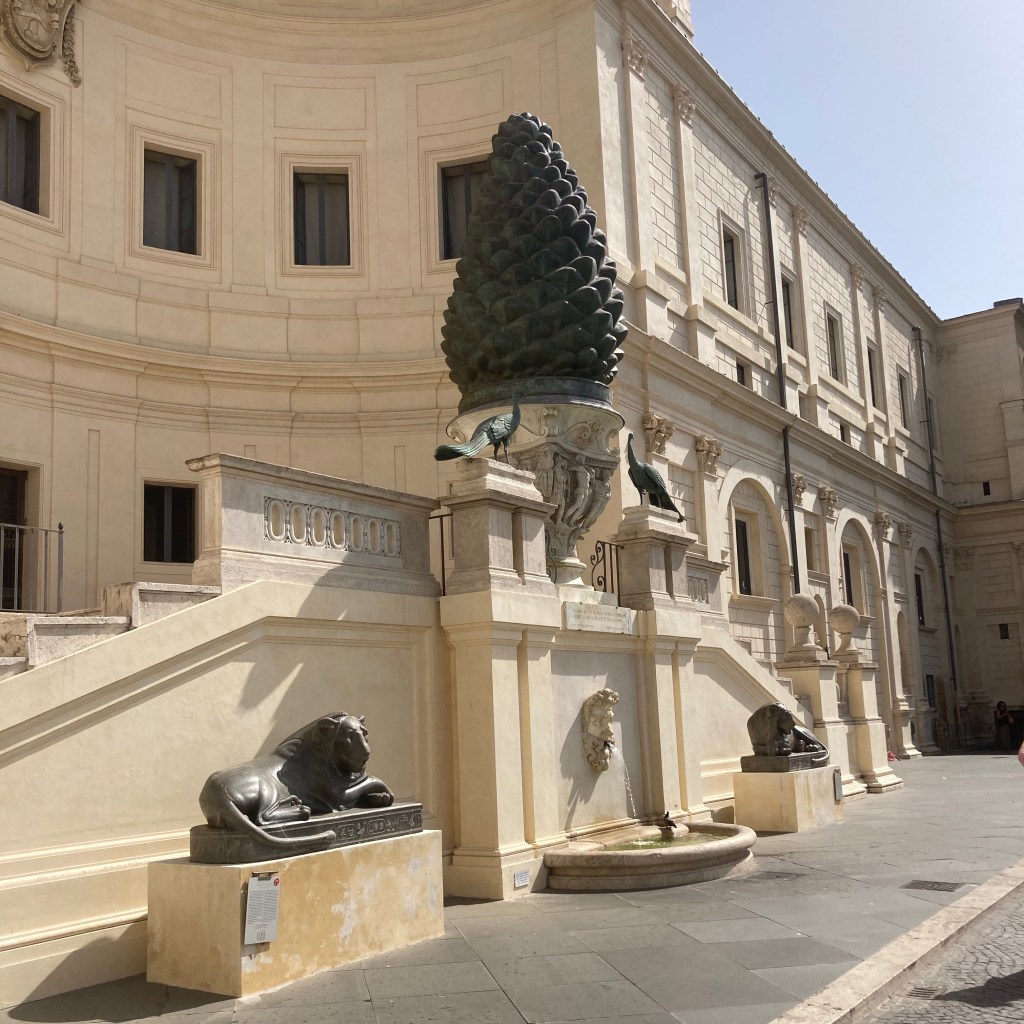
The Fontana della Pigna once stood next to the Pantheon but was moved to the Vatican in 1608.

I wasn’t prepared for how uncomfortable I was going to be at the Vatican. No, I don’t mean that I thought God was going to strike me down or something, I mean it was crowded and hot. I have issues with crowds in general and I prefer to be given a lot of personal space and this was just not an option in the Vatican Museums. It was packed – like three times the fire code capacity packed.

Crowds in the Museum

Also, it was hot. We had tickets for the morning but the high for the day was predicted to be 107 degrees Fahrenheit so it was probably well into the 90s by the time we arrived. It didn’t occur to me that the majority of the Vatican was not going to be air conditioned (How very American of me to assume the Vatican was air conditioned). They did have a lot of open windows, but it was not enough keep it cool on that hot day.

This was the only day on our trip that I wore long pants. The Vatican has a dress code, which for men meant long pants and a collared shirt. For women, a skirt covering the knees, or pants had to be worn and shirts had to cover the shoulders. I was worried we would be denied access if we didn’t follow these rules, but as I quickly figured out, we were pretty much the only ones following the dress code. So we weren’t exactly ideally dressed for a hot day in an unairconditioned museum.

The combination of the heat, the dress code and the crowds meant that I had completely sweated through my shirt and people kept bumping into me. Sorry folks, if you weren’t watching where you were going on that day, there was a good chance that you got some of my sweat on you. Gross, but hey, that was on you because I’m paranoid about personal space and I was hyperaware of the other people around me.

Roman Statues in the Vatican Museums

The museums are set to be walked through in a pattern. I really was unaware of just how vast these museums were going to be. I didn’t do a lot of research on the museums, since I was more interested in seeing the Sistine Chapel, and wasn’t too excited about the museums that you had to walk through to get to the Chapel, but I enjoyed them.

Museo du Pio Clementino

I was immediately surprised by the fact that the first few exhibits were ancient Greek, Roman and Egyptian. I guess I was expecting exhibits in the Vatican to be exclusively Christian in nature and after walking through an absolute ton of Roman busts and statues I turned to Jenn and told her that I was surprised by how pagan this exhibit was.

Tapestry in the Galleria degli Candelabri

Following the Greek, Roman and Egyptian exhibits was the Gallaria degli Arrazi, a room full of large tapestries. Many of these were commissioned by Pope Clement VII and designed by the famous Renaissance painter Raphael. Raphael drew the designs and Belgian tapestry makers actually made them.
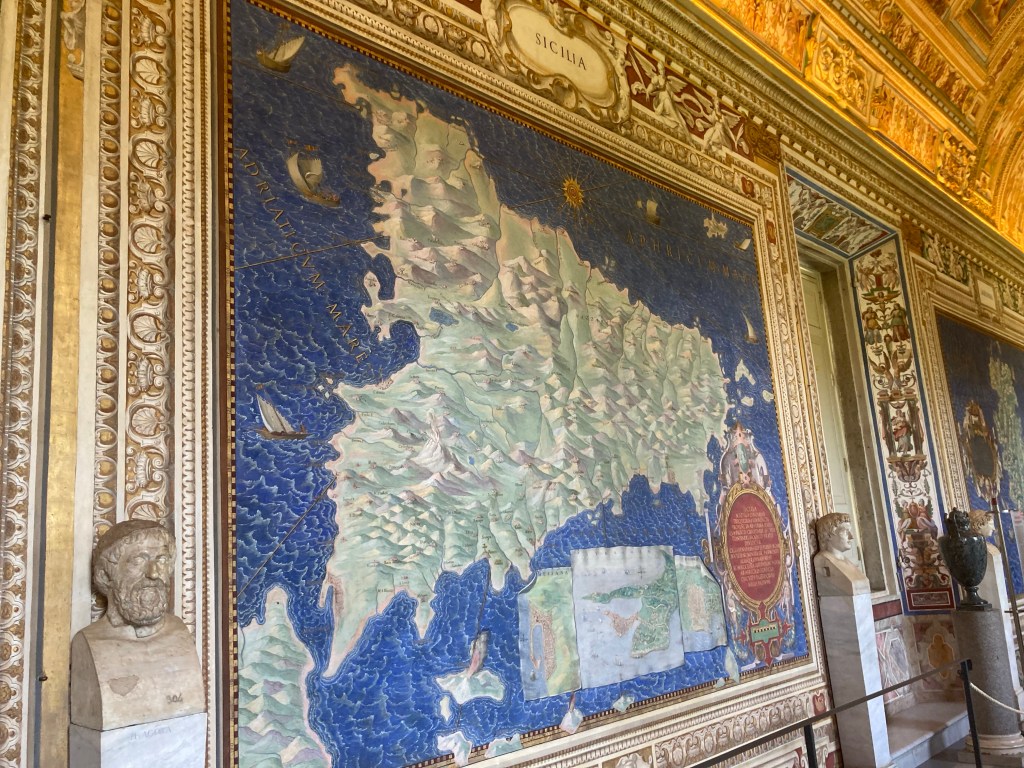
Map of Sicily in Gallery of Maps

Following the tapestry room was the Galleria della Carte Geografische, or the map room. This was my favorite of the rooms in the Museums. It contained dozens of large hand painted maps mostly of the area around Italy. These maps were commissioned around 1580 by Pope Gregory XIII who employed the Italian Priest Ignazio Dante to make the maps. They have a wonderful Age of Discovery look to them when maps were very artistic and a little inaccurate.
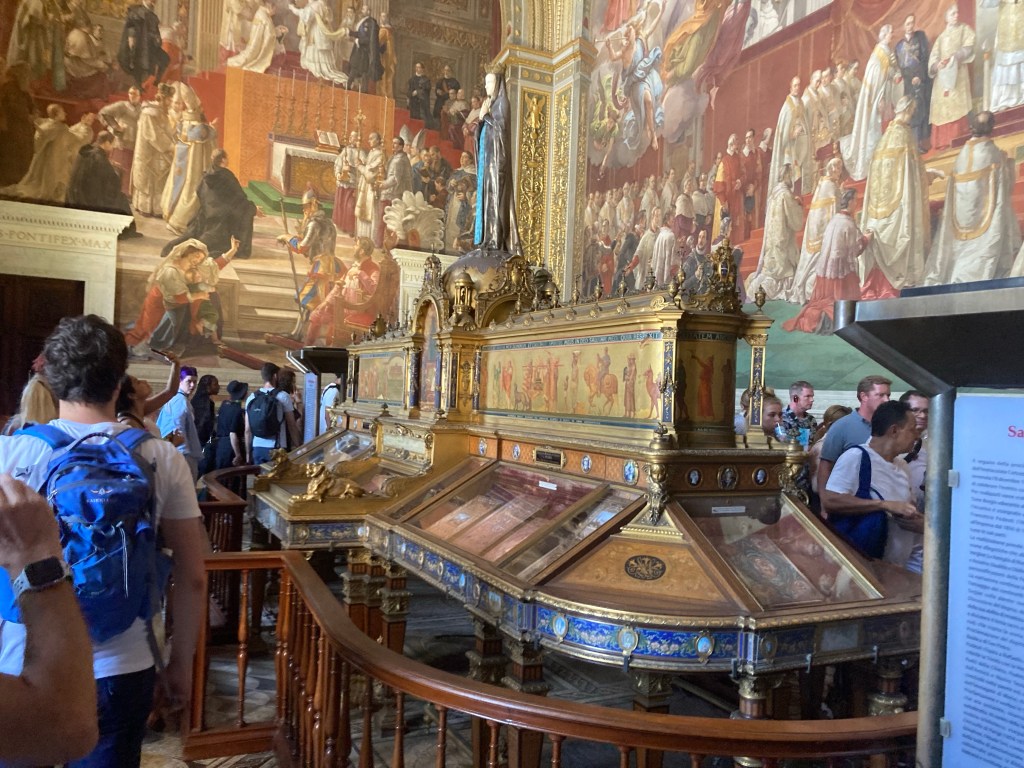
The case in Sala Sobieski displays books but is extremely ornate and beautiful by itself.

Following the Map Gallery, we walked through a number of other hallways including the Sala Sobieski. It had this really interesting book case which was used to display rare books. I honestly thought the case was more interesting than the books, but probably just because I had no idea what the books were.
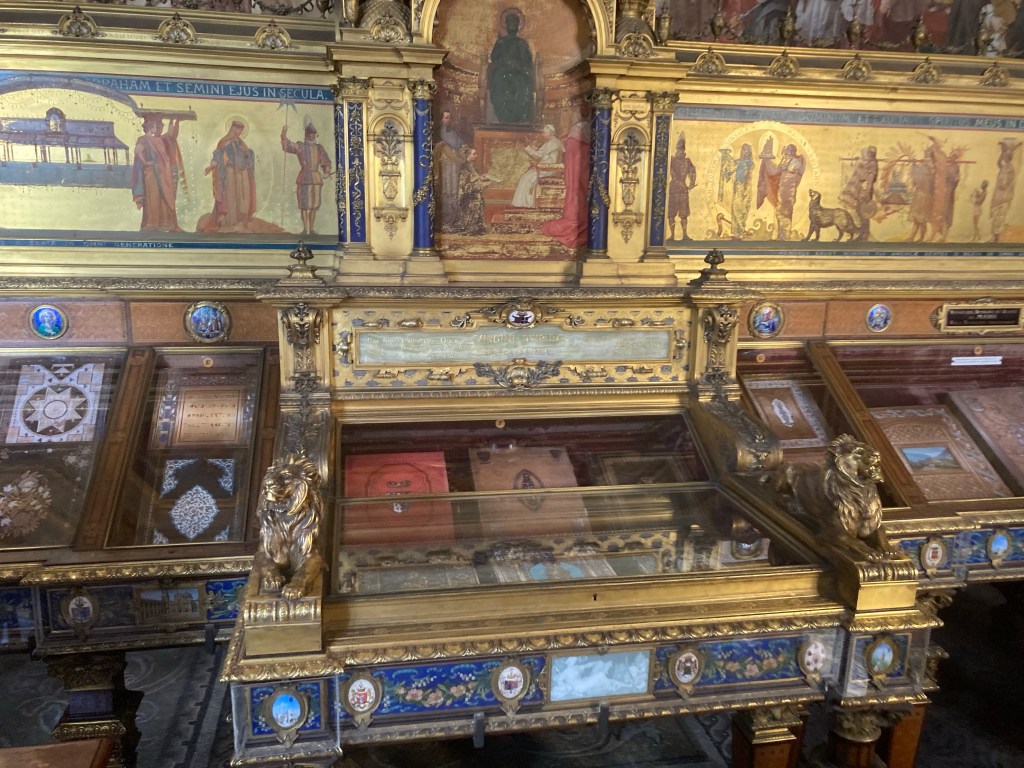
Rare books in the display case

A big surprise for me was the Stanze du Raffaello or the Raphael Rooms. These rooms were commissioned by Pope Julius II in the early 1500s to be used as a series of apartments within the Vatican. Raphael painted some absolute masterpieces in these rooms, and I wish we had spent a little more time here. I’m not really that into art, but when I turned around and saw the School of Athens, not realizing that this was going to be in the Vatican Museums, I was blown away. First of all, it’s brilliant, but it’s also what almost anyone who has taken an art or art history class has seen as the example of perspective.

Raphael‘s School of Athens is in the Stanze du Raffaello.

When we finally arrived in the Sistine Chapel, it was a bit of a let down. I’m not saying that it wasn’t absolutely gorgeous, its just that the whole thing felt a little weird. First of all, these are paintings that we’ve all seen a number of times, and it does feel familiar, but it’s also very far away. The ceiling is 46 feet high, which means that my eyes are 40 feet away, and while it’s cool to see the ceiling in its entirety, the details are a little lost. Alex had to borrow my glasses to see, because while his vision isn’t really bad enough to need glasses, it’s not exactly 20-20 either.

Then there is the fact that its weird and crowded. They force everyone to stand in an area in the center of the chapel, and once you’re there you basically don’t move and you’re not allowed to take pictures. If you take a picture in the Sistine Chapel, a portal to hell opens up and swallows your iPhone. It happened at least 4 times while we were in there. They also pretty much tell you to be quiet the whole time. I think you probably could move around inside that square in the middle if you wanted to see as much of the Chapel as possible, but I think you probably would’ve been viewed as rude for doing so. In the end you just end up standing in one place and looking around as much as you can. If your vision isn’t good, you’re not going to see much.

A small sample in the Collection of Orreries at the Vatican.

After leaving the Sistine Chapel we were went through a number of other museums but my favorite exhibits were the ones that were related to astronomy. It also had that sort of Age of Exploration vibe with a lot of celestial globes, star maps and orreries.

Star map

We finished up our tour of the Vatican Museums and wandered out into the Vatican City. We were approached by a man trying to sell us tickets to the Museums and the Sistine Chapel. When we told him that we had just finished the tour and were a little disappointed because the crowds made it difficult to really enjoy it he told us that we should have gone late in the day, especially on a Friday or Saturday. Apparently, it isn’t nearly as crowded and you should get a better chance of really enjoying the visit.

One of many in the collection of celestial globes at the Vatican

I would definitely visit again, there were a few places that I could’ve definitely enjoyed with a little more time and elbowroom. The whole experience turned out a little backwards for me, where I really loved the Museum and although the Sistine Chapel is gorgeous, it’s just uncomfortable, and difficult to really see the artwork. I guess I wasn’t sure what to expect, but I thought it would be a bunch of museums relating to the Catholic Church, and while much of it is, it’s really more of a great art museum. If you can manage to find a time during the offseason, or maybe take that man’s advice and go at night on Friday or Saturday, I think you will really enjoy it.

Piazza Navona – Rome

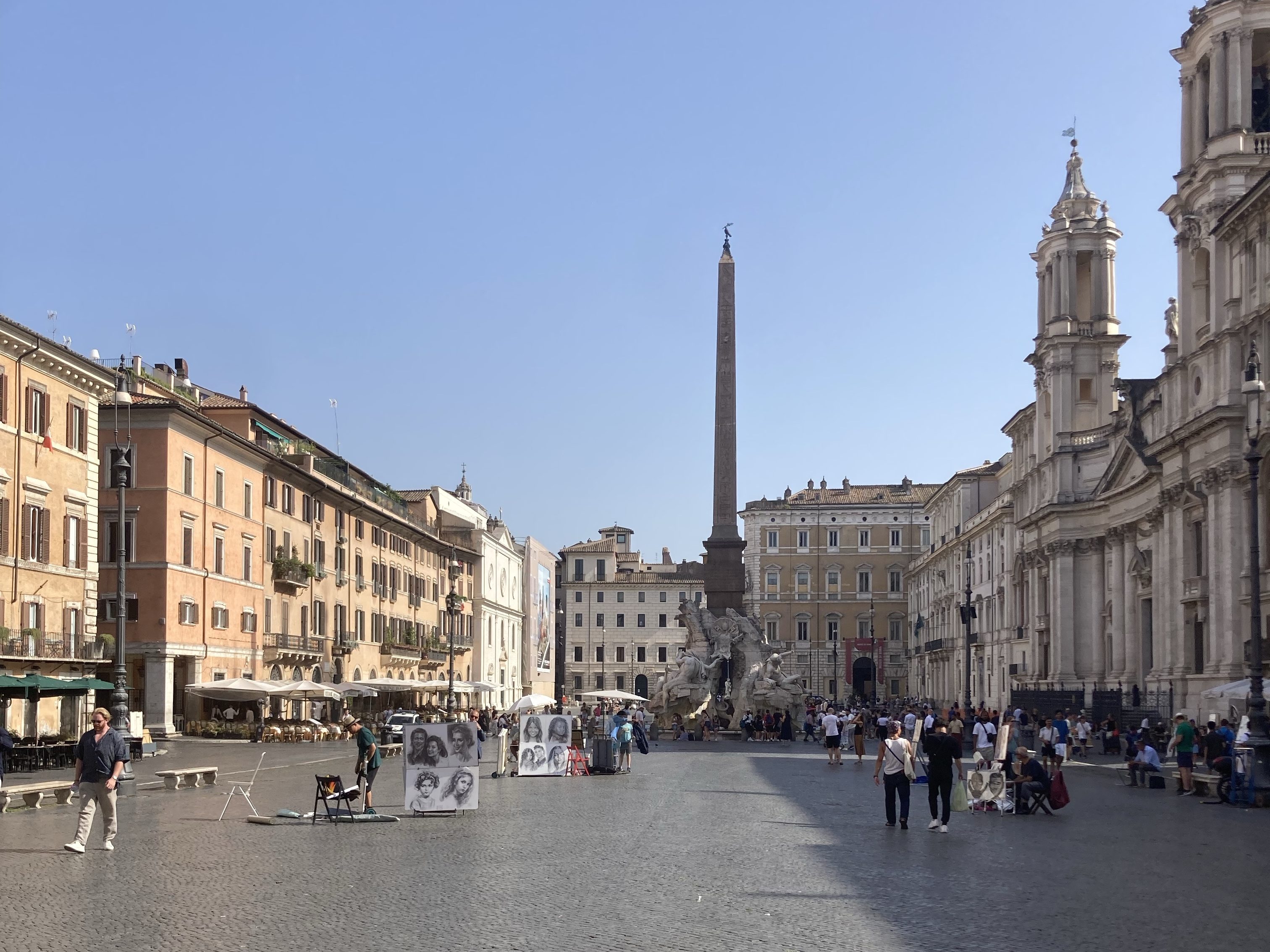
The amazing thing about Rome is the ability to just stumble into something historic while being completely oblivious. It was 106 degrees in Rome and we found ourselves looking for shade and a cold beverage. We wandered into the Piazza Navona where there was a lot of restaurants and found a spot to sit down under an umbrella at Bernini Ristorante for a drink. We were sat on the piazza directly adjacent to the Fountain of Neptune.

Enjoying a Peroni with a beautiful view of the Piazza Navona

Honestly, that’s pretty cool in its own right. You’re just wandering around in high tourist season and without a reservation you just sit down for a drink across from an amazing work of art? It’s just not a huge deal in Rome because there are fountains and ruins and statues everywhere.

Pro tip: Always wear swim trunks when swimming in the ocean. Its the best way to avoid having to peel a kraken off your junk with a trident.

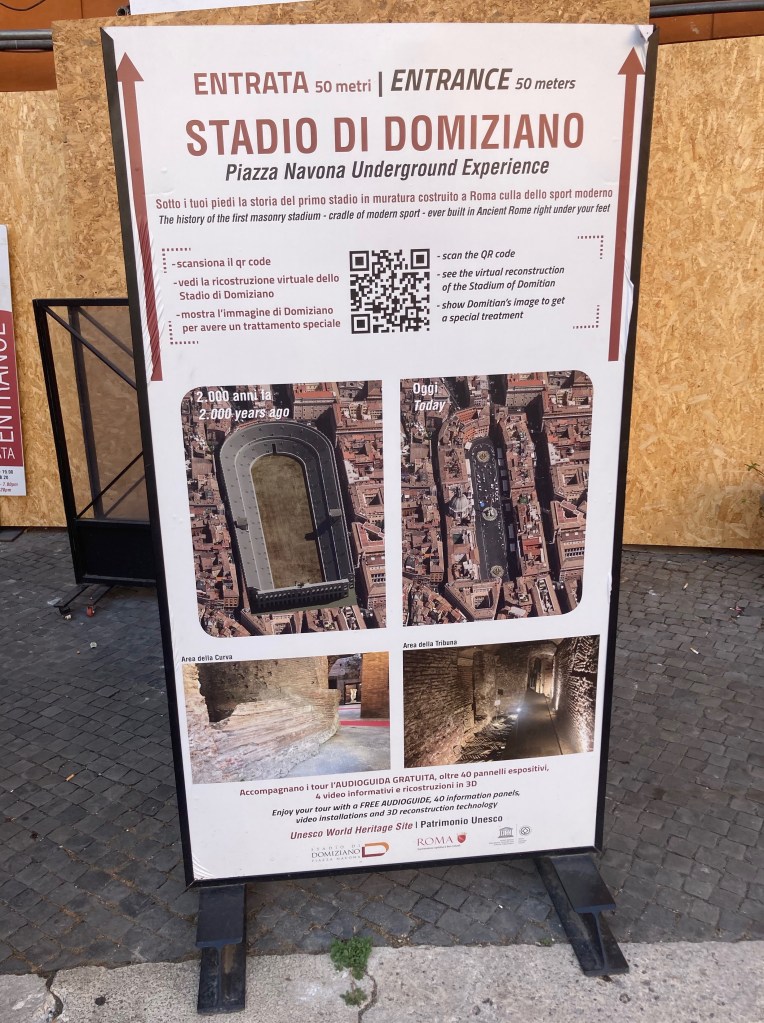
While we’re sitting, enjoying a Peroni and Aperol spritz, I look over and see a sign in front of a construction area. A quick google search and I learned that the Piazza Navona was built on the site of the Stadio Di Domiziano.

Sign outside of construction area directing people to the entrance of the museum

I compared the shape of the stadium on the poster to what I was seeing on the piazza and said “Hey guys, we’re sitting where they used to run chariot races!” (Which is completely false as I found out later, they never ran chariot races there). The kids looked at me like “So? Am I supposed to care about chariot races?”

The Stadio di Domiziano actually was a stadium built to house athletic events. It held around 30,000 Roman citizens and was built around 80 AD. It was built to house the Capitoline Games which was modeled after the original Greek Olympic Games. The Piazza di Navona is fairly long so I imagine that with only 30,000 seats this stadium probably didn’t need to be too tall. This probably meant that the stadium had great viewpoints from almost any seat.

The Fontana del Quattro Fiumi sits directly in front of the Church of Sant’Agnese in Agone, a beautiful 17th Century Baroque church

What is now the piazza is the size of the playing field and the buildings surrounding the piazza is where the stadium itself was. This stadium was built on the standard of Greek stadia which is 180 meters long which obviously is longer than a now standard 100 meter long track.

The fountain of Neptune was created by Giacomo della Porta in 1575.

You can actually take a tour of the ruins of the stadium, which is 15 feet under the piazza. Information about these tours can be found at https://stadiodomiziano.com/. Unless you speak Italian, you will need to have google translate that webpage into English for you.

The stadium fell into disrepair after the fall of the western Roman Empire and was gradually used for building materials. Eventually, the area was dedicated as a public space in the 15th century and developed into the Piazza Navona.

The Fontana del Quattro Fiumi (Fountain of the Four Rivers) was built in 1651 by Gian Lorenzo Bernini. It stands in the center of the Piazza.

After finishing our drinks, we walked around the piazza for a few minutes and continued on our way. We probably should have spent more time there but being in Rome for a short amount of time meant that we had places that we wanted to see and not a lot of time to waste. It is pretty amazing, however, that Rome is so filled with beautiful places like this with a rich history. So full of history, in fact, that you can’t even stop for a drink without stumbling into something like this.

Venice – A Masterpiece Centuries in the Making

Why is Venice Built on Water?

There is debate on this, but the general consensus is that around 600 AD, Italians who were fleeing attacks from Lombard invaders moved out onto the islands of Venice because they could defend themselves better on the islands. The islands were marshy and difficult to build on, but much easier to defend than being on the mainland. In order to prevent anything that was built on the marsh from predictably sinking, the Venetians drove millions of wooden posts into the marsh. These posts compacted the mud. The mud keeps the posts from decomposing and the combination of the mud and posts makes a solid foundation on which to build. Strip the City does a great job demonstrating how this worked in the video below.

Venice Becomes a Trade Empire

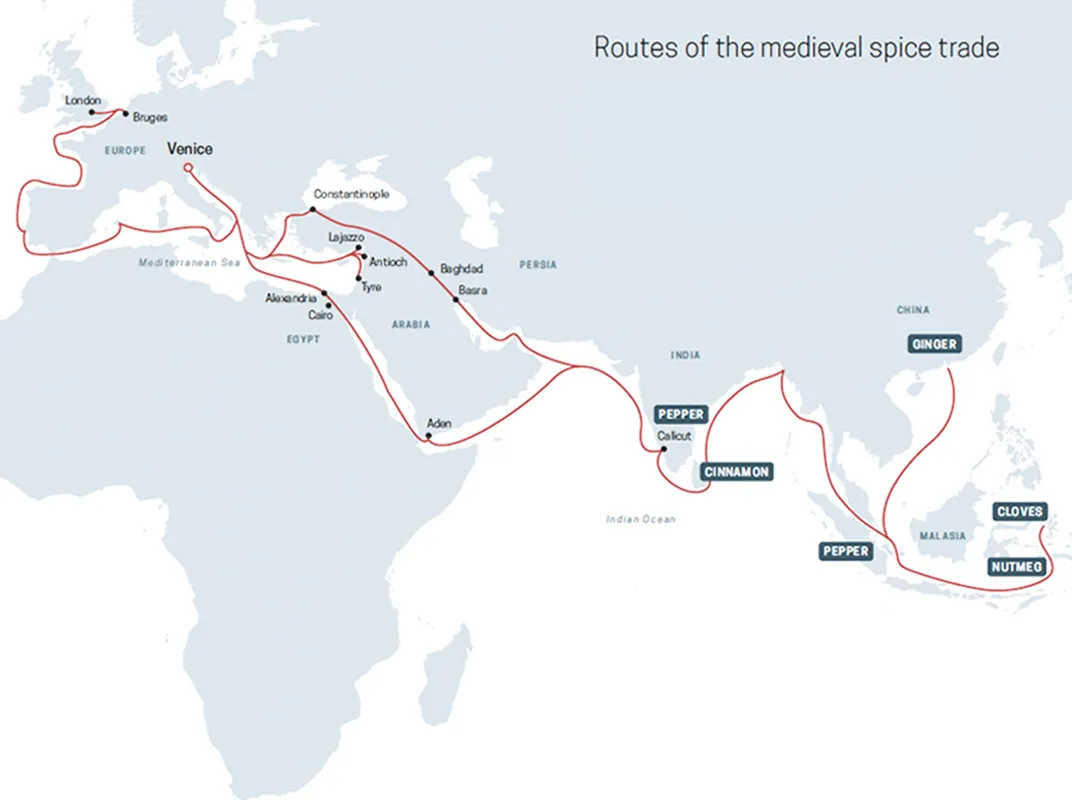
For much of the time between the 9th Century and the 16th Century, Venice was uniquely positioned to take advantage of trade routes. Venice had access to Constantinople as well as Alexandria by ship and was able to unload goods onto the European mainland. This allowed them to sell goods throughout Europe. Venice built a powerful navy in order to protect their merchants from pirates in the Mediterranean Sea. This turned Venice into a vital link between the spice and silk trade of Asia and Medieval Europe where those goods were so valuable. The Smithsonian Magazine has a great article which goes into greater depth on this subject.

Image provided by the Smithsonian Magazine

Wealth Produces Art

One thing that always seems to be the case throughout history, is that where there is great wealth, there is great art. The vast trading empire of Venice was creating an amazing amount of wealth amongst its merchants. That wealth created a market for artwork, since having great artwork is generally a way that many wealthy people demonstrate that they are wealthy and successful. There are a number of famous renaissance artists from Venice, including Giovanni Bellini, Vittore Carpaccio, Giorgione, and Titian.

Palazzo Cavalli-Franchetti

We typically think of painting when we think of art. But art is evident throughout Venice. You see it in the architecture, the stonework and the ironwork on buildings. You see it in the statues and even in the beauty of the gondolas that seem to glide through the canals.

Gondolas take around 6 months to build and cost around 40,000 Euro.

The Architecture of Venice

As was just about everything in Venice, the architecture of Venice was influenced by its trading partners. Because Venice was trading with people throughout Europe and into the Byzantine Empire, a new form of architecture emerged in Venice. It is known as Venetian Gothic and it is found throughout Venice and has elements of Gothic architecture such as pointed arches, rib vaults and tracery as well as elements of Byzantine architecture such as the use of domes and veneers. These elements created a unique style that can be seen throughout Venice.

The domes at St Mark’s Basilica are examples of Byzantine influence in Venetian architecture

The vast majority of buildings are obviously not as adorned as St. Mark’s Basilica, but even the typical homes in Venice have a certain flair to them. There are a number of Juliet balconies, windows featuring tracing and pointed arches, and a lot of lovely doors. There are also window boxes with flowers everywhere. It all leads to a style that is positively Venetian.

The Doors of Venice

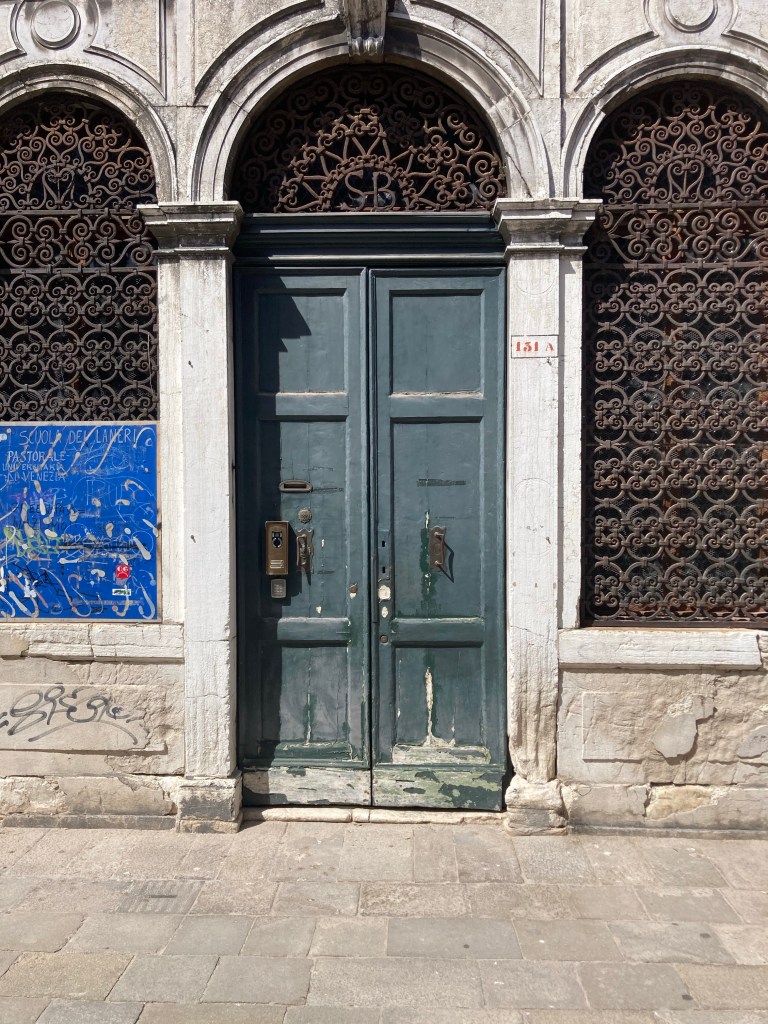
One of my favorite things about Venice is the doors. They all seem to be unique to the buildings. A lot of them are wooden and very worn with time. Often you see them like in the below picture, with beautiful stonework and ironwork surrounding the doorframe.

Other times, you see doors which are not quite as worn, but instead are truly unique pieces of art, like this beautiful metal door. This door also has beautiful stonework surrounding it as well as some really interesting brickwork.

Below is another example of great stonework and brickwork surrounding the door. Also, this door is a gorgeous piece of woodwork. Another thing I’ve noticed about Venetian doors is that not always is the lock and door pull where you would expect them which is interesting. Venetian doors also tend to all have letter slots.

Beautiful Door with Inscription over it meaning “Year of our Lord 1904″

Venetian Statues

If you walk around enough in Venice, you will undoubtably come across a few statues. Many of the campos in Venice feature a statue dedicated to a historical figure of Venice. From the limited amount of time I spent in Venice, it seemed that the majority of these statues were fairly recent, being from the 19th Century or newer. However, in my opinion, they fit in nicely to their surroundings, even if they are recent additions to the plazas they inhabit.

The Monument to Daniele Manin was erected in 1875 and was sculpted by Luigi Borro.

The above statue is a bronze statue of Daniele Manin, who was born in Venice and an important leader who helped to reunify Italy. It is the featured statue in Campo Manin, obviously named for the Daniele Manin.

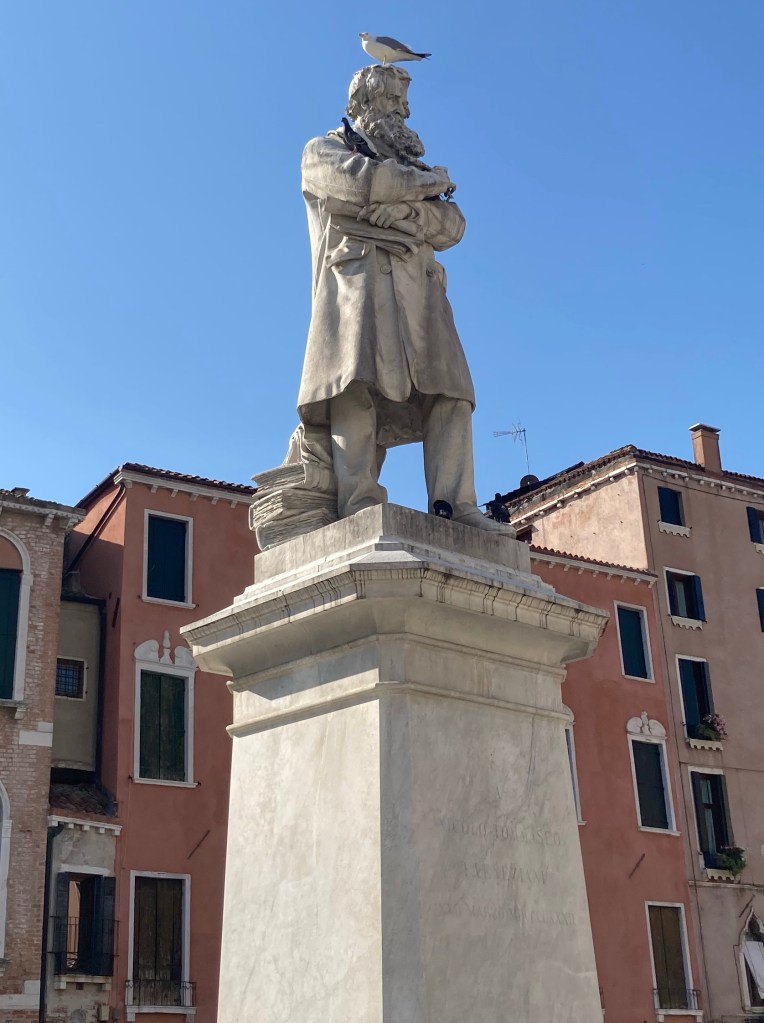
Monument to Niccoló Tommaseo built in 1882 by Francesco Barzaghi

The statue above, is a built out of Carrara marble. It was a monument built to Niccoló Tommaseo who was known as a scholar and an Italian patriot. This particular statue has a funny nickname, because as the sculptor was carving the statue, it began to have structural issues. In order to keep it from falling over, he carved a stack of books for Niccoló to lean on. The problem is that the stack of books looks like it’s flowing from under his overcoat, which has earned the statue the nickname “book shitter”.

The Bridges of Venice

Virtually all bridges in Venice are built with the same basic shape. The strength is created by an archway over the canal, while a walkway is a set of stairs up and a set of stairs down. Many of the bridges, especially the ones that are built over smaller canals are built with stone and brick.

Both of these bridges are typical of Venetian bridges. Arched at the bottom and stairs on top.

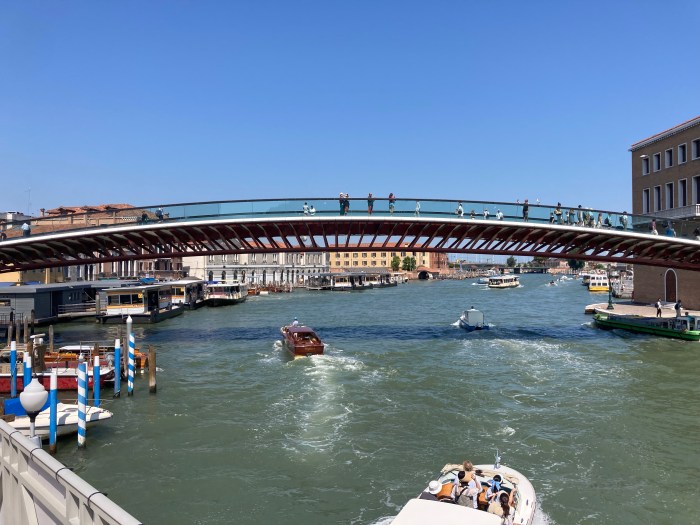
The bridges that are built over the Grand Canal are longer and require a more modern structural design. The most modern example is the Constitution Bridge that was opened in 2008 and is unique in Venice for it’s steel and glass construction and modern design.

Artistic Touches

There is a certain flair to much of what you run across in Venice, you’ll see it in door frames, window frames, as well as architectural sculptures. You’ll also see it in the detail of the three flagpoles in the Piazza San Marco. The bronze bases were sculpted by Alessandro Leopardi in 1505. The flagpoles are spaced out in front of the St. Marks Basilica and are strikingly beautiful.

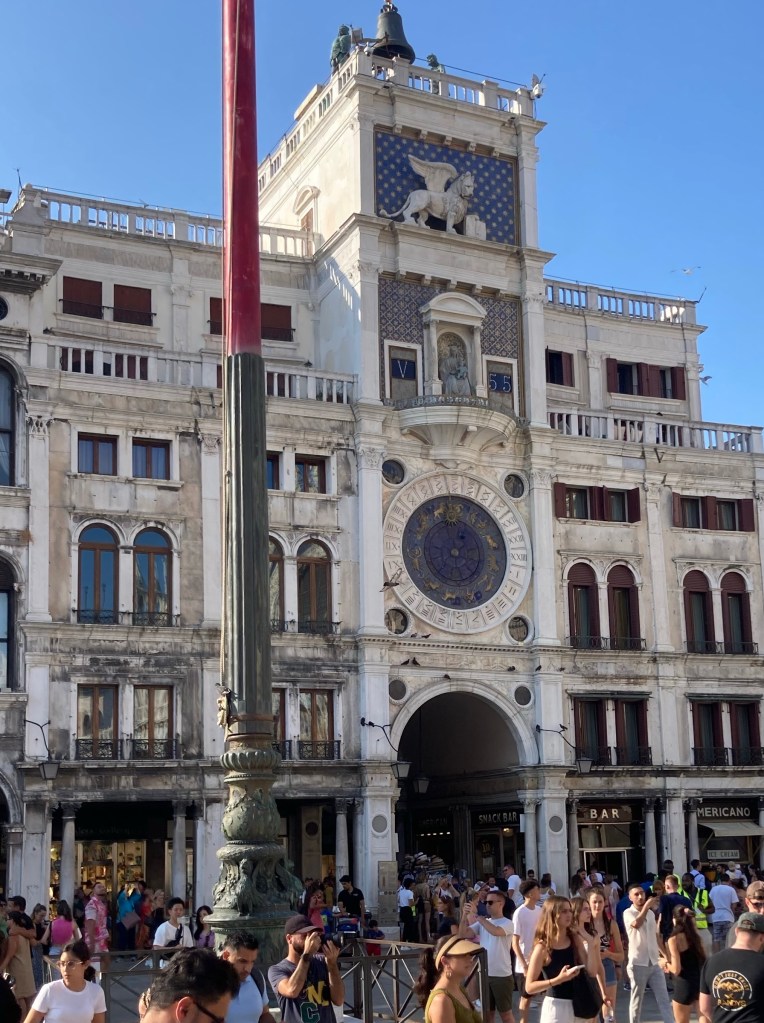
St Mark’s Clocktower is also a great example of the style of Venice. It’s an beautiful white stone structure, with the Lion of St Mark near the top. Below that is the Virgin with Child and then the clockface itself. This clocktower was built as a replacement for an older clocktower in the late 15th Century.

St Mark’s Clocktower

St. Mark’s Basilica itself takes the details to extremes. There are details everywhere. Just one small section of the basilica demonstrates the details. There are multiple columns and a stone archway. The door itself has intricate ironwork while the head of the doorframe is an intricate Byzantine design. The most stunning part, however is the mosaic half-dome which depicts the moment that St Mark’s body was carried into the Basilica. It is adorned in 24 carat gold leaf. Seemingly every inch of the Basilica is covered in detail like this.

This mosaic half dome over a door to St Mark’s Basilica is stunning.

Ironwork of Venice

Venice has some amazing Ironwork that can be found around the city. Mostly you will see it in gates, fences and balconies, but you will also see it on lamp posts.

Ironwork on the doors as well as on lamps are everywhere in Venice

The most typical places that you see this ironwork is as window grills or as door protections. I’m sure that the original purpose of this was for security, however they do tend to be very beautiful and add a certain flair to an already beautiful city.

Window Grille from our AirBnB looking out to a courtyard

The Canals of Venice

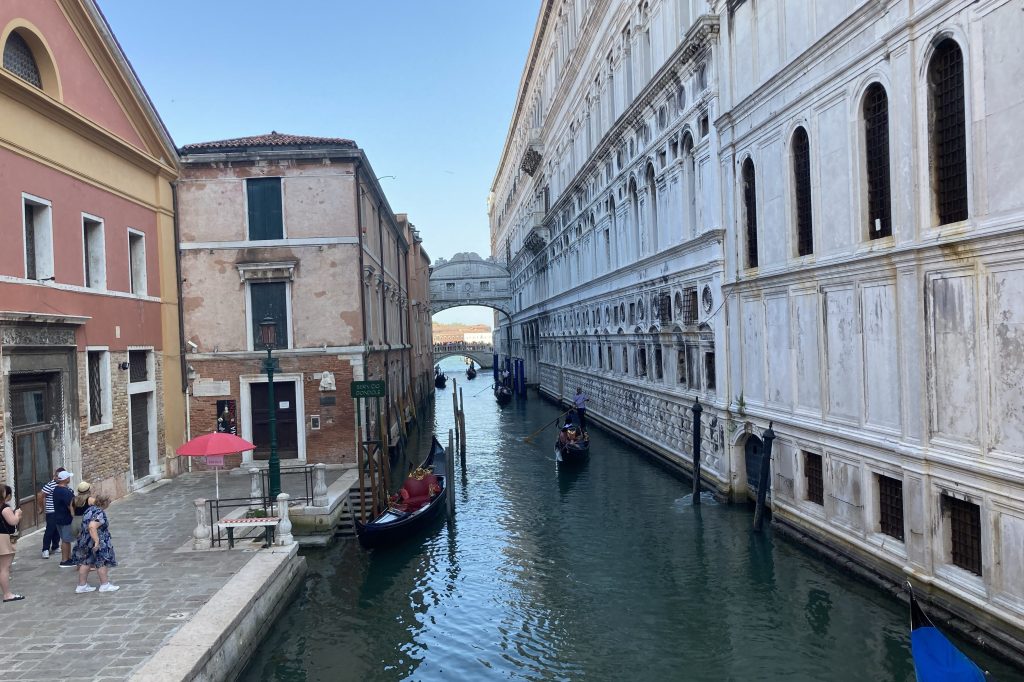
Canals aren’t necessarily art themselves, but in reality they are the parts of Venice that weren’t forced to become solid ground. They are, in a sense, the absence of development. But they are also the main thoroughfares that are the lifeblood of Venice. They are the roads that deliver the goods that feed the city as well as transport citizens and tourists alike around the city.

The canals, themselves, are semi-manmade. Obviously, since Venice was built in a marsh, the water was there naturally. But the wooden pilings that were placed in the marsh to create the solid ground on which Venice’s buildings were built determine the edge of that water. Also, there is a significant amount of maintenance on the canals that maintain the depth of those canals.

The canals are quintessentially Venice and are usually the first things that people think of when they picture the city. They are more a result of public works, much as any street in the world is, but there is just something uniquely beautiful about these canals. I believe that beauty is a result of how well the canals fit in with their surroundings.

Centuries of Artisans create a Single Masterpiece

In the end, what Venice has become is the result of centuries of hard work by thousands upon thousands of hard working Venetian citizens. Great cities take time to evolve. Venice was a city built in the marsh because of the need for security of its citizens. It developed slowly but steadily into a trading empire and it’s citizens became wealthy. As the city developed, they continued to make improvement after improvement, whether it be public works projects like bridges and canals, architectural and building projects, or artisan projects like statues, doors and ironwork.

In the end what is left is a single masterpiece that people from around the world visit and admire. It is one of the world’s great cities and should be experienced at least once in a lifetime.

Window boxes on Juliet balconies are common.