United Airlines adds European Routes for Experienced Travelers

Airlines make announcements about new routes all the time, and most of them don’t interest me very much, but the latest press release about United expanding its seasonal routes in Europe piqued my interest. These new routes seem to be targeting American tourists who have been to Europe, perhaps multiple times, and are looking for something a little different than the normal European stops like Paris, London, or Rome.

The destinations they have chosen to expand to are places that would be on a bucket list for experienced travelers. They definitely speak to me personally, since each one of these are places where I would like to visit.

Glasgow, Scotland

Starting on May 8th, United will start a daily flight from Newark to Glasgow, Scotland. This is probably the least quirky of the destinations that United picked. Scotland is a destination that I could imagine someone traveling to on their first big international trip. The cultural and language similarities to the United States make it an easier trip. It would also appeal to people who didn’t want to visit a huge European city like London or Paris.

Glasgow and nearby Edinburgh are Scotland’s population and cultural centers. They are less than an hour’s train ride apart, making it easy to visit both cities on the same trip. Around Glasgow, there are also many castles to visit, such as Stirling Castle, Doune Castle, and Bothwell Castle.

You can also take the train from Edinburgh or Glasgow through the Scottish highlands. I once asked a Scotsman where he would recommend going if I were to visit Scotland and he was practically gushing about how beautiful train trips through the highlands are. I will definitely be taking his advise on that someday.

Glasgow, I believe, will appeal to more Americans as a destination than the other new destinations that were unveiled by United. The others may be a little more obscure, but they are fantastic destinations.

Bari, Italy

Have you ever found yourself dining outdoors at a restaurant in Florence or Rome and thought “I wish the food was better in Italy?” Probably not, but apparently the region of Puglia in Italy has food that puts other Italian food to shame. I’m not sure how this is possible, but I’m willing to give it a try.

Bari is located on the heel of the boot of Italy, along the Adriatic Sea. It is famous for its beaches, focaccia, pasta, and polenta.

From Bari, it’s about an hour by car to Alberobello, a UNESCO world heritage site known for its Trulli houses. These are unique structures made of limestone with conical roofs.

Bari is less of a tourist trap than other parts of Italy, such as Rome, Florence or Venice. This might make things a little more complicated for people who don’t speak Italian, but it is a great way to experience more authentic Italy than those major tourist destinations.

United will begin flying to Bari four times a week beginning May 1st, 2026.

Split, Croatia
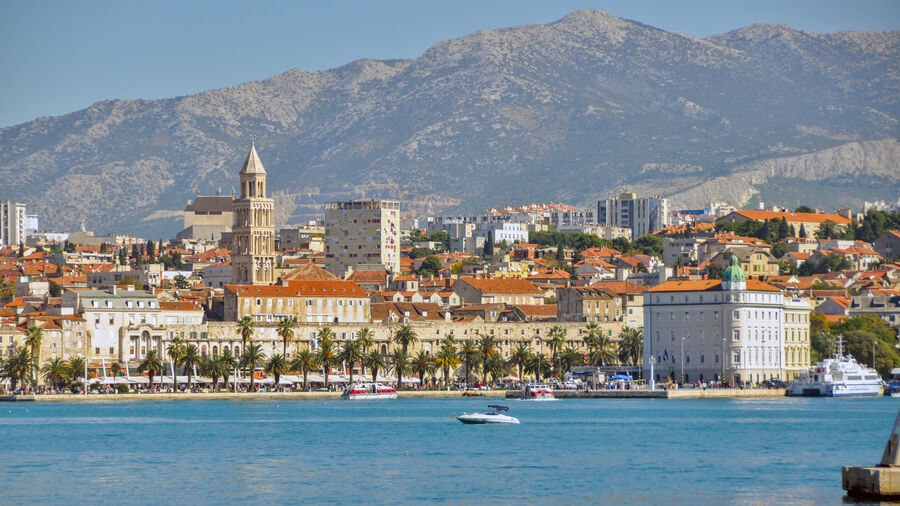
https://www.ricksteves.com/europe/croatia/split has some fantastic information about Split

As the memory of the Yugoslav Wars that took place from 1991 to 2001 fade from memory, the Balkan countries have received more and more attention for being great tourist destinations. Split, Croatia has become a popular destination for its beautiful city as well as the crystal clear, deep blue waters of the Adriatic.

From Split, you can use ferries to go to some of the amazing islands in the Adriatic, such as Brac, Vis, Bol, Korcula and Milna. You can also take the opportunity to visit the beautiful walled city of Dubrovnik.

Croatia has been growing in popularity for a while now and its no surprise to me that United Airlines wants to capitalize on the growing popularity. It’s an absolutely beautiful country, and its been on my short list for a while.

Starting April 30th, United begins seasonal direct flights from Newark to Split.

Santiago de Compostela

Santiago de Compostela is a fairly small community in the Galicia region of Spain. It has a population of around 100,000, The reason United Airlines would be interested in bringing direct flights there, however, is because it’s where the Camino de Santiago ends.
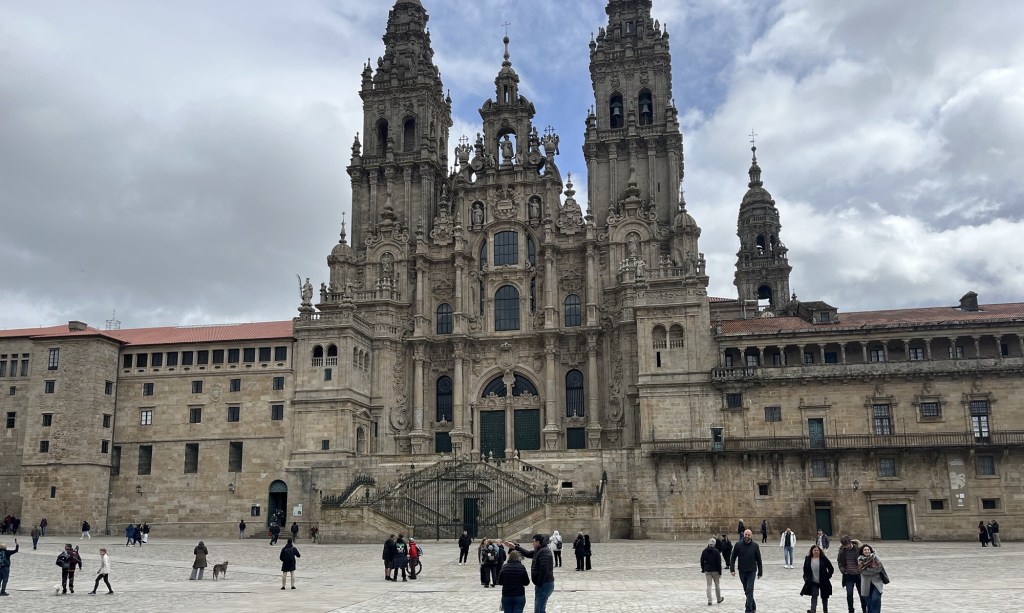
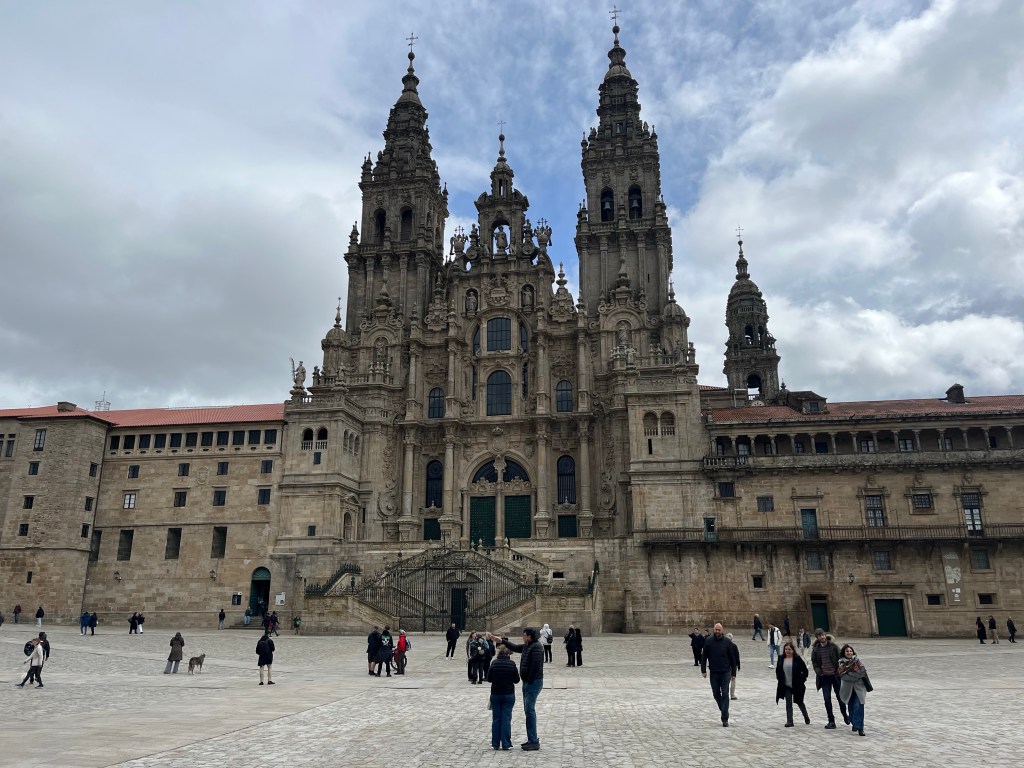
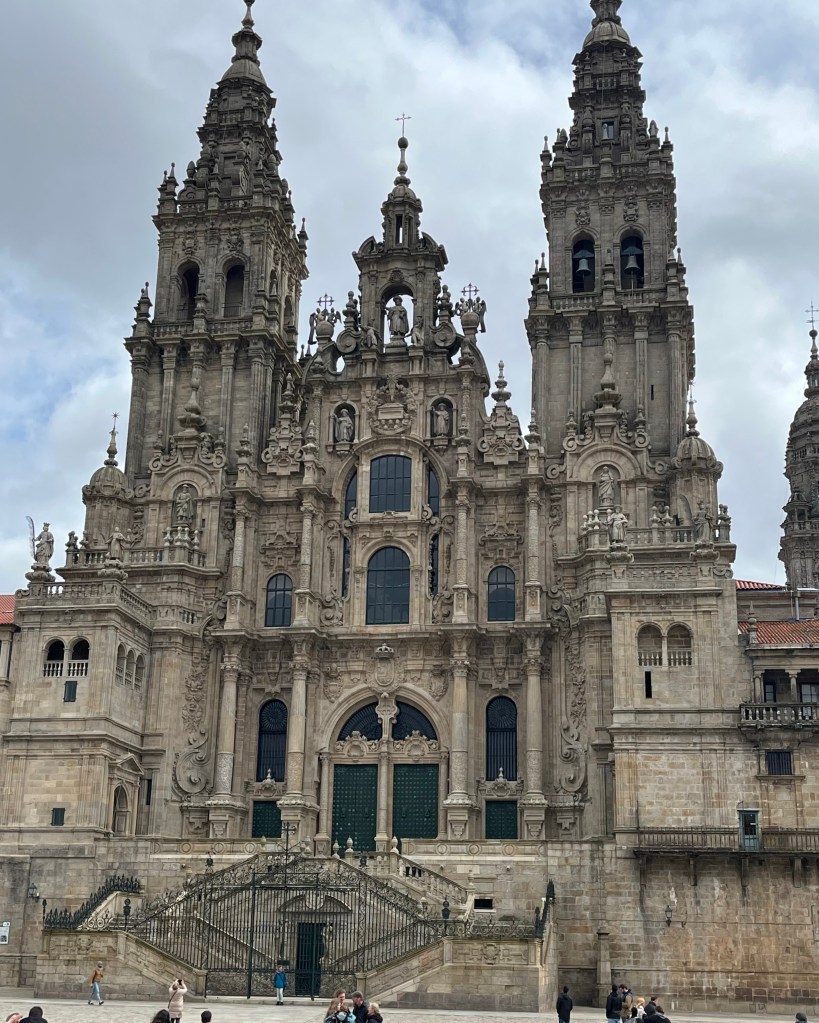
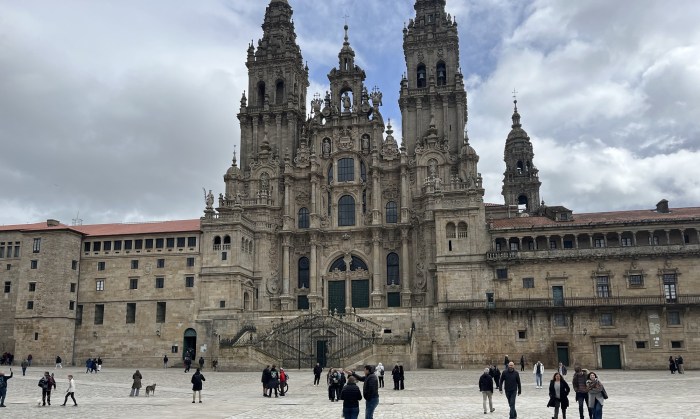
The Santiago de Compostela Archcathedral Basilica is the end point for all of the Camino de Santiago routes.

The Camino is a unique cultural experience. It consists of hiking one of multiple routes, the most famous is the French Way which starts in France and continues across Northern Spain to Santiago de Compostela. Some of these routes take over a month to complete and others a couple of weeks. Pilgrims, however, can choose to start their journey from anywhere and an official pilgrimage is anything more than 100 kilometers that ends at the Cathedral in Santiago de Compostela. Along the way there are hotels or hostels to stay at as well as a variety of pilgrim-friendly restaurants.

We had the pleasure of spending 6 days on the Portuguese route this spring and we met so many people who had done multiple Caminos. It’s an amazing way to see the Spanish countryside and really experience Galician hospitality.

For those brave souls who wish to participate in the Camino, United Airlines will start service three times per week from Newark to Santiago de Compostela on May 22nd, 2026 and continues through September 20th.

Flights out of Newark

So the good news is that these are amazing destinations but the bad news is they all originate in Newark. The Newark Airport has had all kinds of problems and I typically try to avoid flying out of there when possible. Since Newark completed reconstruction of a runway in June, I haven’t heard of as many issues in that airport, so hopefully service out of Newark is improving.

Newark has connections to more than 100 US cities on United, so you shouldn’t have too much difficulty finding connecting flights. This should make these flights accessible for much of the United States.

Award Prices

Right now, the award pricing on these flights are fairly elevated. This isn’t a surprise, since these are new routes. In the future, I would expect some award prices of these flights to dip down to United’s saver rates of around 40,000 points one-way for a flight to Europe. If you see those saver rates on one of these flights, I would also check Singapore Airlines. Often, you can book the exact same flight, if it’s a United saver award, for only 30,500 points. For more information, I have a post about how to use the Singapore Airlines partnership.

It’s also easier to get Singapore miles since they transfer from Citi Thank You points, Chase Ultimate Reward points, American Express Membership Reward points, a Capital One Venture miles. United miles can only be transferred from Chase Ultimate Rewards.

Conclusion

These newly added seasonal routes for United add great direct flights from the United States to amazing destinations that are on the radar for people who have a little experience going to Europe and would like to try something a little different. These are all fantastic choices and would make for a great vacation. These destinations certainly have me thinking about future trips.

Day 6 – Quitting the Camino

This is the final post in a six-part series on our experiences doing the Portuguese Central Route of the Camino de Santiago starting in Valenca, Portugal, and ending in Santiago de Compostela.

I didn’t get more than a couple of hours of sleep. The wind slamming the shutters on the windows was a constant reminder of the massive challenge ahead. At this point, we were all struggling with nagging pain. The hike from Padrón to Santiago de Compostela would be our most challenging to date. In addition, the weather looked horrible. The weather app called for sustained winds of 20 miles per hour with gusts up to 40 miles per hour. The forecast also called for rain all day.

All I could think was, do we really want to spend eight or nine hours hiking in the wind and rain, limping in pain? Jenn and I decided to ask the kids what they wanted to do.

We walked into their room, told them about the weather, and asked them what they thought. Emma was conflicted and said she wanted to finish, but that it sounded terrible. She said she’d leave it up to Alex. He took one look at us and said, “I’m done,” and then he rolled over and tried to go back to sleep.

So there it was, after five days hiking the Camino, we were quitting just 17 miles from the end.

I was conflicted about it, because after all, this was supposed to be a vacation, and I felt like I spent the better part of a week torturing my family. On the other hand, there is value to completing something so physically demanding.

The Camino is a hard physical challenge that is achievable by normal people. Jenn and I have both completed these types of challenges before. Jenn has done two RAGBRAIs (a week-long 400-mile bike ride across Iowa) and a couple of half marathons. I’ve done a RAGBRAI, about ten half marathons, and a couple of full marathons.

The kids hadn’t experienced what it’s like to complete a challenge like that, and I was a little sad they wouldn’t finish. For me, those challenges are important because they build confidence and character. I hoped that quitting that close to the end didn’t invalidate any personal growth that resulted from the first five days of the Camino.

We took our time getting ready, then took the walk of shame through the rain and wind down to the train station and bought a ticket to Santiago de Compostela. We shared the complex feelings of regret for not finishing the Camino as well as the relief of not having to hike that day. I was happy, however, to have a little more time to visit with my friend Nate.

While on the train, I texted Nate to tell him we quit and we would be in Santiago de Compostela in a little bit. He said he would meet me at the Pilgrim House, which is the community center where he works.

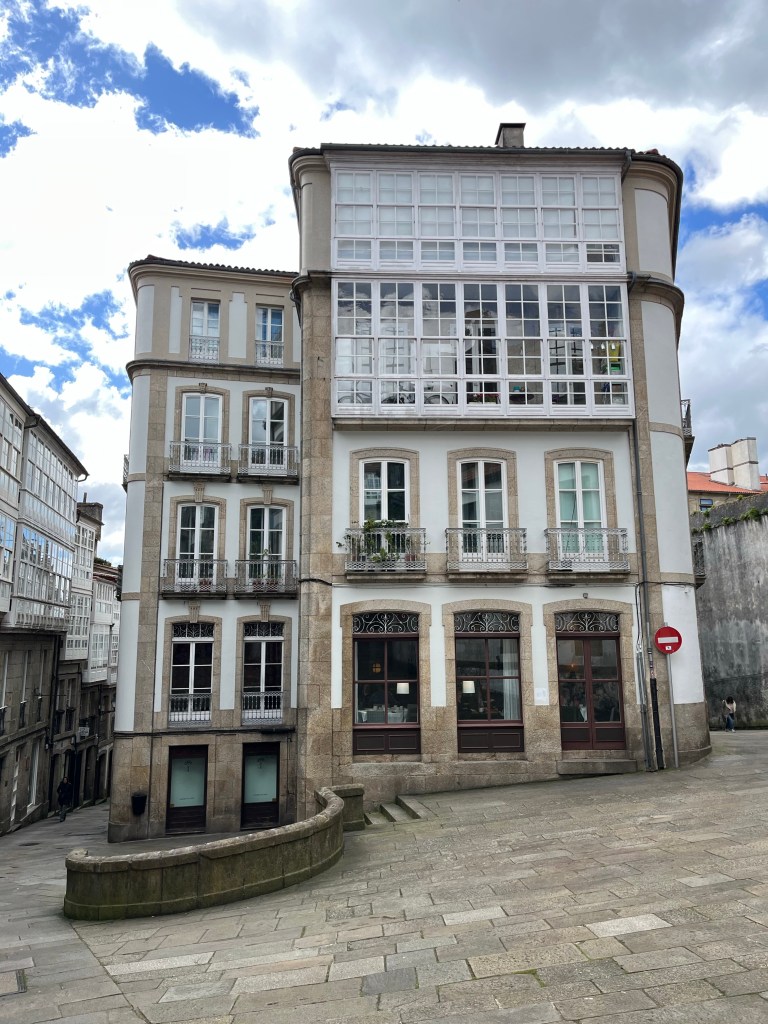
Building in Santiago de Compostela

When we met, he introduced us to the staff at the Pilgrim House and even pointed out someone from our hometown who volunteers with the organization. She was talking with Jenn and mentioned that she also works with the youth symphony orchestra in our hometown. Alex happens to be a viola player in that orchestra, so she took a picture of her and Alex and texted it to his conductor with a message: “Guess who I ran into in Spain?” It’s a small world.

Santiago de Compostela Archcathedral Basilica

We talked with them about our experiences on the Camino and what we would do differently. They have a different perspective as veterans of the Camino themselves and as people who listen to thousands of Camino stories each year. They chucked a little and said, “You spend your first Camino learning how to do a Camino.”

Nate gave us a tour of Santiago de Compostela, showing us his favorite coffee shop, the Cathedral, and the wonderful architecture of the city. We talked about the old days and what happened to our old friends. He talked about his family and what it was like for them to raise kids in Spain.

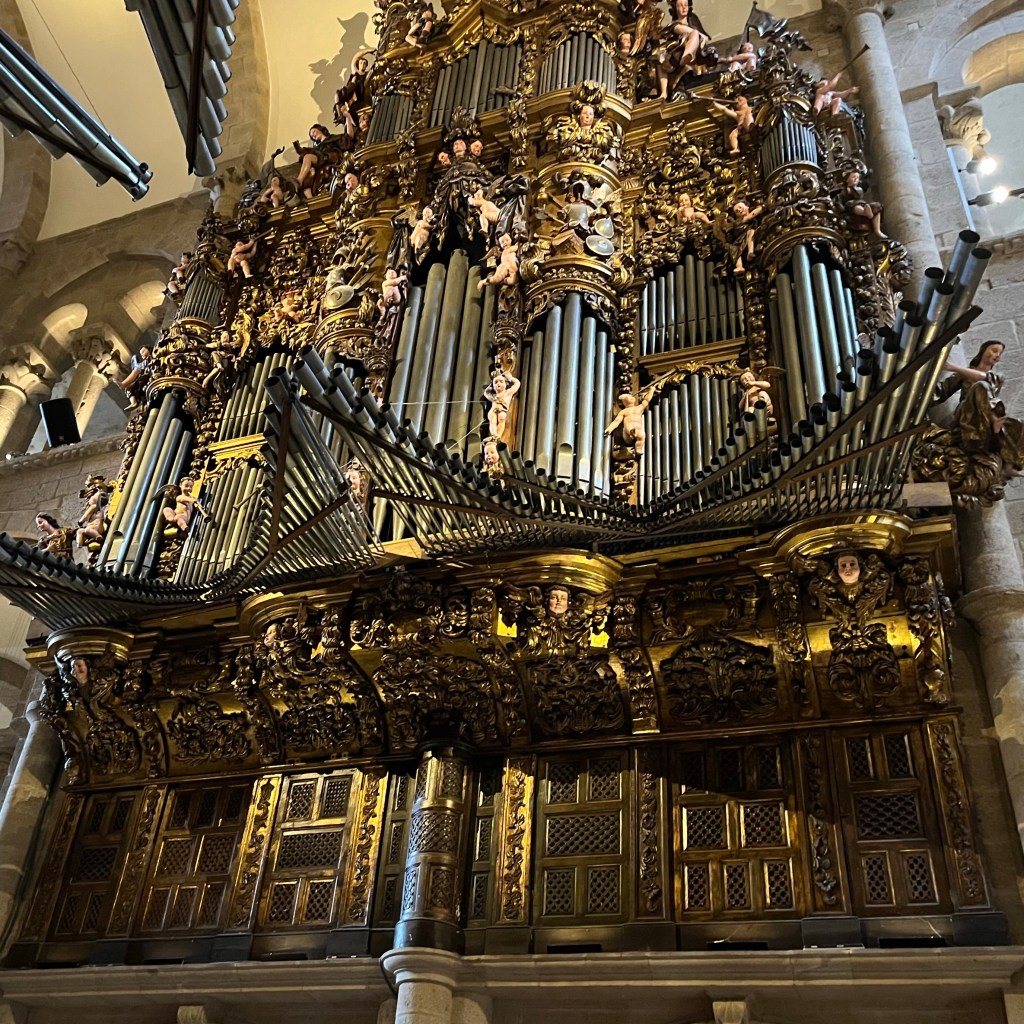
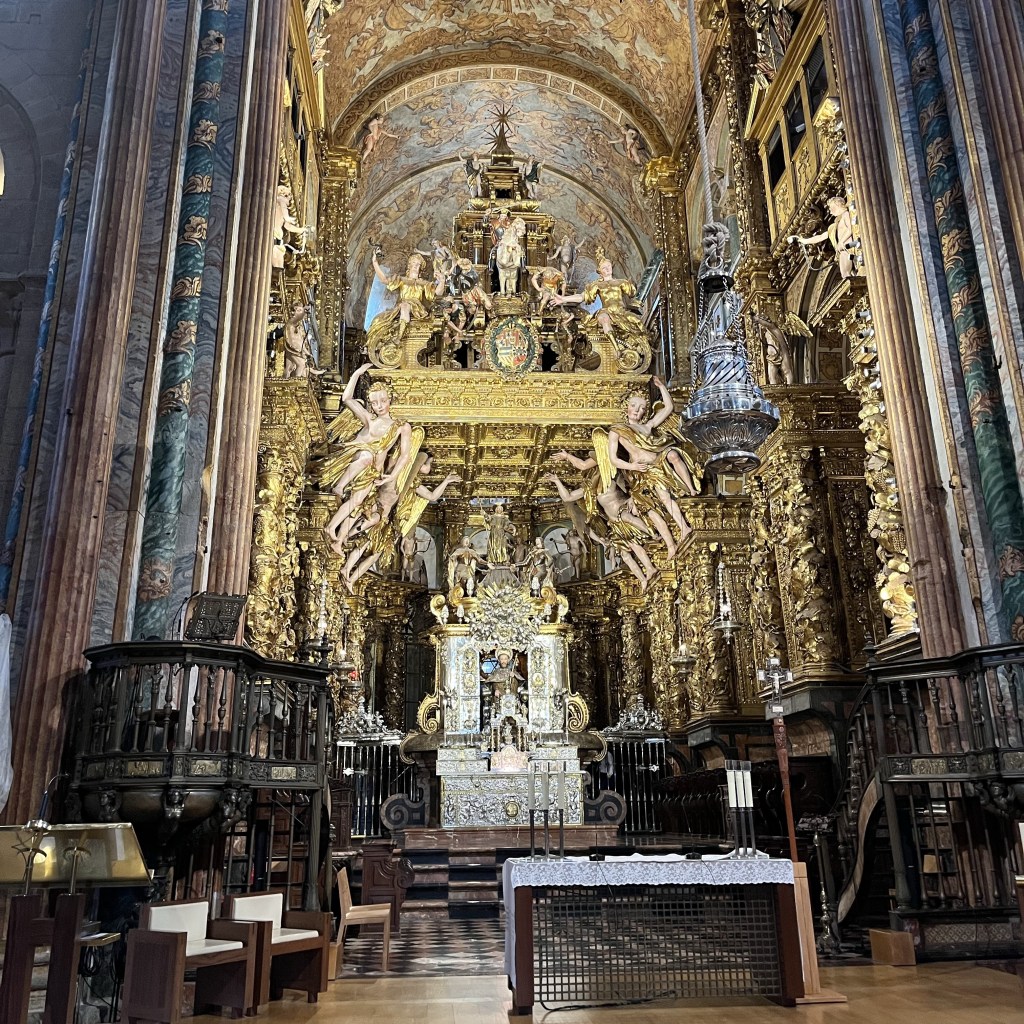
The organ is decorated in a baroque style

It was wonderful catching up with him after all these years, and if there was one blessing from having quit the Camino, it was the ability to spend a couple of hours with an old friend, thousands of miles away from where we grew up.

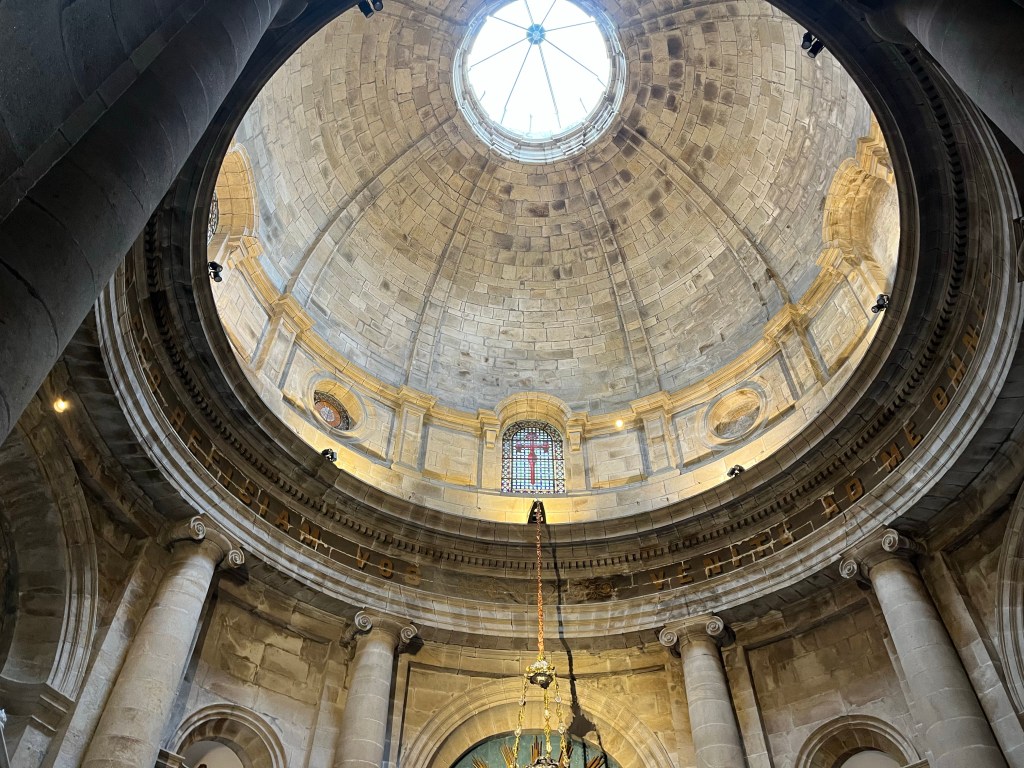
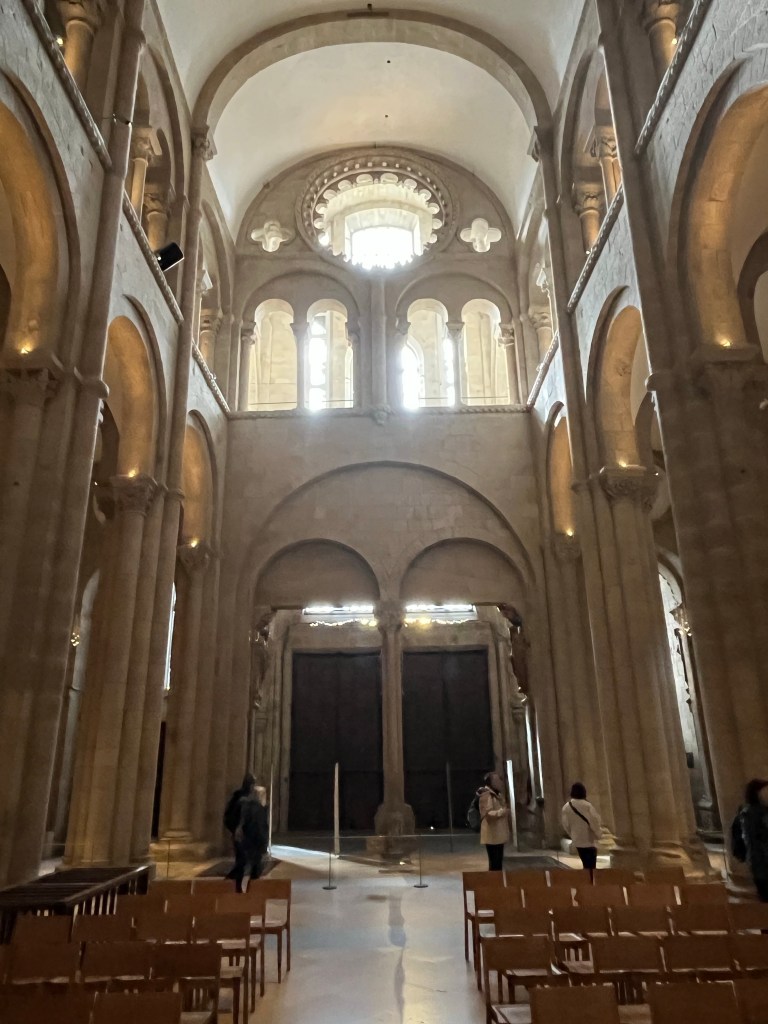
A dome in the Cathedral

We said our goodbyes to Nate and headed to our hostel at Albergue Alda O Fogar de Teodomino. We were able to get a private room with four beds. The hostel was nearly empty. I think most people didn’t hike that day because of the weather. I assume that most people who would have finished in Santiago de Compostela that day were instead taking an off day and would finish the next day.

We checked into the hostel, and I said that I wanted to tour the Cathedral. Emma wanted to join me, while Alex and Jenn stayed back to take a nap.

The full name of the cathedral is the Santiago de Compostela Archcathedral Basilica. Construction began in the late eleventh century, lasted well over a hundred years, and was finally completed in 1211. It was built to house the supposed remains of St James, which were discovered in the 9th Century near modern-day Padrón.

I definitely question the validity of the claims that the body of St James was discovered more than 800 years after his death, thousands of miles away from where he died. However, this discovery led to millions of pilgrims over the centuries walking the Camino to this cathedral in Santiago de Compostela.

Seeing the Cathedral is the goal of every pilgrim who embarks on the Camino. As is the case with so many Cathedrals, it is lavish, with statues and artwork everywhere. The altar of the church is done in a baroque style, with gold and silver elements everywhere. There are countless golden pillars and a group of angels holding up a golden ceiling over the altar. It’s so ornate that I couldn’t really discern what the artwork was supposed to symbolize, but it is beautiful.

Right side of the altar in the Cathedral

My favorite thing in the Cathedral was a giant incense burner called the botafumiero, which is about 5 feet tall and weighs around 180 lbs. Traditionally, it took a team of eight men with ropes to swing the burner over worshipers. The purpose of this was to cover the smell of the pilgrims who had spent the day on a long hike to the Cathedral. They now only do this on special occasions, since it’s so labor-intensive. Presumably, because of modern deodorants, it’s also not as necessary.

Altar with botafumiero hanging in front.

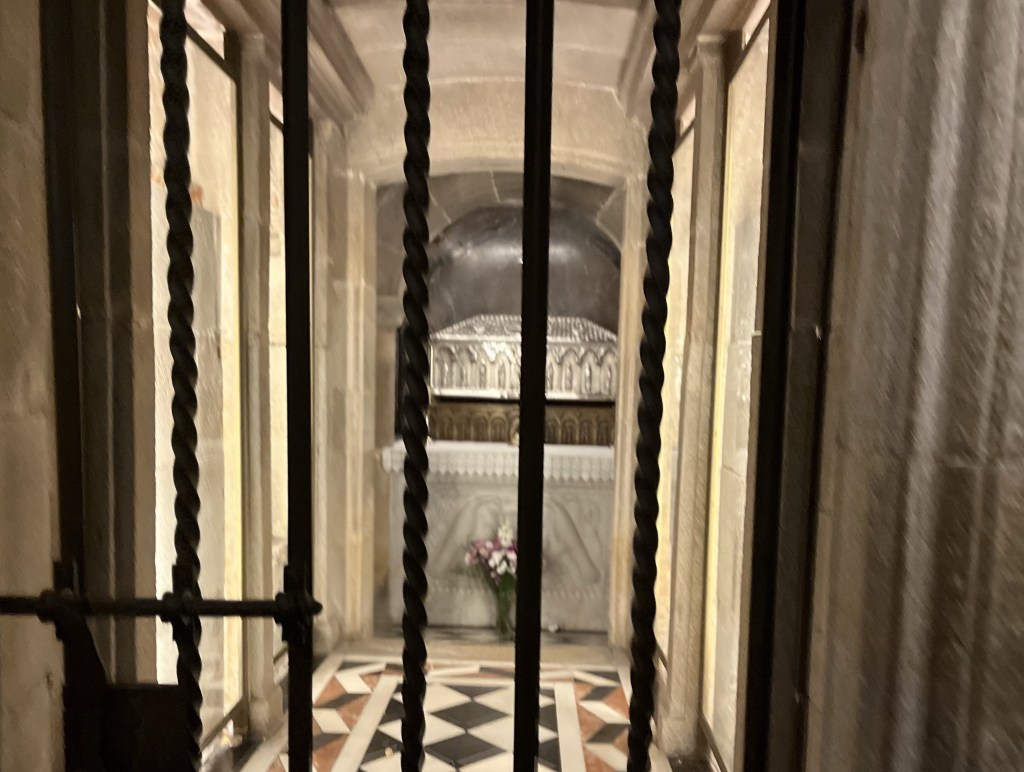
We also walked down to visit the crypt, the supposed final resting place of St James. Behind an iron gate, you can see a silver ossuary. There it is – a beautiful, yet simple box containing the remains of someone, who may or may not be St James. It is the inspiration of millions of pilgrims over centuries to take time out of their busy lives to hike for days or weeks.

Silver Ossuary in the crypt of the Cathedral

I don’t buy it. I think people do it for so many reasons, but seeing a silver box can’t be the motivation for most people. For some, it’s the drive to complete a physical challenge. For others, it’s the opportunity to hike through towns, villages, farms, and forests. Some are taking time for introspection, and others are there for the camaraderie and fellowship with their fellow pilgrims.

I was there for a combination of those things, and I think that’s probably true for most pilgrims. I was also drawn by the opportunity to participate in something that draws people from around the world. According to the official pilgrim website, which keeps statistics on the number of people who complete the Camino, so far in 2025, about 37% of pilgrims were Spanish, 8% American, 7% Portuguese, and 6% were German. The remaining 42% were from various countries around the globe. It’s an amazing opportunity to spend time with a lot of wonderful, diverse people who are all working toward the same difficult goal.

The opportunities to connect with people at cafes, along the Camino, or at an albergue are endless. Those conversations also don’t feel forced. People who come to do the Camino are generally friendly.

Walking around the Cathedral, however, felt a little hollow. We hadn’t finished, and it felt like I didn’t deserve to be there. Visiting the Cathedral is a rite of passage for people who complete the Camino, and we hadn’t. Jenn and Alex didn’t even want to visit the Cathedral.

We finished up our trip to the Cathedral and met up with Jenn and Alex for dinner. At dinner, we discussed the disappointment of not finishing.

With everyone still dealing with being somewhere between sore and injured, I asked if they would like to try this again. Jenn laughed and said that she thinks we owe the kids a beach vacation for the next Spring Break trip. To my surprise, however, everyone said that they would like to do it again, but with some optional off days.

There isn’t an experience like doing a Camino. It’s real. It’s authentic. It’s a tremendous physical challenge. It’s the opportunity to meet people from around the world, as well as the chance to experience Spain in a non-touristy way. I would love to give it another try, but I definitely want to do it when I can hike for at least a couple of weeks. I definitely think it would go better the next time, now that I’ve spent my first Camino learning how to do a Camino.