
The amazing thing about Rome is the ability to just stumble into something historic while being completely oblivious. It was 106 degrees in Rome and we found ourselves looking for shade and a cold beverage. We wandered into the Piazza Navona where there was a lot of restaurants and found a spot to sit down under an umbrella at Bernini Ristorante for a drink. We were sat on the piazza directly adjacent to the Fountain of Neptune.

Honestly, that’s pretty cool in its own right. You’re just wandering around in high tourist season and without a reservation you just sit down for a drink across from an amazing work of art? It’s just not a huge deal in Rome because there are fountains and ruins and statues everywhere.

While we’re sitting, enjoying a Peroni and Aperol spritz, I look over and see a sign in front of a construction area. A quick google search and I learned that the Piazza Navona was built on the site of the Stadio Di Domiziano.
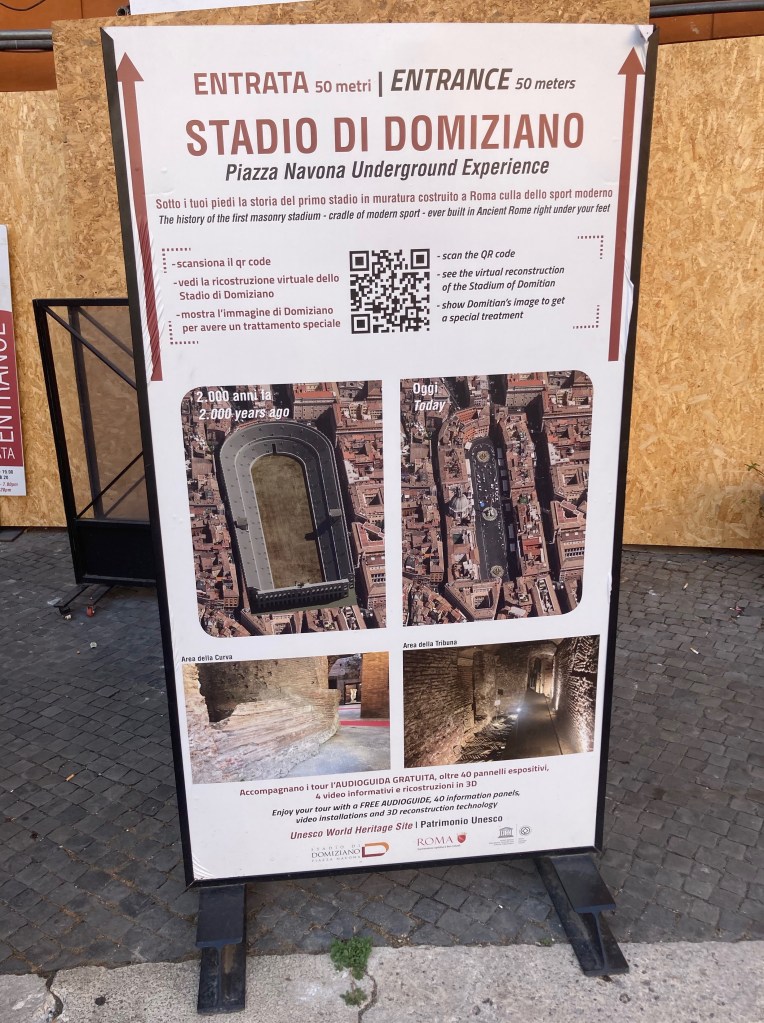
I compared the shape of the stadium on the poster to what I was seeing on the piazza and said “Hey guys, we’re sitting where they used to run chariot races!” (Which is completely false as I found out later, they never ran chariot races there). The kids looked at me like “So? Am I supposed to care about chariot races?”
The Stadio di Domiziano actually was a stadium built to house athletic events. It held around 30,000 Roman citizens and was built around 80 AD. It was built to house the Capitoline Games which was modeled after the original Greek Olympic Games. The Piazza di Navona is fairly long so I imagine that with only 30,000 seats this stadium probably didn’t need to be too tall. This probably meant that the stadium had great viewpoints from almost any seat.

What is now the piazza is the size of the playing field and the buildings surrounding the piazza is where the stadium itself was. This stadium was built on the standard of Greek stadia which is 180 meters long which obviously is longer than a now standard 100 meter long track.

You can actually take a tour of the ruins of the stadium, which is 15 feet under the piazza. Information about these tours can be found at https://stadiodomiziano.com/. Unless you speak Italian, you will need to have google translate that webpage into English for you.
The stadium fell into disrepair after the fall of the western Roman Empire and was gradually used for building materials. Eventually, the area was dedicated as a public space in the 15th century and developed into the Piazza Navona.
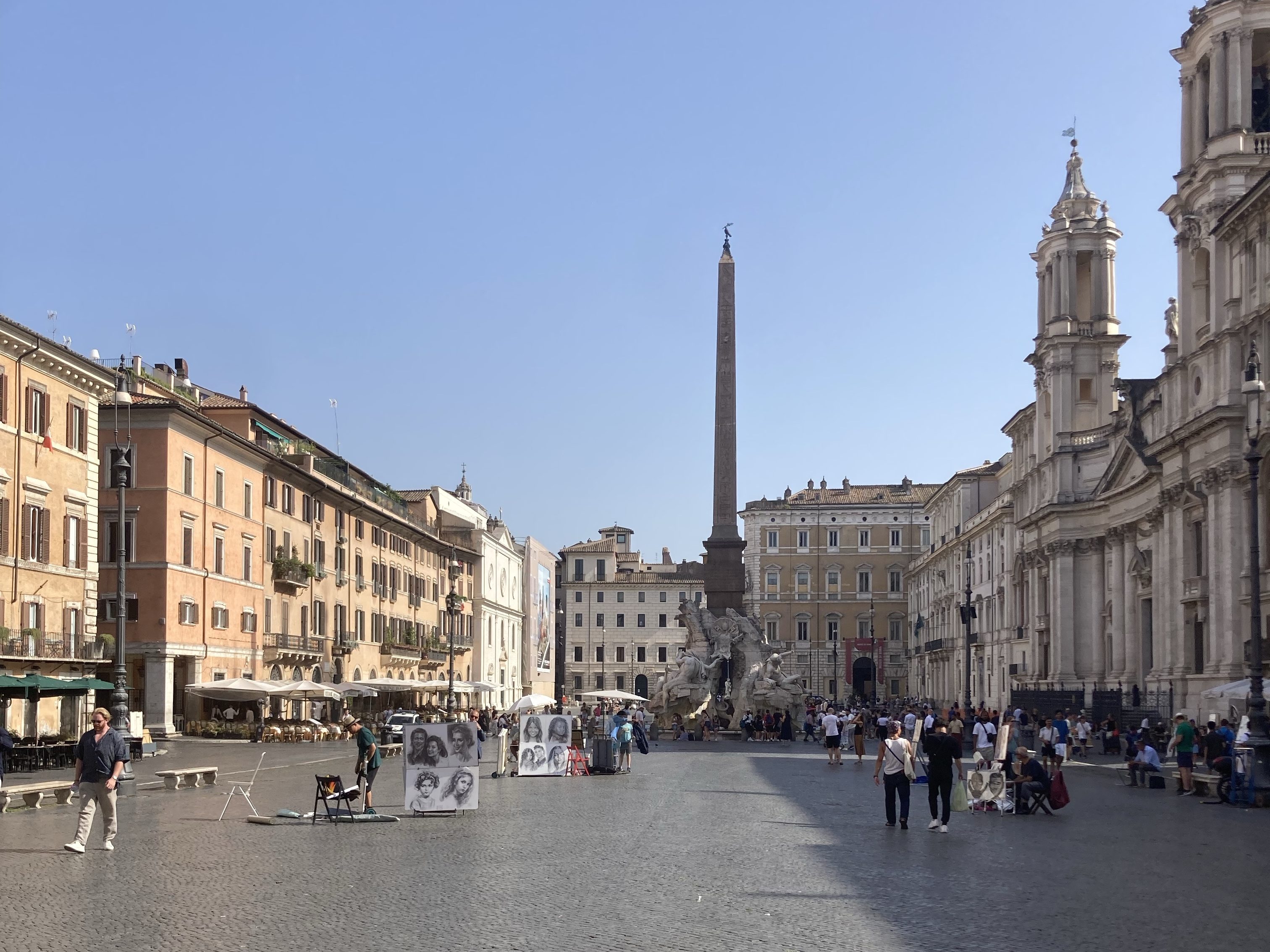
After finishing our drinks, we walked around the piazza for a few minutes and continued on our way. We probably should have spent more time there but being in Rome for a short amount of time meant that we had places that we wanted to see and not a lot of time to waste. It is pretty amazing, however, that Rome is so filled with beautiful places like this with a rich history. So full of history, in fact, that you can’t even stop for a drink without stumbling into something like this.
 Newby to Expert Traveler