
Gamla Stan dates back to the 13th Century and was founded when leaders from Sigtuna were having issues with armed bandits and were looking for a more defensible capital. Since the area is a series of islands and islands are easier to defend, it was a great place to build a capital. Now, without those pesky marauding bands of raiders, it makes for a great place to shop, eat and have a drink.

Gamla Stan is the old town of Stockholm and consists of the islands of Stadtsholden, Riddarholmen, Helgeandsholmen and Stromsborg. Stadtsholden is the main island and the one that most people associate with Gamla Stan.

On our first full day in Stockholm, we made it to the old town fairly early. The streets were mostly empty and some of the shops were still closed, which gave us a fairly calm walk to start the day. We popped in a couple of shops and made our way through town to find a cup of coffee. We managed to find that at Sundberg’s Konditori. We enjoyed the coffee sitting out in the cobblestone plaza. While we were drinking our coffee, however, the streets went from being fairly empty to being pretty packed.

Quite a few tour groups showed up, who traveled in packs of a dozen or two and tended to stretch all the way across the narrower roads. Tourists and shoppers started to pop up everywhere, but this was only a Thursday, so it probably could’ve been busier.

For the next couple of hours, we checked out a lot of shops while making our way down the crowded cobblestone streets. There were quite a few kitschy shops selling Swedish keepsakes scattered amongst art galleries and jewelry stores. After a while, we decided to go looking for a beer.
Swedish Attitudes towards drinking are A Bit Conservative
Sweden seems to be less comfortable about drinking than most of Europe. They have separate state owned grocery stores to sell any alcoholic beverage over 3.5%. They also apparently frown on drinking mid-week. The drinking age is 18, but you have to be 20 to buy alcohol from a store and restaurants and bars can choose to not serve you until you’re 20, which is interesting. Also, the grocery stores that we visited sold only non-alcoholic beer, a product I have yet to understand.
I mention this because as we were looking around for a beer, I noticed that there didn’t seem to be any Swedish bars, Swedish beers, or frankly any kind authentic Swedish alcohol anywhere. Most of the bars we came across were English, Irish or American, so we decided to stop in at Wirstrom’s Pub, an Irish Pub.
The Cellar Pubs of Stockholm
Wirstrom’s had a pretty nice selection of beers and Jenn ended up getting a nice Belgian Dubbel and I had a English Ale. They were showing a soccer game, and the majority of the clientele were pretty laser focused on that. We were admiring the building, which was lovely and has a really interesting basement where you can have a beer in an old cellar.

This, as it turns out, was not unique to Wirstrom’s. We went to O’Connell’s Irish Pub for lunch where I think everyone but Emma got Fish and Chips. The food was great and I developed a love for mushy peas there, but they also had cellar with a bar in it. That bar wasn’t open at the time, but I got the impression that they use it at night when the bars fill up.

Later on we came across another cellar pub named Kallerbyn. It looked very nice, but we didn’t stick around very long. I believe we picked up a to go coffee there and they let us walk around.

I think if we kept looking, we could’ve found more, It might be fun to do a cellar pub crawl in Stockholm. I mean, fun for me, Jenn couldn’t get out of these cellars fast enough, for some reason they creeped her out.
Narrow Roads and Fika
A lot of our time in Gamla Stan was spent wandering the narrow roads and admiring the architecture. The old stone roads were mostly car free, which made the walks fairly carefree and enjoyable. It was crowded but not so much as to be unbearable.
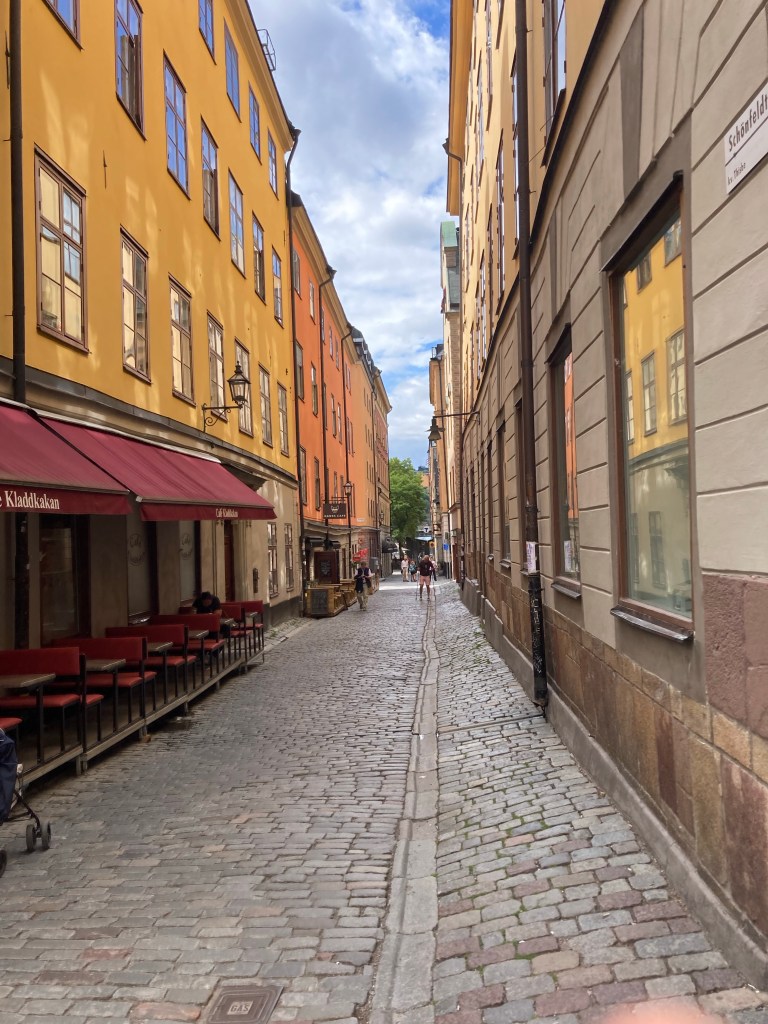
We did manage to stop in to a coffee shop and experience fika, sort of. Fika is a Swedish tradition of taking a set break during the day and have a small snack, usually something sweet like a cinnamon roll and a cup of coffee. Fika is meant to be a ritual that you spend with your coworkers or friends and it apparently is taken pretty seriously by Swedes as a way to disconnect for a few minutes and take a breather. We just sat down and had a cup of coffee and a cinnamon roll in a crowded coffee shop. I don’t think we did it right. By the way, Swedish cinnamon rolls are amazing, I might have to go back just for those.
Riddarholm Church
Riddarholm Church grabbed my attention right away when we approached the old town. I was fascinated by the beautiful iron spire on top of the belltower.
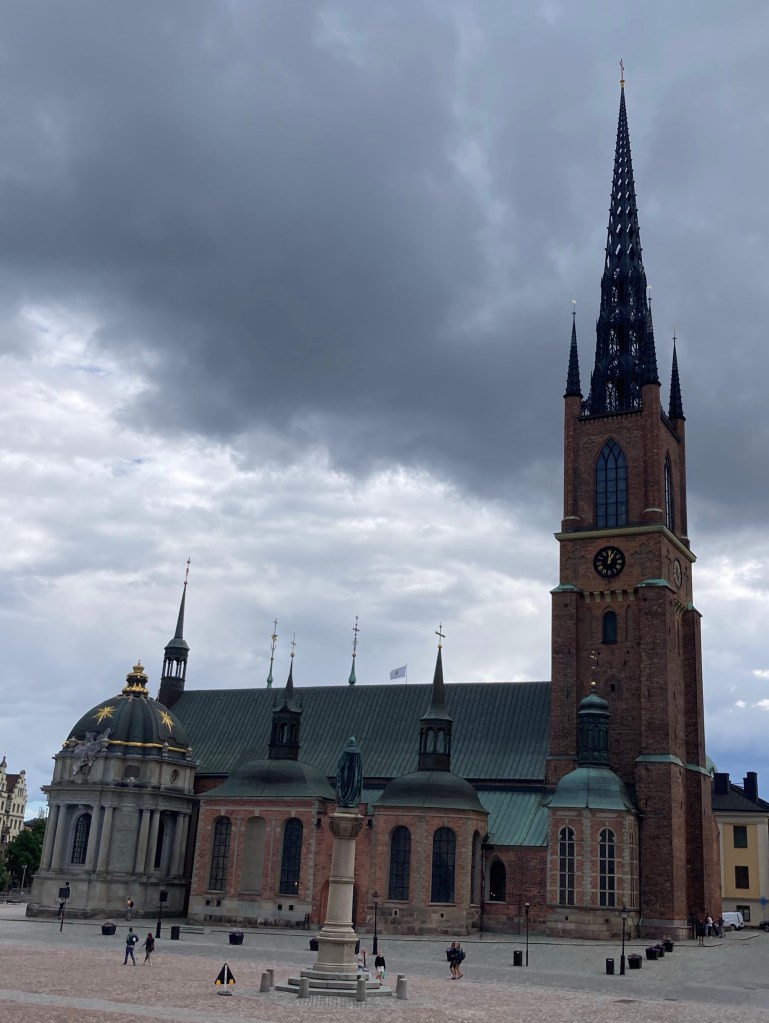
The church began it’s life as a monastery in the late 13th century. The church itself began to be built almost immediately after the monastery was opened. It became a popular place for Swedish royalty to be buried and there are 17 regents buried in the church. When the protestant reformation happened, the monastery was vacated and the church became a Lutheran church which stopped using the church in 1809. In 1835, a lightning strike destroyed the original spire and was replaced by the beautiful and unique iron spire.
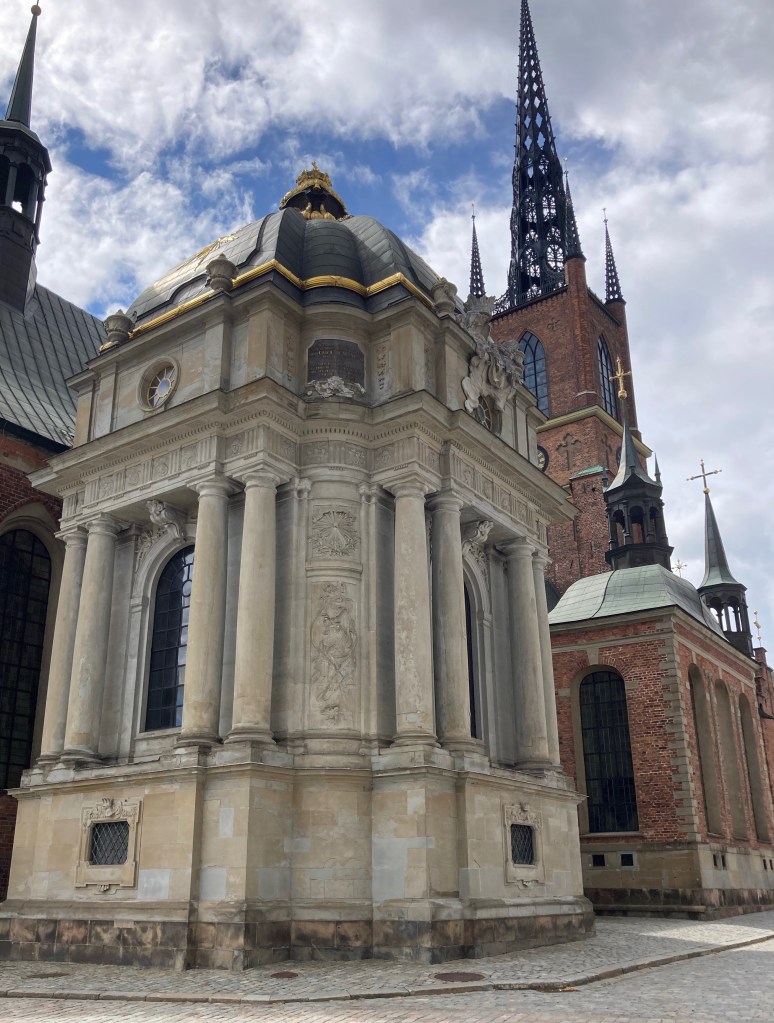
Currently the church is known for being the burial church of the kings, even though Swedish Royalty stopped using the church for burials in 1950.

Personally, I was struck by the contrast of the traditional 13th Century gothic church design mixed with a much more modern iron spire. However, knowing that by the time the iron spire had been added it was no longer being used as a church, that somehow made a little more sense to me. It’s absolutely unique and gorgeous, but unfortunately, we didn’t have tickets, or frankly a lot of time to visit, so we walked around the outside of the church, admired it’s beauty and left.
Reasons to Return to Gamla Stan
There were so many things that we didn’t really make time for in Gamla Stan. There is the Nobel Prize museum and the Royal Palace as well as Parliament. There are a couple of beautiful cathedrals to tour, the house of Nobility and the Bonde Palace. If you really wanted to explore the area to its fullest, I think you would need to devote at least 3 days to it, maybe more. We didn’t have enough time for all of that, but that’s okay with me, since that just gives us an excuse to return and get more of those amazing Swedish cinnamon rolls.






 Newby to Expert Traveler