Running in Venice can be a challenge. The city is like a labyrinth with constant turns, dead ends, narrow passageways and bridges that can sometimes be difficult to find. If you live in Venice and are familiar with how the city is laid out, this might not be too much of a challenge, but for those of us who are on vacation, it can be tricky to find a good route that isn’t too confusing.
There is one particular route that is both beautiful and isn’t too confusing. That is to run along the south side of the the main islands from Piazza San Marco to the east as far as you can go.
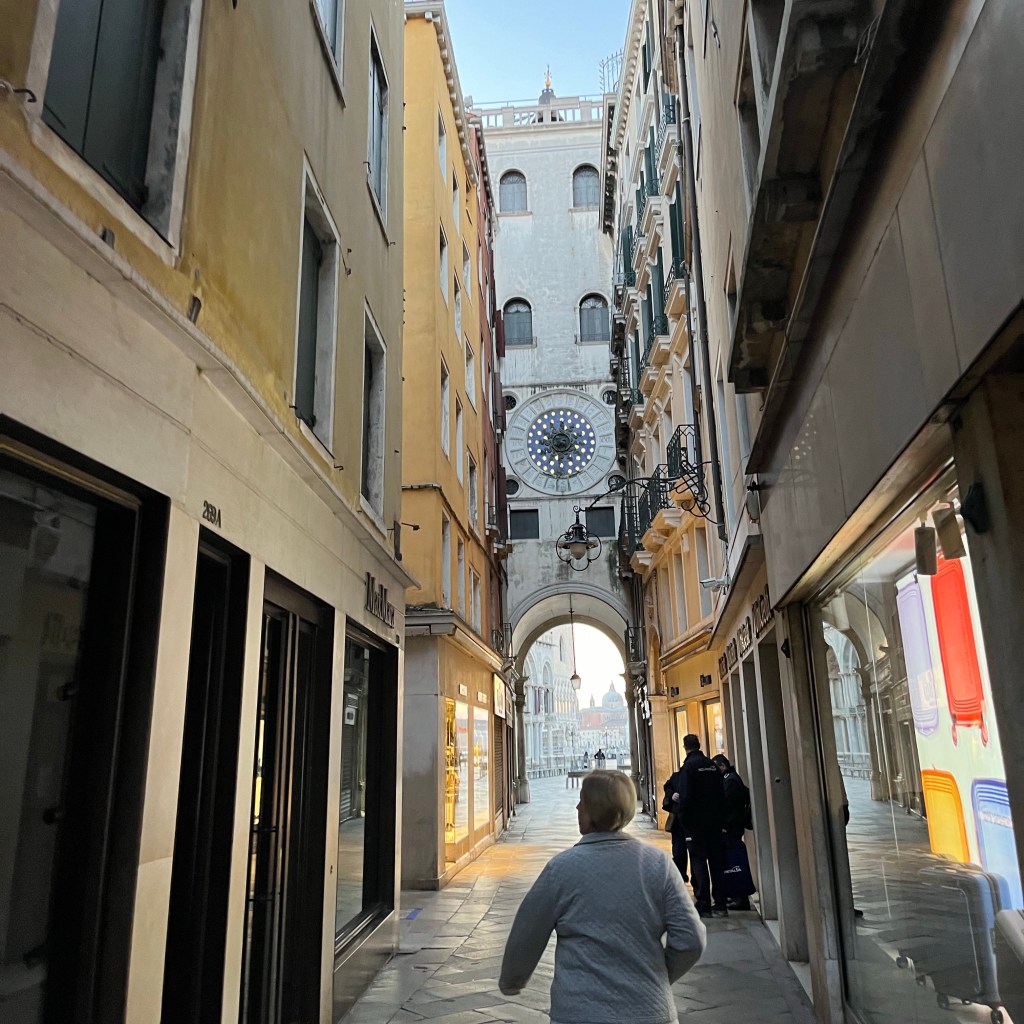
Basilica di San Marco barely visible as I approach the Piazza San Marco from under the clocktower.
I started early in the morning, before sunrise, knowing that it won’t take very long before workers and tourists fill up the streets. I like to get out early when its not too busy. Our Airbnb was near the Rialto Bridge, so the challenging thing to me, navigationally, was to run from Rialto Bridge to Piazza San Marco.
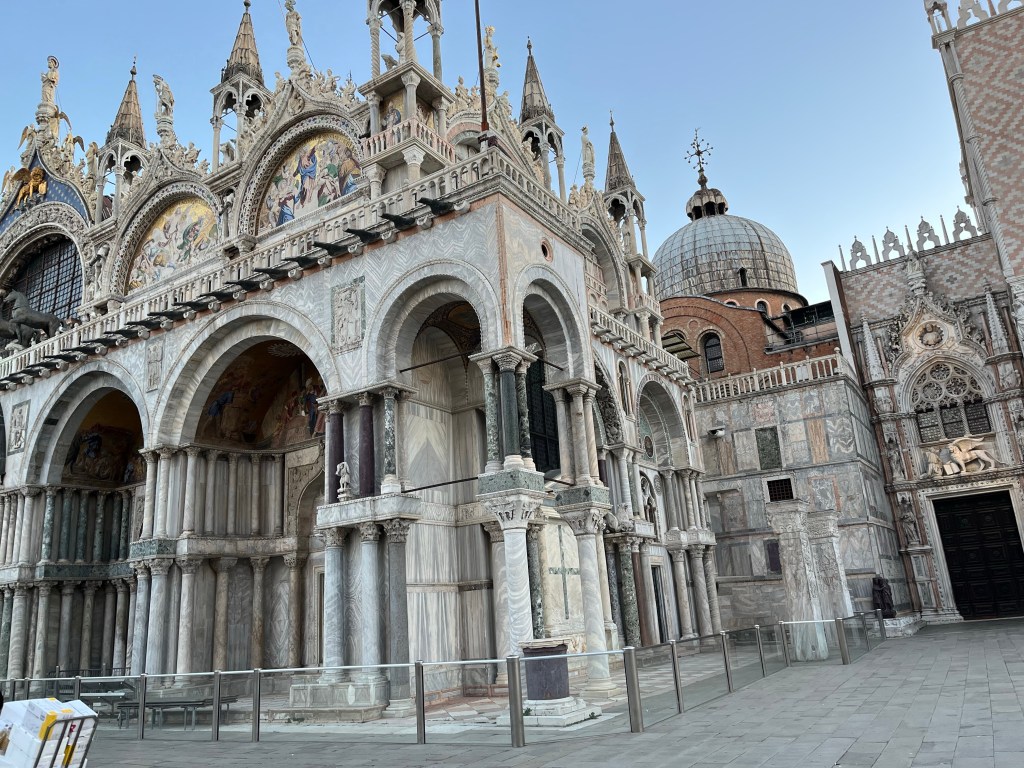
Basilica di San Marco
I wound my way through the narrow streets toward Piazza San Marco, following the signs that point the way. In a short amount of time, I saw the side of the Basilica di San Marco. It’s pretty amazing to see the Piazza early in the morning when its not completely full of people. It’s not exactly empty, but it is pretty great without all of the noise and crowds.
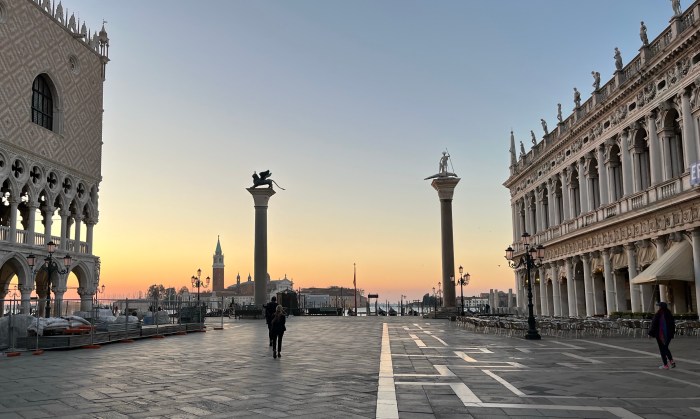
Two Columns, one with St Theodore and one with the Lion of Venice mark the boundary of Piazza San Marco.
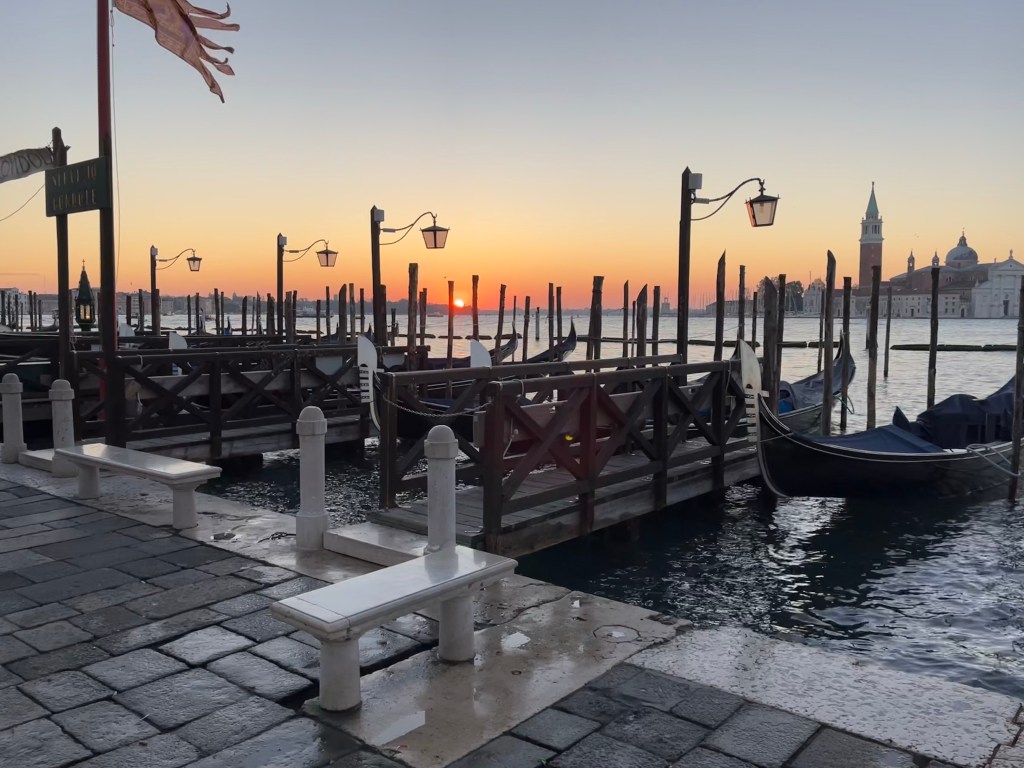
I then ran through the pillars that mark the edge of the Piazza San Marco and turned left along the water. Right outside of the Piazza is a series of docks for gondolas that aren’t yet in service.
Sunrise over Gondolas near Piazza San Marco
Running along the edge of the water toward the east, there is a lot of activity from all of the docks, restaurants and hotels that are getting their morning deliveries. This is normally a very busy area of Venice, and they need to get their supplies early before things get too busy.
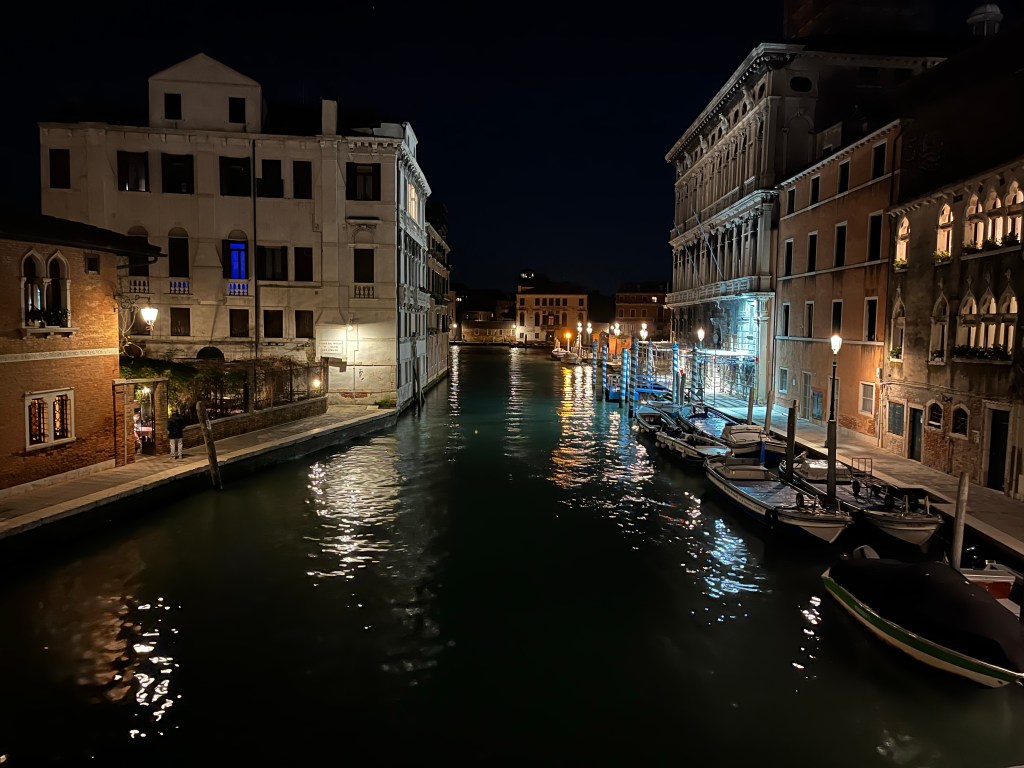
A view of a canal from a bridge along the route.
As I ran to the east, things got calmer and calmer, until finally I reached an area with a lot of trees. It’s a place called the Giardini Della Biennale, which has 30 pavilions, each housing an art exhibit from a different country. These exhibits change and are part of a biennial art exhibition called the Venice Biennale.
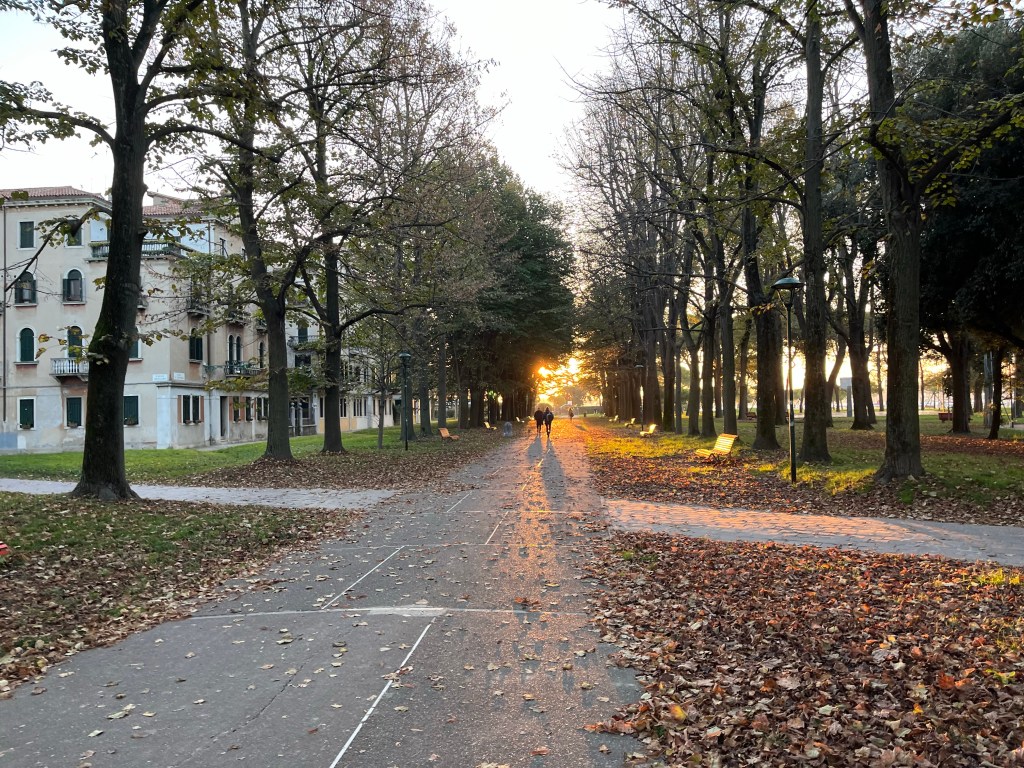
Grass and trees are rare in Venice, but you will find plenty in Parco deile Rimembranze
Moving out of the Giardini, I crossed another bridge and entered another park called the Parco deile Rimembranze. It was a nice serene park with tree lined paths. There were a number of folks walking dogs and enjoying the early morning.
Scuola Navale Militare Francisco Morosoni was the end of the line for me. Time to turn around.
It didn’t take too long before I ran out of park and I arrived at a bridge leading to a military base. Honestly, the last thing I expected to come across in Venice was a military base, but I had reached the end of the line and it was time to head back.
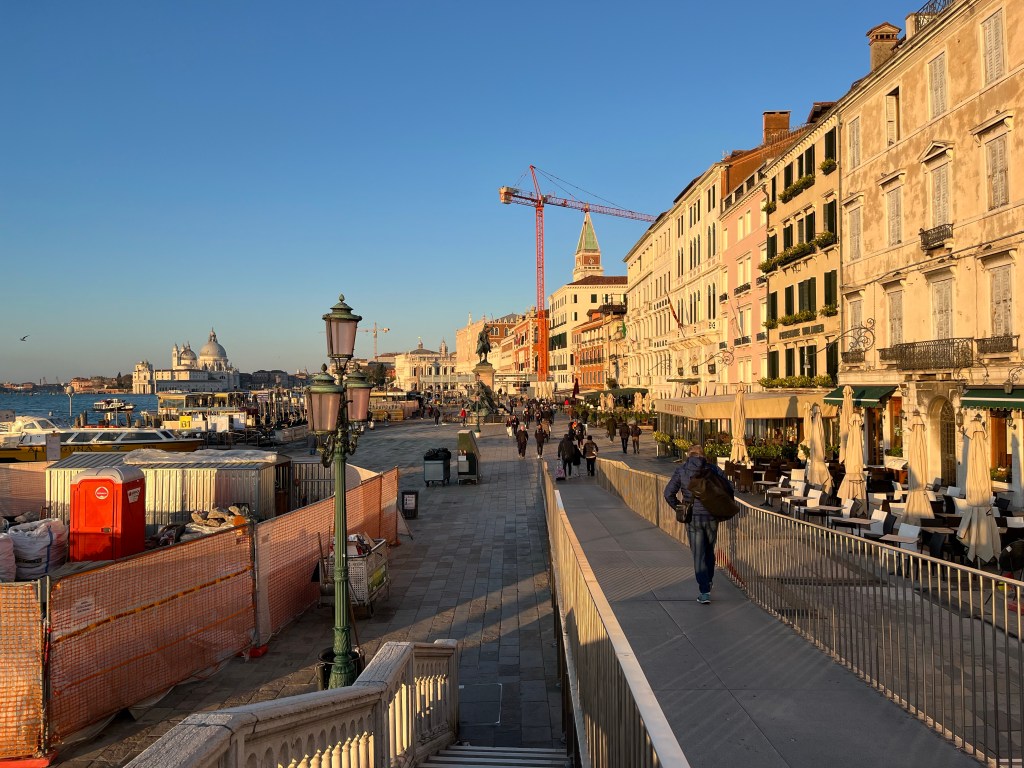
The waterfront area is fairly wide.
On the way back, the sun was higher in the sky, everything was a little brighter and quite a bit busier. It didn’t take very long for the area with all of the restaurants, bars and hotels to begin to fill up with people, probably people heading out for an early cappuccino.
San Giorgio Maggiore
Coming back from the east, there are fantastic views of the islands known as Guidecca. It is just a short distance across the water from the main islands. Also visible is San Georgio Maggiore, a small island that once housed the San Georgio Monastery established in 982. It’s belltower and domed church are striking from across the water.
You won’t find any elevation changes with the exception of bridges in Venice
I finished up by running back through Piazza San Marco and then back to the Airbnb. It turned out to be around 5 miles, and the portion from Piazza San Marco to the Naval Base and back is around 4 miles.
The route primarily is along the water on the South Side of Venice from the Piazza San Marco to the Naval Military School and then back.
When choosing a place to run in Venice, unless you know your way around, you’ll probably want to stick to this route. If you need to stretch out the distance, you’ll probably want to run around in the parks near the art exhibits and the Naval Base. No matter how you do it, it will be a gorgeous run – you’re in Venice after all!
We didn’t have a chance to visit Murano on our first trip to Venice and I wasn’t planning to miss it on our second trip. I was interested in seeing all of the beautiful glass created on the island and get a little insight about the art while we were there.
Inside a glass shop in Murano
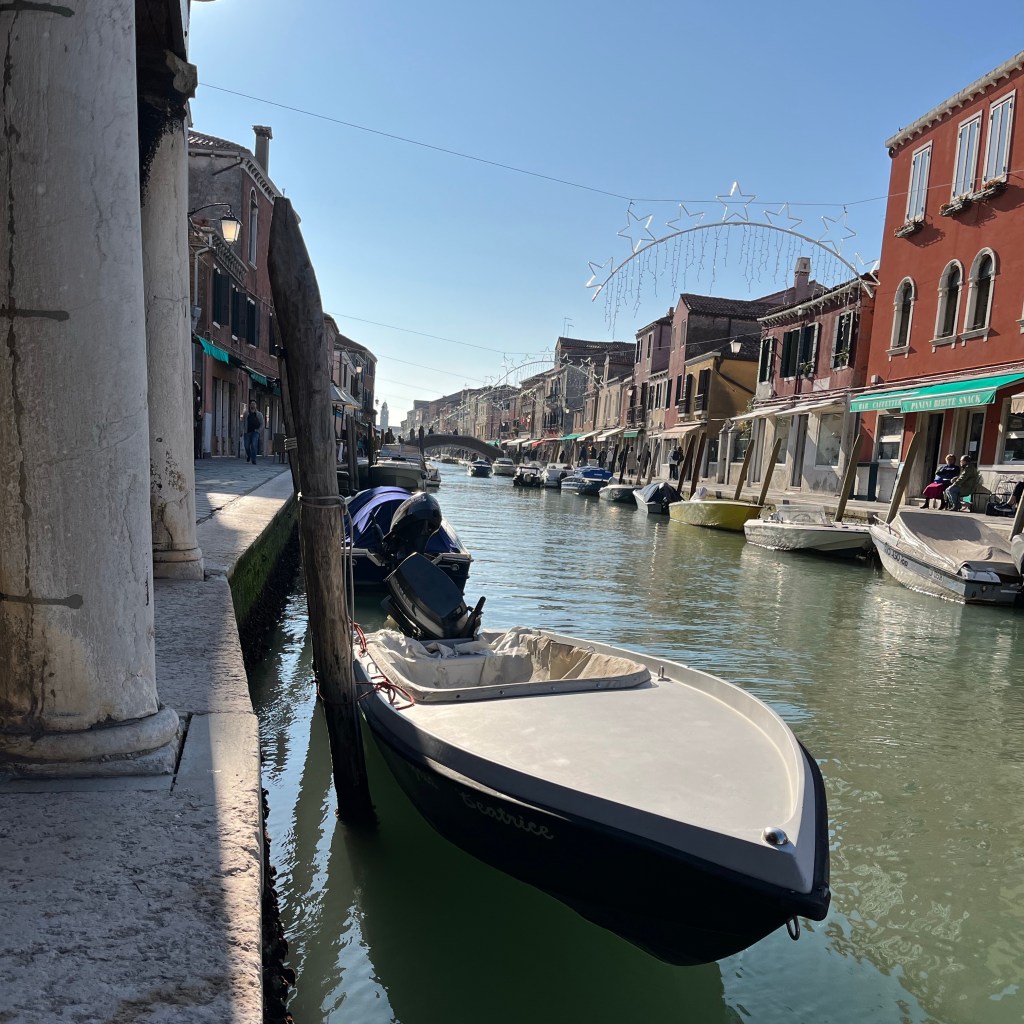
We took a vaporetto from the main islands of Venice to Murano and began our walk. I understood that this was an area primarily for glass production and sales, but I was still surprised by the number of shops that there were. We exited the vaporetto at the docks known as Murano Colonna and began to walk along the canal on Fondamenta dei Vetrai. We wandered along the canal, admiring all of the amazing glass work created by the artisans in Murano.
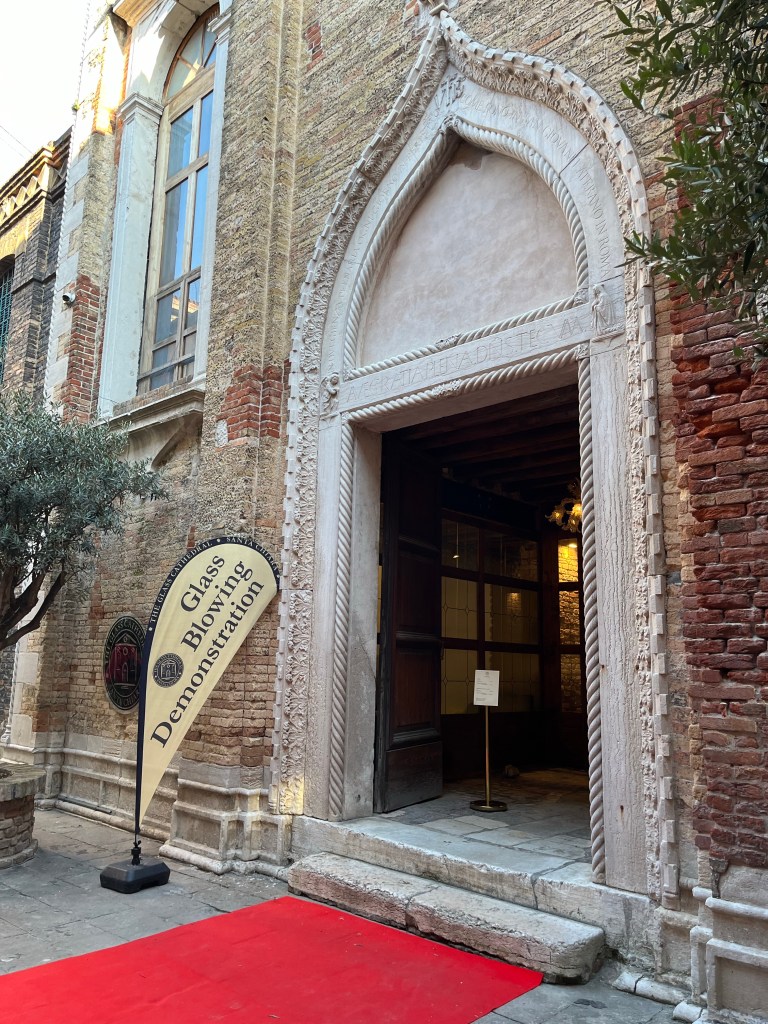
Entrance to the Glass Cathedral
After walking around a bit and shopping, we stopped for a drink and a light lunch at Rivalonga bar which is at the Hyatt Centric Murano. We had a nice view of the main canal through Murano. After the quick bite to eat, we headed to what I was really looking forward to, the glass blowing demonstration at the Glass Cathedral.
The Glass Cathedral
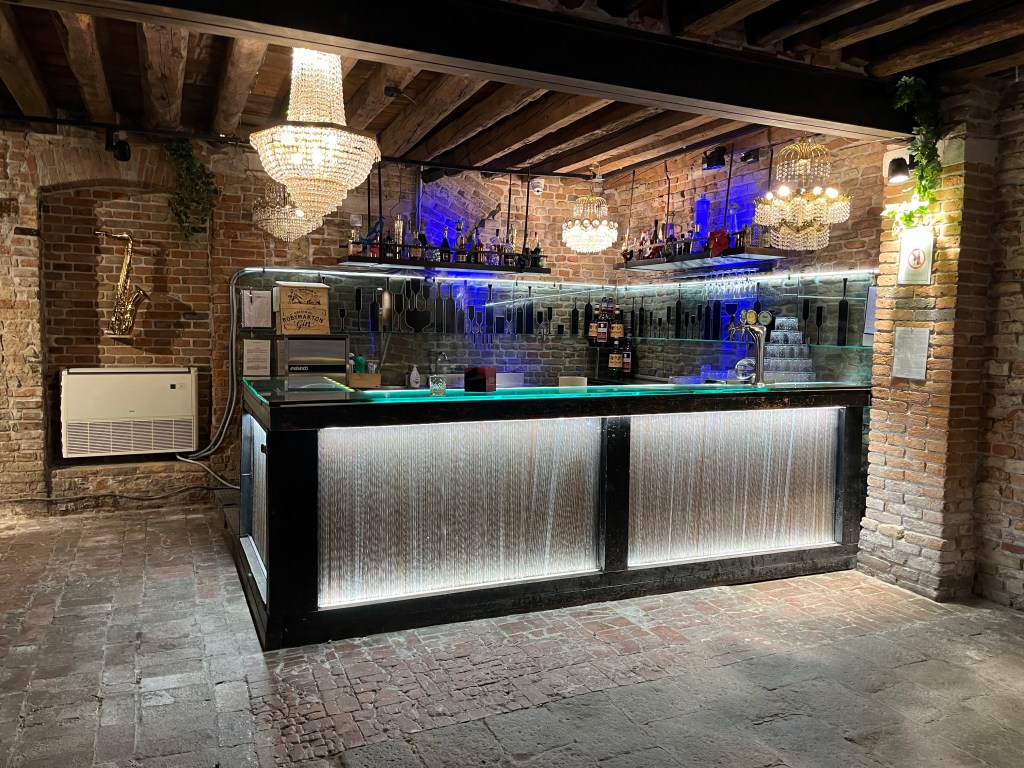
Bar at the Glass Cathedral
The Glass Cathedral is actually the Chiesa Santa Chiara, a church dating back to the 1300’s and was part of a convent for many centuries. In the 1800’s, it became a production facility for glass. Unfortunately, in the 1990s there was a fire and the roof collapsed. After years of vacancy the Belluardo family purchased it with the idea of turning the dilapidated building into a hospitality facility. In 2012, the Belluardo family began renovations of the Church and finished restorations in 2017.
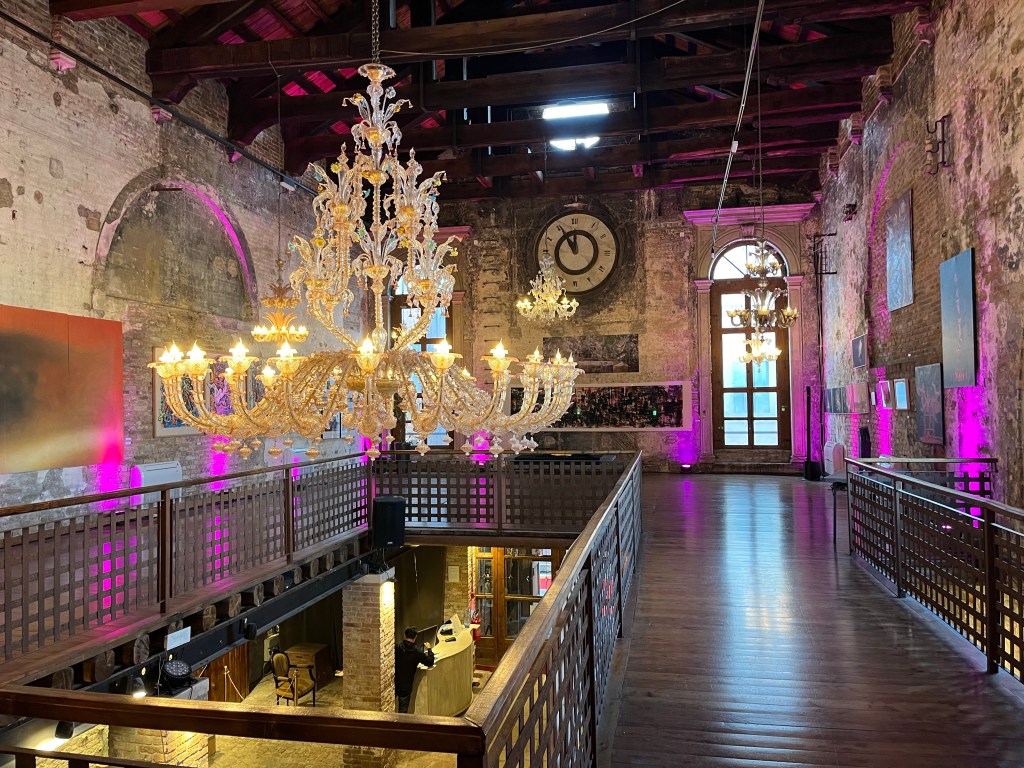
The second floor at the Glass Cathedral
The results of the renovations are spectacular. The Glass Cathedral is primarily an event center that hosts weddings and parties that can accommodate up to 300 people. What I love about this building is the fact that it blends the modern and ancient in a beautiful way. The old brickwork, wooden plank joists, and stained glass windows are accented by colored LED lights. Glass chandeliers and decorations are everywhere. It all makes for a perfect backdrop for a special event.
Metal decorations and vases in the lobby area of the Glass Cathedral.
However, for those of us who aren’t getting married in Venice, we can visit the Glass Cathedral and see a glass blowing demonstration. This of course gives you the opportunity to walk around the facility to see just how beautiful it is and to watch how artisan glass is produced.
LED lights, stained glass, and artwork on second floor of the Glass Cathedral
The Glass Blowing Demonstration
The tickets for the glass blowing demonstration were 14 Euros each, which you can buy in advance or at the door. We went ahead and purchased it when we got there. They did offer us an alcoholic beverage to enjoy during the demonstration for a small additional charge and of course I said yes.
Glass blowing artist heats up glass in oven
The demonstration is more of a performance than a demonstration. The Glass Master doesn’t explain what he’s doing, instead he is operating somewhere in the space between glass production and performance art. It is fascinating to watch.
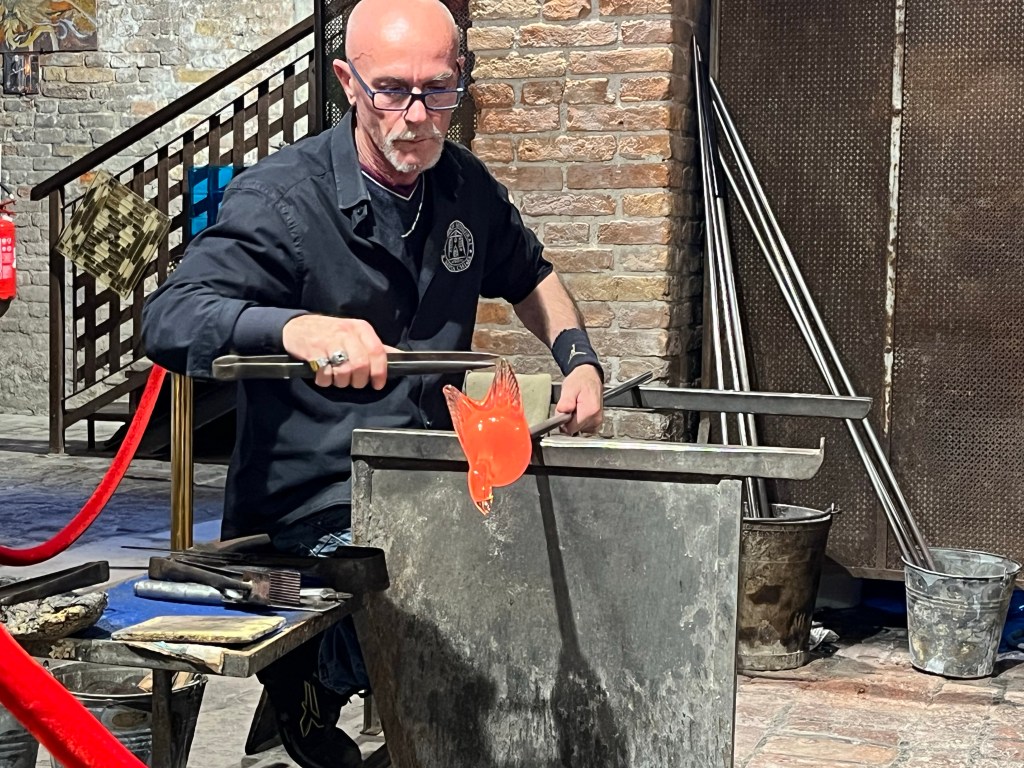
The glass master uses a tool to form the wing of a swan.
The show begins with the Glass Master putting the blow pipe into the furnace to pull out a mass of molten glass. He then proceeds to blow and turn the mass until he has shaped a pitcher. He attaches it a handle to the pitcher and also pulls the top until it forms a spout.
The Glass Master forms the tail feathers on the swan.
He continued the demonstration by making a variety of glass sculptures including a fish and a swan. All throughout, he is silently demonstrating how to use all of the available tools to create the shapes that he wants. He also demonstrated how to smoke glass and how to get various colors.
Glass figurine cools off
In the span of about 25 minutes, he created a vase, a fish and a swan. The speed and accuracy at which he worked was extremely impressive. The artist then announced the end of the demonstration and thanked us for our time.
Glass figure cools
This glass demonstration is a perfect compliment to a day in Murano. Walking around the town, gazing at all of the glass masterpieces, you wonder how they make all of this amazing art. Getting an opportunity to watch a true artisan make these pieces in real time is an great experience.
Glass for sale, probably the result of previous demonstrations
What is also great about going to this particular demonstration is that they aren’t going to hard sell you on anything. I can’t speak from experience, but I have read a number of reviews of other glass demonstrations in Murano and it appears to be common practice for a glass shop to offer free demonstrations, but expect you to buy something in return. We had no intention of buying anything because I didn’t feel like worrying about breaking it on the flight home. They do have some glass for sale at the Cathedral, but they don’t press you to purchase anything.
Going to the Glass Cathedral
Probably the best way to get to the Glass Cathedral is to take a vaporetto to the Murano Colonna docks. When you exit the boats head up along the canal to the right and cross the canal at the first bridge. There is an enormous building right at the end of that bridge and there will be multiple glass blowers doing demonstrations. You could go to any of them, but if you want to go to the Glass Cathedral you need to watch the signs carefully. We almost went to the wrong one.
A grand piano at the Glass Cathedral
You can purchase the tickets online at SantaChiaraMurano.com or you can show up and pay at the door. We went during the off-season so it wasn’t busy but if you are going during high tourist season, you might want to consider buying your tickets in advance.
Logo for the Glass Cathedral
If you plan to spend a few days in Venice there definitely is plenty to do but you should consider a trip to Murano. It is a little calmer, especially during the day, than the main islands of Venice and you will get an opportunity to really get up and personal with the Venetian glass industry. I highly recommend when you are in Murano to go to the Glass Cathedral. It will only take maybe 30 to 45 minutes of your time and you will get to see a beautiful facility and experience a glass blowing demonstration that will give you a greater appreciation for the artform.
Venice is a magical city. It’s architecture, art, cuisine and its soul are constantly on display. Millions of visitors visit Venice annually to experience all that is wonderful about this nearly two thousand year old city built on marshlands in the Adriatic Sea.
Boat Traffic on Canals in Venice During the Daytime
Because of the popularity, Venice can get extremely crowded during the day. The Vaporetto boats that carry tourists and locals from port to port along the canals get completely filled. The canals themselves get so crowded with boats carrying passengers throughout the city that it can seem unfathomable that there aren’t constant crashes between boats.
Canale de Cannaregio
During the day there is a buzz about the city. It’s not the same as the noise and crowds of cities like New York or Rome, but there is an energized feel about it that gets your heart racing a little. The vendors in the kiosks, the hawkers who try to pull you into their restaurants, and the thousands of people taking selfies can feel a bit overwhelming, especially to people like me who are easily overstimulated.
San Polo District Venice Italy
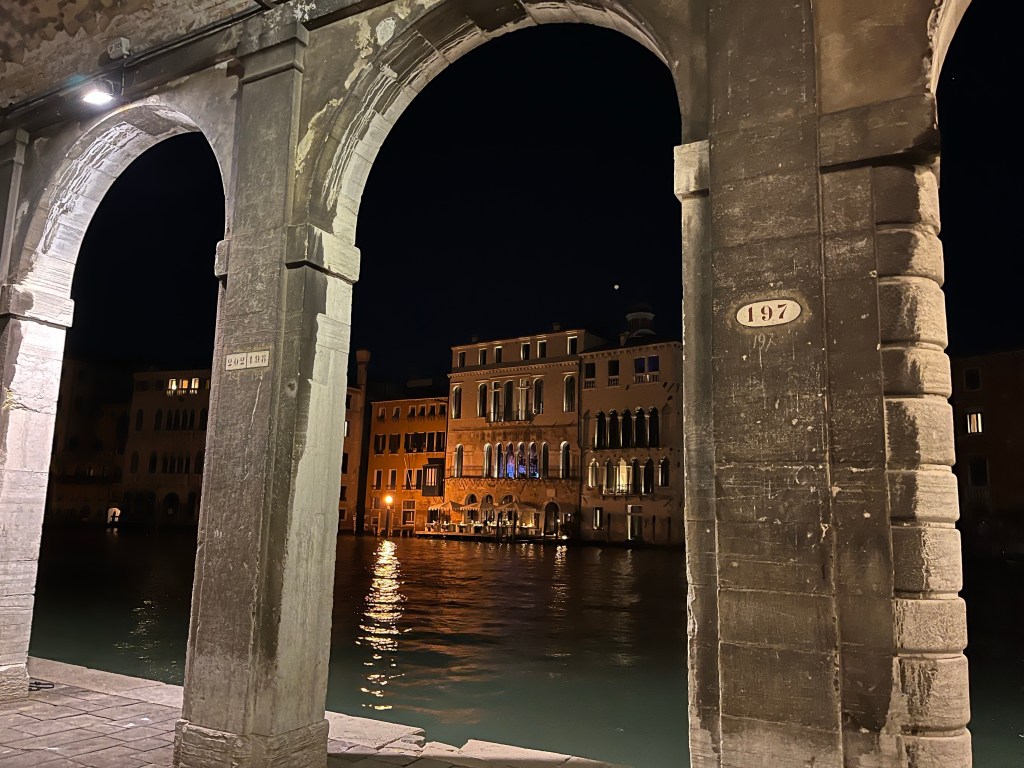
But as the sun begins to set in Venice, something amazing begins. It’s almost like a someone dialing back the chaos with a dimmer switch. Many of the visitors get back on trains and head home. Tourists sit down for a big dinner before heading back to their Airbnb or their hotel. The streets empty a little and the lights begin to turn on.
Grand Canal at night from Vaporretto
During the day, you see the flaws. Paint chipping, buildings leaning and graffiti expose the age of the city. In the evening, shadows hide these imperfections while accentuating the beauty of the architecture and stone streets.
Trattoria alla Palazzina
There is something else going on in Venice and that is that even though tourism is as popular as ever, the population within the city center has fallen dramatically over time. On the main island the population has dropped by around 120,000 residents. This leaves the population on the main island below 50,000 residents. We were in Venice in November, which is low tourist season and with the population of Venice being at its lowest point probably since its founding, it was eerily quiet.
Often when people think of Venice, the idea of Carnival comes to mind. It’s easy to imagine that the streets would be full of drunken costumed revelers as they move from party to party. Instead, what you see are people quietly enjoying a bottle of wine at a restaurant in a plaza.
Archway near Campo Bella Vienna
By early evening, most of the shops had closed, but the restaurants and bars remained open. We wandered around the corner and stumbled upon a crowd in a plaza enjoying wine and beer. They were gathering around a little enoteca named Al Merca. It is known for its small sandwiches, wine, aperol spritz, and great prices. We enjoyed a drink or two in the lovely Campo Bella Vienna and then walked over to the Rialto Bridge.
Barcolo Bar, next to Al Merca in Campo Bella Vienna
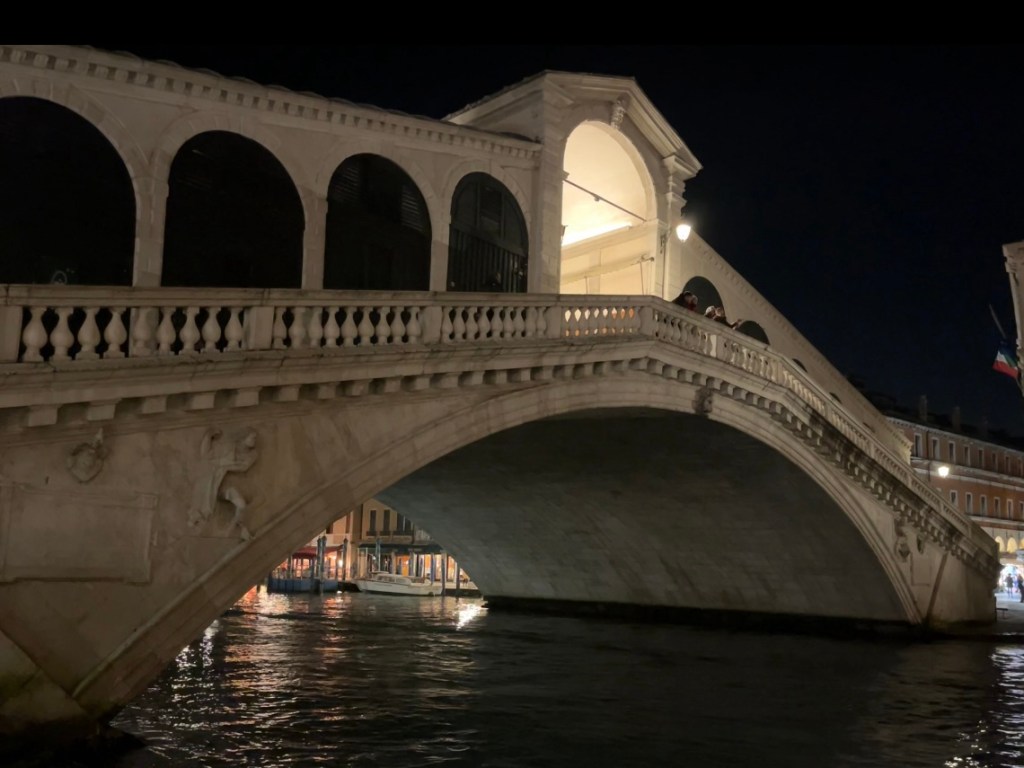
It’s difficult to enjoy the Rialto Bridge during the day, with the crowds of tourists all trying to position themselves for that perfect selfie. But at night, we were able to walk up to the apex of the bridge and rest against the stone handrail that has been smoothed to a fine polish by millions of hands that have run across it over the centuries.
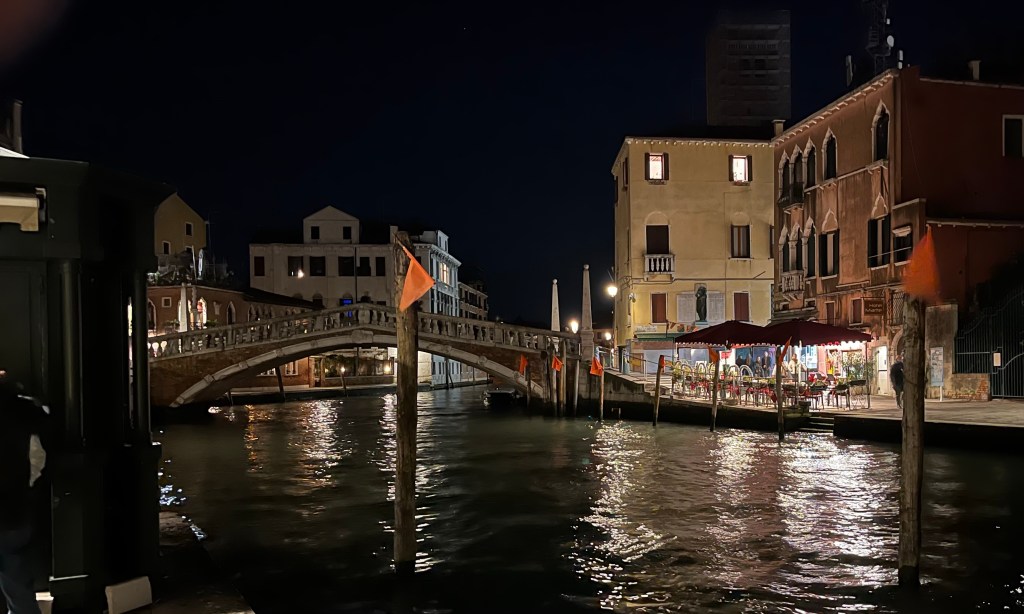
View from Ponte della Guglie
From that vantage point on the Rialto Bridge, you see the lights from the streets and buildings as they dance along the ripples on the Grand Canal. The boat traffic was all but gone with the exception of an occasional vaporetto. What seemed chaotic only a few hours prior was now serene.
Rialto Bridge at night
As the night went on, the streets continued to empty and at some point it felt like we were almost by ourselves. Whenever we would enter a plaza we would find people enjoying a restaurant or a bar, but side streets were really quiet.
Grand Canal at Night from Rialto Bridge
We eventually got tired, but stopped for a slice of thick crust pizza at Antico Forno where the shopkeeper graciously served us even though it was only 5 minutes before they closed. The crust was crispy and the tomatoes, basil and mozzarella was still surprisingly fresh. It was a perfect end to a night of exploration of Venice at night.
Pizza on Display at Antico Forno
We finished our slice and headed back to the Airbnb.
San Polo District Venice Italy
I can’t help but wonder how much the folks who do day trips to Venice are missing by not staying in the main part of the city. It’s such a different vibe in Venice at night. With the population drop in Venice, I wonder if we’re really experiencing Venice in way that nobody really has before. After this trip, I just can’t imagine visiting Venice without staying on the main island and walking it’s beautiful streets at night.
There is debate on this, but the general consensus is that around 600 AD, Italians who were fleeing attacks from Lombard invaders moved out onto the islands of Venice because they could defend themselves better on the islands. The islands were marshy and difficult to build on, but much easier to defend than being on the mainland. In order to prevent anything that was built on the marsh from predictably sinking, the Venetians drove millions of wooden posts into the marsh. These posts compacted the mud. The mud keeps the posts from decomposing and the combination of the mud and posts makes a solid foundation on which to build. Strip the City does a great job demonstrating how this worked in the video below.
Venice Becomes a Trade Empire
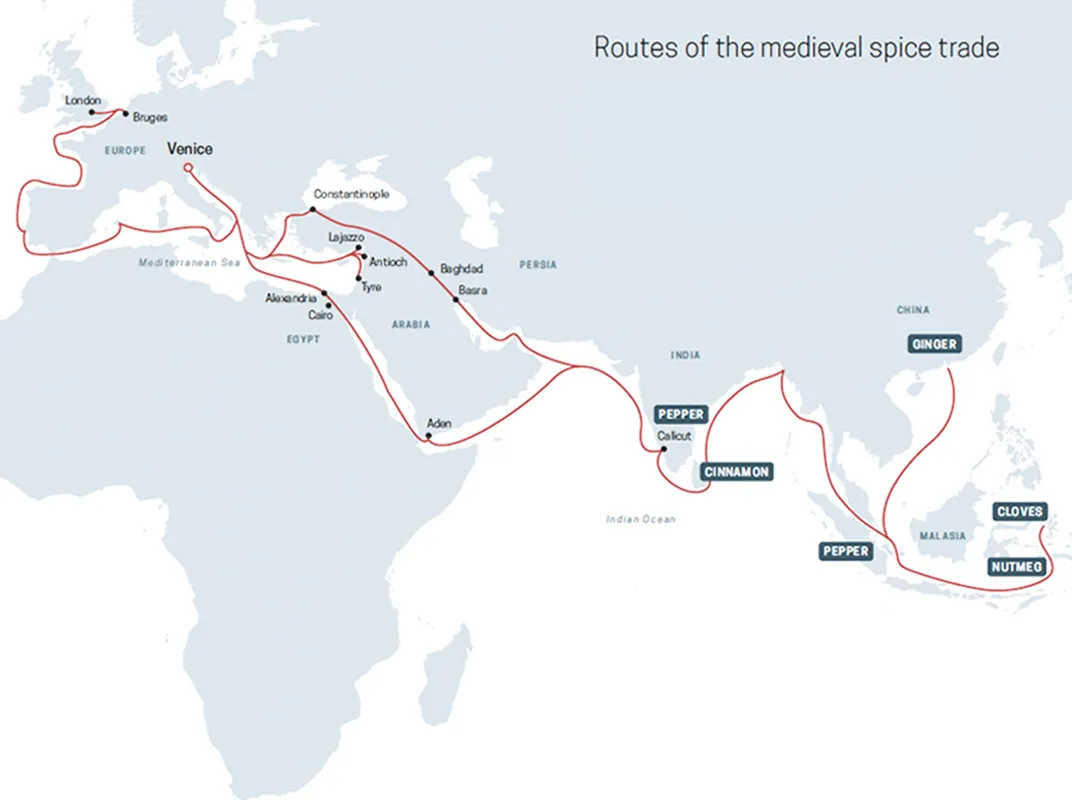
For much of the time between the 9th Century and the 16th Century, Venice was uniquely positioned to take advantage of trade routes. Venice had access to Constantinople as well as Alexandria by ship and was able to unload goods onto the European mainland. This allowed them to sell goods throughout Europe. Venice built a powerful navy in order to protect their merchants from pirates in the Mediterranean Sea. This turned Venice into a vital link between the spice and silk trade of Asia and Medieval Europe where those goods were so valuable. The Smithsonian Magazine has a great article which goes into greater depth on this subject.
Image provided by the Smithsonian Magazine
Wealth Produces Art
One thing that always seems to be the case throughout history, is that where there is great wealth, there is great art. The vast trading empire of Venice was creating an amazing amount of wealth amongst its merchants. That wealth created a market for artwork, since having great artwork is generally a way that many wealthy people demonstrate that they are wealthy and successful. There are a number of famous renaissance artists from Venice, including Giovanni Bellini, Vittore Carpaccio, Giorgione, and Titian.
Palazzo Cavalli-Franchetti
We typically think of painting when we think of art. But art is evident throughout Venice. You see it in the architecture, the stonework and the ironwork on buildings. You see it in the statues and even in the beauty of the gondolas that seem to glide through the canals.
Gondolas take around 6 months to build and cost around 40,000 Euro.
The Architecture of Venice
As was just about everything in Venice, the architecture of Venice was influenced by its trading partners. Because Venice was trading with people throughout Europe and into the Byzantine Empire, a new form of architecture emerged in Venice. It is known as Venetian Gothic and it is found throughout Venice and has elements of Gothic architecture such as pointed arches, rib vaults and tracery as well as elements of Byzantine architecture such as the use of domes and veneers. These elements created a unique style that can be seen throughout Venice.
The domes at St Mark’s Basilica are examples of Byzantine influence in Venetian architecture
The vast majority of buildings are obviously not as adorned as St. Mark’s Basilica, but even the typical homes in Venice have a certain flair to them. There are a number of Juliet balconies, windows featuring tracing and pointed arches, and a lot of lovely doors. There are also window boxes with flowers everywhere. It all leads to a style that is positively Venetian.
The Doors of Venice
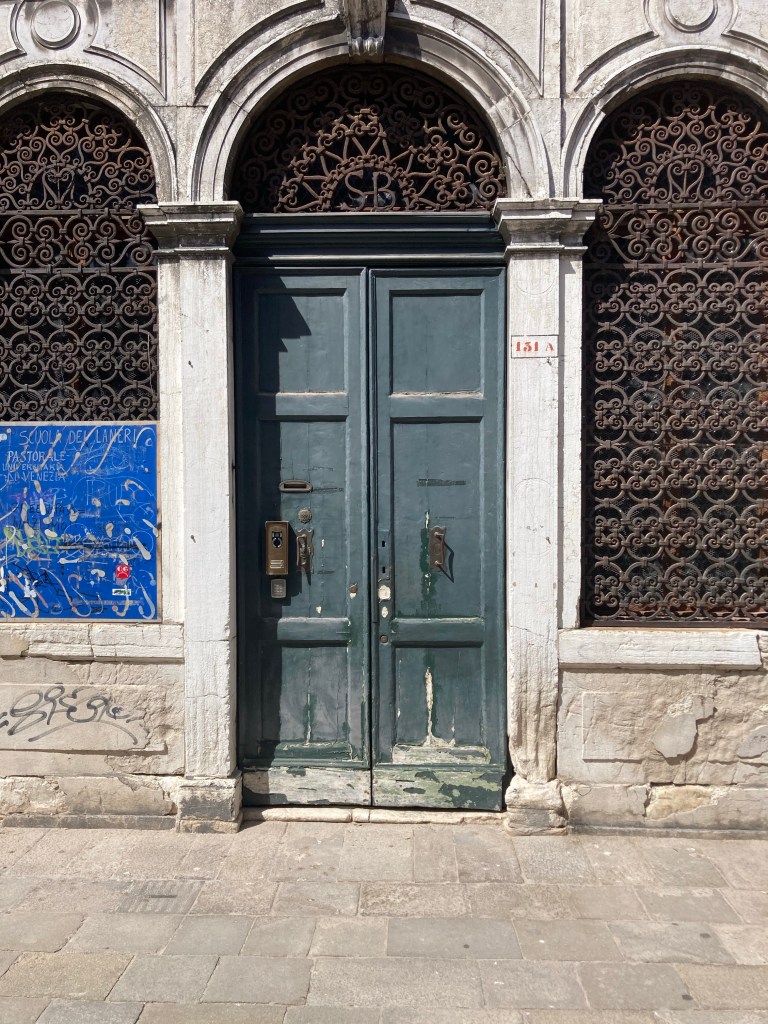
One of my favorite things about Venice is the doors. They all seem to be unique to the buildings. A lot of them are wooden and very worn with time. Often you see them like in the below picture, with beautiful stonework and ironwork surrounding the doorframe.
Other times, you see doors which are not quite as worn, but instead are truly unique pieces of art, like this beautiful metal door. This door also has beautiful stonework surrounding it as well as some really interesting brickwork.
Below is another example of great stonework and brickwork surrounding the door. Also, this door is a gorgeous piece of woodwork. Another thing I’ve noticed about Venetian doors is that not always is the lock and door pull where you would expect them which is interesting. Venetian doors also tend to all have letter slots.
Beautiful Door with Inscription over it meaning “Year of our Lord 1904″
Venetian Statues
If you walk around enough in Venice, you will undoubtably come across a few statues. Many of the campos in Venice feature a statue dedicated to a historical figure of Venice. From the limited amount of time I spent in Venice, it seemed that the majority of these statues were fairly recent, being from the 19th Century or newer. However, in my opinion, they fit in nicely to their surroundings, even if they are recent additions to the plazas they inhabit.
The Monument to Daniele Manin was erected in 1875 and was sculpted by Luigi Borro.
The above statue is a bronze statue of Daniele Manin, who was born in Venice and an important leader who helped to reunify Italy. It is the featured statue in Campo Manin, obviously named for the Daniele Manin.
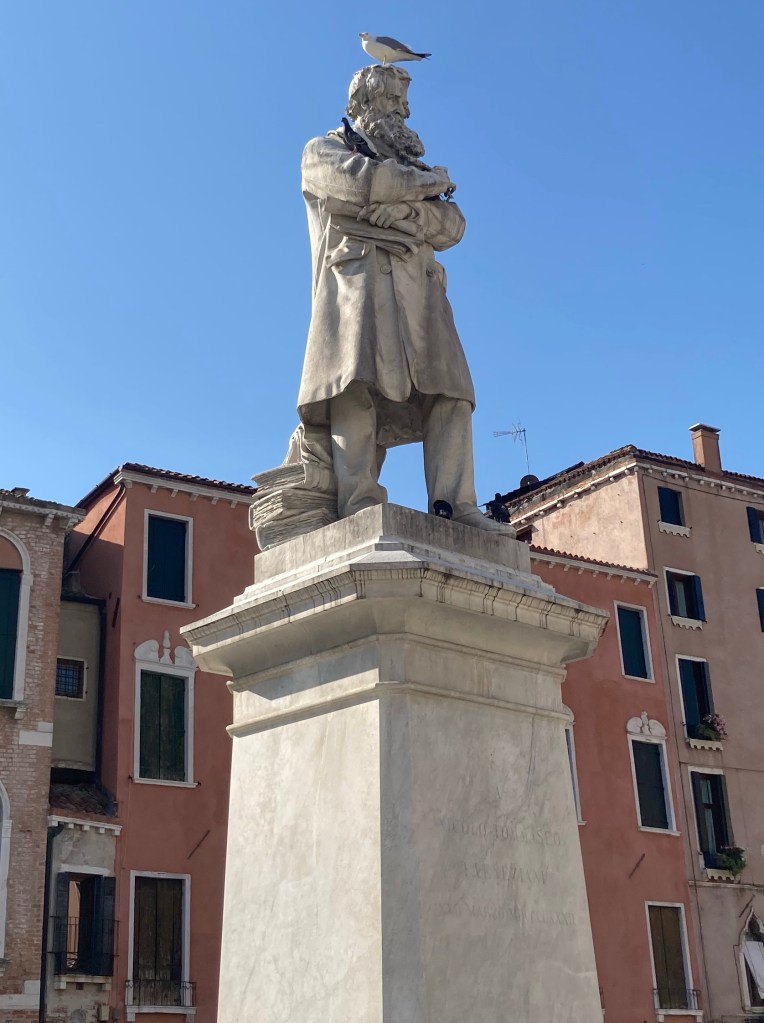
Monument to Niccoló Tommaseo built in 1882 by Francesco Barzaghi
The statue above, is a built out of Carrara marble. It was a monument built to Niccoló Tommaseo who was known as a scholar and an Italian patriot. This particular statue has a funny nickname, because as the sculptor was carving the statue, it began to have structural issues. In order to keep it from falling over, he carved a stack of books for Niccoló to lean on. The problem is that the stack of books looks like it’s flowing from under his overcoat, which has earned the statue the nickname “book shitter”.
The Bridges of Venice
Virtually all bridges in Venice are built with the same basic shape. The strength is created by an archway over the canal, while a walkway is a set of stairs up and a set of stairs down. Many of the bridges, especially the ones that are built over smaller canals are built with stone and brick.
Both of these bridges are typical of Venetian bridges. Arched at the bottom and stairs on top.
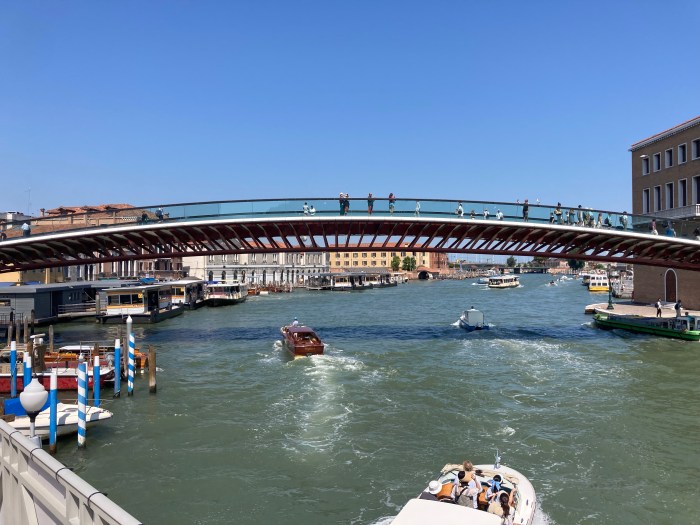
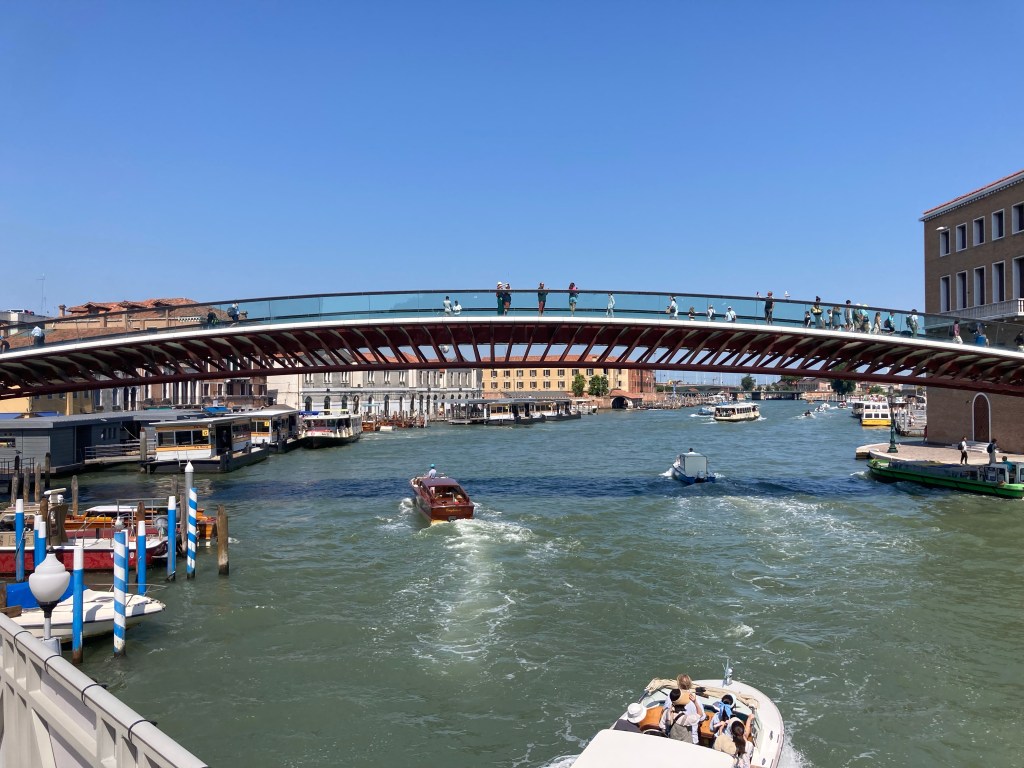
The bridges that are built over the Grand Canal are longer and require a more modern structural design. The most modern example is the Constitution Bridge that was opened in 2008 and is unique in Venice for it’s steel and glass construction and modern design.
Artistic Touches
There is a certain flair to much of what you run across in Venice, you’ll see it in door frames, window frames, as well as architectural sculptures. You’ll also see it in the detail of the three flagpoles in the Piazza San Marco. The bronze bases were sculpted by Alessandro Leopardi in 1505. The flagpoles are spaced out in front of the St. Marks Basilica and are strikingly beautiful.
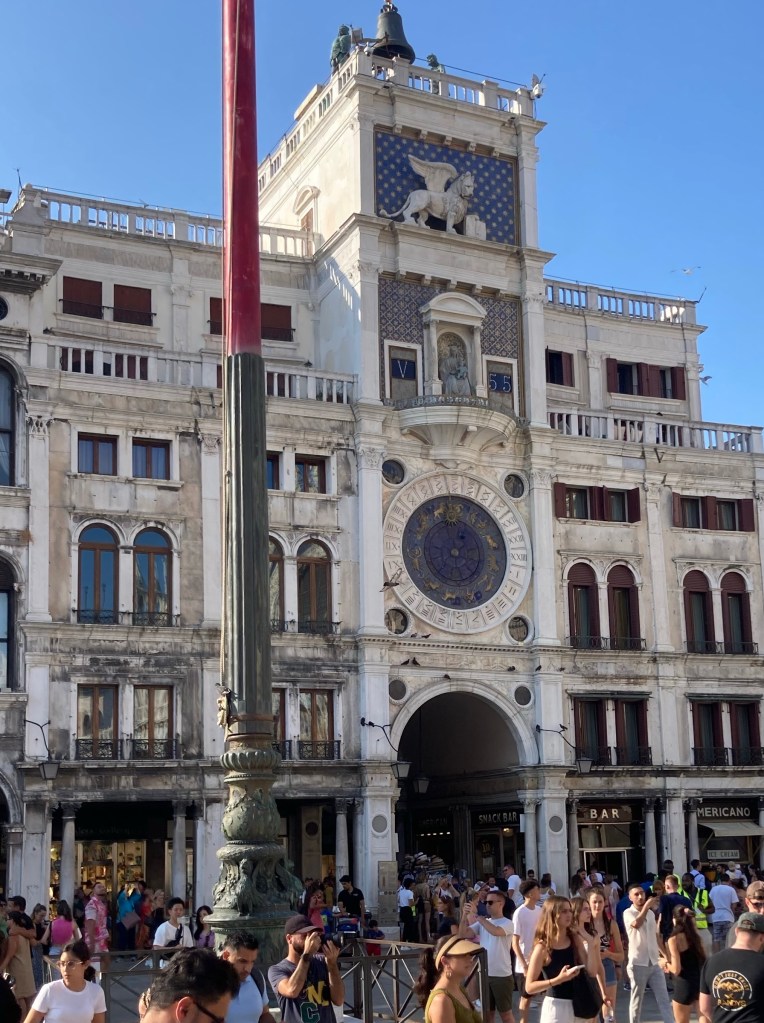
St Mark’s Clocktower is also a great example of the style of Venice. It’s an beautiful white stone structure, with the Lion of St Mark near the top. Below that is the Virgin with Child and then the clockface itself. This clocktower was built as a replacement for an older clocktower in the late 15th Century.
St Mark’s Clocktower
St. Mark’s Basilica itself takes the details to extremes. There are details everywhere. Just one small section of the basilica demonstrates the details. There are multiple columns and a stone archway. The door itself has intricate ironwork while the head of the doorframe is an intricate Byzantine design. The most stunning part, however is the mosaic half-dome which depicts the moment that St Mark’s body was carried into the Basilica. It is adorned in 24 carat gold leaf. Seemingly every inch of the Basilica is covered in detail like this.
This mosaic half dome over a door to St Mark’s Basilica is stunning.
Ironwork of Venice
Venice has some amazing Ironwork that can be found around the city. Mostly you will see it in gates, fences and balconies, but you will also see it on lamp posts.
Ironwork on the doors as well as on lamps are everywhere in Venice
The most typical places that you see this ironwork is as window grills or as door protections. I’m sure that the original purpose of this was for security, however they do tend to be very beautiful and add a certain flair to an already beautiful city.
Window Grille from our AirBnB looking out to a courtyard
The Canals of Venice
Canals aren’t necessarily art themselves, but in reality they are the parts of Venice that weren’t forced to become solid ground. They are, in a sense, the absence of development. But they are also the main thoroughfares that are the lifeblood of Venice. They are the roads that deliver the goods that feed the city as well as transport citizens and tourists alike around the city.
The canals are quintessentially Venice and are usually the first things that people think of when they picture the city. They are more a result of public works, much as any street in the world is, but there is just something uniquely beautiful about these canals. I believe that beauty is a result of how well the canals fit in with their surroundings.
Centuries of Artisans create a Single Masterpiece
In the end, what Venice has become is the result of centuries of hard work by thousands upon thousands of hard working Venetian citizens. Great cities take time to evolve. Venice was a city built in the marsh because of the need for security of its citizens. It developed slowly but steadily into a trading empire and it’s citizens became wealthy. As the city developed, they continued to make improvement after improvement, whether it be public works projects like bridges and canals, architectural and building projects, or artisan projects like statues, doors and ironwork.
In the end what is left is a single masterpiece that people from around the world visit and admire. It is one of the world’s great cities and should be experienced at least once in a lifetime.
We arrived in Venice later than we had expected. Our train was supposed to be in Venice around 6:30, but due to some downed power lines in the Alps, our train from Munich to Venice was delayed for about an hour and a half in Innsbruck. Then, for some reason, OBB refused to go to the destination on our ticket, Santa Lucia, and forced us to take a commuter train from the Venice Maeste station to the Santa Lucia station. I still don’t understand what was going on there, but I’m sure the explanation was lost in translation.
The church San Simeone Piccolo is unmistakable when exiting the train station
We finally arrived around 2 hours later than expected, around dusk. Looking for our AirBnB, we followed the waypoint on Apple Maps from the train station to a courtyard. The directions weren’t making sense, so I double-checked where we were and said “Uh, honey, we’re on the wrong side of the island.” Somehow, the waypoint on Apple Maps was set in the wrong location, and I’m still not sure why, but we were completely in the wrong place. We had walked about 15 minutes on an expected walk of 15 minutes and now according to the map we were now 25 minutes away from our AirBnB. We were thirsty, hot, a touch hangry and lost.
Narrow streets paved with setts lined with gorgeous centuries-old buildings is typical of most streets in Venice
Eventually, after around 45 minutes of wandering around Venice, dragging our suitcases with the clickity-clack of the suitcase wheels smacking every crevice of the stone streets, we arrived at our AirBnB. We took a quick look around the place, dropped our suitcases, and went out to get some food. There was a little pasta place about 50 steps from our door and we sat down for some authentic Italian pasta.
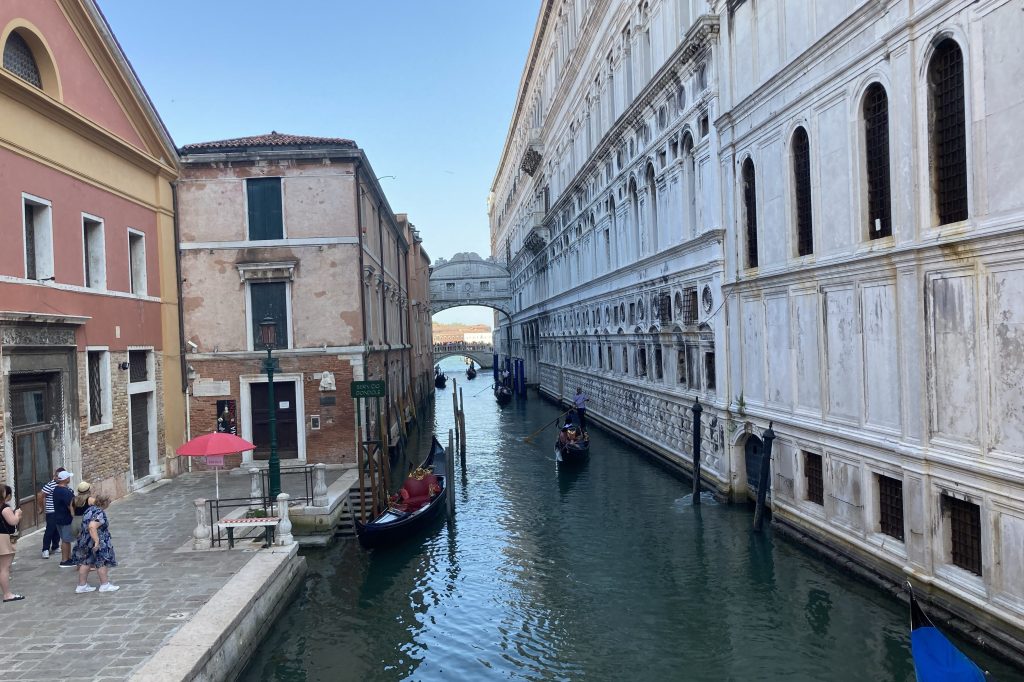
The Bridge of Sighs where convicts would cross and get their last view of Venice before being imprisoned.
Once we had sat down and some food hit our stomachs, we realized that here we were, wandering around one of most beautiful cities in the world, after dark, in the glow of the streetlights, and we hadn’t enjoyed it, because the day didn’t go the way we wanted. It was ridiculous, how in the world had we walked miles through Venice while being thoroughly cranky?
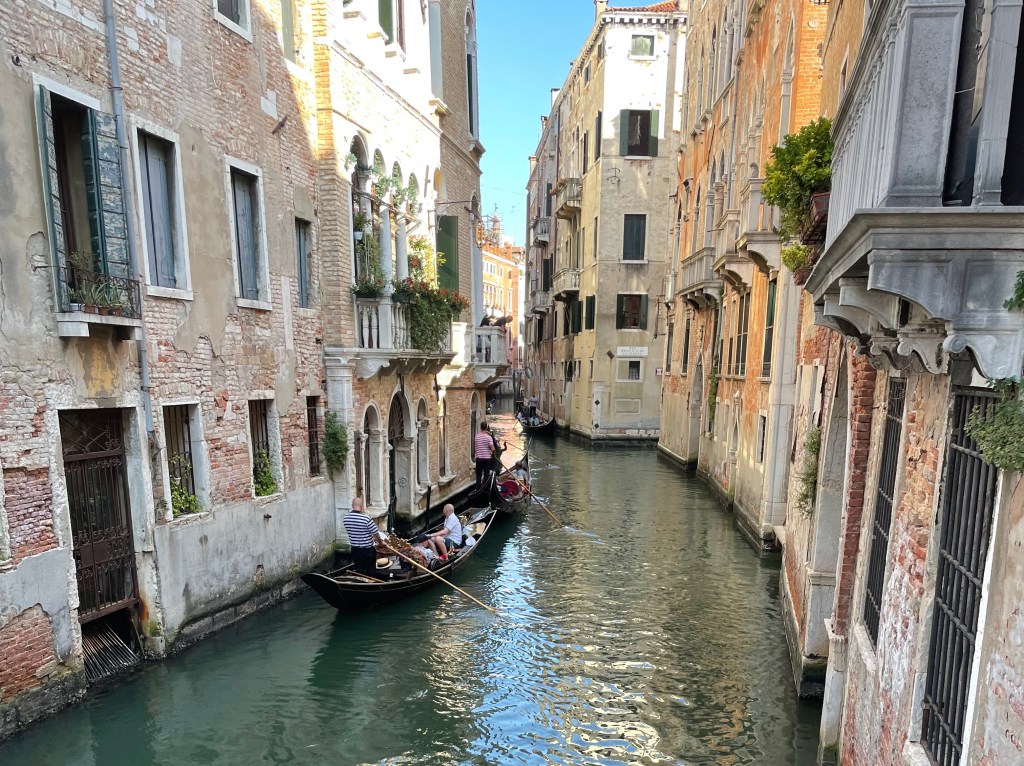
Brick and stone arched bridges, rooftop decks and Juliet balconies are typical features in Venice.
It certainly wasn’t the last time we were lost in Venice. We spent the next few days trying our best to navigate the streets, but it’s tough. We had GPS constantly going and we still would get lost. Venice is just a giant maze, which sounds horrible, but it’s a maze filled with gelato, pasta, cicchetti and aperol spritz.
Gondoliers navigate a narrow canal.
Learning the lesson from our previous crabbiness, we took the other times we were lost in stride. The basic problem, of course, is that Venice is a haphazard collection of narrow, crooked streets and alleys. It’s almost as if the buildings of Venice were dropped wherever and they just built the streets around them. Sometimes the streets narrow down to just a few feet, sometimes they widen into a large piazza with statues and restaurants with outdoor seating.
The Ponte Della Constituzione Bridge is beautiful, but it’s modern design seems wildly out of place in Venice.
It’s chaos, undeniably beautiful chaos. When we made plans to go to Venice there was a lot I hoped to do, but honestly Venice has a way of slowing you down. There’s no real public transportation other than the vaporetto, a water bus, which we didn’t use because the routes didn’t seem useful to us. You pretty much have to walk everywhere. Getting places just takes a while, and once you figure in the time that you inevitably get lost, you end up spending a lot of the day just walking. To make matters worse, there are not as many bridges over the canals as you would think. Also as we found out, the bridges aren’t always on the “main” streets. Sometimes the bridge you need to take is down a narrow alley and around a blind corner.
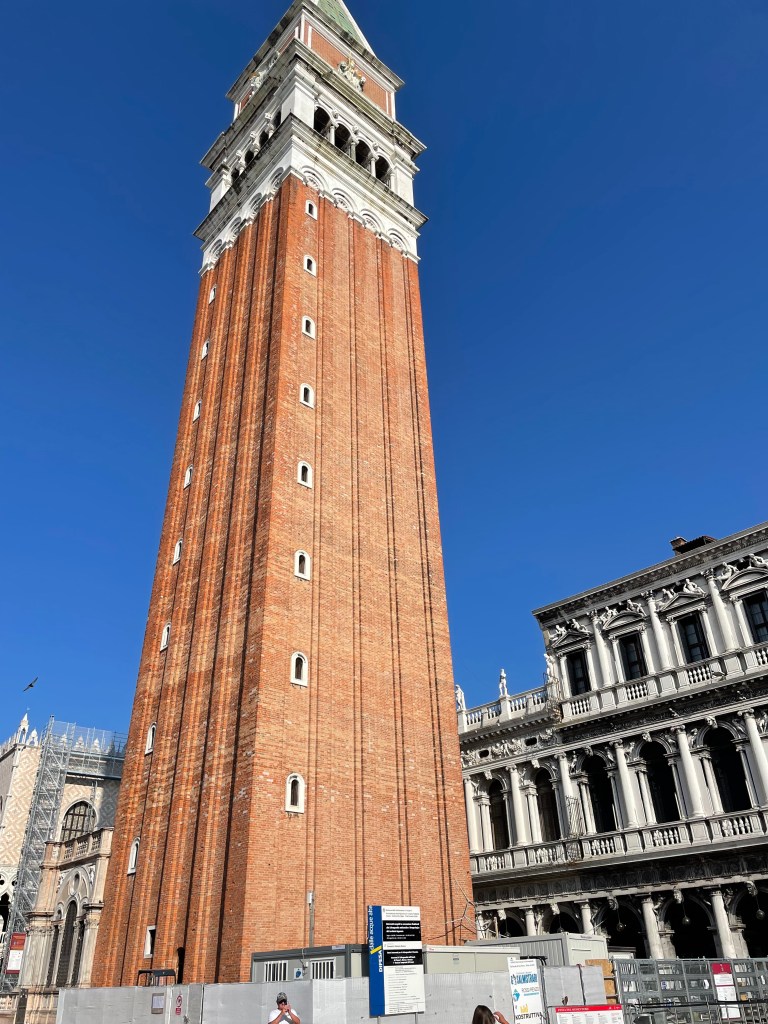
The Campanile Di San Marco is an impressive 323’ tall tower in located in the Piazza San Marco.
The addresses in Venice are also maddening. The AirBnB that we stayed at had an address something like 3343 Dorsoduro. Dorsoduro isn’t a street, it’s an area, a fairly large area in Venice. I legitimately have no idea how Venetian house numbers work. They seem to be grouped but just because you’re standing in front of 3341 doesn’t mean that 3343 is right next door. You’re probably close, but that doesn’t mean you’re really close. This is why you need solid directions, or Google Maps if you are going somewhere specific, those addresses are largely meaningless.
Statue of Daniele Manin, a 19th century statesman from Venice.
The problem isn’t really Venice. In the words of Taylor Swift, “It’s me, hi, I’m the problem.” I’m a middle-aged American who has spent his entire life with a unfinished checklist. Being task oriented is a way of life for Americans. Being in a hurry is so ingrained in us from childhood, that anything that stands in our way is unbelievably frustrating. I had things on my checklist that I needed to check off. I was so wrapped up in buying our groceries from Despar Teatro Italia, getting cicchetti at Arcicchetti Bakero, and finding a bar with a decent beer list that we didn’t wander the way someone really should when visiting Venice.
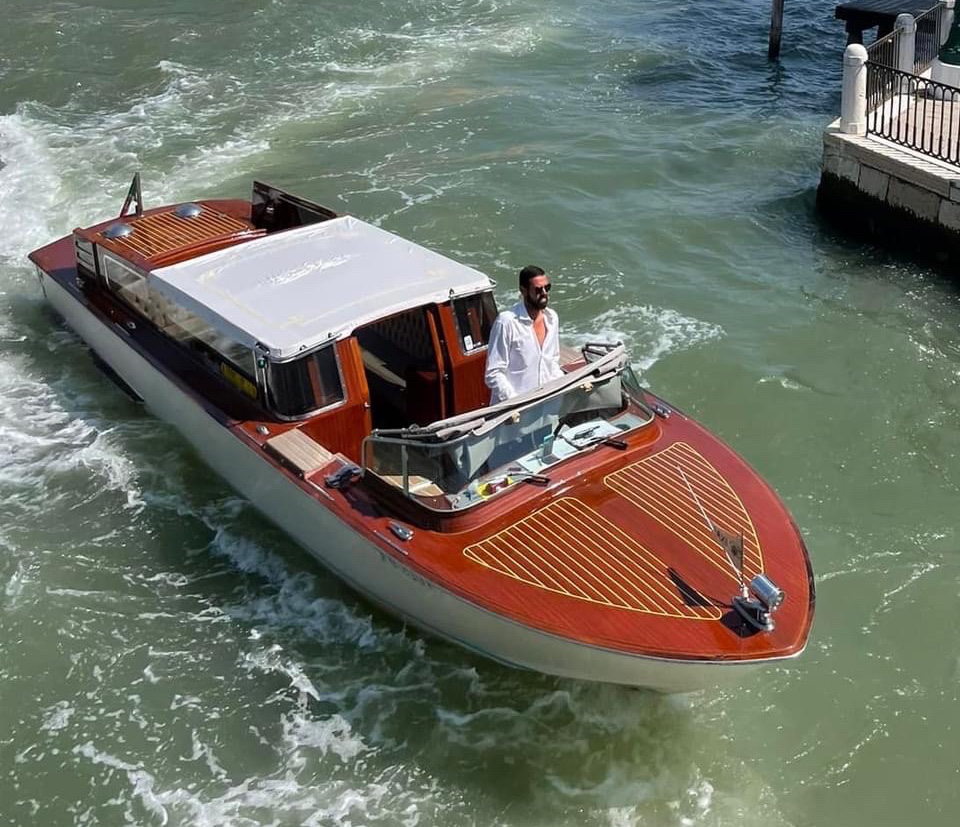
I’m not a big boat guy, but that’s a gorgeous boat.
I’m not saying you shouldn’t have an itinerary when visiting, however we were only there for a few days and it really wasn’t until our last day where we just let Venice tell us where to go. Because of that, when we were walking along the street next to the coast in the Dorsoduro District we saw a floating bridge to the Giudecca District across the Giudecca Canal. If we hadn’t been walking there, I wouldn’t have known that bridge even existed. The bridge doesn’t even show up on Google maps because it’s a pontoon bridge that is only assembled for the Festa del Redentor (Feast of the Redeemer) which takes place over two days in July. We went across the bridge and ended up having lunch there.
The Chiesa de San Barnaba was hosting a DiVinci exhibit.
In retrospect, I wish we had a few more days there. A week might have been perfect. I could have gotten used to the pace of life in Venice, taken our time and really properly wander the streets and alleys of Venice, while still managing to do some of those must-do things like visiting St. Mark’s Square, sunbathing on Lido Beach, or climbing the Campanile. After all, if you’re not randomly stopping for an aperol spritz, or a cannoli with a cappuccino or espresso, or even a cicchetti and a Birra Moretti are you even doing Venice correctly? Venice is practically begging you to come, relax, and toss out that itinerary. Maybe we’ll listen next time (there will be a next time).



























 Newby to Expert Traveler