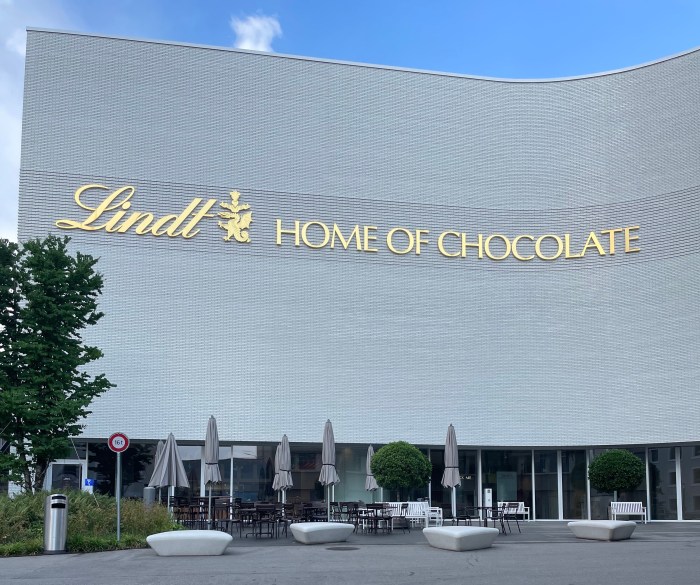
Lindt Chocolate Factory

When we were deciding which countries we would visit, Emma was pretty enthusiastic about wanting to go to Switzerland. I asked her why, thinking that maybe she had learned something in school about Switzerland that she found interesting, but she just said “chocolate”. So of course, since that was a big reason we were in Zurich, we had to go to the Lindt Chocolate Factory.

There is no denying that the Lindt Factory is a tourist trap. Everyone knows about Swiss Chocolate and Lindt is probably the most well-known Swiss chocolate brand. This tour is very popular and planning ahead is definitely recommended. We purchased our tickets from the Lindt website and reserved our time months in advance since tours sell out frequently. They cost around $15 (depending on the current exchange rate).
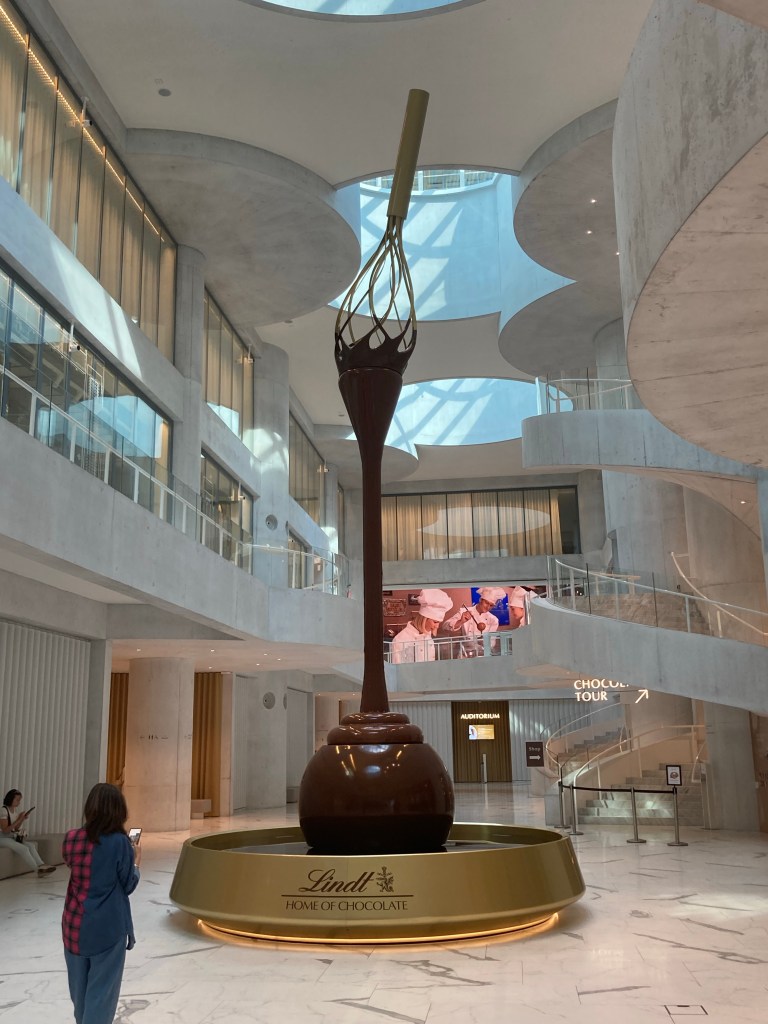
No, you are not allowed to jump in the chocolate fountain.

Entering into the building, there is a reception desk and a large chocolate fountain. The smell of chocolate is really intense almost to the point where it feels like you’re breathing chocolate. The lobby is very large and modern with white marble floors, concrete walls and glass. A spiral staircase leads you to the second floor where the tour begins.

The tour is actually much more interesting than I thought it would be. They start out covering the process of growing cacao pods as well as the various steps, like fermentation and roasting, that is required to turn those pods into chocolate.

A room devoted to the history of chocolate

Next there are a bunch of exhibits that cover the history of chocolate. Chocolate started as a bitter drink that had been enjoyed by the Maya and Aztecs. During colonization, of course, chocolate was brought to Europe where it slowly evolved from being a bitter drink to a sweet food.

Interactive exhibit that shows the evolution of the chocolate market in Switzerland

They also had quite a few exhibits specifically devoted to the Swiss chocolate economy. They cover everything from how the chocolate market evolved in Switzerland to how much of that chocolate is enjoyed in countries around the world.

A variety of hands on exhibits are designed to be kid friendly.

There are quite a few hands on interactive exhibits throughout the tour. They were really well-designed to provide a lot of great information about the subject, while giving children something to play with. One example of this was a map of Switzerland where as you move a dial which controls the decade. And for each decade it shows which Swiss chocolate producers were operating and where in Switzerland. It also provides some data about how much sales and exports occurred during that time.
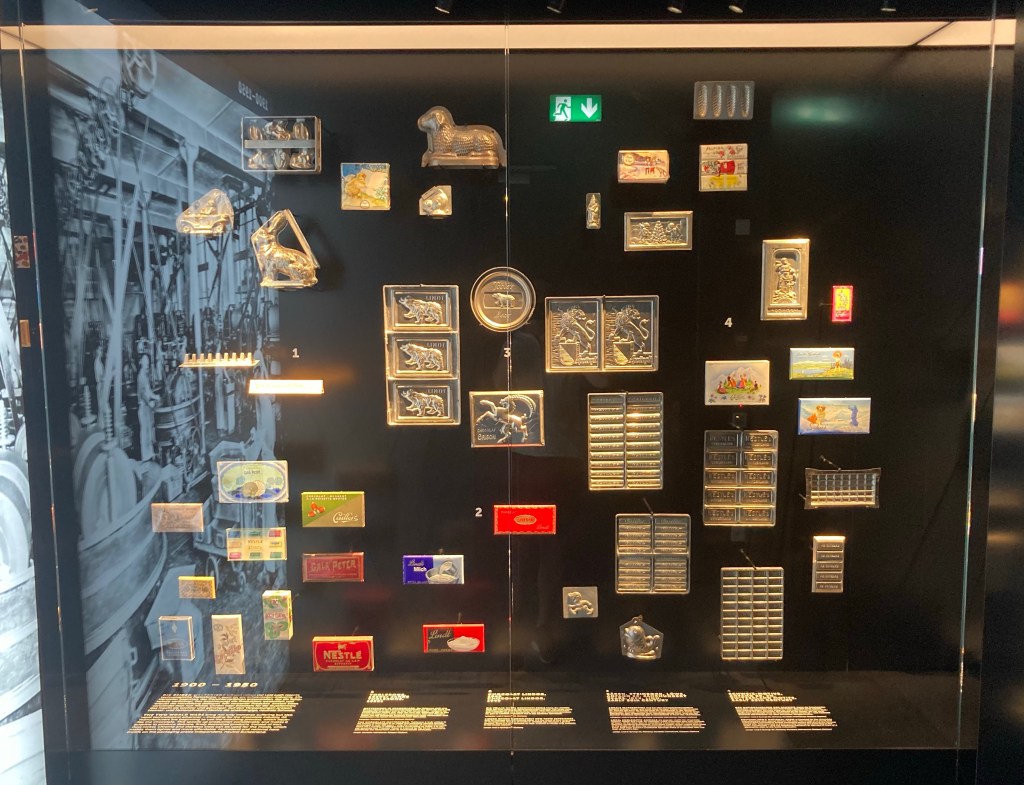
A display of chocolate molds and packaging from 1900-1950.

I was enjoying my time in the exhibits but the rest of the family was not as interested as I was. The main reason for that was that at the end of the tour, you can sample a bunch of chocolate.

Fountain for trying milk chocolate

They’re are three main tasting sections. The first is a series of chocolate fountains where there are a bunch of disposable spoons so that you can taste white chocolate, milk chocolate, and dark chocolate in liquid form.

chocolate square dispenser

The second tasting section is a bunch of over-engineered chocolate square dispensers that invite you to try the chocolate and then guess what the flavor was.
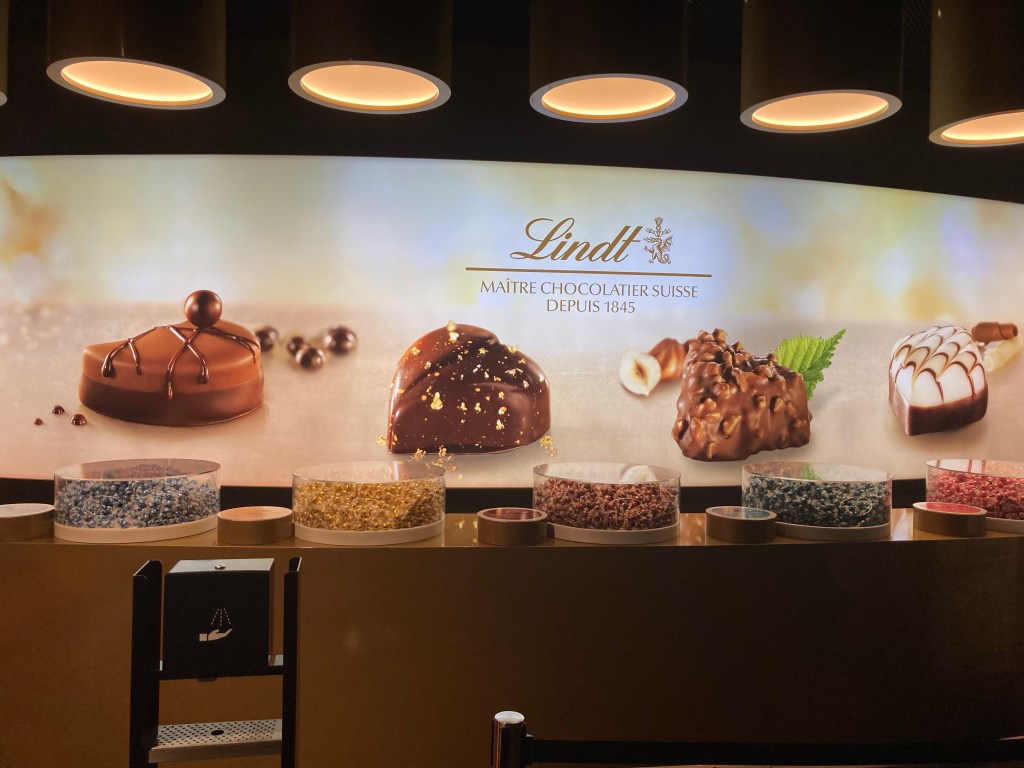
In the plastic cylinders, you are invited to grab as many Lindor truffles as you can eat.

The third section was the a bunch of flavors of the Lindt chocolate balls. This was the part Jenn was looking forward to. For some weird reason, I married someone who rarely eats sweets. When she snacks it’s normally chips or popcorn and only rarely eats chocolate. The Lindt chocolate truffle balls are one big exception and they are a requirement for her Christmas stocking every year.

An elaborate Rube Goldberg machine which distributes a special chocolate at the end of the tour.

Once we were through the tasting section, of course, we had to go into the gift shop. It’s impressive. They have a ton of flavors that you will never find in a store. I came across a Lindor truffle ball made with matcha tea, for example. You can get slabs of chocolate decorated with a message. There was a dizzying array of chocolate bars and gift boxes. It’s a chocolate lovers dream.

You can get these chocolate slabs decoratoned with a message if you like.

In the end, we didn’t buy too much. We had a long trip set up and knowing that we were going to have to travel with chocolate during the summer we didn’t want to risk the chocolate melting. We were able to eat some of it on our next stop in Munich, but then the day we left Munich for Venice we accidentally left the bag in the fridge at the AirBnB. So our loss was probably a nice surprise for the person who had to clean the AirBnB.
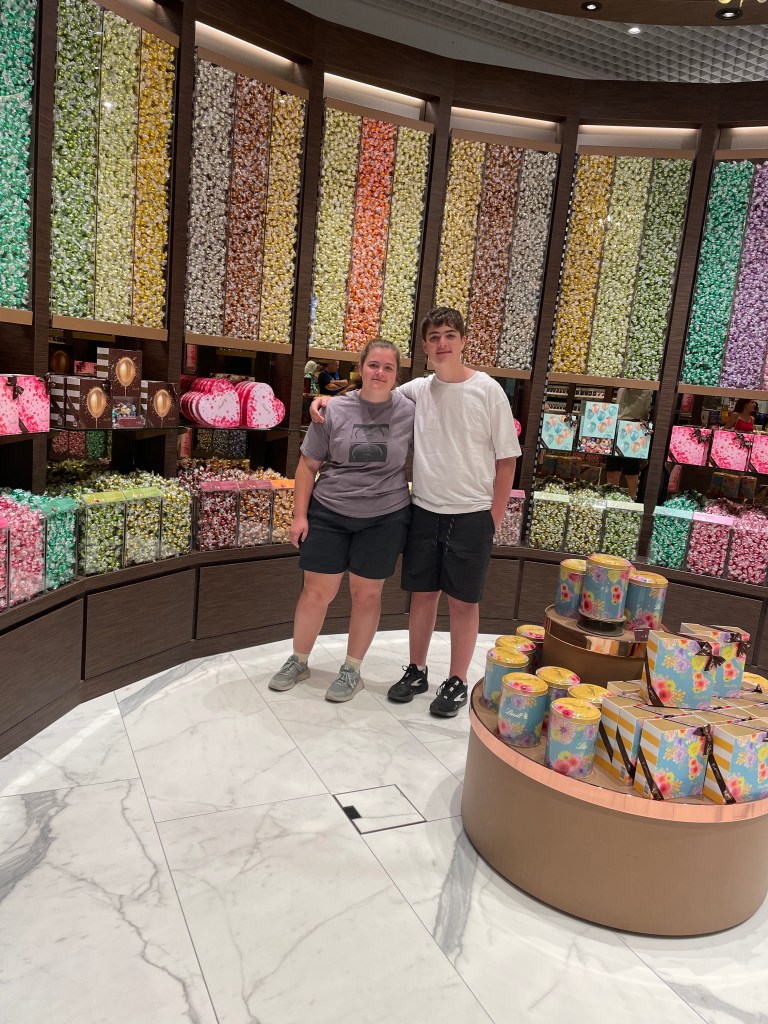
This is a fairly insane wall of truffle balls.

I was surprised by how much I enjoyed the tour. The tour takes about 45 minutes (Unless your group wants to fly through the exhibits and get to the tastings). It was very well done and designed to be interesting to kids and adults. I also can’t imagine anyone not enjoying the chocolate tasting section and they seem to limit the number of people in the museum at a time to a reasonable amount so it never seemed too crowded. The gift shop is also excellent. This is definitely worth visiting if you are in Zurich.
Girls’ Trip booked to Playa Del Carmen (I Guess I’ll Stay Home With The Kids)

Sometime this last winter, Jenn was talking about wanting to take a Girls’ trip (with her Mom and her Sister) to celebrate a milestone birthday for her Sister. We had basically just completed booking our European vacation just a couple of months earlier and we had learned a valuable lesson from that booking that we didn’t want to repeat – don’t be dependent on one way to book.

What I mean by that is that when we booked our flights to Europe, all we had was United miles, and that was our only option. If the flights weren’t cheap enough on United, we weren’t going or we were paying cash. So the solution to this issue was to find multiple ways of booking flights on points and make sure that we stockpile points in multiple areas.

The Power of Stockpiling Points

Jenn had already begun to accumulate Ultimate Reward points by taking advantage of two 90k bonuses for Chase Ink cards as well as a 60k Chase Sapphire bonus. Since they were thinking Mexico or the Caribbean, Chase Ultimate Reward points, having the ability to transfer to Southwest Airlines or United Airlines, might make sense.

We also added over 80k points by meeting the the minimum spend on a Capital One Venture card. That’s intriguing because Capital One miles transfers to the Turkish Airlines Miles & Smiles program where booking round trip United Airlines saver flights to Mexico and the Caribbean often costs only 20k points .

Jenn also jumped on a 75k point bonus offer on the Delta Business Gold Card. When she did it, I scoffed a little because a lot of people joke about Delta Skymiles as being “Sky Pesos”. It’s a bit of a joke because Delta is notoriously expensive to fly to Europe or in business class on points. That being said, I think people might find that Skymiles could be particularly valuable for domestic and North American international economy award tickets and Jenn found that out.

In this case, Jenn received an email from Delta about a flash sale, and went on to Delta’s website, where she was surprised to find a round trip flight out of Moline Airport to Cancun in January for 26k Skymiles each. Because of the 15% award discount afforded to Delta Gold Card holders, she was able to book it for 22k Skymiles and $116 in taxes each for a total of 66K and $348. Those flights were priced at that time at $631 each, which means that this redemption was more than 2.3 cents per point which is a really good value for airline miles and definitely not worthy of being derided as “Sky Pesos”. This is particularly great, because good award rates out of the Moline Airport are usually hard to find, and typically we fly out of Chicago because of it, which usually means booking a hotel and paying for pretty expensive parking.

Because of the fact that we had significant amounts of Chase Ultimate Rewards points, Capital One Venture miles and Delta Skymiles, we were able to keep our eyes open for special rates with Delta, United, and Southwest Airlines, as well as being able to book Sky Alliance flights through Turkish Miles and Smiles or Avianca Lifemiles. I’m sure that we could get more creative than that, but honestly, it wasn’t needed in this case. Having flexibility in multiple programs allowed Jenn to be patient and wait for a great deal, and then jump on it when she had the opportunity.

The nice thing about a vacation rental is having a working kitchen, and this one looks pretty nice.

Flexibility on Booking Lodging

We had some flexibility built into our points for lodging as well. We had accumulated a decent amount of Wyndham points, and a respectable but not huge amount of Marriott Bonvoy points. However, with Jenn having a nice stockpile of Chase Ultimate Reward points, which transfers 1:1 to World of Hyatt points, that also made Hyatt a good possibility as well. Because of a status match made possible by Jenn’s Wyndham Business Earner card to Ceasars Rewards (visit Upgraded Points for more details), we also had a 4 night “free” stay available at Atlantis in Nassau in the Bahamas. The Atlantis stay would have had a bunch of extra resort fees that would have added up to over $200 a night and was quickly eliminated. Chase and Marriott were definitely possibilities, but the Wyndham-Vacasa partnership is just too good to pass up. We booked a Vacasa with Wyndham points before and got great value for that redemption.

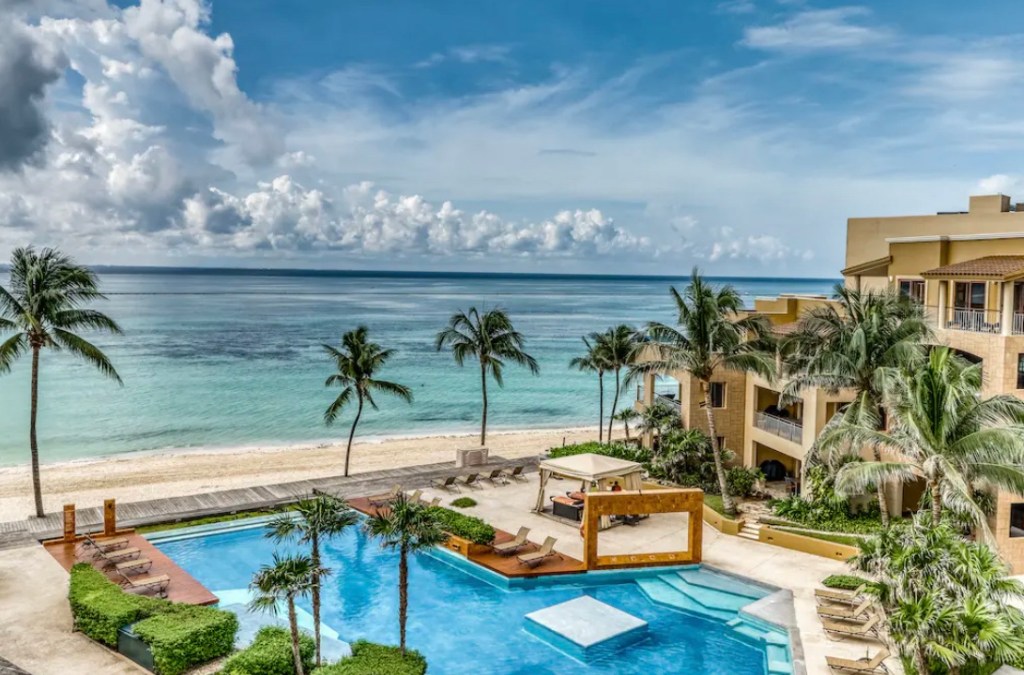
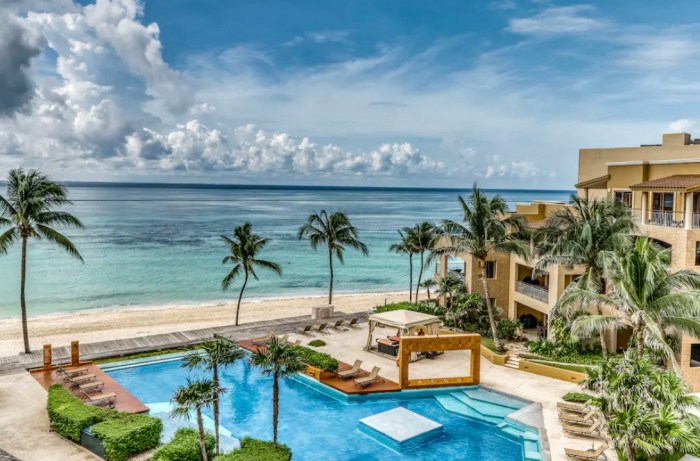
The rental is in a complex with a pool on the beach.

Jenn decided to book a 1 bedroom Vacasa in Playa Del Carmen for 54,000 Wyndham points total for a 4 night stay. That particular Vacasa typically would rent for $1,325 for a 4 night stay in January meaning that those points were redeemed at 2.4 cents per point. This is another ridiculous value considering Wyndham points are generally valued at 1.1 cents per point. Booking a Vacasa rental with Wyndham points is a little weird because you have to call a special line to do it, but the rules are simple. Vacasa rentals cost $15k points per night per bedroom and is bookable with points as long as the cash price is under $500 per night per bedroom. For example, a one bedroom is bookable for 15K points per night as long as it costs under $500 and a 2 bedroom is bookable for 30k points per night as long as the cash rate is under $1000. Having a Wyndham Business Earner card gives you a 10% point discount on those rates. (Update – the ability to book Vacasa vacation rentals with Wyndham points has ended as of December 2025)

Obviously we’ll have to wait until they get there to find out if the Vacasa rental is as nice as the photos, but it looks gorgeous. It looks like Jenn did a great job booking this trip and I really hope they all have a great time (I’m sure she’ll feel sorry for me shoveling mounds of snow out of our driveway while she’s sipping a Bohemia Oscura cerveza on the beach). In the end, this was made possible because Jenn had the ability to be flexible with dates, locations and points programs. It allowed them to book what looks like a great vacation for not a lot of points and cash.

I may Have Created a Monster

When we got started with points and miles, it was pretty much me doing all of the research, listening to podcasts, reading blogs, and doing as much internet research as I could. As we started to have some success, with booking trips to Cabo San Lucas as well as our trip to Europe this summer, Jenn really started to not only get interested in points and miles, but she actually really gets it now. I expected to have to guide her on planning this trip, but for the most part, other than a couple of suggestions, she did this on her own and it was undoubtedly the best trip in terms of redemption value that we’ve made. Going forward, I think with both of us having a solid understanding of points and miles, we should have some great trips ahead, as long as she decides to come back from Mexico, of course.

Hofbräuhaus – Munich’s Cathedral of Beer

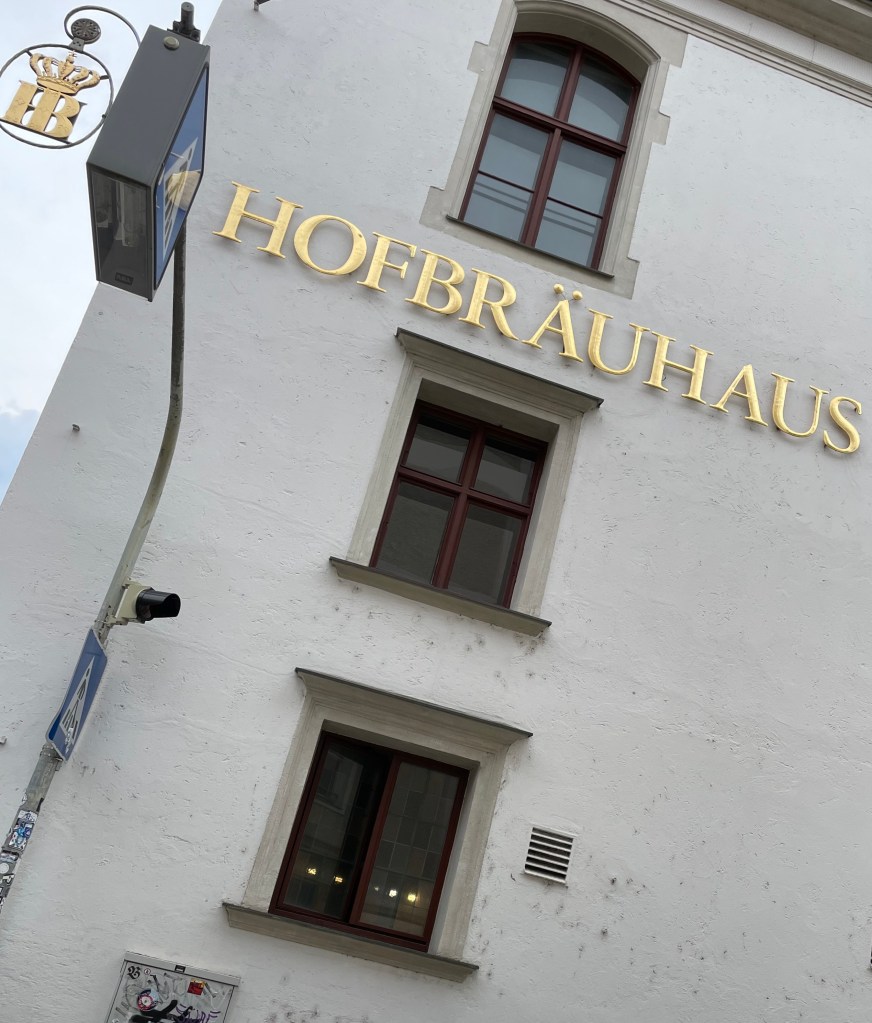
I’m not going to lie, I wasn’t that excited about going to Hofbräuhaus. It just seemed like something that we had to do to check it off our Munich to do list. I just assumed that it was going to be crowded, kitschy and most likely mediocre. Being a bit of a beer aficionado (perhaps a beer snob), going to Munich and not visiting what is essentially the cathedral of Munich beer culture is almost criminal, so of course, we went.

Germans take their beer seriously. During the Middle Ages, beer was made from any number of ingredients. Beer basically needs 4 things – water, a source of sugar (to ferment into alcohol), something to balance sweetness, and yeast for fermentation. In the middle ages, the source of sugar could be fruit, beets, malted barley or wheat. That sweetness from the sugar would be normally balanced by some kind of bittering herb or flower. I imagine that with brewers using all kinds of ingredients (especially in an unscientific age), beer was probably wildly inconsistent and perhaps even poisonous if the wrong herb was used.

Copper washbasin with a inscription.

William IV, Duke of Bavaria adopted Reinheitsbebot (German Purity Law) in 1516 which regulated beer production to water, barley and hops. Yeast was an unknown ingredient in 1516, since microorganisms were unknown at that time, but was later added to the law once it was discovered to be the engine of fermentation. So why am I mentioning this? Well Germans take their beer so seriously that they have a law regulating the ingredients – they’re not messing around. To be fair, if you violated the law you wouldn’t be executed or anything, but your beer would be confiscated and presumably destroyed.

The ceilings of the beer hall are stunning.

I’ve been a home brewer for over 20 years. I also visit at least one brewery every week, without fail. Many of the beers I drink and many of the beers I have brewed, violate this law. Sometimes, the beers I’ve brewed completely ignore it. Some of my favorite beers contain coffee, vanilla, fruit, chocolate and even chili peppers. American microbrewers treat Reinheitsgebot like a lame suggestion by their parents. They brew big, strong flavored beers pushing the envelope at every turn, squeezing as much flavor into one glass as they possibly can. The results are aggressive, bold and normally not very “sessionable” beers. You will not get any beer like this at Hofbräuhaus, or for the most part, in any typical beer garden in Munich.

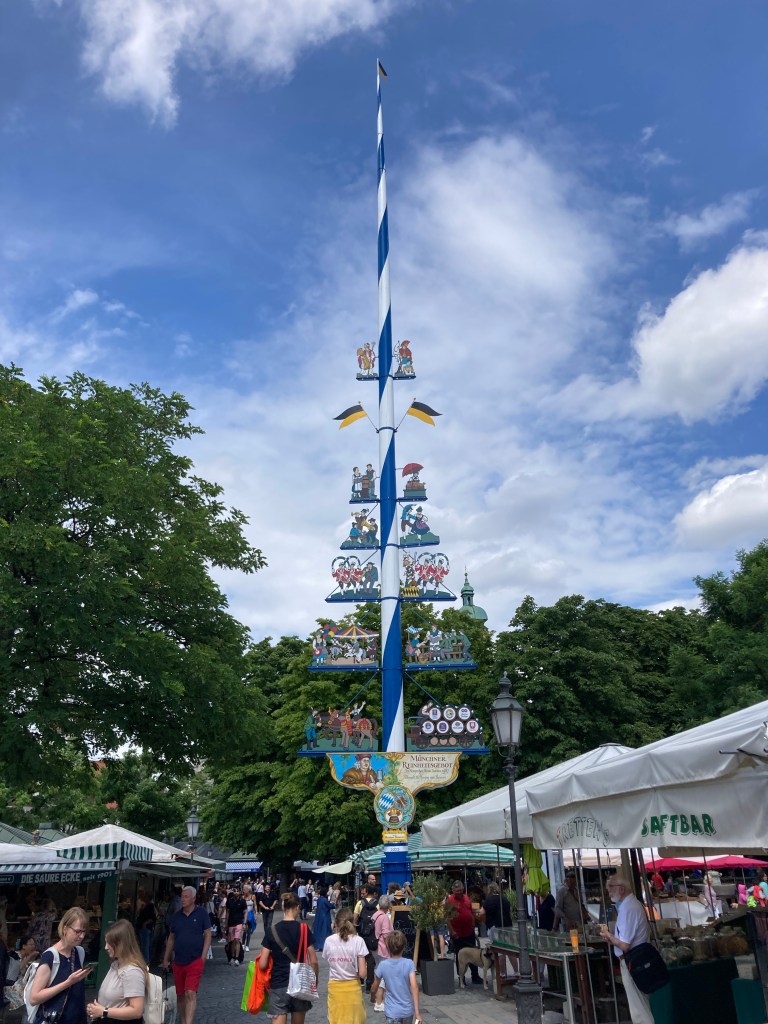
Monument to Reinheitsgebot in Viktualienmarkt in Munich

Instead, Munich lagers are delicate, balanced and crystal clear. They are the result of centuries of perfecting just a handful of styles and getting it precisely right, every single time. The traditional Munich Lager is a golden colored and slightly on the malty side of balanced with a hint of floral hops. The Munich Dunkel is similar, except they use some roasted malt to add a dark color and caramel flavor to the beer. Both of these styles were available for our visit to Hofbräuhaus as well as Radler and Dark Radlers, which are when you take the Munich Lager or Munich Dunkel and mix it 50/50 with lemon soda or lemonade (a great way to keep your wits when drinking from a 1 liter mug). There was also a Weissbier on the menu, which is made from wheat, and violates Reinheitsgebot, but for some reason everyone gives wheat beer a pass on the law.

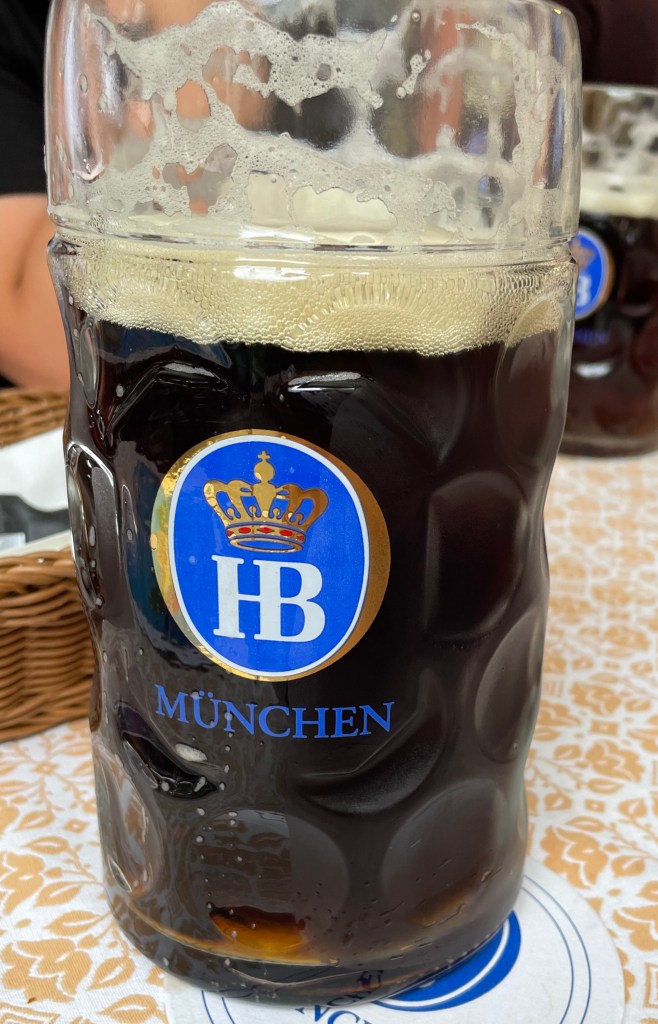
Munich Dunkel is one of my favorite beer styles

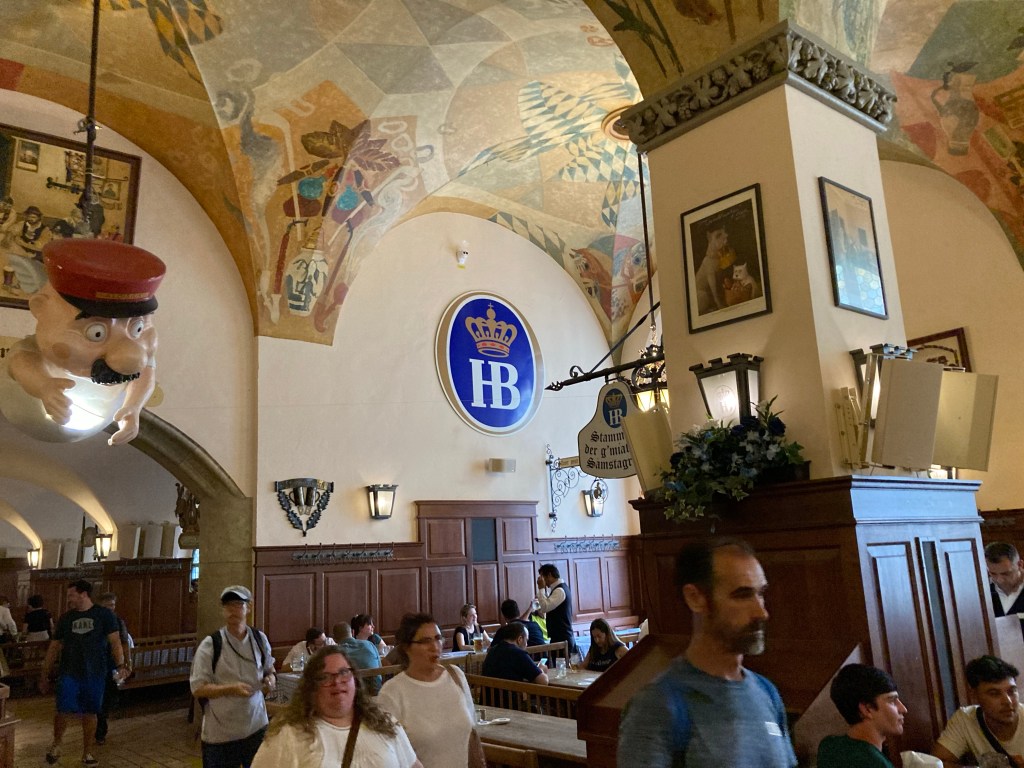
When you walk in, it’s impossible not to notice that it is an absolutely gorgeous, and enormous beer hall. Traditional wood tables in rows everywhere, obviously meant to maximize attendance. We were lucky enough to be able to get a table outside in the beer garden, which is essentially a huge courtyard. They sat us down at a table for 8 next to a group of 3. This is something, that as an American, is weird. It’s not unpleasant, but if you go to a restaurant in America and there is an open table for 8 and you walk in with 4, normally they’ll wait to sit you until a table for 4 is cleared. You don’t share tables, ever. In Germany, this happened to us multiple times, and frankly, it was fine, I could get used to it.

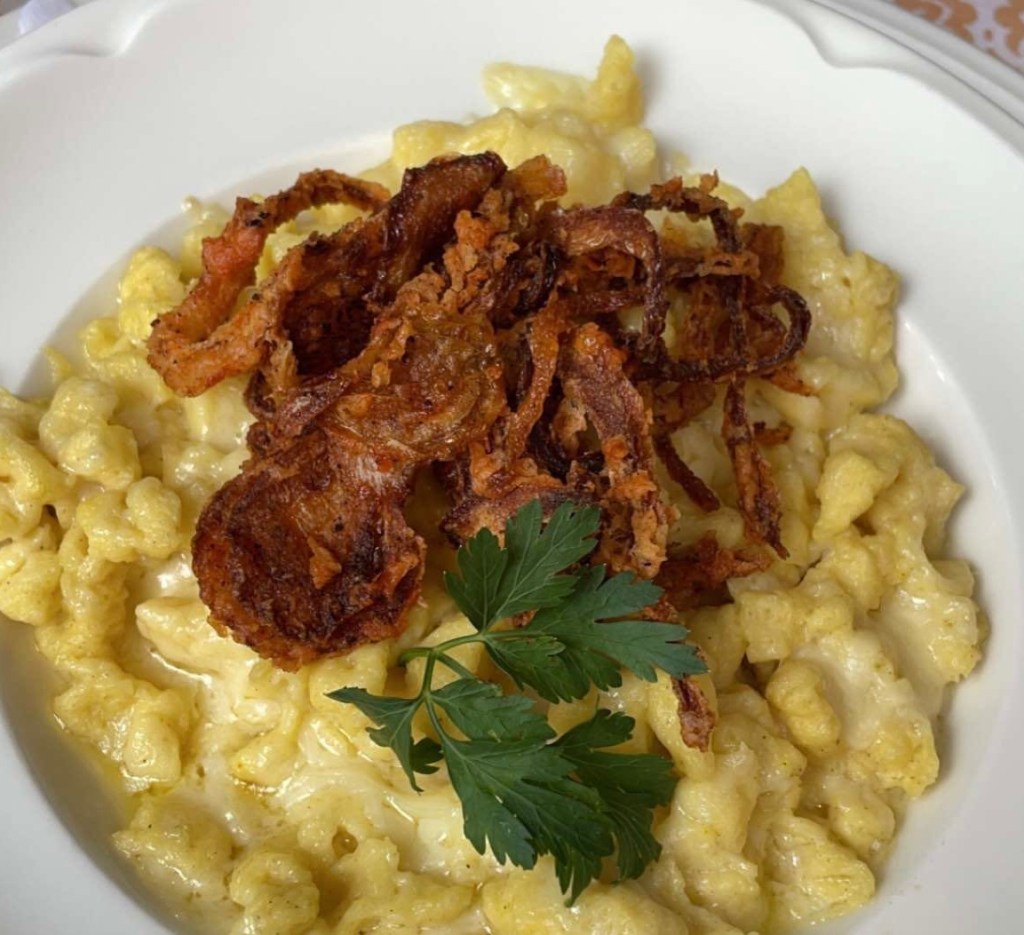
Käsespätzel
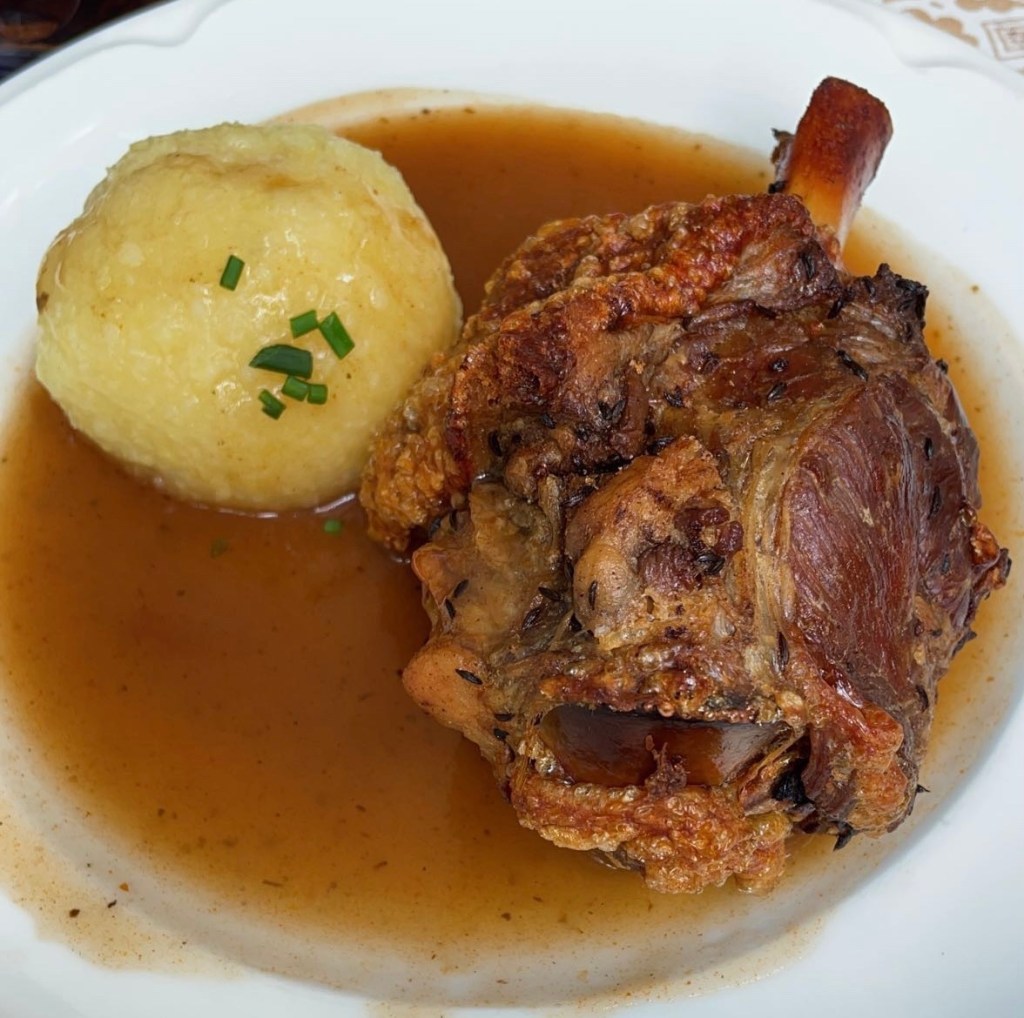
Pork Knuckle and Potato Dumpling

We ordered a lot of the traditional German dishes, Käsespätzel, Pork Knuckle and some fried Perch. Both Jenn and Emma got the Käsespätzel, which is sort of like German mac and cheese. They both thought it was pretty good, not spectacular. I had the Pork Knuckle, which I really liked. It had a super crispy skin, the meat inside was tender and the gravy was rich. The side for that was a potato dumpling, which I believe was probably cooked perfectly, but I didn’t care for it. It was just bland with a strangely dense and sticky texture. I asked Alex about his perch and he just gave me a thumbs up and kept eating, which is about as descriptive as he ever gets.

Arched frescoed ceilings, dark wood panels and rows of tables and benches make for a prototypical beer hall.

We, of course, ordered the 1 liter beer, because it’s almost required at Hofbräuhaus. The enormous mugs they serve these in are unique in beer culture. Nearly all beer glasses are designed to highlight a style, whether it be a tall glass for a Pilsner to highlight the clarity of a Pilsner or a fluted glass for a Belgian Dubbel to hold in aroma, glasses are designed to enhance the experience of the drinker. Not the 1 liter beer steins for Munich Lagers and Munich Dunkels. They are designed to be carried, in bulk. They are built for Oktoberfest, when servers are feverishly serving mug after mug after mug of freshly poured beer. If you are at Hofbräuhaus long enough, you will see a server carrying an obscene amount of beer to a table. In all honesty, liter beer mugs are insane, they are heavy and unless you are on a bit of a bender, that beer is going to get warm before you finish it. It is, however, super cool and that’s why everyone orders their beer that way. I mean, who wants to be the loser who only drinks a half liter of beer, right?

So is it really worth it to visit Hofbräuhaus? Well, the beer was really good and were perfect examples of Bavarian beer styles. we also enjoyed the food which from what I can tell were great examples of Bavarian cuisine. However, the real secret here to the success here is the beer hall itself. It’s an absolutely beautiful beer hall with a great beer garden. Even though I was apprehensive about the visit, we enjoyed it so much that we skipped a visit to a different beer garden in order to come back a couple of days later for a liter of beer and pretzel. Its definitely a place you have to visit when you visit Munich.

Crashing Züri Fäscht

We weren’t in out right minds. We had just gotten off a redeye from Chicago to Zurich where I think Jenn got the most sleep at about 2 hours total. I had basically not slept at all and the kids maybe got an hour each. Our brains were a combination tired/wired with the excitement of being in Europe mixed with the brain fog of sleep deprivation.

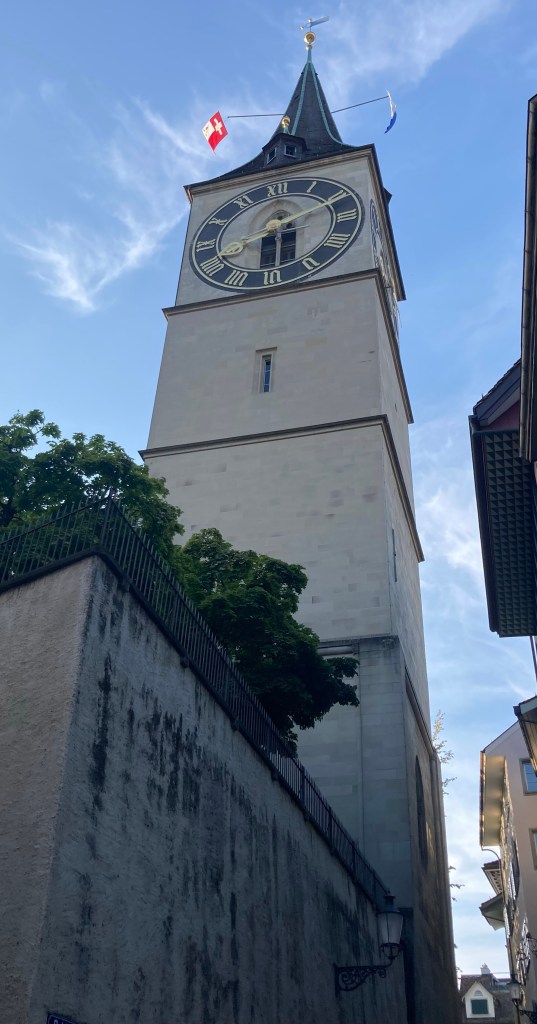
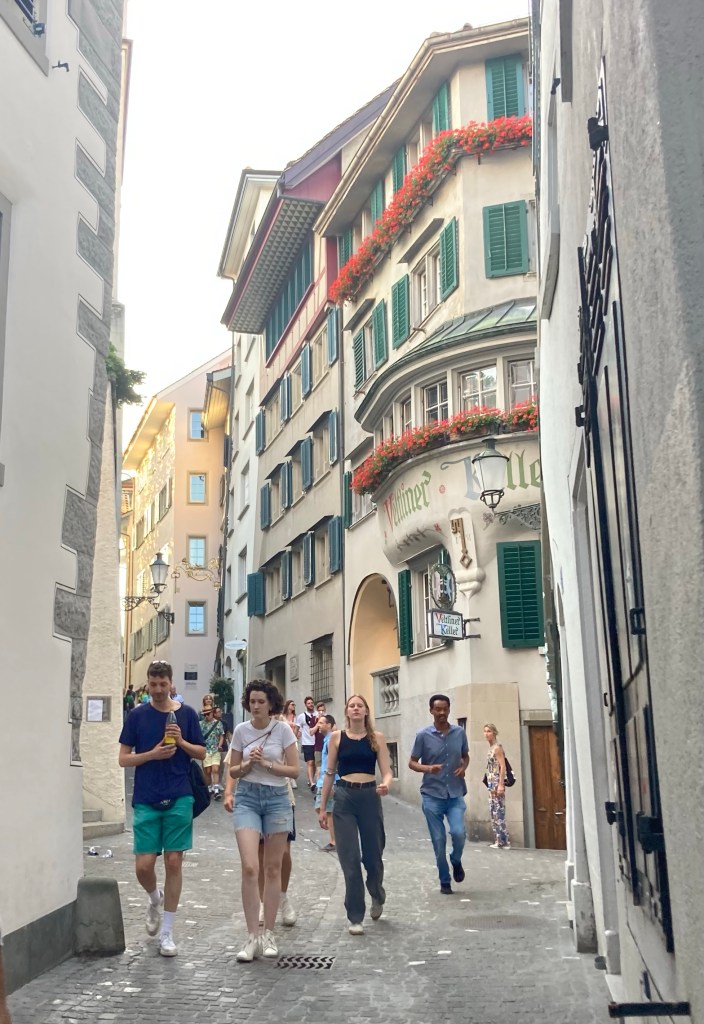
Our first taste of Zurich was as expected – narrow cobblestone streets, Swiss flags, and gorgeous centuries-old Swiss buildings.

We decided to wander out into Zurich to catch a little lunch and then go get a nap. We managed to pop into a Coop to Go to get some sandwiches and then went towards the old part of town to wander. When we crossed the Limmat River, we noticed vendors all along the Münsterbrücke Bridge, and also along the Limmat itself. There must be some kind of festival, how fun! We then had a quick beer and headed back to the hotel for a short nap, expecting to head out to dinner later.

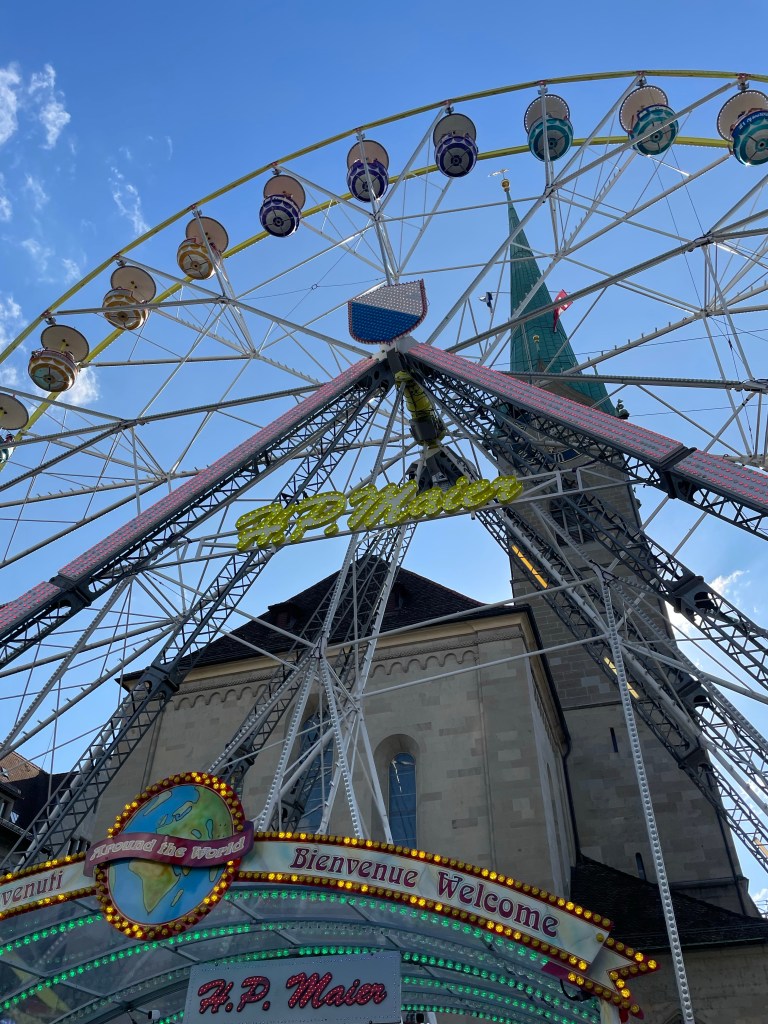
After dinner at a wonderful little Tapas place called Casco Viejo, we noticed the streets had become much more lively. As walked into the festival, it became clear that it must be a pretty big deal. With the brain fog gone, we noticed things that we hadn’t seen earlier, like Ferris Wheels and other carnival rides. It also seemed much, much bigger that it did before. Honestly, it looked huge. How big was this festival and what is it?

We planned to pass through the festival, after all, this wasn’t our party and we intended to enjoy the beauty of Zurich. But the beautiful buildings that we wanted to see were hidden behind food trucks and carnival rides. Just a little further, we thought, and we’ll get past the festival and we can enjoy Zurich the way we wanted to. We kept walking, along the street on the east side of the Limmat. Where does it end? I told Jenn “let’s just walk to the lake and we can enjoy the park there.” But as we approached the lake, the carnival rides turned to temporary outdoor night clubs with bars and DJs (‘Drop the beat’ DJs not ‘top 40’ DJs). The park we walked over to visit was now a makeshift night club and I was now out of ideas of where to go. There was no end to this festival. I didn’t come to Zurich to listen to EDM! I came to see the beautiful buildings, eat chocolate and sit in a beer garden or two!
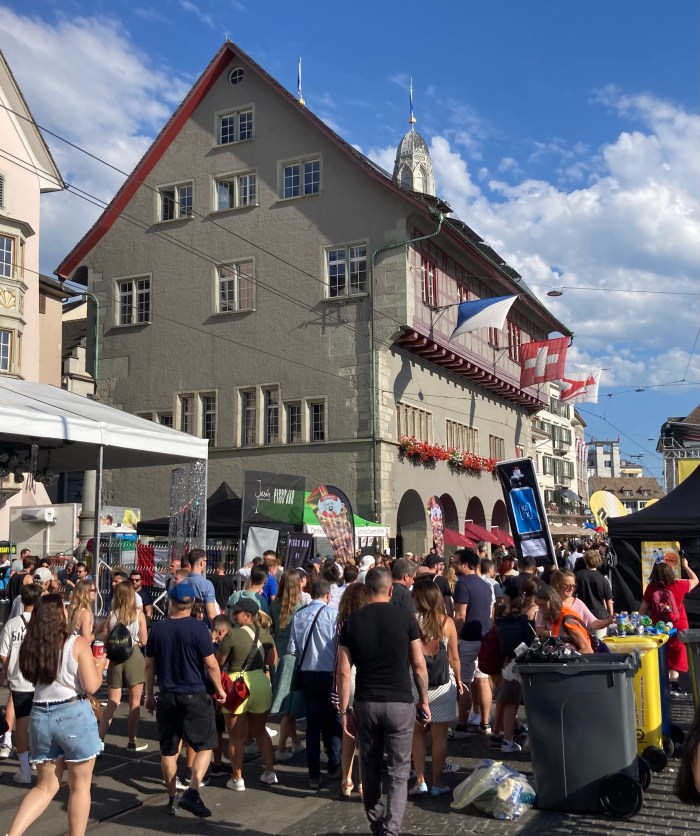
We were in Zurich for essentially two days and those days just happened to be two of the three days of Züri Fäscht. It’s a huge weekend festival with over 2 million visitors that stretches on for miles along the Limmat River and also wraps both sides of Lake Zurich for a couple of miles. Züri Fäscht takes place every three years, but because of Covid, it had been four years from the last time it was held. It had 450 vendor stands, 50 stages and 70 rides.

People perched on the sea wall along the west side of the Limmat.
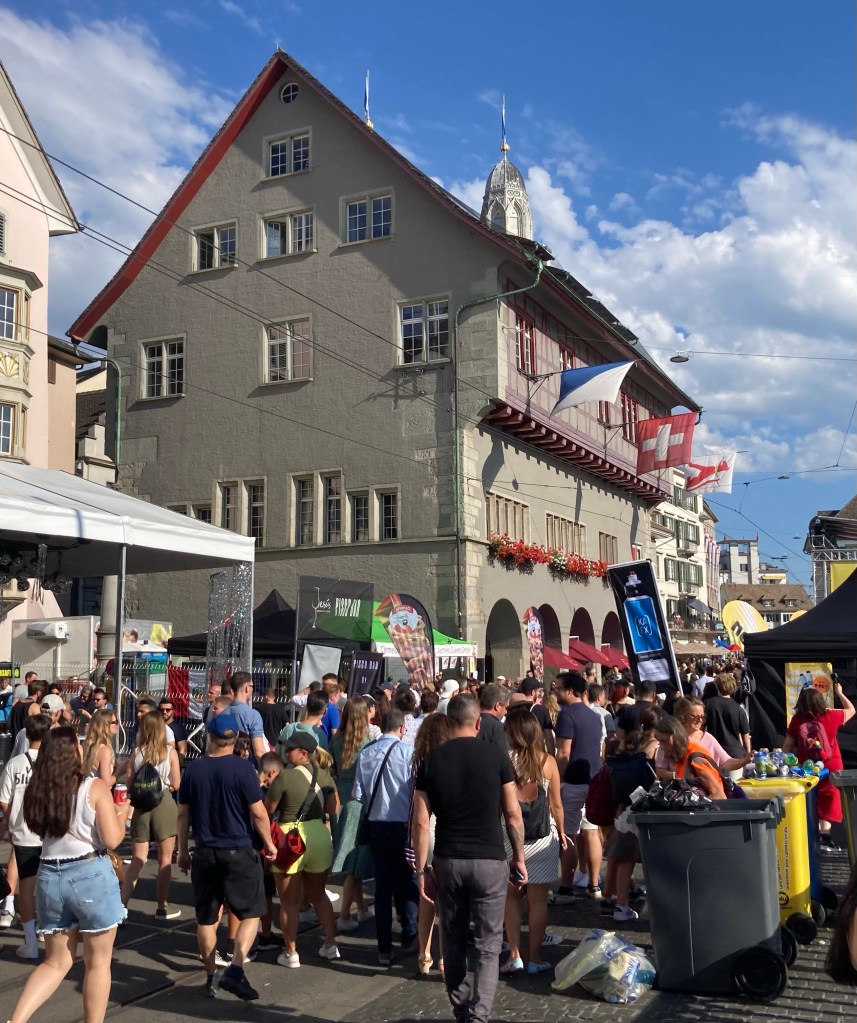
Crowds, chaos and classic Swiss architecture

But it was inescapable, and we were left with two choices, enjoy the festival or go back to the hotel and pout. So for the next couple of days we wandered the festival drinking, eating, and listening to electronic dance music. Guess what? We had a great time! it wasn’t the trip we anticipated, but that’s okay. We were, after all, uninvited guests in Switzerland and it’s not up to them to cater to my expectations.

Jenn couldn’t bring herself to spend 14 CHF on these awesome looking fruit drinks.

In some respects, there was no better time to visit Zurich. So often when you visit a city that has a lot of tourists, you get locals who cater to visitors, whether it be multilingual menus or having to constantly talk to visitors in English. This was simply Swiss people being Swiss, in an environment built for their celebrations. This is an enormous festival, I had never heard of it and finding information about it online is actually not that easy, especially in English. This was something they kept for themselves. They don’t really promote it. From an outsider’s perspective, this was an opportunity to participate in something authentically Swiss.
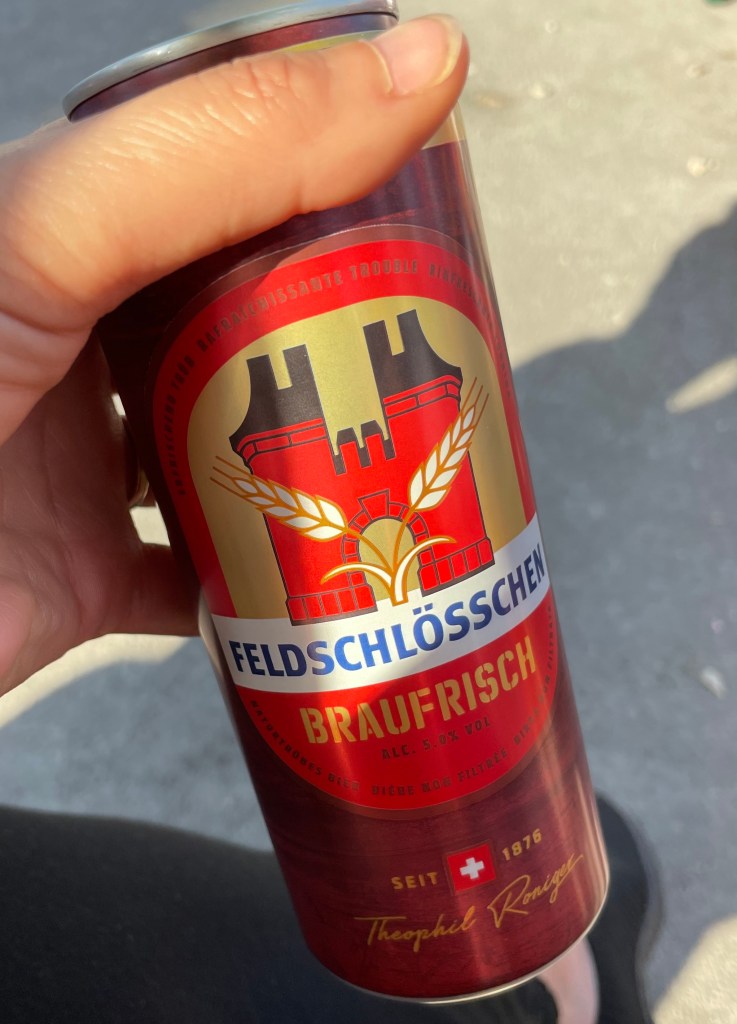
So what did we do? Well, we drank Swiss beers . . .

And watched wakeboarding on the Limmat . . .

And cheered on Zurich’s Kanu Polo team.

Unfortunately, we did miss out on a lot of it, since we were sleeping more than normal, trying to adjust our sleep schedule to Europe. We missed out on what is apparently a fantastic fireworks display and we didn’t hang around for the music acts, which I assume got better as the night went on. The music acts were scheduled until 5 in the morning, which is insane when you consider that it’s an outdoor festival. I can only imagine how great it must be for EDM fans to party all night under the stars until daybreak along Lake Zurich.

Jenn started looking for vegetarian food after seeing this.
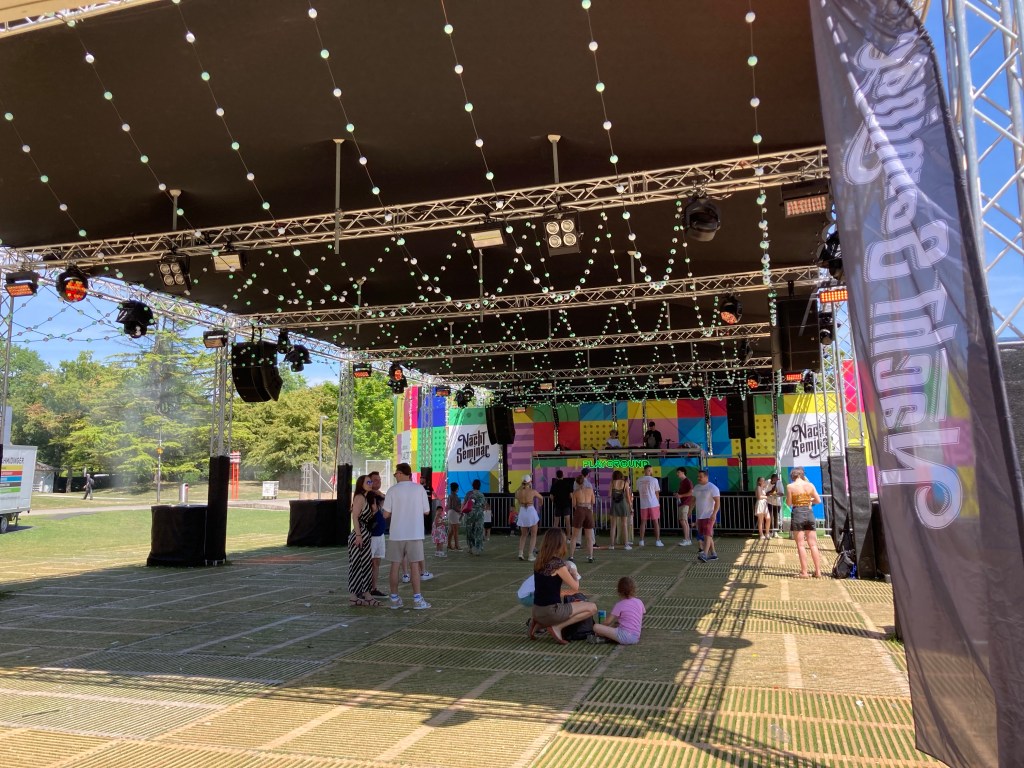
One of many outdoor concert areas set up throughout the city. This was at around 2PM so the hardcore partiers were probably still asleep from the night before.

The next Züri Fäscht will take place July 3rd through 5th, 2026. I assume that it will once again be a great time. If you are love festivals and especially if you love EDM, it could be a great time to visit. Personally, if I were to do this, I would fly in on Friday morning and use the jet lag to my advantage to stay up the whole night. To keep up on plans for the upcoming festival, visit https://www.zuerifaescht.ch/.

Swimming Habits in Zurich and Munich Highlight How Sheltered American Kids Are

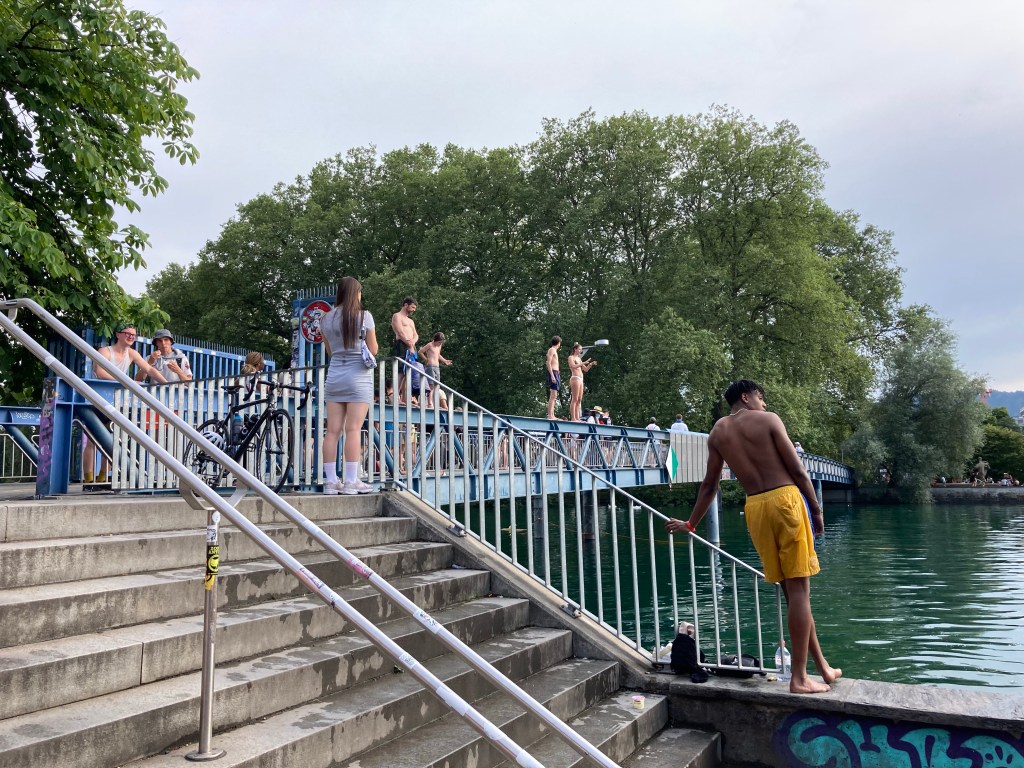
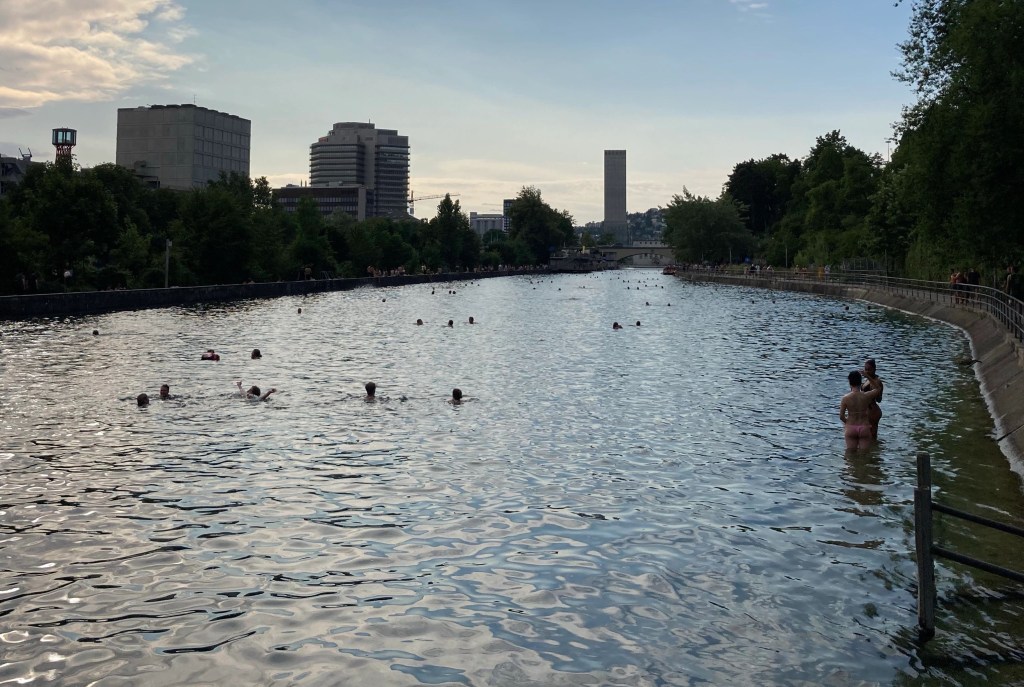
On our last day in Zurich we walked along the Limmat River and we watched as hundreds, if not thousands, of young men and women thoroughly enjoyed the river, They were swimming, floating, and even jumping off bridges into the river.

A couple of young people preparing to jump in the Limmat River from a pedestrian bridge

As an American, I was taken aback. Where are your parents? Is this even legal? Well as it turns out, not only is it legal, but the City of Zurich actually owns a platform with diving boards from which people jump into the river. In spite of this, I saw no lifeguards, no police, no safety measures of any kind. The water was definitely deep enough to drown in, but there didn’t appear to be any precautions whatsoever.

In the foreground, swimmers catching sun on the deck while across the river people are enjoying a couple of barges set up as diving/swimming platforms. The area is called Flussbad Oberer Letten.

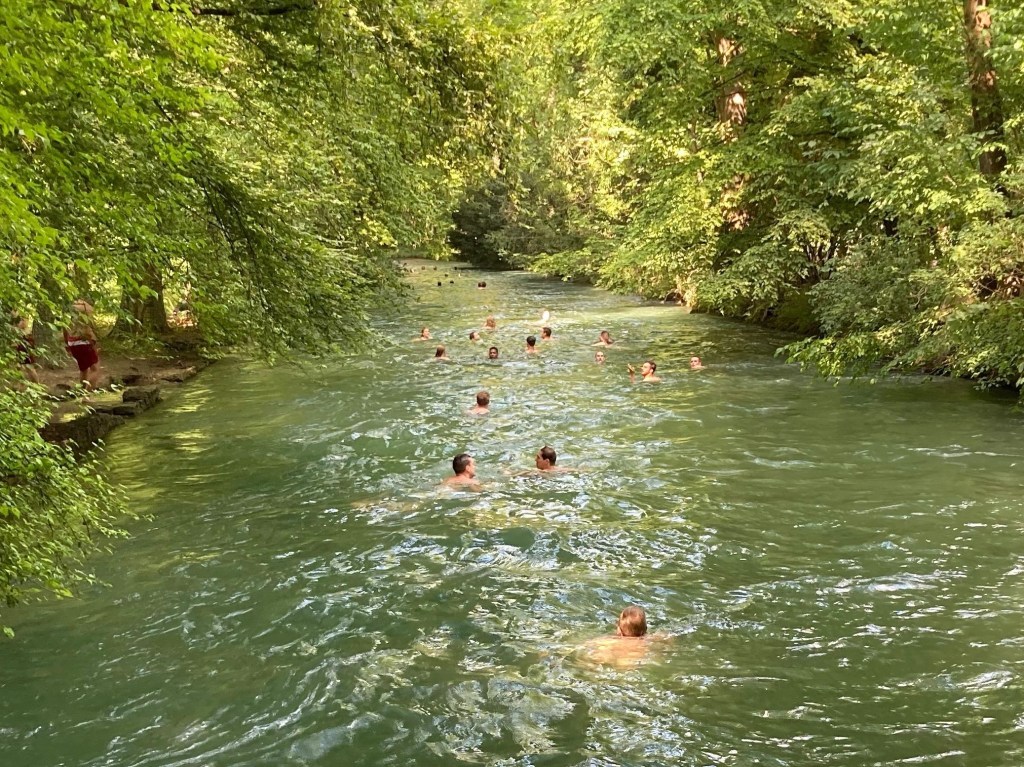
I thought maybe this is some kind of aberration, until just 2 days later we found ourselves in the English Garden in Munich. I wanted to see the surfers that I had seen on YouTube who surf in the rapids of Eisbach. I was not surprised to see the surfers on a day where the temperature was over 90 degrees, but what did surprise me was the hundreds of teens and young adults floating down the superfast current of the Eisbach.
Surfing on the first set of rapids in the Eisbach

It looked like so much fun, that I had to try it myself. I stripped down to just my shorts and gave my stuff to my daughter and jumped in. Guys, this isn’t safe. I’m not a great swimmer and this current is strong. It grabbed ahold of me and pulled me down the river much faster than I had expected. I honestly struggled to float and there were a couple of times where I caught some water in my mouth while struggling to stay above water. Once I had gone about a quarter mile, there was a rope to grab and you could shimmy your way to a ladder to get out. If I had missed the rope I would have floated into a second set of rapids where other surfers are catching “waves”.

Had I not exited on that ladder, my fate was up to those rapids.

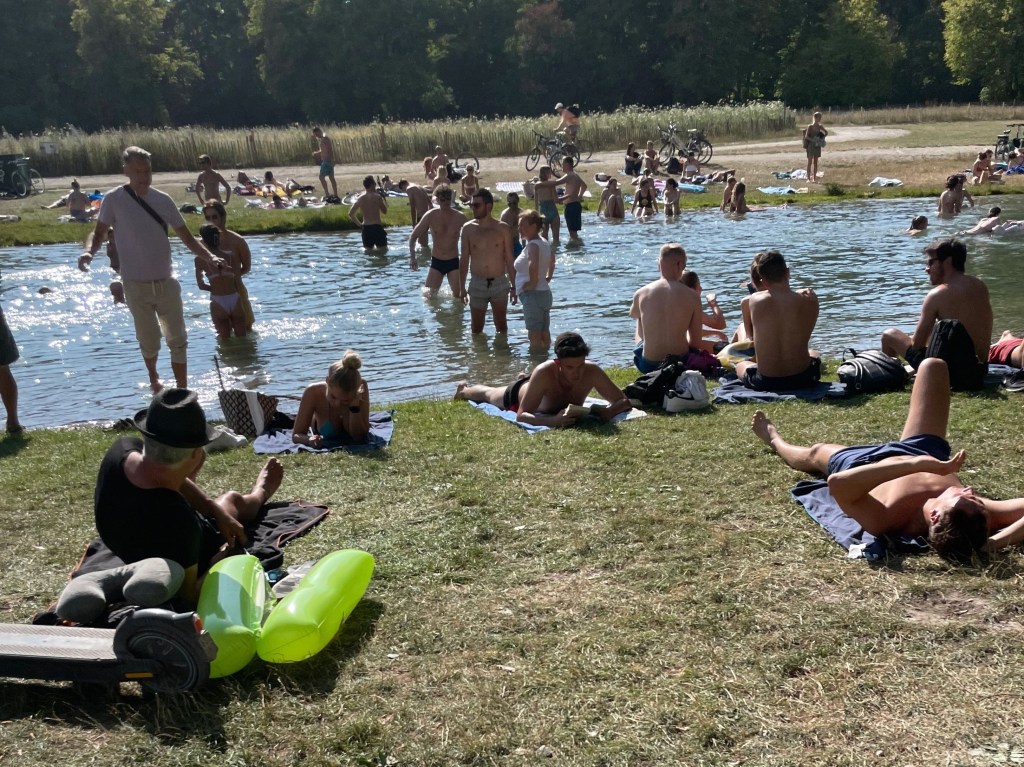
After I was done floating, we walked around the park some more and came across the beer garden where we grabbed a couple of take away beers and continued to walk through the park. There were thousands of teenagers and young adults walking around the park laughing, playing, swimming, sunbathing, and some were even drinking.

Floating down the Eisbach

What did I not notice? Police, fighting, lifeguards, drunken disorderly conduct, or even bullying. I didn’t even see litter. Hell, I even saw empty beer bottles on top of the trash containers because they didn’t want to throw them away, and they knew someone would come by to collect the bottles for recycling.

Swimming, wading and sunbathing in the Schwabinger Bach, a calmer offshoot of the Eisbach in the Englischer Garten

And how did these thousands of teenagers arrive at the park? They walked, rode their bikes or took public transportation. Like really, parents are letting their kids ride on public transportation by themselves? <gasp> Oh, the horror!

Swimming isn’t permitted in the Eisbach, but it’s also not enforced. This guy desperately clinging to a sign that’s basically saying, “don’t swim or you’ll die“ is a bit ironic.

Nothing I mentioned here could happen in the United States. The first time someone got hurt in the river, we would have police patrolling the river and arresting people by the dozens. Selling beer in the park is absolutely out of the question and walking around a park with an open beer? Are you nuts? And the drinking age is 16, you heard me – 16! Can you imagine a 16 year old legally drinking in a park? It’s a recipe for disaster, right?

The Beer Garden at the Chinese Tower is a huge beer garden in the English Garden.

But where was all the fighting, the lewd behavior, surely at least one ambulance was called? Isn’t there broken glass strewn around the paths in the park? Nope, there wasn’t, just a bunch of mostly unsupervised kids having fun.

The Limmat River is a pretty large and fairly deep river, but yet there were tons of people floating in the river, not an inner tube in sight.

We always talk about America being a land of freedom. However, we always frame those freedoms in terms of our First and Second Amendment rights. Does that really make us free? In America, I have more of a right to carry a gun down the street than a beer. That just doesn’t make sense. And could you even imagine the hellstorm that would await anyone who proposed lowering the drinking age to 16? Also, what age would you allow your kid to ride the New York City subway alone? At what age would you allow a kid to go to a park with friends, unsupervised?

Surfing in the second set of rapids on the Eisbach.

Many of our freedoms are restricted by laws and ordinances and others are self-imposed. A kid could easily be taught how to take public transportation by 10 years old but would anyone let them? I mean, it’s legal but, c’mon, in America? Would you let your teenager swim in a river with a strong current and no lifeguards? We definitely wouldn’t allow our children to jump into a river off a bridge and if we knew that was happening somewhere, we wouldn’t allow them to go.

These boys jumped from a fairly high bridge into the Limmat.

We have locked our children in a jail of safety, attempting to prevent even the slightest accidents, but are they safer? We have ridiculously high traffic fatalities as well as off the charts gun deaths. We litigate every accident that causes bodily harm or death and it’s absolutely paralyzing us. We’ve built ourselves a nanny state and I pray for the sake of our kids we can unravel some of this. Its not just physical danger either. Any time that someone even does something in front of a child that a parent doesn’t agree with, whether it be a public prayer, teaching Critical Race Theory, or God forbid seeing a drag queen, we demand that it stop immediately. Our kids aren’t going to explode by seeing something different, by experiencing something different or by just being allowed to have some real, actual, unscheduled spontaneous fun. We need to start allowing our kids to be kids again. <End of rant>

Dos Sirenos Brewing – San Antonio Texas

On the last day of my trip to San Antonio, I had the pleasure of going to Dos Sirenos Brewing. It’s a brewery with a sort of nautical/mythological theme in the area around a mile south of the downtown/Riverwalk area. I walked down there along the Riverwalk (the part that to the south that is more park like and less commercial). After trying it, I probably would’ve walked 5 miles to get there.

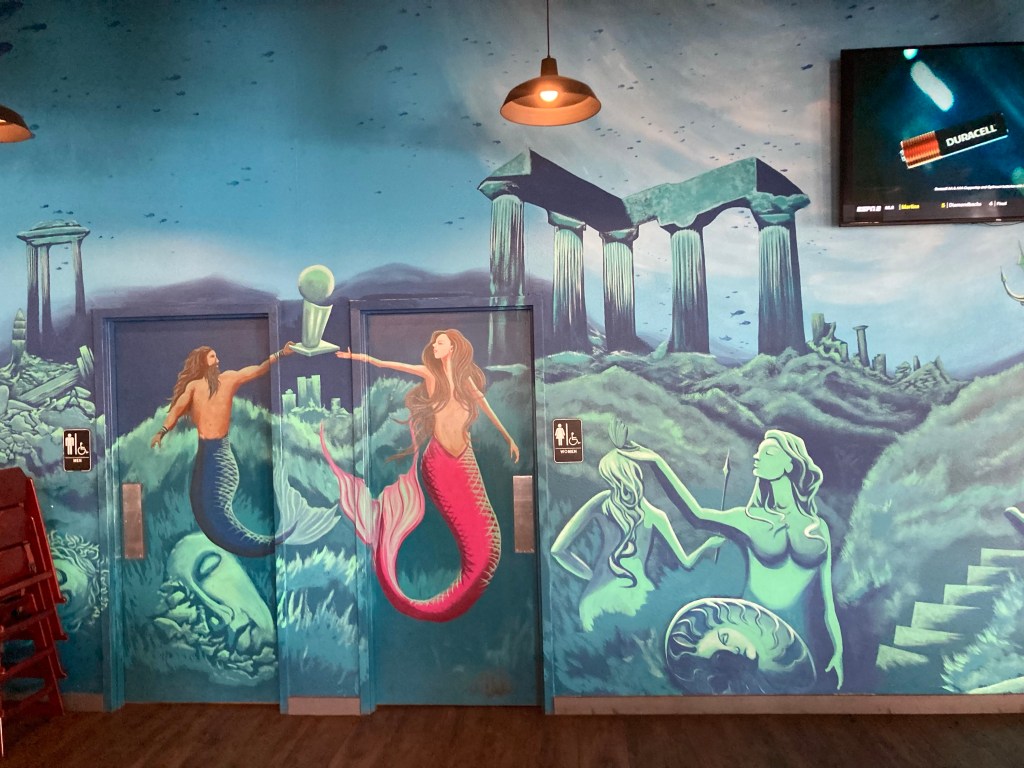
I walked up to the building, and it’s pretty funky, with a couple of mermen drinking beers painted right on the front of the building. It’s definitely an interesting choice but I actually like it. When I walked inside there was a lot more of the theme, especially with the large mural on the back wall. This is gonna be interesting.

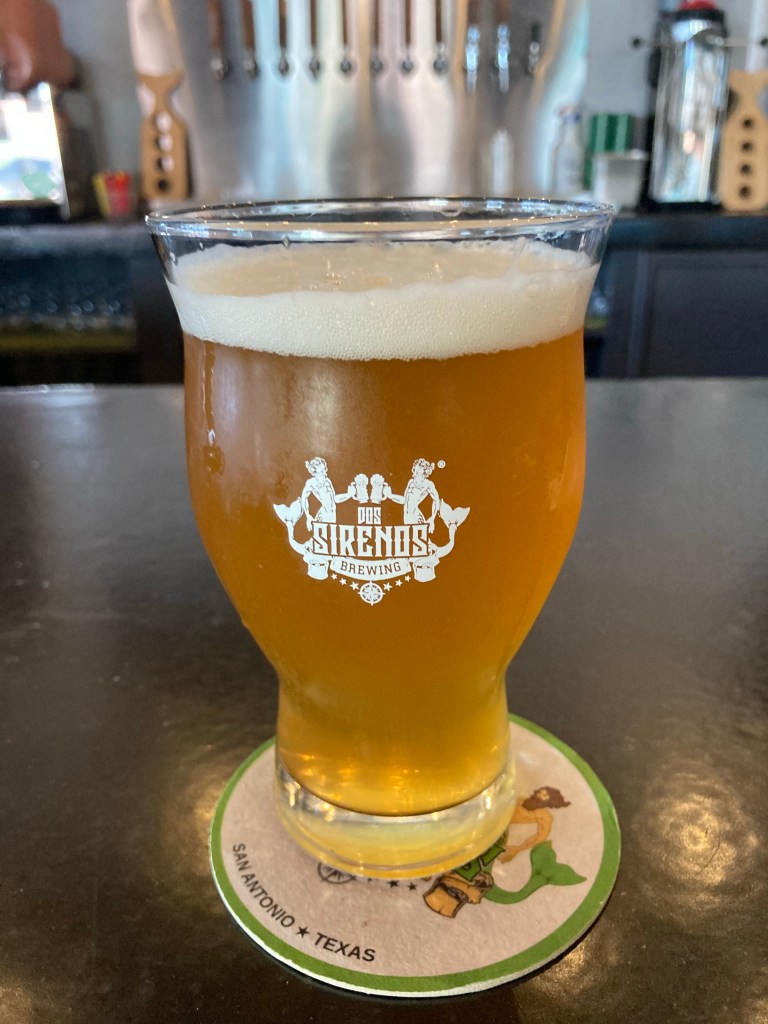
I sat down at the bar and ordered an Atlas Strong Ale. It’s an English Strong Ale and as usual for me, if you have an unusual beer style at your brewery, I’m probably going to order it. Now, I’m not an expert in this beer style so I can’t tell you whether it was appropriate to the beer style but I can tell you it was delicious.

I also ordered the Hera DDH IPA and again it was great, just a really great example of what a double dry hopped IPA should be. I finished my beer tasting with the Sea Turtle Stout, which is a turtle chocolate candy inspired stout and it was a great dessert beer, and capped off my meal wonderfully.

The beer was the best of any of the breweries that I tried in San Antonio, but I really don’t want to talk about that because, you see, I had a life-changing meal at Dos Sirenos. Ok, so life-changing is an exaggeration, but still, DAY-YAMN it was good.

On the menu, there was something called Pork Belly and Grits. The description was “Crispy Pork Belly, Parmesan Grits, Tomatillo Succotash, Salsa Macha.” I was confused. How in the hell do all of these things work together? These ingredients seemed to me to be completely unrelated. Ok, sure, I get the pork belly, but I’m an ignorant Yankee, parmesan grits? Grits can be flavored with parmesan cheese? And what is tomatillo succotash? I love tomatillos and it’s never occurred to me for it to be in succotash. Also, I love all kinds of salsa and I have no clue what salsa macha is.

Pork Belly and Grits

I was intrigued and asked the bartender about this dish. He told me it was the chef’s favorite dish. Ok, that solidified it, bring me this weird ass dish, I’m super confused by this and I need it to make sense.

This bowl shows up and it’s a whole heap of of tomatoes and corn in a tomatillo sauce sitting on a base of parmesan grits with a ring of this salsa macha and a few chunks of pork belly on top. The first thing I did was taste the grits and I was instantaneously enraged. It’s delicious, creamy and with a perfect amount of parmesan goodness. Why am I mad? Because I know plenty of southerners and they kept this from me. You named these grits? You know that you named this deliciousness ‘grits’ to keep us Yankees from eating this. How did you not call this dish ‘super creamy corn yum-yums’ or something? Grits? That’s what you went with? I avoided these for 48 years because it sounded nasty. Not a single one of you ever said me “psst, they’re really not gritty?” C’mon!!!

There is a massive amount of outdoor seating that was going unused that afternoon.

Next, I grabbed a spoonful of the succotash, grits, and the salsa. They went together perfectly. The succotash is bright, flavorful, and acidic with the tomatillos adding the acid. The salsa is spicy and a touch oily, which since I was unfamiliar with salsa macha, was unexpected, but it added a perfect amount of fat and spice to the bite. Overall, it felt fairly light because of the succotash and grits but the pork belly added some additional crispiness and fat to the dish to balance it all out. It was a perfect balance of textures and flavors and it was just unbelievably well done. Honestly, it’s probably the best meal I’ve had in years.

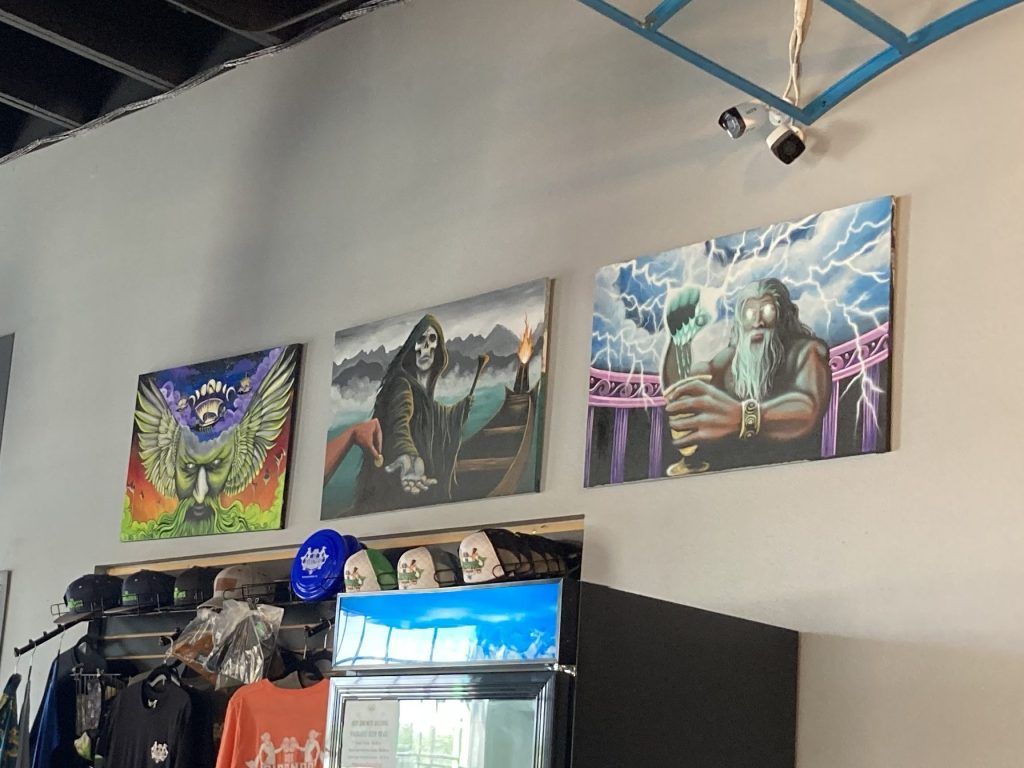
The back wall of the brewery has a massive mural covering the whole wall.

This dish was dreamed up in a mad scientist lab somewhere and it’s just off the charts. I actually went home after this and learned how to make salsa macha, parmesan grits and tomatillo succotash so I could continue to eat this, since I don’t live in San Antonio. It’s probably the best thing I cook now, but it still isn’t as good as the original. Seriously, if you are within a 1 hour drive of Dos Sirenos Brewing, just stop what you’re doing and go there now, before the chef takes this off the menu. Of course, who knows what insane thing this chef might do next. You can find out what they’re up to at https://dossirenosbrewing.com/.

San Antonio Riverwalk

I had the opportunity to take a business trip to San Antonio and the thing I was most excited about was revisiting the Riverwalk. It had been probably around 25 years since I had been there when my wife and I took a day trip there with my parents years ago. I had remembered it as beautiful, full of life and surprising cool on what was a pretty hot summer day. It was every bit as lovely as I remembered and probably even better than it was 25 years ago.

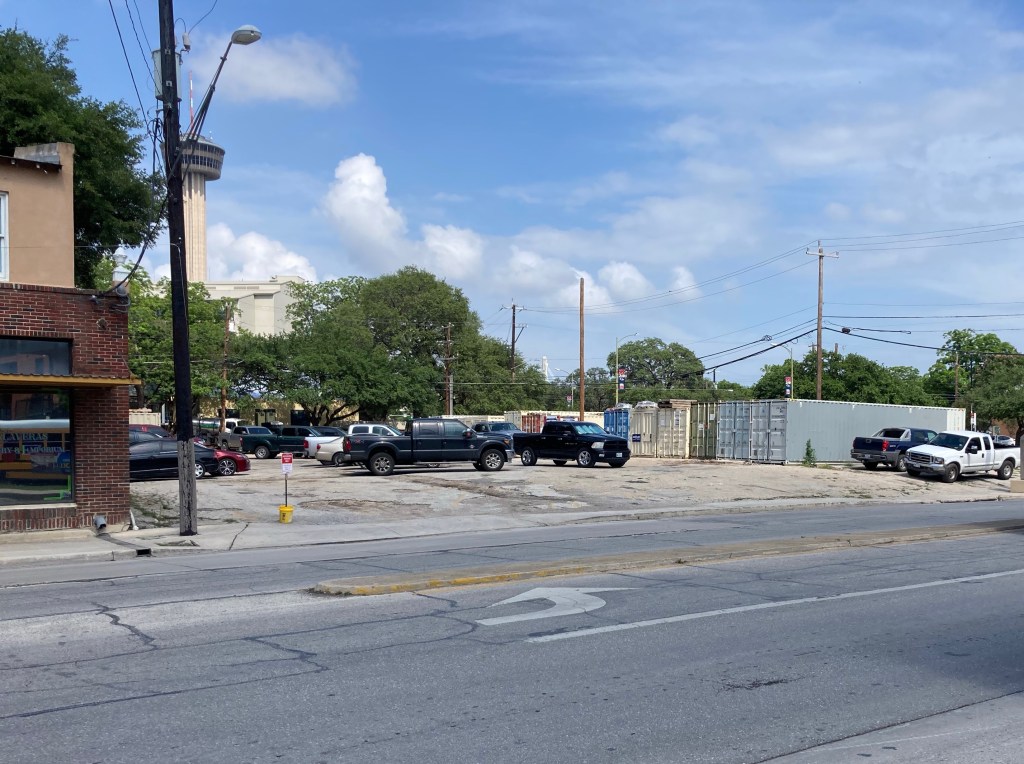
I arrived in San Antonio in the early afternoon and was dropped off at my hotel, the Springhill Suites by Marriott near the Henry B Gonzales Convention Center. My first impressions of San Antonio weren’t great. There are a lot of empty lots in the area directly west of the convention center. There were a lot of unimpressive buildings and surface parking lots and frankly it looked like San Antonio was dilapidated. It reminded me of so many midwestern cities that deteriorated following the closure of big manufacturing plants in those cities. My hometown is one which is still recovering from plant closures dating back to the 80s, and I am well aware of this ‘look’. Early on in the trip, I did a decent amount of walking along the sidewalks in the area around the Riverwalk and it just wasn’t enjoyable at all. There didn’t seem to be any cohesive feeling that you get from walking around a downtown area with block to block buildings like you get when walking along the downtowns of Chicago, New York or San Francisco. I think the reason for this, however, was that in San Antonio all of the energy of this city is centered around the Riverwalk.

Surface parking lots are necessary in cities, but the number here seemed excessive.
A gravel parking lot with shipping containers is not what you expect to see in a vibrant city center.

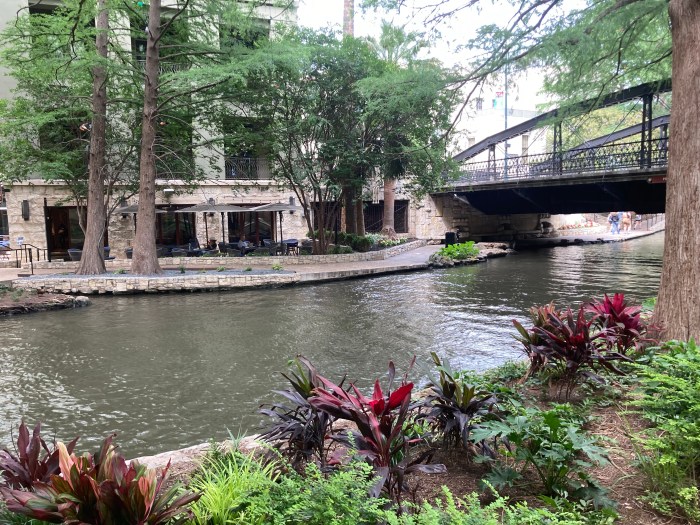
As soon as I had a chance, I headed to the Riverwalk, and it was more impressive than I remembered. The first thing that I noticed was just how close the walkway is to the water. Living in a city that is hit almost yearly with floods, this is impressive. In my hometown, we have some bike paths that are deliberately built 20 feet above normal river level, so that they don’t flood when the river rises (not all of our paths are high enough to avoid flooding). I live in the Quad-Cities, which is built around the Mississippi River. In our area, the height of the river can vary 15 feet over the course of a year. Designs of parks along the Mississippi take this into account and this makes the river feel somewhat distant, but in San Antonio, you can literally sit on the walk and touch the water.

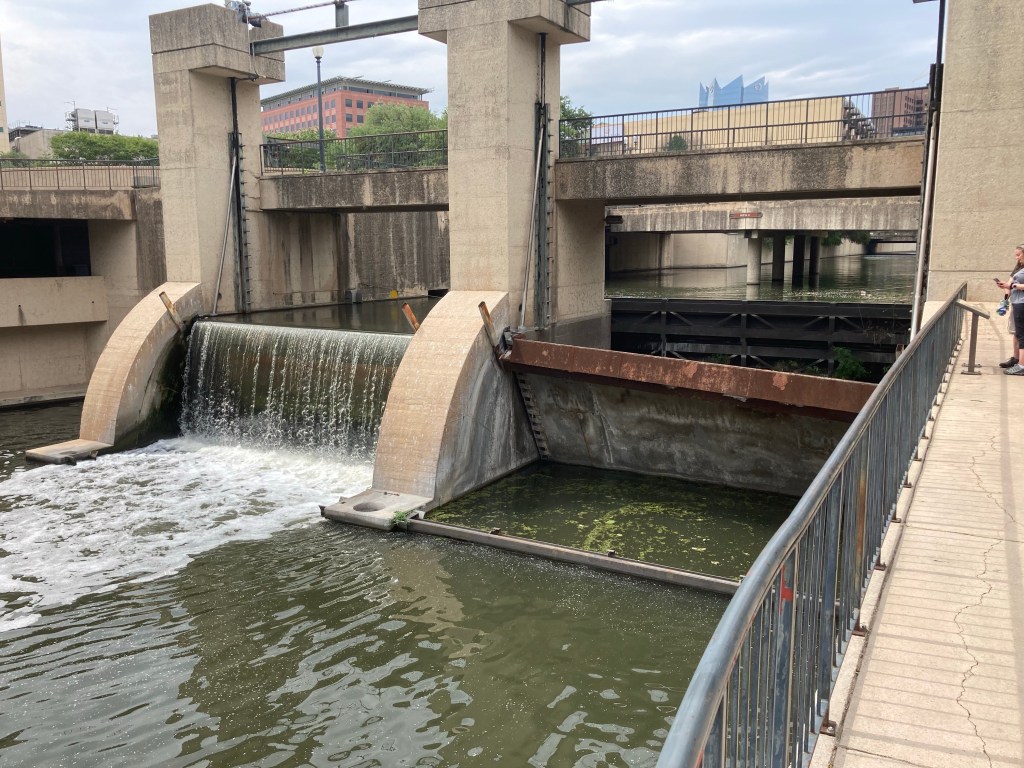
This is the dam on the downstream side of the downtown area.

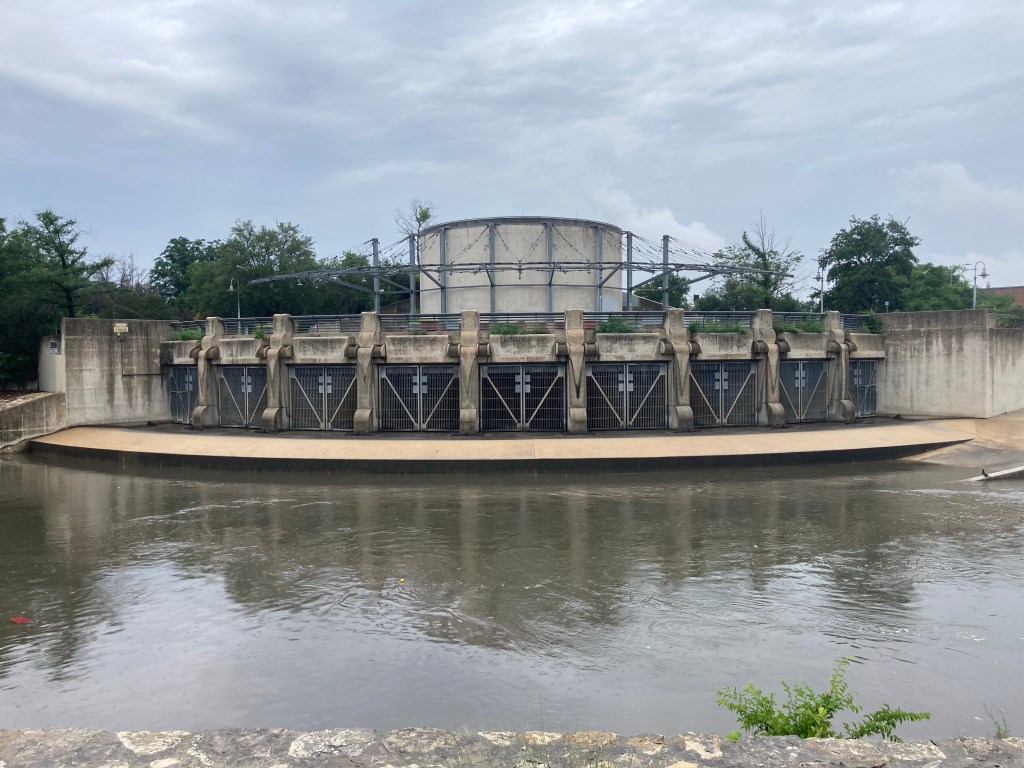
What makes this possible is some really impressive engineering, involving dams and an enormous flood tunnel. They essentially turned this section of the San Antonio River into a canal by being able to control the river level so effectively. The tunnel is 24 foot diameter bored tunnel approximately 140 feet deep that works as an inverted siphon. It’s a brilliant design that helps keep this river from overflowing.

This is the outlet of the flood tunnel, it’s a couple of miles downstream of the downtown.

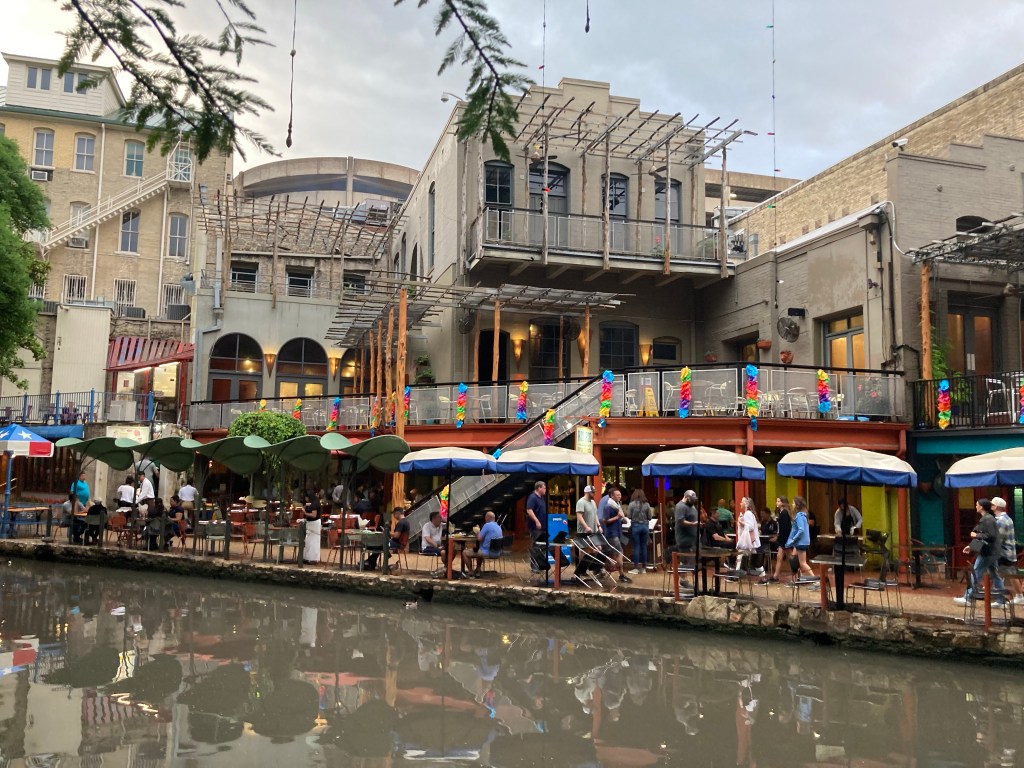
The second thing that hit me is just how close restaurants and bars are to the river. There just aren’t that many places where someone can sit at a restaurant while dining directly next to a river, but there are quite a few restaurants along the Riverwalk where you can do just that. Even on weekdays, these restaurants seemed to get a decent amount of business. They seem incredibly romantic, but since I was traveling alone, I had no desire to dine in a romantic atmosphere. I instead did what any self-respecting solo man on a business trip would do, I ate at bars.

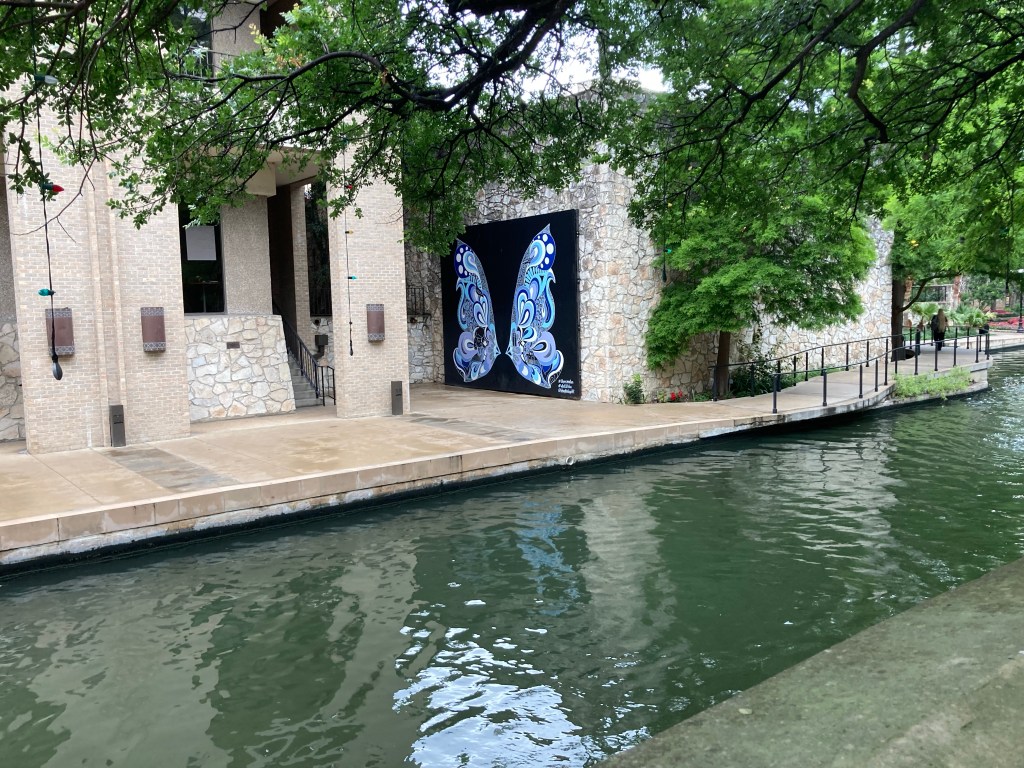
Also impressive are all of the little touches that are at virtually every point along the Riverwalk. There are art pieces, statues, and planters everywhere. Anytime your eyes wonder, they come across something interesting and beautiful. Sometimes its a bright mural sized painting adding contrast to the stone walls.

Sometimes its an enormous statue in the middle of a set of bridges.

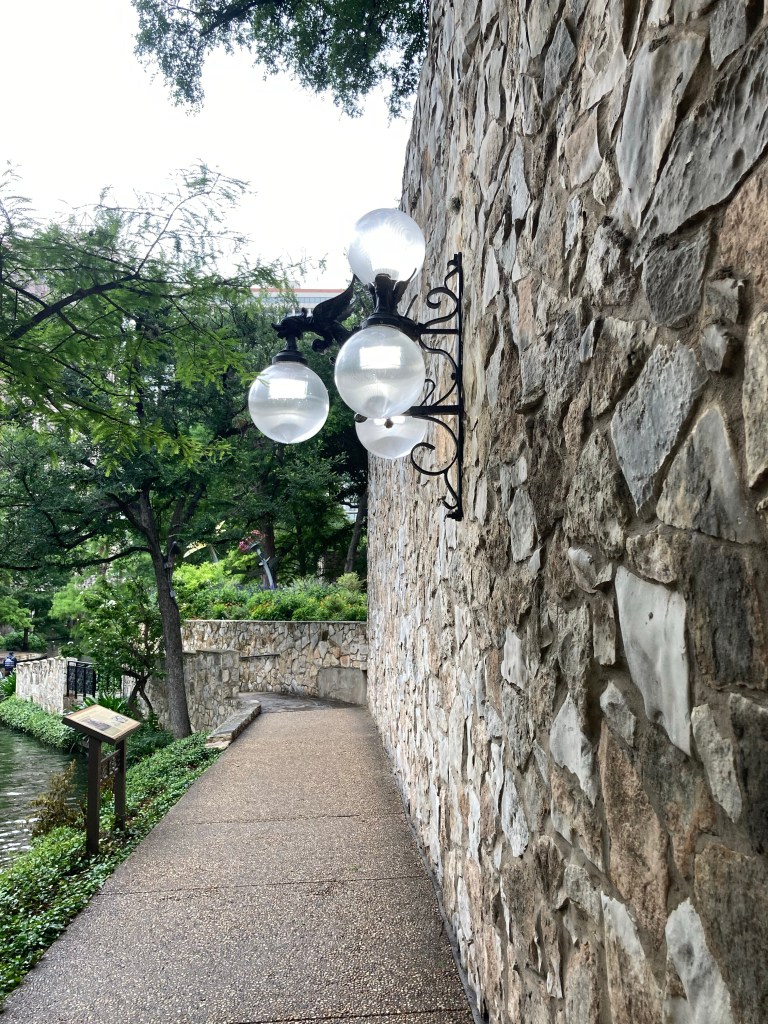
Sometimes its a set of unique light fixture illuminating the path.

And sometimes, its a fountain making the underside of a bridge beautiful. I mean, honestly, when was the last time you were impressed by the underside of a bridge.

I was even impressed by where they stored the boats that they used for tours.

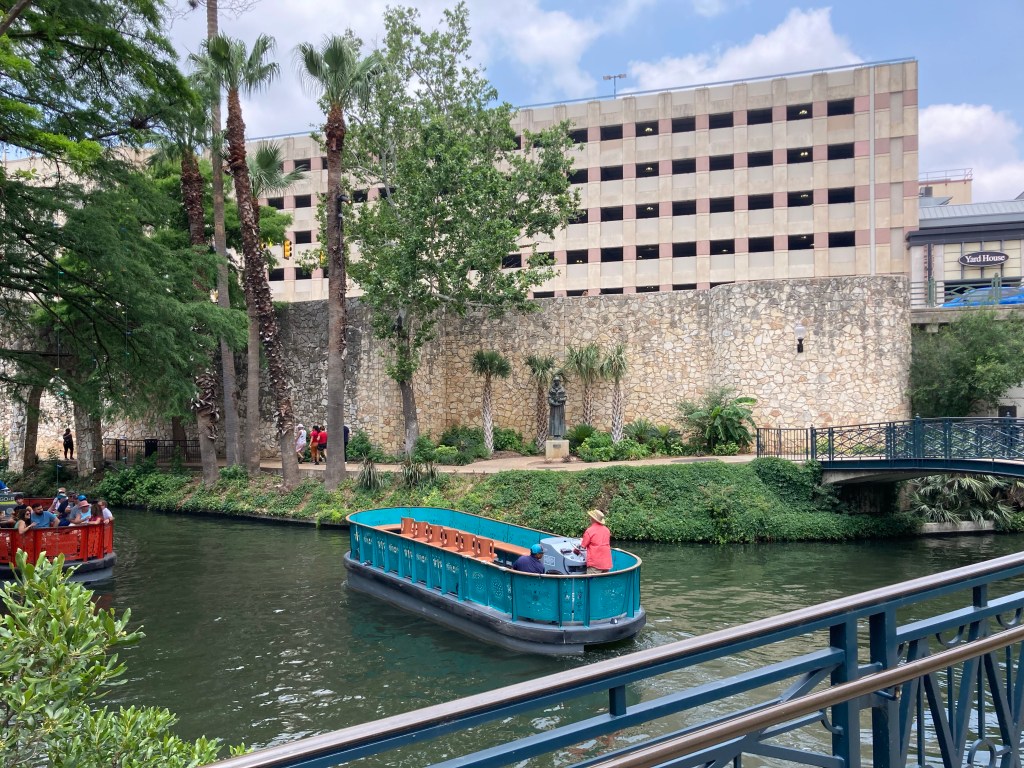
There are a lot of these tourist boats that float around the Riverwalk loop in the downtown area.
They park these things in rooms under the bridges or parking lots.

There are these storage and maintenance areas under parking lots and streets in the area where these boats operate. It is such a unique solution to use the space under the streets for what is essentially maintenance garages.

The “garage” for the boats is under the street.
Here is another maintenance area under a street.

Throughout the Riverwalk area, there are flower planters and trees that not only offer beauty, but also provide shade. I don’t know if there is an actual temperature difference between the temperature in a parking lot in San Antonio and the temperature in the Riverwalk, but I would say that it feels like about 10 degrees cooler by the river.

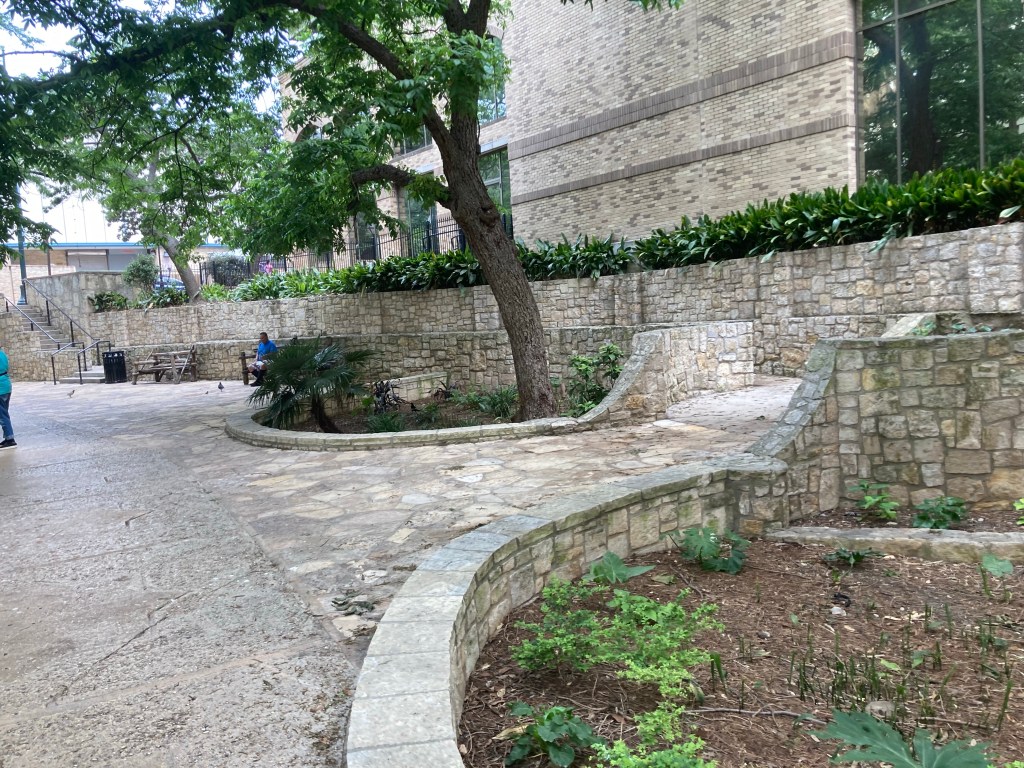
I also loved the fact that stone was used throughout the Riverwalk area. It seems like an obvious choice to use the same material all along the river, but it’s literally miles of stone. Maybe this is an extremely common type of stone in San Antonio, but they used a ton of it and it makes everything feel cohesive.

Oh, and there are water features – everywhere! I love these kinds of water features. They add to a cooling effect by creating some mist in the air and they also provide noise that has an amazing ability to calm the soul.

There are so many water features, they even hide some in grottos.

One of my favorite things along the Riverwalk was the Amphitheatre that straddled the San Antonio River. On one side, there is a raised stage right on the edge of the river and on the other is a seating section that looks like it had capacity for a few hundred people. The seating has a unique stone and grass layout, which means that if you were attending a show there, you would be seated on grass. I imagine that would be comfortable, but you might be a little worried about grass stains on your pants. There weren’t any shows there during my stay in San Antonio, but I hope it gets used a lot because it is very beautiful and unique.

Stage for the Amphitheater
Seating for the Amphitheater

I really love the Riverwalk area in San Antonio and I can see why so many shops, bars and restaurants have located themselves around it. The Riverwalk is one of those amazing examples of how important city planning and engineering can be to the vitality of a city. San Antonio could have easily just decided that they would build enormous flood walls or giant berms to prevent flooding and if they had done that then the area certainly wouldn’t be the commercial success it is today. Creative engineering and great design created a space that is truly unique, and it is definitely a fantastic reason to visit San Antonio if you get the chance.

St. Mary’s Glacier

Is there anything more breathtaking than a mountain lake? There is something indescribably beautiful about still clear waters surrounded by mountain peaks. Add in some melting snowpack nearby, I mean wow, what can be more gorgeous than that? St Mary’s Glacier is all of those things and if you can, this is a must-do hike.

The glacier is on the backside of the lake from the trail.

We had already done a hike at Maxwell Peak that morning and decided to drive out to Idaho Springs and do St Mary’s Glacier. It’s a fairly short hike, about a mile and a half to the lake and back with an elevation change of about 750 feet. That seemed pretty doable on a shortened schedule.

Strava Stats for this hike

The drive out there was a little scary for us Iowa folks. There was a lot of switchbacks and it seemed like one wrong turn could mean plummeting to our deaths. The kids were enjoying the scenery but I was white knuckled on the steering wheel and Jenn was definitely a nervous passenger. The truck didn’t seem to enjoy the drive either. I think the combination of the elevation and the slope was pretty hard on my truck because it smelled like antifreeze when we parked. There is a parking lot near the trailhead, which was sketchy at best, with potholes that you could lose a subcompact car in. I would definitely take into consideration what kind of car you were driving to get to the trailhead. The drive up there will test your drivetrain, the parking lot will test your suspension, and the drive back will test your brakes, so make sure you feel good about what you’re driving.

The rocky path up to the lake

There is a five dollar fee to park in the lot, we paid that and began the trek up the path to the lake. This is definitely a popular hike so there were a lot of people doing this hike with us. That’s usually not great for Sadie who is great with people, but not great with other dogs. The trail is wide, however, which allowed me to steer her away from those dogs.

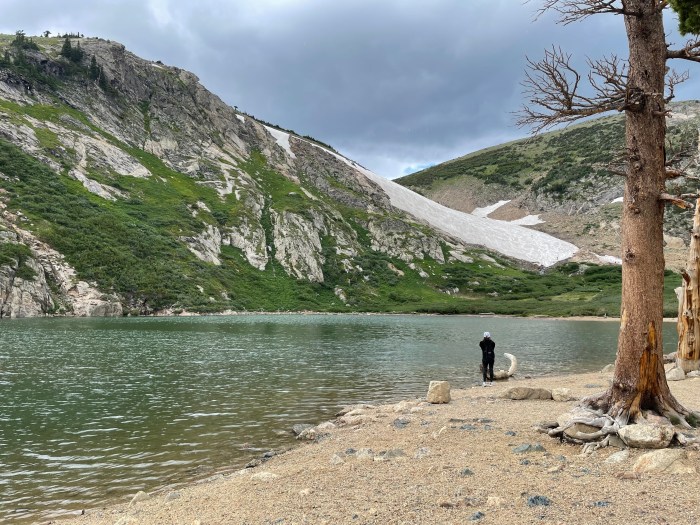
St Mary’s Lake

The path itself is steep and rocky. You should probably be in decent shape to hike this. This is over 10,000 feet, so the air is fairly thin and the slope is steep enough to get most hikers breathing heavy. There are large rocks everywhere which essentially meant that there was a constant danger of an ankle twist or a slip and fall, so slow and steady is the way to go.

You can continue to climb up the mountain after arriving at the lake, we did not.

After a little over a half mile, the rocks begin to be more sparse and the grade becomes less steep. The peak and the glacier suddenly come in to view and then finally the lake itself. There are many places in this world where you see something so beautiful that you forget to breathe for a second. This is one of those spots. I had seen pictures, but they just don’t do it justice.

This cliff face is a popular place to cliff dive

There was a lot of activity going on around the lake. On the far side of the lake, there were some skiers who were skiing down the glacier, then taking their skis off and hiking back up to the top of the glacier. There were some climbers attempting to get to the top of the peak. There was also a group of a couple dozen young people who were cliff diving into the lake on the back side of the lake. I waded into the lake a little and as I imagined, it was pretty cold, so those divers were definitely brave.

Skiers on a glacier in July
Cliff Jumping into the lake

We had a great time hanging around the lake and especially watching those crazy divers, but in typical Colorado fashion the sky started to darken and Sadie was becoming real nervous. It was time to leave, like 15 minutes ago. We got halfway down the trail and it started to downpour. It was a thunderstorm and Sadie was not a happy puppy. By the time we got back to the car, we were all soaked and freezing and Sadie hasn’t talked to us since.

Everyone is in good spirits, but that dark cloud is ominous.

Running the Cabo San Lucas Marina

The run around the marina in Cabo San Lucas is about a 5 kilometers trip if you do a full loop (up and back). It’s dead flat (ignore the elevation change on this Strava recording, my Garmin was having major problems with elevation). It’s also a great way to get a quick sense of what is going on around the major tourist area in Cabo San Lucas.

There are some huge private boats in the marina.

Typically, the marina isn’t very relaxing to walk through because there are tons of people trying to sell you boat tours. However, I found that no one bothers you when your jogging there, which is good to know if you just want to look around without having to say “No, Gracias” every 30 seconds.

The sea lions like to hang out in the marina

We were staying in an Airbnb above the Puerto Paraiso shopping mall on the north end of the marina. I started counterclockwise around the marina so the first part I ran through was past the mall and restaurant area. As I began to turn south, there is an absolutely huge construction area where they were tearing down what looked to be a very large hotel or condo complex. Hopefully someone will build something cool there.

Sea lion enjoying himself

Once I was past the construction area there were some shops and restaurants. This area is a less dense commercial area which meant my attention was being grabbed more by the sea lions diving for fish. There are quite a few sea lions that hang out in the marina, but I only saw them on the west side for some reason. Pretty quickly I reached the end of the marina and had to turn around because the marina ends, and so I had to turn back and run this area in reverse.

Once I did a full backtrack of west side of the marina, I was now running toward Medano Beach on the east side of the marina. This side is pretty much packed with bars, restaurants and shops. It makes it a fun part to hang out but if you start your run too late in the day, like I did, you’ll find yourself dodging a lot of people.

There are boats everywhere

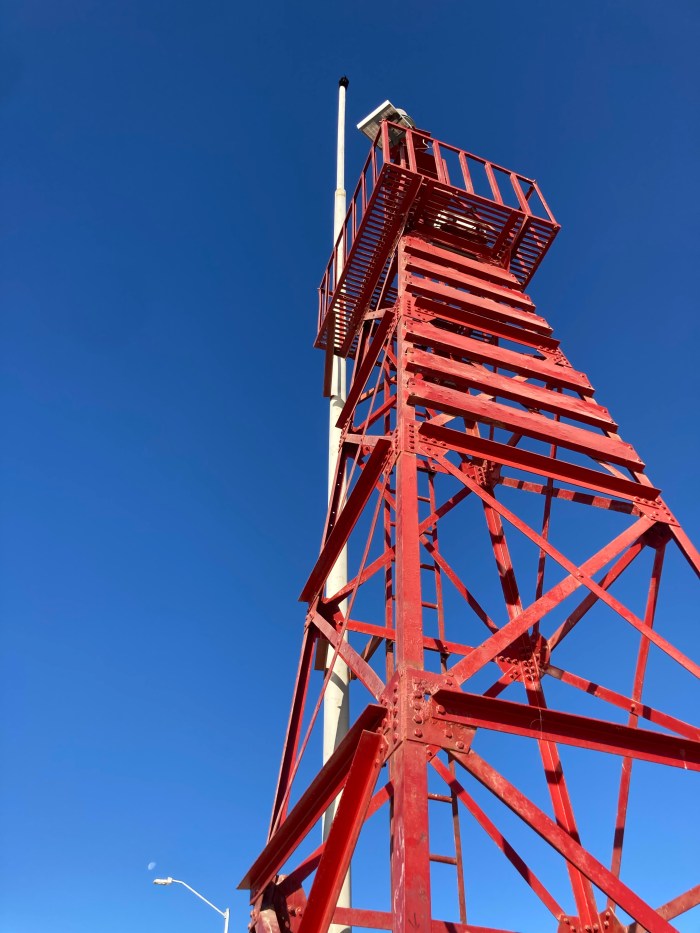
Once you reach the end of the marina, you arrive at Medano Beach. There is a turnaround with a tower which sits atop a rocky breakwater. Looking down the beach from there is a series of nightclubs that get pretty busy during the height of beach time and of course, at night.

The tower at the pier on Medano Beach

I headed back to the Airbnb and ran a little extra so I could get to 4 miles. Running around the marina is very enjoyable, but I would suggest trying to get up fairly early for it. The longer you wait, the hotter and more congested the walkways get. There is a ton to look at between the boats, the sea lions and the shops and restaurants. It’s hard not to jog this area without finding something that you’ll want to wander over and check out (after a shower, obviously).

My Garmin is having an issue with elevation, it should read 0 ft. I doubled back a bit to get an extra mile.

Hyatt Ziva Los Cabos

The Hyatt Ziva Los Cabos is a fairly large all-inclusive resort along the beach where the Sea of Cortez slams into San Jose Del Cabo. Yes, I mean slams! The slope into the ocean here creates violent and thunderous waves. Because of the waves, the beach probably isn’t suitable for most people to swim, but don’t worry, there are plenty of pools.

We paid for our two nights with 43,000 Hyatt points which I was able to get with a signup bonus with the Chase World of Hyatt Card, about $5,000 in spending on that card, plus I did have to buy about $50 worth of points to get the last scraps of points necessary to secure the room. They were listing our room for about $600 per night so that means we got somewhere in the vicinity of 3 cents per point on the redemption, and I’m not at all mad about that. Since it was a point redemption, we weren’t able to be too picky about the room, and even though it was for our anniversary, I had to break it to my wife that we couldn’t get a king bed and we were stuck with two queen beds. She looked at me and said “I don’t have to share a bed with you? That sounds amazing!” So yeah, she loves me.

Someone was about to get married, I don’t recommend it.

We arrived to the hotel a little disheveled after an experience on the Ruta de Desierto that had Jenn maybe a touch mad at me. When we finally made it to the resort gates and they asked for our names and then escorted us into an office where they offered us a couple of beers while they finished the paperwork. Then a bellhop escorted us to our room while informing us about about every restaurant and bar in the resort, which was very helpful. I was trying very hard to pay close attention to him but I was so distracted by the views of the beach and the enormous pools.

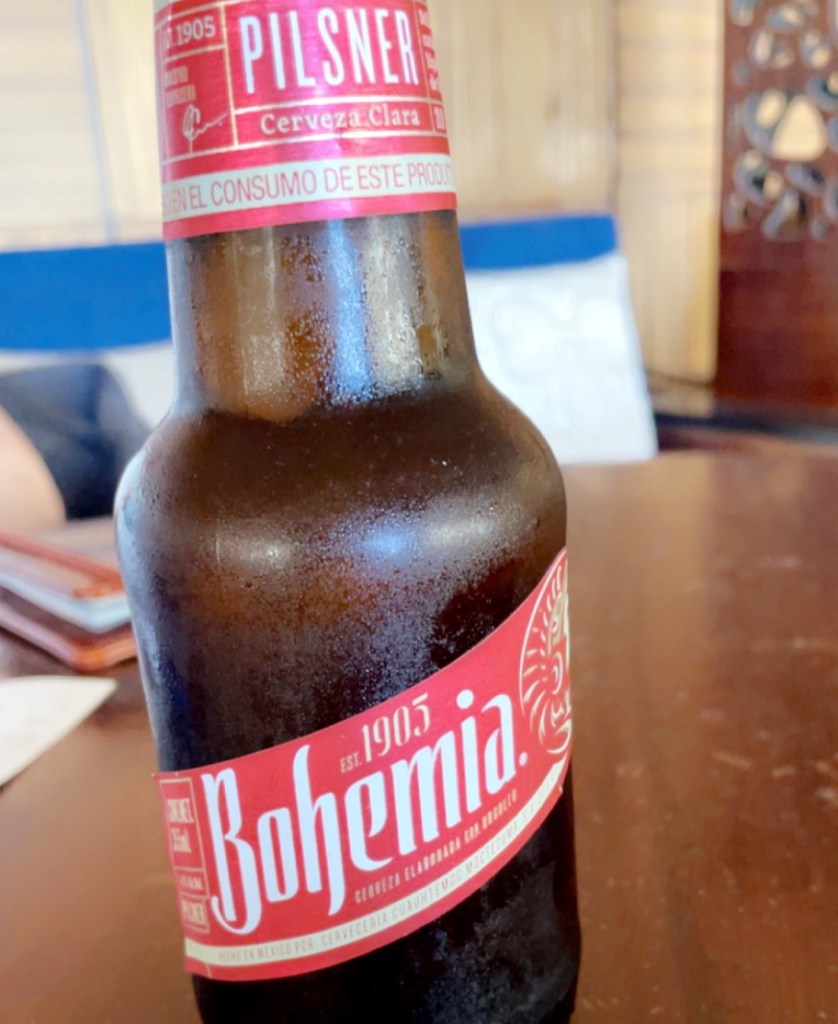
The Bohemia Pilsner was a nice beer, but once I discovered Bohemia Oscura, that became my go-to Mexican beer.

We came to San Jose Del Cabo in January when the temperatures were in the low 60s at night and in the upper 70s during the day with cloudless skies, otherwise known as gorgeous weather. Unfortunately, that’s a little too cool for the pools to stay warm on their own. There was only one heated pool at the Hyatt Ziva, so everyone basically hung out at that pool. This wasn’t really a problem though because the hotel wasn’t crowded and the pool was pretty large.

View from our room’s balcony

The room itself was lovely. It was spacious and had a nice balcony overlooking the children’s pool and the Sea of Cortez. It was modern and had a nice walk-in shower and a separate spa tub. It had all of the things you would expect like a small table, desk and a little mini-fridge with some water, beer and soda. Frankly we didn’t spend a ton of time in the room, we definitely spent the majority of our time at the pool, beach and swim-up bar.

They congratulated us on our anniversary with champagne and chocolate covered strawberries and apparently I couldn’t wait to try it before I took this picture.

Probably my favorite thing about being at an all-inclusive resort is hanging out at the swim up bar. After about an hour at the swim up bar, everyone is your new best friend, you’re doing shots, you’re toasting virtually everything, just generally having a great time. In the span of a couple hours we were having great conversations with a fun couple from British Columbia, a group of folks from Sacramento and a family from Kansas City. The bartender was very accommodating of all of us even though I’m sure we were all pretty annoying to him. We spent the majority of our time at the pool and the hot tub next to the pool. We did have to eat, though.

The beach by the resort

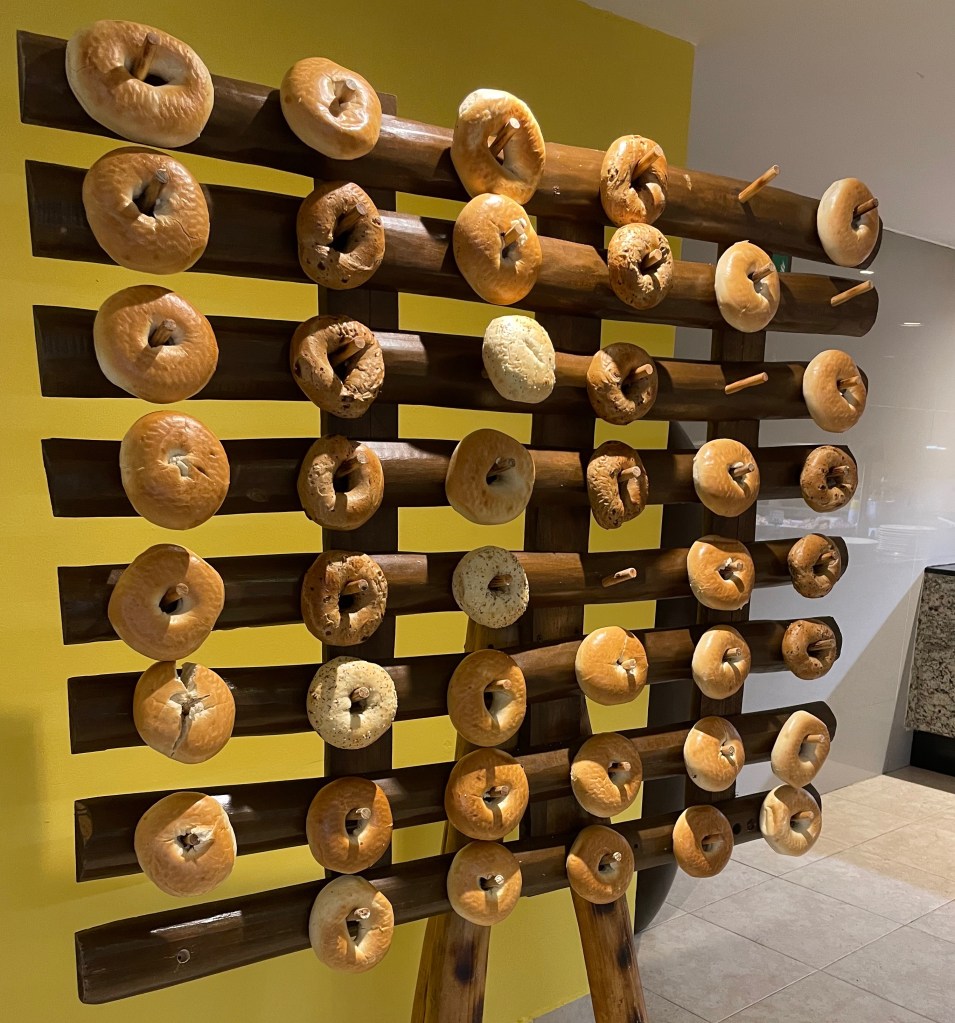
There is a nice selection of restaurants on site, we ate our two dinners at Hacienda Baja Grill and Bon Vivant. At Bon Vivant, we learned that Tuna is fantastic. Neither one of us had ever tried seared tuna before and Jenn ordered a salad with tuna on it. I was reluctant to try it because it pretty much looked raw, but it was amazing and I’m really looking forward to having it again. This is one of the truly great things about all-inclusive resorts, if we were at a restaurant that we were paying for, we wouldn’t have tried the tuna, but knowing that if we didn’t like it, we could just order something else made it so much easier to try. On our last day for breakfast we went to the buffet expecting to be underwhelmed, but it was seriously good. They had a tremendous spread of fruit, salad, hot breakfast items, bagels, pastries and a whole lot more. I probably would’ve eaten there for every breakfast if I had known it was going to be that good.

This is the first time I’ve ever seen a bagel rack. Everyone hotel should have one.

Overall, I thought the Hyatt Ziva Los Cabos was great. The restaurants that we tried were on par with what I would expect from a higher end all-inclusive resort. I was surprised by the quality of the breakfast buffet. The resort was very clean and well-maintained and the staff was extremely friendly and helpful. The beach wasn’t the best, because of how violent the waves were there, although I actually liked how loud the surf was, it’s weirdly calming to me. The hotel doesn’t own the beach, so there is a definite line where the hotel property ends and where the public beach begins and vendors set up shop right on the other side of that line. The hotel has rows of beach chairs set up on the hotel side of the line, so your view is always partially blocked by the vendors, which didn’t really bother me. You might find that annoying or convenient, depending on whether you are in the market for jewelry or a hat, or whether you just want an unobstructed view of the ocean.

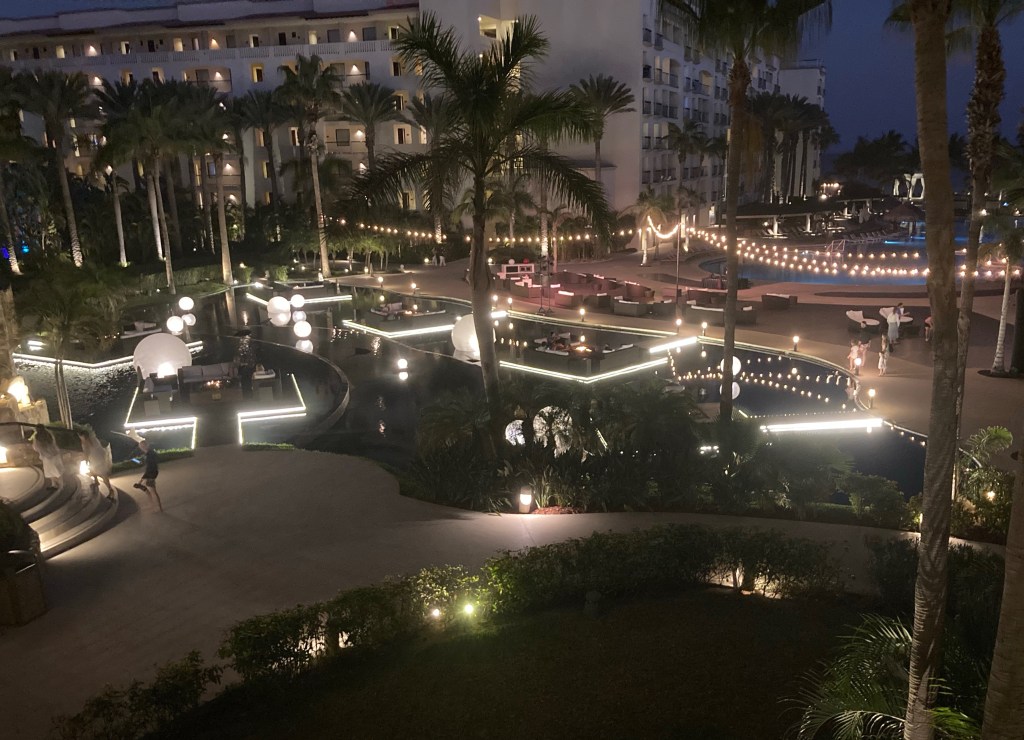
There were these great living room areas with comfy couches in one of the pools which had a real chill vibe at night.

This hotel appears to have gone through the Hyatt point devaluation that just occurred, because this hotel is now going for 25,000 points off peak, 30,000 points normally and 35,000 peak. It also looks like a normal night will run around $500 right now. Considering the quality of the hotel, as well as the food and beverage, that’s probably above what I’m willing to spend, but I’m kind of cheap. In all fairness, people are paying it, and that’s why they can charge that much. Overall, we had a great time and we would definitely return, but I’ll be looking for a deal.