Gamla Stan

Gamla Stan dates back to the 13th Century and was founded when leaders from Sigtuna were having issues with armed bandits and were looking for a more defensible capital. Since the area is a series of islands and islands are easier to defend, it was a great place to build a capital. Now, without those pesky marauding bands of raiders, it makes for a great place to shop, eat and have a drink.

St George and the Dragon Statue commemorating the slaying of a dragon who was extorting villagers. I’m skeptical about the historical accuracy of this story.

Gamla Stan is the old town of Stockholm and consists of the islands of Stadtsholden, Riddarholmen, Helgeandsholmen and Stromsborg. Stadtsholden is the main island and the one that most people associate with Gamla Stan.

A look down Osterlanggatan, a road built on the location of the original east wall of the city.

On our first full day in Stockholm, we made it to the old town fairly early. The streets were mostly empty and some of the shops were still closed, which gave us a fairly calm walk to start the day. We popped in a couple of shops and made our way through town to find a cup of coffee. We managed to find that at Sundberg’s Konditori. We enjoyed the coffee sitting out in the cobblestone plaza. While we were drinking our coffee, however, the streets went from being fairly empty to being pretty packed.

A look down a side street at the belltower on the Stockholm Cathedral, also known as the Great Church.

Quite a few tour groups showed up, who traveled in packs of a dozen or two and tended to stretch all the way across the narrower roads. Tourists and shoppers started to pop up everywhere, but this was only a Thursday, so it probably could’ve been busier.

A typical building in the old town.

For the next couple of hours, we checked out a lot of shops while making our way down the crowded cobblestone streets. There were quite a few kitschy shops selling Swedish keepsakes scattered amongst art galleries and jewelry stores. After a while, we decided to go looking for a beer.

Swedish Attitudes towards drinking are A Bit Conservative

Sweden seems to be less comfortable about drinking than most of Europe. They have separate state owned grocery stores to sell any alcoholic beverage over 3.5%. They also apparently frown on drinking mid-week. The drinking age is 18, but you have to be 20 to buy alcohol from a store and restaurants and bars can choose to not serve you until you’re 20, which is interesting. Also, the grocery stores that we visited sold only non-alcoholic beer, a product I have yet to understand.

I mention this because as we were looking around for a beer, I noticed that there didn’t seem to be any Swedish bars, Swedish beers, or frankly any kind authentic Swedish alcohol anywhere. Most of the bars we came across were English, Irish or American, so we decided to stop in at Wirstrom’s Pub, an Irish Pub.

The Cellar Pubs of Stockholm

Wirstrom’s had a pretty nice selection of beers and Jenn ended up getting a nice Belgian Dubbel and I had a English Ale. They were showing a soccer game, and the majority of the clientele were pretty laser focused on that. We were admiring the building, which was lovely and has a really interesting basement where you can have a beer in an old cellar.

Belgian Dubbel at Wirstrom’s

This, as it turns out, was not unique to Wirstrom’s. We went to O’Connell’s Irish Pub for lunch where I think everyone but Emma got Fish and Chips. The food was great and I developed a love for mushy peas there, but they also had cellar with a bar in it. That bar wasn’t open at the time, but I got the impression that they use it at night when the bars fill up.

Staircase to Kallerbyn.

Later on we came across another cellar pub named Kallerbyn. It looked very nice, but we didn’t stick around very long. I believe we picked up a to go coffee there and they let us walk around.

Kallerbyn seating

I think if we kept looking, we could’ve found more, It might be fun to do a cellar pub crawl in Stockholm. I mean, fun for me, Jenn couldn’t get out of these cellars fast enough, for some reason they creeped her out.

Narrow Roads and Fika

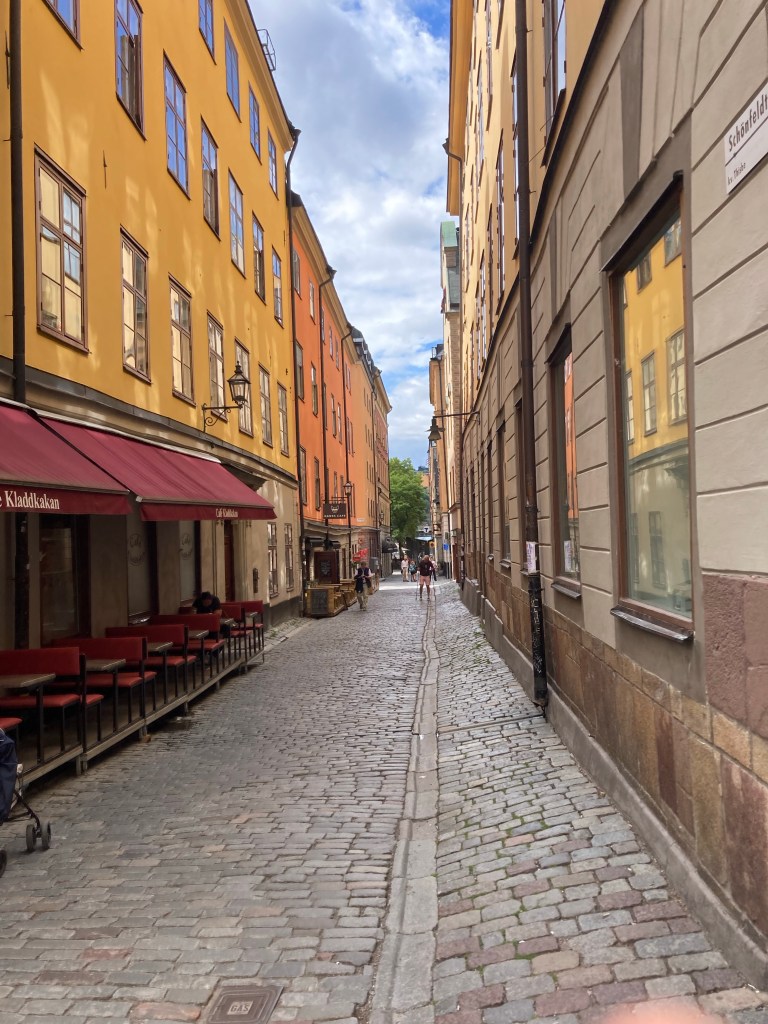
A lot of our time in Gamla Stan was spent wandering the narrow roads and admiring the architecture. The old stone roads were mostly car free, which made the walks fairly carefree and enjoyable. It was crowded but not so much as to be unbearable.

We did manage to stop in to a coffee shop and experience fika, sort of. Fika is a Swedish tradition of taking a set break during the day and have a small snack, usually something sweet like a cinnamon roll and a cup of coffee. Fika is meant to be a ritual that you spend with your coworkers or friends and it apparently is taken pretty seriously by Swedes as a way to disconnect for a few minutes and take a breather. We just sat down and had a cup of coffee and a cinnamon roll in a crowded coffee shop. I don’t think we did it right. By the way, Swedish cinnamon rolls are amazing, I might have to go back just for those.

Riddarholm Church

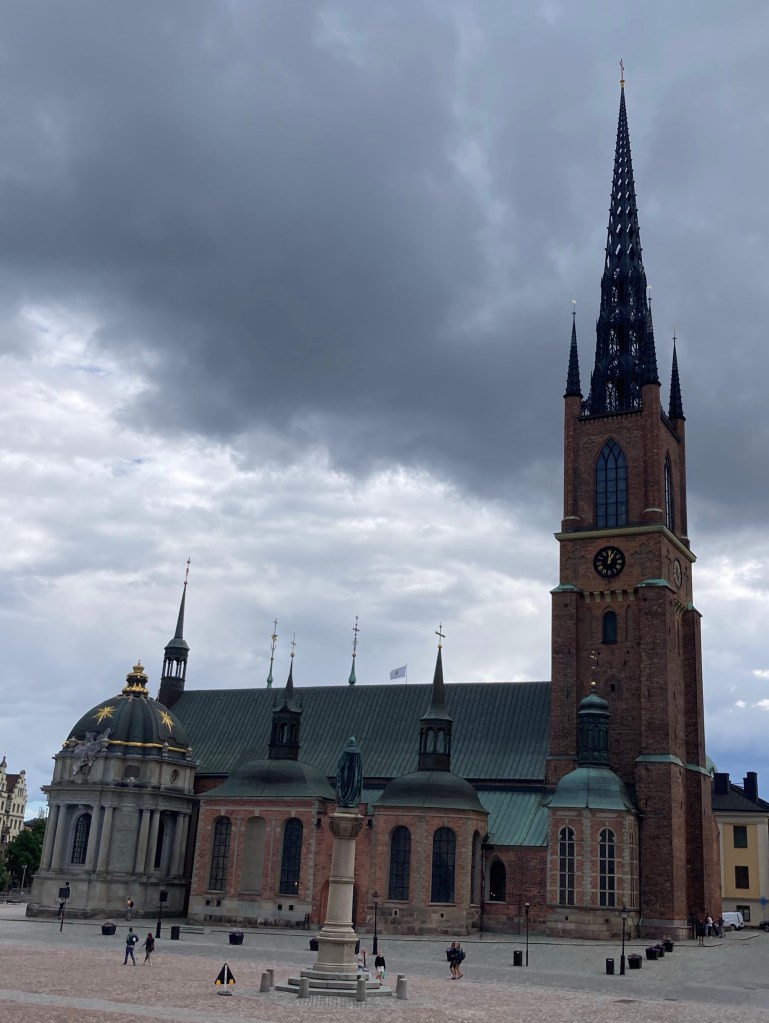
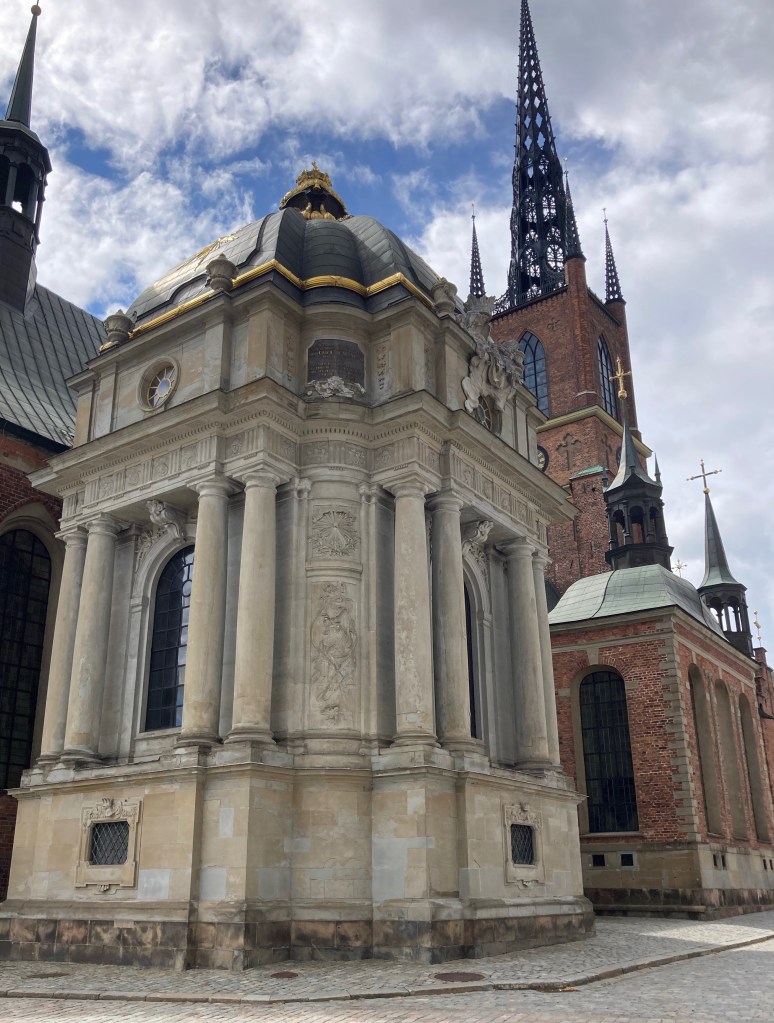
Riddarholm Church grabbed my attention right away when we approached the old town. I was fascinated by the beautiful iron spire on top of the belltower.

The church began it’s life as a monastery in the late 13th century. The church itself began to be built almost immediately after the monastery was opened. It became a popular place for Swedish royalty to be buried and there are 17 regents buried in the church. When the protestant reformation happened, the monastery was vacated and the church became a Lutheran church which stopped using the church in 1809. In 1835, a lightning strike destroyed the original spire and was replaced by the beautiful and unique iron spire.

Currently the church is known for being the burial church of the kings, even though Swedish Royalty stopped using the church for burials in 1950.

Riddarholmen Church looks remarkably well preserved.

Personally, I was struck by the contrast of the traditional 13th Century gothic church design mixed with a much more modern iron spire. However, knowing that by the time the iron spire had been added it was no longer being used as a church, that somehow made a little more sense to me. It’s absolutely unique and gorgeous, but unfortunately, we didn’t have tickets, or frankly a lot of time to visit, so we walked around the outside of the church, admired it’s beauty and left.

Reasons to Return to Gamla Stan

There were so many things that we didn’t really make time for in Gamla Stan. There is the Nobel Prize museum and the Royal Palace as well as Parliament. There are a couple of beautiful cathedrals to tour, the house of Nobility and the Bonde Palace. If you really wanted to explore the area to its fullest, I think you would need to devote at least 3 days to it, maybe more. We didn’t have enough time for all of that, but that’s okay with me, since that just gives us an excuse to return and get more of those amazing Swedish cinnamon rolls.

A Relaxing Ferry Ride in Stockholm

Stockholm was the last of our stops on our 14 days in Europe. We had been averaging around 8-9 miles per day of walking, so having a nice relaxing boat ride was just what our sore feet needed. Many residents here rely on these ferries since Stockholm is built across 14 islands. For visitors, however, it can be a great way to relax and see some of the lesser visited areas of Stockholm.

“God our father on the rainbow” by Carl Milles. This statue is actually a fountain which shoots water out of the end and forms a rainbow shape. Unfortunately, the fountain was turned off for our visit.

The Ferries are Included with SL Card

One of the most amazing benefits of Stockholm’s great public transportation system is the fact that you can ride a number of ferry routes with your SL Card. The SL Card gives a visitor unlimited access to Stockholm’s public transportation system for the period of time that it’s valid. The cards are fairly expensive but the public transportation system in Stockholm is excellent, so it is worth it. The SL Card covers most of the subways, trams and ferries in the city of Stockholm and it’s surrounding areas. Tourists would most likely be looking one of the choices below.

Cost for Adults 20-64Cost for Under 20 or Over 64 years old
24 hour pass165 SEK (about $16 US)110 SEK (about $11 US)
72 hour pass330 SEK (about $33 US)220 SEK (about $22 US)
7 day pass430 SEK (about $43 US)290 SEK (about $29 US)
30 day pass970 SEK (about $97 US)650 SEK (about $65 US)
more information can be found at the SL website

We bought 4 of the 72 hour passes, 2 adults and 2 children, so we spent around $110 US on the passes. That seemed like a lot, but with the ferries being included in the price, it seemed pretty reasonable. Purchasing the tickets was easy, we just went to the subway station near our hotel and bought it from the attendant who was watching the turnstiles.

If you leave from the Nybroplan terminal, you will see some of the amazing Swedish buildings from the ferry.

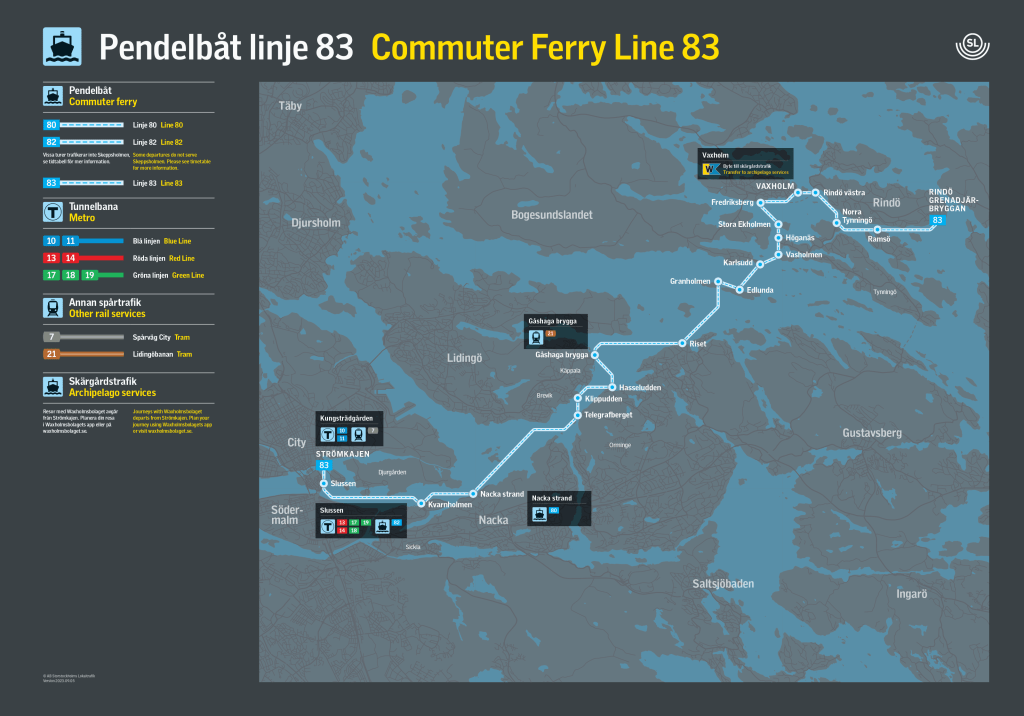
There are 4 ferry lines that are covered with the SL card – lines 80, 82, 83, and 89. The maps for where those lines go are located on the SL website.

Most of the tourists seemed to be getting onto route 80 at the Nybroplan terminal, located near Berzelii Park. That is where we chose to get on as well.

Hotel Diplomat near the Nybroplan terminal

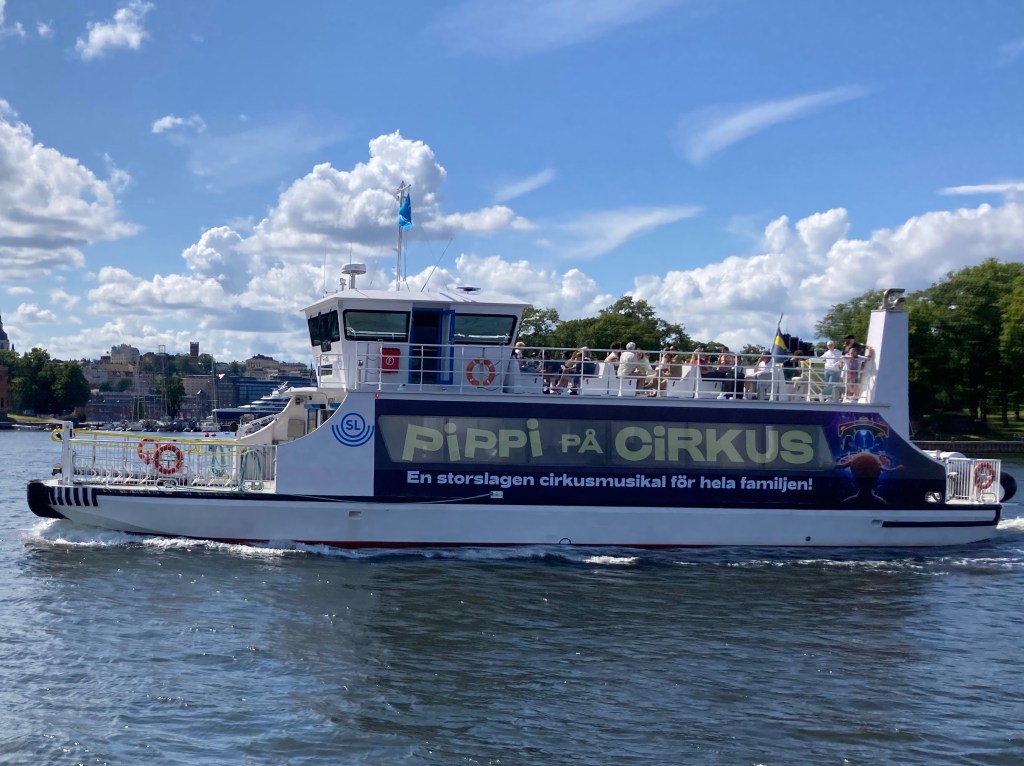
The ferries are two levels with the bottom floor being completely covered. Rows of seats face both directions. There are tons of windows, so if you prefer to stay out of the elements this is a great place to sit. The second level is out essentially a deck on the top of the first level and it is a fantastic place to enjoy the beautiful weather that Stockholm often has during the summer. There is a set of stairs on the back of the ferry that provides access to the second deck.

One of Stockholm’s many public transportation ferries

Daytripping on Commuter Lines 80 and 83

The main commuter ferry line was commuter line 80 from Nybroplan to Nacka Strand. That was as far as we went and we returned on the same boat. If you want to continue on the route, you need to get off at Nacka Strand and continue on the route with a different boat. There might be a boat that does the entire route, I just didn’t see it. That being said, as you can see, line 80 covers a large portion of Stockholm.

The first stop from Nybroplan is Allmanna Grand. It is on Djurgarden island which has an amusement park named Grona Lund as well as an open air museum/zoo called Skansen. It is also home to the very popular Vasa Museum, which houses a poorly designed 17th century warship that sunk early into it’s maiden voyage in 1628. It was raised in 1961 and was towed into the museum in 1990. Djurgarden also has ABBA the Museum, which of course is a museum commemorating a Disco group responsible for some of the worst atrocities ever inflicted upon popular music.

Djurgarden is an extremely popular stop and I noticed that a large portion of the people on the ferry got on at Nybroplan and off at Allmanna Grand. We actually used it the next day to get back from a visit to Skansen, even though the tram would’ve been faster, because we enjoyed the ferry so much.

You can also get off at Nacka Strand and get on line 83, which covers a lot more rural islands. Nacka Strand has a handful of restaurants near the terminal which makes it an interesting place to stop, especially if you are using this opportunity to leave line 80 and get onto line 83. Restaurant J looks like a particularly good place to stop for a drink or a bite to eat, as it sits on the dock overlooking the water.

Restaurant J sits right by the Nacka Strand ferry terminal and looks like a great place to stop for a drink. We should’ve stopped!

A full round trip on line 83 takes about 3 hours and could be a great relaxing trip on a beautiful day. Line 83 terminates at Rindo, which is primarily a residential island and has multiple stops along the way. Some of these islands are small and have only a dozen or two houses on them.

Timetables for stops on the ferries can be found at the SL website.

Vaxholm island might be a good stop on a trip like this because there is a decent number of bars and restaurants near the ferry terminal.

We took the much shorter route from Nybroplan to Nacka Strand and back, mainly because we didn’t have all day to devote to a ferry trip. If we were to go back to Stockholm with more than 2 days to really enjoy the city, I definitely would’ve taken advantage of the longer routes. We had a really relaxing time on the ferry and if we had some more time available to get off at some stops and really enjoy the trip, I think we could’ve made a full day of it. Oh well, I guess that gives us a great excuse to return to Stockholm!

We Booked A Trip to Costa Rica on American Airlines Miles

Booking our spring break trip this year was a different for us. This was essentially the first time that we’ve had an opportunity to book a family trip with both the experience of doing so, and the points to be flexible. When we booked our trip to Europe last summer, we didn’t have a bunch of points in various programs, and we basically had to book what we needed with the available points, and for us that meant that we had to work around United Airlines since that was where we had points.

This time it was much different, since we had significant amounts of points in Chase Ultimate Rewards and a decent amount of Capital One Venture miles. Ultimate Rewards transfers to 11 different airline programs and Capital One Venture miles transfer to 15 different airline programs (many of them overlap with Ultimate Rewards). On top of that, we also had a couple of American Airlines cards that we were working toward signup bonuses on, with no plans to use those AAdvantage miles.

What this meant was that we had a lot of different choices of ways to book flights. But we needed a destination. I was looking pretty hard at Madrid, Europe is off-peak in March and a flight from Chicago to Madrid is 34,000 Avios (transferable from Chase Ultimate Rewards) round trip and around $225 in taxes and fuel surcharges, through Iberia. That seemed like a steal to me, but there is that pesky problem of jetlag and Jenn wasn’t too thrilled about having to pay $900 for four flights (I know it honestly sounds silly, but this is apparently who we are now).

I wasn’t too excited about staying in the US, because in March you basically have Florida if you want to be warm, and that’s so overrun by drunken college students it’s hard to really enjoy it. A lot of the other places we thought about like Cancun, Punta Cana, Aruba, etc seemed to be both not really what we wanted and probably would’ve also been full of drunken college students. We wanted something different.

What About Costa Rica?

Jenn and I were having a beer at our favorite taphouse talking about spring break and I said “What about Costa Rica?” She looked at me a little strange, and said “Why Costa Rica, what’s there?” I replied “beaches, mountains, jungles, great food, it’s pretty much a tropical paradise.” Within a few minutes she was on Airbnb and somehow managed to find an absolutely gorgeous 3 bedroom Airbnb in the middle of a coffee growing region near San Jose for just $75 per night. Since Airbnb allows free cancellations, she booked it right there.

I think Jenn picked a good Airbnb
This kitchen is nicer than what we have at home
You don’t get this view in Iowa.

Now that the rental was booked it was up to me to make the airfare work.

Beating my Head Against a Wall

The Airbnb Jenn booked was only a 40 minute Uber from San Jose Airport, so that’s fantastic. I started to look at flights coming to and from San Jose from our home airport in Moline, and it was pretty clear right away that we were going to want to fly American Airlines if we wanted to leave out of Moline. They were running a special that cost around 8,000 points to San Jose and about 20,000 points coming back, and I thought, that’s pretty good, I just need to wait until we earn our signup bonuses and the points show up in our accounts.

The problem was, Jenn got her bonus from a Barclay’s card and they very specifically mention that they could take 4-6 weeks for the bonus to hit her account. I knew what I wanted but the clock was ticking and availability is never guaranteed.

When they finally hit her account the miles for those flights had increased to 11,500 miles out, and 32,000 miles back and we didn’t have enough points in our accounts for the more than 160,000 miles needed. I started shopping around and found a flight itinerary that would cost 17,500 miles through Avianca Lifemiles for the way home and keep the 11,500 mile AA flight down to San Jose.

What The Hell Am I doing?

I set Jenn up with a Lifemiles account with the intention of moving 70,000 Capital One Venture miles to Lifemiles to book the flight. The flights would have to be out of Peoria (an hour and a half drive away), since that’s where the Lifemiles flight itinerary took us.

I almost pulled the trigger and then I looked at the itinerary once again. On the way out, Moline to Charlotte to Miami, with a 7 hour overnight stay in the Miami airport before taking off to San Jose. I wasn’t thrilled about sleeping in the airport, that’s not ideal. Then on the way back, we would leave San Jose in the afternoon, stop in Guatemala for an hour then fly to Washington Dulles airport, land at 1 AM, go through customs, catch an uber to Reagan National Airport, go back through security (probably at 3 AM) and wait for a 6 AM flight to Chicago and then another flight back to Peoria, where we would have to drive an hour and a half home.

There is no way that I don’t fall asleep at the wheel coming home after that mess of a flight itinerary. That doesn’t even take into account the number of things that would have to go right just to make sure that we made it back to Peoria. It was time to call an audible, this isn’t going to work.

Let’s Try Guanacaste Airport

When I started looking at LIR airport in the north of Costa Rica, it became so much easier. The flights were more direct, less stops and prices were good. Jenn and I looked through a few choices and while we could get a slightly cheaper flight, we could find good prices for flights with just 1 stop each, and given the fact that there could be snow in March, fewer stops mean a better chance of actually getting to our destination. Each flight had long layovers, but they were long enough to get hotels so they looked great.

The outbound flight is Moline to Chicago to Guanacaste with a 17 hour overnight layover in Chicago and the return flight is Guanacaste to Dallas to Moline with a 18 hour layover in Dallas. We will be able to sleep well, staying in hotels for each and we should be able to be rested and relaxed rather than stressed and tired. Much better, but unfortunately we now have a 3 hour drive from Guanacaste airport to the Airbnb as opposed to a 40 minute drive from San Jose Airport. Oh well, we were going to rent a car anyway.

The flights cost us 120,000 AAdvantage miles and $336.24 in taxes. The cash price total for the same exact flights would have cost us $2,888.48 which means that we saved around $2,550. That means that those miles were redeemed at 2.1 cents per point which is well above the normal 1.5 cents per point for AAdvantage Miles, so I’m happy with the value we got from the points.

Land in Costa Rica as Early as Possible

Here is a little side note that I’ve learned from my research – if you are going to fly to the Guanacaste Airport, you probably want to land early if possible. At first, I was a little annoyed that I couldn’t get to Costa Rica with a 1 day flight itinerary but the more I read I’m okay with it. The reason is that Guanacaste Airport is a regional airport and while it is the best airport to go to for a variety of places in the north of Costa Rica, it’s not really close to anything.

So, what’s the big deal, right? I can drive at night. Yeah, but you probably shouldn’t. It is generally not recommended to drive in Costa Rica at night. The reason for this is that the roads are rural, curvy, unlit, and not always in great shape. It’s never a great idea to drive in an unfamiliar country at night, but with Costa Rica being so rural, it’s really not recommended. Add in the possibility of mountainous terrain with no guardrails and it could get deadly. It’s especially not recommended in the rainy season, where it can get even more treacherous.

It is also of note that it gets dark early in Costa Rica. Since it’s fairly close to the equator, the times don’t change too much from season to season but basically you can expect sunrise to be around 5:30 AM and sunset to be around 5:30 PM. That means that we will be probably cutting it a little close with the 12:30 landing and a 3 hour drive (once you figure in customs, car rental counter and probably some lunch).

Booking the Hotels

Since both the flight to Costa Rica and the flight back have overnight layovers, we needed to book a couple of hotels. We’re not that picky about where we stay, but I definitely like things to be easy and Jenn likes free breakfast if available. On the way there, in Chicago Jenn booked the Springhill Suites because it had a free airport shuttle and free breakfast, for 17,500 Marriott Bonvoy points. It would have cost $129 with cash so it comes out to .7 cents per point which is less than the .8 cents per point that Bonvoy points are typically valued at.

I booked the Hyatt Regency DFW for one reason only. It was actually at the airport. We don’t even need a shuttle, just walk from the terminal to the hotel and vice versa. We burned my 1-4 category Hyatt certificate on it and it’s only a category 2 hotel, so I definitely could have done better. It would have cost $218 for that night, so I think the fact that I get that certificate by paying a $95 annual fee for the World of Hyatt credit card makes it decent.

How Do I Feel About the Bookings

I feel pretty good about these bookings. I tend not to worry too much about maximizing hotel certificates, because I’m really not a hotel snob. I’m not sure I could tell the difference between a category 2 and a category 5 Hyatt. Jenn used a few more of her Marriott points to book another night, it almost seems like she always has Bonvoy points when we need them.

I’m pretty happy about the flight booking. We get to leave from our small home airport and still only have one stop. The stops are all long enough to relax at a hotel instead of being uncomfortable at the airport. On top of that, we got good value for our American Airline miles. I had been slow to look at American Airlines because they don’t have any transfer partners except Bilt, but I’m going to have to work a little harder to keep some AAdvantage miles around because that was a good deal.

It always feels great to get a trip booked, because now I can concentrate on what we are going to do when we are there, where we are going to eat and what we want to explore. I have read that Costa Rica is not a place to “wing it” since destinations are typically far away and roads can be unpredictable. That’s okay with me though, I like planning out the fun stuff.

Points Check November 2023

Back to an All Time High

We finally passed our previous all-time high point total of around $10,600 in value. This came primarily from earning a sign up bonus from my Citibusiness AAdvantage Platinum Select card. It offered a 65,000 point bonus for spending $4,000 in the first 3 months and I met the required spend this month. Jenn actually did the required spending on her Barclays American Airlines Aviator Red card which will earn her a 75,000 point bonus as soon as Barclays processes it. We’re actually waiting on that because we plan to book airline tickets to Costa Rica for spring break and the little delay from Barclays is annoying.

A Second Citibusiness AAdvantage Platinum Select Card

Jenn applied for the exact same card I just completed the minimum spend on – the Citibusiness AAdvantage Platinum Select card. She, however, got a better signup bonus than I did. She will receive a 75,000 AAdvantage mile bonus when she spends $6,000 in the first 6 months of having the card.

As I pointed out in the post when I applied for the card, it has a $99 annual fee which is waived for the first year. Miles earning on this card is pretty weak, in that it is 1x on most purchases, and 2x on American Airlines purchases, gas, telecommunications merchants, car rental services and cable and satellite providers. It does provide a free checked bag and priority boarding.

There is a $99 domestic companion certificate that you can earn when you spend $30,000 on the card, but seriously don’t do that. There has to be better ways of getting a cheap companion flight than that, with the only exception of maybe if you spend $30,000 on American Airlines flights.

Getting Bailed out of a Mistake

We had a hotel stay booked with Marriott that Jenn didn’t realize she booked with a non-refundable rate. When you use the Bonvoy app to book a room, there are multiple tabs for you to choose from. The prepaid option is non-refundable, and while they do have that written on there, it’s not exactly jumping out at you.

Jenn had been so used to booking things on points (which are almost always refundable, especially well in advance), that it didn’t really occur to her that the room was non-refundable. She canceled the room almost a month in advance, and after a while I asked her why they hadn’t refunded the money. She called the hotel, only to find out the room was non-refundable, but she was persistent and asked to talk to a manager, who was unavailable, of course. She called back the next day and tried again, with no luck and finally we kind of accepted the fact that there would be no refund. However, once the date for the hotel stay passed, the room was refunded to us. They never called back to let us know, they just refunded it. I guess this just goes to show that sometimes it never hurts to ask. Also, kudos to Marriott and the hotel itself, they absolutely were under no obligation to do so. That being said, it was smart of them because they will probably get more of our business now, because they were gracious in helping us fix our mistake. In the future, we will make sure to not use the non-refundable option.

Anyway, On to the Point Check

Card UsedSpendPoints EarnedPoint ValuePoints Per $Return on Spend
Citi Premier$1,4452,280$41.041.62.8%
Capital One Venture$1,0772,154$39.852.03.7%
Chase Ink Cash$5182,570$52.695.010.2%
World of Hyatt$4292,144$36.455.08.5%
Chase Ink Unlimited$395592$12.141.53.1%
Wyndham Business Earner$254729$14.942.93.2%
Delta Business Gold$107107$1.611.01.5%
Total$4,22510,576$197.102.54.7%

This month was a little disappointing in that the return on spend on our other cards dipped under 5% and I’m really trying to keep that up above the 5% mark. One of the big reasons for that, however, was the fact that my daughter’s car had about $800 of repair costs, and while that can be charged, there isn’t exactly a bonus category for it. We probably should have used the Capital One Venture card, since it is 2x everywhere, but Emma is an authorized user on the Citi Premier card and that’s what she used, for a disappointing 1x instead. Oh well. We were able to get 5x on Amazon through a World of Hyatt promo, which is nice but somehow I misunderstood the Wyndham Business Earner categories and moved our insurance there, thinking I would get 5x and it absolutely wasn’t, just a lowsy 1x on that.

Jenn got an electric car as well, which has cut our fuel consumption by about 75%. That is awesome, but I’m missing the massive amounts of Wyndham points we earned at 8x on gas.

Aside from the spending not devoted to a bonus, I spent almost $1,800 on my Citibusiness AAdvantage Platinum Select card and earned almost 1,800 AAdvantage miles and the 65,000 point bonus. Jenn spent around $1,000 on her Citibusiness AAdvantage Platinum Select card and earned around 1,000 AAdvantage miles.

All of this left us with a month-end total of 289,000 Chase Ultimate Reward Points, 88,400 Capital One Venture miles, 77,000 American Airlines miles, 48,300 Marriott Bonvoy points, 29,800 Citi Thank You points, 24,600 United Miles, 15,000 Delta miles, 3,700 Hyatt points, and $974 in cash back. If you use valuations by the Points Guy, the total value of all of these points is $11,280.

A Wonderful Walk to Trevi Fountain

One of the main landmarks that we wanted to see while in Rome was Trevi Fountain. It was a good 40 minute walk from the Airbnb, which made it tempting to just grab an Uber to drive us there, but that’s not really what you want to do while in Rome, is it? The temperature was predicted to reach 107 degrees Fahrenheit that day, so walking did seem a little dangerous, but there’s plenty to drink on the way there. It was the right decision because the walk, as usual, was the best part.

View of the Castel Sant’Angelo from the Tiber River, a nearly 2,000 year old mausoleum finished in AD 139. It houses the ashes of the Emperor Hadrian.

We started our trek by leaving the Trastavere neighborhood just south of the Vatican and walking through a tunnel under the Pontifical Urban University. Once we left the tunnel, the Tiber was in view. Crossing the Tiber on the Ponte Principe Amedeo Savioa Aosta bridge, a beautiful view of the Ponte Vittoro Emanuele II bridge with the Castel Sant’Angelo in the background emerged. Once you cross that bridge into the Old Rome neighborhood, there is no denying the beauty and history of Rome.

We headed down the Via de Coronari, a narrow road only really appropriate for pedestrians. The narrow cobblestone road is about the size of an American alley. It’s lined with shops, cafes, restaurants and art galleries. It has a wonderful charm with planters along the sides and folks eating gelato.

A view of Piazza Navona with a quick Peroni to start off the journey.

We were looking for something to drink as it was already 106 degrees Fahrenheit and found just the place in Piazza Navona. We stopped for a quick drink and walked around the Piazza for a few moments before returning to our trek to Trevi Fountain.

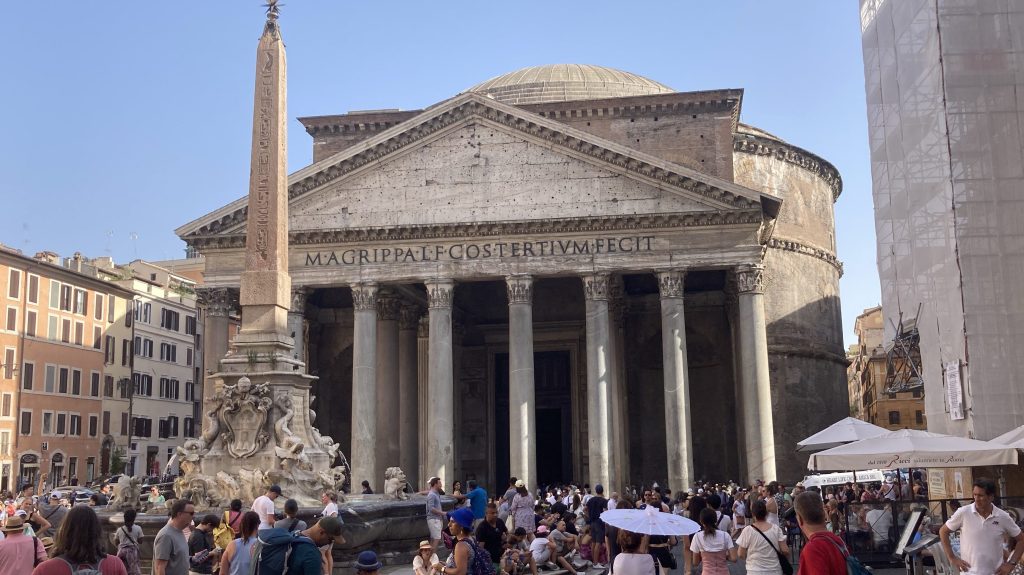
The Pantheon was completed in AD 126 under the direction of the Emperor Hadrian.

While most of what we came across was accidental, including Piazza Navona, I deliberately went a few blocks out of the way to visit the Pantheon. The Pantheon has an enormous concrete dome and was built nearly 2,000 years ago during the reign of Hadrian. It was built as a temple to all the gods, but in the 7th century was reinvented as a church to St. Mary and the martyrs. It’s an absolute wonder of structural engineering and it still stands as the largest concrete dome in the world.

Without the portico at the entrance, I think the Pantheon would look rather strange.

We didn’t walk into the Pantheon. I would have loved to but the lines looked long and we didn’t have an unlimited amount of time. To be honest, Rome is so filled with history that if we stopped to take time at every amazing or historical place, we wouldn’t have made it more than a couple of blocks.

This is, by far, the most beautiful donut I have ever eaten.

Shortly after the Pantheon, we stopped by a pastry shop, with the idea of getting a pistachio cannoli. Somehow, I said the wrong thing and ended up with a donut filled with pistachio cream. It wasn’t what I wanted but it was delicious.

There are cascading levels with benches heading down to the fountain similar to a small theatre.

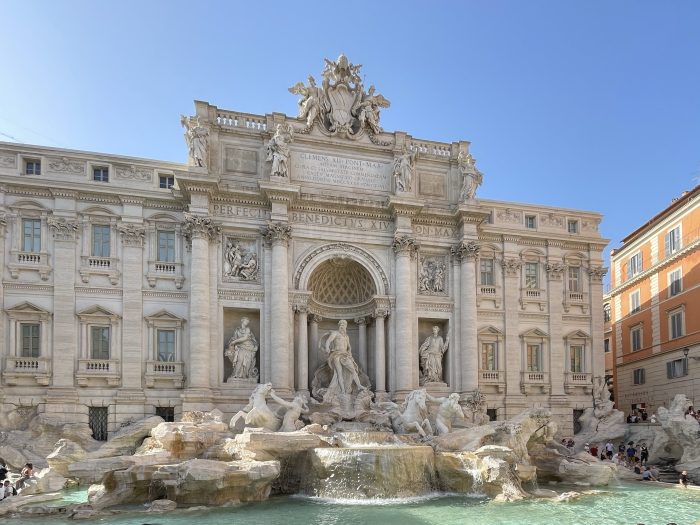
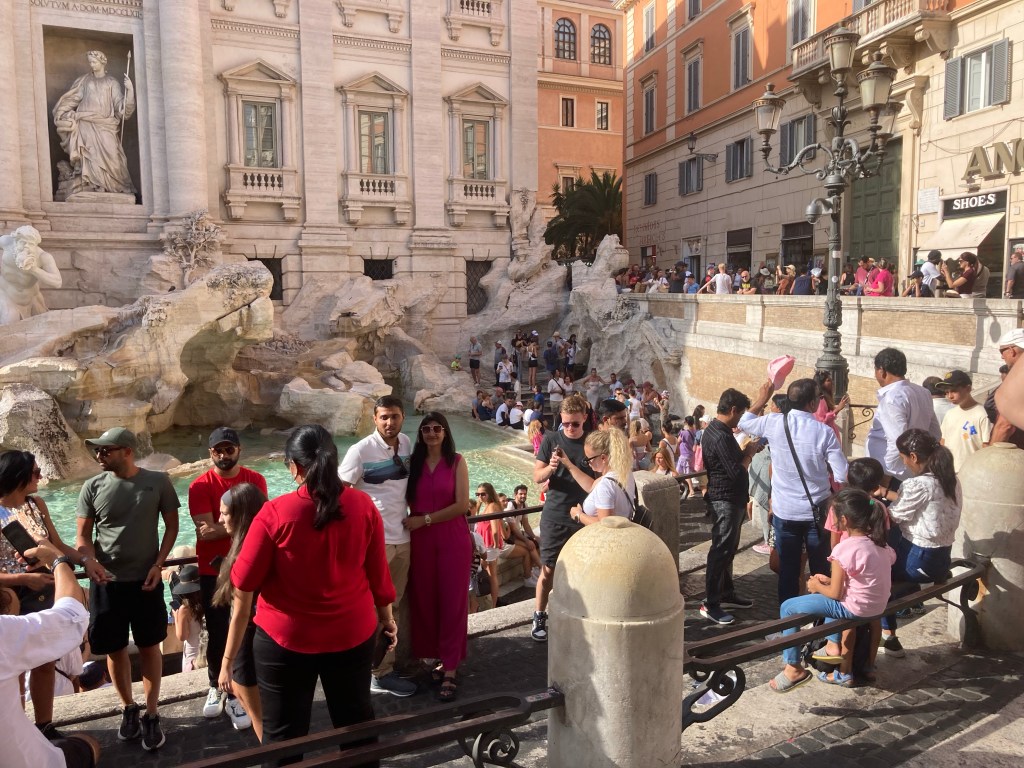
After all of our distractions, we managed to make our way to Trevi Fountain. It is every bit as beautiful as you would expect and even more crowded than I expected.

Trevi Fountain sits at one of the terminuses of the Virgin Waters aqueduct that carries water from the Alban Hills outside of Rome.

Trevi Fountain was completed in 1762 by Architect Guiseppe Pannini after being left half completed by the original architect Nicola Salvi who died in 1751. It was built at the end of one of the aqueducts that supplied Rome with water. It is made mostly of travertine stone.

The stone needed for Trevi Fountain was quarried from Tivoli, located in the hills to the east of Rome.

I can only imagine just how serene this must seem when it’s not wall to wall people, but obviously this was not the case in the middle of tourist season.

Four artists are responsible for the sculptures as well as two architects.

Across from Trevi Fountain is a beautiful Catholic Church named Santi Vincenzo e Anastasio a Fontana di Trevi. It’s a baroque church completed in 1650. Also nearby Trevi Fountain is a United Colors of Benetton which annoyed Jenn by its proximity to Trevi – hey I guess Romans like to shop for overpriced chinos close to beautiful monuments.

Santi Vincenzo e Anastasio a Fontana di Trevi Catholic Church

On our way back, we got some macaroons from Don Nino. I wish I could tell you if they were good or not, but we never actually had a chance to eat them. We ended up leaving them somewhere when we either stopped for dinner or a drink. They did look really good though.

Someday we’ll have to come back here and actually eat the macaroons instead of just buying them and depositing them in a random location.

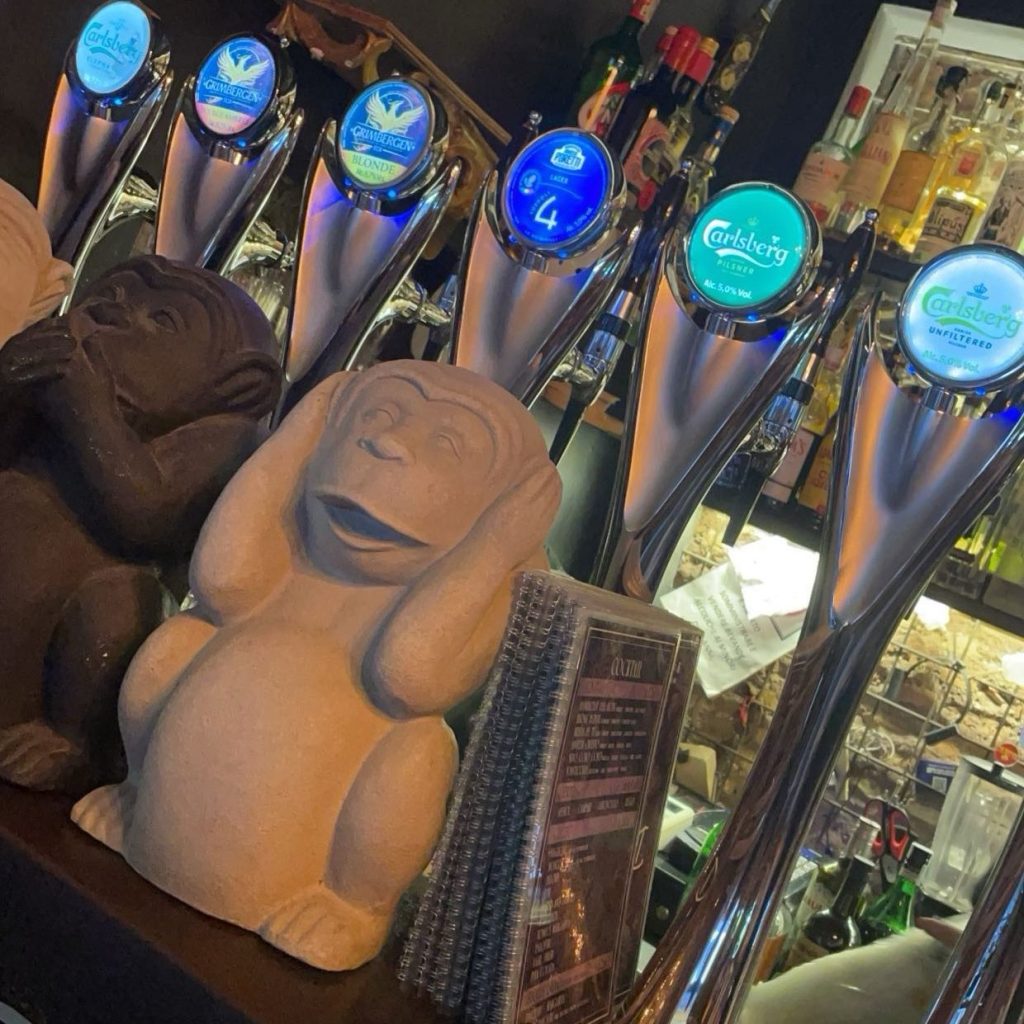
We stopped in for a quick carry out beer at Drink Art Gallery, where I’m pretty sure I got a Carlsbad beer which seemed pretty forgettable, but the bar seemed pretty cool.

These monkeys won’t talk about how many beers I drank and don’t want to hear any more of my stories.

I really enjoyed the narrow roads where all of these nice bars and restaurants were located. It made for a calm, yet beautiful and interesting walk.

Narrow cobblestone roads are the best roads. Also, that’s a McDonald’s there! If you stop at McDonald’s in Rome you are completely incapable of making rational decisions and need to sign over a Power of Attorney to someone who can.

We also stopped at a rooftop bar called La Terrazza del Cèsari where Jenn was introduced to unpitted green olives. She loved the olives but hated the extra effort involved. The sun was unrelenting up there and we quickly finished up our drinks and left. It was beautiful, but not the best place to be when its hot.

La Terrazza del Cèsari has a view of the Temple of Hadrian and a lot of roofing tiles.

We also managed to stop for a quick drink at some sports bar called La Botticella of Poggo Giovanni, you know, typical sports bar name. They had a lot of Steelers memorabilia, which checks out, because Steelers fans will live anywhere except Pittsburgh. All joking aside, that bar had a great beer selection and if we weren’t essentially on a pub crawl at this point, I would’ve liked to stay longer.

A little scrabble graffiti by https://www.wordsbywabisabi.com
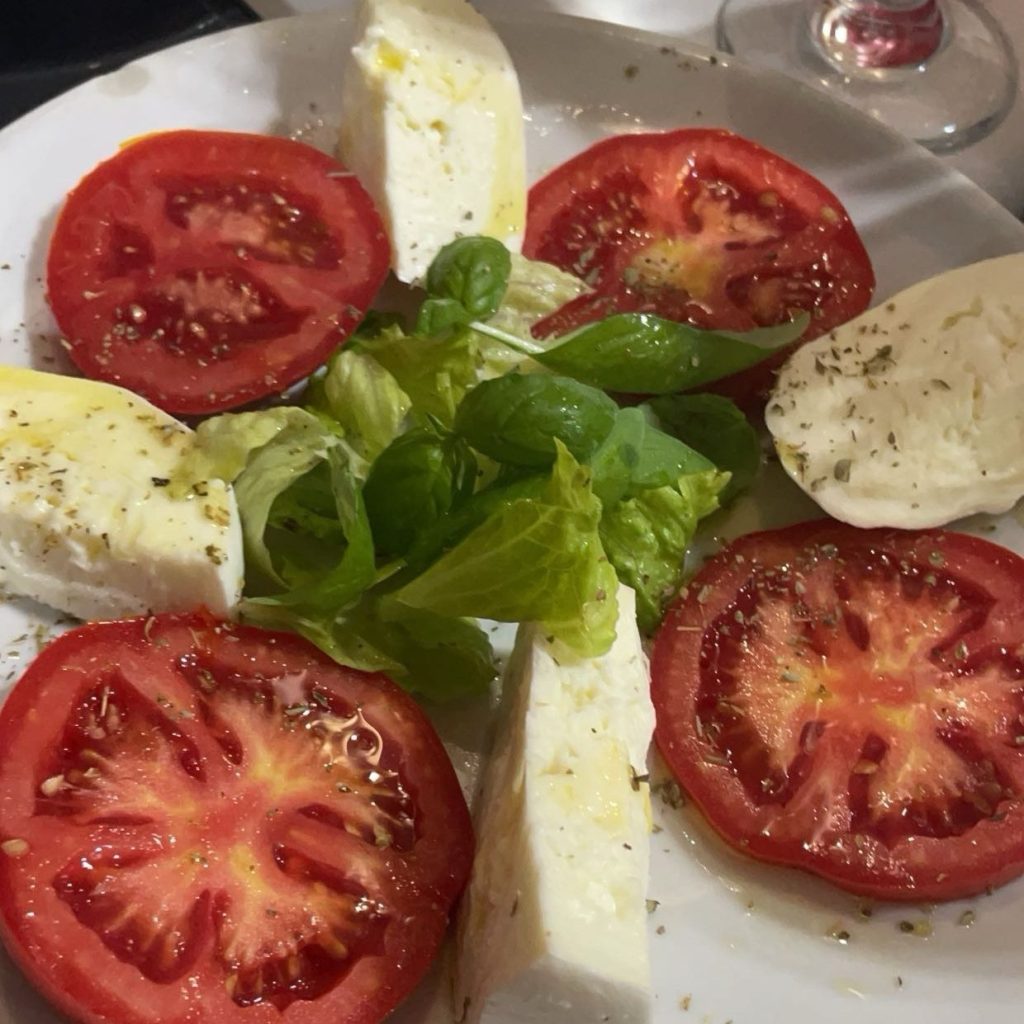
Caprese – simple and so good

We finished the evening with some pasta and antipasti from Ristorante Pizzeria Castello on Via Della Fornaci in the neighborhood where our Airbnb was. It was still really hot and the only available table was inside which was uncomfortable but the food was amazing. We had caprese, pesto pasta and cacio de pepe. Everything was typically Italian, simple, beautiful and perfectly prepared. We finished with a shot of limoncello that apparently I forgot about until I made a comment to Jenn about never trying limoncello and she laughed at me and said “Yeah, ya did.” Maybe it was delicious, I don’t know.

Cacio de Pepe pasta – I still have dreams about this pasta

This was one of my favorite days of our vacation. I honestly didn’t want to leave the air conditioned Airbnb because I knew just how hot it was going to be. We spent the morning at the Vatican and the afternoon on a nice walk to Trevi Fountain. The walk was great because we took our time and when we wanted to check out a bar, restaurant or shop, we stopped. We allowed the city to guide us instead of having a preprogrammed set of things we needed to see. I lost 10 pounds from sweating, but it was great.

Crossover at Kinnick

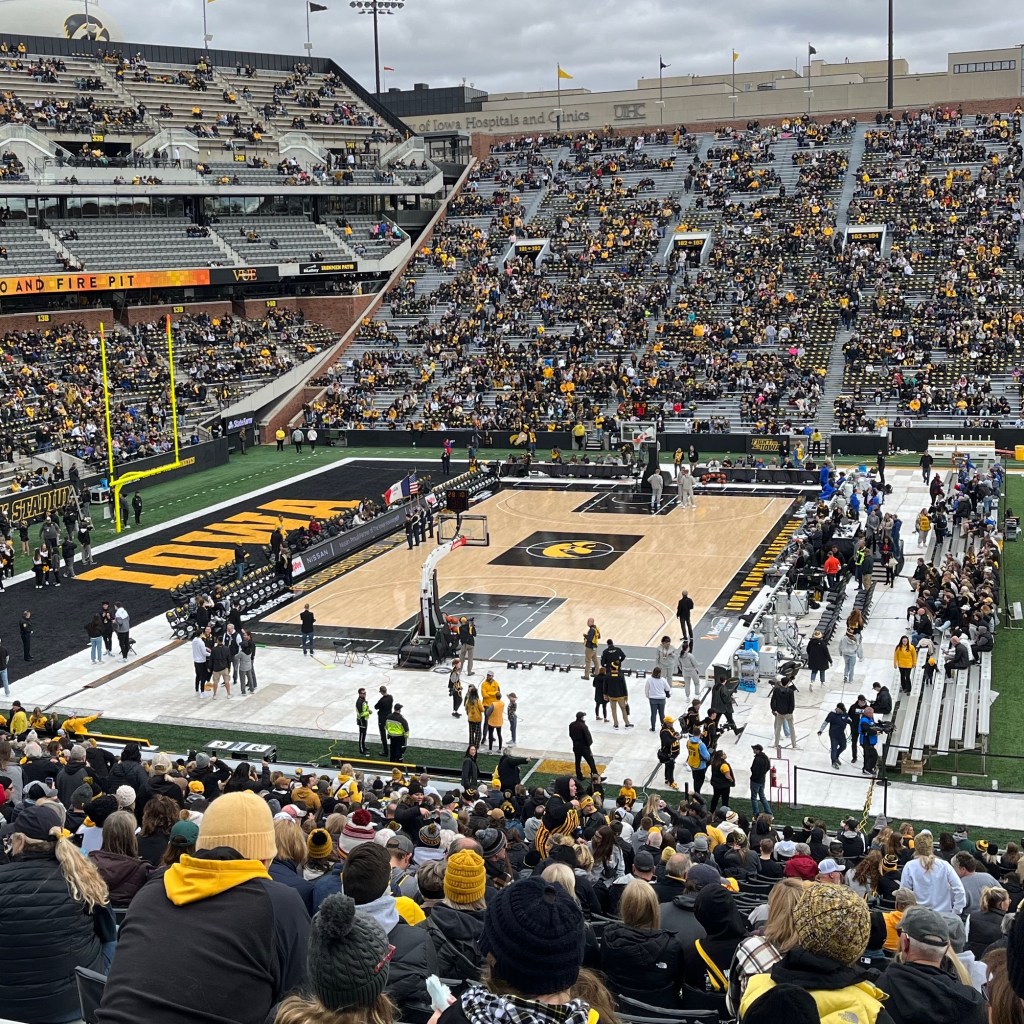
The court was placed near one of the endzones in order to take advantage of the stands on three sides of the court.

The Crossover at Kinnick was an exhibition game between the Depaul Blue Devils and the Iowa Hawkeyes, played on a temporary court built on the grass at the Iowa Hawkeye’s football stadium, Kinnick Stadium. It was a charity event to raise money for the Iowa Children’s Hospital. This event drew a record 55,646 fans which completely eclipsed the previous record for attendance at a women’s college basketball game which was 29,619 at the 2002 National Championship game between UConn and Oklahoma. The Crossover raised $250,000 for the University of Iowa Stead Family Children’s Hospital.

Sudden explosive Popularity of Iowa women’s Basketball

I’ve always been a Hawkeye fan, but I normally just watched the football team and the men’s basketball team. However, my daughter, Emma, played basketball from 4th grade all the way through high school. Because she was into basketball, we always seemed to find a few games per year to drive to Iowa City (about 60 miles away) and watch the Iowa women play. The team was usually pretty good and tickets were easy to come by. A lot of times, you could pick up free tickets on the day of a game, but usually tickets were 5 to 15 dollars each to buy through the University website.

The two main reasons I watch Women’s college basketball.

The games themselves were pretty well attended by women’s college basketball standards, with a few thousand fans showing up for the games. Carver Hawkeye Arena seats about 15,000 fans, which was primarily built for the popularity of men’s college basketball, so a lot of those seats were empty, to the point where they would usually put up black screens in front of the back half of seats to make the stadium feel less empty when the women were playing.

As someone who attended quite a few games across the last few years, you could feel some slow momentum building in excitement for the women’s program. The team, lead by Head Coach Lisa Bluder, was always good and well coached. We watched as Megan Gustafson give way to Monika Czinano and Caitlin Clark. With each successive year, the program kept getting better and the games better attended. They slowly went from being annual NCAA tournament participants to being final four contenders and their success brought fans, lots and lots of fans.

The World Discovers Caitlin Clark

Starting in the 2021-2022 season, the seats were starting to fill up at Carver Hawkeye Arena. They drew just shy of 140,000 fans over 17 homes games averaging over 8,000 per game which was 3rd nationally for attendance. One of the reasons for escalating attendance was Caitlin Clark. She was incredible to watch, averaging 27 points and 8 assists per game. She was the best show in town and fans were taking notice.

What she is known for is the “logo shot”. Wild, often off-balance, 35 foot jump shots fly out her hand when she gets into a rhythm. Almost, without exception, you can hear me say “don’t take that sh-” just as the ball goes through the net. These “logo shots” look selfish and ridiculous, but frankly I bet her shooting percentage on logo shots is just as good as an average uncovered guard with her toes on the 3-point line in the NCAA. In the end, they’re not selfish, because they force the defense to cover the entire half court, not just inside the 3-point arc, which leaves other players, especially centers, in one on one matchups in the lane. In fact, Clark led the NCAA in assists last season with 8.6 per game, and I think stretching the defense out to guard her is one of the reasons why she was able to create so many assists.

Watching an Iowa women’s basketball game is fun, fast-paced and high scoring. Lisa Bluder’s coaching style is basically a 40 minutes of fast breaks. But once Caitlin Clark started to put up video game numbers, folks in Iowa started to take notice. That’s when these attendance numbers started to balloon. In the 2022-2023 season, the attendance at Iowa women’s basketball games jumped to 200,569, averaging 11,143 fans. That was 2nd nationally for attendance. She was, however, still not well-known nationally, outside of women’s college basketball fans.

Late in the Big 10 season, I started to notice something different about the way Caitlin was playing. It seemed like there would be times that the team was struggling and she would just take over a game. It seemed like whenever the team was trying to find a rhythm, all of a sudden she would score 10 consecutive points and would get the team back on track. It was sort of that Michael Jordan-like determination to win.

However, when she put up 41 points, 10 rebounds and 12 assists to put the Hawkeyes over Louisville to go to the final four, the country took notice. Then she followed that up with 41 points in a huge upset win against what looked like an unbeatable South Carolina team to go to the NCAA finals. Iowa’s little secret was no longer a secret. In the NCAA finals, television viewership set a record of 9.9 million viewers for a NCAA women’s basketball game and was more than double the previous year’s viewership.

We Can’t Even Get Tickets

We had talked about getting season tickets for the last couple of years. Emma was still playing basketball, so we figured that there was no point in buying tickets because we would probably miss most of the games. Well, she graduated and figured that we would buy her season tickets this year. Before they went on sale, we put a deposit down to get a couple of season tickets, thinking that it wouldn’t be an issue.

However, between the time that we put down the deposit and the time that they decided who would get tickets, the NCAA tournament happened and Iowa women’s basketball became an absolutely huge deal, I mean massive. When the tickets became available they sold out, EVERY SINGLE HOME GAME, immediately. We were told that we didn’t get the season tickets we had put a deposit down on. As far as I’m aware, this has never happened before in women’s college basketball.

The Crossover

It was absolutely not lost on the Iowa Athletics Office that the women’s team was suddenly the hottest ticket in town. I’m sure that was part of the reason why they came up with this concept of the Crossover, being played in Kinnick Stadium. With the 70,000 seat capacity, they should have no problem giving some fans, like us, a chance to see a game in person, who were shut out of getting tickets. Obviously, an outdoor game had to be an exhibition game, but that’s okay.

Getting set up to begin the Crossover.

At first, I think they only released something like 35,000 to 40,000 seats. They were using one end of the field for the setup, which meant that a large portion of the stadium wouldn’t have a very good view of the game. They must’ve changed their minds at some point and released those seats because they ended up selling 55,000 seats out of the 70,000 seat capacity.

Half-time show featuring “Caitlin Clark” shooting.

This was obviously not just a charity event, this was their opportunity to praise last years team and hype this year’s team. Monika Czinano and McKenna Warnock came back for the game. The overwhelming focus of this game was on Caitlin Clark, though. During the half time show they even had the marching band form a giant shooter, wearing #22, shooting a basket.

The game itself, wasn’t that important, being an exhibition game, but the Hawkeyes beat the Blue Demons 94-72 with Caitlin Clark scoring 34 points. One of the most memorable moments was when Caitlin airballed a free throw, presumably because of the wind, but it was nonetheless still a little funny.

The Wave

Having never been to Kinnick, I hadn’t been able to experience the greatest tradition in college sports. The Wave is a tradition started shortly after the University of Iowa Stead Family Children’s Hospital was built in 2017. The hospital is located across the street from Kinnick Stadium and because of the height of the hospital, has a clear view of the stadium from the top few floors. After the first quarter of every Hawkeye game at the stadium, the fans and players take a minute or two to wave to the children and their families in the hospital.

The wave

It’s a sweet gesture to a bunch of kids and their families who are going through a very tough part of their lives. In this case, the game itself was a fundraiser for the hospital making it extra special. It was really great to be able to experience this tradition, in person.

Will The Crossover at Kinnick Become an Annual Event?

I hope the Crossover at Kinnick will become an annual event. We had a great time and would definitely go to another one. I think it hinges on whether the team continues their current popularity. When Clark moves onto the WNBA, I imagine that the demand for the event will wane considerably, so they might have to end or alter the event. One potential way to continue the Crossover if the popularity of the women’s team starts to fade would be a double-header event with the men’s team. Right now that’s not necessary, but I hope they are able to keep this event going into the future, because it was a fun event and it was for a great cause.

Vatican Museums and Sistine Chapel

Once we decided that we were going to Rome, I knew that I wanted to visit the Sistine Chapel. It’s one of those bucket list items that so many people have to check off. My son Alex wanted to visit the Vatican City, but for a different reason – he just wanted to go to the smallest country in the world. We ended up in an Airbnb less than a mile away from the Vatican, so obviously we were going.

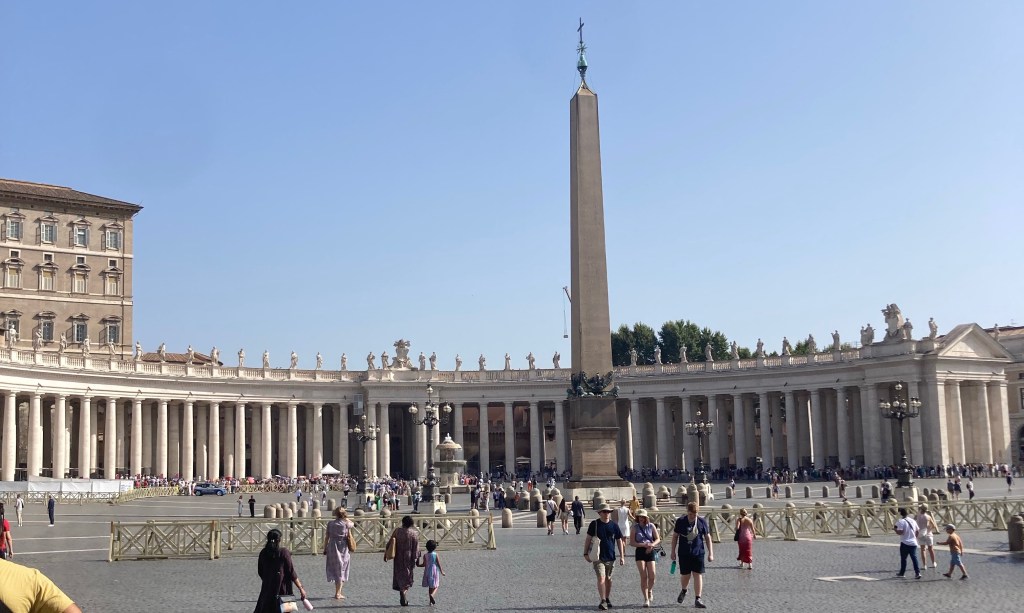
Approaching the colonnades in St Peter’s Square

I ended up having to buy one of those “skip the line” tickets off of an online reseller since the tickets that were sold directly from the Vatican website were gone immediately. Honestly, I tried to buy them the day they were made available and they were gone before I could buy them. It was like Taylor Swift was the Pope or something. I ended up spending more than twice the original ticket price from on online reseller which, of course, feels ridiculous for museum tickets. The tickets are $17 for adults and $8 for children through the Vatican website, but we ended up spending about $120 for 2 children and 2 adults instead of the $50 it would have cost directly. I had to search pretty hard to get those prices, a quick search on Viator will show that people are charging between $35 to $100 per ticket which is quite a markup from $17.

My desire to visit the Sistine Chapel had developed because I had grown up during the restoration of Michelangelo’s paintings in the chapel that took place between 1980 and 1994. I remember watching a PBS special about it in one of my classes in High School. It had been in the news a lot because it was weirdly controversial, with a lot of people thinking that the restoration had left the paintings brighter than they were originally. Strangely no one took high resolution photos of the Chapel in the 16th Century when it completed, so it’s really just a bunch of blow hard art critics yelling at each other.

St Peter‘s Square

There was also a great episode of Animaniacs from 1993 called “Hooked on a Ceiling” where Yakko, Wacko and Dot helped Michelangelo paint the ceiling of the Sistine Chapel. It featured a number of great lines including when Yakko said to Michelangelo “Wait a minute, you expect poor innocent children to climb up that dangerous scaffolding and paint naked people all over a church? We’ll do it!” Ok, to be honest, I was probably more influenced by the Animaniacs than by PBS, but either way I was pretty excited to visit.

One of the two fountains in St Peter‘s Square

The neighborhood we stayed in was just south of the Vatican and we were able to get there by simply walking up the street. Walking into St Peter‘ Square you become almost overwhelmed by the nature of it. Colonnades line the plaza and give it its distinct shape. An Egyptian obelisk sits in the center with two fountains on either side. The plaza itself is mostly empty due to its function of being a location for the Pope to give his blessing. It’s a serene and beautiful place.

Angels Unaware – a bronze statue commemorating 105th World Migrant and Refugee Day in 2019. Artist Timothy Schmalz

I didn’t really think it would be difficult to find the entrance to the Vatican Museums, so I didn’t research it. Instead, I just assumed that we would be able to see where it was from St Peter’s Square, which turned out to be very, very wrong. It’s actually a little over a kilometer walk from the Square, and it felt the whole time that we were lost since much of the walk was outside of the Vatican walls. Once we saw the lines we knew we were heading in the right direction, but I was starting to get worried that we would miss our time slot. Once we finally got to where we were going and traded our reservation for tickets we made it into the Museums.

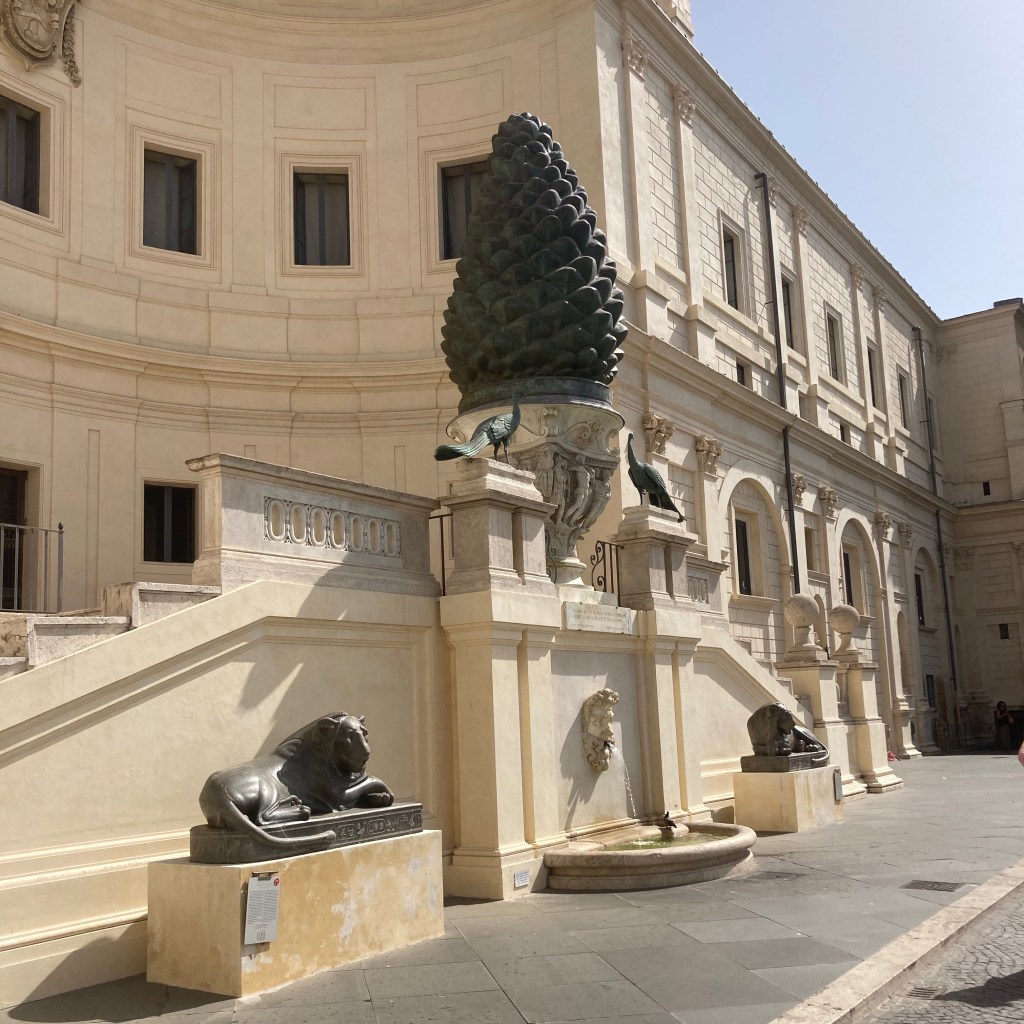
The Fontana della Pigna once stood next to the Pantheon but was moved to the Vatican in 1608.

I wasn’t prepared for how uncomfortable I was going to be at the Vatican. No, I don’t mean that I thought God was going to strike me down or something, I mean it was crowded and hot. I have issues with crowds in general and I prefer to be given a lot of personal space and this was just not an option in the Vatican Museums. It was packed – like three times the fire code capacity packed.

Crowds in the Museum

Also, it was hot. We had tickets for the morning but the high for the day was predicted to be 107 degrees Fahrenheit so it was probably well into the 90s by the time we arrived. It didn’t occur to me that the majority of the Vatican was not going to be air conditioned (How very American of me to assume the Vatican was air conditioned). They did have a lot of open windows, but it was not enough keep it cool on that hot day.

This was the only day on our trip that I wore long pants. The Vatican has a dress code, which for men meant long pants and a collared shirt. For women, a skirt covering the knees, or pants had to be worn and shirts had to cover the shoulders. I was worried we would be denied access if we didn’t follow these rules, but as I quickly figured out, we were pretty much the only ones following the dress code. So we weren’t exactly ideally dressed for a hot day in an unairconditioned museum.

The combination of the heat, the dress code and the crowds meant that I had completely sweated through my shirt and people kept bumping into me. Sorry folks, if you weren’t watching where you were going on that day, there was a good chance that you got some of my sweat on you. Gross, but hey, that was on you because I’m paranoid about personal space and I was hyperaware of the other people around me.

Roman Statues in the Vatican Museums

The museums are set to be walked through in a pattern. I really was unaware of just how vast these museums were going to be. I didn’t do a lot of research on the museums, since I was more interested in seeing the Sistine Chapel, and wasn’t too excited about the museums that you had to walk through to get to the Chapel, but I enjoyed them.

Museo du Pio Clementino

I was immediately surprised by the fact that the first few exhibits were ancient Greek, Roman and Egyptian. I guess I was expecting exhibits in the Vatican to be exclusively Christian in nature and after walking through an absolute ton of Roman busts and statues I turned to Jenn and told her that I was surprised by how pagan this exhibit was.

Tapestry in the Galleria degli Candelabri

Following the Greek, Roman and Egyptian exhibits was the Gallaria degli Arrazi, a room full of large tapestries. Many of these were commissioned by Pope Clement VII and designed by the famous Renaissance painter Raphael. Raphael drew the designs and Belgian tapestry makers actually made them.

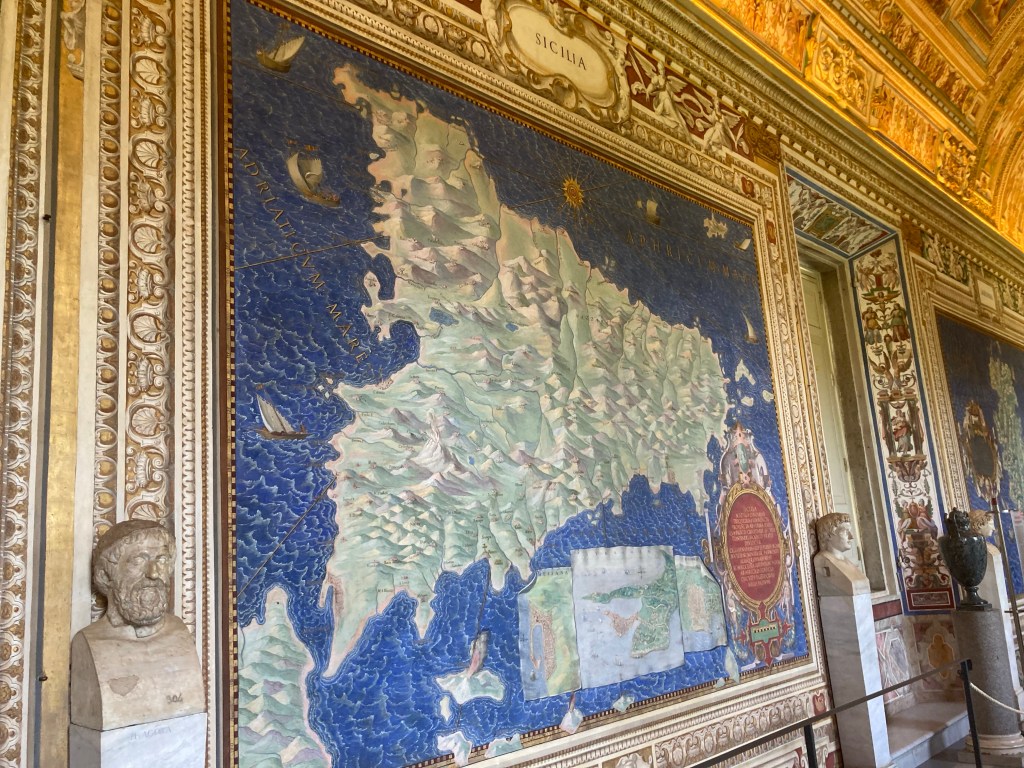
Map of Sicily in Gallery of Maps

Following the tapestry room was the Galleria della Carte Geografische, or the map room. This was my favorite of the rooms in the Museums. It contained dozens of large hand painted maps mostly of the area around Italy. These maps were commissioned around 1580 by Pope Gregory XIII who employed the Italian Priest Ignazio Dante to make the maps. They have a wonderful Age of Discovery look to them when maps were very artistic and a little inaccurate.

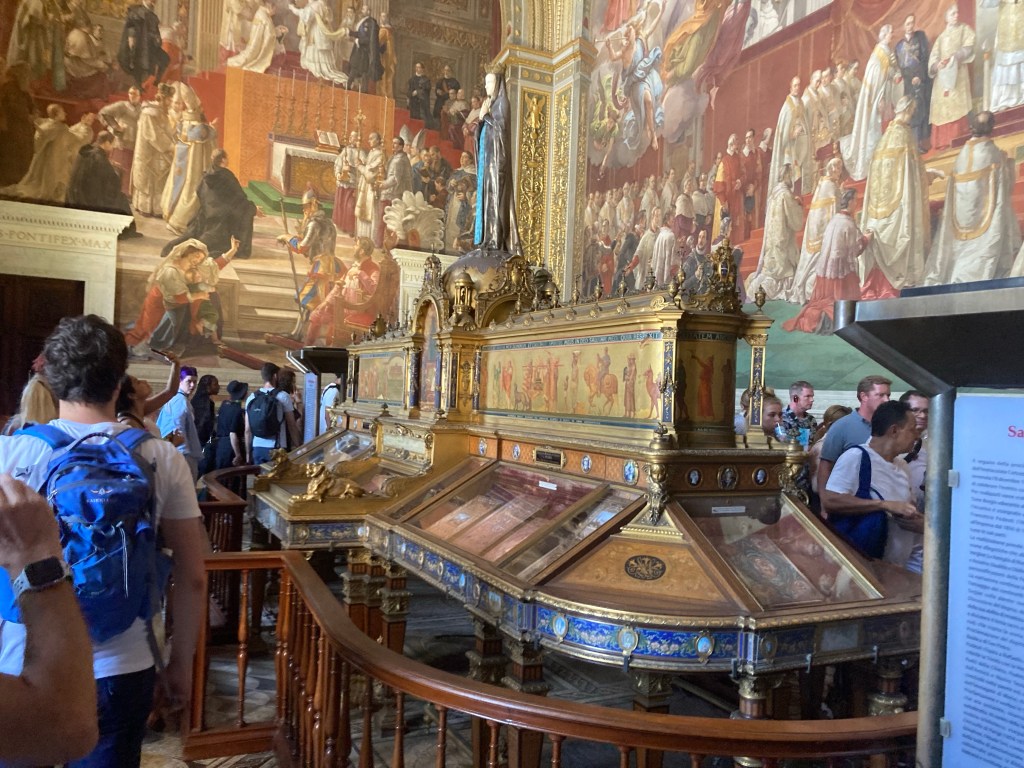
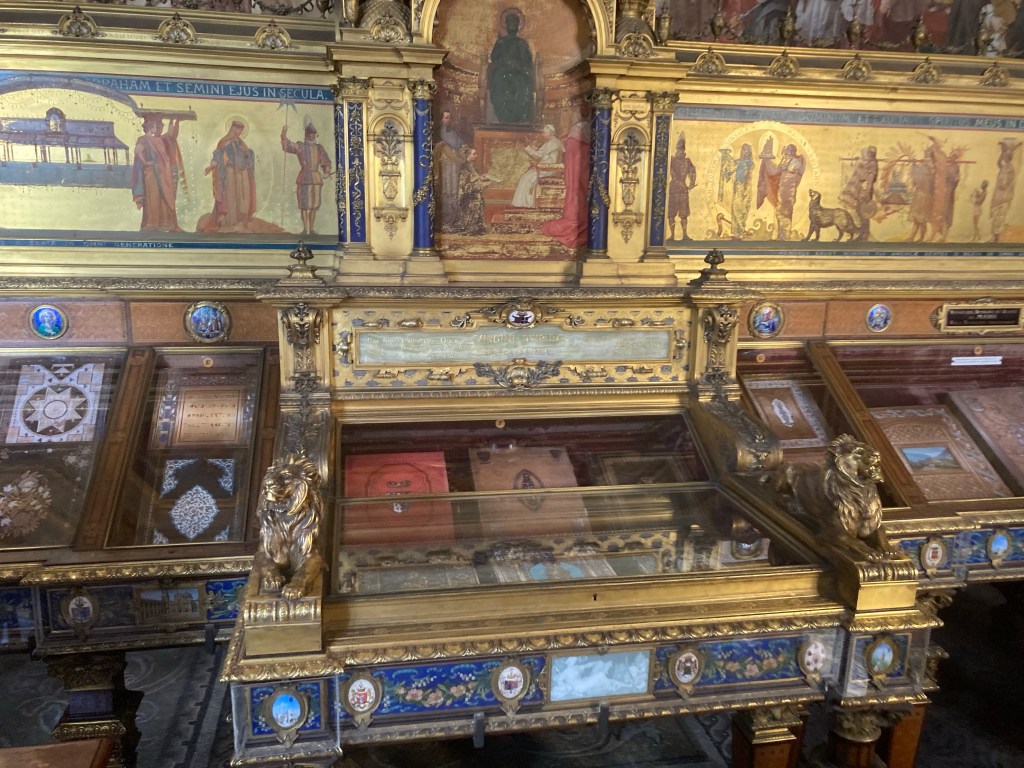
The case in Sala Sobieski displays books but is extremely ornate and beautiful by itself.

Following the Map Gallery, we walked through a number of other hallways including the Sala Sobieski. It had this really interesting book case which was used to display rare books. I honestly thought the case was more interesting than the books, but probably just because I had no idea what the books were.

Rare books in the display case

A big surprise for me was the Stanze du Raffaello or the Raphael Rooms. These rooms were commissioned by Pope Julius II in the early 1500s to be used as a series of apartments within the Vatican. Raphael painted some absolute masterpieces in these rooms, and I wish we had spent a little more time here. I’m not really that into art, but when I turned around and saw the School of Athens, not realizing that this was going to be in the Vatican Museums, I was blown away. First of all, it’s brilliant, but it’s also what almost anyone who has taken an art or art history class has seen as the example of perspective.

Raphael‘s School of Athens is in the Stanze du Raffaello.

When we finally arrived in the Sistine Chapel, it was a bit of a let down. I’m not saying that it wasn’t absolutely gorgeous, its just that the whole thing felt a little weird. First of all, these are paintings that we’ve all seen a number of times, and it does feel familiar, but it’s also very far away. The ceiling is 46 feet high, which means that my eyes are 40 feet away, and while it’s cool to see the ceiling in its entirety, the details are a little lost. Alex had to borrow my glasses to see, because while his vision isn’t really bad enough to need glasses, it’s not exactly 20-20 either.

Then there is the fact that its weird and crowded. They force everyone to stand in an area in the center of the chapel, and once you’re there you basically don’t move and you’re not allowed to take pictures. If you take a picture in the Sistine Chapel, a portal to hell opens up and swallows your iPhone. It happened at least 4 times while we were in there. They also pretty much tell you to be quiet the whole time. I think you probably could move around inside that square in the middle if you wanted to see as much of the Chapel as possible, but I think you probably would’ve been viewed as rude for doing so. In the end you just end up standing in one place and looking around as much as you can. If your vision isn’t good, you’re not going to see much.

A small sample in the Collection of Orreries at the Vatican.

After leaving the Sistine Chapel we were went through a number of other museums but my favorite exhibits were the ones that were related to astronomy. It also had that sort of Age of Exploration vibe with a lot of celestial globes, star maps and orreries.

Star map

We finished up our tour of the Vatican Museums and wandered out into the Vatican City. We were approached by a man trying to sell us tickets to the Museums and the Sistine Chapel. When we told him that we had just finished the tour and were a little disappointed because the crowds made it difficult to really enjoy it he told us that we should have gone late in the day, especially on a Friday or Saturday. Apparently, it isn’t nearly as crowded and you should get a better chance of really enjoying the visit.

One of many in the collection of celestial globes at the Vatican

I would definitely visit again, there were a few places that I could’ve definitely enjoyed with a little more time and elbowroom. The whole experience turned out a little backwards for me, where I really loved the Museum and although the Sistine Chapel is gorgeous, it’s just uncomfortable, and difficult to really see the artwork. I guess I wasn’t sure what to expect, but I thought it would be a bunch of museums relating to the Catholic Church, and while much of it is, it’s really more of a great art museum. If you can manage to find a time during the offseason, or maybe take that man’s advice and go at night on Friday or Saturday, I think you will really enjoy it.

Piazza Navona – Rome

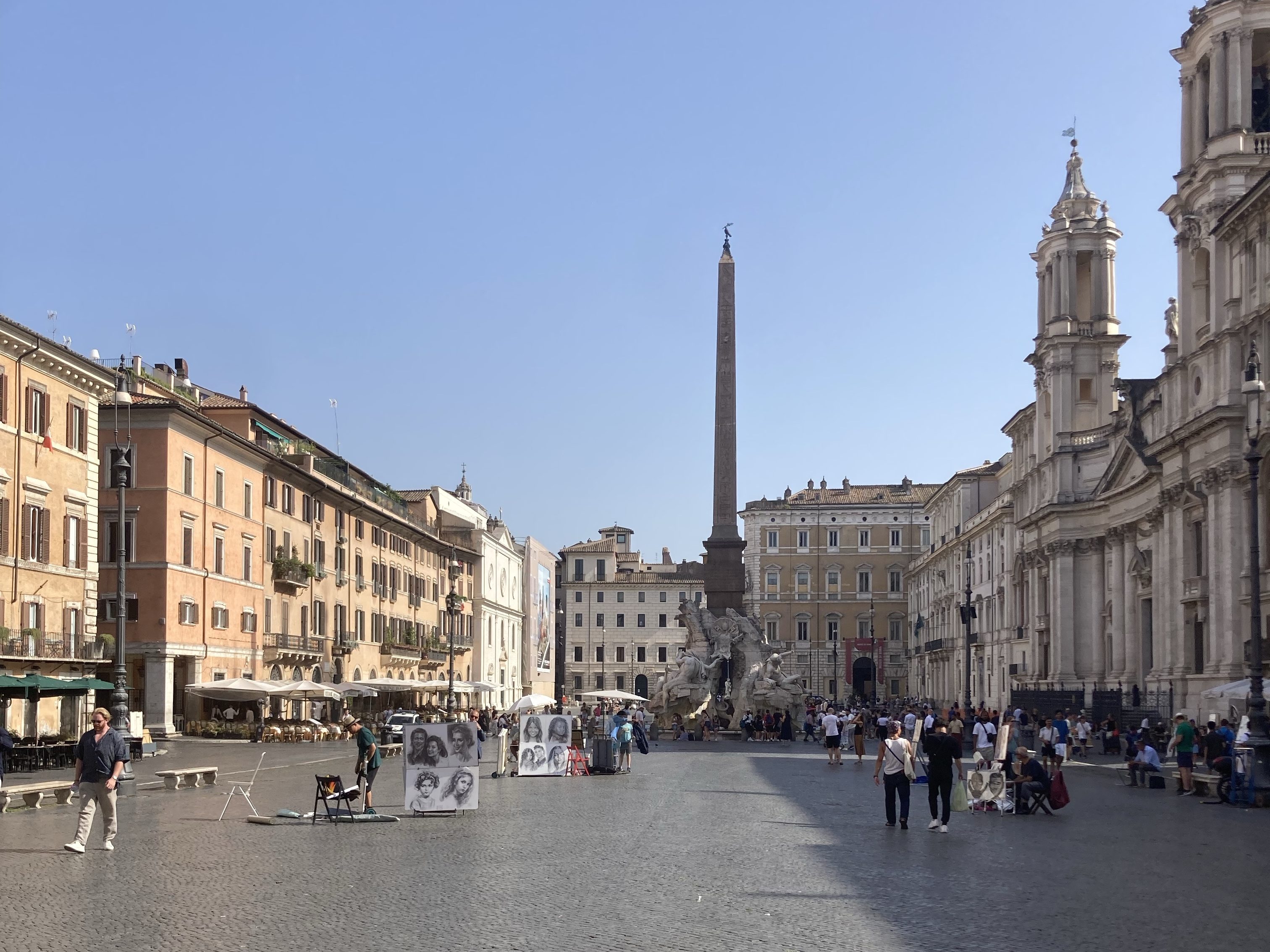
The amazing thing about Rome is the ability to just stumble into something historic while being completely oblivious. It was 106 degrees in Rome and we found ourselves looking for shade and a cold beverage. We wandered into the Piazza Navona where there was a lot of restaurants and found a spot to sit down under an umbrella at Bernini Ristorante for a drink. We were sat on the piazza directly adjacent to the Fountain of Neptune.

Enjoying a Peroni with a beautiful view of the Piazza Navona

Honestly, that’s pretty cool in its own right. You’re just wandering around in high tourist season and without a reservation you just sit down for a drink across from an amazing work of art? It’s just not a huge deal in Rome because there are fountains and ruins and statues everywhere.

Pro tip: Always wear swim trunks when swimming in the ocean. Its the best way to avoid having to peel a kraken off your junk with a trident.

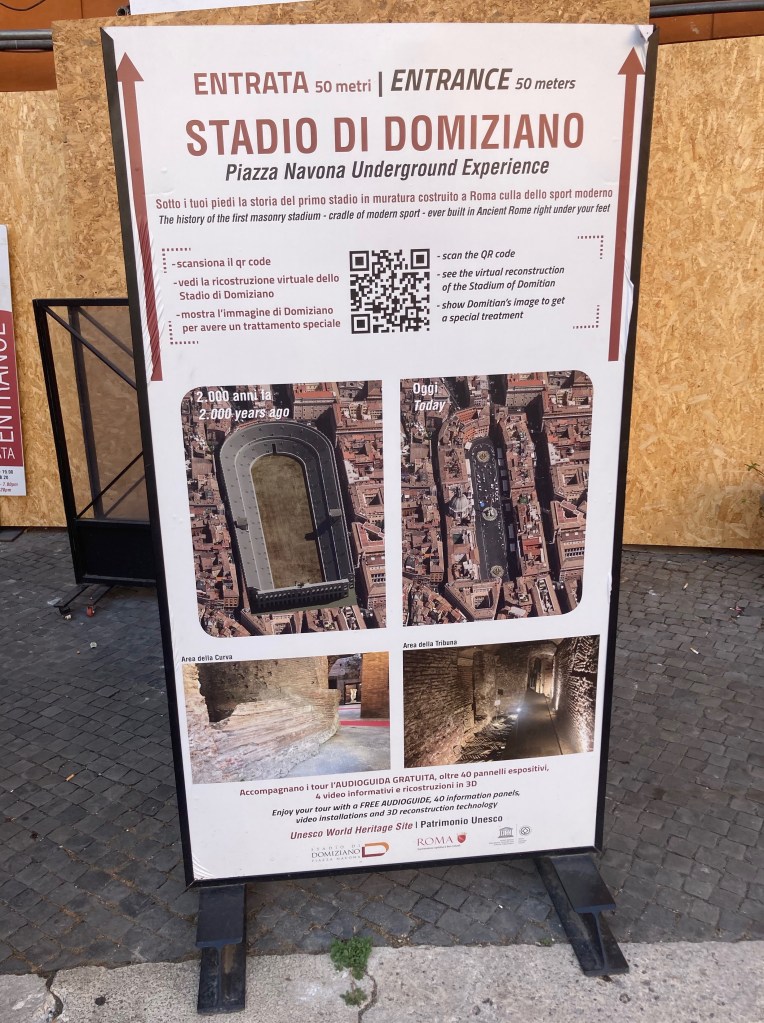
While we’re sitting, enjoying a Peroni and Aperol spritz, I look over and see a sign in front of a construction area. A quick google search and I learned that the Piazza Navona was built on the site of the Stadio Di Domiziano.

Sign outside of construction area directing people to the entrance of the museum

I compared the shape of the stadium on the poster to what I was seeing on the piazza and said “Hey guys, we’re sitting where they used to run chariot races!” (Which is completely false as I found out later, they never ran chariot races there). The kids looked at me like “So? Am I supposed to care about chariot races?”

The Stadio di Domiziano actually was a stadium built to house athletic events. It held around 30,000 Roman citizens and was built around 80 AD. It was built to house the Capitoline Games which was modeled after the original Greek Olympic Games. The Piazza di Navona is fairly long so I imagine that with only 30,000 seats this stadium probably didn’t need to be too tall. This probably meant that the stadium had great viewpoints from almost any seat.

The Fontana del Quattro Fiumi sits directly in front of the Church of Sant’Agnese in Agone, a beautiful 17th Century Baroque church

What is now the piazza is the size of the playing field and the buildings surrounding the piazza is where the stadium itself was. This stadium was built on the standard of Greek stadia which is 180 meters long which obviously is longer than a now standard 100 meter long track.

The fountain of Neptune was created by Giacomo della Porta in 1575.

You can actually take a tour of the ruins of the stadium, which is 15 feet under the piazza. Information about these tours can be found at https://stadiodomiziano.com/. Unless you speak Italian, you will need to have google translate that webpage into English for you.

The stadium fell into disrepair after the fall of the western Roman Empire and was gradually used for building materials. Eventually, the area was dedicated as a public space in the 15th century and developed into the Piazza Navona.

The Fontana del Quattro Fiumi (Fountain of the Four Rivers) was built in 1651 by Gian Lorenzo Bernini. It stands in the center of the Piazza.

After finishing our drinks, we walked around the piazza for a few minutes and continued on our way. We probably should have spent more time there but being in Rome for a short amount of time meant that we had places that we wanted to see and not a lot of time to waste. It is pretty amazing, however, that Rome is so filled with beautiful places like this with a rich history. So full of history, in fact, that you can’t even stop for a drink without stumbling into something like this.

Points Check September 2023

Our point values actually when up this month for the first time since May. It feels good to go in the right direction for the first time in a while. We had a small hotel redemption this month and a signup bonus.

Thats a Lot of Work for a Free Banana

We had one small redemption this month. We scheduled a two day trip to Madison Wisconsin for the Madison Marathon. We used Jenn’s annual free night certificate that she gets from her Marriott Bonvoy Boundless card, and 23,000 Bonvoy points for the two nights. The plan is for Jenn to run 13.1 miles and for me to run 26.2 miles so that we can get a free banana and a Michelob Ultra. Hopefully, we can have a little fun in the two nights we’ll be in Madison, I’ve heard it’s a fun town to hang out in.

Our redemption came in at around .7 cents per point, which is a little low, but that’s okay. You can’t always maximize the value of your points. Sometimes you just need to be happy to get something you need.

Just Another Reason for her to Think She’s Better than Me

This will actually get Jenn over the 25 night threshold (15 nights were from just having a Marriott Credit Card) to make Marriott Gold Elite status. Apparently this gives us 25% more miles on Marriott stays and 2 PM late checkout. It also says it increases our chances of a room upgrade, but I doubt that will actually happen. The late checkout could really come in handy.

A New American Airlines Card

I applied and was accepted for the CitiBusiness AAdvantage Platinum Select. It has a $99 annual fee which is waived for the first year. It’s actually a pretty terrible way to earn points, in that it is 1x on most purchases, and 2x on American Airlines purchases, gas, telecommunications merchants, car rental services and cable and satellite providers. However, there is a 65,000 point sign up bonus for this card, and it does provide a free checked bag and priority boarding.

They do offer a $99 companion fare after you spend $30,000 on the card in a year. The companion certificate is only good within the continental US. Honestly, I can’t imagine that if you did this it would make mathematical sense. I would think that there are better options to spend $30K, where you would earn significantly more points, other than to get a companion certificate in this case.

You might be asking why I applied for a card that I’m badmouthing so much. Well, 65,000 miles is a pretty good haul for $4,000 in spend, and AAdvantage miles are a little hard to come by. American Airlines has no transfer partners outside of Bilt. Also, their cards don’t have great bonus categories, so it’s difficult to accumulate large amounts of miles. They do have a pretty good shopping portal, so there is some ability to accumulate AAdvantage miles that way, but the best way is through sign up bonuses. In addition, they fly out of my home airport (a small airport) which makes their miles more valuable to me.

American Airlines has 4 credit cards available through Citibank and 2 more through Barclays, meaning that they do allow a decent amount of chances to accumulate AA miles through sign up bonuses. Since spending on the cards earns such a small amount of points, and the only transfer partner is Bilt (a credit card company that doesn’t have signup bonuses), the only legitimate ways of accumulating points is through their sign up bonuses, flying American Airlines flights, or by using their shopping portal.

Relying Less on Sign Up Bonuses

A couple of months ago, we decided to start to slow down the number of credit cards that we were opening. There were some pretty good deals out there, and we weren’t able to take advantage of them because of our 5/24 status. 5/24 status is the number of personal credit cards opened in a 24 month period, a metric that Chase uses for determining you eligibility to open new credit cards. If you open more than 5 personal credit card accounts in a 24 month period you are generally considered ineligible to open a new one with Chase. It also seems that Capital One uses something similar, but maybe not as well defined.

Since we won’t need to devote as much of our spending toward meeting minimum spend requirements, we need to be trying our best to take advantage of spending bonus categories on the credit cards we already have. For example, last quarter I had a 5x on gas, groceries, and dining on my Marriott Bonvoy Boundless card on up to $1,500 of spend in the quarter for a maximum of 7,500 points. Also, we basically use the Chase Ink Cash card to pay for our streaming services and phone because we get 5x on those categories. The Ultimate Reward Points earned by spending on the Ink card are worth more than 2 cents per point. In addition, the Wyndham Business Earner card has a whopping 8x on gas.

Those are the types of things that we need to pay more attention to in order to maximize our return on spend when we don’t have to meet large spending requirements for sign up bonuses. I’ve created the chart below in order to keep track of the spending that is not dedicated to meeting sign up bonus requirements. Last month, we managed a 4.8% return, which seems pretty solid.

Anyway, on to the Points Check!

Card UsedSpendPoints EarnedPoint ValuePoints Per $Return on Spend
Capital One Venture$1,0332,037$37.682.04.0%
Citi Premier Card$8531,148$20.661.32.4%
Chase Ink Cash$7073,518$72.125.010.2%
Chase Ink Unlimited$387582$11.931.53.1%
Marriott Bonvoy Boundless$3391,696$14.255.04.2%
Wyndham Business Earner$2341,869$20.568.08.8%
US Bank Leverage$254549$5.492.22.2%
Totals$3,80711,399$182.693.04.8%

In addition to the spending in the chart above, Jenn spent $1,900 on her US Bank Business Leverage Card and earned $29 in cash back and earned a $750 bonus for meeting the $7,500 spending requirement.

This left us with 282,200 Chase Ultimate Reward points, 85,300 Capital One Venture Miles, 48,400 Marriott Bonvoy points, 27,100 Citi points, 24,100 United miles, 15,000 Delta miles, 6,500 American Airlines miles, and 1,600 Hyatt points. According to the Points Guy Valuations, these points are valued at $9,900.

Venice – A Masterpiece Centuries in the Making

Why is Venice Built on Water?

There is debate on this, but the general consensus is that around 600 AD, Italians who were fleeing attacks from Lombard invaders moved out onto the islands of Venice because they could defend themselves better on the islands. The islands were marshy and difficult to build on, but much easier to defend than being on the mainland. In order to prevent anything that was built on the marsh from predictably sinking, the Venetians drove millions of wooden posts into the marsh. These posts compacted the mud. The mud keeps the posts from decomposing and the combination of the mud and posts makes a solid foundation on which to build. Strip the City does a great job demonstrating how this worked in the video below.

Venice Becomes a Trade Empire

For much of the time between the 9th Century and the 16th Century, Venice was uniquely positioned to take advantage of trade routes. Venice had access to Constantinople as well as Alexandria by ship and was able to unload goods onto the European mainland. This allowed them to sell goods throughout Europe. Venice built a powerful navy in order to protect their merchants from pirates in the Mediterranean Sea. This turned Venice into a vital link between the spice and silk trade of Asia and Medieval Europe where those goods were so valuable. The Smithsonian Magazine has a great article which goes into greater depth on this subject.

Image provided by the Smithsonian Magazine

Wealth Produces Art

One thing that always seems to be the case throughout history, is that where there is great wealth, there is great art. The vast trading empire of Venice was creating an amazing amount of wealth amongst its merchants. That wealth created a market for artwork, since having great artwork is generally a way that many wealthy people demonstrate that they are wealthy and successful. There are a number of famous renaissance artists from Venice, including Giovanni Bellini, Vittore Carpaccio, Giorgione, and Titian.

Palazzo Cavalli-Franchetti

We typically think of painting when we think of art. But art is evident throughout Venice. You see it in the architecture, the stonework and the ironwork on buildings. You see it in the statues and even in the beauty of the gondolas that seem to glide through the canals.

Gondolas take around 6 months to build and cost around 40,000 Euro.

The Architecture of Venice

As was just about everything in Venice, the architecture of Venice was influenced by its trading partners. Because Venice was trading with people throughout Europe and into the Byzantine Empire, a new form of architecture emerged in Venice. It is known as Venetian Gothic and it is found throughout Venice and has elements of Gothic architecture such as pointed arches, rib vaults and tracery as well as elements of Byzantine architecture such as the use of domes and veneers. These elements created a unique style that can be seen throughout Venice.

The domes at St Mark’s Basilica are examples of Byzantine influence in Venetian architecture

The vast majority of buildings are obviously not as adorned as St. Mark’s Basilica, but even the typical homes in Venice have a certain flair to them. There are a number of Juliet balconies, windows featuring tracing and pointed arches, and a lot of lovely doors. There are also window boxes with flowers everywhere. It all leads to a style that is positively Venetian.

The Doors of Venice

One of my favorite things about Venice is the doors. They all seem to be unique to the buildings. A lot of them are wooden and very worn with time. Often you see them like in the below picture, with beautiful stonework and ironwork surrounding the doorframe.

Other times, you see doors which are not quite as worn, but instead are truly unique pieces of art, like this beautiful metal door. This door also has beautiful stonework surrounding it as well as some really interesting brickwork.

Below is another example of great stonework and brickwork surrounding the door. Also, this door is a gorgeous piece of woodwork. Another thing I’ve noticed about Venetian doors is that not always is the lock and door pull where you would expect them which is interesting. Venetian doors also tend to all have letter slots.

Beautiful Door with Inscription over it meaning “Year of our Lord 1904″

Venetian Statues

If you walk around enough in Venice, you will undoubtably come across a few statues. Many of the campos in Venice feature a statue dedicated to a historical figure of Venice. From the limited amount of time I spent in Venice, it seemed that the majority of these statues were fairly recent, being from the 19th Century or newer. However, in my opinion, they fit in nicely to their surroundings, even if they are recent additions to the plazas they inhabit.

The Monument to Daniele Manin was erected in 1875 and was sculpted by Luigi Borro.

The above statue is a bronze statue of Daniele Manin, who was born in Venice and an important leader who helped to reunify Italy. It is the featured statue in Campo Manin, obviously named for the Daniele Manin.

Monument to Niccoló Tommaseo built in 1882 by Francesco Barzaghi

The statue above, is a built out of Carrara marble. It was a monument built to Niccoló Tommaseo who was known as a scholar and an Italian patriot. This particular statue has a funny nickname, because as the sculptor was carving the statue, it began to have structural issues. In order to keep it from falling over, he carved a stack of books for Niccoló to lean on. The problem is that the stack of books looks like it’s flowing from under his overcoat, which has earned the statue the nickname “book shitter”.

The Bridges of Venice

Virtually all bridges in Venice are built with the same basic shape. The strength is created by an archway over the canal, while a walkway is a set of stairs up and a set of stairs down. Many of the bridges, especially the ones that are built over smaller canals are built with stone and brick.

Both of these bridges are typical of Venetian bridges. Arched at the bottom and stairs on top.

The bridges that are built over the Grand Canal are longer and require a more modern structural design. The most modern example is the Constitution Bridge that was opened in 2008 and is unique in Venice for it’s steel and glass construction and modern design.

Artistic Touches

There is a certain flair to much of what you run across in Venice, you’ll see it in door frames, window frames, as well as architectural sculptures. You’ll also see it in the detail of the three flagpoles in the Piazza San Marco. The bronze bases were sculpted by Alessandro Leopardi in 1505. The flagpoles are spaced out in front of the St. Marks Basilica and are strikingly beautiful.

St Mark’s Clocktower is also a great example of the style of Venice. It’s an beautiful white stone structure, with the Lion of St Mark near the top. Below that is the Virgin with Child and then the clockface itself. This clocktower was built as a replacement for an older clocktower in the late 15th Century.

St Mark’s Clocktower

St. Mark’s Basilica itself takes the details to extremes. There are details everywhere. Just one small section of the basilica demonstrates the details. There are multiple columns and a stone archway. The door itself has intricate ironwork while the head of the doorframe is an intricate Byzantine design. The most stunning part, however is the mosaic half-dome which depicts the moment that St Mark’s body was carried into the Basilica. It is adorned in 24 carat gold leaf. Seemingly every inch of the Basilica is covered in detail like this.

This mosaic half dome over a door to St Mark’s Basilica is stunning.

Ironwork of Venice

Venice has some amazing Ironwork that can be found around the city. Mostly you will see it in gates, fences and balconies, but you will also see it on lamp posts.

Ironwork on the doors as well as on lamps are everywhere in Venice

The most typical places that you see this ironwork is as window grills or as door protections. I’m sure that the original purpose of this was for security, however they do tend to be very beautiful and add a certain flair to an already beautiful city.

Window Grille from our AirBnB looking out to a courtyard

The Canals of Venice

Canals aren’t necessarily art themselves, but in reality they are the parts of Venice that weren’t forced to become solid ground. They are, in a sense, the absence of development. But they are also the main thoroughfares that are the lifeblood of Venice. They are the roads that deliver the goods that feed the city as well as transport citizens and tourists alike around the city.

The canals, themselves, are semi-manmade. Obviously, since Venice was built in a marsh, the water was there naturally. But the wooden pilings that were placed in the marsh to create the solid ground on which Venice’s buildings were built determine the edge of that water. Also, there is a significant amount of maintenance on the canals that maintain the depth of those canals.

The canals are quintessentially Venice and are usually the first things that people think of when they picture the city. They are more a result of public works, much as any street in the world is, but there is just something uniquely beautiful about these canals. I believe that beauty is a result of how well the canals fit in with their surroundings.

Centuries of Artisans create a Single Masterpiece

In the end, what Venice has become is the result of centuries of hard work by thousands upon thousands of hard working Venetian citizens. Great cities take time to evolve. Venice was a city built in the marsh because of the need for security of its citizens. It developed slowly but steadily into a trading empire and it’s citizens became wealthy. As the city developed, they continued to make improvement after improvement, whether it be public works projects like bridges and canals, architectural and building projects, or artisan projects like statues, doors and ironwork.

In the end what is left is a single masterpiece that people from around the world visit and admire. It is one of the world’s great cities and should be experienced at least once in a lifetime.

Window boxes on Juliet balconies are common.