The most famous building in Florence is the Cathedral of Santa Maria del Fiore, known commonly as the Duomo. It is an architectural and engineering wonder built as Europe was transitioning from the Middle Ages to the Renaissance.
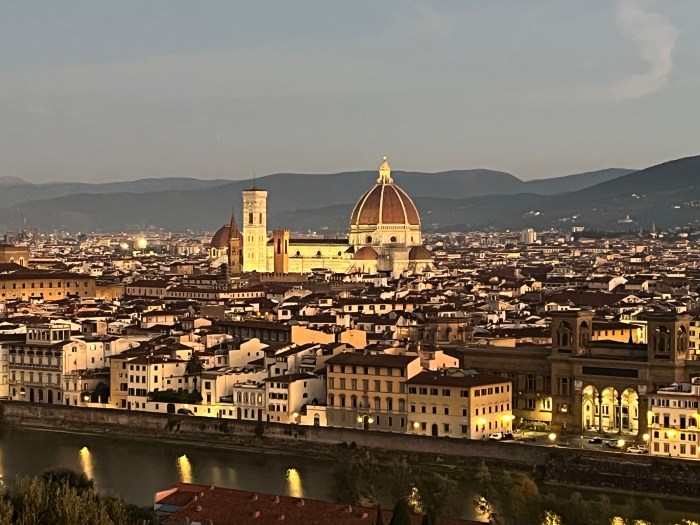
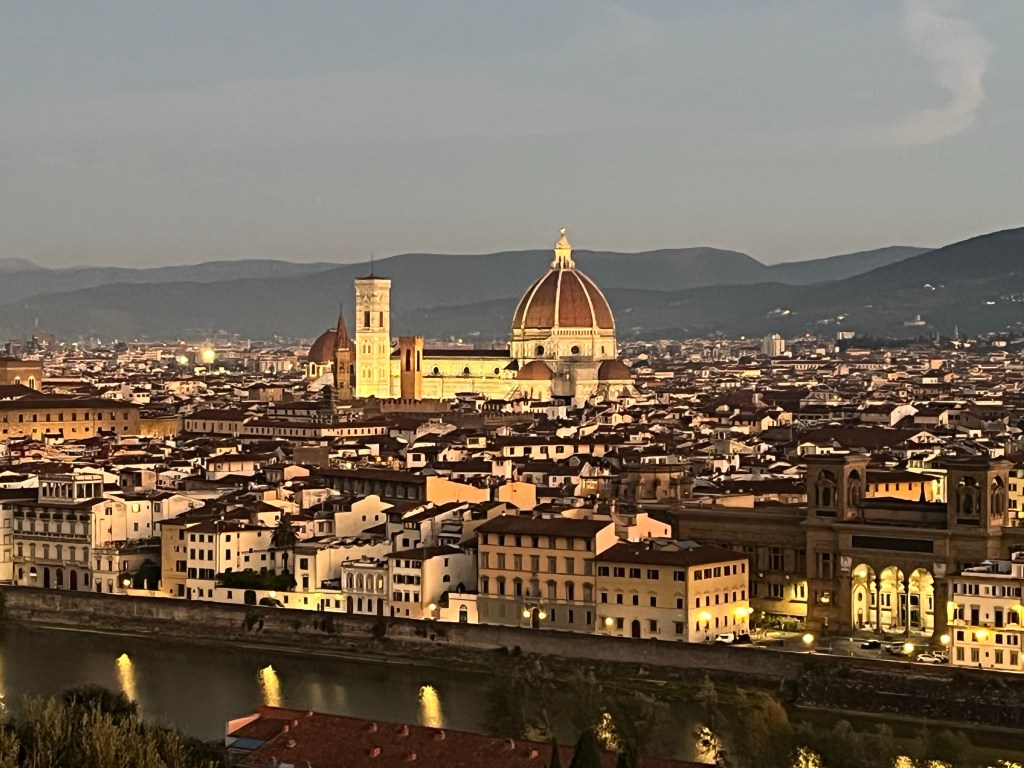
The Duomo at Sunrise taken from Piazzale Michelangelo.
History of Construction
The Duomo dominates the skyline of Florence. It is 376 feet tall at the dome and the campanile is 278 feet tall. Most buildings in Florence are three to five stories tall and are a fraction of the Cathedral’s height. The Duomo is so much larger than the rest of the buildings in Florence that it’s impossible to miss.
The Campanile is an impressive 278 feet tall.
As was the case with many cathedrals built throughout Europe, building the Duomo was a multi-generational project. The project began in 1296 overseen by the architect Arnolfo di Cambio. By 1337, the project had expanded and the plans were changed to include a dome, even though they didn’t yet have plans on how to build it. In 1418, the Architect Brunelleschi solved the dome problem and his design was chosen to finish it. The dome was completed in 1436, finally finishing the construction on the cathedral that had lasted 140 years.
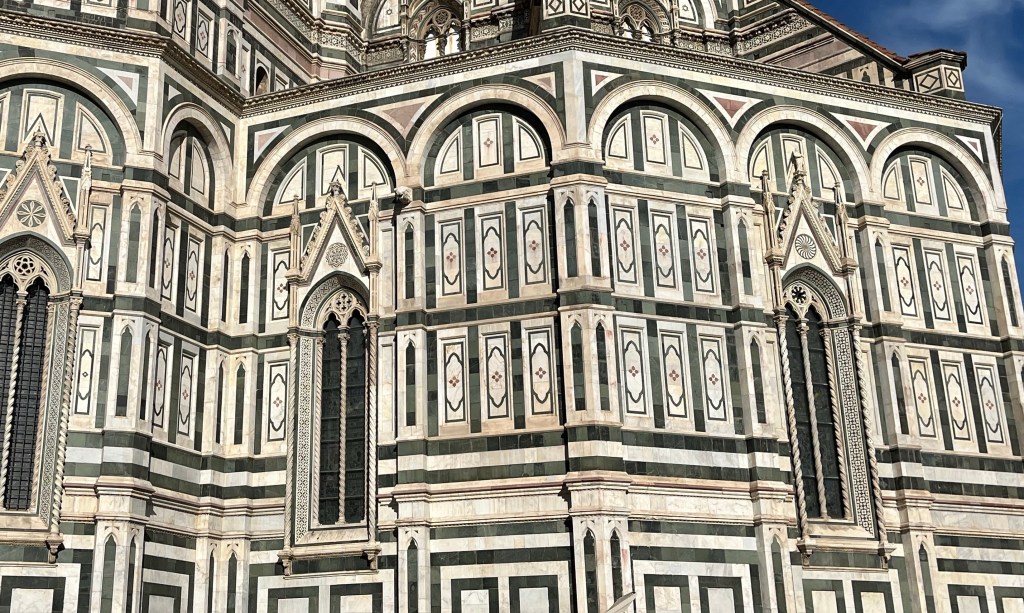
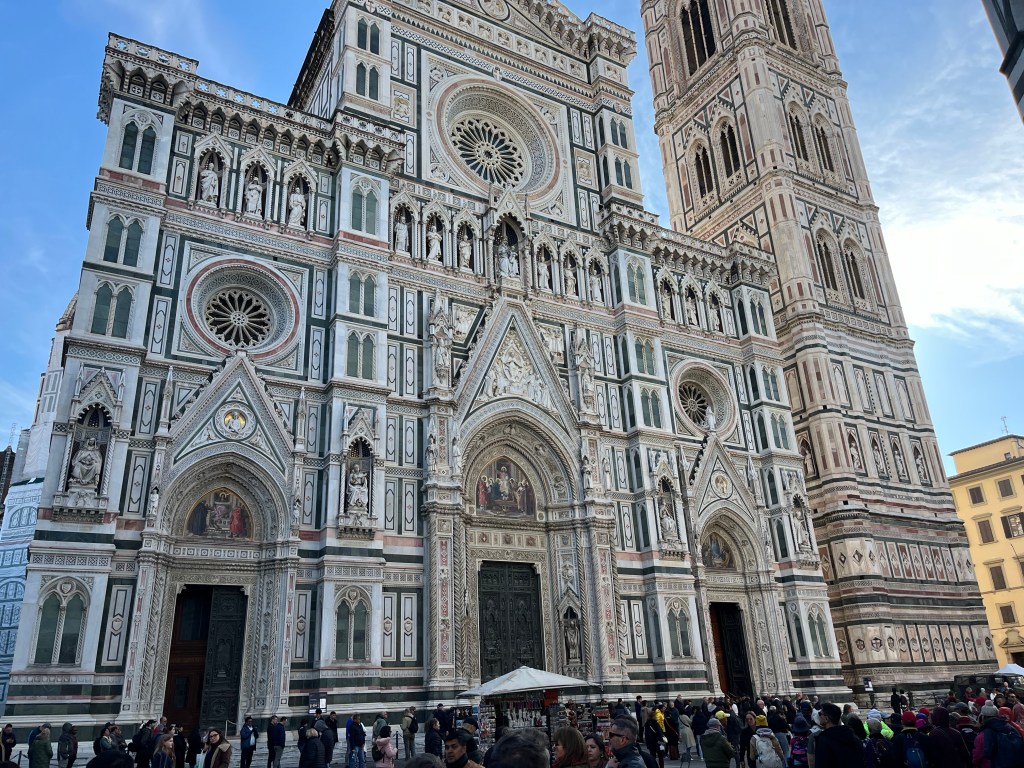
The intricate marble design covers the entire exterior of the Duomo
Even though the Baptistry and the Campanile have extremely similar marble exteriors, they had been clad in marble for centuries when the exterior work was done on the Duomo. Because of the similar marble exteriors, the Baptistry, Campanile and the Duomo feel like one cohesive project, but in fact, the Baptistry was completed in 1059 and the Campanile was completed in 1359.
Ticket Options for the Duomo
The Brunelleschi Pass provides access to climb the stairs up to the top of the dome, as well as the bell tower. It also provides access to the museum, the baptistery and the crypt of Santa Raparata. That pass is available at the Duomo website for 30 Euros.
Doors at the entrance to the Duomo
The Giotto Pass provides everything the Brunelleschi Pass provides, except access to the top of the dome. The Giotto pass costs 20 Euros.
The Ghiberti Pass provides access to the Baptistery, the Museum and the Crypt of Santa Reparata. It costs 15 Euro. If you don’t like hiking up a ton of stairs or heights, this might be the option for you.
Countless statues adorn the outside of the Duomo
Because we didn’t have a ton of time in Florence we decided to do none of those things and just walk inside of the Cathedral. This option is completely free and can be done simply by standing in line. Even though the line was long, it moved fairly quickly and we were able to make it inside in about 20 minutes.
It’s Not as Flashy as You would Expect
When you look at the outside of the Duomo, it’s beautiful, but it’s a quite showy. The front of the Duomo has dozens of statues in the facade, along with the three toned marble exterior. The doors, the windows, every single inch of the exterior of the Duomo is intricate.
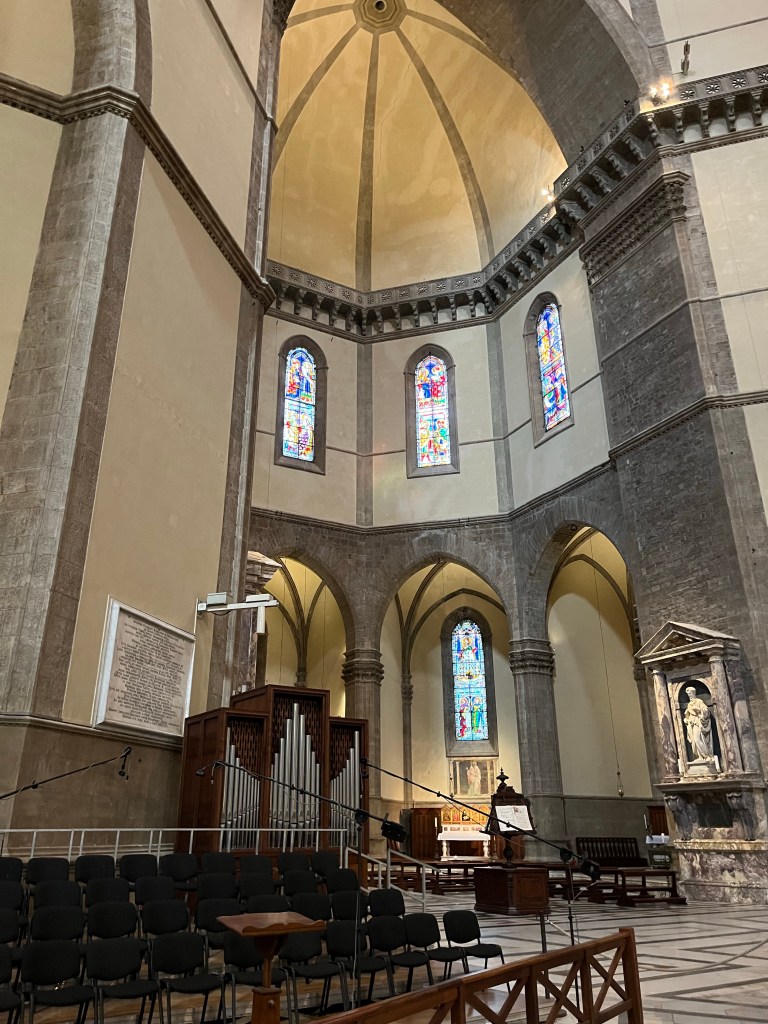
Stone archways and ribs hold up the impressively high ceiling of the Duomo.
However, once we walked inside, the amount of plain light tan walls everywhere was surprising. The gray stone archways and ribs holding up the high vault ceiling are beautiful, while seeming strangely plain. There are also some beautiful stained glass windows letting light in from the outside.
Compared to many of the churches and cathedrals that I’ve visited, the inside of the Duomo seemed understated. I think that’s what I liked so much about it. From the outside, every inch of the exterior is covered with an elaborate marble cladding. The front of the Duomo has statues everywhere and the doors are enormous and elaborate.
Tapestries in outer aisle
But inside, it’s beauty is in the relative simplicity. Sure there are still stained glass windows, statues and tapestries, but when taking it in as a whole, those things complement the cathedral well instead of overwhelm it.
Statue of Pope Eugene IV on the front of the Duomo
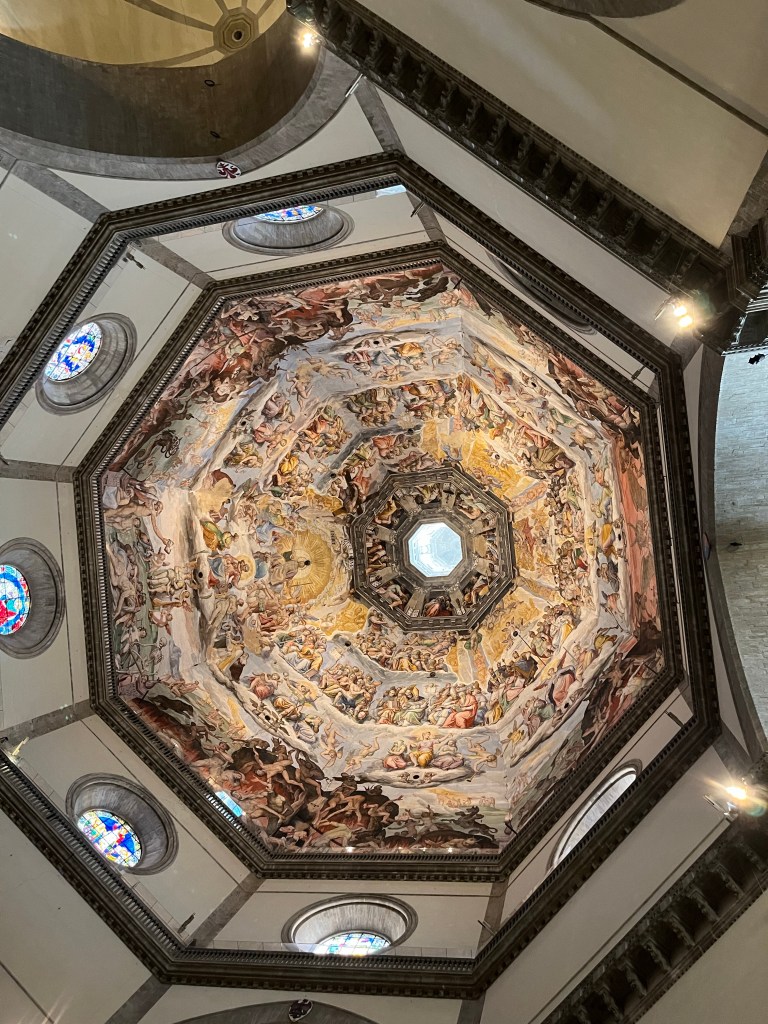
The one element of the inside of the cathedral that is a bit showy is the painting of the Last Judgement in Brunelleschi’s Dome. However, you need to position yourself underneath it in order to view it. You would never see it while seated in a pew during Mass.
Brunelleschi’s Dome
It’s actually a perfect example of the purpose of a Cathedral. For the citizens of Florence, this is the center of their community, it is a source of their pride. The exterior shows off the craftsmanship and labor of centuries of artists, artisans and laborers. But the inside, that’s for worship. Despite, the frescoes and the statues, the focus is most definitely on the altar and the priest performing Mass and ultimately that is the most important function of a Cathedral.
Vernazza is a gorgeous village along the coast in the Liguria Region of Italy. It is one of the five towns that make up Cinque Terre which is both an Italian national park and a UNESCO world heritage site. It has a population of about 700 and dates back almost a thousand years. Traditionally, Vernazza was a town that relied upon fishing, olive oil and wine production. Although those industries still exist today, Vernazza is now mostly a tourist destination.
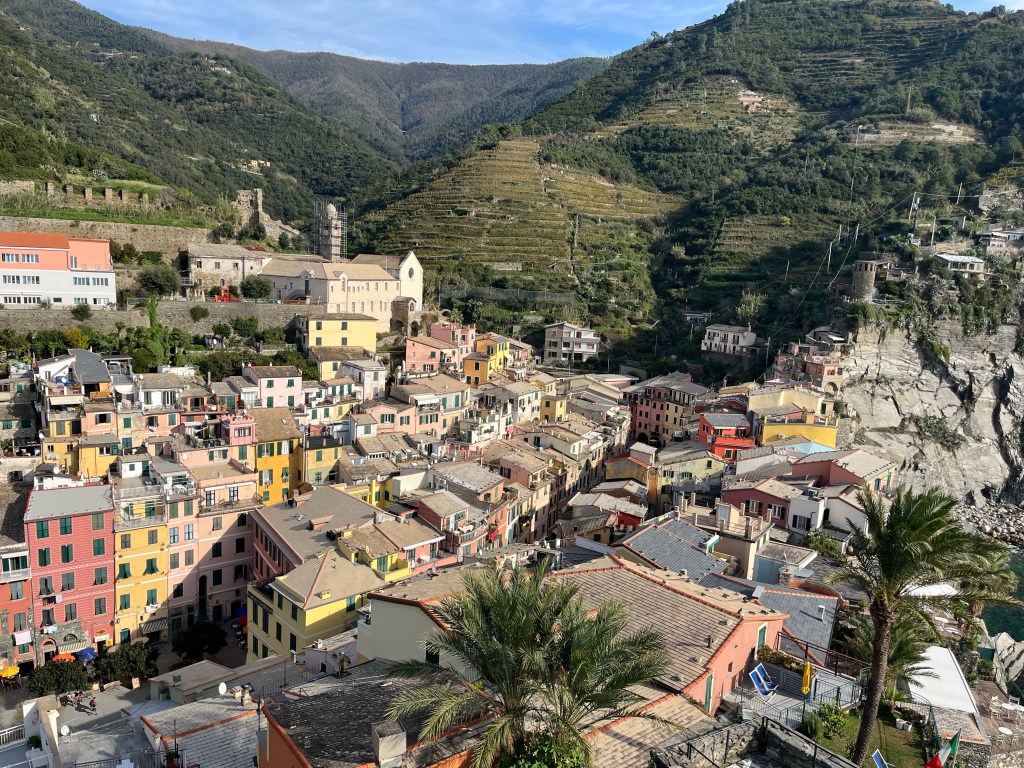
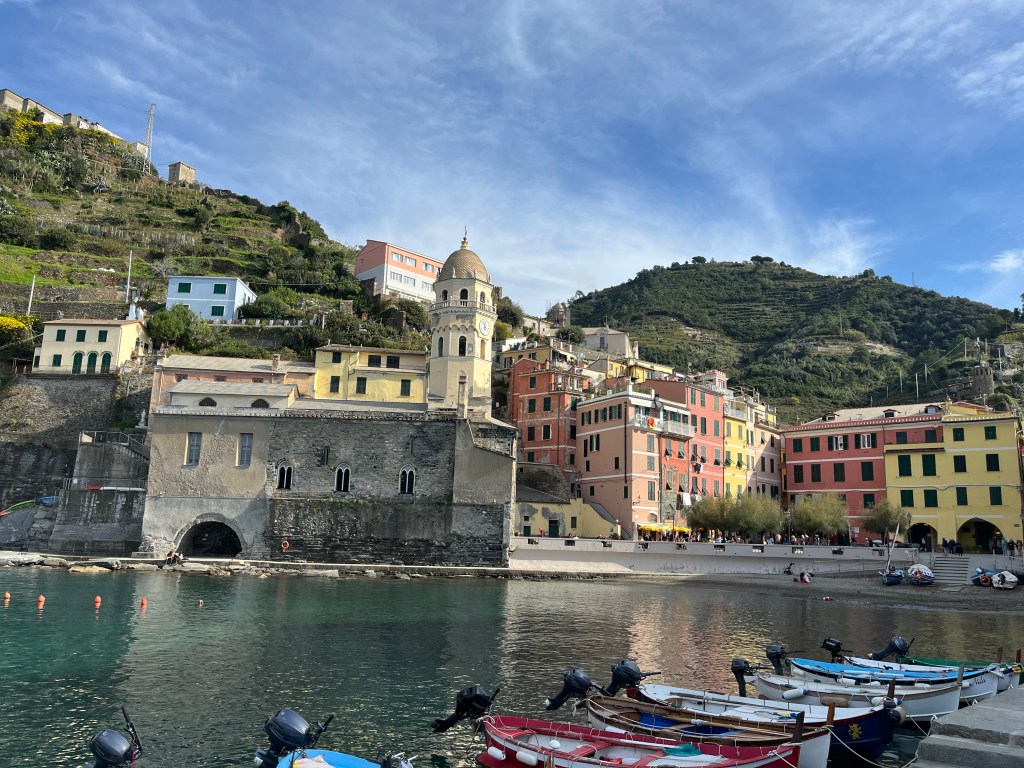
Vernazza from Doria Tower
Getting to Vernazza
The only practical way to get to Vernazza is by train. Technically you can drive to Vernazza, but it takes twice as long and parking would be a challenge. To enter Cinque Terre National Park, you must enter the park through La Spezia on the south end of the park or Lavanto on the north end. You can buy a day pass for unlimited rides on the Cinque Terre Express in either of those towns. You can also buy them through the Trenitalia app.
Buildings were built into the hillside in Vernazza.
During high season (basically April through October), trains run every 20 minutes. During the off season, they run either every 30 or 60 minutes. You should keep a general idea of when the next train will arrive so that you don’t find yourself waiting too long for a train between towns.
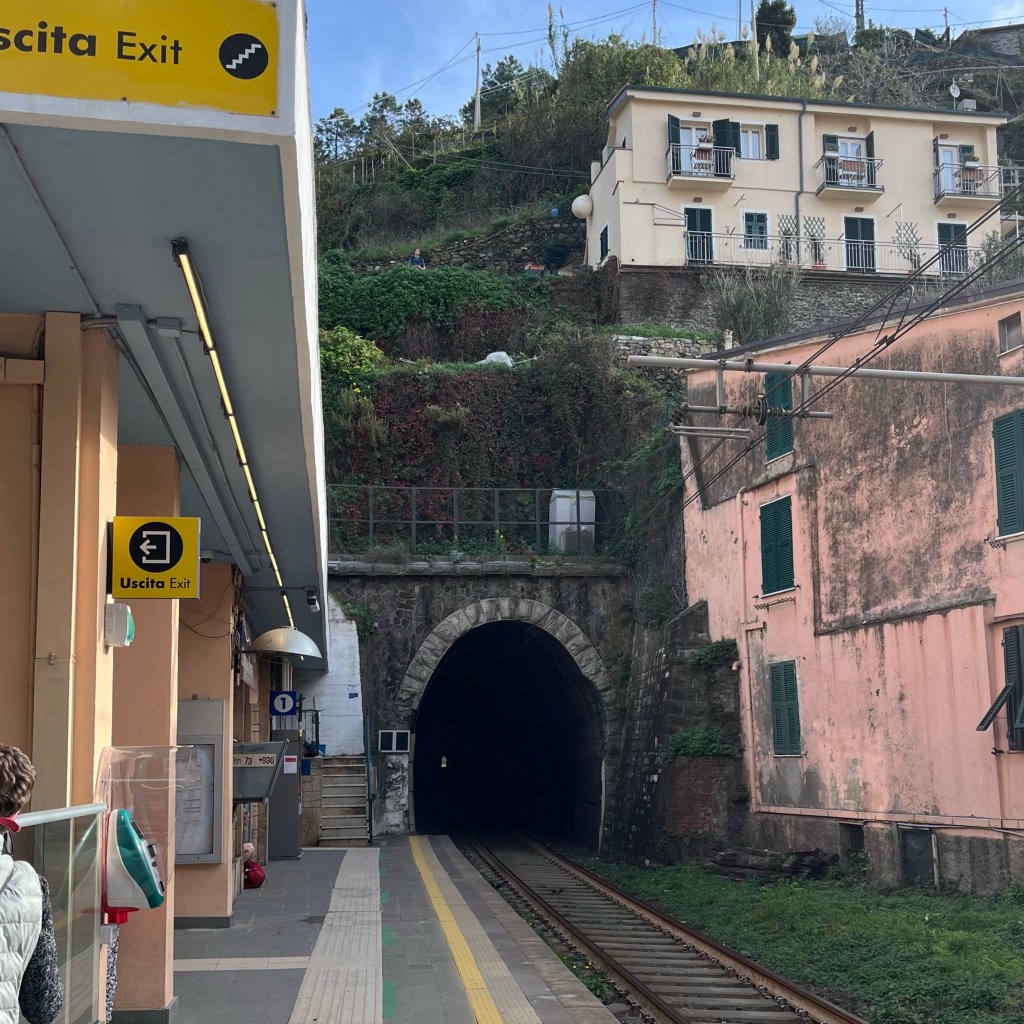
The Cinque Terre Express lets off right in the middle of the town. From the moment you descend from the train platform, you are surrounded by four story buildings on either side and terraced vineyards behind you. In front is Via Roma, the main road through Vernazza that slowly descends into the Ligurian Sea.
Via Roma Vernazza
Walking down Via Roma, there are restaurants and gelato shops on both sides. What caught my eye was the focaccia shops. Who doesn’t love focaccia after all?
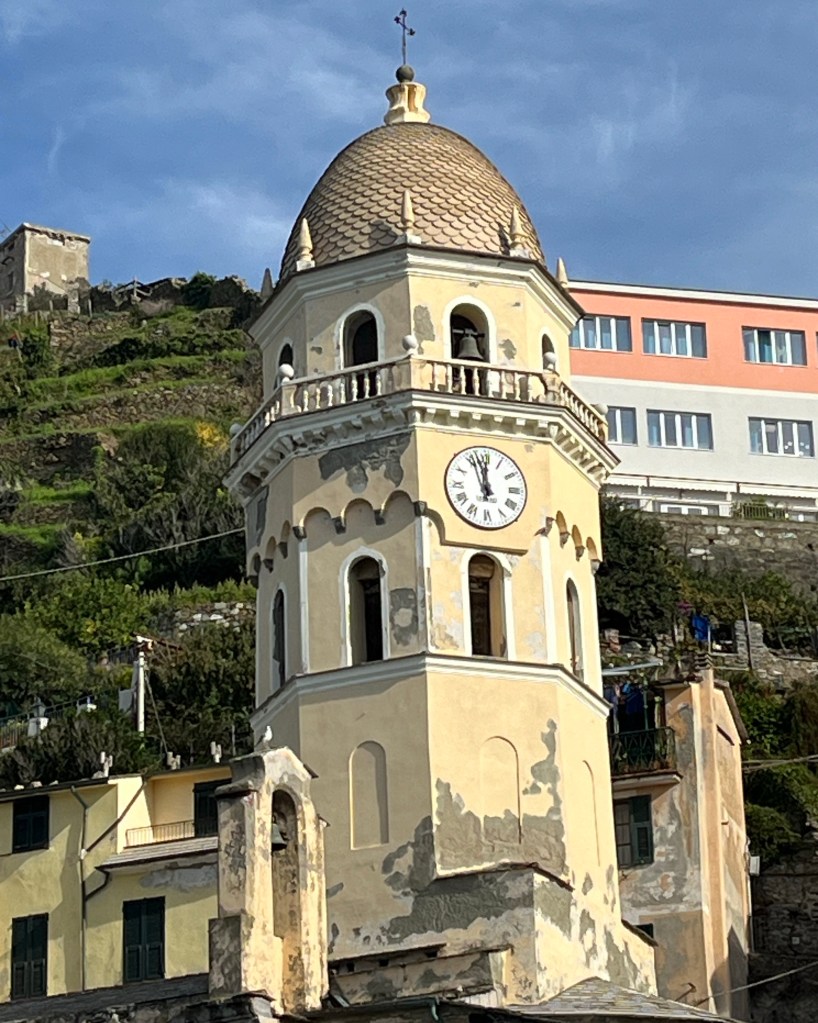
Bell Tower at Chiesa di Santa Margherita d’Antiochia
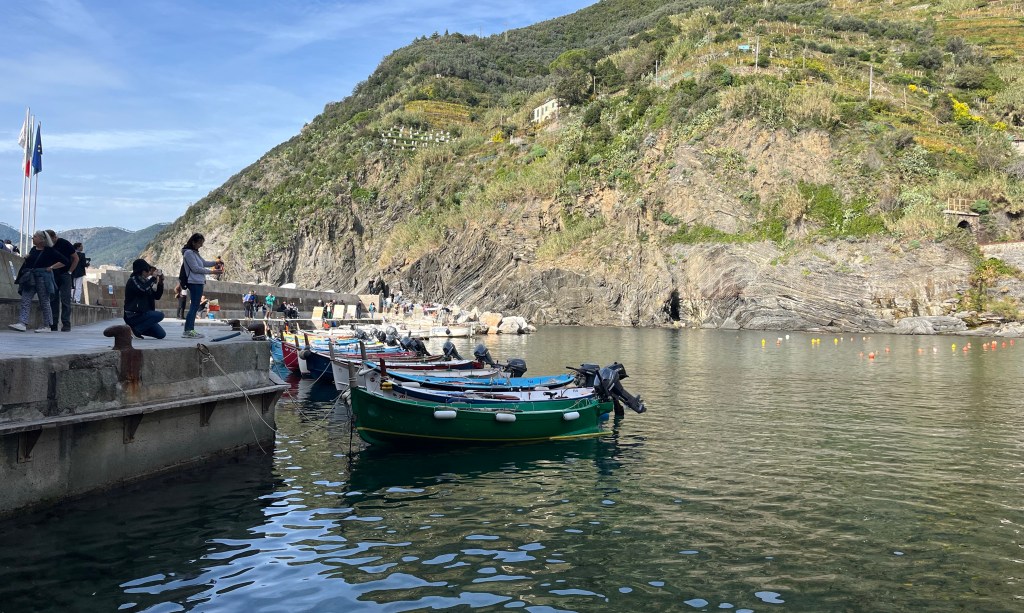
It doesn’t take too much of a walk down Via Roma before you reach the harbor which is the centerpiece of the town. There are no large boats in the marina, it’s mostly just small fishing boats.
Boats in the marina in Vernazza
Directly in front of the marina is a plaza lined with restaurants, bars and shops. To the right is a church from the middle ages called Chiesa di Santa Margherita d’Antiochi. In the front of the plaza is a small beach and to the left is a walkway on the wing dam that protects the harbor. The boats are tied to the walkway on the wing dam.
Doria Tower
Standing in the plaza by the marina, I noticed a sign pointing up an alley that said something about a castle and I was curious. Four of us decided to find out what that was so we walked up a lot of steps through the alleyway and ended up at a ticket booth where a guy was selling entrance tickets to Castle Doria for 2 euros. We paid the two Euros and proceeded up into the castle.
View of Vernazza from top of Doria Tower
The castle itself isn’t terribly impressive other than its location. It is built in the 11th Century as a defense against pirates. It was last used during World War II, when the Germans stationed anti-aircraft weapons there.
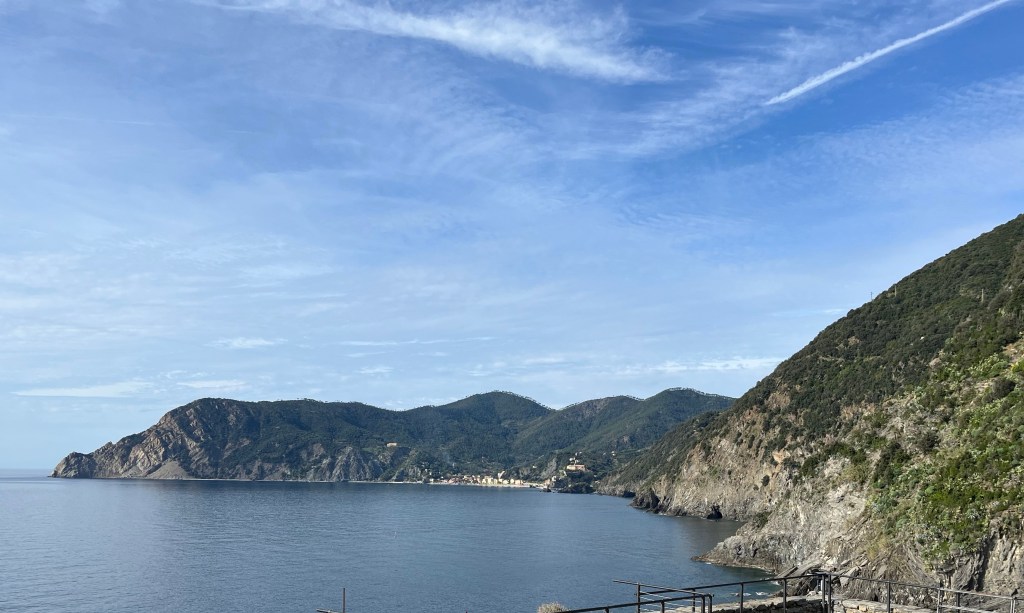
View of Monterosso from Doria Tower
It mostly consists of a single tower and a stone platform. What makes it great is that it is perched on the side of the cliff next to Vernazza and makes for tremendous views. It not only provides a great view of Vernazza but you can also see Monterosso when looking North along the coast.
Chiesa Di Santa Margherita D’Antiochia
Following our trek to the top of Doria Tower, we walked across the plaza by the marina to take a look inside the Chiesa di Santa Margherita d’Antiochia.
Chiesa di Santa Margherita di Antiochia
The Chiesa di Santa Margherita D’Antiochia is a church built sometime around 1,300 AD. It is built directly on the marina in Vernazza. The church has gone through a series of renovations over the years, but still maintains a fairly rustic feel.
Chiesa di Santa Margarita di Antiochia
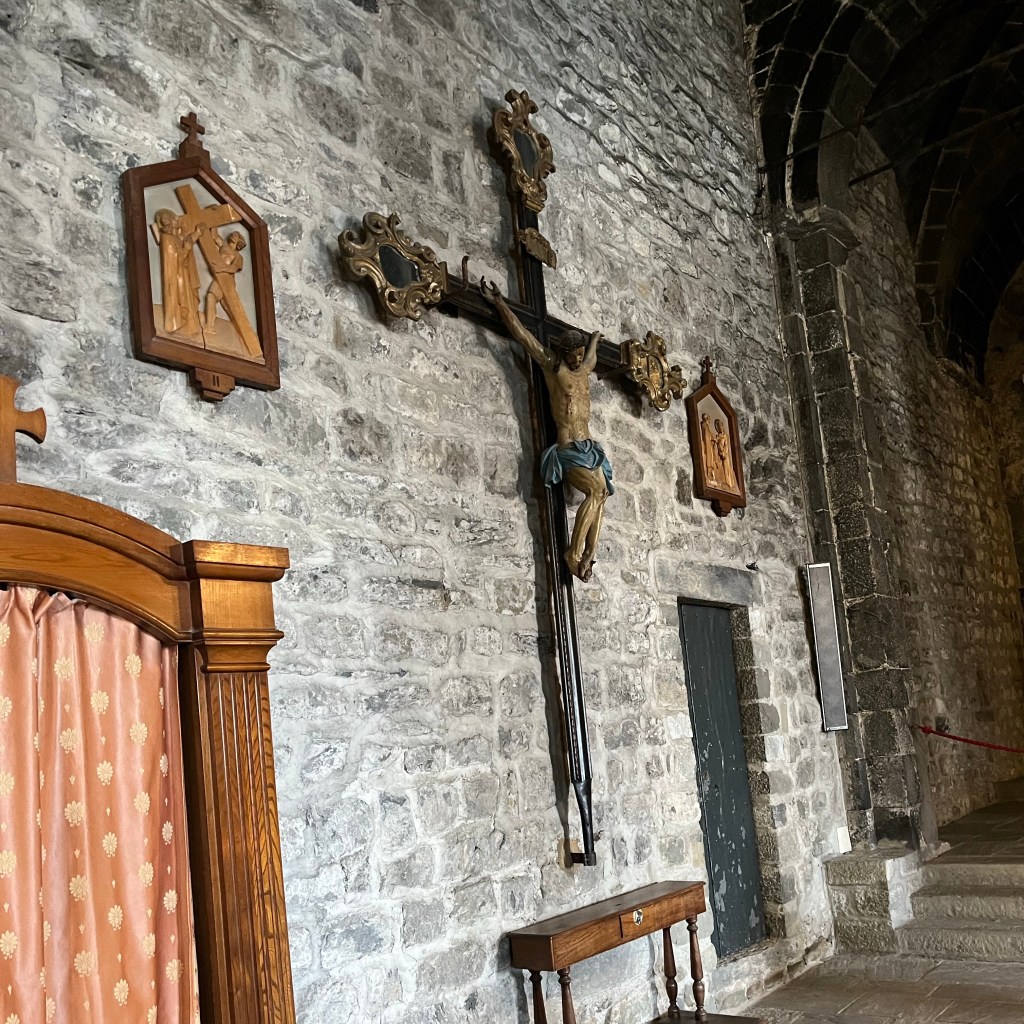
What I love about this church is the stone walls and the large stone archways holding up the wooden ceiling. I think the thing that is most striking about the church is what it lacks. You won’t see any of the giant stained glass windows, frescoes and statues that are so typical of European cathedrals and churches.
Crucifix at Chiesa do Santa Margherita D’Antiochia
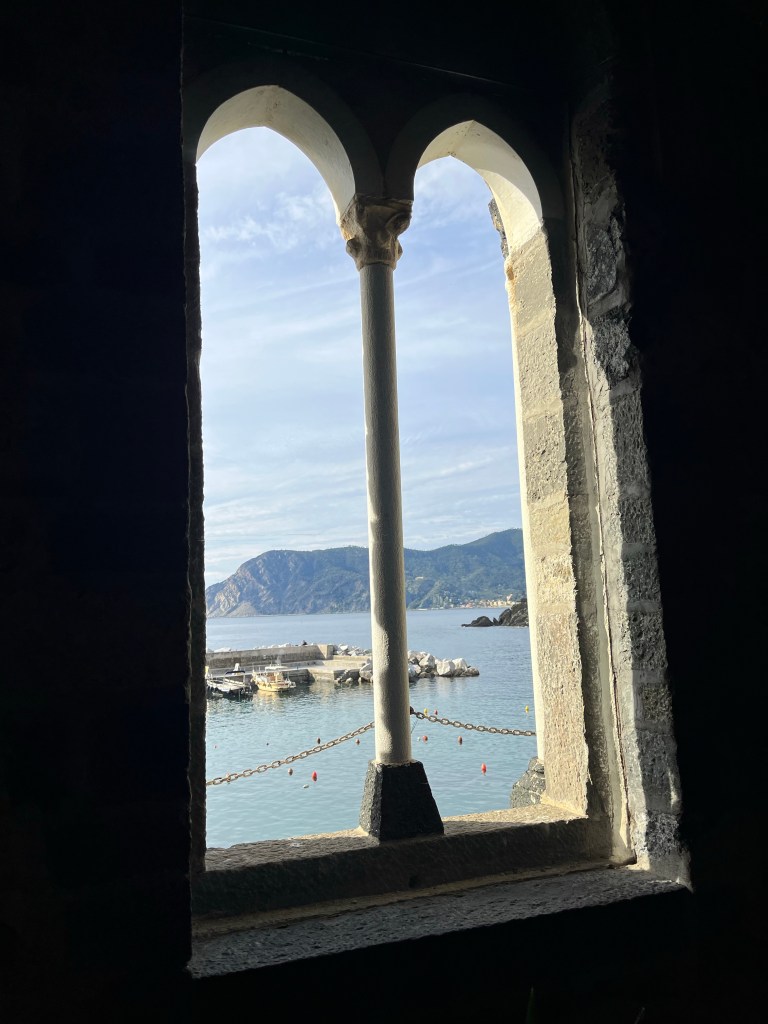
What you do notice are some plain crucifixes, some small shrines, and a fairly basic altar. There are some plain wooden pews lined in rows on a stone floor. It’s dimly lit and has only a couple of arched window openings, although without glass. It is precisely what I would imagine a pre-renaissance church to be like. It was truly a treat to visit.
Windows at Chiesa di Santa Margarita di Antiochia
Leaving too Early
After visiting the church, we stopped in for a drink at a bar by the marina. We took a table in the plaza and it was an lovely day to do so. Even though it was in November, the temperature was in the mid-60s, the sun was shining and there was very little wind. It was an ideal day to sit and enjoy a beer. We also snacked on some fried frutti di mare, which had a variety of fried octopus, squid, crab, and fish served like street food in a paper cup from one of the local shops.
After the drink and a snack we decided that we wanted to go to Monterosso for lunch so we hopped on the train to go there. That turned out to be something that we regretted a little. Monterosso is a bit of a beach town and I think visiting it in November probably isn’t seeing it when it’s at its best. Its lovely but in the end it just didn’t seem to have the same charm as Vernazza, and we quickly started to wish we had stayed a little longer in Vernazza.
Cinque Terre Should Be More Than A Day Trip
We only had three full days in Florence and we devoted one of those days to this day trip to Cinque Terre. I’m glad we went, but in the end, I think we really need to devote three days to Cinque Terre to fully appreciate it. We only visited two of the five towns and it felt rushed.
Hillside Vineyards overlook the marina in Vernazza
There is an old trail that connects the five towns and I would love to spend three days hiking between the towns and really getting to know each town more than what you can in just a few hours. Each town has it’s own unique character and breathtaking views of the Ligurian Sea.
If you plan to visit Cinque Terre, but you only have a single day, I would suggest that you pick just one town and really enjoy as much as you can. I thought Vernazza was a beautiful place, and would be a great choice if you were going to select just one town.
Cinque Terre itself, however, is one of those bucket list locations that any world traveler should visit. The old world charm, the beauty, and the fact that these amazing towns are precariously perched on hillsides overlooking the Mediterranean Sea demonstrate why this area is both a National Park and a UNESCO world heritage site. It’s just an amazing place to visit and I can’t wait to return.
We usually make it a point to visit a local market when we are traveling. For example, we’ve visited the Viktualienmarkt in Munich, the farmer’s market in Grecia Costa Rica and the St. Lawrence Market in Toronto. Of all of the markets that we’ve visited, Mercato Centrale in Florence is my favorite. If you’re planning to spend some time in Florence, this needs to be one of your stops.
Second Level of Mercato Centrale
Where is Mercato Centrale?
Mercato Centrale is about a 5 minute walk northwest of the Duomo in Florence. It’s also about a 5-10 minute walk east on Via Nationale from Santa Maria Novella Train Station.
Just outside of the Mercato Centrale is San Lorenzo Market. This market surrounds Mercato Centrale on three sides. It consists of leather vendors selling jackets, backpacks, purses and belts. These vendors tend to get a little aggressive as you’re walking through, but not too aggressive. From what I can tell, and I’m no expert, but the leather vendors appear to be primarily selling high quality leather goods made in Italy.
The Ground Floor is for High Quality Groceries
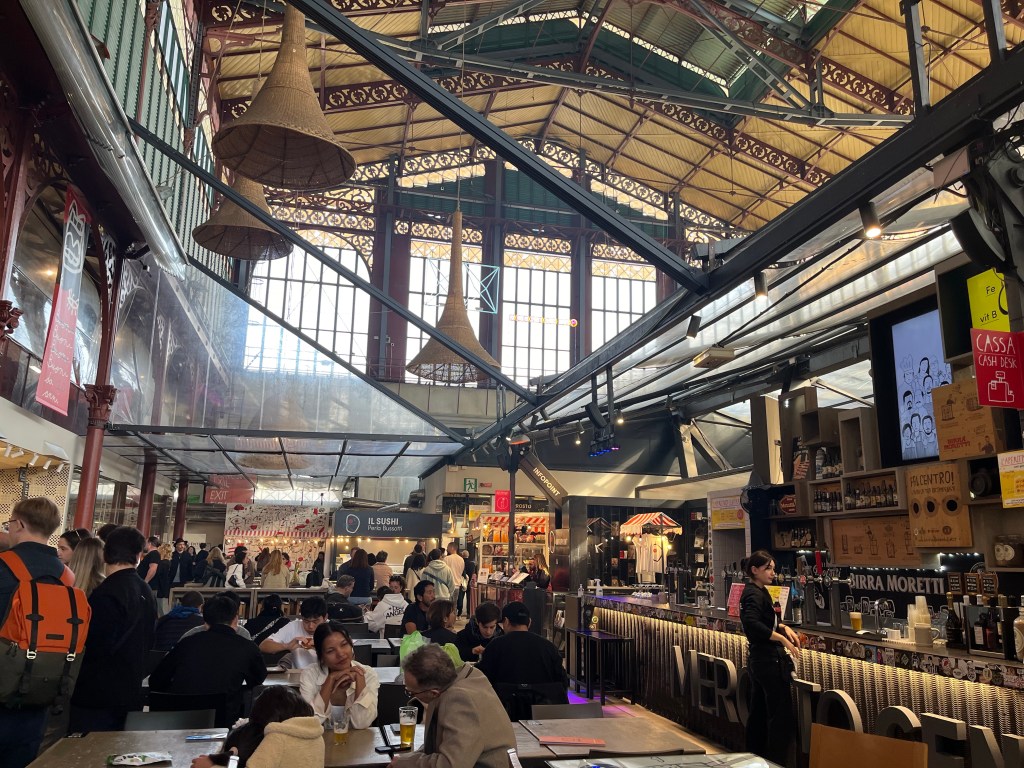
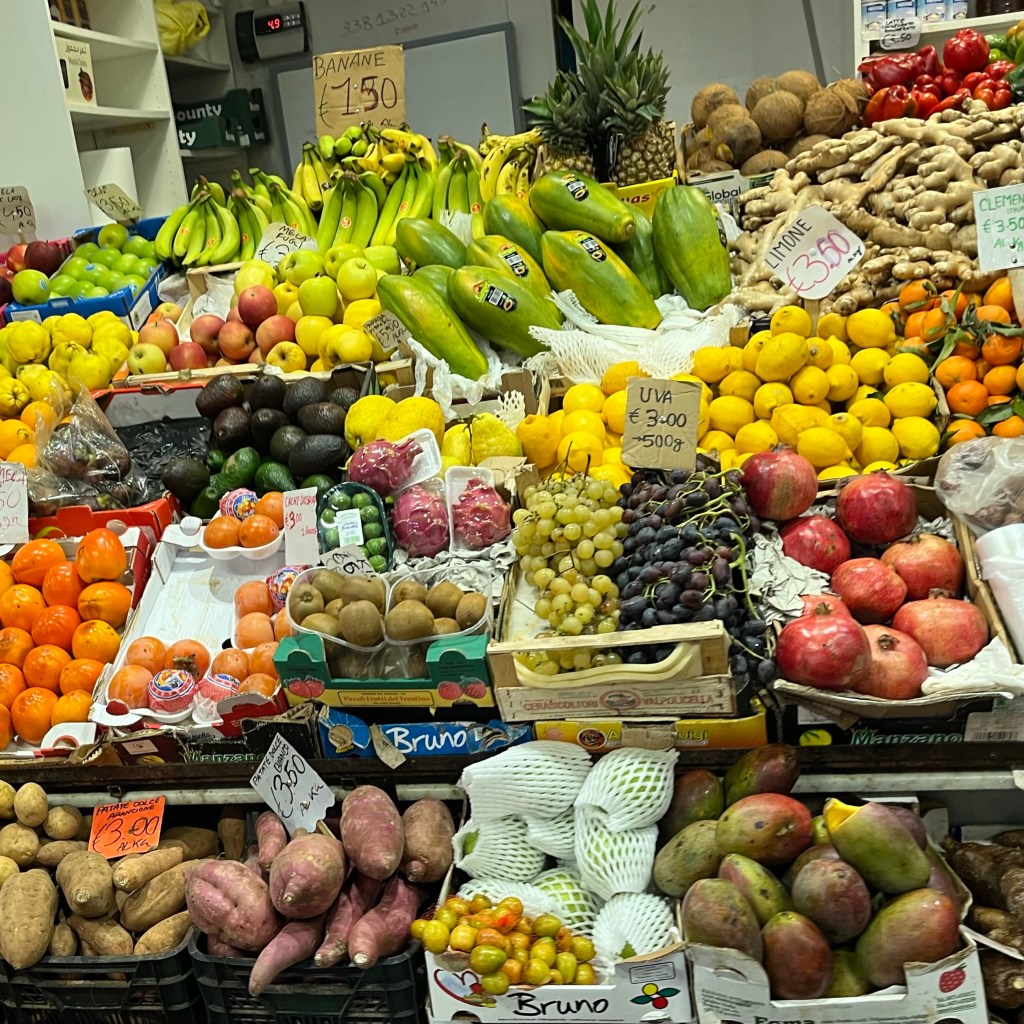
You will have to go through San Lorenzo Market to get into the Mercato Centrale building. The building is a huge two story iron and glass building with massive amounts of space for a variety of vendors. On the ground floor there are fishmongers, butchers and produce vendors as well as specialty stalls selling wine, olive oil and balsamic vinegar.
Unless you’re visiting Florence for a long period of time, and will be buying some groceries for your Airbnb, this area won’t be that useful. It is, however, fascinating to see the kinds of fresh fish, meats and produce that are available in the market. Fishmongers sell a variety of fish, as well as prawns, octopus, and clams.
Some of the available fish at a Fishmonger stall
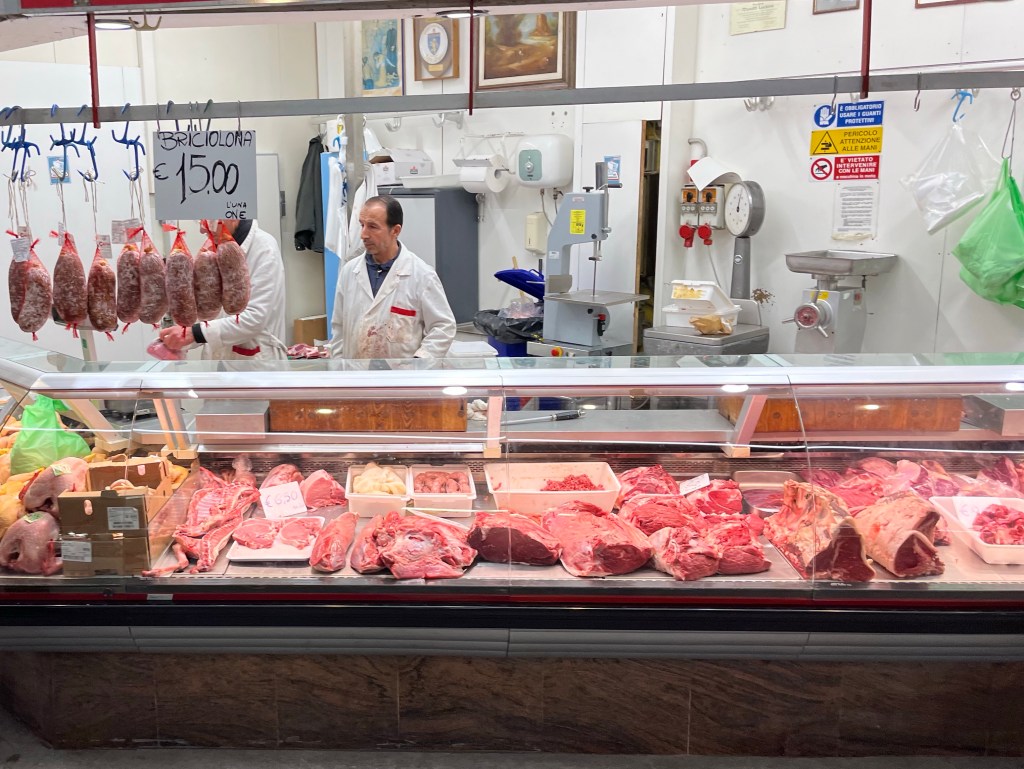
The butchers, of course, are ready to cut meat to order. As a tourist, however, you might be more interested in picking up some cured meat that you will see hanging from the top of many of the stalls. You will also find cheesemakers in the market selling a variety of cheeses that are local to Tuscany. If you pick up a baguette from a baker at the market you can probably put together one of the best sandwiches you’ve ever made. By the way, if you have a long train ride out of Florence, putting together some sandwiches for the trip can make that train ride extra enjoyable.
Butcher at Mercato Centrale
If you’re bringing a checked bag, and would like to bring a bottle of wine home, I would suggest checking out the wine shop. Any wines that are truly local will be marked with a designation of DOC or DOCG. DOC stands for Denominazione di Origine Controllata which basically just means that it’s up to quality standards for a wine of that region. DOCG essentially means the same thing but it adds ‘Garantita’ (guaranteed) to the end meaning that it has higher standards than DOC. Also, if you don’t have room in your checked bag, you can always just drink a bottle or two, no one’s stopping you, you are in Florence after all.
Produce Vendor at Mercato Centrale
The more likely thing you might want to pack in a checked bag would be balsamic vinegar and olive oil. If you’re used to the olive oil that you find at an American supermarket, Italian olive oil is an eye opener. I’m used to the flavorless olive oil from Aldi, and essentially every restaurant we went to in Italy would have a bottle of olive oil sitting on the table that was just outstanding. People who brag about the quality of olive oil in Italy aren’t lying, seriously, grab a bottle, throw it in your suitcase, you won’t regret it (unless it breaks during the flight of course).
First Floor of Mercato Centrale
The Second Floor is for Prepared Food
All of that being said, we didn’t spend much time on the first floor. We weren’t planning to cook and I didn’t bring a checked bag, so the place that I really loved was the second level.
The second level is primarily devoted to prepared food. It’s a great place to get a snack or a full meal.
Cafeteria seating on the second floor with additional seating on the third floor
The first thing I noticed, and immediately went to, was the bar. I love craft beer, and when you’re in Italy, it’s not the easiest thing to find. However, the bar at the market has a number of beers on tap and even more in the bottle. The owner of the bar does an excellent job of choosing beers that not only cover a variety of styles, but also compliment the prepared food by the other vendors on the second level. He also has chosen beer that is of good very good quality, including some Trappist ales.
Bar at Mercato Centrale
We sat down at one of the tables, and a server came out to take a drink order. I think you can order food from the vendors from the table, but we just chose to get up and look around and order it from the counters. I wanted to get a good look at all of the available food, anyway.
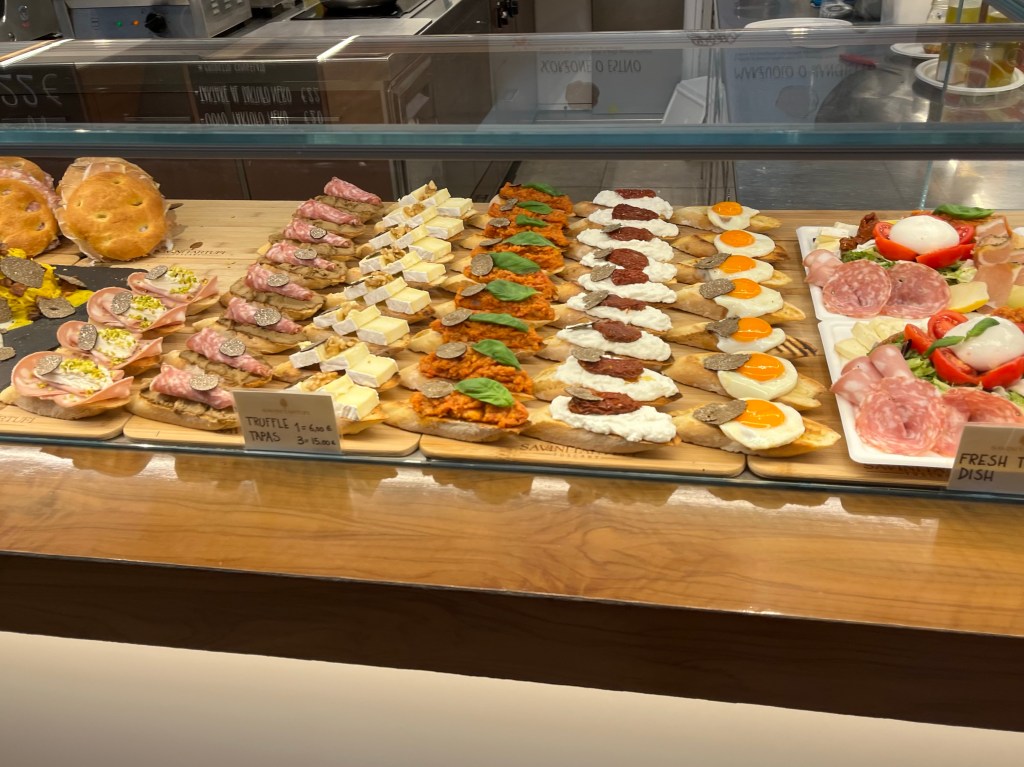
Cicchetti at Mercato Centrale
Scattered around the second level you will find vegan options, sushi, barbecue, and burgers. If you are looking for something a little more Italian, you will find crostini, arancini, and lots of sandwiches made with schiacciata and focaccia.
Sandwiches, Quiche and Baked Goods at Mercato Centrale
We visited the Mercato twice during our trip, and the first time I grabbed an arancini on the way out of the door. It was so good. It had just a little bit of ham and some cheese rolled up in a rice ball and fried. That was the first arancini I had ever tried and after that I was grabbing one wherever I found them.
On the second trip to the market, I grabbed some smaller arancini made with meat and tomato sauce and some fried stuffed olives. They were good as well, but I definitely preferred the arancini with the ham and cheese.
Lorenzo de Medici Cooking School
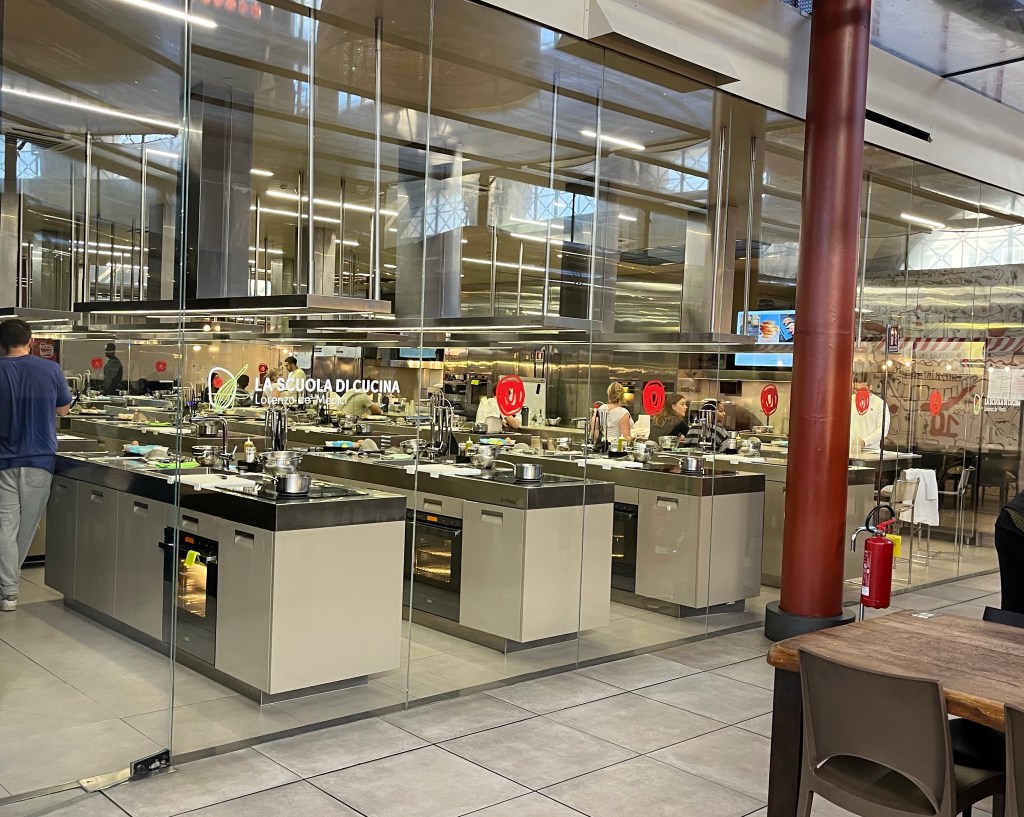
Cooking School at Mercato Centrale
Also on the second floor is the Lorenzo de Medici cooking school. The cooking school offers two hour classes that instruct students on how to make a Italian Dishes. These dishes include pasta, bread, and desserts. Most of the classes cost 80 euros to attend, but some are a little more expensive. A full list of the classes being offered can be found on their website.
Visiting Mercato Centrale is a Must
If you are going to Florence for longer than a couple of days and you love food or wine, you absolutely have to go Mercato Centrale. If you will be in Florence for a week and have access to a kitchen I would absolutely pick up some groceries from the first floor of the market. They are of high quality and you will have an opportunity to talk with the vendors to get some input on how you should use their products.
If you are like us and only have a few days in Florence, you still should go, but the second floor is where you will probably want to spend your time. There is a variety of prepared food that should allow for you to do some taste testing and really try some foods that you might not normally order in a restaurant. And, of course, if you’re a beer lover, you’ll want to check out the bar. It’s got a great selection of beer and will be a nice change of pace from all of the Italian pilsners that you’ll drink while in Italy.
Also, if you have time, you might want to check out the cooking school. If we had been in Florence longer than three days, I might’ve done a class. Who doesn’t want to learn to cook like an Italian after all?
Amsterdam is a city that I’ve dreamed of visiting for decades. The center of Amsterdam is a magical area where the canals and the buildings that line them are practically frozen in the 17th Century, when merchants trading goods from Asia brought wealth to the Netherlands. It was amazing to visit Amsterdam, even though it was a short stopover.
Taking Advantage of KLM Stopover Rules
We had the opportunity to take a 25 hour stopover on our way to Rome. When we planned our trip to Rome, there was a flight we liked from Chicago to Rome, but the layover in Amsterdam was only a little over an hour. That was a dangerous connection since we would have to go through immigration and security. We might’ve made it, but any delay would have made it close to impossible.
Our solution to the short layover was to fly in a day earlier and use KLM’s stopover rules to our advantage. KLM gives flyers the ability to stop in Amsterdam for up to 12 months on flight itineraries that stop in Amsterdam. This adjustment meant that we had a day in Amsterdam to defeat jet lag and do some wandering.
The KLM flight from Chicago to Amsterdam was comfortable and we landed at the airport without incident. Amsterdam has fantastic train service at the airport and in less than 20 minutes we were at Amsterdam Centraal for about 5 Euros a ticket.
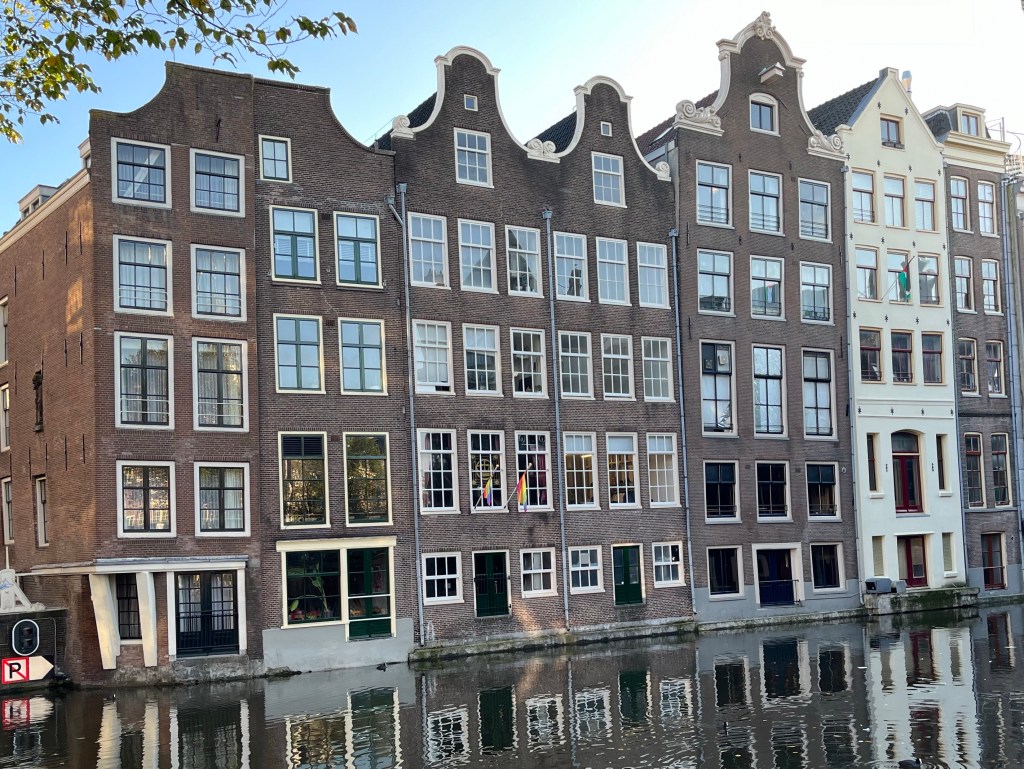
Row houses along a canal in Amsterdam
We stayed at the Kimpton De Witt near Amsterdam Centraal train station. They were gracious enough to find us a vacant room and allow us to check in at around 8:30 AM. The staff was very nice and even gave us a 15 Euro drink credit for using the current Kimpton Password.
What is the Kimpton Secret Password?
Kimpton has a secret password program that allows guests to get a little something extra if they know the secret password and tell it to the clerk when checking in. It's meant to be a fun little way to create a little buzz for the hotel.
We dropped our luggage off at the room, took a quick shower and we were off and running.
Walking the Canals
We were planning to take a nap, since we, as usual, were unable to sleep on the overnight flight. But first we wanted to walk along the canals and, more importantly, get some breakfast.
Wheels of Gouda are on display at a traditional cheese maker near our hotel.
The place we stopped at was a small but very busy breakfast restaurant called Omelegg. Seating there was a bit of a challenge. We ended up having to sit next to each other at a booth because the other side had a bench that was being used by a different table. It was a little awkward, but it was fine.
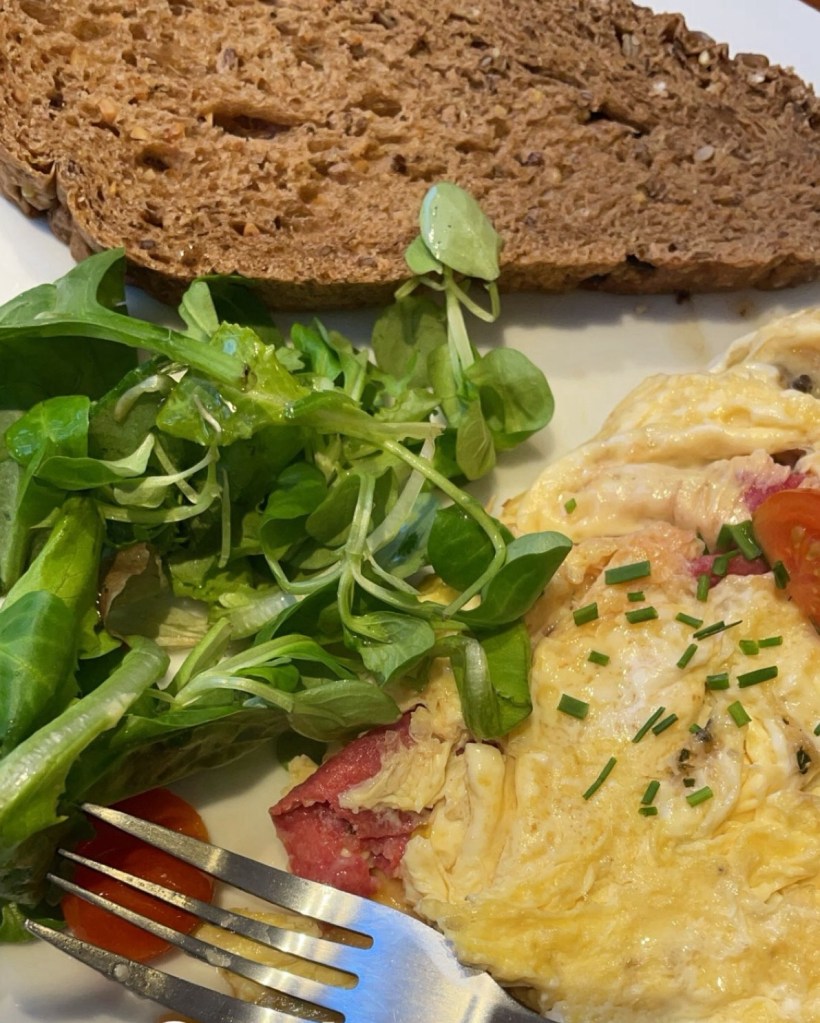
The Italian Job at Omelegg
Jenn ordered the Italian Job and I got the Chicken Harissa omelette. Both were very good and served with soft slice of dark wheat bread and an arugula salad.
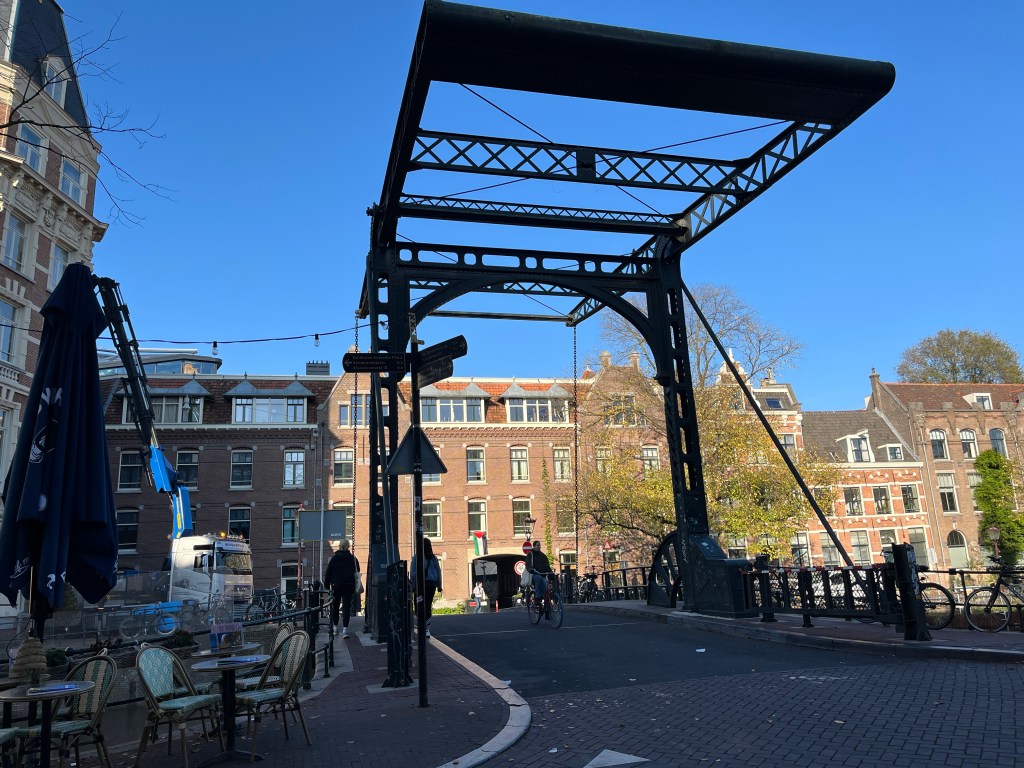
Row houses right on a canal. Watch out that first step out the front door is a little tricky.
The Kimpton De Witt is right on the edge of the Red Light District, so most of what we noticed at the beginning of our walk was a whole lot of weed shops and erotic boutiques. We also noticed more litter than I was used to seeing in Europe. There was a pretty pungent smell of marijuana in the air as well as cigarette smoke.
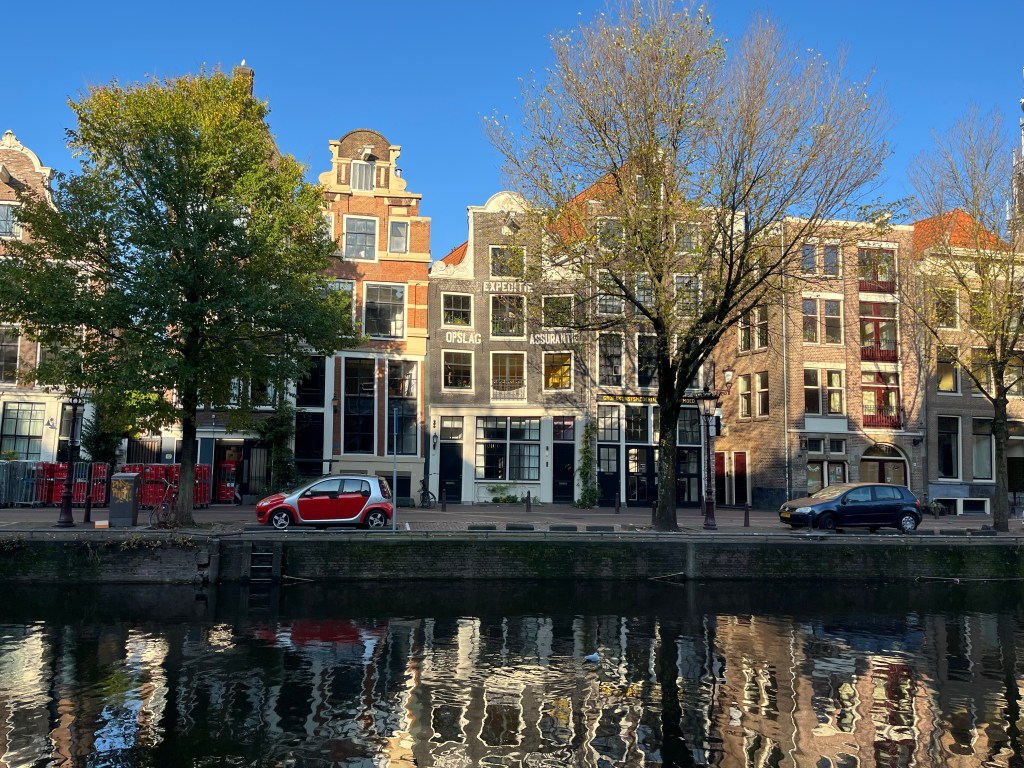
Classic Dutch Row Houses
While those things are a little unpleasant, Amsterdam is so unbelievably gorgeous it easily makes up for those shortcomings. The canal houses with their narrow five story design, brick exterior and big windows are beautiful. The tree lined canals and herringbone pattern brick streets make for an amazing backdrop for a sunny crisp fall walk.
The Church of St Nicholas
It’s nice to walk without a purpose or direction. We wandered the brick streets admiring the houseboats and tiny cars that lined the edges of the canals. It was a fairly peaceful walk with only the occasional car, bike or pedestrian that went past us. After about an hour the jet lag caught up with us and we returned to the hotel for a nap.
After our nap, we headed over to Brouwerij’t Ij. It was about a 25 minute walk from the hotel but a lot of it went through some gorgeous newer neighborhoods. Even though these neighborhoods didn’t have 400 year old row houses, the buildings kept the spirit of Amsterdam architecture. Many of them were block long buildings, instead of the narrow and tall buildings but they still were mostly 5 stories with shops on the first floor.
When we arrived at Brouwerij’t IJ I ordered a Tripel and Jenn ordered the Columbus. I loved the Tripel because it had less funk then many of the tripels that I’ve had in the past. Jenn had the Columbus which is an hoppy imperial beer which she also enjoyed. We sat out in their beer garden and watched traffic along the street which was mostly pedestrians and cyclists. It was lovely and we would’ve stayed longer but I wanted to check out Gollum Aan Het Water.
The beer and the atmosphere at Brouwerij’t Ij was great. I would recommend visiting when you are in Amsterdam.
Gollum has a series of bars around Amsterdam with an impressive beer selection, especially in bottles. Gollum was on my list of places that I really wanted to visit in Amsterdam. I was hoping to try some Belgian Ales that don’t make it to the US.
Just a portion of the amazing beer selection at Gollum Aan Het Water
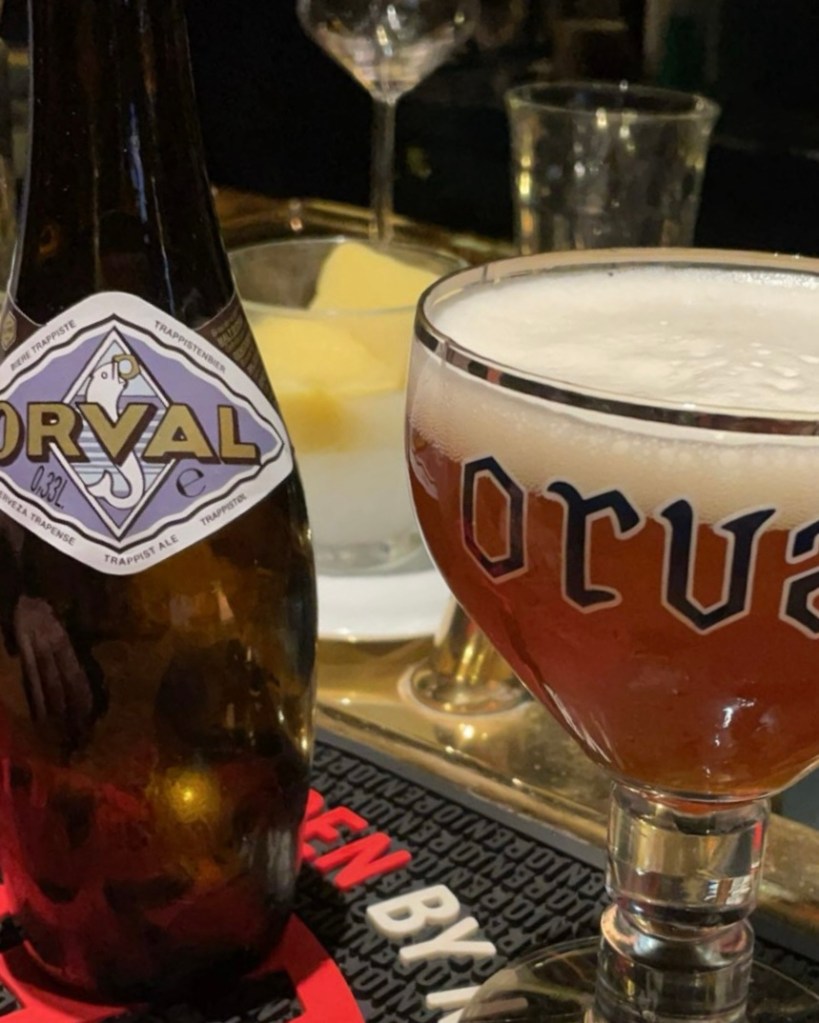
We started with a Rochfort and an Orval then moved onto some regional craft beers and other Belgian Ales. The quality and variety of the beers served at Gollum was off the charts so I was a bit of a kid in a candy store.
Orval is a beer produced at Orval Abbey in Wallonia Belgium and the sale of the beer helps support the monastery.
To be fair, we had perhaps too many beers at Gollum. As is sometimes the case with us, we got to chatting with other folks at the bar. We met a nice gentleman, originally from England, and his Bernese Mountain dog as well as a couple of guys from North Carolina. The bartender was extremely friendly as well.
It’s always tough to drag ourselves away when conversation flows as easy as the beer. It’s even harder when those conversations are with interesting people from various countries.
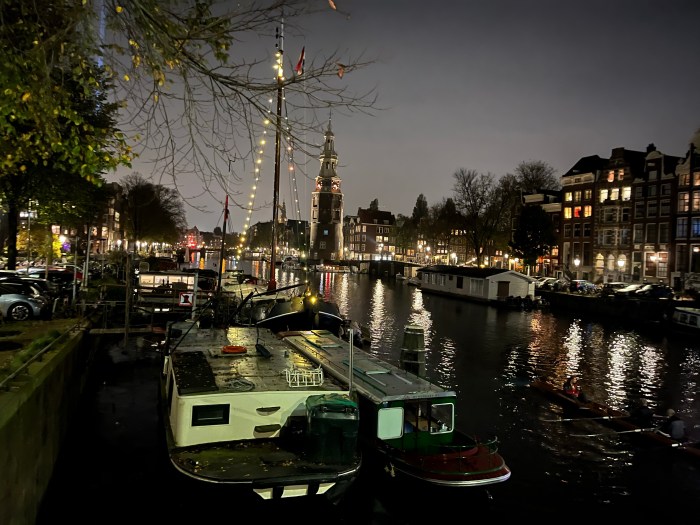
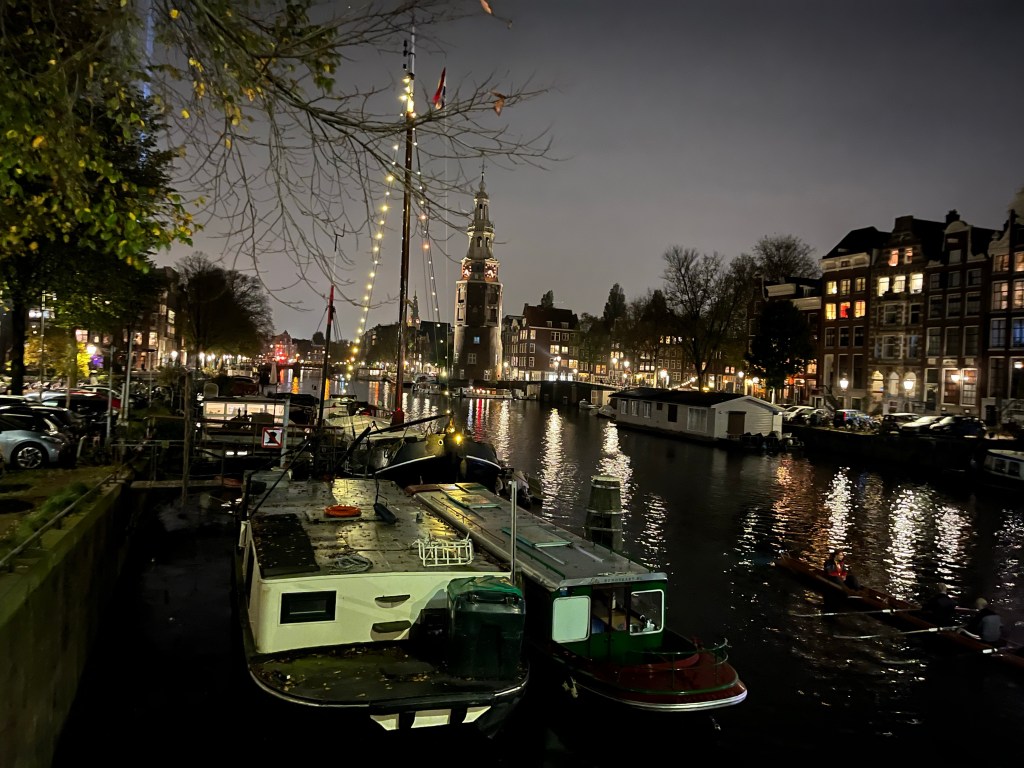
Boats illuminated in the night.
Eventually, a little tipsy, we pulled ourselves away from Gollum we walked back towards the hotel. By this time, it was evening and the lights of Amsterdam were dancing on the ripples of the canals. Amsterdam is lovely during the day, but it’s even more enchanting at night. The wind was calm and the air was a touch chilly. It was a perfect night for a lovely walk through Amsterdam.
Montelbaanstoren, a tower dating to the 16th century is illuminated in the evening.
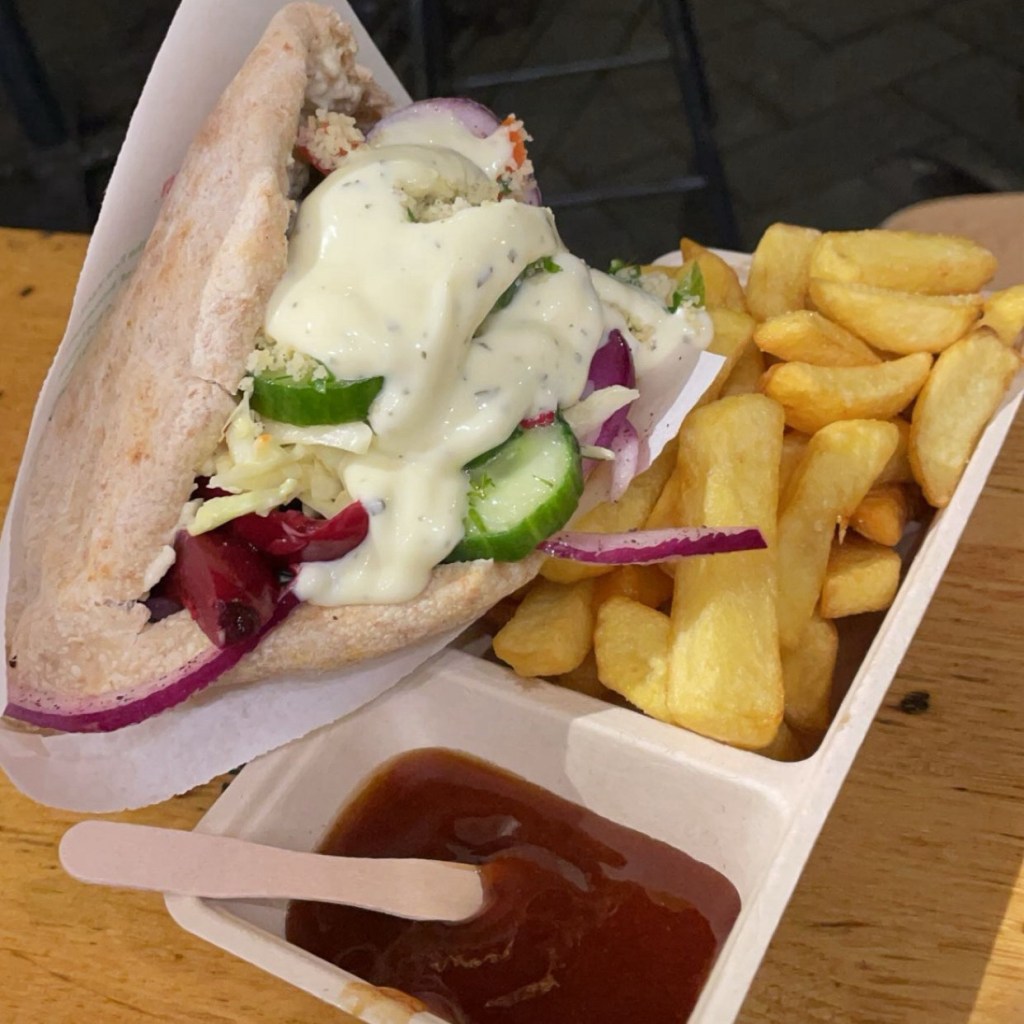
On our way back, we popped into a fast food Kebab place to fill up on hummus, falafel and fries. It hit the spot. I have yet to be disappointed by a middle eastern food in Europe. It is always so good and this was no exception.
Every McDonald’s in America should be replaced by Turkish Street Food – Immediately!
We Will Definitely Return
Doing a stopover in Amsterdam turned out to be a fantastic addition to our trip to Italy. It allowed us to enjoy one of Europe’s great cities without devoting a week to it.
Amsterdam did not disappoint us. Despite our initial negative reactions to the litter and smoke clouds in the Red Light District, Amsterdam is an almost magical city. The architecture, canals, the sheer volume of bikes just make for a uniquely Dutch experience.
We most definitely will be visiting Europe in the future and knowing just how great a stopover in Amsterdam can be, I think there is a good chance we will do this again. Next time, though, we might have to spend two days instead of one.
One thing that surprised me about our trip to Ontario was the number of wineries and vineyards that exist in the area between Niagara Falls and Toronto. According to Ontario Wine Appellation Authority, cool weather varieties thrive in this area, like Riesling, Chardonnay, and Pinot Noir.
We were staying in Hamilton, having parked our camper for the week at Fifty Point Conservation Area. From where we were staying, it seemed like every exit along the Queen Elizabeth Way had signs for at least two wineries.
Maybe we should have popped into a winery and checked out what was special about the wine in the Niagara region, but we were more interested in checking out the beer scene. While we were in Ontario, we noticed that there were a few differences between beer culture there and beer culture in Iowa.
Production Breweries vs Brewpubs
Our first night in Ontario, we decided to go to Newark Brewing Company. It is a pretty large production facility set in an industrial area. There is, however, a large grassy side lot that makes the tap room feel like it’s much more out in the country. In fact, our server told us they were part of Harvest Hosts which is a group of wineries, breweries and other attractions that allow you to camp on their site for free. So that grassy lot might just be available for camping.
Dunkel Lager at Newark Brewing
This was the first of many production breweries we visited. Throughout our visit, one thing became fairly clear. Most of the breweries we visited were full scale production breweries first and taprooms second. It’s a different vibe from most of the breweries we visit in Iowa where most of the beer goes straight into kegs to be served at the brewpub. Some canning is done at these brewpubs, but a very low volume is sold, mainly at the taproom itself for carry out.
Session Beers and Low Alcohol Drinks
I love how the beer culture of Iowa has really grown over the last 20 years or so, but if I had one complaint it’s that Iowa craft brewers (and frankly most US craft brewers) brew too many high alcohol beers.
High alcohol beers are rich, flavorful and delicious but they tend to lack drinkabilty, and aren’t refreshing on a hot day. They also, predictably, make the drinker inebriated at a quicker pace, which creates its own series of problems.
At the first brewery we went to, we noticed that there wasn’t a single beer over 6% and most were 4%-5%. I had the Dunkel while we were there which was right at 5%.There are breweries in Iowa where finding a beer under 6% can be tricky, so being at one where everything was 6% or under was refreshing.
The next day we visited Collective Arts. That is a super funky production brewery in a highly industrial area in Hamilton. They served a micro pale ale at 2.9%. I had never heard of a pale ale that low in alcohol.
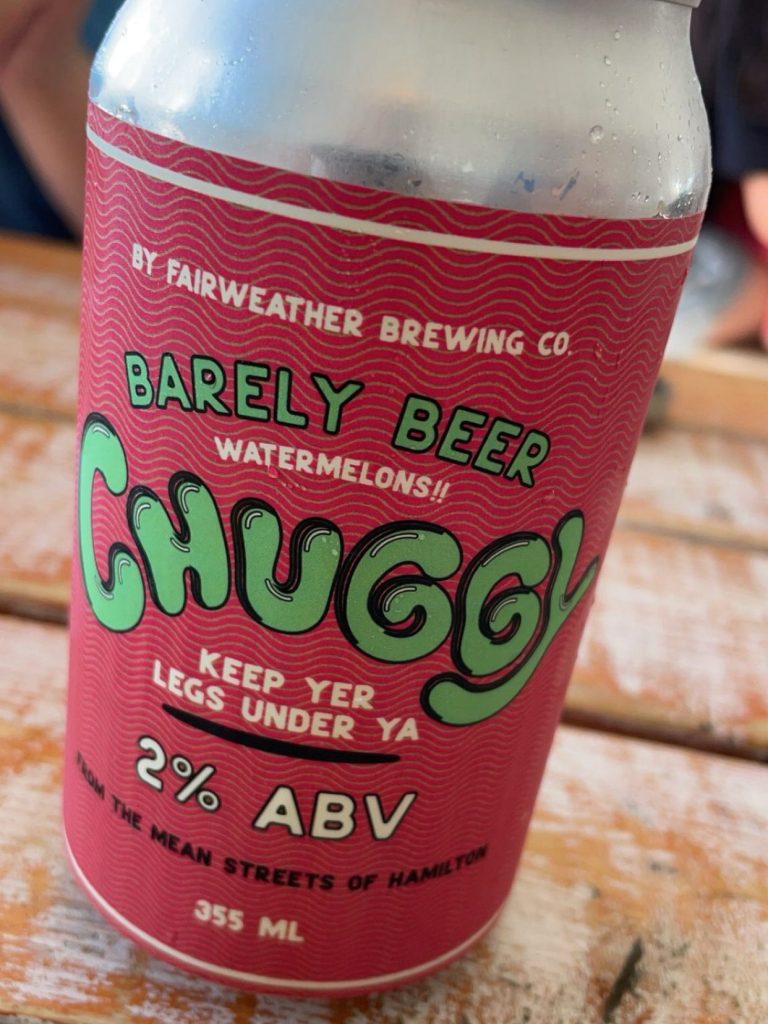
Later in our trip, we went to Fairweather Brewery which had a series of fruited ales that were 2% alcohol. They were called Chuggy, Jenn tried one of them and really liked it.
Throughout our trip, the focus that most of the breweries had was on beers with traditional alcohol content not Imperial or Double beers. The fact that a few also had beers under 3% was a nice little bonus. I wish this was something that we saw a bit more often in Iowa.
Our Favorite Breweries in Ontario
This isn’t really a full assessment of breweries in the Ontario area since we were only able to visit a few breweries in the week we were there. But I can definitely tell which ones we would’ve been visiting multiple times if we lived in the Hamilton area.
Collective Arts
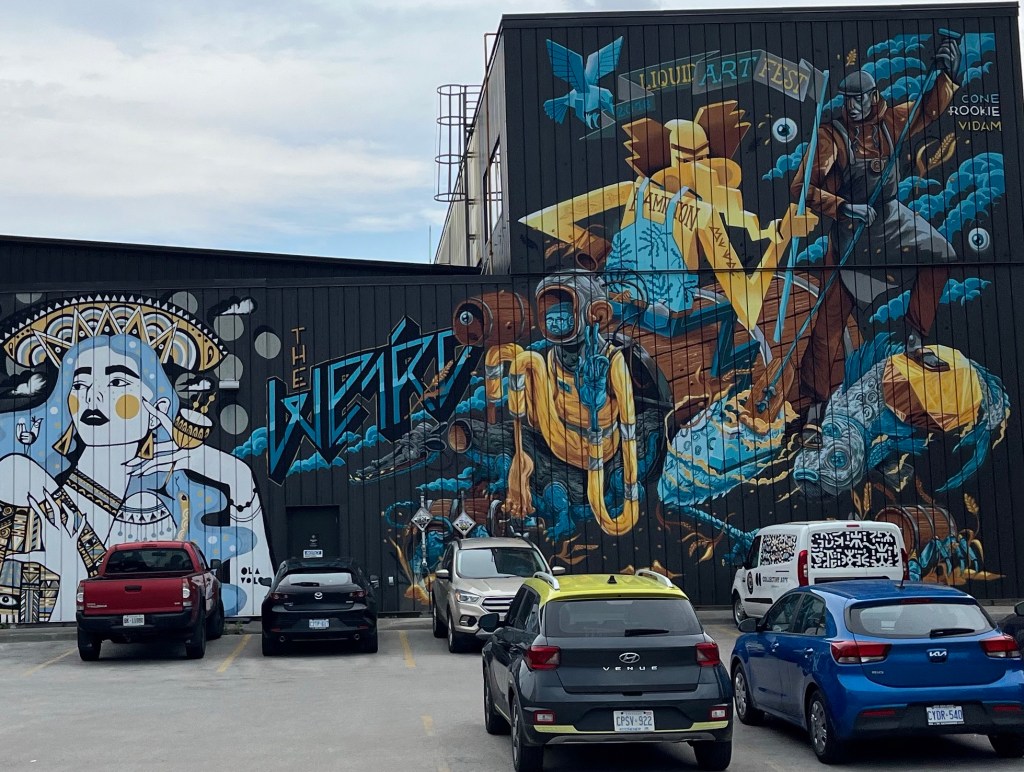
I found this one by searching around on Google Maps and it didn’t disappoint. They have an amazingly funky vibe. Art is everywhere around the facility with murals on practically every wall. It’s a huge facility but they have a cool patio area where we sat for a beer. Next to the patio area is a large industrial room that looks like maybe its used for canning and barrel aging (I’m not sure about that, I didn’t go snooping). That room also has a bunch of cafeteria style tables in it for when its too cold for the patio.
Barrel Aging at Collective Arts Brewing.
Collective Arts also has a good carryout facility and we did pick up some beer for the camper. The cans also had some great artwork. The beers that we tried, both at the facility and back at the camper, were very well done. If we lived in this area, I think we would visit regularly. For more information on Collective Arts, visit their website.
Bench Brewing Company
Bar at Bench Brewing Company
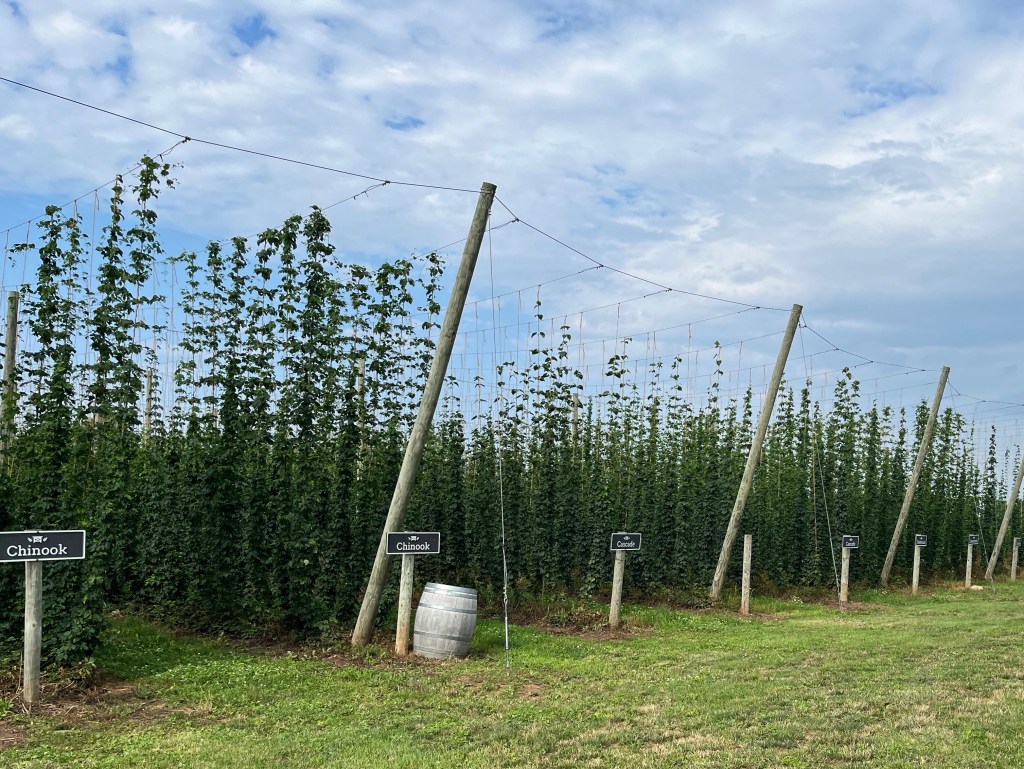
Bench Brewing Company is a large production facility set off in the middle of wine country. The facility is in a very scenic country setting with an apple orchard and several wineries nearby. They actually have their own hop farm on site.
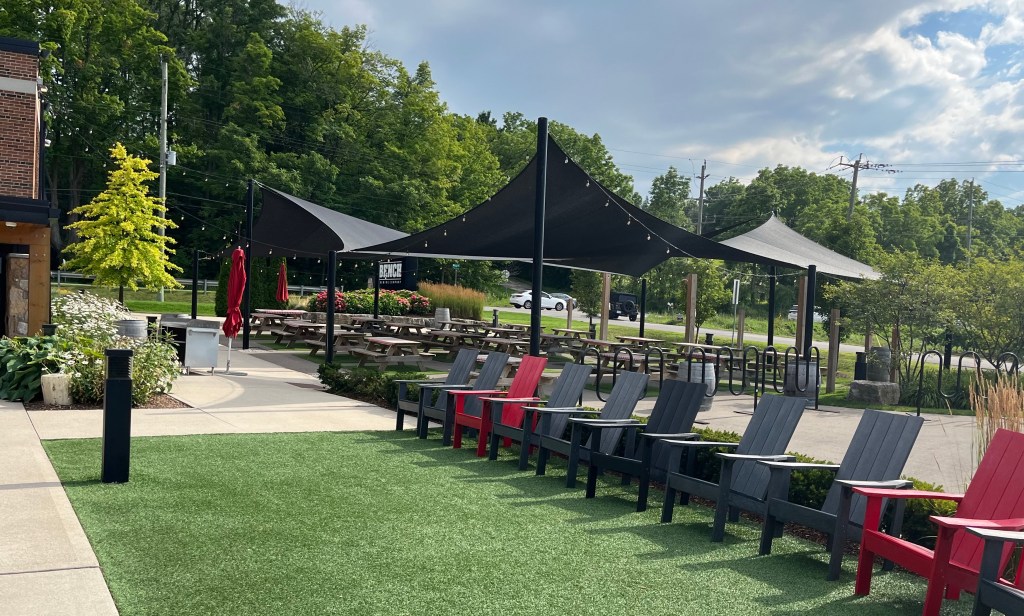
It has a little bit of an modern industrial vibe to it. The bottle and gift shop is actually two shipping containers that you have to walk past to get to the tap room. They have a large patio area and a large restaurant. Since it was a weekday afternoon, they were only offering service in the restaurant so we sat in a covered deck seating area at the restaurant. We had a little snack and a couple of beers. Everything was well done, the beers that we tried were all of session strength and well made.
Rows of hops at Bench Brewing Company
I would have liked to have spent some time in the patio area. Bench Brewing is in an idyllic and peaceful location, being at the restaurant wasn’t taking advantage of the location. If I were looking for a place to relax on a nice day, this would be the place I would want to sit outside and have a beer. More information about Bench Brewing can be found here.
Outdoor Area at Bench Brewing Company
Trust The Locals
We always like to ask the folks who work at breweries where they go for a beer. Most bartenders and servers at breweries are beer lovers themselves and tend to have very good suggestions. A couple that came up were Merit Brewing and Fairweather Brewing.
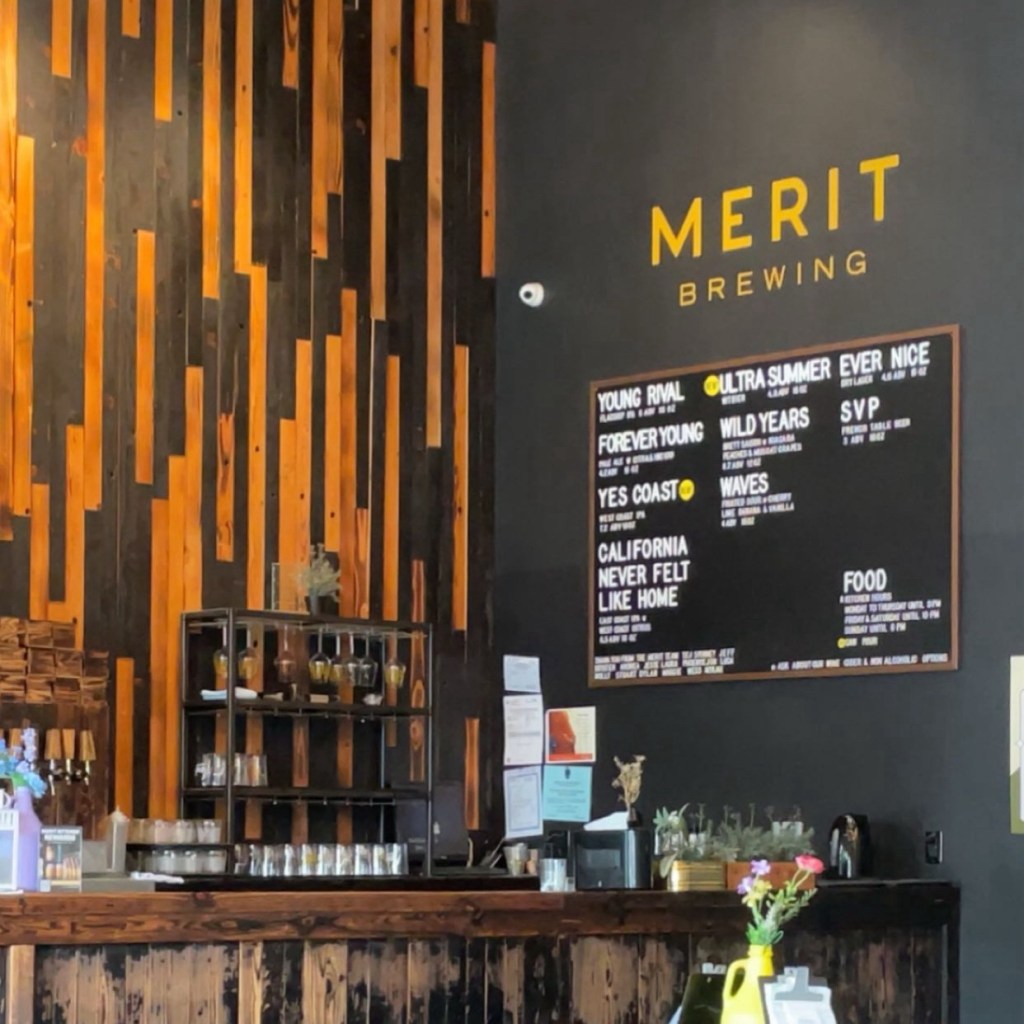
Menu at Merit Brewing
We did go to Merit Brewing and I understood the hype. There is some creative brewing going on at this facility. I’m not into sours, but I did have to try a small pour of the Wild Years, which is a brett saison with peaches and muscat grapes. Hats off to the brewer on this one, that’s a very creative beer and if you’re into sours, definitely worth a try. I also tried Young Rival, which I thought was a very good IPA. More information on Merit Brewing can be found here.
We also managed to make it to Fairweather, which wasn’t my favorite mainly because they did have a focus on sours, which again, I avoid. Jenn loved the low alcohol Chuggy beers. They are doing some creative things with sours. Right now they are serving a beer called Apsara that is a sour with peaches, milk sugar, vanilla and chai. If you love sours, I think this is a great brewery to visit. More information on Fairweather can be found here.
Silversmith Brewing
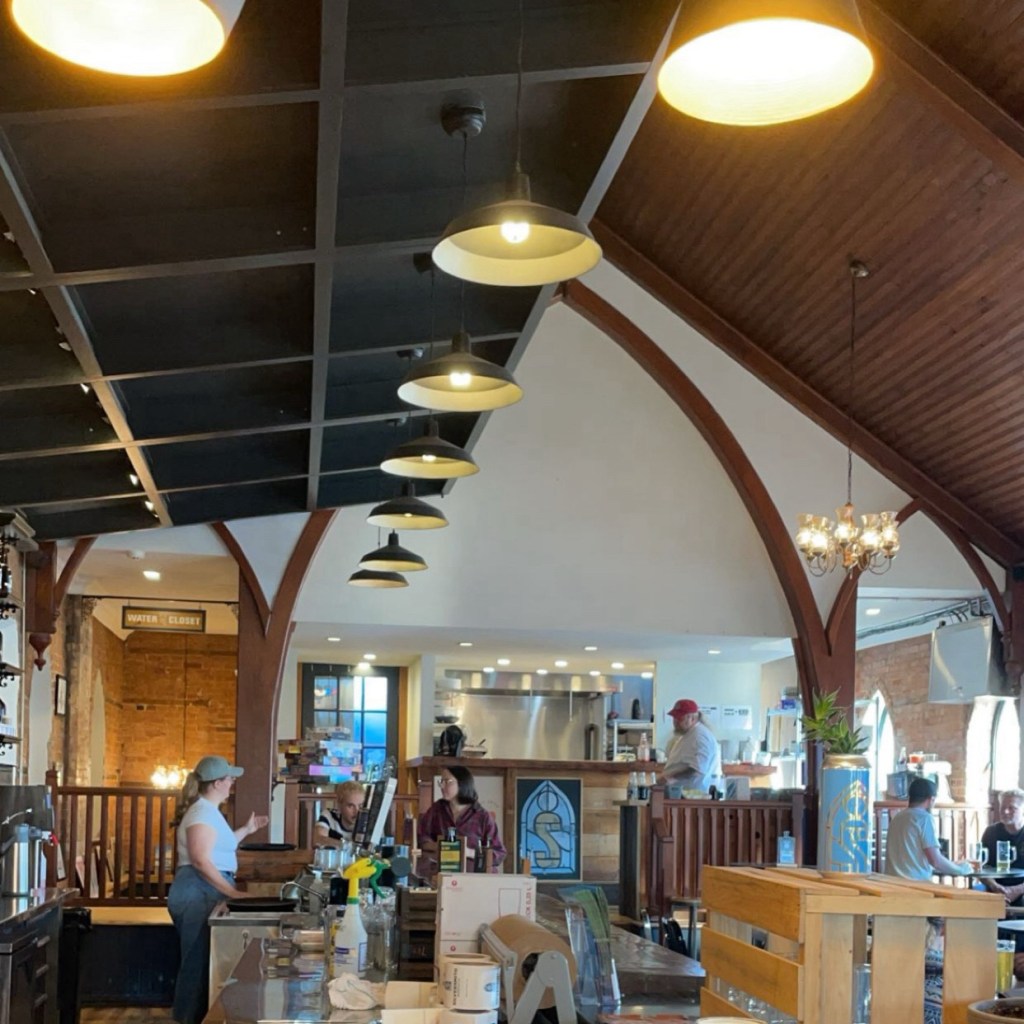
My personal favorite was a little brewery set in Virgil Ontario called Silversmith. It’s located in a little church that’s been converted into a microbrewery. It has a little patio out back where we enjoyed the warm weather and a couple of pints.
The Black Lager
I had The Black Lager, a schwarzbier which was delicious. I don’t know why schwarzbiers aren’t at every brewery to be honest. They are drinkable, flavorful, usually around 5%. They are just perfect all around beers that can be enjoyed year round. Silversmith not only brewed a great beer style, but they nailed it on the execution.
Silversmith is a converted church so I guess you can say you went to church if you go there.
Silversmith seems to focus on well executed classic beer styles and I appreciate that. There are so many breweries now that are going out of their way to invent new kinds of beer, and I applaud the creativity, but sometimes a well executed classic styled beer hits the spot. They are classic beer styles for a reason, after all. More information about Silversmith Brewing Company can be found here.
Belly Up to the Bar
The best thing about beer culture in general is the people. Wherever I am in the world, sitting at the bar is a fantastic way to talk to friendly people. Canadians have reputation for being extremely nice. Our week in Ontario confirmed that stereotype. We’re known in Iowa for being “Iowa Nice” and I can confirm that the folks in Ontario are just as warm and welcoming. Someday we’ll have to visit again.
The Avalanche Lake Trail is a beautiful wooded hike in Glacier Park. It is an extremely popular out-and-back hike in the park and follows the mostly whitewater Avalanche Creek to the gorgeous Avalanche Lake.
Getting to the trailhead requires a park pass to Glacier National Park as well as a pass to drive Going-to-the-Sun road. If you can’t secure a driving pass on Going-to-the-Sun road you can take the free shuttle service. We secured a road pass by booking a boat trip on Lake MacDonald, which you might find easier than getting a pass for the road by itself.
We found parking to be a little hard to come by, so you’ll either need to be patient and circle the lot next to the Trail of the Cedars for a while or arrive early in the day. Avalanche Lake Trail is around 5 miles round-trip, so you’ll definitely want to bring along some water, maybe a snack, and someone in your group should have bear spray.
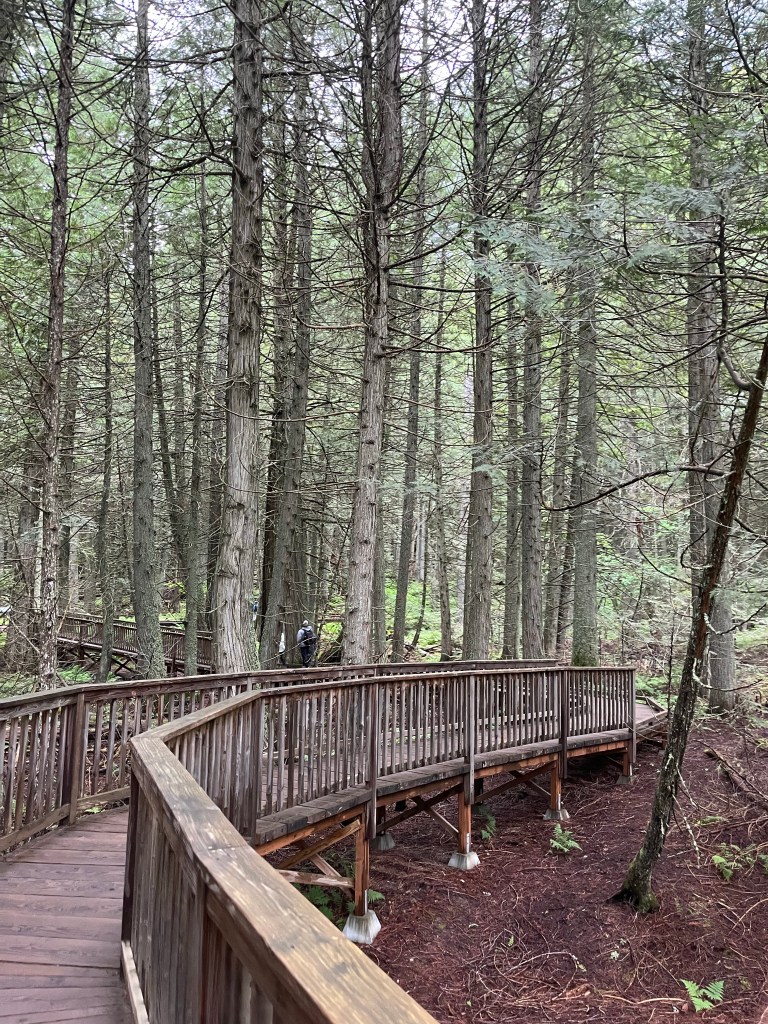
We started on Trail of the Cedars, which is a very flat, easily accessible trail. It has a lot of wooden walkways to make things easier for folks with limited mobility.
Elevated walkway in Trail of the Cedars
This is a very serene hike with tall, thin cedar trees everywhere. It is a very heavily traveled path because of how easy it is to hike. We saw a lot of parents hiking with their young children who wouldn’t be capable of doing a more difficult hike.
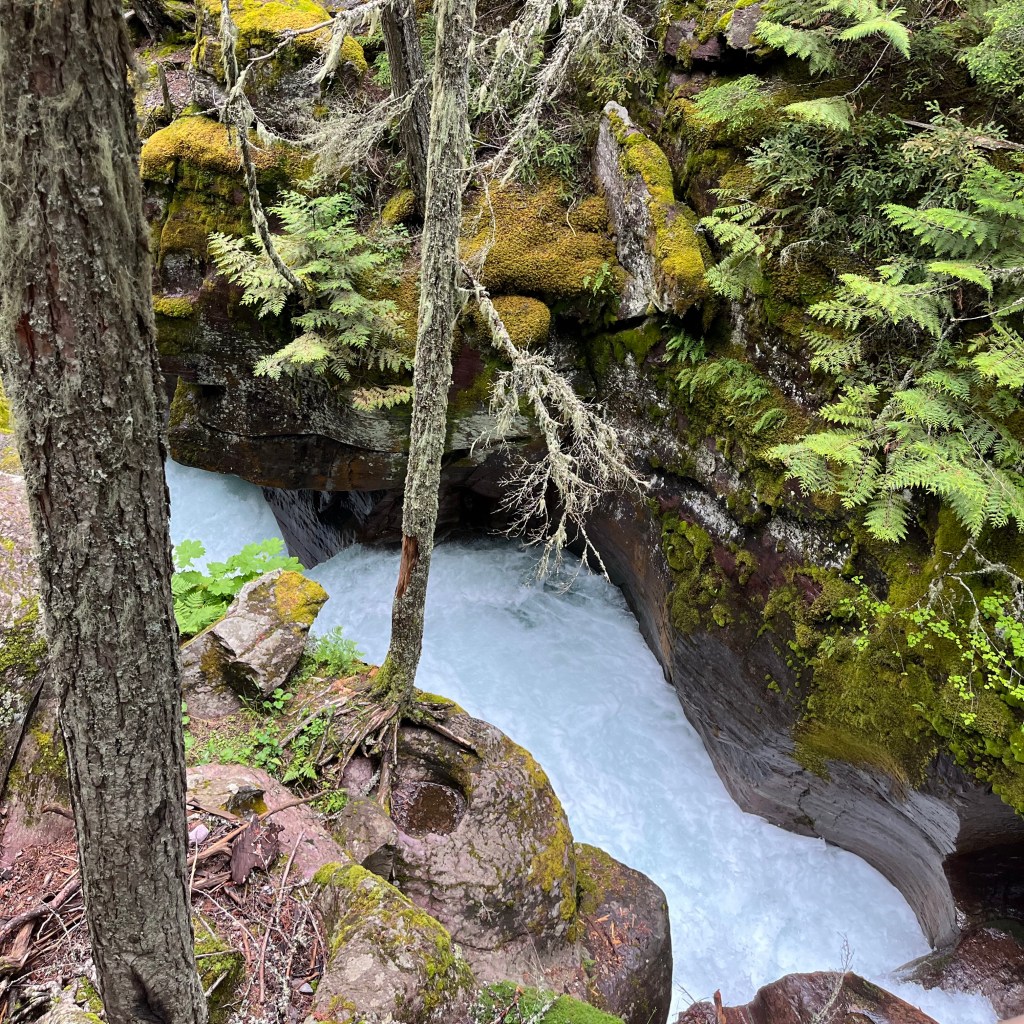
Avalanche Creek carving out a passage in rock
Along the Trail of the Cedars is the Avalanche Lake trailhead and there is a park sign marking the entrance. Once you leave the Trail of the Cedars for Avalanche Lake Trail, the hike becomes more challenging. Alltrails.com has Trail of the Cedars rated as an easy hike and Avalanche Lake Trail as moderate. For most people, Avalanche Lake Trail will be fairly easy to hike, but you should be aware of your personal fitness before getting two miles into the hike and regretting your life’s decisions.
In some areas Avalanche Creek is somewhat narrow
The Avalanche Lake Trail roughly follows Avalanche Creek from the trailhead until you reach the lake. This is a fast flowing, whitewater creek. The creek in some spots has carved out smooth mini-canyons and in other spots opens up into wide rapids flowing over smooth river rock.
Where Avalanche Creek hasn’t been restricted by a rocky passage it opens up and widens into rapids.
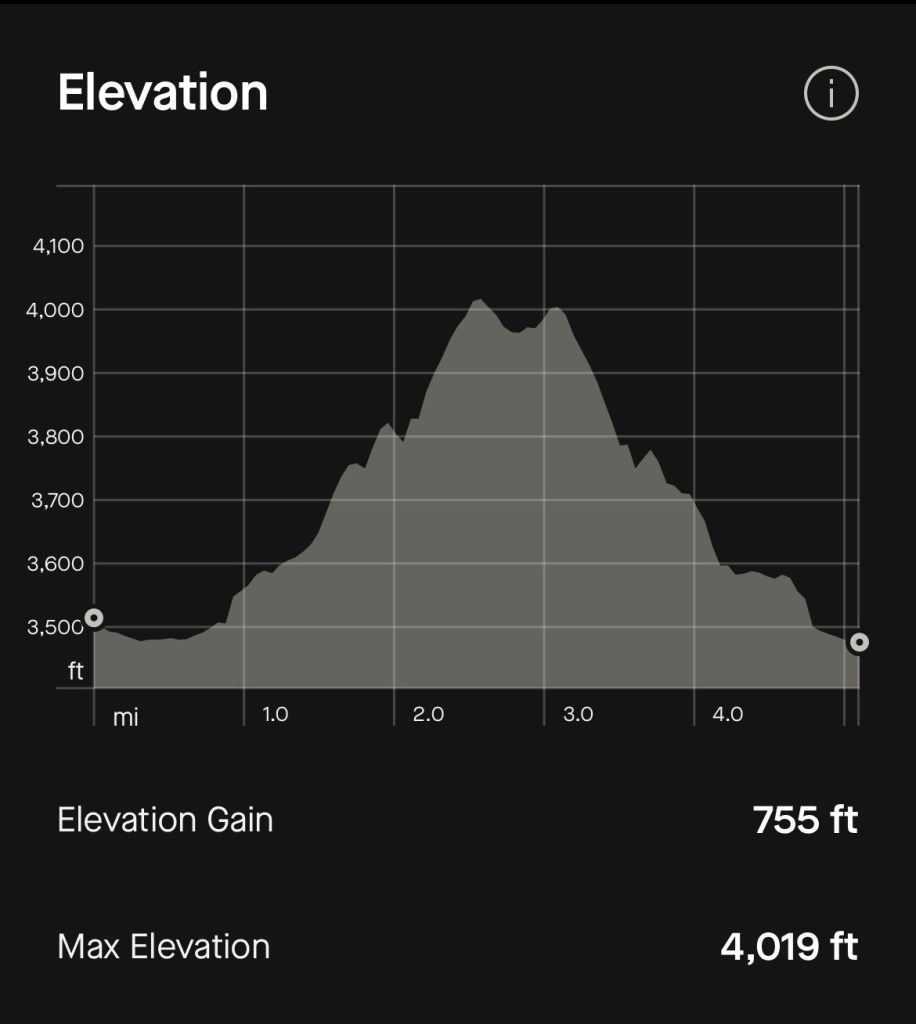
According the data recorded from my Garmin on the hike, the hike to the lake is about 2 1/2 miles and the elevation goes from around 3,500 feet above sea level to around 4,000 feet in that span, The creek basically has the same stats. Any time a creek has a 500 foot drop over a couple of miles, there will be a lot of whitewater.
There are plenty of times that the trail veers away from the creek which lets you enjoy the forest. Most of the trail itself is fairly wide and comfortable to walk. There is quite a bit of traffic on the trail, but because the trail is wide, there is plenty of room to maneuver around other hikers.
Some of the mountains in the area of the trail.
After a little over a couple of miles, we arrived at the lake. In my opinion, there is nothing more stunning than a mountain lake, and this is a breathtaking one. The beach is filled with smooth rocks and the water is crystal clear. The water was extremely calm which made for a perfect mirror of the sky and mountains in the background.
Avalanche Lake from the beach at the end of the trail
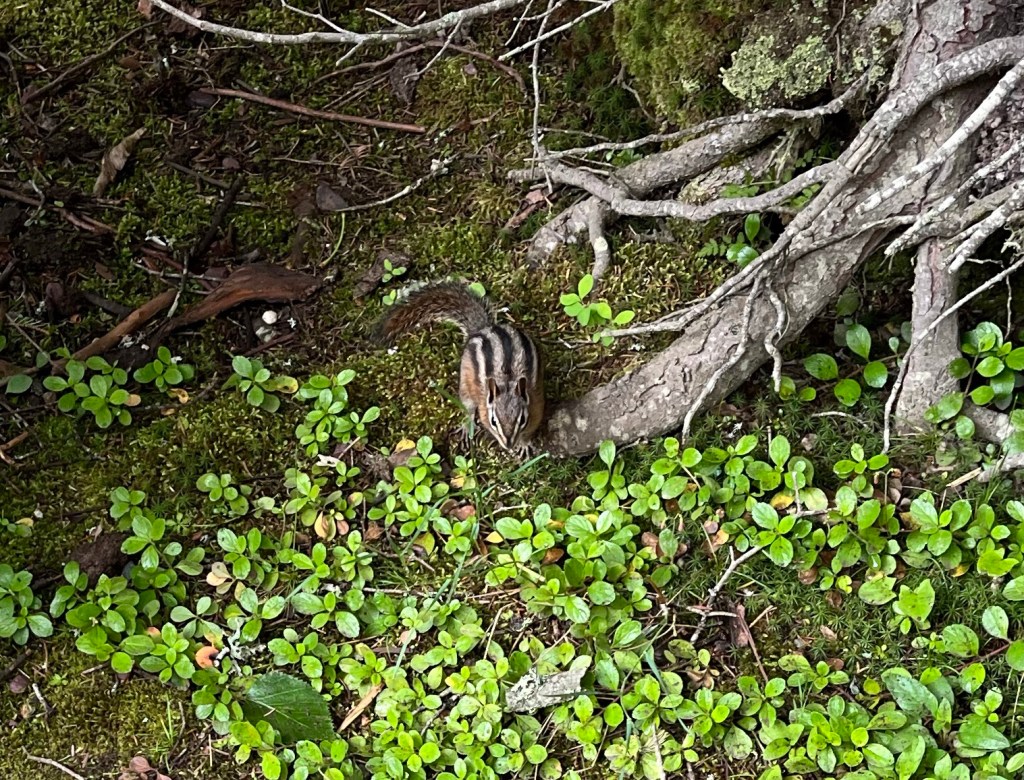
The shore itself was lined with hikers and we found a little chipmunk who had grown accustomed to begging for snacks from the hikers. He was rewarded by one who gave him a little chunk of a snack bar.
Fairly tame chipmunk
While we were there, I caught the end of what was a young man proposing to a young woman in front of their friends and family. She said yes, and everyone cheered. Congratulations to the happy couple and I have to say that was an excellent choice of location for the proposal.
Avalanche Lake
After resting, having a snack, congratulating the couple, and taking a ton of photos and selfies, we headed back to the trail. The hike back is quite a bit easier, since now its dropping 500 feet over 2 1/2 miles instead of climbing it.
Tall pines along the trail
It gave us a second chance to view all of those beautiful rapids that the creek has created on our way back to the parking lot.
Avalanche Creek
The Avalanche Lake Trail is the most consistently beautiful trail that I’ve ever hiked. From the pine trees, to the mountains, to the whitewater and finally the calm mountain lake, there just isn’t a boring or ugly spot on this trail. It is beautiful from beginning to end and I would recommend this trail to anyone who has the opportunity to take it.
Niagara Falls is one of the oldest and best known tourist spots in North America. Dividing the United States from Canada, the St. Lawrence River has been carving out the landscape remaining after glaciers retreated at the end of the last ice age for around 10,000 years. Because of the 160 foot difference between the top and bottom of the falls and the massive amount of water that flows over the edge, it makes for dramatic views.
American Falls
We arrived in Niagara Falls, Canada around 10 AM, and parked in the parking lot near the amusement park. We paid $20 CA to park, but based on the reviews, I think that’s a variable price based on whether its a weekday, weekend, summer, etc. From there we walked down Clifton Hill, which is a street with all of the ridiculous tourist trap things like a wax museum, a Ripley’s Believe It or Not, and lots of gift shops.
Rainbow International Bridge and American Falls
Once we walked past the tourist traps, we finally got a view of American Falls. American Falls are the less dramatic falls to the north of the Horseshoe Falls, which is what most people think about when they think of Niagara Falls.
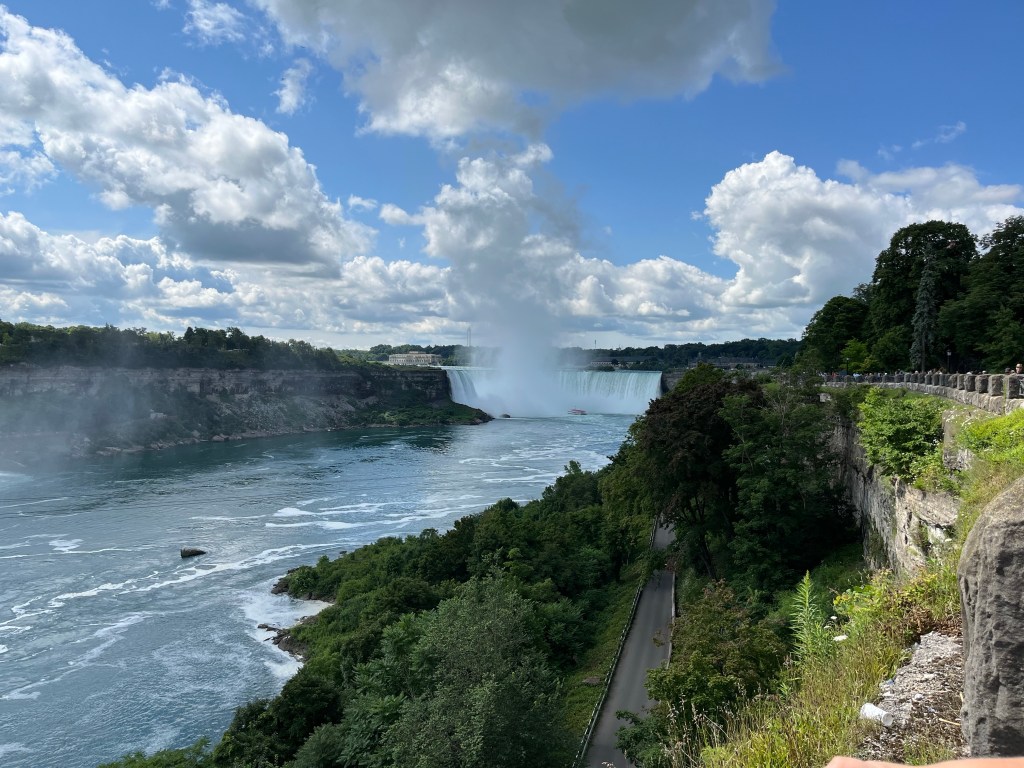
Looking towards Horseshoe Falls along St Lawrence River
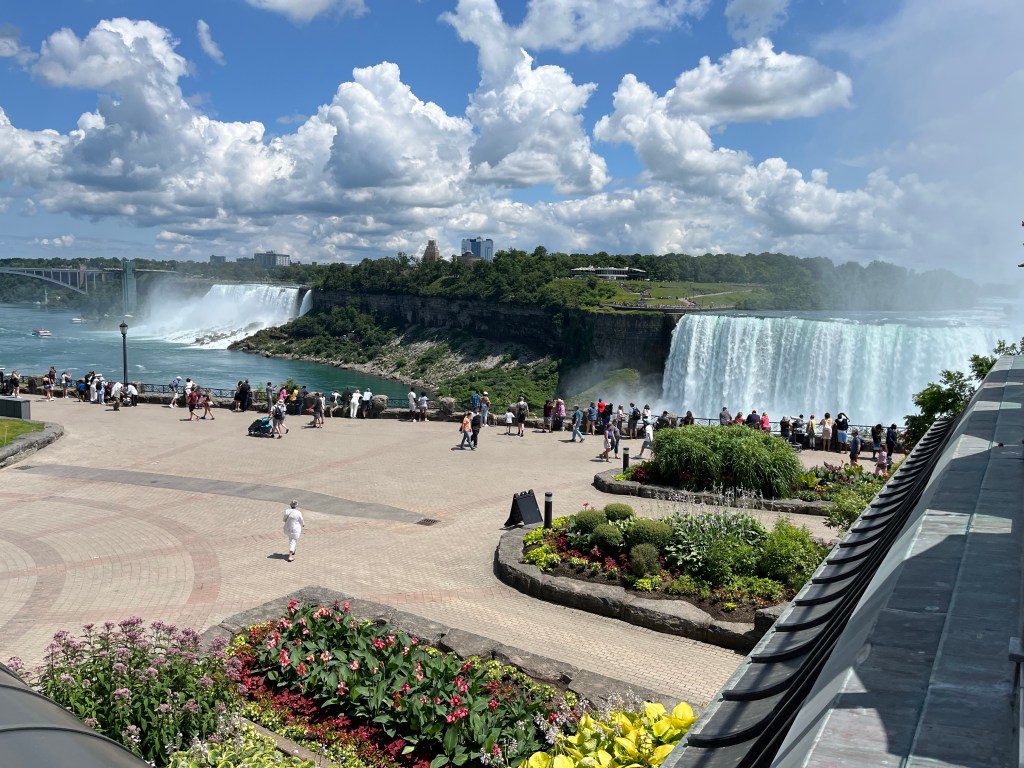
We made our way down to the walkway that edges the St. Lawrence River. From there, we saw the entire wonder of Niagara Falls with Horseshoe Falls off in the distance to the right and American Falls directly in front. The walk from the end of Clifton Hill to the Table Rock Welcome Center by Horseshoe Falls is almost a mile walk.
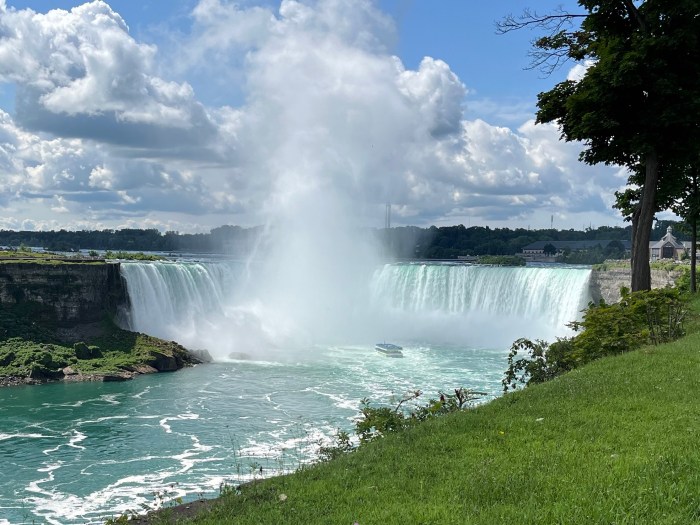
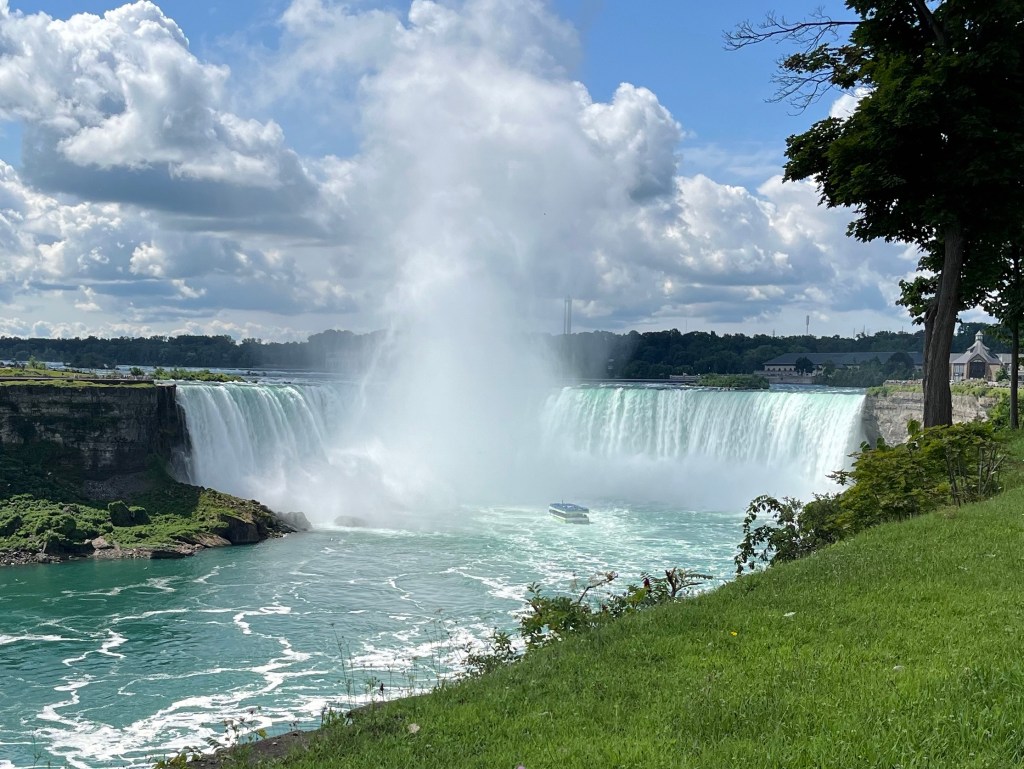
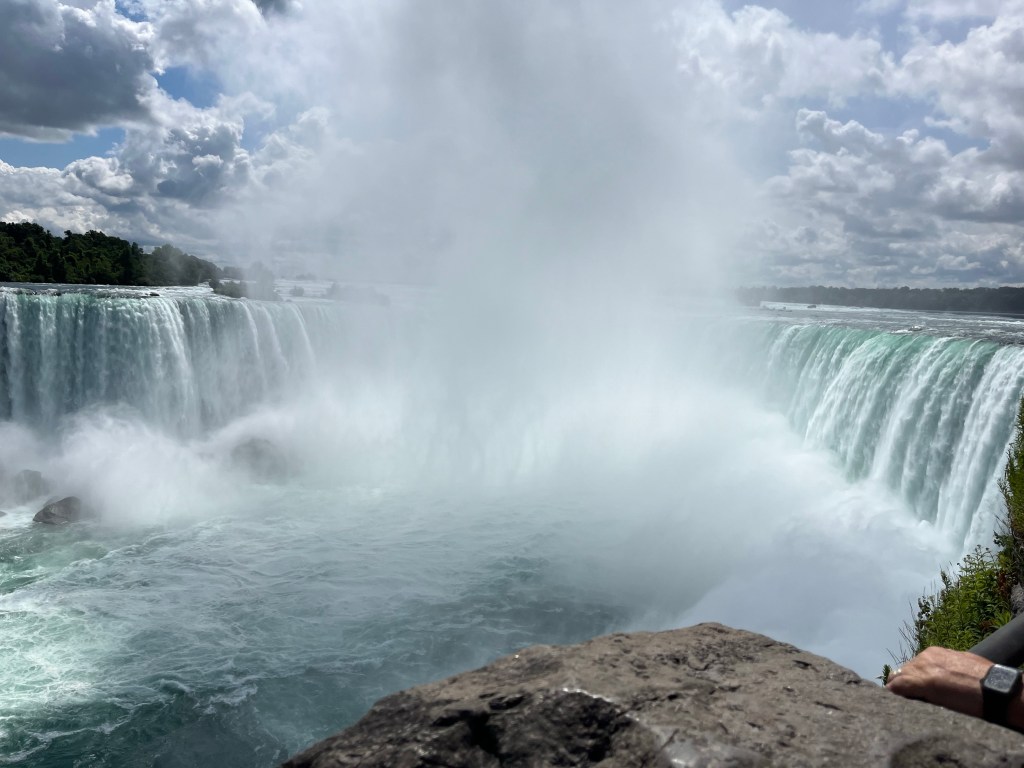
Mist climbing from Horseshoe Falls
Walking along the St Lawrence River has a similar feel to a lot of popular tourist destinations. There are people lined up along the railing taking photos, people speaking in a variety of languages, and vendors selling keepsakes. This is one of those places where people are in a good mood, spending time with their families or friends and just enjoying a nice walk in a beautiful spot.
Horseshoe Falls from in front of the Table Rock Visitor Center
The Welcome Center was extremely busy, but I think that’s pretty normal. We walked past a fairly large gift shop to get to the ticket counter. The ticket counter was busy selling tickets for several attractions. The main ones are the White Water Walk, Whirlpool Aero Car, Power Station tour and the Journey Behind the Falls.
We decided to do the Journey Behind the Falls tour, and quickly jumped into line once we paid for the tickets. It took about an hour to get through the line, and they queue you through a museum-like area to teach you a few things about the history of the falls while you wait. Essentially, the tunnels only have so much space in them and they have to wait for others to leave before you can go down into the tunnels. We did notice on our way out that the line was three times as long, so I’m glad we arrived fairly early.
View from the observation deck on Journey Behind the Falls
Clad in the yellow ponchos that we were handed while in line, we headed down in the elevator. There is really only two attractions for the Journey Behind the Falls, the first one is the observation deck. The observation deck is a huge patio area near the edge of the falls. This really gives you a sense for the power and volume of the water rushing over the edge of the falls. It’s also the place where about a dozen selfies per second is taken because it is an absolutely beautiful place to take photos. Unfortunately everyone has their photos taken with an unflattering yellow poncho, so there are drawbacks.
View from behind the falls. It feels a bit like a scene from an escape from prison movie.
After we were done with the observation deck we headed back into the tunnels to see the falls from behind the water. Construction crews carved out tunnels behind the falls which allow you to see a very small part of the falls from behind them. It doesn’t really give you a great view, but it does give you a sense of just how powerful these falls are. The water rushing over the end of the tunnel is fast and loud.
Once we got our chance to stand up close to the end of the tunnel, we headed out and then went up to the restaurant on top of the Visitors Center. We weren’t hungry yet, but we wanted an opportunity to relax and enjoy a beautiful view of the falls. They called themselves a wine bar, but once we were seated, we realized that they had an interesting variety of local microbrews, so we ordered flights, all of us, except for Alex, of course, who I think got a lemonade.
My flight of microbrews with a peek at American Falls.
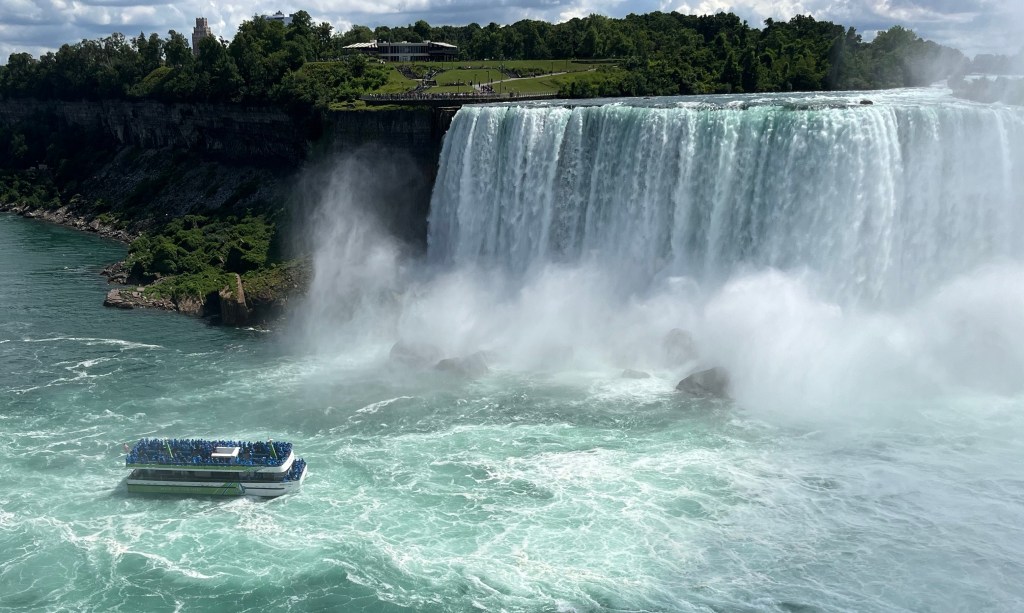
They originally sat us away from the railing, but we were asked to be moved when someone got up from a table by the railing and they were happy to let us move. The view from this restaurant is spectacular, and we had a pretty close view of Horseshoe Falls as well as American Falls off in the distance. We were also able to watch as one tourist boat after another approached the falls, stayed as still as possible and then retreated back to the docks. The number of full tourist boats that approach the falls is impressive. They are even color coded, with the tourists on American boats wearing blue ponchos and the tourists on Canadian boats wearing Red ponchos.
Tour boat from the American side (note the blue ponchos) approach Horseshoe Falls.
We finished up our drinks and headed back on the mile walk back to the car taking in the beautiful scenery along the way. We didn’t spend a ton of time at Niagara Falls, but I feel like we got a great sense of what it was like. We would like to experience Niagara from the American side, so there is a good chance that we will return and perhaps do a boat trip.
View from Wine Bar
All in all, it was a beautiful day to experience one of North America’s great natural wonders.
Normally, I’m the one who does the planning for our family trips. However, I recently found myself in Montana with a group of my old high school friends who made the trek to see our friend Mat get married. It was pretty obvious early on that they were on top of it and I could just show up and enjoy it. I knew that we would be going to Glacier National park as part of this, but I didn’t do an ounce of research on it before we left, which is very unusual for me.
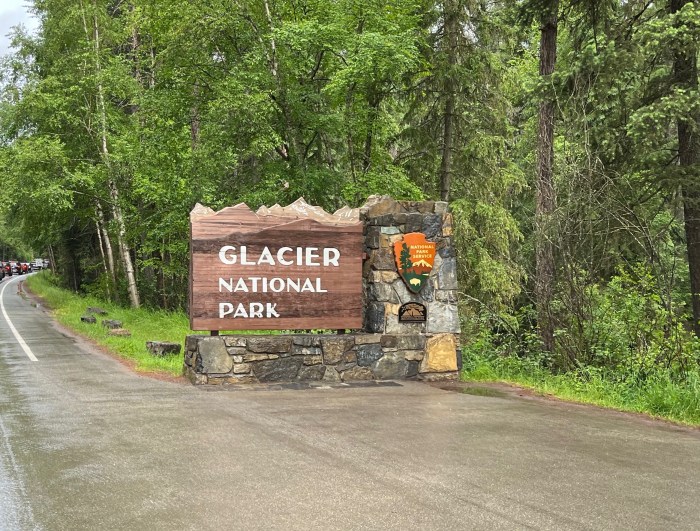
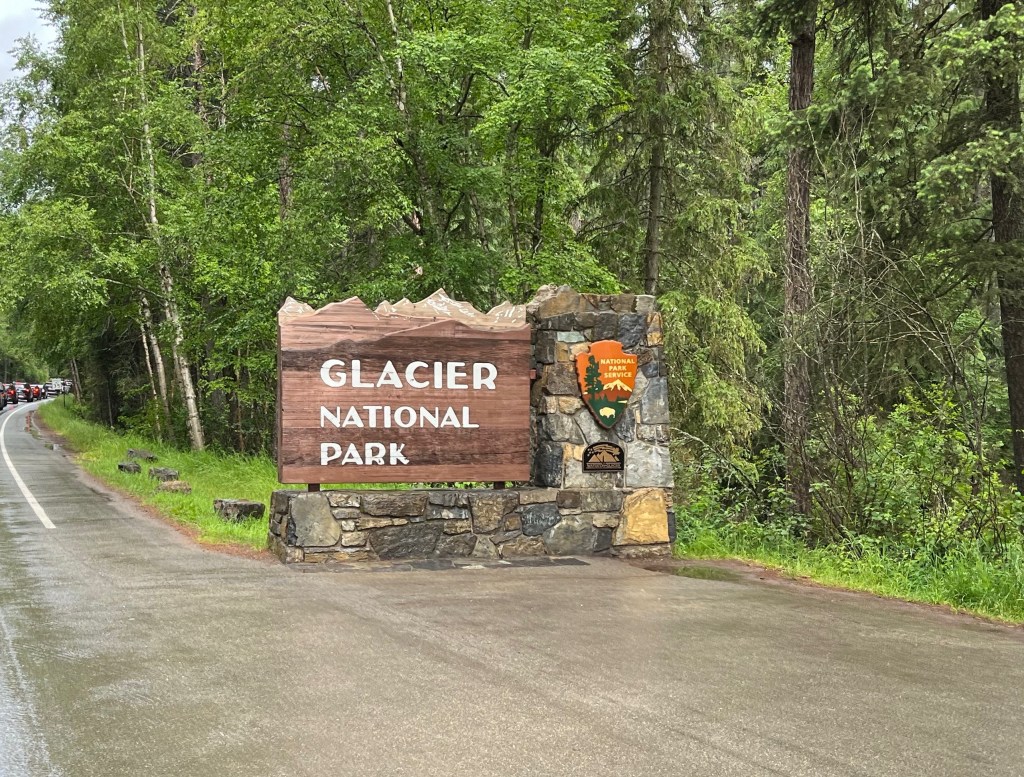
Glacier National Park Entrance Sign
On the first night, we went to Tamarack Brewing for dinner. I was enjoying an IPA while we caught up on old times. The conversation switched to how we would secure passes to “Going-to-the-Sun Road”. Tracy said she would set a reminder for 7 p.m. the next day, which was during the wedding reception, to get the car pass.
Having done zero research for this trip I thought the pass was for “Sun Road” and she just said that in a weird way. Then I heard some of the others say things like “It will be fun to drive Going-to-the-Sun road” and “I’m glad they managed to get Going-to-the-Sun road open.”
I started to strain my ears and look quizzically at them. What’s going on, am I having a stroke? These are all smart, accomplished people, why are they talking like they just learned English last week? Once I figured out that the road was called “Going-to-the-Sun Road,” I was both a little relieved and still a little confused by why a road would be named that.
What is Going-to-the-Sun Road?
According to the National Park Service, Going-to-the-Sun Road is a two lane road built in the late 1920’s and early 1930’s. It is 50 miles long and essentially bisects Glacier National Park from Apgar to St. Mary. It is the only road that goes through Glacier National Park and is one of the most scenic roads in the United States.
The road is named for Going-to-the-Sun Mountain. It is unclear whether the origin of the mountain’s name is based on a Blackfoot Indian legend about the deity Sour Spirit teaching the Blackfoot to hunt or whether the explorer James Willard Schultz made up the name.
Getting a Pass for Going-to-the-Sun Road
The number of cars allowed on Going-to-the-Sun Road is limited. This is to keep the narrow two-lane road and especially the small parking areas on the side of the road from being overwhelmed by cars. Reservations for Going-to-the-Sun Road can be made at Recreation.gov.
There are two types of reservations, one that can be made 120 days in advance, if you have sufficiently planned ahead, and one that can be made at 7 p.m. mountain time, the day before. Tracy grabbed our pass at 7 p.m. which is why she needed to do it during the wedding reception.
The next morning we packed up the minivan and headed out to Glacier National Park. After a quick stop for coffee and breakfast, we had to check our park passes at one set of security and then our pass for the Going-to-the-Sun Road at a second security stop. Once we were through security, we were on our way.
Driving Along Lake McDonald
The drive begins from Apgar along Lake McDonald. Lake McDonald is about 10 miles long, about a mile wide and a pretty impressive 472 feet deep. The beginning of this drive is a beautiful and calm drive through the forest with Lake McDonald on the left hand side. It remains a pretty calm drive past Lake McDonald Lodge, the Trail of the Cedars and up until you hit the West Tunnel, about 20 miles into the drive.
Tunnel cut into rock face
The Ascent to Logan Pass
After the West Tunnel, there is a switchback and then a constant and gradual ascent toward Logan Pass. This is the beginning of a long stretch of road built on the edge of cliffs with long beautiful vistas, waterfalls and mountaintops poking out through the clouds.
View of a valley on the way up to Logan’s Pass on the Going to the Sun Road.
Being the driver is a definite disadvantage. Tim was our driver and while the rest of us were gawking over the views, he had to pay attention to the road. Going-to-the-Sun road is an active driving situation with narrow lanes, tight curves and frequent stops. The temptation to stare at the landscape instead of the narrow road has to be pretty intense.
Much of the early part of our ascent to the pass was marked by a lot of fog, but it made for dramatic views of the mountains and valleys when they cleared.
Ascending up towards Logan’s Pass, we entered the clouds.
At one point, we caught a quick glance of a Big Horn Sheep or a Mountain Goat right on the side of the road, just poking his head out from behind the stone wall, but it happened so fast my brain didn’t fully process it. We stopped at the next pull-off but couldn’t see him, so I don’t know what exactly we saw but it had horns and it was right next to the road.
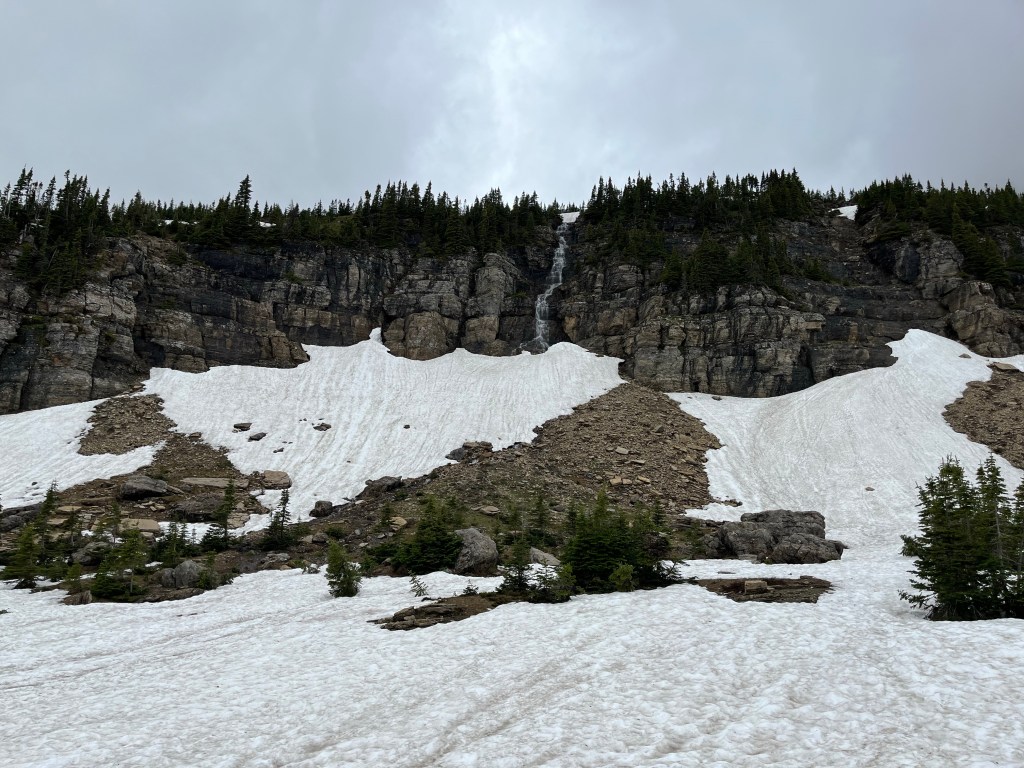
Waterfall where Adler Creek goes under the Going to the Sun Road.
As we continued our ascent, we started to come across snow. It became very obvious why they aren’t able to open the roads until June or July because the amount of snow that has to be removed every year is massive. The remainder of the snow accumulation was still pretty deep by the side of the road in some spots.
According to the National Park Service, Glacier National Park receives an average of 157 inches of snowfall per year at its headquarters in West Glacier and much more at higher elevations. Opening Going-to-the-Sun-Road is a massive undertaking that starts around April and lasts for months. This past year, they had to deal with a drift that was 80 feet high, so it takes a long time for this snow to melt completely.
Snow on the side of the road, slightly before Oberlin Bend
We got out of the car on multiple occasions to take photos at pull-offs along the road, but we got out to walk around at Oberlin Bend. There is a wood and steel grate walkway there. There was still a considerable amount of snow left in the area and it gave us a sense of how long it must take for it to melt every year – this was June 30th!
It was still very snowy at Oberlin Bend
Logan Pass and the Highline Trail
Just a little bit further up the road from Oberlin Bend, we then had a chance to stop at the Logan Pass Visitor Center. There is some bathrooms and a cute little gift shop there. Steph and I took a little walk out the back of the visitor center and she showed me the people who were hiking the Highline Trail.
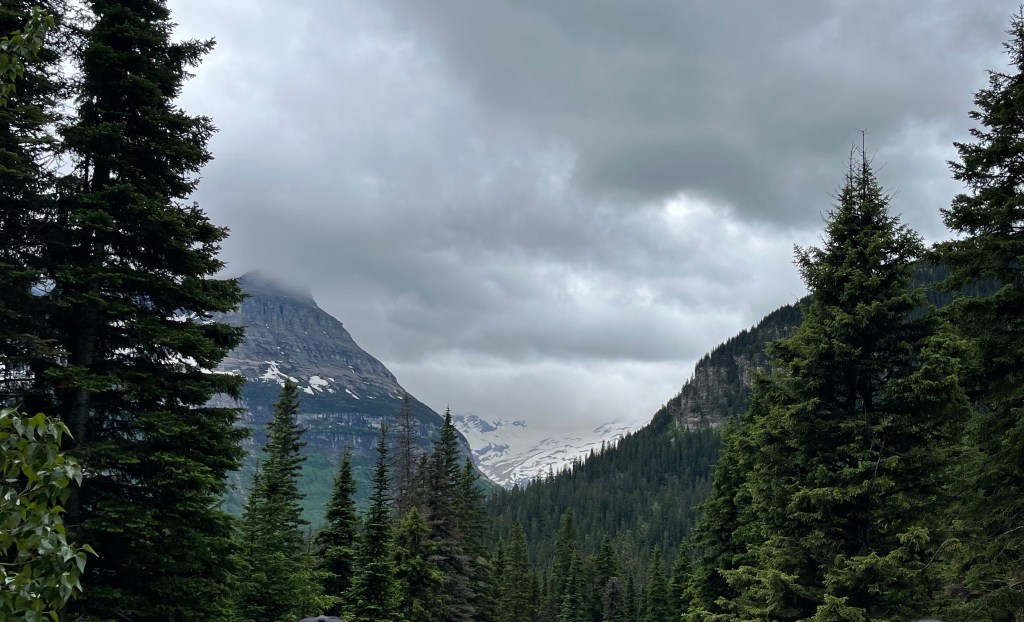
Mountain obscured by clouds near Logan Pass
Prior to the trip we briefly considered doing that trail, but decided to do the Avalanche Lake hike instead since it was considerably less terrifying. The Highline Trail is known for its breathtaking views and a section called “The Ledge” which is only 6-8 feet wide with a sheer drop over a hundred feet down. There is a steel cable to hold onto in this section. If you’re brave enough, parking for people doing the Highline Trail is available at Logan Pass Visitor Center.
Jackson Glacier Outlook
We got back in the minivan and continued on, now going downhill. We stopped at the Jackson Glacier Overlook, where a ranger explained to a fairly large group about the remaining glaciers in the park and how the number of glaciers and size has been shrinking since around 1850. That overlook, of course, has a view of Jackson Glacier, but it is quite far from the overlook.
Way off in the distance is Jackson Glacier, one of the 26 remaining glaciers in Glacier National Park. There were 80 at the end of the Little Ice Age, which ended around 1850.
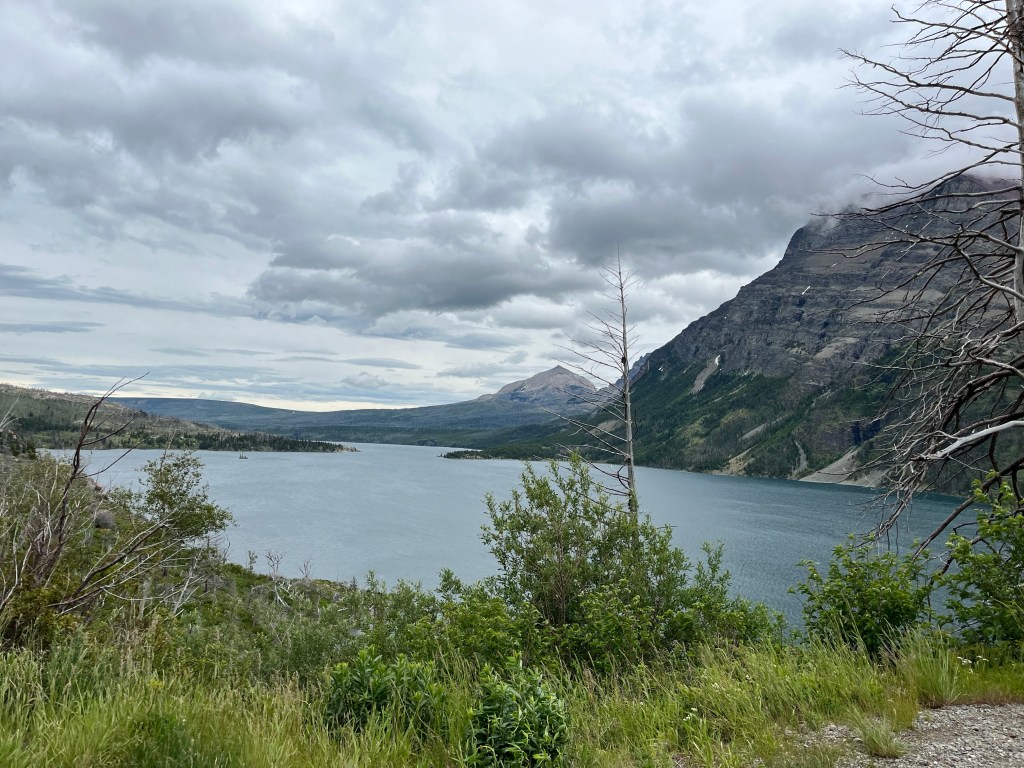
St Mary’s Lake
We completed the drive by stopping at the Visitors Center at St Mary. There is a little gift shop in there as well as some museum-like exhibits about the history of the Native American people indigenous to the area.
St Mary’s Lake
As is going to be the case for most people on the Going-to-the-Sun Road, we needed to do the entire drive back to the start at Apgar, so we returned to the car for the 50 mile return trip.
Piegan Pass Trail
When we did the first half of the drive, we didn’t get to do a hike near St Mary’s Lake. We tried on the way through the first time to get a parking spot on one of the pull-offs near Piegan Pass Trail but couldn’t. On the return trip, after a little work, we were able to get a parking spot and get out and stretch our legs a little.
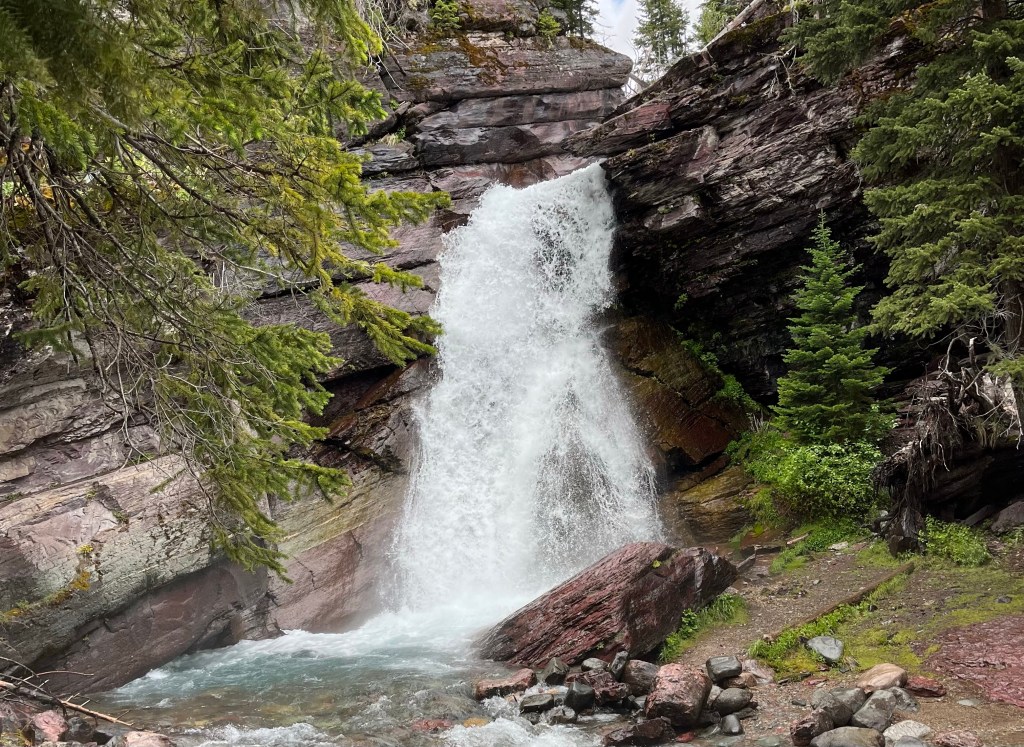
Bering Falls on Piegan Pass Trail
We walked a very short distance to see Bering Falls and then turned around and walked to along the path to a point which I believe was the end of Piegan Pass Trail. There is a rocky area jutting out into St Mary’s Lake there where there was a lot of great photo opportunities.
View of St Mary’s Lake from Piegan Pass Trail
Piegan Pass is a heavily traveled trail, at least in this area, so the odds of being approached by a bear is low. We did bring along bear spray just to be sure, but there were no signs of bears in this area. We hiked around 3 miles, and returned back to the minivan to finish our drive.
St Mary’s Lake from the end of Piegan Pass Trail
A Bear Sighting
Near the end of the return trip back to Apgar, we came across a traffic jam. Obviously, we weren’t expecting a traffic jam on Going-to-the-Sun Road, so we assumed that there must be an animal around. Once enough cars had cleared, we pulled off to the side of the road to see what was going on.
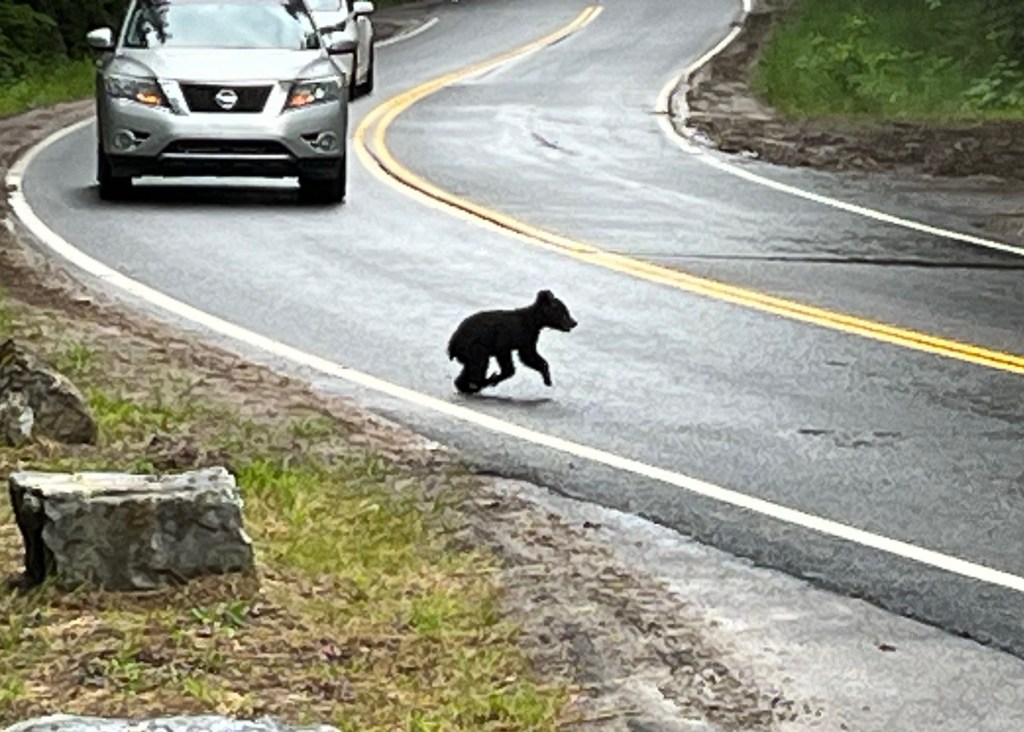
The cub is looking for mama, definitely thinks she’s across the road.
There was an animal making noise by the side of the road, and it was a sound I wasn’t familiar with. After a little while, I saw a baby bear head pop up on the side of the road. It was very clear that the bear was in distress and probably looking for his mama. Now, honestly while that is adorable, it’s also pretty terrifying since I’m assuming a stressed mama bear must be nearby as well.
The cub makes an attempt to cross the road but gets scared back into the tall grass by a car.
The cub made several attempts to cross the road, but kept getting scared off by traffic. Finally Tim jumped out into the road and stopped traffic so that the bear could finally cross and hopefully be reunited with his mama.
Tim stops traffic and finally allows for the bear to cross the road.
The Importance of Great Travel Companions
If you’re driving Going-to-the-Sun Road, you will be spending probably a minimum of 6 hours with people in a car, assuming that you are at least stopping once in a while to take pictures and enjoy nature. Spending that much time in a car, you might want to have people with you that you also enjoy spending a minimum of 6 hours with.
For me, this turned out to be a great group with whom to do this drive. We talked about the old days, our families, and a lot about travel. Obviously, I like to talk about travel, but sometimes feel a little weird about it. Honestly, I avoid the subject with people who don’t travel much, because they’re either not interested or I’m afraid it comes off as braggy. It’s something that I’m really passionate about and to have spent a few days with people who are as passionate about travel as me made for great conversations.
The crew being silly. From left to right: Julie, Tracy, Steph, Carrie and Tim.
I loved hearing about all of the places they’ve been and I’ve certainly taken some mental notes about places that I might want to visit based on our conversations. In between all of these conversations, there was also plenty of carpool karaoke, which I abstained from to save everyone else’s eardrums. In the end, it was a great time with some great friends.
I would definitely recommend driving Going-to-the-Sun Road if you get a chance. It’s an unbelievably beautiful drive. The variety of views from mountain lakes and snow covered peaks to waterfalls is astonishing. It’s also one of the few really accessible places in Glacier National Park for people who aren’t doing long hikes. Keep in mind that the number of car passes are limited and you will need to purchase those in advance. Then all you need is a full tank of gas, some great friends, and some snacks and you will get to witness one of America’s great treasures.
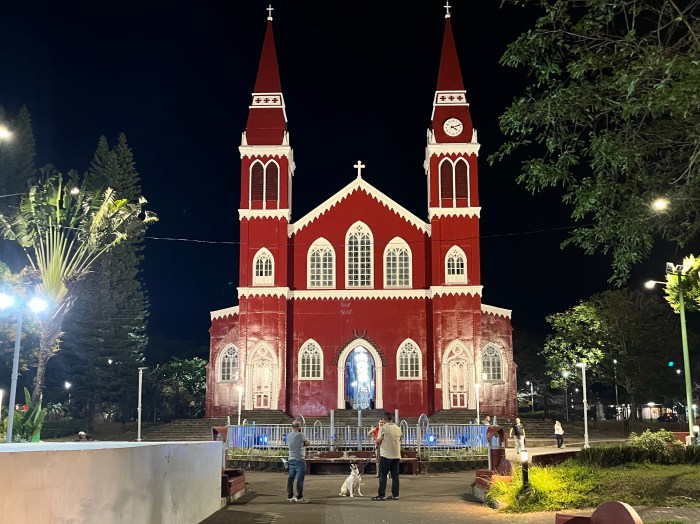
Grecia is centered around the big metal church in the center of town called Iglesia de Nuestra Señora de las Mercedes.
We spent about a week in Grecia, a community with a population of about 15,000 residents, located in the Central Valley of Costa Rica. Of the places where we ate and drank, there were a few that stood out in our minds that are worth a visit while in town.
There were some places that we didn’t care for so I won’t mention those, but there were a few that we really enjoyed and I thought I’d share them here, in case you find yourself in the Grecia area.
El Chante Gastrobus
El Chante Gastrobus is a funky restaurant with a couple of school busses that form the side walls of a pavilion. One of the busses is used as the kitchen while another has diner style tables where the seats used to be.
There is art everywhere at El Chante with murals on the busses as well as tables made out of what appear to be a variety of reclaimed materials, including a bus door.
My impression of the food was that it was pretty good, not fantastic. I ordered a dish that had french fries, queso, pulled pork and toppings.
The beer selection had pretty much all of the typical Costa Rican staples such as Imperial, Pilsen, and Bavaria. They also had some other fairly normal international favorites like Corona, Stella Artois, and Heineken. There was a good selection of mixed drinks. This place seems like a perfect place to stop and have a few drinks and maybe a snack. It’s a pretty fun place to hang out.
Table made out of two barrels and a bus door
As a bonus for El Chante Gastrobus, it is located basically in a huge parking lot. Parking can be difficult to find in Grecia, and I appreciated being able to park my car easily and walk in. There was a small charge, maybe $2-$3, which is pretty standard in Grecia.
Los Jardines Vivero y Cafe
We saw this restaurant while driving by it one day and said that we had to stop in there. It turned out to be a great decision. This is just a great restaurant that serves traditional Costa Rican food in a really fun atmosphere.
We came in for lunch and everyone ordered Casado which is a Costa Rican combo meal traditionally served for lunch. They are various combinations at different restaurants but here it came with rice, beans, plantains, a mini-salad, and your choice of protein. They also gave us iced tea and ice cream with the meal.
We had Casado a few times while in Costa Rica and this was our favorite. I thought everything was extremely well done and the plantains were perfect.
Los Jardines has a lot of antiques and little gardens scattered around the restaurant. It makes you want to walk around and get a look at all of the little touches that they have set up throughout the restaurant. We even sat at a table where all of the seats were swings. It was just a nice, fun place to have a meal.
I have read a lot of reviews talking about how busy it gets there, and I will say it was almost empty for lunch, so that might be a great time to check it out. The food was great, the atmosphere was fun and the prices were pretty reasonable. Definitely worth a visit.
Vuelta al Mundo
In downtown Grecia, across the street from Grecia Park is Vuelta al Mundo. It’s located inside Mangifera Hostel. Its tucked in the back of the building in an open area. Its menu consists of dishes from around the world.
Kebab Wrap
This is a great place to go if you have a group of people arguing about where to go for dinner. We had gyros, pasta carbonara, and a kebab wrap, but there were also dishes on the menu from China, Uruguay, Costa Rica etc. We also had an appetizer called Bitterballen which is some kind of fried breaded meat balls from the Netherlands.
Gyros
They also had a good selection of local beer as well as some interesting European selections.
Pasta Carbonara
It’s difficult to be able to cook a variety of international foods effectively, but I think they handle it well. It was a also a comfortable and interesting dining area and the service was very good. It’s definitely a great stop if you’re hanging out by the park or the main church.
Menu of available juices at Vuelta Al Mundo
La 33
North of Grecia on Calle Brenes there is a local favorite called La 33. How do I know this was a local favorite? Because the entire time we were there there was a parade of delivery drivers and pickup orders coming and going. This is a small and very busy restaurant.
The dining room was full and we were lucky enough to get a table as someone was leaving. The prices were very inexpensive and the food was well prepared. Jenn and Alex got Tacos Birria and I got Taco con Papa.
Jenn said the Tacos Birria were the best she’d ever had. I will say I didn’t care for the Taco con Papa, but in all fairness I didn’t expect to, even though it was well made.
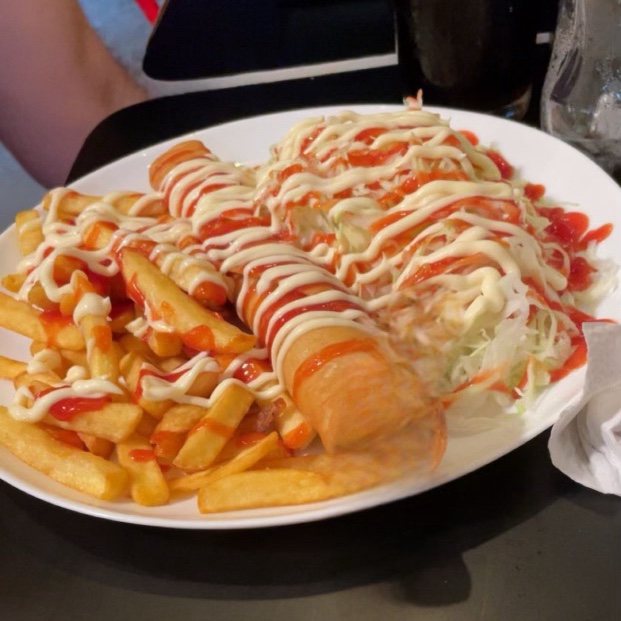
I had heard of Costa Rica’s take on tacos and I wanted to try it even though I was suspicious. The taco itself is shredded beef wrapped in a tortilla and fried to a golden brown. It’s then served with French fries. Sounds delicious, right? Then they add a side of shredded cabbage (I might have gone with lettuce, but ok). Lastly, they top all of this with lots of ketchup and mayonnaise.
Taco con Papa
I tried the taco thinking that maybe I was missing something, but no, I just don’t think mayonnaise and ketchup belong on that. I mean if it was sour cream and hot sauce it would’ve been amazing. Anyway if that sounds good to you, you should definitely try it.
Beer Designers
There are a handful of craft brewers in the area including Cerveceria San Roque and Beer Designers. However, as far as I can tell, if you want to visit a brewery near Grecia, it has to be Beer Designers and it has to be on Saturday night.
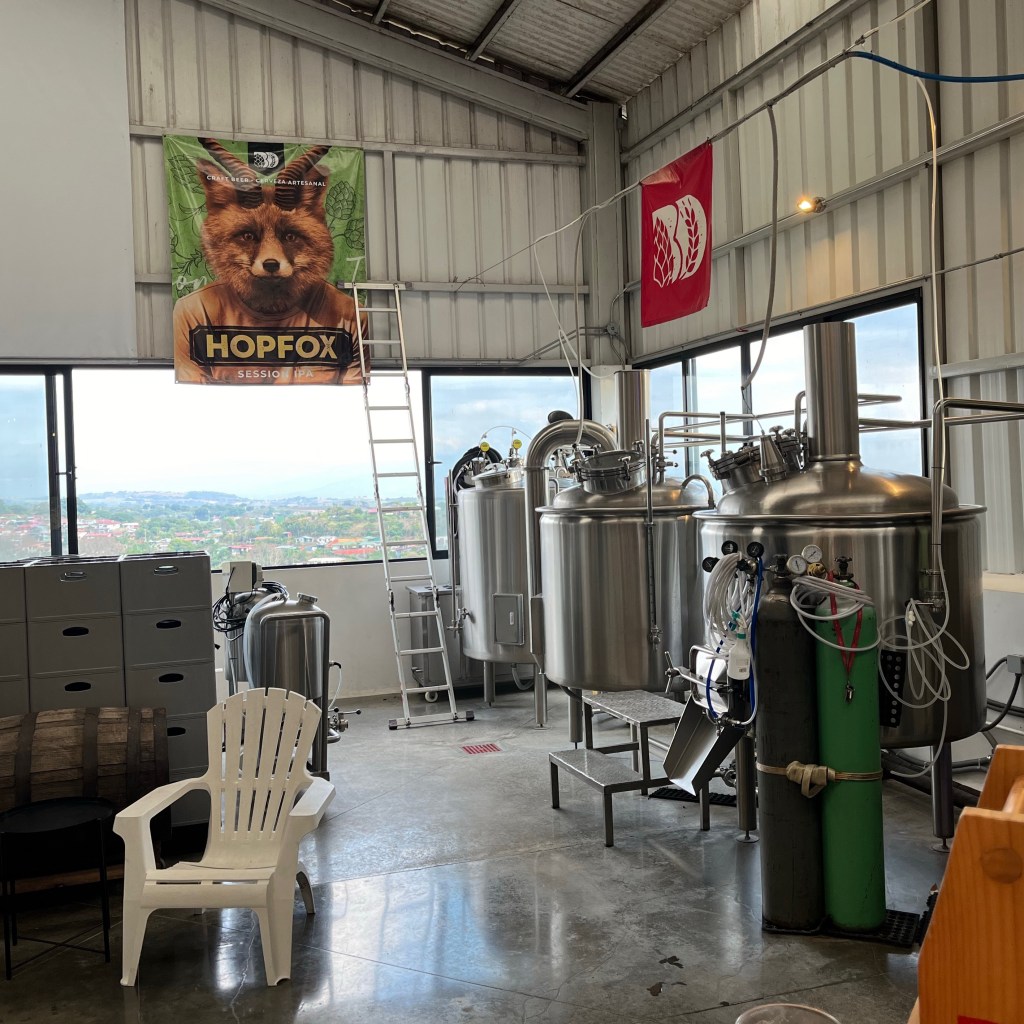
The production area has a beautiful view of the valley between the ridges where Calle Brenes and Calle San Roque are.
Since we love going to breweries and the only available one was Beer Designers on Saturday, that’s where we went on Saturday night.
Bar area at Beer Designers
We got a chance to try a couple of IPAs which were both very good. Jenn really liked their Dorado Dragon which is an IPA with dragon fruit.
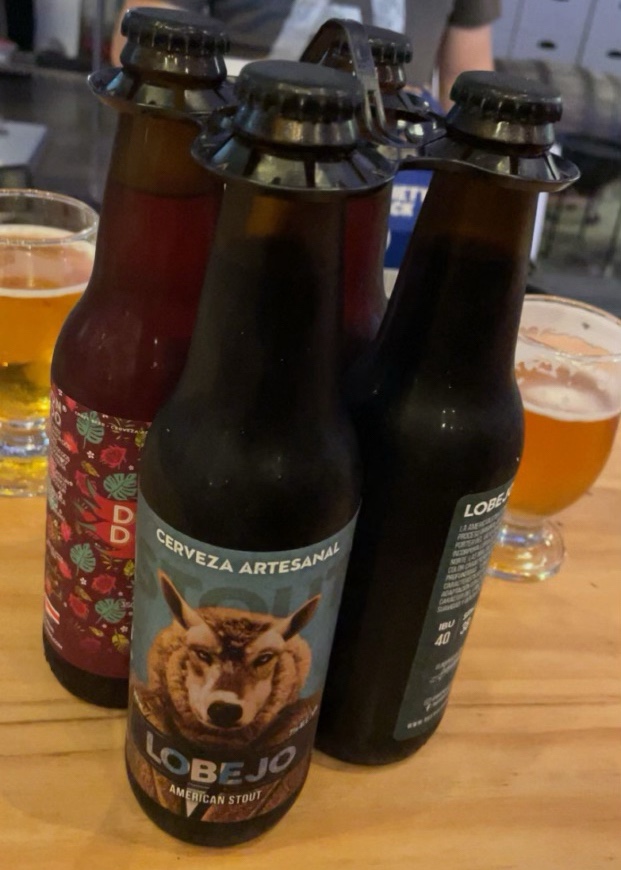
For me, the standout was Lobejo which is an American stout. It’s a was rich and flavorful. Overall it’s just a great example of an American Stout. I consider myself to be a bit of a beer snob, and that was easily one of my favorite stouts, and I’ve tried alot of them.
Dorado Dragon has a nice reddish hue
We had a chance to talk to the brewer and a couple of the locals while we were there. It seemed like the word hadn’t gotten out on them yet because while they definitely had quite a few regulars, they weren’t that busy. The quality of their beers wasn’t matching the amount of business that in my opinion they should be getting.
We were able to pick up a 4 pack to go
A great bonus for Beer Designers is that it is right next door to La 33, which I mentioned earlier as a great place to get takeout. I don’t know if it’s okay if you bring it over and eat it at Beer Designers but I think I would at least ask if I could, because that would make for a great combination.
Cuisine in Grecia Costa Rica
There are actually quite a few great options for eating in the area around Grecia Costa Rica. We obviously weren’t able to visit all of them in less than a week. For the best dine-in experience I would go with Los Jardines Vivero y Cafe. If you just want an inexpensive and delicious authentic Costa Rican experience, I think La 33 is great. For just a nice comfortable hang out I would definitely think El Chante Gastrobus or Vuelta al Mundo and if you like craft beer, check out Beer Designers on Saturday night.
There are also at least two ice cream shops around the park and I would highly recommend going to at least one Costa Rican soda while you are in town. “Sodas” are just small mom and pop shops that sell inexpensive authentic Costa Rican food.
There is a pretty impressive amount of good food options in the Grecia area even though doesn’t have a huge population. A lot of people head to this area for because the weather is beautiful, the people are lovely and frankly the Airbnbs are pretty cheap. If you are thinking about heading to Grecia for those reasons, you definitely won’t be short on food options.
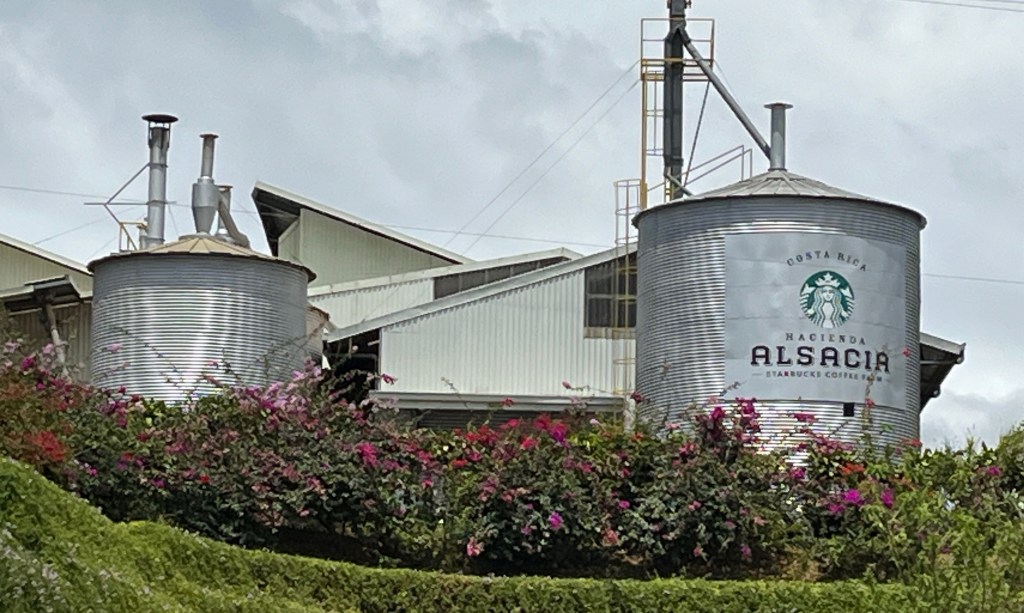
Hacienda Alcascia coffee farm is the only coffee farm in the world owned by Starbucks. Its a beautiful farm located on the southern slope of Poas Volcano about a 30 minute drive north of San Jose Airport in the Alajuela province of Costa Rica. Besides being an operating coffee farm, they also offer tours and have a gift shop and cafe.
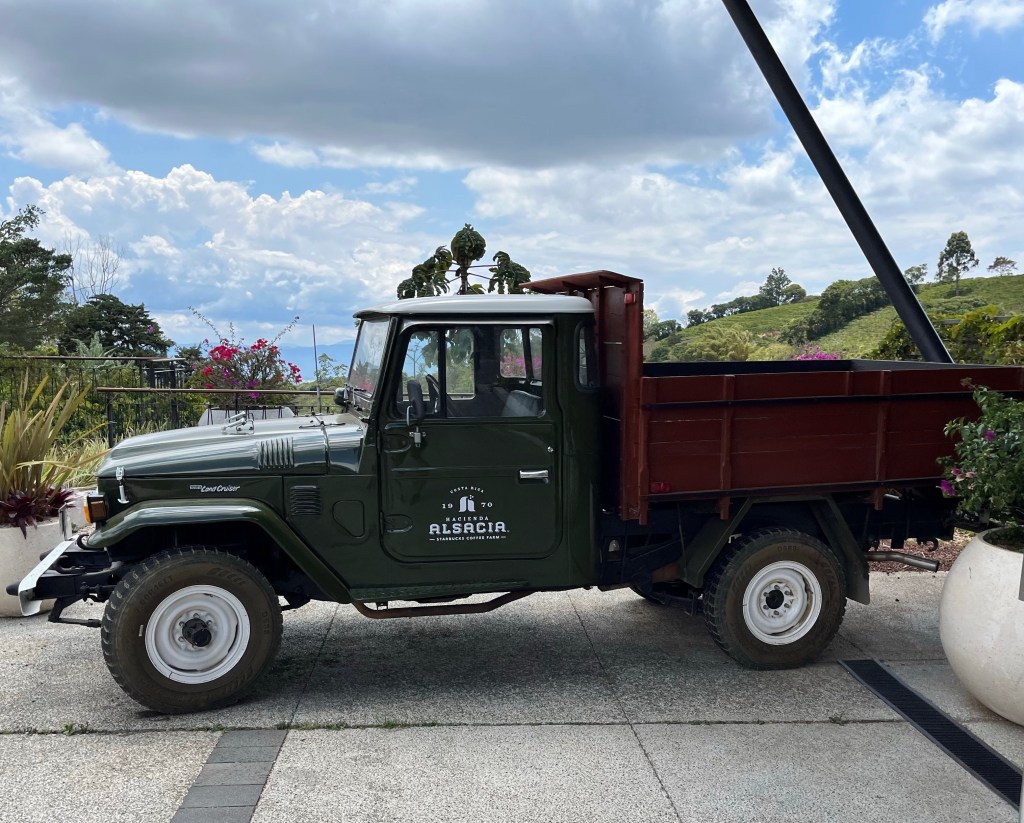
Classic truck between parking lot and cafe
When we decided to go to Costa Rica, and knowing that we had an Airbnb in a major coffee producing region of Costa Rica, we knew that we would want to visit a coffee farm at some point. Since I personally drink about 2 gallons of coffee a day, I thought visiting a farm would be nice.
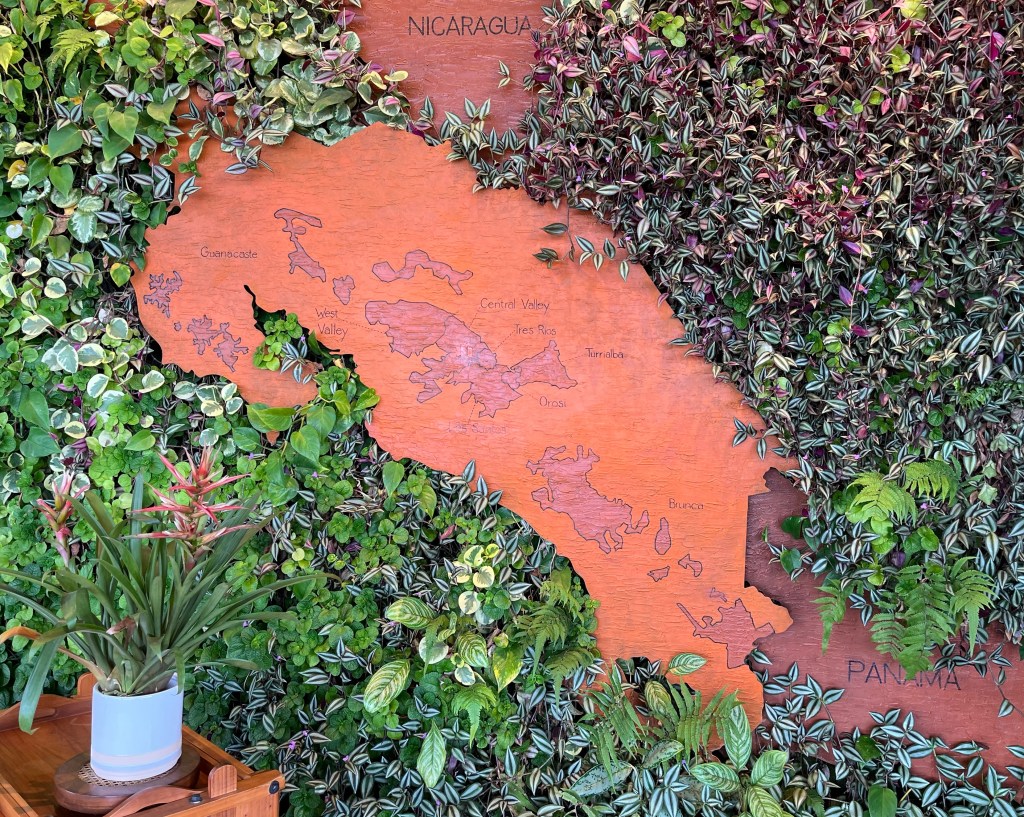
Wall art showing coffee growing regions of Costa Rica
I looked at quite a few local coffee tours, but Jenn found out that there was a Starbucks farm near where we were staying and suggested that. I was a little snarky about it, saying “Oh great, we’re going to go to Costa Rica to visit Starbucks. I mean, they’re so hard to find in the US.” In retrospect though, Jenn was right. This place was spectacular and if you’re anywhere near this, its an absolute must visit.
Coffee Bean Sacks on display near entrance
Starbucks History
A massive sliding door on the backside of the cafe has a sketch of the first Starbucks in Pike Place Market Seattle
Starbucks was formed in 1971 at Pikes Place market in Seattle. Since that time they have grown to over 35,000 stores worldwide. In my mind, Starbucks is largely responsible for getting Americans to drink flavorful coffee again. I can remember a time when Americans would only drink coffee flavored water produced by Maxwell House, Folgers or even Sanka. In the same way that the Boston Beer Company paved the way for microbrewers, Starbucks created a market for so many coffee shops and roasters in the US. My taste buds definitely thank Starbucks for that.
Coffee bean drying table
We’ve been to the Starbucks Reserve Roastery in Chicago, which I would recommend if you are in Chicago. It is one of 6 reserve locations throughout the world. While the Hacienda Alsacia farm is not one of these reserve locations, it has a very similar feel. The architecture is modern and clean. There is art everywhere you look and everything is meant to enhance the experience with your cup of coffee.
The Cafe and Gift Shop
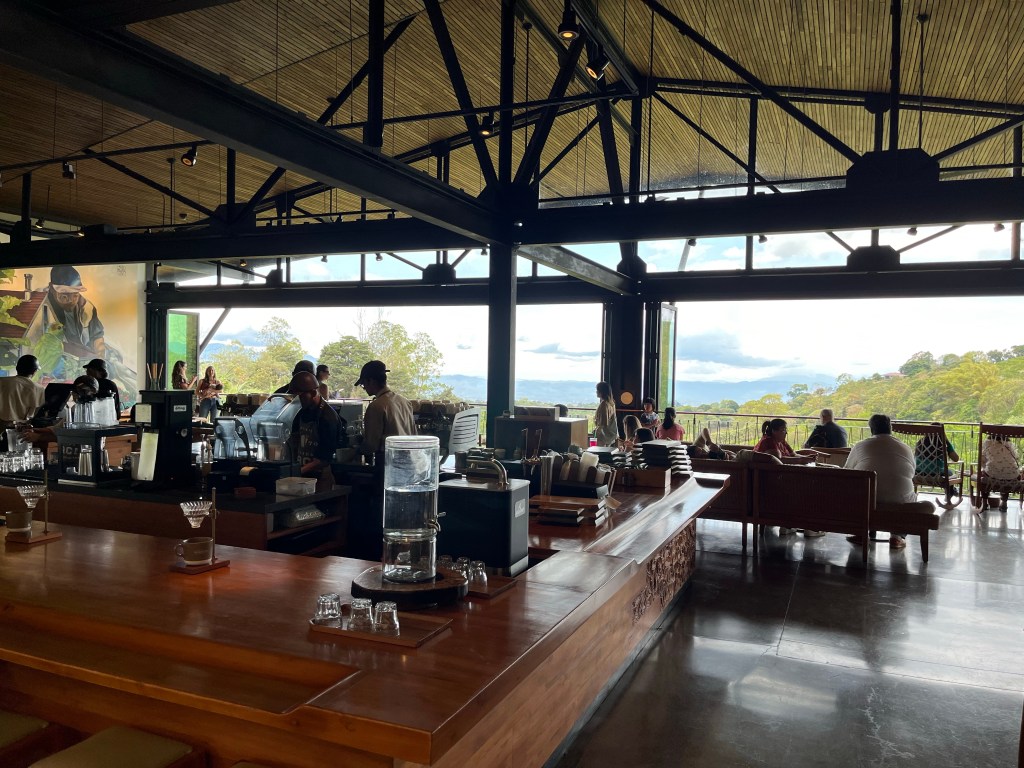
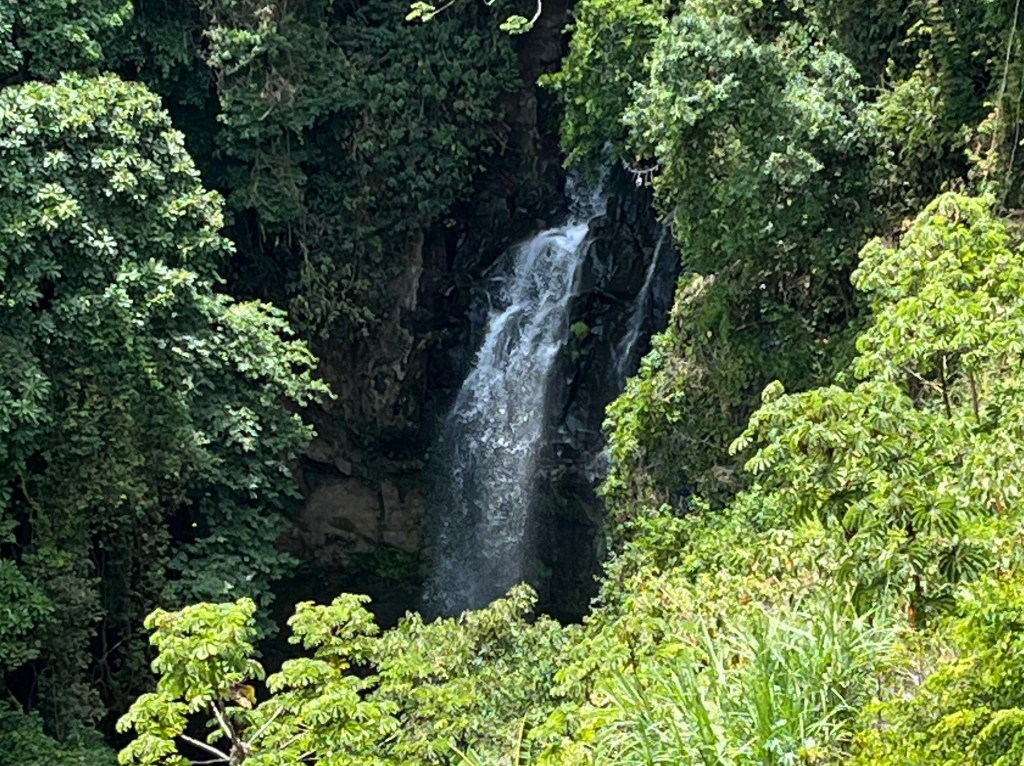
They chose a phenomenal location for the coffee shop and gift shop. It is perched on a what is essentially the southern slope of Poas Volcano, with the building cantilevered over the slope. There is a huge bank of folding glass doors that when opened completely expose the cafe to an amazing view. That viewpoint is perfectly centered over a valley between two ridges. Adding to the amazing view is a waterfall coming off the ridge on the right hand side.
A large square shaped bar area is in the center of the cafe area, with a variety of baked goods on display. There is quite a variety of seating areas in the cafe, nicely spaced out. The seats that were in the highest demand, of course were along the railing which overlooks the valley.
Waterfall on right hand side when looking out of the cafe.
On top of the amazing views, that the building is located at an elevation that in Costa Rica virtually guarantees pleasant temperatures. We were there on a crystal clear day, but I would imagine that fog probably isn’t uncommon in this area. Either way, I would imagine the sliding wall of glass doors is probably open most of the time.
Center bar at Hacienda Alsacia
We sat down in an area with couches near the railing. I ordered a pour over coffee, which I assumed meant a drip coffee, which it apparently isn’t. Pour over coffee is when they put the coffee grounds into some sort of filter and then pour hot water over it. I’m still not sure how this is different from a drip machine, but apparently I’m a knuckle-dragging moron when it comes to coffee.
There is a microroaster in the gift shop which both produces the coffee beans in the gift shop but also is used to demonstrate the roasting process for the tours.
Either way, what I got, after a painfully long wait (I need my caffeine!), was probably the smoothest cup of coffee I’ve ever drank. I normally use creamer, but they gave me a little bit of cream and some sugar, which I used at first. However, this coffee was so good that eventually, after I ordered a second pour over, I just drank it black.
Roasting beans
I don’t know if it was the Costa Rican beans, the pour over method, or the roast itself, but that was probably the best regular cup of coffee I’ve ever had.
The Grounds of the Farm
After we had our fill of coffee and snacks, we decided to walk around the property a little bit. There is a decent amount of the property that they allow guests to roam, even without paying for the tour.
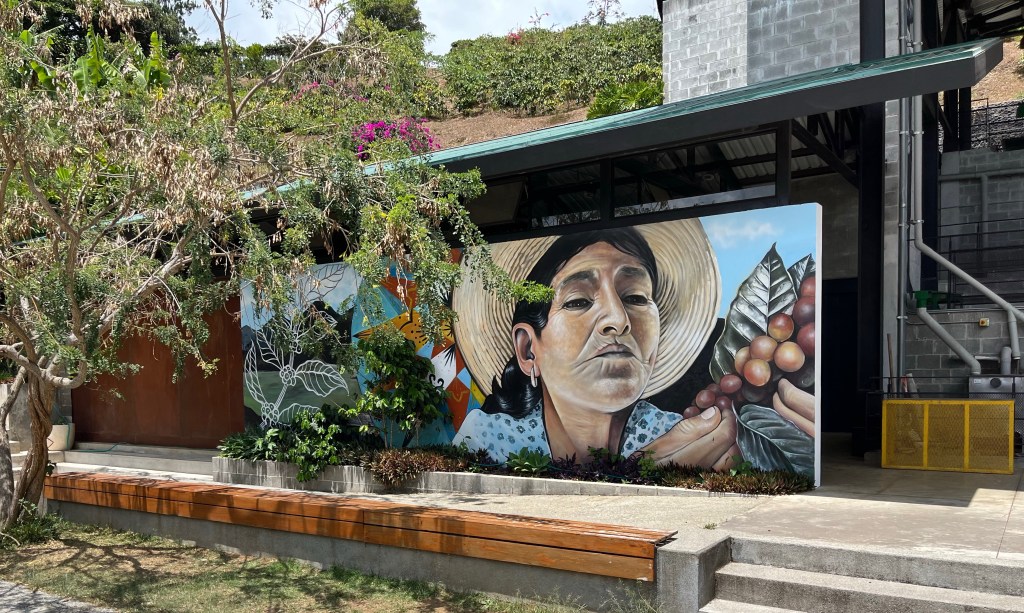
Mural on the coffee processing building
There is a building behind the cafe that is used to process the coffee fruit into coffee beans.
Typical wildlife at Hacienda Alsacia
If you continue walking toward the back of the property there is a tree nursery.
Young coffee plants in the nursery
There is patio area in the back that allows you to get a really great view of the cafe as well as great views of the valley.
Much of the displayed art at Hacienda Alsacia are tributes to the farmers of the region.
Starbucks Hacienda Alsacia Farm Tour
Hacienda Alsacia offers a tour at the facility. It takes about an hour and a half to complete and costs $30 for an adult, $25 for students and $25 for seniors. Children under 6 years old are free.
The tour covers their tree nursery as well as their processing areas and the microroaster. We chose not to do the tour. Without the tour you actually can see a lot of the areas that are covered in the tour, but I imagine that you would get a much better understanding of the history and the process of making coffee by doing the tour. Two Weeks in Costa Rica has a very well written post about this tour if you are looking for more information.
Other Considerations
If you are planning to come to Hacienda Alsacia, I would recommend pairing it with either a visit to the Poas Volcano National Park, or to La Paz Waterfall Gardens Nature Park. Both of those parks are still a half hour drive from Hacienda Alsacia, but by Costa Rican standards, that’s actually a pretty quick drive.
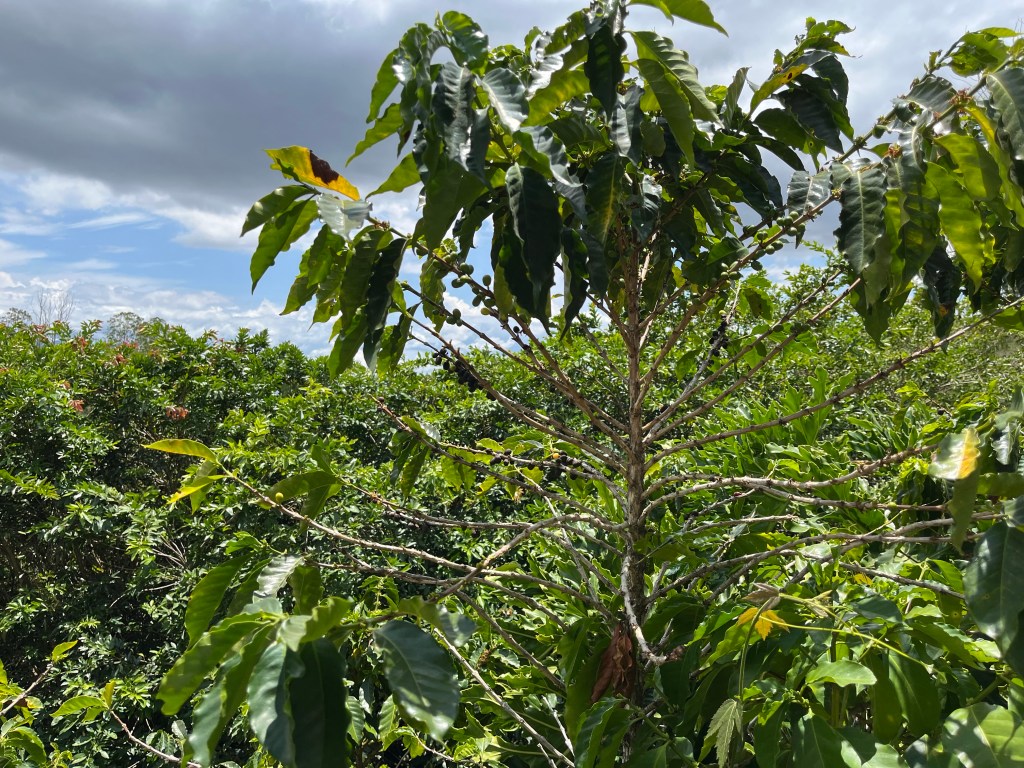
Coffee tree with fruit growing on it
If you take the tour, you’ll probably be there for 2 to 2 1/2 hours, assuming you’ll stay for a coffee and visit the gift shop. If you’re not doing the tour, it’ll probably be an hour to an hour and a half so keep that in mind.
Rows of coffee trees
There is plenty of parking, with a paved lot on site and a gravel overflow lot across the road. and parking is free.
Starbucks logo behind cashier station
We had a great time at Hacienda Alsacia. The views are amazing and the coffee is delicious. They did an absolutely fantastic job creating an experience for coffee fans to enjoy a cup of coffee while learning something about the process of making this magical drink. I would highly recommend a visit.




























































 Newby to Expert Traveler