We arrived in Venice later than we had expected. Our train was supposed to be in Venice around 6:30, but due to some downed power lines in the Alps, our train from Munich to Venice was delayed for about an hour and a half in Innsbruck. Then, for some reason, OBB refused to go to the destination on our ticket, Santa Lucia, and forced us to take a commuter train from the Venice Maeste station to the Santa Lucia station. I still don’t understand what was going on there, but I’m sure the explanation was lost in translation.
The church San Simeone Piccolo is unmistakable when exiting the train station
We finally arrived around 2 hours later than expected, around dusk. Looking for our AirBnB, we followed the waypoint on Apple Maps from the train station to a courtyard. The directions weren’t making sense, so I double-checked where we were and said “Uh, honey, we’re on the wrong side of the island.” Somehow, the waypoint on Apple Maps was set in the wrong location, and I’m still not sure why, but we were completely in the wrong place. We had walked about 15 minutes on an expected walk of 15 minutes and now according to the map we were now 25 minutes away from our AirBnB. We were thirsty, hot, a touch hangry and lost.
Narrow streets paved with setts lined with gorgeous centuries-old buildings is typical of most streets in Venice
Eventually, after around 45 minutes of wandering around Venice, dragging our suitcases with the clickity-clack of the suitcase wheels smacking every crevice of the stone streets, we arrived at our AirBnB. We took a quick look around the place, dropped our suitcases, and went out to get some food. There was a little pasta place about 50 steps from our door and we sat down for some authentic Italian pasta.
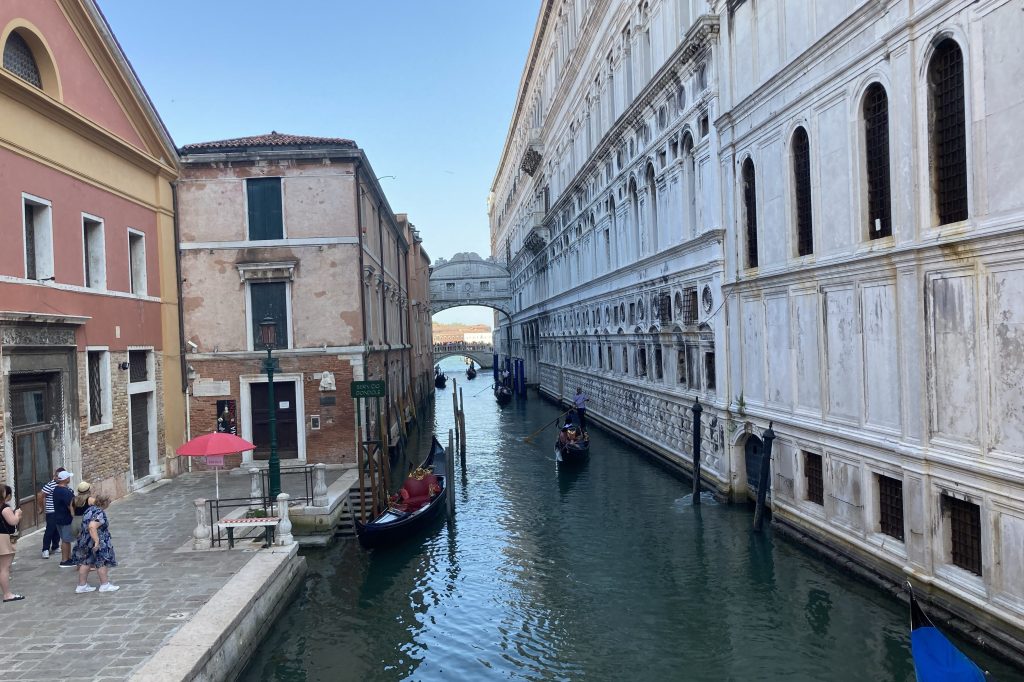
The Bridge of Sighs where convicts would cross and get their last view of Venice before being imprisoned.
Once we had sat down and some food hit our stomachs, we realized that here we were, wandering around one of most beautiful cities in the world, after dark, in the glow of the streetlights, and we hadn’t enjoyed it, because the day didn’t go the way we wanted. It was ridiculous, how in the world had we walked miles through Venice while being thoroughly cranky?
Brick and stone arched bridges, rooftop decks and Juliet balconies are typical features in Venice.
It certainly wasn’t the last time we were lost in Venice. We spent the next few days trying our best to navigate the streets, but it’s tough. We had GPS constantly going and we still would get lost. Venice is just a giant maze, which sounds horrible, but it’s a maze filled with gelato, pasta, cicchetti and aperol spritz.
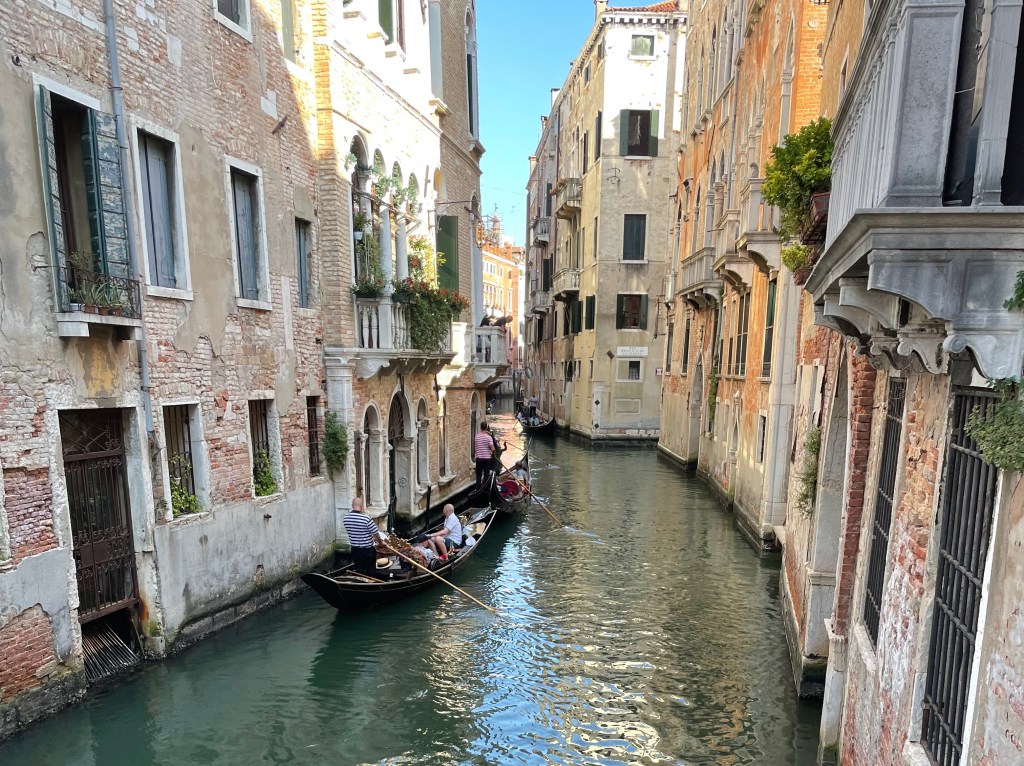
Gondoliers navigate a narrow canal.
Learning the lesson from our previous crabbiness, we took the other times we were lost in stride. The basic problem, of course, is that Venice is a haphazard collection of narrow, crooked streets and alleys. It’s almost as if the buildings of Venice were dropped wherever and they just built the streets around them. Sometimes the streets narrow down to just a few feet, sometimes they widen into a large piazza with statues and restaurants with outdoor seating.
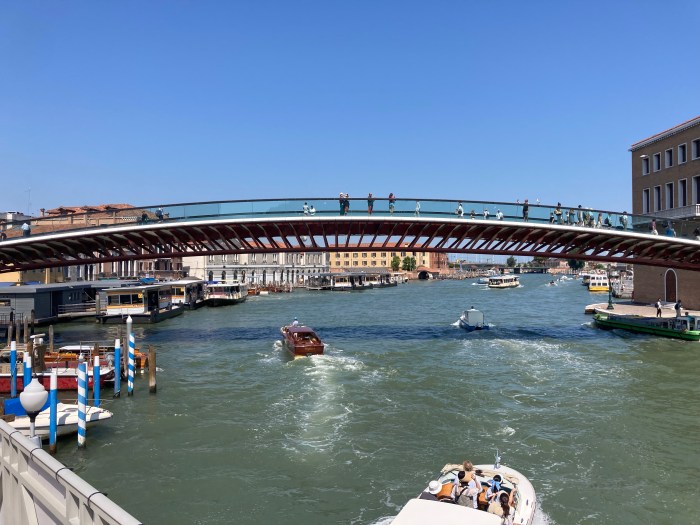
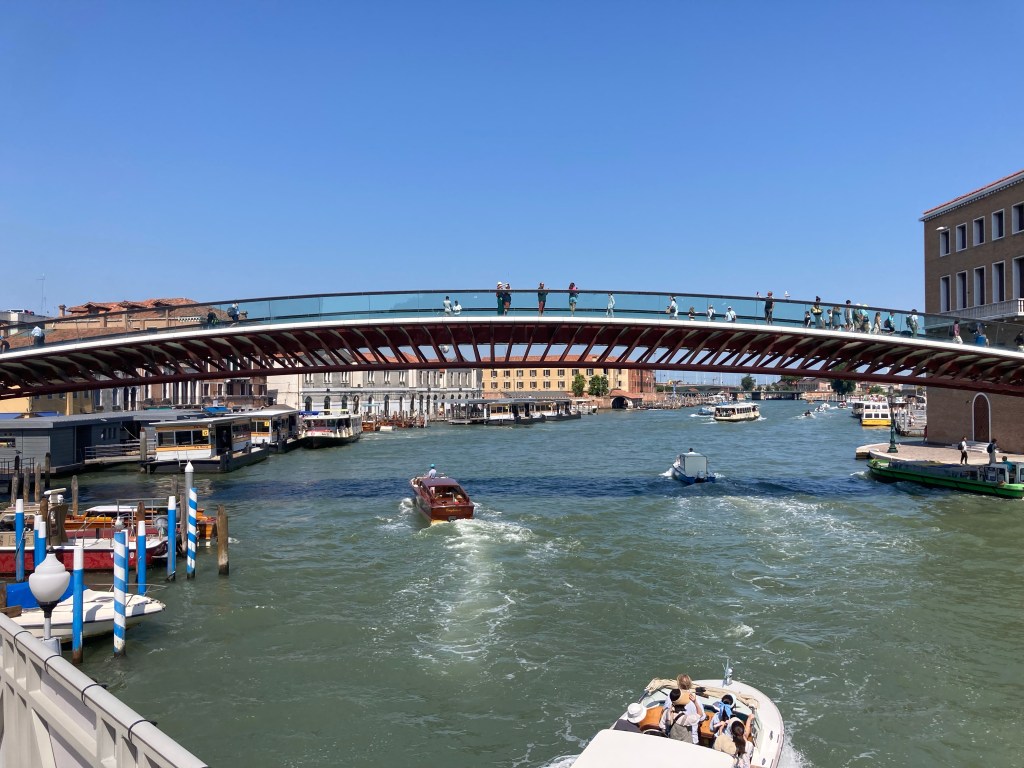
The Ponte Della Constituzione Bridge is beautiful, but it’s modern design seems wildly out of place in Venice.
It’s chaos, undeniably beautiful chaos. When we made plans to go to Venice there was a lot I hoped to do, but honestly Venice has a way of slowing you down. There’s no real public transportation other than the vaporetto, a water bus, which we didn’t use because the routes didn’t seem useful to us. You pretty much have to walk everywhere. Getting places just takes a while, and once you figure in the time that you inevitably get lost, you end up spending a lot of the day just walking. To make matters worse, there are not as many bridges over the canals as you would think. Also as we found out, the bridges aren’t always on the “main” streets. Sometimes the bridge you need to take is down a narrow alley and around a blind corner.
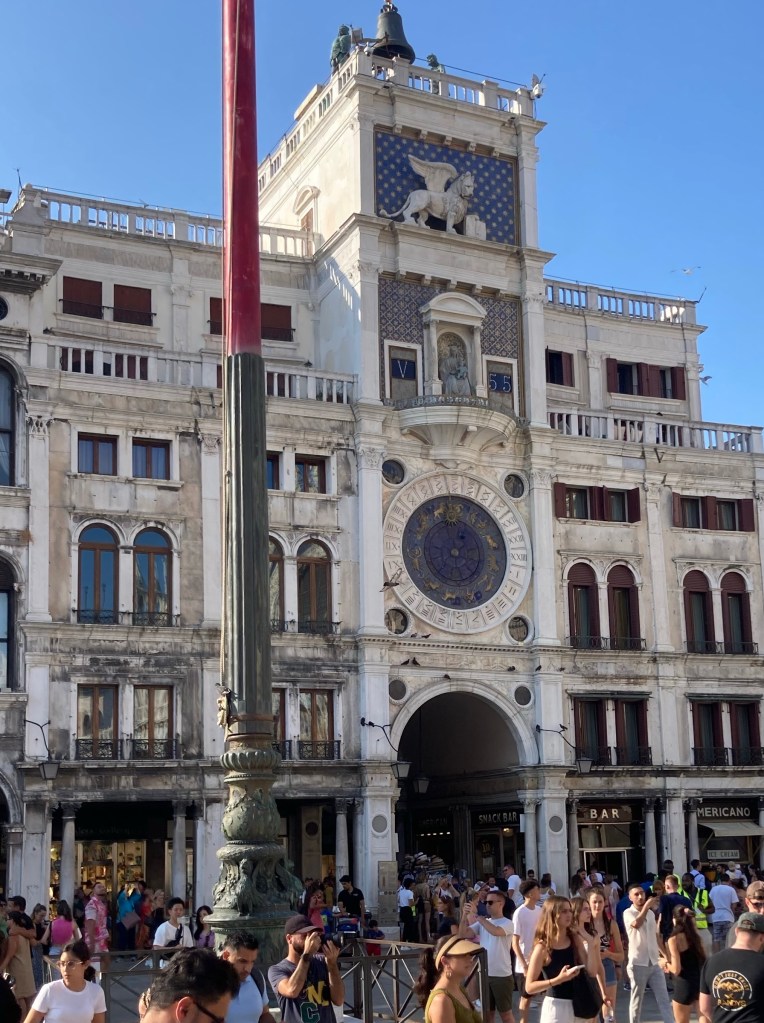
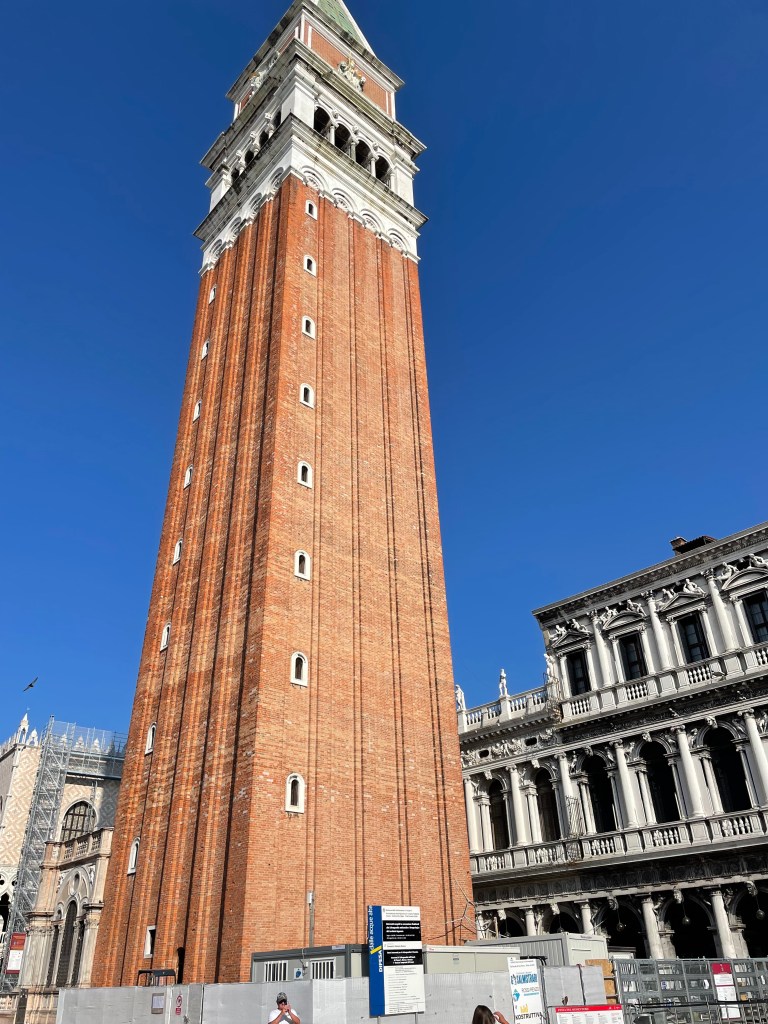
The Campanile Di San Marco is an impressive 323’ tall tower in located in the Piazza San Marco.
The addresses in Venice are also maddening. The AirBnB that we stayed at had an address something like 3343 Dorsoduro. Dorsoduro isn’t a street, it’s an area, a fairly large area in Venice. I legitimately have no idea how Venetian house numbers work. They seem to be grouped but just because you’re standing in front of 3341 doesn’t mean that 3343 is right next door. You’re probably close, but that doesn’t mean you’re really close. This is why you need solid directions, or Google Maps if you are going somewhere specific, those addresses are largely meaningless.
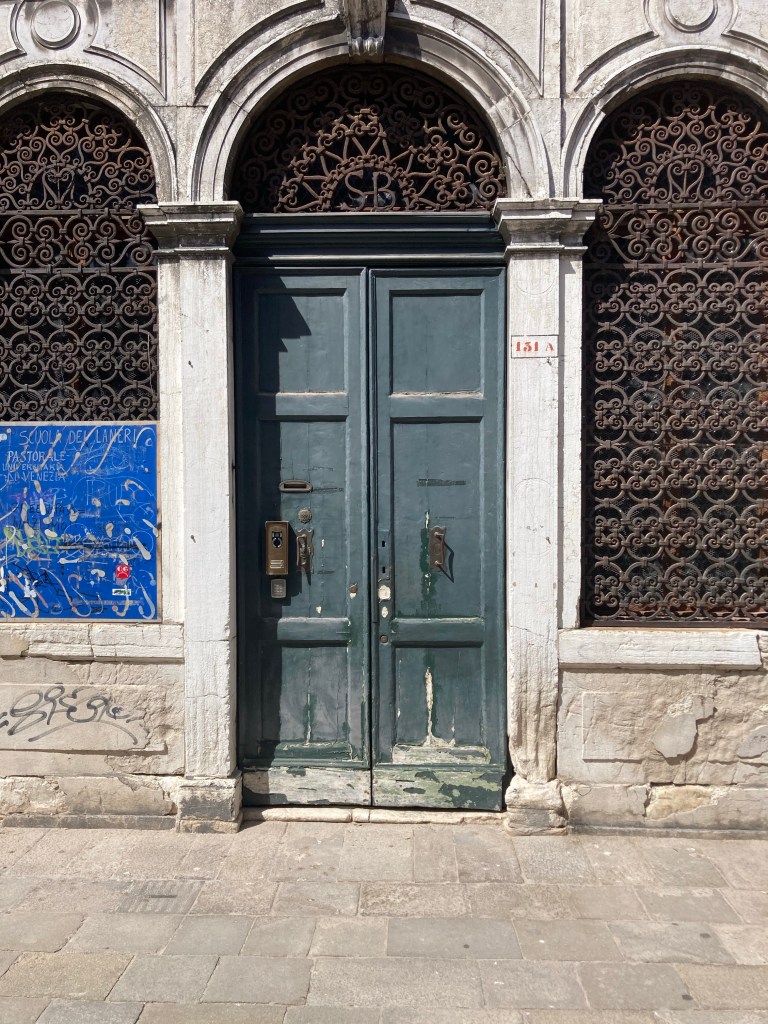
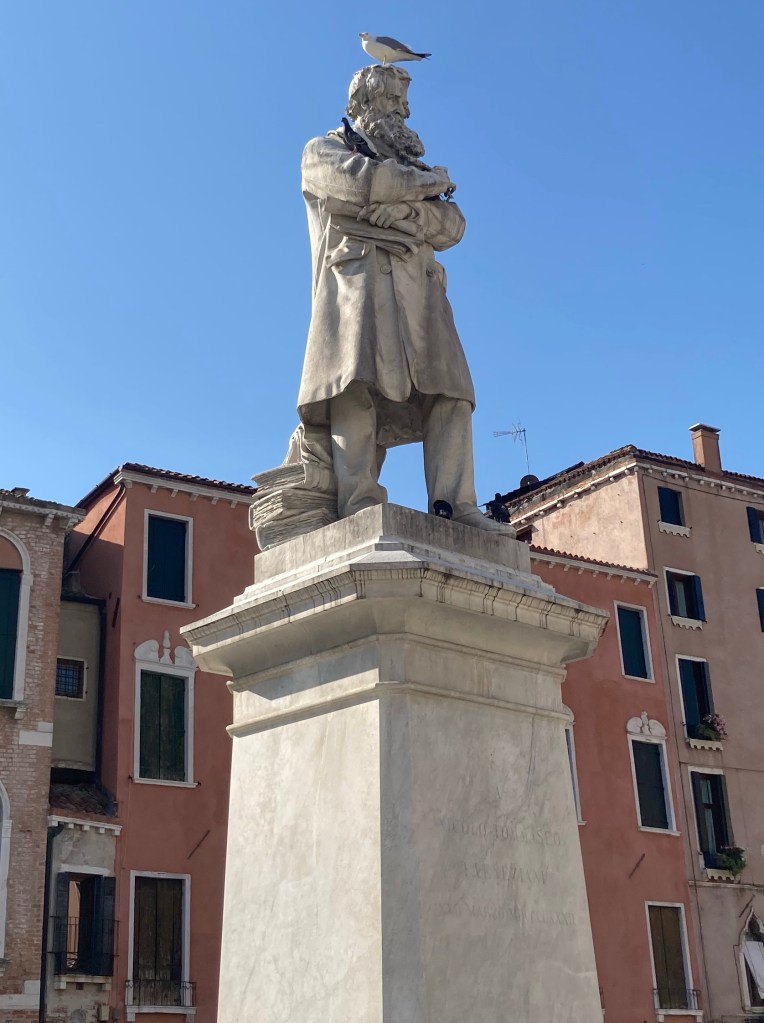
Statue of Daniele Manin, a 19th century statesman from Venice.
The problem isn’t really Venice. In the words of Taylor Swift, “It’s me, hi, I’m the problem.” I’m a middle-aged American who has spent his entire life with a unfinished checklist. Being task oriented is a way of life for Americans. Being in a hurry is so ingrained in us from childhood, that anything that stands in our way is unbelievably frustrating. I had things on my checklist that I needed to check off. I was so wrapped up in buying our groceries from Despar Teatro Italia, getting cicchetti at Arcicchetti Bakero, and finding a bar with a decent beer list that we didn’t wander the way someone really should when visiting Venice.
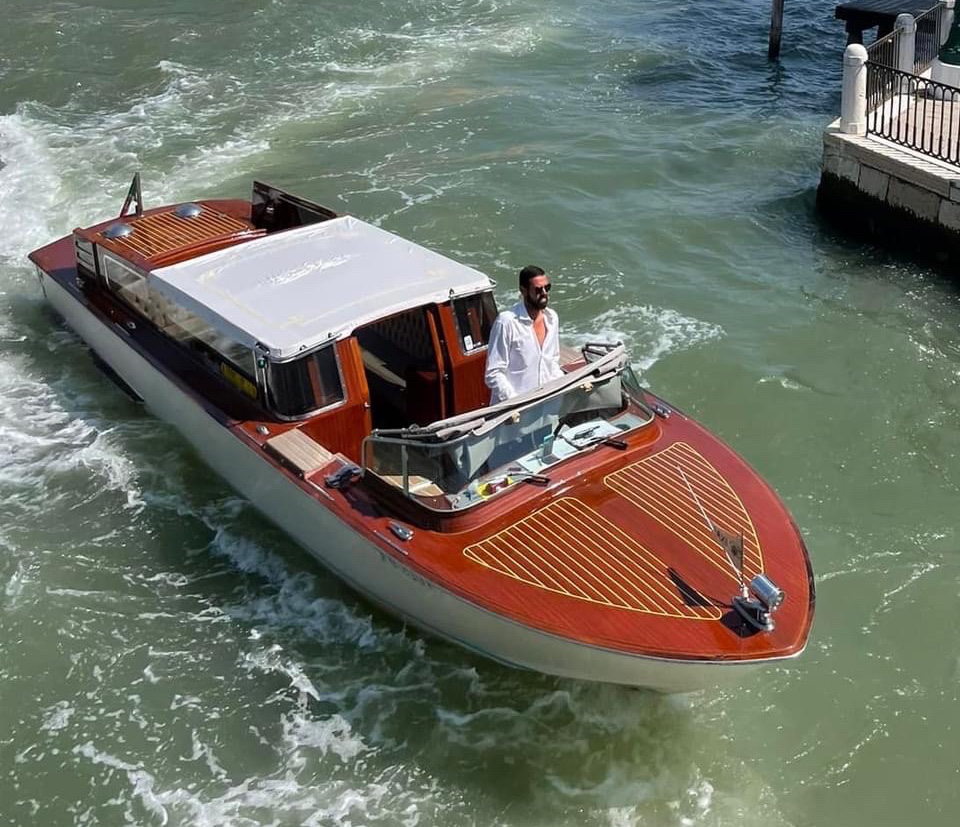
I’m not a big boat guy, but that’s a gorgeous boat.
I’m not saying you shouldn’t have an itinerary when visiting, however we were only there for a few days and it really wasn’t until our last day where we just let Venice tell us where to go. Because of that, when we were walking along the street next to the coast in the Dorsoduro District we saw a floating bridge to the Giudecca District across the Giudecca Canal. If we hadn’t been walking there, I wouldn’t have known that bridge even existed. The bridge doesn’t even show up on Google maps because it’s a pontoon bridge that is only assembled for the Festa del Redentor (Feast of the Redeemer) which takes place over two days in July. We went across the bridge and ended up having lunch there.
The Chiesa de San Barnaba was hosting a DiVinci exhibit.
In retrospect, I wish we had a few more days there. A week might have been perfect. I could have gotten used to the pace of life in Venice, taken our time and really properly wander the streets and alleys of Venice, while still managing to do some of those must-do things like visiting St. Mark’s Square, sunbathing on Lido Beach, or climbing the Campanile. After all, if you’re not randomly stopping for an aperol spritz, or a cannoli with a cappuccino or espresso, or even a cicchetti and a Birra Moretti are you even doing Venice correctly? Venice is practically begging you to come, relax, and toss out that itinerary. Maybe we’ll listen next time (there will be a next time).
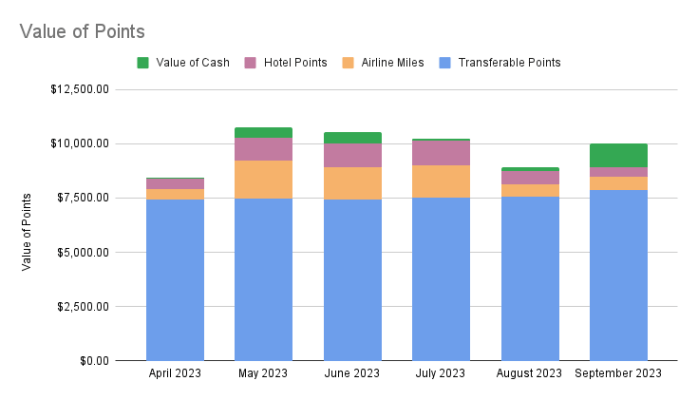
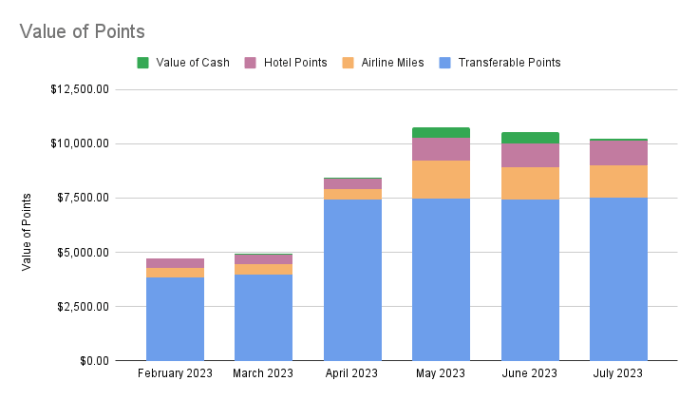
Looking at the chart above, it makes me a little nervous. My points are slipping away! No not really, we’ve been doing what we’re supposed to do with points, we’ve been spending them. Having basically used up all our cash back in Europe and new girls’ trip redemption, the total balance of our points is shrinking. That’s okay, that’s what they’re there for!
A Redemption
Jenn booked a girls’ trip to Mexico with her Sister and her Mom. She used 66,000 Delta Skymiles for a round trip flight to Cancun from the Moline Airport for the 3 round trip tickets. Each ticket had $116 in taxes that needed to be paid, and with cash prices for those flights running at $631/ticket, the redemption came out at 2.3 cents per point, which is great considering Skymiles are typically valued by the Points Guy at 1.41 cents per point. She was also able to book 4 nights in a Vacasa rental which costs $1,325 for 54,000 Wyndham points. That makes that redemption worth 2.4 cents per point, easily besting the Points Guy valuation of Wyndham points of 1.1 cents per point. More information about this redemption can be found here.
No New Cards and Shifting Strategies
With Jenn working on the $7,500 minimum spend on her US Bank Business Leverage Card, we haven’t been signing up for any cards. Also, I had Chase offers of 5 points per dollar on my United Explorer Card and my Marriott Bonvoy Boundless Card on categories like gas stations, and restaurants for 3 months, so I’m using those cards to boost my totals in Bonvoy points and United miles right now.
In general, I think we’re going to switch strategies right now. Because of Chase’s 5/24 rule (they won’t approve you for a personal credit card if you have been approved for 5 new personal cards in the last 24 months), as well as some other rules with Capital One, Citi, etc, we are getting to a point of diminishing returns on sign up bonuses. We are somewhat restricted for what we can sign up for because of all of our new personal cards in the last 2 years. This means that a lot of the sign up bonuses that we can get aren’t as good as the sign up bonuses we got in the past. It seems the solution to that will be to slow down on signing up for personal credit cards, until we get back under that magic Chase 5/24 number. That should open up the full variety of available credit cards from all banks and then we will try to stay under the 5/24 rule going forward.
That doesn’t mean that we won’t be signing up for cards. We essentially have a 4 entity household because Jenn and I obviously are two, but each of us have a business as well. She earns all of her money through her business and so far my business is mostly working for no money, which is fine as far as the banks are concerned, and fine for me, at least for now. Business cards typically don’t count against the 5/24 rule, but Chase will check your 5/24 status before issuing a business card, which is confusing. It basically means that if you want a Chase business card, you must be, as an individual, under 5/24 but the new account won’t end up counting against your 5/24 status. That being said, I’m not going to pass on a great offer from a different bank just because I’m trying to get under 5/24. If American Express puts out a huge sign up bonus on a personal card, I might just jump on it regardless of my 5/24 status.
We are also starting to get a bunch of cards with nice bonus categories. Jenn has her Chase Ink Cash card that gives her 5x on streaming services and phone. Because of that we’re sending our spending in that category to her Ink Cash card to boost her Ultimate Rewards balance. Also, she gets 8x on gas on her Wyndham Business Earner card and that’s a no-brainer on fuel fill-ups. The more that we start to push some spending on categories to other cards the less that is available to spend on meeting spend requirements on new accounts for sign up bonuses.
anyway, on to the point check!
Our spending was quite elevated this month, because much of the spending that we had from our trip to Europe finally hit our statements. It was also spread over quite a few accounts, where we could take advantage of bonus categories. Jenn spent $5,600 on her US Bank Business Leverage card, earning $93 in cash back. I spent around $200 on my Citi Premier Card and earned around 400 points. Jenn spent a little over $200 on her Wyndham Business Earner card and earned over 1,300 Wyndham points. I spent around $700 on my Marriott Bonvoy Boundless card and earned around 2,900 points thanks mostly to a 5x offer on restaurants. Jenn earned 500 Ultimate Reward points on a little over $300 spending on her Chase Ink Unlimited Card as well as 2000 Ultimate Reward points on $400 spending on her Chase Ink Cash Card. Jenn earned 1,300 points on a little over $200 on a hotel stay in Chicago on her Marriott Bonvoy Boundless card. She also earned 700 points on her Delta Gold Business card on $350 spending.
After all of those earnings, as well as the redemptions for the girls’ trip, we were left with 278,000 Chase Ultimate Reward points, 83,000 Capital One Venture miles, 69,000 Marriott Bonvoy points, 25,600 Citi Thank You points, 23,600 United Miles, 14,900 Delta Skymiles, 5,300 American Airlines miles, 1,600 Hyatt points and $160 in cash back. According to the valuations by the Points Guy, these points are worth a total of $8,820.
In addition to all of this, we have a category 1-4 free night certificate from Hyatt and Jenn and I each have a 35K point free night certificate from Marriott. These came from holding a credit card past the anniversary date and paying the annual fee. With each of these cards having a $95 annual fee and each of the certificates being worth probably double that, it feels a bit like prebuying a hotel room at a discount, so that’s why we didn’t cancel those cards.
All in all we still have quite a bit of flexibility in where we have our points and miles and we should be continuing to build on that moving forward.
When we were deciding which countries we would visit, Emma was pretty enthusiastic about wanting to go to Switzerland. I asked her why, thinking that maybe she had learned something in school about Switzerland that she found interesting, but she just said “chocolate”. So of course, since that was a big reason we were in Zurich, we had to go to the Lindt Chocolate Factory.
There is no denying that the Lindt Factory is a tourist trap. Everyone knows about Swiss Chocolate and Lindt is probably the most well-known Swiss chocolate brand. This tour is very popular and planning ahead is definitely recommended. We purchased our tickets from the Lindt website and reserved our time months in advance since tours sell out frequently. They cost around $15 (depending on the current exchange rate).
No, you are not allowed to jump in the chocolate fountain.
Entering into the building, there is a reception desk and a large chocolate fountain. The smell of chocolate is really intense almost to the point where it feels like you’re breathing chocolate. The lobby is very large and modern with white marble floors, concrete walls and glass. A spiral staircase leads you to the second floor where the tour begins.
The tour is actually much more interesting than I thought it would be. They start out covering the process of growing cacao pods as well as the various steps, like fermentation and roasting, that is required to turn those pods into chocolate.
A room devoted to the history of chocolate
Next there are a bunch of exhibits that cover the history of chocolate. Chocolate started as a bitter drink that had been enjoyed by the Maya and Aztecs. During colonization, of course, chocolate was brought to Europe where it slowly evolved from being a bitter drink to a sweet food.
Interactive exhibit that shows the evolution of the chocolate market in Switzerland
They also had quite a few exhibits specifically devoted to the Swiss chocolate economy. They cover everything from how the chocolate market evolved in Switzerland to how much of that chocolate is enjoyed in countries around the world.
A variety of hands on exhibits are designed to be kid friendly.
There are quite a few hands on interactive exhibits throughout the tour. They were really well-designed to provide a lot of great information about the subject, while giving children something to play with. One example of this was a map of Switzerland where as you move a dial which controls the decade. And for each decade it shows which Swiss chocolate producers were operating and where in Switzerland. It also provides some data about how much sales and exports occurred during that time.
A display of chocolate molds and packaging from 1900-1950.
I was enjoying my time in the exhibits but the rest of the family was not as interested as I was. The main reason for that was that at the end of the tour, you can sample a bunch of chocolate.
Fountain for trying milk chocolate
They’re are three main tasting sections. The first is a series of chocolate fountains where there are a bunch of disposable spoons so that you can taste white chocolate, milk chocolate, and dark chocolate in liquid form.
chocolate square dispenser
The second tasting section is a bunch of over-engineered chocolate square dispensers that invite you to try the chocolate and then guess what the flavor was.
In the plastic cylinders, you are invited to grab as many Lindor truffles as you can eat.
The third section was the a bunch of flavors of the Lindt chocolate balls. This was the part Jenn was looking forward to. For some weird reason, I married someone who rarely eats sweets. When she snacks it’s normally chips or popcorn and only rarely eats chocolate. The Lindt chocolate truffle balls are one big exception and they are a requirement for her Christmas stocking every year.
An elaborate Rube Goldberg machine which distributes a special chocolate at the end of the tour.
Once we were through the tasting section, of course, we had to go into the gift shop. It’s impressive. They have a ton of flavors that you will never find in a store. I came across a Lindor truffle ball made with matcha tea, for example. You can get slabs of chocolate decorated with a message. There was a dizzying array of chocolate bars and gift boxes. It’s a chocolate lovers dream.
You can get these chocolate slabs decoratoned with a message if you like.
In the end, we didn’t buy too much. We had a long trip set up and knowing that we were going to have to travel with chocolate during the summer we didn’t want to risk the chocolate melting. We were able to eat some of it on our next stop in Munich, but then the day we left Munich for Venice we accidentally left the bag in the fridge at the AirBnB. So our loss was probably a nice surprise for the person who had to clean the AirBnB.
This is a fairly insane wall of truffle balls.
I was surprised by how much I enjoyed the tour. The tour takes about 45 minutes (Unless your group wants to fly through the exhibits and get to the tastings). It was very well done and designed to be interesting to kids and adults. I also can’t imagine anyone not enjoying the chocolate tasting section and they seem to limit the number of people in the museum at a time to a reasonable amount so it never seemed too crowded. The gift shop is also excellent. This is definitely worth visiting if you are in Zurich.
Sometime this last winter, Jenn was talking about wanting to take a Girls’ trip (with her Mom and her Sister) to celebrate a milestone birthday for her Sister. We had basically just completed booking our European vacation just a couple of months earlier and we had learned a valuable lesson from that booking that we didn’t want to repeat – don’t be dependent on one way to book.
What I mean by that is that when we booked our flights to Europe, all we had was United miles, and that was our only option. If the flights weren’t cheap enough on United, we weren’t going or we were paying cash. So the solution to this issue was to find multiple ways of booking flights on points and make sure that we stockpile points in multiple areas.
The Power of Stockpiling Points
Jenn had already begun to accumulate Ultimate Reward points by taking advantage of two 90k bonuses for Chase Ink cards as well as a 60k Chase Sapphire bonus. Since they were thinking Mexico or the Caribbean, Chase Ultimate Reward points, having the ability to transfer to Southwest Airlines or United Airlines, might make sense.
We also added over 80k points by meeting the the minimum spend on a Capital One Venture card. That’s intriguing because Capital One miles transfers to the Turkish Airlines Miles & Smiles program where booking round trip United Airlines saver flights to Mexico and the Caribbean often costs only 20k points .
Jenn also jumped on a 75k point bonus offer on the Delta Business Gold Card. When she did it, I scoffed a little because a lot of people joke about Delta Skymiles as being “Sky Pesos”. It’s a bit of a joke because Delta is notoriously expensive to fly to Europe or in business class on points. That being said, I think people might find that Skymiles could be particularly valuable for domestic and North American international economy award tickets and Jenn found that out.
In this case, Jenn received an email from Delta about a flash sale, and went on to Delta’s website, where she was surprised to find a round trip flight out of Moline Airport to Cancun in January for 26k Skymiles each. Because of the 15% award discount afforded to Delta Gold Card holders, she was able to book it for 22k Skymiles and $116 in taxes each for a total of 66K and $348. Those flights were priced at that time at $631 each, which means that this redemption was more than 2.3 cents per point which is a really good value for airline miles and definitely not worthy of being derided as “Sky Pesos”. This is particularly great, because good award rates out of the Moline Airport are usually hard to find, and typically we fly out of Chicago because of it, which usually means booking a hotel and paying for pretty expensive parking.
Because of the fact that we had significant amounts of Chase Ultimate Rewards points, Capital One Venture miles and Delta Skymiles, we were able to keep our eyes open for special rates with Delta, United, and Southwest Airlines, as well as being able to book Sky Alliance flights through Turkish Miles and Smiles or Avianca Lifemiles. I’m sure that we could get more creative than that, but honestly, it wasn’t needed in this case. Having flexibility in multiple programs allowed Jenn to be patient and wait for a great deal, and then jump on it when she had the opportunity.
The nice thing about a vacation rental is having a working kitchen, and this one looks pretty nice.
Flexibility on Booking Lodging
We had some flexibility built into our points for lodging as well. We had accumulated a decent amount of Wyndham points, and a respectable but not huge amount of Marriott Bonvoy points. However, with Jenn having a nice stockpile of Chase Ultimate Reward points, which transfers 1:1 to World of Hyatt points, that also made Hyatt a good possibility as well. Because of a status match made possible by Jenn’s Wyndham Business Earner card to Ceasars Rewards (visit Upgraded Points for more details), we also had a 4 night “free” stay available at Atlantis in Nassau in the Bahamas. The Atlantis stay would have had a bunch of extra resort fees that would have added up to over $200 a night and was quickly eliminated. Chase and Marriott were definitely possibilities, but the Wyndham-Vacasa partnership is just too good to pass up. We booked a Vacasa with Wyndham points before and got great value for that redemption.
The rental is in a complex with a pool on the beach.
Jenn decided to book a 1 bedroom Vacasa in Playa Del Carmen for 54,000 Wyndham points total for a 4 night stay. That particular Vacasa typically would rent for $1,325 for a 4 night stay in January meaning that those points were redeemed at 2.4 cents per point. This is another ridiculous value considering Wyndham points are generally valued at 1.1 cents per point. Booking a Vacasa rental with Wyndham points is a little weird because you have to call a special line to do it, but the rules are simple. Vacasa rentals cost $15k points per night per bedroom and is bookable with points as long as the cash price is under $500 per night per bedroom. For example, a one bedroom is bookable for 15K points per night as long as it costs under $500 and a 2 bedroom is bookable for 30k points per night as long as the cash rate is under $1000. Having a Wyndham Business Earner card gives you a 10% point discount on those rates. (Update – the ability to book Vacasa vacation rentals with Wyndham points has ended as of December 2025)
Obviously we’ll have to wait until they get there to find out if the Vacasa rental is as nice as the photos, but it looks gorgeous. It looks like Jenn did a great job booking this trip and I really hope they all have a great time (I’m sure she’ll feel sorry for me shoveling mounds of snow out of our driveway while she’s sipping a Bohemia Oscura cerveza on the beach). In the end, this was made possible because Jenn had the ability to be flexible with dates, locations and points programs. It allowed them to book what looks like a great vacation for not a lot of points and cash.
I may Have Created a Monster
When we got started with points and miles, it was pretty much me doing all of the research, listening to podcasts, reading blogs, and doing as much internet research as I could. As we started to have some success, with booking trips to Cabo San Lucas as well as our trip to Europe this summer, Jenn really started to not only get interested in points and miles, but she actually really gets it now. I expected to have to guide her on planning this trip, but for the most part, other than a couple of suggestions, she did this on her own and it was undoubtedly the best trip in terms of redemption value that we’ve made. Going forward, I think with both of us having a solid understanding of points and miles, we should have some great trips ahead, as long as she decides to come back from Mexico, of course.
So we did it! We took our first trip outside of the continent. For the kids, it was the first time they had left the country. As I expected, it was difficult at times, travelling is never easy and travelling to places where English isn’t the primary language is even more difficult. We turned out to be fairly well prepared, however, and were able to get around pretty easily. We had a great time in Europe and we were already talking about how we would return before we even pulled into our driveway. Luckily for us, we’ve figured out enough hacks to do it affordably.
Since both Jenn and I were signed up with the US Bank Business Leverage Card which both required a $7,500 spend in 4 months there haven’t been credit card signups ($15,000 is a lot of spending to meet for us). I did manage to hit my required spend on the Leverage Card and received my $750 cash back sign up bonus and I also had accumulated another $125 or so of cash back on the normal spending. So for what was probably close to $8,000 in spending on the card, getting around $875 in cash back is around an 11% cash back rate and I’m not mad about it. Jenn should hit her bonus in the next couple of months and that should be about the same. We immediately used the cash back from the Leverage Card along with the $425 left from my US Bank Altitude Card for spending money in Europe. That $1,275 did take a nice chunk out of our expenses while we were there and it was great to be able to use the cash back that way.
On to the Point Check!
I spent around $3,600 on my US Bank Leverage Card and earned $54 in cash back and also finished up the $750 sign up bonus. I spent around $200 on my United card and earned 300 United Miles. Jenn Spent $300 on her Chase Ink Unlimited and $600 on her Chase Ink Cash and earned a total of 3,300 Ultimate Reward points. Jenn also spent a little over $200 on her Wyndham Business Earner Card and earned almost 1,800 Wyndham points (I love that 8x on gas!). Jenn spent around $700 on her US Bank Leverage card and earned $11 in cash back. The only redemption was the $1,275 of cash back we used.
We finished the month with around 276,000 Chase Ultimate Reward Points, 83,000 Capital One Miles, 80,000 Delta Miles, 65,000 Marriott Bonvoy points, 26,000 Citi points, 24,000 United Miles, 5,000 American Airlines Miles and 2,000 Hyatt Points. We also were left with an underwhelming $66 in cash back. All of this left us with a total points value, according to The Points Guy of $10,100.
I have a long-term goal to be multilingual. I would like to travel as much as I can and I don’t want to depend on people speaking English to me. In general, I think if you roll into a country and speak the native language you’re going to have a better experience than you will if you rely on people to speak English. The problem is I’m horrible at learning languages and I’m not exactly young. This is going to take a lot of work.
Why become Multilingual?
Certainly you can travel to countries without learning their language, people do it all the time. English is the most commonly spoken second language in the world. That’s great since I’m a native English speaker! However, just because someone can speak to you in English doesn’t mean they want to and I bet if you venture away from touristy cities, the likelihood you’ll find a person who speaks English decreases dramatically. So if you want to get off the beaten path a little, you might want to speak the native language, at least a little.
Why Duolingo?
My wife introduced me to Duolingo a couple of years ago. We were planning a trip to Germany and my idea to learn German was basically to watch German TV with English subtitles. Honestly, I’m not sure how long that would take, but I’m guessing it would have been a significant amount of time. It didn’t feel like I was getting anywhere at all.
She suggested it because she was using it to learn Spanish and she said it felt like a game. I tried it and I would definitely agree with her – they’ve gamified language learning in a way that keeps you learning, which is probably the most important part of learning a language.
Duolingo is Essentially a Game
Duolingo does a great job of tricking you into staying engaged with the app. With social media that’s a bad thing, but when you’re learning a language you need to stay engaged to actually learn it. Like a lot of games, there are hearts that you get on a time basis. In Duolingo, you earn 1 heart every 5 hours, capping at 5 hearts. When you make a mistake while you’re learning, you lose a heart. When you are out of hearts, you can practice to earn more hearts or you can quit and wait long enough that you’ve gained more hearts (the paid version of Duolingo doesn’t use hearts and you can do as many lessons as you want and make unlimited mistakes) There are gems that you earn for accomplishing certain goals, which can be used for buying additional hearts as well.
The top ribbon on the app contains the icon of the language you’re working on, a fire emoji for the length of your streak in days, the number of gems earned and number of hearts remaining.
They also use leagues to keep you engaged. You earn points when you complete lessons. Every week you are placed in a league with 30 other “players” and the top 7 move up a league and the bottom 5 move down. This tricks you into staying engaged because you want to win your league, right? I’m honestly embarrassed to admit how much this little trick works on me.
And then there are streaks. As you progress, the app will keep reminding you how many days in a row you’ve completed at least one lesson. This basically guilts you into logging in. – and Duo (the cute Owl mascot of Duolingo) will remind you in a notification on your phone that you don’t want to break your streak. You are granted freezes that will automatically pause your streak if you for some reason miss a day, but you only get so many of them.
If you don’t do your lesson every day Duo the owl will hunt you down.
This is all to say that what Duolingo absolutely excels at is keeping their users engaged which is probably the most important thing when learning a language because learning a language requires a lot of time and repetition.
How does Duolingo Work?
For the most part, Duolingo’s lessons are quizzes. Sometimes you will be asked to translate using blocks and sometimes you’ll have to actually write translations out (while using correct spelling). Other times you will be asked to speak something out loud into your phone or listen to someone else speaking and write it down. Duolingo does offer quite a few clues along the way, such as being allowed to tap on any underlined word to find the translation.
What are the advantages of Duolingo?
In my experience, Duolingo is very good at helping you learn grammar rules and building vocabulary. When learning new words the app uses that word over and over again to try to get it to stick in your memory, and then will return to remind you of that new word later on, just to make sure it stays with you. The same pattern is generally true for grammar rules, where Duolingo may introduce a concept like gendered adjectives and might spend a series of lessons working on that concept, and then return to it later.
In my experience, so far, what I think Duolingo excels at is teaching people how to translate from one language to another. That’s really important, of course, because as I’ve discovered when you’re standing in a subway station trying to figure out which word means arrivals and which means departures, translation ability does help.
What are the disadvantages of Duolingo?
What Duolingo seems to lack is the ability to get the user to feel comfortable speaking to others. But this makes sense, right? You don’t practice having conversations on the app, you are primarily practicing translation. From what I’ve seen, this is a common complaint about Duolingo and a number of other language learning products use that in their advertising. While I’ve never seen them use Duolingo’s name specifically, it’s pretty obvious who they are targeting with their criticism. It’s an entirely valid criticism, but I don’t think that should stop you from using the app.
Is Duolingo really worth it?
In my opinion, the most important thing you can do to learn a language is expose yourself to it. The best feature of Duolingo is that it keeps you engaged while you are learning the language. Also, by gamifying language learning, it seems like less of a chore. That is really important in keeping you engaged long enough to actually learn the language and not quit because it’s too hard. I really think the best strategy is to use Duolingo for what it’s good for – vocabulary and learning grammar and fill in the gaps with other methods. I have a couple of podcasts that I listen to in order to get more acquainted with the sound of language. I like Coffee Break language series as well as the Easy Languages series. Those you can find by going to your favorite podcast app and searching for Coffee Break German or Easy Spanish, etc. What I haven’t done yet, and I’ve considered it, is to use a language tutor to practice speaking a language with. Italki.com is one service that connects learners with tutors and I’m sure there are many others. Of course, the best method is to move somewhere for a while and immerse yourself in that language, but for obvious reasons that’s not an option for most people.
How much does Duolingo cost?
I’ve been doing the free version of Duolingo which limits the number of hearts you receive and you can do this, but you will be forced to watch a lot of ads. That doesn’t bother me, but if it bothers you then you might want to pay for the service. The paid service is Super Duolingo and it does offer additional features like personalized practice. It provides unlimited hearts and no ads. Super Duolingo costs $7 per month for individuals or $10 for a family of up to 6.
How is it working for me?
One thing that I had a hard time finding online is what I could expect if I got to a certain milestone in Duolingo. I could see I was making progress in the app and thought “I should be able to make it to Unit 75 by the time I go to Germany” but I didn’t know what that would do for me. Would I be able to order food at a restaurant or talk to the person at the hotel desk in German? Below I plan to update my language progress with my travel experiences to show what to expect when learning languages.
Cabo San Lucas – January 2023 (8 Spanish units and around 5000 XP)
I took a little Spanish in High School but that was many, many years ago. I think Americans in general get at least a little exposure to Spanish on a regular basis. Because of that Spanish feels more natural to me than German. I pretty much flew through the first 8 units of Spanish, it all felt like review to me. That being said, when we got to Mexico I really struggled trying to speak it. I wasn’t surprised at all, I was barely into the program – there is 230 units and I had completed 8. That being said, just having some basics at top of mind, like gracias, de nada, por favor, etc. was really important. One thing that I learned really quickly was that I wish I had learned more food vocabulary before we left. When you’re on vacation, food is a pretty big part of your concerns and you want to try the best foods while you’re in a different country. At restaurants in Cabo San Lucas, menus are typically in both English and Spanish but not necessarily at the grocery store, so we probably missed out on trying something really good by skipping over certain things that we couldn’t translate.
Stockholm – July 2023 (2 Units – 1500 XP)
Ok, I basically never used any Swedish while were in Sweden. In the short amount of time that I did spend on Swedish I did start to notice some similarities between German and Swedish as well as English and Swedish. That’s one of those reminders that as you learn languages, other languages get easier to learn.
Beware, Swedish food can be weird
I’m probably not ever going to really learn Swedish for a couple of reasons. The first is that almost all Swedes are really proficient in English. The second is that I’ll probably never spend a significant amount of time there. The climate is not to my liking and frankly it’s a little pricey. It’s a beautiful country and I’m sure we’ll visit, but there is very little incentive for me to spend much energy on learning Swedish. That being said, it would have been helpful when shopping for chocolates as Jenn picked up what she thought was chocolate with coffee and bought black saltlakrits, which is chocolate with salty black licorice. She had saved this chocolate bar for at least a week after we got back from Sweden, she sat down to enjoy it and quickly learned it was black licorice and she was pissed.
Italy – July 2023 (5 Units – 3,000 XP)
I really thought Italian was easier to at least get the basics of. The pronunciation seems fairly predictable and I just love how Italian feels musical. It’s really a beautiful language and it’s definitely a place I would love to live and truly learn the language. That being said, I don’t think Duolingo will get you anywhere near fluent unless they expand this curriculum. There are only 57 units total. I got through only 5, but I did find myself saying some of the basics when we were in Italy, like per favore, grazie, and scuzzi. Much of the vocabulary overlaps Spanish so I had the ability to guess at some words. I hope Duolingo expands the Italian curriculum, because I’ll probably work through it.
German – Zurich and Munich (July 2023 – 77 Units – 65,000 points)
Ok, I put a ton of effort into learning German – to a point where it annoys Jenn. Honestly German is hard. It just doesn’t seem right to me. The word order is odd for an English speaker and it feels like I’m always one step behind when listening to German because of it.
Progress in July 2023
I had made it through 77 of the 137 available units with around 65,000 XP. I was really hoping that I would be able to have basic conversations with people in Germany but that didn’t really happen. The biggest issue was that I wasn’t prepared for how fast Germans speak. While my vocabulary isn’t terrible, it does take a while for my brain to translate what people are saying, not to mention the time it takes to formulate a response. I was able to speak in situations where I was able to anticipate the conversation, such as when ordering food at a restaurant.
Where I found my limited knowledge useful was translating signs, packaging, menus, etc. We visited grocery stores in every place we went in Europe and I definitely was more comfortable shopping in Munich and Zurich. Also, when we were in the Viktualienmarkt in Munich, being able to quickly scan the signs and pick out the butcher shops, cheese shops and bakeries by the signs made the visit easier.
I did notice that the lessons I did immediately after leaving Germany were way easier, which demonstrates to me how much you learn just from visiting a country on a short trip.
Overall Impression of Duolingo
I definitely think there are better ways of learning a language. The fact you’re not having real conversations while learning is a detriment. However, the convenience of being able to work on a lesson or two while waiting virtually anywhere is huge. It essentially allows a user to do some language learning while they’re wasting time and in the end, isn’t that better then doom scrolling Facebook or playing Candy Crush? Yes, you’ll probably need to do something else in conjunction with Duolingo in order to develop true fluency, but at least the knowledge you learn from the app will make it much easier. I’m planning to continue to use Duolingo and I know that it will further me along in my goal to be multilingual.
I’m not going to lie, I wasn’t that excited about going to Hofbräuhaus. It just seemed like something that we had to do to check it off our Munich to do list. I just assumed that it was going to be crowded, kitschy and most likely mediocre. Being a bit of a beer aficionado (perhaps a beer snob), going to Munich and not visiting what is essentially the cathedral of Munich beer culture is almost criminal, so of course, we went.
Germans take their beer seriously. During the Middle Ages, beer was made from any number of ingredients. Beer basically needs 4 things – water, a source of sugar (to ferment into alcohol), something to balance sweetness, and yeast for fermentation. In the middle ages, the source of sugar could be fruit, beets, malted barley or wheat. That sweetness from the sugar would be normally balanced by some kind of bittering herb or flower. I imagine that with brewers using all kinds of ingredients (especially in an unscientific age), beer was probably wildly inconsistent and perhaps even poisonous if the wrong herb was used.
Copper washbasin with a inscription.
William IV, Duke of Bavaria adopted Reinheitsbebot (German Purity Law) in 1516 which regulated beer production to water, barley and hops. Yeast was an unknown ingredient in 1516, since microorganisms were unknown at that time, but was later added to the law once it was discovered to be the engine of fermentation. So why am I mentioning this? Well Germans take their beer so seriously that they have a law regulating the ingredients – they’re not messing around. To be fair, if you violated the law you wouldn’t be executed or anything, but your beer would be confiscated and presumably destroyed.
The ceilings of the beer hall are stunning.
I’ve been a home brewer for over 20 years. I also visit at least one brewery every week, without fail. Many of the beers I drink and many of the beers I have brewed, violate this law. Sometimes, the beers I’ve brewed completely ignore it. Some of my favorite beers contain coffee, vanilla, fruit, chocolate and even chili peppers. American microbrewers treat Reinheitsgebot like a lame suggestion by their parents. They brew big, strong flavored beers pushing the envelope at every turn, squeezing as much flavor into one glass as they possibly can. The results are aggressive, bold and normally not very “sessionable” beers. You will not get any beer like this at Hofbräuhaus, or for the most part, in any typical beer garden in Munich.
Monument to Reinheitsgebot in Viktualienmarkt in Munich
Instead, Munich lagers are delicate, balanced and crystal clear. They are the result of centuries of perfecting just a handful of styles and getting it precisely right, every single time. The traditional Munich Lager is a golden colored and slightly on the malty side of balanced with a hint of floral hops. The Munich Dunkel is similar, except they use some roasted malt to add a dark color and caramel flavor to the beer. Both of these styles were available for our visit to Hofbräuhaus as well as Radler and Dark Radlers, which are when you take the Munich Lager or Munich Dunkel and mix it 50/50 with lemon soda or lemonade (a great way to keep your wits when drinking from a 1 liter mug). There was also a Weissbier on the menu, which is made from wheat, and violates Reinheitsgebot, but for some reason everyone gives wheat beer a pass on the law.
Munich Dunkel is one of my favorite beer styles
When you walk in, it’s impossible not to notice that it is an absolutely gorgeous, and enormous beer hall. Traditional wood tables in rows everywhere, obviously meant to maximize attendance. We were lucky enough to be able to get a table outside in the beer garden, which is essentially a huge courtyard. They sat us down at a table for 8 next to a group of 3. This is something, that as an American, is weird. It’s not unpleasant, but if you go to a restaurant in America and there is an open table for 8 and you walk in with 4, normally they’ll wait to sit you until a table for 4 is cleared. You don’t share tables, ever. In Germany, this happened to us multiple times, and frankly, it was fine, I could get used to it.
KäsespätzelPork Knuckle and Potato Dumpling
We ordered a lot of the traditional German dishes, Käsespätzel, Pork Knuckle and some fried Perch. Both Jenn and Emma got the Käsespätzel, which is sort of like German mac and cheese. They both thought it was pretty good, not spectacular. I had the Pork Knuckle, which I really liked. It had a super crispy skin, the meat inside was tender and the gravy was rich. The side for that was a potato dumpling, which I believe was probably cooked perfectly, but I didn’t care for it. It was just bland with a strangely dense and sticky texture. I asked Alex about his perch and he just gave me a thumbs up and kept eating, which is about as descriptive as he ever gets.
Arched frescoed ceilings, dark wood panels and rows of tables and benches make for a prototypical beer hall.
We, of course, ordered the 1 liter beer, because it’s almost required at Hofbräuhaus. The enormous mugs they serve these in are unique in beer culture. Nearly all beer glasses are designed to highlight a style, whether it be a tall glass for a Pilsner to highlight the clarity of a Pilsner or a fluted glass for a Belgian Dubbel to hold in aroma, glasses are designed to enhance the experience of the drinker. Not the 1 liter beer steins for Munich Lagers and Munich Dunkels. They are designed to be carried, in bulk. They are built for Oktoberfest, when servers are feverishly serving mug after mug after mug of freshly poured beer. If you are at Hofbräuhaus long enough, you will see a server carrying an obscene amount of beer to a table. In all honesty, liter beer mugs are insane, they are heavy and unless you are on a bit of a bender, that beer is going to get warm before you finish it. It is, however, super cool and that’s why everyone orders their beer that way. I mean, who wants to be the loser who only drinks a half liter of beer, right?
So is it really worth it to visit Hofbräuhaus? Well, the beer was really good and were perfect examples of Bavarian beer styles. we also enjoyed the food which from what I can tell were great examples of Bavarian cuisine. However, the real secret here to the success here is the beer hall itself. It’s an absolutely beautiful beer hall with a great beer garden. Even though I was apprehensive about the visit, we enjoyed it so much that we skipped a visit to a different beer garden in order to come back a couple of days later for a liter of beer and pretzel. Its definitely a place you have to visit when you visit Munich.
We weren’t in out right minds. We had just gotten off a redeye from Chicago to Zurich where I think Jenn got the most sleep at about 2 hours total. I had basically not slept at all and the kids maybe got an hour each. Our brains were a combination tired/wired with the excitement of being in Europe mixed with the brain fog of sleep deprivation.
Our first taste of Zurich was as expected – narrow cobblestone streets, Swiss flags, and gorgeous centuries-old Swiss buildings.
We decided to wander out into Zurich to catch a little lunch and then go get a nap. We managed to pop into a Coop to Go to get some sandwiches and then went towards the old part of town to wander. When we crossed the Limmat River, we noticed vendors all along the Münsterbrücke Bridge, and also along the Limmat itself. There must be some kind of festival, how fun! We then had a quick beer and headed back to the hotel for a short nap, expecting to head out to dinner later.
After dinner at a wonderful little Tapas place called Casco Viejo, we noticed the streets had become much more lively. As walked into the festival, it became clear that it must be a pretty big deal. With the brain fog gone, we noticed things that we hadn’t seen earlier, like Ferris Wheels and other carnival rides. It also seemed much, much bigger that it did before. Honestly, it looked huge. How big was this festival and what is it?
We planned to pass through the festival, after all, this wasn’t our party and we intended to enjoy the beauty of Zurich. But the beautiful buildings that we wanted to see were hidden behind food trucks and carnival rides. Just a little further, we thought, and we’ll get past the festival and we can enjoy Zurich the way we wanted to. We kept walking, along the street on the east side of the Limmat. Where does it end? I told Jenn “let’s just walk to the lake and we can enjoy the park there.” But as we approached the lake, the carnival rides turned to temporary outdoor night clubs with bars and DJs (‘Drop the beat’ DJs not ‘top 40’ DJs). The park we walked over to visit was now a makeshift night club and I was now out of ideas of where to go. There was no end to this festival. I didn’t come to Zurich to listen to EDM! I came to see the beautiful buildings, eat chocolate and sit in a beer garden or two!
We were in Zurich for essentially two days and those days just happened to be two of the three days of Züri Fäscht. It’s a huge weekend festival with over 2 million visitors that stretches on for miles along the Limmat River and also wraps both sides of Lake Zurich for a couple of miles. Züri Fäscht takes place every three years, but because of Covid, it had been four years from the last time it was held. It had 450 vendor stands, 50 stages and 70 rides.
People perched on the sea wall along the west side of the Limmat.Crowds, chaos and classic Swiss architecture
But it was inescapable, and we were left with two choices, enjoy the festival or go back to the hotel and pout. So for the next couple of days we wandered the festival drinking, eating, and listening to electronic dance music. Guess what? We had a great time! it wasn’t the trip we anticipated, but that’s okay. We were, after all, uninvited guests in Switzerland and it’s not up to them to cater to my expectations.
Jenn couldn’t bring herself to spend 14 CHF on these awesome looking fruit drinks.
In some respects, there was no better time to visit Zurich. So often when you visit a city that has a lot of tourists, you get locals who cater to visitors, whether it be multilingual menus or having to constantly talk to visitors in English. This was simply Swiss people being Swiss, in an environment built for their celebrations. This is an enormous festival, I had never heard of it and finding information about it online is actually not that easy, especially in English. This was something they kept for themselves. They don’t really promote it. From an outsider’s perspective, this was an opportunity to participate in something authentically Swiss.
So what did we do? Well, we drank Swiss beers . . .
And watched wakeboarding on the Limmat . . .
And cheered on Zurich’s Kanu Polo team.
Unfortunately, we did miss out on a lot of it, since we were sleeping more than normal, trying to adjust our sleep schedule to Europe. We missed out on what is apparently a fantastic fireworks display and we didn’t hang around for the music acts, which I assume got better as the night went on. The music acts were scheduled until 5 in the morning, which is insane when you consider that it’s an outdoor festival. I can only imagine how great it must be for EDM fans to party all night under the stars until daybreak along Lake Zurich.
Jenn started looking for vegetarian food after seeing this.One of many outdoor concert areas set up throughout the city. This was at around 2PM so the hardcore partiers were probably still asleep from the night before.
The next Züri Fäscht will take place July 3rd through 5th, 2026. I assume that it will once again be a great time. If you are love festivals and especially if you love EDM, it could be a great time to visit. Personally, if I were to do this, I would fly in on Friday morning and use the jet lag to my advantage to stay up the whole night. To keep up on plans for the upcoming festival, visit https://www.zuerifaescht.ch/.
On our last day in Zurich we walked along the Limmat River and we watched as hundreds, if not thousands, of young men and women thoroughly enjoyed the river, They were swimming, floating, and even jumping off bridges into the river.
A couple of young people preparing to jump in the Limmat River from a pedestrian bridge
As an American, I was taken aback. Where are your parents? Is this even legal? Well as it turns out, not only is it legal, but the City of Zurich actually owns a platform with diving boards from which people jump into the river. In spite of this, I saw no lifeguards, no police, no safety measures of any kind. The water was definitely deep enough to drown in, but there didn’t appear to be any precautions whatsoever.
In the foreground, swimmers catching sun on the deck while across the river people are enjoying a couple of barges set up as diving/swimming platforms. The area is called Flussbad Oberer Letten.
I thought maybe this is some kind of aberration, until just 2 days later we found ourselves in the English Garden in Munich. I wanted to see the surfers that I had seen on YouTube who surf in the rapids of Eisbach. I was not surprised to see the surfers on a day where the temperature was over 90 degrees, but what did surprise me was the hundreds of teens and young adults floating down the superfast current of the Eisbach.
Surfing on the first set of rapids in the Eisbach
It looked like so much fun, that I had to try it myself. I stripped down to just my shorts and gave my stuff to my daughter and jumped in. Guys, this isn’t safe. I’m not a great swimmer and this current is strong. It grabbed ahold of me and pulled me down the river much faster than I had expected. I honestly struggled to float and there were a couple of times where I caught some water in my mouth while struggling to stay above water. Once I had gone about a quarter mile, there was a rope to grab and you could shimmy your way to a ladder to get out. If I had missed the rope I would have floated into a second set of rapids where other surfers are catching “waves”.
Had I not exited on that ladder, my fate was up to those rapids.
After I was done floating, we walked around the park some more and came across the beer garden where we grabbed a couple of take away beers and continued to walk through the park. There were thousands of teenagers and young adults walking around the park laughing, playing, swimming, sunbathing, and some were even drinking.
Floating down the Eisbach
What did I not notice? Police, fighting, lifeguards, drunken disorderly conduct, or even bullying. I didn’t even see litter. Hell, I even saw empty beer bottles on top of the trash containers because they didn’t want to throw them away, and they knew someone would come by to collect the bottles for recycling.
Swimming, wading and sunbathing in the Schwabinger Bach, a calmer offshoot of the Eisbach in the Englischer Garten
And how did these thousands of teenagers arrive at the park? They walked, rode their bikes or took public transportation. Like really, parents are letting their kids ride on public transportation by themselves? <gasp> Oh, the horror!
Swimming isn’t permitted in the Eisbach, but it’s also not enforced. This guy desperately clinging to a sign that’s basically saying, “don’t swim or you’ll die“ is a bit ironic.
Nothing I mentioned here could happen in the United States. The first time someone got hurt in the river, we would have police patrolling the river and arresting people by the dozens. Selling beer in the park is absolutely out of the question and walking around a park with an open beer? Are you nuts? And the drinking age is 16, you heard me – 16! Can you imagine a 16 year old legally drinking in a park? It’s a recipe for disaster, right?
The Beer Garden at the Chinese Tower is a huge beer garden in the English Garden.
But where was all the fighting, the lewd behavior, surely at least one ambulance was called? Isn’t there broken glass strewn around the paths in the park? Nope, there wasn’t, just a bunch of mostly unsupervised kids having fun.
The Limmat River is a pretty large and fairly deep river, but yet there were tons of people floating in the river, not an inner tube in sight.
We always talk about America being a land of freedom. However, we always frame those freedoms in terms of our First and Second Amendment rights. Does that really make us free? In America, I have more of a right to carry a gun down the street than a beer. That just doesn’t make sense. And could you even imagine the hellstorm that would await anyone who proposed lowering the drinking age to 16? Also, what age would you allow your kid to ride the New York City subway alone? At what age would you allow a kid to go to a park with friends, unsupervised?
Surfing in the second set of rapids on the Eisbach.
Many of our freedoms are restricted by laws and ordinances and others are self-imposed. A kid could easily be taught how to take public transportation by 10 years old but would anyone let them? I mean, it’s legal but, c’mon, in America? Would you let your teenager swim in a river with a strong current and no lifeguards? We definitely wouldn’t allow our children to jump into a river off a bridge and if we knew that was happening somewhere, we wouldn’t allow them to go.
These boys jumped from a fairly high bridge into the Limmat.
We have locked our children in a jail of safety, attempting to prevent even the slightest accidents, but are they safer? We have ridiculously high traffic fatalities as well as off the charts gun deaths. We litigate every accident that causes bodily harm or death and it’s absolutely paralyzing us. We’ve built ourselves a nanny state and I pray for the sake of our kids we can unravel some of this. Its not just physical danger either. Any time that someone even does something in front of a child that a parent doesn’t agree with, whether it be a public prayer, teaching Critical Race Theory, or God forbid seeing a drag queen, we demand that it stop immediately. Our kids aren’t going to explode by seeing something different, by experiencing something different or by just being allowed to have some real, actual, unscheduled spontaneous fun. We need to start allowing our kids to be kids again. <End of rant>
So it’s about that time. The flights, trains, buses, hotels and Airbnbs are all booked. Our passports are in our hands. In some respects, this is crazy. I’ve always wanted to go to Europe, it’s been something that I’ve dreamed about since I was a kid. It was just always unreachable or impractical. I’m sure we could’ve made it work at different times, but it probably would’ve been crippling to us financially. I could never justify it. Now that we’ve figured out how to make this work, it seems unreal that it’s actually happening. All we have to do now is wait and of course, pack.
A Change in Flight
We changed our flight from a two-leg flight from Chicago to Zurich with a 12 hour layover in Brussels to a direct flight from Chicago to Zurich. That cost us 28,000 United miles, of which 22,000 came from Jenn’s United accounts and 6,000 came from transferred Ultimate Reward points. There was a whole ordeal where Jenn had merged her business and personal United accounts and because of that the plane tickets she booked for Alex and I somehow became completely unreachable for customer service. It was some kind of insane glitch that ended up taking about 4 hours on United’s customer service to unravel when Jenn was trying to change our flights. Customer service felt so bad about the mix up that they upgraded us to economy plus, which at the time they were charging over $200 per ticket for an upgrade, so 4 hours on hold for $800 worth of upgrades, sure I’ll take it (especially when it wasn’t me on hold). Ironically, Jenn was considering upgrading her and Emma to business class which would have cost an additional 80,000 points, but because we had been moved to economy plus, the upgrade didn’t make as much sense to her. It’s one thing to spend 40,000 points per ticket to move from basic economy to business class, it’s another to spend 40,000 points per ticket to move from economy plus to business class.
The bad thing about this flight change is that we aren’t going to see Brussels, but the good news is that if we’re exhausted from the flight, we will now be able to take a nap once we’ve checked into the hotel. Also, this ends up giving us an extra day in Zurich, which I felt like we weren’t going to be in long enough. Also, since it’s now a direct flight, that means much less time spent in airports. This is going to make the trip simpler and I’m sure, better.
Jenn’s New Card is the Same as My New Card
Jenn applied for the US Bank Leverage Card and her application was accepted. This is the same card that I am still working on a sign up bonus for. The US Bank Business Leverage Card is a cash back card that gives 2x on your top 2 spending categories each month and 1x on everything else. It has a $750 bonus after $7,500 in spending in the first 4 months. It also has a $95 annual fee which is waived for the first year. It’s not a very exciting card, but with our points stacking up nicely, it seems more important right now to accumulate some cash for those expenses that points can’t cover. $750 is a pretty nice sign up bonus, even if there’s a fairly hefty spend requirement to get it. Essentially this works out to 11 to 12 percent cash back on everything we spend up to $7,500. I’ll take that.
On to the Point Check!
I spent over $3,200 on my US Bank Business Leverage and earned around $51 in cash back. Jenn spent over $200 on her Wyndham Business Earner card and earned 1900 points. She also spent over $300 on her Chase Ink Unlimited Card and earned 500 Ultimate Reward Points and $1000 on her Chase Ink Cash card and earned 2,900 Ultimate Reward Points.
With the redemptions and the earnings, we finished the month with 25,400 Citi points, 23,700 United miles, 80,200 Delta miles, 5,200 American Airlines miles, 58,300 Marriott Bonvoy points, 1,600 Hyatt points, 272,300 Chase Ultimate Reward points and $525 in cash back. Using the monthly valuations published at The Points Guy this brings our total to over $10,400 which is down a couple hundred dollars from last month because of the extra points and miles used to change our flight.
A Moment of Gratitude
We’re about to embark on a trip which Jenn and I have been planning for the better part of a year and a half. It’s not lost on me just how amazing it is to live in a time that I can just hop on a plane and overnight be transported to another continent. I feel incredibly lucky and privileged to be able to make this journey and be able to do it while my kids are at an age that they should be able to appreciate what they are experiencing. It also is not lost on me how much information we are able to digest in order to make this trip possible. I learned how to use points and miles by reading blog posts and listening to podcasts. I’m learning how to speak different languages by using an app on my phone. We have even gotten all kinds of travel and packing advice from watching YouTube videos. All of the information is readily at my fingertips which makes this trip possible and will hopefully enhance our experience. This is an incredible age that we live in and I’m very grateful to be able to take advantage of this opportunity.