So You’re Going to Rome

Rome is unique. With most historical cities, there are eras when the city was a dominant force. Venice rose to power as a merchant and military powerhouse starting around the 9th century. The art and architecture of Venice is demonstrative of that time period. Their dominance slowly faded when their status as a merchant city was lessened by the Age of Discovery beginning in the 15th Century. At that time, Europe no longer needed to send goods from Asia through the ports of Venice and instead could simply sail to where the goods were produced rather than count on a series of merchants that controlled a portion of a trade route. As a result, places like Amsterdam, with the Dutch East India Company, flourished while Venice faded.

In Florence, the history of the city revolves around the renaissance. Florence rose to prominence around the 14th century, mainly because of the wool trade, and remained a dominant force in Italy for a couple of centuries. Driven by the wealth of the powerful Medici family, the art and architecture of Florence displayed today are dominated by works from that time frame.

Rome however, rose to prominence in the 3rd century BC, more than a millennium before Venice. Rome not only became the center of a huge empire that lasted centuries, but they also later became the center of the Catholic church. Rome is also the modern capital of Italy. Because of this, Rome has layers of history, with art that goes back to the Roman Empire and continues through the Renaissance and into the modern age. There is so much history, everywhere that you just stumble across it while wandering the streets. It’s practically a museum that people live in.

Attractions

Parco Archeologico

The Colosseum

Many of the remnants of the Roman Empire reside in one location, the Parco Archeologico del Colosseo. This includes the Colosseum, the Roman Forum and Palatine Hill. We might also be able to see the remnants of Circus Maximus which you might remember from the chariot races in Ben Hur.

Ruins near the Roman Forum

According to legend, Rome was founded by twin brothers around 750 BC named Romulus and Remus. They were supposedly raised by a she-wolf who does appear in many Roman works of art. The founding of Rome was at Palatine Hill and many wealthy Romans lived there during the Republican Era (509 BC to 44 BC). It’s no surprise that so many important buildings such as the Forum, the Circus Maximus, and the Colosseum were built in and around Palatine Hill.

There are different types of tickets you can buy at Parco Archeologico, but the start at 18 Euros.

The Vatican

The Vatican is obviously the worldwide headquarters of the Catholic Church. But, in my opinion, it’s surprisingly new. St Peter’s Basilica wasn’t completed until 1626. The Sistine Chapel was built by Pope Sixtus IV and completed in 1481. Michelangelo painted the ceiling from 1508 to 1512. The Vatican didn’t even become it’s own country until 1929.

What most people visit when they go to the Vatican is the Vatican Museums and the Sistine Chapel. This is likely to be wall to wall people, but the Vatican is packed with amazing pieces of art, scientific exhibits, and maps dating back thousands of years. A lot of the exhibits are from the Renaissance to the present, but there are a surprising amount of secular pieces from the early days of Rome.

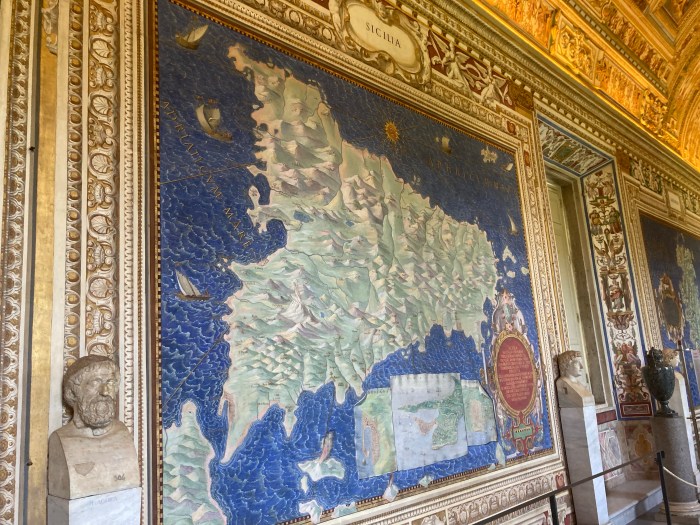
The Map Room

My favorite parts of the Vatican Museums was the map room and the Raphael Rooms which feature Raphael’s artwork commissioned by Pope Julius II. Raphael did some amazing work in those rooms, with one of his most famous frescoes “The School of Athens” being one of the pieces.

The School of Athens

The Sistine Chapel is also amazing, but you aren’t allowed to take pictures and you basically have to stand in a square and stare at the ceiling, so that can be a little disappointing.

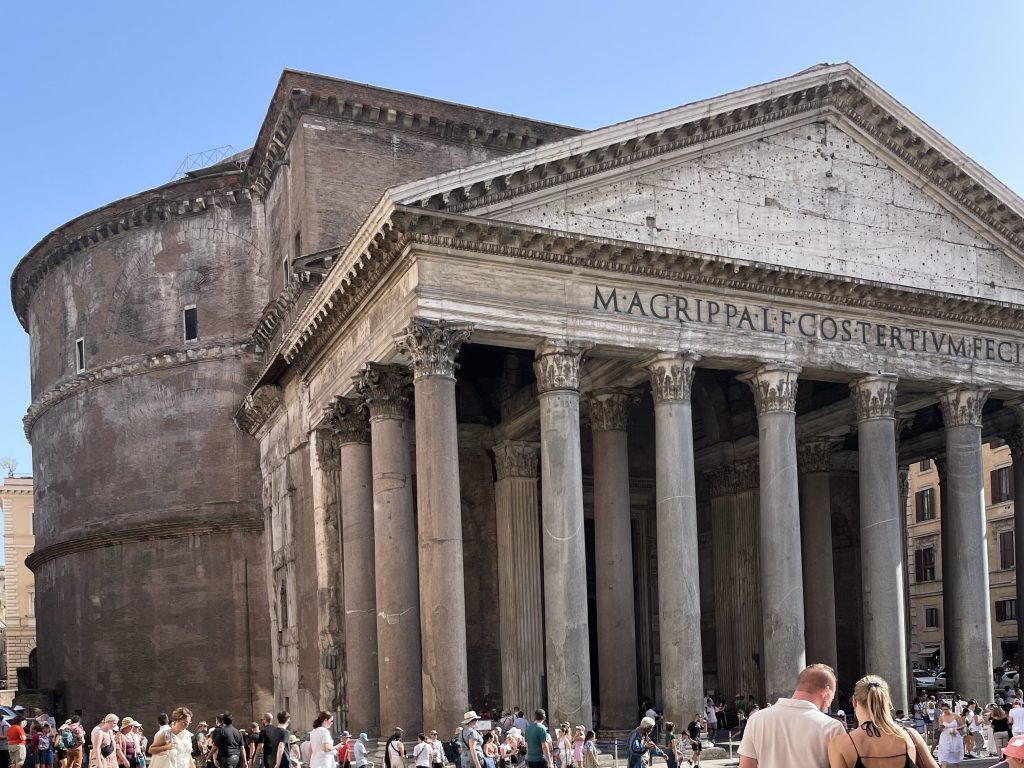
The Pantheon

The Pantheon was commissioned by the emperor Hadrian in AD 126 as a temple to all the Gods. Nearly 2 millennia after its construction, it remains the world’s largest unsupported concrete dome.

In 609 AD, the Catholic church didn’t like all those pagan gods and renovated the Pantheon into the Basilica of St Mary and the Martyrs. Tickets for the Pantheon cost 5 Euros.

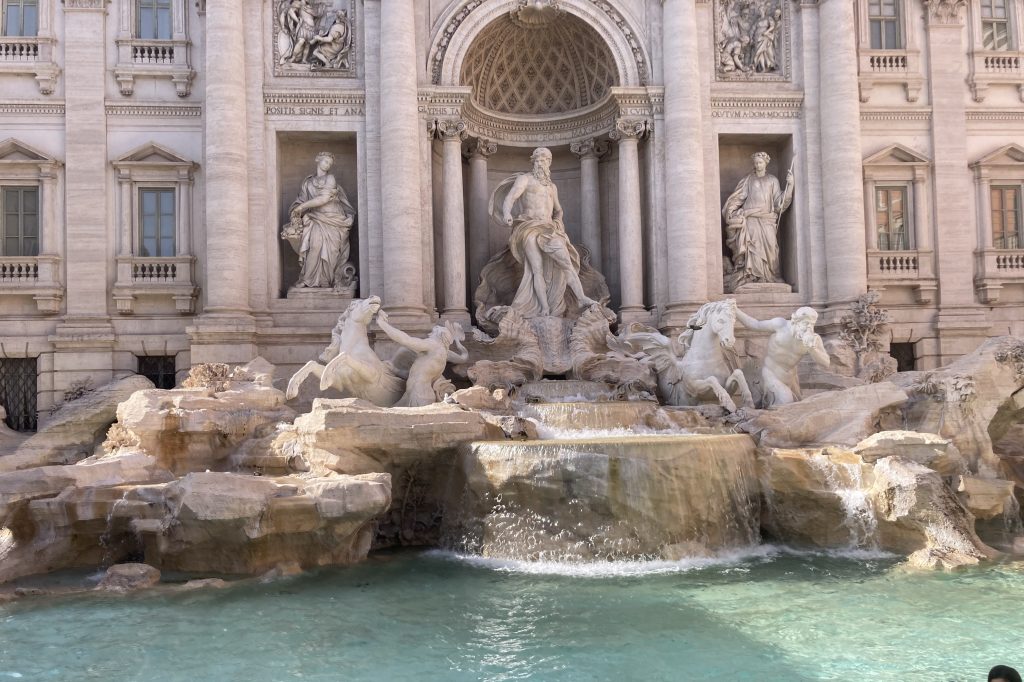
Trevi Fountain

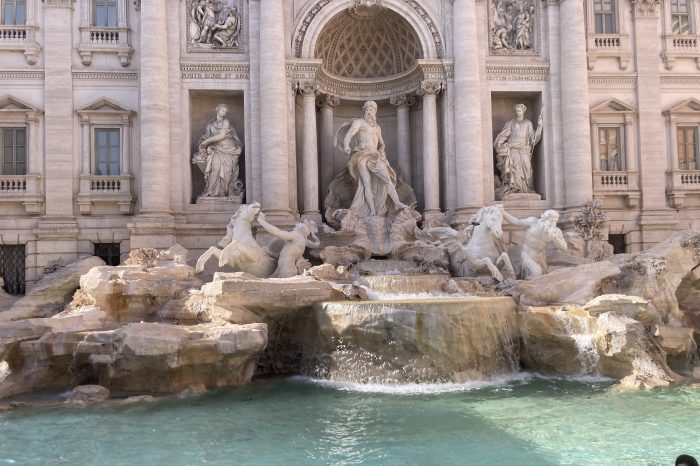
Trevi Fountain is a baroque fountain designed by Nicola Salvi and completed in 1762. You are allowed to throw coins in the fountain and the coins are collected and donated to a Catholic charity. You are absolutely not allowed to strip down and bathe in the Trevi Fountain – I won’t make that mistake twice.

Trevi Fountain

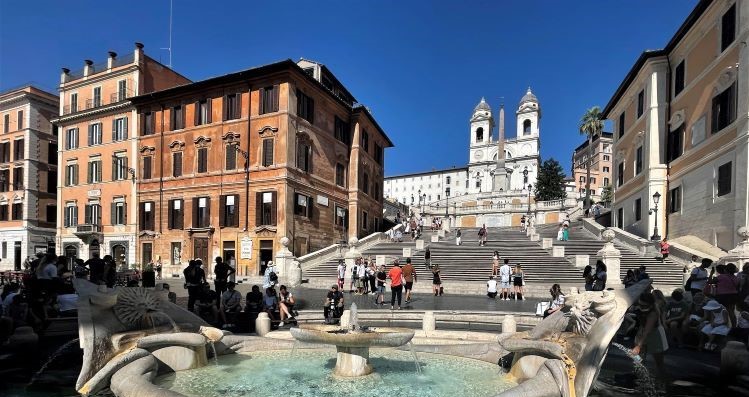
Spanish Steps

There is a lot of talk in travel blogs and videos about visiting the Spanish Steps, and I’m not sure I get it. Pope Gregory XIII first envisioned a set of stairs that connected the Piazza di Spagna to Trinita dei Monte church in the 1580s. A french diplomat left money for the construction of the stairs when he died in 1660 and the stairs were finally completed in 1725. So yeah, 145 years to build steps.

Apparently, it’s illegal with a penalty of 400 euros to sit on the steps and if you attempt it people will whistle at you to get you to stop. Anyway, it’s pretty close to our Airbnb and also close to a subway station, so we might end up going past this a few times.

Piazza Navona

Piazza Navona is a large Piazza built on the site of the Stadium of Domitian. Because of that, it is a large oval shape. It has three main fountains and a lot of restaurants. It’s just a relaxing, beautiful place. They have excavated a portion of the Stadium of Domitian under the Piazza, so you can see a little of that it was like, or you can just sit down at a cafe and enjoy a beer.

Food

Gnocchi

Gnocchi is a Thursday tradition in Rome. It’s related to the fact that Catholics don’t eat meat on Fridays during lent, so they think they need to eat something heavy the day before and gnocchi does the job. It sounds like something that should be served at a number of restaurants on Thursdays, and might not be on their regular menu. My knowledge of gnocchi ends at the dry packaged stuff at Aldi, and that’s pretty good, so I’m imagining fresh gnocchi in Rome must be amazing.

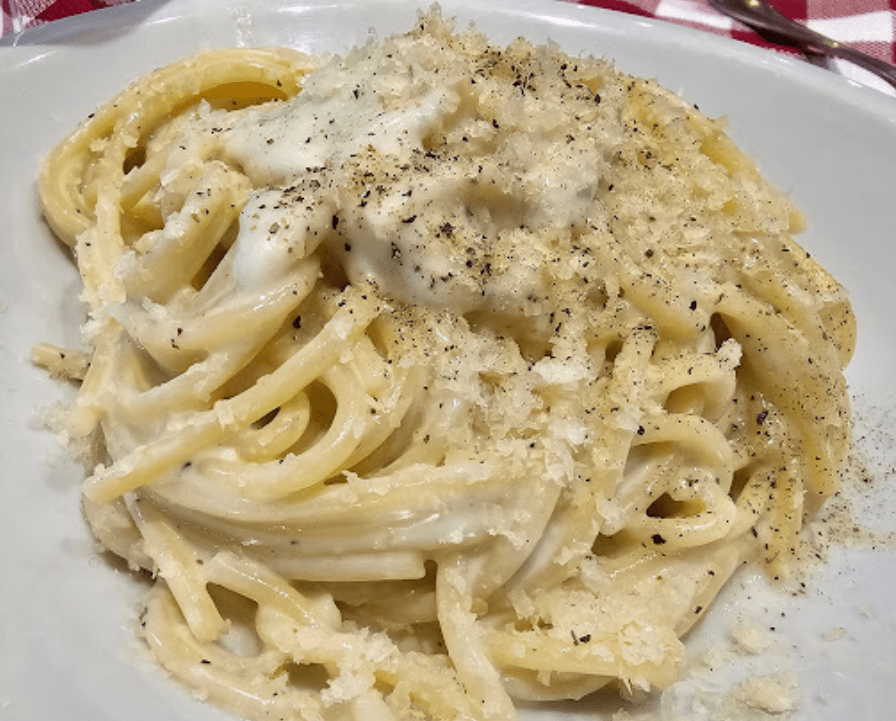
Cacio e Pepe

This is one of those dishes that’s too good to be that simple. Its pasta, pecorino cheese and pepper. That’s it. It’s also amazing.

Maritozzo con la panna

Maritozzo con la panna is a sweet brioche style bread, split and then filled with whipped cream. Apparently it’s a big deal in Rome.

Cannoli

If you haven’t had a cannoli by this time in the trip, you’re running out of time.

Craft Beer Near the Vatican

There seem to be a number of places to get craft beer near the entrance to the Vatican, like a siren song luring folks away from the Holy See. Honestly, it’s a little weird considering the lack of real beer bars in Rome. For them all to be located near the entrance to the Vatican seems like the work of, Satan, maybe? Oh well, best not to think about it.

  • Birreria Martini Esperienza Tedesca – German themed Restaurant with a very Italian name
  • Be.Re. + Trapizzino – Gastropub with 24 taps, if it’s been a week or two since you’ve had a proper stout, this might be the place to get it.
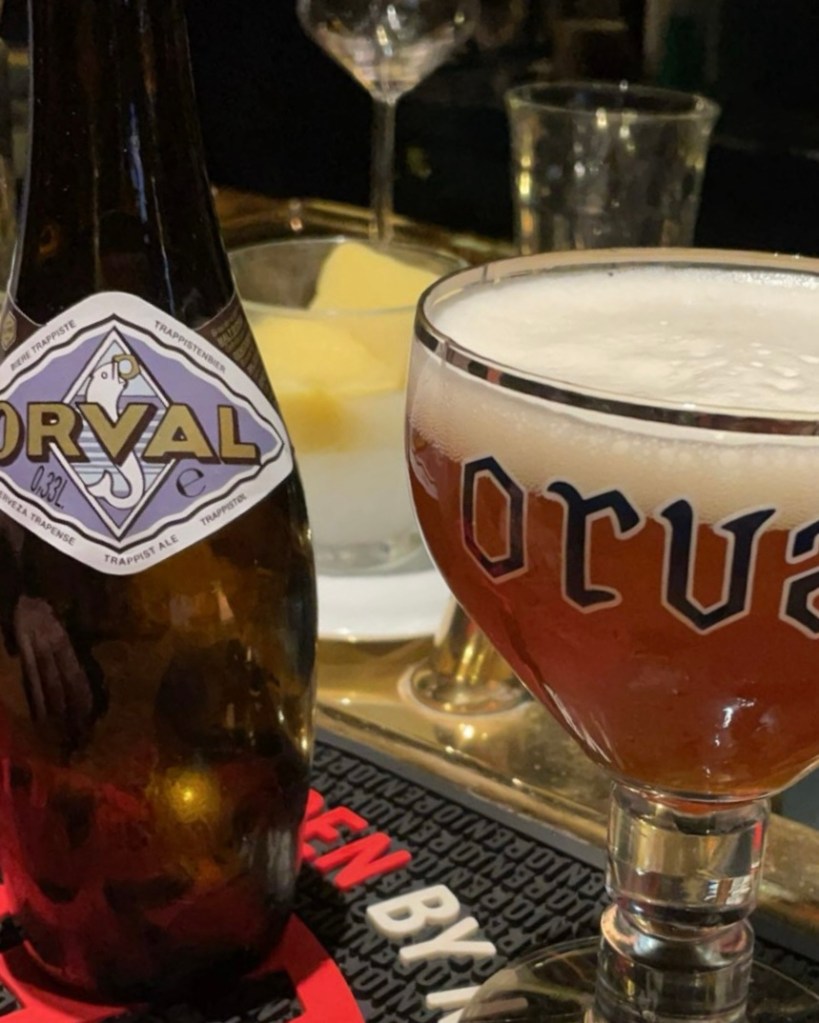
  • Angrypig Birretta e Porchetta – It’s really a sandwich shop, but in a photo on Google, it shows a really impressive bottle collection of hard to find beers, specifically Belgian ales.
  • Aeternum Beer Shop Roma – Sandwich shop/pizza, but with a really impressive tap list.

So You’re Going to Venice

Would you like to visit a swamp filled with a bunch of people who get drunk and dress in costumes right before having to cleanse themselves for Lent? No I’m not talking about New Orleans, I’m talking about real debauchery, Venice!

Carnival began in Venice to celebrate a military victory in 1162. They enjoyed the party so much that they began to hold it annually and the celebration changed to be a pre-Lent sinful blowout. In fact, the masks that people associate with Carnival were worn to facilitate anonymous trysts as well as trips to brothels and casinos.

We are visiting in November, not February so keep those masks off and those pants on!

Getting Around Venice

Venice was laid out by Satan himself. It’s an absolute shit show. Literally all of the buildings seem to be dropped at random. Any place where there is a decent space between buildings is called a Campo, which serve as plazas.

There are addresses in Venice, but the numbers aren’t always sequential or frankly even logical.

Campos are pretty much the best way to identify where you’re at. If you say “I’m near Campo San Polo” that might be understood, but if you say I’m at 3433 Dorsoduro that may be the address, but it’s completely meaningless, because, you know, designed by Satan.

So you might be asking “Why are we going to a swamp, where it’s impossible to find anything and it’s filled with a bunch of drunken sex perverts?” Good question, and the answer is “Because it’s awesome!”

Attractions

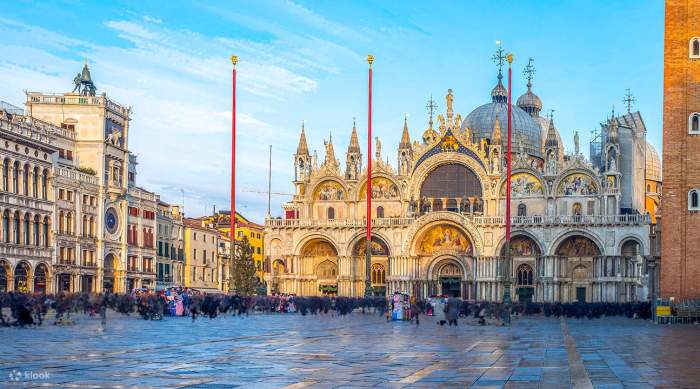
St Mark’s Basilica and St Mark’s Square

Unlike the Duomo in Florence, St Mark’s Basilica has a distinctively Byzantine Style because the Byzantine Empire ruled over the region off and on over many centuries.

The Basilica was built in 828 and was built to house the body of St Mark. His body had been stolen and moved from Alexandria, Egypt. Apparently the head of St Mark the Evangelist remains in Alexandria because, I don’t know, maybe the skull just fell out of the thief’s hands when he was walking and he just couldn’t pick it up. I mean, who does that? Steals his body and then leaves the head? Anyway, the church looks cool, even if they only have like 90% of a saint interred there.

There is also a campanile which is 323 feet tall. It was rebuilt in 1912 after the previous campanile had collapsed a decade earlier.

Tickets to visit the Basilica are free, you can purchase skip the line tickets, but I don’t know if that is necessary in the off-season. I would like to visit this and climb the campanile if possible, we did not do this the last time we were in Venice.

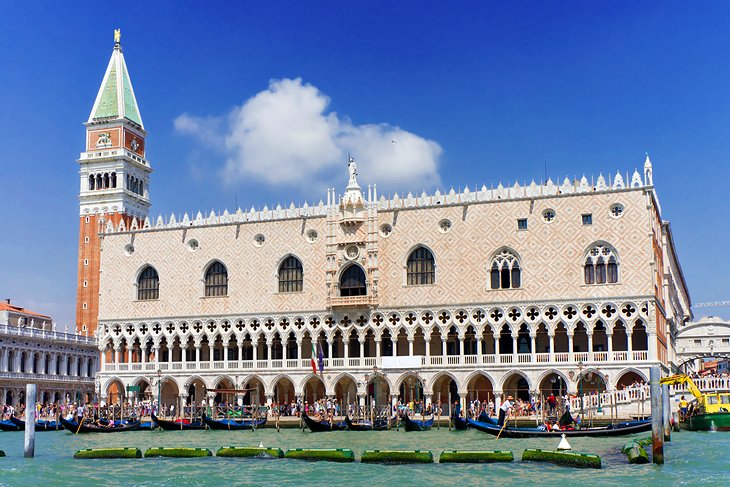
Doge’s Palace

The Doge was the name given to the leader of Venice from the 7th Century all the way up to 1797 when Napoleon Bonaparte ended the reign of the last Doge, Ludovicio Manin. As you can expect from the leader of one of the most opulent cities in the world at the time, this is an enormous palace with lots and lots of art and other grandiose displays of wealth.

Tickets to the Doge’s Palace run around 30 Euros.

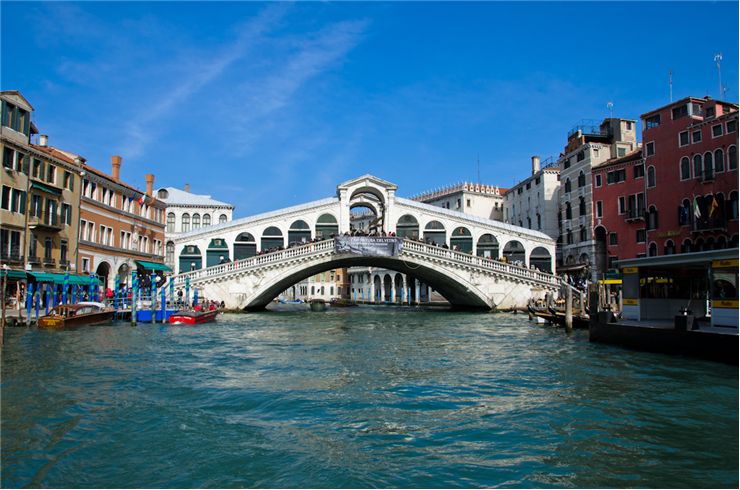
Rialto Bridge

Rialto Bridge is an iconic bridge spanning the grand canal in Venice. The Rialto Bridge is near our Airbnb, so we will cross it multiple times. There also is a market nearby called Rialto market that we should visit.

Leonardo Da Vinci Museum

Okay, this isn’t a huge attractions for Venice, but I’ve always been interested in Leonardo Da Vinci and they have an exhibit of his inventions, sketches, etc. The cost to get in is 9 euros. More information here

Murano Island – Glass Blowing

Murano Island is well known for it’s industry of craft glass blowing. There are several glass shops and glass factories on the island. Many of them have demonstrations. One unique place on the island is The Glass Cathedral which is an old cathedral that has been converted into an events center. They also do glass blowing demonstrations that take around 25 minutes and cost 14 euros.

Food

Cicchetti

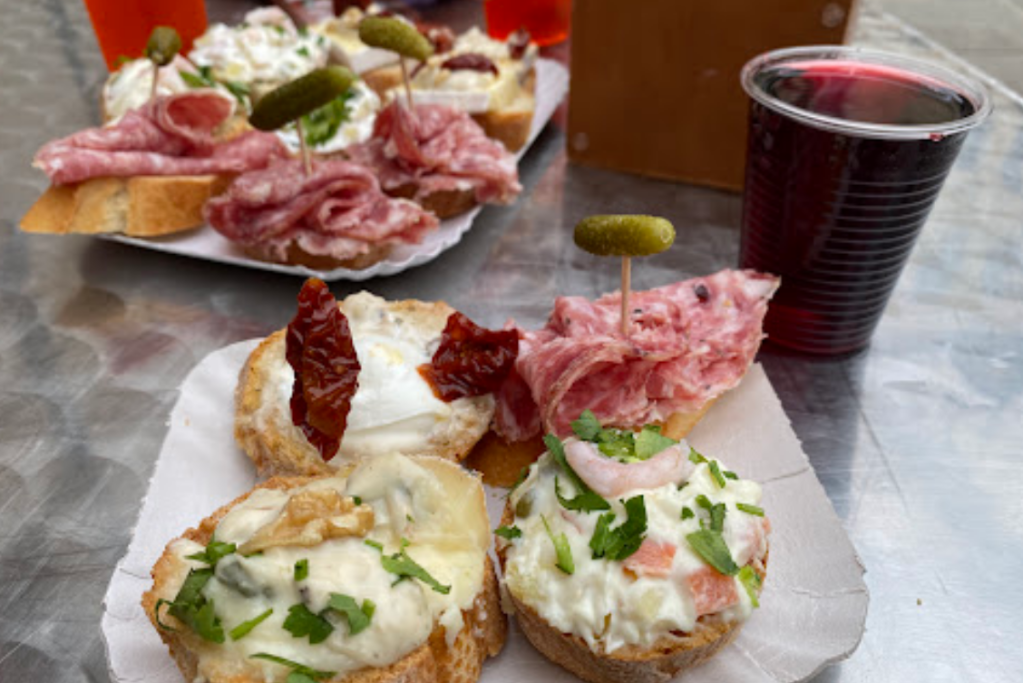
Cicchetti is a term used for small finger foods. They are often sold at wine bars known as enotecas or bacari. We went to Archicchetti Bakaro the last time we were in Venice and it was definitely a favorite of the locals. Very good. We ate crostini which are little open faced sandwiches similar to bruschetta.

Cicchetti can be found all over Venice, especially at wine bars, You will also find little crustless sandwiches named tramezzini, croquettes, and even salted mashed cod formed into balls called baccalà mantecato (looks like a better version of canned tuna fish)

Risotto

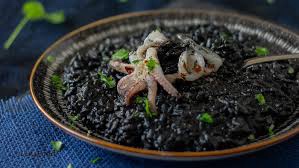
Have you ever watched 12 hours straight of the Food Network and convinced yourself that Squid Ink Risotto sounds delicious? Well now is your chance to try it! You’ll find it all over Venice on the menu as Risotto Al Nero di Seppia. Honestly, you will see a lot of squid ink dishes on menus, and they will all be labeled with ‘Nero di Seppia’.

I’ll stick with vegetable risotto known as risotto primavera. There is a similar dish known as Risi e Bisi which translates as rice and peas which is more of a thick soup.

Places to Eat

  • Mare Magno – This place has 4.9 stars on Google (370+ reviews). It’s a little pasta restaurant on the Grand Canal run by a couple. Maybe 6 dishes, mainly pasta, that change daily on the menu, around 15 euros a plate, open 1-3 and 7:30-10. I assume you need to be there at 1 or 7:30.
  • Antico Forno – Pizza near our Airbnb, and the Rialto bridge. Known for it’s Sicilian style thick crust pizza, but also has a traditional thin crust.
  • Archicchetti Bakaro – This is where we tried cicchetti when we were in Venice last time. There were so many locals there, I have to believe its one of the best. Bonus – they had Birra Morretti Rossa on tap. Oh and its very cheap.
  • Al Merca – A little wine bar that has a ton of little 2 euro sandwiches.

The Vaporetto

The Vaporetto is the only form of public transportation on the islands in Venice. They travel around the outside of the main cluster of islands in Venice as well as through the Grand Canal. They also connect the main part of Venice with other islands such as Murano, Burano, and Lido. A map of the main lines of the Vaporetto can be found here.

We should be able to buy Vaporetto tickets at the train station. Ticket prices for the Vaporetto depend on how long you want the ticket.

  • 60 minute pass – 7.50 Euros
  • 24 hour pass – 20 Euros
  • 48 hour pass – 30 Euros
  • 72 hour pass – 40 Euros
  • 7 day pass – 60 Euros

I know we are only in Venice for a few days so we will have to make a decision about whether we want to spend the entire time in the main cluster of islands or if we want to venture off using the Vaporetto. I did find some interesting places on other islands if we choose to go wandering off.

  • Murano Island – glass blowing factories, shops, demonstrations
  • Lido Island – It’s likely too cold to really enjoy this, but its the beach area for Venice, there are a number of beachfront bars, such as Bluemoon Spiaggia Lido di Venezia
  • Guidecca – Skyline Rooftop bar, on the roof of the Hilton Milano Stucky. This looks a bit bougie, but the views of Venice would be pretty amazing

So You’re Going to Cinque Terre

We are going to be heading to Cinque Terre after the tourist season is over, so this is going to make things perhaps a little trickier but perhaps better? I would expect that we won’t be waiting in any lines and we won’t be fighting crowds but the trains only run once an hour during the off-season and some of the stores and restaurants will be closed, unfortunately.

What is Cinque Terre?

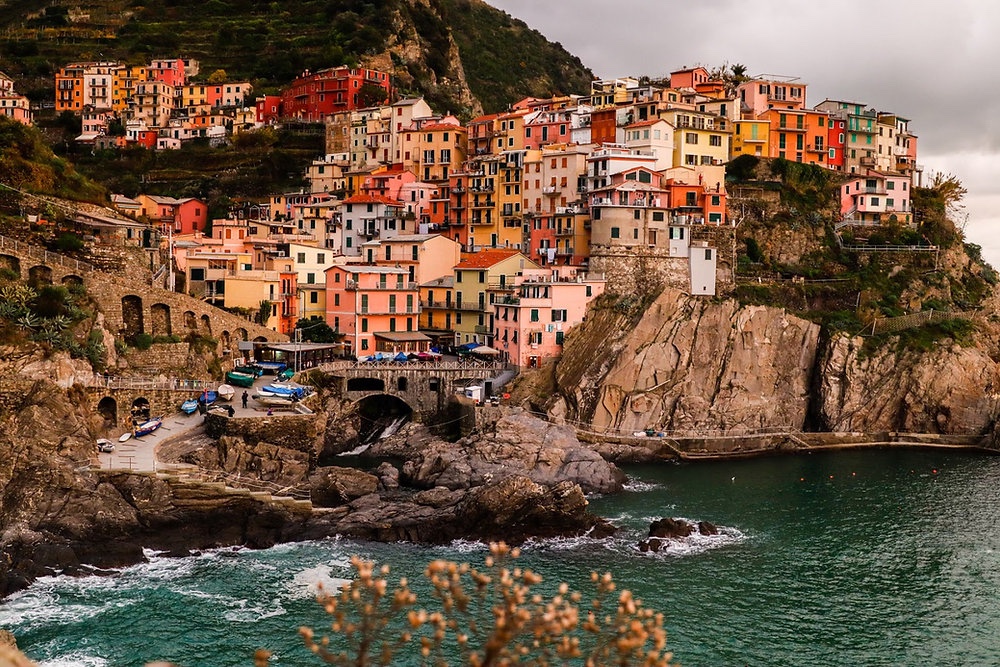
Cinque Terre is actually a national park and a UNESCO world heritage site. It consists of 5 Italian villages that are perched over the Mediterranean Sea. In order along the train from La Spezia those towns are:

  • Riomaggiore
  • Manarola
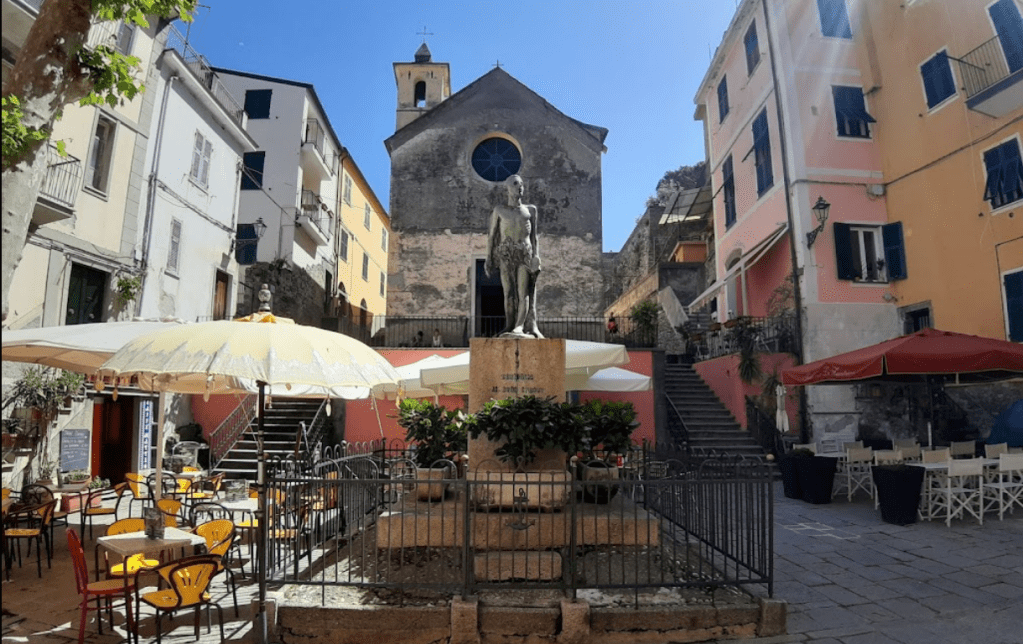
  • Corniglia
  • Vernazza
  • Monterroso Al Mare

Villages of Cinque Terre

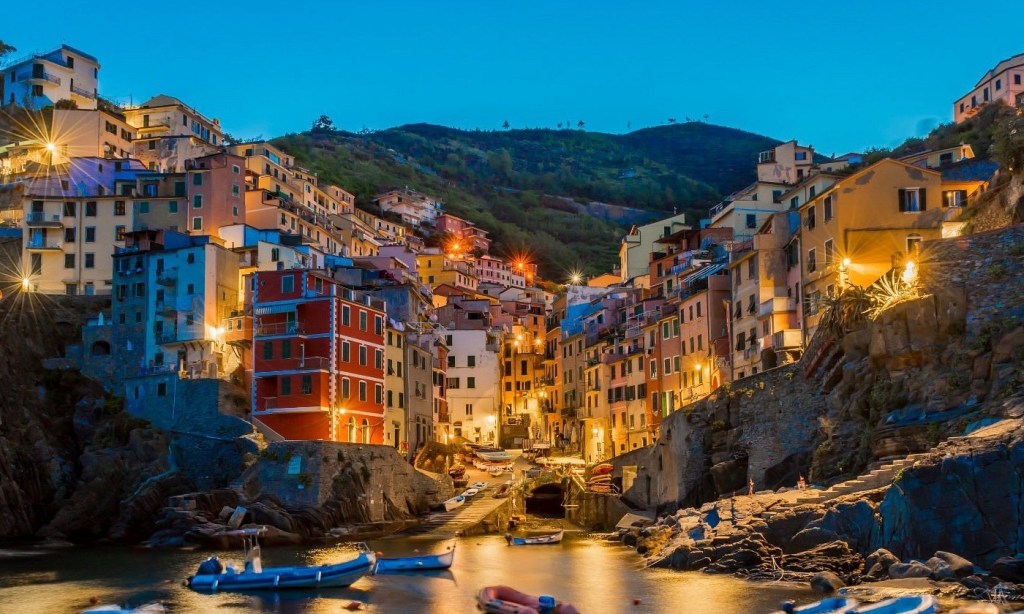
Riomaggiore

The first town on the list is Riomaggiore. Cinque Terre is well known for the wine produced in the area. The most famous wine from the region is Sciacchetra, a sweet, strong wine made from grapes that have been slightly dried over 50 days.

I wanted to try to get a tasting/tour at Terre Di Bargon but they only offer that on certain days and we weren’t going to be there at the right time. I think we might be able to see if they’re open for a glass of wine, but their website is not helpful. Either way, we should be able to try a glass of Sciacchetra in any number of wine bars throughout Cinque Terre.

If it’s early we can head to a bar for a cappuccino, because bars usually are open for coffee in the morning.

Manarola

Manarola is the second town as we head north. We will have to get off the train and into a tunnel for a walk to the town. Manarola has a small church built in 1338, Chiesa di San Lorezno. There is basically one main road that snakes through the town with restaurants, bars and shopping along it.

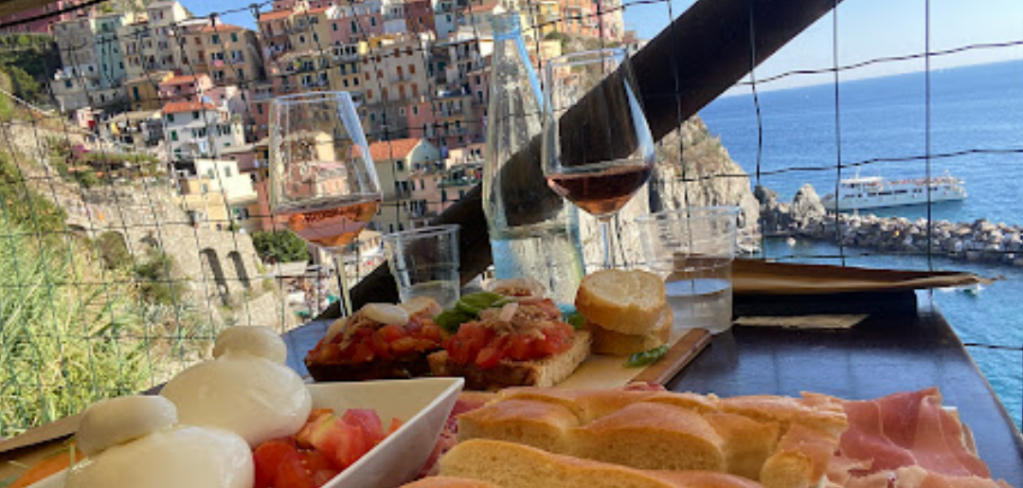
There is one offshoot road that goes north along the coast and leads to an overlook and a restaurant that I would really like to visit. Nessun Dorma is well known for their pesto, tagliere (charcuterie), and especially bruschetta. It has an amazing view of the sea from the terrazzo. Their hours are super short from 4:30 PM to 7 PM or 8 PM depending on the day, so this might not work out.

Corniglia

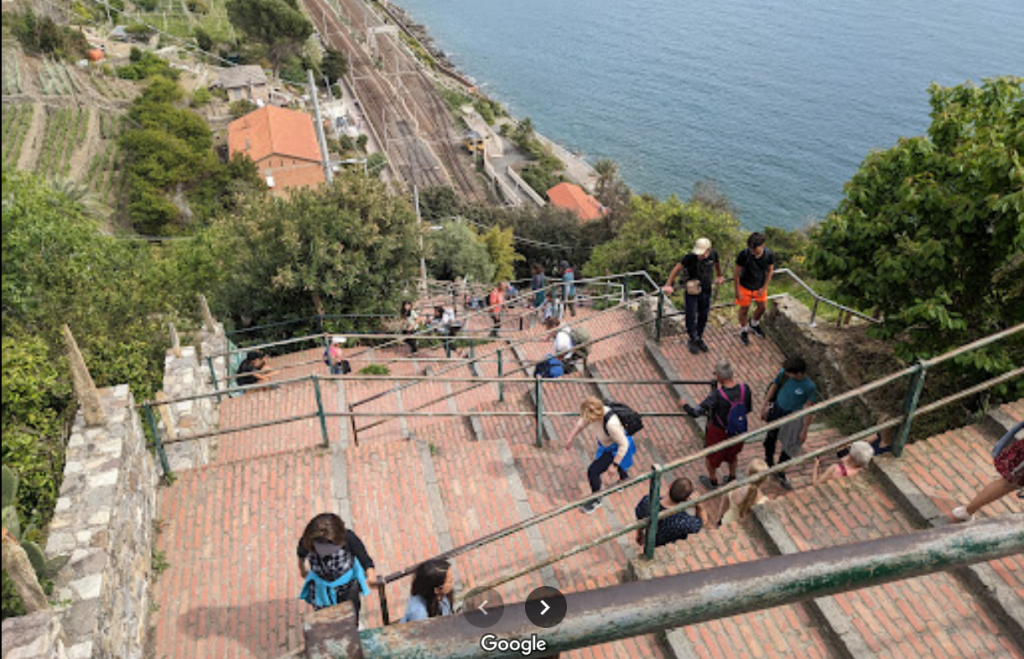
I suspect it is going to be difficult to do all of the towns in one day, and I assumed we would have to skip one or two. This is one I think we would want to skip. I didn’t find anything that made me think we had to go. But the number one reason not to go is the ridiculous number of steps from the train station to the town. It looks a little strenuous.

Vernazza

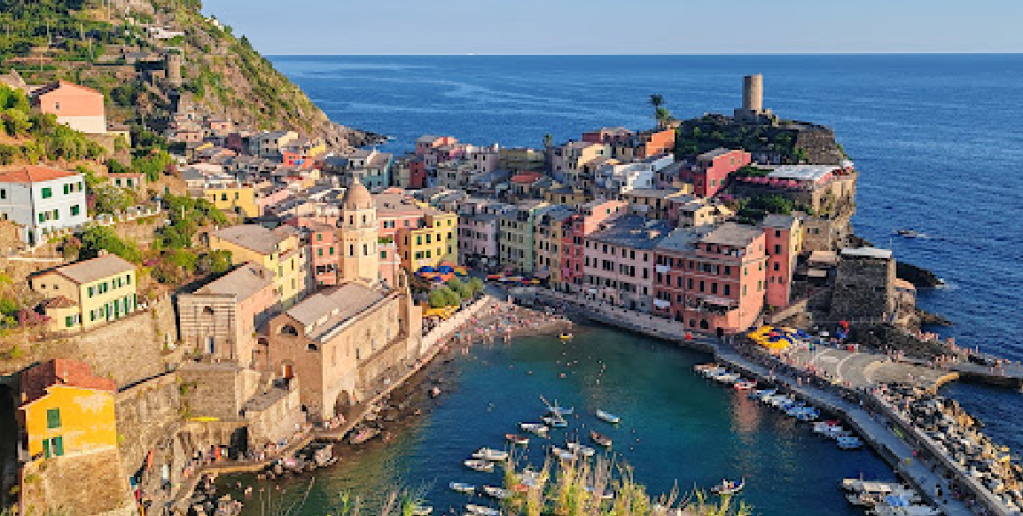
Vernazza is going to be super accessible as the train station is right smack dab in the center of town. While we definitely should visit as many enotecas (wine bars) as possible in Cinque Terre, there is a funky bar called the Monkey Artpub that I’d like to pop in for a visit.

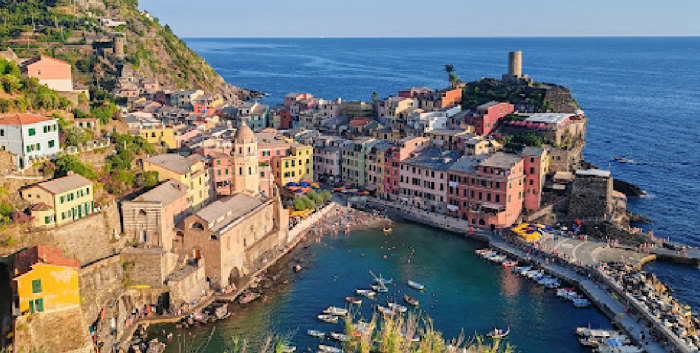
The marina in Vernazza looks pretty awesome and has the Chiesa di Santa Margarita di Antioch right on it. The church is from the 14th century and hopefully the doors will be open and we can peak inside.

The most famous view in Cinque Terre is the view from the hiking trail overlooking the marina in Vernazza. We might manage to sneak up there if we have time.

Monterossa Al Mare

Monterossa Al Mare is the only one of the five towns that has a sandy beach. Like Vernazza, the train station is very close to the center of town and makes it very accessible. This area is much flatter than the other towns and actually has multiple streets rather than one narrow street in a valley. There are quite a few restaurants and shops that are in this town and we can probably just wonder around and see what we see.

Monterossa is separated into two parts by a large hill in between. On top of that hill is a monastery. Walking by the sea will be the best way to get around that hill. The area to the east has more restaurants and shops. The area to the west also has shops, but it also has a giant statue which is interesting.

Order of Operations

So in order to see as much as we can see, I think the optimal way to approach this is probably to go to Riomaggiore in the morning and then skip to Vernazza, then Monterossa Al Mare. If we have time, I would like to head back to Manarola to go to Nessun Dorma.

If we want to really simplify things, I think skipping to Vernazza and then going to Monterossa Al Mare makes sense. Those two towns will probably be the best two to visit.

This place is a major wine region, with a lot of wine styles that can only be experienced in Italy. We should do our best to visit as many enotecas as possible and hopefully get some tips from the store keepers.

We will always have to be mindful of the time, because we are off season in Cinque Terre and the trains will only come once an hour. Since there is a very good chance this turns into a high class pub crawl, someone needs to stay sober enough to get us to the damn trains on time.

So You’re Going to Florence

In a few hours, you will be landing in Fiumincino “Leonardo Da Vinci” Airport. This airport was named after one of the ninja turtles, who outside of fighting crime in the sewers, also created major artwork around Italy. It is very likely you will be seeing work by Leonardo, Donatello, Michelangelo and Rafael during this trip.

It sounds like you guys will be there before us, but hopefully if everything goes according to plan, we will be meeting around noon.

The signs in the airport will be Italian on top and English below, so you shouldn’t have any issue navigating the airport. I’m not sure about the bathroom signs, but it’s really important to know that Donne means women and Uomini means men.

Once we have met up, and you’ve gotten that coveted Italy passport stamp, we will move to the train station where we will be getting on our train to Florence.

Attractions

The Duomo

Everyone refers to the Cathedral of Santa Maria del Fiore as “the Duomo.” Duomo means “Cathedral” in Italian. The Duomo dominates the skyline in Florence and was completed in 1436. It is 500 feet long 295 feet wide and 295 tall to the base of the lantern.

To visit the crypt of Santa Reparata, the museum, and the baptistery, it costs 15 euros, if you add a trip to the top of a the campanile (tower 414 steps, no elevator) it’s 20 euros. To add the campanile and the top of the Duomo (463 steps, no elevator) it’s 30 euros

For more information visit: https://duomo.firenze.it/en/discover/cathedral

Naked Guys named David

In the Galleria Dell’Academia you will find the original Statue of David by Michelangelo. Other artwork in the Galleria is from the 13th century through the renaissance and contains paintings of Botticelli and statues from Michelangelo.

What is weird about David is that he appears to be uncircumcised, which is an odd choice considering King David’s history with the practice. You see, King Saul offered his daughter Michel’s hand in marriage but he wanted a dowry in exchange. The King was seeking revenge from their Philistine enemies and asked for a different sort of dowry.

He decided to send David and a group of soldiers on what is one of the weirdest scavenger hunts of all time. King Saul asked the young man to go into the Philistine camp and return with the foreskins of 100 Philistines. Being an overachiever, he returned with 200 foreskins. Unfortunately, it is unclear from the King James Version if David told Saul to “Eat a bag of dicks” when he presented Saul with the dowry. You don’t believe me, do you? Fine read it yourself!

Either way, I would assume that David was circumcised based on that Bible story. I also question my Mother’s decision to name me after a prolific penis mutilator.

Tickets to see this historically inaccurate todger cost 20 euros.

There is a replica of the Statue of David in the Piazza Della Signoria if you don’t care if you see the original.

Piazzale Michelangelo

The Piazzale Michelangelo is across the Arno from the main part of the city. It is known for being a beautiful place to view the city and see a sunset. This is probably the furthest point on my list from our Airbnb, but its still only about 2.7 km away. We might need a couple of aperol spritz stops to complete this journey.

Getting Alcohol

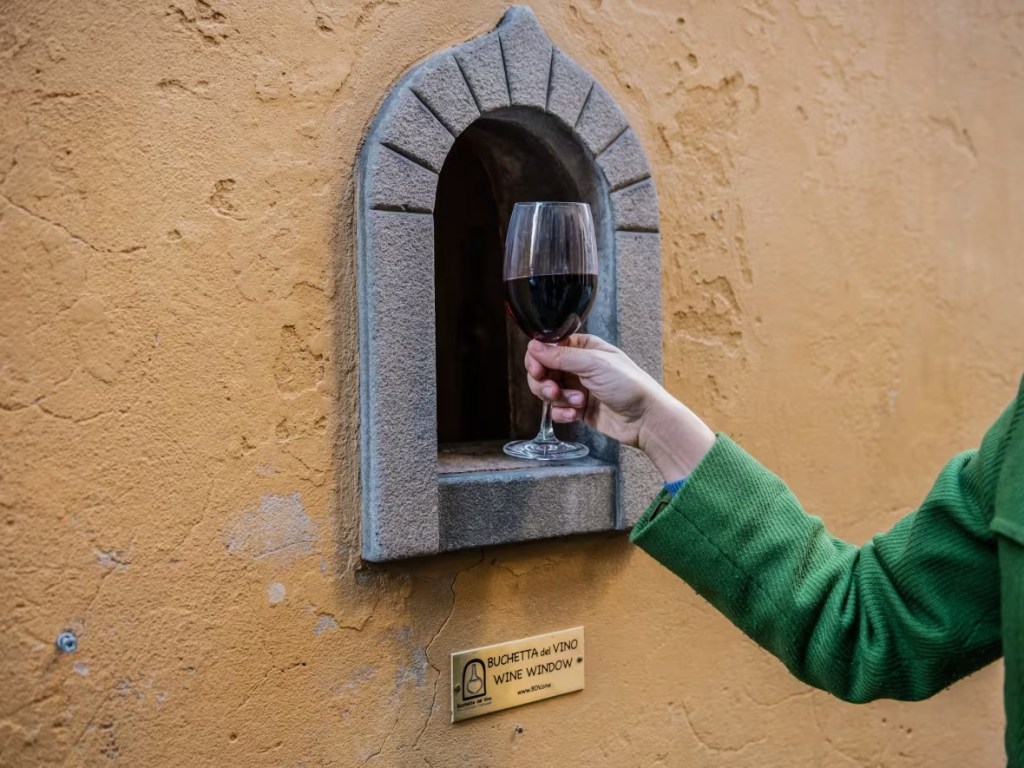
We will be embarking on a much more pleasant scavenger hunt. Instead of foreskins, we will be looking for wine windows.

Wine windows were a result of nobles attempting to sell wine during the black plague. Selling wine through windows allowed the seller to socially distance themselves from their clients. There are over 200 of these windows throughout the city and they do allow you to purchase wine through these cute little windows.

Native Wine Varieties

  • Chianti is the most famous variety from Tuscany
  • Vinsanto is an Italian sweet red wine made from a high sugar must due to drying Trebbiano Toscano and Malvasia Bianca grapes
  • Moscadello di Montalcino DOC is similar to Moscato

Most of the wine in Florence will be dry and most of those will be red.

Beer in Italy?

Yes, there is beer in Italy. Thank God. Most common will probably be Birra Morretti, which is an Italian Pilsner. If you can find the Birra Morretti Rossa, get it, it’s delicious. There is also Peroni Navarro Azzurro and Menabrea which are also Pilsners. Navarro Azzurro means “blue ribbon” so Italian PBR?

Also keep in mind bottiglia means bottle and al spina means on tap. Rossa means red, ambrata means amber.

There are a surprising amount of Irish bars in Florence, but if we’re looking for a craft beer bar, we can head to Alibi Craft Beer and Kitchen. 17 taps, not sure if it’s their own or purchased.

Aperitifs and Mixed Drinks

  • Aperol Spritz – Aperol, Prosecco, soda and delicious
  • Negroni – gin, vermouth, Campari – a classic Italian cocktail
  • Lemoncello – had it, don’t remember it, sounds good

Getting Food

Panini

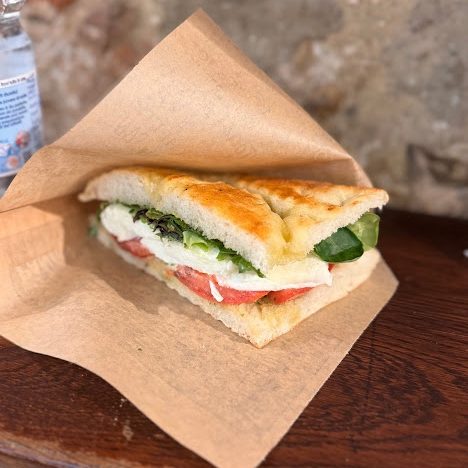
In Florence, everyone raves about the panini. It’s made with Schiacciata bread which is like focaccia but thinner and more chewy. It shouldn’t be too hard to find a sandwich shop, but if we can’t then we need to find Vinaino Fiorenza, which has some great looking sandwiches and vegetarian options.

Pizza

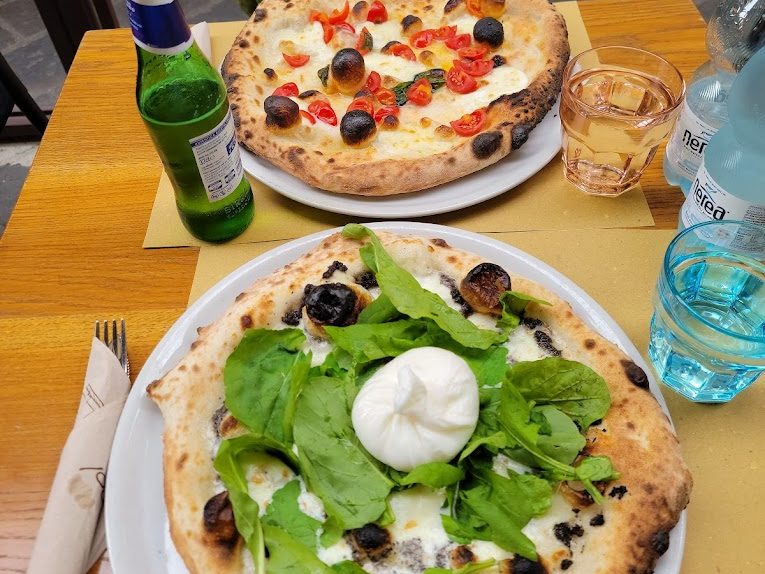
We’re going to eat pizza, this is non-negotiable. Some highly rated pizza shops include Gustapizza, Bondi Le Focaccine, and Antica Figgitoria Dell’Alberto.

Street Food

It won’t be hard to find street food, but Ará é Sicilia looks really interesting if we get a chance for a snack.

These are Arancini di Riso or fried rice balls. Essentially there is an item in the ball, like proscutto which is mixed with rice and balled up, breaded and fried.

Different Kinds of Italian Restaurants

You will notice a few terms on restaurants that identify what kind of restaurant it is. These terms are semi-interchangeable but they do give an indication of what kind of experience that you are likely to have in that restaurant.

  • Osterias – Simple rustic restaurants with rotating menus.
  • Trattoria – Family restaurants that serve regional cuisines, typically affordable, and no-frills
  • Ristorante – A little more high-end, better service, higher end wines, more curated menus
  • Enoteca – Wine bar that may have evolved into a restaurant, although it would be a wine forward restaurant.
  • Bar – Most bars will serve coffee in the morning, and maybe a pastry. In the afternoon and evening it switches to small bites and alcoholic beverages

For a much better and more complete explanation of this visit curiousappetitetravel.com

Reading an italian Menu

If we do end up in a Ristorante (this can also be true of some Osterias or Trattorias), you will find a little more complex menu then we are used to in the US. Most of the time, the menus will be set up the same, however. The menu will be split into sections.

  • Antipasti – Appetizers (like good appetizers, not mozzarella sticks or boneless wings)
  • Primi – First Course, typically pasta, risotto, or soup (although soup could be under a section called zuppa)
  • Secondi – Second Course, heartier dishes, which could include beef, fish, shellfish, etc.
  • Contorni – Side dishes – chances are your Primi and Secondi won’t come with any sides
  • Dolci – Dessert
  • Digesti – After dinner liquors such as limoncello, grappa (made from grapes), mirto (made from blueberries)

You don’t need to order from all of the sections, you aren’t required to eat a 6 course dinner. Typically I was satisfied by just eating pasta from the Primi menu, considering we eat all day on vacation, but obviously that’s up to how hungry you are. There is a good article on Italian menus at walksofitaly.com.

The Bill/Tipping

As far as tipping is concerned, there will be some fees added to the bill and that will determine whether it is customary to tip. If there is a coperto only (sitting fee), you should perhaps round up your bill, but you’ll need to tell the server that before they take your payment. If there is a servizio added, they already took your tip, and you can just pay the bill.

One other thing, a lot of restaurants will put a basket of bread on your table, don’t be surprised if it shows up on your bill. It shouldn’t if you don’t eat it, and it might be complementary, but I wouldn’t expect to eat free bread.

Pretty much at any restaurant in Europe, water isn’t free and it’s not tap water. If you ask for water, they will ask you if you want still or carbonated and they will bring you a bottle.

Oh yeah, and you might have to tackle the waiter in order to get another beer or your bill, they will pretty much leave you alone unless you want something. Once you do manage to tackle your server, don’t expect them to split the bill for us, apparently that’s not a thing in Italy. We will have to have one person pay and split it ourselves.

Special Food Terms

IGP – means Indicative of Geographic Province, which is a term indicating a product that is only produced in a specific region. You’ll see this on salamis and cheeses

DOC – means Denominazione di Origine Controllata or in English, Controlled Designation of Origin -basically the same thing as IGP, just with wines

DOCG – means Denominazione di Origine Controllata e Garantita or Controlled and Guaranteed Designation of Origin – the same as DOC only this time they’re super serious.

DOP – means Denominazione di Origine Protetta – means Protected Designation of Origin -you know how Eskimos have like 100 words for snow?

PDO – means Protective Designation of Origin – seriously why are there so many terms that mean the same thing? Dammit Italy you’re giving me a headache. Ok, so if you see any 3 letters after a wine name, it means its a unique wine from the area it says its from.

Shopping

  • San Lorenzo Market – Well known for clothing and leather goods
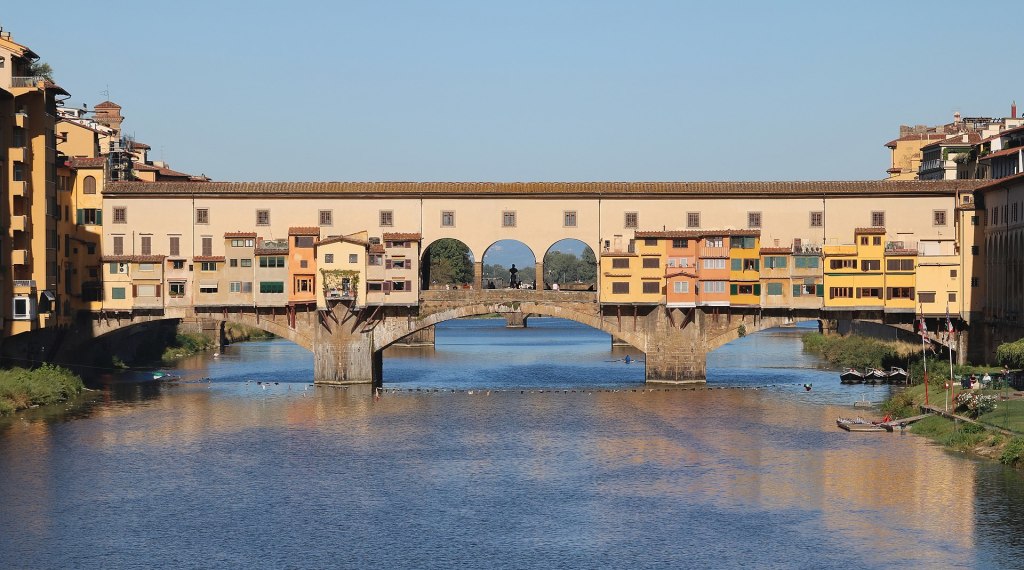
  • Ponte Vecchio – Well known bridge/landmark, its a place to buy jewelry and souvenirs
  • Mercato Central – World Famous Farmer’s Market

Learn A Little Italian

It shouldn’t be difficult to find someone who speaks English virtually everywhere we go. However, Italians will appreciate it if you put in a little effort to speak a little Italian. Here are few words/phrases that you might recognize but are helpful to know.

  • Ciao – Hello/Goodbye
  • Arrivederci – Goodbye
  • Buongiorno – Good Morning
  • Buonasera – Good Evening
  • Buona Notte – Good Night
  • Vino – Wine
  • Birra – Beer
  • Scusi – Excuse Me
  • Non Parlo Italiano – I Don’t Speak Italian
  • Parlo Inglese – I Speak English

Exploring Beer Culture in Ontario’s Wine Country

One thing that surprised me about our trip to Ontario was the number of wineries and vineyards that exist in the area between Niagara Falls and Toronto. According to Ontario Wine Appellation Authority, cool weather varieties thrive in this area, like Riesling, Chardonnay, and Pinot Noir.

We were staying in Hamilton, having parked our camper for the week at Fifty Point Conservation Area. From where we were staying, it seemed like every exit along the Queen Elizabeth Way had signs for at least two wineries.

Maybe we should have popped into a winery and checked out what was special about the wine in the Niagara region, but we were more interested in checking out the beer scene. While we were in Ontario, we noticed that there were a few differences between beer culture there and beer culture in Iowa.

Production Breweries vs Brewpubs

Our first night in Ontario, we decided to go to Newark Brewing Company. It is a pretty large production facility set in an industrial area. There is, however, a large grassy side lot that makes the tap room feel like it’s much more out in the country. In fact, our server told us they were part of Harvest Hosts which is a group of wineries, breweries and other attractions that allow you to camp on their site for free. So that grassy lot might just be available for camping.

Dunkel Lager at Newark Brewing

This was the first of many production breweries we visited. Throughout our visit, one thing became fairly clear. Most of the breweries we visited were full scale production breweries first and taprooms second. It’s a different vibe from most of the breweries we visit in Iowa where most of the beer goes straight into kegs to be served at the brewpub. Some canning is done at these brewpubs, but a very low volume is sold, mainly at the taproom itself for carry out.

Session Beers and Low Alcohol Drinks

I love how the beer culture of Iowa has really grown over the last 20 years or so, but if I had one complaint it’s that Iowa craft brewers (and frankly most US craft brewers) brew too many high alcohol beers.

High alcohol beers are rich, flavorful and delicious but they tend to lack drinkabilty, and aren’t refreshing on a hot day. They also, predictably, make the drinker inebriated at a quicker pace, which creates its own series of problems.

At the first brewery we went to, we noticed that there wasn’t a single beer over 6% and most were 4%-5%. I had the Dunkel while we were there which was right at 5%.There are breweries in Iowa where finding a beer under 6% can be tricky, so being at one where everything was 6% or under was refreshing.

The next day we visited Collective Arts. That is a super funky production brewery in a highly industrial area in Hamilton. They served a micro pale ale at 2.9%. I had never heard of a pale ale that low in alcohol.

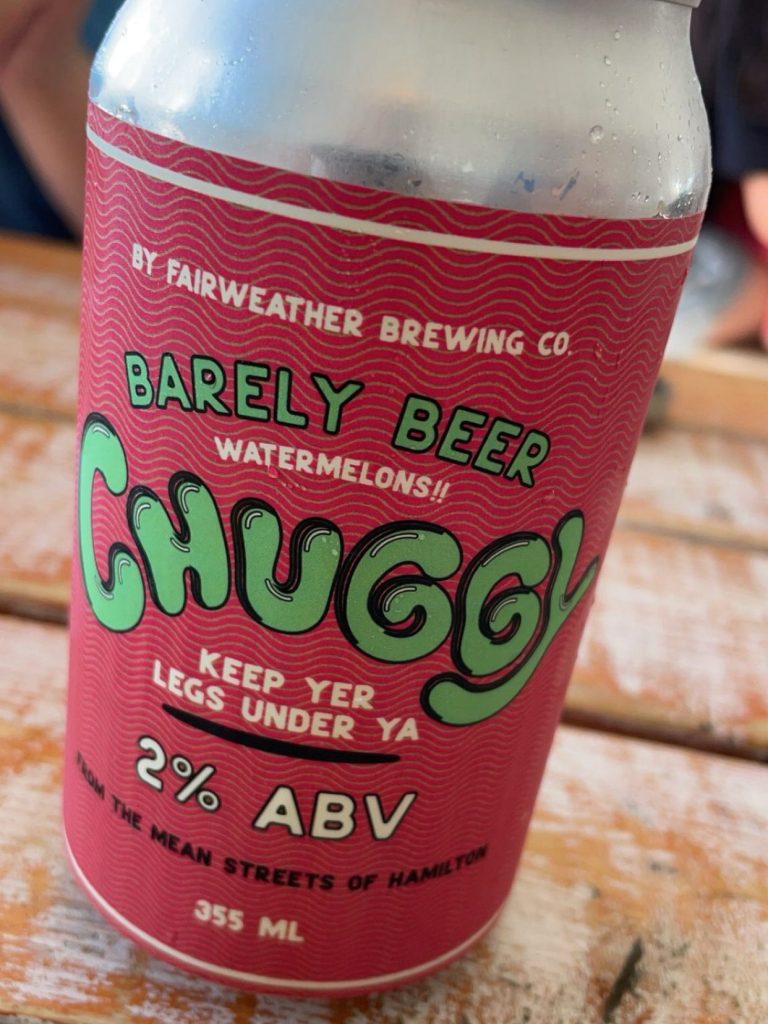
Later in our trip, we went to Fairweather Brewery which had a series of fruited ales that were 2% alcohol. They were called Chuggy, Jenn tried one of them and really liked it.

Throughout our trip, the focus that most of the breweries had was on beers with traditional alcohol content not Imperial or Double beers. The fact that a few also had beers under 3% was a nice little bonus. I wish this was something that we saw a bit more often in Iowa.

Our Favorite Breweries in Ontario

This isn’t really a full assessment of breweries in the Ontario area since we were only able to visit a few breweries in the week we were there. But I can definitely tell which ones we would’ve been visiting multiple times if we lived in the Hamilton area.

Collective Arts

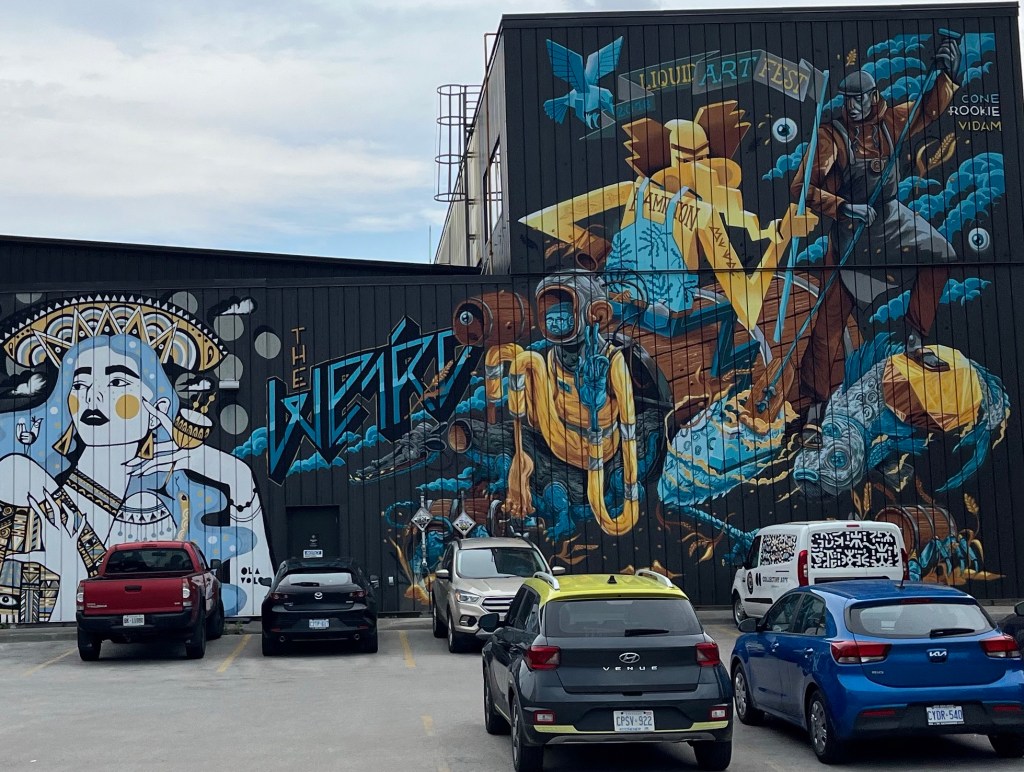
I found this one by searching around on Google Maps and it didn’t disappoint. They have an amazingly funky vibe. Art is everywhere around the facility with murals on practically every wall. It’s a huge facility but they have a cool patio area where we sat for a beer. Next to the patio area is a large industrial room that looks like maybe its used for canning and barrel aging (I’m not sure about that, I didn’t go snooping). That room also has a bunch of cafeteria style tables in it for when its too cold for the patio.

Barrel Aging at Collective Arts Brewing.

Collective Arts also has a good carryout facility and we did pick up some beer for the camper. The cans also had some great artwork. The beers that we tried, both at the facility and back at the camper, were very well done. If we lived in this area, I think we would visit regularly. For more information on Collective Arts, visit their website.
Bench Brewing Company

Bar at Bench Brewing Company

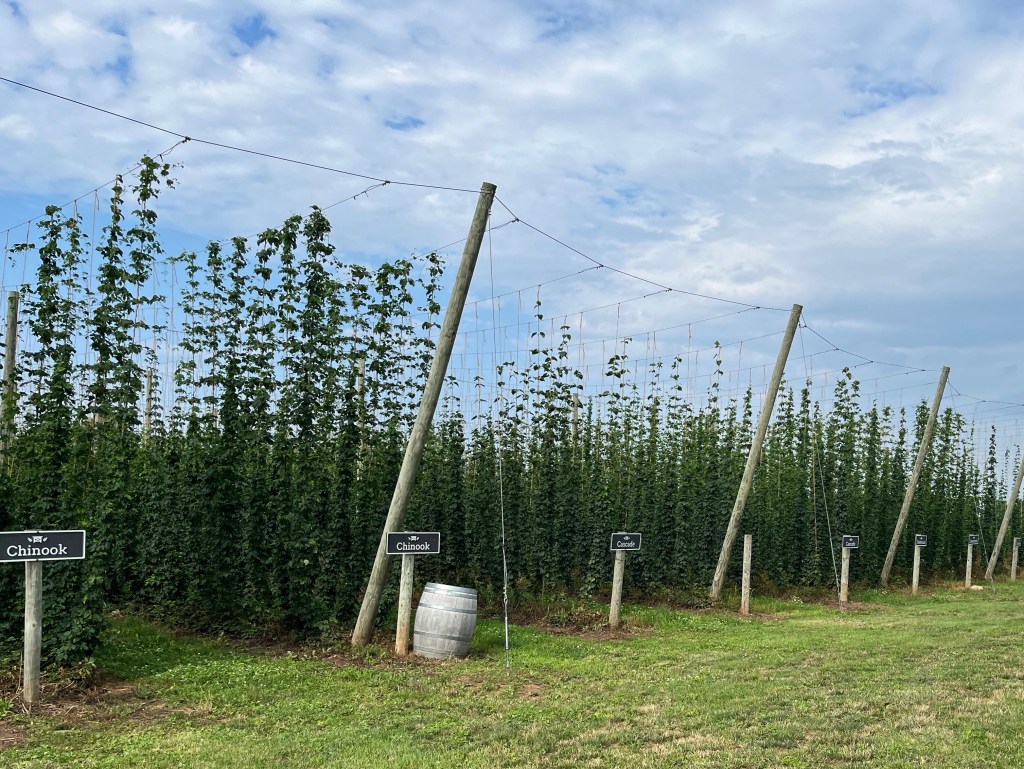
Bench Brewing Company is a large production facility set off in the middle of wine country. The facility is in a very scenic country setting with an apple orchard and several wineries nearby. They actually have their own hop farm on site.

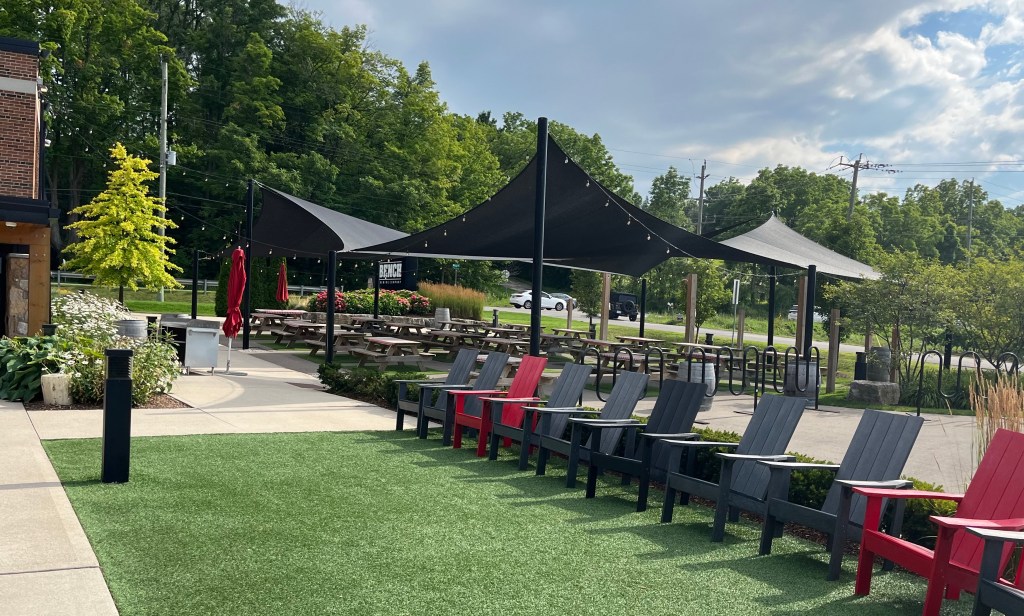
It has a little bit of an modern industrial vibe to it. The bottle and gift shop is actually two shipping containers that you have to walk past to get to the tap room. They have a large patio area and a large restaurant. Since it was a weekday afternoon, they were only offering service in the restaurant so we sat in a covered deck seating area at the restaurant. We had a little snack and a couple of beers. Everything was well done, the beers that we tried were all of session strength and well made.

Rows of hops at Bench Brewing Company

I would have liked to have spent some time in the patio area. Bench Brewing is in an idyllic and peaceful location, being at the restaurant wasn’t taking advantage of the location. If I were looking for a place to relax on a nice day, this would be the place I would want to sit outside and have a beer. More information about Bench Brewing can be found here.

Outdoor Area at Bench Brewing Company

Trust The Locals

We always like to ask the folks who work at breweries where they go for a beer. Most bartenders and servers at breweries are beer lovers themselves and tend to have very good suggestions. A couple that came up were Merit Brewing and Fairweather Brewing.

Menu at Merit Brewing

We did go to Merit Brewing and I understood the hype. There is some creative brewing going on at this facility. I’m not into sours, but I did have to try a small pour of the Wild Years, which is a brett saison with peaches and muscat grapes. Hats off to the brewer on this one, that’s a very creative beer and if you’re into sours, definitely worth a try. I also tried Young Rival, which I thought was a very good IPA. More information on Merit Brewing can be found here.

We also managed to make it to Fairweather, which wasn’t my favorite mainly because they did have a focus on sours, which again, I avoid. Jenn loved the low alcohol Chuggy beers. They are doing some creative things with sours. Right now they are serving a beer called Apsara that is a sour with peaches, milk sugar, vanilla and chai. If you love sours, I think this is a great brewery to visit. More information on Fairweather can be found here.

Silversmith Brewing

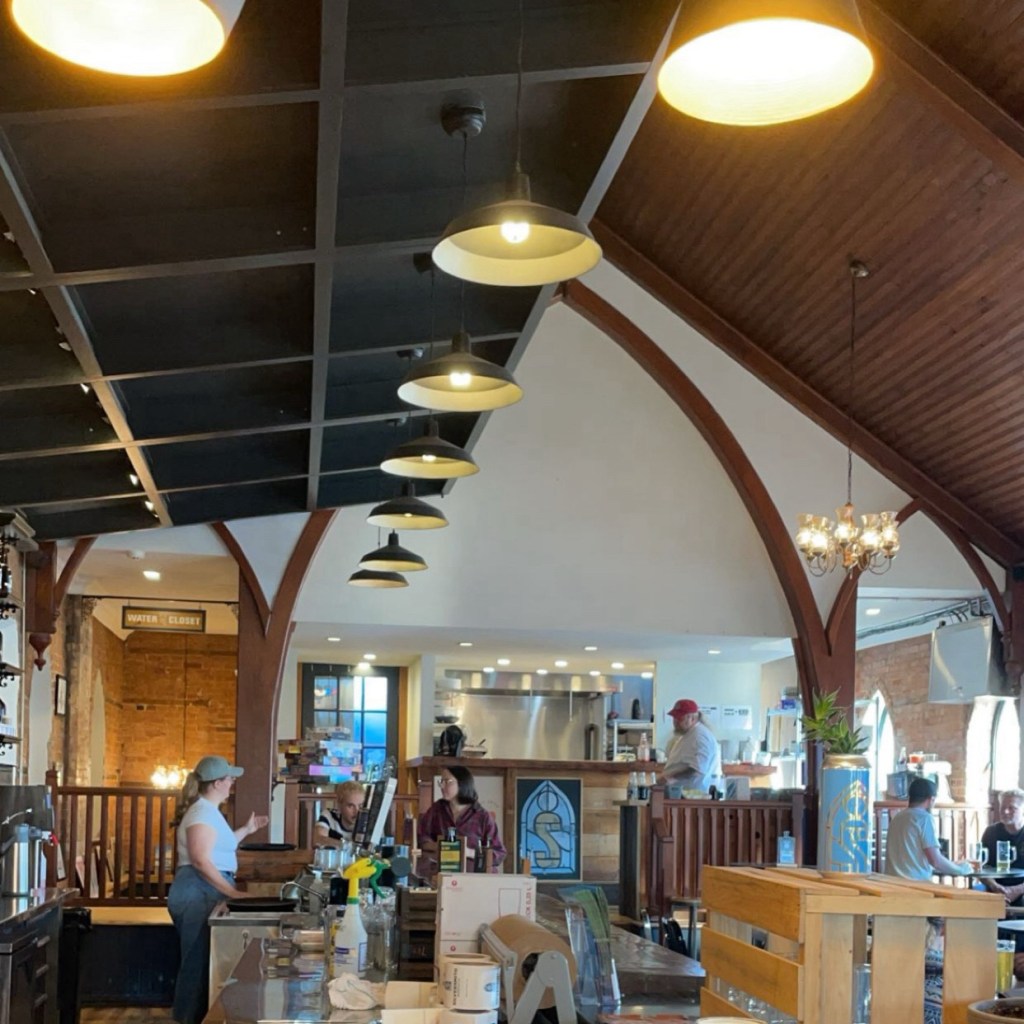
My personal favorite was a little brewery set in Virgil Ontario called Silversmith. It’s located in a little church that’s been converted into a microbrewery. It has a little patio out back where we enjoyed the warm weather and a couple of pints.

The Black Lager

I had The Black Lager, a schwarzbier which was delicious. I don’t know why schwarzbiers aren’t at every brewery to be honest. They are drinkable, flavorful, usually around 5%. They are just perfect all around beers that can be enjoyed year round. Silversmith not only brewed a great beer style, but they nailed it on the execution.

Silversmith is a converted church so I guess you can say you went to church if you go there.

Silversmith seems to focus on well executed classic beer styles and I appreciate that. There are so many breweries now that are going out of their way to invent new kinds of beer, and I applaud the creativity, but sometimes a well executed classic styled beer hits the spot. They are classic beer styles for a reason, after all. More information about Silversmith Brewing Company can be found here.

Belly Up to the Bar

The best thing about beer culture in general is the people. Wherever I am in the world, sitting at the bar is a fantastic way to talk to friendly people. Canadians have reputation for being extremely nice. Our week in Ontario confirmed that stereotype. We’re known in Iowa for being “Iowa Nice” and I can confirm that the folks in Ontario are just as warm and welcoming. Someday we’ll have to visit again.

Points Check September 2024

September was a fairly normal month for us. No traveling this month other than Jenn and I did spend a night in fabulous Cedar Rapids, Iowa at the luxurious Residence Inn. I know that sounds funny, but we had an expiring Marriott hotel certificate. Unfortunately, we just didn’t find a use for it until it was close to expiring.

The funny thing was we just didn’t want to drive too far for a one night stay, and the only places that seemed interesting enough to drive to within a couple of hours was Cedar Rapids and Iowa City. It was the day of the annual Iowa Hawkeyes/Iowa State Cyclone football game so finding a good use for that hotel certificate anywhere near Iowa City on that weekend was tricky, since the hotels were pretty full.

We ended up staying in a hotel that frankly was a little run down, but it was fine and we had a little night out in Cedar Rapids. It was fun to visit a city nearby that we hadn’t had a chance to experience yet. It was also a good reminder to stay on top of those free night certificates.

Rebooking a Positioning Flight

We had a couple of flights booked to go to and from Chicago O’Hare from Moline at the beginning and end of our trip to Italy. With the new ability to transfer points to Alaskan Airlines through Hawaiian Airlines from American Express, we rebooked the exact same American Airlines flights we had already booked. I know that sounds nuts, but I swear it’s all perfectly logical, and I explained my reasoning and the method in a previous post.

The flights now cost a grand total of 18,000 Amex Membership Reward points and $72 instead of the original 30,000 American Airlines miles and $22. Since I really value American Airlines miles, I was glad to have those returned.

Keeping It Loosey-Goosey

I’ve been spending a decent amount of my time getting ready for our trip to Italy. When we went to Europe last summer, I made sure to book all of our train tickets, museums and tours in advance. That was necessary, in my opinion, during high season. This time we’re going during November, which I’m hoping means that we can be a little bit more relaxed about our schedule. It is a bit of a gamble, but I think it will pay off.

The way I see it, if we plan to visit the Colosseum one day and the Vatican a different day, and it rains on the day we go to the Colosseum, that’s not great. By keeping it open, we can watch the weather forecast and visit the Vatican on the day it rains and the Colosseum on the day it doesn’t. Unfortunately, by not buying skip-the-line tickets ahead of time, it might mean that we’re waiting in line. With it being off-peak, however, I don’t think it will be too bad. That being said, I’m not certain what off-peak season is like so I’ll just cross my fingers that we’re not making a horrible mistake.

Instead of tediously planning out a bunch of activities, I’m just keeping a list of things we can do, with the thought that we can make those decisions on a day to day basis. Hopefully that will turn out to be the best approach.
What’s The Value of a Hotel Certificate?

Jenn earned her bonus for her IHG Premier card this month which was 5 free night certificates worth up to 60,000 IHG points each. What does that really mean?

Free night certificates are hard to value. As noted earlier in this post, they’re usually only good for one year and they expire. They also have a maximum value that cannot be exceeded. One thing is almost assured, and that is that we will never redeem any of those certificates for a stay at an IHG property that is charging exactly 60,000 points for a stay. Finding that one hotel room that you need at maximum value is very close to impossible.

So what is the actual value for those certificates? For some people, they would try to maximize the value of those certificates by searching for the best hotel and if they have to go out of their way to maximize the value of that certificate, they will. We really use certificates because we need to stay somewhere, often for just one night, and that might mean on a stopover on a long flight. The most important thing to me is location and Jenn likes a free breakfast. Considering how we use certificates, the chances of us getting full value out of our certificates is basically zero.

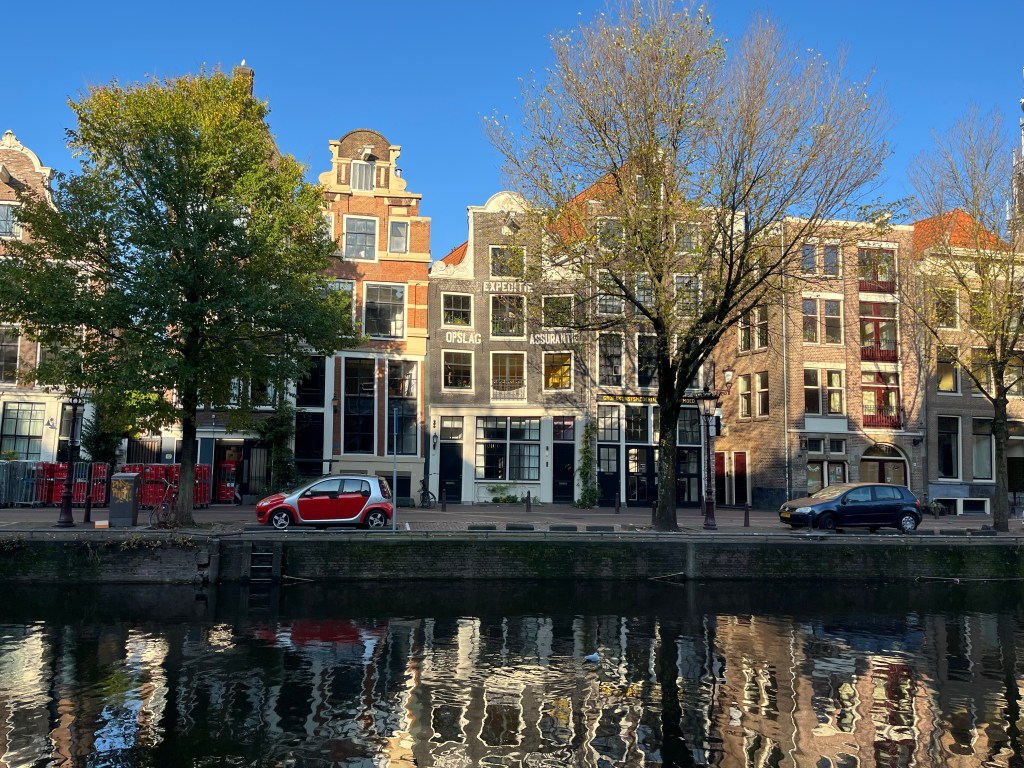
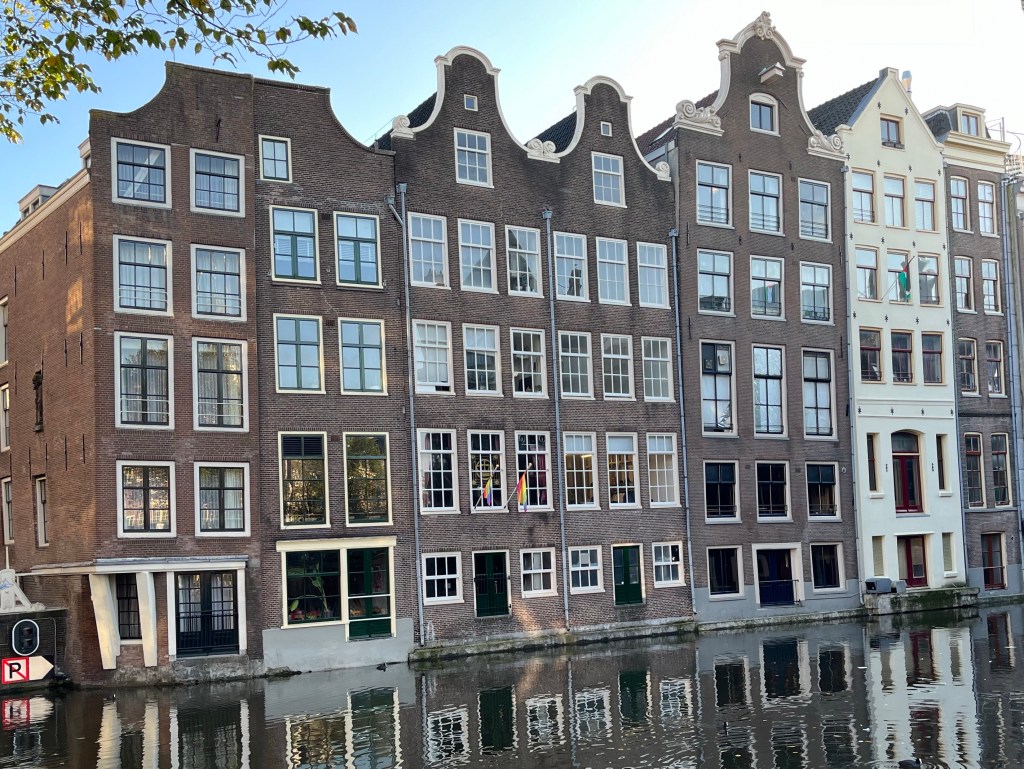
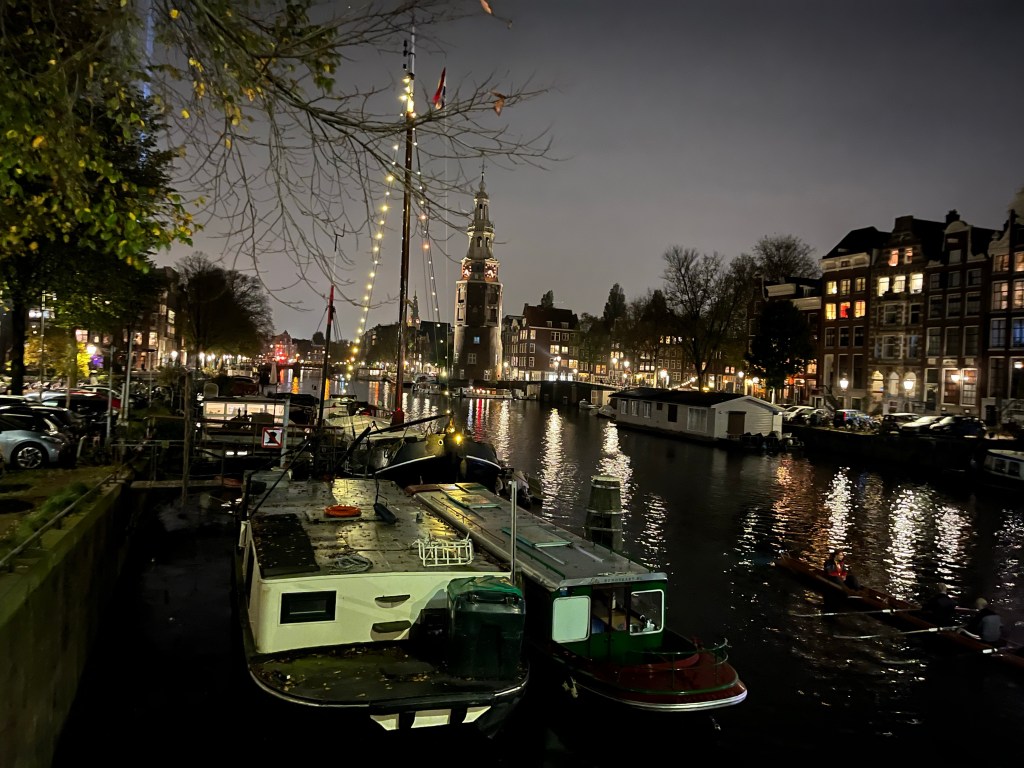
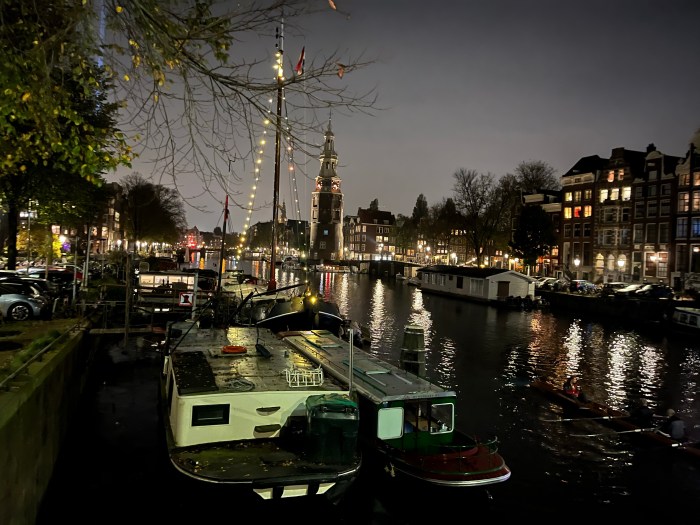
That being said, we already used one of these certificates to book the Kimpton De Witt in Amsterdam. We have a 25 hour stopover in Amsterdam on our way to Rome and this checked a lot of boxes for us. It was a short train ride from the airport, right by the train station and downtown by the canals. We were going to have to leave for the airport too early for breakfast, so the fact that they didn’t have free breakfast is irrelevant. This hotel is going for 47,000 points per night, so we used almost 80% of the full value of the certificate. Honestly, that is about as good as you can reasonably expect. The cash value of the hotel room was $302, so I’m not mad about the free night.

For the sake of simplicity, I just value certificates at half of their maximum value. So if I can get a hotel room worth more than 30,000 IHG points with one of these certificates, I’ll be happy. With IHG points being worth around half a cent each, I would say the sign up bonus that Jenn earned was 150,000 points at .5 cents or $750. Considering the first certificate we used saved us $300, I think we’re already ahead.

US Bank Triple Cash

I signed up for the US Bank Triple Cash Rewards Business Card. This is a card with no annual fee. It earns 3% cash back on gas, EV charging stations, office supply stores, cell phone providers and restaurants. It earns 1% cash back on everything else. There is also a $100 per year credit for recurring software purchases, like Quickbooks.

The signup bonus is $750 after spending $6,000 in 6 months. I’m always a big fan of having some extra time to complete a spending requirement, so 6 months is great. This bonus will give us a little cash back to pay for some of those annoying taxes and surcharges when booking award flights.

American Airlines Aviator Red

I also signed up for the American Airlines Aviator Red card, under the assumption that it was going to disappear and this was my last chance to get the 70,000 American Airlines miles bonus for just one purchase and a paying the $99 annual fee. It’s just too easy to pass up. I already met the requirements now and I’m just waiting for those sweet, sweet AA miles to show up in my account. For more information about that card, read my post.

On To The Point Check

We did a pretty good job this last month continuing to use the bonus categories on some of our existing credit cards which led to a total of 6.3% return on all of our spend not devoted to earning a signup bonus.

Card UsedSpendPoints EarnedPoint ValuePoints Per $Return on Spend
Amex Gold$5921,862$37.283.16.3%
Ink Cash$5582,772$56.835.010.2%
Venture$5471,094$20.242.03.7%
Wyndham Business $3521,955$21.515.66.1%
Citi $297667$12.012.24.0%
Amex Business Gold$190546$10.922.95.8%
Total$2,5368,898$158.783.56.3%
This month’s spending not devoted to earning a signup bonus

Aside from the spending in the above chart, Jenn spent around $4,300 on her IHG Premier card earning her 19,000 IHG points and the signup bonus of 5 free night certificates worth up to 60,000 points per night. I spent a little over $500 on my US Bank Triple Cash card earning around $13 in cash back. At the end of the month, we were left with:

  • 293,000 Amex Membership Rewards Points
  • 214,000 Chase Ultimate Reward Points
  • 139,000 IHG Points (includes 4 free night certificates)
  • 104,800 American Airlines Miles
  • 84,700 Capital One Venture Miles
  • 71,900 Marriott Bonvoy Points (Includes 2 free night certificates)
  • 43,000 Wyndham Points
  • 30,400 Citi Thank You Points
  • 11,300 Hyatt Points (includes a free night certificate)
  • 5,000 Delta Skymiles
  • 1,900 United Miles
  • $170 in cash back

Using the valuations from the Points Guy, those points are worth a grand total of nearly $15,600. We’re going to need them, because we have big plans for 2025.

Transferring Amex Membership Rewards Points to Alaska Airlines

The ability to transfer American Express Membership Rewards Points to Hawaiian Airlines is no longer available. However, this article is an example of what is possible if you are creative with your points and miles.

Recently, I transferred 18,000 American Express Membership Rewards points to Hawaiian Airlines, then transferred them from Hawaiian Airlines to Alaska Airlines to book a round trip positioning flight on American Airlines for my wife Jenn and I. To anyone other than a hardcore travel hacker that seems insane. Yet, to hackers, that sounds like a normal rational decision.

This process was actually rather easy, but there is a lot to unpack in that sentence. Doing this has only really been possible for a few days, and for me it is the result of learning a lot about travel hacking over the course of the last few years. A recent merger between Alaska Airlines and Hawaiian Airlines is the reason why this is suddenly possible.

What is a Positioning Flight?

A few months ago, we booked a trip to Italy using Flying Blue miles to fly KLM to Rome from Chicago and we booked United Airlines to fly back to Chicago from Rome. The problem is that we live 3 hours away from Chicago O’Hare Airport. The reason why we booked it out of Chicago is that the flights were much cheaper than out of our home airport, Quad Cities International.

A one-way ticket from Chicago to Rome was 20,000 Flying Blue miles and $122, but if you tack on the Quad Cities to Chicago leg, it becomes 53,000 Flying Blue miles and $127. It seems insane that from Chicago to Rome was 20,000 Flying Blue miles but adding the leg from Moline to Chicago was 33,000 miles. I’m not doing that.

We were okay with driving to O’Hare, but we didn’t want to. Instead we (originally) used American Airlines miles to book a separate flight from the Quad Cities to Chicago that would save us the drive. Those flights were 7,500 American Airlines miles per passenger each way, or a total of 30,000 American Airlines miles. This is called a positioning flight because we had a separate booking to position us to the airport we wanted to fly out of.

What is a Transfer Partner?

Transfer partners are basically what makes the points in banks’ reward programs so powerful. The reason why people covet Amex Membership Reward points or Chase Ultimate Reward points is that they can be transferred to various airline and hotel programs. Having transferable points lets you keep your points flexible while you’re earning them and then choose the best way to use them when you are redeeming those points.

American Express Membership Rewards have a number of transfer partners. One of those transfer partners is Hawaiian Airlines. You can transfer your Membership Rewards points to Hawaiian Airlines at a rate of 1:1 with a minimum of 1000 points transferred. American Express does charge an excise tax of 60 cents per 1000 points transferred.

OK, But you Booked with Alaska Airlines Not Hawaiian Airlines

Alaska Airlines has been an amazing program for a long time. According to their website, they partner with 31 different airlines. You can redeem Alaska miles for flights on many of them, when they are available. There have been several times that I’ve used Pointsyeah.com to find the best award flight, and Alaska has had the best price.

The problem with Alaska Airlines was that it was hard to amass a lot of miles in their program. There are only a couple of credit cards issued by Alaska, and the signup bonuses are lackluster. They also, until recently, haven’t had any transfer partners. They did, recently, sign a deal with Bilt Rewards to be a transfer partner, but Bilt doesn’t have signup bonuses so amassing a stash of Bilt Rewards points can be difficult.

Nevertheless, when Alaska Airlines and Hawaiian Airlines agreed to a merger, they made an agreement to allow transfers between the two programs. This opened up a back door to move points from American Express Membership Rewards to Alaska miles through Hawaiian. This is fantastic, because amassing a large number of American Express Membership Rewards points is not difficult.

Exact Flights, Different Prices

One of the most consistently baffling things to me about points and miles is the fact that sometimes the same flight is being offered by different programs at different prices. In this case, we had an American Airlines flight booked with American Airlines miles leaving on a Sunday night and returning on a Sunday night. Using American Airlines miles it was 30,000 AA miles and around $22 in taxes for the two of us.

When we originally booked with American Airlines, I saw that Alaska had the same flights for 4,500 points and around $18 per person per flight, so in other words, 18,000 Alaska miles and around $72 in taxes and fees. At the time, I didn’t have access to Alaska miles.

When the backdoor transfer option from American Express to Alaska Airlines materialized, I checked to see if that was still available and it was so I jumped on it. American Airlines has free cancellations, so it wasn’t a difficult to have my points and fees returned.

Saving American Airlines Miles

One big reason that we changed how we booked this flight was being able to use something other than American Airlines miles. American Airlines doesn’t have any transfer partners and lately it seems like whenever I’m comparing prices on award flights American Airlines always has competitive pricing. I didn’t want to use AA miles that I find so valuable if I don’t need to.

Also, earning 30,000 AA miles using just credit card spend requires a lot of spending. If we did it using the Barclays Aviator Red card, all purchases except American Airlines purchases earn 1 point per dollar spent. That means I would have to spend $30,000 on that credit card to earn 30,000 points.

On the other hand, I transferred 18,000 American Express Membership rewards points to Alaska and those are much easier to earn. When I buy groceries or dine out using my American Express Gold Card, I earn 4 Membership Rewards points per dollar spent on that card. That means I would only need to spend $4,500 on that Amex Gold Card, assuming I only use it for groceries and dining out, to earn the 18,000 miles necessary to book the flight. That’s a huge difference! Yes, the Alaska flights cost an extra $50 in fees but I was happy to spend that to keep those 30,000 AA miles.

Will This Back Door Transfer Option Remain?

It is unclear at this point whether transferring American Express Membership Rewards points through Hawaiian to Alaskan Airlines will remain an option. We know that transferring points between Hawaiian Airlines and Alaskan Airlines will be around for the foreseeable future. This has created a lot of interest in the travel hacking community for Hawaiian Airlines credit cards.

In the past, most travel hackers weren’t very interested in Hawaiian Airlines credit cards. Hawaiian miles weren’t worth a whole lot and because of that, the credit cards weren’t interesting. In fact, the Points Guy used to value Hawaiian miles at .9 cents per point and Alaskan miles at 1.5 cents per point. Moving 100,000 Hawaiian miles to Alaska Airlines increases their value, according to these valuations, by $600. That’s a big deal.

The problem for American Express is that now this throws their agreement with Hawaiian out of balance. If Hawaiian miles are suddenly worth more, will Hawaiian Airlines/Alaska Airlines demand more money to sell those miles to American Express? I don’t know, and there has been a lot of speculation in the travel hacking community that this transfer agreement could end.

The potential end of this agreement has me tempted to move some Membership Rewards to Alaska, but I don’t really have enough to just move them without a flight in mind. Instead, I think I’ll just wait and hope that Membership Rewards continues to allow transfers to Hawaiian Airlines. That being said, I might just be looking at a Hawaiian Airlines credit card soon. It’s never a bad idea to take advantage of a great deal when it pops up.

Last Call for the American Airlines Aviator Red card?

Last week an article by CNBC indicated that Citigroup was in heavy negotiations with American Airlines to be the exclusive card issuer for American Airlines credit cards. These negotiations are immensely important for American Airlines because the revenue that comes from airline loyalty programs are now a huge portion of their income. It’s become so important, in fact, that it’s sometimes joked that airlines are credit card companies that fly planes. According to Delta CEO Ed Bastian, nearly 1% of the entire US economy is charged to Delta credit cards. The revenue from selling loyalty points to banks is a multi-billion dollar industry for airlines, and its a revenue stream they take very seriously.

American Airlines is in a strange situation because they have cobranded credit cards issued by two different banks. There are four credit cards issued by Citigroup which include three personal credit cards and one business card. Barclays technically has two personal American Airlines cards, but one is only available through upgrade, the AAdvantage Aviator Silver. The only Barclays American Airlines card with a current sign up bonus is the AAdvantage Aviator Red.

The fact that American Airlines has two banks issuing their credit cards is because of an American Airlines merger with US Airways over a decade ago. US Airways had a relationship with Barclays and after the merger US Airways credit cards issued by Barclays became American Airlines cards. American Airlines kept that relationship going, even as people began to forget about US Airways.

It makes sense for American Airlines and Citigroup to form an exclusive relationship. It would make the AAdvantage program more straightforward by reducing the complexity of having multiple card issuers. In the end, I think it’s highly likely that American Airlines will end their relationship with Barclays and form an exclusive relationship with Citigroup.

AAdvantage Aviator Red Card

If Barclays is going to get dropped from the AAdvantage program, it’s safe to say the Barclays AAdvantage Aviator Red card is going to go away. In some respects, good riddance, it’s not a very interesting card. It earns 2 miles per dollar spent on American Airlines purchases and 1 mile on everything else. You do get a free checked bag and preferred boarding but the annual fee is $99.

The thing that does make it interesting is that the signup bonus is incredibly easy to earn. Right now, there is a 70,000 mile signup bonus available through Frequent Miler’s website. What is the spending requirement? Signup and use it once. Literally, pay the $99 annual fee, activate the card and buy a pack of gum using the credit card and 70,000 AAdvantage miles are yours for the taking.

70,000 AAdvantage miles is a pretty decent haul. We took recently our family of four to Costa Rica from our small regional airport during Spring Break for a total of 120,000 AAdvantage miles and around $340 in taxes. Also, I have noticed, anecdotally, that flights out of smaller airports that are serviced by American Airlines don’t pay significantly higher amounts of points than flights out of larger airports. That it is definitely not the case for United Airlines, for example.

In addition, I’ve been eyeballing some deals to Portugal for spring break that are running around 22,500 AAdvantage miles one way per person. Having an extra 70,000 miles would top off our accounts enough to book the flights there, even though it wouldn’t be enough to get home.

Fear of Missing Out

I think that this is the last chance I have of taking advantage of one of the biggest no-brainers in points and miles. It’s legitimately buying 70,000 miles for $99. It’s not the best signup bonus the card has offered. Jenn got this card about a year ago when it offered 60,000 points for one charge and 15,000 for an authorized user and an additional charge to the authorized user card. However, it is definitely a solid deal, and waiting for a better deal at this point could mean that I miss out completely.

In the middle of writing this post, I actually did apply for this card and was approved. That’s fantastic and I will happily take my shiny new 70,000 miles from American Airlines. As a matter of fact, after I was approved, my daughter walked downstairs and I convinced her to apply for it as well and she was approved.

In all fairness, when I told her there was an annual fee she balked, but I told her if she would use her miles to pay for her ticket to Portugal, I would pay for her annual fee and she jumped on it.

Potentially Good News From the Exclusive Deal with Citigroup

Knowing that Barclays will likely be cut out of the American Airlines credit card business, it means that there will be less choices, and less available signup bonuses in the future. Still, it does raise the possibility of American Airlines becoming a transfer partner for Citi Thank You points.

American Airlines currently doesn’t have a transfer partner. Most major airlines have transfer partners, with Delta Airlines being a partner from American Express Membership Rewards points and United Airlines and Southwest Airlines being partners from Chase Ultimate Reward points. American Airlines was briefly a transfer partner of Citi Thank You points a few years ago, and was a transfer partner of Bilt Rewards very recently. A few months ago Bilt Rewards and American Airlines ended that partnership, and maybe that has to do with their negotiations with Citigroup.

With no current transfer partner, and with American Airlines negotiating a deal with Citigroup, there is a fairly good possibility that Citi Thank You points will become transferable to American Airlines. If that becomes a reality, I will definitely be attempting to earn more Citi Thank You points, because I find a lot of value in American Airlines miles.

In the end, I hope the changes that American Airlines makes to their credit card business with Citigroup works out to be beneficial to both them and their cardholders. Knowing how important that loyalty points are to the business of airlines puts a lot of pressure on them to have a good and profitable loyalty program. In the meantime, I need to figure out how I’m going to use these shiny new American Airlines miles.

Points Check August 2024

We’ve been making preparations to go with our friends Bill and Theresa as well as Jenn’s parents to Italy. We will be visiting Florence, Cinque Terre, Venice and Rome on this trip. This is a little nerve-wracking, since we have made a lot of the plans and we don’t want to let them down. In the past, we’ve mostly just gone on trips with our kids and I’ve spent their entire lives trying to lower their expectations. But, we are going to Italy, how can you not have a great time there?

Signing up for the IHG One Rewards Card

Jenn applied for and was accepted for the IHG One Rewards card, issued by Chase. We wanted to jump on this because they had an elevated offer of 5 free night certificates worth up to 60,000 points per night. IHG points are worth around a half a cent each, so for the most part, these certificates can book you a room that would cost less than $300 per night. The card has an annual fee of $99 and each year on the anniversary date the cardholder receives a 40,000 point certificate.

It has a cool perk where you get a fourth night free if you book a 4 night award stay with points. That doesn’t count for free nights using certificates, so you would need to actually have 3 nights worth of points to take advantage of that perk.

The card earns 10x at IHG properties, 5x on travel dining and gas, and 3x on everything else, so you can earn quite a lot of points quickly. Unfortunately, with them being worth half a cent each, it does take quite a few points to book a hotel room.

A Couple of Bonuses

I finished the rest of my spend on the American Express Blue Business Plus card, earning me the 15,000 Membership Reward point bonus. Jenn also finished the required spend on her Spark Cash Select card which ended up earning her a $750 bonus and a total of $855 of cash back on just under $7,000 in spend over a few months which works out to a pretty impressive 12% cash back rate.

We used that cash back as well as other cash back that we had earned from other cards to cover the $1,500 in VRBO costs that we have for our trip to Italy this fall. We always like to have some cash back cards to cover VRBO charges or taxes and fuel surcharges on flights so cash back cards can be really helpful.

Anyway, on to the Points Check!

This month, we did fairly well focusing our spending on cards to earn signup bonuses. We do have our normal recurring payments set up to maximize the value of some of our cards. For instance, taking advantage of the 8x on gas and 5x on utilities on the Wyndham Earner Business card and using the Capital One Venture card’s 2x on everything to take care of our car insurance and Costco charges, neither of which are bonus categories anywhere that I know of.

The Citi Strata Premier charges are the only real exception, but that’s really because our daughter Emma is an authorized user and if we need her to buy groceries or something else for the family, she uses that. It is nice that she will run an errand once in a while for us, even though she treats a 15 minute trip to Aldi like a 2 month stretch on the Oregon Trail.

Card UsedSpendPoints EarnedPoint ValuePoints Per $Return on Spend
Wyndham Business Earner$8054,961$54.576.26.8%
Venture$6661,332$24.642.03.7%
Ink Cash$5402,679$54.925.010.2%
Citi Strata Premier$152262$4.721.73.1%
Amex Gold$101404$8.084.08.0%
Total$2,2649,638$146.934.36.5%
This month’s spending not devoted to earning a signup bonus

Aside from the spend in the above chart, I also spent a little under $1,700 on my Amex Blue Business Plus card earning around 3,400 Membership Reward points as well as 15,000 bonus Membership Reward points. Jenn spent $4,800 on her Spark Cash Select which included a lot of those VRBO charges, earning her around $72 in cash back and finishing off her $750 signup bonus on that card.

At the end of the month we were left with 306,900 Amex Membership Reward points, 211,500 Chase Ultimate Reward points, 83,600 Capital One Venture miles, 74,700 American Airlines miles, 54,400 Marriott Bonvoy points, 41,200 Wyndham points, 29,700 Citi Thank You points, 11,300 Hyatt points, 5,000 Delta miles, 1,900 United miles, and around $160 in cash back. Using the Points Guy valuations, all of this is worth just over $15,000.

US Bank Improves Altitude Connect Card

I got the US Bank Altitude Connect card about a year an a half ago and I viewed it as basically a cash back card. At the time, the card came with a $95 annual fee and required $2,000 in spending over 4 months to earn the $500 signup bonus. Technically, they advertise this as 50,000 points with each point being worth 1 cent each, but since there aren’t any transfer partners, that meant it was just 50,000 pennies. Recently, US Bank made some changes to this card that I think actually make it a better credit card.

Earning Rates For the Altitude Connect Card

Something that didn’t change with this credit card is the earning rates for its bonus categories. It actually has some pretty good earning categories, they include:

  • 5x on hotels and car rentals booked through the Altitude Reward Center
  • 4x on travel
  • 4x on gas station and EV charging (up to $1,000 per quarter)
  • 2x on dining, streaming services, and grocery stores
  • 1x on everything else

I almost Canceled it Before it Renewed

When the annual fee was coming up for renewal, this was one I considered canceling. It had a $95 annual fee, and frankly I just wasn’t using it. Yes, it does have some pretty good earning potential in some categories, but typically outside of signup bonuses, I don’t get that excited about earning cash back.

However, there was one particular reason that I did keep it and that is because it comes with 4 annual passes to Priority Pass airport lounges. According to the Priority Pass website, there are over 1,600 Priority Pass lounges and experiences. In my experience, it’s not difficult to find a Priority Pass lounge when you need one, as long as you’re in a major airport.

My experiences with Priority Pass lounges haven’t been phenomenal, but its been pretty good. Typically I’ve managed to get basic buffet style food, a beer or two, as well as a place to charge a phone, and open my laptop. For the most part, I’ve enjoyed relaxing in their lounges. They haven’t been as good as my experiences in United Lounges, but it sure beats waiting in the airport terminal.

Recent Changes Made to the Altitude Connect Card

I think US Bank originally saw this card as being something that would compete with mid-level travel cards from major banks, like the Citi Strata Premier card or the Chase Sapphire Preferred card. Unfortunately, with US Bank lacking transfer partners for those points, I don’t think they really competed well in this space. Recently, US Bank made some changes to the Altitude Connect card that made it a more interesting card, in my opinion.

The first change is that they have dramatically reduced the signup bonus on this card. The typical signup bonus used to be 50,000 points ($500) after spending $2,000 in 4 months. However, this has now been dropped to a 20,000 point bonus ($200) after spending $1,000 in the first 3 months on the card. That’s not a great change, but the lower spending requirement does make it more accessible to people who don’t spend as much on credit cards.

The second change is that they eliminated the $95 annual fee. That’s a great change!

At first glance, that doesn’t make this card much more attractive than a lot of no annual fee cards. There are a lot of no annual fee cards that have some good bonus categories and a whole lot of them have signup bonuses of $200. That seems pretty typical. What isn’t typical of no annual fee cards is the benefits that are included.

Surprising benefits of the Altitude Connect Card

Since the US Bank Altitude Connect Card is a no annual fee card, it is surprising that it kept some pretty good benefits that typically come with cards that have at least $95 annual fees.

  • 4 annual passes to Priority Pass Lounges
  • No Foreign Transaction Fees
  • $100 credit for TSA or Global Entry application fee
  • Trip Cancellation/ Interruption Protections

The $100 credit for TSA or Global Entry application is something that you can get once every four years, which is a nice benefit, but to me the big one here is the 4 annual passes to Priority Pass Lounges. Yes, it’s only 4 passes, and if you are flying with a family of 4, that means one trip. However, anyone who eaten at an airport restaurant knows how easy it is to drop well over $100 for a family of 4.

The fact that just having this credit card means that I can take the family into a Priority Pass lounge and relax rather than paying through the nose at an airport restaurant and then being uncomfortable in the terminal is a huge bonus to me. Its almost guaranteed to save me over $100 once a year.

Trip Cancellation coverage for this card will pay up to $2,000 for non-refundable common carrier tickets paid for with this credit card. This can be triggered by the death, injury or illness of a person or family member that causes a trip to be canceled.

Trip delay coverage covers up to $300 of expenses like meals or lodging when a trip is delayed, as long as that trip was paid with this credit card. This benefit kicks in if you paid for the ticket with the Altitude Connect card and the delay is more than 12 hours. It only covers what the airline does not cover.

Smart Delay coverage is a new concept I had never heard about. According the information at the Smart Delay webpage, if you register your flight on this website 2 hours prior to scheduled departure and your flight gets delayed by over 2 hours, you will be immediately issued up to 4 passes for Priority Pass lounges to use during the delay. Considering my luck with flight delays, I will definitely be using that.

Foreign transaction fees are annoying. Normally I’ve paid attention to what credit card I was using out of the country. Unfortunately, I forgot to check the credit card I was using in Canada and came home to a series of foreign transaction fees. It didn’t exactly bankrupt me, but who wants to pay those fees? This is a nice benefit if you plan to use this card outside of the US.

Who Should Get the Altitude Connect Card?

Honestly, I’m not sure if I hadn’t already signed up for this card when the bonus was $500, that I would now. A $200 signup bonus isn’t that interesting to me with so many huge bonuses out there. But a no annual fee card with 4 annual one-time Priority Passes? That’s pretty tempting.

The amount of spend required to earn the signup bonus is the only $1,000 over 3 months, so if you’re someone without a ton of credit card spend, this is intriguing.

Honestly, I think this is be perfect for my daughter. She doesn’t have the credit card spend necessary to chase the big bonuses, but a $200 cash back bonus would be pretty nice for her. Getting a good, no annual fee card, would allow her to keep this card for a long time and build her credit age which is a big part of her credit score. In addition, gas, EV charging, groceries and dining are bonus categories that should get used frequently by young adults.

Aside from that, this card would give her some pretty good benefits, such as the trip protections and Priority Passes that she wouldn’t have access to without going to a card with an annual fee.

Over the summer, she went with three of her friends on a trip to California. If she had this card at the time, she could have treated everyone to a trip to a Priority Pass lounge. That may not seem like a big deal to someone who is older, but if you’re 19, that’s a pretty baller move.

Also, I think if you are the type of person who flies once or twice a year, having a handful of Priority Passes really enhances those trips. Lounge access is one of those things that lowers the stress of being in an airport. With that access provided on a no annual fee card, even if you don’t use the passes, it’s not costing you anything.

Will US Bank Get Rid of These Benefits?

I think the benefits of this card is remarkable for a no annual fee credit card, so I do have to question whether US Bank will continue to offer the level of benefits this card provides at no annual fee. To be honest, I don’t know, it really all depends on whether this stays profitable for them. If at some point they realize that the amount of money that they are spending on these benefits isn’t worth the amount of revenue that the card generates, then it could easily disappear or get altered into something less valuable.

I do think it’s worth it to anyone who flies occasionally and wants to have a handful of Priority Pass lounge visits in their pockets to sign up for this card. It also makes a really nice starter card for someone who might struggle to meet the minimum spend requirements to earn the signup bonus on a mid-range travel card that has similar benefits.

What US Bank has done is create a different kind of product, it’s a entry level, no annual fee travel credit card with many of the benefits of a mid-tier travel credit card. I hope that it stays the way it is, because it turns out to be a really interesting product that I think a lot of customers will really enjoy.