We didn’t have a chance to visit Murano on our first trip to Venice and I wasn’t planning to miss it on our second trip. I was interested in seeing all of the beautiful glass created on the island and get a little insight about the art while we were there.
Inside a glass shop in Murano
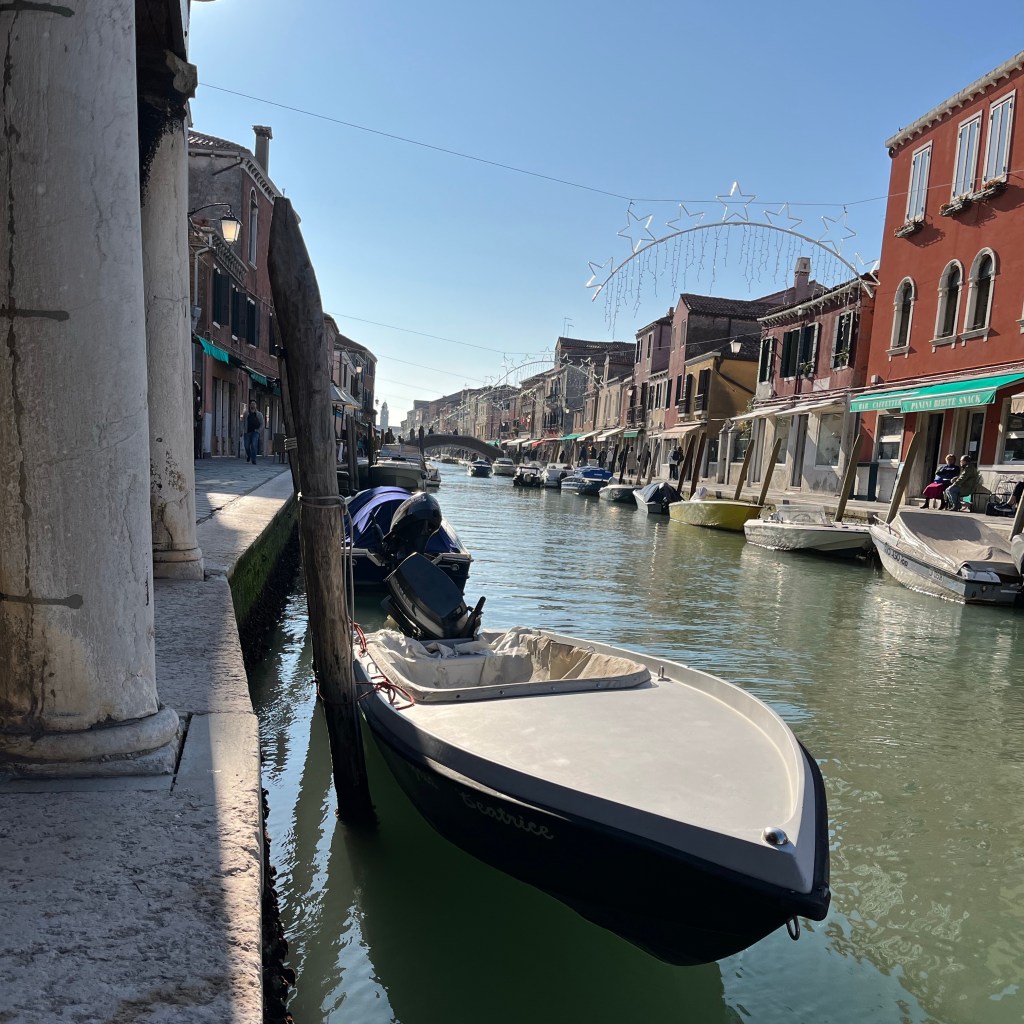
We took a vaporetto from the main islands of Venice to Murano and began our walk. I understood that this was an area primarily for glass production and sales, but I was still surprised by the number of shops that there were. We exited the vaporetto at the docks known as Murano Colonna and began to walk along the canal on Fondamenta dei Vetrai. We wandered along the canal, admiring all of the amazing glass work created by the artisans in Murano.
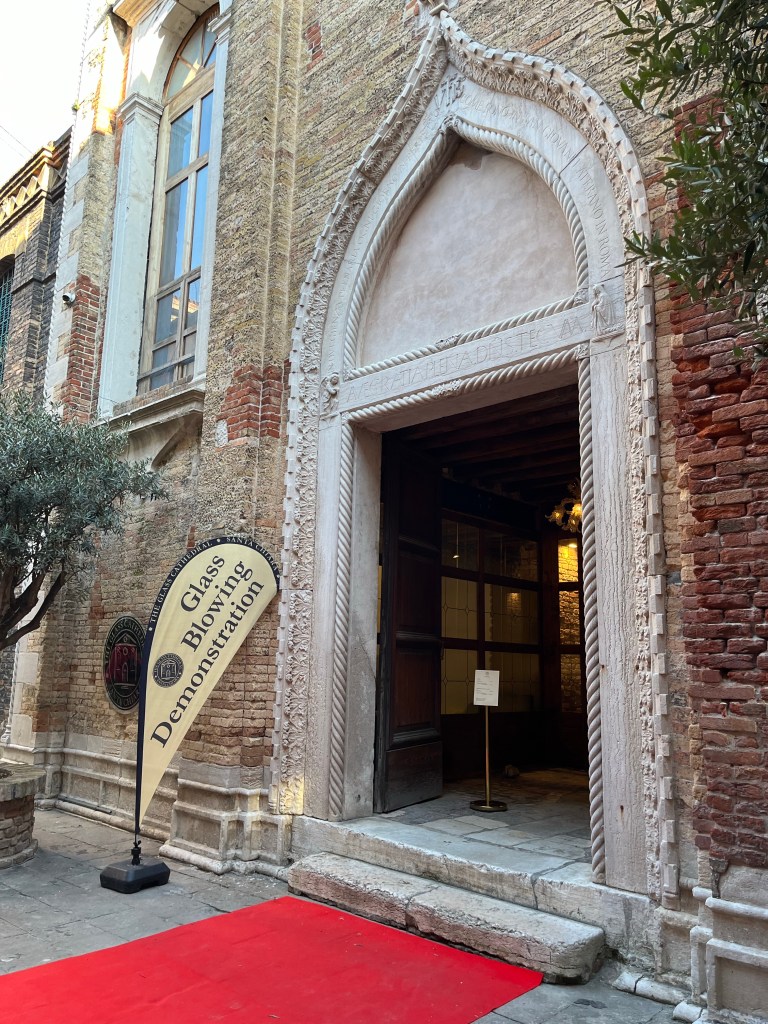
Entrance to the Glass Cathedral
After walking around a bit and shopping, we stopped for a drink and a light lunch at Rivalonga bar which is at the Hyatt Centric Murano. We had a nice view of the main canal through Murano. After the quick bite to eat, we headed to what I was really looking forward to, the glass blowing demonstration at the Glass Cathedral.
The Glass Cathedral
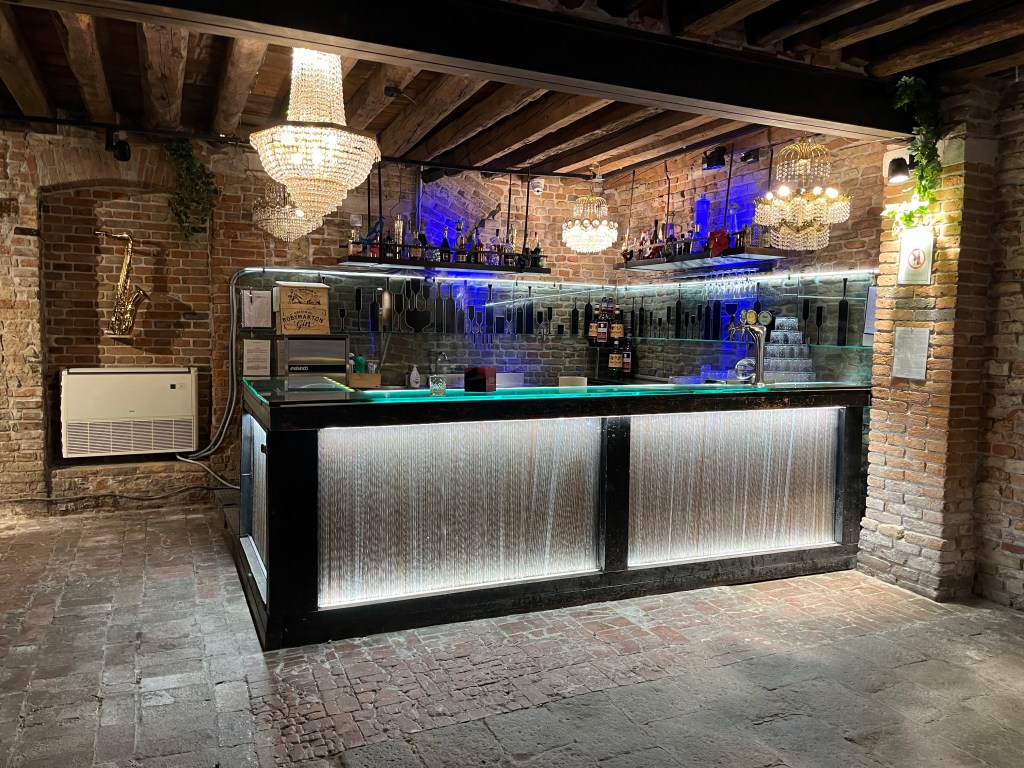
Bar at the Glass Cathedral
The Glass Cathedral is actually the Chiesa Santa Chiara, a church dating back to the 1300’s and was part of a convent for many centuries. In the 1800’s, it became a production facility for glass. Unfortunately, in the 1990s there was a fire and the roof collapsed. After years of vacancy the Belluardo family purchased it with the idea of turning the dilapidated building into a hospitality facility. In 2012, the Belluardo family began renovations of the Church and finished restorations in 2017.
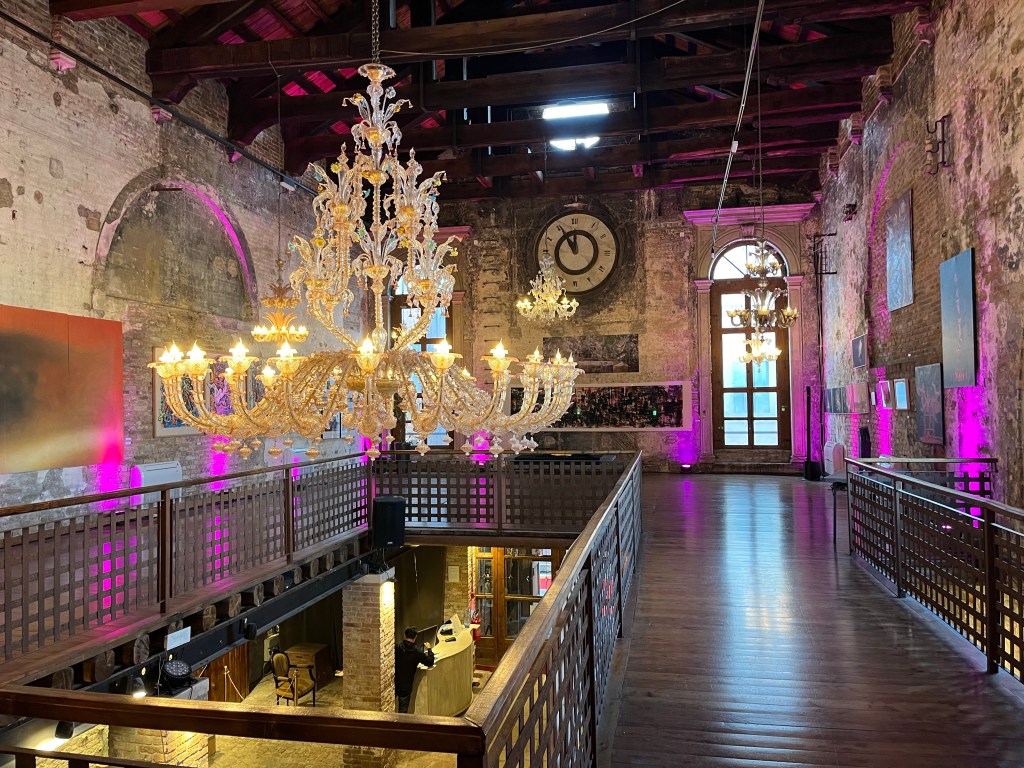
The second floor at the Glass Cathedral
The results of the renovations are spectacular. The Glass Cathedral is primarily an event center that hosts weddings and parties that can accommodate up to 300 people. What I love about this building is the fact that it blends the modern and ancient in a beautiful way. The old brickwork, wooden plank joists, and stained glass windows are accented by colored LED lights. Glass chandeliers and decorations are everywhere. It all makes for a perfect backdrop for a special event.
Metal decorations and vases in the lobby area of the Glass Cathedral.
However, for those of us who aren’t getting married in Venice, we can visit the Glass Cathedral and see a glass blowing demonstration. This of course gives you the opportunity to walk around the facility to see just how beautiful it is and to watch how artisan glass is produced.
LED lights, stained glass, and artwork on second floor of the Glass Cathedral
The Glass Blowing Demonstration
The tickets for the glass blowing demonstration were 14 Euros each, which you can buy in advance or at the door. We went ahead and purchased it when we got there. They did offer us an alcoholic beverage to enjoy during the demonstration for a small additional charge and of course I said yes.
Glass blowing artist heats up glass in oven
The demonstration is more of a performance than a demonstration. The Glass Master doesn’t explain what he’s doing, instead he is operating somewhere in the space between glass production and performance art. It is fascinating to watch.
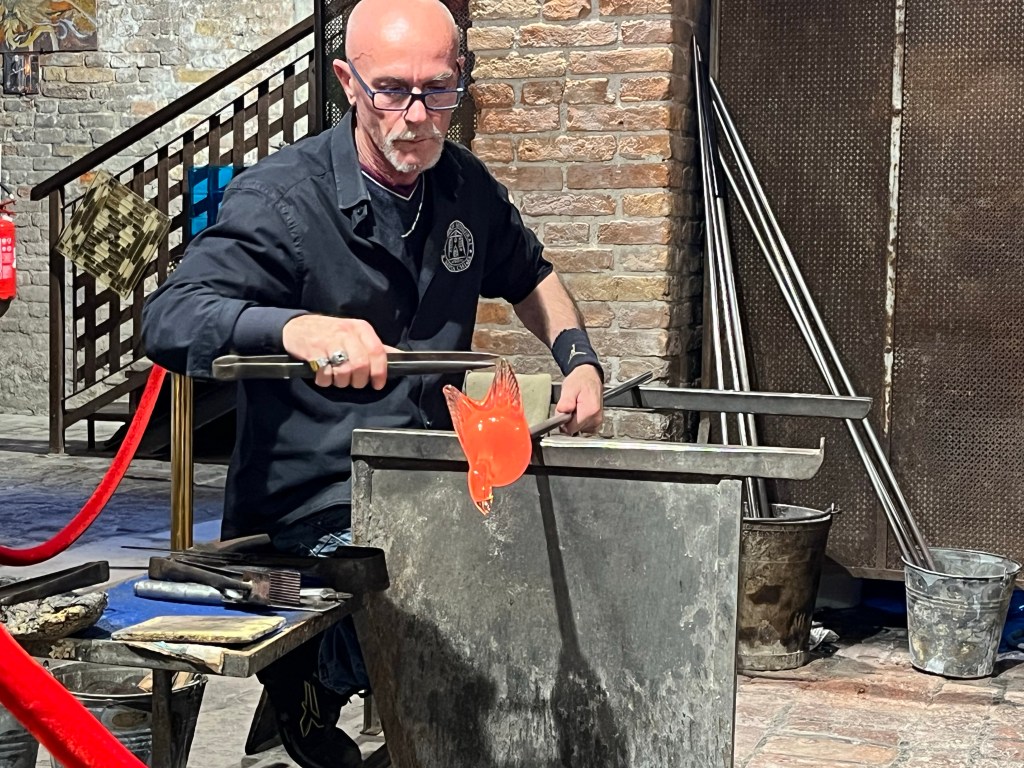
The glass master uses a tool to form the wing of a swan.
The show begins with the Glass Master putting the blow pipe into the furnace to pull out a mass of molten glass. He then proceeds to blow and turn the mass until he has shaped a pitcher. He attaches it a handle to the pitcher and also pulls the top until it forms a spout.
The Glass Master forms the tail feathers on the swan.
He continued the demonstration by making a variety of glass sculptures including a fish and a swan. All throughout, he is silently demonstrating how to use all of the available tools to create the shapes that he wants. He also demonstrated how to smoke glass and how to get various colors.
Glass figurine cools off
In the span of about 25 minutes, he created a vase, a fish and a swan. The speed and accuracy at which he worked was extremely impressive. The artist then announced the end of the demonstration and thanked us for our time.
Glass figure cools
This glass demonstration is a perfect compliment to a day in Murano. Walking around the town, gazing at all of the glass masterpieces, you wonder how they make all of this amazing art. Getting an opportunity to watch a true artisan make these pieces in real time is an great experience.
Glass for sale, probably the result of previous demonstrations
What is also great about going to this particular demonstration is that they aren’t going to hard sell you on anything. I can’t speak from experience, but I have read a number of reviews of other glass demonstrations in Murano and it appears to be common practice for a glass shop to offer free demonstrations, but expect you to buy something in return. We had no intention of buying anything because I didn’t feel like worrying about breaking it on the flight home. They do have some glass for sale at the Cathedral, but they don’t press you to purchase anything.
Going to the Glass Cathedral
Probably the best way to get to the Glass Cathedral is to take a vaporetto to the Murano Colonna docks. When you exit the boats head up along the canal to the right and cross the canal at the first bridge. There is an enormous building right at the end of that bridge and there will be multiple glass blowers doing demonstrations. You could go to any of them, but if you want to go to the Glass Cathedral you need to watch the signs carefully. We almost went to the wrong one.
A grand piano at the Glass Cathedral
You can purchase the tickets online at SantaChiaraMurano.com or you can show up and pay at the door. We went during the off-season so it wasn’t busy but if you are going during high tourist season, you might want to consider buying your tickets in advance.
Logo for the Glass Cathedral
If you plan to spend a few days in Venice there definitely is plenty to do but you should consider a trip to Murano. It is a little calmer, especially during the day, than the main islands of Venice and you will get an opportunity to really get up and personal with the Venetian glass industry. I highly recommend when you are in Murano to go to the Glass Cathedral. It will only take maybe 30 to 45 minutes of your time and you will get to see a beautiful facility and experience a glass blowing demonstration that will give you a greater appreciation for the artform.
In what is becoming a new family tradition, to celebrate our niece, Zoey graduating from high school, we are going to Europe to celebrate. Well, not really we, since I’m not going, but Jenn and her sister Misty are taking Zoey and our daughter Emma to Europe this summer.
It is, however, my responsibility to do a lot of the trip planning. The parameters were fairly loose. It needed to be in mid-July. Jenn wanted to take Misty to Munich because she will absolutely love Munich, and maybe a day trip to Neuschwanstein Castle. Zoey wanted to travel to Dublin or Italy.
So, I got on my laptop and started to search on PointsYeah.com, thinking that this wouldn’t be that hard since they were pretty flexible. To my horror, there wasn’t anything that was very good. Almost everything was over 40,000 points one-way per person in economy for flights that were less than desirable. A lot of them had taxes and surcharges of well over $200 per ticket – for economy flights out of the US!
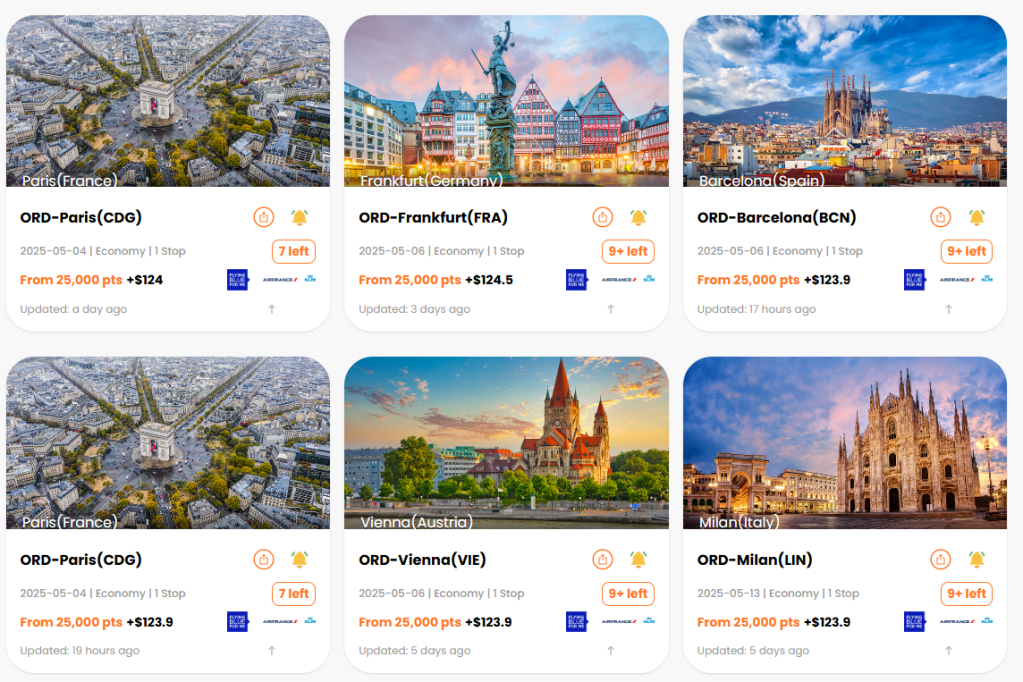
What surprised me the most was that typically you can count on Flying Blue to have flights available from Chicago throughout Europe on KLM or Air France for 25,000 points and a little over $100 each. Those deals were no where to be seen.
Flying United Airlines with Partner Miles
I was beginning to notice that United had a number of flights available for 40,000 points. I wasn’t interested at 40,000 points, but I also know that is the saver fare price for a flight to Europe and sometimes those saver fares end up on partner websites. Maybe I should check those partner sites?
Turkish Airlines
I’ve used Turkish Miles and Smiles to book United flights before. In our case, I used it to book flights to San Jose del Cabo Airport for 10,000 miles from Chicago. That is no longer a thing, because the new price after devaluation is 30,000 points. I wasn’t expecting this to be very good because the devaluation has made most of their partner awards more expensive, but I thought I should look. Sure enough, it was 55,000 miles instead of 40,000. Not worth it.
Air Canada Aeroplan
Next I checked out Air Canada Aeroplan and found the same flight for 40K points and $80 CA ($56 USD). This is the same number of points but about $50 more expensive for taxes and fuel surcharges. This might actually make sense to do, because Aeroplan transfers from Amex, Capital One, Chase and Bilt whereas United miles only transfer from Chase. So if you can’t come up with United miles, this might make some sense. 40,000 points still seemed to steep for me, though.
Avianca Lifemiles
Avianca Lifemiles does have quite a few partner redemption options and that is why it’s good to check them as well. They had the flight listed at 40,000 miles and $28.50, which is still a little more than United at 40,000 miles and $5.60. However, like Air Canada, you can transfer to Avianca Lifemiles from more programs than United does. Avianca transfers from basically everyone including Amex, Capital One, Chase, Citibank and Wells Fargo. If you’re too short on Chase points or United miles, Avianca Lifemiles might make sense.
Singapore Airlines
I had basically forgotten about Singapore Airlines. I always found it difficult to find any availability on their website when I was looking. I decided to try them anyway and yes, that flight was available. They had four tickets available at 30,500 Krisflyer miles each and $5.60 for taxes. That’s great! Singapore Airlines also transfers from Amex, Chase, Citibank and Capital One, making it easy to get enough points.
What I Ended up Booking
So obviously on the way there I booked the United flight direct from Chicago to Munich for 30,500 points transferred from Citibank and $5.60. I will be booking a connecting flight from Munich to Dublin on Aer Lingus for 7,500 Avios transferred from American Express and $53. The return flight from Dublin to Chicago was also booked on Aer Lingus with American Express Membership Rewards transferred to Avios for 20,000 points and $155. So each complete itinerary was a total of 58,000 points and $204.
When I priced out the entire itinerary as a multi-city cash flight with United Airlines it was $1,550 per ticket. That means that the 58,000 points saved around $1,350 or about 2.3 cents per point. I’m always happy to get over 2 cents per point, so I’m happy with this redemption and that wouldn’t have been possible without remembering that I could redeem Singapore Airlines Krisflyer miles for United saver award flights. In the end it saved us a total of 38,000 transferable points.
Finding United Flights on Singapore Airlines website
The only flights that will normally be available on partner sites like Singapore Airlines will be saver awards. It is also important to note that not all saver awards will be available to partner websites. If you are looking to book one of these saver awards on a partner airline, you need to find when one should be available.
The best way is to go United.com and DON’T SIGN IN. The reason that you shouldn’t sign in is that if you have a United credit card, you have access to additional award inventory. This will not be available to partner websites. You’re looking for basic saver awards.
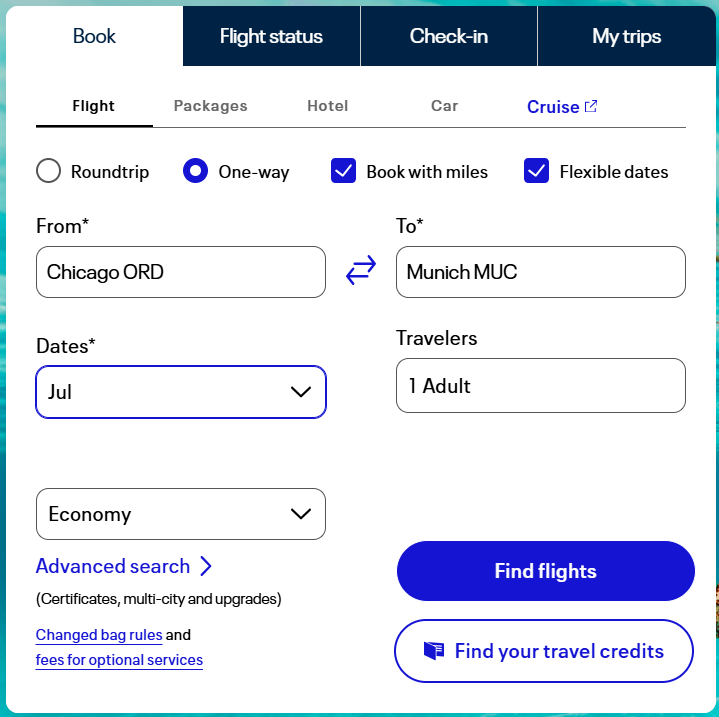
What you want to do is search for flights, but make sure you check the checkboxes for one-way, book with miles, and flexible dates. As soon as you hit search it will prompt you again to sign in – DO NOT DO IT, just click on the ‘x’ in the corner.
In this case, I see a ton of available flights for 40k + $5.60. When you look below on one specific flight, you see “Saver Award” listed for this day. Looking at this, I would assume that it’s likely that there are a ton of available flights in July from Chicago to Munich on United that I should be able to find on Singapore Airlines Krisflyer.
If you then go to the Singapore Airlines website and search for award flights from Chicago to Munich for that date, at first you won’t find anything. That’s because the default is to search Singapore Airlines flights. You need to click on the Star Alliance tab in order to find anything from United Airlines.
Not only will you find wide open availability on United for July, as was indicated by saver awards on the United website, but you also see flights for Lufthansa as well. That is because Lufthansa is also a Star Alliance member. The number of points is the same as the United flights because Singapore Airlines has a standard award chart that has North America to Europe as that number of points. The difference, however, is the amount of taxes and fees that are required to book that flight. On United, it’s $5.60 and with Lufthansa it’s $316.50 and has a stop in Frankfort. Yeah, I think I’ll take the United flight.
When To Book United on Partner Sites
So this is when things can get complicated. Earlier in this post, I mentioned four different ways to book the same United Airlines flight from Chicago to Munich. In my analysis, Singapore Airlines was the cheapest and so I booked with them. The problem is that Singapore Airlines will not be the cheapest all of the time. Each of these programs have different award charts that mean that depending on where you are flying, different programs might be the ideal for that particular flight.
Some of these award charts are regional, and some are distance based. For each of these charts, they define regions differently or they are using different cut-offs for distance. I’m not going to go into the different award charts here, but I want to show what it’s like for those of us who routinely use Chicago Ohare airport to demonstrate just how different it can be.
Chicago to:
United Airlines
Singapore Airlines
Air Canada Aeroplan
Avianca Lifemiles
Turkish Airlines
Munich
40,000 miles and $5.60
30,500 miles and $5.60
40,000 miles and $56
40,000 miles and $28.50
55,000 miles and $5.60
Tokyo
60,000 miles and $5.60
59,500 miles and $164.50
50,000 miles and $56
55,000 miles and $28.50
75,000 miles and $5.60
Cancun
20,000 miles and $47.47
19,500 miles and $47.47
12,500 miles and $98
15,000 miles and $58
30,000 miles and $47.47
Honolulu
25,000 miles and $5.60
19,500 miles and $5.60
22,500 miles and $44
25,000 miles and $15.20
10,000 miles and $5.60
Auckland
55,000 miles and $40.90
66,000 miles and $40.90
60,000 miles and $92
60,000 miles and $36.93
100,000 miles and $40.90
Denver
8,800 miles and $5.60
14,000 miles and $5.60
10,000 miles and $33
15,000 miles and $5.60
10,000 miles and $5.60
Prices for identical saver award flights on United, with the award redemption I would consider in bold and italics.
In the above chart, you will notice that even though these are identical United Airlines flights, they have wildly different prices. That is because of the award charts that each of these programs use. If you are aware of these price differences and check on multiple websites, you can save a lot of points as well as money on taxes and fuel surcharges.
In addition, these programs have different transfer partners, which might affect your decision as well. In the case of the Denver flight, the lowest price is 8,800 miles and $5.60 but the miles are United miles which only transfer from Chase. If you don’t have any United miles or Chase Ultimate Reward points, you might decide that 10,000 Turkish Miles and Smiles is better for you because you can transfer those points from Citi Thank You points or Capital One Venture miles. If all you have is American Express Membership Reward points, you might want to use Air Canada Aeroplan, even though the taxes are higher, because you can transfer to Air Canada from Amex.
Think Before You Book a United Flight
I enjoy flying United. I haven’t yet had a bad United flight. Generally the seats have been comfortable and the planes have been in good shape. I know that’s not the case for everyone, but I’ve had pretty good luck on United. That being said, I find that booking award flights with United to be generally overpriced, although I love that they don’t tack on huge fuel surcharges on their award flights.
In addition to the fact that their award prices can be elevated, the fact that their only transfer partner is from Chase makes it sometimes difficult to amass the amount of points necessary for those flights.
Understanding how and when to use partner awards for those flights can save you a ton of points and might mean the difference between being able to make the trip at all. Keep in mind, you don’t need to memorize the award charts to make this work. All you need to do is when you identify a saver award flight on United, remember that you might be able to book that flight on partners like Turkish Airlines, Singapore Airlines, etc. Then start looking for that flight on other sites and see if you can find a better deal for you. This one little trick can make a huge difference in the price of identical flights.
January was the start of a pretty big year for us. Just two years ago, I was in the middle of planning our first trip to Europe. I honestly couldn’t believe that we were going, it had been a dream of mine my entire life and then finally, in my late 40’s I was getting a chance to go. And then, last year we got a chance to go to Europe for a second time.
This year, however, we have plans to go to Europe three times, and that just seems crazy to me. In March, the four of us will be heading to Portugal and Spain so we can hike the last 120 kilometers from Tui to Santiago de Compostela on the Portuguese route of the Camino de Santiago.
In September, Jenn and I will be going to Nice, France for the UTMB Cote d’Azur Ultramarathons, where I will be doing a 54 kilometer race and Jenn will be doing the 22 kilometer version. Our friends Bill and Theresa will be joining us and also doing the 22 kilometer race. After going to Nice, we will end up for a couple days in Dublin before heading home.
The summer trip, is a little unsettled at this point. It’s not booked, but Jenn and Emma will be going to Europe with Jenn’s sister and our niece, who will be graduating from high school this year. The tentative plans are to go to Munich for a few days, then to Dublin and head home.
This leaves our son Alex and I with nothing to do, so I’m hoping we can find an excuse to go to Europe around the same time, maybe for a hiking trip. I’m eyeballing the Alps, or the Malerweg near Dresden, Germany or perhaps even Madeira, Portugal. I’m going to wait until after our trip to Spain to see how much we feel like hiking. It might be up to what flight deals are available to determine where we are going.
Taking Alex to His First Concert
Alex’s favorite band had a concert in a small venue in the West Loop of Chicago. He asked if he could go and we decided to buy him and our daughter, Emma tickets and told Emma that she needed to take him, since she is 19 and he was about to turn 16.
As the concert got closer, we started thinking “Are we really going to let them go to Chicago on their own and stay the night in a hotel there?” We eventually decided that we would drive them to Chicago and book separate hotel rooms, that way they could at least pretend to be somewhat independent and we could enjoy a night away.
We stayed at the Hyatt House West Loop – Fulton Market and we used a free night certificate from my World of Hyatt personal card for one room and 12,000 Hyatt points transferred from Chase Ultimate Rewards for the other. Those rooms typically cost around $180 per night so we got about 1.5 cents per point value on the redemptions, which is a little low for Hyatt points, but I really liked the hotel. The rooms were very large, modern and comfortable. They also had mini kitchens. I would definitely stay there again.
We also got a chance to use our semi-annual $50 Amex Resy credit at Cruz Blanca which was a combination brewery/Mexican restaurant. We had a nice meal there, but honestly I was more impressed by the drinks at Haymarket Pub and Brewery that we got before we went to Cruz Blanca. All of the beers that we tried at Haymarket were very well made and I was particularly fond of their Dopplebock. If you find yourself in the neighborhood, give Haymarket a try, it’s really good.
The kids enjoyed their illusion of freedom for a night and Alex came home with a ton of merchandise from the band. I’m glad he got a chance to see them, since they were not going to be in our town anytime soon.
This is really the kind of thing that we wouldn’t have done without points and miles since the cost of a couple of hotel rooms, dinner and driving up to Chicago would seemed too much for him to just see his favorite band. However, because we were able to redeem points and a certificate the cost was low enough to go ahead and say yes.
Alaskan Airlines Visa Signature Card
I applied for and was approved for the Alaskan Airlines Visa Signature Card. This card has an annual fee of $95 and right now has a signup bonus of 75,000 Alaska miles and a companion fare when you spend $3,000 in the first 3 months.
Outside of the signup bonus, it’s not a particularly great card for earning miles. The card earns 2x per dollar on gas, EV charging stations, transit, cable and select streaming services. It earns 1 point per dollar spent on everything else. It also has a companion fare that allows a companion to fly for $122 ($99 plus applicable taxes) round trip when you book a paid economy fare on Alaskan Airlines. An additional companion fare can be earned each year, after the cardholder spends $6,000 on the card.
That being said, I think Alaskan miles are great, and they are pretty hard to come by. They offer some really great deals on domestic flights, for example, we used Alaskan miles to book one-way American Airlines flights from Moline to Chicago for 4,500 points. That was on the same flight that we had previously booked with 7,500 American Airlines miles. Obviously we canceled the AA booking and went with Alaskan.
On to the Point Check
For the first time in a while, neither Jenn nor I wasn’t working on a signup bonus. There really hadn’t been any huge credit card offers that we just had to jump on. I did signup for the Alaska Airlines card, but I hadn’t had a chance to start using it before the end of the month.
Card Used
Spend
Points Earned
Point Value
Points Per $
Return on Spend
Citi Premier
$1,223
2,794
50.29
2.3
4.1
Amex Gold
$1150
4,327
$86.54
3.8
7.5%
Venture
$912
1,824
$33.74
2.0
4.0%
Ink Cash
$630
3,150
$64.58
5.0
10.3%
Wyndham Business Earner
$417
2,306
$25.37
5.5
6.1%
US Bank Triple Cash
$286
416
$4.16
1.5
1.5%
Total
$4,618
14,817
$260.53
3.2
5.6%
This month’s spending not devoted to earning a signup bonus
That being said, I was surprised by the fact that we had earned 5.6% as a total return with no signup bonuses. At least I know that if we stopped signing up for credit cards we’re still capable of getting more than 5% return on our spending.
With all of points earned and the two hotel rooms that were redeemed. We were left with:
203,900 American Express Membership Rewards Points
167,800 Chase Ultimate Reward Points
143,800 IHG Points
116,800 Citi Thank You Points
99,700 American Airlines Miles
71,900 Marriott Bonvoy Points
52,000 Wyndham Points
10,600 Hyatt Points
5,700 Delta Miles
2,700 United Miles
$109 in Cash Back
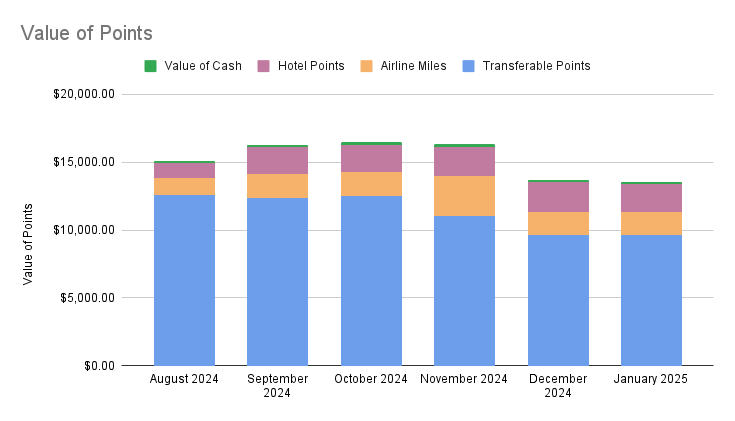
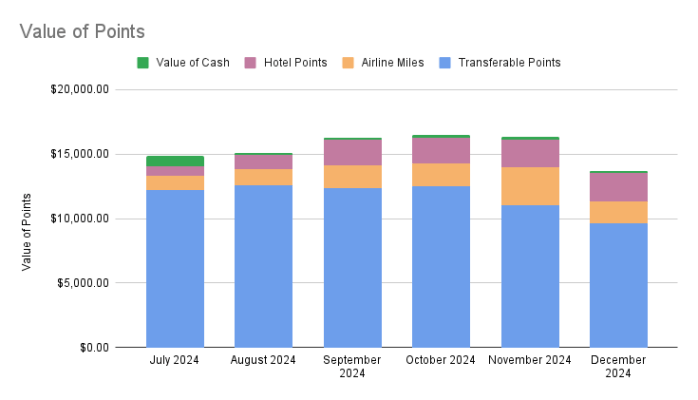
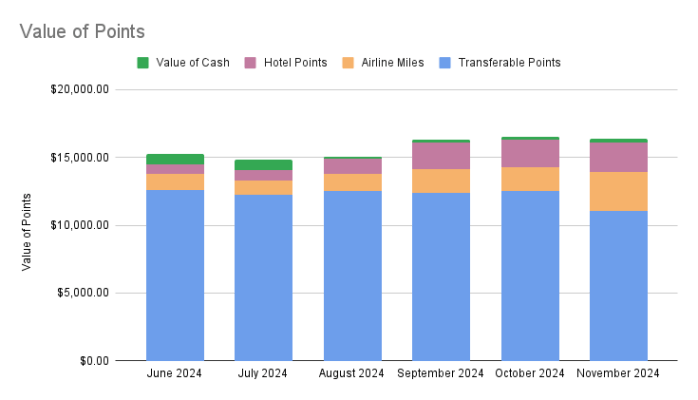
The value of all of these points and miles according to the Points Guy, totals up to $12,850 that is just a touch lower than in December. Next up will be booking for a summer trip, and I think we should have enough points and miles to make that work. After that, we won’t need to book very much because we would have three trips for 2025 already booked. Sounds ridiculous, but that’s okay with me!
Venice is a magical city. It’s architecture, art, cuisine and its soul are constantly on display. Millions of visitors visit Venice annually to experience all that is wonderful about this nearly two thousand year old city built on marshlands in the Adriatic Sea.
Boat Traffic on Canals in Venice During the Daytime
Because of the popularity, Venice can get extremely crowded during the day. The Vaporetto boats that carry tourists and locals from port to port along the canals get completely filled. The canals themselves get so crowded with boats carrying passengers throughout the city that it can seem unfathomable that there aren’t constant crashes between boats.
Canale de Cannaregio
During the day there is a buzz about the city. It’s not the same as the noise and crowds of cities like New York or Rome, but there is an energized feel about it that gets your heart racing a little. The vendors in the kiosks, the hawkers who try to pull you into their restaurants, and the thousands of people taking selfies can feel a bit overwhelming, especially to people like me who are easily overstimulated.
San Polo District Venice Italy
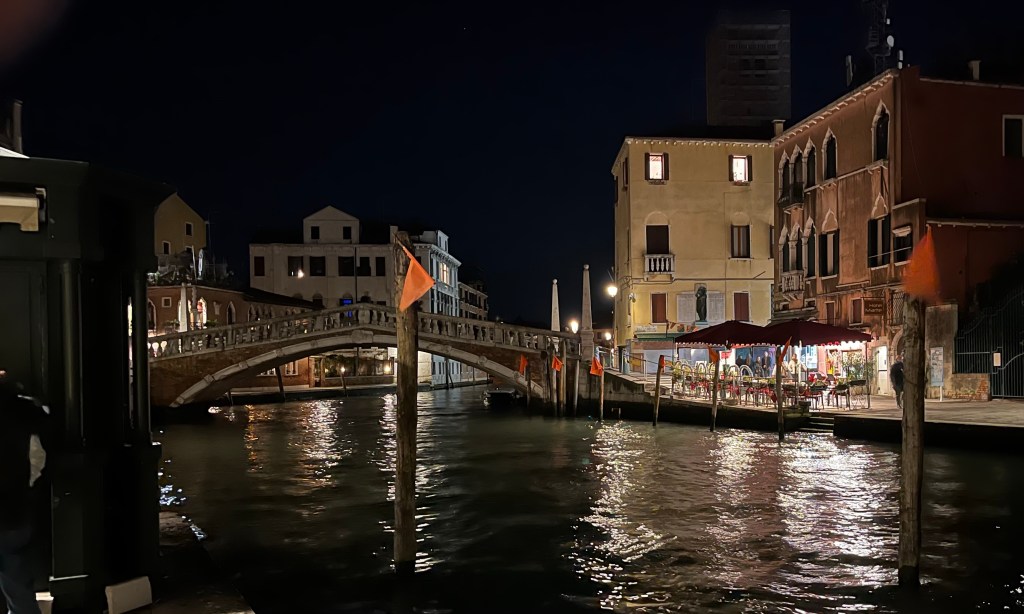
But as the sun begins to set in Venice, something amazing begins. It’s almost like a someone dialing back the chaos with a dimmer switch. Many of the visitors get back on trains and head home. Tourists sit down for a big dinner before heading back to their Airbnb or their hotel. The streets empty a little and the lights begin to turn on.
Grand Canal at night from Vaporretto
During the day, you see the flaws. Paint chipping, buildings leaning and graffiti expose the age of the city. In the evening, shadows hide these imperfections while accentuating the beauty of the architecture and stone streets.
Trattoria alla Palazzina
There is something else going on in Venice and that is that even though tourism is as popular as ever, the population within the city center has fallen dramatically over time. On the main island the population has dropped by around 120,000 residents. This leaves the population on the main island below 50,000 residents. We were in Venice in November, which is low tourist season and with the population of Venice being at its lowest point probably since its founding, it was eerily quiet.
Often when people think of Venice, the idea of Carnival comes to mind. It’s easy to imagine that the streets would be full of drunken costumed revelers as they move from party to party. Instead, what you see are people quietly enjoying a bottle of wine at a restaurant in a plaza.
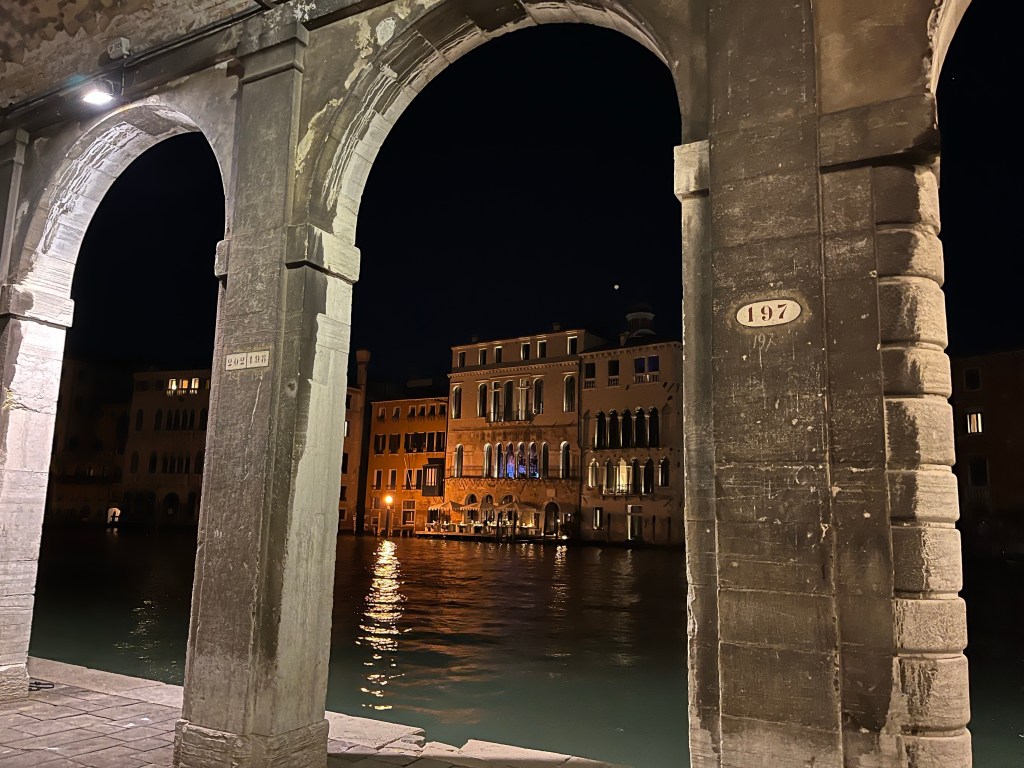
Archway near Campo Bella Vienna
By early evening, most of the shops had closed, but the restaurants and bars remained open. We wandered around the corner and stumbled upon a crowd in a plaza enjoying wine and beer. They were gathering around a little enoteca named Al Merca. It is known for its small sandwiches, wine, aperol spritz, and great prices. We enjoyed a drink or two in the lovely Campo Bella Vienna and then walked over to the Rialto Bridge.
Barcolo Bar, next to Al Merca in Campo Bella Vienna
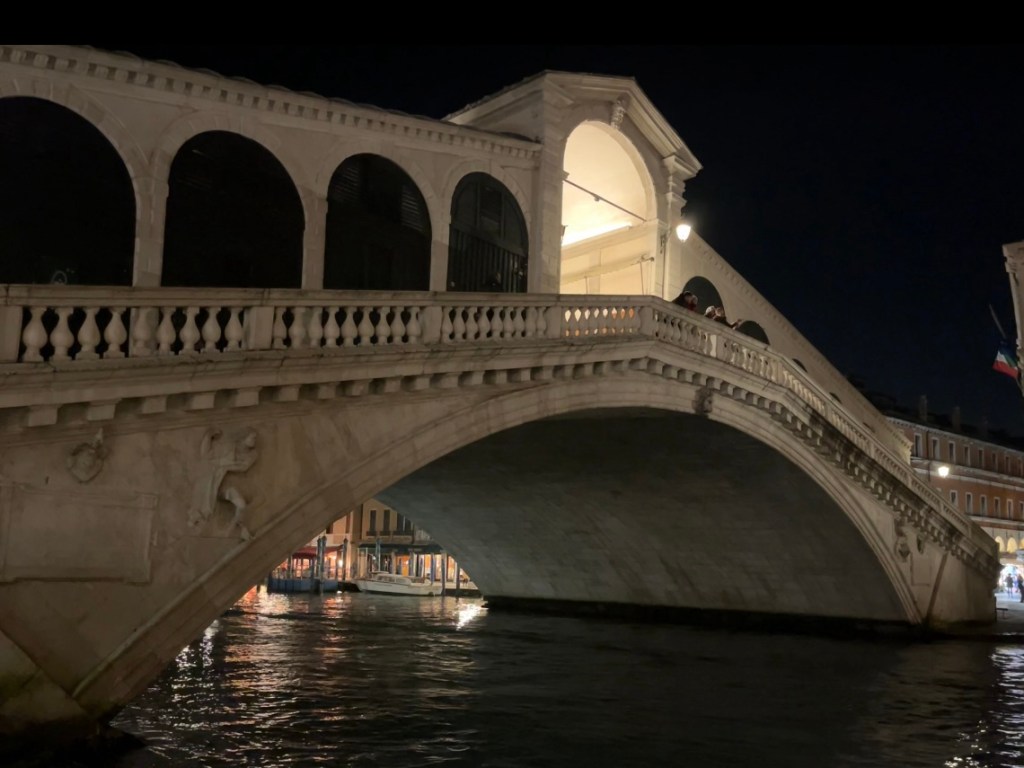
It’s difficult to enjoy the Rialto Bridge during the day, with the crowds of tourists all trying to position themselves for that perfect selfie. But at night, we were able to walk up to the apex of the bridge and rest against the stone handrail that has been smoothed to a fine polish by millions of hands that have run across it over the centuries.
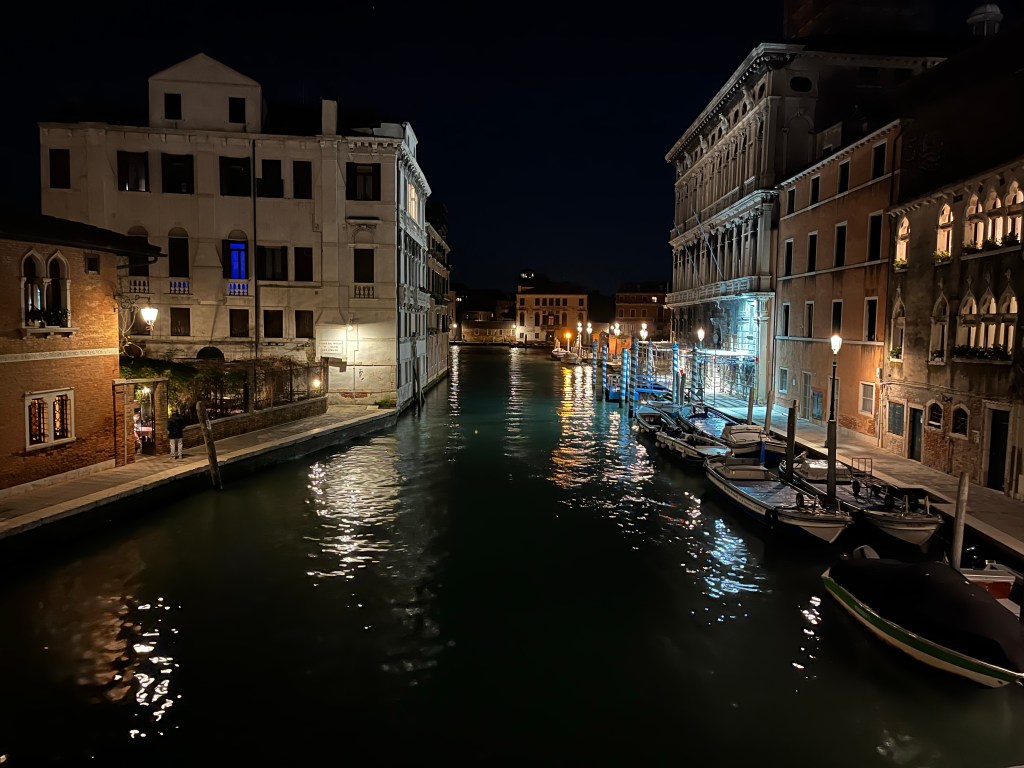
View from Ponte della Guglie
From that vantage point on the Rialto Bridge, you see the lights from the streets and buildings as they dance along the ripples on the Grand Canal. The boat traffic was all but gone with the exception of an occasional vaporetto. What seemed chaotic only a few hours prior was now serene.
Rialto Bridge at night
As the night went on, the streets continued to empty and at some point it felt like we were almost by ourselves. Whenever we would enter a plaza we would find people enjoying a restaurant or a bar, but side streets were really quiet.
Grand Canal at Night from Rialto Bridge
We eventually got tired, but stopped for a slice of thick crust pizza at Antico Forno where the shopkeeper graciously served us even though it was only 5 minutes before they closed. The crust was crispy and the tomatoes, basil and mozzarella was still surprisingly fresh. It was a perfect end to a night of exploration of Venice at night.
Pizza on Display at Antico Forno
We finished our slice and headed back to the Airbnb.
San Polo District Venice Italy
I can’t help but wonder how much the folks who do day trips to Venice are missing by not staying in the main part of the city. It’s such a different vibe in Venice at night. With the population drop in Venice, I wonder if we’re really experiencing Venice in way that nobody really has before. After this trip, I just can’t imagine visiting Venice without staying on the main island and walking it’s beautiful streets at night.
I am a travel hacker, and the amount of travel I do is unusual. We traveled three times last year, including a week in Canada, a week in Costa Rica, and a week and a half in Italy. I also had a extended weekend trip to Montana with my old high school friends. I do realize that this isn’t normal and it’s also a lot more than we did even a few years ago. We also did that without spending a lot of money, because of points and miles.
Most Americans, if they travel at all, probably plan just a single vacation a year. If you only travel once a year, though, you really want to make the most of it. This is where doing a little bit of travel hacking would allow you to stretch your budget and allow you to travel with a little more panache.
The average American who wants to take one trip per year, should maximize that trip as much as is possible by using a one credit card per year strategy. This gives the average traveler the ability to reduce the cost of their vacation or increase the luxury of the vacation without having to become a crazy travel hacker.
Why New Accounts are Important
Let’s say that you already have a Chase Sapphire Preferred card. It’s a great card with good earning categories and great benefits. Why would you need anything else? Well, the truth is that signup bonuses are really important to building point balances. In the case of the Chase Sapphire Preferred card, if you spent $3,000 per month on that card, you would probably earn around 4,000-4,500 points, depending on what categories most of the spending was in. That means that at the end of the year, you would have earned somewhere around 50,000 points on $36,000 in credit card spend.
The signup bonus for the Chase Sapphire right now is 60,000 points. That means that if you signed up for the card and did the above spend, you would end up with 110,000 Ultimate Reward points. For 50,000 points, you can probably eek out enough points for 2 to fly to Cancun, if you’re flexible on when you fly. For 110,000, you can fly to Cancun and stay in an All-Inclusive hotel for 2 or 3 nights. For 110,000 points you could also pretty easily fly 2 people to Europe and back, if you transferred those points to KLM/Air France Flying Blue, or Iberia/Air Lingus/British Airways/Finnair Avios. If you were only paying for one flight, you could probably get to New Zealand and back for that, but that’s a long flight in economy.
Signup Bonus Frequency
The problem is that you can’t sign up for the Chase Sapphire Card each year. Chase only allows for you to get a signup bonus on the Sapphire Card once every four years. The same is also true of the Capital One Venture Card and the Citi Strata Premier Card. The American Express Gold Card is technically for a lifetime, but apparently people do get a second bonus on that card, usually after around 7 years.
I mention these cards because they have transferable points, meaning that you can earn them as Citi Thank You points, Chase Ultimate Reward points, Capital One Venture miles or Amex Membership Reward points and you can transfer them to any of their hotel and airline partners to take advantage of their best deals.
It’s also fortunate that there are four of these cards and with the exception of the Amex Gold card, you can get an additional bonus once every four years. This means that you can signup for one of these cards, earn as many points as you want during the year, transfer the points out and either downgrade or cancel that card and move on to the next card in this group. With the exception of the Amex Gold card on the 4th year, you could rotate though those cards every year.
Work With a Friend
While solo travel can be fun, traveling with a spouse, significant other, or a friend can make trips extra special. Working together to earn points also makes for a great strategy. In the travel hacking community, they affectionately call this ‘two player mode’.
Let’s say that you’re married and your spouse will be traveling with you. Two player mode essentially works like this: You sign up for the Citi Strata Premier card. You do the required spending and earn your signup bonus, but you DO NOT add your spouse as an authorized user. Then your spouse signs up for the same card and earns the same bonus. After both of you have earned your bonuses you continue to use those cards for all of your credit card spend for the rest of the year.
In two player mode, assuming the $3,000 per month spend listed above, in addition to the 50,000 or so points you would earn on your normal spend, you would also earn two 75,000 point sign up bonuses. That would mean a total of 200,000 Citi Thank You points that can be used to vacation in a variety of places.
Citibank’s Transfer Partners
If you just used Citi Thank You points to pay for items on your card, you would get .8 cents per point for a total of $1,600 for those 200,000 points. Don’t do that. The best way to use those points to transfer to airline partners and purchase flights. Citi has quite a few transfer partners. They are:
Partner
Citi Points Used
Points Received
Aeromexico Rewards
1,000
1,000
Accor Live Limitless
1,000
500
Avianca Livemiles
1,000
1,000
Cathay Pacific
1,000
1,000
Choice Privileges
1,000
2,000
Emirates Skywards
1,000
1,000
Etihad Guest
1,000
1,000
EVA Air
1,000
1,000
Air France/KLM Flying Blue
1,000
1,000
Jetblue Trueblue
1,000
1,000
Leaders Club
1,000
200
Preferred Hotel and Resorts
1,000
4,000
Qantas Frequent Flyer
1,000
1,000
Qatar Privilege Club
1,000
1,000
Singapore Airlines
1,000
1,000
Thai Royal Orchid Plus
1,000
1,000
Turkish Airlines Miles and Smiles
1,000
1,000
Virgin Atlantic Flying Club
1,000
1,000
Wyndham Rewards
1,000
1,000
This list can be a bit overwhelming, but if you spend a little effort you can use these transfer partners for some great value. There are too many great uses of these points to discuss all of them but I’ll give you some surprising examples:
Using Turkish Airlines Miles to Fly To Hawaii on United Airlines
This is one of those bizarre combinations that works pretty well if you are flexible about when you go to Hawaii. You do this by finding saver awards to Hawaii on the United Airlines website. Once you find this then you search on the Turkish Airlines Miles and Smiles website for Star Alliance award space for the same day. Usually if saver awards are available on the United website, you will find it on Turkish Airlines for 10,000 points each way. If you used United miles, it’s probably going to be 25,000 miles.
Flying Blue used to offer a lot of flights to Europe for an extremely low 20,000 points. A recent devaluation happened that has raised that price to 25,000 points. There are some great things about this program. One is that it covers both Air France, which uses Paris as its hub, and KLM, which uses Amsterdam as it’s hub, making a single platform that covers both airlines’ reward programs. The second thing is that it covers a whole lot of award flights to Europe from the United States. Using the Daydream Explorer feature in PointsYeah, I came up with a ton of 25,000 point flights to Europe in May.
However, one of my favorite things about Flying Blue is that it allows for stopovers in Paris and Amsterdam. In other words, if I’m flying from Chicago to Munich on KLM, there is going to be a stop at it’s hub in Amsterdam. I can choose to do a stopover for up to a year in Amsterdam before moving on to Munich. This allows me to book one flight to Munich, pay one fare, and stay in Amsterdam for a few days, a week, whatever I feel like doing. The bad news is that there isn’t a way to do it on the website, you’ll have to call. The worse news is that if you book with an agent on the phone, it costs 50 Euros per ticket. That being said, I’ll gladly pay 50 Euros for a stopover in Amsterdam.
East Coast to London on Virgin Atlantic
I honestly can’t believe this hasn’t dried up yet, but for some reason Virgin Atlantic offers flights from mostly JFK airport in New York to London for 6,000 points and around $70 in taxes. They also have the same prices for some flights from Washington Dulles and Boston Logan, but most are from New York to London. It seems to be too good to be true, so get it while you can, I guess.
Qatar Privilege Club for Transferring to Avios
I really like the Avios program. It is a points platform that is used by Qatar Airlines, British Airways, Iberia Airlines, Aer Lingus and Finnair. In the case of Citi, it only transfers to Qatar, but once you transfer points to Qatar you can transfer to these other programs, although it can get a little complicated, One Mile at a Time has a good explanation of how to do it.
Once you convert your Citi Thank You points to Avios, you can use them for such things as 13,000 point off peak flights from most of the eastern portion of the US to Dublin, 17,000 points from Chicago to Madrid off peak on Iberia Airlines, and 30,000 points to Helsinki from the US. These are obviously not always the prices, but they are fairly typical, and available if you are flexible.
Other Examples
There are some other transfer partners that can be very useful as well. If I were booking anything to Central America, South America, Mexico, or the Caribbean, I would start my search with Avianca Lifemiles. They consistently have competitive prices to those areas. I recently saw an example of 14,000 points and around $65 to San Jose del Cabo from Chicago.
Keep your eyes on JetBlue as well. There is a new partnership with TAP Portugal where you can get to Portugal from the United States for as low as 19,000 miles and $5.60 using JetBlue Trueblue miles. The Points Guy went into depth on this new sweet spot, and I think I’m going to have to look into that one a little more, it sounds very promising.
Citi’s Hotel Partners
While I love the choices for transferring to Airline partners, Citi’s hotel partners aren’t as exciting. You can get some value by transferring to Choice hotels at 2 Choice points per 1 Citi Thank You point. You could also transfer to Wyndham and take advantage of their partnership with Vacasa that has been a little watered down, but it’s still pretty good.
For the most part, though, the best use of Citi points will be to book flights, so I would hesitate to transfer to hotel partners in less you found a great use for those points. Of course you should never feel bad if you choose to use your points in a suboptimal way, since they’re your points and you should use them the way you want, but making the most out of your points will help stretch your vacation budget.
How Much Can This Save You?
If you are only going to take advantage of one signup bonus per year, it becomes imperative that you do everything you can to maximize the use of those points. This is where you should spend your mental energy. The good news is that there are a ton of resources on how to take advantage of these transfer partners to get the most of those points.
I suggest using PointsYeah as a good place to start. You can search a number of airline programs simultaneously so that you can choose where to transfer your points an book your flights. Also, sometimes just spending a few minutes googling for the best use of points for flights to the destination you want to go to will yield you a blog article that will be very beneficial.
So how much can you actually save doing this? Let’s look at the example of a couple in two player mode that earned 200,000 Citi Thank You points. From the examples above, probably the easiest, and most available redemption opportunities would be to book two sets of one way flights to Europe using Flying Blue. If they had a family of 4, they could book one set of flights on KLM with a stopover in Amsterdam and then head on to Munich. On the way back, they could book a flight with Air France and stop for a few nights in Paris. In this example, the family of four would spend 50,000 points and around $300 in taxes and surcharges each. Those flights probably would normally cost over a $1000 each. I would imagine that this would save the couple around $3,000 on this trip.
In the Turkish Miles and Smiles example above, booking from the US mainland to Hawaii for 10,000 points each way would mean that for 200,000 points that couple could book 10 round trip tickets. Those tickets typically cost between $600 and $1,000. So in this example it could save the couple between $6,000 and $10,000.
The amount that you save is definitely going to vary by location and airline, but it can definitely stretch that vacation budget out to save money on the flights.
A Simpler Way to Travel Hack
By using a one card per year strategy, you can reduce the cost of your vacations without putting too much of an effort into it. Juggling multiple credit cards to maximize point accumulation in bonus categories and having multiple signup bonuses per year takes work and mental energy. Most people would prefer to not have to think so hard about which credit card to swipe on every single purchase.
By signing up for one card per year, you can take advantage of the signup bonus and continue to use that card throughout the year. The key is to be smart when redeeming those points with transfer partners and Citi Thank You points have some really great transfer partners. Doing this one thing, can save you thousands of dollars per year on your travel plans. It can also be the key to unlocking vacations that you wouldn’t have considered before. Doing just a little travel hacking absolutely has the potential to open the entire world to you.
I love running while traveling. I spend a ridiculous amount of my life running the same roads and bike paths near my house. Over and over again – and don’t even get me started on treadmills. Any time that I get an opportunity to run in different scenery, I will take it.
Florence, Italy is a pretty nice place to run if you get a chance. There aren’t a whole lot of choices of places to run when you’re in Florence, but the views are amazing nonetheless.
Limited Route Choices
The problem with running in Florence is that much of the town is covered by a ZTL or a limited traffic zone that doesn’t allow for cars other than residents, buses or taxis to drive within that zone. As a runner, that sounds great, right? The problem is that because of the ZTL all of the garbage trucks and delivery trucks run around Florence in the morning before the ZTL goes into effect and it can get a little busy. I like to run in the morning but I don’t want to dodge delivery trucks.
You could wait until the ZTL goes into effect, at 7:30, but then the amount of pedestrians increase dramatically and you might end up dodging pedestrians during your run. This might be okay if you want to run a low intensity run and maybe you want to see a lot of the beautiful sights of Florence. But if you want to run at a higher intensity, the option is really to run along the Arno River.
My Route
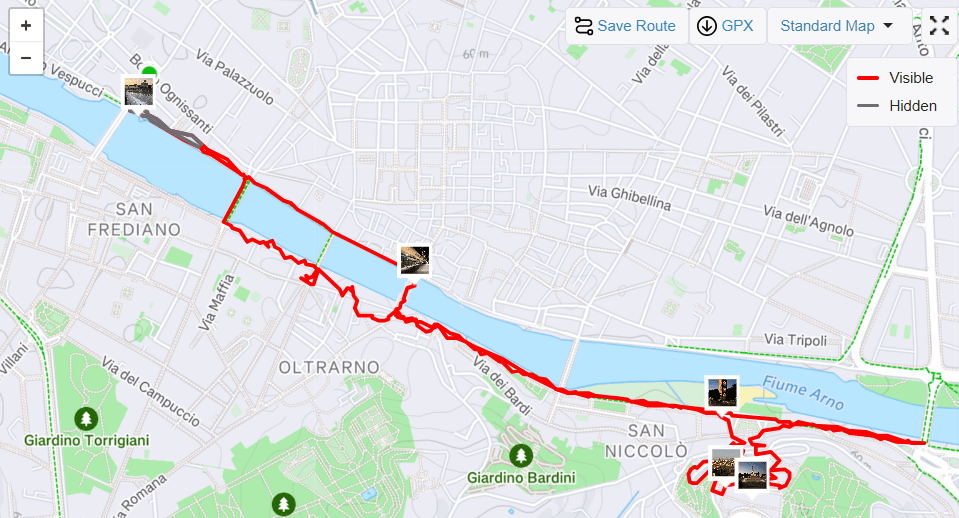
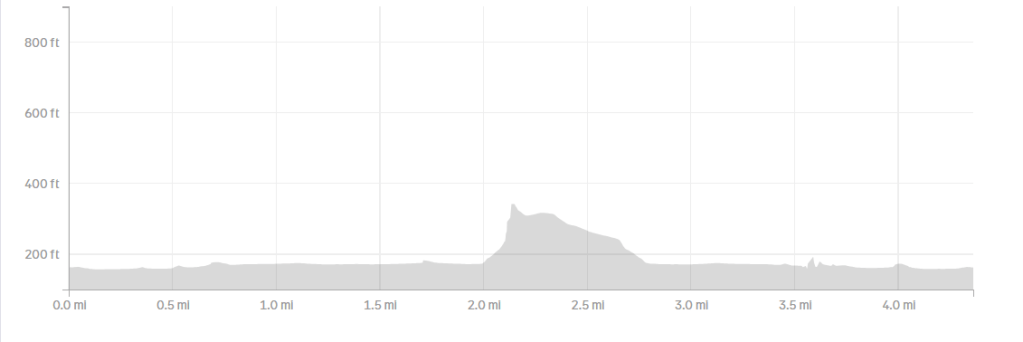
This route was a little over 4 miles with an elevation gain of 233 feet.
Our Airbnb was located south of the Firenze Santa Maria Novella train station and just a block off of the Arno river. This meant that all I had to do was take a right on the first street, and then jump on the sidewalk that runs parallel to the Arno River.
The elevation of this route was pretty much dead flat with the exception of the climb to Piazzale Michelangelo
It was before dawn in November, and the air was crisp with the temperatures in the mid 40s and very little wind. It was the kind of temperatures that is ideal for performance. My attention wasn’t on running a fast time, it was on the amazing views of Florence as it emerged from darkness.
Light reflects off of the Arno before dawn
Florence is beautifully illuminated by the lights along the Arno at night, with streetlights dancing on the ripples of the river. I continued my jog along the river heading toward the famous Ponte Vecchio. There were a few other joggers along the path. I was on the north side of the Arno heading east and the sidewalk was only a few feet wide, but the traffic was light which allowed passing in the street, when necessary.
Crossing at Ponte Vecchio
Ponte Vecchio lit up in the early morning
The previous day, I had experienced Ponte Vecchio in the afternoon with crowds of people shopping for jewelry. When I was there I noticed the shops had wooden protections for the shop windows. I was curious what the shops looked like with the wooden protections down and the crowds gone. I was not disappointed. It was truly interesting and in a way beautiful. At least as beautiful as theft protection could be.
Shops closed on Ponte Vecchio in the early morning
I crossed the Arno River at Ponte Vecchio and then continued east along the river, this time on the south side.
Looking east along the Arno River taken from sidewalk on south side of the river.
Piazzale Michelangelo
I timed my run out for one particular reason. I wanted to experience Piazzale Michelangelo at sunrise. Piazzale Michelangelo is a very popular place for people to visit at sunset, but going at sunrise allows for people to get a spectacular view of the city when very few people have even bothered to get up.
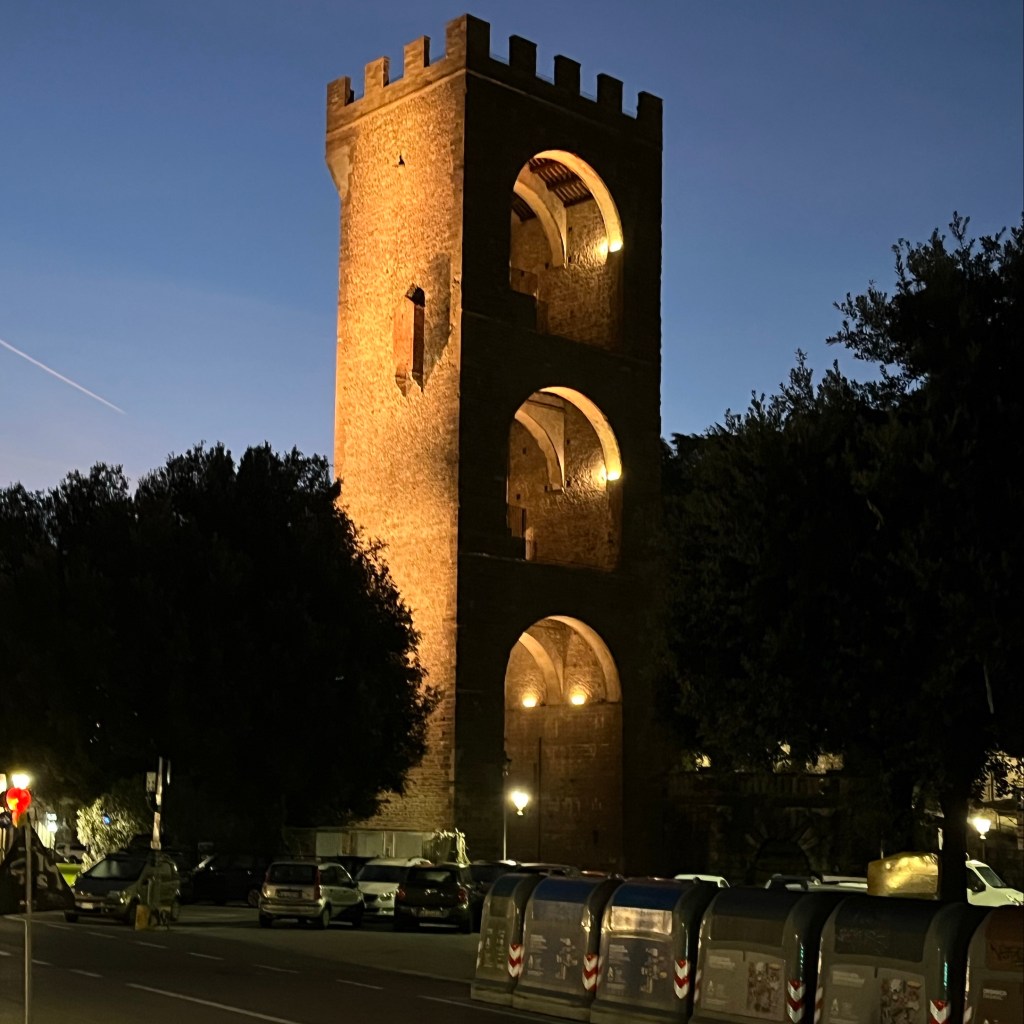
Porto San Niccolò – where you should turn to go up to Piazzale Michelangelo
The problem was, that I missed my turn. I kept running along the path and missed the turn to go up to Piazzale Michelangelo. I ended up running probably about a half mile too far, before I realized that I needed to turn around and come back to the west. I finally took my turn off at Porto San Niccolo, a tower that marks the turn up to Piazzale Michelangelo.
There is a decent amount of elevation change from the path along the Arno up to the Piazzale, so I’m ashamed to admit, I walked a little. But I worked my way up the windy road until I reached the Piazzale Michelangelo and I was not disappointed.
Bronze replica of Michelangelo’s David
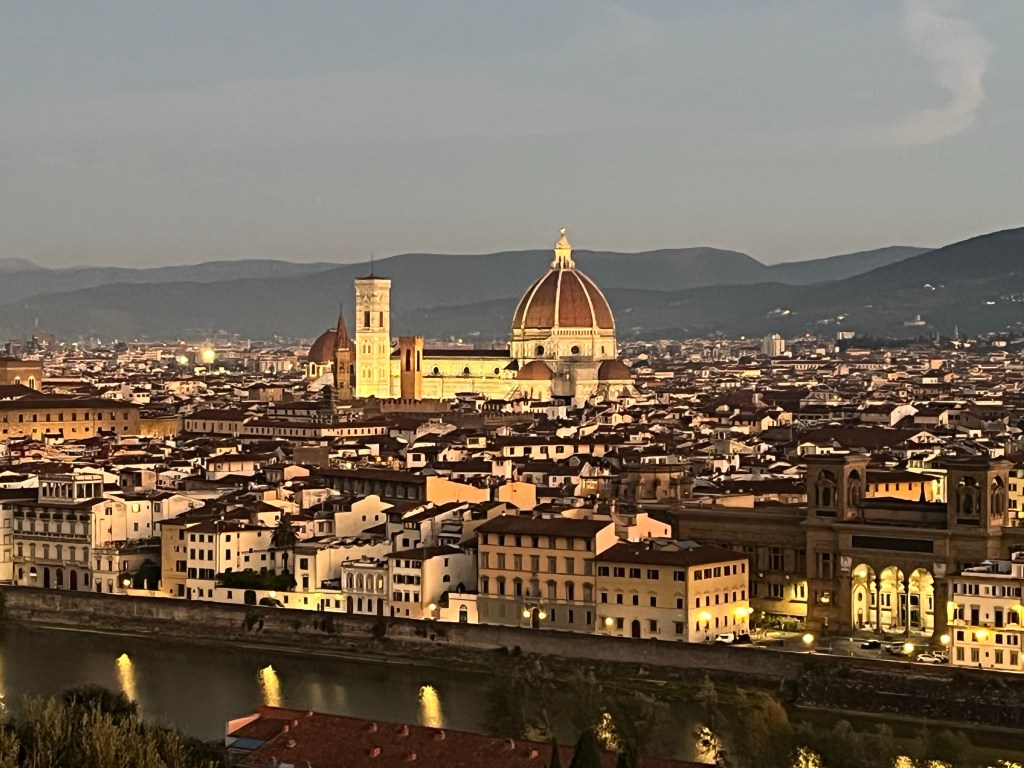
The Piazzale Michelangelo is a large plaza that has unbeatable views of the city of Florence. It has spectacular views of the Duomo with the Tuscan hills in the background. Seeing the sun rising over the city is an amazing experience and it was worth every mile and every foot of elevation on the climb.
View from Piazzale Michelangelo
After relaxing a bit in the plaza and watching the sunrise, I worked my way back to the Airbnb, this time spending more time on the south side of the Arno. Seeing essentially the same sights, but this time illuminated by the sun, instead of illuminated by streetlights created a different appreciation for the beauty of Florence.
A look at some of the old city wall
Suggestions for Routes
Based on the limited amount of running that I’ve done in Florence. I think running along the Arno might be your best bet. Running through town, you might find yourself dodging delivery trucks early in the morning or pedestrians later in the morning. If you’re not in a hurry that might not be a problem.
If you can work in a trip to Piazzale Michelangelo, you absolutely should. If you can do it at dawn or dusk, even better. There is just something magical about that location and you will not be disappointed.
In November, we had the opportunity to spend a few days in Florence. Prior to that visit, I had talked to a few people about Florence and virtually everyone I talked to practically gushed about how much they loved the city. After spending a few days there, my feelings about Florence are a bit more complicated, and while I’m sure that I’ll return someday, I’m not rushing to schedule a return trip.
Florence at Dawn from Piazzale Michelangelo
Certainly there are some absolutely wonderful things about Florence, but something bothered me about it and I couldn’t quite understand what that was. I enjoyed our stay there but were my expectations too high to begin with?
Architecture
From a building by building, block by block perspective, I’ve never visited a city more beautiful than Florence. No matter where we were, seemingly each and every block in Florence was beautiful. In the mostly residential areas, a pretty normal building is usually four or five stories tall and made with some kind of stone and stucco combination. The majority of the buildings have commercial space on the ground floor and living quarters above. The buildings are well maintained and the neighborhoods are clean.
In the main commercial area of town, closer to Ponte Vecchio, the buildings become a little more elaborate, with some taking medieval castle-like elements from the nearby Palazzo Vecchio.
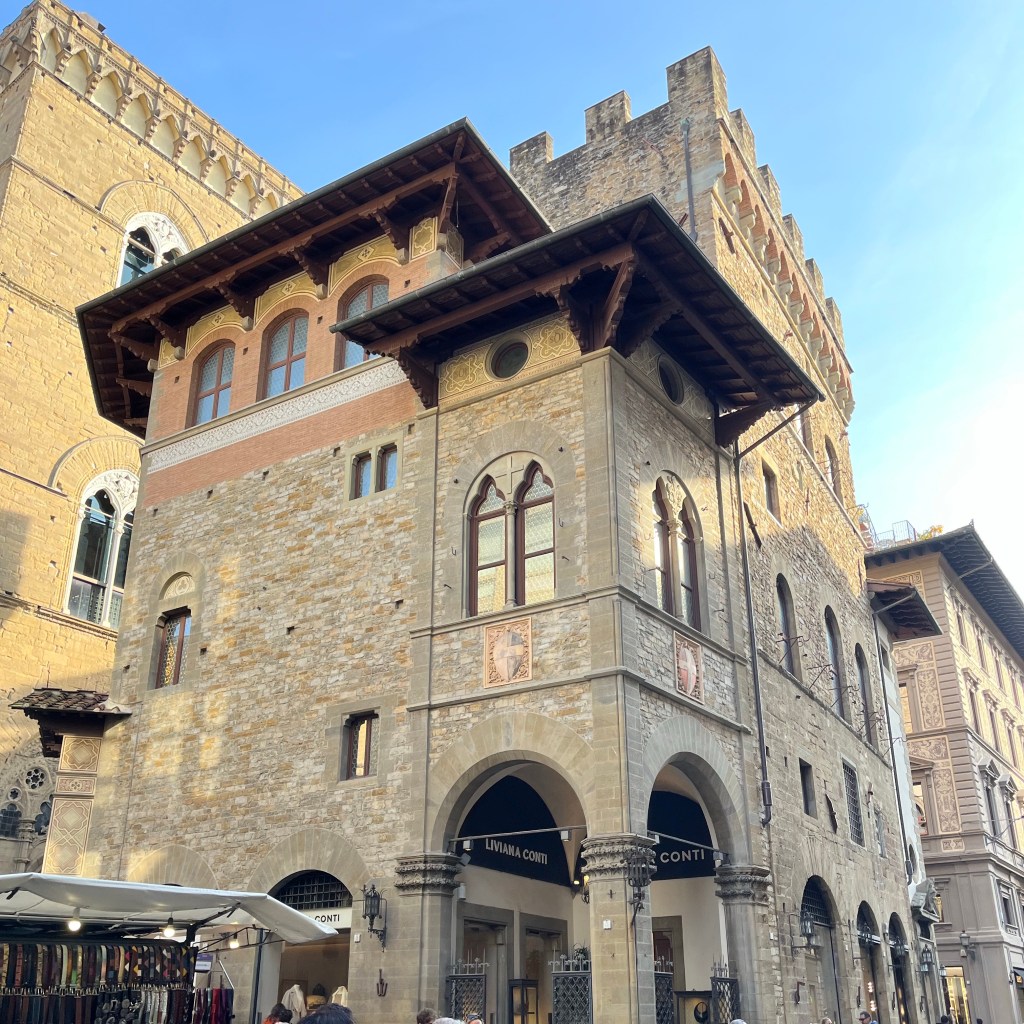
Liviana Conti in Florence
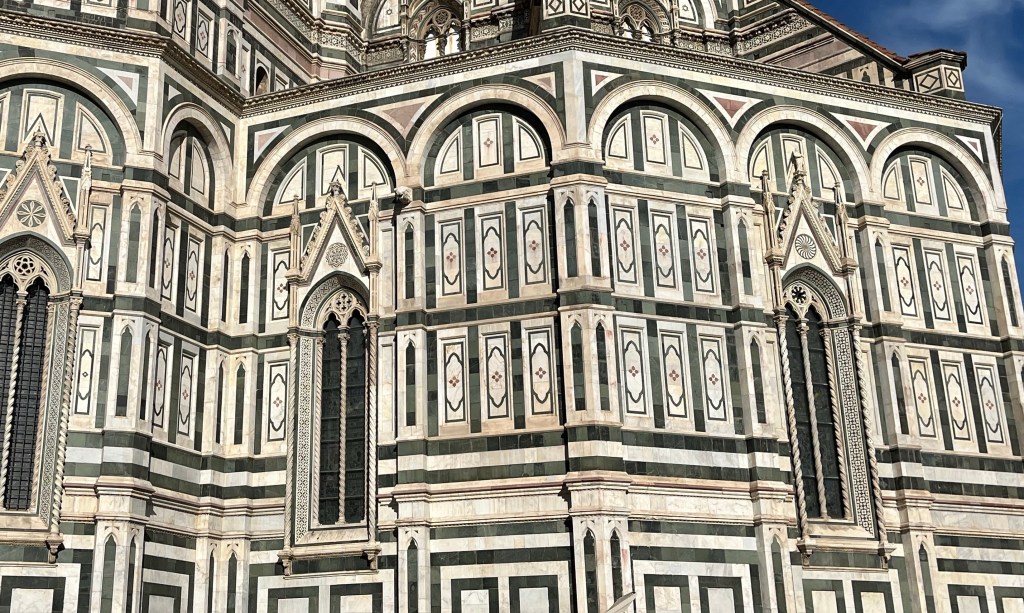
There are also some amazing architecturally significant landmarks in Florence, including the Duomo, Palazzo Vecchio, the Baptistery at the Cathedral, and the Basilica di Santa Croce. Many of these buildings have taken on a three toned marble exterior style with green, pink and white marble that were extracted from nearby quarries.
Baptistery at the Duomo in Florence with Typical Marble Exterior.
The combination of these buildings mean that virtually wherever you walk in Florence, you will be surrounded by beautiful architecture.
Walkability
Florence is an extremely densely populated city. The main area of the city is comparably small for the population in the area. That makes it an excellent place to walk around. Population density is always good for shops, bars and restaurants, because there are more residents and visitors to support them. It also means that, for visitors, there are a lot of places to shop, eat and drink, without having to take a car or public transportation.
Well Preserved Buildings and Narrow Cobblestone roads
It’s so walkable, in fact, that there is a huge amount of the main area of the city that you can’t drive in for much of the day. The area is called the ZTL or the “zona a traffico limitato“, which you probably don’t need to speak Italian to translate. It restricts traffic to only residents, taxis, or buses. This dramatically cuts down on the number of vehicles and because of that, the roads are mostly for bikes and pedestrians during the ZTL times.
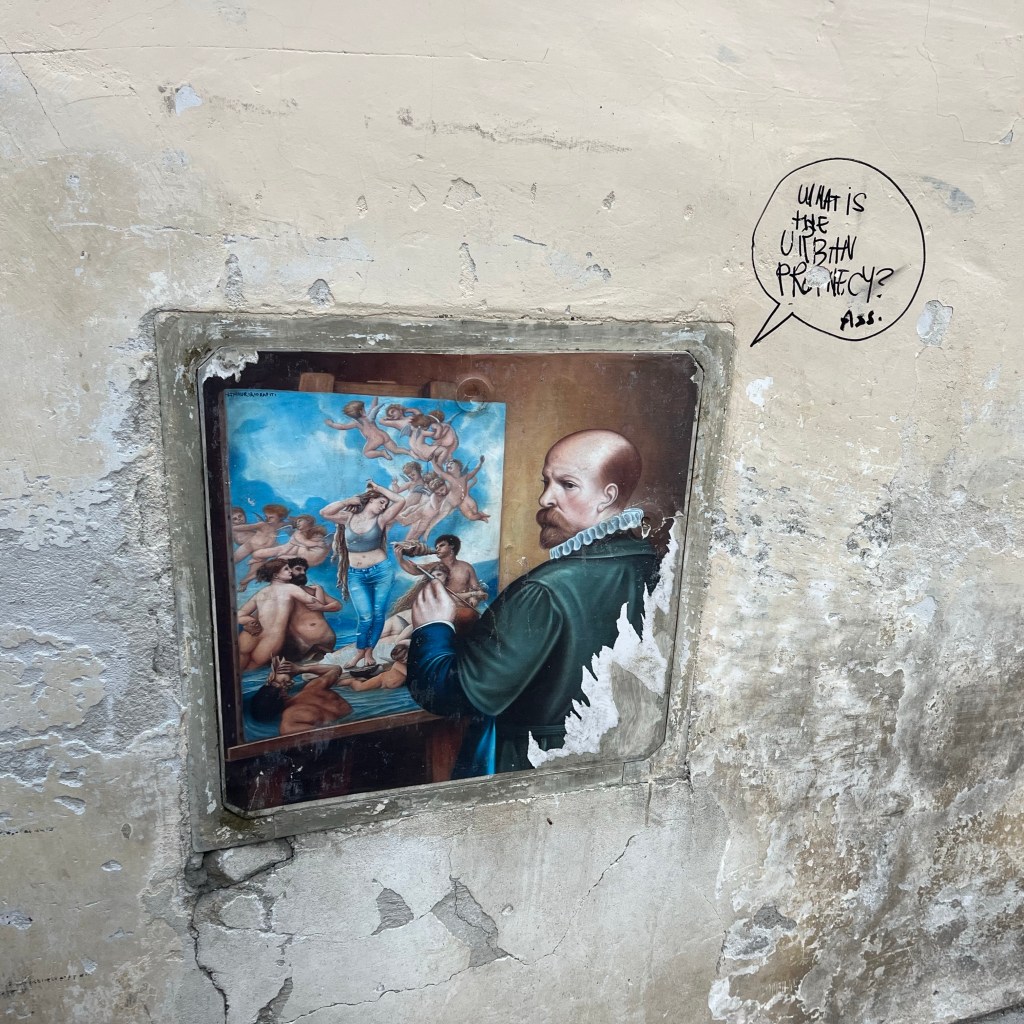
Quirky art in an alley near Palazzo Vecchio
As with many European cities, there are many narrow streets and alleyways that are fun to explore on foot. That’s where you will find quirky little pieces of art, small street shrines and some of the best restaurants.
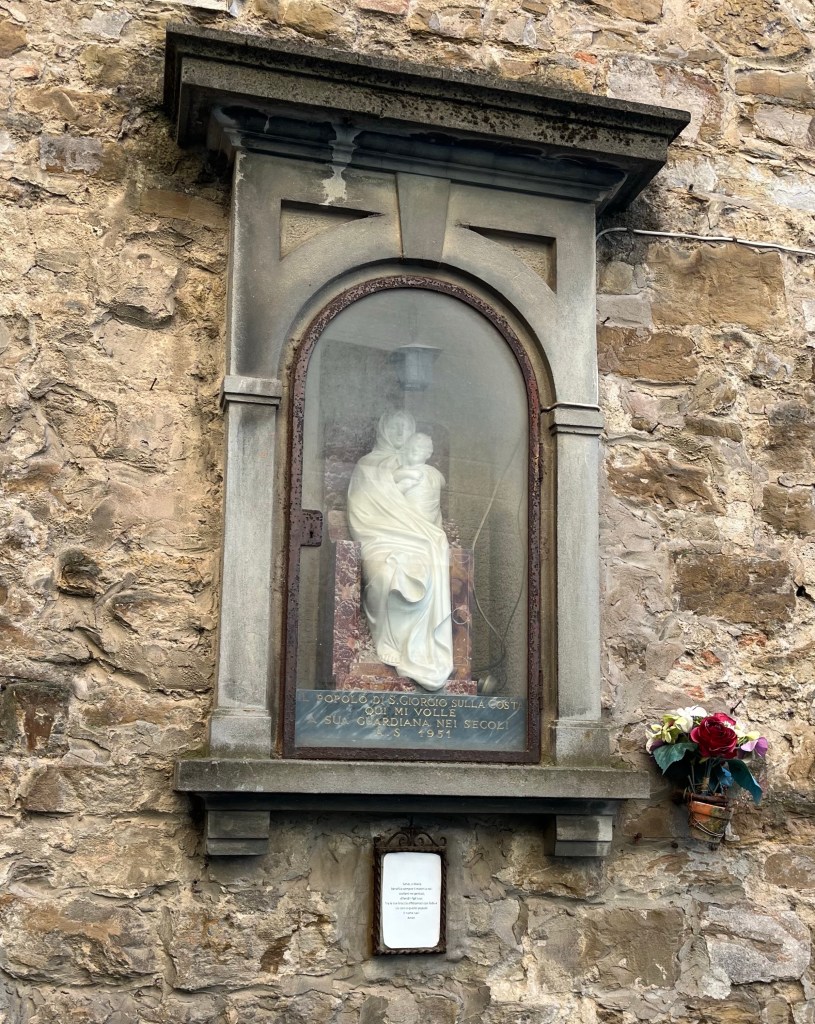
Small street shrine
Markets
The best cities to visit have great markets and Florence has some amazing ones. The most famous of those is the Ponte Vecchio which is a bridge over the River Arno. It is full of jewelry artisans. There are dozens of jewelers selling bracelets, watches and rings all along the bridge. The “Golden Street” is a fantastic place for any jewelry lover to shop.
Rows of Jewelry Shops on Ponte Vecchio
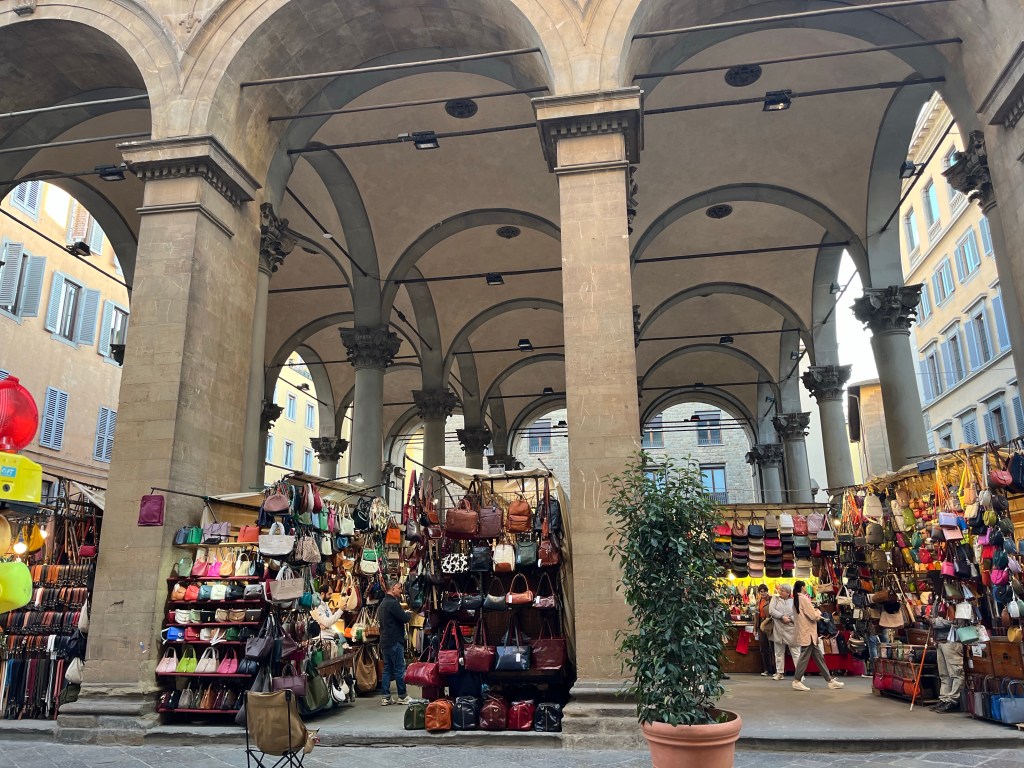
There are also a couple of great markets for shopping for leather goods. Florence is famous for it’s leather shops and you will find plenty of places to buy leather jackets, purses, wallets, belts and even backpacks. There is a covered market near Piazza della Signoria and just a few blocks north of Ponte Vecchio called Mercato de Porcellino. In addition, there is actually a bigger leather market near the Basilica di San Lorenzo called the San Lorenzo Market. There you will find block after block of leather goods.
Mercato del Porcellino
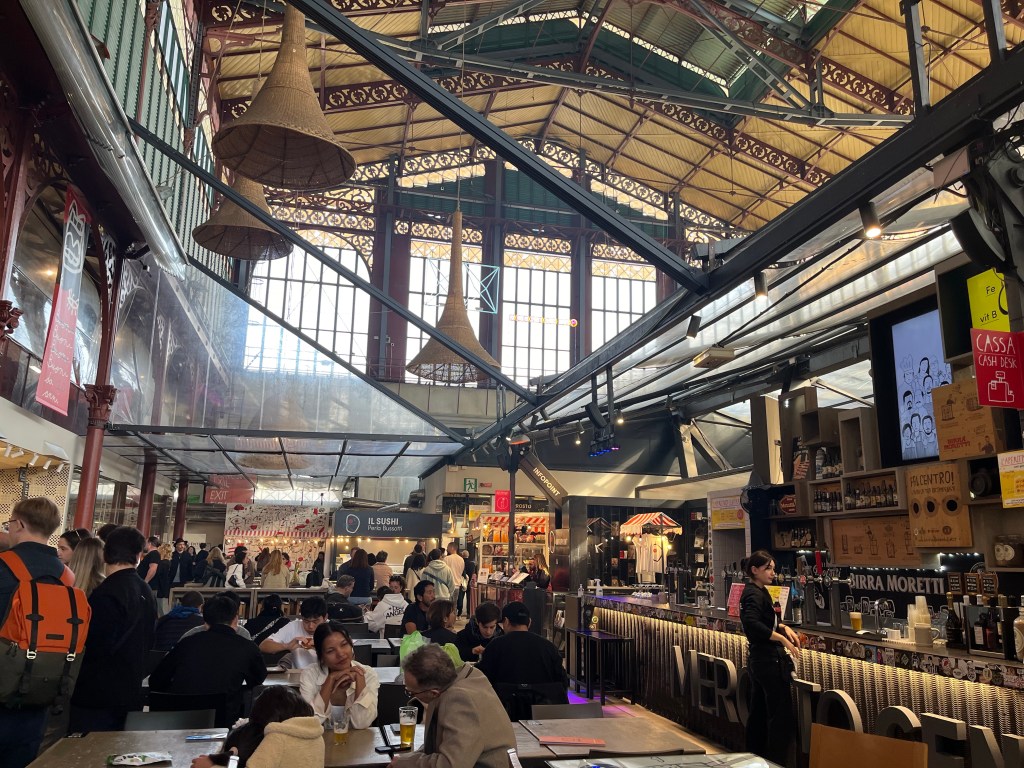
There is also a fantastic indoor food market near the San Lorenzo marked called Il Mercato Centrale. Of all of the farmer’s markets I’ve ever been to, this is my favorite. The market has two floors, the bottom is devoted to vendors selling meat, fish, vegetables, cheese and wine. The upper floor serves as a bit of a food court with the vendors selling a variety of delicious prepared food. I would not go to Florence without visiting this market.
2nd Floor at Mercato Centrale
Art
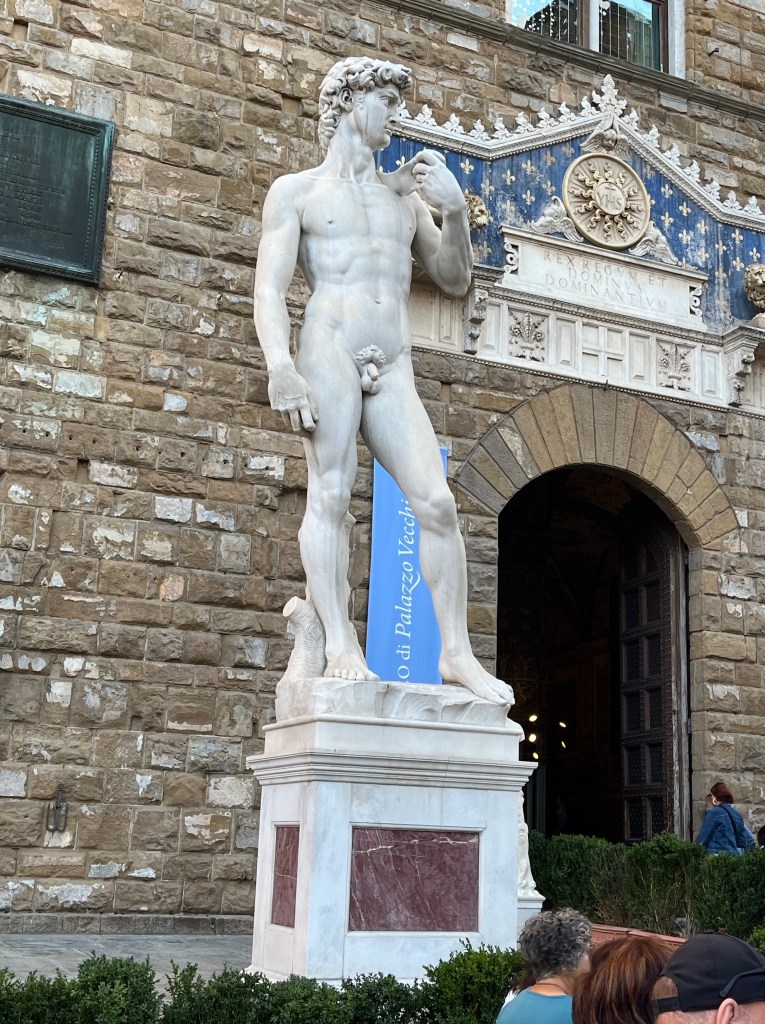
Replica of Michelangelo David residing outside of Palazzo Vecchio
You’re not going to find many places with better examples of Renaissance art than in Florence. The wealthy Medici family funded a lot of the production of art in Florence during the Renaissance. As a result, art is practically everywhere. You could spend days visiting museums such as the Uffizi Gallery, and the Accademia Gallery or you could simply wander the city and admire the statues on the Duomo, and in the Piazza della Signore. Renaissance art is in the blood of the Florence and you could spend a lifetime exploring all of it.
Fountain of Neptune at Piazza della Signoria
Shopping
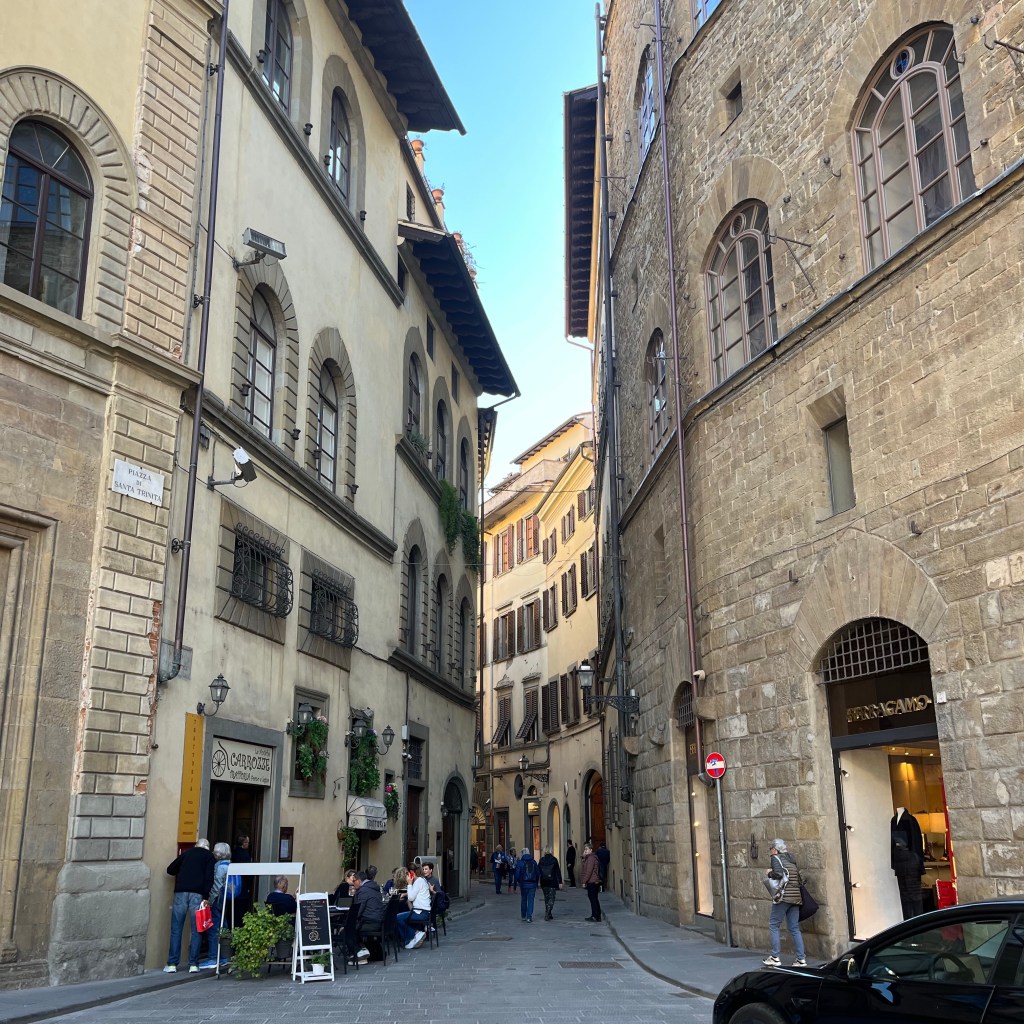
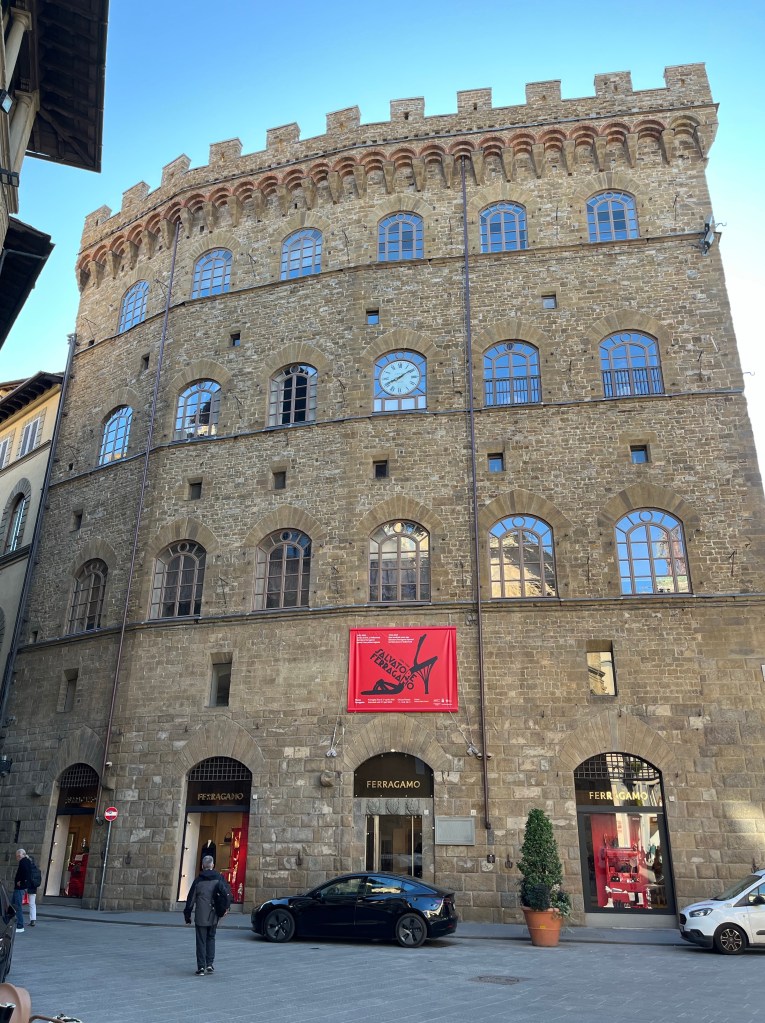
Ferragamo in Florence
Walking around Florence, you will notice some very famous and expensive luxury brands have shops catering to tourists. Brands like Fendi, Prada, Ferragamo, Tiffany and Bvlgari dominate the streets near Ponte Vecchio. This is in addition to the artisans in the jewelry and leather markets.
Crowds
We went to Florence in November, which should be low season in Florence. This did seem to be evident in the fact that we didn’t struggle to find places to eat and drink. We generally were able to get a table immediately and without a reservation.
Crowds gather around the Duomo
But even though there seemed to be plenty of capacity at bars and restaurants, the streets seemed pretty busy. There were some fairly long lines at the Duomo, and I can imagine they were equally long at the Uffizi Museum and the Accademia Gallery as it is generally advised to buy ‘skip the line’ tickets for those museums. On side streets, you could catch a bit of a breather, but walking in the area around Ponte Vecchio or the Duomo was extremely crowded, even though it was November.
Tempering our Expectations
It took me quite a bit of time to understand why I wasn’t blown away by Florence. When I thought about the architecture, history, art and the markets of Florence, it seemed like it should have been a place that I absolutely loved. Something about it bothered me and I wondered why. I had a good time. I loved so much of what Florence had to offer, but it just didn’t seem that great.
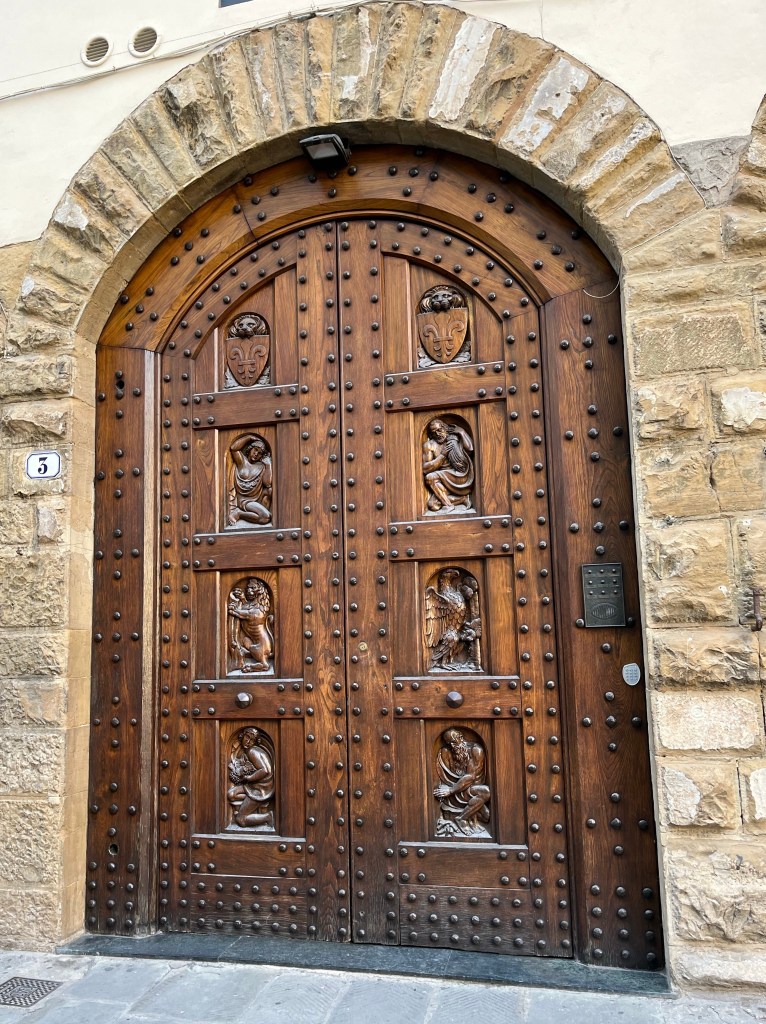
Elaborate door near Piazza Della Signoria
I think what bothered me is that Florence is a victim of its own success. Even in the off season, it was crowded and felt too touristy. For example, while the leather artisans at San Lorenzo Market and the jewelers on Ponte Vecchio felt like a natural part of Florence, seeing Tiffany’s and Prada didn’t.
Borgo Sant’Apostoli
But I think the problem was that I had an idealized version in my head of what I thought Florence should be. Of course Tiffany’s and Prada are in Florence. There are millions of visitors every year and many of them can afford to shop there. It makes sense. Sometimes, we as tourists, want everything to feel authentic but at the end of the day the crowds provide business opportunities for investors and residents.
Horse drawn carriage near Piazza della Signoria
And of course, there are going to be lines for museums and the Duomo. These are massively popular attractions in a very popular city. Yes, it will be crowded on Ponte Vecchio. No you’re probably not going to get that perfect selfie standing in front of the Statue of David, there’s going to be a crowd of people there.
Area near Arno River
I wish I had tempered my expectations a little. I think when we planned the trip, I thought that it’s off season, and we’ll get to experience everything that we want without too much wait or crowds. It just not that way, I’m not sure that there is such a thing as a true off season in Florence, because it’s just too popular of a location.
View from the Window of our Airbnb
If you can slow yourself down a little and maybe pick one museum or one major attraction per day, while expecting crowds, you should be able to really enjoy your stay. If you have time and energy to do more than one thing, than that’s a bonus. It’s obviously difficult when you make the long trip from the US to slow down and enjoy the little time you have in a location but its absolutely essential.
Before Dawn on the Arno River
“We can always come back” is a bit of a mantra for us. It takes the pressure off of treating a vacation like a checklist of things we have to do. That being said, I think we will be back to Florence, but next time, I’ll understand that there will be crowds, even in the off season, and I’ll plan accordingly. With the correct expectations, I would have truly appreciated Florence. We can always come back right?
December is always a month to get together with family and friends to celebrate the holidays. For a lot of people there is holiday travel, but this has always been a time for us to stay home. Now that we’ve been traveling more, this is time that I get a chance to slow down and think about next year’s travels.
While children dreamed of Christmas morning, I was dreaming about where we are going in 2025. Over the last few years, we have done a great job of building up our point balances in a variety of programs, and that opens up a lot of possibilities for our 2025 travels.
It has been tempting to think of places in South America or Asia, but right now, we really love going to Europe. Even though it can be a challenging distance to fly, it’s still close enough that a seven to ten day trip isn’t dominated by flights and the accompanying jet lag. The infrastructure of subways, high speed rail and airports makes getting around in Europe without renting a car easy.
Europe is beginning to feel like an easy destination, where I don’t have to worry too much about how to get around, where to stay or for that matter the language barrier, since so many Europeans speak English well. Plus, we have so much left to see in Europe. Because of that, we have three trips to Europe in 2025 in various stages of planning.
Redemptions Galore
I went on a bit of a booking spree in December. It started with me noticing a great deal on an American Airlines flight to Nice at the perfect time for the UTMB Nice Cote d’Azur Ultramarathons. I wanted to do the 54 kilometer trail race, but I also wanted to make sure that I could get a decent price on a flight before I committed to it. We booked the way there from Moline for only 19,000 American Airlines miles and $11 each. Getting home wasn’t quite as affordable as going to Nice, so I ended up booking a flight out of Dublin, Ireland instead for 19,000 American Airlines miles and $47 in taxes.
That meant we needed to book a flight from Nice to Dublin which we were able to secure on Aer Lingus for a 6,500 Aer Lingus Avios and $37 each. We transferred Amex Membership Rewards points to Aer Lingus Avios at a 1:1 ratio to acquire the necessary Avios. So in the end, for Jenn and I to fly to Nice from Moline and then on to Dublin for a couple days and then back to Moline, cost us 76,000 American Airlines miles, 13,000 Amex Membership Reward points and $190 in cash.
In November, we had booked a flight for Jenn and I and our two kids Alex and Emma from Chicago to Porto, Portugal for 48,000 Virgin Atlantic miles transferred from 35,000 Chase Ultimate Reward points and $702 in taxes and fees.
We did however, need to get back so we booked 4 flights from Madrid to Chicago for 88,000 Iberia Avios and $512 dollars in taxes and fees. Those points were transferred from American Express Membership Reward points and we used 50,700 Capital One Venture miles at one cent per point to wipe out all but $5 of the taxes and fees.
So in two months we booked four flights from Chicago to Porto, four flights from Madrid to Chicago, two flights from Moline to Nice, two flights from Nice to Dublin and two flights from Dublin to Moline. These flights in total cost us 101,000 Amex Membership Reward points, 76,000 American Airlines miles, 50,700 Capital One Venture miles, 35,000 Chase Ultimate Reward points and $897 in cash. I was able to redeem $875 in cash back to help out with the cash for taxes and fees, so out of pocket these flights cost us a grand total of $23. I’m not mad about that at all.
The cash value for the flights from Chicago to Porto were $433 each on KLM. The cash value for the flights from Madrid to Chicago on Iberia was a shockingly high $901 each. The whole Moline to Nice to Dublin to Moline itinerary had a cash value of $1,253 each. The grand total for all of that would have been $7,842 so to only fork over $23 isn’t bad. The 262,700 points and miles we used ended up netting us over 2.6 cents per point in value which is way above what they are actually valued at, so we did a tremendous job of redeeming those points.
A Couple of Bonuses
The $875 in cash back didn’t appear out of thin air. I happened to finally get my $750 sign up bonus for hitting the required $6,000 in spend in the first five months of opening my US Bank Triple Cash card. I actually spent a little over $6,400 and the total cash back was over $850. That meant I got around 13.3% cash back for all of that spend on the Triple Cash over the first 4 months. That’s pretty good, I’ll take it.
Jenn also hit the signup bonus that she was working on. She signed up for the Citi Strata Premier card, which had a 75,000 Thank You point bonus after spending $4,000 in the first 3 months.
This leaves us with no current credit card signup bonuses we are working on, so I’ll have to make a decision about how I’m going to go about building up our points balances after using so many in the last couple of months.
Never Forget Those Credits
I’m supposed to be an “expert”, right? Well, I was listening to a podcast (It was probably Frequent Miler on the Air), and they mentioned that you need to make sure to use up the credits that were expiring at the end of the year. One of the credits that they mentioned was that many Delta Airlines credit cards have hotel credits that can be used once a year. I knew Jenn had a Delta Airlines Business Gold card and so I checked out the credit. Sure enough, there is a $150 annual hotel credit if you book the hotel though Delta Stays.
We used the credit to do a short trip to Iowa City for an Iowa Hawkeye Women’s Basketball game – Go Hawks! We also use this as an opportunity to use up the $50 semi-annual Resy credit that comes with my American Express Gold card.
This was a huge reminder to me to make sure that I not only understand all of the benefits of the credit cards we have, but to actually use them. Most travel credit cards with annual fees will have some benefits or credits that will expire if you don’t use them. It’s important to remember to use those, or you’re not getting the full benefit of a card you’re paying for.
On to THe POint Check!
We didn’t stray too much from the cards that we were working on for a bonus this month. Most of the spending that we did on cards not earning a signup bonus was on recurring charges like utilities, insurance, streaming services, etc. The good news is that you can get a pretty good return on that spend and we were able to get a fairly impressive 7.1% return on all of those recurring charges last month. I’ll take it.
Card Used
Spend
Points Earned
Point Value
Points Per $
Return on Spend
Ink Cash
$463
2,317
$47.50
5.0
10.3%
Wyndham Business Earner
$450
2,591
$28.50
5.8
6.3%
Venture
$345
690
$12.77
2.0
3.7%
Total
$1,258
5,598
$88.76
4.4
7.1%
This month’s spending not devoted to earning a signup bonus
Besides the spending listed above, I also spent a little over $2,200 on my US Bank Triple Cash card earning $37 in cash back as well as the $750 sign up bonus. Jenn spent a little over $2,800 on her Citi Strata Premier card and earned almost 5,600 Citi Thank You points as well as the 75,000 point bonus on that card.
After earning two bonuses and having a whole lot of points redeemed for flights, we were left with:
199,600 American Express Membership Rewards Points
176,700 Chase Ultimate Reward Points
142,300 IHG Points
113,900 Citi Thank You Points
99,700 American Airlines Miles
71,900 Marriott Bonvoy Points
49,700 Wyndham Points
19,600 Hyatt Points
5,100 Delta Miles
2,700 United Miles
$105 in Cash Back
According to the valuations published by The Points Guy, the total value of our points, miles and cash back is $12,950. That is a significant drop from November when the total was worth $15,600, but that’s fine. We are using those points wisely and have all of the flights for two trips to Europe out of the way. I just need to book a summer trip and all of our plans are ready for 2025. It’s going to be a fun year.
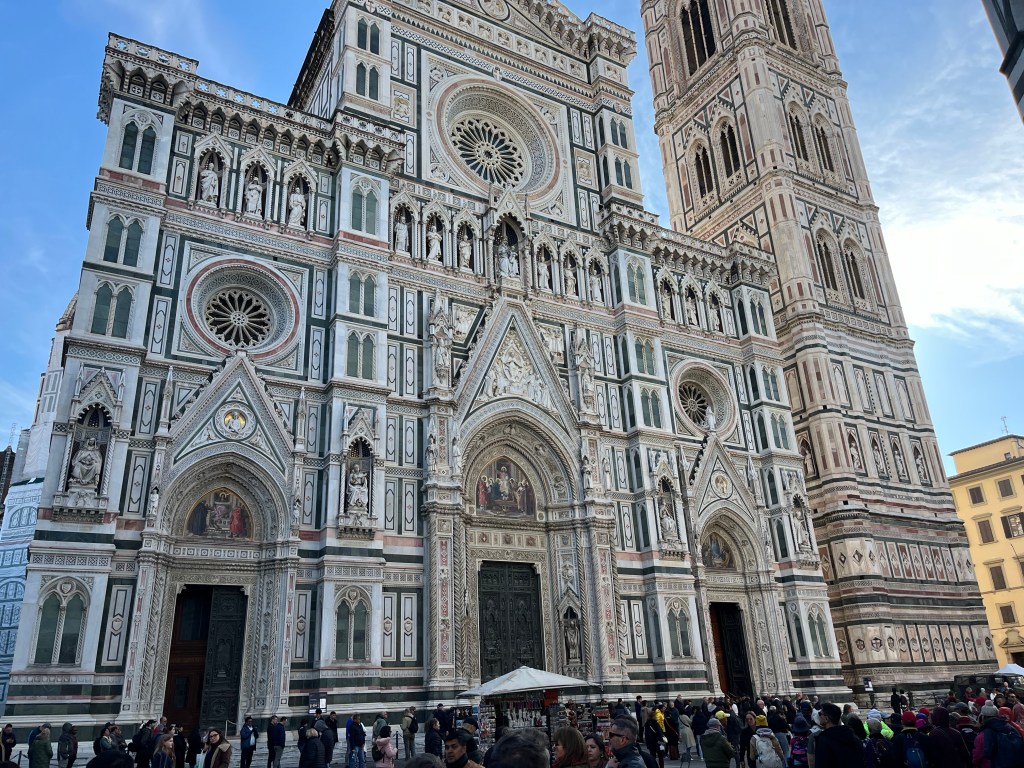
The most famous building in Florence is the Cathedral of Santa Maria del Fiore, known commonly as the Duomo. It is an architectural and engineering wonder built as Europe was transitioning from the Middle Ages to the Renaissance.
The Duomo at Sunrise taken from Piazzale Michelangelo.
History of Construction
The Duomo dominates the skyline of Florence. It is 376 feet tall at the dome and the campanile is 278 feet tall. Most buildings in Florence are three to five stories tall and are a fraction of the Cathedral’s height. The Duomo is so much larger than the rest of the buildings in Florence that it’s impossible to miss.
The Campanile is an impressive 278 feet tall.
As was the case with many cathedrals built throughout Europe, building the Duomo was a multi-generational project. The project began in 1296 overseen by the architect Arnolfo di Cambio. By 1337, the project had expanded and the plans were changed to include a dome, even though they didn’t yet have plans on how to build it. In 1418, the Architect Brunelleschi solved the dome problem and his design was chosen to finish it. The dome was completed in 1436, finally finishing the construction on the cathedral that had lasted 140 years.
The intricate marble design covers the entire exterior of the Duomo
Even though the Baptistry and the Campanile have extremely similar marble exteriors, they had been clad in marble for centuries when the exterior work was done on the Duomo. Because of the similar marble exteriors, the Baptistry, Campanile and the Duomo feel like one cohesive project, but in fact, the Baptistry was completed in 1059 and the Campanile was completed in 1359.
Ticket Options for the Duomo
The Brunelleschi Pass provides access to climb the stairs up to the top of the dome, as well as the bell tower. It also provides access to the museum, the baptistery and the crypt of Santa Raparata. That pass is available at the Duomo website for 30 Euros.
Doors at the entrance to the Duomo
The Giotto Pass provides everything the Brunelleschi Pass provides, except access to the top of the dome. The Giotto pass costs 20 Euros.
The Ghiberti Pass provides access to the Baptistery, the Museum and the Crypt of Santa Reparata. It costs 15 Euro. If you don’t like hiking up a ton of stairs or heights, this might be the option for you.
Countless statues adorn the outside of the Duomo
Because we didn’t have a ton of time in Florence we decided to do none of those things and just walk inside of the Cathedral. This option is completely free and can be done simply by standing in line. Even though the line was long, it moved fairly quickly and we were able to make it inside in about 20 minutes.
It’s Not as Flashy as You would Expect
When you look at the outside of the Duomo, it’s beautiful, but it’s a quite showy. The front of the Duomo has dozens of statues in the facade, along with the three toned marble exterior. The doors, the windows, every single inch of the exterior of the Duomo is intricate.
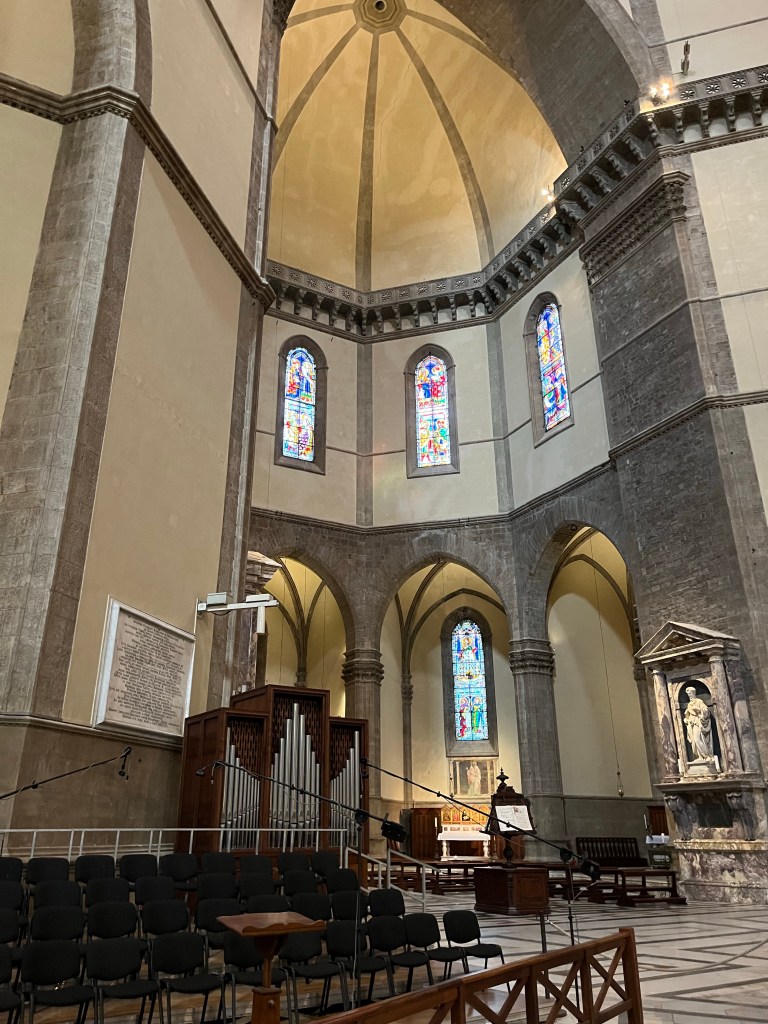
Stone archways and ribs hold up the impressively high ceiling of the Duomo.
However, once we walked inside, the amount of plain light tan walls everywhere was surprising. The gray stone archways and ribs holding up the high vault ceiling are beautiful, while seeming strangely plain. There are also some beautiful stained glass windows letting light in from the outside.
Compared to many of the churches and cathedrals that I’ve visited, the inside of the Duomo seemed understated. I think that’s what I liked so much about it. From the outside, every inch of the exterior is covered with an elaborate marble cladding. The front of the Duomo has statues everywhere and the doors are enormous and elaborate.
Tapestries in outer aisle
But inside, it’s beauty is in the relative simplicity. Sure there are still stained glass windows, statues and tapestries, but when taking it in as a whole, those things complement the cathedral well instead of overwhelm it.
Statue of Pope Eugene IV on the front of the Duomo
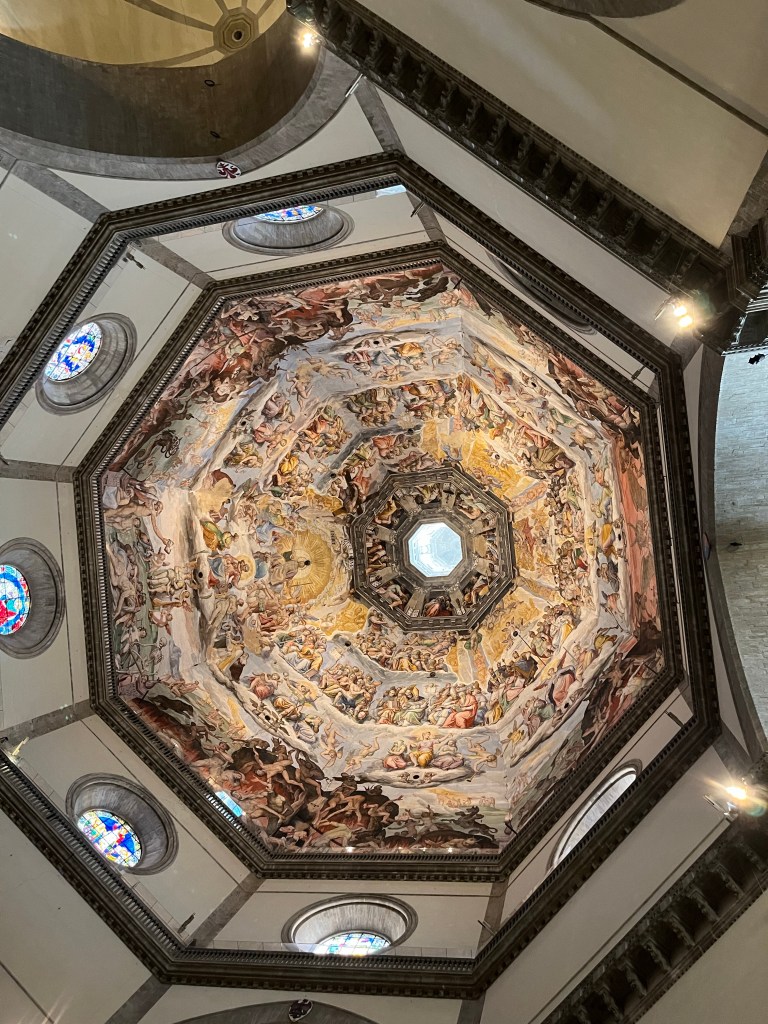
The one element of the inside of the cathedral that is a bit showy is the painting of the Last Judgement in Brunelleschi’s Dome. However, you need to position yourself underneath it in order to view it. You would never see it while seated in a pew during Mass.
Brunelleschi’s Dome
It’s actually a perfect example of the purpose of a Cathedral. For the citizens of Florence, this is the center of their community, it is a source of their pride. The exterior shows off the craftsmanship and labor of centuries of artists, artisans and laborers. But the inside, that’s for worship. Despite, the frescoes and the statues, the focus is most definitely on the altar and the priest performing Mass and ultimately that is the most important function of a Cathedral.
November was a pretty good month for us. Why? Well we were in Italy for a couple weeks of it. Italy is a magical place where climate, landscape, food, culture and history all come together to make an incredible place to visit. There is no doubt why it is one of the most visited countries in the world and it did not disappoint.
We stayed in Florence, Venice and Rome and we also had a nice day trip to Cinque Terre. Rome and Venice were repeats for us. Rome is fine, I’m sure we will visit again, but I’m amazed by how much we’ve enjoyed Venice. Before we went the first time, I thought Venice would feel extremely touristy. It turned out to be quite different than I imagined. It really felt more authentic than the other places we visited. That being said, I think we spent more time on the side streets away from the tourist traps than the other cities we visited. It’s a reminder to us to actively get away from the main tourist areas of a city.
I’m determined to revisit Cinque Terre, hopefully for a few days. I’d love to hike the trail between the five towns and really spend some time exploring each of them. A day trip just wasn’t enough to fully appreciate Cinque Terre. As far as Florence is concerned, it’s the most beautiful city I’ve visited thus far, but even during the off-peak travel season, it seemed overrun with tourists. I might have appreciated Florence more if we would have wandered out of the main tourist areas.
A Couple of Redemptions
We have three trips planned for next year. The first is a spring break trip to spend a week on the Portuguese route of the Camino de Santiago de Compostella. The second trip is a summer trip where we haven’t determined locations or dates. The third is a trip to Nice France to participate in a UTMB trail running event where Jenn and our friends Bill and Theresa will be doing the 22 kilometer race and I will be participating in the 54 kilometer race.
In November, we started the planning of these trips by booking a flight from Chicago to Porto. Virgin Atlantic was charging 12,000 miles and $175 per ticket to book the flight but with a 40% transfer bonus from Chase it ended up costing us 35,000 Chase Ultimate Reward points and around $700 for four tickets.
In cash, those flights would have cost $433 each. That means that we ended up getting a little over $1000 value for those 35,000 Ultimate Rewards points. That works out to 2.9 cents per point value, when Chase Ultimate Rewards points are typically valued at 2 cents per point so I’m pretty happy with the redemption.
We also used 38,000 Capital One miles to wipe out the cost of some train tickets from our trip to Italy. This isn’t the best use of Capital One miles, because we just get one cent per point on reimbursement for travel purchases. However, my goal is to use all of Jenn’s Capital One miles so she can cancel her Venture Card and then I will apply for one. Capital One allows people to get a bonus every four years so I think with the two of us working together, the smart thing is for us to alternate every two years who is carrying a Venture Card. That will allow us to maximize signup bonuses for Venture cards.
Barclays Aviator Red Bonus
I had one signup bonus hit in November. I received the 70,000 American Airlines mile bonus for signing up with the Barclays Aviator Red card, which is scheduled to no longer be with Barclays in 2026. This is part of an exclusive deal between American Airlines and Citibank, making Citibank the exclusive bank of all of the American Airlines credit cards moving forward. Customers who hold American Airlines cards issued by Barclays will probably be transferred to Citibank and I would assume that the Aviator Red card will no longer be taking new applicants. Therefore if you if you want sign up for the Aviator Red card, the clock is ticking, and I would assume that some time soon, Barclays will no longer be taking new applications.
On to the Point Check
I’ve been working on a signup bonus for my US Bank Triple Cash card and I had some issues with it that really boils down to me not paying attention to what I was doing. Without getting into the boring details of it, I’m an idiot and I ended up having to get new credit cards issued, with the correct business name on it. This happened right before we went to Europe, so I basically wasn’t using the card for most of the November billing period.
Card Used
Spend
Points Earned
Point Value
Points Per $
Return on Spend
Amex Business Gold
$889
1401
$28.02
1.6
3.1%
Amex Gold
$817
2,148
$42.96
2.6
5.3%
Venture
$752
1,504
$27.82
2.0
3.7%
Citibusiness AAdvantage
$698
698
$11.17
1.0
1.6%
Ink Cash
$459
2,298
$47.11
5.0
10.3%
Wyndham Business Earner
$422
2,288
$25.17
5.4
6.0%
Total
$4,046
10,337
$182.25
2.6
4.5%
This month’s spending not devoted to earning a signup bonus
My spending primarily got put on my Amex Gold and the Citibusiness AAdvantange, where they didn’t take American Express, which was in a lot of places in Italy. It wasn’t really ideal, and that’s why my non-bonus spend only returned a disappointing 4.5% last month. I ended up spending less than $500 on my Triple Cash card and earned about $8 in cash back.
Jenn has been working on her bonus for her Citi Strata Premier card and spent less than $1,500, earning over 2,500 Citi Thank You points.
Between the points earned this month and the redemptions the total value of our points went down slightly. We finished the month with:
298,200 American Express Membership Rewards Points
175,700 American Airlines Miles
174,300 Chase Ultimate Reward Points
142,300 IHG Points
71,900 Marriott Bonvoy Points
48,900 Capital One Venture Miles
47,100 Wyndham Points
19,600 Hyatt Points
5,000 Delta Skymiles
2,700 United Miles
$227 in Cash Back
All of these miles, when using the Points Guy’s valuations, add up to around $15,600. That should give me plenty of room to do all of the travel planning that I need to do for 2025. That’s the fun stuff, I can’t wait!





































 Newby to Expert Traveler