American Airlines makes Citi Thank You Points Much More Valuable

In a widely expected move, American Airlines is now a transfer partner from Citi Thank You Points. Rumors have been circulating since it was announced that American Airlines was phasing out its Barclay’s credit cards and signing an exclusive deal with Citibank. Finally, Citibank has added American Airlines to its Thank You Points transfer page, making those points much more valuable.

How This Transfer Partnership Works

People who hold a Citi Strata Premier, Citi Prestige, or Citi Strata Elite credit card can now transfer Citi Thank You Points to American Airlines AAdvantage Miles at a 1:1 ratio. Adding a coveted transfer partner makes any Citi Thank You Points much more valuable, especially since Citi is the only bank that transfers its points to American Airlines.

In addition, this also means that as long as you hold one of those cards, any points earned with a Citi credit card that earns Thank You Points, such as the Double Cash or Custom Cash, can also become AAdvantage Miles. This is because you can combine your Thank You Points and then transfer them to any of 15 airline partners or 5 hotel partners.

The reason why transferring points is so important is that in many cases, you can book hotels and flights with fewer points when you transfer them to a hotel or airline loyalty program. Even better, if what you’re looking for is actually a better deal to book with points through a travel portal, you have that option as well.

Domestic Airlines are (Mostly) Monogamous

Many international airline programs, like Air France/KLM Flying Blue, Avianca Lifemiles, and Air Canada Aeroplan, are polyamorous, allowing transfer partners from multiple bank points programs. For example, Flying Blue allows transfers from Chase, Citibank, American Express, Capital One, Bilt, and Wells Fargo. This is extremely common for international programs. Even Virgin Atlantic, despite its name, is a bit of a swinger.

Airlines based in the United States aren’t the swinging type; by comparison, they’re mostly monogamous. Delta Airlines only allows transfers from American Express Membership Rewards, American Airlines only allows transfers from Citi, and Alaska Airlines allows transfers from Bilt Rewards.

There are three airlines that, however, that aren’t exclusive. Southwest Airlines and United Airlines allow transfers from both Chase and Bilt, while JetBlue allows transfers from Citi, Chase, and American Express.

Your Airline Preferences Matter

Because of several factors, such as route networks, hub locations, award pricing, or just which airline you prefer, you should earn points that transfer to the airline that works best for you. For example, I know people who absolutely love Southwest Airlines. They fly a ton of flights out of Midway Airport in Chicago, which is an airport that isn’t far from where we live. Unfortunately, we do a lot of our flying to Europe, and Southwest Airlines doesn’t fly to Europe. We’re just not going to use it.

United Airlines flies to Europe and has a great network there, but generally, I find that it takes a lot of United miles to book a flight to Europe. Also, even though they fly out of my small home airport in Moline, the point prices for United flights out of Moline are extremely high.

Delta Skymiles is probably the most popular airline award currency in the world, but I struggle to find good value with Delta. They overcharge for one-way flights, and usually it’s difficult to find competitive pricing for round-trip tickets as well. That being said, I do occasionally find a great deal, and did recently book round-trip tickets in the summer for a little over 40,000 points each to Berlin. Unfortunately, those deals are not the easiest to find, and I don’t consistently find good value with Delta.

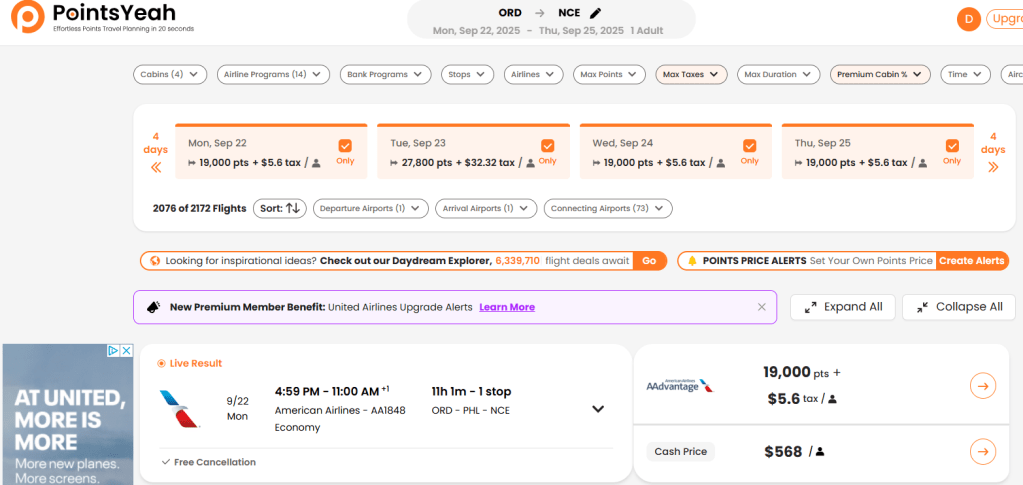
American Airlines, however, has a lot of great flights out of our local airport to Europe and some for extremely low prices, in points. In September, we are flying to Nice, France, from our local airport for only 19,000 AAdvantage miles each, and we were able to find a flight home from Dublin for only 19,000 miles as well. I have also seen several flights to Italy, Spain, and England for only 19,000 miles. Overall, it’s just a program that works well for us.

Those airline miles aren’t created equal either. The Points Guy does valuations each month, which look at the price of flights in miles and compare it to the price in cash for the same flights. In July 2025, the values of those domestic airline miles are:

  • Delta Skymiles- 1.15 cents per point
  • United Mileage Plus- 1.3 cents per point
  • Southwest Rapid Rewards- 1.4 cents per point
  • JetBlue TrueBlue – 1.45 cents per point
  • Alaska Airlines Mileage Plan- 1.5 cents per point
  • American Airlines AAdvantage – 1.55 cents per point

As you can see, according to the Points Guy, AAdvantage miles are the most valuable of the domestic airline currencies, so having an additional way to earn those miles is a very good thing.

This Will Shift My Focus to Citi

Lately, I’ve been concentrating on earning American Express Membership Reward Points and Chase Ultimate Rewards. That’s because they have excellent ways of earning points, and they have great transfer partners. Both have great ways of accumulating points through sign up bonuses and cards with great earning rates.

For example, we put all our internet and cell phone charges on our Chase Ink Cash card because it earns 5x in those categories. Also, as much as possible, we use our Amex Gold Card for restaurants and grocery stores because they earn 4x in those categories. Those are both great ways to accumulate a lot of points without sign up bonuses.

However, with Citi, I have a Custom Cash card which earns 5x on all spending in your top category, up to $500 in a billing cycle. This means that if you pick a category that you can come close to spending $500 on each month and only use it in that category, you can accumulate 2,500 Citi Thank You points each month without a lot of spending. I haven’t been doing that, however, because I just wasn’t that excited about accumulating Citi Thank You Points.

The partnership with American Airlines changes that. Because AAdvantage miles are very valuable to me, I will be going out of my way to earn Citi Thank You Points so I have points available to transfer to American Airlines.

Current Citi Strata Travel Credit Cards

Now that Citibank has revamped its travel cards, they are currently offering three different credit cards that all earn Citi Thank You Points: one is an entry-level card, one is a travel card, and one is a premium travel card.

Citi Strata Card

This is the entry-level travel card, and it is a pretty good starter card. It has no annual fee and is currently offering a 30,000-point welcome offer if you spend $1,000 in 3 months. For being a no annual fee card, it has tremendous bonus categories including 5x on travel through the Citi Travel Portal, 3x at supermarkets, 3x on gas and EV stations, 3x on a self-selected category, 2x on dining, and 1x everywhere else.

The downside is that it has a limited number of transfer partners (Does not allow transfers to AAdvantage), and those points transfer at a worse ratio. You could however, hold onto those points until you get a Citi credit card with a better transfer ratio, or perhaps transfer those points to a family member who holds a Citi credit card with better transfer options and have them book flights or hotels for you.

Citi Strata Premier

The Citi Strata Premier is a great travel credit card. It has a $95 annual fee and is currently offering a 60,000-point bonus if you spend $4,000 in the first 3 months. It offers 10x on hotels, attractions, and car rentals booked through the Citi Travel Portal, 3x on other air and hotel purchases, 3x on supermarkets, 3x on restaurants, 3x on gas and EV Charging stations, and 1x on everything else.

Unlike the Citi Strata Card, the Citi Strata Premier transfers to all of Citi’s partners at the best transfer rate that Citi offers. This also includes the 1:1 ratio to American Airlines. In addition, the Citi Strata Premier also offers a variety of benefits, including trip delay coverage, trip cancellation, and protection insurance, lost and damaged luggage coverage, and some car rental coverage.

Citi Strata Elite

The Citi Strata Elite is a brand-new premium credit card offering from Citibank with a $595 annual fee. It is currently offering an 80,000 point bonus when you spend $4,000 on the card in the first 3 months. It earns 12x on hotels, car rentals, and attractions booked through the Citi Travel Portal, 6x on air travel through the Citi Travel Portal, 6x on dining on Friday and Saturday nights, 3x on dining other nights, as well as 1.5x on all other purchases.

To compensate for the high annual fee, it offers $300 per year in hotel credits, $200 on an annual splurge credit, $200 Blacklane credit, a Priority Pass Select Membership, 4 American Airlines Admirals Club Lounge passes, as well as a $120 Global Entry or TSA pre-check credit.

My Favorite Strata Card

In my opinion, the Citi Strata Premier Card is the best of this group. The 3x categories of groceries, dining, and gas can help users accumulate a lot of points quickly. It has access to all of the transfer partners that the Citi Strata Elite card does, but with a $95 annual fee instead of a $595 annual fee. Also, I don’t find the credits on the Strata Elite to be enticing enough to pay an extra $500 on an annual fee. The only reason I would consider the Strata Elite is if I were a very frequent flyer, and I used those lounge passes a lot.

Being Strategic about Your Credit Card Choices

The points and miles world is extremely complicated. There are multiple banks with multiple cards, and each comes with different earning rates, benefits, and transfer partners. If you wish to turn all of your everyday purchases into great vacations, it’s important to try to be as strategic as possible.

For travel hackers who are using points to supercharge their travel, they must use the points programs that fit their travel plans the best. That really means working backwards from the destinations that you would like to visit, figuring out the best airlines that service those destinations from where they live, and then trying to figure out the best way to earn points to use with that airline. If American Airlines miles are a good fit for your travel plans, then this new partnership with Citi is a very exciting development.
American Airlines Continues to be Great for Booking Award Flights From Small Airports

I love my local airport. It’s MLI, sometimes known as the Moline Airport or as it’s officially called, the Quad Cities International Airport. What is great about this airport is that you can pretty much roll into a parking spot 20 minutes before boarding and be alright. I personally am not brave enough to try it, but I’m certain you’d be fine. TSA normally takes less than ten minutes and you can literally park just a couple hundred feet from the front door. There are only a dozen gates, so it only takes a couple minutes to get to your gate. Whenever it’s feasible, we try to fly out of MLI. If we can’t, we generally fly out of Chicago O’hare.

On the other hand, I really hate the whole experience of going to Chicago O’hare. It’s a three hour drive and the last hour is in white knuckle traffic. Then we have to park something like a dozen miles away and take a shuttle to the airport. Getting to O’hare is usually a four hour ordeal for us and we have to leave at least two hours for security and getting to the gate. There is nothing pleasant about having to leave your house six hours before boarding.

Booking award flights out of MLI however, is a little tricky. Flying to Europe on points, we usually find the best deals on KLM/Air France Flying Blue or with either Aer Lingus or Iberia Avios. None of those airlines fly out of MLI, but they all have direct flights from Chicago O’hare to Europe. There are only three airlines that will book with points out of MLI: United, American, and Delta.

This leaves us with three choices. The first is to book with one of the European carriers and deal with the whole ordeal of driving to Chicago. This isn’t great, not only because of the way there, but generally that means we’re trying to stay awake while driving home after a seven hour time change when returning from Europe.

The second option is to book a separate award flight to get to Chicago and book with a European carrier out of Chicago. The problem with the second option is that if something happens to your first flight, such as a delay, the second flight doesn’t care that your first flight is delayed, since it’s not their fault and frankly not their problem. When I’ve done this in the past, I’ve booked a day early just so we could make sure to get there in time.

The third option is to book the whole trip with one of the American carriers that fly out of MLI. The problem with the third option is that it’s often a whole lot of points. United Airlines consistently charges a premium for flying to a small airport, and I usually just look at their prices and laugh. Delta rarely has good award prices and when you find a deal you need to book them as a round-trip ticket to get good rates. American Airlines, however, continues to surprise me with great value on award flights out of MLI, although you do have to hunt a little for them.

Punishing Myself in Style

I’ve been a distance runner for about eight years now and I’m turning 50 next year. I decided that as a challenge to myself, I would run my first 50K during my 50th year. But let’s face it, I’m a travel hacker, if I’m going to do a 50K, of course I’m going to do it with a little style.

I decided to do the 50K which is one of the UTMB ultramarathons that are taking place in Nice, France. The race in the 50K category in Nice is actually a 54K with around 7,000 feet of elevation gain. This is going to hurt – honestly it’s probably bordering on self-torture. But hey, If I’m going to torture myself, why not do it in the hills overlooking Nice, Monaco and the Mediterranean Sea, right?

Searching for Flights

Now that I knew what I wanted to do, I needed to get there. I started my search the same way that I always do, by searching on PointsYeah from Chicago to wherever I want to go, in this case the Nice Airport, NCE. Right away I noticed that American Airlines had a 19,000 mile award from Chicago to NCE.

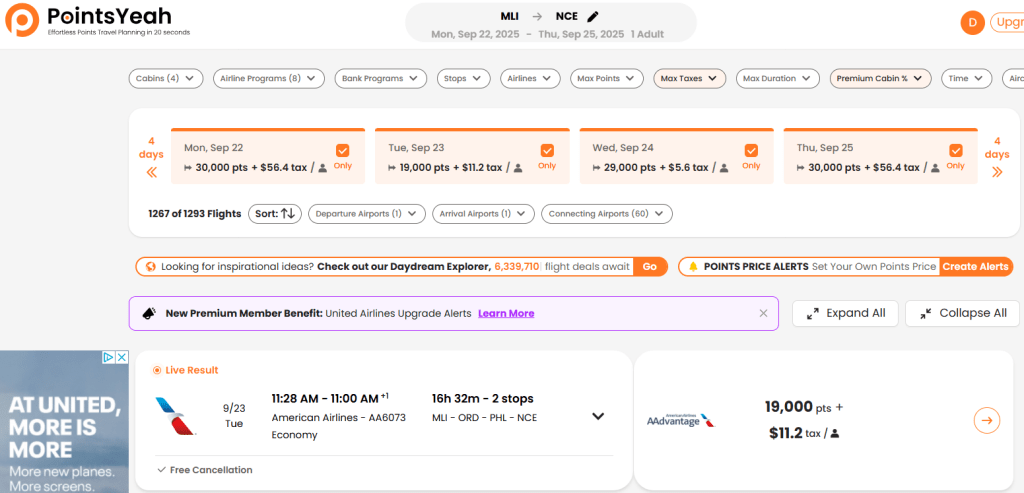
If I see that any of the major American carriers have a cheap flight from Chicago, I instantly change it to MLI, just to see if they also have a cheap flight to the Quad City Airport. Sure enough, American tacked on an extra leg and it was still 19,000 points and $11 in taxes. I immediately jumped on that.

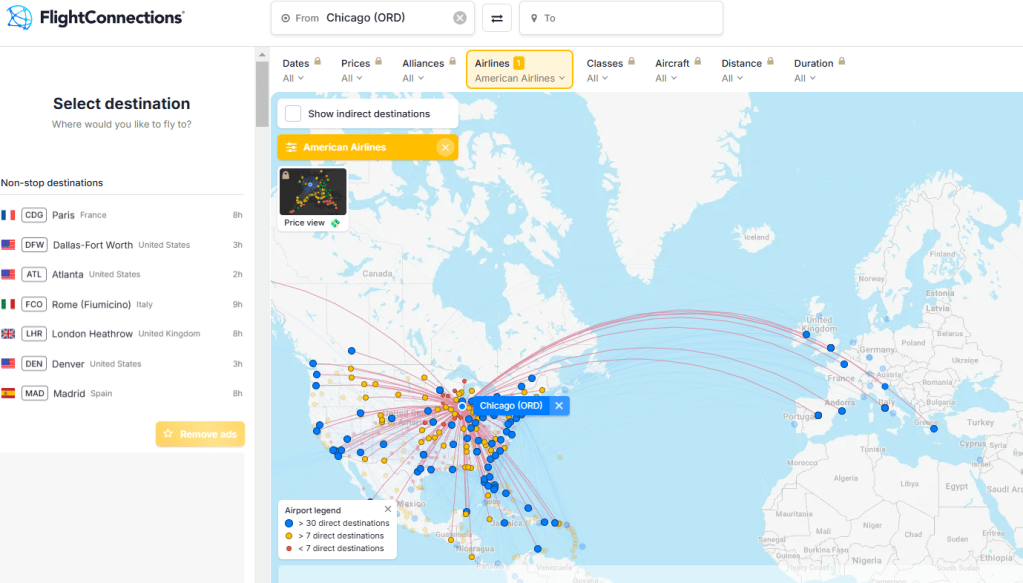
Flying home, the best I could find was again an American Airlines flight from NCE to MLI for 30,000 points and $130 in taxes and fuel surcharges. Honestly, that’s not bad, but I decided to look around a little bit. I went on Flight Connections and filtered down to see where American Airlines flew directly from Europe to Chicago, knowing that there are multiple flights from Chicago to MLI every day.

I then used PointsYeah to check each of these cities to MLI to see if American Airlines had any other great deals. I wound up finding a flight from Dublin to MLI for 19,000 American Airlines miles and $47. This of course means that we will have to get from Nice to Dublin, but Aer Lingus is available for 6,500 Aer Lingus Avios and $37 in taxes.

Why would we position ourselves to a different country just to fly home? Well, I always like a bargain, but this also means we can spend a day or two in Dublin. I love the idea of having a stopover like this, because it really gives you a quick sample of a city so that you can know whether or not you would like to return later. Honestly, I feel like being cheap can actually make your trips better.

What We Are Paying Vs Cash Flights

Once we book the flight with Aer Lingus, which I’ll book for 6,500 Amex Membership Rewards points transferred to Aer Lingus Avios and $37 in taxes, we will have essentially booked the entire trip for 38,000 AAdvantage miles, 6,500 Membership Rewards points and $95 in fees for each ticket.

Booking the American Airlines portion of the flights with cash would have cost $1,091 if we booked it as a multi-city flight with an open jaw (a flight itinerary where you fly back from a different city from where you landed). The cost of the Aer Lingus flight was $162 for a one way flight from Nice to Dublin. Together, the itinerary was $1,253 booking with cash. That means we got a value of 2.6 cents per point for our award flights. Considering The Points Guy values American Airlines miles at 1.65 cents per point and Amex Membership Rewards points at 2 cents per point, I’d say we did pretty well on that redemption.

Creativity and Thrift Wins Again

When we first started travel hacking, we didn’t have a lot of points to throw around for our trips. On our first trip to Europe, we had to fly back from Stockholm because that was the only flight we had enough points to book, even though we were going to be in Italy. We ended up having to book a separate flight from Rome to Stockholm to make it work. It turned out to be great though, because we got to experience Sweden for a few days. It taught me that thinking outside of the box can allow you to enhance your trips while essentially being cheap.

This time we had the points to fly back directly from Nice, but by being creative with how we booked our flights, it allowed us to retain more of our valuable American Airlines miles and we were able to tack on a side quest to Ireland. Enhancing our trip while getting great value is a win win, even though after running the 50K, I probably won’t be able to walk by the time we get to Dublin.

Transferring Amex Membership Rewards Points to Alaska Airlines

Recently, I transferred 18,000 American Express Membership Rewards points to Hawaiian Airlines, then transferred them from Hawaiian Airlines to Alaska Airlines to book a round trip positioning flight on American Airlines for my wife Jenn and I. To anyone other than a hardcore travel hacker that seems insane. Yet, to hackers, that sounds like a normal rational decision.

This process was actually rather easy, but there is a lot to unpack in that sentence. Doing this has only really been possible for a few days, and for me it is the result of learning a lot about travel hacking over the course of the last few years. A recent merger between Alaska Airlines and Hawaiian Airlines is the reason why this is suddenly possible.

What is a Positioning Flight?

A few months ago, we booked a trip to Italy using Flying Blue miles to fly KLM to Rome from Chicago and we booked United Airlines to fly back to Chicago from Rome. The problem is that we live 3 hours away from Chicago O’Hare Airport. The reason why we booked it out of Chicago is that the flights were much cheaper than out of our home airport, Quad Cities International.

A one-way ticket from Chicago to Rome was 20,000 Flying Blue miles and $122, but if you tack on the Quad Cities to Chicago leg, it becomes 53,000 Flying Blue miles and $127. It seems insane that from Chicago to Rome was 20,000 Flying Blue miles but adding the leg from Moline to Chicago was 33,000 miles. I’m not doing that.

We were okay with driving to O’Hare, but we didn’t want to. Instead we (originally) used American Airlines miles to book a separate flight from the Quad Cities to Chicago that would save us the drive. Those flights were 7,500 American Airlines miles per passenger each way, or a total of 30,000 American Airlines miles. This is called a positioning flight because we had a separate booking to position us to the airport we wanted to fly out of.

What is a Transfer Partner?

Transfer partners are basically what makes the points in banks’ reward programs so powerful. The reason why people covet Amex Membership Reward points or Chase Ultimate Reward points is that they can be transferred to various airline and hotel programs. Having transferable points lets you keep your points flexible while you’re earning them and then choose the best way to use them when you are redeeming those points.

American Express Membership Rewards have a number of transfer partners. One of those transfer partners is Hawaiian Airlines. You can transfer your Membership Rewards points to Hawaiian Airlines at a rate of 1:1 with a minimum of 1000 points transferred. American Express does charge an excise tax of 60 cents per 1000 points transferred.

OK, But you Booked with Alaska Airlines Not Hawaiian Airlines

Alaska Airlines has been an amazing program for a long time. According to their website, they partner with 31 different airlines. You can redeem Alaska miles for flights on many of them, when they are available. There have been several times that I’ve used Pointsyeah.com to find the best award flight, and Alaska has had the best price.

The problem with Alaska Airlines was that it was hard to amass a lot of miles in their program. There are only a couple of credit cards issued by Alaska, and the signup bonuses are lackluster. They also, until recently, haven’t had any transfer partners. They did, recently, sign a deal with Bilt Rewards to be a transfer partner, but Bilt doesn’t have signup bonuses so amassing a stash of Bilt Rewards points can be difficult.

Nevertheless, when Alaska Airlines and Hawaiian Airlines agreed to a merger, they made an agreement to allow transfers between the two programs. This opened up a back door to move points from American Express Membership Rewards to Alaska miles through Hawaiian. This is fantastic, because amassing a large number of American Express Membership Rewards points is not difficult.

Exact Flights, Different Prices

One of the most consistently baffling things to me about points and miles is the fact that sometimes the same flight is being offered by different programs at different prices. In this case, we had an American Airlines flight booked with American Airlines miles leaving on a Sunday night and returning on a Sunday night. Using American Airlines miles it was 30,000 AA miles and around $22 in taxes for the two of us.

When we originally booked with American Airlines, I saw that Alaska had the same flights for 4,500 points and around $18 per person per flight, so in other words, 18,000 Alaska miles and around $72 in taxes and fees. At the time, I didn’t have access to Alaska miles.

When the backdoor transfer option from American Express to Alaska Airlines materialized, I checked to see if that was still available and it was so I jumped on it. American Airlines has free cancellations, so it wasn’t a difficult to have my points and fees returned.

Saving American Airlines Miles

One big reason that we changed how we booked this flight was being able to use something other than American Airlines miles. American Airlines doesn’t have any transfer partners and lately it seems like whenever I’m comparing prices on award flights American Airlines always has competitive pricing. I didn’t want to use AA miles that I find so valuable if I don’t need to.

Also, earning 30,000 AA miles using just credit card spend requires a lot of spending. If we did it using the Barclays Aviator Red card, all purchases except American Airlines purchases earn 1 point per dollar spent. That means I would have to spend $30,000 on that credit card to earn 30,000 points.

On the other hand, I transferred 18,000 American Express Membership rewards points to Alaska and those are much easier to earn. When I buy groceries or dine out using my American Express Gold Card, I earn 4 Membership Rewards points per dollar spent on that card. That means I would only need to spend $4,500 on that Amex Gold Card, assuming I only use it for groceries and dining out, to earn the 18,000 miles necessary to book the flight. That’s a huge difference! Yes, the Alaska flights cost an extra $50 in fees but I was happy to spend that to keep those 30,000 AA miles.

Will This Back Door Transfer Option Remain?

It is unclear at this point whether transferring American Express Membership Rewards points through Hawaiian to Alaskan Airlines will remain an option. We know that transferring points between Hawaiian Airlines and Alaskan Airlines will be around for the foreseeable future. This has created a lot of interest in the travel hacking community for Hawaiian Airlines credit cards.

In the past, most travel hackers weren’t very interested in Hawaiian Airlines credit cards. Hawaiian miles weren’t worth a whole lot and because of that, the credit cards weren’t interesting. In fact, the Points Guy used to value Hawaiian miles at .9 cents per point and Alaskan miles at 1.5 cents per point. Moving 100,000 Hawaiian miles to Alaska Airlines increases their value, according to these valuations, by $600. That’s a big deal.

The problem for American Express is that now this throws their agreement with Hawaiian out of balance. If Hawaiian miles are suddenly worth more, will Hawaiian Airlines/Alaska Airlines demand more money to sell those miles to American Express? I don’t know, and there has been a lot of speculation in the travel hacking community that this transfer agreement could end.

The potential end of this agreement has me tempted to move some Membership Rewards to Alaska, but I don’t really have enough to just move them without a flight in mind. Instead, I think I’ll just wait and hope that Membership Rewards continues to allow transfers to Hawaiian Airlines. That being said, I might just be looking at a Hawaiian Airlines credit card soon. It’s never a bad idea to take advantage of a great deal when it pops up.

Last Call for the American Airlines Aviator Red card?

Last week an article by CNBC indicated that Citigroup was in heavy negotiations with American Airlines to be the exclusive card issuer for American Airlines credit cards. These negotiations are immensely important for American Airlines because the revenue that comes from airline loyalty programs are now a huge portion of their income. It’s become so important, in fact, that it’s sometimes joked that airlines are credit card companies that fly planes. According to Delta CEO Ed Bastian, nearly 1% of the entire US economy is charged to Delta credit cards. The revenue from selling loyalty points to banks is a multi-billion dollar industry for airlines, and its a revenue stream they take very seriously.

American Airlines is in a strange situation because they have cobranded credit cards issued by two different banks. There are four credit cards issued by Citigroup which include three personal credit cards and one business card. Barclays technically has two personal American Airlines cards, but one is only available through upgrade, the AAdvantage Aviator Silver. The only Barclays American Airlines card with a current sign up bonus is the AAdvantage Aviator Red.

The fact that American Airlines has two banks issuing their credit cards is because of an American Airlines merger with US Airways over a decade ago. US Airways had a relationship with Barclays and after the merger US Airways credit cards issued by Barclays became American Airlines cards. American Airlines kept that relationship going, even as people began to forget about US Airways.

It makes sense for American Airlines and Citigroup to form an exclusive relationship. It would make the AAdvantage program more straightforward by reducing the complexity of having multiple card issuers. In the end, I think it’s highly likely that American Airlines will end their relationship with Barclays and form an exclusive relationship with Citigroup.

AAdvantage Aviator Red Card

If Barclays is going to get dropped from the AAdvantage program, it’s safe to say the Barclays AAdvantage Aviator Red card is going to go away. In some respects, good riddance, it’s not a very interesting card. It earns 2 miles per dollar spent on American Airlines purchases and 1 mile on everything else. You do get a free checked bag and preferred boarding but the annual fee is $99.

The thing that does make it interesting is that the signup bonus is incredibly easy to earn. Right now, there is a 70,000 mile signup bonus available through Frequent Miler’s website. What is the spending requirement? Signup and use it once. Literally, pay the $99 annual fee, activate the card and buy a pack of gum using the credit card and 70,000 AAdvantage miles are yours for the taking.

70,000 AAdvantage miles is a pretty decent haul. We took recently our family of four to Costa Rica from our small regional airport during Spring Break for a total of 120,000 AAdvantage miles and around $340 in taxes. Also, I have noticed, anecdotally, that flights out of smaller airports that are serviced by American Airlines don’t pay significantly higher amounts of points than flights out of larger airports. That it is definitely not the case for United Airlines, for example.

In addition, I’ve been eyeballing some deals to Portugal for spring break that are running around 22,500 AAdvantage miles one way per person. Having an extra 70,000 miles would top off our accounts enough to book the flights there, even though it wouldn’t be enough to get home.

Fear of Missing Out

I think that this is the last chance I have of taking advantage of one of the biggest no-brainers in points and miles. It’s legitimately buying 70,000 miles for $99. It’s not the best signup bonus the card has offered. Jenn got this card about a year ago when it offered 60,000 points for one charge and 15,000 for an authorized user and an additional charge to the authorized user card. However, it is definitely a solid deal, and waiting for a better deal at this point could mean that I miss out completely.

In the middle of writing this post, I actually did apply for this card and was approved. That’s fantastic and I will happily take my shiny new 70,000 miles from American Airlines. As a matter of fact, after I was approved, my daughter walked downstairs and I convinced her to apply for it as well and she was approved.

In all fairness, when I told her there was an annual fee she balked, but I told her if she would use her miles to pay for her ticket to Portugal, I would pay for her annual fee and she jumped on it.

Potentially Good News From the Exclusive Deal with Citigroup

Knowing that Barclays will likely be cut out of the American Airlines credit card business, it means that there will be less choices, and less available signup bonuses in the future. Still, it does raise the possibility of American Airlines becoming a transfer partner for Citi Thank You points.

American Airlines currently doesn’t have a transfer partner. Most major airlines have transfer partners, with Delta Airlines being a partner from American Express Membership Rewards points and United Airlines and Southwest Airlines being partners from Chase Ultimate Reward points. American Airlines was briefly a transfer partner of Citi Thank You points a few years ago, and was a transfer partner of Bilt Rewards very recently. A few months ago Bilt Rewards and American Airlines ended that partnership, and maybe that has to do with their negotiations with Citigroup.

With no current transfer partner, and with American Airlines negotiating a deal with Citigroup, there is a fairly good possibility that Citi Thank You points will become transferable to American Airlines. If that becomes a reality, I will definitely be attempting to earn more Citi Thank You points, because I find a lot of value in American Airlines miles.

In the end, I hope the changes that American Airlines makes to their credit card business with Citigroup works out to be beneficial to both them and their cardholders. Knowing how important that loyalty points are to the business of airlines puts a lot of pressure on them to have a good and profitable loyalty program. In the meantime, I need to figure out how I’m going to use these shiny new American Airlines miles.