Points Check September 2025

September was a fun month. We took a trip with our friends Bill and Theresa to Nice, France, to compete in the UTMB Nice Côte d’Azur ultramarathons. Obviously, that wasn’t the only reason we went there. We also took a day trip to Monaco and spent quite a lot of time walking the beautiful streets of the old town of Nice.
The Nice area is stunning with deep blue Mediterranean waters and marinas filled with massive yachts. This area is where the Alps meet the Mediterranean, creating amazing coastline views from hundreds of feet above the water. It’s simply beautiful.

Beaches along the Quai des Etats Unis taken from Colline du Chateau

We stayed in the old town of Nice, which is a tightly packed group of old buildings with restaurants and shops along narrow streets. It’s pretty touristy, but it’s also a very nice place to walk around. The old town is actually a fairly large area, which makes its winding, narrow streets easy to get lost in.

Nighttime on the narrow streets of Old Nice

We also spent a couple of days in Dublin on the way home. During our time in Dublin, we visited some classic Irish pubs and walked through Grafton Street and the Temple Bar district. We just happened to be there right after the Pittsburgh Steelers played the Minnesota Vikings in Dublin, so there were a ton of NFL fans and bars decorated to draw in those fans. It felt a little too much like being in the US.

The Norseman in the Temple Bar district decorated in Minnesota Vikings colors for the Dublin NFL game

My favorite stop in Dublin was the Jameson Distillery. I thought they did a fantastic job explaining the history of the distillery as well as the process of making their whiskey. They also, of course, had samples of their products to try along the tour.

No Real News

This may be hard to believe, but I’ve lost some of my desire to aggressively accumulate points through signup bonuses. Every new account adds complexity to what I need to keep track of, and I’m probably going to close a few accounts soon that have annual fees that we don’t use. Those were cards where the intention was to get the signup bonus and cancel them anyway.

The other reason why I haven’t been as aggressive is that we don’t have a ton of travel planned. We have a half-booked Spring Break trip to the Canary Islands, but we already have the points to book the rest of it. We thought we might take it a little easier next year, because our youngest child is going to be a Senior in high school and we don’t want to miss anything. We were hoping to do some camping next summer, but that doesn’t require any points and miles.

What that really means is that we’ll probably take advantage of great offers when they pop up so we can accumulate some points for later, but it will most likely be at a slower pace. Once Alex goes off to college, though, Jenn and I can finally take vacations whenever we want without worrying about missing anything. That sounds amazing!

On to the Point Check!

Most of our spending that isn’t devoted to a signup bonus looks pretty solid; the one exception to that is the spend on the Sapphire Preferred. However, I can explain. Those were charges that were done overseas, where bonus categories are not really a thing. The Sapphire Preferred is a pretty good card for foreign transactions, because it’s accepted just about anywhere (I’ve had issues using Amex in Europe) and it doesn’t have foreign transaction fees. Overall, it’s a good overseas choice, even if the points earned there aren’t great. Overall, we managed a return of 6.6% on that spending, and I’m happy with anything that is above 5%.

Card UsedSpendPoints EarnedPoint ValuePoints Per $Return on Spend
Amex Gold$9913,164$63.283.26.4%
Ink Cash$7163583$73.455.010.3%
Sapphire Preferred$522522$10.701.02.0%
Wyndham Business Earner$5133,063$33.696.06.6%
Total$2,74210,332$181.133.86.6%
This month’s spending not devoted to earning a signup bonus

The only card that we had where we were working toward a signup bonus was Jenn’s Citi AAdvantage Platinum card. Jenn spent just under $1,100 on that card, earning her a little over 1,700 American Airlines AAdvantage miles. She still has around $2,000 left to finish her spend to earn the 80,000 point signup bonus.

At the end of the months, we were left with:

  • 264,400 IHG Points
  • 239,600 Chase Ultimate Reward Points
  • 135,700 Amex Membership Rewards Points
  • 90,600 Wyndham Points
  • 79,100 Alaska Miles
  • 37,700 American Airlines Miles
  • 33,400 Marriott Bonvoy Points
  • 33,300 Citi Thank You Points
  • 16,700 United Miles
  • 9,300 Hyatt Points
  • 1,500 Delta Miles
  • $133 Cash Back

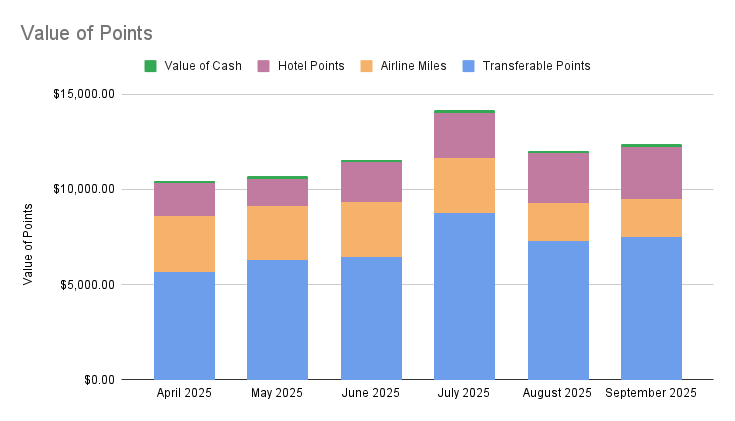
According to The Points Guy’s Valuations, the total of those points, miles, and cash back is worth around $12,400. That is up from last month’s total of $12,000. We need to book flights back from Tenerife and some hotel stays, but after that, we don’t have much to plan for, so I expect our point totals will grow a lot in the next 12 months or so.


Why I’ll Keep My Amex Gold But I won’t Recommend it

The American Express Gold Card is a classic American credit card. It was one of the first credit cards ever issued when it was launched in 1966. Back in the early days it was seen as a status symbol, using it was a symbol to people around you that you were successful. Now I think people view credit cards as mostly utilitarian and I am definitely one of those people. I need to know that the card that I’m using is providing me with great value, and if that isn’t the case, then I want to use something else.

The annual fee for a credit card is part of the equation for me. There are definitely some good credit cards that have no annual fee, but most of the time, cards that have high earning rates and good benefits have at least a $95 annual fee. On the travel hacking side, a credit card that earns points that can be transferred to multiple hotel and airline programs is the most important benefit to me.

The American Express Gold Card earns Ultimate Reward points that can be transferred to a variety of airline and hotel programs, of which some of my favorites are KLM/Air France Flying Blue, Aer Lingus/British Airways/Iberia Avios, Air Canada Aeroplan and Delta. Being able to transfer to a variety of programs allows you to take advantage of flash sales and sweet spots so that you can get the most for the points that you earn.

Many premium credit cards also have statement credits which people can use to offset the cost of an elevated annual fee. This is definitely the case with the Amex Gold and Platinum cards which come with elevated annual fees but offer a lot of available statement credits that can offset the annual fee.

The Gold Card Annual Fee Raised to $325

In July of 2024, American Express announced that it would raise it’s annual fee to $325 from $250. That’s a fairly large increase for a card that already had an elevated annual fee. If you’re going to charge a $325 annual fee, it better damn well be worth it.

The main attraction to the Amex Gold card for me is the fact that it earns 4x on groceries and 4x on dining. Those are two categories in which the average American spends a considerable amount of their income. The fact that those 4x categories are awarded in Ultimate Reward points, that many people value at 2 cents a point, means that you can realistically get back 8 cents per dollar spent, assuming you use those points for travel.

That being said, there is no way that the ability to earn 4x on groceries and dining is worth a $325 annual fee. You absolutely would need to get back some of this elevated annual fee in the form of statement credits.

Statement Credits offered by Amex Gold

Before the Amex Gold refresh there were two main statement credits that could be used to get some value for the (at that time) $250 annual fee. They were:

  • $10 per month Uber credit – can be used with Uber Eats or Uber
  • $10 per month dining credit with dining partners (which now are Grubhub, Goldbelly, Cheesecake Factory, Five Guys and Wine.com)

We have used both of those credits each month by picking up carryout using both Uber Eats and Grubhub. That meant that we were paying essentially $10 per year for the card, although it can be a little bit of a pain to use those credits, so that irritation has to be considered.

New benefits have been added to the card now that the annual fee has been raised to $325. The new benefits are:

  • $50 statement credit every 6 months when dining at Resy.com restaurants
  • $7 per month statement credit at Dunkin’.

I like the Resy.com statement credit because it’s going to be fairly easy to use. There is only one Resy.com restaurant in my hometown, which I would definitely go to, but with it being every six months I could see using it when we are traveling as well. I don’t think it’s going to be too much of a challenge for me to use this credit and it won’t feel like as much of a chore as using the $10 per month dining and uber credits.

The $7 monthly Dunkin’ credit is probably going to annoy me, but I will try to use it. Frankly, I don’t get coffee often and if I did, it probably wouldn’t be Dunkin’. We don’t even have a Dunkin’ anywhere close to where I live so I’d have to go out of my way for mediocre coffee or a donut. I have heard that you should be able to get a statement credit for loading the Dunkin’ app every month. So I might just load $7 to the Dunkin’ app and then if we’re out of town and need to get a quick breakfast we can use that all at once.

At full value, these credits are worth $424, which is $99 more than the $325 annual fee. Honestly, because of the ability to earn 4x on dining and 4x on groceries as well as being able to transfer those points, I’d probably pay $150 per year for the Amex Gold if it didn’t have any credits. So as far as I’m concerned, If I feel like I can get $175 dollar value for the $424 dollars in statement credits, than the card is worth it – at least for me.

Why I Won’t Recommend it

I used to think that the Amex Gold card was a great card for people who were only going to use one credit card, because they would be able to amass a decent amount of points through those 4x categories. Unfortunately, at $325, someone who doesn’t spend that much time thinking about points and miles is probably going to be pretty repulsed by that price tag.

Sure, the card usually comes with a pretty impressive signup bonus and those 4x categories are great, but I don’t think it’s enough on their own to justify that $325 annual fee. What can make the card worthwhile is the statement credits, but if you aren’t going to use them then you’re just paying too much to accumulate points. If you’re not going to use those statement credits, you’d probably be better off with the Citi Strata Premier card which only has a $95 annual fee but earns 3x on gas, groceries and dining. Those come as Citi Thank You points which are also transferrable to a number of hotel and airline programs.

In other words, this is a card that frankly only really appeals to people who want to maximize the value of those cards. This is definitely not a card I would recommend to someone who casually wants to earn enough points to take one flight a year or get a couple of nights in a hotel for free. This is really just for the hardcore travel hacker who is going to squeeze every ounce of value out of these credits and maximize their point redemptions.

For me, the changes actually make me more likely to keep the card, since I’m pretty likely to use those credits. But, at the end of the day, I probably won’t be recommending the Amex Gold card to anyone going forward. The kind of people who can find good use for this credit card, probably already have it or already know about it. This to me feels like something that will eventually lose American Express business rather than gain them business. I just don’t think that a $325 annual fee credit card is going to have that kind of mass appeal and I’ll be interested to see if they end up regretting this decision.

Wells Fargo Launches Another Great Credit Card with Signify Business Cash

For years, Wells Fargo has been a boring bank for travel hackers. However, in the last year or so, Wells Fargo has been put the travel rewards industry on notice that they intend to compete for business in the points and miles space.

The difference is that they have added some transfer partners for their credit cards. This allows for users to redeem their rewards for value that is better than the normal cash back rate. They are also adding new credit cards to their lineup.

Why Choose the Signify Business Cash Card

There are 3 good reasons to choose the Signify Business Cash card:

  • $0 Annual Fee
  • 2% Cash Back
  • $500 Signup offer

These are all pretty boring reasons, but they are important if you are planning to maximize return on your spending. 2% cash back seems pretty boring in the points and miles world, but it’s important because it allows you to get at least 2% in categories where there are no bonus categories. This is especially true if you have a business that has to purchase supplies or parts.

Having a 2% base is especially nice if you can use a different card for purchases in other bonus categories. For example, if you also had the Wells Fargo Autograph card, you could earn 3% on gas, groceries, transit, streaming services, and phone plans. Simply pairing these two cards, could allow you to get 3% on a lot of your expenses while earning 2% on everything else.

Also, having no annual fee allows you to not use it when you want and not worry about getting the most out of the card. If you decide you want to put it aside while you work on a new credit card signup bonus, you’re not going to worry that you’re getting your money’s worth on an annual fee. In that way, a 2% card with no annual fee becomes a solid, dependable card that you can use when you want and shove it to the back of your wallet when you don’t need it.

$500 Signup Bonus

The Signify Business Cash card is currently offering a $500 signup bonus when you spend $5,000 in the first 3 months. That’s a very strong signup bonus for a card with no annual fee. The best comparison to this card, in my opinion is the American Express Blue Business Cash card that earns 2% cash back, has no annual fee and is offering a $250 statement credit on $3,000 in spending in 3 months.

It’s Not Just a Cash Back Card – There are Transfer Partners!

This is where things get a little in the weeds. By itself, the Signify Business Cash card is strictly a 2% cash back card. However, as Frequent Miler points out in their review of the Signify card, if you have either the Wells Fargo Autograph card or the Wells Fargo Autograph Journey card along with the Signify card, you can convert the cash back to Wells Fargo Reward points at 1 cent per point.

This allows you to access Wells Fargo Transfer partners, including:

  • Aer Lingus Avios
  • British Airways Avios
  • Iberia Avios
  • Qatar Privilege Avios
  • Air France Flying Blue
  • KLM Flying Blue
  • Avianca Lifemiles
  • Choice Privileges

Having these transfer partners means that you can take advantage of some of the great deals these programs have. For example, if you wanted to fly round trip from Chicago to Madrid in March 2025, the cost of that flight, in economy, using Avios, is 34,000 Avios and $228.70 (that’s not a flash sale – it’s normal off-peak pricing using Iberia Avios). In terms of the Signify card, that is essentially $340 in cash back transferred to Wells Fargo Rewards points then to Iberia Avios and $228.70. So essentially for $568.70 in cash back, you can fly to Madrid and back. That’s a really good deal, especially if you factor in the $500 signup bonus.

These transfer partners make the Wells Fargo Signify card much stronger than just a 2% cash back card. The Points Guy values Wells Fargo Reward points at 1.6 cents per point, meaning if you use the cash back from the Signify card as points, you are really earning 3.2% back as travel rewards. That’s pretty good.

Wells Fargo Active Cash is the Personal Version of Signify Cash

The Wells Fargo Active Cash card is essentially the same thing as the Signify Cash card, except that it’s a personal card. It is a 2% cash back everywhere card with no annual fee. Like the Signify card you can pool your rewards together with an Autograph or Autograph Journey Card and accumulate all of the rewards as Wells Fargo Reward points and transfer those points to their transfer partners.

The main differences here is that the Active Cash is a personal card and that the signup bonus is much lower ($200 for spending $500 in 3 months)

I expect this to Get Even Better Over Time

The transfer partners that Wells Fargo have chosen to work with initially are really good choices, but it’s a pretty limited list. Flying Blue, Avios, and Avianca Lifemiles are all really good programs that cover a lot of needs for travelers on points and miles. However, that’s a pretty short list and I imagine that Wells Fargo is trying to add more transfer partners.

As I pointed out in a previous post when Wells Fargo announced they would have transfer partners, but before they announced who the partners would be, Wells Fargo is associated with the Bilt Card, and Bilt has probably the best list of transfer partners in the points and miles space. It took a while for Bilt to build out their impressive list of transfer partners, and if Wells Fargo follows suit, this could become a very valuable transferrable points currency.

There are a few, like Air Canada Aeroplan and Emirates Skyward, that I think would be pretty easy for them to add. Some others, such as Alaska Air or American Airlines, would be amazing but I wouldn’t count on it. I would also love to see them add Hyatt, but I don’t think they will, although I would expect them to add at least one more hotel chain.

Wells Fargo Rewards Keeps Getting Better

Anything that Wells Fargo can add to their transfer partner list at this point will make Wells Fargo Reward points more valuable, and by extension, Wells Fargo credit cards. The Wells Fargo Autograph and the Wells Fargo Autograph Journey are already cards that do a great job of earning points with some really strong bonus categories.

Wells Fargo seems intent on making some cards that really appeal to the points and miles community. It looks like they definitely want to start aggressively taking some business away from Chase, American Express, Capital One and Citibank. With that in mind, and the fact that they’ve been offering transfer partners for less than a year, I expect that Wells Fargo will add new credit card offerings, and new transfer partners over time. This is absolutely a bank to keep your eyes on.