We had a short amount of time to spend in Dublin. We were using Dublin as a stopover on our way home from Nice, and that meant we had a full day and an additional evening to soak up everything we could. Our friends, Bill and Theresa were on this trip with us, where we participated in the UTMB Nice Côte d’Azur ultramarathons. The result of our races meant that both Bill and I were injured and hobbling around town.
Normally, I’m the trip planner, suggesting bars, restaurants, museums, and activities, but this time I deferred to Jenn. She had been to Dublin for three days on a girls’ trip earlier in the year, and she was in a much better position to guide our visit.
As soon as we had checked into our hotel, we were hungry and needed to go get a bite to eat. Jenn was excited about taking us to a couple of old taverns in Dublin, so we went to the Brazen Head, a classic Irish pub, founded in 1198.
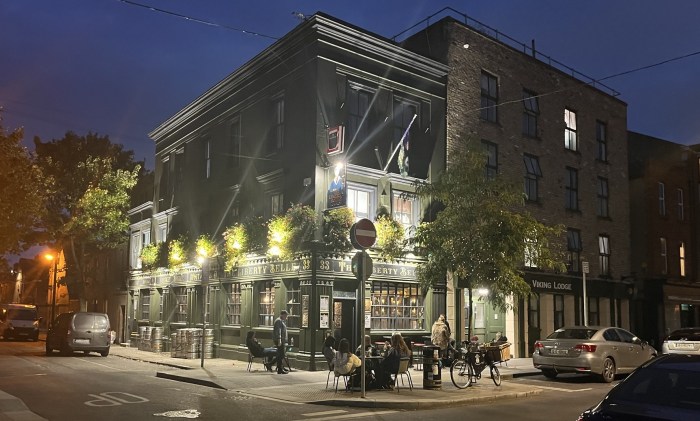
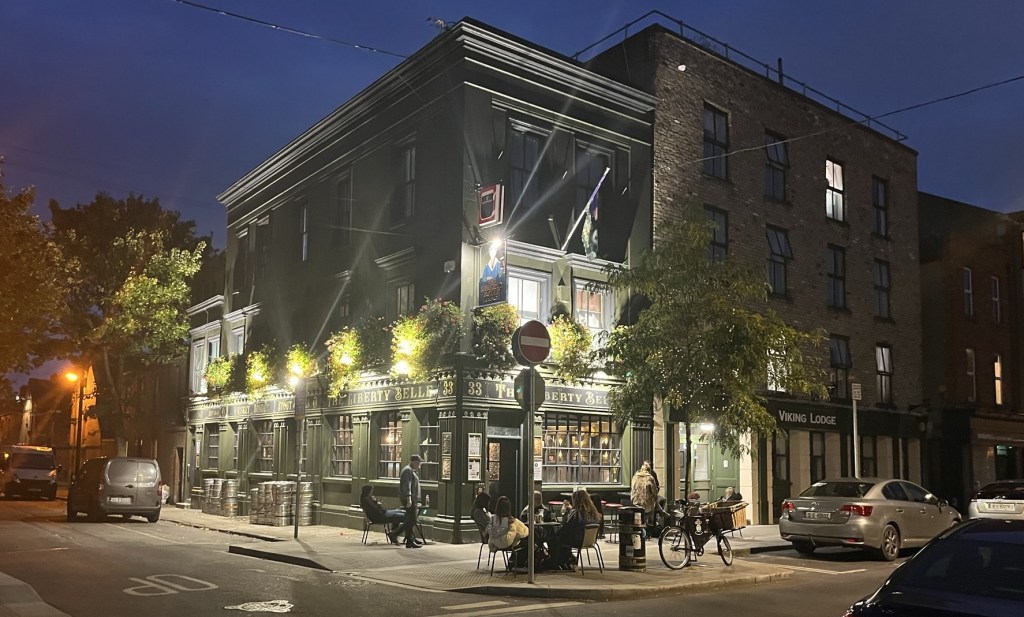
The Liberty Belle, along our walk to the Brazen Head
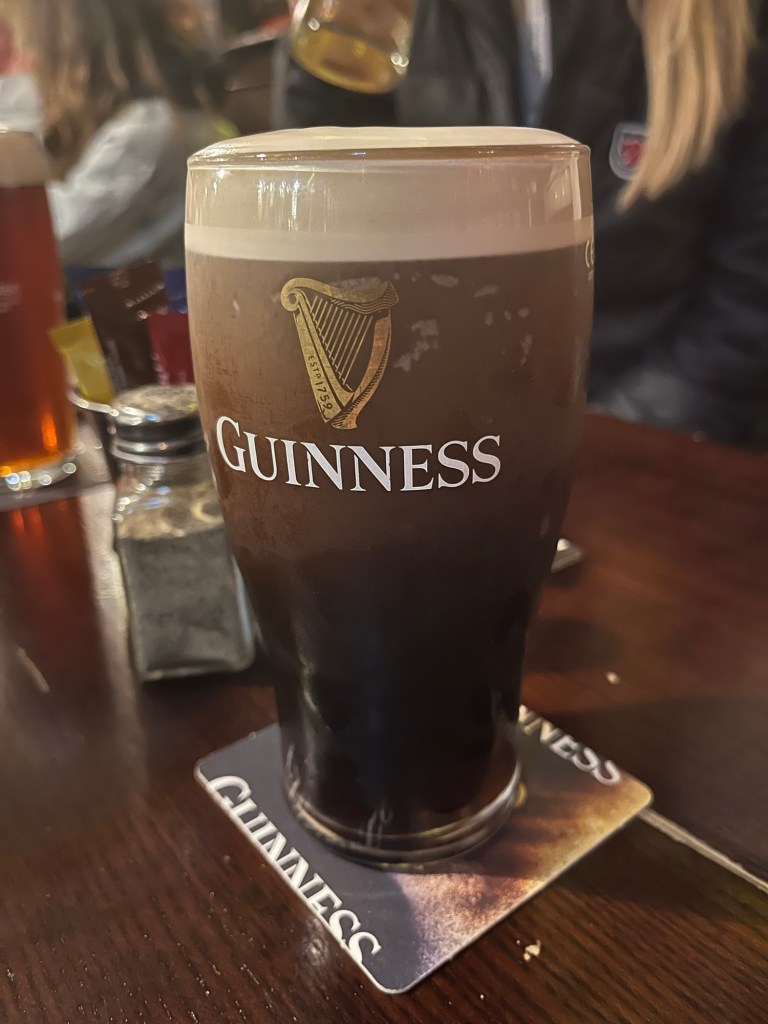
There was a line stretching out into the street, but the service was efficient, and the line moved quickly. It didn’t take too long before sitting at an old wooden table in a crowded bar, ordering our first real Irish ales. A few minutes later, I was enjoying a properly poured Guinness while Jenn and Bill were both drinking Smithwick’s red ales. It was great to have a beer with a little malt backbone after spending the last few days in France drinking light Italian and French pilsners. It wasn’t too long before they delivered me a plate of fish and chips, which really hit the spot.
There isn’t many things more beautiful that watching a Guinness settle
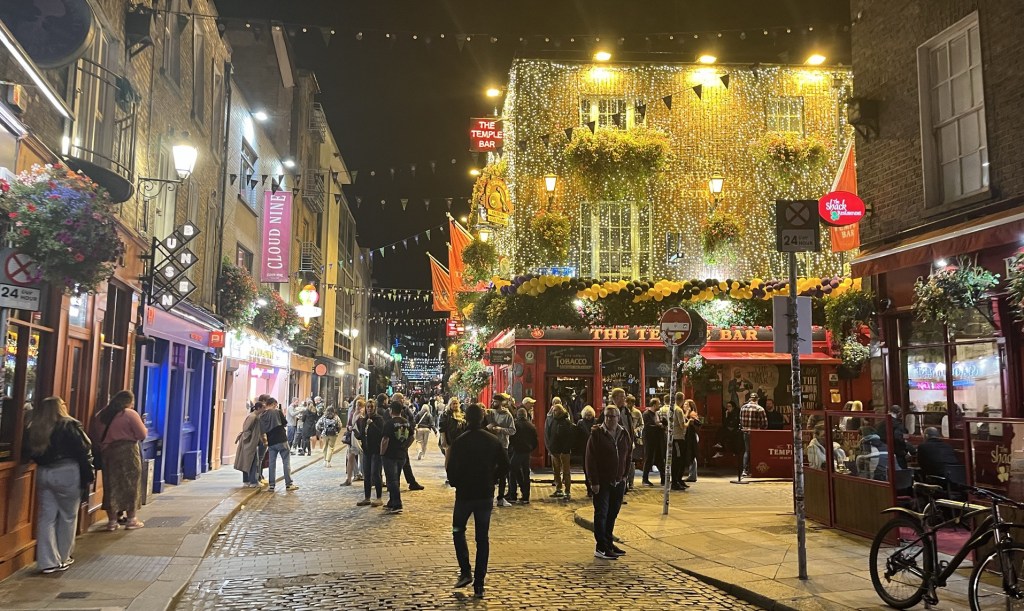
After our trip to the Brazen Head, we walked down to the Temple Bar District. For it being fairly early in the evening, we certainly ran across enough people who were already overserved. That is the general reputation of the Temple Bar District, a place for overindulging. After wandering around the district for a while, we tucked into the Old Storehouse to grab a drink and listen to a little music.
The Temple Bar District
The bar was packed, standing room only, and not much room for standing either. The bar itself is another classic Irish pub with a long wood bar, tons of wainscoting, and every inch of the wall above the wainscoting covered in framed pictures. We grabbed some pints of ale and then walked outside to enjoy our beer. The weather was cool but comfortable, and outside we were able to enjoy the music at a reasonable volume.
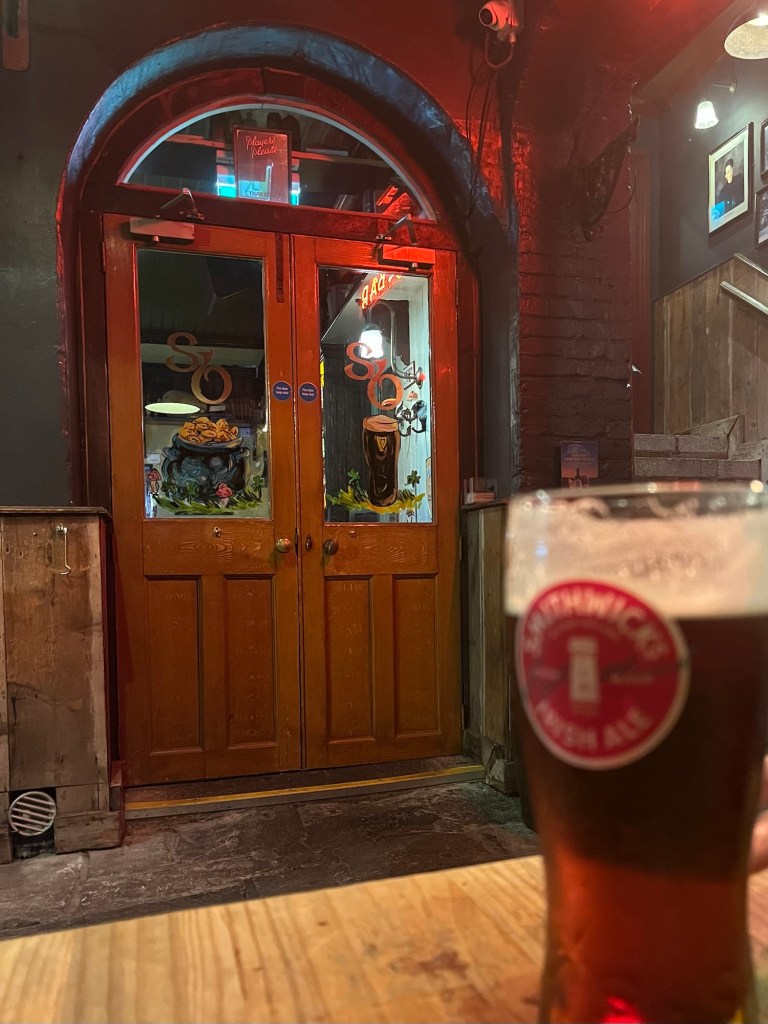
Enjoying a Smithwick’s Red Ale outside at the Old Storehouse
We enjoyed our drinks, then headed back to the hotel to get a good night’s sleep so we could get ready for the day ahead.
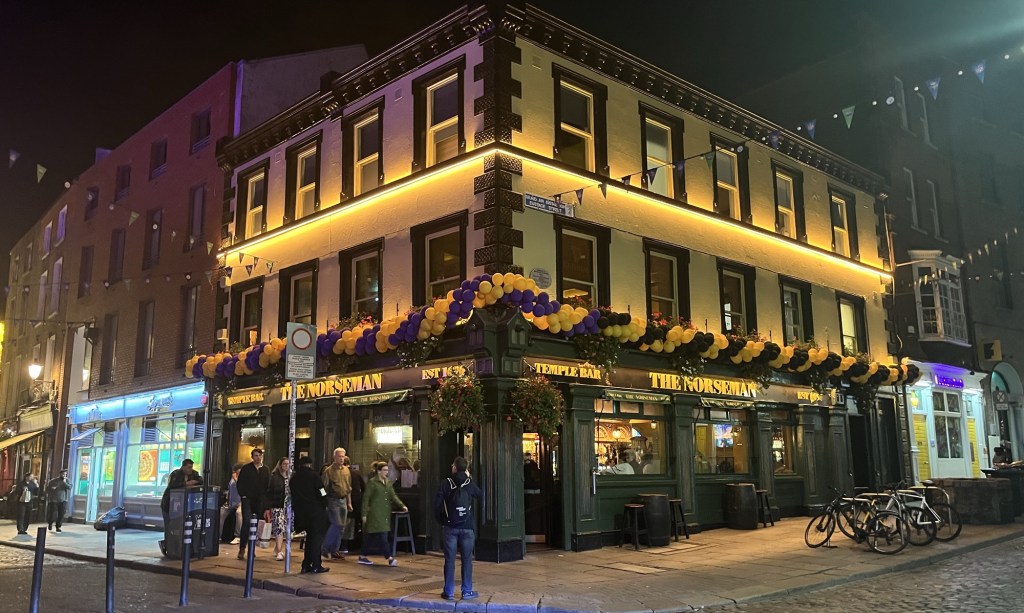
Many bars had decorated with balloons to attract NFL fans who were in town. The Norseman couldn’t decide between the Vikings and the Steelers, so they decorated with both.
The next morning, we woke up and grabbed a light breakfast and a cappuccino from a little coffee shop called Two Pups, less than a block away from the Hyatt Centric, where we were staying. It was a quaint cafe with warm hosts and delicious food. The Irish are much friendlier than the French, and after several days in Nice, being treated so well by the staff felt like a warm hug.
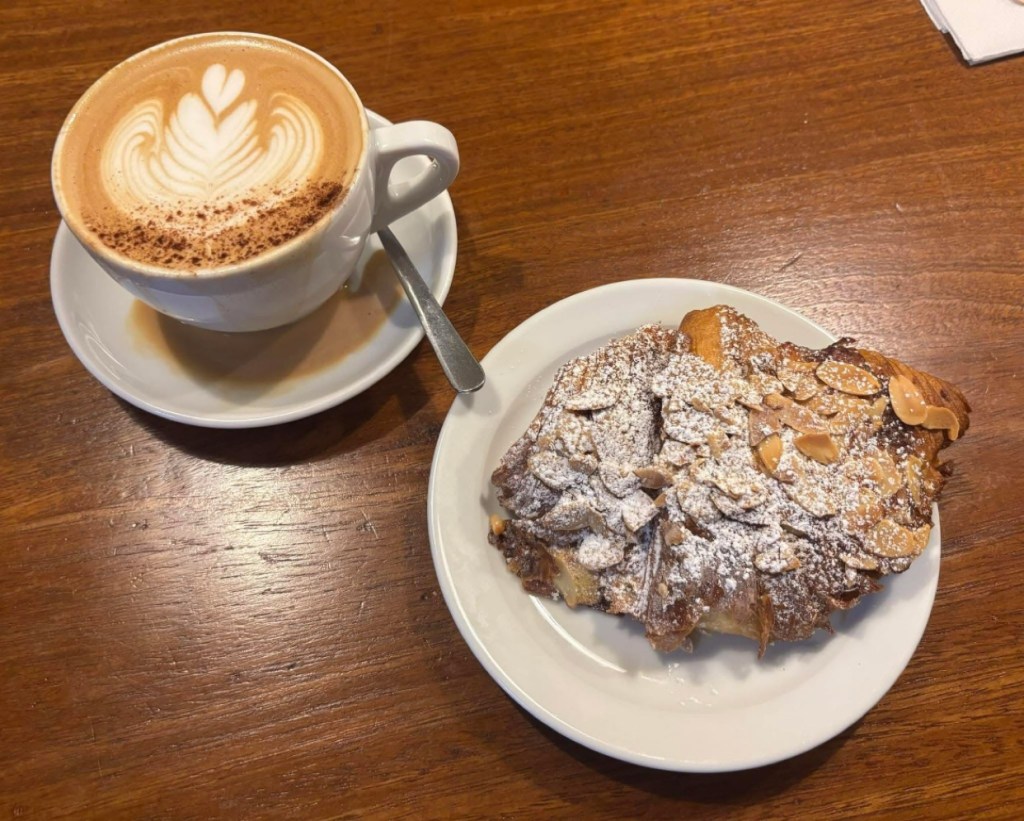
Pastry and Cappuccino from Two Pups
Following breakfast, we headed over to the Jameson Distillery to do a tour of the facility. It was 10 AM, which seemed a little early for a distillery tour, but hey, we’re on vacation, right? The tour was wonderful, very informative, and came with samples of various Jameson products. I really enjoyed the tour, probably more than I should have, because Jenn was sliding me her samples too.
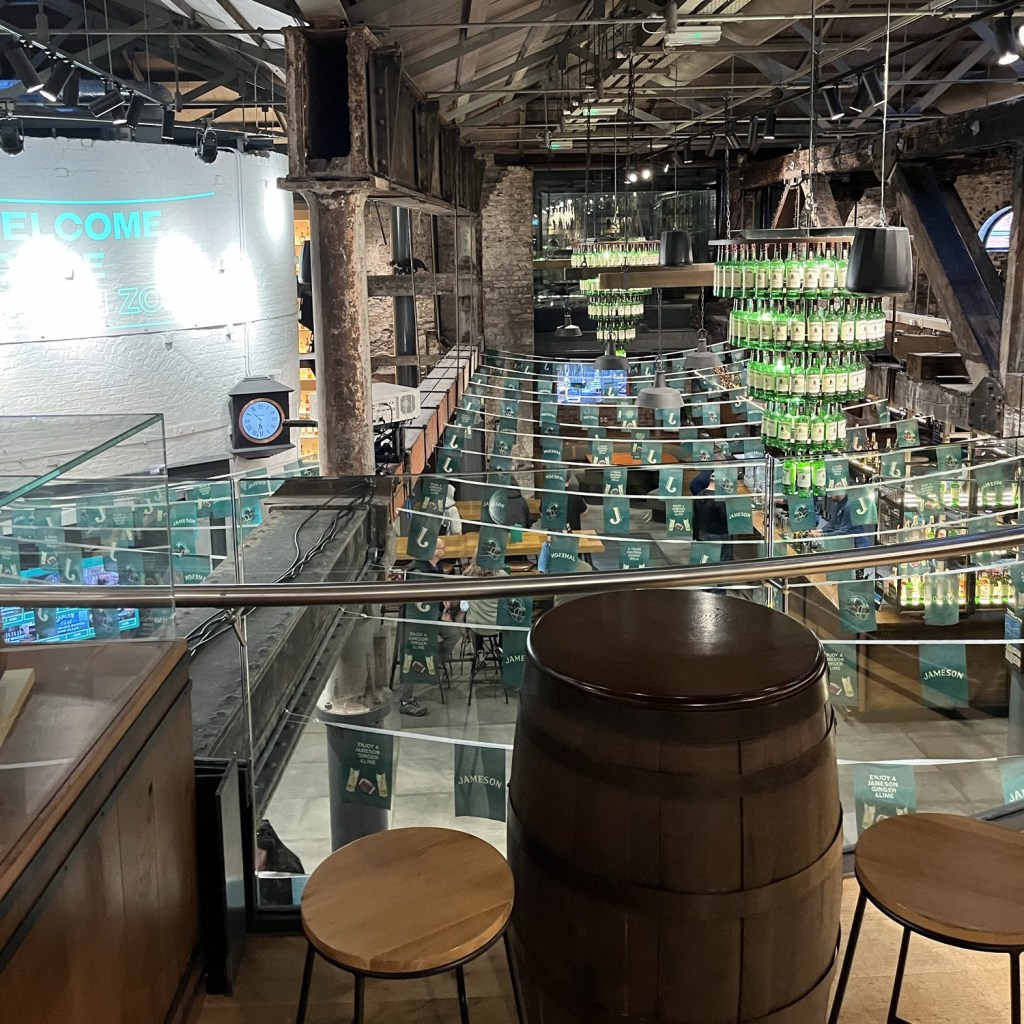
Second floor at Jameson Distillery
Following the distillery tour, we started walking toward Trinity College. However, after a kilometer, we were feeling like we needed to stop for another drink, so we ended up stopping for a pint at Trinity Bar and Venue, where I had a nice glass of Murphy’s Stout. I know, we had just left the distillery, but in our defense, Bill and I were limping pretty bad, so it did take a while to get there.
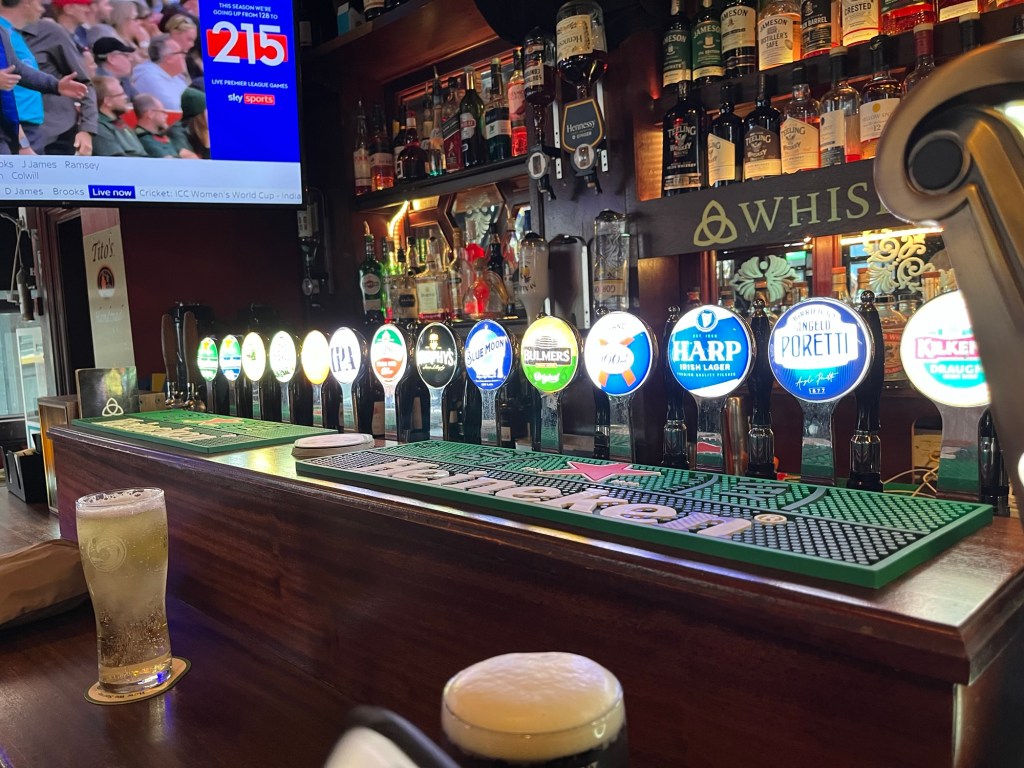
Tap selection at Trinity Bar and Venue
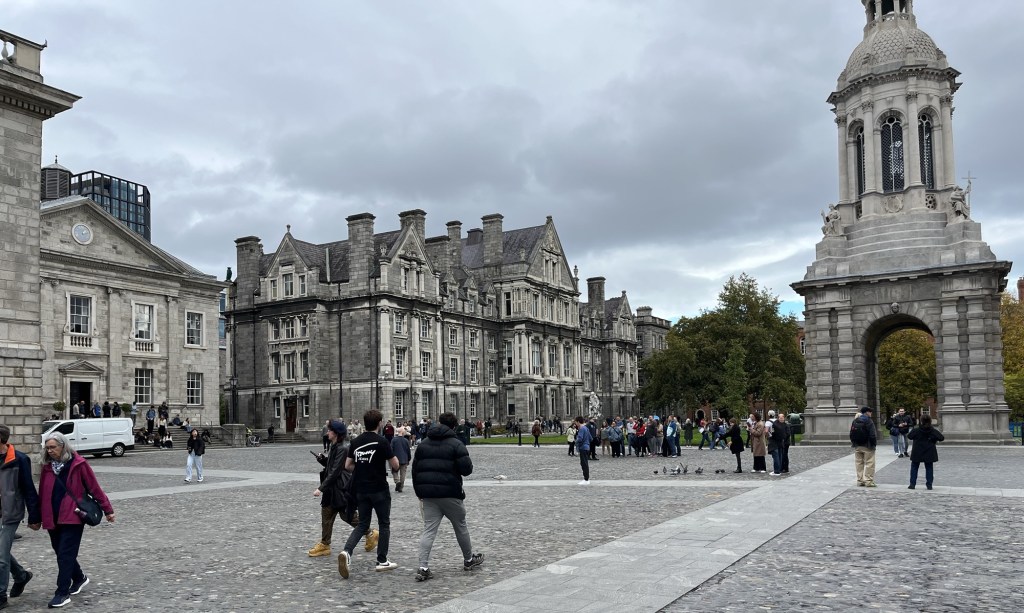
After the pint, we walked into Trinity College. It would have been nice to see the Long Room at the Old Library, but Jenn had been there just been there a few months earlier, and ongoing maintenance on the Library had affected the experience. They had removed a lot of the books as part of the project so I think I’ll try to return when the shelves are full again.
Old Stone Buildings at Trinity College
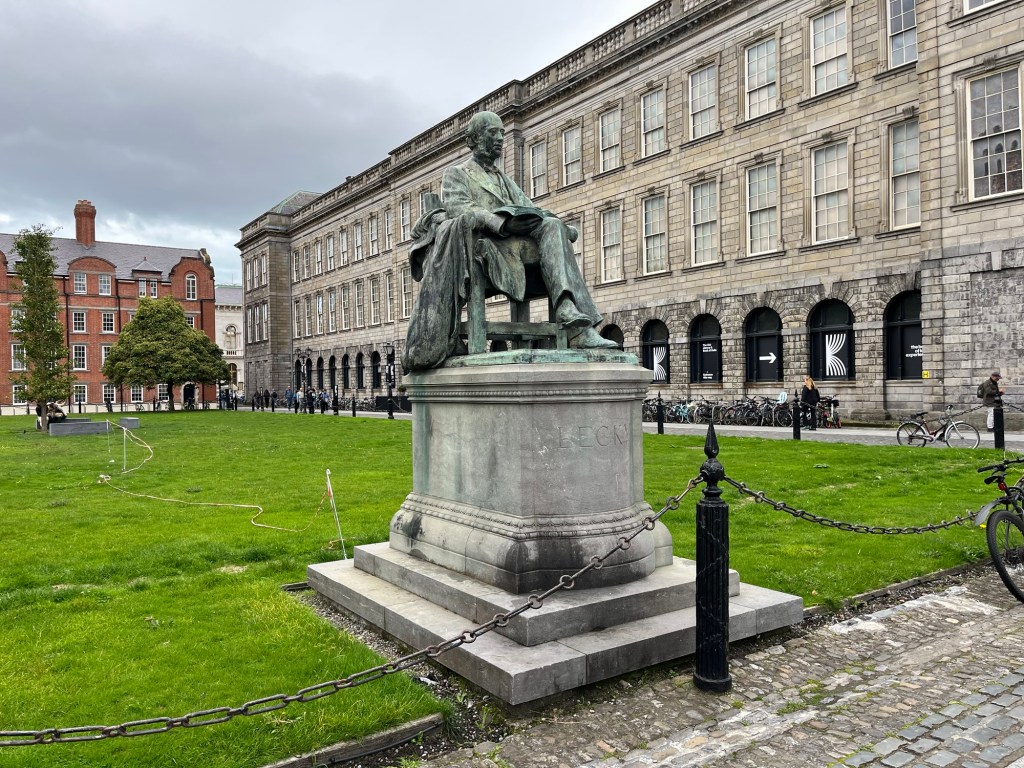
Trinity College itself is a beautiful campus with ancient stone buildings, cobblestone plazas, and copper statues. It’s a calm and beautiful place to visit, and I can only imagine what a privilege it is for the students to study there.
Statue of William Hartpole Lecky at Trinity College
After Trinity College, we walked down to Grafton Street, where we walked around looking at shops. The area was packed, which surprised me for a Tuesday afternoon. There were buskers playing music and singing, spread out strategically to not interfere with each other. It is a very nice area; however, for the most part, it was the most modern of the areas that we had visited so far, and I was enjoying the old buildings throughout Dublin.
We found a pub and stopped in for lunch, where I had another pint and some bangers and mash. After lunch, we left Grafton Street and headed back towards the hotel.
Bangers and Mash
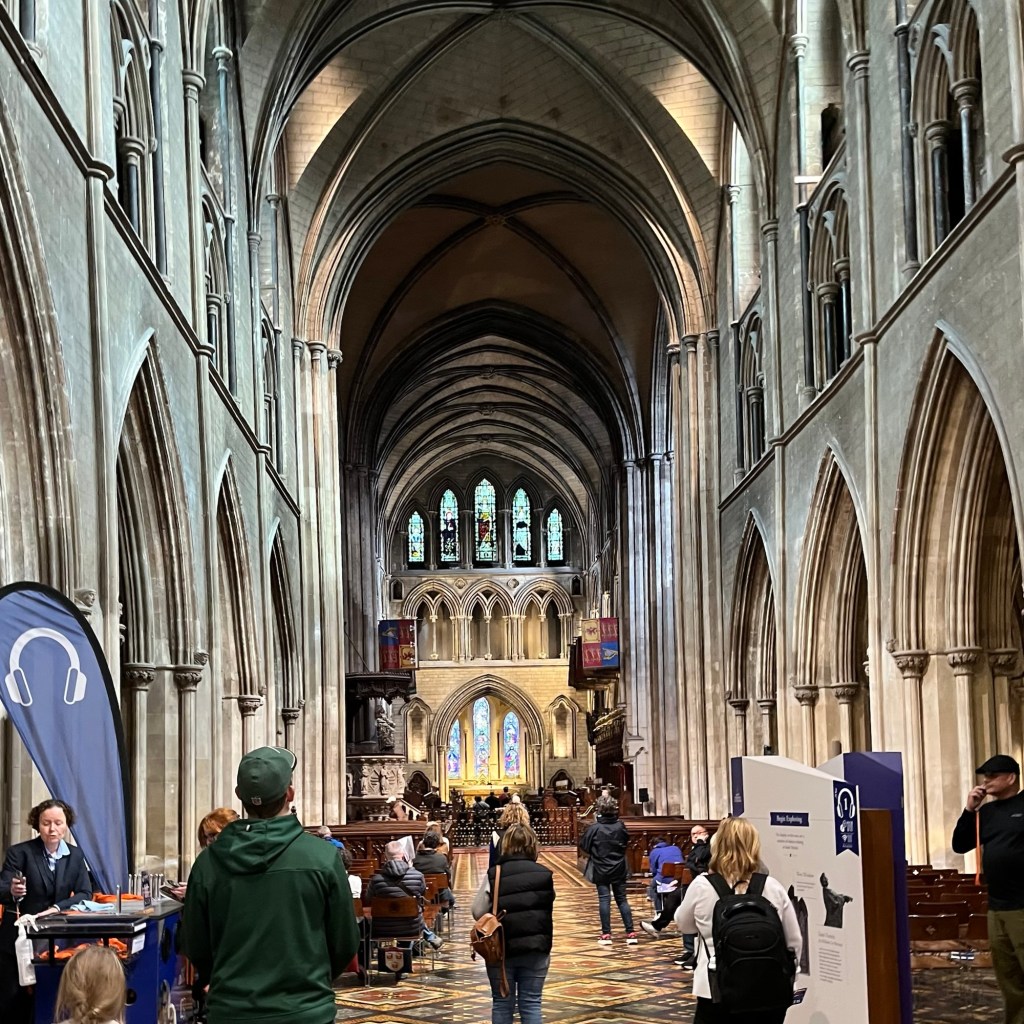
St. Patrick’s Cathedral was on the way back to the hotel, and we decided to stop in. I’m always in awe of the amazing churches and cathedrals in Europe. St. Patrick’s Cathedral did not disappoint. It was founded in 1191, and like most cathedrals of the era, took more than a generation to complete. It was completed in 1270.
St Patrick’s Cathedral
St. Patrick’s Cathedral is a classic Gothic cathedral, characterized by its pointed arches and ribbed vaults. It features some amazing stained glass windows and statues, as well as ancient flags hanging from the walls. Many important people were buried here as well, including Jonathan Swift, most famous for being the author of many great works, including Gulliver’s Travels.
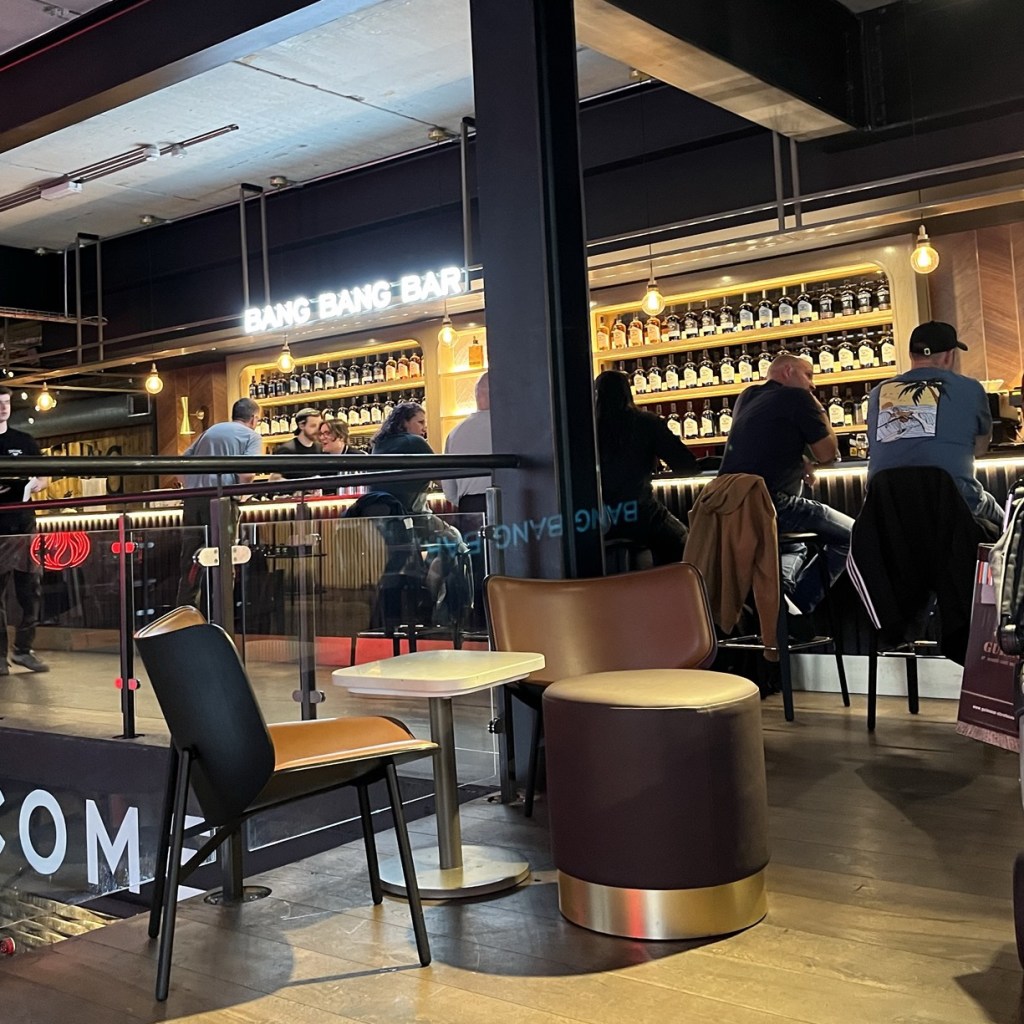
The bar at Teeling Distillery
Of course, we couldn’t attend an Irish cathedral without following that up with a trip to another distillery, so following St. Patrick’s, we walked over to Teeling Distillery. The Teeling Distillery is a beautiful and modern-looking distillery with a really nice bar. We sat down and had a couple drinks, some of us drinking whiskey and others mixed drinks. I went for the cheaper whiskeys on the menu and was a little disappointed, but everyone else was happy with their drinks.
After our drinks, we finished the evening at Darkey Kelly’s, a traditional Irish tavern with live music. It was suggested by the clerk at our hotel. The food was good, but it was so busy that we had to sit outside, where it was raining a little. We were under an awning, but the air was cold and moist, which did make things a little uncomfortable. We had dinner and a couple of red ales, enjoying our last night on vacation before the long flight home.
Outside at Darkey Kelly’s
We were only in Dublin for a day and a half, and what is amazing is just how much we were able to enjoy in a short amount of time. Dublin is full of history, old buildings, and especially distilleries and pubs. It’s also quite dense, meaning we were able to see quite a bit, even though we weren’t able to walk very well. We had a great time in Dublin, and I can’t wait to go back – only next time I will spend a little more time there.
I’ve never been comfortable with wealth. If you catch me in a pair of Brooks running shoes, I feel like I have to explain that I got them on sale. It’s the Midwestern in me; if you own anything nice, you have to explain to everyone who notices it that you’re not rich, you just got a great deal. Hell, this entire blog is practically an apology for taking fancy trips. “Oh sure, Margaret, we went to France, but I had coupons, doncha know.”
Monaco is the opposite of Midwestern frugality. People come to Monaco to flaunt their wealth. They pull into the marina in multimillion-dollar yachts and unload their multimillion-dollar sports cars to drive around town. Designer clothes and expensive jewelry are standard.
Monaco is an odd country. It is the second-smallest in the world, measuring less than one square mile. Its size, combined with its population of around 38,000, makes it the most densely populated country in the world. It is also extremely wealthy, with its GDP per capita of over $250,000 per year, around triple that of the United States.
There aren’t many places on earth where I feel more out of place than Monaco, but we decided to visit anyway. Since we were spending five days in Nice, which is only a 20-30 minute trip from Monaco, it would seem like a missed opportunity not to visit when we were nearby.
Despite my discomfort with wealth, I was looking forward to the visit. The country is undeniably beautiful. Port Hercule sits on the Mediterranean Sea, filled with numerous yachts, and the hills encircle it in a crescent shape, acting almost as an amphitheater, with the port at its center. To the east of Port Hercule is the Old Town area, where the Palace and the Cathedral are located. The hills to the north and west of Port Hercule are lined with beautiful, modern mid-rise condos where even the most basic condominiums sell for well into the millions of dollars.
White tents block the view of the Marina
We arrived from Nice by Uber, which turned out to be a great choice. The drive to Monaco is beautiful, crossing through the maritime Alps and then, at the end of the trip, following switchbacks perched over the Mediterranean as you descend from the Alps. There are also a lot of tunnels, as Monaco and France needed to fit modern infrastructure in pretty steep, rocky terrain. We were let out of the Uber right by the marina.
Unfortunately, we couldn’t see the marina because of a line of white tents blocking the view of the marina from the road. The reason, as we found out, was that the Monaco Yacht Show was happening. This is not an ordinary boat show. This is an exhibition of superyachts, and they certainly didn’t want people who couldn’t afford those boats to look at them because admission to the event was 725 Euros per day.
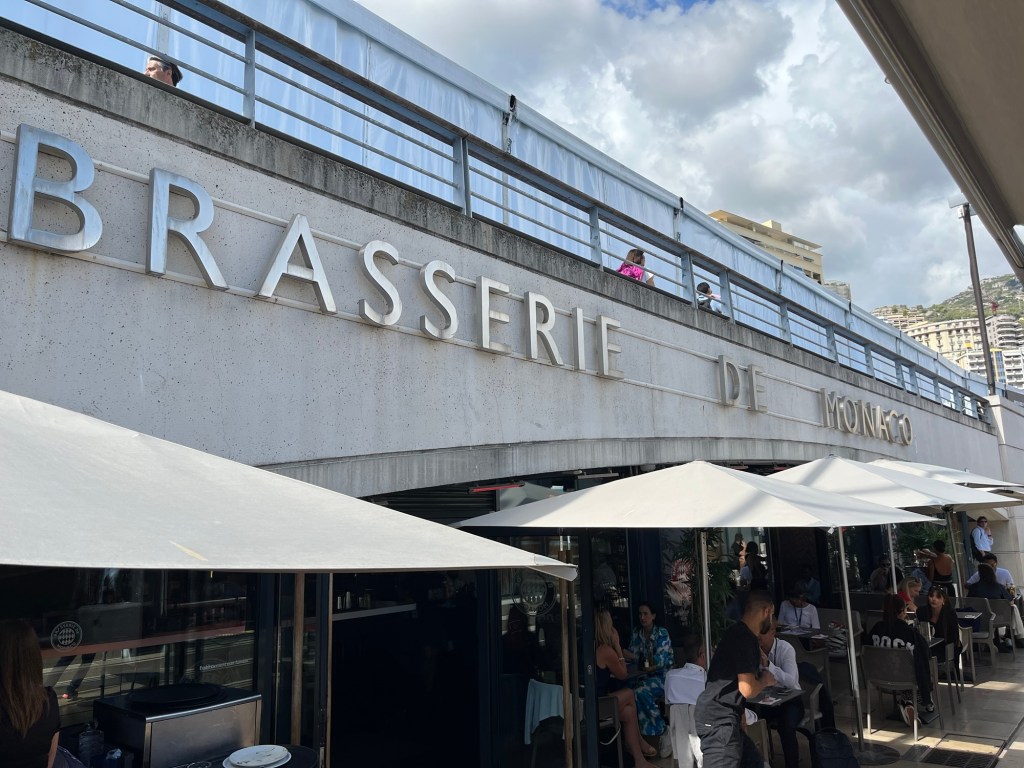
I had planned to go to Monaco Brewery and have a beer while enjoying the view of the marina, but unfortunately, the view was now just the backside of a set of white tents. We went to the brewery anyway and asked to be seated. The hostess asked us if we would be eating, and we said no, so she told us there was no seating. We then told her we would eat, and they found us a table.
People queuing to enter the Yacht Show
We ordered a couple of beers, I believe a brown and a wheat beer. Jenn ordered a salad, and I had the fish and chips. I’m a bit of a beer snob, so take this with a grain of salt, but I felt like the beer was below average, at best, and certainly not worth the 12 euro price. The fish and chips were very good; however, although definitely on the pricey side at 28 euros.
Monaco Brewery
I knew that prices in Monaco were going to be inflated, so that was no surprise, but not getting a view of the Port Hercule, when that is our main draw to the brewery, was a huge letdown.
After lunch, we walked from the marina up to the top of the hill where Monaco’s old town sits. There is quite a climb from the base of the hill to the old town, which makes for some incredible views.
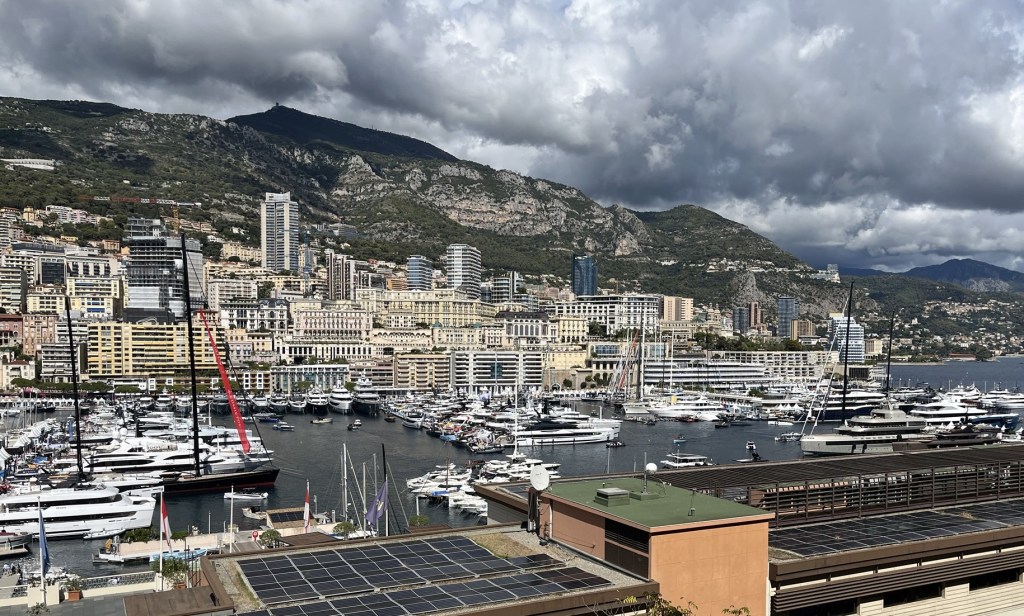
Port Hercule
We walked along the road heading up the west side of the hill, which overlooked the marina. Finally, we were able to see the boats from above the tents. The marina is quite impressive, as are the yachts that are docked in it.
Condominiums surrounding the marina
This was also where we started to get a sense of the city itself, with its midrise condo buildings looking out over the marina and Mediterranean. Past the rows of condominiums are the beginnings of the maritime Alps, with their white stone cliffs and trees.
Port Hercule
As we climbed up the road, the views became even more impressive as we could see more of the city as well as longer views of the deep blue Mediterranean.
Ships out in the Mediterranean who weren’t able to dock in Port Hercule
We finally arrived at the top of the hill, where there are some amazing viewpoints looking out over the Mediterranean. There is also a giant frame, where people were lining up for their Instagram-worthy portraits, looking over the marina.
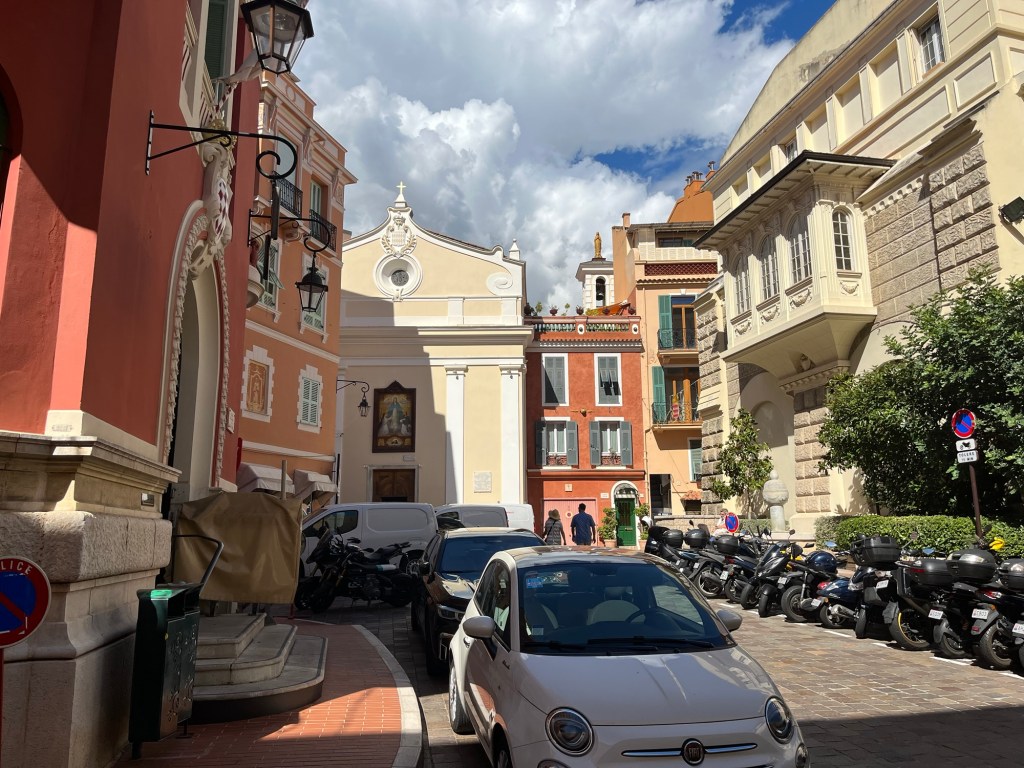
Once we began to walk into the old town itself, I began to feel more comfortable. The old town, with its older buildings and its narrow streets, is very similar to most older European cities.
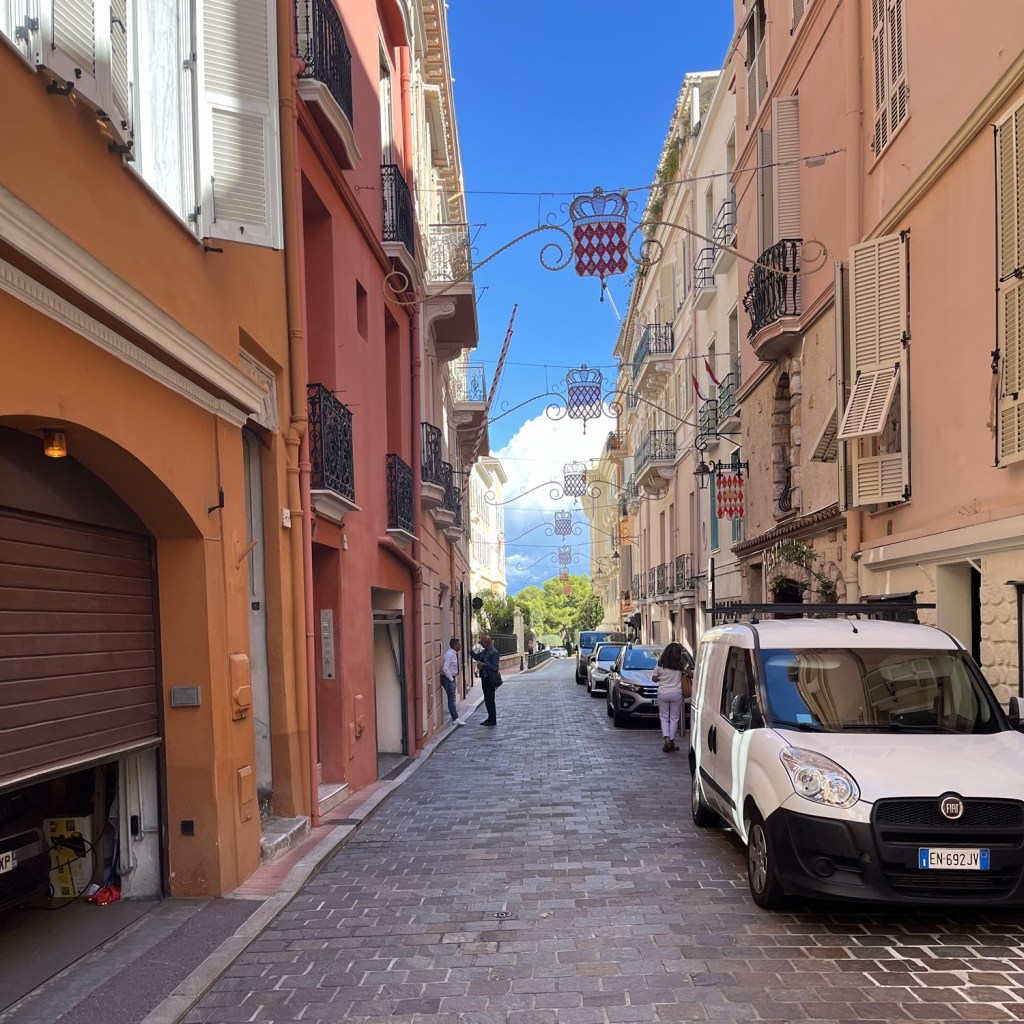
Old Town in Monaco
Walking through the old town to the Prince’s Palace, we passed several shops, and I noticed that the posted prices were much more typical of a European city rather than the inflated prices at Port Hercule. We probably should have stopped for a drink and food in the old town rather than at the brewery.
Prince’s Palace and the plaza
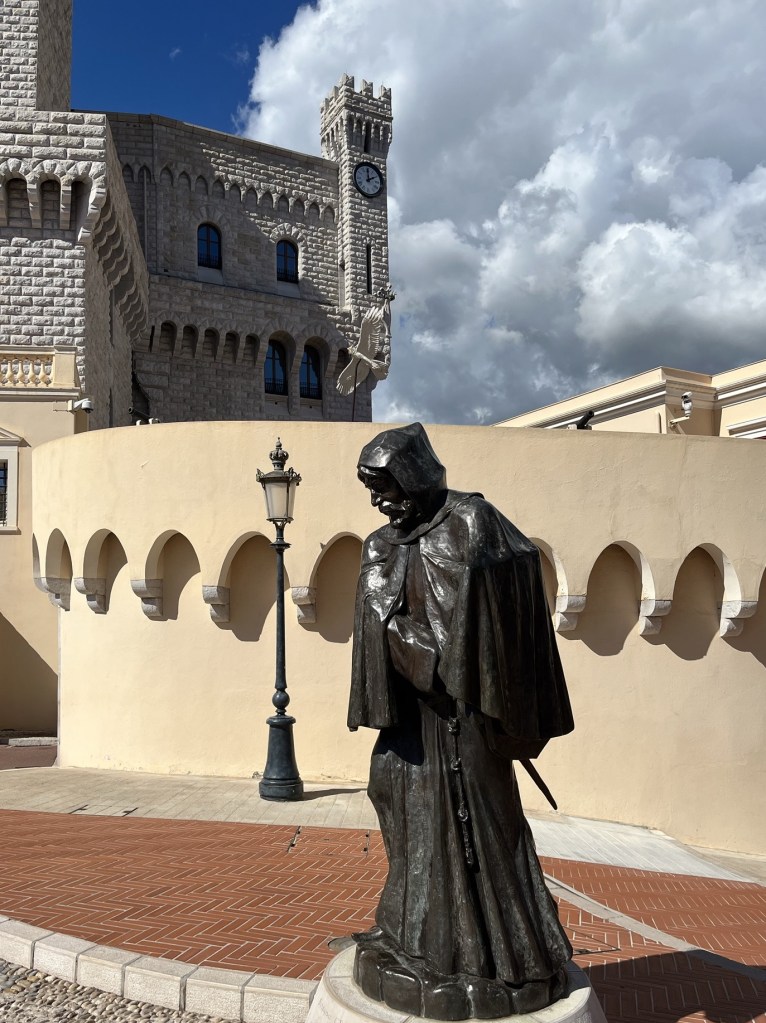
The Prince’s Palace was a beautiful white building sitting behind a large plaza. It was surprisingly quiet, with just a couple of guards outside and a handful of tourists snapping pictures. It’s also remarkably plain with just a couple of statues outside. I expected something a bit more gaudy, but was pleasantly surprised by the elegant simplicity of the area.
Grimaldi Statue in front of the Prince’s Palace
We hung around the area for a while and then proceeded to head back down the hill and go to the train station to return to Nice.
Ministry of the State Building
Going to Monaco was definitely an experience. I wish that we had been there when the yacht show wasn’t in town, because I would have really enjoyed a walk around the marina. There is also a ‘you don’t belong here’ vibe that I sensed almost everywhere I went. From blocking the view at the yacht show to not allowing you to drink at the brewery if you weren’t eating, it was clear that we weren’t the preferred visitors.
That being said, the views were spectacular, and I imagine that if we had spent a little more time in the old town, our experience would have been more positive. So if you’re like us and would like to check Monaco off your bucket list, I would recommend less time around the marina and more in the old town. I think you’ll find yourself a little more comfortable.
When our kids were younger, we used to do the typical Midwestern “I’m tired of the snow” Spring Break trips. This usually meant a 15-hour drive each way so that we could rent an Airbnb somewhere along the Gulf of Mexico between Gulf Shores, Alabama, and Destin, Florida. Every year, it seemed like these vacation rentals would get more expensive, the beaches more crowded, and the trips overall became less and less enjoyable.
After four years of doing that, I was bored with the same old Spring Break trips. When we got into points and miles, I started looking for more exotic ways of spending Spring Break. A couple of years ago, we took a trip to Costa Rica, where we rented a house near Grecia, a fairly small community in the Central Valley more known for agriculture than tourism. We spent the week hiking to waterfalls and on volcanoes and eating local cuisine.
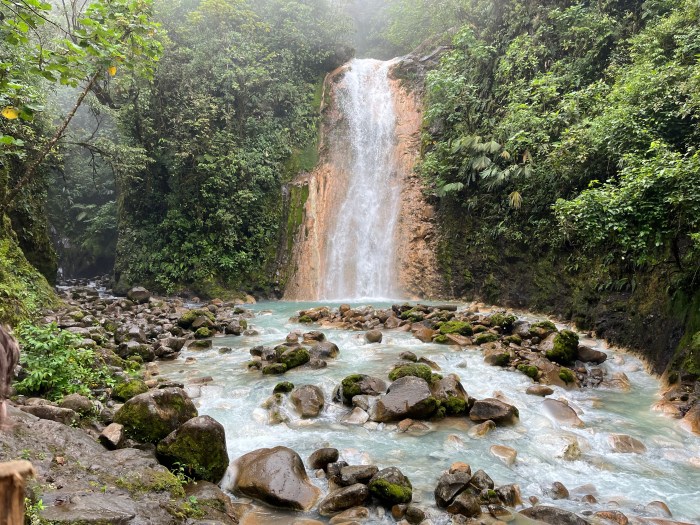
One of the seven falls at the Blue Falls of Costa Rica
This year, for Spring Break, we went to Spain and Portugal to hike the Portuguese route of the Camino de Santiago. It was an amazing trip, but it was physically challenging. It resulted in Achilles’ tendon inflammation, hip bruises, and blisters. Because of that, I had to promise to plan a much more relaxed Spring Break trip; otherwise, my family might murder me.
Walking through the city walls in Valenca, Portugal.
After a couple of pretty active Spring Break vacations, we decided it was time to find a beach again, but this time, not in the United States.
Why Visit The Canary Islands?
The Canary Islands are a set of volcanic islands off the coast of Africa, near Morocco. It has been a part of Spain since the late 1400’s, when they conquered the island from the native Guanche population. While tourism is popular throughout the islands, Tenerife is the most popular island, with over 5 million annual visitors.
Jenn and I have talked about visiting the Canary Islands for a while. It’s intrigued me, since it’s a very popular destination for European travelers, but mostly unknown to American travelers. There are no direct flights between the US and the Canary Islands, even though there are seemingly endless flights between Europe and the US. It’s basically a secret to Americans.
This, however, makes it a perfect alternative to typical Spring Break destinations. It has all of the trappings of a tourist hotspot, but because Europe doesn’t have Spring Break, it’s not going to be busy. Even though it’s bit further from the US, and there are no direct flights, I thought it would make for a better trip.
Screenshot from Google Maps shows plenty of resorts and condo complexes in Playa de las Americas, Spain. From the aerial photo, this looks like any major beach town in Florida.
The weather during March is fairly similar to Florida, with high temperatures in the low to mid-70s. The climate in South Tenerife, where we are flying to, is considerably drier than Florida as well, which should mean the chances of being rained out are much smaller.
In addition to Tenerife’s beach life, it’s an Island with an active volcano, Mount Teide, which is over 12,000 feet high. Because of that volcano, Tenerife has a dramatic landscape and amazing hiking trails.
Booking the Trip
I started by searching on PointsYeah for flights from our home airport, Moline, to Tenerife, but most of the available flights were a ton of points or less than ideal. For example, the quickest itinerary included a stop in London with an airport change. I’m not thrilled about the idea of switching airports in the middle of a flight itinerary; there are just too many things that could go wrong. After searching for a while, I became convinced it would be better to book a flight to Europe and then move on to Tenerife.
Because Tenerife had a lot of flights that arrive from all over Europe, I went looking for any flight to Europe that was inexpensive on points. I was able to find a flight on American Airlines that landed in London Heathrow for 19,000 American Airlines miles and $5.60. The total time on the flight is less than 11 hours. I was pretty happy with that.
From London Gatwick, we can fly to Tenerife South airport on a direct flight for 13,750 British Airways Avios and $1. The flight into London lands on Tuesday morning, so we decided to book the flight out for Thursday morning, to give us a couple of days in London. That is great because we are able to get to Tenerife for 32,750 points and under $7 each, and we also get a short visit to London.
For our flight back, the only thing that was comparably reasonable was a flight on American Airlines from Madrid through Chicago and back to Moline for 34,000 AAdvantage miles and around $50. We also need to get from Tenerife to Madrid, but there are direct cash flights available on Iberia Airlines for only around $50, so it’s better to pay cash than use points. We plan to fly to Madrid the morning before our flight to Moline so we can spend one afternoon and evening there.
We were able to use a couple of Hyatt category 1-4 hotel certificates to book two rooms for our first night in London (one for Jenn and me and one for the kids, since, as usual, there aren’t many hotels in Europe that accommodate families of four). While I don’t obsess about maximizing the value of those certificates, London is an extremely expensive city, so we booked the nearest hotel to the downtown that would accept those certificates. That was the Hyatt Place London City, and for that night, the rooms would have cost $300 each, which is about the maximum value you can get for one of those certificates.
For the second night, we booked a Courtyard by Marriott near the London Gatwick airport that did accommodate a family of four, which should allow us to get to the airport quickly for our morning flight to Tenerife. We used a Marriott free night certificate that is good up to 35,000. That room would have cost around $190, so I’m pretty happy with the use of that certificate as well.
We were also able to book a couple of rooms in Madrid, for the one night we plan to spend there before flying out. For that, we used Jenn’s $150 Delta Stays credit that comes with her Delta Gold Card.
Aside from that, we haven’t booked an Airbnb in Tenerife for the 5 nights we are there, but I expect, based on the prices I’ve seen, that we should be able to book something nice with a heated pool for around $900 that will accommodate the family. I also expect to spend around $200 for a car rental, again based on what I’ve seen in searches for car rentals in the Canary Islands.
Total Cost
When we put all of that together, I expect that we will spend 212,000 American Airlines miles, 55,000 British Airways Avios (transferred from Chase Ultimate Rewards), and about $1,500 to book all of our transportation and lodging. That’s really good, and we will get to experience a Spring Break-like destination without the Spring Break crowds. I’m pretty happy about that. In addition, we get to spend some time in London and Madrid as well, which is fantastic.
I looked up the total cost of the exact flight itinerary, booked through British Airways, and I was surprised to find that the itinerary with stopovers in London and Madrid was only $880 each. That’s actually a really good deal. You could completely recreate what we did without points for around $5,500. Anyone who has priced flights, car rentals, and an Airbnb in Florida might want to reconsider their trip at those prices.
We were able to book that for $1,500, but if you consider that we probably needed around $600 in credit card annual fees to make this work, you could say that we would end up spending $2,100. But wow, for a little over two thousand dollars, we have the opportunity to visit London, Madrid, and the Canary Islands. That’s pretty amazing, and it’s exactly why we’re points and miles junkies.
Now it’s just a matter of deciding where we want to stay and booking the Airbnb. Then we can dream of lying on the beach and soaking in the sun. Don’t tell the kids, but I’m definitely going to drag them on some hikes.
Perched 300 feet above the Mediterranean Sea, Colline du Chateau is a beautiful park with amazing views of Nice. To the west of the park lies Old Nice, with its narrow streets and buildings dating back to the 16th Century. Also to the west is the beautiful beach along the Quai des Etats-Unis and a walkway. To the east is the Port of Nice with its impressive collection of multi-million dollar yachts.
A wide boardwalk separates the main road from the beach. The hill in the background is Colline du Chateau.
Colline du Chateau was the home of a military fort until 1706, when the fort was destroyed by King Louis XIV, during the War of Spanish Succession. More than 100 years later, in 1822, the King of Sardinia turned Colline du Chateau into a park. Starting as a botanical park, it was developed over time, leading to the beautiful park that it is today.
View from the stairway on the west side of Colline du Chateau.
We began our walk from the beach. It was a perfect day with mostly sunny skies, the temperature was around 70 degrees Fahrenheit and a slight breeze coming off of the Mediterranean. Walking up to Colline du Chateau, the hill looks imposing with its steep slope. A stone staircase, with multiple switchbacks is there on the west side of the hill to aid walkers in hiking up the slope.
One of the many amazing viewpoints at the top of the hill
At nearly every switchback, there are viewing platforms, allowing you to catch your breath while looking out over Old Nice and the beach. Every viewpoint was essentially the same, each one from a greater height.
A quiet moment under a tree at the top of Colline du Chateau
At the top of the stairs, the hill flattens out, and a traditional park emerges. There is a large, open grassy area with a children’s playground.
There is also a snack bar at the top of the hill with a good variety of snacks. Besides things like ice cream and hot dogs, it also sells things like crepes. Also, in addition to selling soft drinks and water, they also sold cappuccino, aperol spritz, prosecco, and champagne. As unique as the snack bar was, we just paid for a couple of bottles of water and continued our walk around the park.
Port of Nice
We walked across the park to the east side of the hill. The east side has fantastic views of the Port of Nice. The port has a wide variety of boats within the marina, from some fairly small sailboats to enormous yachts. There is also room in the port for small cruise ships. Club Med 2 was docked in the marina on this day.
Looking East from the southeast edge of the park with Mont Boron in the background. Club Med 2 is the large docked ship near the breakwater.
Off in the distance, over the marina, houses ascend up to Mont Boron, which is another park on top of a much larger hill. Mont Boron is taller and much larger than Colline du Chateau.
Cascade du Chateau
After viewing the marina, we went looking for the Cascade. The Cascade is a man-made waterfall on the west side, near the top of the hill. It is a very popular place to take pictures.
A plane flies over the plaza at the top of Colline du Chateau
Directly above the Cascade is a large cobblestone plaza. This is the highest point of the park and has fantastic views of Nice from all directions. We stayed there for a while, admiring the views, while watching an seemingly endless string of airplanes descending into Nice Airport.
View of the Old Town of Nice from the plaza
Under the plaza is another snack bar called Lou Casteu. We stopped in and grabbed a couple of French beers and enjoyed the weather and the view. It was a lovely place to take a few minutes to relax.
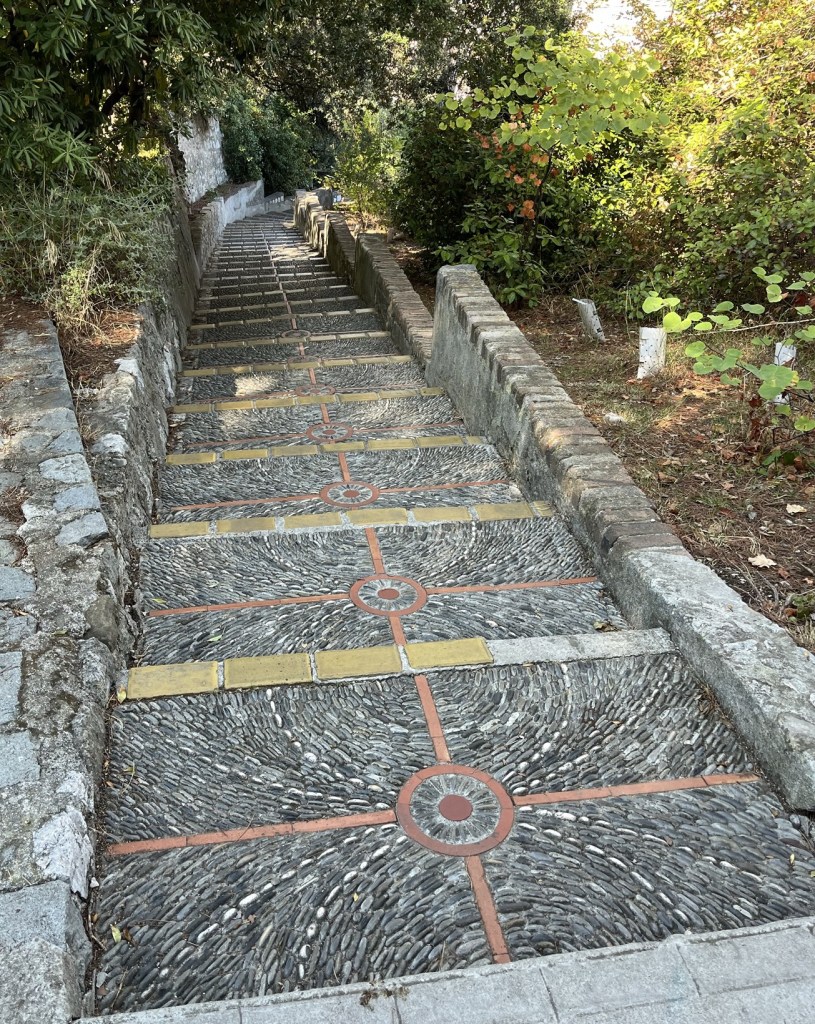
Stairs descend to the marina on the east side of the park.
We finished our drinks and decided to return to our Airbnb, which was just north of the park. That meant we were able to walk a little more through the park, and then we descended down the path and stairs on the east side of the park by the Marina.
It was an absolutely lovely day in Colline du Chateau. It is a beautiful place for a walk, with many places to relax. There are amazing views from practically everywhere in the park. This is an absolute must visit for anyone who is spending time in Nice.
Airlines make announcements about new routes all the time, and most of them don’t interest me very much, but the latest press release about United expanding its seasonal routes in Europe piqued my interest. These new routes seem to be targeting American tourists who have been to Europe, perhaps multiple times, and are looking for something a little different than the normal European stops like Paris, London, or Rome.
The destinations they have chosen to expand to are places that would be on a bucket list for experienced travelers. They definitely speak to me personally, since each one of these are places where I would like to visit.
Glasgow, Scotland
Starting on May 8th, United will start a daily flight from Newark to Glasgow, Scotland. This is probably the least quirky of the destinations that United picked. Scotland is a destination that I could imagine someone traveling to on their first big international trip. The cultural and language similarities to the United States make it an easier trip. It would also appeal to people who didn’t want to visit a huge European city like London or Paris.
Glasgow and nearby Edinburgh are Scotland’s population and cultural centers. They are less than an hour’s train ride apart, making it easy to visit both cities on the same trip. Around Glasgow, there are also many castles to visit, such as Stirling Castle, Doune Castle, and Bothwell Castle.
You can also take the train from Edinburgh or Glasgow through the Scottish highlands. I once asked a Scotsman where he would recommend going if I were to visit Scotland and he was practically gushing about how beautiful train trips through the highlands are. I will definitely be taking his advise on that someday.
Glasgow, I believe, will appeal to more Americans as a destination than the other new destinations that were unveiled by United. The others may be a little more obscure, but they are fantastic destinations.
Bari, Italy
Have you ever found yourself dining outdoors at a restaurant in Florence or Rome and thought “I wish the food was better in Italy?” Probably not, but apparently the region of Puglia in Italy has food that puts other Italian food to shame. I’m not sure how this is possible, but I’m willing to give it a try.
Bari is located on the heel of the boot of Italy, along the Adriatic Sea. It is famous for its beaches, focaccia, pasta, and polenta.
From Bari, it’s about an hour by car to Alberobello, a UNESCO world heritage site known for its Trulli houses. These are unique structures made of limestone with conical roofs.
Bari is less of a tourist trap than other parts of Italy, such as Rome, Florence or Venice. This might make things a little more complicated for people who don’t speak Italian, but it is a great way to experience more authentic Italy than those major tourist destinations.
United will begin flying to Bari four times a week beginning May 1st, 2026.
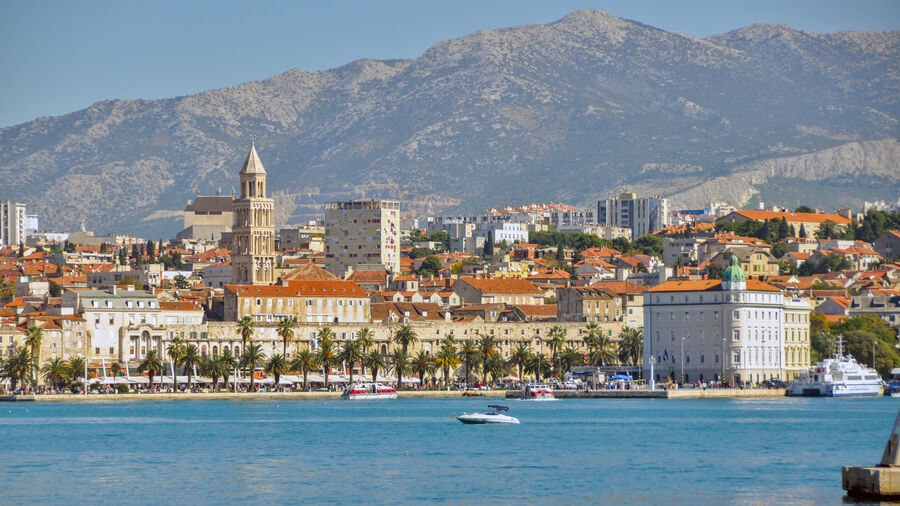
As the memory of the Yugoslav Wars that took place from 1991 to 2001 fade from memory, the Balkan countries have received more and more attention for being great tourist destinations. Split, Croatia has become a popular destination for its beautiful city as well as the crystal clear, deep blue waters of the Adriatic.
From Split, you can use ferries to go to some of the amazing islands in the Adriatic, such as Brac, Vis, Bol, Korcula and Milna. You can also take the opportunity to visit the beautiful walled city of Dubrovnik.
Croatia has been growing in popularity for a while now and its no surprise to me that United Airlines wants to capitalize on the growing popularity. It’s an absolutely beautiful country, and its been on my short list for a while.
Starting April 30th, United begins seasonal direct flights from Newark to Split.
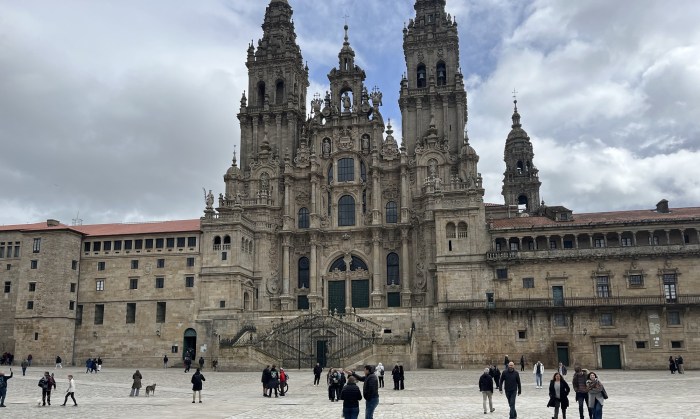
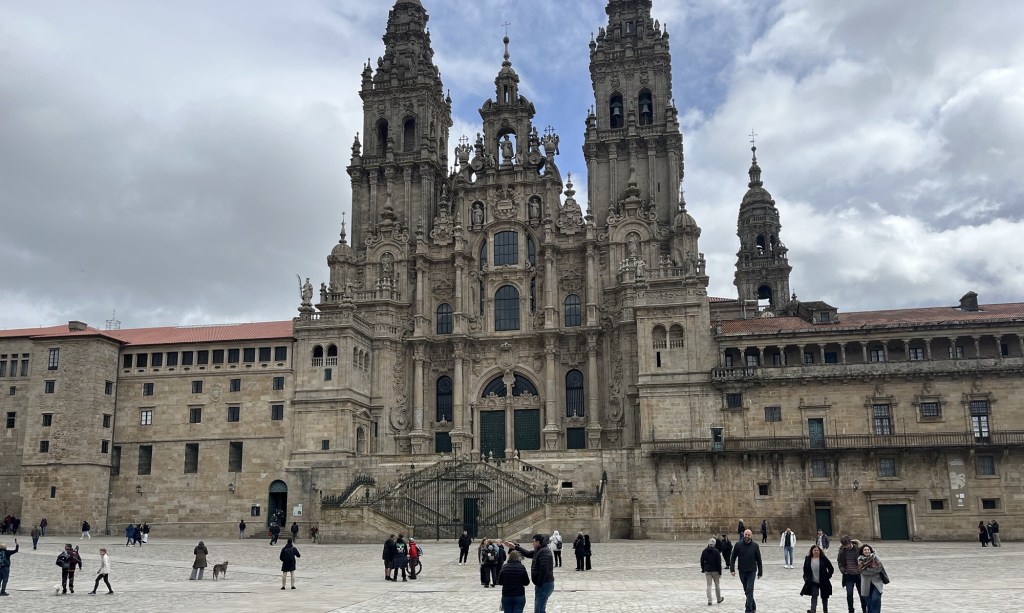
Santiago de Compostela
Santiago de Compostela is a fairly small community in the Galicia region of Spain. It has a population of around 100,000, The reason United Airlines would be interested in bringing direct flights there, however, is because it’s where the Camino de Santiago ends.
The Santiago de Compostela Archcathedral Basilica is the end point for all of the Camino de Santiago routes.
The Camino is a unique cultural experience. It consists of hiking one of multiple routes, the most famous is the French Way which starts in France and continues across Northern Spain to Santiago de Compostela. Some of these routes take over a month to complete and others a couple of weeks. Pilgrims, however, can choose to start their journey from anywhere and an official pilgrimage is anything more than 100 kilometers that ends at the Cathedral in Santiago de Compostela. Along the way there are hotels or hostels to stay at as well as a variety of pilgrim-friendly restaurants.
For those brave souls who wish to participate in the Camino, United Airlines will start service three times per week from Newark to Santiago de Compostela on May 22nd, 2026 and continues through September 20th.
Flights out of Newark
So the good news is that these are amazing destinations but the bad news is they all originate in Newark. The Newark Airport has had all kinds of problems and I typically try to avoid flying out of there when possible. Since Newark completed reconstruction of a runway in June, I haven’t heard of as many issues in that airport, so hopefully service out of Newark is improving.
Newark has connections to more than 100 US cities on United, so you shouldn’t have too much difficulty finding connecting flights. This should make these flights accessible for much of the United States.
Award Prices
Right now, the award pricing on these flights are fairly elevated. This isn’t a surprise, since these are new routes. In the future, I would expect some award prices of these flights to dip down to United’s saver rates of around 40,000 points one-way for a flight to Europe. If you see those saver rates on one of these flights, I would also check Singapore Airlines. Often, you can book the exact same flight, if it’s a United saver award, for only 30,500 points. For more information, I have a post about how to use the Singapore Airlines partnership.
It’s also easier to get Singapore miles since they transfer from Citi Thank You points, Chase Ultimate Reward points, American Express Membership Reward points, a Capital One Venture miles. United miles can only be transferred from Chase Ultimate Rewards.
Conclusion
These newly added seasonal routes for United add great direct flights from the United States to amazing destinations that are on the radar for people who have a little experience going to Europe and would like to try something a little different. These are all fantastic choices and would make for a great vacation. These destinations certainly have me thinking about future trips.
If you are traveling to Germany, you might be surprised to find out that your best public transportation option might just be a program developed for German citizens. The Deutschland Ticket or D-Ticket was first introduced in May 2023 as a joint venture between the German government and the individual regions within Germany. The original cost was 49 Euros, which was raised to 58 Euros in January 2025.
What is the Deutschland Ticket?
Deutschland Ticket is a subscription service that allows you to travel on virtually any public transportation system in Germany for one price. This eliminates the need to navigate multiple apps and ticketing systems for different public transportation systems in Germany. The service covers buses, trams, subways, and trains throughout Germany.
The Deutschland Ticket doesn’t, however, cover travel between cities. This means that long-distance buses such as Flixbus or Intercity Express (ICE), Intercity (IC), or Eurocity (EC) trains are not included. For example, when my son and I were in Germany recently, we had to purchase separate tickets for travel between Dresden and Berlin.
My Experience with the Deutschland Ticket
When I was planning our trip to Germany this summer, the plan was to spend six nights in Dresden and two nights in Berlin. We were also going to visit Saxon Switzerland National Park for a few days while staying in Dresden.
What this meant for me was that I needed to figure out how to navigate as well as purchase tickets for three separate transportation systems in Berlin, Dresden, and Saxon Switzerland National Park. That is a giant headache to deal with because if you don’t want to overspend on tickets, you need to know how much you plan to use that system. Should I get a single-day pass, a single-journey pass, or a week pass? How many fare zones do I plan to travel in? It can get overwhelming in a hurry.
For example, on the Dresden Public Transportation website, there is a map, ironically labeled “Fare Zones made easy,” showing the 21 fare zones in the Dresden Public Transportation system. That’s right, 21 zones. The prices vary depending on how many zones you plan to travel in.
I spent a considerable amount of time trying to figure out that I would need to purchase a ticket that was good for a week in two zones, plus Dresden. For a week, that would have cost almost 45 Euros per person. That also limited us to just part of the system around Dresden.
On top of that, I was going to need to buy tickets in Berlin as well as inside Saxon Switzerland National Park. I knew that the Deutschland Ticket was only 58 Euros, so it didn’t take me too long to realize that it was going to be cheaper and much simpler to just buy the D-ticket.
In practice, it was a huge relief to have the Deutschland Ticket. I didn’t spend any time worrying about whether or not my ticket was valid for any place I wanted to go. If it was public transportation, it was covered – all I needed to worry about was which train, tram, or bus to take.
This actually expanded where we traveled because we decided at the last minute to visit Meissen, which would have been in a fare zone not covered by the Dresden week pass. Having the pass meant that we actually went the full length of the train system from Meissen to the Czech border, which is about 50 miles apart. Knowing that was all covered by one ticket was incredibly valuable.
The Simplicity of the D-Ticket
The best thing about holding the Deutschland Ticket is the fact that it simplifies your experience on German public transportation. Purchasing separate tickets for each city means that you will need that city’s phone app in order to purchase tickets and view routes. If you purchase the D-Ticket, however, you can buy it on any of those apps you choose, and you only need that one app, not a different app when you visit a new city. The QR code on that app works anywhere the D-Ticket is valid.
In fact, we weren’t visiting Munich, but I already had that app on my phone, so I purchased my ticket using that app. Whenever I needed to show my ticket while I was in Dresden, Berlin, or in Saxon Switzerland National Park, I simply opened the Munich app and flashed the QR code. It really simplified things for us. Meanwhile, for routes and times, we used the transit features within Apple Maps.
The Deutschland Ticket is a Subscription Service
There are some downsides to using the D-Ticket that might keep you from wanting to use it. The negatives revolve around it being a subscription service that renews at the end of the month. While the ticket is allowed for use by tourists, it’s generally meant for use by residents. So the rules are set up for residents, not tourists.
The first issue is that it renews at the beginning of the month. This means that if you are planning a trip that starts in one month and ends in the next month, you will end up paying the 58 Euro subscription fee twice. If you are only visiting Germany for a week and have to pay 116 Euros, you might rethink the D-Ticket.
The other problem is that you really need to plan ahead. It is required that you cancel your subscription before the 10th of the previous month. For example, if you are going to Germany from October 15th to October 25th, you need to purchase the ticket between September 1st and September 9th, and then cancel the subscription before the 10th. It seems counterintuitive to cancel something before you start to use it, but once you’ve purchased the Deutschland Ticket you have that ticket for the next month.
All purchases are final, and you can purchase the Deutschland Ticket in the same month that you use it, but you won’t be able to cancel it for the first month. In other words, if you don’t plan ahead, you will be required to purchase it for two months.
Purchasing the Deutschland Ticket
The actual purchasing of the Deutschland Ticket is fairly easy. I used the MVV app which is Munich’s public transportation phone app. You can find the Deutschland Ticket subscription in the Ticketshop tab at the bottom of the screen. Once you are there, select Deutschland Ticket Subscription.
Once you get to that point, all you need to do is enter your payment method (they accept US credit cards), and complete the payment.
If you are only trying to purchase your ticket for one month, you must remember to purchase and cancel the ticket before the tenth of the previous month otherwise you will be charged for a second month.
Conclusion
The Deutschland Ticket is a great way for tourists, especially those visiting multiple German cities, to simplify their public transportation needs. You can travel on virtually all forms of public transport within cities, hold only one ticket, and use only one app.
It’s very likely it will save you money on your trip as well, since purchasing individual tickets or day/week passes can add up quickly. The biggest headache is managing the subscription. But if you make sure you understand the subscription rules and are able to purchase and cancel the subscription within the correct time period, you’ll be thankful you had it.
Berlin is the epicenter of uncomfortable history. The city was the seat of power for Germany during World War I and World War II. During the Second World War, many crimes against humanity were directed from this city. It was also physically split during the Cold War.
20th-century German history forces people to confront the worst parts of humanity. This includes the history of concentration camps, persecution of vulnerable groups, and ethnic cleansing. It also forces people to confront totalitarianism and the stripping of basic human rights. It’s a history that confronts each and every individual who learns about it with the worst parts of the human experience.
Berlin could have decided to move on from its history and maybe built some small monuments or plaques to inform people of the past. Instead, the people of Berlin have built an impressive and thoughtful collection of monuments, allowing people to mourn the past and contemplate what it means for the present.
World War II Monuments
There are various monuments related to World War II in Berlin, and many of them recount the horrors related to the Holocaust and the Nazis’ campaigns of ethnic cleansing. There were three in particular that drew my attention related to the persecution of minorities by the Nazis from 1933 to 1945.
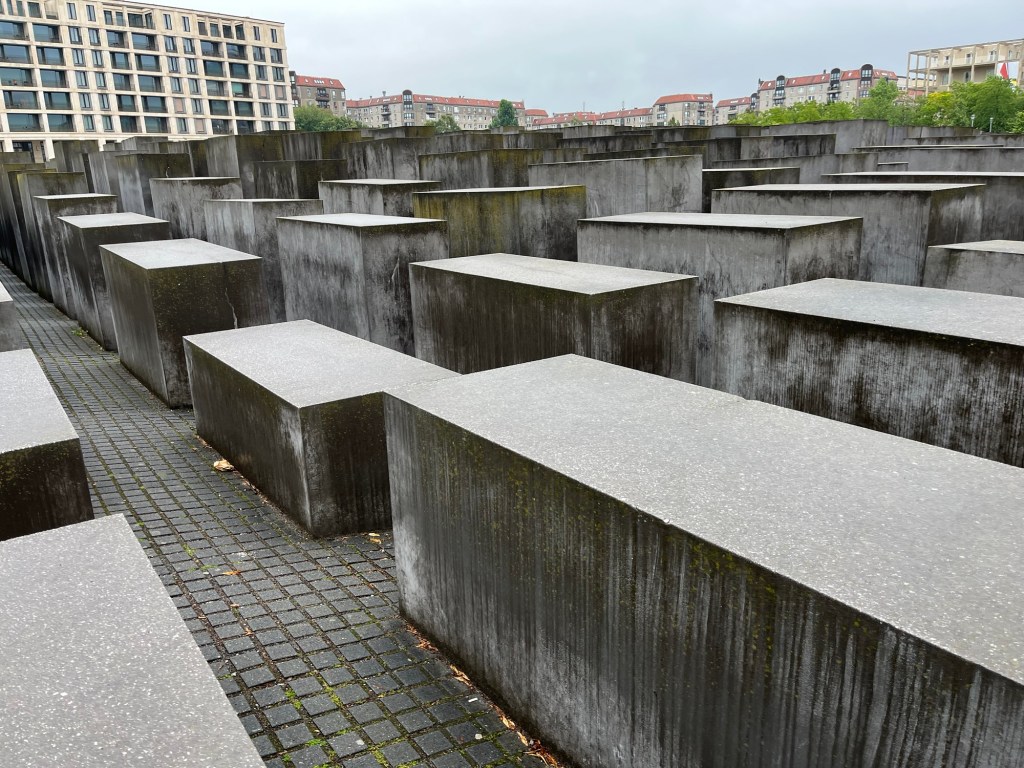
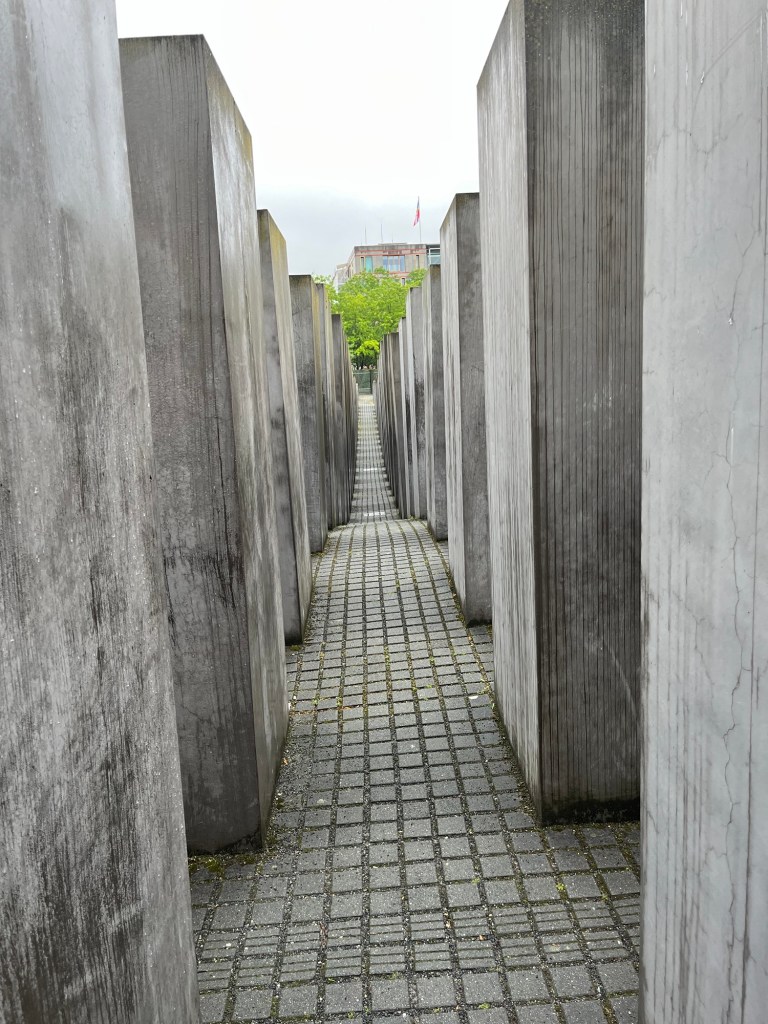
As I was walking through the memorial, it became very clear to me just how difficult it is to visualize large numbers. There were an estimated six million Jews killed during the Holocaust at the hands of the Nazis. That is a number that becomes incredibly hard to visualize. However, as I was walking among the concrete blocks, seeing 2,711 blocks, and that, if divided equally, each block would represent more than 2,000 lives lost, six million becomes an unfathomable number.
Monument to the Murdered Jews of Europe
People have commented that the design is meant to be disorienting, with the varying heights of the blocks and the fact that the ground they sit on is not flat. To me, instead, it felt like a place for reflection. Once you get into the sea of concrete blocks, the distractions of the city vanish, and you are only left with your thoughts.
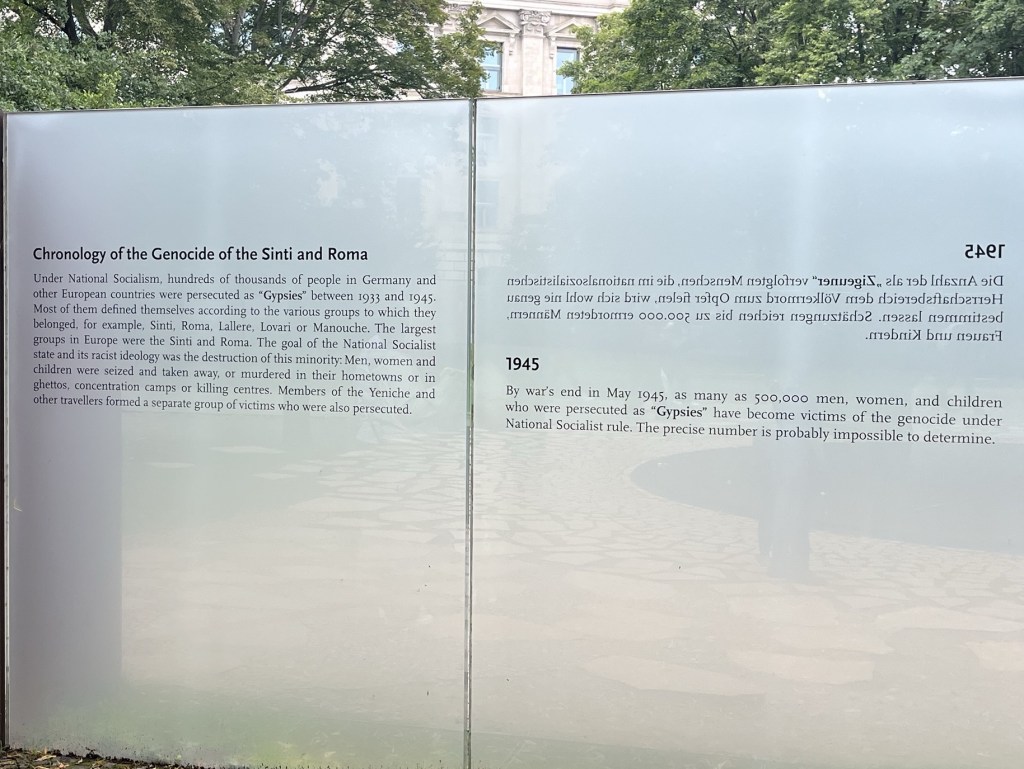
Monument to the Sinti and Roma Victims of National Socialism
In the Tiergarten in Berlin is the Monument to the Sinti and Roma Victims of National Socialism. It was officially opened in October 2012 and was dedicated to the estimated 250,000 to 500,000 Sinti and Roma who were killed by the Nazis.
Monument to Europe’s Sinti and Roma Murdered under Nazism
Memorial to the Homosexuals Persecuted Under Nazism.
The Memorial to the Homosexuals Persecuted Under Nazism looks like a plain concrete cube, similar to the concrete cubes in the Monument to the Murdered Jews of Europe. There is, however, a window in the concrete which, when you look inside, displays a short video of two men kissing. Every two years, the video alternates between two women kissing and two men kissing.
Memorial to Homosexuals Persecuted Under Nazism in Berlin
From the end of World War II in 1945 until reunification in 1990, Berlin was essentially split in half, with the western side part of West Germany and the eastern side part of East Germany. West Berlin, however, was essentially an island as it was completely surrounded by East Germany.
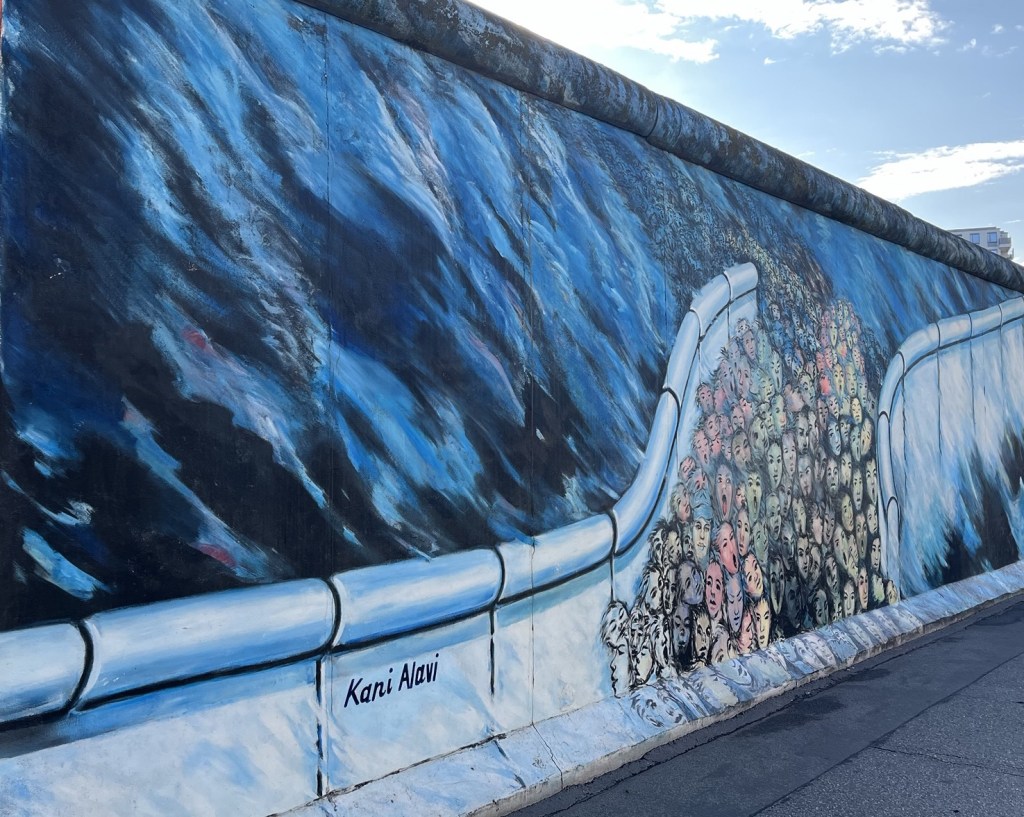
Mural by Kani Alavi depicting the crowds of people who broke through the Berlin Wall the day it fell. The mural is located at the East Side Gallery
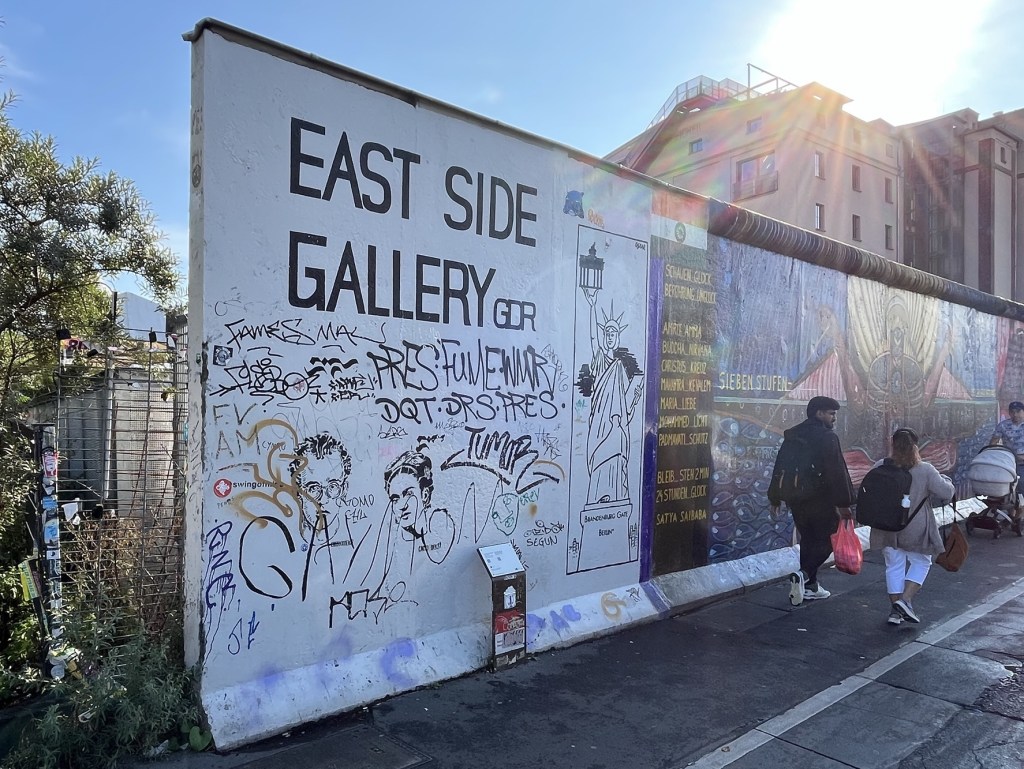
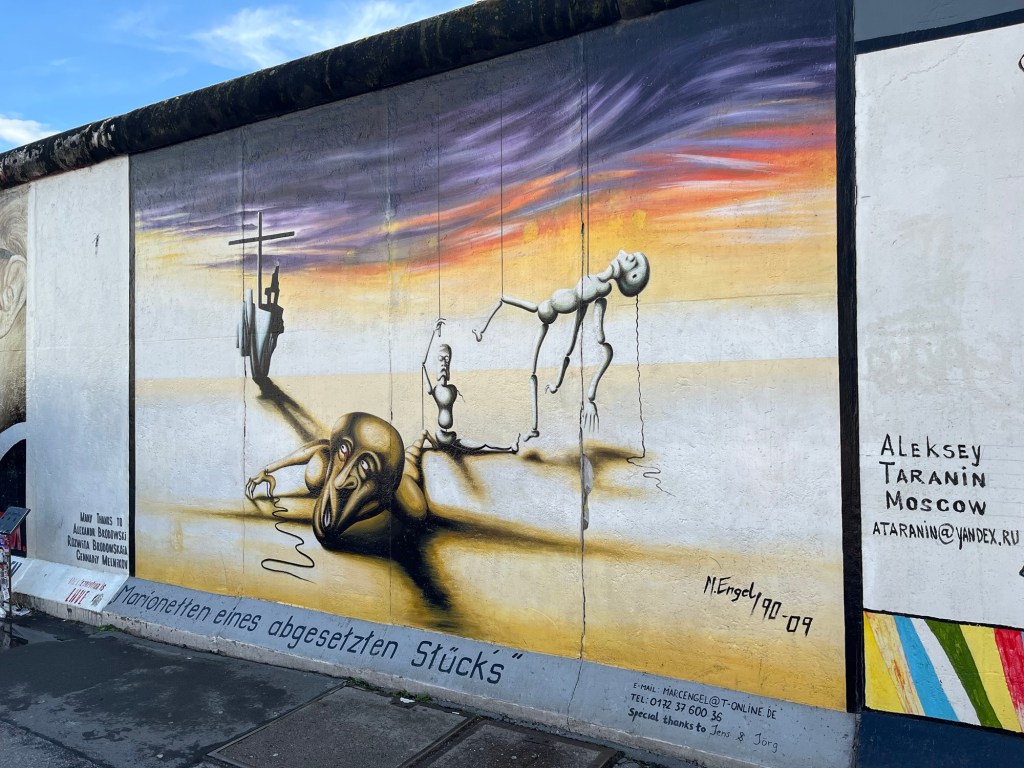
Many sections of the Berlin Wall are left standing throughout Berlin. The East Side Gallery is a large portion of the Berlin Wall painted by a series of artists. It is a large open-air art gallery with over 100 unique paintings from across the world.
Marc Engel’s Puppets in a Dropped Play
It is impressive in its size and artistic diversity. We spent a couple of hours walking along the wall, admiring the artwork.
White Crosses
Walking into the Tiergarten, we came across a series of white crosses that were placed to commemorate the people who died attempting to cross from East Berlin to West Berlin. The stories of some of the 171 East Berliners who died trying to cross the Berlin Wall are displayed on these crosses.
The White Crosses Memorial pays tribute to people who were killed trying to escape East Germany by crossing the Berlin Wall
There were over a dozen at the location we saw at the northeast corner of the Tiergarten, but there are also 8 additional crosses along the Spree River behind the Reichstag building.
Remnants of the Berlin Wall
Remnant of Berlin Wall with peace sign sits along a thin line of bricks and stone signifying the location of the wall.
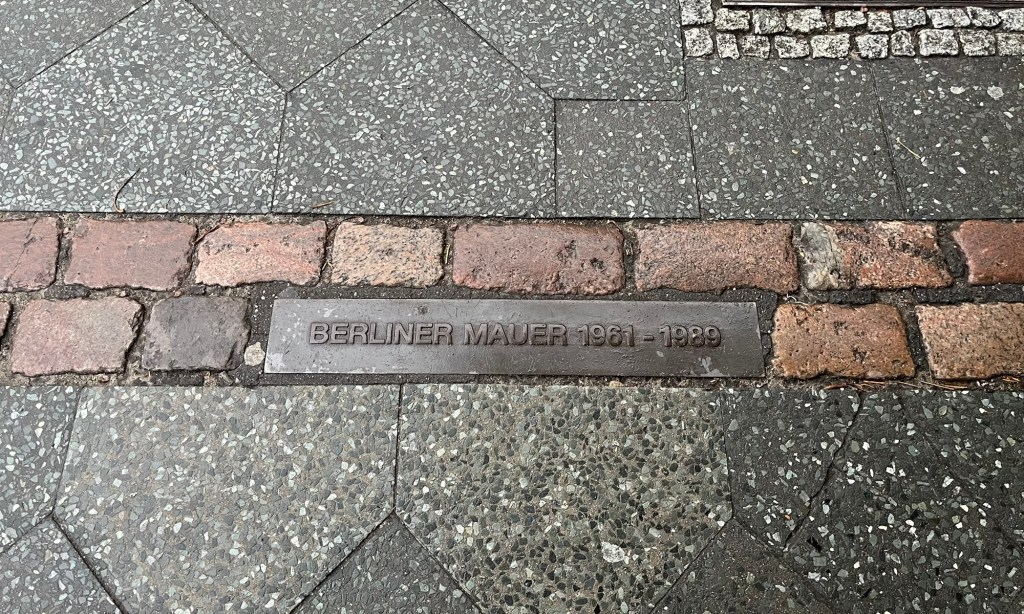
Throughout Berlin, you will see reminders of the location of the Berlin Wall. In some cases, it is a piece of the wall. In others, it’s a brick line in the pavement that marks where the wall had been. It is a constant reminder to the citizens of Berlin of when and where their city had been split for the duration of the Cold War.
Much of the location of the Berlin Wall is marked by brick lines in the pavement
The city of Berlin could have chosen to completely remove all of the Berlin Wall and turn the page on a horrible part of its history. However, they left scars throughout the city as a reminder of the trauma of the past.
Addressing the Past with Clarity
In the United States, it has been 160 years since the end of the Civil War. Even after that much time, we lack a cohesive narrative about the end of a horrible chapter in our past.
Throughout much of the Old South in the United States, there are still countless monuments to Robert E. Lee. People still proudly wave Confederate flags. For some people, the teaching of the history of slavery, segregation, and the Civil Rights movement in America is labeled ‘Critical Race Theory’ and demonized. Even after more than a century and a half, we cannot come to terms with the sins of our past.
The city of Berlin addresses its past with clarity. You will not find statues in Berlin commemorating Hitler or any of his generals. Nazi flags are illegal in Germany, and you will not find many people who defend Nazi Germany. What you will find are thoughtful monuments to their victims. The message is clear to visitors and Berlin residents – we made horrible mistakes and are committed to not repeating those mistakes.
Germany does not hide from its past; it addresses it head-on. Unlike the United States, it does not confuse or excuse its immoral actions but instead addresses them with clarity. That is the best way for a society to move forward from its mistakes.
We should not shy away from things that make us uncomfortable. Discomfort is the fertile soil where wisdom grows. It is not our responsibility to bear the weight of the sins of our fathers. It is, however, our responsibility to not repeat those sins.
As soon as we arrived in Dresden, we went directly to the Frauenkirche (The Church of Our Lady). I wanted to see this beautiful church for myself. Gorgeous churches are everywhere in Europe. What makes this church special is its history and how perfectly it dovetails with modern German and world history.
Statue of Martin Luther in front of the Frauenkirche
Frauenkirche is a Lutheran Church built in the Baroque style and originally completed in 1743. Its distinctive architecture and 220-foot-tall dome define the Neumarkt area of Dresden. However, the story of Frauenkirche is defined by the history of Germany in the 20th Century.
The Firebombing of Dresden
On February 13th, 1945, as Allied forces were advancing on German-held territory, and the war was nearing its end, US and British forces began firebombing Dresden. Over the next three days, Allied forces dropped thousands of tons of incendiary bombs. The intense heat from the bombing killed an estimated 25,000 people and reduced much of Dresden to rubble. Part of that was the destruction of the Frauenkirche.
Following the war, Dresden was on the Soviet side of the Iron Curtain. While Dresden was being rebuilt, Frauenkirche was left as a pile of rubble in the Neumarkt neighborhood. It remained this way throughout the entire history of the German Democratic Republic, also known as East Germany. The rubble was declared a monument against war and remained that way until after German reunification.
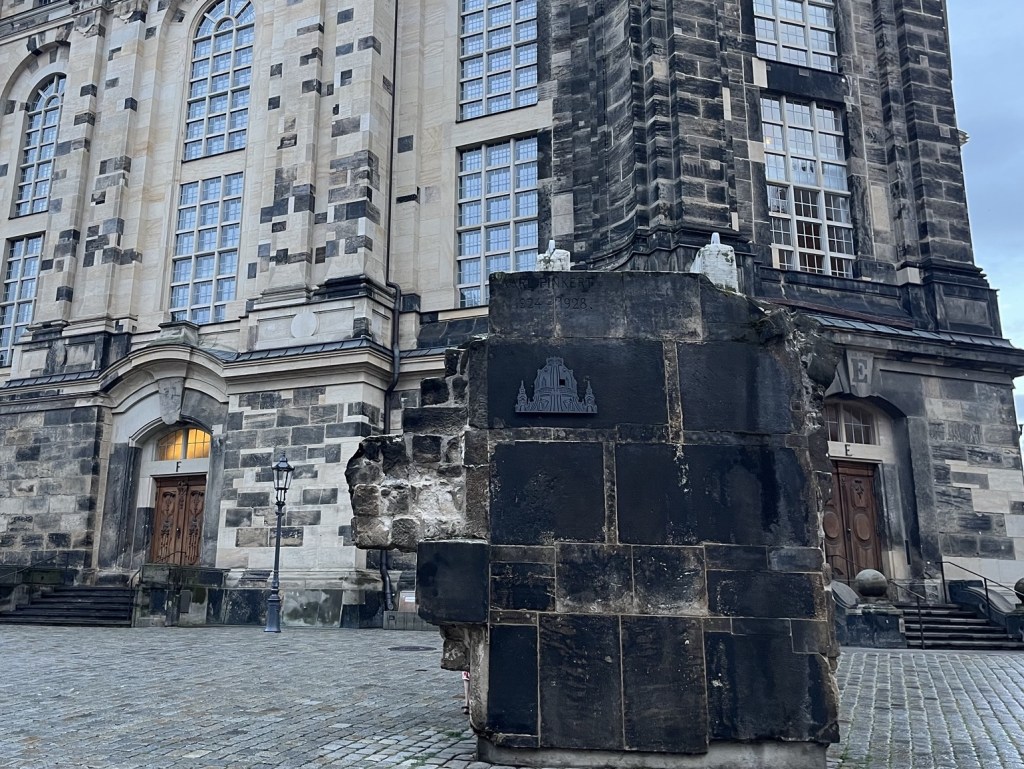
Following reunification, funding for rebuilding the church was raised, and a plan was created for the reconstruction. Construction began in 1994 and was completed in 2005. They removed as much as they could from the rubble pile and reused around 3,800 stones. The remaining stones necessary for rebuilding the church were harvested from nearby sandstone quarries. Due to weathering and the fire damage, the salvaged stones have a darker patina than the newer stones.
The reused stones are dark gray, while the newly quarried stones are a lighter tan. Over time, the newer stones will darken as the type of stone used will patina.
On this beautiful July day, with people enjoying Neumarkt and tourists crowding the Statue of Martin Luther for selfies, it’s easy to forget about the destruction and rebirth of the Neumarkt area. The dark stones, which serve as a reminder of the firebombing, are scattered throughout the building, but two sections have a heavy concentration of the old stones.
The Rise of Nationalism
In the 19th Century, nationalism was on the rise in Europe. This movement wanted to define a country’s borders based on the ethnic, racial, and linguistic characteristics of the people inside those borders. This was in contrast to centuries of European borders defined by the marriage alliances and the conquests of monarchs.
Statue of Martin Luther in front of the Frauenkirche
While the formation of countries with borders based on ethnic similarities made sense, it also made unassimilated groups vulnerable. There were over 9 million Jews and around 1 million Roma, otherwise known as Gypsies, living in Europe before World War II. These groups lived among the various ethnic/national groups throughout Europe and didn’t have a specific nation state to call their own. In addition, nationalistic fervor left anyone who wasn’t living within their own nation’s borders vulnerable, like the 1.7 million Poles who lived within German borders before World War 2.
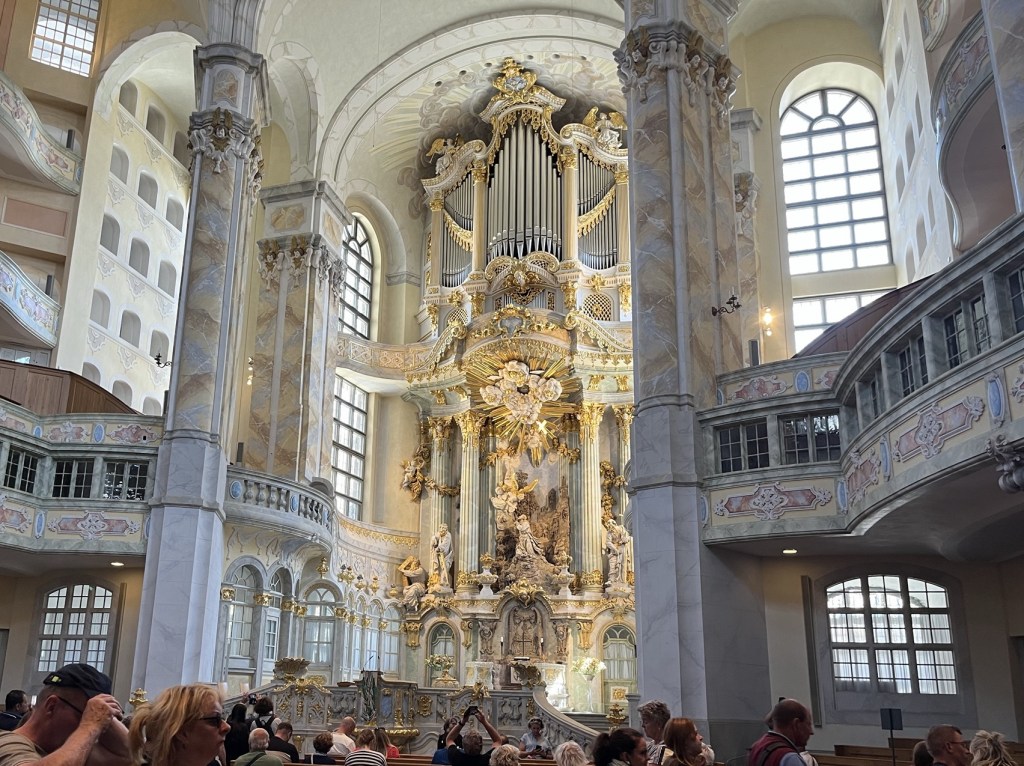
We walked around the church, admiring the Baroque architecture. We decided to take a look inside. My first reaction was that it was incredibly airy and bright, with many intricate Baroque elements and multiple balconies. It’s breathtaking.
Nationalism in the United States
Nationalism wasn’t a strictly European phenomenon. Fear of unassimilated ethnic groups has persisted throughout American history, typically when large numbers of immigrants arrived and formed their own communities. This includes Italians, Irish, Polish, Chinese, and other groups who created their communities within American cities.
In Germany, however, the Nationalist movement was taken to extremes as the Nazis sought to expand their borders while eliminating anything that was not exclusively German. The objective was to create a completely homogeneous German nation with expansive borders. This obviously could not be accomplished without war and ethnic cleansing, and led to World War II and the horrors of the Holocaust.
The altar in Frauenkirche
In America, World War II stoked fear of Japanese and German immigrants. Japanese-Americans were moved into internment camps, and Germans were viewed with suspicion.
Multiple levels of seating have clear views of the altar in Frauenkirche.
After walking around the inside of the church, we headed down to the basement. The basement contains an altar and seating for additional services. It also contains multiple alcoves for private prayer and reflection.
Who Sows Fear, Reaps Weapons
The story is always the same: fear leads to hate, and hate leads to violence. Fear and hatred work by dehumanizing the perceived enemy and justifying violence against that group.
Under the church, there is an altar where additional services can be performed
For the Germans during World War II, that fear justified the war and the campaigns of ethnic cleansing. For Americans, it meant justifying the bombing of civilian populations, like the ones in Nagasaki, Hiroshima, and Dresden.
Monument under Frauenkirche depicting the 10 commandments
Following World War II, enemies became allies as Western Europe began working together in military alliances and as trading partners. America and Japan, once mortal enemies, became valued trading partners and close friends. Instead, a new enemy had emerged, with the world split by the Cold War, and Dresden was on the Soviet side of the Iron Curtain, separated from their brothers and sisters in West Germany.
Visitors gather in Frauenkirche throughout the day to see this amazing church and to pray.
The Cold War defined the next 45 years of human history. There was a space race, nuclear proliferation, and the Cuban Missile Crisis – everything seemed to be defined as a competition between the West and the East, Communist and Capitalist. The entire time, Frauenkirche sat as a pile of rubble in Neumarkt, a daily reminder to the citizens of Dresden of the dangers of Nationalism.
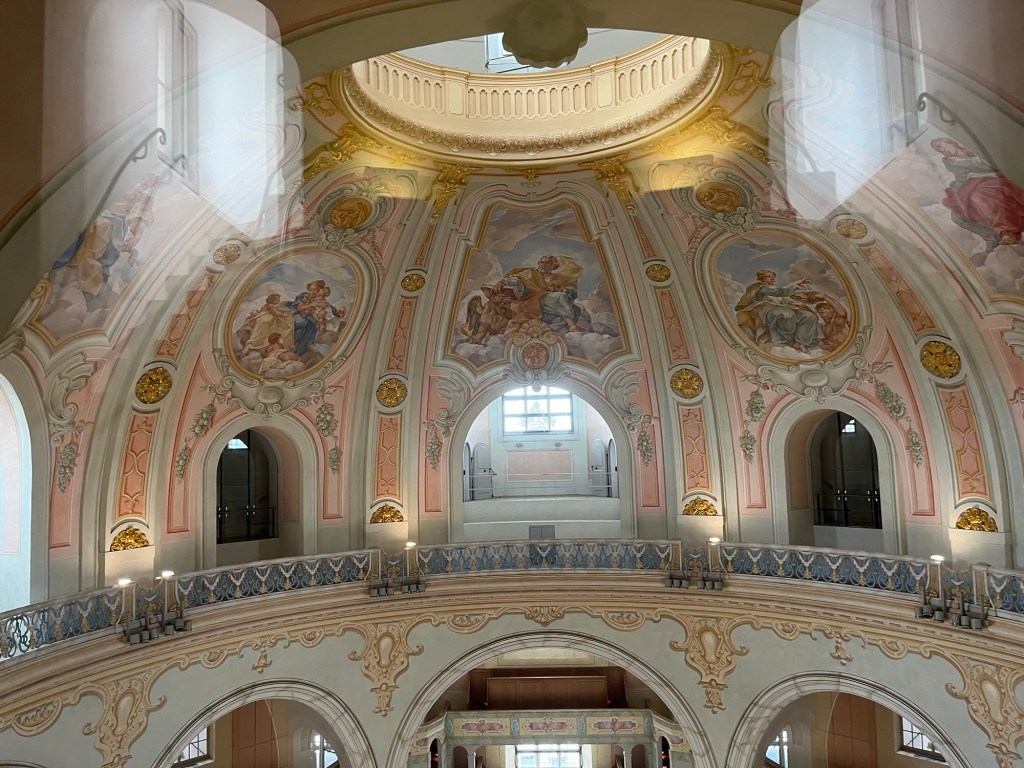
We decided to buy tickets to climb up into the dome. For 10 Euros, you can see a different perspective of the church. As you go up, you see the paintings on the inner dome. Ascending further, you can look through windows at the main dome and down through an oculus at the inner dome and the rest of the church.
Europe Unites as Frauenkirche is Rebuilt
The collapse of the Soviet Union and the fall of the Berlin Wall ushered in a new era for Europe and for the Frauenkirche. In the late 1980s and early 1990s, as Germany was going through Reunification, an aggressive fundraising campaign was conducted to raise the 180 million euros necessary to rebuild the church.
Paintings on the inner dome
In 1993, a rubble-sorting event marked the beginning of the efforts to reconstruct the Frauenkirche. As the church’s cornerstone was stabilized in 1995, the European Union added Austria, Sweden, and Finland to raise its membership to 14 members.
Reconstruction of the Frauenkirche was completed in 2005. During the eleven years of Reconstruction, the Euro was developed and established in 11 countries. The Schengen Zone went into effect in many of the EU countries, allowing freedom of movement without border controls. By the time the Frauenkirche was completed, the European Union had expanded to 25 countries.
Room above the oculus in the inner dome
Nationalism had divided the continent and led to the destruction of the church. In the 60 years from rubble to reconstruction, the continent became defined by its cooperation and connections.
Since 2005, three more members have joined the European Union, and one, Great Britain, has left. Nine countries are currently listed as candidates to join the European Union. This interconnection has ended all wars between these countries, which have fought each other for centuries. The fear is gone, and with it the hatred and the violence.
Sloped walkway between the outside wall and the inside wall of the dome
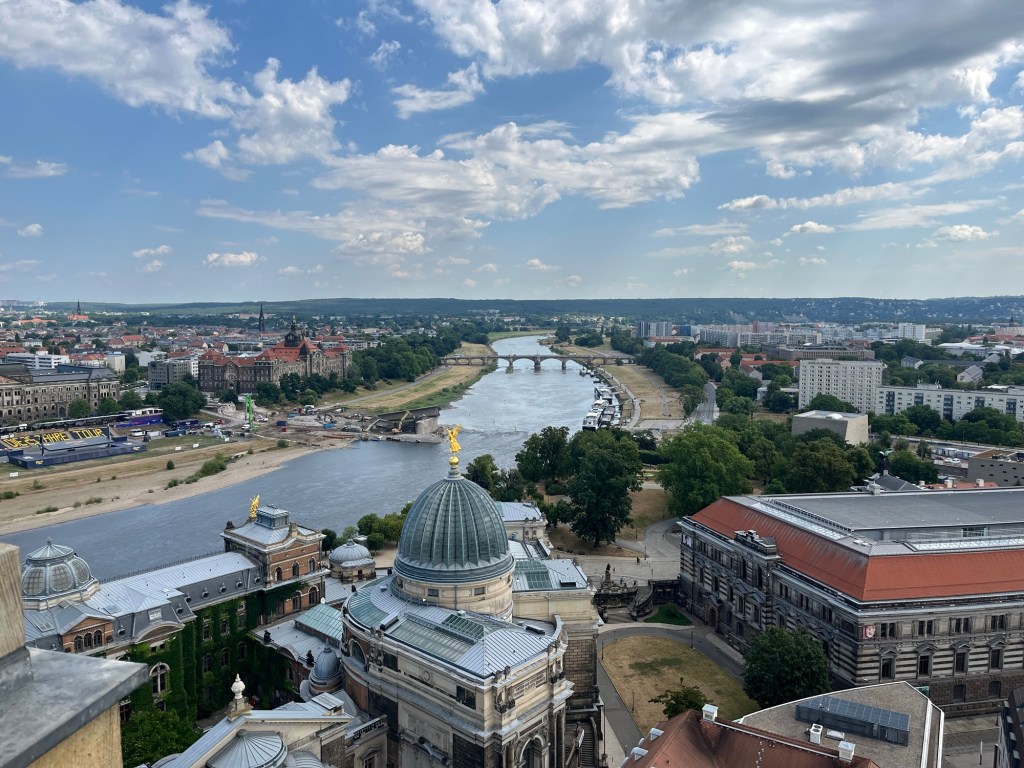
We climbed all the way to the top of the dome and walked out onto the observation deck. From the top, you could see most of Dresden. The neighborhood around Frauenkirche has also been reconstructed with shops, apartments, hotels, and restaurants. The plaza in front of the church was lively with visitors and shoppers. Neumarkt is whole again.
Tension in North America
While Europe becomes a more unified continent, North America has become more divided. A tariff war has made Canada and the United States, longtime allies and friends, suspicious of one another. In addition, statements by Donald Trump indicating that he would like Canada to be the 51st state, however unserious that sounds, have to be taken seriously by Canada because of the power imbalance between the two countries.
A view of the Elbe River from the observation deck above the dome
The relationship between the US and Mexico continues to be complicated, with the US both relying upon Mexican immigrants for cheap labor and vilifying their presence within the country.
Recently, the immigration debate has turned extremely dark as a detention center has been constructed on swampland in Florida. Known by its supporters as Alligator Alcatraz, its goal is to house illegal immigrants until they can be deported.
However, some of the supporters of this plan have expressed more extreme ideas. Laura Loomer, who traveled with President Trump during the 2024 campaign, recently tweeted, “The good news is, the alligators are guaranteed at least 65 million meals, if we get started now.” 65 million is the total population of all Hispanics in the US, most of whom are citizens. So, as you can see, for the most extreme members of the Republican Party, the issue of protecting the border has now moved toward ethnic cleansing.
Fear also affects the LGBTQ+ community. The LGBTQ+ community has been the target of many ridiculous accusations over the years, including the idea that same-sex marriage destroys the sanctity of straight marriage and the idea that homosexuals groom children for pedophilia. These are accusations meant to paint all LGBTQ+ individuals as a danger to society.
A pride flag hangs from a balcony of an art museum that faces the Frauenkirche
Another persistent fear among right-wing communities is that transgender women will use women’s restrooms to rape cisgender women. I’ve never heard of a real case where this happened, but the fear persists nonetheless. The idea is ridiculous, of course, because anyone willing to commit rape would not be deterred by laws that limit access to restrooms based on biological gender.
Lessons from the Past
Much like the lies told in the Protocols of the Elders of Zion in the early 20th Century, these lies persist in the early 21st Century. These lies are told to marginalize communities within the United States in the same way that communities were marginalized in Germany before World War II. They spread fear. Fear leads to hate, hate leads to violence.
Europe has shown what is possible when people put their fears aside and work together. They have lived through the horrors of war and chosen to work together towards a peaceful and more prosperous future.
We ended our visit to Frauenkirche, standing in front of the last remaining piece of rubble from what was the pile that lay in Dresden for decades. It was a large piece of the dome recovered from the pile, placed as a monument with a plaque containing the account of a survivor of the firebombing.
The remaining piece of rubble from the dome was left as a monument to the destruction of Frauenkirche.
Standing in front of the monument, I was reminded of the vulnerable communities within my country and the lies and slurs they endure daily. We live in a precarious time when we must decide whether to listen to the sounds of fear and hate or embrace empathy, kindness, and love. I hoped that one day, a curious traveler wouldn’t be standing in front of a similar monument in the United States.
People should be treated with empathy and kindness regardless of their immigration status, sexual orientation, gender identity, race, religion, or disability. People are people, and love is love.
There is a socially accepted form of beauty that we are all familiar with. Flawless skin, a wrinkle-free face, athletic body, the kind of beauty we see on the cover of Vogue magazine.
As I approach 50, I understand now that’s not true beauty. Real beauty has grit, personality, life experience. Life experience, however, has a price. That’s why true beauty has cellulite, laugh lines, scars and maybe a fading tattoo. True beauty also comes with kind eyes and a loving heart.
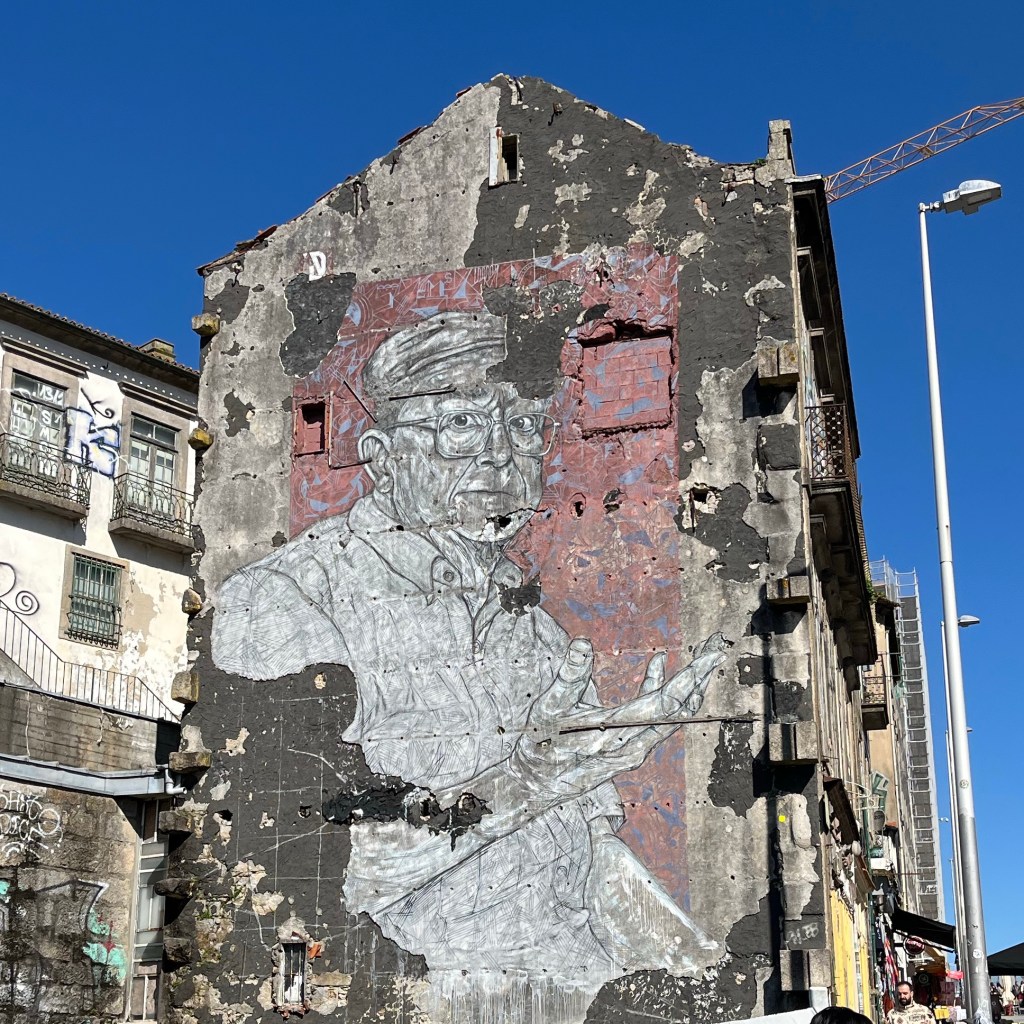
Fading mural near Dom Luis bridge
For years now, I’ve heard people gush about how much they love Porto. I would look at photos and not understand the hype. Sure there were clearly beautiful things in the photos. But nothing to me seemed exceptional – why does everyone love Porto so much?
Church of the Lord of Bonfim
We decided to spend our Spring Break walking the Portuguese route of the Camino de Santiago, but we only had a week, so we decided to start in Valenca, Portugal. Valenca is located along the Minho River which serves as the border between Spain and Portugal. That meant that we needed to fly into Porto and take the train to Valenca from Porto.
Fountain of the Lions illuminated by colored LED lights
This gave us the golden opportunity to brush off our jet lag in Porto and spend one evening there. To be fair, I wasn’t that excited about it. I assumed it would be nice, but other than going to the Cathedral to pick up our pilgrim passport for the Camino, I didn’t have anything planned.
Porto Cathedral where many pilgrims on the Portuguese route of the Camino de Santiago begin their journeys.
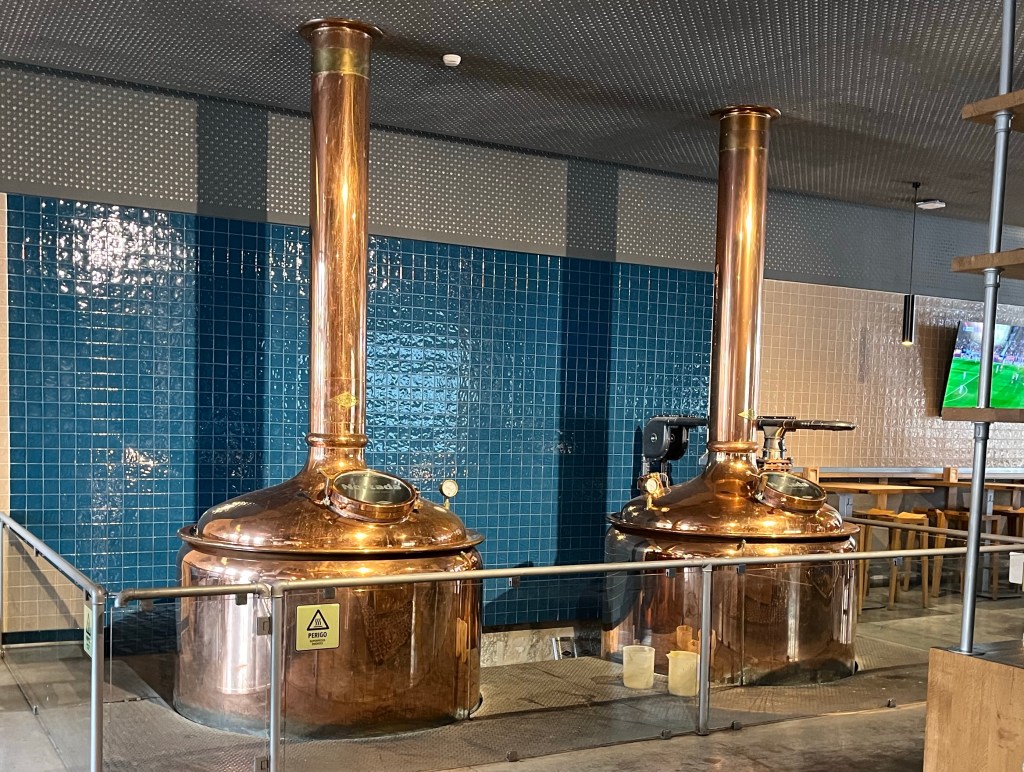
Once we got to our hotel, we were able to drop off our stuff and head out. We stopped into Cervejaria Nortada, a brewery near our hotel. We had a couple of drinks and a snack. Our server could tell we were struggling with the Portuguese menu and even though we insisted we could figure it out, he took the time to explain some of his favorite dishes. He was our first experience with Portuguese hospitality.
Copper brewing equipment at Cervejaria Nortada
From there we walked to the Cathedral for our Camino passports. Along the way, I noticed a combination of beautiful buildings and buildings in decay. Shells of buildings without roofs and graffiti are common even in the center of the city. In Porto, when a building falls into disrepair, the exterior remains in place, even if the rest of the building has completely disintegrated. By not demolishing the building, the city keeps it’s historic blockfaces intact, even if it has clearly deteriorated inside of the shell.
Graffiti on an overhead door in Porto
Graffiti is common in Porto. In general, graffiti isn’t uncommon in Europe, but sometimes, as Americans, it seems unfathomable that people would deface buildings that are centuries old. Graffiti is an artform like tattoo, where some are clearly horrible while others are fine works of art. Like tattoo, it is also polarizing, because some people love the artform and others find it vulgar.
Restored building in Porto
There is evidence of a renaissance of sorts in Porto. There are cranes everywhere as old buildings undergo renovations. The city is renewing itself as people look to transform those decaying properties into vibrant rehabs. Porto, like Lisbon and the Algarve, have become hot spots for middle and upper class immigrants from the European Union and the United States, so the need to provide housing for the new immigrant class likely is responsible for many of the rehabs.
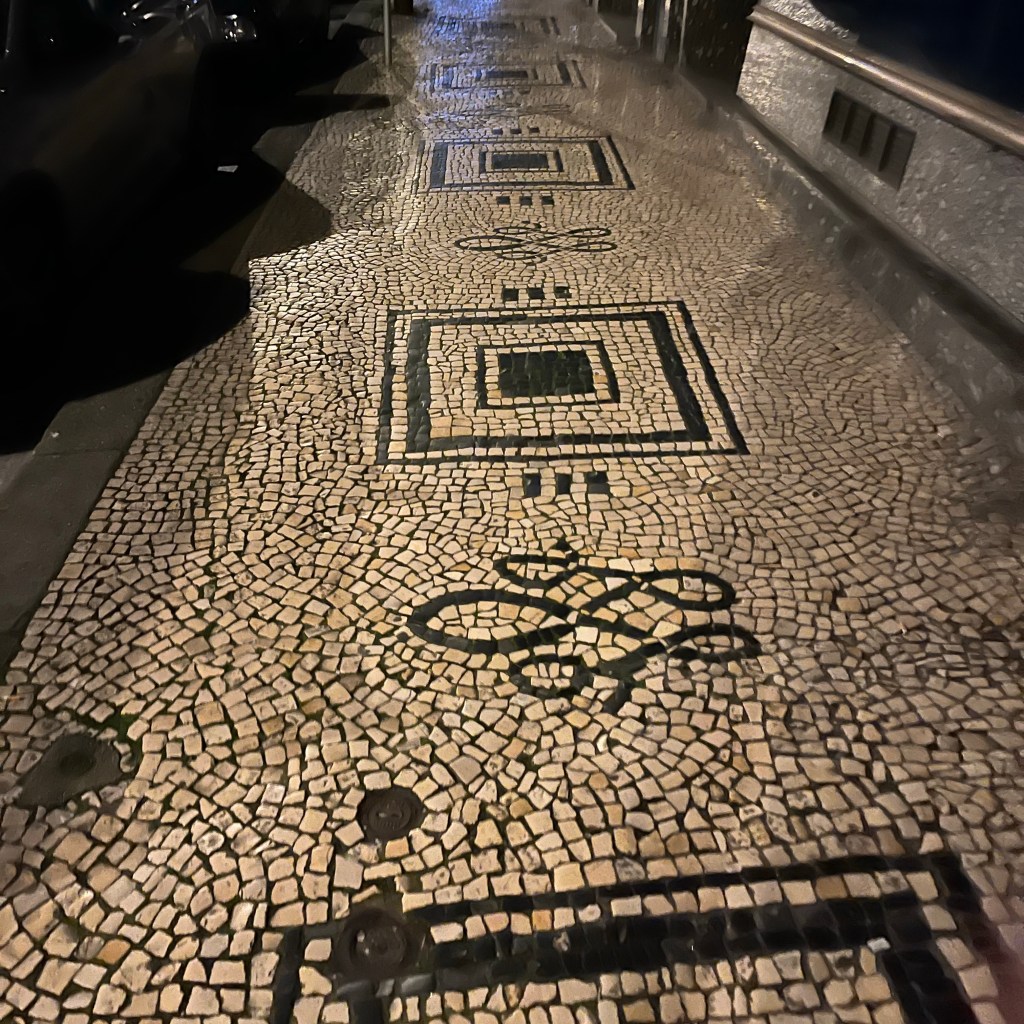
Mosaic sidewalks are everywhere in Porto
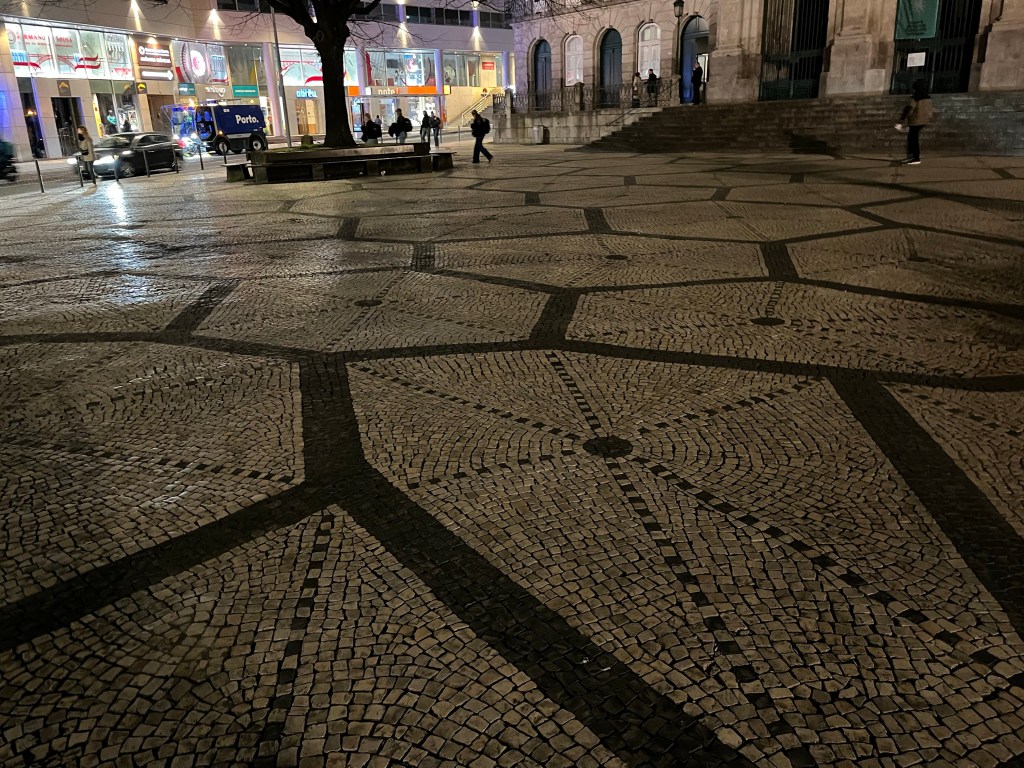
The character of the city remains, however. Mosaic black and white stonework turn sidewalks and plazas into works of art. They are absolutely stunning and it’s almost impossible to imagine how much work went into building the miles and miles of mosaic walkways.
Plaza by Porto City Hall
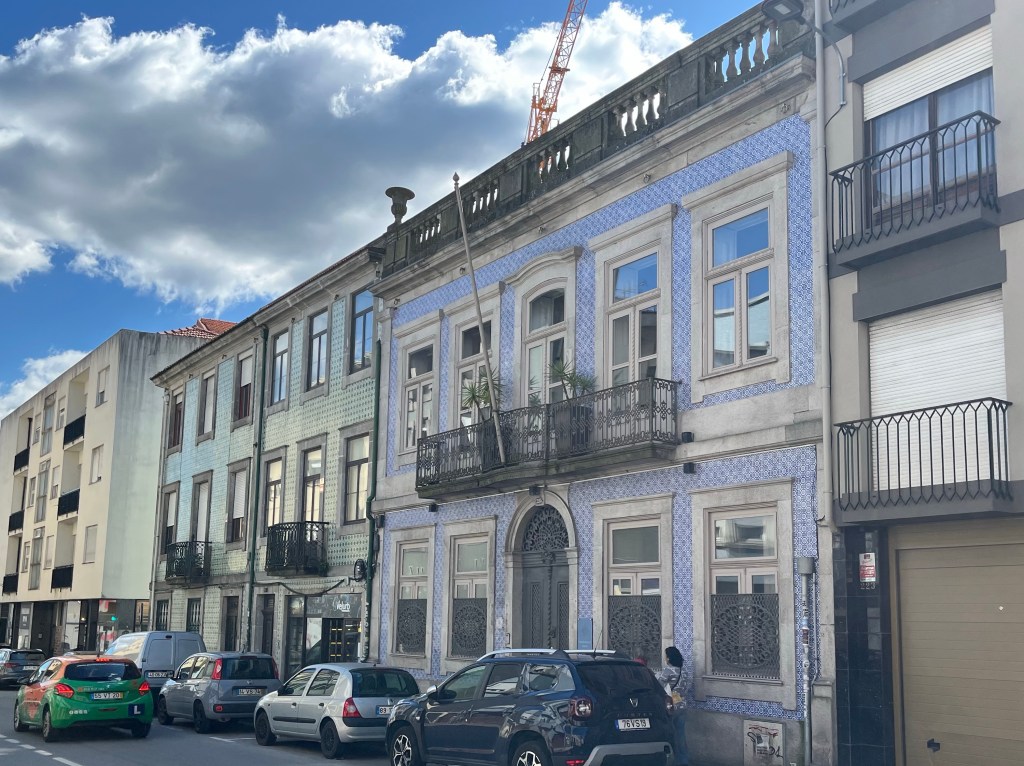
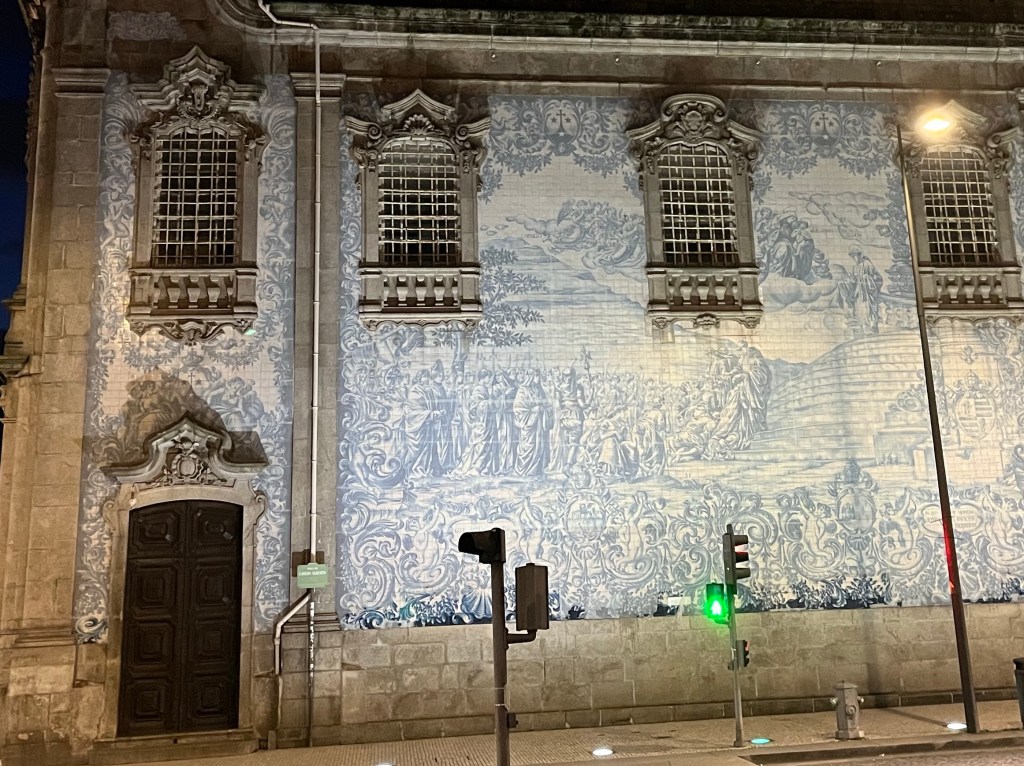
Another defining feature of Porto is exterior tiled walls. The Portuguese began to use tile on the exterior of the homes in the 1800’s, not only for their aesthetics, but also because they are fire retardant and help regulate temperature. You will find anything on the exterior walls from highly artistic tiles to subway tiles.
Buildings with Tile exteriors
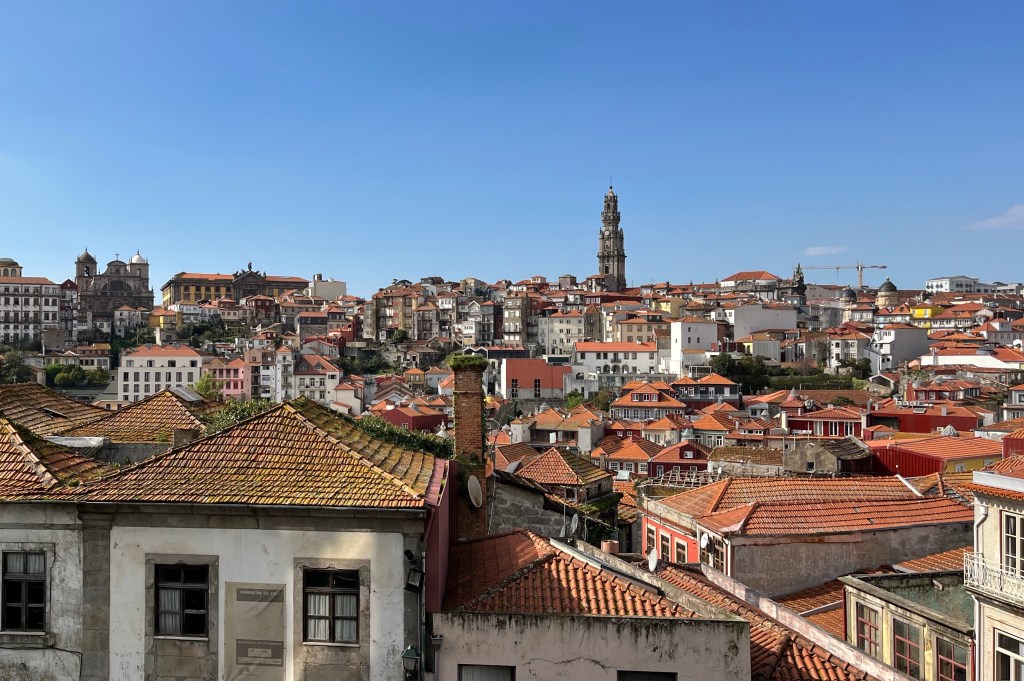
Porto does have its moments that take your breath away. The Cathedral is located high on a hill near the Douro River and from the plaza, you can see a large portion of the city as beautiful churches and bell towers emerge over red tiled roofs for square miles.
View of Porto from the plaza by Porto Cathedral
The Cathedral itself is a beautiful example of a 12th Century cathedral. It’s one of many beautiful houses of worship we came across while in Porto, including the Igreja do Carmo and the Church of the Lord of Bonfim.
Igreja do Carmo was constructed in the mid 1700s.
After a long night of sleep, we walked on Dom Luis bridge, where the views of the Douro River are stunning. The bridge is at a dizzying height over river which provides long views along the river in two directions.
Looking West from Dom Luis I Bridge
Off in the distance from the Dom Luis bridge is Maria Pía bridge, which was designed by Gustave Eiffel, best known for the design of the Eiffel Tower. Both of these bridges are stunning metal bridges that only enhance the Douro River’s beauty.
Looking East from Dom Luis I Bridge
During our short time in Porto, I noticed something you don’t see in crowded cities – patience. People make way for other people while walking on the sidewalk. When we struggled with the language barrier, people were understanding and patient. No matter what building we walked into, we never felt out of place or unwanted. The people are just genuinely kind.
Tiles on the side of the Igreja do Carmo depict scenes from the founding of the Caramelite Order.
The general vibe of the city is relaxed. People weren’t trying to run past you to get to the next crosswalk, It also wasn’t excessively noisy. People just seemed to genuinely enjoy their day.
Narrow building and road in commercial section of Porto
On our way to the train station, leaving town we stopped at a bar where there clearly were regulars drinking coffee and beer, playing cards. Nobody spoke English well. They weren’t annoyed by these four Americans and their giant backpacks taking up space in their bar. The bartender took his time to figure out what we wanted and allowed us to enjoy our drinks. They were all demonstrating kindness, patience, and tolerance. Isn’t that what this world needs more of today? What can be more beautiful than that?
Running in Venice can be a challenge. The city is like a labyrinth with constant turns, dead ends, narrow passageways and bridges that can sometimes be difficult to find. If you live in Venice and are familiar with how the city is laid out, this might not be too much of a challenge, but for those of us who are on vacation, it can be tricky to find a good route that isn’t too confusing.
There is one particular route that is both beautiful and isn’t too confusing. That is to run along the south side of the the main islands from Piazza San Marco to the east as far as you can go.
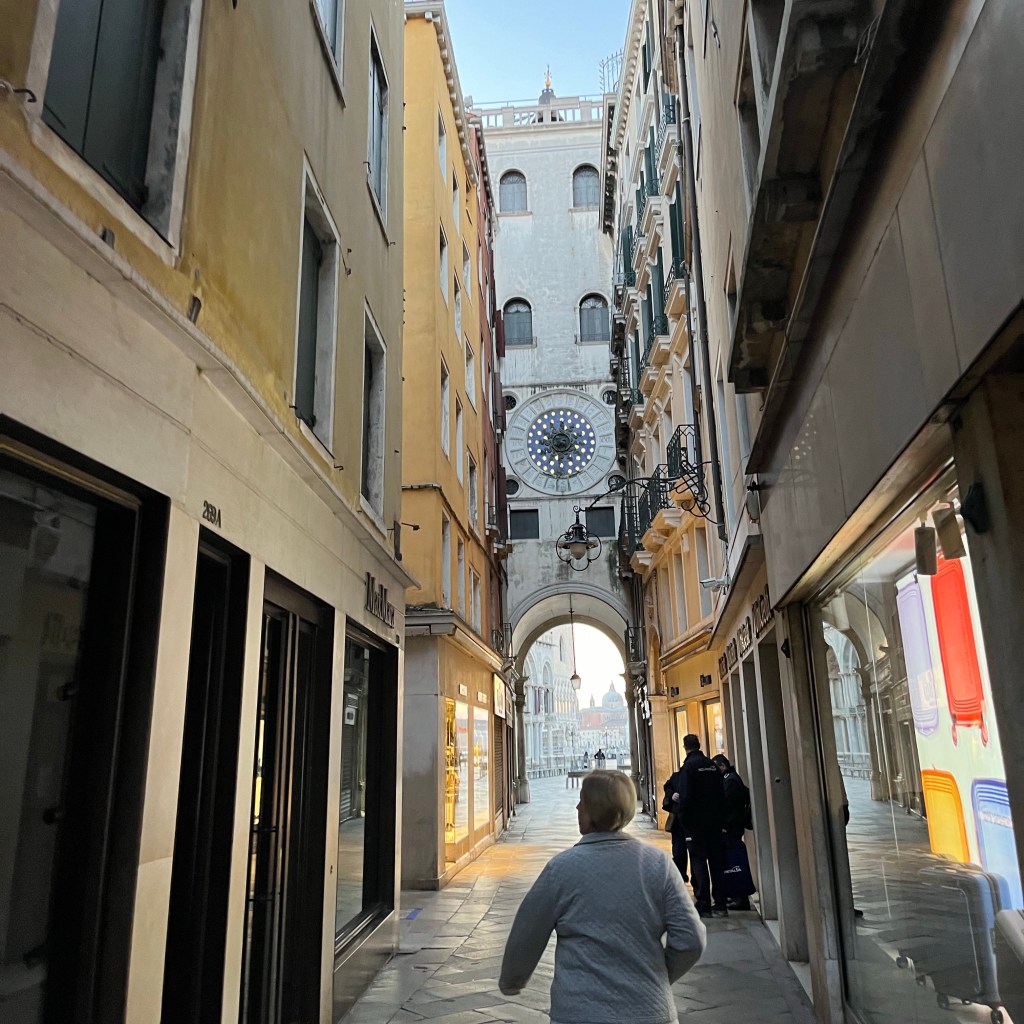
Basilica di San Marco barely visible as I approach the Piazza San Marco from under the clocktower.
I started early in the morning, before sunrise, knowing that it won’t take very long before workers and tourists fill up the streets. I like to get out early when its not too busy. Our Airbnb was near the Rialto Bridge, so the challenging thing to me, navigationally, was to run from Rialto Bridge to Piazza San Marco.
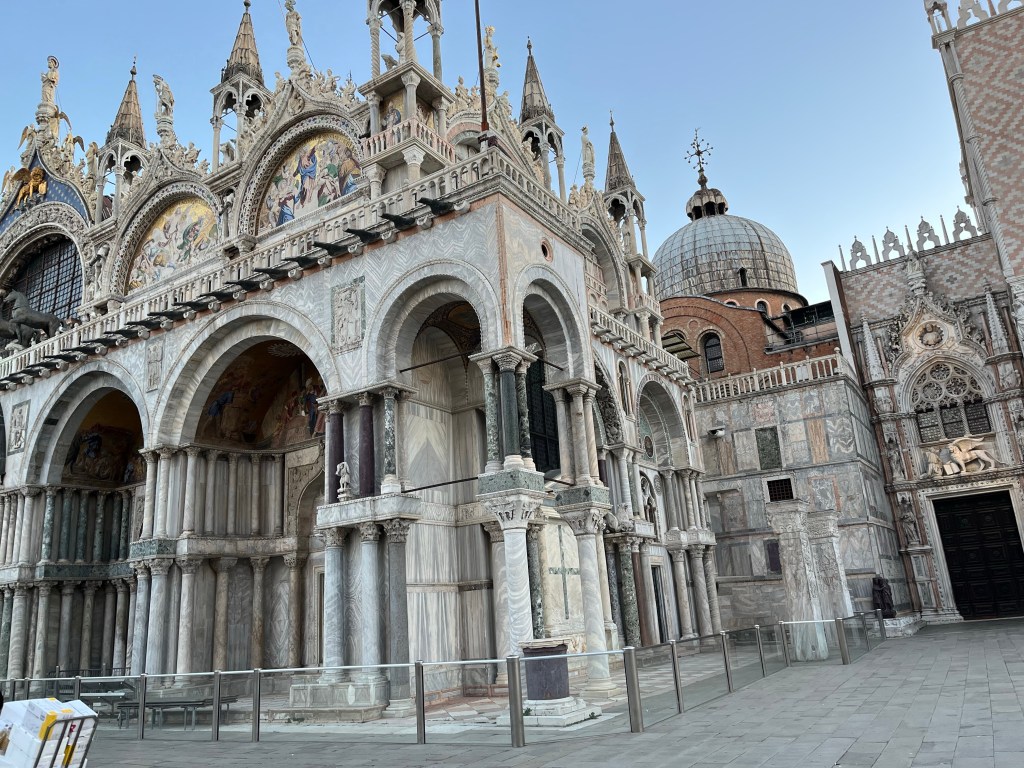
Basilica di San Marco
I wound my way through the narrow streets toward Piazza San Marco, following the signs that point the way. In a short amount of time, I saw the side of the Basilica di San Marco. It’s pretty amazing to see the Piazza early in the morning when its not completely full of people. It’s not exactly empty, but it is pretty great without all of the noise and crowds.
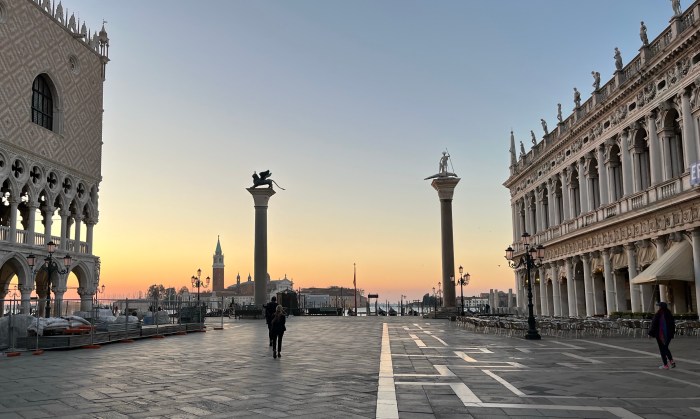
Two Columns, one with St Theodore and one with the Lion of Venice mark the boundary of Piazza San Marco.
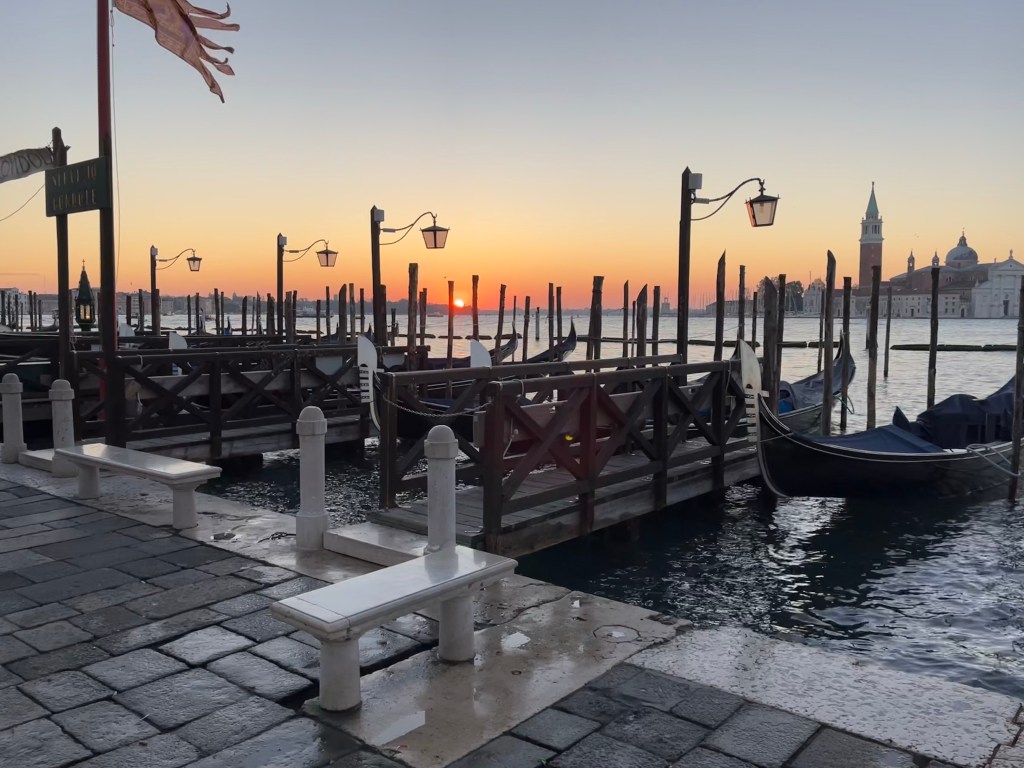
I then ran through the pillars that mark the edge of the Piazza San Marco and turned left along the water. Right outside of the Piazza is a series of docks for gondolas that aren’t yet in service.
Sunrise over Gondolas near Piazza San Marco
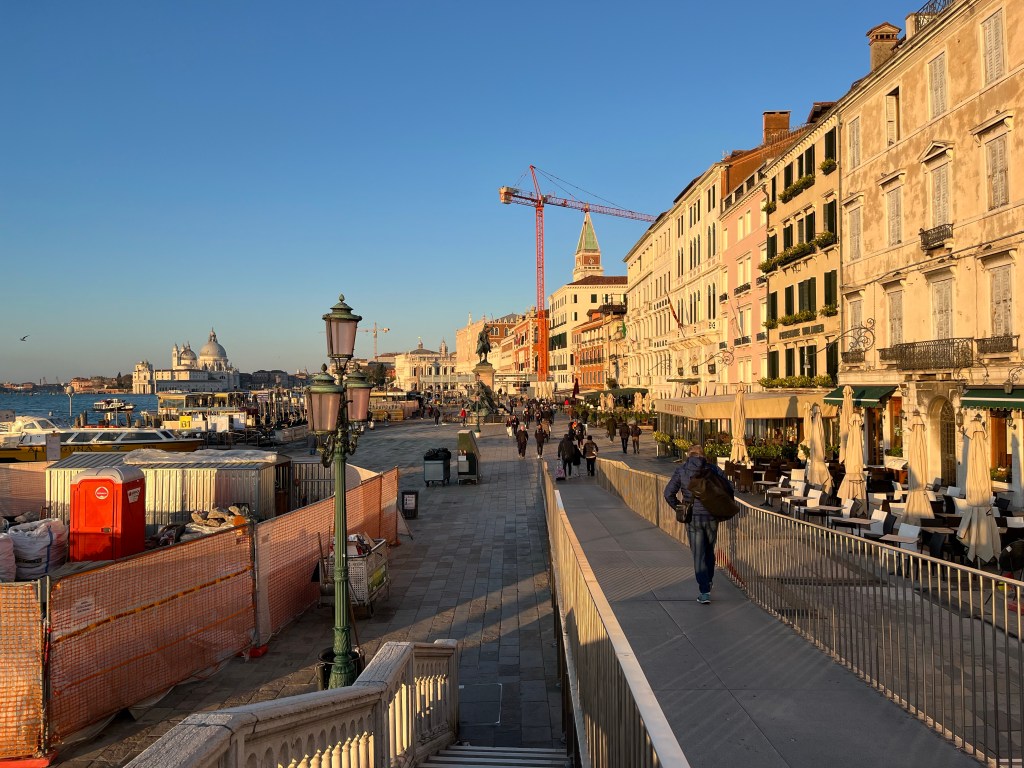
Running along the edge of the water toward the east, there is a lot of activity from all of the docks, restaurants and hotels that are getting their morning deliveries. This is normally a very busy area of Venice, and they need to get their supplies early before things get too busy.
A view of a canal from a bridge along the route.
As I ran to the east, things got calmer and calmer, until finally I reached an area with a lot of trees. It’s a place called the Giardini Della Biennale, which has 30 pavilions, each housing an art exhibit from a different country. These exhibits change and are part of a biennial art exhibition called the Venice Biennale.
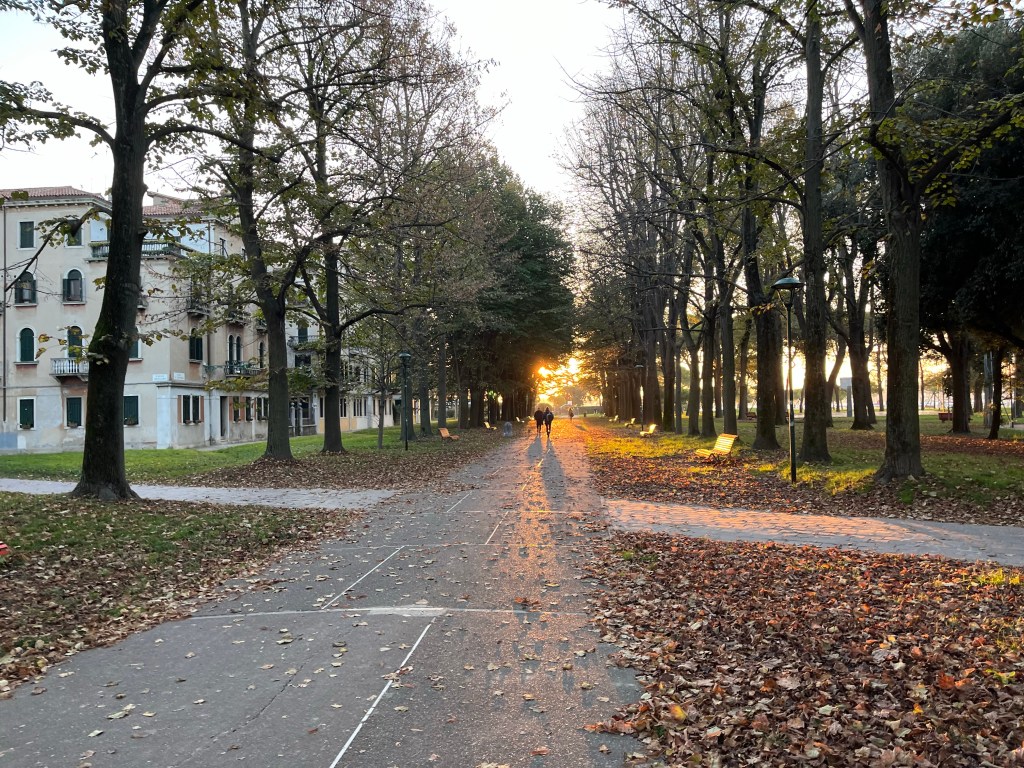
Grass and trees are rare in Venice, but you will find plenty in Parco deile Rimembranze
Moving out of the Giardini, I crossed another bridge and entered another park called the Parco deile Rimembranze. It was a nice serene park with tree lined paths. There were a number of folks walking dogs and enjoying the early morning.
Scuola Navale Militare Francisco Morosoni was the end of the line for me. Time to turn around.
It didn’t take too long before I ran out of park and I arrived at a bridge leading to a military base. Honestly, the last thing I expected to come across in Venice was a military base, but I had reached the end of the line and it was time to head back.
The waterfront area is fairly wide.
On the way back, the sun was higher in the sky, everything was a little brighter and quite a bit busier. It didn’t take very long for the area with all of the restaurants, bars and hotels to begin to fill up with people, probably people heading out for an early cappuccino.
San Giorgio Maggiore
Coming back from the east, there are fantastic views of the islands known as Guidecca. It is just a short distance across the water from the main islands. Also visible is San Georgio Maggiore, a small island that once housed the San Georgio Monastery established in 982. It’s belltower and domed church are striking from across the water.
You won’t find any elevation changes with the exception of bridges in Venice
I finished up by running back through Piazza San Marco and then back to the Airbnb. It turned out to be around 5 miles, and the portion from Piazza San Marco to the Naval Base and back is around 4 miles.
The route primarily is along the water on the South Side of Venice from the Piazza San Marco to the Naval Military School and then back.
When choosing a place to run in Venice, unless you know your way around, you’ll probably want to stick to this route. If you need to stretch out the distance, you’ll probably want to run around in the parks near the art exhibits and the Naval Base. No matter how you do it, it will be a gorgeous run – you’re in Venice after all!





































 Newby to Expert Traveler