A Sunrise Jog in Florence

I love running while traveling. I spend a ridiculous amount of my life running the same roads and bike paths near my house. Over and over again – and don’t even get me started on treadmills. Any time that I get an opportunity to run in different scenery, I will take it.

Florence, Italy is a pretty nice place to run if you get a chance. There aren’t a whole lot of choices of places to run when you’re in Florence, but the views are amazing nonetheless.

Limited Route Choices

The problem with running in Florence is that much of the town is covered by a ZTL or a limited traffic zone that doesn’t allow for cars other than residents, buses or taxis to drive within that zone. As a runner, that sounds great, right? The problem is that because of the ZTL all of the garbage trucks and delivery trucks run around Florence in the morning before the ZTL goes into effect and it can get a little busy. I like to run in the morning but I don’t want to dodge delivery trucks.

You could wait until the ZTL goes into effect, at 7:30, but then the amount of pedestrians increase dramatically and you might end up dodging pedestrians during your run. This might be okay if you want to run a low intensity run and maybe you want to see a lot of the beautiful sights of Florence. But if you want to run at a higher intensity, the option is really to run along the Arno River.

My Route

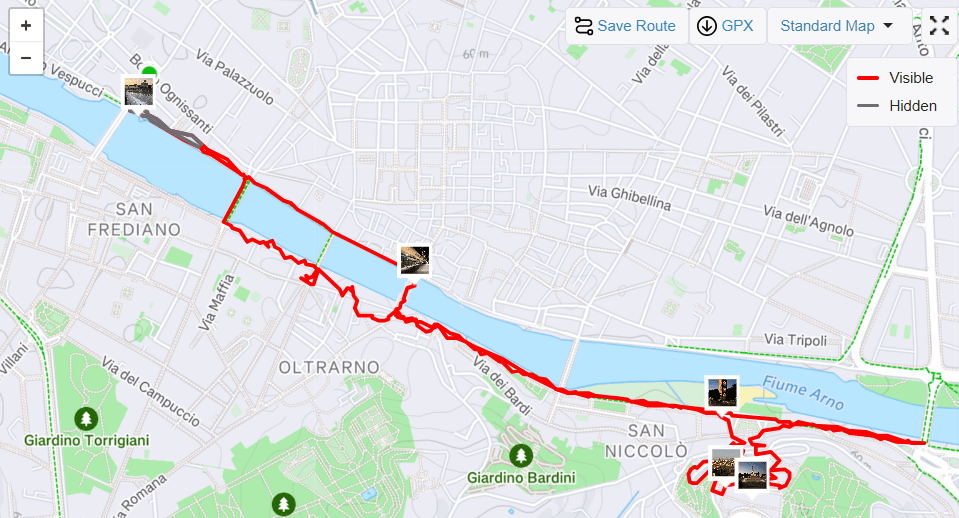
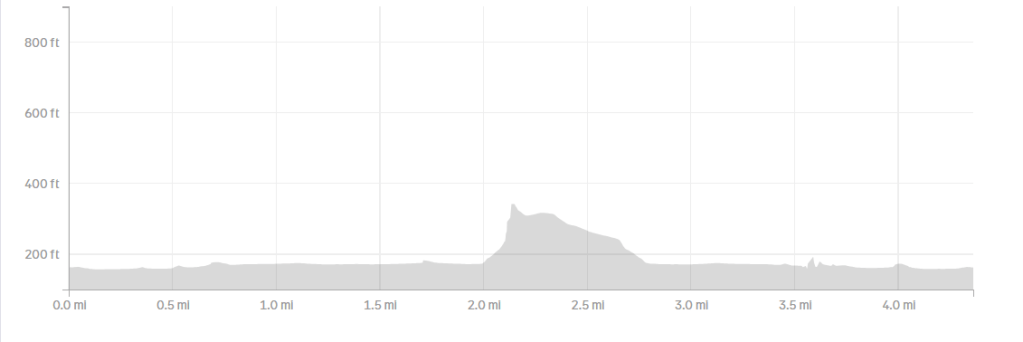
This route was a little over 4 miles with an elevation gain of 233 feet.

Our Airbnb was located south of the Firenze Santa Maria Novella train station and just a block off of the Arno river. This meant that all I had to do was take a right on the first street, and then jump on the sidewalk that runs parallel to the Arno River.

The elevation of this route was pretty much dead flat with the exception of the climb to Piazzale Michelangelo

It was before dawn in November, and the air was crisp with the temperatures in the mid 40s and very little wind. It was the kind of temperatures that is ideal for performance. My attention wasn’t on running a fast time, it was on the amazing views of Florence as it emerged from darkness.

Light reflects off of the Arno before dawn

Florence is beautifully illuminated by the lights along the Arno at night, with streetlights dancing on the ripples of the river. I continued my jog along the river heading toward the famous Ponte Vecchio. There were a few other joggers along the path. I was on the north side of the Arno heading east and the sidewalk was only a few feet wide, but the traffic was light which allowed passing in the street, when necessary.

Crossing at Ponte Vecchio

Ponte Vecchio lit up in the early morning

The previous day, I had experienced Ponte Vecchio in the afternoon with crowds of people shopping for jewelry. When I was there I noticed the shops had wooden protections for the shop windows. I was curious what the shops looked like with the wooden protections down and the crowds gone. I was not disappointed. It was truly interesting and in a way beautiful. At least as beautiful as theft protection could be.

Shops closed on Ponte Vecchio in the early morning

I crossed the Arno River at Ponte Vecchio and then continued east along the river, this time on the south side.

Looking east along the Arno River taken from sidewalk on south side of the river.

Piazzale Michelangelo

I timed my run out for one particular reason. I wanted to experience Piazzale Michelangelo at sunrise. Piazzale Michelangelo is a very popular place for people to visit at sunset, but going at sunrise allows for people to get a spectacular view of the city when very few people have even bothered to get up.

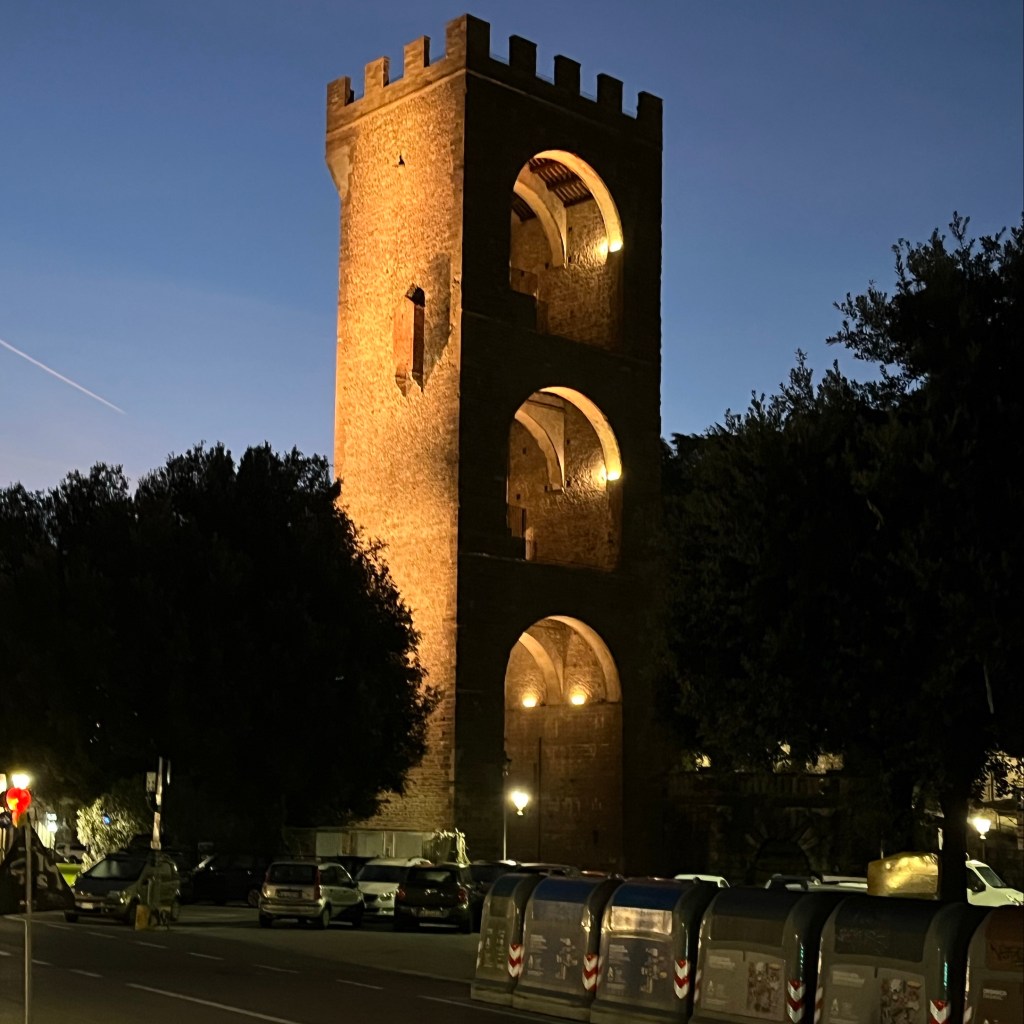
Porto San Niccolò – where you should turn to go up to Piazzale Michelangelo

The problem was, that I missed my turn. I kept running along the path and missed the turn to go up to Piazzale Michelangelo. I ended up running probably about a half mile too far, before I realized that I needed to turn around and come back to the west. I finally took my turn off at Porto San Niccolo, a tower that marks the turn up to Piazzale Michelangelo.

There is a decent amount of elevation change from the path along the Arno up to the Piazzale, so I’m ashamed to admit, I walked a little. But I worked my way up the windy road until I reached the Piazzale Michelangelo and I was not disappointed.

Bronze replica of Michelangelo’s David

The Piazzale Michelangelo is a large plaza that has unbeatable views of the city of Florence. It has spectacular views of the Duomo with the Tuscan hills in the background. Seeing the sun rising over the city is an amazing experience and it was worth every mile and every foot of elevation on the climb.

View from Piazzale Michelangelo

After relaxing a bit in the plaza and watching the sunrise, I worked my way back to the Airbnb, this time spending more time on the south side of the Arno. Seeing essentially the same sights, but this time illuminated by the sun, instead of illuminated by streetlights created a different appreciation for the beauty of Florence.

A look at some of the old city wall

Suggestions for Routes

Based on the limited amount of running that I’ve done in Florence. I think running along the Arno might be your best bet. Running through town, you might find yourself dodging delivery trucks early in the morning or pedestrians later in the morning. If you’re not in a hurry that might not be a problem.

If you can work in a trip to Piazzale Michelangelo, you absolutely should. If you can do it at dawn or dusk, even better. There is just something magical about that location and you will not be disappointed.

Managing Crowds and Expectations in Florence

In November, we had the opportunity to spend a few days in Florence. Prior to that visit, I had talked to a few people about Florence and virtually everyone I talked to practically gushed about how much they loved the city. After spending a few days there, my feelings about Florence are a bit more complicated, and while I’m sure that I’ll return someday, I’m not rushing to schedule a return trip.

Florence at Dawn from Piazzale Michelangelo

Certainly there are some absolutely wonderful things about Florence, but something bothered me about it and I couldn’t quite understand what that was. I enjoyed our stay there but were my expectations too high to begin with?

Architecture

From a building by building, block by block perspective, I’ve never visited a city more beautiful than Florence. No matter where we were, seemingly each and every block in Florence was beautiful. In the mostly residential areas, a pretty normal building is usually four or five stories tall and made with some kind of stone and stucco combination. The majority of the buildings have commercial space on the ground floor and living quarters above. The buildings are well maintained and the neighborhoods are clean.

In the main commercial area of town, closer to Ponte Vecchio, the buildings become a little more elaborate, with some taking medieval castle-like elements from the nearby Palazzo Vecchio.

Liviana Conti in Florence

There are also some amazing architecturally significant landmarks in Florence, including the Duomo, Palazzo Vecchio, the Baptistery at the Cathedral, and the Basilica di Santa Croce. Many of these buildings have taken on a three toned marble exterior style with green, pink and white marble that were extracted from nearby quarries.

Baptistery at the Duomo in Florence with Typical Marble Exterior.

The combination of these buildings mean that virtually wherever you walk in Florence, you will be surrounded by beautiful architecture.

Walkability

Florence is an extremely densely populated city. The main area of the city is comparably small for the population in the area. That makes it an excellent place to walk around. Population density is always good for shops, bars and restaurants, because there are more residents and visitors to support them. It also means that, for visitors, there are a lot of places to shop, eat and drink, without having to take a car or public transportation.

Well Preserved Buildings and Narrow Cobblestone roads

It’s so walkable, in fact, that there is a huge amount of the main area of the city that you can’t drive in for much of the day. The area is called the ZTL or the “zona a traffico limitato“, which you probably don’t need to speak Italian to translate. It restricts traffic to only residents, taxis, or buses. This dramatically cuts down on the number of vehicles and because of that, the roads are mostly for bikes and pedestrians during the ZTL times.

Quirky art in an alley near Palazzo Vecchio

As with many European cities, there are many narrow streets and alleyways that are fun to explore on foot. That’s where you will find quirky little pieces of art, small street shrines and some of the best restaurants.

Small street shrine

Markets

The best cities to visit have great markets and Florence has some amazing ones. The most famous of those is the Ponte Vecchio which is a bridge over the River Arno. It is full of jewelry artisans. There are dozens of jewelers selling bracelets, watches and rings all along the bridge. The “Golden Street” is a fantastic place for any jewelry lover to shop.

Rows of Jewelry Shops on Ponte Vecchio

There are also a couple of great markets for shopping for leather goods. Florence is famous for it’s leather shops and you will find plenty of places to buy leather jackets, purses, wallets, belts and even backpacks. There is a covered market near Piazza della Signoria and just a few blocks north of Ponte Vecchio called Mercato de Porcellino. In addition, there is actually a bigger leather market near the Basilica di San Lorenzo called the San Lorenzo Market. There you will find block after block of leather goods.

Mercato del Porcellino

There is also a fantastic indoor food market near the San Lorenzo marked called Il Mercato Centrale. Of all of the farmer’s markets I’ve ever been to, this is my favorite. The market has two floors, the bottom is devoted to vendors selling meat, fish, vegetables, cheese and wine. The upper floor serves as a bit of a food court with the vendors selling a variety of delicious prepared food. I would not go to Florence without visiting this market.

2nd Floor at Mercato Centrale

Art

Replica of Michelangelo David residing outside of Palazzo Vecchio

You’re not going to find many places with better examples of Renaissance art than in Florence. The wealthy Medici family funded a lot of the production of art in Florence during the Renaissance. As a result, art is practically everywhere. You could spend days visiting museums such as the Uffizi Gallery, and the Accademia Gallery or you could simply wander the city and admire the statues on the Duomo, and in the Piazza della Signore. Renaissance art is in the blood of the Florence and you could spend a lifetime exploring all of it.

Fountain of Neptune at Piazza della Signoria

Shopping

Ferragamo in Florence

Walking around Florence, you will notice some very famous and expensive luxury brands have shops catering to tourists. Brands like Fendi, Prada, Ferragamo, Tiffany and Bvlgari dominate the streets near Ponte Vecchio. This is in addition to the artisans in the jewelry and leather markets.

Crowds

We went to Florence in November, which should be low season in Florence. This did seem to be evident in the fact that we didn’t struggle to find places to eat and drink. We generally were able to get a table immediately and without a reservation.

Crowds gather around the Duomo

But even though there seemed to be plenty of capacity at bars and restaurants, the streets seemed pretty busy. There were some fairly long lines at the Duomo, and I can imagine they were equally long at the Uffizi Museum and the Accademia Gallery as it is generally advised to buy ‘skip the line’ tickets for those museums. On side streets, you could catch a bit of a breather, but walking in the area around Ponte Vecchio or the Duomo was extremely crowded, even though it was November.

Tempering our Expectations

It took me quite a bit of time to understand why I wasn’t blown away by Florence. When I thought about the architecture, history, art and the markets of Florence, it seemed like it should have been a place that I absolutely loved. Something about it bothered me and I wondered why. I had a good time. I loved so much of what Florence had to offer, but it just didn’t seem that great.

Elaborate door near Piazza Della Signoria

I think what bothered me is that Florence is a victim of its own success. Even in the off season, it was crowded and felt too touristy. For example, while the leather artisans at San Lorenzo Market and the jewelers on Ponte Vecchio felt like a natural part of Florence, seeing Tiffany’s and Prada didn’t.

Borgo Sant’Apostoli

But I think the problem was that I had an idealized version in my head of what I thought Florence should be. Of course Tiffany’s and Prada are in Florence. There are millions of visitors every year and many of them can afford to shop there. It makes sense. Sometimes, we as tourists, want everything to feel authentic but at the end of the day the crowds provide business opportunities for investors and residents.

Horse drawn carriage near Piazza della Signoria

And of course, there are going to be lines for museums and the Duomo. These are massively popular attractions in a very popular city. Yes, it will be crowded on Ponte Vecchio. No you’re probably not going to get that perfect selfie standing in front of the Statue of David, there’s going to be a crowd of people there.

Area near Arno River

I wish I had tempered my expectations a little. I think when we planned the trip, I thought that it’s off season, and we’ll get to experience everything that we want without too much wait or crowds. It just not that way, I’m not sure that there is such a thing as a true off season in Florence, because it’s just too popular of a location.

View from the Window of our Airbnb

If you can slow yourself down a little and maybe pick one museum or one major attraction per day, while expecting crowds, you should be able to really enjoy your stay. If you have time and energy to do more than one thing, than that’s a bonus. It’s obviously difficult when you make the long trip from the US to slow down and enjoy the little time you have in a location but its absolutely essential.

Before Dawn on the Arno River

“We can always come back” is a bit of a mantra for us. It takes the pressure off of treating a vacation like a checklist of things we have to do. That being said, I think we will be back to Florence, but next time, I’ll understand that there will be crowds, even in the off season, and I’ll plan accordingly. With the correct expectations, I would have truly appreciated Florence. We can always come back right?

We definitely will.

Points Check December 2024

December is always a month to get together with family and friends to celebrate the holidays. For a lot of people there is holiday travel, but this has always been a time for us to stay home. Now that we’ve been traveling more, this is time that I get a chance to slow down and think about next year’s travels.

While children dreamed of Christmas morning, I was dreaming about where we are going in 2025. Over the last few years, we have done a great job of building up our point balances in a variety of programs, and that opens up a lot of possibilities for our 2025 travels.

It has been tempting to think of places in South America or Asia, but right now, we really love going to Europe. Even though it can be a challenging distance to fly, it’s still close enough that a seven to ten day trip isn’t dominated by flights and the accompanying jet lag. The infrastructure of subways, high speed rail and airports makes getting around in Europe without renting a car easy.

Europe is beginning to feel like an easy destination, where I don’t have to worry too much about how to get around, where to stay or for that matter the language barrier, since so many Europeans speak English well. Plus, we have so much left to see in Europe. Because of that, we have three trips to Europe in 2025 in various stages of planning.

Redemptions Galore

I went on a bit of a booking spree in December. It started with me noticing a great deal on an American Airlines flight to Nice at the perfect time for the UTMB Nice Cote d’Azur Ultramarathons. I wanted to do the 54 kilometer trail race, but I also wanted to make sure that I could get a decent price on a flight before I committed to it. We booked the way there from Moline for only 19,000 American Airlines miles and $11 each. Getting home wasn’t quite as affordable as going to Nice, so I ended up booking a flight out of Dublin, Ireland instead for 19,000 American Airlines miles and $47 in taxes.

That meant we needed to book a flight from Nice to Dublin which we were able to secure on Aer Lingus for a 6,500 Aer Lingus Avios and $37 each. We transferred Amex Membership Rewards points to Aer Lingus Avios at a 1:1 ratio to acquire the necessary Avios. So in the end, for Jenn and I to fly to Nice from Moline and then on to Dublin for a couple days and then back to Moline, cost us 76,000 American Airlines miles, 13,000 Amex Membership Reward points and $190 in cash.

In November, we had booked a flight for Jenn and I and our two kids Alex and Emma from Chicago to Porto, Portugal for 48,000 Virgin Atlantic miles transferred from 35,000 Chase Ultimate Reward points and $702 in taxes and fees.

We did however, need to get back so we booked 4 flights from Madrid to Chicago for 88,000 Iberia Avios and $512 dollars in taxes and fees. Those points were transferred from American Express Membership Reward points and we used 50,700 Capital One Venture miles at one cent per point to wipe out all but $5 of the taxes and fees.

So in two months we booked four flights from Chicago to Porto, four flights from Madrid to Chicago, two flights from Moline to Nice, two flights from Nice to Dublin and two flights from Dublin to Moline. These flights in total cost us 101,000 Amex Membership Reward points, 76,000 American Airlines miles, 50,700 Capital One Venture miles, 35,000 Chase Ultimate Reward points and $897 in cash. I was able to redeem $875 in cash back to help out with the cash for taxes and fees, so out of pocket these flights cost us a grand total of $23. I’m not mad about that at all.

The cash value for the flights from Chicago to Porto were $433 each on KLM. The cash value for the flights from Madrid to Chicago on Iberia was a shockingly high $901 each. The whole Moline to Nice to Dublin to Moline itinerary had a cash value of $1,253 each. The grand total for all of that would have been $7,842 so to only fork over $23 isn’t bad. The 262,700 points and miles we used ended up netting us over 2.6 cents per point in value which is way above what they are actually valued at, so we did a tremendous job of redeeming those points.

A Couple of Bonuses

The $875 in cash back didn’t appear out of thin air. I happened to finally get my $750 sign up bonus for hitting the required $6,000 in spend in the first five months of opening my US Bank Triple Cash card. I actually spent a little over $6,400 and the total cash back was over $850. That meant I got around 13.3% cash back for all of that spend on the Triple Cash over the first 4 months. That’s pretty good, I’ll take it.

Jenn also hit the signup bonus that she was working on. She signed up for the Citi Strata Premier card, which had a 75,000 Thank You point bonus after spending $4,000 in the first 3 months.

This leaves us with no current credit card signup bonuses we are working on, so I’ll have to make a decision about how I’m going to go about building up our points balances after using so many in the last couple of months.

Never Forget Those Credits

I’m supposed to be an “expert”, right? Well, I was listening to a podcast (It was probably Frequent Miler on the Air), and they mentioned that you need to make sure to use up the credits that were expiring at the end of the year. One of the credits that they mentioned was that many Delta Airlines credit cards have hotel credits that can be used once a year. I knew Jenn had a Delta Airlines Business Gold card and so I checked out the credit. Sure enough, there is a $150 annual hotel credit if you book the hotel though Delta Stays.

We used the credit to do a short trip to Iowa City for an Iowa Hawkeye Women’s Basketball game – Go Hawks! We also use this as an opportunity to use up the $50 semi-annual Resy credit that comes with my American Express Gold card.

This was a huge reminder to me to make sure that I not only understand all of the benefits of the credit cards we have, but to actually use them. Most travel credit cards with annual fees will have some benefits or credits that will expire if you don’t use them. It’s important to remember to use those, or you’re not getting the full benefit of a card you’re paying for.

On to THe POint Check!

We didn’t stray too much from the cards that we were working on for a bonus this month. Most of the spending that we did on cards not earning a signup bonus was on recurring charges like utilities, insurance, streaming services, etc. The good news is that you can get a pretty good return on that spend and we were able to get a fairly impressive 7.1% return on all of those recurring charges last month. I’ll take it.

Card UsedSpendPoints EarnedPoint ValuePoints Per $Return on Spend
Ink Cash$4632,317$47.505.010.3%
Wyndham Business Earner$4502,591$28.505.86.3%
Venture$345690$12.772.03.7%
Total$1,2585,598$88.764.47.1%
This month’s spending not devoted to earning a signup bonus

Besides the spending listed above, I also spent a little over $2,200 on my US Bank Triple Cash card earning $37 in cash back as well as the $750 sign up bonus. Jenn spent a little over $2,800 on her Citi Strata Premier card and earned almost 5,600 Citi Thank You points as well as the 75,000 point bonus on that card.

After earning two bonuses and having a whole lot of points redeemed for flights, we were left with:

  • 199,600 American Express Membership Rewards Points
  • 176,700 Chase Ultimate Reward Points
  • 142,300 IHG Points
  • 113,900 Citi Thank You Points
  • 99,700 American Airlines Miles
  • 71,900 Marriott Bonvoy Points
  • 49,700 Wyndham Points
  • 19,600 Hyatt Points
  • 5,100 Delta Miles
  • 2,700 United Miles
  • $105 in Cash Back

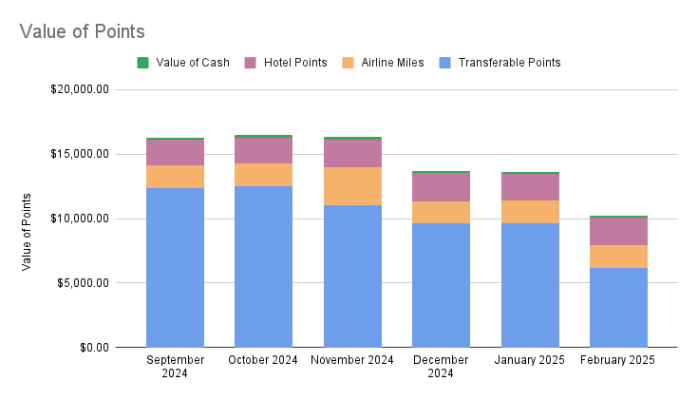
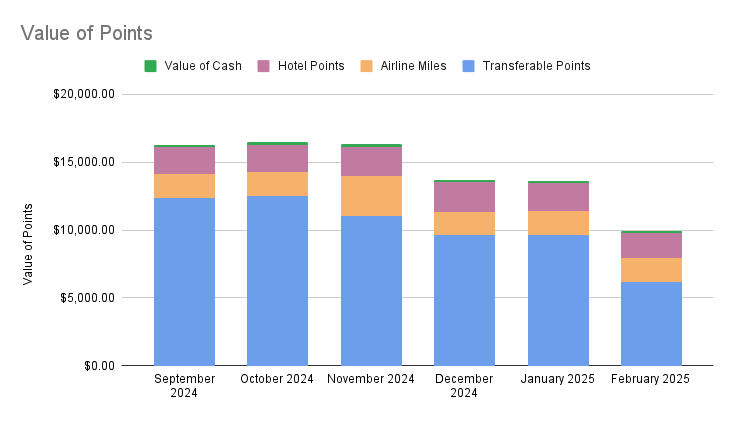
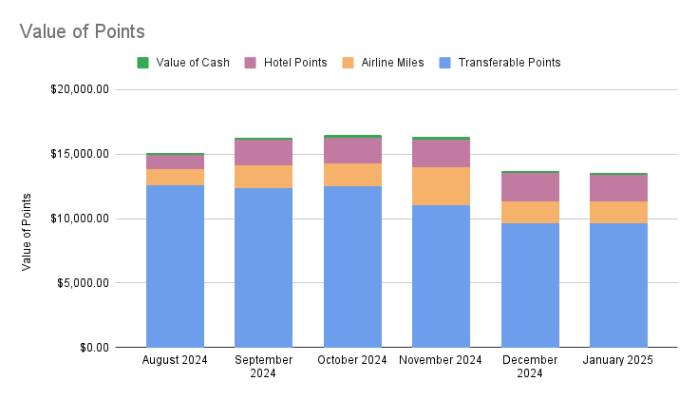
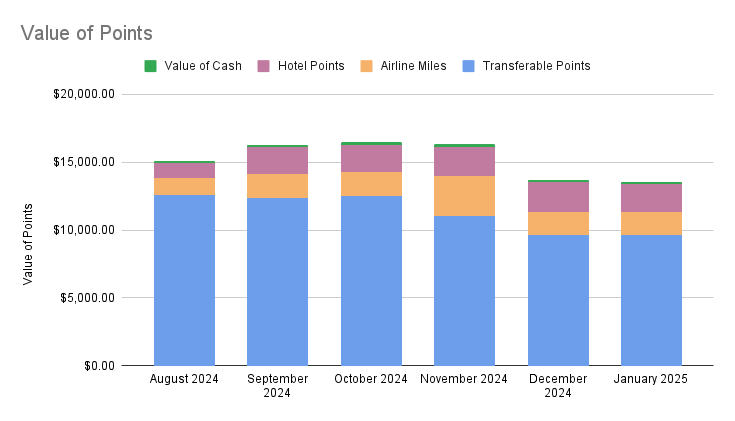
According to the valuations published by The Points Guy, the total value of our points, miles and cash back is $12,950. That is a significant drop from November when the total was worth $15,600, but that’s fine. We are using those points wisely and have all of the flights for two trips to Europe out of the way. I just need to book a summer trip and all of our plans are ready for 2025. It’s going to be a fun year.

Exploring the Duomo in Florence

The most famous building in Florence is the Cathedral of Santa Maria del Fiore, known commonly as the Duomo. It is an architectural and engineering wonder built as Europe was transitioning from the Middle Ages to the Renaissance.

The Duomo at Sunrise taken from Piazzale Michelangelo.

History of Construction

The Duomo dominates the skyline of Florence. It is 376 feet tall at the dome and the campanile is 278 feet tall. Most buildings in Florence are three to five stories tall and are a fraction of the Cathedral’s height. The Duomo is so much larger than the rest of the buildings in Florence that it’s impossible to miss.

The Campanile is an impressive 278 feet tall.

As was the case with many cathedrals built throughout Europe, building the Duomo was a multi-generational project. The project began in 1296 overseen by the architect Arnolfo di Cambio. By 1337, the project had expanded and the plans were changed to include a dome, even though they didn’t yet have plans on how to build it. In 1418, the Architect Brunelleschi solved the dome problem and his design was chosen to finish it. The dome was completed in 1436, finally finishing the construction on the cathedral that had lasted 140 years.

Brunelleschi’s Dome

Painting the dome started in 1572 when Georgio Vasari was commissioned by the Grand Duke Cosmio I d’ Medici to depict the Last Judgment. Vasari died in 1574 and left the frescoes incomplete. Frederico Zuccari was commissioned in 1576 to finish the project which he did in 1579.

The Last Judgment

The facade of the Duomo is a striking combination of white, green and pink marble. Interestingly, the exterior is relatively new, with the work having begun on the exterior in 1871 and was completed in 1887. All of the marble was sourced nearby with the white marble being from Carrera, the green marble from Prato and the pink marble from Siena.

The intricate marble design covers the entire exterior of the Duomo

Even though the Baptistry and the Campanile have extremely similar marble exteriors, they had been clad in marble for centuries when the exterior work was done on the Duomo. Because of the similar marble exteriors, the Baptistry, Campanile and the Duomo feel like one cohesive project, but in fact, the Baptistry was completed in 1059 and the Campanile was completed in 1359.

Ticket Options for the Duomo

The Brunelleschi Pass provides access to climb the stairs up to the top of the dome, as well as the bell tower. It also provides access to the museum, the baptistery and the crypt of Santa Raparata. That pass is available at the Duomo website for 30 Euros.

Doors at the entrance to the Duomo

The Giotto Pass provides everything the Brunelleschi Pass provides, except access to the top of the dome. The Giotto pass costs 20 Euros.

The Ghiberti Pass provides access to the Baptistery, the Museum and the Crypt of Santa Reparata. It costs 15 Euro. If you don’t like hiking up a ton of stairs or heights, this might be the option for you.
Countless statues adorn the outside of the Duomo

Because we didn’t have a ton of time in Florence we decided to do none of those things and just walk inside of the Cathedral. This option is completely free and can be done simply by standing in line. Even though the line was long, it moved fairly quickly and we were able to make it inside in about 20 minutes.

It’s Not as Flashy as You would Expect

When you look at the outside of the Duomo, it’s beautiful, but it’s a quite showy. The front of the Duomo has dozens of statues in the facade, along with the three toned marble exterior. The doors, the windows, every single inch of the exterior of the Duomo is intricate.

Stone archways and ribs hold up the impressively high ceiling of the Duomo.

However, once we walked inside, the amount of plain light tan walls everywhere was surprising. The gray stone archways and ribs holding up the high vault ceiling are beautiful, while seeming strangely plain. There are also some beautiful stained glass windows letting light in from the outside.

Choir area to the left of Brunelleschi’s Dome

There are a series of twelve marble statues inside the Duomo, created by a variety of artists in the 16th Century. These are marvelous pieces of art and fairly large. However, because of the size of the Duomo, they aren’t immediately obvious.

Statue of St James

Compared to many of the churches and cathedrals that I’ve visited, the inside of the Duomo seemed understated. I think that’s what I liked so much about it. From the outside, every inch of the exterior is covered with an elaborate marble cladding. The front of the Duomo has statues everywhere and the doors are enormous and elaborate.

Tapestries in outer aisle

But inside, it’s beauty is in the relative simplicity. Sure there are still stained glass windows, statues and tapestries, but when taking it in as a whole, those things complement the cathedral well instead of overwhelm it.

Statue of Pope Eugene IV on the front of the Duomo

The one element of the inside of the cathedral that is a bit showy is the painting of the Last Judgement in Brunelleschi’s Dome. However, you need to position yourself underneath it in order to view it. You would never see it while seated in a pew during Mass.

Brunelleschi’s Dome

It’s actually a perfect example of the purpose of a Cathedral. For the citizens of Florence, this is the center of their community, it is a source of their pride. The exterior shows off the craftsmanship and labor of centuries of artists, artisans and laborers. But the inside, that’s for worship. Despite, the frescoes and the statues, the focus is most definitely on the altar and the priest performing Mass and ultimately that is the most important function of a Cathedral.

Exploring Vernazza: A Seaside Gem in Cinque Terre

Vernazza is a gorgeous village along the coast in the Liguria Region of Italy. It is one of the five towns that make up Cinque Terre which is both an Italian national park and a UNESCO world heritage site. It has a population of about 700 and dates back almost a thousand years. Traditionally, Vernazza was a town that relied upon fishing, olive oil and wine production. Although those industries still exist today, Vernazza is now mostly a tourist destination.

Vernazza from Doria Tower

Getting to Vernazza

The only practical way to get to Vernazza is by train. Technically you can drive to Vernazza, but it takes twice as long and parking would be a challenge. To enter Cinque Terre National Park, you must enter the park through La Spezia on the south end of the park or Lavanto on the north end. You can buy a day pass for unlimited rides on the Cinque Terre Express in either of those towns. You can also buy them through the Trenitalia app.

Buildings were built into the hillside in Vernazza.

During high season (basically April through October), trains run every 20 minutes. During the off season, they run either every 30 or 60 minutes. You should keep a general idea of when the next train will arrive so that you don’t find yourself waiting too long for a train between towns.

Tunnel at Vernazza Train Station

For up to date timetable and prices for the trains in Cinque Terre, visit the official website.

Experiencing Vernazza

The Cinque Terre Express lets off right in the middle of the town. From the moment you descend from the train platform, you are surrounded by four story buildings on either side and terraced vineyards behind you. In front is Via Roma, the main road through Vernazza that slowly descends into the Ligurian Sea.
Via Roma Vernazza

Walking down Via Roma, there are restaurants and gelato shops on both sides. What caught my eye was the focaccia shops. Who doesn’t love focaccia after all?

Bell Tower at Chiesa di Santa Margherita d’Antiochia

It doesn’t take too much of a walk down Via Roma before you reach the harbor which is the centerpiece of the town. There are no large boats in the marina, it’s mostly just small fishing boats.

Boats in the marina in Vernazza

Directly in front of the marina is a plaza lined with restaurants, bars and shops. To the right is a church from the middle ages called Chiesa di Santa Margherita d’Antiochi. In the front of the plaza is a small beach and to the left is a walkway on the wing dam that protects the harbor. The boats are tied to the walkway on the wing dam.

Doria Tower

Standing in the plaza by the marina, I noticed a sign pointing up an alley that said something about a castle and I was curious. Four of us decided to find out what that was so we walked up a lot of steps through the alleyway and ended up at a ticket booth where a guy was selling entrance tickets to Castle Doria for 2 euros. We paid the two Euros and proceeded up into the castle.

View of Vernazza from top of Doria Tower

The castle itself isn’t terribly impressive other than its location. It is built in the 11th Century as a defense against pirates. It was last used during World War II, when the Germans stationed anti-aircraft weapons there.

View of Monterosso from Doria Tower

It mostly consists of a single tower and a stone platform. What makes it great is that it is perched on the side of the cliff next to Vernazza and makes for tremendous views. It not only provides a great view of Vernazza but you can also see Monterosso when looking North along the coast.

Chiesa Di Santa Margherita D’Antiochia

Following our trek to the top of Doria Tower, we walked across the plaza by the marina to take a look inside the Chiesa di Santa Margherita d’Antiochia.

Chiesa di Santa Margherita di Antiochia

The Chiesa di Santa Margherita D’Antiochia is a church built sometime around 1,300 AD. It is built directly on the marina in Vernazza. The church has gone through a series of renovations over the years, but still maintains a fairly rustic feel.

Chiesa di Santa Margarita di Antiochia

What I love about this church is the stone walls and the large stone archways holding up the wooden ceiling. I think the thing that is most striking about the church is what it lacks. You won’t see any of the giant stained glass windows, frescoes and statues that are so typical of European cathedrals and churches.

Crucifix at Chiesa do Santa Margherita D’Antiochia

What you do notice are some plain crucifixes, some small shrines, and a fairly basic altar. There are some plain wooden pews lined in rows on a stone floor. It’s dimly lit and has only a couple of arched window openings, although without glass. It is precisely what I would imagine a pre-renaissance church to be like. It was truly a treat to visit.

Windows at Chiesa di Santa Margarita di Antiochia

Leaving too Early

After visiting the church, we stopped in for a drink at a bar by the marina. We took a table in the plaza and it was an lovely day to do so. Even though it was in November, the temperature was in the mid-60s, the sun was shining and there was very little wind. It was an ideal day to sit and enjoy a beer. We also snacked on some fried frutti di mare, which had a variety of fried octopus, squid, crab, and fish served like street food in a paper cup from one of the local shops.

After the drink and a snack we decided that we wanted to go to Monterosso for lunch so we hopped on the train to go there. That turned out to be something that we regretted a little. Monterosso is a bit of a beach town and I think visiting it in November probably isn’t seeing it when it’s at its best. Its lovely but in the end it just didn’t seem to have the same charm as Vernazza, and we quickly started to wish we had stayed a little longer in Vernazza.

Cinque Terre Should Be More Than A Day Trip

We only had three full days in Florence and we devoted one of those days to this day trip to Cinque Terre. I’m glad we went, but in the end, I think we really need to devote three days to Cinque Terre to fully appreciate it. We only visited two of the five towns and it felt rushed.

Hillside Vineyards overlook the marina in Vernazza

There is an old trail that connects the five towns and I would love to spend three days hiking between the towns and really getting to know each town more than what you can in just a few hours. Each town has it’s own unique character and breathtaking views of the Ligurian Sea.

If you plan to visit Cinque Terre, but you only have a single day, I would suggest that you pick just one town and really enjoy as much as you can. I thought Vernazza was a beautiful place, and would be a great choice if you were going to select just one town.

Cinque Terre itself, however, is one of those bucket list locations that any world traveler should visit. The old world charm, the beauty, and the fact that these amazing towns are precariously perched on hillsides overlooking the Mediterranean Sea demonstrate why this area is both a National Park and a UNESCO world heritage site. It’s just an amazing place to visit and I can’t wait to return.

Mercato Centrale in Florence is Fantastic!

We usually make it a point to visit a local market when we are traveling. For example, we’ve visited the Viktualienmarkt in Munich, the farmer’s market in Grecia Costa Rica and the St. Lawrence Market in Toronto. Of all of the markets that we’ve visited, Mercato Centrale in Florence is my favorite. If you’re planning to spend some time in Florence, this needs to be one of your stops.

Second Level of Mercato Centrale

Where is Mercato Centrale?

Mercato Centrale is about a 5 minute walk northwest of the Duomo in Florence. It’s also about a 5-10 minute walk east on Via Nationale from Santa Maria Novella Train Station.

Just outside of the Mercato Centrale is San Lorenzo Market. This market surrounds Mercato Centrale on three sides. It consists of leather vendors selling jackets, backpacks, purses and belts. These vendors tend to get a little aggressive as you’re walking through, but not too aggressive. From what I can tell, and I’m no expert, but the leather vendors appear to be primarily selling high quality leather goods made in Italy.

The Ground Floor is for High Quality Groceries

You will have to go through San Lorenzo Market to get into the Mercato Centrale building. The building is a huge two story iron and glass building with massive amounts of space for a variety of vendors. On the ground floor there are fishmongers, butchers and produce vendors as well as specialty stalls selling wine, olive oil and balsamic vinegar.

Unless you’re visiting Florence for a long period of time, and will be buying some groceries for your Airbnb, this area won’t be that useful. It is, however, fascinating to see the kinds of fresh fish, meats and produce that are available in the market. Fishmongers sell a variety of fish, as well as prawns, octopus, and clams.

Some of the available fish at a Fishmonger stall

The butchers, of course, are ready to cut meat to order. As a tourist, however, you might be more interested in picking up some cured meat that you will see hanging from the top of many of the stalls. You will also find cheesemakers in the market selling a variety of cheeses that are local to Tuscany. If you pick up a baguette from a baker at the market you can probably put together one of the best sandwiches you’ve ever made. By the way, if you have a long train ride out of Florence, putting together some sandwiches for the trip can make that train ride extra enjoyable.

Butcher at Mercato Centrale

If you’re bringing a checked bag, and would like to bring a bottle of wine home, I would suggest checking out the wine shop. Any wines that are truly local will be marked with a designation of DOC or DOCG. DOC stands for Denominazione di Origine Controllata which basically just means that it’s up to quality standards for a wine of that region. DOCG essentially means the same thing but it adds ‘Garantita’ (guaranteed) to the end meaning that it has higher standards than DOC. Also, if you don’t have room in your checked bag, you can always just drink a bottle or two, no one’s stopping you, you are in Florence after all.

Produce Vendor at Mercato Centrale

The more likely thing you might want to pack in a checked bag would be balsamic vinegar and olive oil. If you’re used to the olive oil that you find at an American supermarket, Italian olive oil is an eye opener. I’m used to the flavorless olive oil from Aldi, and essentially every restaurant we went to in Italy would have a bottle of olive oil sitting on the table that was just outstanding. People who brag about the quality of olive oil in Italy aren’t lying, seriously, grab a bottle, throw it in your suitcase, you won’t regret it (unless it breaks during the flight of course).

First Floor of Mercato Centrale

The Second Floor is for Prepared Food

All of that being said, we didn’t spend much time on the first floor. We weren’t planning to cook and I didn’t bring a checked bag, so the place that I really loved was the second level.

The second level is primarily devoted to prepared food. It’s a great place to get a snack or a full meal.

Cafeteria seating on the second floor with additional seating on the third floor

The first thing I noticed, and immediately went to, was the bar. I love craft beer, and when you’re in Italy, it’s not the easiest thing to find. However, the bar at the market has a number of beers on tap and even more in the bottle. The owner of the bar does an excellent job of choosing beers that not only cover a variety of styles, but also compliment the prepared food by the other vendors on the second level. He also has chosen beer that is of good very good quality, including some Trappist ales.

Bar at Mercato Centrale

We sat down at one of the tables, and a server came out to take a drink order. I think you can order food from the vendors from the table, but we just chose to get up and look around and order it from the counters. I wanted to get a good look at all of the available food, anyway.

Cicchetti at Mercato Centrale

Scattered around the second level you will find vegan options, sushi, barbecue, and burgers. If you are looking for something a little more Italian, you will find crostini, arancini, and lots of sandwiches made with schiacciata and focaccia.

Sandwiches, Quiche and Baked Goods at Mercato Centrale

We visited the Mercato twice during our trip, and the first time I grabbed an arancini on the way out of the door. It was so good. It had just a little bit of ham and some cheese rolled up in a rice ball and fried. That was the first arancini I had ever tried and after that I was grabbing one wherever I found them.

On the second trip to the market, I grabbed some smaller arancini made with meat and tomato sauce and some fried stuffed olives. They were good as well, but I definitely preferred the arancini with the ham and cheese.

Lorenzo de Medici Cooking School

Cooking School at Mercato Centrale

Also on the second floor is the Lorenzo de Medici cooking school. The cooking school offers two hour classes that instruct students on how to make a Italian Dishes. These dishes include pasta, bread, and desserts. Most of the classes cost 80 euros to attend, but some are a little more expensive. A full list of the classes being offered can be found on their website.

Visiting Mercato Centrale is a Must

If you are going to Florence for longer than a couple of days and you love food or wine, you absolutely have to go Mercato Centrale. If you will be in Florence for a week and have access to a kitchen I would absolutely pick up some groceries from the first floor of the market. They are of high quality and you will have an opportunity to talk with the vendors to get some input on how you should use their products.

If you are like us and only have a few days in Florence, you still should go, but the second floor is where you will probably want to spend your time. There is a variety of prepared food that should allow for you to do some taste testing and really try some foods that you might not normally order in a restaurant. And, of course, if you’re a beer lover, you’ll want to check out the bar. It’s got a great selection of beer and will be a nice change of pace from all of the Italian pilsners that you’ll drink while in Italy.

Also, if you have time, you might want to check out the cooking school. If we had been in Florence longer than three days, I might’ve done a class. Who doesn’t want to learn to cook like an Italian after all?

Points Check October 2024

Much of our time in October was spent preparing for our trip to Italy. Our trip included our good friends Bill and Theresa and Jenn’s Parents. None of them had been to Italy before and we wanted to make sure that they had a great time. I spent a decent amount of time researching places to visit, things to eat, train tickets, etc.

Meanwhile, Jenn spent a good deal of the month making ensuring that our kids had everything they needed to survive while we were gone. Emma and Alex are 19 and 15, respectively and they are definitely at the age where leaving them for another continent is questionable. I am, however, a firm believer that giving children challenges is a great way to turn them into functioning adults.

I can tell you that Emma passed this challenge with flying colors. She was not only responsible for taking care of Alex while she was gone, but she also was working, going to school and taking care of Jenn’s Parents’ dog. On top of that, she was coaching a youth basketball team. She took care of all of that and made sure that our house didn’t turn into a scene from Lord of the Flies. We couldn’t be prouder of her.

Citi Strata Premier Card

Right before we left for Italy, Jenn applied for, and her application was accepted for the Citi Strata Premier card. This is Citibank’s premier card and it’s a pretty good one. It has a $95 annual fee and has some pretty good bonus categories.

  • 10x on Hotels, Rental Cars, and Attractions booked through the CitiTravel.com
  • 3x on Groceries
  • 3x on Restaurants
  • 3x on Gas and EV Charging stations
  • 3x on Flights and Other Hotel Purchases
  • 1x on Everything Else

Getting 3x on groceries, restaurants and gas means means the cardholder can get 3x on a large portion of their spending without worrying about using one card for dining, and one card for gas, etc. It is a great credit card for people who don’t want to think too hard about points and miles.

This card currently has a 75,000 point welcome offer when the cardholder spends $4,000 within 3 months. Citi points are valued at 1.8 cents per point by The Points Guy, so that bonus is worth $1,350. In order to get that 1.8 cents per point value, you would need to use one of Citi’s transfer partners, including some of my favorites like Air France/KLM flying blue and Avianca Lifemiles.

It has a $100 credit on a hotel purchase of $500 or more using the Citi Travel site. It also has some trip protections and no foreign transaction fees. Overall, it’s a really solid travel credit card and especially good for people who don’t want to manage multiple cards.

Ok, On to the Point Check

This was not a great month for spending on non-bonus cards. We’ve gotten a little lazy about what card to use. For the vast majority of the month, Jenn didn’t have a card where she was working on a signup bonus. She is usually the one yelling at me that we need to sign up for a new card, because she can’t stand not working towards a signup bonus. Because she didn’t have a signup bonus to work towards, she just used her IHG Premier and her Amex Business Gold, neither of which were particularly great choices.

Card UsedSpendPoints EarnedPoint ValuePoints Per $Return on Spend
Amex Business Gold$1,1431,310$26.201.12.3%
IHG Premier$8142,695$13.483.31.7%
Ink Cash$5612,783$57..055.010.2%
Venture$372745$13.782.03.7%
Wyndham Business $2841,588$17.475.66.2%
Total$3,1749,121$127.982.94.0%
This month’s spending not devoted to earning a signup bonus

Because of that, the return on spend on cards where there wasn’t a signup bonus was 4%. I like to keep that number above 5% and lately we’ve been over 6%. Note to self – make sure Jenn has a signup bonus to work on.

Besides the spending on the above chart, I spent over $3,200 on my US Bank Triple Cash card, earning a little under $50 in cash back. That puts me more than halfway to the $6,000 in required spend to earn the $750 bonus on that card.

That meant that we finished the month with:

  • 296,700 Amex Membership Reward Points
  • 217,000 Chase Ultimate Reward Points
  • 141,700 IHG Points
  • 104,800 American Airlines Miles
  • 85,400 Capital One Venture Miles
  • 71,900 Marriott Bonvoy Points
  • 30,400 Citi Thank You Points
  • 11,300 Hyatt Points
  • 5,000 Delta Miles
  • 2,700 United Miles
  • $220 Cash Back

Using the Points Guy’s valuations, all of this totals to an all-time high for us of $15,800 in points, miles and cash back. We have some pretty big travel plans for 2025, so we’re going to need a big stash of points available. Hopefully I see some Black Friday deals so I can lock in some plane tickets!

We Loved our 25 Hour KLM Stopover in Amsterdam

Amsterdam is a city that I’ve dreamed of visiting for decades. The center of Amsterdam is a magical area where the canals and the buildings that line them are practically frozen in the 17th Century, when merchants trading goods from Asia brought wealth to the Netherlands. It was amazing to visit Amsterdam, even though it was a short stopover.

Taking Advantage of KLM Stopover Rules

We had the opportunity to take a 25 hour stopover on our way to Rome. When we planned our trip to Rome, there was a flight we liked from Chicago to Rome, but the layover in Amsterdam was only a little over an hour. That was a dangerous connection since we would have to go through immigration and security. We might’ve made it, but any delay would have made it close to impossible.

Our solution to the short layover was to fly in a day earlier and use KLM’s stopover rules to our advantage. KLM gives flyers the ability to stop in Amsterdam for up to 12 months on flight itineraries that stop in Amsterdam. This adjustment meant that we had a day in Amsterdam to defeat jet lag and do some wandering.

Check out this post for more information about how we booked the KLM stopover in Amsterdam.

Arriving in Amsterdam

The KLM flight from Chicago to Amsterdam was comfortable and we landed at the airport without incident. Amsterdam has fantastic train service at the airport and in less than 20 minutes we were at Amsterdam Centraal for about 5 Euros a ticket.

Row houses along a canal in Amsterdam

We stayed at the Kimpton De Witt near Amsterdam Centraal train station. They were gracious enough to find us a vacant room and allow us to check in at around 8:30 AM. The staff was very nice and even gave us a 15 Euro drink credit for using the current Kimpton Password.

We dropped our luggage off at the room, took a quick shower and we were off and running.

Walking the Canals

We were planning to take a nap, since we, as usual, were unable to sleep on the overnight flight. But first we wanted to walk along the canals and, more importantly, get some breakfast.

Wheels of Gouda are on display at a traditional cheese maker near our hotel.

The place we stopped at was a small but very busy breakfast restaurant called Omelegg. Seating there was a bit of a challenge. We ended up having to sit next to each other at a booth because the other side had a bench that was being used by a different table. It was a little awkward, but it was fine.

The Italian Job at Omelegg

Jenn ordered the Italian Job and I got the Chicken Harissa omelette. Both were very good and served with soft slice of dark wheat bread and an arugula salad.

Row houses right on a canal. Watch out that first step out the front door is a little tricky.

The Kimpton De Witt is right on the edge of the Red Light District, so most of what we noticed at the beginning of our walk was a whole lot of weed shops and erotic boutiques. We also noticed more litter than I was used to seeing in Europe. There was a pretty pungent smell of marijuana in the air as well as cigarette smoke.

Classic Dutch Row Houses

While those things are a little unpleasant, Amsterdam is so unbelievably gorgeous it easily makes up for those shortcomings. The canal houses with their narrow five story design, brick exterior and big windows are beautiful. The tree lined canals and herringbone pattern brick streets make for an amazing backdrop for a sunny crisp fall walk.

The Church of St Nicholas

It’s nice to walk without a purpose or direction. We wandered the brick streets admiring the houseboats and tiny cars that lined the edges of the canals. It was a fairly peaceful walk with only the occasional car, bike or pedestrian that went past us. After about an hour the jet lag caught up with us and we returned to the hotel for a nap.

Trying Amsterdam Beer Culture

Scharrebiersluis bridge along the way from the hotel to Brouwerij’t Ij is a drawbridge built in 1906.

After our nap, we headed over to Brouwerij’t Ij. It was about a 25 minute walk from the hotel but a lot of it went through some gorgeous newer neighborhoods. Even though these neighborhoods didn’t have 400 year old row houses, the buildings kept the spirit of Amsterdam architecture. Many of them were block long buildings, instead of the narrow and tall buildings but they still were mostly 5 stories with shops on the first floor.

The De Gooyer Windmill sits behind Brouwerij’t Ij is the tallest wooden windmill in the Netherlands at 26.6 meters tall.

When we arrived at Brouwerij’t IJ I ordered a Tripel and Jenn ordered the Columbus. I loved the Tripel because it had less funk then many of the tripels that I’ve had in the past. Jenn had the Columbus which is an hoppy imperial beer which she also enjoyed. We sat out in their beer garden and watched traffic along the street which was mostly pedestrians and cyclists. It was lovely and we would’ve stayed longer but I wanted to check out Gollum Aan Het Water.

The beer and the atmosphere at Brouwerij’t Ij was great. I would recommend visiting when you are in Amsterdam.

Gollum has a series of bars around Amsterdam with an impressive beer selection, especially in bottles. Gollum was on my list of places that I really wanted to visit in Amsterdam. I was hoping to try some Belgian Ales that don’t make it to the US.

Just a portion of the amazing beer selection at Gollum Aan Het Water

We started with a Rochfort and an Orval then moved onto some regional craft beers and other Belgian Ales. The quality and variety of the beers served at Gollum was off the charts so I was a bit of a kid in a candy store.

Orval is a beer produced at Orval Abbey in Wallonia Belgium and the sale of the beer helps support the monastery.

To be fair, we had perhaps too many beers at Gollum. As is sometimes the case with us, we got to chatting with other folks at the bar. We met a nice gentleman, originally from England, and his Bernese Mountain dog as well as a couple of guys from North Carolina. The bartender was extremely friendly as well.

It’s always tough to drag ourselves away when conversation flows as easy as the beer. It’s even harder when those conversations are with interesting people from various countries.

Boats illuminated in the night.

Eventually, a little tipsy, we pulled ourselves away from Gollum we walked back towards the hotel. By this time, it was evening and the lights of Amsterdam were dancing on the ripples of the canals. Amsterdam is lovely during the day, but it’s even more enchanting at night. The wind was calm and the air was a touch chilly. It was a perfect night for a lovely walk through Amsterdam.

Montelbaanstoren, a tower dating to the 16th century is illuminated in the evening.

On our way back, we popped into a fast food Kebab place to fill up on hummus, falafel and fries. It hit the spot. I have yet to be disappointed by a middle eastern food in Europe. It is always so good and this was no exception.

Every McDonald’s in America should be replaced by Turkish Street Food – Immediately!

We Will Definitely Return

Doing a stopover in Amsterdam turned out to be a fantastic addition to our trip to Italy. It allowed us to enjoy one of Europe’s great cities without devoting a week to it.

Amsterdam did not disappoint us. Despite our initial negative reactions to the litter and smoke clouds in the Red Light District, Amsterdam is an almost magical city. The architecture, canals, the sheer volume of bikes just make for a uniquely Dutch experience.

We most definitely will be visiting Europe in the future and knowing just how great a stopover in Amsterdam can be, I think there is a good chance we will do this again. Next time, though, we might have to spend two days instead of one.

Exploring Beer Culture in Ontario’s Wine Country

One thing that surprised me about our trip to Ontario was the number of wineries and vineyards that exist in the area between Niagara Falls and Toronto. According to Ontario Wine Appellation Authority, cool weather varieties thrive in this area, like Riesling, Chardonnay, and Pinot Noir.

We were staying in Hamilton, having parked our camper for the week at Fifty Point Conservation Area. From where we were staying, it seemed like every exit along the Queen Elizabeth Way had signs for at least two wineries.

Maybe we should have popped into a winery and checked out what was special about the wine in the Niagara region, but we were more interested in checking out the beer scene. While we were in Ontario, we noticed that there were a few differences between beer culture there and beer culture in Iowa.

Production Breweries vs Brewpubs

Our first night in Ontario, we decided to go to Newark Brewing Company. It is a pretty large production facility set in an industrial area. There is, however, a large grassy side lot that makes the tap room feel like it’s much more out in the country. In fact, our server told us they were part of Harvest Hosts which is a group of wineries, breweries and other attractions that allow you to camp on their site for free. So that grassy lot might just be available for camping.

Dunkel Lager at Newark Brewing

This was the first of many production breweries we visited. Throughout our visit, one thing became fairly clear. Most of the breweries we visited were full scale production breweries first and taprooms second. It’s a different vibe from most of the breweries we visit in Iowa where most of the beer goes straight into kegs to be served at the brewpub. Some canning is done at these brewpubs, but a very low volume is sold, mainly at the taproom itself for carry out.

Session Beers and Low Alcohol Drinks

I love how the beer culture of Iowa has really grown over the last 20 years or so, but if I had one complaint it’s that Iowa craft brewers (and frankly most US craft brewers) brew too many high alcohol beers.

High alcohol beers are rich, flavorful and delicious but they tend to lack drinkabilty, and aren’t refreshing on a hot day. They also, predictably, make the drinker inebriated at a quicker pace, which creates its own series of problems.

At the first brewery we went to, we noticed that there wasn’t a single beer over 6% and most were 4%-5%. I had the Dunkel while we were there which was right at 5%.There are breweries in Iowa where finding a beer under 6% can be tricky, so being at one where everything was 6% or under was refreshing.

The next day we visited Collective Arts. That is a super funky production brewery in a highly industrial area in Hamilton. They served a micro pale ale at 2.9%. I had never heard of a pale ale that low in alcohol.

Later in our trip, we went to Fairweather Brewery which had a series of fruited ales that were 2% alcohol. They were called Chuggy, Jenn tried one of them and really liked it.

Throughout our trip, the focus that most of the breweries had was on beers with traditional alcohol content not Imperial or Double beers. The fact that a few also had beers under 3% was a nice little bonus. I wish this was something that we saw a bit more often in Iowa.

Our Favorite Breweries in Ontario

This isn’t really a full assessment of breweries in the Ontario area since we were only able to visit a few breweries in the week we were there. But I can definitely tell which ones we would’ve been visiting multiple times if we lived in the Hamilton area.

Collective Arts

I found this one by searching around on Google Maps and it didn’t disappoint. They have an amazingly funky vibe. Art is everywhere around the facility with murals on practically every wall. It’s a huge facility but they have a cool patio area where we sat for a beer. Next to the patio area is a large industrial room that looks like maybe its used for canning and barrel aging (I’m not sure about that, I didn’t go snooping). That room also has a bunch of cafeteria style tables in it for when its too cold for the patio.

Barrel Aging at Collective Arts Brewing.

Collective Arts also has a good carryout facility and we did pick up some beer for the camper. The cans also had some great artwork. The beers that we tried, both at the facility and back at the camper, were very well done. If we lived in this area, I think we would visit regularly. For more information on Collective Arts, visit their website.

Bench Brewing Company

Bar at Bench Brewing Company

Bench Brewing Company is a large production facility set off in the middle of wine country. The facility is in a very scenic country setting with an apple orchard and several wineries nearby. They actually have their own hop farm on site.

It has a little bit of an modern industrial vibe to it. The bottle and gift shop is actually two shipping containers that you have to walk past to get to the tap room. They have a large patio area and a large restaurant. Since it was a weekday afternoon, they were only offering service in the restaurant so we sat in a covered deck seating area at the restaurant. We had a little snack and a couple of beers. Everything was well done, the beers that we tried were all of session strength and well made.

Rows of hops at Bench Brewing Company

I would have liked to have spent some time in the patio area. Bench Brewing is in an idyllic and peaceful location, being at the restaurant wasn’t taking advantage of the location. If I were looking for a place to relax on a nice day, this would be the place I would want to sit outside and have a beer. More information about Bench Brewing can be found here.

Outdoor Area at Bench Brewing Company

Trust The Locals

We always like to ask the folks who work at breweries where they go for a beer. Most bartenders and servers at breweries are beer lovers themselves and tend to have very good suggestions. A couple that came up were Merit Brewing and Fairweather Brewing.

Menu at Merit Brewing

We did go to Merit Brewing and I understood the hype. There is some creative brewing going on at this facility. I’m not into sours, but I did have to try a small pour of the Wild Years, which is a brett saison with peaches and muscat grapes. Hats off to the brewer on this one, that’s a very creative beer and if you’re into sours, definitely worth a try. I also tried Young Rival, which I thought was a very good IPA. More information on Merit Brewing can be found here.

We also managed to make it to Fairweather, which wasn’t my favorite mainly because they did have a focus on sours, which again, I avoid. Jenn loved the low alcohol Chuggy beers. They are doing some creative things with sours. Right now they are serving a beer called Apsara that is a sour with peaches, milk sugar, vanilla and chai. If you love sours, I think this is a great brewery to visit. More information on Fairweather can be found here.

Silversmith Brewing

My personal favorite was a little brewery set in Virgil Ontario called Silversmith. It’s located in a little church that’s been converted into a microbrewery. It has a little patio out back where we enjoyed the warm weather and a couple of pints.

The Black Lager

I had The Black Lager, a schwarzbier which was delicious. I don’t know why schwarzbiers aren’t at every brewery to be honest. They are drinkable, flavorful, usually around 5%. They are just perfect all around beers that can be enjoyed year round. Silversmith not only brewed a great beer style, but they nailed it on the execution.

Silversmith is a converted church so I guess you can say you went to church if you go there.

Silversmith seems to focus on well executed classic beer styles and I appreciate that. There are so many breweries now that are going out of their way to invent new kinds of beer, and I applaud the creativity, but sometimes a well executed classic styled beer hits the spot. They are classic beer styles for a reason, after all. More information about Silversmith Brewing Company can be found here.

Belly Up to the Bar

The best thing about beer culture in general is the people. Wherever I am in the world, sitting at the bar is a fantastic way to talk to friendly people. Canadians have reputation for being extremely nice. Our week in Ontario confirmed that stereotype. We’re known in Iowa for being “Iowa Nice” and I can confirm that the folks in Ontario are just as warm and welcoming. Someday we’ll have to visit again.

Last Call for the American Airlines Aviator Red card?

Last week an article by CNBC indicated that Citigroup was in heavy negotiations with American Airlines to be the exclusive card issuer for American Airlines credit cards. These negotiations are immensely important for American Airlines because the revenue that comes from airline loyalty programs are now a huge portion of their income. It’s become so important, in fact, that it’s sometimes joked that airlines are credit card companies that fly planes. According to Delta CEO Ed Bastian, nearly 1% of the entire US economy is charged to Delta credit cards. The revenue from selling loyalty points to banks is a multi-billion dollar industry for airlines, and its a revenue stream they take very seriously.

American Airlines is in a strange situation because they have cobranded credit cards issued by two different banks. There are four credit cards issued by Citigroup which include three personal credit cards and one business card. Barclays technically has two personal American Airlines cards, but one is only available through upgrade, the AAdvantage Aviator Silver. The only Barclays American Airlines card with a current sign up bonus is the AAdvantage Aviator Red.

The fact that American Airlines has two banks issuing their credit cards is because of an American Airlines merger with US Airways over a decade ago. US Airways had a relationship with Barclays and after the merger US Airways credit cards issued by Barclays became American Airlines cards. American Airlines kept that relationship going, even as people began to forget about US Airways.

It makes sense for American Airlines and Citigroup to form an exclusive relationship. It would make the AAdvantage program more straightforward by reducing the complexity of having multiple card issuers. In the end, I think it’s highly likely that American Airlines will end their relationship with Barclays and form an exclusive relationship with Citigroup.

AAdvantage Aviator Red Card

If Barclays is going to get dropped from the AAdvantage program, it’s safe to say the Barclays AAdvantage Aviator Red card is going to go away. In some respects, good riddance, it’s not a very interesting card. It earns 2 miles per dollar spent on American Airlines purchases and 1 mile on everything else. You do get a free checked bag and preferred boarding but the annual fee is $99.

The thing that does make it interesting is that the signup bonus is incredibly easy to earn. Right now, there is a 70,000 mile signup bonus available through Frequent Miler’s website. What is the spending requirement? Signup and use it once. Literally, pay the $99 annual fee, activate the card and buy a pack of gum using the credit card and 70,000 AAdvantage miles are yours for the taking.

70,000 AAdvantage miles is a pretty decent haul. We took recently our family of four to Costa Rica from our small regional airport during Spring Break for a total of 120,000 AAdvantage miles and around $340 in taxes. Also, I have noticed, anecdotally, that flights out of smaller airports that are serviced by American Airlines don’t pay significantly higher amounts of points than flights out of larger airports. That it is definitely not the case for United Airlines, for example.

In addition, I’ve been eyeballing some deals to Portugal for spring break that are running around 22,500 AAdvantage miles one way per person. Having an extra 70,000 miles would top off our accounts enough to book the flights there, even though it wouldn’t be enough to get home.

Fear of Missing Out

I think that this is the last chance I have of taking advantage of one of the biggest no-brainers in points and miles. It’s legitimately buying 70,000 miles for $99. It’s not the best signup bonus the card has offered. Jenn got this card about a year ago when it offered 60,000 points for one charge and 15,000 for an authorized user and an additional charge to the authorized user card. However, it is definitely a solid deal, and waiting for a better deal at this point could mean that I miss out completely.

In the middle of writing this post, I actually did apply for this card and was approved. That’s fantastic and I will happily take my shiny new 70,000 miles from American Airlines. As a matter of fact, after I was approved, my daughter walked downstairs and I convinced her to apply for it as well and she was approved.

In all fairness, when I told her there was an annual fee she balked, but I told her if she would use her miles to pay for her ticket to Portugal, I would pay for her annual fee and she jumped on it.

Potentially Good News From the Exclusive Deal with Citigroup

Knowing that Barclays will likely be cut out of the American Airlines credit card business, it means that there will be less choices, and less available signup bonuses in the future. Still, it does raise the possibility of American Airlines becoming a transfer partner for Citi Thank You points.

American Airlines currently doesn’t have a transfer partner. Most major airlines have transfer partners, with Delta Airlines being a partner from American Express Membership Rewards points and United Airlines and Southwest Airlines being partners from Chase Ultimate Reward points. American Airlines was briefly a transfer partner of Citi Thank You points a few years ago, and was a transfer partner of Bilt Rewards very recently. A few months ago Bilt Rewards and American Airlines ended that partnership, and maybe that has to do with their negotiations with Citigroup.

With no current transfer partner, and with American Airlines negotiating a deal with Citigroup, there is a fairly good possibility that Citi Thank You points will become transferable to American Airlines. If that becomes a reality, I will definitely be attempting to earn more Citi Thank You points, because I find a lot of value in American Airlines miles.

In the end, I hope the changes that American Airlines makes to their credit card business with Citigroup works out to be beneficial to both them and their cardholders. Knowing how important that loyalty points are to the business of airlines puts a lot of pressure on them to have a good and profitable loyalty program. In the meantime, I need to figure out how I’m going to use these shiny new American Airlines miles.