Best Single Reward card – Chase Sapphire Preferred vs Amex Gold

Jenn asked what she thought was a simple question the other day – “I have a friend who is interested in getting two award flights to Germany, but doesn’t want to open a bunch of new cards, which single card should she pick?” My immediate answer was “Of course, the Chase Sapphire Preferred.” But now I’m second guessing that answer

The reason for my answer was fairly simple, Chase Ultimate Reward points transfer to a number of great airline programs many of whom serve Germany well, especially United Airlines. It’s a pretty good earning card and the transfer partners for Chase are great.

Then I questioned myself, because the Amex Gold card has tremendous points earning potential and some pretty good transfer partners as well. It’s flagship airline partner is Delta, which is not the best way to redeem points to Europe, but it could be a possibility.

Let’s run the numbers and see which of these two cards would be the best fit for a single reward card for redeeming points for two flights to Germany.

The Assumptions for this Comparison

The only categories of spending that are important for the Amex Gold and Chase Sapphire Preferred are groceries, restaurants and travel. The Chase Sapphire Preferred is 3x on dining, 2x on travel and 1x on groceries. The Amex Gold is 4x on groceries, 4x on dining and 3x on travel. Both cards earn one point per dollar on everything else.

The person we are comparing these cards for has a family of 4, and for the purpose of this comparison we will say that she spends $1,000 per month on groceries, $500 per month on dining and $2,500 on everything else, with no real spending on travel. I know $2,500 sounds like a lot, but when you figure that you can charge virtually everything, including shopping, insurance, gas, utilities, etc. that adds up quick when you have a family of 4.

Signup Bonuses

I always start with the Frequent Miler best offer page when I’m determining which credit card I want to sign up for, since it always posts the best publicly available offer. In this case, the Chase Sapphire Preferred is offering a 60,000 point bonus when the card holder spends $4,000 in 3 months. The Amex Gold is offering a 75,000 point bonus when the card holder spends $6,000 in 6 months as well as 20% back on dining up to $250 back. We are going to ignore the 20% back on dining, because that isn’t terribly common for Amex to offer that, but it is a fantastic deal. Neither one of those spend requirements will be a challenge for this card holder to reach.

Everyday Spend

So for this example, we are going to use the assumptions set earlier, $1,000 per month on groceries, $500 per month dining and $2,500 per month on everything else. The other assumption here is that she will use this card exclusively for 1 year. So which one will earn more points?

CategoryChase Sapphire PreferredAmerican Express Gold
Groceries12,00048,000
Dining18,00024,000
Everything Else30,00030,000
Signup Bonus60,00075,000
Total120,000177,000

I’m going to be honest, I thought the Amex Gold card would earn more points over the course of a year, but I didn’t think it would be that much more. The Chase Sapphire Preferred card is a very beloved card in the travel hacking world and to see it get outperformed by 57,000 points by the Amex Gold was a little shocking.

That being said, the Amex Gold does have a $250 annual fee compared to Chase Sapphire Preferred’s $95 annual fee. In the case of someone who is using it in this manner, the Amex Gold definitely is worth the extra $155 in annual fees though, which may not be the case for someone like me who churns and burns a lot of cards.

Comparing Flagship Partners

When comparing points you have to consider the most important transfer partner. In this case, Amex has Delta Airlines and Chase has United Airlines. Since the person in question here was looking for 2 tickets to Munich, with flexible dates, in the summer, let’s look to see what these points can get.

With Delta, the points calendar from Chicago to Munich in July looks like this.
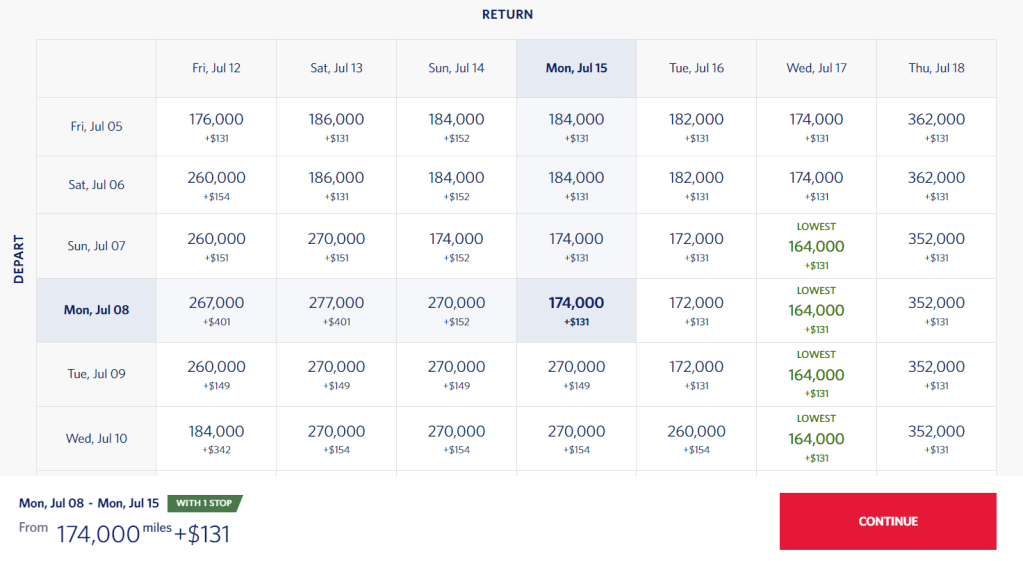
The lowest available round trip is 164,000 miles. That would essentially eat up all of the points earned from the Amex Gold with one round trip ticket when the points are transferred to Delta. That’s not great.

With United Airlines, it’s a bit better with round trip tickets available in the summer for 80,000 United miles.

In this comparison, you would be better off with 120,000 Chase Ultimate Reward points than you would with the 177,000 Amex Membership Reward points, because on the flagship partners, the points go much further on United than on Delta. Neither one was able to get the cardholder to 2 roundtrip tickets to Munich, though. Luckily, those aren’t the only transfer partners for Amex and Chase.

Does Chase or Amex Have Better Airline Transfer Partners?

On the face of it, Amex has more airline partners, but as we all know, quantity doesn’t necessarily mean quality. In the chart below, Amex has 15 airline partners while Chase has 9. There are some key overlaps for trips to Europe, namely Avios, Flying Blue, Virgin Atlantic and Air Canada. Amex has Avianca Lifemiles, which I have used before, and I like due to their low taxes and fees. Chase and Amex both have JetBlue but Chase has a better transfer rate than Amex. Chase also has Southwest Airlines, which is a great partner, but it’s irrelevant for flights to Europe.

Airline PartnerTransfer RateChase Ultimate RewardsAmex Membership Rewards
Avios (Aer Lingus, Iberia, British Airways)1:1YesYes
Aeromexico1:1.6NoYes
Air Canada Aeroplan1:1YesYes
ANA1:1NoYes
Avianca Lifemiles1:1NoYes
Cathay Pacific1:1NoYes
Delta Airlines1:1NoYes
Emirates1:1YesYes
Etihad1:1NoYes
Flying Blue (KLM, Air France)1:1YesYes
Hawaiian1:1NoYes
JetBlue1:0.8,1:1Yes (1:1)Yes (1:0.8)
Quantas1:1NoYes
Singapore Airlines1:1YesYes
Southwest Airlines1:1YesNo
United Airlines1:1YesNo
Virgin Atlantic1:1YesYes

A Quick look at Pointsyeah!

We need to talk a little bit about PointsYeah. This is a fairly new website that allows you to search available airline award space across 14 different airline programs. It also shows you which transferable points transfer to those programs as they display the results of the search. It’s an unbelievable free tool that is making searching for award flights super easy. There are other tools out there like Point.me and Seats.aero, so it’s a matter of preference, but my favorite right now is PointsYeah.

Searching on PointsYeah and using flexible dates in July, I was able to find these award flights from Chicago to Munich with the dates of July 1st through July 4th:

  • 20,000 Flying Blue Miles and $105.38
  • 24,500 Avianca Lifemiles and $26.70
  • 26,500 Virgin Atlantic Miles and $149.40
  • 30,000 Iberia Avios and $231.20
  • 40,000 United Miles and $5.60
  • 63,000 JetBlue Miles and $42.80
  • 160,000 Delta Miles and $5.60

Returning, the flights from Munich to Chicago with the dates of July 8th through July 11th were:

  • 22,000 Flying Blue Miles and $223.20
  • 28,250 Iberia Avios and $237.60
  • 30,000 Avianca Lifemiles and $109.30
  • 43,900 United Miles and $124.60
  • 63,000 JetBlue Miles and $156.20
  • 160,000 Delta Skymiles and $288.21

Since there is no real penalty for booking one-way award flights, this is really like picking a first course/second course to piece together the round trip. If you are really trying to conserve points you could go with the two Flying Blue awards and pay 42,000 Flying Blue miles and $328.58 in taxes and fuel surcharges. Both Chase Ultimate Rewards and Amex Membership Rewards to Flying Blue so in this case, it wouldn’t matter if Jenn’s friend picked the Chase Sapphire or the Amex Gold. Either way it would cost a grand total of 84,000 Chase Ultimate Rewards or Amex Membership Rewards and $657.16. In either case, Jenn’s friend would have points to spare, but $657 is a lot of taxes and fuel surcharges for 2 economy tickets.

I would be tempted to go with Avianca Lifemiles both ways which would cost 54,500 miles and $136.00 in taxes and fuel surcharges round-trip. Avianca has a $25 fee for booking, so I think you would have to tack on an additional $100 for the two round trip fares. Avianca transfers from Amex Membership Rewards, and not Chase Ultimate Rewards so the total for the two flights to Munich would be 109,000 Membership Reward points and $372.00. That’s not too bad for flights in the summer.

You could also do a flight out using United miles and back using Flying Blue miles. That would only be available with Chase Ultimate Rewards, since United is a Chase partner and not an Amex partner. It would cost 62,000 Ultimate Reward points and $228.80 in taxes and fuel surcharges each. For two tickets, it would cost 124,000 Ultimate Reward points and $457.60. In this scenerio, there wouldn’t be enough Chase points available in one year, so this would have to take 13 months to earn the points for this trip instead of 12.

Disclaimer

There are a lot of factors at work here, including the fact that if you wanted to use Iberia Avios, for example, you would try to find the best times to get the best prices for those flights. I just used a random stretch of days in July, so you would most likely do better than this if you were searching over a longer period of time. There are also occasional transfer bonuses, so you can sometimes transfer points from Chase Sapphire Preferred or Amex Membership Rewards and get more than a 1:1 ratio, making your points work harder. Also, just because Flying Blue is offering great prices now doesn’t mean they will in six months, and just because United is charging 40,000 for a saver fare now doesn’t mean they won’t offer a flight for 30,000 later. Change is the only constant in miles and points.

What Wins – Chase Sapphire Preferred or Amex Gold?

In this case, I would say hands down the Amex Gold wins. This is simply because Amex, for someone with a decent amount of grocery and dining spend, earns a lot of points. This is also because with Amex Membership Rewards points, they could book the Avianca Lifemiles example or the Flying Blue example. In the Flying Blue example, they would be left with 93,000 Membership Rewards points that could be used on a different trip. In the Avianca Lifemiles example, with lower fees, they would be left with 68,000 membership rewards points after booking the trip.

With Chase Sapphire Preferred there was enough points to book the Flying Blue example and would be left with 36,000 Chase Ultimate Reward points after booking the two flights. They didn’t have quite have enough points after one year to book the United/Flying Blue combo with lower taxes and fees.

Conclusion

Honestly, I’m a little surprised that Amex Gold outperformed Chase Sapphire so easily in this comparison. That being said, this is a narrow comparison with a mid-summer trip from Chicago to Munich, these things vary wildly based on destination and timing. There are plenty of circumstances when you would be thrilled to have access to United miles or Southwest Airlines miles and you don’t have that access with Amex. However, doing this kind of search ahead of time can help you determine the best credit cards to sign up for before you potentially make a mistake.

Year End Review 2023

2023 was a huge year for us in points and miles. We went on our first major trips that were funded by points – a couple’s trip to Cabo San Lucas for our 25th Anniversary and a 2 week European vacation to celebrate Emma graduating from High School. 2023 was the first year that I felt like I truly understood travel hacking and the results were shockingly better than the year in review for 2022.

We earned dramatically more points and miles than we did in 2022 and the trips that we booked were also better uses of points. Having experience matters in everything, after all.

Signup Bonuses are Still King

The best way to earn points and miles is still signup bonuses, and will be for the foreseeable future. We signed up for 13 cards in 2023 and received signup bonuses for 13. I have to be honest, until I sat down and went through them all, I didn’t realize there had been 13. Jenn’s Business did a lot of the heavy lifting here.

  • Chase Ink Unlimited (Jenn’s Business) – $7,500 spend in 3 months, 90,000 Ultimate Reward Points
  • Chase Ink Cash (Jenn’s Business) – $6,000 spend in 3 months, 90,000 Ultimate Reward Points
  • Delta Business Gold (Jenn’s Business) – $3,000 spend in 3 months, 75,000 Delta Skymiles
  • Wyndham Business Earner (Jenn’s Business) – $2,000 spend in 3 months, 45,000 Wyndham points
  • US Bank Leverage (Jenn’s Business) – $7,500 spend in 4 months, $750 cash back
  • Citibusiness AAdvantage Platinum (Jenn’s Business) – $6,000 spend in 6 months, 75,000 AAdvantage miles (earned in 2024).
  • Bank of America Customized Cash (Me) – $1,000 spend in 3 months, $200 cash back
  • Bank of the West Cash Back World (Me) – $1,000 spend in 3 months, $200 cash back
  • US Bank Altitude Card (Me) – $2,000 spend in 4 months, $500 cash back
  • Chase Sapphire Preferred (Jenn) – $4,000 in spend 3 months, 60,000 Ultimate Reward Points
  • Capital One Venture (Jenn) – $4,000 spend in 3 months, 75,000 Venture miles
  • Barclays Aviator Red (Jenn) – Make 2 transactions, 75,000 AAdvantage miles
  • US Bank Leverage (My Business) – $7,500 spend in 4 months, $750 cash back
  • Citibusiness AAdvantage Platinum (My Business) – $4,000 spend in 3 months, 65,000 AAdvantage miles.

In total, signup bonuses were responsible for $12,427 of the $15,188 in value from the points, miles and cash back we earned from credit card spend in 2023. That’s a whopping 82%, so it’s obvious the importance of signup bonuses to acquiring large amounts of points and miles.

Spending isn’t necessarily household spending

When I was putting these charts together, I nearly choked. No way did we spend $82,000 on our credit cards last year! In reality, we really didn’t. There are a few things that show up on our credit card statements that aren’t really in our monthly budget. We still have yet to get our 18 year old daughter set up with her own credit card account, so whenever she spends her own money, she uses our cards and reimburses us – this includes tuition payments. We also paid our tax bill last year on a credit card. On top of that, Jenn’s business does have supplies that she has to buy which adds up as well.

Everything Gets Charged

Everything gets charged is kind of a mantra around here, and that includes things that charge us a couple of percent for the charge, such as license plate tags and taxes. Why? Frankly because we earned 18.4% on all our spend last year and paying 2% in fees doesn’t scare me at all. That really just looks like an opportunity to profit 16% on an expensive charge.

This Really Isn’t Everything

The 18.4% return really isn’t everything either. I’m not even counting what Jenn makes by using the Capital One shopping portal. A pretty common offer through the shopping portal might be 5% cash back on something that you were going to buy online anyway. You might as well click through the shopping portal and pick up the cash.

I honestly don’t know what Jenn is doing with the shopping portal money. She’s probably just stockpiling it so that she can leave me for a younger man with six-pack abs.

Are these Annual Fees Getting out of Control?

Well I don’t think I ever thought I’d be spending over $1,000 on annual credit card fees in a year. That being said, I don’t regret any of these, yet. The Citi Premier card, Chase Sapphire, and Capital One cards all are basically keys to unlocking transfer partners. We need those if we’re going to transfer Citi Thank You points, Chase Ultimate Rewards points, or Capital One Venture miles to any of the airline and hotel transfer partners that they have.

The annual fees for the Marriott, Hyatt, and Wyndham cards all come with free night certificates, or in the case of the Wyndham card, points worth a free night certificate. It’s pretty easy to get $95 in value for those free night certificates, so it’s more like prepaying for a discounted hotel room rather than a annual fee. Side note, I’m beginning to count these certificates as half of their maximum value when they are issued each year as a way of accounting for them (Redeeming at maximum value is tricky, annoying, and not worth the headache).

We paid for the annual fees for the United Airlines cards simply because we valued the United Club access, and frankly I’m happy we did. We used United Clubs at Chicago O’hare and Newark Airport. They were both very nice and well worth paying the annual fee to have the free passes. That being said, we probably won’t be flying United this year, so these cards will probably be canceled, unless I can get them to waive the annual fees.

The only other annual fee was for the Aviator Red card, which we needed to pay in order to get the bonus. A lot of cards had waived first year annual fees, and I think we’ll be canceling all of them this year before the annual fee hits.

Earning Points is Only Half the Battle

Earning a bunch of points and miles isn’t terribly useful if you use it on the wrong redemptions. Air France can be a great example of this. I love Air France, because they often offer deals as low as 11,250 points one-way to Europe, and you can transfer points from a number of programs to Air France. That being said, their award fares can vary wildly, in this case for a one-way flight to Munich from Chicago in June, it can be as high as 119,000 miles or as low as 20,000 miles. Being flexible and booking low fares saves you points that can be used on other vacations.

Being flexible in multiple programs matters too. When Jenn wanted to get the Delta Gold Business card, I laughed at her because Skymiles have a reputation for being worth less than other award currencies. While I do agree with that reputation for the most part, because I think that finding great deals with Delta can be difficult, she was able to book a very good deal on a round trip flight to Cancun for a girl’s trip. If she hadn’t picked up that gold card, she wouldn’t have been able to do that, and now she has me thinking I’m going to have to get one too because that was a damn good deal. Having that flexibility in multiple programs gave her the ability to jump on that when it was available.

Credit CardPts EarnedPts UsedTPG Value of Used PtsAct Value of Used PtsExp Pt Value (Act Pt Value)
United Miles10,92120,000$290$01.45 cpp (0 cpp)
Marriott Bonvoy50,37758,000$487$559.8 cpp (1 cpp)
Hyatt11,6157,500$128$2181.7 cpp (2.9 cpp)
Chase Ultimate Rewards Points287,0658,000$164$02.05 cpp (0 cpp)
Delta Skymiles81,06666,000$792$1,5451.2 cpp (2.3 cpp)
Cash Back$2,806$2,153$2,153$2,153cash is cash
Wyndham Points59,39254,000$594$1,3251.1 cpp (2.5 cpp)
AAdvantage Miles151,668120,000$1,800$2,5521.5 cpp (2.1 cpp)
Totals548,800$6,408$8,3531.2 cpp (1.5 cpp)
TPG means “The Points Guy” and the values in that column is based on published valuations on the Points Guy website. “CPP” stands for cents per point.

I Set Points on Fire and I’m Not Mad About it

If you look at the above chart, you will see that there was a 20,000 United mile redemption and an 8,000 Ultimate Rewards point redemption, both had $0 in value. That is because right before we went to Europe in the summer, we canceled a flight that had an 11 hour layover in Brussels and rebooked a direct flight. The original flight cost 33,000 United miles each, but the direct flight was 40,000 United miles each. This meant we needed an additional 28,000 United miles to cover the difference. The flight wasn’t any more valuable then the original, so there wasn’t added value there, but it was definitely more valuable to us. The great thing is that we weren’t charged anything for the change and actually got some money refunded because the taxes were lower on the new flights.

Overall Redemptions were Great

Looking at the totals from the chart, we were able to squeeze almost $8,400 in value out of a little more than $6,400 in points and miles. All of that was due to understanding the programs, how to use them to maximum value and pulling the trigger when a deal was available.

What did We Get For Those Points?

  • 20,000 United Miles and 8,000 Ultimate Reward Points used to change flight to non-stop.
  • 2 nights in Des Moines at Marriott Downtown Des Moines. 1 – 35,000 point certificate and 23,000 bonvoy points – Saved $430
  • 1 night booked at Springhill Suites in Chicago – 17,500 Marriott Bonvoy points- saved $129
  • 1 night booked at Hyatt Regency DFW – 1 Hyatt Category 1-4 hotel certificate – saved $218
  • 3 round trip tickets to Cancun – 66,000 Delta Skymilles – saved $1,545
  • $2,153 in cash back used in 2023
  • 4 nights at a Vacasa in Playa del Carmen – 54,000 Wyndham points – saved $1,325
  • 4 round trip tickets to Costa Rica – 120,000 AAdvantage miles – saved $2,552

Looking Forward to 2024

We have been on a roll in 2023, and I don’t see that stopping now. I have a feeling that we may not sign up for 13 credit cards in 2024, since that was getting to be a bit much, especially when Jenn is opening up statement after statement whenever she is doing our budget. We will probably be a little more selective in what we sign up for and we will be canceling a whole bunch of credit cards with annual fees.

As far as redemptions go, we have some ideas as far as where we might want to go. Because we finally have good point balances in a number of programs, we should be able to take advantage of deals when they come available. 2024 should be another great year!

Year End Review 2022

2022 was the year that we got into travel hacking. It was out of a bit of desperation that we started looking into it as a way to reduce the expense of a trip I promised to take Emma on when she graduated from high school. The power of travel credit cards turned out to be much greater that I had anticipated when I started and now it’s become a way of life for us. We love to travel and if we spend less on each trip, then we can do it more often.

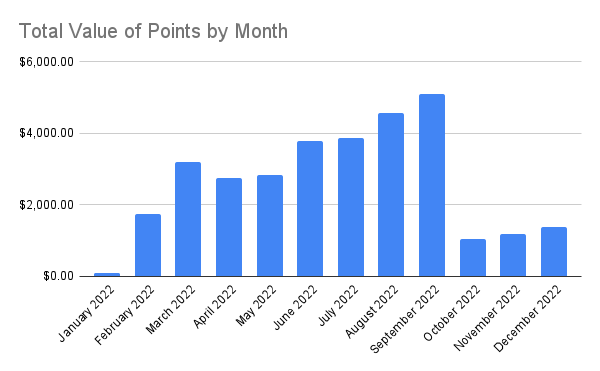
We didn’t take any trips using points and miles in 2022, it was mostly just a year of accumulating points and then booking the flights and hotels that we would be using in 2023. As you can see in the chart below, most of year was accumulating points and the dips were when we redeemed those points and miles for hotels or flights.

SignUp Bonuses – The Main Fuel of Travel Hacking

Nothing manages to pile up more points in this hobby than signup bonuses. It’s the fuel that makes travel hacking work. It’s also, essentially gambling with the credit card companies. The credit card companies are gambling that they can get you to sign up for their card, and you will begin to pay them interest and you are gambling that you won’t. It’s really a gamble on your self-control. They want you to pay them exorbitant interest rates and you want their points and miles. It’s very important that you have self-control because you need to win this gamble every time otherwise you won’t be saving any money with points and miles, you’ll be paying ridiculous amounts of fees and interest to the credit card companies.

Now this is going to sound ridiculous, but it’s really not – We signed up for 8 credit cards in 2022. Each of them had minimum spend requirements to reach the bonus. They were:

  • Citi Premier Card (Me)- $4,000 spend in 3 months, 80,000 Citi Thank You Points
  • United Explorer Card (Me) – $3,000 spend in 3 months, 60,000 United Miles
  • United Explorer Card (Jenn) – $3,000 spend in 3 months, 60,000 United Miles
  • United Explorer Business (Jenn’s Business) – $5,000 spend in 3 months, 75,000 United Miles
  • Marriott Bonvoy Boundless (Jenn) – $5,000 spend in 3 months, 5 – 50,000 point free night certificates
  • Marriott Bonvoy Boundless (Me) – $1,000 spend in 3 months, 3 – 35,000 point free night certificates
  • World of Hyatt (Me) – $3,000 spend in 3 months, 30,000 World of Hyatt points
  • Ink Unlimited (Jenn’s Business) – $7,500 spend in 3 months, 90,000 Chase Ultimate Reward Points (earned in 2023)

So we earned 7 signup bonuses in 2022, and that accounted for 660,000 of the 839,000 points and miles we earned for the year. There were also a total of 70,000 points and miles we earned from referral bonuses to each other. So 87% of the points and miles we earned in 2022 were because of signup bonuses in one way or another. That’s why they are important.

Complete Chart of Spending for the Year

As you can see from the above chart, we spent over $62,000 in 2022 on credit cards, which just seems ridiculous, but we charge everything we can, which is pretty much anything besides house and car payments. Virtually everything is payable by credit card now including all utilities, streaming services, cell phone plans and insurance, in addition to the normal things like gas, groceries, dining and shopping. And when you total everything up and realize that you are getting almost a 15% return on all spending, it’s really hard not to want to process all payments through a credit card.

What did these points buy?

Credit CardPts EarnedPts UsedTPG Value of Used PtsAct Value of Used PtsExp Pt Value (Act Pt Value)
Citi Thank You Points110,48690,000$1,530$1,4401.7 cpp (1.6 cpp)
United Miles257,620221,600$2,881$5,1101.3 cpp (2.3 cpp)
Marriott Bonvoy417,961369,000$2,952$1,680.8 cpp (.45 cpp)
World of Hyatt42,37841,000$697$7631.7 cpp (1.9 cpp)
Totals839,008721,600$8,060$8,9931.1 cpp (1.2 cpp)
TPG means “The Points Guy” and the values in that column is based on published valuations on the Points Guy website. “CPP” stands for cents per point.

So obviously, just collecting points does you no good. You have to spend those points wisely if you want to make the most of the spending that you have. In 2022, we had a very specific goal in mind and we burned our points as fast as we earned them. We were planning and booking a trip to Europe for the summer of 2023. It had been a promise that we made to Emma a few years back that we would let her pick a trip when she graduated and that bill was coming due. It’s primarily how I got into this hobby, because I was staring at a more that $10,000 upcoming bill I didn’t really want to pay. Jenn and I also celebrated our 25th Anniversary on a trip to Cabo San Lucas so all of that was booked using these points. Here’s what we redeemed points on:

  • 2 Round Trip tickets from Chicago to San Jose del Cabo – 40,000 Citi points (transferred to Turkish to book United) – saved around $800
  • 2 Nights at All-Inclusive Hyatt Ziva Los Cabos – 43,000 Hyatt Points (had to buy 2,000 points) – saved $763
  • 4 One-way tickets to Zurich on United – 132,000 miles – saved around $2,300
  • 4 One-way tickets from Rome to Stockholm – 50,000 Citi points (transferred to Avianca LifeMiles to book SAS) – saved around $630.
  • 4 One-way tickets from Stockholm to Chicago – 89,600 United miles, saved around $2,800
  • 2 Nights in Zurich Marriott, 2 – 50,000 point Marriott Certificates used, saved around $900
  • 3 Nights, 2 Rooms in AC Stockholm Hotel near Stockholm, 3 – 50,000 point certificates and 3 – 35,000 point certificates used, $780 saved

All in all, the total saved on those two trips by using points was a little less than $9,000 which was a little better than the slightly more than $8,000 that those points were “worth”. Obviously the “savings” is debatable because there are so many ways to book, that it is nearly impossible to say that flight would have cost this or that hotel would have cost that. I’m doing my best to be honest with these numbers, but they aren’t exactly gospel.

Booking with Points Changes Travel Style

When you begin to book vacations with points instead of money, your travel style changes a little. Had we booked the trip to Europe with money I think our vacation would have been considerably different than what it ended up being.

One Way is OK

The thing that I think changes the most when you are traveling on points is that one way flights are perfectly fine when paying with points. I find it completely inexplicable that airlines charge almost the same amount for a one-way flight as they do for a round trip flight. It’s bonkers. I just looked at a February flight to Zurich on United and round trip they were charging a little less than $1,100 but one-way it was over $950.

Award flights, however, aren’t like that, they are priced individually. What this means is that there isn’t an incentive to fly back from the place you arrived, and that changes your travel itinerary. Our plan, before we got into points and miles, was that we would fly into Munich, stay for a little more than a week and fly home.

However, once we were into points and miles, there was no incentive to fly home from where we started, we simply looked for a place to arrive, a place to leave from and then connected the dots. What we ended up with was a trip that started in Zurich, then went to Munich, Venice, Rome and Stockholm before coming home. That is a much more interesting travel itinerary then just Munich and back.

Hotel Stays are a Little Different

For the most part, hotel stays for me are hotel stays. I’m not someone who needs a first class experience when I’m staying in a hotel, I just need a comfortable bed, a TV and a clean shower. I would like a decent coffee maker in the room, but that’s asking way too much of hotel chains. However, when you sign up for hotel co-branded credit cards, they like to give you free night certificates instead of points. This usually creates a situation where you try to maximize the redemption of the certificate by getting the highest priced hotel room that the certificate allows for instead of just getting the hotel room that works best for you.

We didn’t really like to play this game, and ended up using 6 certificates in Stockholm (2 rooms, 3 nights) at way less then their value simply because it was a nice hotel and they offered breakfast. We actually could have booked more expensive rooms closer to the city center because our certificates would have covered it, but Jenn loves a free breakfast. This hotel just worked better for us and on paper, it looks like a bad redemption, but it was what we wanted and what we needed.

Points just don’t feel Like Cash

When you are paying with cash, you have a tendency to horde it as much as possible. The reason is simple, the money you would spend on this vacation could be used on remodeling the house, getting a new dishwasher, buying clothes, etc. When you are paying with airline miles and hotel points, it’s pretty easy to go the extra mile knowing that’s what the points are for. It’s a lot easier to plan on a more expensive experience if you know that those miles and points can’t be used for something more practical.

5/24 and the Importance of Owning a Business

If you look at the list of 8 cards that we applied for in 2022, you will notice that 4 of them were mine, 2 were Jenn’s and 2 were for Jenn’s business. We are blessed to have a business that we can open up credit cards under, and that is because there are business credit cards and there are personal credit cards and if you don’t have a business, you don’t have access to business credit cards. Some of those cards are really good. The last card Jenn signed up for the year was Chase Ink Unlimited card which had a bonus of 90,000 ultimate reward points for $7,500 in spending in 3 months and it’s a $0 annual fee. That is a great deal, and if you don’t have a business, you are shut out.

As many people will tell you though, you can call just about any side hustle a business, even if you don’t make money. I now have a business and I have no revenue, although I plan to eventually, which makes me eligible for business cards. I just set up a checking account through my bank and picked a business name, and now I can get business credit cards. It doesn’t seem to matter that I probably won’t be earning any revenue for a while.

The other reason why business cards are important is that they don’t count against your personal 5/24 score (some do but most don’t). Chase has a rule that they don’t accept applications for new credit cards if you have opened at least 5 new personal credit card accounts in a 24 month period. This only really matters if you want Chase credit cards (and probably Capital One cards), so if you don’t care, then you are free to ignore this statistic. However, after one year, my 5/24 count is 4, and Jenn’s is 2 because she had 2 business cards and even though she had opened 4 accounts only 2 counted against her 5/24 number.

Looking Forward to 2023

2023, for us, is about finally being able to take advantage of all of these rewards that we accumulated in 2022. It’s when the fun stuff begins. Jenn and I have a trip to Mexico and we have our family trip to Europe coming in 2023. I am also looking forward to taking the knowledge that I gained in 2022 and really leveraging what I’ve learned into more points and miles and more great trips in the future. Travel hacking has really changed the way we do trips and I can’t wait to see what the future has in store.

Points Check December 2023

That’s a wrap for 2023 and it was a great year for us. We went on our first international trip as a family and primarily used points and miles that we earned in 2022 to book those trips. Jenn and I were able to celebrate our 25th wedding anniversary in Cabo San Lucas, and the whole family took a pretty epic trip to Europe where we visited Zurich, Munich, Venice, Rome and Stockholm over two weeks. The cost savings from using those points and miles made those great trips possible for us.

We also booked a couple of trips for next year using points primarily earned in 2023. Jenn will be going on a girls trip to Playa Del Carmen with her mom and her sister. We have also booked a spring break trip with the kids to Costa Rica. I’m also looking into a couple of other trips for 2024, so I imagine we will be pretty busy.

Besides that, our points and miles balances grew dramatically in 2023, which should allow us a better flexibility when booking future trips.

Those AAdvantage Miles Were Gone Before We Knew it

We’ve obviously continued to earn miles on signup bonuses and December was no different. This month, Jenn earned a 75,000 point bonus on her AAdvantage Aviator Red card. This might be the easiest bonus in the points and miles world since she earned 60,000 AAdvantage miles simply by making one purchase and another 15,000 miles by naming our son as an authorized user and making a purchase on the authorized user card (I don’t get why Barclays does this, but it’s practically a free 75,000 AAdvantage mile bonus for next to no spend)

Those AAdvantage miles didn’t sit in her account very long though because we immediately used them to book those flights to Costa Rica. We were able to get 4 roundtrip tickets to Guanacaste from Moline on American Airlines for only 120,000 AAdvantage Miles and $336 which I thought was a pretty good deal. Both there and back we have an overnight layover, so we used 17,500 Marriott Bonvoy points for a hotel in Chicago on the way there and a Category 1-4 Hyatt certificate for a hotel stay at Dallas Fort Worth Airport on the way back.

Product Changing an Old Unused Citi Card

I product changed an old Citi Thank You Preferred card that I never used for a Citi Custom Cash. I couldn’t cancel the old card because it was my oldest credit card and canceling it would’ve negatively affected my credit score. The best bonus category was 2x on dining and I already have a Citi Premier that gets 3x on dining so it never got used. By switching to the Custom Cash card, I can earn 5x on by biggest spending category each month up to $500 in spending. I just need to remember to use it for just one category each month, and I failed on that for the first month. The product change process was extremely simple, I just called up Citibank and told them what I wanted. They switched it in just a matter of minutes and the cards arrived in about a week.

On to the Point check!

Our spending in December was pretty high, mainly because of Christmas, but there was also a tuition payment thrown in there. But the main amount of spending towards a bonus was on Jenn’s Citibusiness AAdvantage Platinum card, where she spent a little less than $3,500 and earned a little more than 3,600 AAdvantage miles.

Card UsedSpendPoints EarnedPoint ValuePoints Per $Return on Spend
Citi AAdvantage$1,1561,325$19.881.11.7%
Chase Ink Cash$5182,570$52.695.010.2%
World of Hyatt$3521,759$29.905.08.5%
United Business$351351$5.091.01.45%
Citi Custom Cash$305869$15.642.85.3%
Citi Premier$291694$12.492.44.3%
Wyndham Business Earner$113903$1.611.01.5%
Total$3,0998,540$147.032.84.7%

I’m still trying to dial in our non-bonus spending in the chart above, but made a couple of mistakes. First mistake was continuing to spend on my Citi AAdvantage Business Platinum Card after earning my bonus on it, since it’s a bad earning card. The second mistake was not just choosing a category for my Custom Cash card and sticking with it. The United Business card looks like a poor choice, but Jenn was getting cash back on groceries on that card, so it’s fine. Either way we finished with a return of about 4.7% on spending, and I would like that number to be consistently over 5%.

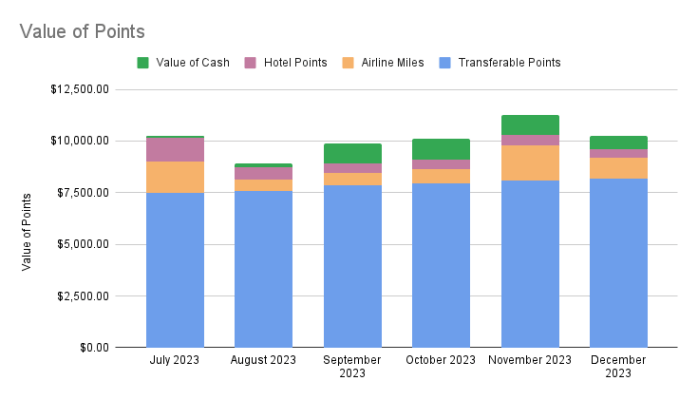
So with the Costa Rica redemption, the bonus and other earnings, we finished the month with 291,600 Chase Ultimate Reward Points, 88,400 Capital One miles, 35,900 AAdvantage miles, 31,600 Citi Thank You points, 30,900 Marriott Bonvoy points, 24,900 United miles, 15,100 Delta Skymiles, 5,500 Hyatt points, and $646 in cash back. Using the Points Guy valuations, we finished the month with $10,300 in points and miles, not too bad.

Wells Fargo Autograph Journey Could Launch Points Arms Race

Travel hackers have for years directed their efforts around four main banks – Citibank, Chase, Capital One, and American Express. You might throw Barclays in there as an honorable mention. Also in 2021, the Bilt Mastercard was launched which allowed renters to earn points by paying their rent with Mastercard. Aside from that, there are “travel cards” that are offered by US Bank, Bank of America, and Wells Fargo.

The Sweet Spot for Travel Hackers

Credit cards that offer signup bonuses as well as transfer partners are the sweet spot in travel hacking. The Bilt Mastercard has great transfer partners but they don’t really offer much in the way of signup bonuses. The travel cards from US Bank, Bank of America, and Wells Fargo offer signup bonuses, but they essentially are cash back cards that you can redeem using their travel portals. But Citibank, Capital One, Chase and American Express were the only banks to offer signup bonuses as well as the option to transfer those points to a variety of hotel and airline programs. Until now? Maybe?

Rumors About Wells Fargo

Wells Fargo launched the Autograph Card in June of 2022, which came with a 30,000 point ($300) bonus and offered a nice variety of 3x categories. It was a strong offering by Wells Fargo for a no annual fee card, but it was essentially a cash back card because they didn’t offer any transfer partners. However, as 2024 approaches, Wells Fargo is teasing a couple of things. They are teasing that transfer partners will be available soon and that a new card called Autograph Journey is coming.

Why are Transfer Partners Important?

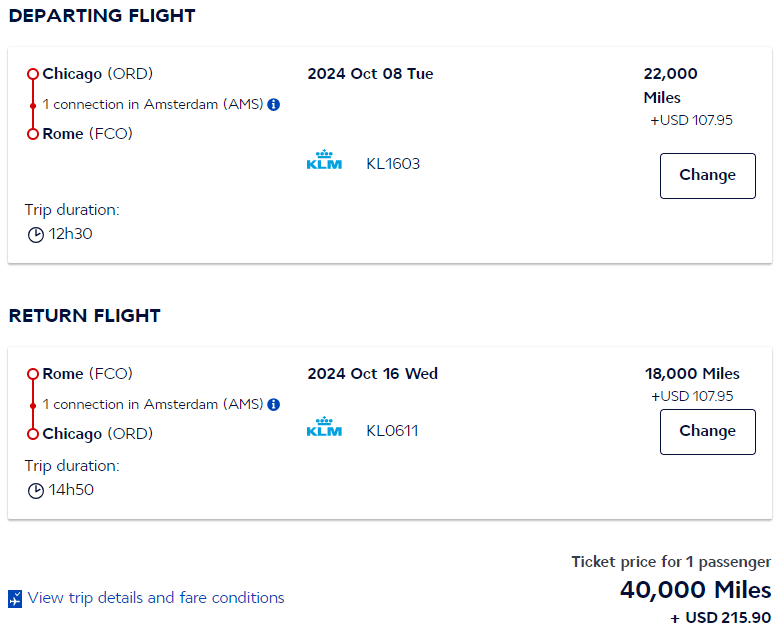
Transfer partners are important because they often offer a significant discount over the price you can get through a travel portal. Here’s an example from a flight I’m currently researching for my own travel plans. Using the Chase Travel Portal, a flight from Chicago to Rome runs 95,608 Chase Ultimate Reward points.

However, the same flight costs 40,000 miles and $215.90 if you transfer those same Chase Ultimate Reward points to Flying Blue and book there.

Even if you chose to pay for the $215.90 fees with Ultimate Reward points by cashing out at 1 cent per point that would only cost 61,590 points instead of 95,608. That’s a significant savings simply by transferring the points and purchasing there. The other benefit is that I would always rather book a hotel or an airline ticket using that program’s own currency and website. It will most likely be easier to deal with a cancellation or a problem if you are dealing directly with the hotel or airline instead of trying to get a travel portal to resolve it with the hotel or airline.

What could the Wells Fargo Transferable currency look like?

As Summer Hull and Nick Ewen from the Points Guy confirmed, Wells Fargo intends to give points transfer options for their Autograph card as well as a new product called Autograph Journey. This could end up being anything from pathetic to amazing, but it really all hinges on who they land as transfer partners and how good the transfer rates are.

The Pathetic Option

If Wells Fargo only lands a few transfer partners or they land fairly weak transfer partners like Choice Hotels, EVA Air or Royal Orchid it’s only going to make the points mildly interesting. Also, if those points transfer at rates lower than they would from Citi, Chase, Amex, or Capital One, then Wells Fargo points won’t be as valuable as points from those other banks. This won’t move the needle for most consumers, and probably won’t create any real buzz for their products.

The Middle of the Road Option

If they put together a set of transfer partners like Capital One or Citibank along with decent transfer ratios, then you will essentially have a pretty good list of transfer partners that provide good value for their customers. This would put Wells Fargo’s consumer cards immediately on par with consumer cards from Capital One and Citibank.

The Amazing Option

The best set of transfer partners, in my opinion, is the one put together by Bilt. One huge reason is that they have Hyatt as a 1:1 transfer partner which is by far the most valuable hotel currency from a major hotel chain. The second reason is that they are the only transfer partner for American Airlines. Prior to Bilt landing that partnership, there were no transfer partners for AAdvantage miles. Considering how big American Airlines is, that makes Bilt points very interesting to people who live near places that American flies.

I mention Bilt for one reason – you can apply for the Bilt Mastercard on Wells Fargo’s website. I don’t know how tight the relationship is with Bilt, but if they are able to use the exact same transfer partner roster that Bilt has, then this will be an absolute home run. I can’t imagine many people who know a lot about points and miles who wouldn’t sign up for a Wells Fargo travel card immediately after it launched.

What This Could Mean For US Bank and Bank of America

If Wells Fargo is able to make a big enough splash with this release, that is going to put a lot of pressure on US Bank and Bank of America. Nobody likes losing market share and I can’t imagine that they wouldn’t notice if their customers begin to choose Wells Fargo over them. I would expect those banks to counter with their own transfer partners.

Both US Bank and Bank of America are well positioned to be able to take that next step. US Bank offers the Altitude Connect card and the Altitude Reserve card. Both currently offer 50,000 point bonuses and have some strong bonus categories. Bank of America has both a travel rewards and a premium rewards card with 25,000 and 60,000 point offers respectively. Bank of America also offers cobranded airline cards with Alaska, Allegiant, Spirit and Air France/KLM Flying Blue.

Both of these banks offer good travel cards and could fairly easily insert themselves into a travel rewards arms race. The only thing that is stopping either of these banks is making the necessary agreements with these airline and hotel programs and adding the necessary changes to their software and website. I would imagine those changes could take at least a year to implement.

Benefits for the Consumer

Anytime competition creeps into a space like this, then the customer will benefit. If suddenly there are 7 banks that offer signup bonuses and points that are transferable instead of 4, these banks will be competing for business. I would imagine that elevated signup bonuses could be the end result of this and that would be a nice benefit for travel hackers.

The other nice result would be the ability to choose between which package of transfer partners that you like. For example, if you live near an airport that is serviced by Delta, you might want to pick an American Express card because Amex Membership Rewards points transfer to Delta. If you have a favorite hotel chain, you might pick your travel rewards card by who transfers to that hotel’s points program. Maybe you can find one card that transfers to both your favorite airline and favorite hotel program. Having 7 menus of transfer partners would be very good for the consumer.

I’ll be keeping my eye on what Wells Fargo does here. If they release Autograph Journey with a signup bonus of at least 60,000 points and a similar menu of transfer partners to Bilt and if they have an annual fee under $100, then I’ll definitely be applying for a card. If they offer it with similar 3x categories that the Autograph card has, then it might quickly become my favorite credit card.

Wells Fargo may have just started the new points arms race, and I’m here for it.

Points Check November 2023

Back to an All Time High

We finally passed our previous all-time high point total of around $10,600 in value. This came primarily from earning a sign up bonus from my Citibusiness AAdvantage Platinum Select card. It offered a 65,000 point bonus for spending $4,000 in the first 3 months and I met the required spend this month. Jenn actually did the required spending on her Barclays American Airlines Aviator Red card which will earn her a 75,000 point bonus as soon as Barclays processes it. We’re actually waiting on that because we plan to book airline tickets to Costa Rica for spring break and the little delay from Barclays is annoying.

A Second Citibusiness AAdvantage Platinum Select Card

Jenn applied for the exact same card I just completed the minimum spend on – the Citibusiness AAdvantage Platinum Select card. She, however, got a better signup bonus than I did. She will receive a 75,000 AAdvantage mile bonus when she spends $6,000 in the first 6 months of having the card.

As I pointed out in the post when I applied for the card, it has a $99 annual fee which is waived for the first year. Miles earning on this card is pretty weak, in that it is 1x on most purchases, and 2x on American Airlines purchases, gas, telecommunications merchants, car rental services and cable and satellite providers. It does provide a free checked bag and priority boarding.

There is a $99 domestic companion certificate that you can earn when you spend $30,000 on the card, but seriously don’t do that. There has to be better ways of getting a cheap companion flight than that, with the only exception of maybe if you spend $30,000 on American Airlines flights.

Getting Bailed out of a Mistake

We had a hotel stay booked with Marriott that Jenn didn’t realize she booked with a non-refundable rate. When you use the Bonvoy app to book a room, there are multiple tabs for you to choose from. The prepaid option is non-refundable, and while they do have that written on there, it’s not exactly jumping out at you.

Jenn had been so used to booking things on points (which are almost always refundable, especially well in advance), that it didn’t really occur to her that the room was non-refundable. She canceled the room almost a month in advance, and after a while I asked her why they hadn’t refunded the money. She called the hotel, only to find out the room was non-refundable, but she was persistent and asked to talk to a manager, who was unavailable, of course. She called back the next day and tried again, with no luck and finally we kind of accepted the fact that there would be no refund. However, once the date for the hotel stay passed, the room was refunded to us. They never called back to let us know, they just refunded it. I guess this just goes to show that sometimes it never hurts to ask. Also, kudos to Marriott and the hotel itself, they absolutely were under no obligation to do so. That being said, it was smart of them because they will probably get more of our business now, because they were gracious in helping us fix our mistake. In the future, we will make sure to not use the non-refundable option.

Anyway, On to the Point Check

Card UsedSpendPoints EarnedPoint ValuePoints Per $Return on Spend
Citi Premier$1,4452,280$41.041.62.8%
Capital One Venture$1,0772,154$39.852.03.7%
Chase Ink Cash$5182,570$52.695.010.2%
World of Hyatt$4292,144$36.455.08.5%
Chase Ink Unlimited$395592$12.141.53.1%
Wyndham Business Earner$254729$14.942.93.2%
Delta Business Gold$107107$1.611.01.5%
Total$4,22510,576$197.102.54.7%

This month was a little disappointing in that the return on spend on our other cards dipped under 5% and I’m really trying to keep that up above the 5% mark. One of the big reasons for that, however, was the fact that my daughter’s car had about $800 of repair costs, and while that can be charged, there isn’t exactly a bonus category for it. We probably should have used the Capital One Venture card, since it is 2x everywhere, but Emma is an authorized user on the Citi Premier card and that’s what she used, for a disappointing 1x instead. Oh well. We were able to get 5x on Amazon through a World of Hyatt promo, which is nice but somehow I misunderstood the Wyndham Business Earner categories and moved our insurance there, thinking I would get 5x and it absolutely wasn’t, just a lowsy 1x on that.

Jenn got an electric car as well, which has cut our fuel consumption by about 75%. That is awesome, but I’m missing the massive amounts of Wyndham points we earned at 8x on gas.

Aside from the spending not devoted to a bonus, I spent almost $1,800 on my Citibusiness AAdvantage Platinum Select card and earned almost 1,800 AAdvantage miles and the 65,000 point bonus. Jenn spent around $1,000 on her Citibusiness AAdvantage Platinum Select card and earned around 1,000 AAdvantage miles.

All of this left us with a month-end total of 289,000 Chase Ultimate Reward Points, 88,400 Capital One Venture miles, 77,000 American Airlines miles, 48,300 Marriott Bonvoy points, 29,800 Citi Thank You points, 24,600 United Miles, 15,000 Delta miles, 3,700 Hyatt points, and $974 in cash back. If you use valuations by the Points Guy, the total value of all of these points is $11,280.

Points Check October 2023

October was a pretty dull month for us as far as accumulating points. Jenn signed up for a credit card and I continued to work toward a sign-up bonus but we didn’t manage to earn any sign-up bonuses. Our point value total inched back over the $10K threshold. That $10K threshold is pretty important to me because I believe that is where we can begin to really make good choices about how to spend those points without be subjected to using just one program or a couple of programs. The fact that more than 75% of that is in transferable points means that we really have a lot of different ways to take advantage of a lot of different programs.

Being Gimpy and a Change of Plans

We had booked a hotel in Madison with the expectation of participating in the Madison Marathon, but Jenn and I both had nagging injuries and that meant that we really were having a difficult time keeping our training up. We basically decided to switch our plans to go to Des Moines on the same weekend instead, because if we weren’t going to participate in the Madison Marathon, then I sure as hell was going to avoid the crowds associated with it. Because of that we had a change in hotel, we still used a Marriott certificate, but the second night was booked on points so there was a slight decrease in the cost of the new hotel, so we got about a thousand Bonvoy points back.

Another American Airlines Card

Jenn applied for the American Airlines Aviator Red card from Barclays. It is a personal card that at the time of application was offering a sign up bonus of 60K AAdvantage Miles when the $99 annual fee is paid and 1 purchase is made. An additional 15K AAdvantage Miles are earned when an authorized user makes 1 purchase.

The card earns 1 mile per dollar on everything except American Airlines purchases which earns 2 miles per dollar. It offers a companion ticket (domestic economy flight with $99 fee) if you spend $20,000 on the card in a year. It does offer a free checked bag, 25% off on inflight purchases and an annual $25 wifi credit on American Airlines flights.

None of that is too exciting and I definitely have no intention of spending $20K on a card that earns 1x just to earn a domestic companion ticket. This is a card that is pretty much only good for a quick charge to earn the sign up bonus, although the checked bags, wifi credit and discount on inflight purchases might be a good reason to use it when flying American Airlines. I would imagine that we will be canceling this card before we pay a second annual fee on it.

Costa Rica for Spring Break?

We have normally done spring break trips every year with the exception of last year. This was the first time that we considered flying for Spring Break. Before we got into points and miles, our trips usually involved us driving to the Gulf Coast and renting an Airbnb for a week and then driving back. Those trips generally meant 30 hours round trip in the car and an overpriced Airbnb. This time its a little different with points and we have a lot more options when booking airfare with points.

The problem with this seems to be that a spring break trip is probably going to have to be Tuesday to Tuesday because award tickets prices on the weekend during Spring Break are crazy high. Sorry, I’m not going to spend 80K miles round trip per ticket to go hang out with drunk college students in Cancun. But 30K-40K miles round trip to hang out in the jungle in Costa Rica, and my son misses two days of school? Maybe?

After talking about this with Jenn for a little while, Jenn was looking through Airbnb’s site and found a modern 3 bedroom house in coffee country within an Uber ride from the airport for $75 per night with a 4.99 rating. Nothing else in the area compared on price and quality, so she snatched it up before it disappeared, with the knowledge that its fully cancelable if we can’t make the flights work. I would prefer to book the flights first then the airfare, but with it being fully cancelable, I’m not worried about it.

Anyway, on to the Point Check!

Card UsedSpendPoints EarnedPoint ValuePoints Per $Return on Spend
Chase Ink Cash$5692,823$57.875.010.2%
US Bank Signature$5041008$10.802.02.0%
Capital One Venture$461955$17.672.13.8%
Chase Ink Unlimited$338507$10.391.53.1%
Wyndham Business Earner$1601,279$26.228.08.8%
Citi Premier$176444$7.992.54.5%
Chase Sapphire$151203$2.231.32.8%
Totals$2,3597,219$122.383.15.2%

So, looking at the chart above, I’m pretty happy. We spent a little less than $2,400 on credit cards where we weren’t trying to get a sign-up bonus and earned 5.2% back on that spending. That’s pretty good, I’ll be happy with any month we can get more than 5% back on non-signup bonus spending. This is a reminder to me to move spending off of the Chase Ink Unlimited and the US Bank Signature, because I’m pretty sure I can do better elsewhere. If I can’t find a bonus category for that spending, it should, at minimum be moved to the Capital One Venture card because it earns 2x on everything and the points are worth 1.85 cents per point, meaning that its a minimum 3.7% back.

Aside from that, I spent almost $2,300 on my Citibusiness AAdvantage Platinum Select Card, earning just shy of 2,500 points. That is a frustratingly low number of points to earn on that kind of spend but it’s okay when I’m trying to earn a sign-up bonus. It is a reminder to never use that card on anything besides with American Airlines, once the spending is completed.

At the end of the month, this leaves us with 285,800 Ultimate Rewards points, 86,400 Capital One Venture miles, 50,600 Marriott Bonvoy points, 27,500 Citi Thank You points, 24,600 United miles, 15,000 Delta Skymiles, 9,000 American Airlines miles, 3,700 Wyndham points and 1,600 Hyatt points as well as $974 in cash back. Using the valuations published by The Points Guy, this is all worth around $10,100.

Why I’m Not Mad About the Vacasa Devaluation

** On November 30, 2025, vacasa will end ITS partnership with Wyndham and this will no longer be available.**

This post was written in October 2023 after the first Vacasa/Wyndham partnership devaluation. For a post about the most recent devaluation, which took place on 3/26/2024, please visit my newest post on the subject.

There has been a lot of chatter in the last couple of weeks about the Wyndham points program recent devaluation. Wyndham points have suddenly become less valuable for booking Vacasa vacation rentals. At the end of the day, I’m more relieved by the changes made to the program than upset about it. It seemed like something that was inevitable and I think they still managed to keep the partnership valuable with Wyndham.

Update (3/6/2024) - Loyalty Lobby reports that starting on 3/26/24 pricing for a Vacasa vacation rental with Wyndham points will be 15,000 points per bedroom per night for a rental with an average price of up to $250 per night per bedroom. The price will be 30,000 Wyndham points per bedroom per night for a rental with an average price of $250 to $500 per night per bedroom.

We have used Wyndham points twice to book Vacasa rentals and have gotten great value with those two bookings. I have written about those redemptions in the two blog posts below.

Should we keep Vacasa a secret?

Using Wyndham points on a Vacasa vacation rental can be such a crazy good deal, that maybe we should keep this quiet?

What is the Vacasa Partnership with Wyndham?

Vacasa is another short term home rental agency, like Airbnb or VRBO. Being a family of four we appreciate the extra space a vacation rental provides, and we try to eat healthy as much as possible which is difficult to do when eating at restaurants all the time. Because of that, a kitchen is a huge bonus for us. I know people hate the “inconsistencies” of vacation rentals, but I’ll take a vacation rental with worn pillows and sheets and a kitchen over a 300 square foot hotel room with a terrible coffee maker and perfect sheets. I also find daily housekeeping to be more of an annoyance than a benefit.

There are very few partnerships in the short term vacation rental space, Marriott has Homes and Villas and Wyndham has Vacasa. Hyatt is working on a vacation rental program called Homes and Hideaways, but we’re all waiting to see whether or not it becomes a big deal or just a few rentals in a few locations. Because of the limited choices, booking vacation rentals with points is not easy. But the Vacasa/Wyndham partnership is the best way right now to book rentals with points.

Wyndham and Vacasa put together a relatively easy to understand program. Basically, if you looked at the Vacasa website and you found a rental that you liked, and it was available on the days you wanted, you could rent it for 15,000 Wyndham points per night per bedroom. In other words, if the rental was a 1-bedroom, it would cost 15,000 points per night, a 2-bedroom would cost 30,000 points per night. There was only 1 limitation of the program, and that was that the price for the nights that you wanted would have to be under $500 per bedroom per night. So, you could rent a 1-bedroom for 15,000 points if it was under $500, and you could rent a 2-bedroom for 30,000 points if it was under $1,000 per night.

That Wasn’t Going to Last

That was way too good of a deal. You could get maximum value for those Wyndham points at 3.3 cents per point when Wyndham points are normally valued at 1.1 cents per point. On top of that there are some great ways to earn Wyndham points, such as 8x on gas and 5x on utilities when using the Wyndham Business Earner card. In the case of the gas, if you were to earn 8x and then spend it at 3.3 cents per point, you would be getting 26.3% back and there is no way that is profitable. If you also take into account the 10% discount you get when redeeming points when you have a Wyndham Business Earner card it was like getting 29.6% back.

This deal was going to have to change. This felt like the kind of deal that happens if they were just trying to figure out a simple way to bring vacation rentals into the Wyndham points program. Once the word got out and people started to take advantage of it, they were going to have to change the program – it was inevitable. I was worried that they would go to a cash value system, where they would allow you to book Vacasas at 1 cent per point. That seemed to me to make the most sense from a business perspective, and while I would probably still use it occasionally, it wouldn’t have been great deal.

How Did they Devalue Vacasa/Wyndham?

One morning I was scrolling though Twitter and came across a post from Shawn Coomer at Miles to Memories titled “Vacasa Makes Negative Change to Wyndham Rewards Bookings“. Oh no, here it goes, one of the great deals in miles and points is gone. But after reading it I felt okay. What they did was lower the cap from $500 per night per bedroom to $350 per night per bedroom. The price is still 15,000 points per night per bedroom. What this means is the maximum value falls from 3.3 cents per point (3.7 with Wyndham Business Earner Card) to 2.3 cents per point (2.6 cents per point with Wyndham Business Earner card).

That may seem like a bummer, but I think it might actually be a blessing. I was very suspicious that they could keep this program the way it was because I didn’t believe that it could be profitable. If they have made this particular adjustment, I would assume that this should make the Vacasa/Wyndham partnership more sustainable. I actually feel better about building up balances of Wyndham points, because I feel there is a better chance that they won’t completely devalue Wyndham points or kill the partnership altogether.

How Much Does the Devaluation Hurt?

I think that the way to measure how big the Vacasa/Wyndham partnership devaluation is to find out how many properties are suddenly unavailable for booking on points. What that means is, how many 1-bedroom properties are priced between $350 and $500 per night and how many 2-bedroom properties are priced between $700 and $1,000 per night. For this I’ll look at Hawaii during a spring break weekend in 2024.

There are 147 1-bedroom properties for rent on Vacasa for the weekend from March 15th through the 18th for up to $500 per night (bookable under the old rules). There are 136 properties for the same weekend for up to $350 per night (bookable under the new rules).

There are 126 2-bedroom properties for rent on Vacasa for the same weekend for up to $1,000 per night (bookable under old rules) and 124 2-bedroom properties for rent for up to $700 per night (bookable under new rules).

So with all of the handwringing about the changes to the program, people have lost access to 13 properties during a Spring Break weekend in Hawaii while still having access to 260 properties. Even though you are probably losing access to the nicest properties, that’s not a lot of properties in a time and place where vacation rentals tend to run very expensive. The sky isn’t exactly falling.

What might Be Around the Corner

The one thing that seems to be missing here is that the higher end Vacasas won’t be available for a points redemption. This could be an area where Wyndham could make changes in the future to allow for a higher point redemption for a more expensive property. For example, maybe they say that a vacation rental from $350 – $700 per bedroom costs 30,000 points per bedroom if they wanted to keep the point chart simple. But with this new devaluation, the higher end Vacasas are out of reach on points and allowing for a second tier would at least make them bookable.

Another potential devaluation I could see on the horizon for the Wyndham program would be the elimination of 8x on gas when using the Wyndham Business Earner card. It just seems so out of whack, that I can’t understand how that’s a good business move for them. I would expect them to drop it to 3x or 5x some time in the future.

Even if they made these changes, the Wyndham program would still be a great program. The redemption rates on Vacasas are still way more valuable than using them on Wyndham hotels and earning Wyndham points is still fairly easy to do. I’m obviously a big fan and still plan to use it for vacation rentals in the future.

Points Check September 2023

Our point values actually when up this month for the first time since May. It feels good to go in the right direction for the first time in a while. We had a small hotel redemption this month and a signup bonus.

Thats a Lot of Work for a Free Banana

We had one small redemption this month. We scheduled a two day trip to Madison Wisconsin for the Madison Marathon. We used Jenn’s annual free night certificate that she gets from her Marriott Bonvoy Boundless card, and 23,000 Bonvoy points for the two nights. The plan is for Jenn to run 13.1 miles and for me to run 26.2 miles so that we can get a free banana and a Michelob Ultra. Hopefully, we can have a little fun in the two nights we’ll be in Madison, I’ve heard it’s a fun town to hang out in.

Our redemption came in at around .7 cents per point, which is a little low, but that’s okay. You can’t always maximize the value of your points. Sometimes you just need to be happy to get something you need.

Just Another Reason for her to Think She’s Better than Me

This will actually get Jenn over the 25 night threshold (15 nights were from just having a Marriott Credit Card) to make Marriott Gold Elite status. Apparently this gives us 25% more miles on Marriott stays and 2 PM late checkout. It also says it increases our chances of a room upgrade, but I doubt that will actually happen. The late checkout could really come in handy.

A New American Airlines Card

I applied and was accepted for the CitiBusiness AAdvantage Platinum Select. It has a $99 annual fee which is waived for the first year. It’s actually a pretty terrible way to earn points, in that it is 1x on most purchases, and 2x on American Airlines purchases, gas, telecommunications merchants, car rental services and cable and satellite providers. However, there is a 65,000 point sign up bonus for this card, and it does provide a free checked bag and priority boarding.

They do offer a $99 companion fare after you spend $30,000 on the card in a year. The companion certificate is only good within the continental US. Honestly, I can’t imagine that if you did this it would make mathematical sense. I would think that there are better options to spend $30K, where you would earn significantly more points, other than to get a companion certificate in this case.

You might be asking why I applied for a card that I’m badmouthing so much. Well, 65,000 miles is a pretty good haul for $4,000 in spend, and AAdvantage miles are a little hard to come by. American Airlines has no transfer partners outside of Bilt. Also, their cards don’t have great bonus categories, so it’s difficult to accumulate large amounts of miles. They do have a pretty good shopping portal, so there is some ability to accumulate AAdvantage miles that way, but the best way is through sign up bonuses. In addition, they fly out of my home airport (a small airport) which makes their miles more valuable to me.

American Airlines has 4 credit cards available through Citibank and 2 more through Barclays, meaning that they do allow a decent amount of chances to accumulate AA miles through sign up bonuses. Since spending on the cards earns such a small amount of points, and the only transfer partner is Bilt (a credit card company that doesn’t have signup bonuses), the only legitimate ways of accumulating points is through their sign up bonuses, flying American Airlines flights, or by using their shopping portal.

Relying Less on Sign Up Bonuses

A couple of months ago, we decided to start to slow down the number of credit cards that we were opening. There were some pretty good deals out there, and we weren’t able to take advantage of them because of our 5/24 status. 5/24 status is the number of personal credit cards opened in a 24 month period, a metric that Chase uses for determining you eligibility to open new credit cards. If you open more than 5 personal credit card accounts in a 24 month period you are generally considered ineligible to open a new one with Chase. It also seems that Capital One uses something similar, but maybe not as well defined.

Since we won’t need to devote as much of our spending toward meeting minimum spend requirements, we need to be trying our best to take advantage of spending bonus categories on the credit cards we already have. For example, last quarter I had a 5x on gas, groceries, and dining on my Marriott Bonvoy Boundless card on up to $1,500 of spend in the quarter for a maximum of 7,500 points. Also, we basically use the Chase Ink Cash card to pay for our streaming services and phone because we get 5x on those categories. The Ultimate Reward Points earned by spending on the Ink card are worth more than 2 cents per point. In addition, the Wyndham Business Earner card has a whopping 8x on gas.

Those are the types of things that we need to pay more attention to in order to maximize our return on spend when we don’t have to meet large spending requirements for sign up bonuses. I’ve created the chart below in order to keep track of the spending that is not dedicated to meeting sign up bonus requirements. Last month, we managed a 4.8% return, which seems pretty solid.

Anyway, on to the Points Check!

Card UsedSpendPoints EarnedPoint ValuePoints Per $Return on Spend
Capital One Venture$1,0332,037$37.682.04.0%
Citi Premier Card$8531,148$20.661.32.4%
Chase Ink Cash$7073,518$72.125.010.2%
Chase Ink Unlimited$387582$11.931.53.1%
Marriott Bonvoy Boundless$3391,696$14.255.04.2%
Wyndham Business Earner$2341,869$20.568.08.8%
US Bank Leverage$254549$5.492.22.2%
Totals$3,80711,399$182.693.04.8%

In addition to the spending in the chart above, Jenn spent $1,900 on her US Bank Business Leverage Card and earned $29 in cash back and earned a $750 bonus for meeting the $7,500 spending requirement.

This left us with 282,200 Chase Ultimate Reward points, 85,300 Capital One Venture Miles, 48,400 Marriott Bonvoy points, 27,100 Citi points, 24,100 United miles, 15,000 Delta miles, 6,500 American Airlines miles, and 1,600 Hyatt points. According to the Points Guy Valuations, these points are valued at $9,900.

Points Check August 2023

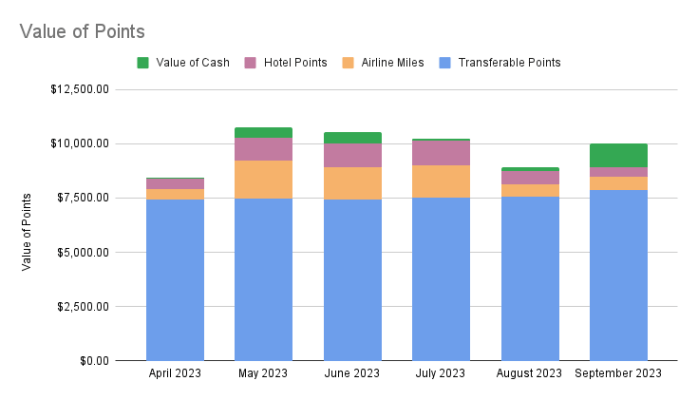
Looking at the chart above, it makes me a little nervous. My points are slipping away! No not really, we’ve been doing what we’re supposed to do with points, we’ve been spending them. Having basically used up all our cash back in Europe and new girls’ trip redemption, the total balance of our points is shrinking. That’s okay, that’s what they’re there for!

A Redemption

Jenn booked a girls’ trip to Mexico with her Sister and her Mom. She used 66,000 Delta Skymiles for a round trip flight to Cancun from the Moline Airport for the 3 round trip tickets. Each ticket had $116 in taxes that needed to be paid, and with cash prices for those flights running at $631/ticket, the redemption came out at 2.3 cents per point, which is great considering Skymiles are typically valued by the Points Guy at 1.41 cents per point. She was also able to book 4 nights in a Vacasa rental which costs $1,325 for 54,000 Wyndham points. That makes that redemption worth 2.4 cents per point, easily besting the Points Guy valuation of Wyndham points of 1.1 cents per point. More information about this redemption can be found here.

No New Cards and Shifting Strategies

With Jenn working on the $7,500 minimum spend on her US Bank Business Leverage Card, we haven’t been signing up for any cards. Also, I had Chase offers of 5 points per dollar on my United Explorer Card and my Marriott Bonvoy Boundless Card on categories like gas stations, and restaurants for 3 months, so I’m using those cards to boost my totals in Bonvoy points and United miles right now.

In general, I think we’re going to switch strategies right now. Because of Chase’s 5/24 rule (they won’t approve you for a personal credit card if you have been approved for 5 new personal cards in the last 24 months), as well as some other rules with Capital One, Citi, etc, we are getting to a point of diminishing returns on sign up bonuses. We are somewhat restricted for what we can sign up for because of all of our new personal cards in the last 2 years. This means that a lot of the sign up bonuses that we can get aren’t as good as the sign up bonuses we got in the past. It seems the solution to that will be to slow down on signing up for personal credit cards, until we get back under that magic Chase 5/24 number. That should open up the full variety of available credit cards from all banks and then we will try to stay under the 5/24 rule going forward.

That doesn’t mean that we won’t be signing up for cards. We essentially have a 4 entity household because Jenn and I obviously are two, but each of us have a business as well. She earns all of her money through her business and so far my business is mostly working for no money, which is fine as far as the banks are concerned, and fine for me, at least for now. Business cards typically don’t count against the 5/24 rule, but Chase will check your 5/24 status before issuing a business card, which is confusing. It basically means that if you want a Chase business card, you must be, as an individual, under 5/24 but the new account won’t end up counting against your 5/24 status. That being said, I’m not going to pass on a great offer from a different bank just because I’m trying to get under 5/24. If American Express puts out a huge sign up bonus on a personal card, I might just jump on it regardless of my 5/24 status.

We are also starting to get a bunch of cards with nice bonus categories. Jenn has her Chase Ink Cash card that gives her 5x on streaming services and phone. Because of that we’re sending our spending in that category to her Ink Cash card to boost her Ultimate Rewards balance. Also, she gets 8x on gas on her Wyndham Business Earner card and that’s a no-brainer on fuel fill-ups. The more that we start to push some spending on categories to other cards the less that is available to spend on meeting spend requirements on new accounts for sign up bonuses.

anyway, on to the point check!

Our spending was quite elevated this month, because much of the spending that we had from our trip to Europe finally hit our statements. It was also spread over quite a few accounts, where we could take advantage of bonus categories. Jenn spent $5,600 on her US Bank Business Leverage card, earning $93 in cash back. I spent around $200 on my Citi Premier Card and earned around 400 points. Jenn spent a little over $200 on her Wyndham Business Earner card and earned over 1,300 Wyndham points. I spent around $700 on my Marriott Bonvoy Boundless card and earned around 2,900 points thanks mostly to a 5x offer on restaurants. Jenn earned 500 Ultimate Reward points on a little over $300 spending on her Chase Ink Unlimited Card as well as 2000 Ultimate Reward points on $400 spending on her Chase Ink Cash Card. Jenn earned 1,300 points on a little over $200 on a hotel stay in Chicago on her Marriott Bonvoy Boundless card. She also earned 700 points on her Delta Gold Business card on $350 spending.

After all of those earnings, as well as the redemptions for the girls’ trip, we were left with 278,000 Chase Ultimate Reward points, 83,000 Capital One Venture miles, 69,000 Marriott Bonvoy points, 25,600 Citi Thank You points, 23,600 United Miles, 14,900 Delta Skymiles, 5,300 American Airlines miles, 1,600 Hyatt points and $160 in cash back. According to the valuations by the Points Guy, these points are worth a total of $8,820.

In addition to all of this, we have a category 1-4 free night certificate from Hyatt and Jenn and I each have a 35K point free night certificate from Marriott. These came from holding a credit card past the anniversary date and paying the annual fee. With each of these cards having a $95 annual fee and each of the certificates being worth probably double that, it feels a bit like prebuying a hotel room at a discount, so that’s why we didn’t cancel those cards.

All in all we still have quite a bit of flexibility in where we have our points and miles and we should be continuing to build on that moving forward.