Points check December 2025

As 2025 came to a close, we looked back at what turned out to be a fairly hectic year of travel. In March, we went to Portugal and Spain, to hike six days on the Portuguese route of the Camino de Santiago. In July, Jenn went with Emma, her sister, and her niece to Munich and Dublin, while Alex and I went to Dresden, Saxon Switzerland National Park, and Berlin. In September, we went to Nice and Dublin. It’s been a lot.

We had a blast, but it did seem to add a bit of chaos to our lives, and we agreed to do a little less in 2026. We’ll probably still take three vacations, but we’re going to stay a little closer to home and keep the trip lengths a little shorter. That being said, we’ve only planned one trip for 2026, and wouldn’t you know it, it’s a long way away and ten days long. But I swear – after that – we’ll be good, I promise!

That trip is to Tenerife, a place I’ve wanted to visit for years now. We will also spend two nights in London on our way to Tenerife and one night in Madrid on our way home. Virtually everything is booked, except for the flight from Tenerife to Madrid.

Picking an Airbnb

Tenerife is an interesting place to try to plan a vacation. There is so much to do spread out on an island that takes about an hour and a half to two hours to drive from the south side of the island to the north side. In the north, there are lush forests with beautiful hiking trails. On the south side, there are also beautiful hiking trails, but instead of pine forests, there are deserts with succulents and cacti. On the south side, there are tourist beaches, bars, and restaurants, while on the north side, the city of Santa Cruz de Tenerife is the major city of the island. Also, slightly south of the center of the island is Mount Teide, a volcano towering 12,000 feet above the sea, and sometimes covered in snow.

Because there were so many things to visit all over the island, it made it tricky to pick an Airbnb. We had looked at rentals almost everywhere on the island, and finally, we just threw up our hands and let our son Alex pick. He chose a rental in Costa del Silencio, which I think will be nice. It looks like a quieter part of the island, only about a 20-minute drive from the tourist hot spots of Playa de los Americas, and about a 50-minute drive to Santa Cruz de Tenerife. Plus, if the Airbnb sucks, I can blame it on Alex.

Points or a Certificate?

It can be difficult sometimes to decide whether or not to use a hotel certificate or to use points. We have a 40,000 point IHG certificate that we wanted to use for a night in Iowa City. We have season tickets for the Iowa Hawkeye women’s basketball team, and we decided to go up the night before one of the games and enjoy Iowa City for an evening. Since we had the IHG certificate, we wanted to use it for the stay.

The problem was that the nicest IHG hotel in Iowa City was 22,000 points per night, which is well below the value of the certificate. Since the certificate expires in the fall of 2026, we figured that we probably will have the opportunity to book something more worthy of that certificate. We also had plenty of IHG points, so we decided to use points and save the certificate. Unfortunately, it’s not uncommon for people to make this bargain, and then find themselves later on with a certificate that they never used – so hopefully that isn’t our fate.

On to the point check!

There were no new credit card signups this month, and I think that’s because we just haven’t seen any offers that have gotten our attention lately. Since we don’t have another vacation in mind yet, we can be patient and wait until something grabs our attention.

That also means that Jenn hasn’t worked on a signup bonus in a while, and she defaulted to using her Amex Gold card. With Christmas spending being a significant part of our purchases, and there not being a consistently good way of earning points on Amazon purchases, the earning rates were a little low. That being said, we still managed to earn a return of a little over 5% on our spending not devoted to earning a signup bonus.

Card UsedSpendPoints EarnedPoint ValuePoints Per $Return on Spend
Amex Gold$2,7226,585$131.702.44.8%
Ink Cash$4412205$45.205.010.3%
Wyndham Business Earner$4212,246$24.715.35.9%
Sapphire Preferred$376376$7.711.02.1%
AAdvantage Platinum$223223$3.461.01.6%
Blue Business Plus$66132$2.642.04.0%
Total$4,24911,767$215.412.85.1%
This month’s spending not devoted to earning a signup bonus

In addition to the spending listed above, I spent a little under $2,400 on my Chase Ink Unlimited card, earning me a little less than 3,600 Ultimate Reward points. I should be hitting my signup bonus on that card in January, which is 90,000 points. We finished up the year with:

  • 268,300 Chase Ultimate Reward Points
  • 264,900 IHG Points
  • 155,400 Amex Membership Rewards Points
  • 98,800 Wyndham Points
  • 79,400 Alaska Miles
  • 33,900 American Airlines Miles
  • 19,300 Citi Thank You Points
  • 16,700 United Miles
  • 15,900 Marriott Bonvoy Points
  • 1,500 Delta Miles
  • 300 Hyatt Points
  • $133 Cash Back

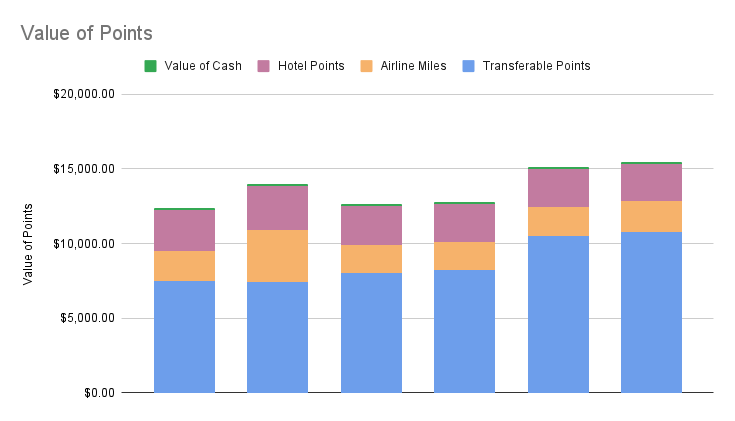
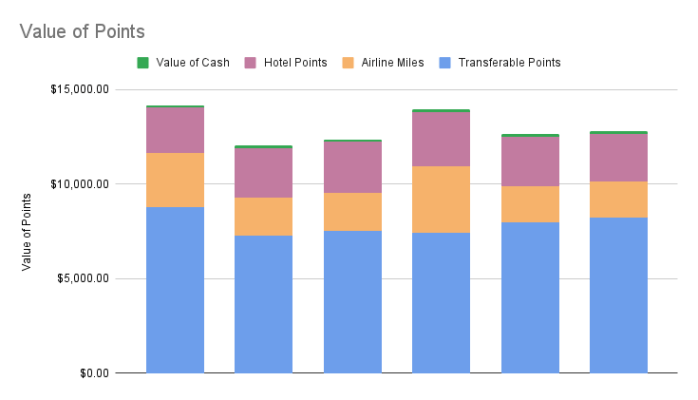
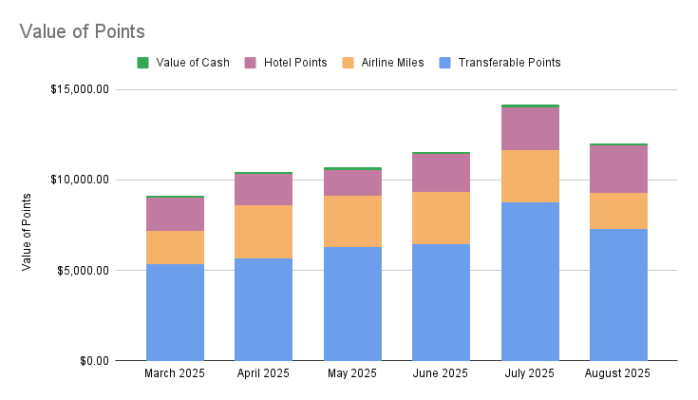
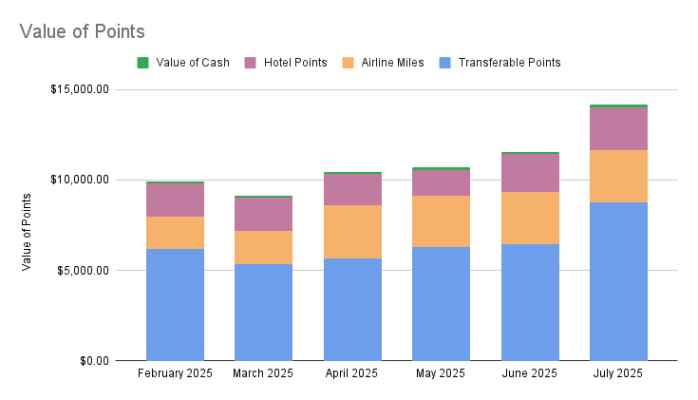
According to the points valuations published by The Points Guy, these points and miles are worth a total of $12,800. We started off the year with $13,700 in points and miles. It’s shocking to me that, given the amount of travel we did in 2025, we finished the year only $900 behind where we were the previous year. Our vacation plans will be much tamer in 2026, so I expect our points balances should go up throughout 2026. That probably means we will have a wild 2027 – can’t sit on those points forever!

Hotel Credit Cards that are Worth it For Free Night Certificates

Credit cards that come with free night certificates can be a great way to reduce the cost of vacations or weekend getaways. We have been travel hacking for a few years now, which generally means opening up credit cards, earning points and miles, and then redeeming them for flights and hotel stays. Many of these credit cards aren’t worth keeping, and we close those accounts after a year, sometimes two, depending on the situation. This is generally to avoid paying ongoing annual fees on a card we no longer value.

However, hotel credit cards can often continue to be valuable every single year, even if you don’t use them, and even if they have annual fees. This is because many of them come with free night certificates and some level of hotel status. Typically, in my experience, it’s easy to get more value out of those certificates than the cost of the annual fee.

Hyatt

Hyatt has two credit cards, both issued by Chase Bank; one is a business card, and one is a personal credit card. The business card does not offer a free night certificate, but the personal World of Hyatt Credit Card does.

World of Hyatt Credit Card

The World of Hyatt Credit Card is a card issued by Chase. It has a $95 annual fee, but in exchange for the annual fee, you will receive a category 1-4 free night certificate. I find it fairly easy to book a hotel with these certificates that would normally cost between $200 and $300. In addition to the free night certificate, the cardholder will also receive:

  • Discoverist Elite Status (2nd lowest of 4 status levels)
  • 5 Elite Qualifying Nights
  • Additional category 1-4 certificate when you spend $15,000 on the card in a year

Marriott Bonvoy

The Marriott Bonvoy program has 6 credit cards, and all but one come with an annual free night certificate. The Marriott Bold credit card doesn’t come with a free night certificate, but it also doesn’t have an annual fee. The rest of the Marriott credit cards have a variety of annual fees as well as benefits and free night certificates. Marriott’s free night certificates allow you to use up to 15,000 Marriott Bonvoy points on top of the value of the certificate. This means that if a hotel is just a little too expensive to book with a certificate, you can add some points to make the stay work.

Marriott Bonvoy Boundless Card

The Marriott Bonvoy Boundless Credit Card is issued by Chase Bank and has a $95 annual fee. It comes with a free night certificate worth up to 35,000 Marriott Bonvoy points. I generally find it pretty easy to find a hotel that typically costs between $150 and $250 per night where these certificates work. In addition to the free night certificate, the cardholder will receive:

  • Silver Elite Status (lowest of 5 status levels)
  • 15 elite qualifying nights
  • 1 elite night for every $5,000 spent on the credit card

Marriott Bonvoy Business American Express Card

The Marriott Bonvoy Business American Express card has an annual fee of $125. Like the Marriott Bonvoy Boundless card, it comes with a free night certificate worth up to 35,000 points. In addition to the free night certificate, the cardholder will receive:

  • Gold Elite Status (2nd lowest of 5 status levels)
  • 15 elite qualifying nights

Marriott Bonvoy Bountiful Card

The Marriott Bonvoy Bountiful card is issued by Chase Bank and has an annual fee of $250. It receives a 50,000-point annual free night certificate. That certificate can be redeemed for a hotel that would probably cost $300 to $400. In addition to the free night certificate, the cardholder will receive:

  • Gold Elite status (2nd lowest of 5 status levels)
  • 15 elite qualifying nights
  • 1,000 bonus Bonvoy points with each qualifying stay

Marriott Bonvoy Bevy American Express Card

The Marriott Bonvoy Bevy card is issued by American Express and has an annual fee of $250. Like the Bountiful card, it also receives an annual 50,000-point free night certificate. Also, like the Bountiful card, the cardholder will receive:

  • Gold Elite status (2nd lowest of 5 status levels)
  • 15 elite qualifying nights
  • 1,000 bonus Bonvoy points with each qualifying stay

Marriott Bonvoy Brilliant American Express Card

The Marriott Bonvoy Brilliant card is issued by American Express and has a whopping annual fee of $650. This card comes with an annual 85,000-point free night certificate. That can be used on a luxury hotel stay, probably somewhere in the $500 to $800 range. In addition to the free night certificate, the cardholder will receive:

  • Platinum Elite Status (3rd highest of 5 status levels)
  • 25 elite qualifying nights
  • Priority Pass membership with 2 guests
  • $25 per month dining credit
  • Global Entry Fee Credit

Hilton

Hilton has four credit cards that are all issued through American Express. Only one of these cards has a free night certificate as a perk. The Hilton Honors and Hilton Business card don’t have any ability to earn a free night certificate, but the Hilton Surpass can earn a certificate after $15,000 in spend in a calendar year. That might seem like a lot of money to spend on a card just to earn a free night certificate, but Hilton certificates are uncapped. This means if you have your heart set on spending an evening in an ultra-premium hotel and being completely pampered, one certificate can get you there. Upgraded points has a great post on how to completely maximize the value of those certificates.

Hilton Honors Aspire American Express Card

The Hilton Honors Aspire card is issued by American Express and is a premium credit card with a $550 annual fee. It does come with an uncapped annual free night certificate that can be used on amazing ultra-premium hotels. In addition to the free night certificate, the cardholder will receive:

  • Diamond Status (highest of 3 Hilton status levels)
  • $400 Hilton Resort credit ($200 semi-annually)
  • $200 flight credit ($50 annually)
  • Clear Plus credit

IHG

IHG has three credit cards, with two offering annual free night certificates. The IHG One Rewards Traveler card has no annual fee and doesn’t come with a free night certificate. The free night certificates that are issued by IHG are worth up to 40,000 points and can be topped off. That means if the hotel room you really want costs 60,000 points, you can use a certificate and 20,000 points. For a 40,000-point certificate, you can generally expect to be able to book a hotel that would cost $150-$200.

IHG One Rewards Premier

The IHG One Rewards Premier credit card is issued by Chase Bank and has an annual fee of $99. It comes with an annual free night certificate worth up to 40,000 IHG points. Besides the annual free night certificate, the cardholder will receive:

  • Platinum Elite Status (2nd highest of 4 levels)
  • Fourth night free on award stays
  • Up to $50 per year United Travel Bank Credit

IHG One Rewards Premier Business Card

The IHG One Rewards Premier Business card is pretty much the same as the IHG One Rewards Premier card, but for businesses. It has an annual fee of $99 and comes with a free night certificate worth up to 40,000 IHG points. In addition to the free night certificate, the cardholder will receive:

  • Platinum Elite Status (2nd Highest of 4 levels)
  • Fourth night free on award stays
  • Up to $50 per year United Travel Bank Credit

Wyndham

With a collection of brands like Super 8, Travelodge, and Ramada, Wyndham Rewards isn’t the sexiest program on this list, but it is solid. Barclays issues 3 credit cards for Wyndham with impressive earning rates, especially on gas purchases. The Wyndham Earner card earns 5x on gas, the Wyndham Rewards Earner Plus card earns 6x on gas, and the Wyndham Business Earner card earns a whopping 8x on gas and 5x on utilities.

None of these cards issues a free night certificate per se, but they do issue points on an annual basis, which, unlike a free night certificate, don’t expire. The Wyndham Earner card has no annual fee and doesn’t earn any annual bonus points. However, the other two cards do issue annual bonus points.

Wyndham Rewards Earner Plus Card

The Wyndham Rewards Earner Plus card has an annual fee of $75 and earns 7,500 points each anniversary year. 7,500 points can typically book a room worth around $60 to $90. In addition to the 7,500 points, the cardholder will receive:

  • Platinum Status (2nd Highest of 4 levels)
  • 10% Discount on Free Night Awards

Wyndham Business Earner Card

The Wyndham Business Earner Card has an annual fee of $95 and earns 15,000 points each anniversary year. 15,000 Wyndham points can typically book a room worth between $125 and $200. In addition to the 15,000 points, the cardholder will receive:

  • Platinum Status (2nd Highest of 4 levels)
  • 10% Discount on Free Night Awards

Choice

Like Wyndham, many of the brands that Choice is famous for are low-end hotels, such as Travelodge and Rodeway Inn. They do have some nicer brands, such as Cambria and the Ascend Collection. Choice has two credit cards, which are issued by Wells Fargo: The fee-free card called the Wells Fargo Choice Privileges Mastercard and the Wells Fargo Choice Privileges Mastercard Select.

Wells Fargo Choice Privileges Mastercard Select

The Wells Fargo Choice Privileges Mastercard Select has a $95 annual fee. While it doesn’t come with a free-night certificate, the cardholder gets 30,000 Choice Privileges points every anniversary year. That number of points can book a hotel worth somewhere in the $125 to $200 range. Since they are points and not a certificate, you could also use them to book two nights at a less expensive hotel. Besides the free night certificate, the cardholder will receive:

  • Platinum Status (2nd highest of 4 levels)
  • Cell Phone protection (up to $800 per claim)

My thoughts

I love having free night certificates ready for me to use. Typically, we tend to stay in vacation rentals, but we like to use certificates to book one or two-night stays. If the place we wish to go to doesn’t have a major airport or is difficult to get to in one day, we like to stay for a night or two in a city with direct flights to the US like London, Madrid, or Amsterdam as a way of adding a little extra excitement to our trip and a good way to get over jet lag. Being able to book a hotel for free (or essentially the cost of the annual fee) is clutch in these circumstances.

We typically aren’t too picky when it comes to where we stay, as long as the location is good. We don’t spend a lot of time in the hotel when we are traveling, since there is always so much to see, drink, and eat in these locations. For these reasons, the credit cards that work best for our purposes (in order of my favorites) include:

  • World of Hyatt Card
  • Marriott Bonvoy Boundless Card
  • IHG Premier Card
  • IHG Premier Business Card
  • Marriott Bonvoy American Express Business Card
  • Wyndham Business Earner Card
  • Choice Privileges Select

The most expensive card on this list has a $125 annual fee, and I think that it’s pretty easy with each of these cards to get at least the value of the annual fee back. Usually, better, especially the ones higher on the list.

The ones I left off are ones where I think you basically need to be using the other benefits of the cards to make them worth the annual fee. They are also great if you need higher value certificates because you want to stay at luxury hotels. If your goal is to stay at luxury hotels and utilize status, your best bets are:

  • Hilton Honors Aspire Card
  • Marriott Bonvoy Brilliant Card
  • Marriott Bonvoy Bountiful Card
  • Marriott Bonvoy Bevy Card

Free night certificates can be a great way to enhance your travels. My suggestion is to take advantage of elevated sign-up bonuses on those cards when they are available and then hold onto them if you find the certificates to be worthwhile.

Vacasa and Wyndham are Divorcing, Now What?

Recently, the news broke that starting November 30th, 2025, Wyndham points will no longer be redeemable for Vacasa vacation rentals. Earlier this year, Casago, a vacation rental management company purchased Vacasa. Casago apparently didn’t like the arrangement with Wyndham and now has ended it.

What was the Vacasa/Wyndham Partnership?

Vacasa had a deal with Wyndham, which allowed people to rent vacation rentals that were posted on the Vacasa website with Wyndham points. Originally, they charged 15,000 Wyndham points per bedroom per night up to $500 per night, but eventually shrank that to $250 per bedroom per night. What that essentially meant was that for a one-bedroom vacation rental, if its cash rate was less than $250 per night, you could rent that for 15,000 Wyndham points per night. If it was a two-bedroom vacation rental with a cash rate under $500 per night, you could rent that for 30,000 Wyndham points per night.

View from Vacasa Jenn stayed at in Playa del Carmen

This was a tremendous deal, but it was made even better with the fact that Wyndham has one of the best/quirkiest business credit cards available. The Wyndham Business Earner card earns 5 points per dollar on utilities and 8 points per dollar at gas stations. At 8 points per dollar at gas stations, it’s not hard to imagine that someone who drives a lot could earn a ton of Wyndham points quickly. Holding that card also meant you got a 10% discount on points redemptions, making those Vacasa rentals 13,500 Wyndham points instead of 15,000 points.

For us, it was a way to quickly accumulate a lot of points that we could use for a vacation rental. We had actually booked with Vacasa using Wyndham points twice, once for a beachfront condo in Playa del Carmen and once for a condo in Nashville. Both were tremendous deals. In general, we prefer vacation rentals over hotels when they are available, and now the best method for booking them with points is no longer available.

What are the Alternatives?

Some partnerships could potentially be interesting. Hyatt has a Homes & Hideaways vacation rental program, and Choice has a partnership with Bluegreen Vacations, but both of those seem really limited in terms of properties. Marriott Homes and Villas has quite a few properties, but given the number of points needed to book a stay there, I wouldn’t even consider using points for it. I would consider paying for a Marriott Homes and Villas to earn Marriott points though.

If you can find vacation rentals through one of the bank travel portals, such as Amex Travel, Chase Travel, or Capital One Travel, you could potentially book on points that way. To be honest, though, nothing is really going to replace the Wyndham/Vacasa partnership. It was just a great way to get value for Wyndham points and rent a vacation rental for no out-of-pocket cost.

What am I to do with all these Wyndham Points?

One of the things that is painful about this is that we’ve been earning 2,000 to 3,000 Wyndham points monthly on the Wyndham Business Earner card, thinking that we would at some point book a Vacasa when we were vacationing in Mexico or the US (Vacasa doesn’t operate in Europe, where our recent vacations have been). Now we have close to 100,000 Wyndham points that would have gone a long way with Vacasa. Now what? Am I stuck with a bunch of points that are only good at places like Travelodge, Super 8, and La Quinta?

Ok, let’s be honest, Wyndham hotels aren’t typically high-end hotels. It’s known for its no-frills brands. That being said, Wyndham has been trying to expand its portfolio of hotels to include all-inclusive resorts in their Alltra brand as well as a boutique brand called the Registry Collection.

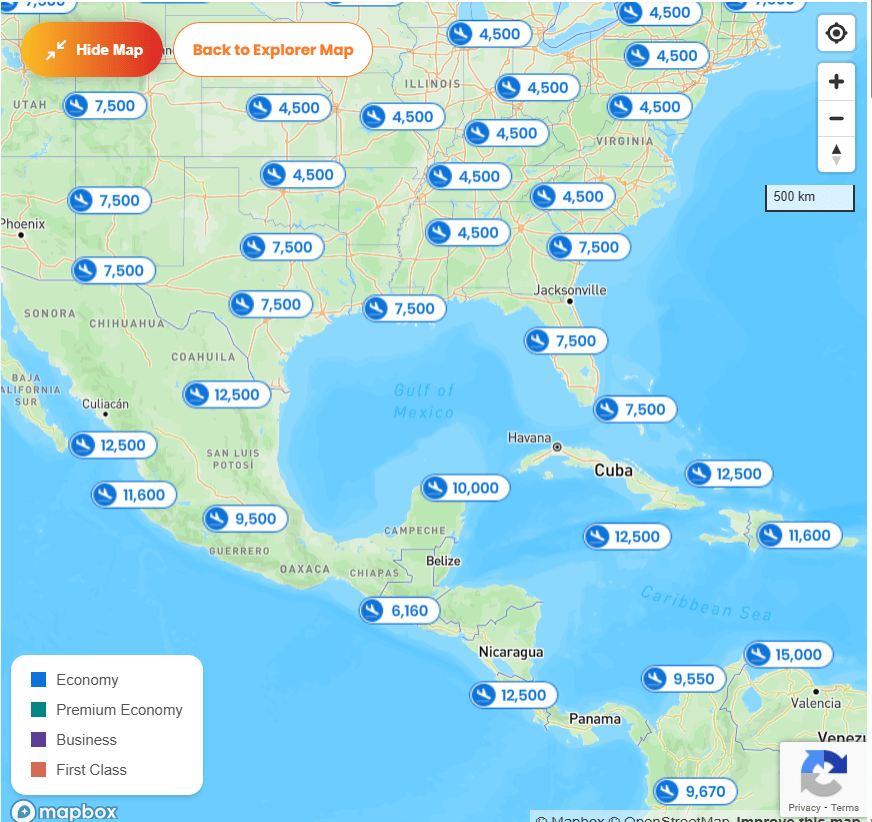
This appears to be working, as I was able to find several hotels in areas where luxury and all-inclusive hotels are typically located. There are nine all-inclusive resorts in the Riviera Maya area in Mexico alone, most of which were bookable for only 30,000 Wyndham points.

Additionally, they offer Club Wyndham, a timeshare organization that allows individuals to book select properties. Although most of those apartments will be occupied by timeshare owners, some are available for rent with cash or points.

Personally, I have a feeling we will be leaning toward an occasional all-inclusive stay. For 30,000 Wyndham points per night for many of those resorts, a couple of nights testing my liver at the pool sounds like a good use of all of those hard-earned Wyndham points.

Conclusion

The ending of the relationship between Wyndham and Vacasa is quite a bummer. There isn’t a good alternative way to book a vacation rental property at a good value using points. Since that was my primary reason for accumulating Wyndham points, I really thought long and hard about whether I would just use up what points we have left and abandon the program.

The problem with that thought is that the Wyndham Business Earner card earns 8x on gas and 5x on Utilities, which is so good that I would almost have to have no other use for the points to stop using that credit card. The earnings are too good, I just need to find a decent use for those points.

For the time being, I think we will try using them on all-inclusive resorts, and if we don’t like the quality, then we will have to use them on random hotel stays. For now, I think that’s okay, but I’m just not happy about this.

Forget Destin – We’re Going to the Canary Islands for Spring Break

When our kids were younger, we used to do the typical Midwestern “I’m tired of the snow” Spring Break trips. This usually meant a 15-hour drive each way so that we could rent an Airbnb somewhere along the Gulf of Mexico between Gulf Shores, Alabama, and Destin, Florida. Every year, it seemed like these vacation rentals would get more expensive, the beaches more crowded, and the trips overall became less and less enjoyable.

After four years of doing that, I was bored with the same old Spring Break trips. When we got into points and miles, I started looking for more exotic ways of spending Spring Break. A couple of years ago, we took a trip to Costa Rica, where we rented a house near Grecia, a fairly small community in the Central Valley more known for agriculture than tourism. We spent the week hiking to waterfalls and on volcanoes and eating local cuisine.

One of the seven falls at the Blue Falls of Costa Rica

This year, for Spring Break, we went to Spain and Portugal to hike the Portuguese route of the Camino de Santiago. It was an amazing trip, but it was physically challenging. It resulted in Achilles’ tendon inflammation, hip bruises, and blisters. Because of that, I had to promise to plan a much more relaxed Spring Break trip; otherwise, my family might murder me.

Walking through the city walls in Valenca, Portugal.

After a couple of pretty active Spring Break vacations, we decided it was time to find a beach again, but this time, not in the United States.

Why Visit The Canary Islands?

The Canary Islands are a set of volcanic islands off the coast of Africa, near Morocco. It has been a part of Spain since the late 1400’s, when they conquered the island from the native Guanche population. While tourism is popular throughout the islands, Tenerife is the most popular island, with over 5 million annual visitors.

Jenn and I have talked about visiting the Canary Islands for a while. It’s intrigued me, since it’s a very popular destination for European travelers, but mostly unknown to American travelers. There are no direct flights between the US and the Canary Islands, even though there are seemingly endless flights between Europe and the US. It’s basically a secret to Americans.

This, however, makes it a perfect alternative to typical Spring Break destinations. It has all of the trappings of a tourist hotspot, but because Europe doesn’t have Spring Break, it’s not going to be busy. Even though it’s bit further from the US, and there are no direct flights, I thought it would make for a better trip.

Screenshot from Google Maps shows plenty of resorts and condo complexes in Playa de las Americas, Spain. From the aerial photo, this looks like any major beach town in Florida.

The weather during March is fairly similar to Florida, with high temperatures in the low to mid-70s. The climate in South Tenerife, where we are flying to, is considerably drier than Florida as well, which should mean the chances of being rained out are much smaller.

In addition to Tenerife’s beach life, it’s an Island with an active volcano, Mount Teide, which is over 12,000 feet high. Because of that volcano, Tenerife has a dramatic landscape and amazing hiking trails.

Booking the Trip

I started by searching on PointsYeah for flights from our home airport, Moline, to Tenerife, but most of the available flights were a ton of points or less than ideal. For example, the quickest itinerary included a stop in London with an airport change. I’m not thrilled about the idea of switching airports in the middle of a flight itinerary; there are just too many things that could go wrong. After searching for a while, I became convinced it would be better to book a flight to Europe and then move on to Tenerife.

Because Tenerife had a lot of flights that arrive from all over Europe, I went looking for any flight to Europe that was inexpensive on points. I was able to find a flight on American Airlines that landed in London Heathrow for 19,000 American Airlines miles and $5.60. The total time on the flight is less than 11 hours. I was pretty happy with that.

From London Gatwick, we can fly to Tenerife South airport on a direct flight for 13,750 British Airways Avios and $1. The flight into London lands on Tuesday morning, so we decided to book the flight out for Thursday morning, to give us a couple of days in London. That is great because we are able to get to Tenerife for 32,750 points and under $7 each, and we also get a short visit to London.

For our flight back, the only thing that was comparably reasonable was a flight on American Airlines from Madrid through Chicago and back to Moline for 34,000 AAdvantage miles and around $50. We also need to get from Tenerife to Madrid, but there are direct cash flights available on Iberia Airlines for only around $50, so it’s better to pay cash than use points. We plan to fly to Madrid the morning before our flight to Moline so we can spend one afternoon and evening there.

We were able to use a couple of Hyatt category 1-4 hotel certificates to book two rooms for our first night in London (one for Jenn and me and one for the kids, since, as usual, there aren’t many hotels in Europe that accommodate families of four). While I don’t obsess about maximizing the value of those certificates, London is an extremely expensive city, so we booked the nearest hotel to the downtown that would accept those certificates. That was the Hyatt Place London City, and for that night, the rooms would have cost $300 each, which is about the maximum value you can get for one of those certificates.

For the second night, we booked a Courtyard by Marriott near the London Gatwick airport that did accommodate a family of four, which should allow us to get to the airport quickly for our morning flight to Tenerife. We used a Marriott free night certificate that is good up to 35,000. That room would have cost around $190, so I’m pretty happy with the use of that certificate as well.

We were also able to book a couple of rooms in Madrid, for the one night we plan to spend there before flying out. For that, we used Jenn’s $150 Delta Stays credit that comes with her Delta Gold Card.

Aside from that, we haven’t booked an Airbnb in Tenerife for the 5 nights we are there, but I expect, based on the prices I’ve seen, that we should be able to book something nice with a heated pool for around $900 that will accommodate the family. I also expect to spend around $200 for a car rental, again based on what I’ve seen in searches for car rentals in the Canary Islands.

Total Cost

When we put all of that together, I expect that we will spend 212,000 American Airlines miles, 55,000 British Airways Avios (transferred from Chase Ultimate Rewards), and about $1,500 to book all of our transportation and lodging. That’s really good, and we will get to experience a Spring Break-like destination without the Spring Break crowds. I’m pretty happy about that. In addition, we get to spend some time in London and Madrid as well, which is fantastic.

I looked up the total cost of the exact flight itinerary, booked through British Airways, and I was surprised to find that the itinerary with stopovers in London and Madrid was only $880 each. That’s actually a really good deal. You could completely recreate what we did without points for around $5,500. Anyone who has priced flights, car rentals, and an Airbnb in Florida might want to reconsider their trip at those prices.

We were able to book that for $1,500, but if you consider that we probably needed around $600 in credit card annual fees to make this work, you could say that we would end up spending $2,100. But wow, for a little over two thousand dollars, we have the opportunity to visit London, Madrid, and the Canary Islands. That’s pretty amazing, and it’s exactly why we’re points and miles junkies.

Now it’s just a matter of deciding where we want to stay and booking the Airbnb. Then we can dream of lying on the beach and soaking in the sun. Don’t tell the kids, but I’m definitely going to drag them on some hikes.

Points Check October 2025

There wasn’t much going on for us in October. We were recovering from our trip to Nice and Dublin. For me, it was literal recovery. I had finished my first ultramarathon in Nice, a 50K which was a part of the UTMB World Series. The combination of training and the actual race had left my right knee and my left foot pretty sore so other than some low impact gym visits, I did nothing. It was nice to finally take it easy for a little while.

There wasn’t much going on for us as far as travel this month, and that’s fine. Over the last year, we had taken four trips to Europe. That’s utterly insane and we would never have thought that was possible prior to getting into points and miles. We’re now at the point where we almost have to talk ourselves out of taking trips, because with points, it’s always really tempting when you see a great deal.

Ink Business Unlimited

I signed up and was approved for the Chase Ink Business Unlimited. They were running an elevated signup bonus of 90,000 Chase Ultimate Reward points for $6,000 in spending in 3 months. This deal comes up occasionally and, in my experience, is typically offered in the fall. The normal signup bonus for the Ink Business Unlimited is 75,000.

The Ink Business Unlimited is a no annual fee business card that earns 1.5x on all spending. It’s an extremely simple card, no extra bonus categories. I think it makes for a pretty good card for someone who has a lot of spend in categories that aren’t typical bonus categories. For example, if you spent a lot of money on gasoline, it’s pretty easy to find a credit card that earns 3x or better on gas. But if you are spending a lot of money at hardware stores, it’s going to be difficult to find more than 1x in that category.

There are a couple of business cards that earn 2x everywhere, like the Amex Blue Business Plus or the Venture X for Business. However, if you want to earn Chase Ultimate Reward points (perhaps because you want to transfer those points to Hyatt), the Ink Business Unlimited is a great choice.`

In addition to the 90,000 points, Jenn was able to refer me, which means that she will earn the 20,000 point referral bonus as well. If you count the points I will earn from the 1.5x plus the 90,000 points for my bonus and 20,000 points for her bonus, we will earn a minimum of 119,000 Ultimate Reward points on this card in 3 months on just $6,000 in spend. When you consider that Chase Ultimate Reward points are generally valued at 2 cents per point, that means that the total return on spend is just less than 40%. That’s a pretty amazing return.

Hyatt Brand Explorer Certificate

One of my favorite little loyalty program perks is the Hyatt Brand Explorer. Hyatt currently has 37 different hotel brands and you are rewarded for exploring those brands. For every 5 brands that you visit in your lifetime, you will earn a category 1-4 free night certificate. It’s not something that I would necessarily go out of my way for, but when we were in Dublin, we stayed at the Hyatt Centric in Dublin which turned out to be the 5th brand on my Hyatt account.

That earned us a free night certificate. While I wouldn’t pick a hotel just to get a free night certificate, I would consider booking a hotel under Jenn’s account instead of mine if she didn’t have that brand and I did. Either way, it’s a fun little perk that Hyatt can put out there to encourage people to book with them rather than another hotel program.

Also, it’s the kind of perk that could be missed, so if you have a Hyatt account that you use regularly, you should check out the Brand Explorer tab in your Hyatt account. I could imagine quite a few of those free night certificates go unused simply because people might not be aware they earned one.

On to the Point Check

When I do the accounting on these points and our spending, it’s not really a calendar month, it’s based on when the statement closes. I bring this up, because our spending was a little high this month, but some of that was because that spending was from our trip to Nice and Dublin, especially the spend on my Sapphire Preferred card, which was my go-to card when we were overseas. That trip was in September instead of October, but many of those charges showed up on the October statement.

All in all, the return on spend was okay this last month, with it being 5.3% on the spend not dedicated to earning a signup bonus.

Card UsedSpendPoints EarnedPoint ValuePoints Per $Return on Spend
Sapphire Preferred$1,1522,332$47.812.04.2%
Amex Gold$9903,206$64.123.26.5%
IHG Premier$5511,652$8.263.01.5%
Ink Cash$4512,251$46.155.010.2%
Wyndham Business Earner$4022,196$24.165.56.0%
Amex Blue Business Plus$277554$11.082.04.0%
Total$3,82312,191$201.573.25.3%
This month’s spending not devoted to earning a signup bonus

In addition to the spend not devoted to earning a signup bonus, Jenn spent over $2,400 on her American Airlines AAdvantage Platinum Select card. That earned her almost 3,300 AAdvantage miles and put her over the amount for her 80,000 AAdvantage mile bonus. We’ve been waiting on this bonus, because the best award prices we’ve seen to get us back from our half-booked Spring Break trip to Tenerife are on American Airlines, but we didn’t have enough AAdvantage miles. Now we should be ready to book that flight.

After the American Airlines bonus and all of the other points earned this month, we were left with:

  • 266,000 IHG Points
  • 236,100 Chase Ultimate Reward Points
  • 136,400 Amex Membership Rewards Points
  • 121,000 American Airlines Miles
  • 92,800 Wyndham Points
  • 79,100 Alaska Miles
  • 33,400 Marriott Bonvoy Points
  • 33,300 Citi Thank You Points
  • 18,300 Hyatt Points
  • 16,700 United Miles
  • 1,500 Delta Miles
  • $133 Cash Back

According to the Points Guy’s valuations, all of these points and miles are worth a grand total of just under $14,000. It’s about time to use some of these points to finish booking our trip to Tenerife. It’s going to be a great trip!

Simplify Your Travel in Germany with the Deutschland Ticket

If you are traveling to Germany, you might be surprised to find out that your best public transportation option might just be a program developed for German citizens. The Deutschland Ticket or D-Ticket was first introduced in May 2023 as a joint venture between the German government and the individual regions within Germany. The original cost was 49 Euros, which was raised to 58 Euros in January 2025.

What is the Deutschland Ticket?

Deutschland Ticket is a subscription service that allows you to travel on virtually any public transportation system in Germany for one price. This eliminates the need to navigate multiple apps and ticketing systems for different public transportation systems in Germany. The service covers buses, trams, subways, and trains throughout Germany.

The Deutschland Ticket doesn’t, however, cover travel between cities. This means that long-distance buses such as Flixbus or Intercity Express (ICE), Intercity (IC), or Eurocity (EC) trains are not included. For example, when my son and I were in Germany recently, we had to purchase separate tickets for travel between Dresden and Berlin.

My Experience with the Deutschland Ticket

When I was planning our trip to Germany this summer, the plan was to spend six nights in Dresden and two nights in Berlin. We were also going to visit Saxon Switzerland National Park for a few days while staying in Dresden.

What this meant for me was that I needed to figure out how to navigate as well as purchase tickets for three separate transportation systems in Berlin, Dresden, and Saxon Switzerland National Park. That is a giant headache to deal with because if you don’t want to overspend on tickets, you need to know how much you plan to use that system. Should I get a single-day pass, a single-journey pass, or a week pass? How many fare zones do I plan to travel in? It can get overwhelming in a hurry.

For example, on the Dresden Public Transportation website, there is a map, ironically labeled “Fare Zones made easy,” showing the 21 fare zones in the Dresden Public Transportation system. That’s right, 21 zones. The prices vary depending on how many zones you plan to travel in.

Dresden Zone Map from the Dresden Public Transportation website.

I spent a considerable amount of time trying to figure out that I would need to purchase a ticket that was good for a week in two zones, plus Dresden. For a week, that would have cost almost 45 Euros per person. That also limited us to just part of the system around Dresden.

On top of that, I was going to need to buy tickets in Berlin as well as inside Saxon Switzerland National Park. I knew that the Deutschland Ticket was only 58 Euros, so it didn’t take me too long to realize that it was going to be cheaper and much simpler to just buy the D-ticket.

In practice, it was a huge relief to have the Deutschland Ticket. I didn’t spend any time worrying about whether or not my ticket was valid for any place I wanted to go. If it was public transportation, it was covered – all I needed to worry about was which train, tram, or bus to take.

This actually expanded where we traveled because we decided at the last minute to visit Meissen, which would have been in a fare zone not covered by the Dresden week pass. Having the pass meant that we actually went the full length of the train system from Meissen to the Czech border, which is about 50 miles apart. Knowing that was all covered by one ticket was incredibly valuable.

The Simplicity of the D-Ticket

The best thing about holding the Deutschland Ticket is the fact that it simplifies your experience on German public transportation. Purchasing separate tickets for each city means that you will need that city’s phone app in order to purchase tickets and view routes. If you purchase the D-Ticket, however, you can buy it on any of those apps you choose, and you only need that one app, not a different app when you visit a new city. The QR code on that app works anywhere the D-Ticket is valid.

In fact, we weren’t visiting Munich, but I already had that app on my phone, so I purchased my ticket using that app. Whenever I needed to show my ticket while I was in Dresden, Berlin, or in Saxon Switzerland National Park, I simply opened the Munich app and flashed the QR code. It really simplified things for us. Meanwhile, for routes and times, we used the transit features within Apple Maps.

The Deutschland Ticket is a Subscription Service

There are some downsides to using the D-Ticket that might keep you from wanting to use it. The negatives revolve around it being a subscription service that renews at the end of the month. While the ticket is allowed for use by tourists, it’s generally meant for use by residents. So the rules are set up for residents, not tourists.

The first issue is that it renews at the beginning of the month. This means that if you are planning a trip that starts in one month and ends in the next month, you will end up paying the 58 Euro subscription fee twice. If you are only visiting Germany for a week and have to pay 116 Euros, you might rethink the D-Ticket.

The other problem is that you really need to plan ahead. It is required that you cancel your subscription before the 10th of the previous month. For example, if you are going to Germany from October 15th to October 25th, you need to purchase the ticket between September 1st and September 9th, and then cancel the subscription before the 10th. It seems counterintuitive to cancel something before you start to use it, but once you’ve purchased the Deutschland Ticket you have that ticket for the next month.

All purchases are final, and you can purchase the Deutschland Ticket in the same month that you use it, but you won’t be able to cancel it for the first month. In other words, if you don’t plan ahead, you will be required to purchase it for two months.

Purchasing the Deutschland Ticket

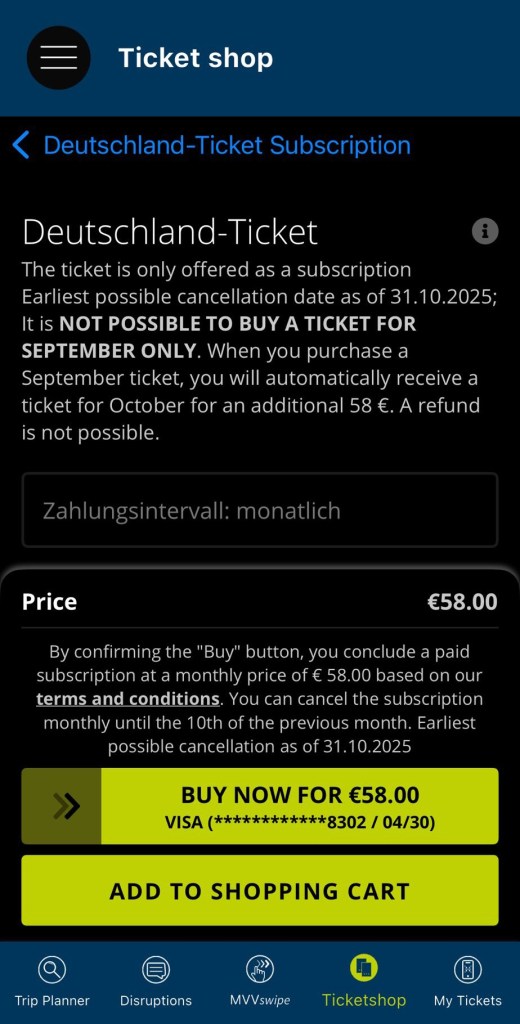
The actual purchasing of the Deutschland Ticket is fairly easy. I used the MVV app which is Munich’s public transportation phone app. You can find the Deutschland Ticket subscription in the Ticketshop tab at the bottom of the screen. Once you are there, select Deutschland Ticket Subscription.

Once you get to that point, all you need to do is enter your payment method (they accept US credit cards), and complete the payment.

If you are only trying to purchase your ticket for one month, you must remember to purchase and cancel the ticket before the tenth of the previous month otherwise you will be charged for a second month.

Conclusion

The Deutschland Ticket is a great way for tourists, especially those visiting multiple German cities, to simplify their public transportation needs. You can travel on virtually all forms of public transport within cities, hold only one ticket, and use only one app.

It’s very likely it will save you money on your trip as well, since purchasing individual tickets or day/week passes can add up quickly. The biggest headache is managing the subscription. But if you make sure you understand the subscription rules and are able to purchase and cancel the subscription within the correct time period, you’ll be thankful you had it.

Points Check August 2025

August was a month when we spent considerable time preparing for our trip to Nice, France, at the end of September. Unlike most trips, this didn’t mean finalizing trip details or finding places we would like to visit. Instead, it meant training – lots and lots of painful training.

Our trip is based around participating in the Nice Côte d’Azur UTMB Ultramarathons. I will be doing the 55K, and Jenn is doing the 23K. This means that we are spending a lot of time on our feet running and preparing ourselves physically for this challenge. On the last day of the month, I completed a 31-mile training run, which destroyed me physically for about three days, so this seems like a fantastic idea.

Besides that, we used some of our points and miles to finalize the details of our trip as well as beginning to book a spring break trip. I hadn’t planned to start booking anything yet for spring break, but I came across a fantastic flight deal, and I believe in booking something when you have the opportunity.

The Beginnings of a Trip to Tenerife

After we hiked part of the Portuguese Route of the Camino de Santiago last spring break, I promised our kids a more laid-back beach vacation for the next spring break. For a couple of years, I’ve been thinking about visiting the Canary Islands during spring break, because unlike Florida, Mexico, and the Caribbean, March is the offseason for them. The weather should still be great, but there shouldn’t be crowds, and the prices should be cheaper. I really wanted to fly into Tenerife South Airport, because that is the center of beach tourism for the islands.

When I was looking for flights, it quickly became obvious that it would be cheaper to fly to somewhere in Europe and then get a separate flight from Europe to Tenerife. What we discovered was that we could fly from our home airport in Moline to London Heathrow for 19,000 American Airlines miles and $5.60. Then we could fly British Airways from London Gatwick to Tenerife South for 13,750 British Airways Avios (transferred from Chase Ultimate Rewards) and $1 each.

That meant that we could fly for a total of 32,750 points and $6.60 each, which was considerably less than the more than 40,000 points each I was seeing for similar flights on one itinerary. The bonus was that we were able to schedule a couple of nights in London, which should allow us to enjoy a taste of England while we’re getting over jet lag.

We had Emma use some of her American Airlines miles to book her flight, so we only needed to pay for 3 of the American Airlines flights, but we did need to pay for all 4 of the British Airways flights. Altogether, we spent 57,000 American Airlines miles and 55,000 Chase Ultimate Reward points transferred to British Airways to book the flight to Tenerife.

Finalizing our Trip to Nice and Dublin

After 5 nights in Nice, we will move on to Dublin for a few nights before heading home. We hadn’t, however, booked any lodging in Dublin. Booking a hotel in Dublin for a reasonable number of points was difficult. The best option was to book the Hyatt Centric Dublin, a category 5 hotel with 17,000 points per night. Because it was a category 5, I couldn’t use my category 1-4 certificate. I ended up using 34,000 Hyatt points, 9,000 from my Hyatt account, and 25,000 Ultimate Reward Points transferred to Hyatt.

This will be the fifth Hyatt brand we’ve stayed at on my Hyatt account, which means that I will hit my first Hyatt Brand Explorer reward and will earn a category 1-4 certificate with this stay. That takes a little bit of the sting away from having to use so many points for this redemption.

Citi AAdvantage Platinum Select

Jenn applied for the Citi AAdvantage Platinum Select World Elite Mastercard. That name is way too long, but it comes with an elevated 80,000 AAdvantage mile bonus after she spends $3,500 in the first three months.

It earns 2x on gas, dining, and American Airlines purchases. It has a $95 annual fee, but it is waived the first year. There really isn’t much to be excited about with this card other than the signup bonus. It does give the cardholder free checked bags and priority boarding, which is pretty standard for an airline credit card.

She signed up for this card in order to boost her American Airlines miles balance. We’ve been using American a lot more, and we find it to be extremely reasonable for flights out of our local small airport in Moline.

On to the Point Check!

Without having a signup bonus that I was working on, our spending on our regular cards was a little higher than normal, and some of it was not ideal. We used my Sapphire Preferred card on categories that weren’t earning a lot of points. In addition, I used my Citi Custom Cash on camping fees, wondering whether or not it would code as one of the 5x categories, which it did not. Oh well, it was worth a try.

I usually say that I’m happy if we earn a 5% return on our spending on cards where we weren’t earning a signup bonus, but I feel like we were a little sloppy this month, and we could’ve done better. It seems like lately we’ve been able to earn 6% to 8% on that spending, so I know we can do better than that.

Card UsedSpendPoints EarnedPoint ValuePoints Per $Return on Spend
Amex Gold$12603,351$67.022.75.3%
Sapphire Preferred$890980$20.091.12.3%
Wyndham Business Earner$7304,218$46.405.86.4%
Ink Cash$4662,335$47.875.010.3%
Citi Custom Cash$364364$6.551.01.9%
Total$3,71011,248$187.933.05.1%
This month’s spending not devoted to earning a signup bonus

Besides the spending listed above, Jenn spent a little under $2,200 on her IHG Premier Business card, earning 7,000 IHG points. It also meant she reached the second bonus threshold and an additional 60,000 points. That card had a weird double bonus, which earned 140,000 points after $4,000 in spending and another 60,000 points after an additional $5,000 in spending.

All of that leaves us with:

  • 261,800 IHG points
  • 235,500 Chase Ultimate Reward Points
  • 129,000 Amex Membership Rewards Points
  • 87,500 Wyndham Points
  • 79,100 Alaska Miles
  • 36,000 American Airlines Miles
  • 33,400 Marriott Bonvoy Points
  • 32,700 Citi Thank You Points
  • 16,700 United Miles
  • 7,800 Hyatt Points
  • 1,500 Delta Miles
  • $133 in Cash Back

All of that together is worth, according to the Points Guy’s valuations, a little over $12,000, which is down more than $2,000 from the previous month. Most of that is due to the flights booked to Tenerife. We keep using these points to book some amazing vacations, so the dip doesn’t bother me at all. We seem to be constantly earning and burning those points, which is how it should be done. That being said, I’ll worry about my points totals later because I have a race to train for.

Points Check July 2025

July was a fun month. Jenn and I took separate vacations. While Jenn and Emma went on a girls’ trip to Munich and Dublin with Jenn’s sister and our niece, I took our son Alex to Berlin and Dresden. It was a little strange being on separate vacations, but with us both being in Europe, texting our adventures back and forth was fun.

Alex and I wanted to do a lot of hiking in Saxon Switzerland National Park in Germany along the Czech border. Unfortunately, it rained a lot while we were there, and we only got to hike for a couple of days. Because of that, we spent more time in Dresden than we originally planned, which turned out to be great. I absolutely love Dresden and hope to return someday.

The girls enjoyed their trip as well. Between the two cities they visited, two of the girls preferred Dublin and two preferred Munich. That just goes to show that everyone has different travel preferences. I’ll get a chance to spend a little over a day in Dublin in late September, so I’ll get to see what I think soon enough.

Chase Sapphire Preferred Bonus

Back in May, I signed up for the Chase Sapphire Preferred card, which at the time had a 100,000 point bonus. This month, I finally finished the required spending on the card and received the bonus.

In the meantime, Chase has “refreshed” their Chase Sapphire Reserve card, which is the big brother of the Preferred card. The big news was that the annual fee jumped to $795 per year. At one point, this card had an annual fee of $450. A few years ago, it was increased to $550, and now with this refresh, it’s an eye-popping $795.

Each time the annual fee is increased, there are new benefits and credits added, which theoretically add value. Obviously, if you don’t use those credits, they are worthless. The list of credits is quite long, but most involve travel. In fact, the card seems to be designed for people who are very frequent travelers. It gives 8x on travel purchased through the Chase travel portal, 4x on flights and hotels not purchased through the portal, 3x on all restaurant spend, and 1x on all other spend. It has great airport lounge access benefits as well.

By contrast, the Chase Sapphire Preferred has a $95 annual fee and gets 5x on the Chase travel portal, 2x on other travel, 3x on dining, 3x on groceries, and 3x on streaming services, and 1x on everything else. There really aren’t any benefits to speak of on this card, except for the ability to transfer points to a variety of hotel and airline programs.

Personally, I’m glad I went for the Chase Sapphire Preferred. It’s a great choice for normal people. 3x on dining, groceries, and streaming services are categories in which most people spend a significant amount of money. There are good bonus categories on the Reserve card as well, but they are mostly related to travel, which is great if you travel a lot, but for people who don’t, the Preferred card makes much more sense.

Either way, it’s going to take a lot to convince me to spend $800 on an annual fee, and right now, I’m not interested.

On to the Point Check!

Our spending was a little higher than normal, mostly due to being on vacation. As much as I obviously try to reduce our vacation spending on flights and lodging, there really isn’t too much you can do about things like train tickets, bus tickets, and dining out. There’s no way I’m going to Germany without eating döner, and I’m certainly not denying Alex his currywurst. For some reason, they won’t let me pay for my döner box with Wyndham points.

We did a pretty good job of using the bonus categories of some of our credit cards, which meant that we earned a 7.7% return on spending on cards that we weren’t trying to earn a bonus. I’m pretty happy with any number over 5%, so I’m thrilled with that number.

Card UsedSpendPoints EarnedPoint ValuePoints Per $Return on Spend
Amex Gold$5331797$35.943.46.8%
Ink Cash$4492,247$46.065.010.2%
Wyndham Business Earner$4102,242$24.665.56.0%
Total$1,3926,286$106.674.57.7%
This month’s spending not devoted to earning a signup bonus

In addition to the spending on cards where we aren’t working on a bonus, I spent a little less than $3,900 on my Chase Sapphire Preferred card, earning over 7,600 Chase Ultimate Reward Points. That also put me over the required spend to earn the sign-up bonus of 100,000 points. Jenn spent a little over $2,100 on her IHG Business Card and earned almost 8,900 IHG points. She had previously earned the 140,000 point signup bonus for $4,000 spending in 3 months, but she is now just a little more than $2,000 in spending away from earning the additional 60,000 point bonus for spending a total of $9,000 in 6 months.

All of that left us with a total of:

  • 272,100 Chase Ultimate Reward Points
  • 194,600 IHG points
  • 125,500 Amex Membership Rewards Points
  • 93,000 American Airlines Miles
  • 83,300 Wyndham Points
  • 79,100 Alaska Miles
  • 33,400 Marriott Bonvoy Points
  • 32,700 Citi Thank You Points
  • 16,800 Hyatt Points
  • 16,700 United Miles
  • 1,500 Delta Miles
  • $133 in Cash Back

According to the Points Guy’s valuations, the grand total of those points, miles, and cash back is a little less than $14,200. That is an increase of around $2,600 from the previous month, mostly due to the Chase Sapphire Preferred bonus. That’s a pretty massive jump in just a month. Our total points values have increased for the last few months, so hopefully, we’re really starting to stockpile some points in programs that will really allow us to book some great vacations in the future.

American Airlines makes Citi Thank You Points Much More Valuable

In a widely expected move, American Airlines is now a transfer partner from Citi Thank You Points. Rumors have been circulating since it was announced that American Airlines was phasing out its Barclay’s credit cards and signing an exclusive deal with Citibank. Finally, Citibank has added American Airlines to its Thank You Points transfer page, making those points much more valuable.

How This Transfer Partnership Works

People who hold a Citi Strata Premier, Citi Prestige, or Citi Strata Elite credit card can now transfer Citi Thank You Points to American Airlines AAdvantage Miles at a 1:1 ratio. Adding a coveted transfer partner makes any Citi Thank You Points much more valuable, especially since Citi is the only bank that transfers its points to American Airlines.

In addition, this also means that as long as you hold one of those cards, any points earned with a Citi credit card that earns Thank You Points, such as the Double Cash or Custom Cash, can also become AAdvantage Miles. This is because you can combine your Thank You Points and then transfer them to any of 15 airline partners or 5 hotel partners.

The reason why transferring points is so important is that in many cases, you can book hotels and flights with fewer points when you transfer them to a hotel or airline loyalty program. Even better, if what you’re looking for is actually a better deal to book with points through a travel portal, you have that option as well.

Domestic Airlines are (Mostly) Monogamous

Many international airline programs, like Air France/KLM Flying Blue, Avianca Lifemiles, and Air Canada Aeroplan, are polyamorous, allowing transfer partners from multiple bank points programs. For example, Flying Blue allows transfers from Chase, Citibank, American Express, Capital One, Bilt, and Wells Fargo. This is extremely common for international programs. Even Virgin Atlantic, despite its name, is a bit of a swinger.

Airlines based in the United States aren’t the swinging type; by comparison, they’re mostly monogamous. Delta Airlines only allows transfers from American Express Membership Rewards, American Airlines only allows transfers from Citi, and Alaska Airlines allows transfers from Bilt Rewards.

There are three airlines that, however, that aren’t exclusive. Southwest Airlines and United Airlines allow transfers from both Chase and Bilt, while JetBlue allows transfers from Citi, Chase, and American Express.

Your Airline Preferences Matter

Because of several factors, such as route networks, hub locations, award pricing, or just which airline you prefer, you should earn points that transfer to the airline that works best for you. For example, I know people who absolutely love Southwest Airlines. They fly a ton of flights out of Midway Airport in Chicago, which is an airport that isn’t far from where we live. Unfortunately, we do a lot of our flying to Europe, and Southwest Airlines doesn’t fly to Europe. We’re just not going to use it.

United Airlines flies to Europe and has a great network there, but generally, I find that it takes a lot of United miles to book a flight to Europe. Also, even though they fly out of my small home airport in Moline, the point prices for United flights out of Moline are extremely high.

Delta Skymiles is probably the most popular airline award currency in the world, but I struggle to find good value with Delta. They overcharge for one-way flights, and usually it’s difficult to find competitive pricing for round-trip tickets as well. That being said, I do occasionally find a great deal, and did recently book round-trip tickets in the summer for a little over 40,000 points each to Berlin. Unfortunately, those deals are not the easiest to find, and I don’t consistently find good value with Delta.

American Airlines, however, has a lot of great flights out of our local airport to Europe and some for extremely low prices, in points. In September, we are flying to Nice, France, from our local airport for only 19,000 AAdvantage miles each, and we were able to find a flight home from Dublin for only 19,000 miles as well. I have also seen several flights to Italy, Spain, and England for only 19,000 miles. Overall, it’s just a program that works well for us.

Those airline miles aren’t created equal either. The Points Guy does valuations each month, which look at the price of flights in miles and compare it to the price in cash for the same flights. In July 2025, the values of those domestic airline miles are:

  • Delta Skymiles- 1.15 cents per point
  • United Mileage Plus- 1.3 cents per point
  • Southwest Rapid Rewards- 1.4 cents per point
  • JetBlue TrueBlue – 1.45 cents per point
  • Alaska Airlines Mileage Plan- 1.5 cents per point
  • American Airlines AAdvantage – 1.55 cents per point

As you can see, according to the Points Guy, AAdvantage miles are the most valuable of the domestic airline currencies, so having an additional way to earn those miles is a very good thing.

This Will Shift My Focus to Citi

Lately, I’ve been concentrating on earning American Express Membership Reward Points and Chase Ultimate Rewards. That’s because they have excellent ways of earning points, and they have great transfer partners. Both have great ways of accumulating points through sign up bonuses and cards with great earning rates.

For example, we put all our internet and cell phone charges on our Chase Ink Cash card because it earns 5x in those categories. Also, as much as possible, we use our Amex Gold Card for restaurants and grocery stores because they earn 4x in those categories. Those are both great ways to accumulate a lot of points without sign up bonuses.

However, with Citi, I have a Custom Cash card which earns 5x on all spending in your top category, up to $500 in a billing cycle. This means that if you pick a category that you can come close to spending $500 on each month and only use it in that category, you can accumulate 2,500 Citi Thank You points each month without a lot of spending. I haven’t been doing that, however, because I just wasn’t that excited about accumulating Citi Thank You Points.

The partnership with American Airlines changes that. Because AAdvantage miles are very valuable to me, I will be going out of my way to earn Citi Thank You Points so I have points available to transfer to American Airlines.

Current Citi Strata Travel Credit Cards

Now that Citibank has revamped its travel cards, they are currently offering three different credit cards that all earn Citi Thank You Points: one is an entry-level card, one is a travel card, and one is a premium travel card.

Citi Strata Card

This is the entry-level travel card, and it is a pretty good starter card. It has no annual fee and is currently offering a 30,000-point welcome offer if you spend $1,000 in 3 months. For being a no annual fee card, it has tremendous bonus categories including 5x on travel through the Citi Travel Portal, 3x at supermarkets, 3x on gas and EV stations, 3x on a self-selected category, 2x on dining, and 1x everywhere else.

The downside is that it has a limited number of transfer partners (Does not allow transfers to AAdvantage), and those points transfer at a worse ratio. You could however, hold onto those points until you get a Citi credit card with a better transfer ratio, or perhaps transfer those points to a family member who holds a Citi credit card with better transfer options and have them book flights or hotels for you.

Citi Strata Premier

The Citi Strata Premier is a great travel credit card. It has a $95 annual fee and is currently offering a 60,000-point bonus if you spend $4,000 in the first 3 months. It offers 10x on hotels, attractions, and car rentals booked through the Citi Travel Portal, 3x on other air and hotel purchases, 3x on supermarkets, 3x on restaurants, 3x on gas and EV Charging stations, and 1x on everything else.

Unlike the Citi Strata Card, the Citi Strata Premier transfers to all of Citi’s partners at the best transfer rate that Citi offers. This also includes the 1:1 ratio to American Airlines. In addition, the Citi Strata Premier also offers a variety of benefits, including trip delay coverage, trip cancellation, and protection insurance, lost and damaged luggage coverage, and some car rental coverage.

Citi Strata Elite

The Citi Strata Elite is a brand-new premium credit card offering from Citibank with a $595 annual fee. It is currently offering an 80,000 point bonus when you spend $4,000 on the card in the first 3 months. It earns 12x on hotels, car rentals, and attractions booked through the Citi Travel Portal, 6x on air travel through the Citi Travel Portal, 6x on dining on Friday and Saturday nights, 3x on dining other nights, as well as 1.5x on all other purchases.

To compensate for the high annual fee, it offers $300 per year in hotel credits, $200 on an annual splurge credit, $200 Blacklane credit, a Priority Pass Select Membership, 4 American Airlines Admirals Club Lounge passes, as well as a $120 Global Entry or TSA pre-check credit.

My Favorite Strata Card

In my opinion, the Citi Strata Premier Card is the best of this group. The 3x categories of groceries, dining, and gas can help users accumulate a lot of points quickly. It has access to all of the transfer partners that the Citi Strata Elite card does, but with a $95 annual fee instead of a $595 annual fee. Also, I don’t find the credits on the Strata Elite to be enticing enough to pay an extra $500 on an annual fee. The only reason I would consider the Strata Elite is if I were a very frequent flyer, and I used those lounge passes a lot.

Being Strategic about Your Credit Card Choices

The points and miles world is extremely complicated. There are multiple banks with multiple cards, and each comes with different earning rates, benefits, and transfer partners. If you wish to turn all of your everyday purchases into great vacations, it’s important to try to be as strategic as possible.

For travel hackers who are using points to supercharge their travel, they must use the points programs that fit their travel plans the best. That really means working backwards from the destinations that you would like to visit, figuring out the best airlines that service those destinations from where they live, and then trying to figure out the best way to earn points to use with that airline. If American Airlines miles are a good fit for your travel plans, then this new partnership with Citi is a very exciting development.

Points Check June 2025

We’re getting ready to embark on another European adventure, although this time we will be on separate vacations. Jenn is visiting Munich and Dublin with our daughter, her sister, and our niece. That was planned as a girls’ trip to celebrate our niece graduating from High School.

Meanwhile, my son Alex and I will be visiting Dresden and Berlin, and spending a significant amount of time hiking in Saxon Switzerland National Park on the border of Germany and the Czech Republic.

It’s getting a little weird, this being our fourth trip to Europe in three years, since I thought that a European vacation was out of reach for us a decade ago. Knowing how and where we can save money on these trips makes all the difference.

For instance, for Alex and me to go on our trip, the round-trip flight cost $264 in taxes and fuel charges on top of the 81,600 Delta Skymiles. We will be taking Flixbus from the airport to Dresden and then from Dresden to Berlin the following week. Those bus tickets will cost a total of $80. We will spend about $140 for two Deutschland tickets, which will cover all of our public transportation while we are there. That means that our transportation costs are a total of $484.

Knowing that we would spend only a little time in our Airbnb, we rented a small apartment near a train stop in Dresden for $490 for 6 nights. We also have two nights in the Holiday Inn Express Alexanderplatz, where we will use two IHG free night certificates.

That means that, outside of food and activities, we will spend less than $1,000 on the trip. I get a lot of odd looks from people who can’t believe that we can afford to keep going to Europe, but it’s absolutely possible if you know what you’re doing.

IHG Bonus

Jenn earned the first of her bonuses on the IHG One Rewards Premier Business Card. She signed up for the card when there was a 140,000 point bonus after $4,000 in 3 months and an additional 60,000 points after $9,000 spent in 6 months.

IHG isn’t a luxury brand, but it offers many affordable options and has locations worldwide. I’ve especially been pleased with its footprint in Europe. Plenty of hotels are available wherever I look in Europe on the IHG app. Having a stash of IHG points will be nice to have when planning trips in the future.

On to the Point Check!

Most of our spending was done on the two cards for which we are working on signup bonuses. That would be my Chase Sapphire Preferred and Jenn’s IHG Business Card. There was some spending done on cards that we use for recurring billing. We’ve optimized them so that we earn 5x on utilities and 8x on gas with the Wyndham Business Earner card as well as 5x on streaming services and cell phone plans on the Ink Cash. All of that means that for these cards we earned 8.3% back on all spend on the cards listed below – not too bad.

Card UsedSpendPoints EarnedPoint ValuePoints Per $Return on Spend
Ink Cash$5022,510$51.465.010.2%
Wyndham Business Earner$4072,234$24.575.56.0%
Amex Gold$165660$13.204.08.0%
Total1,0745,404$89.235.08.3%
This month’s spending not devoted to earning a signup bonus

In addition to the spending listed above, I also spent a little less than $3,000 on my Chase Sapphire Preferred Card, earning around 4,700 Chase Ultimate Reward points. Jenn spent over $3,100 on her IHG, earning 11,900 IHG points as well as the 140,000 point bonus for spending $4,000 in the first 3 months. If she ends up spending an additional $5,000 over the next 4 months, she will earn an additional 60,000 point bonus.

At the end of the month, we had a grand total of:

  • 185,000 IHG points
  • 161,800 Chase Ultimate Rewards Points
  • 124,600 Amex Membership Rewards Points
  • 93,000 American Airlines Miles
  • 81,100 Wyndham Points
  • 79,100 Alaska Miles
  • 32,300 Citi Thank You Points
  • 16,700 United Miles
  • 15,900 Marriott Bonvoy Points
  • 9,300 Hyatt Points
  • 1,500 Delta Miles
  • $132 in Cash Back

According to the Points Guy’s valuations, the grand total of those points, miles, and cash back is a little less than $11,600. That is an increase of around $800 from the previous month, as our point totals finally start to recover from the massive amount of point redemptions we made at the end of last year and the beginning of this year. Of course, the most important thing is that we get to enjoy another wonderful vacation.