Berlin’s Lessons from a Troubling Past

Berlin is the epicenter of uncomfortable history. The city was the seat of power for Germany during World War I and World War II. During the Second World War, many crimes against humanity were directed from this city. It was also physically split during the Cold War.

20th-century German history forces people to confront the worst parts of humanity. This includes the history of concentration camps, persecution of vulnerable groups, and ethnic cleansing. It also forces people to confront totalitarianism and the stripping of basic human rights. It’s a history that confronts each and every individual who learns about it with the worst parts of the human experience.

Berlin could have decided to move on from its history and maybe built some small monuments or plaques to inform people of the past. Instead, the people of Berlin have built an impressive and thoughtful collection of monuments, allowing people to mourn the past and contemplate what it means for the present.

World War II Monuments

There are various monuments related to World War II in Berlin, and many of them recount the horrors related to the Holocaust and the Nazis’ campaigns of ethnic cleansing. There were three in particular that drew my attention related to the persecution of minorities by the Nazis from 1933 to 1945.

Memorial to the Murdered Jews of Europe

Completed in 2004, the Memorial to the Murdered Jews of Europe was designed by architect Peter Eisenman and artist Richard Serra. This memorial is built out of 2,711 concrete blocks of various sizes arranged in a grid pattern over an area of about 4 acres. The memorial is abstract, and your interpretation of its meaning is up to you.

Monument to the Murdered Jews of Europe

As I was walking through the memorial, it became very clear to me just how difficult it is to visualize large numbers. There were an estimated six million Jews killed during the Holocaust at the hands of the Nazis. That is a number that becomes incredibly hard to visualize. However, as I was walking among the concrete blocks, seeing 2,711 blocks, and that, if divided equally, each block would represent more than 2,000 lives lost, six million becomes an unfathomable number.

Monument to the Murdered Jews of Europe

People have commented that the design is meant to be disorienting, with the varying heights of the blocks and the fact that the ground they sit on is not flat. To me, instead, it felt like a place for reflection. Once you get into the sea of concrete blocks, the distractions of the city vanish, and you are only left with your thoughts.

Monument to the Sinti and Roma Victims of National Socialism

In the Tiergarten in Berlin is the Monument to the Sinti and Roma Victims of National Socialism. It was officially opened in October 2012 and was dedicated to the estimated 250,000 to 500,000 Sinti and Roma who were killed by the Nazis.

Monument to Europe’s Sinti and Roma Murdered under Nazism

The monument consists of a dark pool with a triangular-shaped stone, which signifies the badge the Sinti and Roma were forced to wear in the concentration camps. The monument also contains a large exhibit that describes the story of the persecution and genocide of the Sinti and Roma.

Memorial to the Homosexuals Persecuted Under Nazism.

The Memorial to the Homosexuals Persecuted Under Nazism looks like a plain concrete cube, similar to the concrete cubes in the Monument to the Murdered Jews of Europe. There is, however, a window in the concrete which, when you look inside, displays a short video of two men kissing. Every two years, the video alternates between two women kissing and two men kissing.

Memorial to Homosexuals Persecuted Under Nazism in Berlin

This monument is in Berlin’s Tiergarten and was opened in May 2008. I thought the monument was a great depiction of how members of the LGBTQ+ community had to live their lives in secrecy to avoid persecution.

Monuments to the Berlin Wall

From the end of World War II in 1945 until reunification in 1990, Berlin was essentially split in half, with the western side part of West Germany and the eastern side part of East Germany. West Berlin, however, was essentially an island as it was completely surrounded by East Germany.

Mural by Kani Alavi depicting the crowds of people who broke through the Berlin Wall the day it fell. The mural is located at the East Side Gallery

In an effort to stop people from defecting from East Berlin to West Berlin, a wall was constructed in 1961. This concrete and barbed wire wall completely encircled West Berlin. From the construction of the wall in 1961 to the fall in November 1989, a total of 171 people were killed attempting to escape East Berlin. Approximately 5,000 East Germans were successful in escaping East Berlin during that time.

East Side Gallery

Far end of the East Side Gallery

Many sections of the Berlin Wall are left standing throughout Berlin. The East Side Gallery is a large portion of the Berlin Wall painted by a series of artists. It is a large open-air art gallery with over 100 unique paintings from across the world.

Marc Engel’s Puppets in a Dropped Play

It is impressive in its size and artistic diversity. We spent a couple of hours walking along the wall, admiring the artwork.

White Crosses

Walking into the Tiergarten, we came across a series of white crosses that were placed to commemorate the people who died attempting to cross from East Berlin to West Berlin. The stories of some of the 171 East Berliners who died trying to cross the Berlin Wall are displayed on these crosses.

The White Crosses Memorial pays tribute to people who were killed trying to escape East Germany by crossing the Berlin Wall

There were over a dozen at the location we saw at the northeast corner of the Tiergarten, but there are also 8 additional crosses along the Spree River behind the Reichstag building.

Remnants of the Berlin Wall

Remnant of Berlin Wall with peace sign sits along a thin line of bricks and stone signifying the location of the wall.

Throughout Berlin, you will see reminders of the location of the Berlin Wall. In some cases, it is a piece of the wall. In others, it’s a brick line in the pavement that marks where the wall had been. It is a constant reminder to the citizens of Berlin of when and where their city had been split for the duration of the Cold War.

Much of the location of the Berlin Wall is marked by brick lines in the pavement

The city of Berlin could have chosen to completely remove all of the Berlin Wall and turn the page on a horrible part of its history. However, they left scars throughout the city as a reminder of the trauma of the past.

Addressing the Past with Clarity

In the United States, it has been 160 years since the end of the Civil War. Even after that much time, we lack a cohesive narrative about the end of a horrible chapter in our past.

Throughout much of the Old South in the United States, there are still countless monuments to Robert E. Lee. People still proudly wave Confederate flags. For some people, the teaching of the history of slavery, segregation, and the Civil Rights movement in America is labeled ‘Critical Race Theory’ and demonized. Even after more than a century and a half, we cannot come to terms with the sins of our past.

The city of Berlin addresses its past with clarity. You will not find statues in Berlin commemorating Hitler or any of his generals. Nazi flags are illegal in Germany, and you will not find many people who defend Nazi Germany. What you will find are thoughtful monuments to their victims. The message is clear to visitors and Berlin residents – we made horrible mistakes and are committed to not repeating those mistakes.

Germany does not hide from its past; it addresses it head-on. Unlike the United States, it does not confuse or excuse its immoral actions but instead addresses them with clarity. That is the best way for a society to move forward from its mistakes.

We should not shy away from things that make us uncomfortable. Discomfort is the fertile soil where wisdom grows. It is not our responsibility to bear the weight of the sins of our fathers. It is, however, our responsibility to not repeat those sins.

Exploring the Panometer Museum in Dresden

The Panometer in Dresden is a unique museum. It was built inside a former gasometer, a round structure that was used to pressurize coal gas for use in houses. Many of these structures have been converted for other purposes, and in Dresden, one was converted into a truly unique museum.

Photo of the exterior of the Panometer in Dresden courtesy of https://www.panometer-dresden.de/en/panometer-dresden/industriedenkmal/

This museum hosts incredibly large panoramic paintings created by artist Yadegar Asisi. Only one painting at a time is on display, and each painting covers the entire inside wall of the Panometer. These paintings immerse visitors in a time and place. Previous exhibits have included a panoramic view of Dresden in the 1700s and Dresden immediately following the Allied bombings in 1945.

The exhibit we visited was Amazonia, which immerses the visitor in a 1:1 scale painting of the Amazon Rainforest. This exhibit has been hosted by other panoramic museums, but has been at Dresden’s Panometer since 2024 and should continue through the end of 2025.

Exhibit explaining the process of creating a panoramic painting.

Entering the museum, we walked into a series of rooms that explained the artwork and how it was created. There was also a lot of background information about the Amazon Rainforest and its flora and fauna.

Amazonian insects are displayed in the museum area before entering the panorama.

Once we had walked through the exhibitions, we entered the Panometer itself. My first reaction was awe at the size of the painting. Each piece of art that gets displayed at Panometer is almost 90 feet tall and approximately 350 feet long. It’s absolutely massive. But it’s not just the size that’s impressive. The detail in the painting itself, especially considering the scale of the painting, is phenomenal.

Viewing Tower in the Center of Panometer

Visitors also experience sounds from the Amazon and music. The soundscape was designed by Eric Babak, who collaborates with Yadegar Asisi on these projects.

Rainforest floor in daytime lighting

In the center of the Panometer is a 50-foot-tall tower, where visitors can view the painting from various heights. Attached to the tower are a series of lights that simulate different times of the day, from moonlit night through dawn to midday. The painting reacts differently to the different kinds of lighting it’s exposed to. While daytime lighting exposes the incredible detail of the painting, the nighttime lighting hides those details, but creates an interesting glow, as it would under a full moon.

Above the rainforest canopy during dusk lighting

All of this makes for a completely immersive experience for the visitor. Instead of at an art museum where you would go to view a great work of art, this feels like a visit to the Amazon itself, without, of course, the heat, humidity, and the possibility of being eaten by a snake.

Rainforest floor at night

Viewing the work of art from the multiple levels of the tower gives the visitor many different perspectives on the same work of art. We took full advantage of the multiple viewpoints and different lighting to get the full experience. You can fully experience the Panometer in around an hour, allowing yourself plenty of time to see the art at multiple heights with different lighting.

Visiting Panometer Dresden

Panometer Dresden is about an 8-minute walk from the Dresden Reick train station. There is also a bus stop even closer than the train station. If you are driving, there is free parking in front of the building.

Tickets are 14 Euros for an adult. It costs 12 Euros for 17-20 year old students, Dresden Card holders, Dresden Pass holders, and the disabled. It is 7 Euros for children 6-16 years old. Children under the age of 6 are free.

Places to View the Art of Yadegar Asisi

Yadegar Asisi has many different panoramic art pieces on display throughout Germany.

  • The Cathedral of Monet is currently on display in Leipzig. This 360-degree panorama, inspired by Monet’s painting of the Rouen Cathedral, is scheduled to end on Jan 7th, 2026.
  • On display at Museumsinsel Berlin is the Pergamon. This art depicts the Greek City of Pergamon as it was during the reign of the Roman Emperor Hadrian in 129 AD.
  • At Panorama Berlin is The Wall. This depicts various scenes from a 25-year period centered on the Berlin Wall.
  • On display at Panorama Wittenberg360 in Wittenberg, Germany, is Luther 1517. This work depicts scenes from the life of Martin Luther and represents what Germany looked like 500 years ago.
  • At Gasometer Pforzheim, Amazonia, the same exhibit being shown in Dresden, is also on display. It is scheduled to be in Pforzheim through 2026.

Altogether, there are 6 panoramic museums in Germany displaying Asisi’s work. I think the combination of the size and the detail of the work makes it worth visiting. It also makes for a quick trip if you want to fit it in with other things. You should be able to visit any of these works of art in an hour or less, and the price is reasonable.

I don’t think that I would go out of my way to do a day trip to one of these exhibits, but if you are in one of the cities where one of these panorama museums exists, I think it’s worth a stop. It’s a great way to spend a little time if you are in the area.

Points Check July 2025

July was a fun month. Jenn and I took separate vacations. While Jenn and Emma went on a girls’ trip to Munich and Dublin with Jenn’s sister and our niece, I took our son Alex to Berlin and Dresden. It was a little strange being on separate vacations, but with us both being in Europe, texting our adventures back and forth was fun.

Alex and I wanted to do a lot of hiking in Saxon Switzerland National Park in Germany along the Czech border. Unfortunately, it rained a lot while we were there, and we only got to hike for a couple of days. Because of that, we spent more time in Dresden than we originally planned, which turned out to be great. I absolutely love Dresden and hope to return someday.

The girls enjoyed their trip as well. Between the two cities they visited, two of the girls preferred Dublin and two preferred Munich. That just goes to show that everyone has different travel preferences. I’ll get a chance to spend a little over a day in Dublin in late September, so I’ll get to see what I think soon enough.

Chase Sapphire Preferred Bonus

Back in May, I signed up for the Chase Sapphire Preferred card, which at the time had a 100,000 point bonus. This month, I finally finished the required spending on the card and received the bonus.

In the meantime, Chase has “refreshed” their Chase Sapphire Reserve card, which is the big brother of the Preferred card. The big news was that the annual fee jumped to $795 per year. At one point, this card had an annual fee of $450. A few years ago, it was increased to $550, and now with this refresh, it’s an eye-popping $795.

Each time the annual fee is increased, there are new benefits and credits added, which theoretically add value. Obviously, if you don’t use those credits, they are worthless. The list of credits is quite long, but most involve travel. In fact, the card seems to be designed for people who are very frequent travelers. It gives 8x on travel purchased through the Chase travel portal, 4x on flights and hotels not purchased through the portal, 3x on all restaurant spend, and 1x on all other spend. It has great airport lounge access benefits as well.

By contrast, the Chase Sapphire Preferred has a $95 annual fee and gets 5x on the Chase travel portal, 2x on other travel, 3x on dining, 3x on groceries, and 3x on streaming services, and 1x on everything else. There really aren’t any benefits to speak of on this card, except for the ability to transfer points to a variety of hotel and airline programs.

Personally, I’m glad I went for the Chase Sapphire Preferred. It’s a great choice for normal people. 3x on dining, groceries, and streaming services are categories in which most people spend a significant amount of money. There are good bonus categories on the Reserve card as well, but they are mostly related to travel, which is great if you travel a lot, but for people who don’t, the Preferred card makes much more sense.

Either way, it’s going to take a lot to convince me to spend $800 on an annual fee, and right now, I’m not interested.

On to the Point Check!

Our spending was a little higher than normal, mostly due to being on vacation. As much as I obviously try to reduce our vacation spending on flights and lodging, there really isn’t too much you can do about things like train tickets, bus tickets, and dining out. There’s no way I’m going to Germany without eating döner, and I’m certainly not denying Alex his currywurst. For some reason, they won’t let me pay for my döner box with Wyndham points.

We did a pretty good job of using the bonus categories of some of our credit cards, which meant that we earned a 7.7% return on spending on cards that we weren’t trying to earn a bonus. I’m pretty happy with any number over 5%, so I’m thrilled with that number.

Card UsedSpendPoints EarnedPoint ValuePoints Per $Return on Spend
Amex Gold$5331797$35.943.46.8%
Ink Cash$4492,247$46.065.010.2%
Wyndham Business Earner$4102,242$24.665.56.0%
Total$1,3926,286$106.674.57.7%
This month’s spending not devoted to earning a signup bonus

In addition to the spending on cards where we aren’t working on a bonus, I spent a little less than $3,900 on my Chase Sapphire Preferred card, earning over 7,600 Chase Ultimate Reward Points. That also put me over the required spend to earn the sign-up bonus of 100,000 points. Jenn spent a little over $2,100 on her IHG Business Card and earned almost 8,900 IHG points. She had previously earned the 140,000 point signup bonus for $4,000 spending in 3 months, but she is now just a little more than $2,000 in spending away from earning the additional 60,000 point bonus for spending a total of $9,000 in 6 months.

All of that left us with a total of:

  • 272,100 Chase Ultimate Reward Points
  • 194,600 IHG points
  • 125,500 Amex Membership Rewards Points
  • 93,000 American Airlines Miles
  • 83,300 Wyndham Points
  • 79,100 Alaska Miles
  • 33,400 Marriott Bonvoy Points
  • 32,700 Citi Thank You Points
  • 16,800 Hyatt Points
  • 16,700 United Miles
  • 1,500 Delta Miles
  • $133 in Cash Back

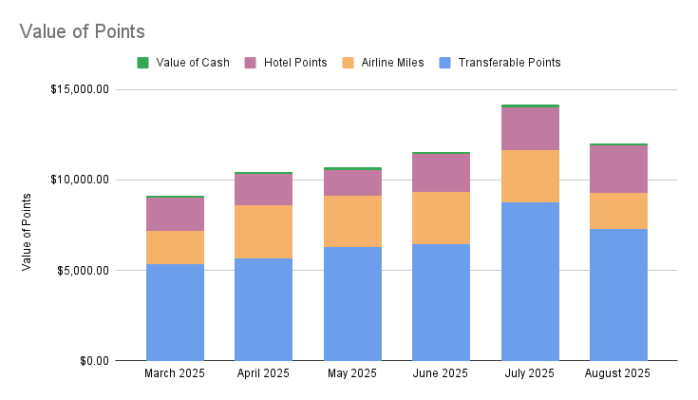
According to the Points Guy’s valuations, the grand total of those points, miles, and cash back is a little less than $14,200. That is an increase of around $2,600 from the previous month, mostly due to the Chase Sapphire Preferred bonus. That’s a pretty massive jump in just a month. Our total points values have increased for the last few months, so hopefully, we’re really starting to stockpile some points in programs that will really allow us to book some great vacations in the future.

Beauty and Danger on Malerweg Trail Stage Four

Stage four of the Malerweg starts in Altendorf and finishes in Neumannmühle. It is part of the Malerweg Trail (Painter’s Way), which is a series of eight point-to-point trails through Saxon Switzerland National Park in Germany. It roughly follows the path of German landscape painters who frequented the area in the 18th Century.

Building in Bad Schandau

My Son Alex and I had only planned four days of hiking while in Dresden, but because of the amount of rain that fell while we were there, we were only able to hike two days. Having read blog posts of people who had done all eight stages, stage four seemed to be one of the favorites of the eight stages.

Our day started with a train ride from Dresden to Bad Schandau. From there, we needed to take a bus from Bad Schandau to Altendorf. Once we got off the bus in Altendorf, it only took a few minutes to find the sign directing us to the Malerweg trail.

We followed the signs, and it wasn’t long before we came across a sign that said the path was under repair and that we needed to turn around to go to an alternative path. That forced us to turn around and eventually led us down a fairly steep trail with a lot of switchbacks that descended from Altendorf.

At the bottom of the hill was a campground where we missed a sign and walked another quarter mile or so before I thought that the trail didn’t seem right. My instincts told me we weren’t on the Malerweg, so we turned around and returned to the campground, where we saw the sign pointing to the Malerweg, which we had missed the first time. We had barely even started hiking, and we had already come across a closed trail and taken a wrong turn – not a great way to start.

Walking beside the sandstone pillars

From there, we started an approximately 1,000-ft ascent over the next four miles. The first part of the ascent was through prairie and woods until we reached the sandstone mountains. The early parts of the hike weren’t that scenic, but as we approached those stone cliffs, we were treated to amazing views.

Sandstone pillars next to the trail

The trail took us around a series of sandstone pillars for about 15 to 20 minutes before leading us uphill. This area has a large sandstone bluff, and the Malerweg trail continues on top of the bluff for a few miles. However, first we needed to climb from the trail up onto the sandstone bluffs.

Metal stairs on the sandstone ridge

On the ascent, the trail was varied. Often there would be metal stairs with handrails, other times, wooden steps, and sometimes you would need to climb on the rocks themselves. There were spots that I thought were fairly dangerous, and the footing was tricky, but after a while, we made it to the top of the bluffs, where we were treated to some spectacular views.

Looking down on the trail after climbing onto a bluff.

I was baffled by how dangerous the trail felt in parts. At one point, I was completely stretched out, holding onto the base of a metal railing, with my feet desperately trying to grip onto a large boulder, which was slick from the sand on top of the stone. This was precariously over what would be a fall of at least fifty feet.

View from the top of the sandstone bluffs

The baffling part, though, wasn’t the fact that I perceived it to be so dangerous; it was the number of much older Germans and German children doing this hike. Alex and I are in pretty good shape, and these German hikers were treating this trail like it’s a walk along a gentle river. As I learned on the Camino de Santiago earlier this year, when it comes to hiking, Germans are pretty hardcore.

Off in the distance, you can see the channel carved by the Elbe River and across it, a plateau with farmland atop it.

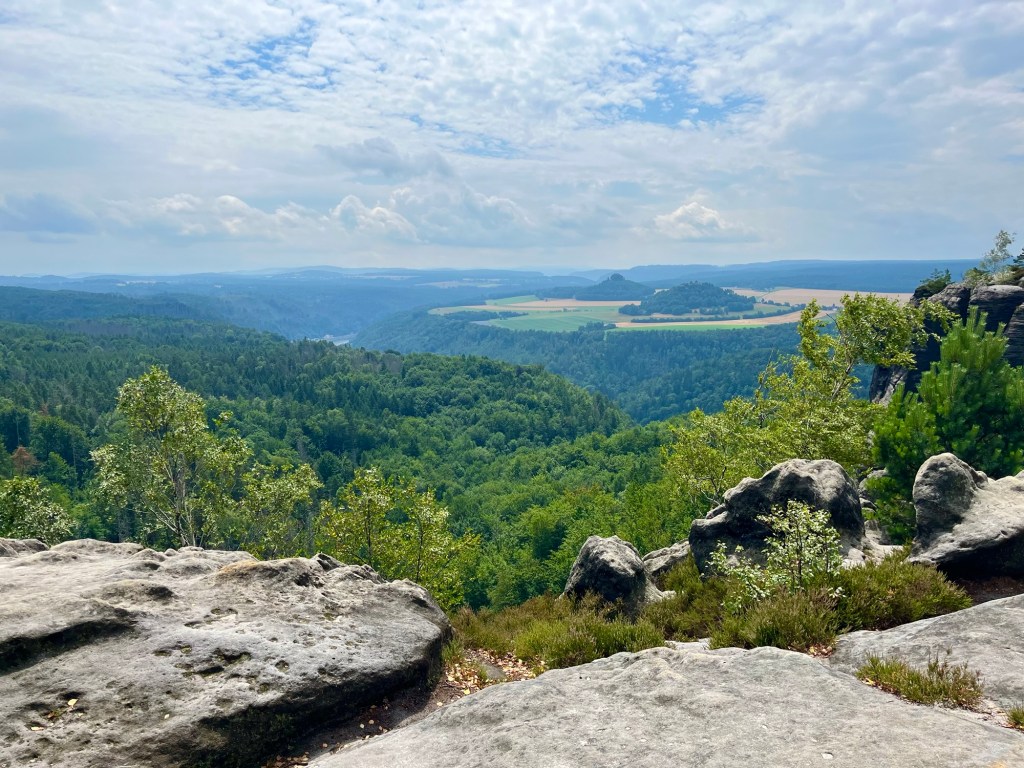
For about an hour, we walked along the top of the sandstone ridge, with phenomenal views of Saxon Switzerland National Park. On occasion, we would have to climb on top of rocks formations, and sometimes we would need to descend. However, the whole time, we were enjoying breathtaking views of the Elbe River and the Elbe Sandstone Mountains.

Metal stairs poke up between rocks on the bluff

Finally, we began our descent out of the ridge and down along the edge of the sandstone pillars. We were in a pine forest, with the sandstone cliffs next to us. We were starting to get hungry and hoped to find civilization so we could stop for some food and a drink.

A railing along the edge of a steep drop-off.

While the hike had provided us with spectacular views, it hadn’t yet passed through any towns that had restaurants. This was unlike Stage Two of the Malerweg, which had plenty of opportunities to stop for a drink and a bite to eat. After about four hours and ten miles of hiking, we finally stopped at Lichtenhainer Wasserfall.

After the descent, we found this amazing tree and formation

Lichtenhainer Wasserfall is a waterfall with a beer garden and restaurant nearby. We both ordered sausages and potato salad, and enjoyed some rest by the waterfall. The food tasted great, but I couldn’t tell if it was because it was actually great or because the hiking had made me extremely hungry.

A section of the trail perched on the edge of a cliff

I had a couple of beers, including a dunkel made by Sachsisches Schmuggler, which is made in nearby Sebnitz. It hit the spot, and we were ready to head off into the woods again.

Biergarten at Lichtenhainer Wasserfall

We only had two or three miles left, so with food in our bellies, we were feeling pretty good. Unfortunately, it was only a matter of about 10 minutes before it started to completely downpour. At first, we put on our raincoats and continued on, thinking that the rain would have to break up eventually.

Lichtenhainer Wasserfall

The rain was so heavy that the raincoats were powerless to stop us from getting wet. We walked about a mile away from Lichtenhainer Wasserfall before giving up and walking back in the other direction. We really wanted to finish, but without really knowing how much further we needed to go and being completely soaked to the bone, we decided to return to Lichtenhainer Wasserfall and take the train back to Bad Schandau.

It was disappointing not to finish the rest of Malerweg Stage Four; however, I felt pretty sure that we had experienced most of the beauty of the stage, with all of the amazing views at the top of the ridge of the Elbe Sandstone Mountains. It was an absolutely amazing hike, and while I wish we had finished it, I was glad that we were able to do the parts that we did.

If you are thinking about hiking some of the Malerweg, I would highly recommend doing stage four. You should, however, keep in mind that there are parts of the trail that are very technical and sometimes dangerous. Just don’t be surprised if you get passed by a German family with a couple of grandparents and a four-year-old.

American Airlines makes Citi Thank You Points Much More Valuable

In a widely expected move, American Airlines is now a transfer partner from Citi Thank You Points. Rumors have been circulating since it was announced that American Airlines was phasing out its Barclay’s credit cards and signing an exclusive deal with Citibank. Finally, Citibank has added American Airlines to its Thank You Points transfer page, making those points much more valuable.

How This Transfer Partnership Works

People who hold a Citi Strata Premier, Citi Prestige, or Citi Strata Elite credit card can now transfer Citi Thank You Points to American Airlines AAdvantage Miles at a 1:1 ratio. Adding a coveted transfer partner makes any Citi Thank You Points much more valuable, especially since Citi is the only bank that transfers its points to American Airlines.

In addition, this also means that as long as you hold one of those cards, any points earned with a Citi credit card that earns Thank You Points, such as the Double Cash or Custom Cash, can also become AAdvantage Miles. This is because you can combine your Thank You Points and then transfer them to any of 15 airline partners or 5 hotel partners.

The reason why transferring points is so important is that in many cases, you can book hotels and flights with fewer points when you transfer them to a hotel or airline loyalty program. Even better, if what you’re looking for is actually a better deal to book with points through a travel portal, you have that option as well.

Domestic Airlines are (Mostly) Monogamous

Many international airline programs, like Air France/KLM Flying Blue, Avianca Lifemiles, and Air Canada Aeroplan, are polyamorous, allowing transfer partners from multiple bank points programs. For example, Flying Blue allows transfers from Chase, Citibank, American Express, Capital One, Bilt, and Wells Fargo. This is extremely common for international programs. Even Virgin Atlantic, despite its name, is a bit of a swinger.

Airlines based in the United States aren’t the swinging type; by comparison, they’re mostly monogamous. Delta Airlines only allows transfers from American Express Membership Rewards, American Airlines only allows transfers from Citi, and Alaska Airlines allows transfers from Bilt Rewards.

There are three airlines that, however, that aren’t exclusive. Southwest Airlines and United Airlines allow transfers from both Chase and Bilt, while JetBlue allows transfers from Citi, Chase, and American Express.

Your Airline Preferences Matter

Because of several factors, such as route networks, hub locations, award pricing, or just which airline you prefer, you should earn points that transfer to the airline that works best for you. For example, I know people who absolutely love Southwest Airlines. They fly a ton of flights out of Midway Airport in Chicago, which is an airport that isn’t far from where we live. Unfortunately, we do a lot of our flying to Europe, and Southwest Airlines doesn’t fly to Europe. We’re just not going to use it.

United Airlines flies to Europe and has a great network there, but generally, I find that it takes a lot of United miles to book a flight to Europe. Also, even though they fly out of my small home airport in Moline, the point prices for United flights out of Moline are extremely high.

Delta Skymiles is probably the most popular airline award currency in the world, but I struggle to find good value with Delta. They overcharge for one-way flights, and usually it’s difficult to find competitive pricing for round-trip tickets as well. That being said, I do occasionally find a great deal, and did recently book round-trip tickets in the summer for a little over 40,000 points each to Berlin. Unfortunately, those deals are not the easiest to find, and I don’t consistently find good value with Delta.

American Airlines, however, has a lot of great flights out of our local airport to Europe and some for extremely low prices, in points. In September, we are flying to Nice, France, from our local airport for only 19,000 AAdvantage miles each, and we were able to find a flight home from Dublin for only 19,000 miles as well. I have also seen several flights to Italy, Spain, and England for only 19,000 miles. Overall, it’s just a program that works well for us.

Those airline miles aren’t created equal either. The Points Guy does valuations each month, which look at the price of flights in miles and compare it to the price in cash for the same flights. In July 2025, the values of those domestic airline miles are:

  • Delta Skymiles- 1.15 cents per point
  • United Mileage Plus- 1.3 cents per point
  • Southwest Rapid Rewards- 1.4 cents per point
  • JetBlue TrueBlue – 1.45 cents per point
  • Alaska Airlines Mileage Plan- 1.5 cents per point
  • American Airlines AAdvantage – 1.55 cents per point

As you can see, according to the Points Guy, AAdvantage miles are the most valuable of the domestic airline currencies, so having an additional way to earn those miles is a very good thing.

This Will Shift My Focus to Citi

Lately, I’ve been concentrating on earning American Express Membership Reward Points and Chase Ultimate Rewards. That’s because they have excellent ways of earning points, and they have great transfer partners. Both have great ways of accumulating points through sign up bonuses and cards with great earning rates.

For example, we put all our internet and cell phone charges on our Chase Ink Cash card because it earns 5x in those categories. Also, as much as possible, we use our Amex Gold Card for restaurants and grocery stores because they earn 4x in those categories. Those are both great ways to accumulate a lot of points without sign up bonuses.

However, with Citi, I have a Custom Cash card which earns 5x on all spending in your top category, up to $500 in a billing cycle. This means that if you pick a category that you can come close to spending $500 on each month and only use it in that category, you can accumulate 2,500 Citi Thank You points each month without a lot of spending. I haven’t been doing that, however, because I just wasn’t that excited about accumulating Citi Thank You Points.
The partnership with American Airlines changes that. Because AAdvantage miles are very valuable to me, I will be going out of my way to earn Citi Thank You Points so I have points available to transfer to American Airlines.

Current Citi Strata Travel Credit Cards

Now that Citibank has revamped its travel cards, they are currently offering three different credit cards that all earn Citi Thank You Points: one is an entry-level card, one is a travel card, and one is a premium travel card.

Citi Strata Card

This is the entry-level travel card, and it is a pretty good starter card. It has no annual fee and is currently offering a 30,000-point welcome offer if you spend $1,000 in 3 months. For being a no annual fee card, it has tremendous bonus categories including 5x on travel through the Citi Travel Portal, 3x at supermarkets, 3x on gas and EV stations, 3x on a self-selected category, 2x on dining, and 1x everywhere else.
The downside is that it has a limited number of transfer partners (Does not allow transfers to AAdvantage), and those points transfer at a worse ratio. You could however, hold onto those points until you get a Citi credit card with a better transfer ratio, or perhaps transfer those points to a family member who holds a Citi credit card with better transfer options and have them book flights or hotels for you.
Citi Strata Premier

The Citi Strata Premier is a great travel credit card. It has a $95 annual fee and is currently offering a 60,000-point bonus if you spend $4,000 in the first 3 months. It offers 10x on hotels, attractions, and car rentals booked through the Citi Travel Portal, 3x on other air and hotel purchases, 3x on supermarkets, 3x on restaurants, 3x on gas and EV Charging stations, and 1x on everything else.

Unlike the Citi Strata Card, the Citi Strata Premier transfers to all of Citi’s partners at the best transfer rate that Citi offers. This also includes the 1:1 ratio to American Airlines. In addition, the Citi Strata Premier also offers a variety of benefits, including trip delay coverage, trip cancellation, and protection insurance, lost and damaged luggage coverage, and some car rental coverage.

Citi Strata Elite

The Citi Strata Elite is a brand-new premium credit card offering from Citibank with a $595 annual fee. It is currently offering an 80,000 point bonus when you spend $4,000 on the card in the first 3 months. It earns 12x on hotels, car rentals, and attractions booked through the Citi Travel Portal, 6x on air travel through the Citi Travel Portal, 6x on dining on Friday and Saturday nights, 3x on dining other nights, as well as 1.5x on all other purchases.

To compensate for the high annual fee, it offers $300 per year in hotel credits, $200 on an annual splurge credit, $200 Blacklane credit, a Priority Pass Select Membership, 4 American Airlines Admirals Club Lounge passes, as well as a $120 Global Entry or TSA pre-check credit.

My Favorite Strata Card

In my opinion, the Citi Strata Premier Card is the best of this group. The 3x categories of groceries, dining, and gas can help users accumulate a lot of points quickly. It has access to all of the transfer partners that the Citi Strata Elite card does, but with a $95 annual fee instead of a $595 annual fee. Also, I don’t find the credits on the Strata Elite to be enticing enough to pay an extra $500 on an annual fee. The only reason I would consider the Strata Elite is if I were a very frequent flyer, and I used those lounge passes a lot.

Being Strategic about Your Credit Card Choices

The points and miles world is extremely complicated. There are multiple banks with multiple cards, and each comes with different earning rates, benefits, and transfer partners. If you wish to turn all of your everyday purchases into great vacations, it’s important to try to be as strategic as possible.

For travel hackers who are using points to supercharge their travel, they must use the points programs that fit their travel plans the best. That really means working backwards from the destinations that you would like to visit, figuring out the best airlines that service those destinations from where they live, and then trying to figure out the best way to earn points to use with that airline. If American Airlines miles are a good fit for your travel plans, then this new partnership with Citi is a very exciting development.

Stage Two of the Malerweg Trail

The Malerweg is a famous hiking path through Saxon Switzerland National Park in Germany. It has eight stages, each starting in one town and ending in another. For an avid hiker of average endurance, each stage takes a day to complete. Anyone who hikes the full eight days will be treated to a variety of landscapes, spectacular viewpoints, and quaint German villages.

Radfahrerkirche in Stadt Wehlen

Malerweg is German for “The Painter’s Way.” In the middle of the 18th Century, landscape artists came to the area to paint the Elbe Sandstone Mountains. The area became so popular that the artists began to share their routes, and an ideal route was created. When the railroad arrived in the 19th Century, the route fell out of favor. Over a century, efforts had been made to recreate the path, and finally, in 2006, an optimized route of 116 kilometers was created.

I knew we would not have enough time to hike the entire Malerweg, so I chose a few stages I wanted to hike. Stage two was at the top of my list because of the Bastei Bridge. As I’ve learned, if there is something that you really want to do, do it on the first day that has good weather.

We were treated to fantastic weather. It was an absolutely fabulous day with mostly clear skies and temperatures hovering around 70 degrees Fahrenheit.

View from the trail over Stadt Wehlen

The day started with a train ride from our Airbnb in Dresden, followed by a ferry ride across the Elbe from the train station in Stadt Wehlen to the town itself. From the Radfahrerkirche, the church in the main square of Stadt Wehlen, the trail starts on stairs that switchback up a steep hill overlooking the town.

From there, we followed the signs along the Malerweg through the woods. This section involved about a 600-foot climb, which was fairly gradual but strenuous nonetheless. As I’ve learned, though, if you want a great view, you need to climb a hill. In fact, the more you climb, the better the view.

The path between Stadt Wehlen and Bastei was wooded and full of large stones

After about an hour of hiking, we arrived in Bastei. Bastei is probably the most scenic and most visited part of Saxon Switzerland National Park. We immediately stopped at the Panorama Biergarten for a couple of pretzels and drinks.

There are two sides to Bastei: one facing the Elbe River and one facing the sandstone mountains. From the Panorama Biergarten, we saw the side with the sweeping views of the Elbe. Even though the views from this biergarten are amazing, this side of Bastei is less impressive than the other.

View from Panorama Biergarten in Bastei

We finished our snack in the biergarten and walked over to the other side of Bastei, and were immediately struck by the amazing views of the sandstone mountains. Spreading off into the horizon was a sea of gray sandstone columns smoothed from millions of years of erosion.

The sandstone mountains were formed during the Cretaceous period when this area was under the sea. A 600-meter-thick sandstone slab was formed at the bottom of the sea. When geologic forces caused the area to rise from the sea, erosion of the sandstone formed these landscapes. What is left is breathtaking.

Bastei Bridge

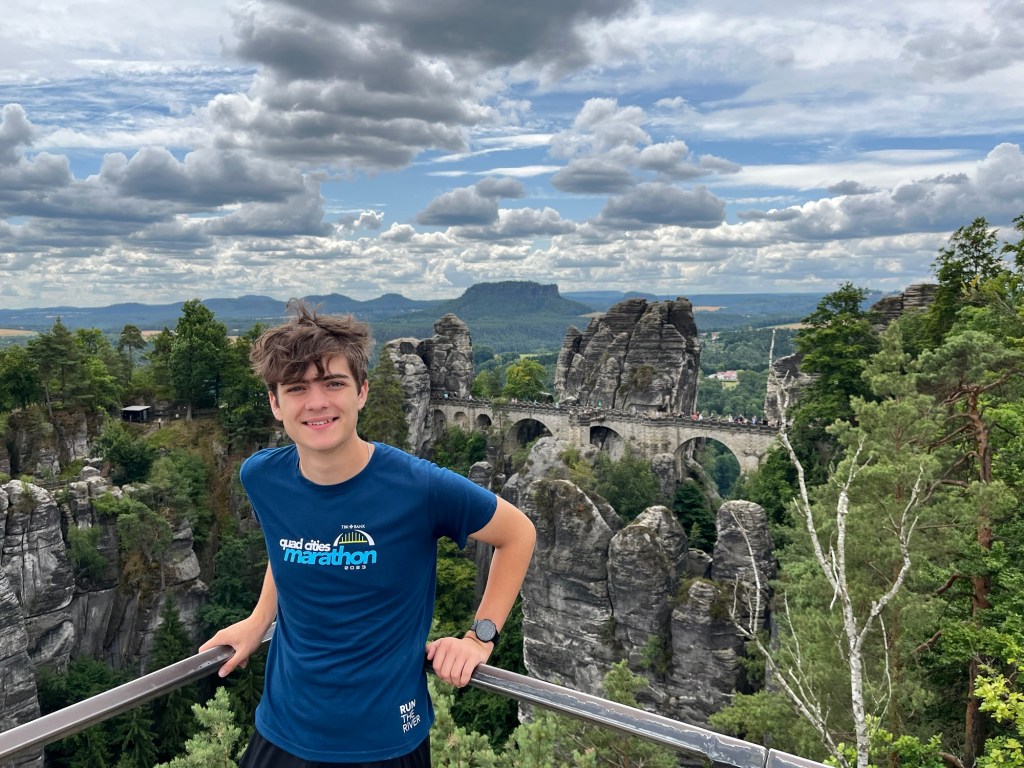
We continued walking along the path until we saw the Bastei Bridge. This sandstone bridge was built in 1851 to link multiple sandstone columns. It is a major tourist attraction and is a man-made object that complements nature rather than detracts from it.

Bastei Bridge

Most of the time we spent on the trail was by ourselves. That was not the case in Bastei. There are many ways to get to Bastei without hiking the Malerweg. There are parking lots near Bastei for people who drive, there is a bus that goes to Bastei, or you can take a much shorter 1-kilometer hike from Rathen.

Outlook stretching off the Bastei Bridge

This meant that while we were in Bastei, the trails were very crowded as people jockeyed for position to see the Elbe Sandstone Mountains and the Bastei Bridge. The crowds were fairly thick for at least a kilometer from the Bridge itself. There is a great reason for this, though—the views are tremendous.

Elbe River taken from the outlook near the Bastei Bridge

Continuing on the Malerweg past the Bastei Bridge, multiple viewpoints of the Elbe River valley and the Sandstone Mountains are simply amazing. We spent a lot of time in this area taking pictures and just looking out over the breathtaking landscape.

Viewing platform overlooking the Elbe River

Eventually, we reached the end of the sandstone bluffs at Bastei and had to start heading downhill on the trail. There were a decent number of hikers still on the trail, but they were starting to thin out.

Descending from Bastei

When we finished our descent, we were treated to a man-made lake, as the creek that ran through the area had been dammed up. People were enjoying the lake with paddle boats and kayaks, while others hiked around the lake. It was a beautiful location.

Walking along the Amelsee

That path continued until we reached Rathwalde and stopped for a little lunch. Rathwalde is a cute little village with a few restaurants. It was a nice place to stop for a little while and rest.

After stopping in Rothwalde, we got off the correct Malerweg path. I’m not sure if we missed a sign or if we misinterpreted one, but we ended up going the wrong way and had to use Google Maps to try to get us to Hohnstein, which was the end town of Malerweg stage two. That took us on a narrow blacktopped road, which wasn’t particularly fun or scenic to walk.

View from Hocksteinaussicht

Eventually, we made it back onto the Malerweg and ended up in a place called Hocksteinaussicht, a rocky lookout with a view of the village of Hohnstein. After taking in the views from Hocksteinaussicht, we descended from the rock down a set of metal stairs between the rocks. Finally making it to the bottom of the hill, we found ourselves at a road where we could go left or right. We chose to go left, which was, again, the incorrect choice.

Metal stairs through a break in the sandstone descend from Hocksteinaussicht.

Had we chosen the path to the right, we would have been treated to a pleasant walk through the woods ending in Hohnstein. Much of that path would have been along a gentle creek. Unfortunately, since we chose the other direction, we ended up on another road walking the long way into Hohnstein.

Walking into Hohnstein

When we finally did make it into Hohnstein, we were greeted by a beautiful German village with a castle on top of the highest point. It dates back to at least the 14th Century and is now a hotel.

Hohnstein

We wandered a little around the town and finally caught a bus back to the Pirna train station to catch the train back to our Airbnb in Dresden.

Between the sweeping views of the Elbe valley, the Elbe Sandstone Mountains, the Bastei Bridge, and all of the beautiful forests, creeks, and ponds, this is by far the most scenic hike I’ve ever been on. Even though the last couple of hours had been frustrating with our wrong turns along the Malerweg, we had an absolutely tremendous hike on the second stage of the Malerweg.

Fear, Hatred and Dresden’s Frauenkirche

As soon as we arrived in Dresden, we went directly to the Frauenkirche (The Church of Our Lady). I wanted to see this beautiful church for myself. Gorgeous churches are everywhere in Europe. What makes this church special is its history and how perfectly it dovetails with modern German and world history.

Statue of Martin Luther in front of the Frauenkirche

Frauenkirche is a Lutheran Church built in the Baroque style and originally completed in 1743. Its distinctive architecture and 220-foot-tall dome define the Neumarkt area of Dresden. However, the story of Frauenkirche is defined by the history of Germany in the 20th Century.

The Firebombing of Dresden

On February 13th, 1945, as Allied forces were advancing on German-held territory, and the war was nearing its end, US and British forces began firebombing Dresden. Over the next three days, Allied forces dropped thousands of tons of incendiary bombs. The intense heat from the bombing killed an estimated 25,000 people and reduced much of Dresden to rubble. Part of that was the destruction of the Frauenkirche.

Statue of Martin Luther in front of the ruins of Frauenkirche from 1958. .https://en.m.wikipedia.org/wiki/Frauenkirche,_Dresden

The End of the Cold War and Reconstruction

Following the war, Dresden was on the Soviet side of the Iron Curtain. While Dresden was being rebuilt, Frauenkirche was left as a pile of rubble in the Neumarkt neighborhood. It remained this way throughout the entire history of the German Democratic Republic, also known as East Germany. The rubble was declared a monument against war and remained that way until after German reunification.

Following reunification, funding for rebuilding the church was raised, and a plan was created for the reconstruction. Construction began in 1994 and was completed in 2005. They removed as much as they could from the rubble pile and reused around 3,800 stones. The remaining stones necessary for rebuilding the church were harvested from nearby sandstone quarries. Due to weathering and the fire damage, the salvaged stones have a darker patina than the newer stones.

The reused stones are dark gray, while the newly quarried stones are a lighter tan. Over time, the newer stones will darken as the type of stone used will patina.

On this beautiful July day, with people enjoying Neumarkt and tourists crowding the Statue of Martin Luther for selfies, it’s easy to forget about the destruction and rebirth of the Neumarkt area. The dark stones, which serve as a reminder of the firebombing, are scattered throughout the building, but two sections have a heavy concentration of the old stones.

The Rise of Nationalism

In the 19th Century, nationalism was on the rise in Europe. This movement wanted to define a country’s borders based on the ethnic, racial, and linguistic characteristics of the people inside those borders. This was in contrast to centuries of European borders defined by the marriage alliances and the conquests of monarchs.

Statue of Martin Luther in front of the Frauenkirche

While the formation of countries with borders based on ethnic similarities made sense, it also made unassimilated groups vulnerable. There were over 9 million Jews and around 1 million Roma, otherwise known as Gypsies, living in Europe before World War II. These groups lived among the various ethnic/national groups throughout Europe and didn’t have a specific nation state to call their own. In addition, nationalistic fervor left anyone who wasn’t living within their own nation’s borders vulnerable, like the 1.7 million Poles who lived within German borders before World War 2.

As Nationalism began to rise in Europe in the early 20th Century, a toxic blend of pride and fear began to take shape. Pride and fear are natural companions, as pride in people’s ethnic/national identity often leads to the fear of other groups, especially unassimilated groups. In the early 20th century, a book called the Protocols of the Elders of Zion circulated around Europe, which was a fabricated story of a Jewish plot for world domination. Even though the book should have been seen as an obvious lie, it was treated as factual and became required reading in some classes in Germany.

We walked around the church, admiring the Baroque architecture. We decided to take a look inside. My first reaction was that it was incredibly airy and bright, with many intricate Baroque elements and multiple balconies. It’s breathtaking.

Nationalism in the United States

Nationalism wasn’t a strictly European phenomenon. Fear of unassimilated ethnic groups has persisted throughout American history, typically when large numbers of immigrants arrived and formed their own communities. This includes Italians, Irish, Polish, Chinese, and other groups who created their communities within American cities.

Inside Frauenkirche, under the dome

In my hometown of Davenport, Iowa, the dominant immigrant group was German. There were so many Germans in the area that a German language newspaper called Der Demokrat was published from 1851 to 1918. The newspaper was shut down when the Babel Proclamation made speaking German in public illegal in Iowa.

In Germany, however, the Nationalist movement was taken to extremes as the Nazis sought to expand their borders while eliminating anything that was not exclusively German. The objective was to create a completely homogeneous German nation with expansive borders. This obviously could not be accomplished without war and ethnic cleansing, and led to World War II and the horrors of the Holocaust.

The altar in Frauenkirche

In America, World War II stoked fear of Japanese and German immigrants. Japanese-Americans were moved into internment camps, and Germans were viewed with suspicion.

Multiple levels of seating have clear views of the altar in Frauenkirche.

After walking around the inside of the church, we headed down to the basement. The basement contains an altar and seating for additional services. It also contains multiple alcoves for private prayer and reflection.

Who Sows Fear, Reaps Weapons

The story is always the same: fear leads to hate, and hate leads to violence. Fear and hatred work by dehumanizing the perceived enemy and justifying violence against that group.

Under the church, there is an altar where additional services can be performed

For the Germans during World War II, that fear justified the war and the campaigns of ethnic cleansing. For Americans, it meant justifying the bombing of civilian populations, like the ones in Nagasaki, Hiroshima, and Dresden.

Monument under Frauenkirche depicting the 10 commandments

Those justifications don’t always hold up after the fog of war clears. In 1945, according to a Gallup poll, 85% of Americans approved of the use of nuclear weapons on Nagasaki and Hiroshima as a means of ending the war. By 2005, that number had fallen to 57%.

The Cold War and New Alliances

Following World War II, enemies became allies as Western Europe began working together in military alliances and as trading partners. America and Japan, once mortal enemies, became valued trading partners and close friends. Instead, a new enemy had emerged, with the world split by the Cold War, and Dresden was on the Soviet side of the Iron Curtain, separated from their brothers and sisters in West Germany.

Visitors gather in Frauenkirche throughout the day to see this amazing church and to pray.

The Cold War defined the next 45 years of human history. There was a space race, nuclear proliferation, and the Cuban Missile Crisis – everything seemed to be defined as a competition between the West and the East, Communist and Capitalist. The entire time, Frauenkirche sat as a pile of rubble in Neumarkt, a daily reminder to the citizens of Dresden of the dangers of Nationalism.

We decided to buy tickets to climb up into the dome. For 10 Euros, you can see a different perspective of the church. As you go up, you see the paintings on the inner dome. Ascending further, you can look through windows at the main dome and down through an oculus at the inner dome and the rest of the church.

Europe Unites as Frauenkirche is Rebuilt

The collapse of the Soviet Union and the fall of the Berlin Wall ushered in a new era for Europe and for the Frauenkirche. In the late 1980s and early 1990s, as Germany was going through Reunification, an aggressive fundraising campaign was conducted to raise the 180 million euros necessary to rebuild the church.

Paintings on the inner dome

In 1993, a rubble-sorting event marked the beginning of the efforts to reconstruct the Frauenkirche. As the church’s cornerstone was stabilized in 1995, the European Union added Austria, Sweden, and Finland to raise its membership to 14 members.

Reconstruction of the Frauenkirche was completed in 2005. During the eleven years of Reconstruction, the Euro was developed and established in 11 countries. The Schengen Zone went into effect in many of the EU countries, allowing freedom of movement without border controls. By the time the Frauenkirche was completed, the European Union had expanded to 25 countries.

Room above the oculus in the inner dome

Nationalism had divided the continent and led to the destruction of the church. In the 60 years from rubble to reconstruction, the continent became defined by its cooperation and connections.

Since 2005, three more members have joined the European Union, and one, Great Britain, has left. Nine countries are currently listed as candidates to join the European Union. This interconnection has ended all wars between these countries, which have fought each other for centuries. The fear is gone, and with it the hatred and the violence.

Sloped walkway between the outside wall and the inside wall of the dome

We climbed all the way to the top of the dome and walked out onto the observation deck. From the top, you could see most of Dresden. The neighborhood around Frauenkirche has also been reconstructed with shops, apartments, hotels, and restaurants. The plaza in front of the church was lively with visitors and shoppers. Neumarkt is whole again.

Tension in North America

While Europe becomes a more unified continent, North America has become more divided. A tariff war has made Canada and the United States, longtime allies and friends, suspicious of one another. In addition, statements by Donald Trump indicating that he would like Canada to be the 51st state, however unserious that sounds, have to be taken seriously by Canada because of the power imbalance between the two countries.

A view of the Elbe River from the observation deck above the dome

The relationship between the US and Mexico continues to be complicated, with the US both relying upon Mexican immigrants for cheap labor and vilifying their presence within the country.

Fear of Immigrants and the LGBTQ+ Community

Much of this is stoked by irrational fears, with immigrants being accused of drug trafficking and violent crime. Even though studies have indicated that it is likely that immigrants commit less crime than native populations in the US, the fear that immigrants worsen crime rates persists. These fears sometimes reveal themselves in strange ways, such as in the 2024 Presidential Debates, where Donald Trump accused Haitian immigrants of eating neighborhood pets. The fact that this statement didn’t disqualify him from office in the minds of voters is an indication of the public’s perception of immigrants.

Neumarkt area from the observation deck

Recently, the immigration debate has turned extremely dark as a detention center has been constructed on swampland in Florida. Known by its supporters as Alligator Alcatraz, its goal is to house illegal immigrants until they can be deported.

However, some of the supporters of this plan have expressed more extreme ideas. Laura Loomer, who traveled with President Trump during the 2024 campaign, recently tweeted, “The good news is, the alligators are guaranteed at least 65 million meals, if we get started now.” 65 million is the total population of all Hispanics in the US, most of whom are citizens. So, as you can see, for the most extreme members of the Republican Party, the issue of protecting the border has now moved toward ethnic cleansing.

Fear also affects the LGBTQ+ community. The LGBTQ+ community has been the target of many ridiculous accusations over the years, including the idea that same-sex marriage destroys the sanctity of straight marriage and the idea that homosexuals groom children for pedophilia. These are accusations meant to paint all LGBTQ+ individuals as a danger to society.

A pride flag hangs from a balcony of an art museum that faces the Frauenkirche

Another persistent fear among right-wing communities is that transgender women will use women’s restrooms to rape cisgender women. I’ve never heard of a real case where this happened, but the fear persists nonetheless. The idea is ridiculous, of course, because anyone willing to commit rape would not be deterred by laws that limit access to restrooms based on biological gender.

Lessons from the Past

Much like the lies told in the Protocols of the Elders of Zion in the early 20th Century, these lies persist in the early 21st Century. These lies are told to marginalize communities within the United States in the same way that communities were marginalized in Germany before World War II. They spread fear. Fear leads to hate, hate leads to violence.

Europe has shown what is possible when people put their fears aside and work together. They have lived through the horrors of war and chosen to work together towards a peaceful and more prosperous future.

We ended our visit to Frauenkirche, standing in front of the last remaining piece of rubble from what was the pile that lay in Dresden for decades. It was a large piece of the dome recovered from the pile, placed as a monument with a plaque containing the account of a survivor of the firebombing.

The remaining piece of rubble from the dome was left as a monument to the destruction of Frauenkirche.

Standing in front of the monument, I was reminded of the vulnerable communities within my country and the lies and slurs they endure daily. We live in a precarious time when we must decide whether to listen to the sounds of fear and hate or embrace empathy, kindness, and love. I hoped that one day, a curious traveler wouldn’t be standing in front of a similar monument in the United States.

People should be treated with empathy and kindness regardless of their immigration status, sexual orientation, gender identity, race, religion, or disability. People are people, and love is love.

Points Check June 2025

We’re getting ready to embark on another European adventure, although this time we will be on separate vacations. Jenn is visiting Munich and Dublin with our daughter, her sister, and our niece. That was planned as a girls’ trip to celebrate our niece graduating from High School.

Meanwhile, my son Alex and I will be visiting Dresden and Berlin, and spending a significant amount of time hiking in Saxon Switzerland National Park on the border of Germany and the Czech Republic.

It’s getting a little weird, this being our fourth trip to Europe in three years, since I thought that a European vacation was out of reach for us a decade ago. Knowing how and where we can save money on these trips makes all the difference.

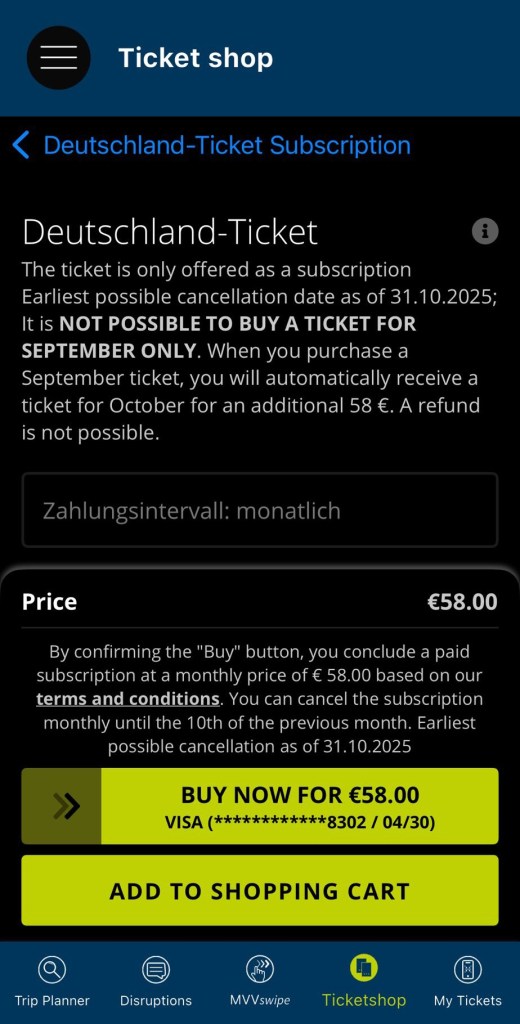
For instance, for Alex and me to go on our trip, the round-trip flight cost $264 in taxes and fuel charges on top of the 81,600 Delta Skymiles. We will be taking Flixbus from the airport to Dresden and then from Dresden to Berlin the following week. Those bus tickets will cost a total of $80. We will spend about $140 for two Deutschland tickets, which will cover all of our public transportation while we are there. That means that our transportation costs are a total of $484.

Knowing that we would spend only a little time in our Airbnb, we rented a small apartment near a train stop in Dresden for $490 for 6 nights. We also have two nights in the Holiday Inn Express Alexanderplatz, where we will use two IHG free night certificates.

That means that, outside of food and activities, we will spend less than $1,000 on the trip. I get a lot of odd looks from people who can’t believe that we can afford to keep going to Europe, but it’s absolutely possible if you know what you’re doing.

IHG Bonus

Jenn earned the first of her bonuses on the IHG One Rewards Premier Business Card. She signed up for the card when there was a 140,000 point bonus after $4,000 in 3 months and an additional 60,000 points after $9,000 spent in 6 months.

IHG isn’t a luxury brand, but it offers many affordable options and has locations worldwide. I’ve especially been pleased with its footprint in Europe. Plenty of hotels are available wherever I look in Europe on the IHG app. Having a stash of IHG points will be nice to have when planning trips in the future.

On to the Point Check!

Most of our spending was done on the two cards for which we are working on signup bonuses. That would be my Chase Sapphire Preferred and Jenn’s IHG Business Card. There was some spending done on cards that we use for recurring billing. We’ve optimized them so that we earn 5x on utilities and 8x on gas with the Wyndham Business Earner card as well as 5x on streaming services and cell phone plans on the Ink Cash. All of that means that for these cards we earned 8.3% back on all spend on the cards listed below – not too bad.

Card UsedSpendPoints EarnedPoint ValuePoints Per $Return on Spend
Ink Cash$5022,510$51.465.010.2%
Wyndham Business Earner$4072,234$24.575.56.0%
Amex Gold$165660$13.204.08.0%
Total1,0745,404$89.235.08.3%
This month’s spending not devoted to earning a signup bonus

In addition to the spending listed above, I also spent a little less than $3,000 on my Chase Sapphire Preferred Card, earning around 4,700 Chase Ultimate Reward points. Jenn spent over $3,100 on her IHG, earning 11,900 IHG points as well as the 140,000 point bonus for spending $4,000 in the first 3 months. If she ends up spending an additional $5,000 over the next 4 months, she will earn an additional 60,000 point bonus.

At the end of the month, we had a grand total of:

  • 185,000 IHG points
  • 161,800 Chase Ultimate Rewards Points
  • 124,600 Amex Membership Rewards Points
  • 93,000 American Airlines Miles
  • 81,100 Wyndham Points
  • 79,100 Alaska Miles
  • 32,300 Citi Thank You Points
  • 16,700 United Miles
  • 15,900 Marriott Bonvoy Points
  • 9,300 Hyatt Points
  • 1,500 Delta Miles
  • $132 in Cash Back

According to the Points Guy’s valuations, the grand total of those points, miles, and cash back is a little less than $11,600. That is an increase of around $800 from the previous month, as our point totals finally start to recover from the massive amount of point redemptions we made at the end of last year and the beginning of this year. Of course, the most important thing is that we get to enjoy another wonderful vacation.

Points Check May 2025

May wasn’t terribly exciting, but Jenn did join me on a business trip to San Antonio. While I’m not a huge fan of being in Texas during the warmer months, I love the River Walk. What is unique about the River Walk is that San Antonio built a giant flood tunnel and a lock and dam system along the San Antonio River to ensure that the river stays at the same level, regardless of the amount of rain they receive. That allows for the walkway to be only a few inches above the water level, and all of the shops and restaurants can be extremely close to the river. It makes for a unique and beautiful experience, especially at night.

While much of my time was spent at a convention, the evenings allowed us to check out many of the breweries and restaurants in the area. While I love walking around the main commercial area on the River Walk, the restaurants and bars there are expensive and underwhelming. When you get off the main area of River Walk, the food and drink seems to improve dramatically. We had the opportunity to visit my favorite place in San Antonio, Dos Sirenos Brewing, a couple of times when we were there, which made me and my belly, very happy.

Some Hotel Redemptions

My son Alex and I are going to Berlin and Dresden for a week this July. We hope to do a little hiking at Saxon Switzerland National Park and explore both cities. I waited maybe a little too long to book our lodging, but I was able to find a cheap Airbnb along the main train line in Dresden that should mean quick transit to the national park as well as Downtown Dresden. We also used the last two of Jenn’s IHG free-night certificates to book a Holiday Inn in Downtown Berlin.

In addition, we used Jenn’s Marriott free-night certificate, which was about to expire, to book a hotel in Peoria for a quick weekend getaway with our friends Bill and Theresa. While I hate that we almost had a certificate expire, using it for a quick getaway with some good friends is never a bad use of a certificate.

Slow and Steady

I’ve been a pretty big fan of the Wyndham program for a while. One reason is that Jenn’s Wyndham Business Earner card earns 8 points per dollar spent at gas stations and 5 points per dollar on utilities. That means that we are typically earning a couple of thousand Wyndham points per month on those categories. In addition, it gives any cardholder a 10% discount when those points are used.

Also, when the $95 annual fee is paid each year, the cardholder receives a 15,000-point bonus. Since those points are valued at 1.1 cents per dollar, we receive $165 in Wyndham points, and if you figure in the 10% point redemption discount, it’s closer to $180. That’s a pretty good reason to hold the card by itself.

Over the last 21 months, our Wyndham points balance has gone up by 78,000 points by doing nothing but using it for utilities and gas, and earning the annual bonus. This demonstrates how slow and steady growth can lead to a meaningful number of points.

At 81,000 points, we will have enough points to book a 1-bedroom Vacasa vacation rental for 6 days that is priced up to $250 per night. Since we really love to use vacation rentals, the ability to book one with points is fantastic. Also, the ability to get a free vacation rental worth up to $1,500 for just 81,000 points is pretty nice. There just happen to be quite a few Vacasas in Tulum, Puerto Vallarta, and Cabo San Lucas that fit that category, so there is a good chance I’ll be booking a trip to Mexico at some point.

On To The Point Check!

Once again, our spending not committed to earning a signup bonus was spent strategically. We earned 6.9% on that spending, and I’m generally happy when we earn over 5%.

Card UsedSpendPoints EarnedPoint ValuePoints Per $Return on Spend
Wyndham Business Earner$9184,879$53.675.35.9%
Ink Cash$7243.622$74.255.010.2%
Venture$455910$18.202.03.7%
Amex Gold$4211,684$33.684.08.0%
Sapphire Preferred$157247$5.061.63.2%
Total$2,67511,342$184.864.26.9%
This month’s spending not devoted to earning a signup bonus

Besides the spending on the credit cards listed above, Jenn spent almost $1,600 on her IHG card, earning over 5,000 IHG points. I spent almost $1,500 on my Chase Sapphire Preferred card, earning me over 3,800 Chase Ultimate Reward points and getting me closer to my 100,000 point bonus. At the end of the month we were left with:

  • 154,600 Chase Ultimate Rewards Points
  • 124,500 Amex Membership Rewards Points
  • 93,000 American Airlines Miles
  • 79,100 Alaska Miles
  • 78,800 Wyndham Points
  • 60,000 Marriott Bonvoy Points
  • 33,200 IHG points
  • 32,100 Citi Thank You Points
  • 16,700 United Miles
  • 9,300 Hyatt Points
  • 1,500 Delta Miles
  • $132 in Cash Back

When you add up all of those points, according to the valuations published by the Points Guy, they are worth a grand total of $10,700. That is slightly higher than the previous month, but still well below our all-time high of $16,500. Given the fact that we have some signup bonuses that we are working on and the fact that I don’t have to much to redeem our points on soon, I think we might top that this year. We’ll have to wait and see how that plays out though. Either way, I have a trip to Germany to get ready for!

The Aer Lingus Avios Sweet Spot Nobody Talks About

Aer Lingus Avios is a tremendous program that almost nobody in the points and miles community talks about. The program is great because it provides a predictably great value on award flights. It is also easy to accumulate points because of its great transfer partners. What makes it fly under the radar, however, is that it is a confusing website and is not scanned by award websites like awardtool.com and pointsyeah.com.

Not Kidding – This Website is Terrible

One of the main reasons people don’t pay attention to this program is that the website is just horrible. For instance, you would think that if you logged into the website and then went to book a flight, you would be able to toggle between paying with Aer Lingus Avios and paying with cash. You would think this because almost every other airline has this feature on their website—not Aer Lingus, however.

This is the normal interface for the website, but there isn’t an option to pay with points.

Instead, you need to click on the AerClub tab at the top and under the “Spend Avios” section, select “Book a Reward Flight”.

When you click on “Book an Award Flight”, you would expect it to take you to a page where you could book an award flight. Unfortunately, you need to find the little button that says “Buy a Reward Flight,” which is about halfway down the page after a bunch of information about the kinds of flights that you can book with Avios.

Once you do that, there will finally be an interface to allow you to search for an award flight. Just type in the airport that you wish to depart from and the airport that you want to arrive at, as well as the date, and then click the “search flights” button.

That sounds easy enough, but the problem is that for some reason, you can only search for direct flights. For instance, I can search from Chicago to Dublin. I can also search from Dublin to Edinburgh, because both of those are direct flights. What I can’t do is search from Chicago to Edinburgh, because there would be a stop in Dublin. That’s utterly insane. I cannot think of another airline website that is unable to book an award flight with a stop. It’s non-stop flights or nothing.

How A Limitation Can Be an Advantage

This limitation, though, can be used to your advantage. I am a huge fan of stopover flights and because you need to book all of the awards as separate itineraries, that makes stopovers simple.

Let’s look at the above example. I want to fly from Chicago to Edinburgh, Scotland, and do it on points. Clearly, I can’t book it as one itinerary, because the website only allows for non-stop flights. However, that does mean that I can break the two segments up into separate days and instead plan a stopover in Dublin for a day or two. Now, instead of flying directly into Edinburgh, I can stop for a day or two, visit Dublin Castle, have a couple of Guinness stouts, and adjust to the jet lag before moving on to Edinburgh. Stopovers are a fun way of getting a little extra out of a vacation.

Unfortunately, that means that if you are planning to fly from America to Europe using Aer Lingus, you will need to fly from one of the few cities in North America that have a direct flight to Dublin or Shannon. There are a couple of dozen American cities that you can fly to Ireland on using Aer Lingus, and Flight Connections is a great way to find out where those airports are that connect via Aer Lingus.

Award Flights are Consistently Available at Reasonable Prices

The Aer Lingus website is clunky and hard to use, but the payoff is predictable pricing and fairly consistently available awards, at least in economy. Aer Lingus has a distance-based award chart, and they seem to release five economy seats for each flight. I have no idea how many business class awards they release, because they are always sold out. If you find one, consider yourself extremely lucky.

The points charges for economy flights within Europe are pretty good, with flights from Ireland to the UK or within Ireland costing 4,000 Avios off-peak and 4,500 peak. From Ireland to most of Europe, it is 6,500 off-peak and 7,500 at peak. When you get a little further out, like Ireland to Greece, the Canary Islands, or Croatia, it gets up to 8,500 off-peak and 10,000 peak.

The calendar for peak/off-peak is also fairly generous, with peak pricing basically being summer and a few holiday-related dates the rest of the year.

Where this program gets extremely interesting, for Americans, is the fact that you can fly to Dublin from most of the Northeast and Midwest in the US for 13,000 miles off-peak and 20,000 miles peak. For destinations in Florida, Denver, and the US West Coast, it costs 16,250 miles off-peak and 25,000 miles peak. To view the full award chart, click on this link.

What this means, at least for me, is that you can use Dublin as a great launching point for trips from the US to different parts of Europe. I’ve been promising my family a Canary Islands trip for years and haven’t pulled it off yet. Using Aer Lingus Avios, we could fly to Tenerife during spring break, for 13,000 miles to Dublin. We could stopover in Dublin for a night or two and then get back on a plane and fly to Tenerife for 8,500 Avios. That’s a total of 21,500 Avios each for a pretty great flight itinerary.

You could do the same thing and end up in Munich for 19,500 Avios with a stopover in Dublin, or go to virtually any place in Ireland or the UK for only 17,000 Avios. That’s not unheard of, but the fact that it’s available most of the time on the Aer Lingus website makes it unique. It might not be available on the exact date you want to fly, but usually within a few days of when you want to fly.

Also, if you really need to fly on a Saturday, because you really can’t do a Tuesday-to-Tuesday trip, Aer Lingus offers the same good flight prices on the weekends as they do on any other day of the week. You might need to plan ahead and book early if you want to get those flights, however.

Aer Lingus Avios are Easy to Earn

Accumulating Avios is one of the easiest things you can do in travel hacking. You can transfer points directly from American Express Membership Rewards, Bilt Rewards, Chase Ultimate Rewards points, and Wells Fargo points. You can also transfer points from Citi Thank You points and Capital One by transferring to other Avios programs and then transferring to Aer Lingus Avios. In addition, Chase has three personal credit cards: the British Airways Visa Signature Card, the Iberia Visa Signature Credit Card, as well as the Aer Lingus Visa Signature Card, which earn Avios. There are also two credit cards issued by Cardless that earn Qatar Privilege Avios. If you earn Avios in any other program, like Iberia, you can just transfer those points to Aer Lingus at a 1:1 ratio.

All of those points can be consolidated into any Avios program. That probably makes Aer Lingus, as well as British Airways, Qatar Airlines, Finnair, and Iberia (all Avios programs), the easiest programs to accumulate points in. This means that not only will it not take a ton of points to book those flights, but it’s relatively easy to get those points.

Taxes and Fuel Surcharges are Relatively High

One thing that can be a little frustrating about the Aer Lingus program is that the taxes and fuel surcharges are relatively high. They’re not high compared to other European programs like Flying Blue or Virgin Atlantic, but compared to Alaska Airlines, American Airlines, Delta, or United, those fees are pretty high. At current exchange rates, a round-trip flight to Dublin from Chicago costs $299.71 in taxes and fuel surcharges. On an identical United flight itinerary, the taxes are $50.41.

US-based programs like Alaska, American, Delta, or United are going to charge much less in taxes and fuel surcharges, but the number of points needed will typically be much higher. In the United Airlines example that I mentioned earlier, the total number of points needed was 80,000 United miles round-trip, as opposed to the 26,000 points needed with Aer Lingus. So the question is, would you rather pay 26,000 points and $300 or 80,000 points and $50? That’s really an individual decision.

Why Aer Lingus For Transatlantic Flights is Clutch

Recently, the Chase Sapphire Preferred Card had a 100,000 Chase Ultimate Rewards Points bonus. This will probably be the most popular signup bonus for 2025. Anyone who signed up for this credit card and completed the $5,000 spend in 3 months necessary to get the bonus will be sitting on at least 105,000 Chase Ultimate Reward Points.

If you have a family of four that you would like to fly to Dublin from Chicago, in an off-peak time like September, for example, you could book that with Aer Lingus for 26,000 Avios and $300 each, for a total of 104,000 Aer Lingus Avios and $1,200. Those flights currently cost around $800 each, or around $3,200 total. Since the Avios needed to book those flights transfer from Chase Ultimate Reward Points at a 1:1 ratio, that means that this one signup bonus can ultimately save $2,000 on these flights.

One credit card signup and one transfer, and you can save $2,000 on flights to Dublin. That’s pretty good.

What Would I do?

In practice, when we travel to Europe, I prefer to have a destination that I want to go to and a stopover that’s a bonus. When Jenn and I visited Italy last fall, we had a stopover in Amsterdam that was a great add-on to the trip. That being said, I almost always book one-way flights. In order to keep the cost of the taxes and fuel surcharges down, I would probably book one of the one-way flights with one of the American carriers.

Let’s say I wanted to visit Prague in September. Alaska Air has a flight bookable with Alaska Miles (ironically, an Aer Lingus partner award) for 27,500 miles and $24. I would book that and then book a flight from Prague to Dublin using 6,500 Aer Lingus Avios and $32 as well as a flight from Dublin to Chicago for 13,000 Aer Lingus Avios and $167. That means that for 27,500 Alaska Miles, 19,500 Aer Lingus Avios, and $223, I can fly from Chicago and visit both Prague and Dublin. That’s a pretty solid itinerary for a fairly low price in points and dollars.

Don’t Overlook Aer Lingus

The Aer Lingus rewards program flies under the radar as a pretty great way to book inexpensive economy awards from the United States to Europe, especially Ireland and the UK. While the website can be a little clunky, and all of the award flights have to be booked as separate legs of direct flights, understanding the Aer Lingus program can yield amazing value.

The fact that everything has to be booked as non-stop flights means that you can add a day or two stopover in Dublin. This allows people to add an additional destination to a European vacation. Having to book separate legs could be an annoyance, or it could be a benefit. It’s really just a matter of how you look at it. That being said, 13,000 miles one-way from the northeast and midwest of the US is a deal that just amazing, and it’s basically standard with Aer Lingus.

It’s easy to overlook this program because if you are trying to find the best deal on award flights with a website like pointsyeah.com or awardtool.com you won’t find Aer Lingus awards. But don’t forget to go to Aer Lingus and see what’s available, especially if a trip to Ireland or at least a stopover would be desirable. It’s a great program that flies under the radar, so don’t ignore it.