Day 2 of the Camino – O Porrino to Redondela

This is part two of a multi-part series on our experiences doing the Portuguese Central Route of the Camino de Santiago starting in Valenca, Portugal and ending in Santiago de Compostela.

The first day of the Camino was hard on us. Everyone was sore. For me, it was my shoulders. I wasn’t used to my backpack. Surprisingly, a good night’s sleep healed up most of our aches and pains. The first day had tested everyone physically and mentally, but surprisingly everyone woke up refreshed and ready to take on another challenge.

We tinkered around in our hostel kitchen and made some breakfast. The English gentleman we met the previous day was also having breakfast, and we discussed his previous caminos. He had done the English way, the French Way, and the Coastal Route of the Portuguese Way. This time he was doing the Portuguese Central Route with the Spiritual Variant. Talking to him it became clear that you can hike the Camino in infinite ways. As a nearly 70-year-old man, he had truly been making the most of his retirement and was inspiring to talk to.

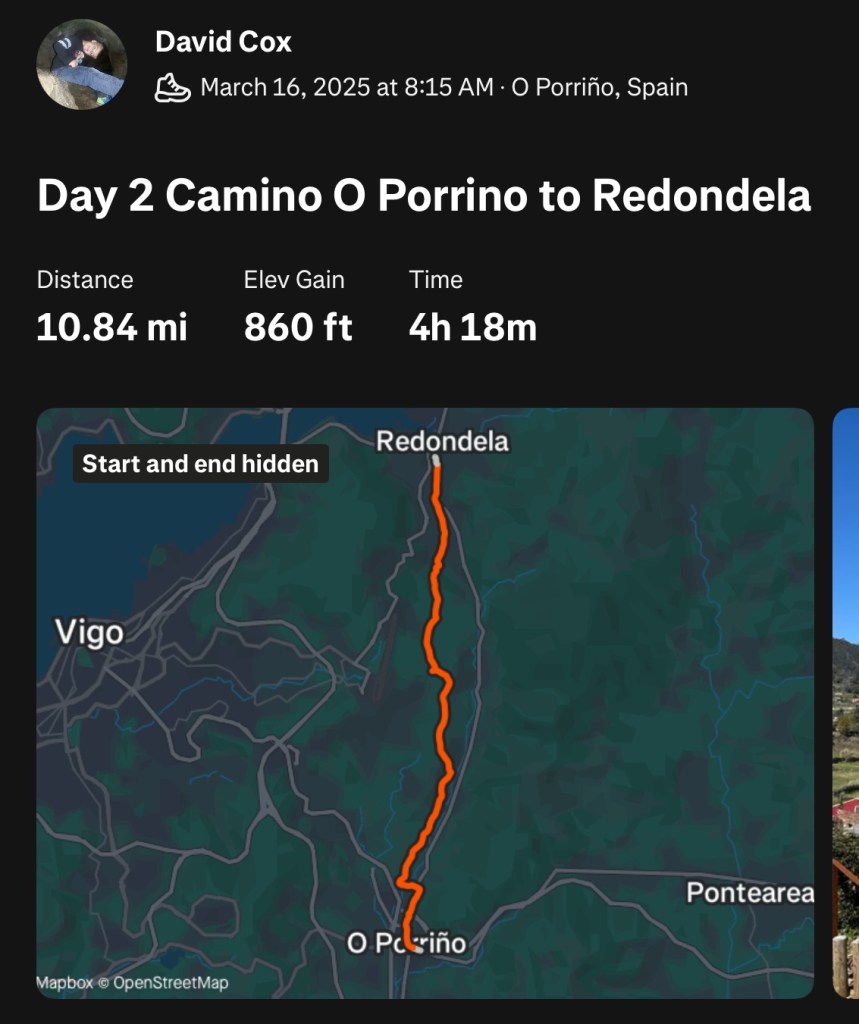
Strava activity from day 2

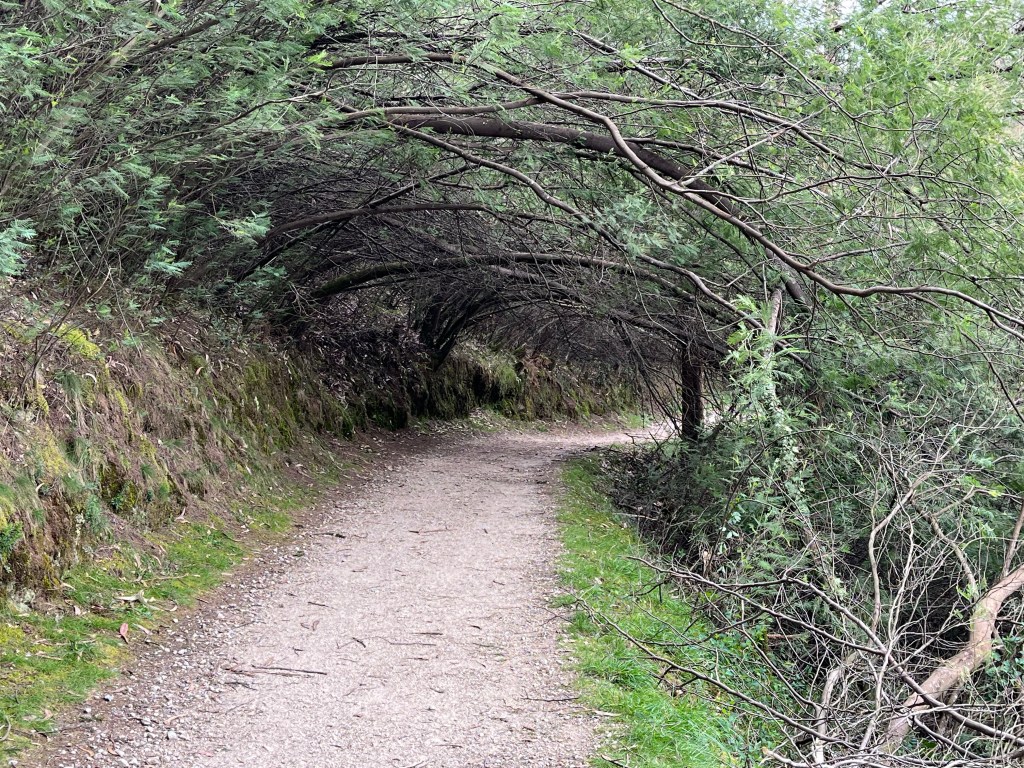
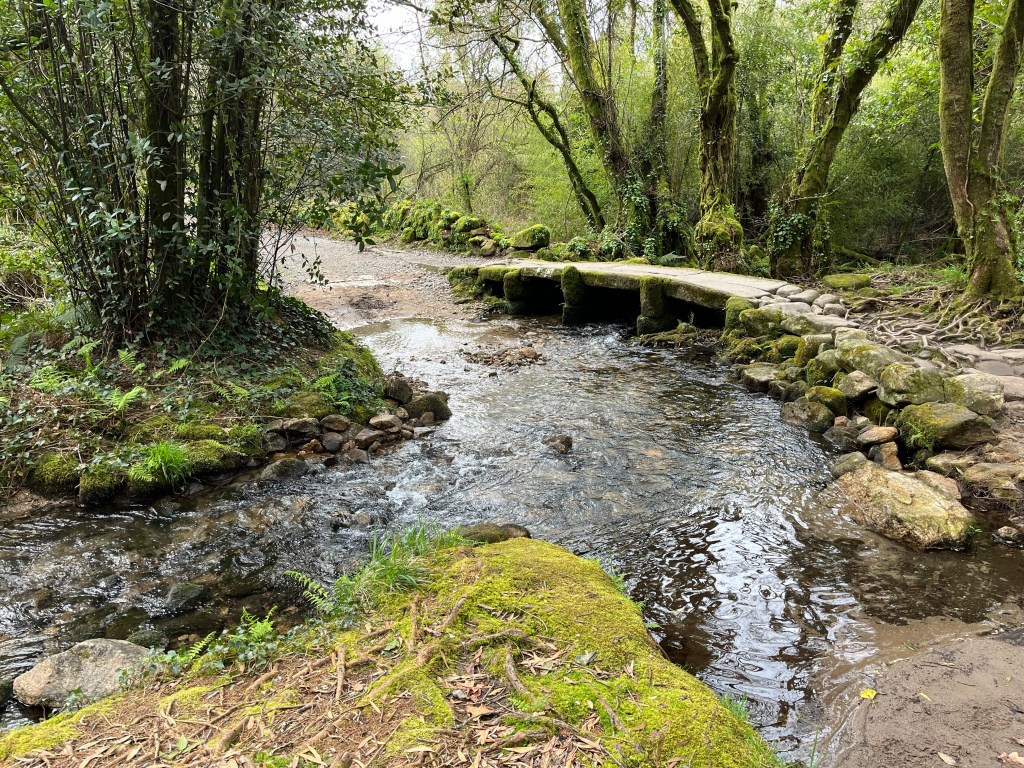
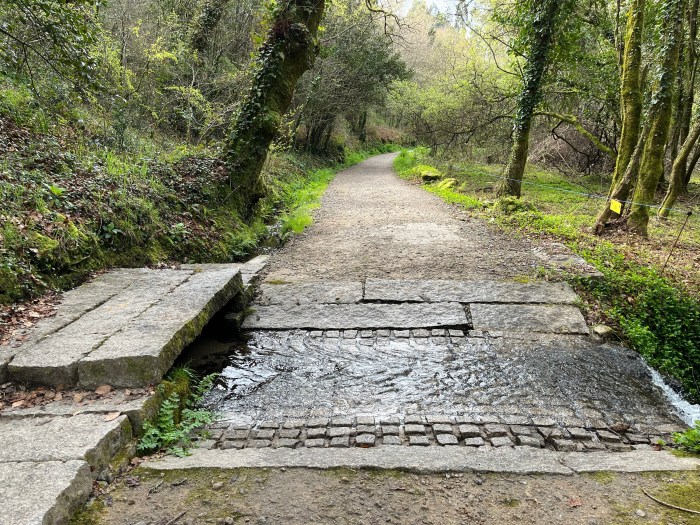
We told the gentleman goodbye and that we would see him on the trail (he’s a faster hiker than us, he was going to catch up) and started our walk toward Redondela. Most of the early part of the day was spent hiking through rural Galicia. It was on a lot of blacktop country roads weaving through farms.

Sheep above a wall near Mos, Spain

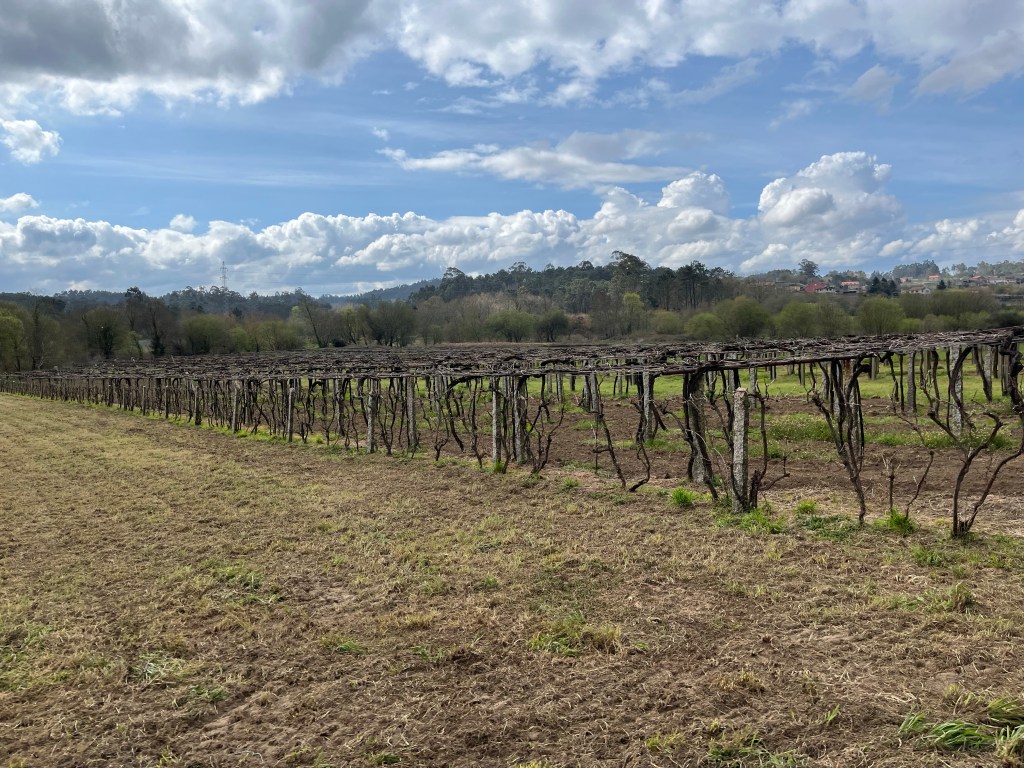
In Iowa, we are used to giant factory farms where one family plows thousands of acres of one crop, either soybeans or corn. In Galicia, farms are small and have a variety of animals and crops. Almost everyone had a dozen or more chickens. There were also usually some other animals on the farms including ducks, geese, cows, sheep, and sometimes goats. There were also a lot of gardens and grapevines. My favorite thing about these little farms was that you normally saw an orange tree and a lemon tree on the property. Walking outside and picking an orange right from the tree has to be pretty amazing.

Wooden arrow marking direction on the Camino

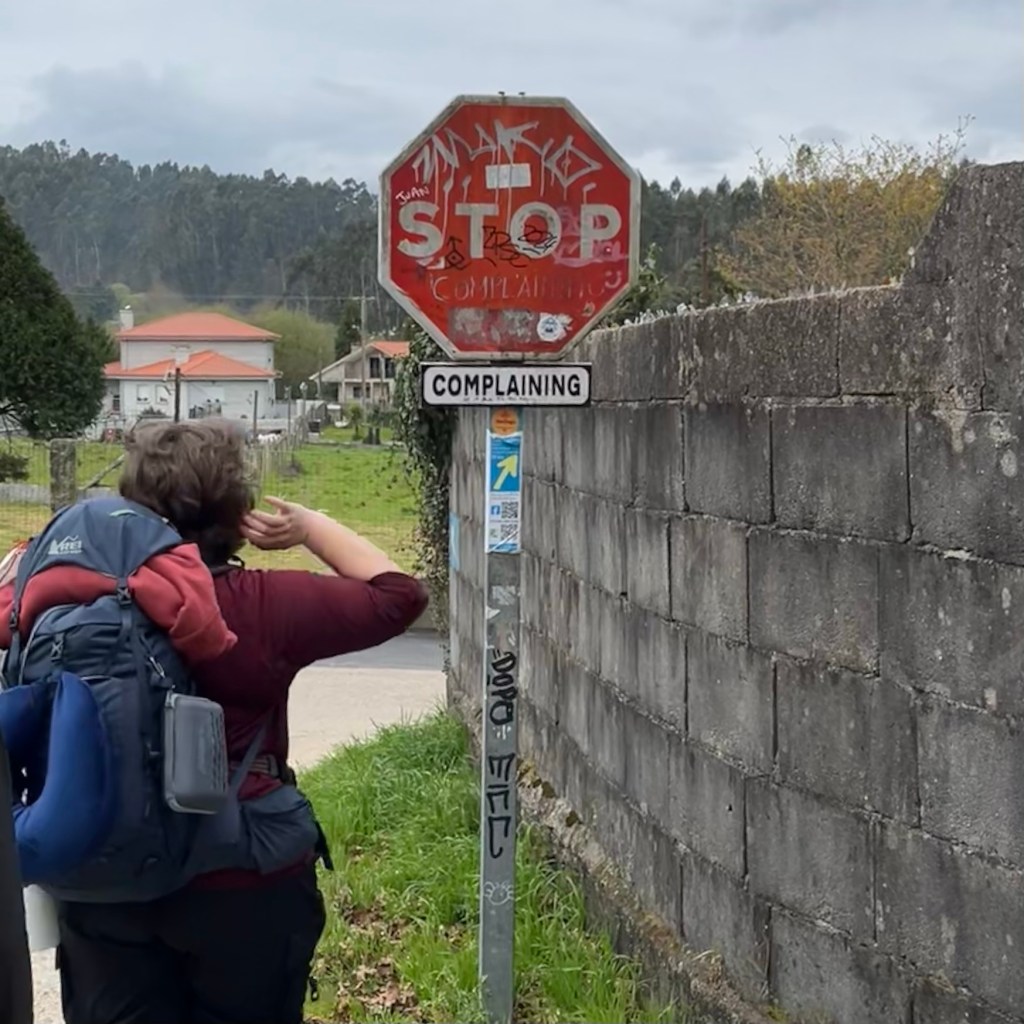
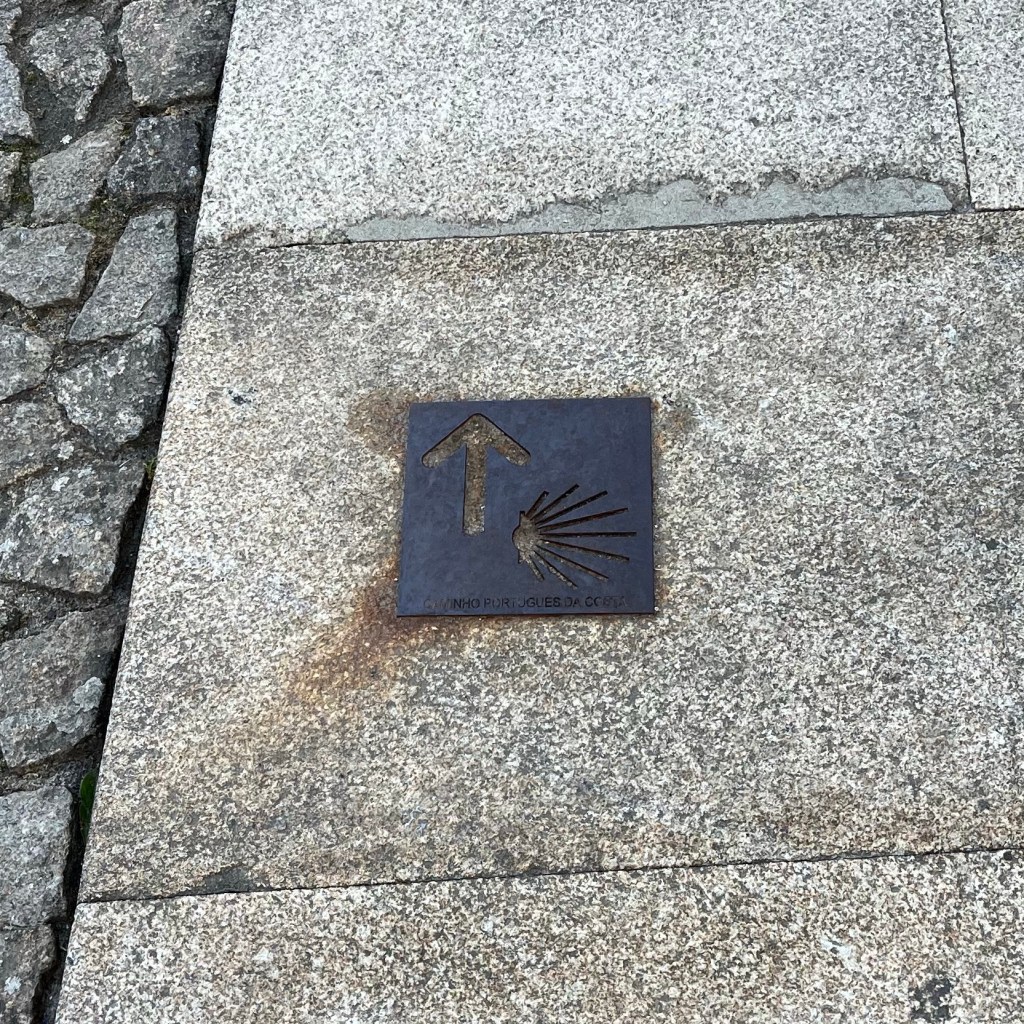
Walking among the farms, I began to realize that my anxiety about getting lost had vanished. The Camino is marked with yellow arrows that guide pilgrims to Santiago de Compostela. These arrows come in a variety of forms. Some are simply spray painted on walls, some are wooden arrows, and some are signs. There are also granite monuments and brass shells embedded into streets. These markers are at almost every intersection, ensuring pilgrims don’t take a wrong turn.

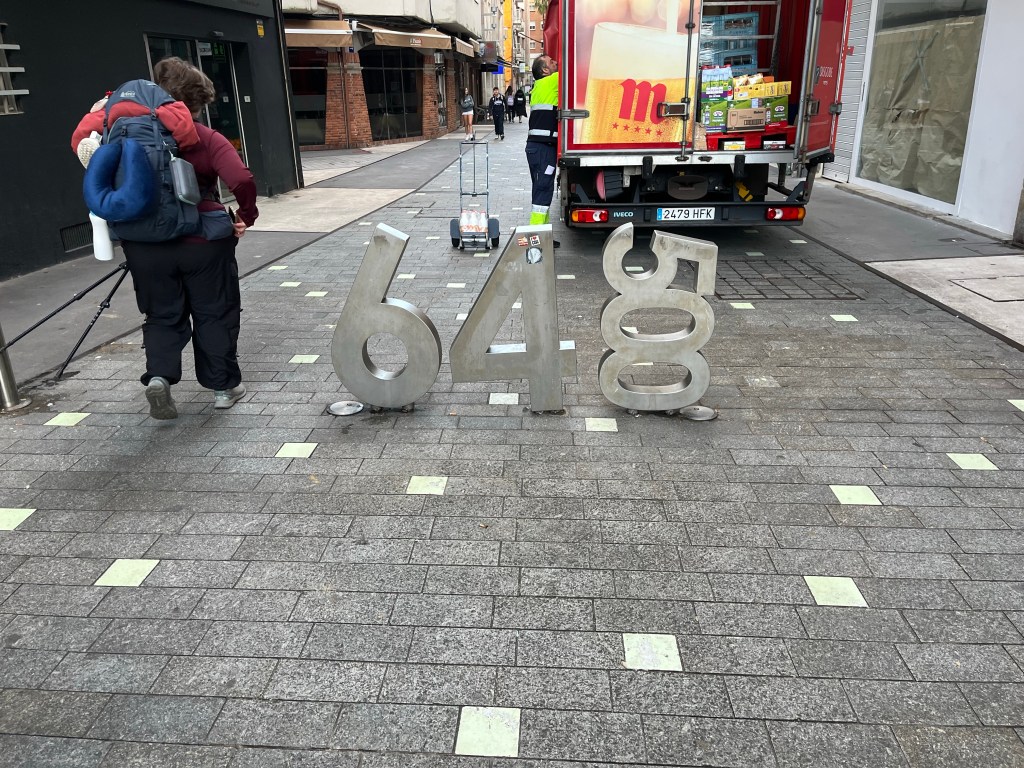
Metal marker on a sidewalk

I was surprised by the frequency of these guides, especially the granite monuments. Those monuments mark the Camino and give the pilgrim the distance left, in kilometers, to Santiago de Compostela. It became clear that we weren’t going to get lost.

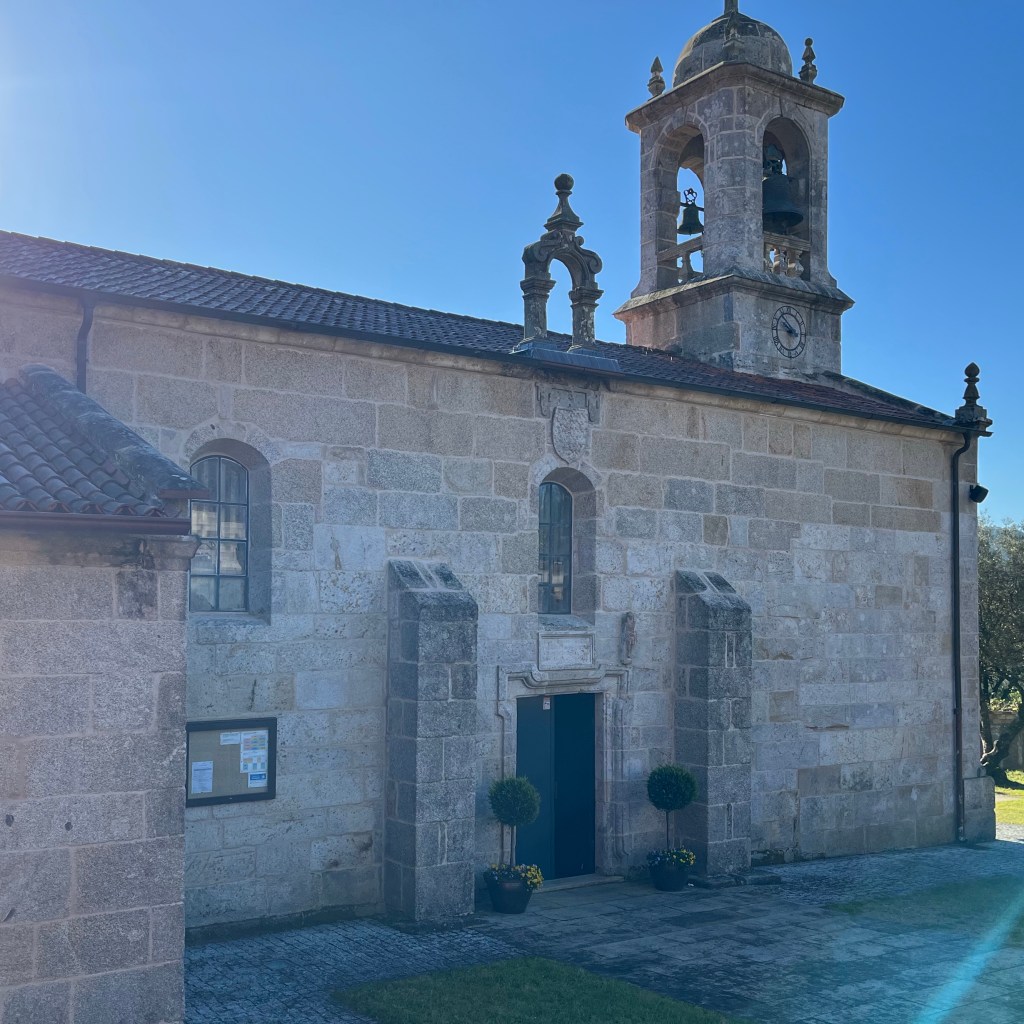
A little chapel named Igrexa de Santa Baia de Mos

We walked among these farms until we reached Mos, a tiny but beautiful village. We stopped for coffee at a cafeteria there, which was mostly serving locals at the time. We had some café con leches and a bite to eat and prepared ourselves for a large hill we were about to climb.

A small group of shops and restaurants in Mos

The next two miles or so were hiking uphill as we gained about 600 feet of elevation. As with most climbing, the views improved as we became more tired. At the top of the hill, we stopped at Casa Veiga for a couple of beers and some bocadillos under an orange tree. Bocadillos are basic sandwiches usually made with baguette-style bread. They were available at most bars and like most sandwiches can be found with a variety of fillings. Typically, we saw things like jamon, chorizo, bacon, and cheese.

Bacon and Cheese Bocadillo from Casa Veiga

The man working at Casa Veiga didn’t speak much English, so we did our best to order in Spanish. Jenn, Emma, and I have all been trying to learn Spanish, so it was nice to try out our skills. I notice so often while in Europe, that so many people speak excellent English, that I feel like I’m annoying them when I try to speak in their language (Germans are definitely annoyed).

Orange Tree at Casa Veiga

The odds of meeting someone who doesn’t speak English well in Galicia must be higher than in other parts of Europe. That is because the language spoken in this area is Galician which is very similar to both Spanish and Portuguese. However, the main official language of Spain is of course Spanish, which means for most people, English would be a third language not a second.

View from the outside dining area of Casa Veiga

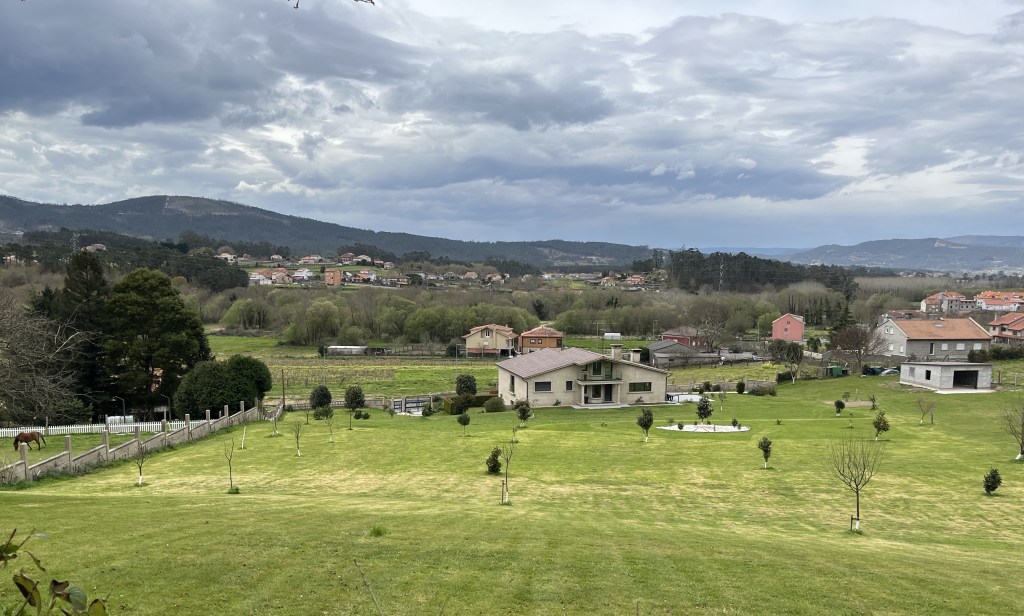
With our stomachs full of bocadillos, we continued to Redondela. Most of the hiking from Casa Veiga to Redondela was either flat or downhill, which made the rest of the day pretty easy. The views coming down the hill were really nice. There were many areas where we were on top of a hill looking out over the Galician countryside. It made for an enjoyable second half of the hike.

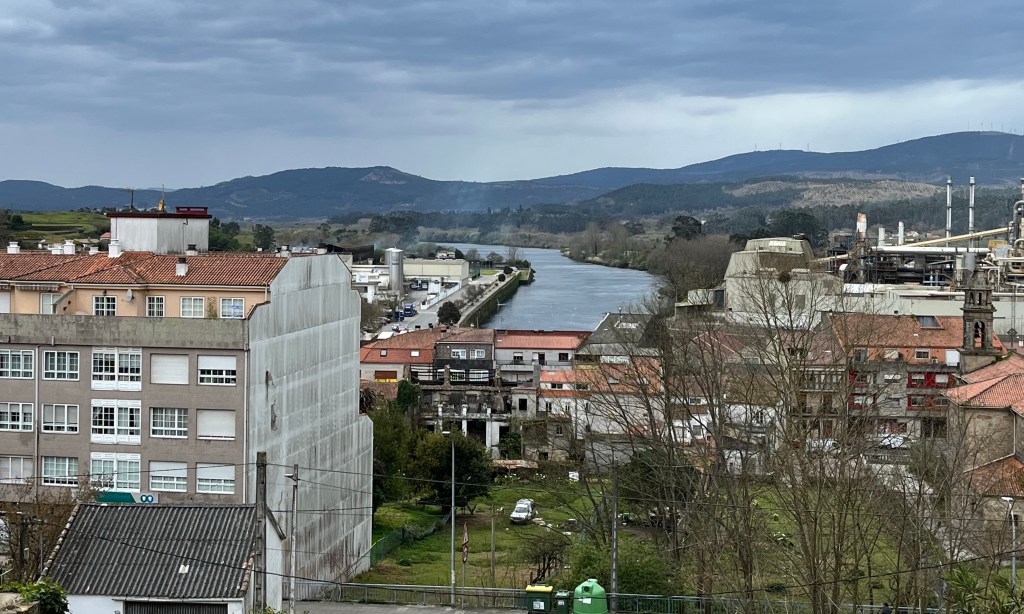
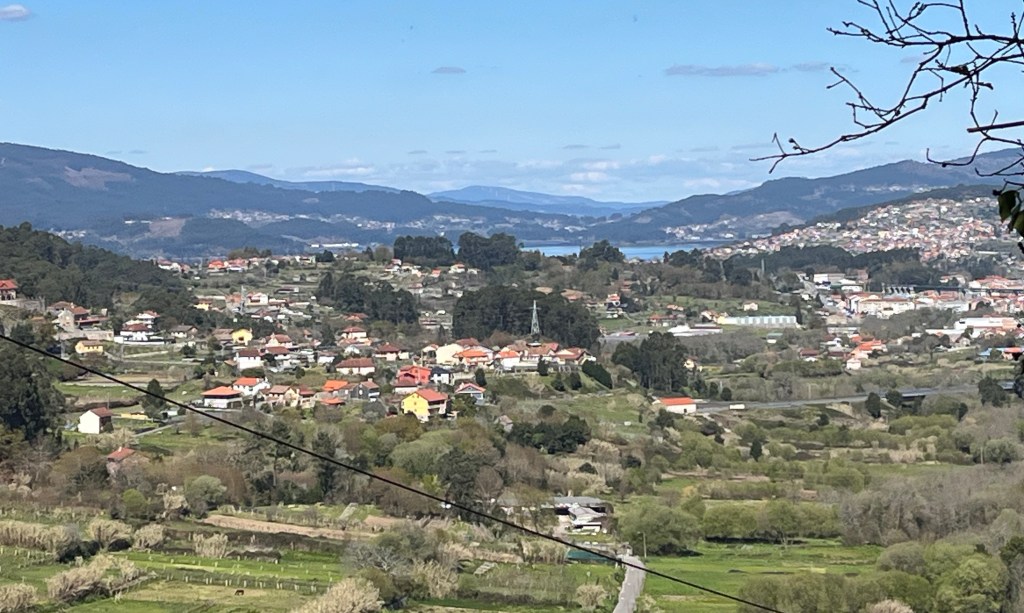
Looking down toward Redondela you can see a tiny bit of the Ria de Vigo estuary

We made only one more quick stop for a drink at a café and we were in Redondela. The second day turned out to be our shortest hike, where we only logged around 11 miles. After struggling the first day, the short day was welcome and we were all feeling a bit more confident that we would finish the Camino.

Countryside near Redondela

We checked into Albergue A Conserveira in Redondela. Unlike the previous two stays, this hostel was nearly full. The Portuguese coastal route had now joined the Portuguese Central Route and now there were considerably more pilgrims looking for beds.

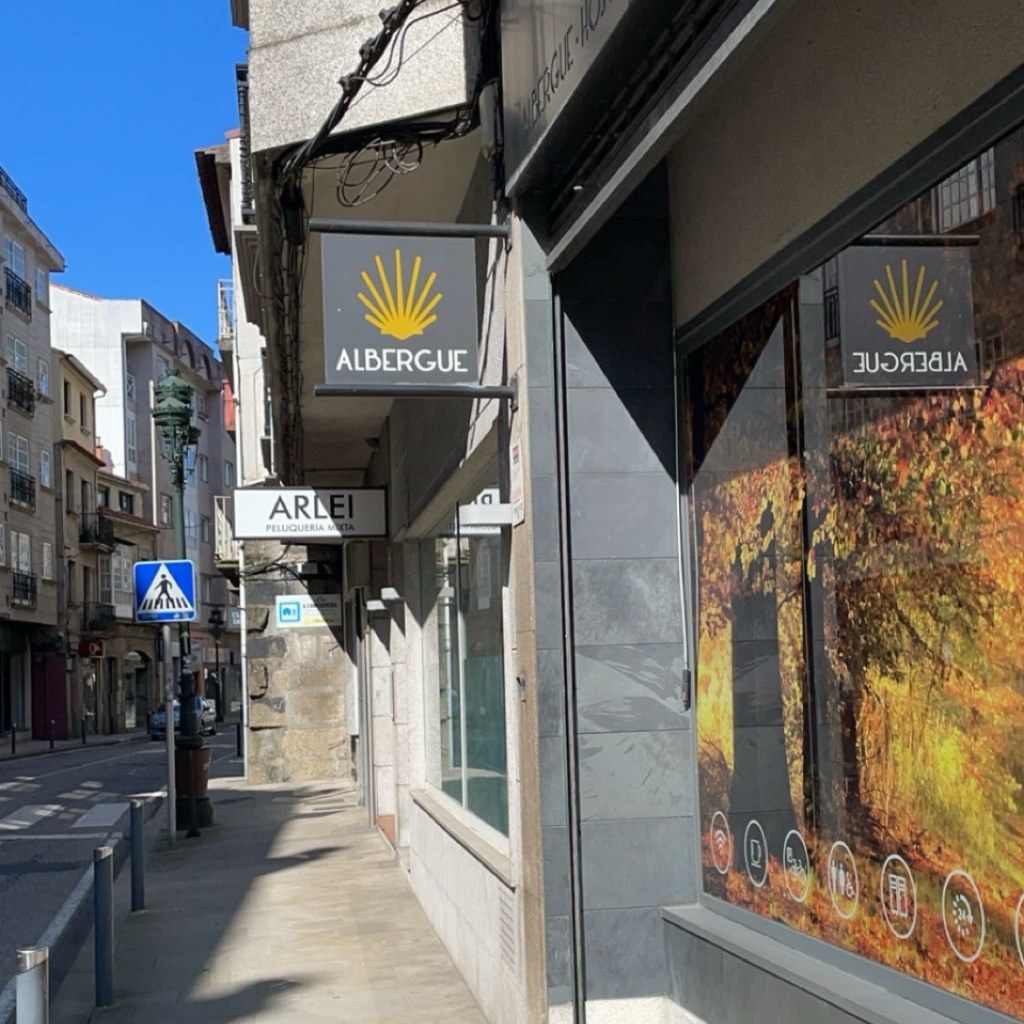
Sign in front of an Albergue in Redondela

This is where things started to become more social. We ran into the English gentleman again who was staying in the same hostel. Jenn and Emma chatted with two girls from Ohio taking a gap year. They were on their second week of the Camino, having started from Porto.

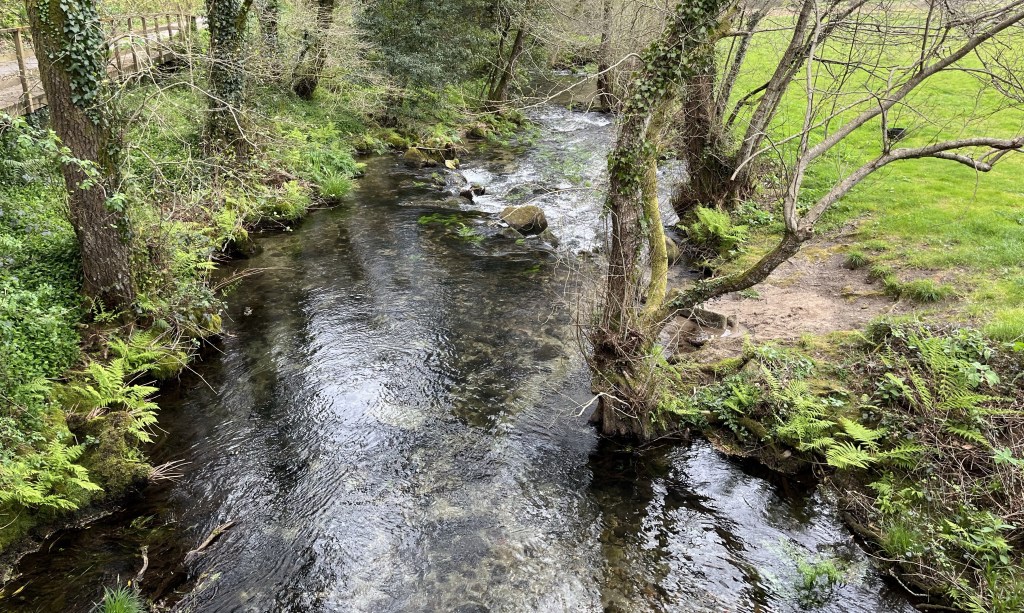
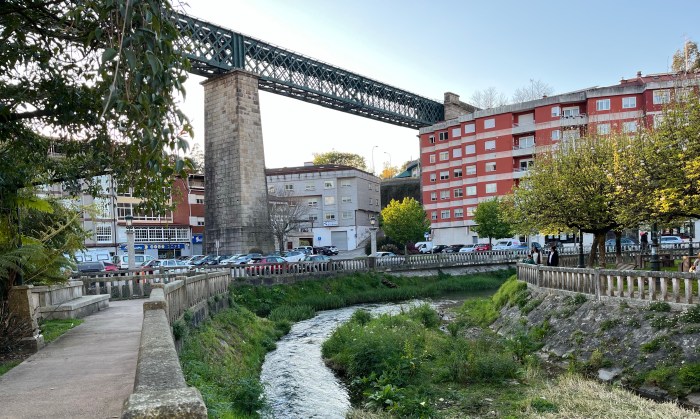
After getting situated in the hostel, we headed out to look around the town. Redondela is beautiful. There is a creek that runs through the center of town and a lattice iron train bridge that seems impossibly tall going over it.

Creek running through Redondela with overhead train bridge

We sat down for a couple of bottles of wine at Don Vilnius, a tapas and wine bar. Don Vilnius has an outdoor patio facing a beautiful building called Convento de Vilavella. We ordered a bottle of house white and a bottle of house red. Both were very good and it was a great night to sit outside in a beautiful setting and enjoy some wine.

Convento de Vilavella

Returning to the hostel after dinner, we met Carlos, a young man from Valencia. He’s one of those incredibly friendly, generous people who is just having a great time all of the time. He had done plenty of caminos in the past and because of his outgoing personality, it seemed like he knew everyone. He and his friend Herk were making spaghetti carbonara in the hostel kitchen and enjoying a couple of beers.

We sat in the kitchen for way too long talking about the Camino, differences between the US and Spain, and life in general. We eventually had to go to bed because we had another big day the next day. It had been a great day along the Camino and I was looking forward to day 3.

Beginning the Camino – Valenca to O Porrino

This is part one of a multi-part series on our experiences doing the Portuguese Central Route of the Camino de Santiago starting in Valenca, Portugal and ending in Santiago de Compostela.

Walking the Portuguese Route of the Camino de Santiago was an unusual choice for a spring break trip. We could have chosen something a little more relaxing, like a beach vacation, but here we were, backpacks on, getting ready to head out for an adventurous, long hike across Galicia, in the northwest corner of Spain.

Following a night in Porto, a train ride to Valenca, and our first night in an albergue, Jenn and I and our two kids Alex and Emma were set to begin a journey of more than 120 kilometers to the Cathedral in Santiago de Compostela.

Strava recording from our first day on the Camino

We started our Camino from the Albergue Sao Teotonio in Valenca. Albergues are essentially what Americans call youth hostels – basic bunk beds stacked in rows to maximize sleeping capacity and economy not comfort.

City walls of Valenca

It cost 8 euros per bed a night, cash only, and we were given fitted sheets made of paper to sleep on. Each of us packed a sleeping bag liner for these conditions. It was uncomfortable and I didn’t sleep well. This was when I found out that my son was a snorer and I worried that we were keeping the other guests up. However, I don’t think this was the case since I was hearing snoring from the other guests as well. I probably only got a few hours of sleep between the uncomfortable conditions and the anticipation of starting the Camino.

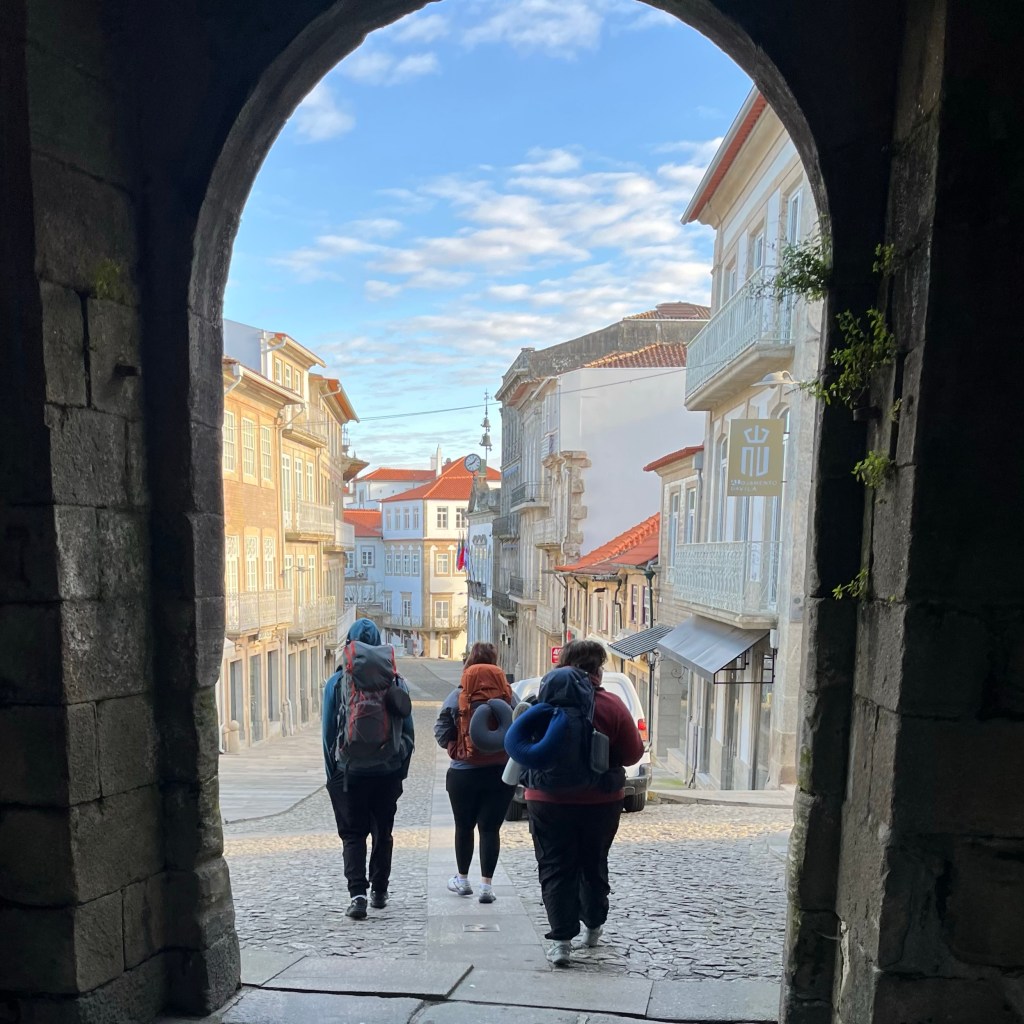
Emerging into Valenca through the castle walls

We woke up in the morning and had some coffee from the instant coffee vending machine in the common room. We readied ourselves for the first morning, made our packs as comfortable as we thought they could be, and walked out of the albergue and onto the Camino.

Building inside the city walls of Valenca

The trail from the albergue immediately winds through the Fortaleza de Valenca, the ancient fortified town of Valenca. It was first built in the 13th Century and has been improved many times, but the current walls are from the 17th and 18th centuries.

Capela do Bom Jesús with Statue of Sao Teotonio in front

The town is very well preserved but is mostly bars, restaurants, and gift shops now. We lamented the fact that most pilgrims would be coming through the town at night and would have a variety of bars and restaurants to choose from and we, unfortunately, were going through in the morning when nothing was even open yet.

Building in Valenca

Leaving the castle walls of Valenca we continued down to the Minho River where we crossed into Spain for the first time. Once in Tui, we had a couple of people greet us with a “Buen Camino”, the traditional greeting of pilgrims on the Camino. One kind gentleman showed us where to find the first marker on the Spanish portion of the Portuguese route of the Camino.

Bridge from Valenca to Tui and the border between Portugal and Spain

We wound along the Minho River and saw a Cathedral on a hill. The route took us up the hill and finally to the Tui Cathedral where we stopped to buy pilgrim shells. Scallop shells are the traditional symbol of the Camino, with pilgrims frequently hanging them from the outside of their backpacks in order to show they are on the Camino.

Cathedral in Tui

There are many explanations as to why scallop shells are the traditional symbol of the Camino but my favorite explanation is that on a scallop shells there are several lines converging into one point. This is similar to the multiple paths of the Camino converging in Santiago de Compostela.

Looking out at the Minho River from just past Tui Cathedral

In Tui, we met our first fellow pilgrim, an English gentleman who is retired and has done multiple routes of the Camino. We had a nice chat with him and he gave us some pointers on doing a Camino. He gave us some instruction on the proper use of hiking poles, which might sound basic, but using them improperly negates much of their benefit. The whole time we were chatting, we had been walking through a rural natural area.

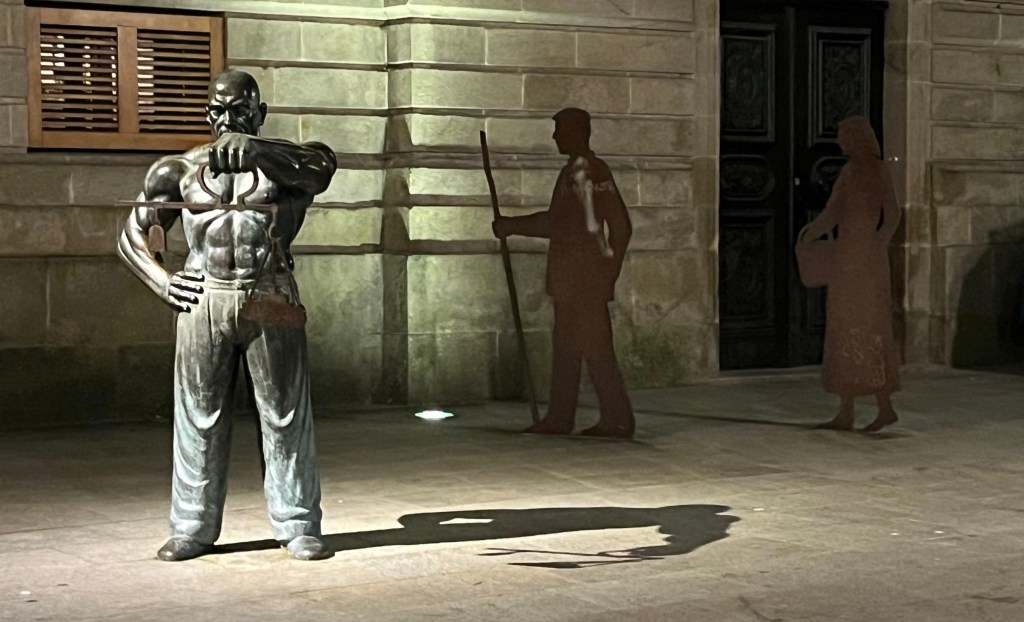
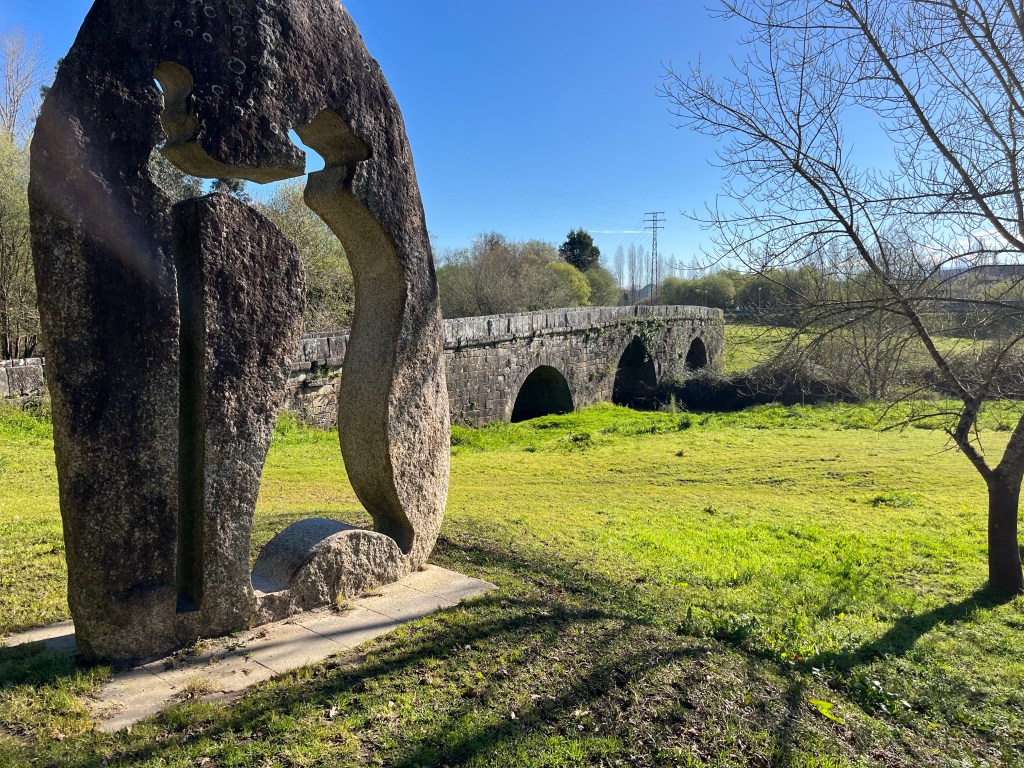
Statue at Parque Merendas Pedra Santa with Ponte Medieval do Louro in background

After a little while, he left us and where we had been enjoying a nice hike in nature, we were suddenly on the edge of a country road with infrequent but unnervingly fast traffic. This section may not have been that long, but it wasn’t pleasant so it seemed to last quite some time.

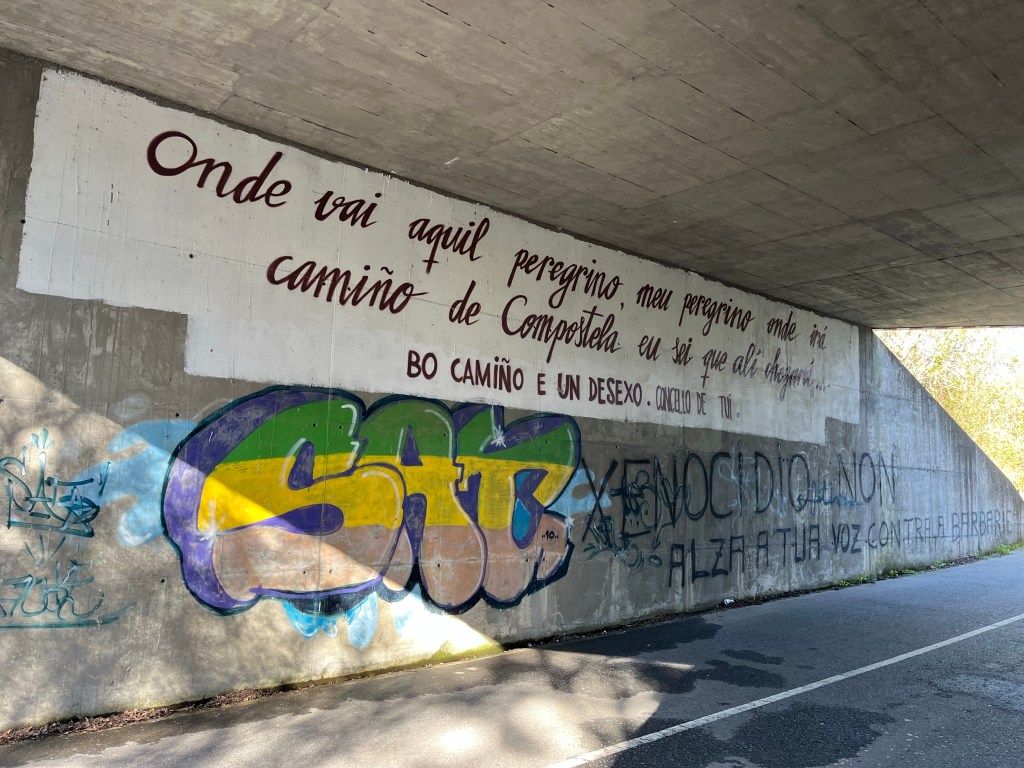
A mural on an underpass wishes pilgrims a good journey from the Municipality of Tui.

Along the road we were passed by a couple of young German women who made us feel like we were practically standing still. It was becoming clear that we were considerably slower than the other pilgrims along the route. Are we going to be able to do this? Are we in good enough shape to pull this off? The doubts were already creeping into our heads.

Wooded path before our first stop or Ponte das Febres.

This is also where the weight of the pack started to bother me. We all were struggling with trying to navigate new equipment. This was the first time doing a long hike. The weight from the pack is supposed to sit on my hips, but was instead resting on my shoulders too much. We all did some equipment adjustments and while the pack didn’t seem quite right, it did seem better.

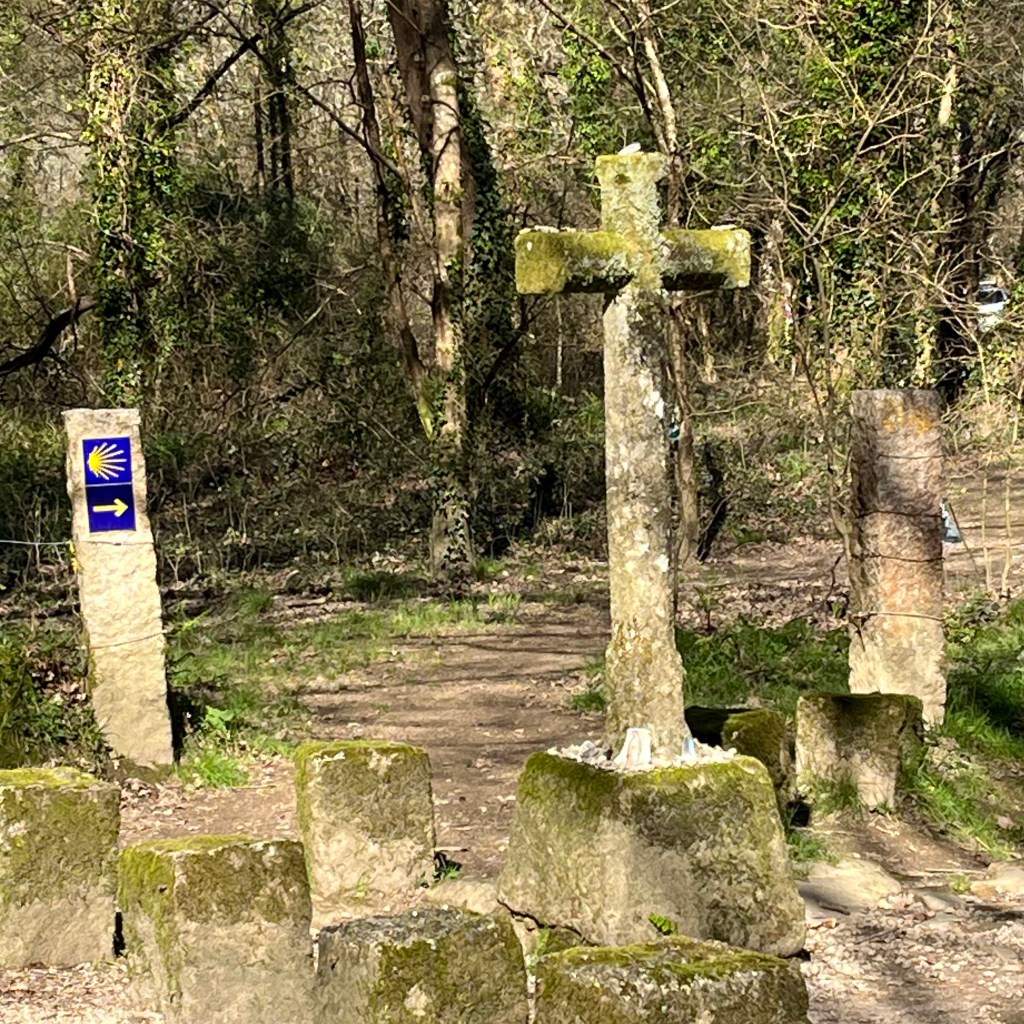
There are a lot of stone crosses along the Camino.

It seemed like forever before we were able to make our first stop of the day. It was about 7.5 miles along the route and we came by Ponte des Febres, a really cute cafe and albergue. We were greeted with “Oh no, it’s the bloody Americans!” We looked up to see the English gentleman sitting at a table, the two German women at another, and both guys from our albergue the night before.

Spanish Tortilla from Ponte des Febres

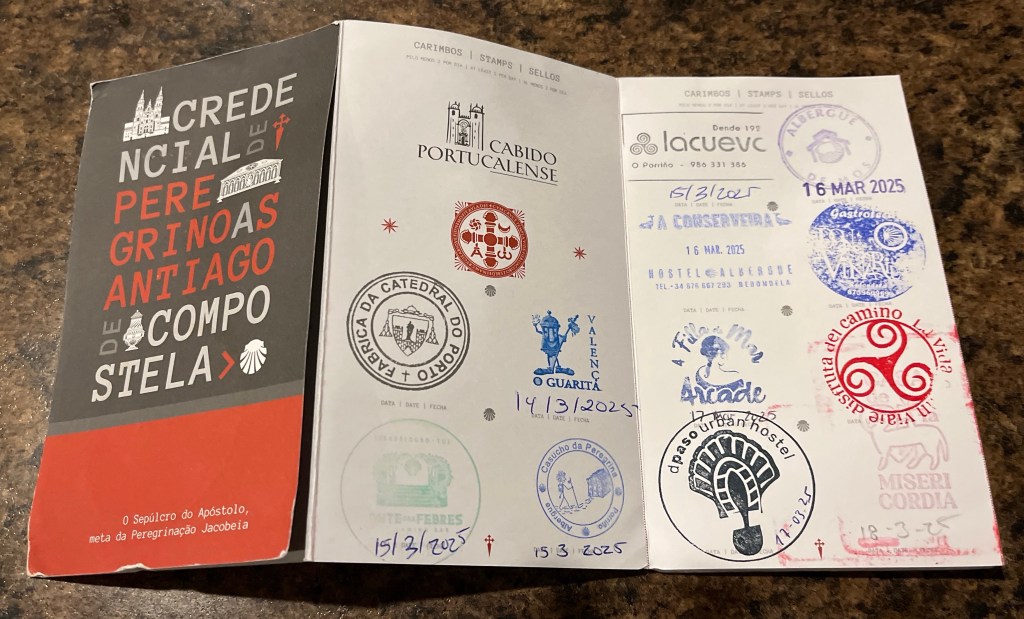
We ordered croissants and Spanish Tortilla as well as some cafés con leche. We also got our first stamp in our pilgrim passport.

Pilgrim Passport

The Pilgrim passport is a book that each pilgrim carries with them to prove that they are on the Camino. Without it, you may not get admission to an albergue. Also, if you complete a 100-kilometer pilgrimage ending in Santiago de Compostela, you are awarded a certificate. You need at least two stamps per day to qualify.

Wall near Orbanlle

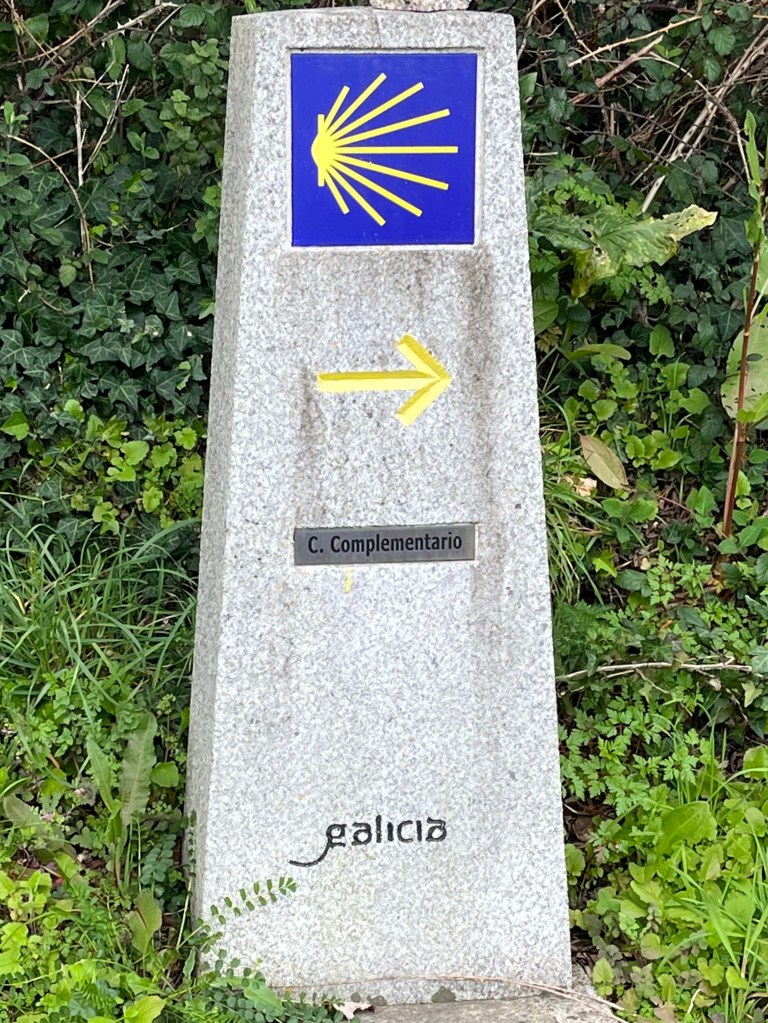
From there we went to Orbanlle where we had the opportunity to choose between a more direct route through an industrial area or a more scenic route through the country. There are routes like this one on many days, they are called complementary routes.

Complimentary route marker

That turned out to be a pretty good choice because that was a pretty relaxing route to take. Most of it was out in the country, but it did wind through a lot of small towns along the way.

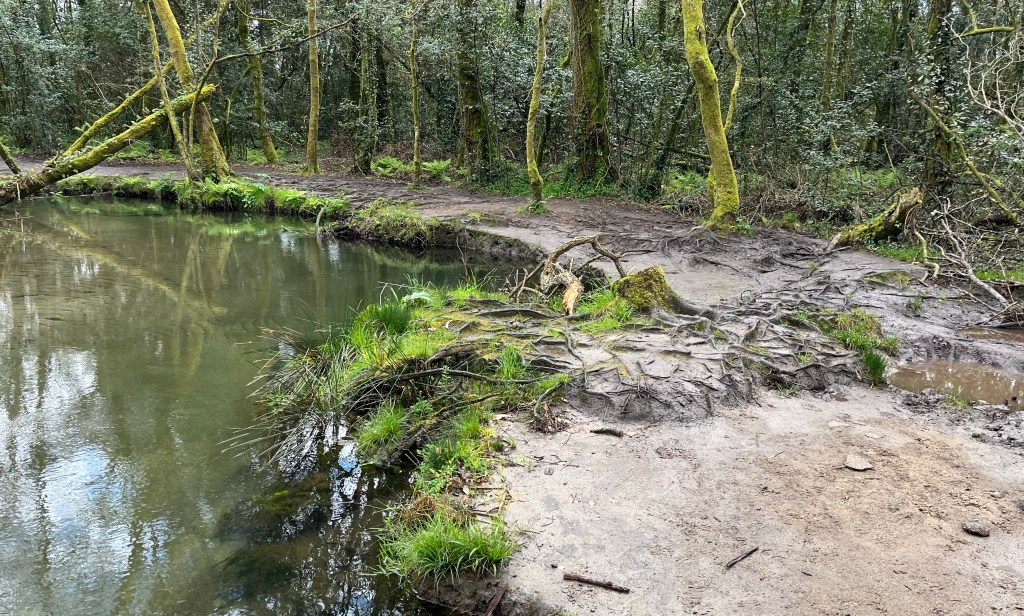
Pathway along a creek on the complimentary route

Getting really tired by this point we came across San Campio, a bar and restaurant that clearly is a favorite of locals, but also caters to pilgrims. Everyone but Alex had a beer and I ordered a giant bottle of water for the table. We also shared three sandwiches and a big plate of fries. It hit the spot and gave us enough energy to finish our trek to O Porrino.

Enjoying a beer at San Campio

From San Campio to our Hostel in O Porrino was about 2.5 miles and honestly most of it wasn’t very scenic, but it felt good to finish the hike. We arrived at Casucho de Peregrina, which is a nice hostel. We paid extra to have our bunks in a private room with only 4 beds. As it turned out, that was pretty unnecessary, because there was only one other pilgrim sleeping in the hostel.

While we were getting our stuff settled in our private room, I heard a familiar voice. It was the English gentleman we met earlier on the trail. It was nice to see a friendly face. Being the only other pilgrim in the hostel, he ended up sleeping in a large room full of bunks all by himself.

It had been a challenging day and I was already beginning to question whether doing a Camino was a smart way to spend a family vacation. I underestimated how much of a physical challenge this was going to be and both hoped we would finish and that we would be able to actually enjoy it.

The accommodations at the hostel were very comfortable and after a little dinner we were out cold. I guess 15 miles of hiking will do that to you.

The Unexpected Beauty of Porto

There is a socially accepted form of beauty that we are all familiar with. Flawless skin, a wrinkle-free face, athletic body, the kind of beauty we see on the cover of Vogue magazine.

As I approach 50, I understand now that’s not true beauty. Real beauty has grit, personality, life experience. Life experience, however, has a price. That’s why true beauty has cellulite, laugh lines, scars and maybe a fading tattoo. True beauty also comes with kind eyes and a loving heart.

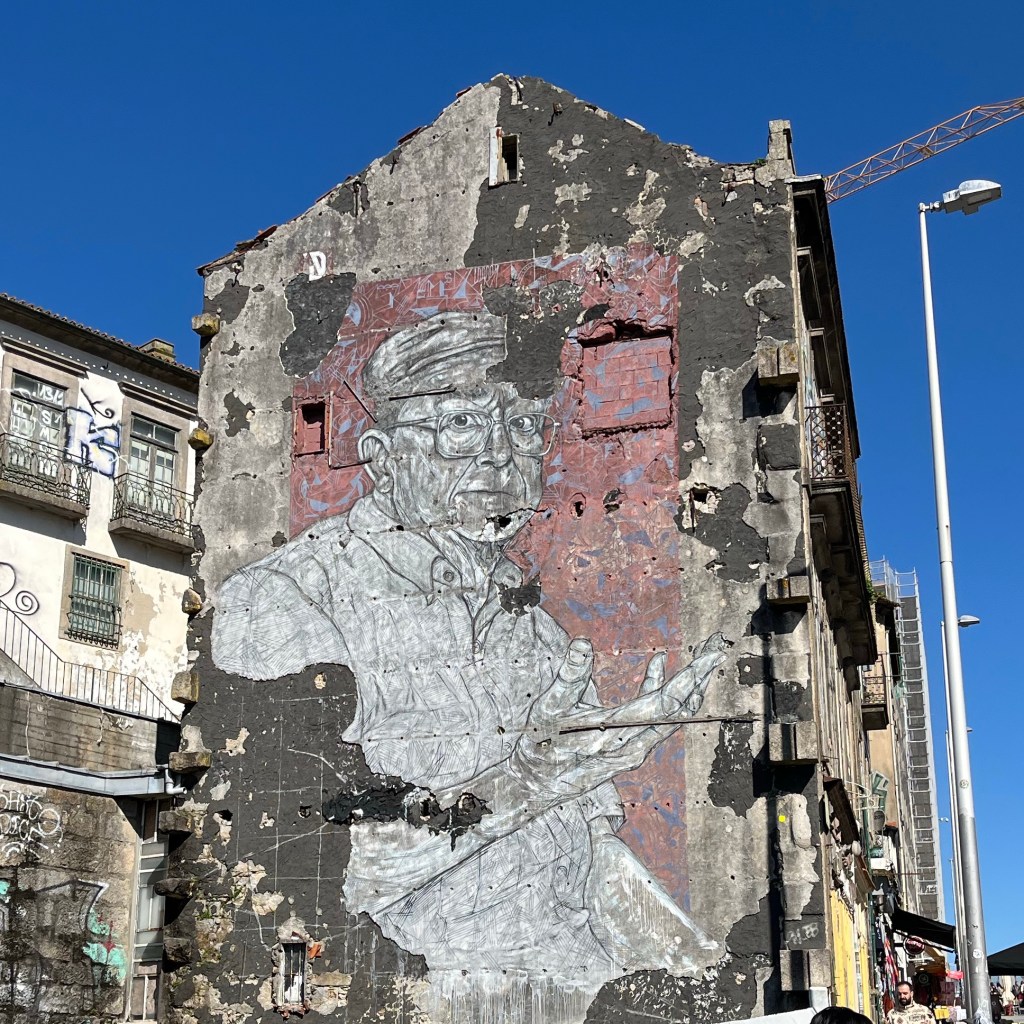
Fading mural near Dom Luis bridge

For years now, I’ve heard people gush about how much they love Porto. I would look at photos and not understand the hype. Sure there were clearly beautiful things in the photos. But nothing to me seemed exceptional – why does everyone love Porto so much?

Church of the Lord of Bonfim

We decided to spend our Spring Break walking the Portuguese route of the Camino de Santiago, but we only had a week, so we decided to start in Valenca, Portugal. Valenca is located along the Minho River which serves as the border between Spain and Portugal. That meant that we needed to fly into Porto and take the train to Valenca from Porto.

Fountain of the Lions illuminated by colored LED lights

This gave us the golden opportunity to brush off our jet lag in Porto and spend one evening there. To be fair, I wasn’t that excited about it. I assumed it would be nice, but other than going to the Cathedral to pick up our pilgrim passport for the Camino, I didn’t have anything planned.

Porto Cathedral where many pilgrims on the Portuguese route of the Camino de Santiago begin their journeys.

Once we got to our hotel, we were able to drop off our stuff and head out. We stopped into Cervejaria Nortada, a brewery near our hotel. We had a couple of drinks and a snack. Our server could tell we were struggling with the Portuguese menu and even though we insisted we could figure it out, he took the time to explain some of his favorite dishes. He was our first experience with Portuguese hospitality.

Copper brewing equipment at Cervejaria Nortada

From there we walked to the Cathedral for our Camino passports. Along the way, I noticed a combination of beautiful buildings and buildings in decay. Shells of buildings without roofs and graffiti are common even in the center of the city. In Porto, when a building falls into disrepair, the exterior remains in place, even if the rest of the building has completely disintegrated. By not demolishing the building, the city keeps it’s historic blockfaces intact, even if it has clearly deteriorated inside of the shell.

Graffiti on an overhead door in Porto

Graffiti is common in Porto. In general, graffiti isn’t uncommon in Europe, but sometimes, as Americans, it seems unfathomable that people would deface buildings that are centuries old. Graffiti is an artform like tattoo, where some are clearly horrible while others are fine works of art. Like tattoo, it is also polarizing, because some people love the artform and others find it vulgar.

Restored building in Porto

There is evidence of a renaissance of sorts in Porto. There are cranes everywhere as old buildings undergo renovations. The city is renewing itself as people look to transform those decaying properties into vibrant rehabs. Porto, like Lisbon and the Algarve, have become hot spots for middle and upper class immigrants from the European Union and the United States, so the need to provide housing for the new immigrant class likely is responsible for many of the rehabs.

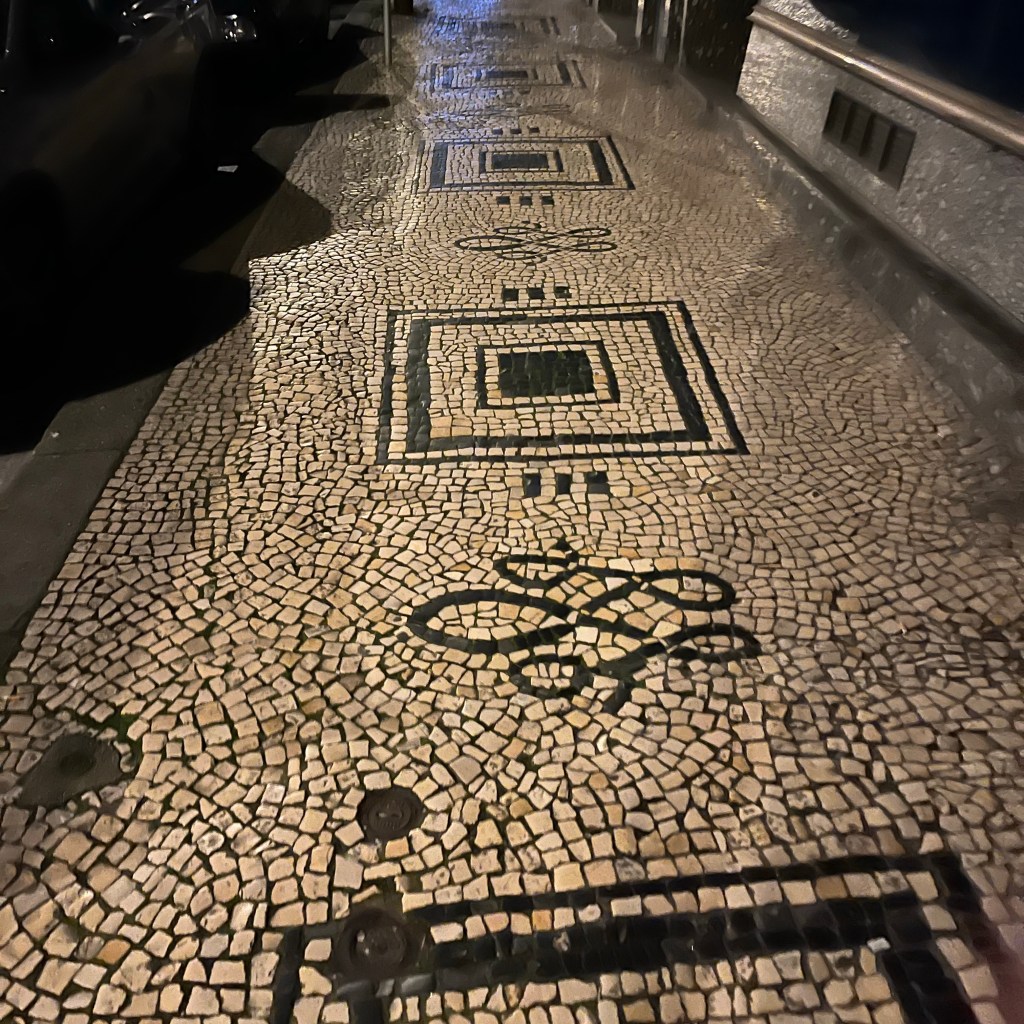
Mosaic sidewalks are everywhere in Porto

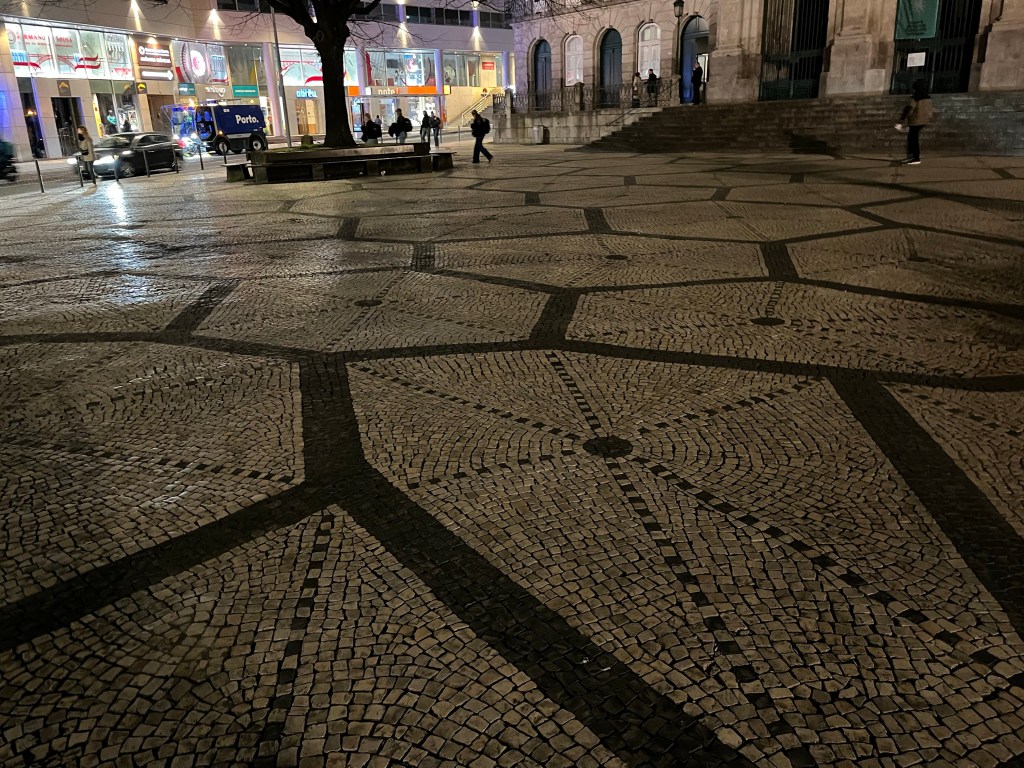
The character of the city remains, however. Mosaic black and white stonework turn sidewalks and plazas into works of art. They are absolutely stunning and it’s almost impossible to imagine how much work went into building the miles and miles of mosaic walkways.

Plaza by Porto City Hall

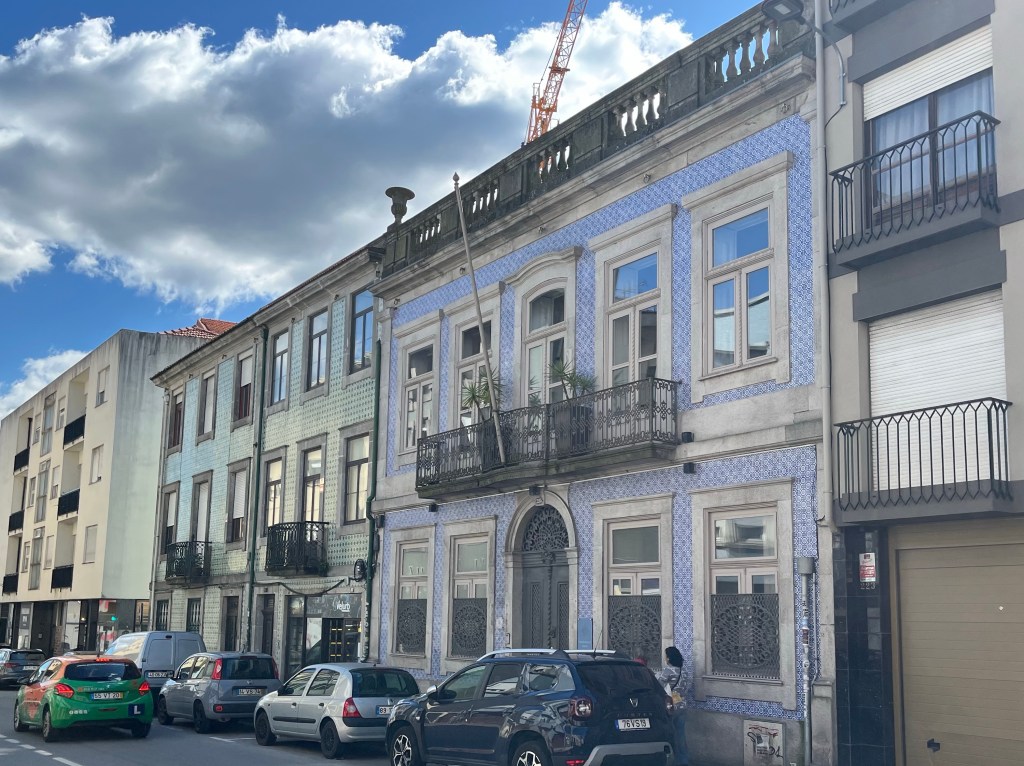
Another defining feature of Porto is exterior tiled walls. The Portuguese began to use tile on the exterior of the homes in the 1800’s, not only for their aesthetics, but also because they are fire retardant and help regulate temperature. You will find anything on the exterior walls from highly artistic tiles to subway tiles.

Buildings with Tile exteriors

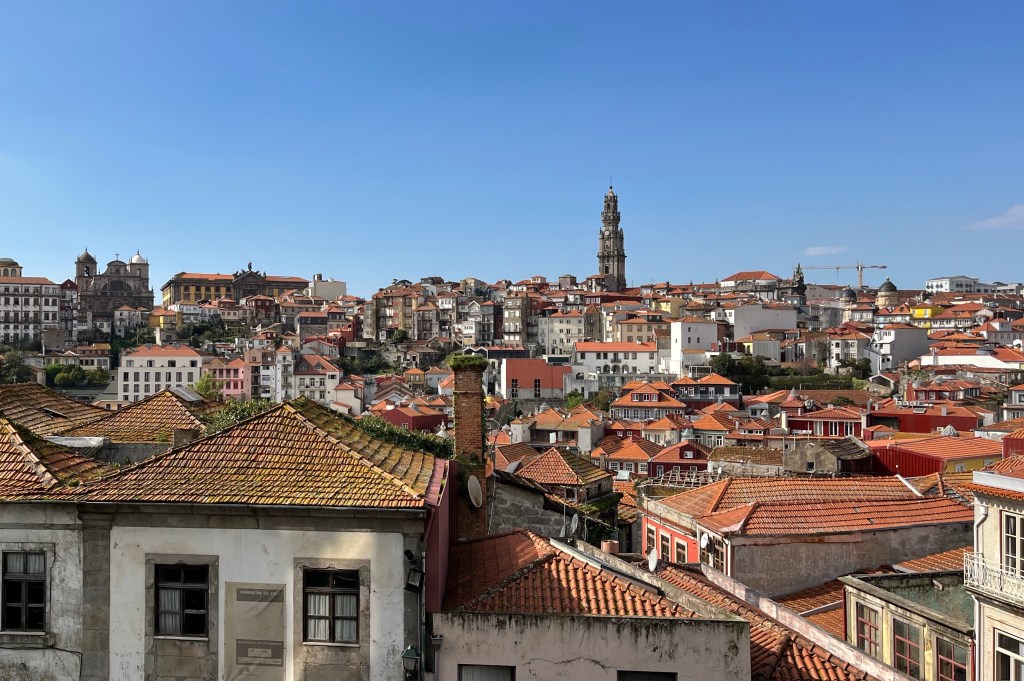
Porto does have its moments that take your breath away. The Cathedral is located high on a hill near the Douro River and from the plaza, you can see a large portion of the city as beautiful churches and bell towers emerge over red tiled roofs for square miles.

View of Porto from the plaza by Porto Cathedral

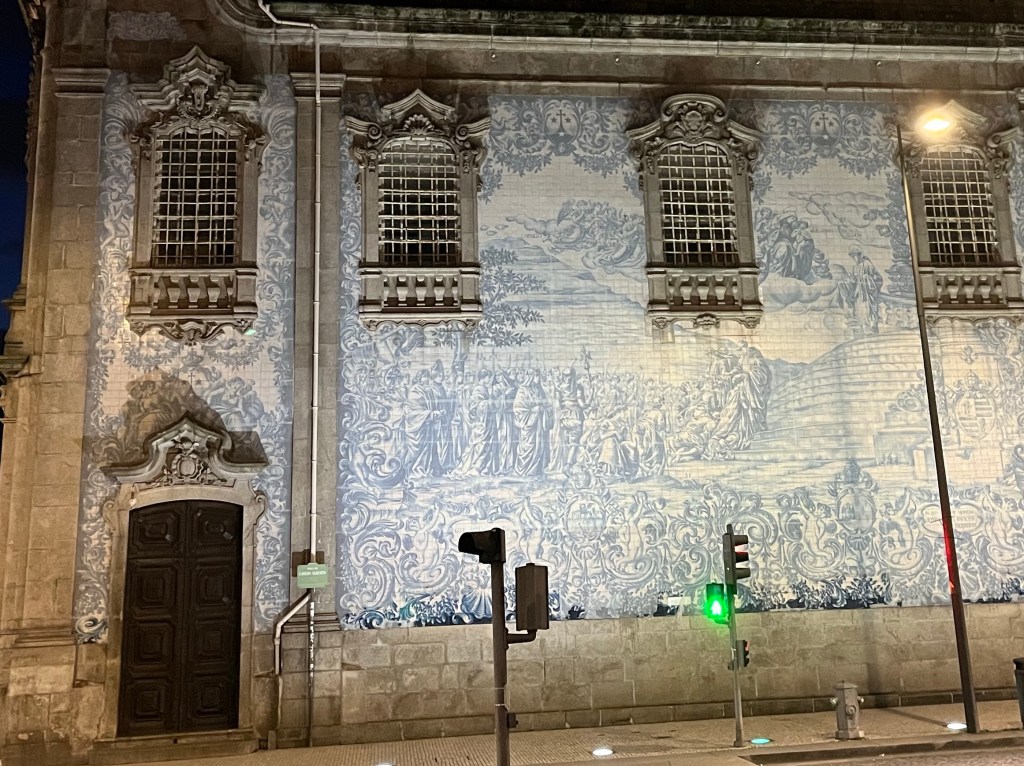
The Cathedral itself is a beautiful example of a 12th Century cathedral. It’s one of many beautiful houses of worship we came across while in Porto, including the Igreja do Carmo and the Church of the Lord of Bonfim.

Igreja do Carmo was constructed in the mid 1700s.

After a long night of sleep, we walked on Dom Luis bridge, where the views of the Douro River are stunning. The bridge is at a dizzying height over river which provides long views along the river in two directions.

Looking West from Dom Luis I Bridge

Off in the distance from the Dom Luis bridge is Maria Pía bridge, which was designed by Gustave Eiffel, best known for the design of the Eiffel Tower. Both of these bridges are stunning metal bridges that only enhance the Douro River’s beauty.

Looking East from Dom Luis I Bridge

During our short time in Porto, I noticed something you don’t see in crowded cities – patience. People make way for other people while walking on the sidewalk. When we struggled with the language barrier, people were understanding and patient. No matter what building we walked into, we never felt out of place or unwanted. The people are just genuinely kind.

Tiles on the side of the Igreja do Carmo depict scenes from the founding of the Caramelite Order.

The general vibe of the city is relaxed. People weren’t trying to run past you to get to the next crosswalk, It also wasn’t excessively noisy. People just seemed to genuinely enjoy their day.

Narrow building and road in commercial section of Porto

On our way to the train station, leaving town we stopped at a bar where there clearly were regulars drinking coffee and beer, playing cards. Nobody spoke English well. They weren’t annoyed by these four Americans and their giant backpacks taking up space in their bar. The bartender took his time to figure out what we wanted and allowed us to enjoy our drinks. They were all demonstrating kindness, patience, and tolerance. Isn’t that what this world needs more of today? What can be more beautiful than that?

Sunrise Jog in Venice

Running in Venice can be a challenge. The city is like a labyrinth with constant turns, dead ends, narrow passageways and bridges that can sometimes be difficult to find. If you live in Venice and are familiar with how the city is laid out, this might not be too much of a challenge, but for those of us who are on vacation, it can be tricky to find a good route that isn’t too confusing.

There is one particular route that is both beautiful and isn’t too confusing. That is to run along the south side of the the main islands from Piazza San Marco to the east as far as you can go.

Basilica di San Marco barely visible as I approach the Piazza San Marco from under the clocktower.

I started early in the morning, before sunrise, knowing that it won’t take very long before workers and tourists fill up the streets. I like to get out early when its not too busy. Our Airbnb was near the Rialto Bridge, so the challenging thing to me, navigationally, was to run from Rialto Bridge to Piazza San Marco.

Basilica di San Marco

I wound my way through the narrow streets toward Piazza San Marco, following the signs that point the way. In a short amount of time, I saw the side of the Basilica di San Marco. It’s pretty amazing to see the Piazza early in the morning when its not completely full of people. It’s not exactly empty, but it is pretty great without all of the noise and crowds.

Two Columns, one with St Theodore and one with the Lion of Venice mark the boundary of Piazza San Marco.

I then ran through the pillars that mark the edge of the Piazza San Marco and turned left along the water. Right outside of the Piazza is a series of docks for gondolas that aren’t yet in service.

Sunrise over Gondolas near Piazza San Marco

Running along the edge of the water toward the east, there is a lot of activity from all of the docks, restaurants and hotels that are getting their morning deliveries. This is normally a very busy area of Venice, and they need to get their supplies early before things get too busy.

A view of a canal from a bridge along the route.

As I ran to the east, things got calmer and calmer, until finally I reached an area with a lot of trees. It’s a place called the Giardini Della Biennale, which has 30 pavilions, each housing an art exhibit from a different country. These exhibits change and are part of a biennial art exhibition called the Venice Biennale.

Grass and trees are rare in Venice, but you will find plenty in Parco deile Rimembranze

Moving out of the Giardini, I crossed another bridge and entered another park called the Parco deile Rimembranze. It was a nice serene park with tree lined paths. There were a number of folks walking dogs and enjoying the early morning.

Scuola Navale Militare Francisco Morosoni was the end of the line for me. Time to turn around.

It didn’t take too long before I ran out of park and I arrived at a bridge leading to a military base. Honestly, the last thing I expected to come across in Venice was a military base, but I had reached the end of the line and it was time to head back.

The waterfront area is fairly wide.

On the way back, the sun was higher in the sky, everything was a little brighter and quite a bit busier. It didn’t take very long for the area with all of the restaurants, bars and hotels to begin to fill up with people, probably people heading out for an early cappuccino.

San Giorgio Maggiore

Coming back from the east, there are fantastic views of the islands known as Guidecca. It is just a short distance across the water from the main islands. Also visible is San Georgio Maggiore, a small island that once housed the San Georgio Monastery established in 982. It’s belltower and domed church are striking from across the water.

You won’t find any elevation changes with the exception of bridges in Venice

I finished up by running back through Piazza San Marco and then back to the Airbnb. It turned out to be around 5 miles, and the portion from Piazza San Marco to the Naval Base and back is around 4 miles.

The route primarily is along the water on the South Side of Venice from the Piazza San Marco to the Naval Military School and then back.

When choosing a place to run in Venice, unless you know your way around, you’ll probably want to stick to this route. If you need to stretch out the distance, you’ll probably want to run around in the parks near the art exhibits and the Naval Base. No matter how you do it, it will be a gorgeous run – you’re in Venice after all!

Points Check February 2025

Looking forward to the Camino

We’ve spent a good deal of time in February planning our spring break trip to Portugal and Spain as well as booking some parts of a summer trip to Europe.

“Planning” is an odd way to put how we’re approaching our spring break trip. We’re doing a week on the Portuguese route of the Camino de Santiago de Compostela, a thousand year old tradition of folks, primarily Spanish Catholics, taking a pilgrimage to the Cathedral of Santiago de Compostela to visit the final resting place of Saint James. The fact of the matter is that planning, other than making sure you have the correct gear, is unnecessary and maybe counterproductive for the Camino. It’s probably best to do the Camino with spontaneity, and this is driving me crazy because I want to plan SOMETHING!

This will be our first opportunity to do participate in something in Europe, instead of just being a tourist. While Americans certainly are welcome on the Camino only about 8 percent of pilgrims are Americans. Pilgrims come from around the world, but the majority are Europeans and hence this is primarily a European phenomenon. Knowing that the stops along the Camino are primarily to cater to the needs of them and not just Americans hopefully will mean that this will seem more authentic and not altered to appeal to American tourists.

We will be spending an evening in Porto on the day we arrive and a night in Madrid the day we leave. We booked a room in Porto at a hotel not affiliated with any major program using Jenn’s Delta Business Gold Card and the Delta Stays site, because her Delta Gold card has a $150 hotel credit which was immediately credited to her account.

We also used two IHG certificates to book a night at The Intercontinental Madrid. We had to book 2 rooms because, as usual, booking any room in Europe with 4 people is next to impossible, especially with points. Those rooms cost us a 60,000 point certificate each, but the cash rate for those rooms are $273 per night, which is right at about the maximum value you can expect to get for a 60,000 point IHG certificate.

American Express Gold

I referred Jenn to the American Express Gold Card and she was approved. I immediately received a 15,000 point referral bonus and Jenn will receive a 75,000 Membership Rewards point bonus when she completes $6,000 in spend in 6 months. It has a pretty steep $325 annual fee.

Despite the high annual fee, it’s actually one of my favorite credit cards for families. The reason is that it earns 4x on groceries and 4x on dining. Those are two categories where people tend to spend a lot of money, so it has the ability to accumulate points very quickly.

The 4x bonus categories wouldn’t be good enough to offset the $325 annual fee, but if you are able to use some of the credits available on the Amex Gold card, you should be able to get all or most of the annual fee back. Those credits include $100 per year at Resy restaurants, $120 per year Uber credit, $120 per year dining credit and a $84 per year credit at Dunkin.

Amex points are extremely flexible since the transfer to 18 airline reward programs and 3 hotel programs. I’ve had no problem finding good use for Amex points but I do have a problem keeping them around, so earning a few more is always good.

Booking Jenn’s Summer Trip

We booked the main legs of Jenn’s trip this summer with her sister, our niece and our daughter. The four of them will be flying from Chicago to Munich on a direct flight on United that we booked using Singapore Krisflyer miles. We transferred 87,000 Citi Thank You points and 35,000 American Express Membership Reward points to get the 122,000 points needed. Booking using Krisflyer miles meant that the flight was 30,500 points per ticket and $5.60 instead of 40,000 United miles and $5.60 each.

We also booked the flight home, a direct flight on Aer Lingus from Dublin to Chicago. That cost 20,000 Aer Lingus Avios and $155 each. We transferred the 80,000 points from American Express to book that flight.

I’m waiting to book the flight from Munich to Dublin until they decide on what day they want to travel. They might even want to take a train or bus to another nearby city like Vienna or Zurich, spend a day and fly out of those cities. They need to hash out those details before I book anything else.

On to the Point Check

Jenn didn’t have a welcome offer to work on, so her default credit card was her Amex Business Gold card, which she earned a surprising 2.4 points per dollar spent on. We almost never use my World of Hyatt card because it’s just not good for earning points. However, they had an offer of 5x on groceries for up to $1,000 spent this quarter, so we started to use it for our groceries. I’ll take 5x Hyatt points any day of the week. So for all of our credit card spending not going towards a welcome bonus, we earned a 6.2% return. That means that we were doing a good job of taking advantage of the bonus categories on our credit cards to maximize point accumulation.

Card UsedSpendPoints EarnedPoint ValuePoints Per $Return on Spend
Amex Business Gold$1,0592,59151.822.44.9%
Ink Cash$4452,224$45.595.010.3%
World of Hyatt$3561,783$30.315.08.5%
Venture$345690$12.772.03.7%
Wyndham Business Earner$3062,253$24.787.48.1%
Blue Business Plus$234468$9.362.04.0%
Citi Premier$206271$4.881.32.4%
Amex Gold$127508$10.164.08.0%
Total$3,07810,788$189.673.56.2%
This month’s spending not devoted to earning a signup bonus

Besides that, I spent a little over $1,500 on my Alaska Airlines card and earned around 1,500 Alaska miles. With the redemptions for the summer trip, that leaves us with:

  • 170,000 Chase Ultimate Reward Points
  • 105,000 Amex Membership Reward Points
  • 99,700 American Airlines Miles
  • 83,800 IHG Points
  • 71,900 Marriott Bonvoy Points
  • 54,300 Wyndham Points
  • 32,000 Citi Thank You Points
  • 12,400 Hyatt Points
  • 6,300 Delta Miles
  • 2,800 United Miles
  • 1,500 Alaska Airlines Miles
  • $109 in Cash Back

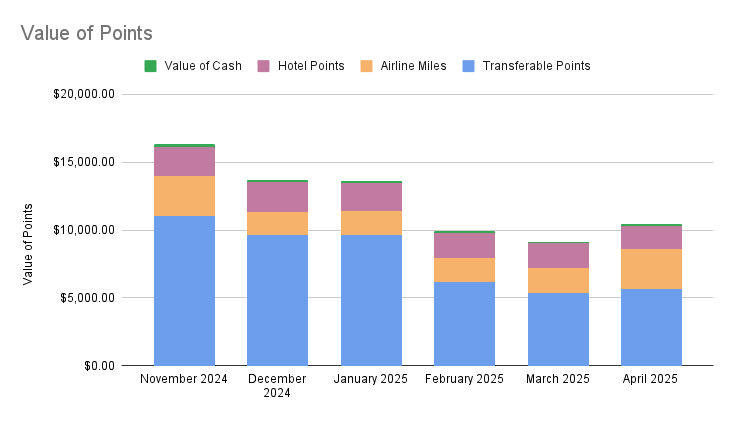
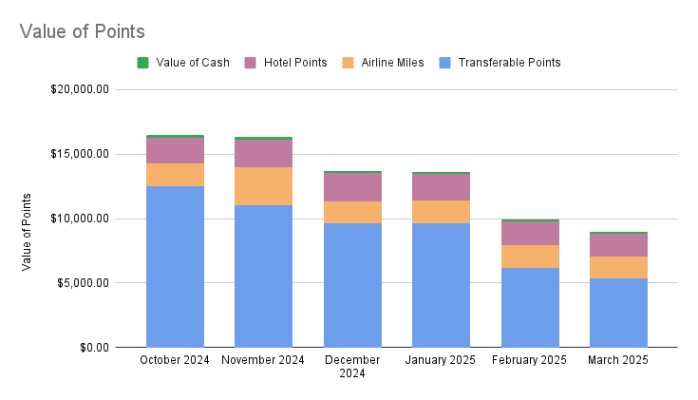
It feels like lately we’ve been absolutely bleeding points, but we are getting to the end of most of the points redemptions, at least for flights, that we will need for 2025. That means that we should be able to concentrate more on enjoying our trips and accumulating more points to get ready for whatever we have plan for 2026. In October our points, according to the Point Guy, was worth $16,500. With all of the redemptions that we’ve made since October, we are down to $9,900. Time to earn some more points!
Murano and The Glass Cathedral

Murano is a series of islands in the Venetian Lagoon world renowned for it’s artisan glass. In the 1200’s, a growing glass industry had emerged in Venice, but concerns had grown about the dangers of the furnaces used to make them. A law was passed in 1291, that required all glass production in the city of Venice to be produced in Murano to protect Venice from fire. This concentrated all of the production of glass to one area which persists today.

A boat parked along a canal in Murano

We didn’t have a chance to visit Murano on our first trip to Venice and I wasn’t planning to miss it on our second trip. I was interested in seeing all of the beautiful glass created on the island and get a little insight about the art while we were there.

Inside a glass shop in Murano

We took a vaporetto from the main islands of Venice to Murano and began our walk. I understood that this was an area primarily for glass production and sales, but I was still surprised by the number of shops that there were. We exited the vaporetto at the docks known as Murano Colonna and began to walk along the canal on Fondamenta dei Vetrai. We wandered along the canal, admiring all of the amazing glass work created by the artisans in Murano.

Entrance to the Glass Cathedral

After walking around a bit and shopping, we stopped for a drink and a light lunch at Rivalonga bar which is at the Hyatt Centric Murano. We had a nice view of the main canal through Murano. After the quick bite to eat, we headed to what I was really looking forward to, the glass blowing demonstration at the Glass Cathedral.

The Glass Cathedral

Bar at the Glass Cathedral

The Glass Cathedral is actually the Chiesa Santa Chiara, a church dating back to the 1300’s and was part of a convent for many centuries. In the 1800’s, it became a production facility for glass. Unfortunately, in the 1990s there was a fire and the roof collapsed. After years of vacancy the Belluardo family purchased it with the idea of turning the dilapidated building into a hospitality facility. In 2012, the Belluardo family began renovations of the Church and finished restorations in 2017.

The second floor at the Glass Cathedral

The results of the renovations are spectacular. The Glass Cathedral is primarily an event center that hosts weddings and parties that can accommodate up to 300 people. What I love about this building is the fact that it blends the modern and ancient in a beautiful way. The old brickwork, wooden plank joists, and stained glass windows are accented by colored LED lights. Glass chandeliers and decorations are everywhere. It all makes for a perfect backdrop for a special event.

Metal decorations and vases in the lobby area of the Glass Cathedral.

However, for those of us who aren’t getting married in Venice, we can visit the Glass Cathedral and see a glass blowing demonstration. This of course gives you the opportunity to walk around the facility to see just how beautiful it is and to watch how artisan glass is produced.

LED lights, stained glass, and artwork on second floor of the Glass Cathedral

The Glass Blowing Demonstration

The tickets for the glass blowing demonstration were 14 Euros each, which you can buy in advance or at the door. We went ahead and purchased it when we got there. They did offer us an alcoholic beverage to enjoy during the demonstration for a small additional charge and of course I said yes.

Glass blowing artist heats up glass in oven

The demonstration is more of a performance than a demonstration. The Glass Master doesn’t explain what he’s doing, instead he is operating somewhere in the space between glass production and performance art. It is fascinating to watch.

The glass master uses a tool to form the wing of a swan.

The show begins with the Glass Master putting the blow pipe into the furnace to pull out a mass of molten glass. He then proceeds to blow and turn the mass until he has shaped a pitcher. He attaches it a handle to the pitcher and also pulls the top until it forms a spout.

The Glass Master forms the tail feathers on the swan.

He continued the demonstration by making a variety of glass sculptures including a fish and a swan. All throughout, he is silently demonstrating how to use all of the available tools to create the shapes that he wants. He also demonstrated how to smoke glass and how to get various colors.

Glass figurine cools off

In the span of about 25 minutes, he created a vase, a fish and a swan. The speed and accuracy at which he worked was extremely impressive. The artist then announced the end of the demonstration and thanked us for our time.

Glass figure cools

This glass demonstration is a perfect compliment to a day in Murano. Walking around the town, gazing at all of the glass masterpieces, you wonder how they make all of this amazing art. Getting an opportunity to watch a true artisan make these pieces in real time is an great experience.

Glass for sale, probably the result of previous demonstrations

What is also great about going to this particular demonstration is that they aren’t going to hard sell you on anything. I can’t speak from experience, but I have read a number of reviews of other glass demonstrations in Murano and it appears to be common practice for a glass shop to offer free demonstrations, but expect you to buy something in return. We had no intention of buying anything because I didn’t feel like worrying about breaking it on the flight home. They do have some glass for sale at the Cathedral, but they don’t press you to purchase anything.

Going to the Glass Cathedral

Probably the best way to get to the Glass Cathedral is to take a vaporetto to the Murano Colonna docks. When you exit the boats head up along the canal to the right and cross the canal at the first bridge. There is an enormous building right at the end of that bridge and there will be multiple glass blowers doing demonstrations. You could go to any of them, but if you want to go to the Glass Cathedral you need to watch the signs carefully. We almost went to the wrong one.

A grand piano at the Glass Cathedral

You can purchase the tickets online at SantaChiaraMurano.com or you can show up and pay at the door. We went during the off-season so it wasn’t busy but if you are going during high tourist season, you might want to consider buying your tickets in advance.

Logo for the Glass Cathedral

If you plan to spend a few days in Venice there definitely is plenty to do but you should consider a trip to Murano. It is a little calmer, especially during the day, than the main islands of Venice and you will get an opportunity to really get up and personal with the Venetian glass industry. I highly recommend when you are in Murano to go to the Glass Cathedral. It will only take maybe 30 to 45 minutes of your time and you will get to see a beautiful facility and experience a glass blowing demonstration that will give you a greater appreciation for the artform.

Singapore Krisflyer Saves Points on United Airlines Flights to Europe

In what is becoming a new family tradition, to celebrate our niece, Zoey graduating from high school, we are going to Europe to celebrate. Well, not really we, since I’m not going, but Jenn and her sister Misty are taking Zoey and our daughter Emma to Europe this summer.

It is, however, my responsibility to do a lot of the trip planning. The parameters were fairly loose. It needed to be in mid-July. Jenn wanted to take Misty to Munich because she will absolutely love Munich, and maybe a day trip to Neuschwanstein Castle. Zoey wanted to travel to Dublin or Italy.

So, I got on my laptop and started to search on PointsYeah.com, thinking that this wouldn’t be that hard since they were pretty flexible. To my horror, there wasn’t anything that was very good. Almost everything was over 40,000 points one-way per person in economy for flights that were less than desirable. A lot of them had taxes and surcharges of well over $200 per ticket – for economy flights out of the US!

What surprised me the most was that typically you can count on Flying Blue to have flights available from Chicago throughout Europe on KLM or Air France for 25,000 points and a little over $100 each. Those deals were no where to be seen.

Flying United Airlines with Partner Miles

I was beginning to notice that United had a number of flights available for 40,000 points. I wasn’t interested at 40,000 points, but I also know that is the saver fare price for a flight to Europe and sometimes those saver fares end up on partner websites. Maybe I should check those partner sites?

Turkish Airlines

I’ve used Turkish Miles and Smiles to book United flights before. In our case, I used it to book flights to San Jose del Cabo Airport for 10,000 miles from Chicago. That is no longer a thing, because the new price after devaluation is 30,000 points. I wasn’t expecting this to be very good because the devaluation has made most of their partner awards more expensive, but I thought I should look. Sure enough, it was 55,000 miles instead of 40,000. Not worth it.

Air Canada Aeroplan

Next I checked out Air Canada Aeroplan and found the same flight for 40K points and $80 CA ($56 USD). This is the same number of points but about $50 more expensive for taxes and fuel surcharges. This might actually make sense to do, because Aeroplan transfers from Amex, Capital One, Chase and Bilt whereas United miles only transfer from Chase. So if you can’t come up with United miles, this might make some sense. 40,000 points still seemed to steep for me, though.

Avianca Lifemiles

Avianca Lifemiles does have quite a few partner redemption options and that is why it’s good to check them as well. They had the flight listed at 40,000 miles and $28.50, which is still a little more than United at 40,000 miles and $5.60. However, like Air Canada, you can transfer to Avianca Lifemiles from more programs than United does. Avianca transfers from basically everyone including Amex, Capital One, Chase, Citibank and Wells Fargo. If you’re too short on Chase points or United miles, Avianca Lifemiles might make sense.

Singapore Airlines

I had basically forgotten about Singapore Airlines. I always found it difficult to find any availability on their website when I was looking. I decided to try them anyway and yes, that flight was available. They had four tickets available at 30,500 Krisflyer miles each and $5.60 for taxes. That’s great! Singapore Airlines also transfers from Amex, Chase, Citibank and Capital One, making it easy to get enough points.

What I Ended up Booking

So obviously on the way there I booked the United flight direct from Chicago to Munich for 30,500 points transferred from Citibank and $5.60. I will be booking a connecting flight from Munich to Dublin on Aer Lingus for 7,500 Avios transferred from American Express and $53. The return flight from Dublin to Chicago was also booked on Aer Lingus with American Express Membership Rewards transferred to Avios for 20,000 points and $155. So each complete itinerary was a total of 58,000 points and $204.

When I priced out the entire itinerary as a multi-city cash flight with United Airlines it was $1,550 per ticket. That means that the 58,000 points saved around $1,350 or about 2.3 cents per point. I’m always happy to get over 2 cents per point, so I’m happy with this redemption and that wouldn’t have been possible without remembering that I could redeem Singapore Airlines Krisflyer miles for United saver award flights. In the end it saved us a total of 38,000 transferable points.

Finding United Flights on Singapore Airlines website

The only flights that will normally be available on partner sites like Singapore Airlines will be saver awards. It is also important to note that not all saver awards will be available to partner websites. If you are looking to book one of these saver awards on a partner airline, you need to find when one should be available.

The best way is to go United.com and DON’T SIGN IN. The reason that you shouldn’t sign in is that if you have a United credit card, you have access to additional award inventory. This will not be available to partner websites. You’re looking for basic saver awards.

What you want to do is search for flights, but make sure you check the checkboxes for one-way, book with miles, and flexible dates. As soon as you hit search it will prompt you again to sign in – DO NOT DO IT, just click on the ‘x’ in the corner.

In this case, I see a ton of available flights for 40k + $5.60. When you look below on one specific flight, you see “Saver Award” listed for this day. Looking at this, I would assume that it’s likely that there are a ton of available flights in July from Chicago to Munich on United that I should be able to find on Singapore Airlines Krisflyer.

If you then go to the Singapore Airlines website and search for award flights from Chicago to Munich for that date, at first you won’t find anything. That’s because the default is to search Singapore Airlines flights. You need to click on the Star Alliance tab in order to find anything from United Airlines.

Not only will you find wide open availability on United for July, as was indicated by saver awards on the United website, but you also see flights for Lufthansa as well. That is because Lufthansa is also a Star Alliance member. The number of points is the same as the United flights because Singapore Airlines has a standard award chart that has North America to Europe as that number of points. The difference, however, is the amount of taxes and fees that are required to book that flight. On United, it’s $5.60 and with Lufthansa it’s $316.50 and has a stop in Frankfort. Yeah, I think I’ll take the United flight.

When To Book United on Partner Sites

So this is when things can get complicated. Earlier in this post, I mentioned four different ways to book the same United Airlines flight from Chicago to Munich. In my analysis, Singapore Airlines was the cheapest and so I booked with them. The problem is that Singapore Airlines will not be the cheapest all of the time. Each of these programs have different award charts that mean that depending on where you are flying, different programs might be the ideal for that particular flight.

Some of these award charts are regional, and some are distance based. For each of these charts, they define regions differently or they are using different cut-offs for distance. I’m not going to go into the different award charts here, but I want to show what it’s like for those of us who routinely use Chicago Ohare airport to demonstrate just how different it can be.

Chicago to:United AirlinesSingapore AirlinesAir Canada AeroplanAvianca LifemilesTurkish Airlines
Munich40,000 miles and $5.6030,500 miles and $5.6040,000 miles and $5640,000 miles and $28.5055,000 miles and $5.60
Tokyo60,000 miles and $5.6059,500 miles and $164.5050,000 miles and $5655,000 miles and $28.5075,000 miles and $5.60
Cancun20,000 miles and $47.4719,500 miles and $47.4712,500 miles and $9815,000 miles and $5830,000 miles and $47.47
Honolulu25,000 miles and $5.6019,500 miles and $5.6022,500 miles and $4425,000 miles and $15.2010,000 miles and $5.60
Auckland55,000 miles and $40.9066,000 miles and $40.9060,000 miles and $9260,000 miles and $36.93100,000 miles and $40.90
Denver8,800 miles and $5.6014,000 miles and $5.6010,000 miles and $3315,000 miles and $5.6010,000 miles and $5.60
Prices for identical saver award flights on United, with the award redemption I would consider in bold and italics.

In the above chart, you will notice that even though these are identical United Airlines flights, they have wildly different prices. That is because of the award charts that each of these programs use. If you are aware of these price differences and check on multiple websites, you can save a lot of points as well as money on taxes and fuel surcharges.

In addition, these programs have different transfer partners, which might affect your decision as well. In the case of the Denver flight, the lowest price is 8,800 miles and $5.60 but the miles are United miles which only transfer from Chase. If you don’t have any United miles or Chase Ultimate Reward points, you might decide that 10,000 Turkish Miles and Smiles is better for you because you can transfer those points from Citi Thank You points or Capital One Venture miles. If all you have is American Express Membership Reward points, you might want to use Air Canada Aeroplan, even though the taxes are higher, because you can transfer to Air Canada from Amex.

Think Before You Book a United Flight

I enjoy flying United. I haven’t yet had a bad United flight. Generally the seats have been comfortable and the planes have been in good shape. I know that’s not the case for everyone, but I’ve had pretty good luck on United. That being said, I find that booking award flights with United to be generally overpriced, although I love that they don’t tack on huge fuel surcharges on their award flights.

In addition to the fact that their award prices can be elevated, the fact that their only transfer partner is from Chase makes it sometimes difficult to amass the amount of points necessary for those flights.

Understanding how and when to use partner awards for those flights can save you a ton of points and might mean the difference between being able to make the trip at all. Keep in mind, you don’t need to memorize the award charts to make this work. All you need to do is when you identify a saver award flight on United, remember that you might be able to book that flight on partners like Turkish Airlines, Singapore Airlines, etc. Then start looking for that flight on other sites and see if you can find a better deal for you. This one little trick can make a huge difference in the price of identical flights.

Points Check January 2025

January was the start of a pretty big year for us. Just two years ago, I was in the middle of planning our first trip to Europe. I honestly couldn’t believe that we were going, it had been a dream of mine my entire life and then finally, in my late 40’s I was getting a chance to go. And then, last year we got a chance to go to Europe for a second time.

This year, however, we have plans to go to Europe three times, and that just seems crazy to me. In March, the four of us will be heading to Portugal and Spain so we can hike the last 120 kilometers from Tui to Santiago de Compostela on the Portuguese route of the Camino de Santiago.

In September, Jenn and I will be going to Nice, France for the UTMB Cote d’Azur Ultramarathons, where I will be doing a 54 kilometer race and Jenn will be doing the 22 kilometer version. Our friends Bill and Theresa will be joining us and also doing the 22 kilometer race. After going to Nice, we will end up for a couple days in Dublin before heading home.

The summer trip, is a little unsettled at this point. It’s not booked, but Jenn and Emma will be going to Europe with Jenn’s sister and our niece, who will be graduating from high school this year. The tentative plans are to go to Munich for a few days, then to Dublin and head home.

This leaves our son Alex and I with nothing to do, so I’m hoping we can find an excuse to go to Europe around the same time, maybe for a hiking trip. I’m eyeballing the Alps, or the Malerweg near Dresden, Germany or perhaps even Madeira, Portugal. I’m going to wait until after our trip to Spain to see how much we feel like hiking. It might be up to what flight deals are available to determine where we are going.

Taking Alex to His First Concert

Alex’s favorite band had a concert in a small venue in the West Loop of Chicago. He asked if he could go and we decided to buy him and our daughter, Emma tickets and told Emma that she needed to take him, since she is 19 and he was about to turn 16.
As the concert got closer, we started thinking “Are we really going to let them go to Chicago on their own and stay the night in a hotel there?” We eventually decided that we would drive them to Chicago and book separate hotel rooms, that way they could at least pretend to be somewhat independent and we could enjoy a night away.

We stayed at the Hyatt House West Loop – Fulton Market and we used a free night certificate from my World of Hyatt personal card for one room and 12,000 Hyatt points transferred from Chase Ultimate Rewards for the other. Those rooms typically cost around $180 per night so we got about 1.5 cents per point value on the redemptions, which is a little low for Hyatt points, but I really liked the hotel. The rooms were very large, modern and comfortable. They also had mini kitchens. I would definitely stay there again.
We also got a chance to use our semi-annual $50 Amex Resy credit at Cruz Blanca which was a combination brewery/Mexican restaurant. We had a nice meal there, but honestly I was more impressed by the drinks at Haymarket Pub and Brewery that we got before we went to Cruz Blanca. All of the beers that we tried at Haymarket were very well made and I was particularly fond of their Dopplebock. If you find yourself in the neighborhood, give Haymarket a try, it’s really good.

The kids enjoyed their illusion of freedom for a night and Alex came home with a ton of merchandise from the band. I’m glad he got a chance to see them, since they were not going to be in our town anytime soon.

This is really the kind of thing that we wouldn’t have done without points and miles since the cost of a couple of hotel rooms, dinner and driving up to Chicago would seemed too much for him to just see his favorite band. However, because we were able to redeem points and a certificate the cost was low enough to go ahead and say yes.

Alaskan Airlines Visa Signature Card

I applied for and was approved for the Alaskan Airlines Visa Signature Card. This card has an annual fee of $95 and right now has a signup bonus of 75,000 Alaska miles and a companion fare when you spend $3,000 in the first 3 months.

Outside of the signup bonus, it’s not a particularly great card for earning miles. The card earns 2x per dollar on gas, EV charging stations, transit, cable and select streaming services. It earns 1 point per dollar spent on everything else. It also has a companion fare that allows a companion to fly for $122 ($99 plus applicable taxes) round trip when you book a paid economy fare on Alaskan Airlines. An additional companion fare can be earned each year, after the cardholder spends $6,000 on the card.

That being said, I think Alaskan miles are great, and they are pretty hard to come by. They offer some really great deals on domestic flights, for example, we used Alaskan miles to book one-way American Airlines flights from Moline to Chicago for 4,500 points. That was on the same flight that we had previously booked with 7,500 American Airlines miles. Obviously we canceled the AA booking and went with Alaskan.

On to the Point Check

For the first time in a while, neither Jenn nor I wasn’t working on a signup bonus. There really hadn’t been any huge credit card offers that we just had to jump on. I did signup for the Alaska Airlines card, but I hadn’t had a chance to start using it before the end of the month.

Card UsedSpendPoints EarnedPoint ValuePoints Per $Return on Spend
Citi Premier$1,2232,79450.292.34.1
Amex Gold$11504,327$86.543.87.5%
Venture$9121,824$33.742.04.0%
Ink Cash$6303,150$64.585.010.3%
Wyndham Business Earner$4172,306$25.375.56.1%
US Bank Triple Cash$286416$4.161.51.5%
Total$4,61814,817$260.533.25.6%
This month’s spending not devoted to earning a signup bonus

That being said, I was surprised by the fact that we had earned 5.6% as a total return with no signup bonuses. At least I know that if we stopped signing up for credit cards we’re still capable of getting more than 5% return on our spending.

With all of points earned and the two hotel rooms that were redeemed. We were left with:

  • 203,900 American Express Membership Rewards Points
  • 167,800 Chase Ultimate Reward Points
  • 143,800 IHG Points
  • 116,800 Citi Thank You Points
  • 99,700 American Airlines Miles
  • 71,900 Marriott Bonvoy Points
  • 52,000 Wyndham Points
  • 10,600 Hyatt Points
  • 5,700 Delta Miles
  • 2,700 United Miles
  • $109 in Cash Back

The value of all of these points and miles according to the Points Guy, totals up to $12,850 that is just a touch lower than in December. Next up will be booking for a summer trip, and I think we should have enough points and miles to make that work. After that, we won’t need to book very much because we would have three trips for 2025 already booked. Sounds ridiculous, but that’s okay with me!

Venice at Night

Venice is a magical city. It’s architecture, art, cuisine and its soul are constantly on display. Millions of visitors visit Venice annually to experience all that is wonderful about this nearly two thousand year old city built on marshlands in the Adriatic Sea.

Boat Traffic on Canals in Venice During the Daytime

Because of the popularity, Venice can get extremely crowded during the day. The Vaporetto boats that carry tourists and locals from port to port along the canals get completely filled. The canals themselves get so crowded with boats carrying passengers throughout the city that it can seem unfathomable that there aren’t constant crashes between boats.

Canale de Cannaregio

During the day there is a buzz about the city. It’s not the same as the noise and crowds of cities like New York or Rome, but there is an energized feel about it that gets your heart racing a little. The vendors in the kiosks, the hawkers who try to pull you into their restaurants, and the thousands of people taking selfies can feel a bit overwhelming, especially to people like me who are easily overstimulated.

San Polo District Venice Italy

But as the sun begins to set in Venice, something amazing begins. It’s almost like a someone dialing back the chaos with a dimmer switch. Many of the visitors get back on trains and head home. Tourists sit down for a big dinner before heading back to their Airbnb or their hotel. The streets empty a little and the lights begin to turn on.

Grand Canal at night from Vaporretto

During the day, you see the flaws. Paint chipping, buildings leaning and graffiti expose the age of the city. In the evening, shadows hide these imperfections while accentuating the beauty of the architecture and stone streets.

Trattoria alla Palazzina

There is something else going on in Venice and that is that even though tourism is as popular as ever, the population within the city center has fallen dramatically over time. On the main island the population has dropped by around 120,000 residents. This leaves the population on the main island below 50,000 residents. We were in Venice in November, which is low tourist season and with the population of Venice being at its lowest point probably since its founding, it was eerily quiet.

The Fondaco dei Turchi is a palazzo originally built in the 13th Century and was renovated in 1869.

Often when people think of Venice, the idea of Carnival comes to mind. It’s easy to imagine that the streets would be full of drunken costumed revelers as they move from party to party. Instead, what you see are people quietly enjoying a bottle of wine at a restaurant in a plaza.

Archway near Campo Bella Vienna

By early evening, most of the shops had closed, but the restaurants and bars remained open. We wandered around the corner and stumbled upon a crowd in a plaza enjoying wine and beer. They were gathering around a little enoteca named Al Merca. It is known for its small sandwiches, wine, aperol spritz, and great prices. We enjoyed a drink or two in the lovely Campo Bella Vienna and then walked over to the Rialto Bridge.

Barcolo Bar, next to Al Merca in Campo Bella Vienna

It’s difficult to enjoy the Rialto Bridge during the day, with the crowds of tourists all trying to position themselves for that perfect selfie. But at night, we were able to walk up to the apex of the bridge and rest against the stone handrail that has been smoothed to a fine polish by millions of hands that have run across it over the centuries.

View from Ponte della Guglie

From that vantage point on the Rialto Bridge, you see the lights from the streets and buildings as they dance along the ripples on the Grand Canal. The boat traffic was all but gone with the exception of an occasional vaporetto. What seemed chaotic only a few hours prior was now serene.

Rialto Bridge at night

As the night went on, the streets continued to empty and at some point it felt like we were almost by ourselves. Whenever we would enter a plaza we would find people enjoying a restaurant or a bar, but side streets were really quiet.

Grand Canal at Night from Rialto Bridge

We eventually got tired, but stopped for a slice of thick crust pizza at Antico Forno where the shopkeeper graciously served us even though it was only 5 minutes before they closed. The crust was crispy and the tomatoes, basil and mozzarella was still surprisingly fresh. It was a perfect end to a night of exploration of Venice at night.

Pizza on Display at Antico Forno

We finished our slice and headed back to the Airbnb.

San Polo District Venice Italy

I can’t help but wonder how much the folks who do day trips to Venice are missing by not staying in the main part of the city. It’s such a different vibe in Venice at night. With the population drop in Venice, I wonder if we’re really experiencing Venice in way that nobody really has before. After this trip, I just can’t imagine visiting Venice without staying on the main island and walking it’s beautiful streets at night.

Single Card Solutions – Citi Strata Premier

I am a travel hacker, and the amount of travel I do is unusual. We traveled three times last year, including a week in Canada, a week in Costa Rica, and a week and a half in Italy. I also had a extended weekend trip to Montana with my old high school friends. I do realize that this isn’t normal and it’s also a lot more than we did even a few years ago. We also did that without spending a lot of money, because of points and miles.

Most Americans, if they travel at all, probably plan just a single vacation a year. If you only travel once a year, though, you really want to make the most of it. This is where doing a little bit of travel hacking would allow you to stretch your budget and allow you to travel with a little more panache.

The average American who wants to take one trip per year, should maximize that trip as much as is possible by using a one credit card per year strategy. This gives the average traveler the ability to reduce the cost of their vacation or increase the luxury of the vacation without having to become a crazy travel hacker.

Why New Accounts are Important

Let’s say that you already have a Chase Sapphire Preferred card. It’s a great card with good earning categories and great benefits. Why would you need anything else? Well, the truth is that signup bonuses are really important to building point balances. In the case of the Chase Sapphire Preferred card, if you spent $3,000 per month on that card, you would probably earn around 4,000-4,500 points, depending on what categories most of the spending was in. That means that at the end of the year, you would have earned somewhere around 50,000 points on $36,000 in credit card spend.

The signup bonus for the Chase Sapphire right now is 60,000 points. That means that if you signed up for the card and did the above spend, you would end up with 110,000 Ultimate Reward points. For 50,000 points, you can probably eek out enough points for 2 to fly to Cancun, if you’re flexible on when you fly. For 110,000, you can fly to Cancun and stay in an All-Inclusive hotel for 2 or 3 nights. For 110,000 points you could also pretty easily fly 2 people to Europe and back, if you transferred those points to KLM/Air France Flying Blue, or Iberia/Air Lingus/British Airways/Finnair Avios. If you were only paying for one flight, you could probably get to New Zealand and back for that, but that’s a long flight in economy.

Signup Bonus Frequency

The problem is that you can’t sign up for the Chase Sapphire Card each year. Chase only allows for you to get a signup bonus on the Sapphire Card once every four years. The same is also true of the Capital One Venture Card and the Citi Strata Premier Card. The American Express Gold Card is technically for a lifetime, but apparently people do get a second bonus on that card, usually after around 7 years.

I mention these cards because they have transferable points, meaning that you can earn them as Citi Thank You points, Chase Ultimate Reward points, Capital One Venture miles or Amex Membership Reward points and you can transfer them to any of their hotel and airline partners to take advantage of their best deals.

It’s also fortunate that there are four of these cards and with the exception of the Amex Gold card, you can get an additional bonus once every four years. This means that you can signup for one of these cards, earn as many points as you want during the year, transfer the points out and either downgrade or cancel that card and move on to the next card in this group. With the exception of the Amex Gold card on the 4th year, you could rotate though those cards every year.

Work With a Friend

While solo travel can be fun, traveling with a spouse, significant other, or a friend can make trips extra special. Working together to earn points also makes for a great strategy. In the travel hacking community, they affectionately call this ‘two player mode’.

Let’s say that you’re married and your spouse will be traveling with you. Two player mode essentially works like this: You sign up for the Citi Strata Premier card. You do the required spending and earn your signup bonus, but you DO NOT add your spouse as an authorized user. Then your spouse signs up for the same card and earns the same bonus. After both of you have earned your bonuses you continue to use those cards for all of your credit card spend for the rest of the year.

In two player mode, assuming the $3,000 per month spend listed above, in addition to the 50,000 or so points you would earn on your normal spend, you would also earn two 75,000 point sign up bonuses. That would mean a total of 200,000 Citi Thank You points that can be used to vacation in a variety of places.

Citibank’s Transfer Partners

If you just used Citi Thank You points to pay for items on your card, you would get .8 cents per point for a total of $1,600 for those 200,000 points. Don’t do that. The best way to use those points to transfer to airline partners and purchase flights. Citi has quite a few transfer partners. They are:

PartnerCiti Points UsedPoints Received
Aeromexico Rewards1,0001,000
Accor Live Limitless1,000500
Avianca Livemiles1,0001,000
Cathay Pacific1,0001,000
Choice Privileges1,0002,000
Emirates Skywards1,0001,000
Etihad Guest1,0001,000
EVA Air1,0001,000
Air France/KLM Flying Blue1,0001,000
Jetblue Trueblue1,0001,000
Leaders Club1,000200
Preferred Hotel and Resorts1,0004,000
Qantas Frequent Flyer1,0001,000
Qatar Privilege Club1,0001,000
Singapore Airlines1,0001,000
Thai Royal Orchid Plus1,0001,000
Turkish Airlines Miles and Smiles1,0001,000
Virgin Atlantic Flying Club1,0001,000
Wyndham Rewards1,0001,000

This list can be a bit overwhelming, but if you spend a little effort you can use these transfer partners for some great value. There are too many great uses of these points to discuss all of them but I’ll give you some surprising examples:

Using Turkish Airlines Miles to Fly To Hawaii on United Airlines

This is one of those bizarre combinations that works pretty well if you are flexible about when you go to Hawaii. You do this by finding saver awards to Hawaii on the United Airlines website. Once you find this then you search on the Turkish Airlines Miles and Smiles website for Star Alliance award space for the same day. Usually if saver awards are available on the United website, you will find it on Turkish Airlines for 10,000 points each way. If you used United miles, it’s probably going to be 25,000 miles.

This is because Turkish Airlines uses a zone based award chart and any flights within the United States are 10,000 miles each way, even those going to Hawaii. If you are lucky enough to find business class awards, it would be 15,000 miles each way. This used to also be the case for flights to Mexico, Canada and the Caribbean but that changed in a recent devaluation for Turkish Airlines that I was very disappointed in.

Air France/KLM Flying Blue Flights to Europe

Flying Blue used to offer a lot of flights to Europe for an extremely low 20,000 points. A recent devaluation happened that has raised that price to 25,000 points. There are some great things about this program. One is that it covers both Air France, which uses Paris as its hub, and KLM, which uses Amsterdam as it’s hub, making a single platform that covers both airlines’ reward programs. The second thing is that it covers a whole lot of award flights to Europe from the United States. Using the Daydream Explorer feature in PointsYeah, I came up with a ton of 25,000 point flights to Europe in May.

However, one of my favorite things about Flying Blue is that it allows for stopovers in Paris and Amsterdam. In other words, if I’m flying from Chicago to Munich on KLM, there is going to be a stop at it’s hub in Amsterdam. I can choose to do a stopover for up to a year in Amsterdam before moving on to Munich. This allows me to book one flight to Munich, pay one fare, and stay in Amsterdam for a few days, a week, whatever I feel like doing. The bad news is that there isn’t a way to do it on the website, you’ll have to call. The worse news is that if you book with an agent on the phone, it costs 50 Euros per ticket. That being said, I’ll gladly pay 50 Euros for a stopover in Amsterdam.

East Coast to London on Virgin Atlantic

I honestly can’t believe this hasn’t dried up yet, but for some reason Virgin Atlantic offers flights from mostly JFK airport in New York to London for 6,000 points and around $70 in taxes. They also have the same prices for some flights from Washington Dulles and Boston Logan, but most are from New York to London. It seems to be too good to be true, so get it while you can, I guess.

Qatar Privilege Club for Transferring to Avios

I really like the Avios program. It is a points platform that is used by Qatar Airlines, British Airways, Iberia Airlines, Aer Lingus and Finnair. In the case of Citi, it only transfers to Qatar, but once you transfer points to Qatar you can transfer to these other programs, although it can get a little complicated, One Mile at a Time has a good explanation of how to do it.

Once you convert your Citi Thank You points to Avios, you can use them for such things as 13,000 point off peak flights from most of the eastern portion of the US to Dublin, 17,000 points from Chicago to Madrid off peak on Iberia Airlines, and 30,000 points to Helsinki from the US. These are obviously not always the prices, but they are fairly typical, and available if you are flexible.

Other Examples

There are some other transfer partners that can be very useful as well. If I were booking anything to Central America, South America, Mexico, or the Caribbean, I would start my search with Avianca Lifemiles. They consistently have competitive prices to those areas. I recently saw an example of 14,000 points and around $65 to San Jose del Cabo from Chicago.

Keep your eyes on JetBlue as well. There is a new partnership with TAP Portugal where you can get to Portugal from the United States for as low as 19,000 miles and $5.60 using JetBlue Trueblue miles. The Points Guy went into depth on this new sweet spot, and I think I’m going to have to look into that one a little more, it sounds very promising.

Citi’s Hotel Partners

While I love the choices for transferring to Airline partners, Citi’s hotel partners aren’t as exciting. You can get some value by transferring to Choice hotels at 2 Choice points per 1 Citi Thank You point. You could also transfer to Wyndham and take advantage of their partnership with Vacasa that has been a little watered down, but it’s still pretty good.

For the most part, though, the best use of Citi points will be to book flights, so I would hesitate to transfer to hotel partners in less you found a great use for those points. Of course you should never feel bad if you choose to use your points in a suboptimal way, since they’re your points and you should use them the way you want, but making the most out of your points will help stretch your vacation budget.

How Much Can This Save You?

If you are only going to take advantage of one signup bonus per year, it becomes imperative that you do everything you can to maximize the use of those points. This is where you should spend your mental energy. The good news is that there are a ton of resources on how to take advantage of these transfer partners to get the most of those points.

I suggest using PointsYeah as a good place to start. You can search a number of airline programs simultaneously so that you can choose where to transfer your points an book your flights. Also, sometimes just spending a few minutes googling for the best use of points for flights to the destination you want to go to will yield you a blog article that will be very beneficial.

So how much can you actually save doing this? Let’s look at the example of a couple in two player mode that earned 200,000 Citi Thank You points. From the examples above, probably the easiest, and most available redemption opportunities would be to book two sets of one way flights to Europe using Flying Blue. If they had a family of 4, they could book one set of flights on KLM with a stopover in Amsterdam and then head on to Munich. On the way back, they could book a flight with Air France and stop for a few nights in Paris. In this example, the family of four would spend 50,000 points and around $300 in taxes and surcharges each. Those flights probably would normally cost over a $1000 each. I would imagine that this would save the couple around $3,000 on this trip.

In the Turkish Miles and Smiles example above, booking from the US mainland to Hawaii for 10,000 points each way would mean that for 200,000 points that couple could book 10 round trip tickets. Those tickets typically cost between $600 and $1,000. So in this example it could save the couple between $6,000 and $10,000.

The amount that you save is definitely going to vary by location and airline, but it can definitely stretch that vacation budget out to save money on the flights.

A Simpler Way to Travel Hack

By using a one card per year strategy, you can reduce the cost of your vacations without putting too much of an effort into it. Juggling multiple credit cards to maximize point accumulation in bonus categories and having multiple signup bonuses per year takes work and mental energy. Most people would prefer to not have to think so hard about which credit card to swipe on every single purchase.

By signing up for one card per year, you can take advantage of the signup bonus and continue to use that card throughout the year. The key is to be smart when redeeming those points with transfer partners and Citi Thank You points have some really great transfer partners. Doing this one thing, can save you thousands of dollars per year on your travel plans. It can also be the key to unlocking vacations that you wouldn’t have considered before. Doing just a little travel hacking absolutely has the potential to open the entire world to you.