Stop Transferring Points to Hotel Programs

Coming off the recent devaluation of the World of Hyatt program and a change to the transfer ratio from Chase Ultimate Rewards to the World of Hyatt program, I think it’s time to ask a pointed question. Does it make sense to transfer points from any transferable points program to any hotel program?

In 2023, we stayed two nights at the Hyatt Ziva Los Cabos for a total of 43,000. For the same dates in 2027, it’s now 100,000 Hyatt points.

I’m not talking about situations where you need some points to top off your Marriott account to use the rest of your Marriott Bonvoy points on a hotel stay. I’m talking about situations where all of the points that you need to book a hotel stay are coming from a transferable points program. For the purposes of this discussion, let’s assume that the person booking the hotel never flies, since, generally, the best use of those points would be for airline tickets. In other words, they have points, and they are going to use them to book hotel rooms.

For each of these transferable programs, there is an option to use points on the travel portal to book a stay, rather than transferring those points to the hotel program and booking directly with the hotel.

American Express Membership Reward Points

According to The Points Guy, the value of an American Express Membership Rewards point is 2 cents. The chances of getting 2 cents per point value on a hotel stay using Amex points are extremely low, however. Amex has a laughably low redemption rate of 0.7 cents per point for hotels through their Amex travel portal. That becomes the baseline that you would have to beat to make a transfer make sense.

ProgramTransfer FromPoints Worth (TPC Valuations) in CPPTransfer Value
Choice Privileges Amex MR (1:1)0.60.6
Hilton HonorsAmex MR (1:2)0.350.7
Marriott BonvoyAmex MR (1:1)0.80.8

In the case of Amex, I would probably transfer to Hilton or Marriott, simply because I would prefer to book with the hotel itself, because if something were to go wrong, you’d be better off having to deal with the hotel program itself, instead of dealing with the customer service from the Amex travel portal. But still, none of these options would even get you 1 cent per point. At these rates, if I’m not ever going to fly, I don’t think I’m even considering earning Amex points.

Bilt Rewards

Bilt Rewards is still a fairly new program, but they have grown to be, in my opinion, the best points program. One great aspect of the program is that, if you book a hotel through the Bilt Travel Portal, your points are redeemed at a 1.25 cents per point rate. In other words, a hotel that costs $125 per night would be bookable for 10,000 Bilt points. That is actually a really good rate by itself, but they also have six hotel transfer partners: All Accor, IHG Rewards, Hilton Honors, World of Hyatt, Marriott Bonvoy, and Wyndham.

ProgramTransfer FromPoints Worth (TPC Valuations) in CPPTransfer Value
All Accor Bilt (3:2)21.5
IHG RewardsBilt (1:1)0.550.55
Hilton HonorsBilt (1:1)0.350.35
World of HyattBilt (1:1)1.551.55
Marriott BonvoyBilt (1:1)0.80.8
WyndhamBilt (1:1)0.70.7

Of the six transfer partners, only two, All Accor and World of Hyatt, redeem at an average rate higher than the 1.25 cents per point that you can get through the travel portal. Points transferred to IHG, Hilton, Marriott, and Wyndham would essentially be burning those points, compared to just booking those hotels through the travel portal. The only good reason to transfer to one of those programs is to top off an account to use points that are already in one of those programs.

Capital One

Using Capital One Travel, Capital One Venture Miles are worth 1 cent per point when redeemed for hotels. Aside from booking on Capital One Travel, Venture Miles can be transferred to ALL Accor, Choice Privileges, I Prefer, and Wyndham.

ProgramTransfer FromPoints Worth (TPC Valuations) in CPPTransfer Value
ALL AccorCapital One (2:1)21
Choice PrivilegesCapital One (1:1)0.60.6
I PreferCapital One (1:2)0.51
WyndhamCapital One (1:1)0.70.7

All Accor and I Prefer end up with a value of 1 cent per point when transferring from Capital One Venture Miles. That’s the same value as booking through the travel portal, so it’s really just a matter of how you prefer to book the hotel. Wyndham and Choice provide very low value when transferring Venture Miles.

Citi Thank You Points

Citi Thank You Points are worth 1 cent per point for hotels through the Citi Travel Portal. Besides, what they are worth through the travel portal, Thank You Points can be transferred to several hotel programs. There are two different rates, but to get the highest transfer ratio, you will need to be a cardholder of either Citi Strata Premier or Citi Strata Elite. You can transfer if you are a cardholder of the Citi Custom Cash, Citi Strata, or Citi Double Cash, but the transfer ratios are so bad that I wouldn’t consider it. Below are the transfer rates if you hold a Strata Premier or Strata Elite card.

ProgramTransfer FromPoints Worth (TPC Valuations) in CPPTransfer Value
Accor Live LimitedCiti Thank You (2:1)2.01.0
Choice PrivilegesCiti Thank You (2:3)0.60.9
Leading Hotels of the WorldCiti Thank You (5:1)81.6
I Prefer Citi Thank You (1:2)0.51
WyndhamCiti Thank You (1:1)0.70.7

Actually with Citi, the transfer ratios are decent. With Accor and I Prefer, points transferred are worth a cent per point. With Leading Hotels of the World the value you get from a transferred Thank You point is 1.6 cents. That’s pretty good, unfortunately, it’s a small program with really expensive hotel rooms. If you want a really unique hotel stay, this is a good use of Citi Thank You Points.

Chase Ultimate Rewards

On the Chase Travel Portal, Chase Ultimate Rewards are worth 1 cent per point for hotels. On the portal, a points boost can yield up to 2x on hotels, however, that is up to Chase to determine what multiple you receive. For this discussion, we will assume no points boost.

Chase Ultimate Rewards has four transfer partners: Hyatt, IHG, Marriott Bonvoy, and Wyndham. Thanks to a new change in the Chase Sapphire Preferred, points are transferred at different rates depending on which card you hold.

ProgramTransfer FromPoints Worth (TPC Valuations) in CPPTransfer Value
Wyndham Chase Ultimate Rewards (1:1)0.70.7
Marriott BonvoyChase Ultimate Rewards (1:1)0.80.8
IHG RewardsChase UR (1:1)0.550.55
World of HyattChase UR w Sapphire Preferred (4:3)1.551.16
World of HyattChase UR w/ Sapphire Reserve (1:1)1.551.55

When transferring to Wyndham, Marriott Bonvoy, or IHG, you will get, on average, less than one cent per point. If you have the Sapphire Preferred, you will get slightly above 1 cent per point and with the Sapphire Reserve you will get over 1.5 cents per point, on average.

Always Check the Hotel Program First

The value of these points, with the exception of ALL Accor, are not set. Accor points are worth 2 Euro cents per point, meaning that a €200 per night hotel will always be 10,000 ALL Accor points. For the other hotel programs, the number of points per night to book a hotel could vary wildly. If you have a hotel in mind, check the hotel program’s website or app and see how many points they are charging. Then compare it with a travel portal and see which one will cost less in points.

Check for Transfer Bonuses

All of the math that I’ve included above does not include transfer bonuses. Hotel programs frequently offer transfer bonuses, that allow you to move points at a higher transfer rate and boost the value of your transferrable points. They change constantly, but a great resources is to use Frequent Miler’s Current Transfer Bonus page to quickly check for a transfer bonus before you book that hotel.

Where to Earn Points

If we ignore transfer partners for a second and assume you will only redeem your points through the travel portal for hotels, then it does become important where you earn them. At 0.7 cents per point for hotels through the American Express Travel Portal, I wouldn’t even bother earning Amex points for hotel stays. Capital One, Citibank, and Chase all offer redemptions at 1 cent per point, which isn’t too bad; however, Chase occasionally offers a points boost, and I would lean toward earning Chase points because of that. Bilt has them all beat with a redemption rate of 1.25 cents per point, so all things being equal, I would lean toward earning Bilt points when possible.

Conclusion

By default, I always lean toward transferring points to a hotel or airline program. I always assumed that I would get a better deal when doing it that way. Over time, I started to really narrow down that focus, and I found myself only looking at Hyatt properties when I was trying to transfer points from a transferable points program, because most other programs provided such weak value for those points.

Unfortunately, Hyatt appears to be hell-bent on devaluing their points, and since their changes to their award chart earlier this year, the value of Hyatt points has fallen from 1.7 cents per point to 1.55. I actually think it will continue to fall for the rest of this year, and then level off. To make matters worse, the transfer ratio from the popular Chase Sapphire Preferred card has fallen from 1:1 to 4:3. This makes these points barely better than going through the Chase Travel Portal.

Of the examples that I went through here, American Express Membership Rewards points are the worst for using on hotels. Their portal only gets 0.7 cents per point for hotels, and transferring points to their partners is a bad value as well.

Capital One, Citibank, and Chase all allow 1 cent per point redemptions on their travel portal, but other than a few examples, you can’t do much better than that. Capital One and Citibank get 1 cent per point to All Accor and I Prefer. Citi Thank You Points does better at 1.6 cents per point to Leading Hotels of the World, and Chase gets either 1.16 cents per point or 1.55 cents per point to Hyatt. Of those, Hyatt is the only one of those programs that isn’t pretty niche.

Bilt is slightly different. They offer 1.25 cents per point through their travel portal, and they only beat that with 1.5 cents per point to All Accor (again, pretty niche) and 1.55 cents per point to Hyatt. Bilt, in my opinion, is the clearly the best way to earn points for hotel programs, and if that’s your goal, I would earn as many Bilt points as possible.

At the end of the day, with only a few exceptions, you’ll do better booking through the transfer portals than transferring points. There is an advantage to booking directly through the hotel programs, in that if you do, it should be easier to deal with any issues that arise, since you will be dealing directly with that hotel program and not a third-party booking site. Also, not all programs will allow you to earn elite nights or use your elite benefits when you book through a third-party platform. If that is important to you, you may wish to use more points and transfer your points to the hotel program to book there.

But all things being equal, if you are someone who doesn’t stay enough in hotels to earn elite benefits or status and you just want the most economical way to book hotels using points, you’re probably better off booking through a travel portal. That is unfortunate, in my opinion. I would really like to see these banks work with hotel programs to boost the value of these points, because the value of transferrable points when transferring to hotel programs is laughably low.

The Aer Lingus Avios Sweet Spot Nobody Talks About

Aer Lingus Avios is a tremendous program that almost nobody in the points and miles community talks about. The program is great because it provides a predictably great value on award flights. It is also easy to accumulate points because of its great transfer partners. What makes it fly under the radar, however, is that it is a confusing website and is not scanned by award websites like awardtool.com and pointsyeah.com.

Not Kidding – This Website is Terrible

One of the main reasons people don’t pay attention to this program is that the website is just horrible. For instance, you would think that if you logged into the website and then went to book a flight, you would be able to toggle between paying with Aer Lingus Avios and paying with cash. You would think this because almost every other airline has this feature on their website—not Aer Lingus, however.

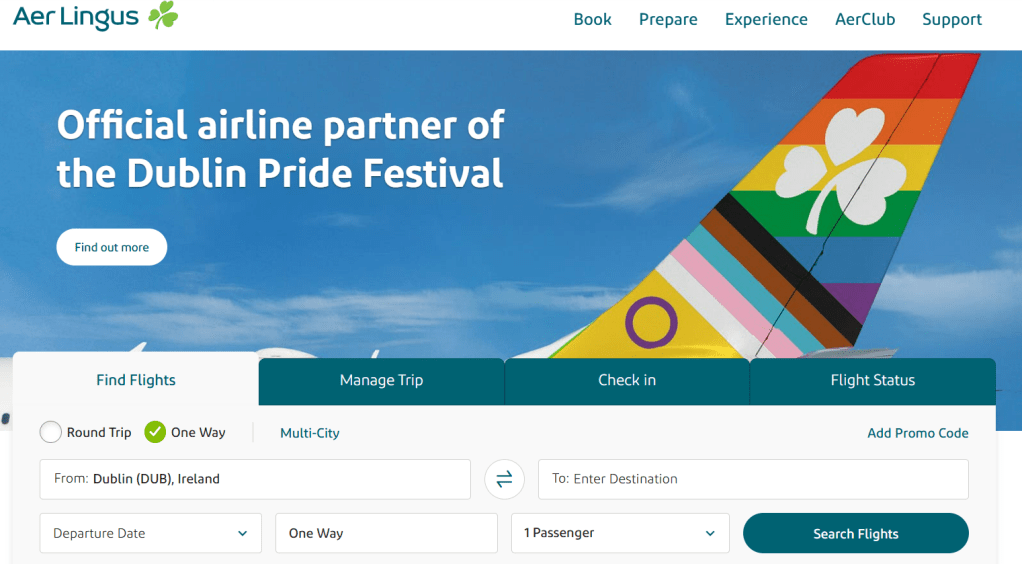
This is the normal interface for the website, but there isn’t an option to pay with points.

Instead, you need to click on the AerClub tab at the top and under the “Spend Avios” section, select “Book a Reward Flight”.

When you click on “Book an Award Flight”, you would expect it to take you to a page where you could book an award flight. Unfortunately, you need to find the little button that says “Buy a Reward Flight,” which is about halfway down the page after a bunch of information about the kinds of flights that you can book with Avios.

Once you do that, there will finally be an interface to allow you to search for an award flight. Just type in the airport that you wish to depart from and the airport that you want to arrive at, as well as the date, and then click the “search flights” button.

That sounds easy enough, but the problem is that for some reason, you can only search for direct flights. For instance, I can search from Chicago to Dublin. I can also search from Dublin to Edinburgh, because both of those are direct flights. What I can’t do is search from Chicago to Edinburgh, because there would be a stop in Dublin. That’s utterly insane. I cannot think of another airline website that is unable to book an award flight with a stop. It’s non-stop flights or nothing.

How A Limitation Can Be an Advantage

This limitation, though, can be used to your advantage. I am a huge fan of stopover flights and because you need to book all of the awards as separate itineraries, that makes stopovers simple.

Let’s look at the above example. I want to fly from Chicago to Edinburgh, Scotland, and do it on points. Clearly, I can’t book it as one itinerary, because the website only allows for non-stop flights. However, that does mean that I can break the two segments up into separate days and instead plan a stopover in Dublin for a day or two. Now, instead of flying directly into Edinburgh, I can stop for a day or two, visit Dublin Castle, have a couple of Guinness stouts, and adjust to the jet lag before moving on to Edinburgh. Stopovers are a fun way of getting a little extra out of a vacation.

Unfortunately, that means that if you are planning to fly from America to Europe using Aer Lingus, you will need to fly from one of the few cities in North America that have a direct flight to Dublin or Shannon. There are a couple of dozen American cities that you can fly to Ireland on using Aer Lingus, and Flight Connections is a great way to find out where those airports are that connect via Aer Lingus.

Award Flights are Consistently Available at Reasonable Prices

The Aer Lingus website is clunky and hard to use, but the payoff is predictable pricing and fairly consistently available awards, at least in economy. Aer Lingus has a distance-based award chart, and they seem to release five economy seats for each flight. I have no idea how many business class awards they release, because they are always sold out. If you find one, consider yourself extremely lucky.

The points charges for economy flights within Europe are pretty good, with flights from Ireland to the UK or within Ireland costing 4,000 Avios off-peak and 4,500 peak. From Ireland to most of Europe, it is 6,500 off-peak and 7,500 at peak. When you get a little further out, like Ireland to Greece, the Canary Islands, or Croatia, it gets up to 8,500 off-peak and 10,000 peak.

The calendar for peak/off-peak is also fairly generous, with peak pricing basically being summer and a few holiday-related dates the rest of the year.

Where this program gets extremely interesting, for Americans, is the fact that you can fly to Dublin from most of the Northeast and Midwest in the US for 13,000 miles off-peak and 20,000 miles peak. For destinations in Florida, Denver, and the US West Coast, it costs 16,250 miles off-peak and 25,000 miles peak. To view the full award chart, click on this link.

What this means, at least for me, is that you can use Dublin as a great launching point for trips from the US to different parts of Europe. I’ve been promising my family a Canary Islands trip for years and haven’t pulled it off yet. Using Aer Lingus Avios, we could fly to Tenerife during spring break, for 13,000 miles to Dublin. We could stopover in Dublin for a night or two and then get back on a plane and fly to Tenerife for 8,500 Avios. That’s a total of 21,500 Avios each for a pretty great flight itinerary.

You could do the same thing and end up in Munich for 19,500 Avios with a stopover in Dublin, or go to virtually any place in Ireland or the UK for only 17,000 Avios. That’s not unheard of, but the fact that it’s available most of the time on the Aer Lingus website makes it unique. It might not be available on the exact date you want to fly, but usually within a few days of when you want to fly.

Also, if you really need to fly on a Saturday, because you really can’t do a Tuesday-to-Tuesday trip, Aer Lingus offers the same good flight prices on the weekends as they do on any other day of the week. You might need to plan ahead and book early if you want to get those flights, however.

Aer Lingus Avios are Easy to Earn

Accumulating Avios is one of the easiest things you can do in travel hacking. You can transfer points directly from American Express Membership Rewards, Bilt Rewards, Chase Ultimate Rewards points, and Wells Fargo points. You can also transfer points from Citi Thank You points and Capital One by transferring to other Avios programs and then transferring to Aer Lingus Avios. In addition, Chase has three personal credit cards: the British Airways Visa Signature Card, the Iberia Visa Signature Credit Card, as well as the Aer Lingus Visa Signature Card, which earn Avios. There are also two credit cards issued by Cardless that earn Qatar Privilege Avios. If you earn Avios in any other program, like Iberia, you can just transfer those points to Aer Lingus at a 1:1 ratio.

All of those points can be consolidated into any Avios program. That probably makes Aer Lingus, as well as British Airways, Qatar Airlines, Finnair, and Iberia (all Avios programs), the easiest programs to accumulate points in. This means that not only will it not take a ton of points to book those flights, but it’s relatively easy to get those points.

Taxes and Fuel Surcharges are Relatively High

One thing that can be a little frustrating about the Aer Lingus program is that the taxes and fuel surcharges are relatively high. They’re not high compared to other European programs like Flying Blue or Virgin Atlantic, but compared to Alaska Airlines, American Airlines, Delta, or United, those fees are pretty high. At current exchange rates, a round-trip flight to Dublin from Chicago costs $299.71 in taxes and fuel surcharges. On an identical United flight itinerary, the taxes are $50.41.

US-based programs like Alaska, American, Delta, or United are going to charge much less in taxes and fuel surcharges, but the number of points needed will typically be much higher. In the United Airlines example that I mentioned earlier, the total number of points needed was 80,000 United miles round-trip, as opposed to the 26,000 points needed with Aer Lingus. So the question is, would you rather pay 26,000 points and $300 or 80,000 points and $50? That’s really an individual decision.

Why Aer Lingus For Transatlantic Flights is Clutch

Recently, the Chase Sapphire Preferred Card had a 100,000 Chase Ultimate Rewards Points bonus. This will probably be the most popular signup bonus for 2025. Anyone who signed up for this credit card and completed the $5,000 spend in 3 months necessary to get the bonus will be sitting on at least 105,000 Chase Ultimate Reward Points.

If you have a family of four that you would like to fly to Dublin from Chicago, in an off-peak time like September, for example, you could book that with Aer Lingus for 26,000 Avios and $300 each, for a total of 104,000 Aer Lingus Avios and $1,200. Those flights currently cost around $800 each, or around $3,200 total. Since the Avios needed to book those flights transfer from Chase Ultimate Reward Points at a 1:1 ratio, that means that this one signup bonus can ultimately save $2,000 on these flights.

One credit card signup and one transfer, and you can save $2,000 on flights to Dublin. That’s pretty good.

What Would I do?

In practice, when we travel to Europe, I prefer to have a destination that I want to go to and a stopover that’s a bonus. When Jenn and I visited Italy last fall, we had a stopover in Amsterdam that was a great add-on to the trip. That being said, I almost always book one-way flights. In order to keep the cost of the taxes and fuel surcharges down, I would probably book one of the one-way flights with one of the American carriers.

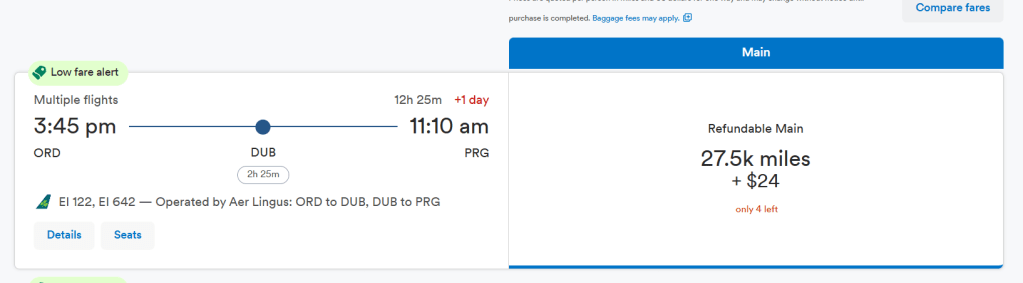
Let’s say I wanted to visit Prague in September. Alaska Air has a flight bookable with Alaska Miles (ironically, an Aer Lingus partner award) for 27,500 miles and $24. I would book that and then book a flight from Prague to Dublin using 6,500 Aer Lingus Avios and $32 as well as a flight from Dublin to Chicago for 13,000 Aer Lingus Avios and $167. That means that for 27,500 Alaska Miles, 19,500 Aer Lingus Avios, and $223, I can fly from Chicago and visit both Prague and Dublin. That’s a pretty solid itinerary for a fairly low price in points and dollars.

Don’t Overlook Aer Lingus

The Aer Lingus rewards program flies under the radar as a pretty great way to book inexpensive economy awards from the United States to Europe, especially Ireland and the UK. While the website can be a little clunky, and all of the award flights have to be booked as separate legs of direct flights, understanding the Aer Lingus program can yield amazing value.

The fact that everything has to be booked as non-stop flights means that you can add a day or two stopover in Dublin. This allows people to add an additional destination to a European vacation. Having to book separate legs could be an annoyance, or it could be a benefit. It’s really just a matter of how you look at it. That being said, 13,000 miles one-way from the northeast and midwest of the US is a deal that just amazing, and it’s basically standard with Aer Lingus.

It’s easy to overlook this program because if you are trying to find the best deal on award flights with a website like pointsyeah.com or awardtool.com you won’t find Aer Lingus awards. But don’t forget to go to Aer Lingus and see what’s available, especially if a trip to Ireland or at least a stopover would be desirable. It’s a great program that flies under the radar, so don’t ignore it.

Points and Miles has an Influencer Problem

I’ve been using points and miles to help me and my family travel for a little over three years now. In that time, I have been consuming large amounts of podcasts, blogs, and YouTube videos to learn how to maximize earning points and miles, as well as using those points and miles for maximum value. The information that I’ve gotten from these influencers has been invaluable in helping me set up my own strategies for travel, but lately, I have to admit, I’m getting annoyed.

I’m annoyed because many influencers present an unrealistic idea of what points and miles can do, especially for the average person. They also miss the point of what travel should be. I’m afraid people are paying attention to these influencers and not listening to what is best for themselves.

The Myth of Unlimited Points

There are three points and miles podcasts that I listen to on a regular basis. Every host on these podcasts takes multiple trips a year. These aren’t normal trips either; they are trips to Asia or Europe, and they fly their entire family in business class and stay in luxury hotels when they are there. They do this all on points. Listening to these conversations, the listener might think, “Maybe I can do this too?” Chances are, you can’t. These podcasters are spending millions of points per year, and that’s just not feasible for most people.

The podcasters fall into two categories: people who travel a lot for business and people with a lot of business spending. If you are a person who falls into one of these two categories, congratulations, you are going to have a lot of fun traveling on points. If you’re not, it gets considerably harder.

What really annoys me, however, are the ones who aren’t honest about this fact. I follow someone on Threads who, earlier this year, claimed that she had earned over 800,000 American Express Membership Rewards points on normal spend in three months. When pressed about it, she said that she had been getting 15x on a lot of purchases through Rakuten.

15x is pretty amazing but let’s, for the sake of argument, say that she got 20x on all her spending, which would be next to impossible, by the way. That would mean that she spent over $40,000 at 20x in 3 months to earn those points. That is not “normal” spending, and I guarantee she would have to spend way more than $40,000 to earn those points.

On one of the podcasts I listen to, a question was posed from a listener who asked how the hosts are earning all of their points. One of the hosts started talking about paying estimated taxes with a credit card, and while that will boost your point totals and help you earn signup bonuses, it doesn’t explain the number of points he must be earning to do the travel that he does.

I’m not saying that they aren’t earning a lot of points; I absolutely believe they are. However, can we be honest about how they are doing it? It’s not what they say. Here is how they are actually earning their points:

Lots of Business Spend

Many of these influencers are either owners of businesses that spend a lot of money on credit cards, or they are people who can spend and be reimbursed for expenses. This opens up the ability to earn a lot of points. This is especially true if you are a business traveler because that opens up the possibility of earning a lot of frequent flyer miles with airlines as well as lots of hotel points. It also opens up the possibility of earning status with those hotel and airline programs.

Manufactured Spend

A lot of points and miles people earn points and miles through manufactured spending. This comes in many forms, but generally it involves buying items, such as toys or gift cards, and then selling them for little or no profit. There are actually buyer’s groups that facilitate this for people who don’t actually want to handle the items themselves. There are all kinds of risks that are involved in doing this, including the fact that it’s frowned upon by credit card companies. This is probably why people don’t want to talk publicly about it. Understand, though, that there are a lot of folks doing this to boost their point totals.

Referral bonuses

For a lot of credit cards, you are offered a bonus for referring someone to apply for that card. These are generally limited to a certain number of referrals per card per year. For many of these cards, you can earn 100,000 points per year by referring applicants. If you have quite a few cards and a means to promote those referrals, like a blog or a YouTube channel, you can accumulate a lot of points and miles. However, for the average person, hounding all of your friends and family members to sign up for cards to earn a signup bonus may not make you very popular.

The Luxury Problem

Travel influencers are obsessed with luxury hotels. Hearing them talk about a Park Hyatt, a Ritz-Carlton, or an Andaz property makes me wonder if the only reason they traveled was to stay at that hotel. I understand that if you stay at a resort, you stay there because it’s the destination. But most of the time, the hotel shouldn’t be the destination.

We recently stayed in Madrid, where we used an IHG free night certificate that was good up to 60,000 points. We ended up staying at the Intercontinental Madrid, which was 59,000 points, so we maximized the value of the certificate. When we checked in, they double upgraded us because of Jenn’s status with IHG. The room was really nice, the service was great, but it was in the middle of the Financial District, and I would have preferred to be in an area with a bunch of tapas bars. In that case, maximizing the value of the certificate cost us the opportunity to be in a neighborhood that suited us better.

When we were in Amsterdam, we stayed at the Kimpton. It was a fun, quirky hotel with great service. When we checked in, they gave us $30 in bar credit because we used the Kimpton secret code, and Jenn had status with IHG. We didn’t use the credits. The reason why was simple – we were in Amsterdam! I don’t want to hang out at the hotel. I want to walk the canals and visit their bars and restaurants. We had a blast in Amsterdam, and all we did in the room was sleep.

At the end of the day, if you are out enjoying the place that you went to visit, the only thing that really matters is that you have a comfortable bed, a clean room, and a hot shower. Guess what? That’s nearly every hotel room. You don’t need to be that picky. If you have small kids and you will spend more time in the hotel because of naps, then maybe you want to be pickier, but for most people, what does it matter?

Flying in Economy is Fine

The obsession among points and miles people with flying in business class is ridiculous. Some of the comments from the folks I follow on Threads have been “I don’t care where I’m going as long as I turn left when I get on the plane,” and “Stop wasting your points on economy flights.” I mean, seriously, those are crazy statements. Are you only traveling so you can take a selfie in your lie-flat business class seat? That’s seriously weird.

I’ll tell you a little secret. When Jenn and I fly, she always wants an aisle seat, so if the seat arrangement is window, middle, aisle, I take the middle. I’m 6’2″, 220 pounds, and I can handle a 10-hour flight in the middle seat in economy just fine. The way influencers talk about economy seats, they act like they’re being stashed in the baggage hold under the plane.

Flying in economy is wasting my points? Really? At best, your business class flight costs twice the number of points that my economy class flight costs. That means that I can travel twice as often for the same number of points. The magic of flying is that I can be transported to a completely different part of the world in a matter of hours, it’s not that I can take a nap during the flight.

The Insanity of Positioning Flights

The worst part is the lengths people will go to get a business class flight. A good price on a business class flight is difficult to find. It’s so difficult that there is a term for a flight that you take to get to a business class flight. It’s called a positioning flight. In other words, you need to take a flight to get to the airport where your desired flight departs.

Typically, you want to fly a positioning flight the day before, that way if there is a delay on your positioning flight, you won’t miss the more important, business class flight. This is where, for me, the logic of doing this begins to break down.

Earlier this year, we booked flights from our home airport to Nice, France, for 19,000 American Airlines miles. Let’s say I have a friend who wants to join us there, but he wants to fly business class. He finds a business class flight from New York to Nice for an excellent price of 50,000 points. He’s going to have to book a positioning flight, which, if he’s lucky, will cost around 10,000 points, but he’ll have to get there a day early, so he also needs to book a hotel. Let’s say he books a Hyatt for 12,000 points near JFK airport. Now that a 50,000 point flight really costs him 72,000 points and a day of his time. Not only did I save 53,000 points compared to my friend, but I’ll be enjoying a latte and a chocolate croissant at a cafe in Nice while he’s on the plane.

This even gets more extreme, though. I’ve actually heard two people recently suggest that it’s easier to get a business class flight outside of the country, and you should try to take a positioning flight outside of the country. Let me get this straight: you want me to take a four-hour economy flight to Mexico, so that I can get a business class flight to Europe? Nope, nope, nope.

What is your Time Worth?

At the end of the day, many of the complaints I have are based on the amount of time required to earn the volume of points to go on luxury vacations. If you are lucky enough to earn points through large amounts of business or travel spend, then you are holding the golden ticket. However, for the rest of us, you would probably need to earn those points through some kind of manufactured spend scheme. I don’t really feel like spending my free time driving around town buying gift cards and products on sale and then posting those items on eBay.

Even if I had an unlimited amount of points, I don’t have an unlimited amount of vacation. Do I really want to waste a vacation day positioning so that I can take a business class flight? No, just get me to my destination so I can enjoy my vacation.

Know Yourself and Your Needs

Knowing yourself is important, however. If you are someone who appreciates luxury, maybe you’re willing to take fewer vacations to have that one dream vacation. That’s fine, and you shouldn’t be ashamed. It’s not for me, though. I want to experience the world, and that means that I need to make the most out of every single point that I earn.

We just got back from Spain and Portugal, where we hiked the Camino de Santiago. We ate at tapas bars and stayed in hostels. We flew in economy. Guess what? It was fantastic, and we were spending less than 50 euros per person per day, including lodging and food. It was fantastic because it was an authentic experience. We used points and miles to help us afford the flights, as well as a hotel in Madrid and one in Porto.

Points and miles have opened the world for us by lowering the cost of taking vacations. I’m proud of what we’ve done and the precious time that I’ve been able to spend with my family on those vacations – and you know what? I’ll never feel bad about turning right when I enter a plane and it wasn’t a waste of points, that’s for damn sure!

Turkish Airlines Miles and Smiles is (Almost) Dead to Me

When I first got into the points and miles hobby a couple of years ago, I was listening to a Frequent Miler podcast when I heard the term “sweet spot” for the first time. What they were referring to was a route, series of routes, or region in a points program where the deals were especially good. They were talking specifically about Turkish Miles and Smiles which had a number of great sweet spots:

  • 7,500 miles in economy and 12,500 miles in business class within the United States including Hawaii (on Star Alliance Partners – usually United Airlines)
  • 10,000 miles in economy and 15,000 miles in business class within North America including the Caribbean and Mexico (on Star Alliance Partners – usually United Airlines)
  • 30,000 points in economy and 45,000 points in business class to Europe on Star Alliance Partners or Turkish Airlines.

This turned out to be the first program I that I ever used to redeem points for a flight. I had to learn how to take my Citi Thank You points, transfer them to Miles and Smiles and then use their program to book United Airlines flights. In this case, I booked Jenn and I round trip tickets from Chicago to San Jose del Cabo Mexico for 40,000 points, which was a very good deal. 10,000 miles per person one-way to Mexico was fantastic. This was a deal that wasn’t the easiest to get, but it wasn’t too hard either. It just required a little flexibility on when you took the flight.

Because of this sweet spot, I always wanted to keep some Capital One Venture miles or Citi Thank You points (Citi and Capital One transfer to Turkish 1:1) around just to make sure that I could transfer them to Miles and Smiles. It was nice to have some miles available in case we wanted to use Turkish to book flights to the Caribbean or Mexico.

Turkish Airlines Website is Frustrating

The Turkish Airlines Miles and Smiles website is notorious for having all kinds of glitches. I kept getting an error when doing an award search while writing this blog post, and based on some google searches and reddit threads, I would say this error is common and has been around for a while without being fixed.

There is also an issue where most people cannot book anyone besides themselves online the first time they use the Miles and Smiles website to book an award ticket. Most people report that they end up calling customer support the first time they book with Turkish so they can book additional passengers (I had to do this also). Travel Update wrote a blog post about how to book with Turkish, which is very informative on the subject. For the most part, if you want to book with Turkish, you probably need to be a patient person.

The Sky Is Falling!

In early February, I started to see a bunch of blog and Twitter posts about a sudden devaluation that was to take place on February 16th. I read this one by One Mile at a Time, which showed what the new award chart would look like on Turkish Airlines, and it looked bad, with rates going up in the 40%-100% range.

A favorite redemption of miles and points hobbyists was business class tickets from the US to Europe for 45,000 miles. That’s a pretty amazing price, but with the new award chart it’s going cost 85,000 miles. This was, in my mind, what I think was freaking people out the most. One of the great ways of using Citi and Capital One points – business class flights to Europe for 45,000 miles – gone.

What I hadn’t seen anyone comment on was about my favorite redemption with Miles and Smiles. What was a flight to Mexico or the Caribbean from the US going to cost in economy? I figured I would just wait until after the change and then do a quick search to find out the answer.

I wasn’t too concerned, frankly I figured if they jumped it to 15,000 each way it would still be a decent deal. Besides, I’ve seen the points and miles community overreact when it came to Delta just a few months earlier. How bad could it possibly be?

Well, As it Turns out, Pretty Damn Bad!

30,000 miles? Are you serious? My favorite sweet spot to Mexico and the Caribbean is now 3 times the amount of points as it was before! Considering that the only way flights are even available to book on Miles and Smiles is if they are a saver award from another airline, there is no way that that I would book that through Turkish, I would just book it through the other airline.

Two of the best sweet spots, business class to Europe and economy or business class to Mexico and the Caribbean are effectively dead. But is there anything still worthwhile with Turkish Miles and Smiles?

Is Any Redemption Still Decent With Turkish?

The one remaining bright spot, in my mind, is 10,000 miles for domestic flights in economy and 15,000 miles in business class. When I saw this in the chart, I thought it meant just within Turkey. However, this appears to be any domestic, Star Alliance flights within any country. In the example below, a flight from Vancouver to Montreal is 10,000 miles in economy class.

A coast to coast flight from Washington DC to San Francisco is also just 10,000 miles.

The most impressive redemption left in the Miles and Smiles program is still on flights to Hawaii from the mainland US for just 10,000 miles in economy and 15,000 in business class. This used to be 7,500 miles in economy and 12,500 miles in business class before the change. They don’t make an exception for Hawaii even though it is almost a 5,000 mile flight from the east coast of the US. I even managed to find a flight to Hawaii from my little regional airport in Moline for 10,000 miles. That shocked me.

The baffling thing is that for some reason, coming it at one tenth of the distance of the flight from Washington to Honolulu is Chicago to Toronto for 30,000 Miles and Smiles. Why 30,000? Well, that’s because since it crosses a border, it counts as a flight within North America, not a domestic flight. Because it crosses the border between the US and Canada it ends up being 3x the number of miles to redeem. It doesn’t matter in the least that this has got to be a much cheaper flight for the airline to operate.

Dynamic Pricing Vs Award Charts

Most airline award programs have gone to some sort of dynamic pricing model, where they essentially calculate the price, in miles, based on the price of the ticket or the availability of award seats on the plane. American Airlines does this, and this became apparent to me when Jenn and I were trying to book 4 seats on American Airlines, 2 seats on her account and 2 on my account for the same flight. Once I booked my 2 seats, her price went up by 5,000 points each for those same flights. I assume that happened because 2 award seats had just disappeared from inventory.

This can get a little frustrating when you check the price of a flight a couple of days in a row and they change, but at the end of the day, they follow the price, in dollars, of the same flights. The cost of the flights, in points, generally makes sense.

There are some airlines, like Turkish Airlines, that still use an award chart for their award flights. This does make their award flight prices much more predictable, but can mean that some flight prices don’t make a lot of sense, such as the low cost of the flights from the east coast to Hawaii compared to a short flight across the Canadian border. For those of us who like to make the most of our miles and points, these charts often provide us with ideas on how to stretch the value of those points.

How I will Use Turkish MIles and Smiles

Turkish Airlines used to be one of the best uses of Capital One miles and Citi Thank You Points. Because you can transfer either of those programs 1:1 to Turkish Miles and Smiles, the great deals they had for flying from the US to Turkey, Europe, Mexico, the Caribbean and within the United States made this program a favorite amongst people in the miles and points hobby.

Most of the value of the program has disappeared with the increase in award prices to Turkey, Europe, Mexico and the Caribbean. That eliminates most of the usefulness for me, but knowing that I can still fly for 10,000 miles one-way within the US on United Airlines makes it still relevant. At 10,000 miles, it won’t always be a better deal than booking with United, American or Delta, but it most likely will be on the longer US routes.

Turkish Miles and Smiles, you’re not dead to me – yet.