Points Check February 2024

We’re inching closer every day to our spring break Costa Rican adventure. Honestly, this is a trip that I probably wouldn’t have dared to do a year ago. When we first started to do international travel (it’s only been a year – we’re still newbies!), every logistical step in the process was something that we needed to examine. How long will we be waiting in customs? Is that layover long enough? How do the trains/busses/taxis work from the airport? Will we be understood if we don’t speak the local language well? Each trip that we take gives us a little more confidence in the process and our abilities to handle those logistical issues.

The biggest logistical hurdle this time is driving a rental car in a foreign country, especially Costa Rica. There are horror stories all over the internet about scams at the rental car counter. Also, driving habits apparently are a little different in Costa Rica and the roads sound like they will be questionable off the major highways.

It’s easier for us to mentally prepare ourselves for what could be stressful driving and perhaps a difficult time at the rental car facility when we don’t have to mentally prepare ourselves for the logistics of flying. I feel like there are parts of travel that we’ve started to understand pretty well and it opens up my mental energy for new experiences. This is really important when you don’t want the negatives of travel to overwhelm what I’m anticipating to be an amazing experience with waterfalls, beaches and volcanoes in Costa Rica.

Hold!!!

Jenn and I have been planning a trip for us with her parents and our good friends who live in Nashville. The biggest logistical issue for this trip was landing around the same time in Rome with us using 3 different flight itineraries. That part has been done, but we’ve only managed to book the flights to Italy, not the return flights.

However, every time I try to bring up the fact that maybe we should book the return trip, Jenn turns into Kirstin Bell from the Carvana commercial and just tells me “HOLD!” I think she’s waiting on the perfect flight home that costs something like 1,000 points in business class with a stopover in Madrid. I’m sure we’ll find something decent since it is off-peak from Europe, but she’s making me nervous. I guess there are worse things in life than getting stranded in Italy.

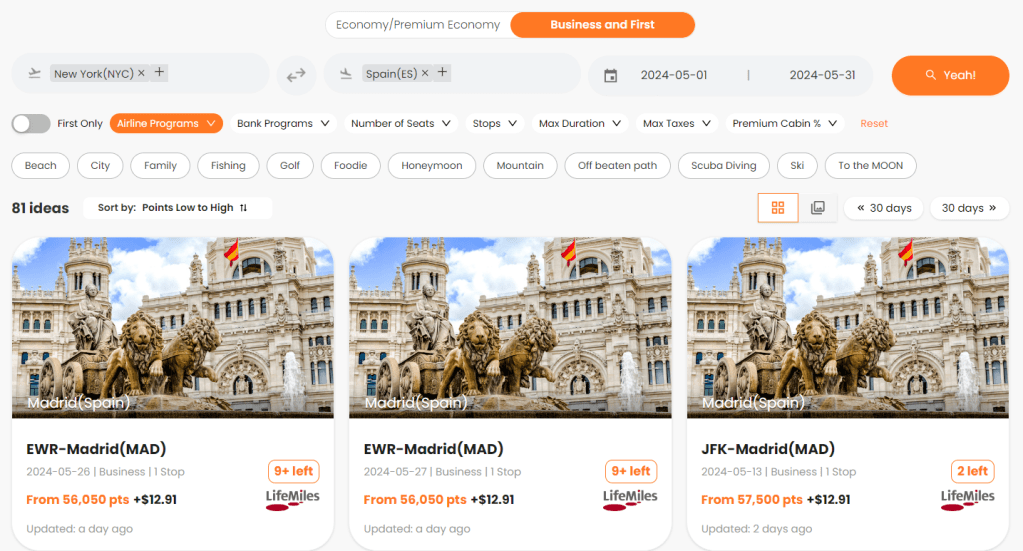
Anyway the flight we booked to Italy cost us 20,000 Chase Ultimate Reward points each transferred to Flying Blue plus about $90 in taxes and surcharges and $50 each to stopover in Amsterdam for a day. Stopovers are supposed to be free and I go into greater detail as to the $50 charge in this post about Flying Blue Stopovers. I would’ve paid the $50 charge anyway, but it would’ve been nice to know ahead of time.

The redemption turned out to be pretty good. The price of a comparable flight was $658 (with the $50 stopover fee included), so the 20,000 points we used reduced the cost of the flight by $518 each, meaning we got nearly 2.6 cents per point for the Chase Ultimate Reward points which are normally valued at 2 cents per point. You gotta love how great the deals have been on Flying Blue lately.

We also double booked some lodging in Costa Rica. We kept going over the logistics of landing at the Guanacaste Airport at a little past noon, going through passport control and customs, then renting a car and driving more than 3 hours to Grecia, outside of San Jose and trying to do this before dark. It gets dark in Costa Rica around 5:30 and it’s not recommended for people who aren’t familiar with the roads there to drive after dark, so we decided that maybe we should get a hotel closer to the airport and make the big drive the next day.

We ended up booking a local hotel in Playa Hermosa, which is less than 30 minutes from the airport. We booked it through Capital One travel for a little over 16,000 Capital One miles. These are redeemed at exactly 1 cent per point, which isn’t a fantastic redemption of Capital One miles, but it served it’s purpose and now we will get a little beach time while in Costa Rica, when we hadn’t planned to spend any time near the coast. We probably could have shortened our stay at the Airbnb by the day that we are in Playa Hermosa, but it feels wrong this late to change our reservation, and frankly it was only $75 per night at the Airbnb. This also ensures that we can check in at any time the next day.

A Shiny New Amex Gold Card

American Express Membership Rewards is a beloved program in the points and miles space. It has a ton of great transfer partners and has amazing opportunities to accumulate a massive amounts of Membership Rewards points very quickly with enormous signup bonuses, great bonus spend categories and other Amex offers. Up until now, I’ve avoided Amex because their cards tend to have high annual fees.

I applied for and was accepted for the American Express Gold Card. It has an annual fee of $250 and earns 4x on dining, 4x on groceries, and 3x on flights booked through Amex travel or directly through the airline. It also has $120 Uber Cash and $120 Dining Credit every month which is good at a handful of restaurants or Grubhub (so it’ll get used on Grubhub, if at all). Those credits are doled out monthly so it’s really $10 per month for Uber and $10 per month for Grubhub.

I applied with the bonus offer of 75,000 membership reward points and a 20% rebate on dining up to $250 back. The 75,000 membership reward points are awarded if I spend $6,000 in 6 months. There was also an offer for 90,000 membership rewards points without the 20% rebate, but I thought this was a way to get an Amex Gold card for essentially no annual fee, since spending $1,250 on dining for the $250 rebate is practically automatic for us and is equal to the $250 annual fee.

Anyway, On to the Point Check!

Card UsedSpendPoints EarnedPoint ValuePoints Per $Return on Spend
Citibusiness AAdvantage$1,1391,139$17.651.01.5%
Capital One Venture$7061437$26.742.04.0%
Wyndham Business Earner Card$5813,069$33.765.35.8%
Citi Custom Cash$5402,539$45.704.78.7%
Ink Cash$5312,639$54.105.010.2%
Citi Premier$491935$16.831.93.4%
Marriott Bonvoy$198995$8.365.04.2%
Total$4,18412,753$202.993.04.9%
This month’s spending not devoted to earning a signup bonus

We still haven’t managed to stop accidentally spending on our Citibusiness cards. They are practically useless for normal spend, and the problem is that when we are done with a bonus, we forget to remove them from all of the places where we’ve set up default payments. The most painful one here was when we ordered a dishwasher through Home Depot’s website and somehow managed to use that card instead of a card we are working on a bonus for. $700 worth of spending that could’ve gone toward a bonus, dammit.

Our spending was quite elevated this month because of the dishwasher and we also bought a new couch since the kids and the dog had managed to slowly kill the old one. Aside from the non-bonus spending in the chart above, Jenn spent a little less than $3,400 on her US Bank Altitude Business Connect card and earned a little more than $43 in cash back.

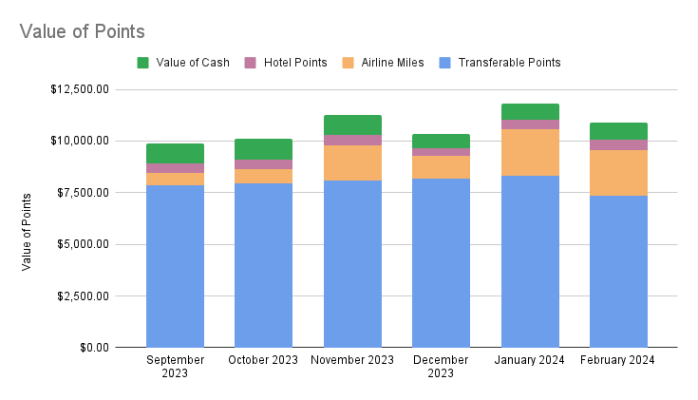
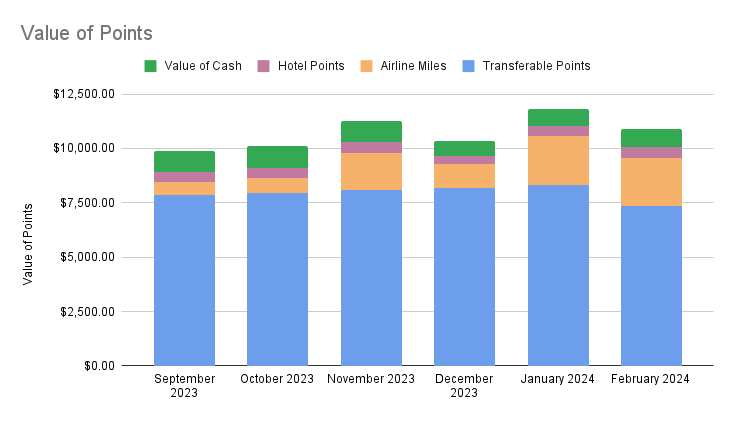
This left us with a grand total of 257,000 Chase Ultimate Reward points, 115,500 American Airlines miles, 75,100 Capital One Venture miles, 38,400 Citi Thank You points, 31,800 Marriott Bonvoy points, 24,900 United miles, 6,900 Hyatt points, 5,100 Delta miles, and $700 in cash back. According to the valuations determined by the Points Guy, these points are worth a grand total of a little less than $10,800.

Flying Blue Free Stopover Isn’t Really Free

We’re planning a trip to Italy for the fall with friends and Jenn’s parents. This requires a little bit of coordination between the parties, especially since we are all booking with different methods. Remarkably, even though Jenn’s parents and our friends were flying from different airports, the last leg of their journey is on the same Delta flight from Atlanta to Rome. Now it was up to us to try to match that time to land.

The best thing to do would’ve been to use Delta and get on the same flight, but we don’t have a lot of Delta Skymiles and their only transfer partner is American Express Membership Rewards and we don’t have any Amex points. Delta was not going to work but Air France (Flying Blue) had a flight landing just 10 minutes after the Delta flight.

The Problem with Short Layovers

Unfortunately, that had an hour and 25 minute layover in Paris (CDG), and that seemed pretty risky considering we would have to go through passport control, then security, and then find our gate in a busy airport I’m not familiar with. I would put the chances of success at about 50/50. Not good enough for me – especially with Jenn’s luck (she has had delays of 2 hours, 5 hours and 8 hours respectively on her last three flights)

A little off topic here, but why in the hell do airlines offer these tight layovers? You know you all suck at getting your flights in the air on time. I once sat on the tarmac for half an hour watching two mechanics trying to fix a seat that wouldn’t recline – on a 2 hour flight. Suck it up buttercup, I got places to go and your inability to move your seat 3 inches back is not my problem. Strap yourself in and lets go!

Sorry about the rant – the other option was to arrive in Rome 3 hours later, around 3 PM. Not only would that have been a massive inconvenience for our fellow travelers, but our plan was to take a train to Florence on the first day, and when I added up all the time to get through passport control, take the commuter line to Rome Termini, transfer, then take a train from Rome to Florence, we would be getting in very late. Assuming we all only sleep a little on the plane, we might be dragging our suitcases through Florence trying to find our Airbnb with the mental acuity of a toddler on Benadryl.

The better option was to go a day early, but with timing of the flights and the fact that FCO really isn’t that close to Rome, we probably wouldn’t have gotten to enjoy the extra day in Rome, we probably would just end up sitting in a hotel room. But what if we stayed in Paris or Amsterdam on the way, instead?

Flying Blue Free Stopovers to the Rescue

A quick google search pulled up this article by One Mile at a Time that points out that indeed, Flying Blue offers free layovers. We pieced together an itinerary that flew KLM from Chicago landing in Amsterdam at 7:10 AM and a second flight that leaves Amsterdam 26 hours later which lands in Rome a mere 20 minutes after our companions. The nice thing is that since we will go through passport control in Amsterdam, and they will be going through in Rome, theoretically we should be ready to leave the airport in Rome around the same time.

Perfect, now we just had to call, and by we, I mean Jenn since the points were in her account. She wasn’t happy about that.

She was on hold for about an hour, but when she got on, the agent understood what Jenn was trying to do, and got it all booked. The process on the phone wasn’t exactly quick, but she was probably off the phone in about 15 minutes after the agent picked up.

Free Stopovers Aren’t Exactly Free

When Jenn got off the phone, she said that the taxes were higher than we expected. We looked and sure enough, the taxes were $139.70 per ticket instead of the $85.90 that is listed online. The difference worked out to be exactly 50 Euros. So it appears that the “Free Layover” is going to cost 50 Euros per ticket, unless it’s 100 Euros per call.

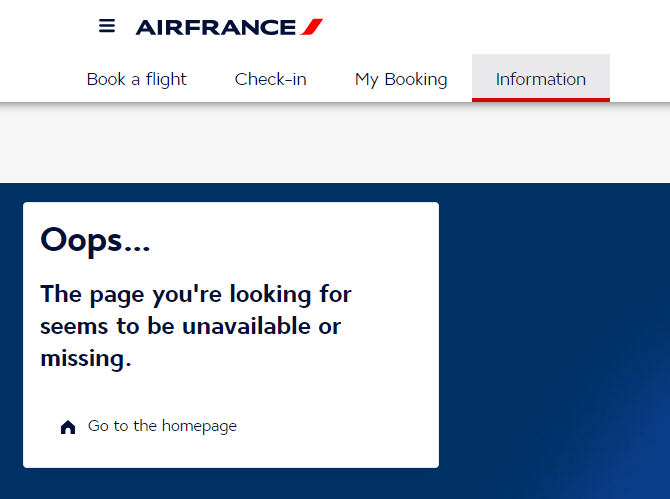
They do have the fact that higher issuing fees do occur by phone, but when you click on the link for an explanation, you get a dead link. So my assumption is that it costs 50 Euros per ticket, but I don’t know for sure.

Booking Stopover Online isn’t Possible, Yet

Currently there isn’t a way to book with a stopover on the website. I would assume that they might add that in the future, but for now it’s by phone only. This means that you are going to have to do a considerable amount of research on their website to pick out the flight segments that you want and then communicate this effectively to an agent who is most likely in France or the Netherlands. This can lead to confusion, which Jenn found out, when she gave my birthdate to the agent the American way, month-day-year, and the agent entered the birthdate the European way, day-month-year.

It also means that until they can add a free stopover feature to their website, you will be paying the fees associated with making an award flight redemption over the phone. My limited experience with how agile tech development is with airline point programs suggest it might take some time before you see that feature on their website. For now, prepare to pay for the stopover.

Which Cities Can you Stopover with Flying Blue?

I assume that these stopovers will only work in their hubs. I doubt that they would let you fly, say Chicago to Paris to Barcelona, then get a free stopover, then Barcelona to Paris to Munich. However, they will allow you to stop in Paris if flying from Chicago to Barcelona when the normal layover would be in Paris. So that will limit any stopovers to just Paris or Amsterdam. The article from One Mile at a Time does indicate that it should work with partner airlines booked through Flying Blue, so there are actually other possibilities besides Amsterdam and Paris, but for the most part, that’s how you would typically use them.

Stopovers can be as short as 24 hours and as long as 1 year. That offers great flexibility, but I imagine that most people are going to use this as a way to visit Paris or Amsterdam for a few days and then move on to another location. With this stopover rule, you could pretty easily put together an itinerary where you go to Amsterdam for a few days on a flight from the US, move on to another European city for a few days and stop in Paris for a few days on the way back. That’s a pretty easy way to get a sampler platter of Europe and the prices could be around 40,000 points (transferable from Citi, Amex, Chase, Capital One and Bilt), around $240 for taxes and $100 for booking by phone. That’s not too shabby.

Making Lemonade out of Lemons

For us, it was a way to make lemonade out of lemons. We didn’t want to land in Rome that late on the same day as our fellow travelers, and getting in at 3 PM the day before left us with not a lot of time to enjoy Rome. However, 26 hours in Amsterdam with the opportunity to adjust our sleep to the new time zone, sign me up. We’ll get to walk along the canals and have dinner in downtown Amsterdam and still make it into Rome right at the right time. That’s some damn good lemonade.

Gamla Stan

Gamla Stan dates back to the 13th Century and was founded when leaders from Sigtuna were having issues with armed bandits and were looking for a more defensible capital. Since the area is a series of islands and islands are easier to defend, it was a great place to build a capital. Now, without those pesky marauding bands of raiders, it makes for a great place to shop, eat and have a drink.

St George and the Dragon Statue commemorating the slaying of a dragon who was extorting villagers. I’m skeptical about the historical accuracy of this story.

Gamla Stan is the old town of Stockholm and consists of the islands of Stadtsholden, Riddarholmen, Helgeandsholmen and Stromsborg. Stadtsholden is the main island and the one that most people associate with Gamla Stan.

A look down Osterlanggatan, a road built on the location of the original east wall of the city.

On our first full day in Stockholm, we made it to the old town fairly early. The streets were mostly empty and some of the shops were still closed, which gave us a fairly calm walk to start the day. We popped in a couple of shops and made our way through town to find a cup of coffee. We managed to find that at Sundberg’s Konditori. We enjoyed the coffee sitting out in the cobblestone plaza. While we were drinking our coffee, however, the streets went from being fairly empty to being pretty packed.

A look down a side street at the belltower on the Stockholm Cathedral, also known as the Great Church.

Quite a few tour groups showed up, who traveled in packs of a dozen or two and tended to stretch all the way across the narrower roads. Tourists and shoppers started to pop up everywhere, but this was only a Thursday, so it probably could’ve been busier.

A typical building in the old town.

For the next couple of hours, we checked out a lot of shops while making our way down the crowded cobblestone streets. There were quite a few kitschy shops selling Swedish keepsakes scattered amongst art galleries and jewelry stores. After a while, we decided to go looking for a beer.

Swedish Attitudes towards drinking are A Bit Conservative

Sweden seems to be less comfortable about drinking than most of Europe. They have separate state owned grocery stores to sell any alcoholic beverage over 3.5%. They also apparently frown on drinking mid-week. The drinking age is 18, but you have to be 20 to buy alcohol from a store and restaurants and bars can choose to not serve you until you’re 20, which is interesting. Also, the grocery stores that we visited sold only non-alcoholic beer, a product I have yet to understand.

I mention this because as we were looking around for a beer, I noticed that there didn’t seem to be any Swedish bars, Swedish beers, or frankly any kind authentic Swedish alcohol anywhere. Most of the bars we came across were English, Irish or American, so we decided to stop in at Wirstrom’s Pub, an Irish Pub.

The Cellar Pubs of Stockholm

Wirstrom’s had a pretty nice selection of beers and Jenn ended up getting a nice Belgian Dubbel and I had a English Ale. They were showing a soccer game, and the majority of the clientele were pretty laser focused on that. We were admiring the building, which was lovely and has a really interesting basement where you can have a beer in an old cellar.

Belgian Dubbel at Wirstrom’s

This, as it turns out, was not unique to Wirstrom’s. We went to O’Connell’s Irish Pub for lunch where I think everyone but Emma got Fish and Chips. The food was great and I developed a love for mushy peas there, but they also had cellar with a bar in it. That bar wasn’t open at the time, but I got the impression that they use it at night when the bars fill up.

Staircase to Kallerbyn.

Later on we came across another cellar pub named Kallerbyn. It looked very nice, but we didn’t stick around very long. I believe we picked up a to go coffee there and they let us walk around.

Kallerbyn seating

I think if we kept looking, we could’ve found more, It might be fun to do a cellar pub crawl in Stockholm. I mean, fun for me, Jenn couldn’t get out of these cellars fast enough, for some reason they creeped her out.

Narrow Roads and Fika

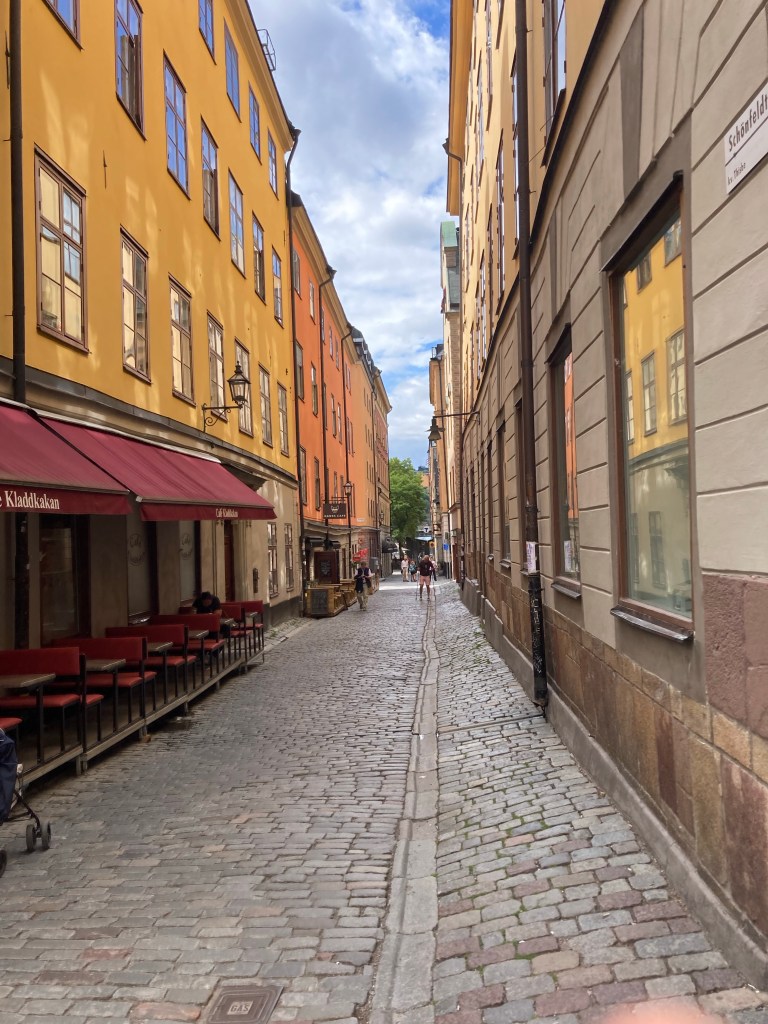
A lot of our time in Gamla Stan was spent wandering the narrow roads and admiring the architecture. The old stone roads were mostly car free, which made the walks fairly carefree and enjoyable. It was crowded but not so much as to be unbearable.

We did manage to stop in to a coffee shop and experience fika, sort of. Fika is a Swedish tradition of taking a set break during the day and have a small snack, usually something sweet like a cinnamon roll and a cup of coffee. Fika is meant to be a ritual that you spend with your coworkers or friends and it apparently is taken pretty seriously by Swedes as a way to disconnect for a few minutes and take a breather. We just sat down and had a cup of coffee and a cinnamon roll in a crowded coffee shop. I don’t think we did it right. By the way, Swedish cinnamon rolls are amazing, I might have to go back just for those.

Riddarholm Church

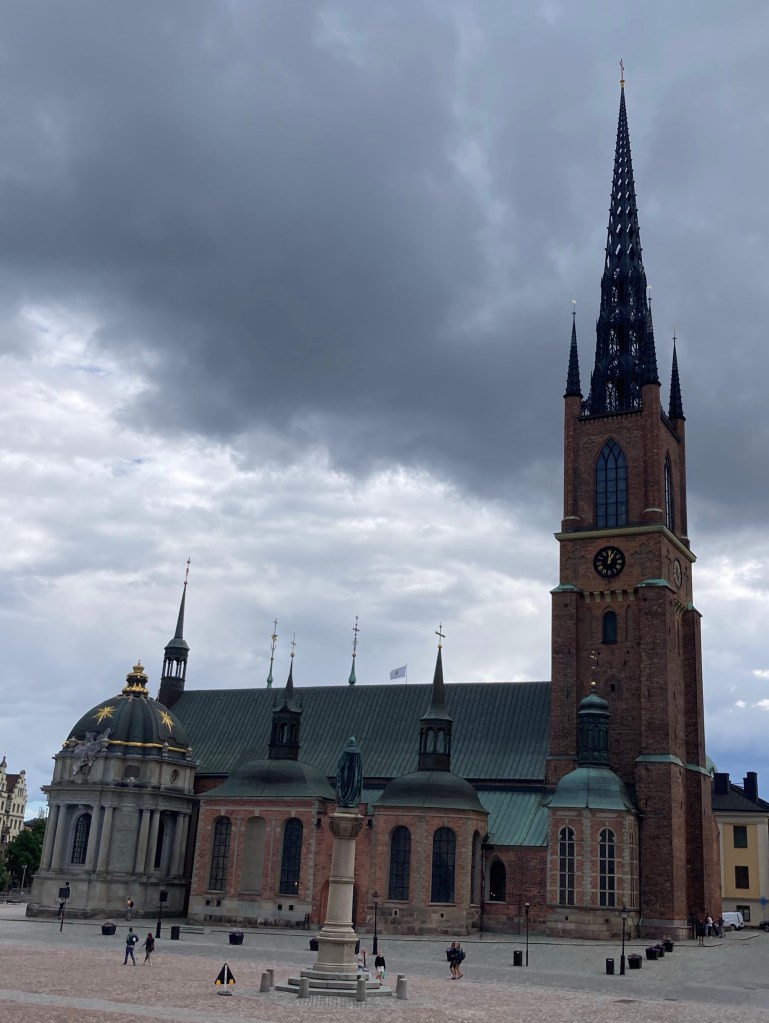
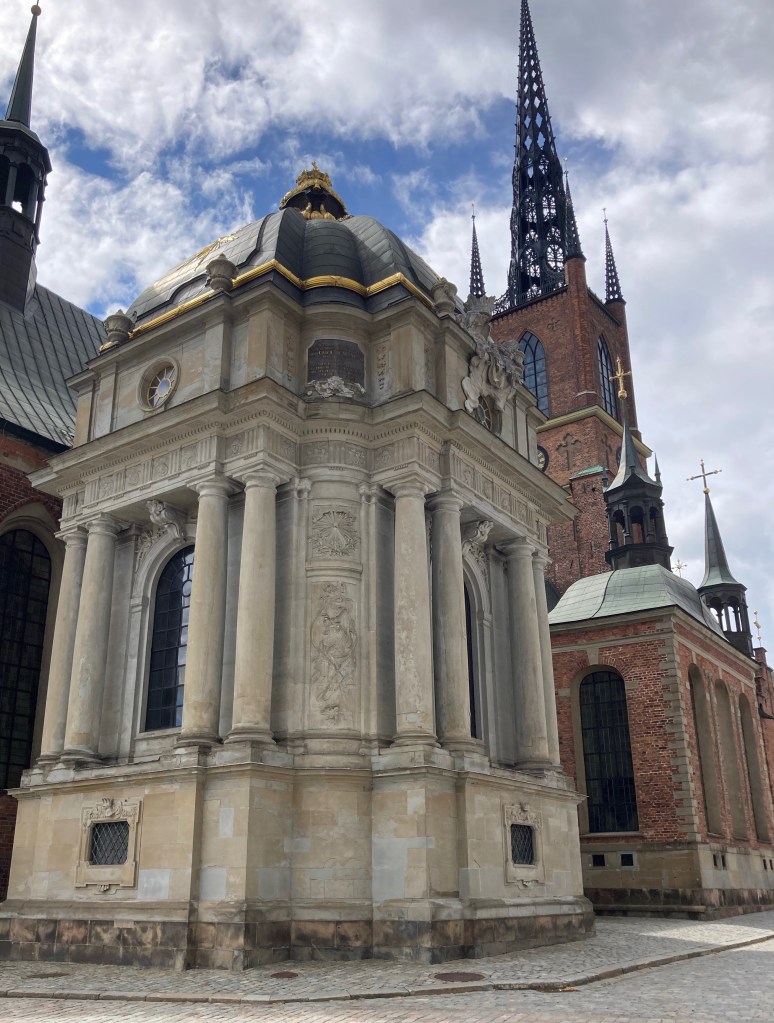
Riddarholm Church grabbed my attention right away when we approached the old town. I was fascinated by the beautiful iron spire on top of the belltower.

The church began it’s life as a monastery in the late 13th century. The church itself began to be built almost immediately after the monastery was opened. It became a popular place for Swedish royalty to be buried and there are 17 regents buried in the church. When the protestant reformation happened, the monastery was vacated and the church became a Lutheran church which stopped using the church in 1809. In 1835, a lightning strike destroyed the original spire and was replaced by the beautiful and unique iron spire.

Currently the church is known for being the burial church of the kings, even though Swedish Royalty stopped using the church for burials in 1950.

Riddarholmen Church looks remarkably well preserved.

Personally, I was struck by the contrast of the traditional 13th Century gothic church design mixed with a much more modern iron spire. However, knowing that by the time the iron spire had been added it was no longer being used as a church, that somehow made a little more sense to me. It’s absolutely unique and gorgeous, but unfortunately, we didn’t have tickets, or frankly a lot of time to visit, so we walked around the outside of the church, admired it’s beauty and left.

Reasons to Return to Gamla Stan

There were so many things that we didn’t really make time for in Gamla Stan. There is the Nobel Prize museum and the Royal Palace as well as Parliament. There are a couple of beautiful cathedrals to tour, the house of Nobility and the Bonde Palace. If you really wanted to explore the area to its fullest, I think you would need to devote at least 3 days to it, maybe more. We didn’t have enough time for all of that, but that’s okay with me, since that just gives us an excuse to return and get more of those amazing Swedish cinnamon rolls.

Points Check November 2023

Back to an All Time High

We finally passed our previous all-time high point total of around $10,600 in value. This came primarily from earning a sign up bonus from my Citibusiness AAdvantage Platinum Select card. It offered a 65,000 point bonus for spending $4,000 in the first 3 months and I met the required spend this month. Jenn actually did the required spending on her Barclays American Airlines Aviator Red card which will earn her a 75,000 point bonus as soon as Barclays processes it. We’re actually waiting on that because we plan to book airline tickets to Costa Rica for spring break and the little delay from Barclays is annoying.

A Second Citibusiness AAdvantage Platinum Select Card

Jenn applied for the exact same card I just completed the minimum spend on – the Citibusiness AAdvantage Platinum Select card. She, however, got a better signup bonus than I did. She will receive a 75,000 AAdvantage mile bonus when she spends $6,000 in the first 6 months of having the card.

As I pointed out in the post when I applied for the card, it has a $99 annual fee which is waived for the first year. Miles earning on this card is pretty weak, in that it is 1x on most purchases, and 2x on American Airlines purchases, gas, telecommunications merchants, car rental services and cable and satellite providers. It does provide a free checked bag and priority boarding.

There is a $99 domestic companion certificate that you can earn when you spend $30,000 on the card, but seriously don’t do that. There has to be better ways of getting a cheap companion flight than that, with the only exception of maybe if you spend $30,000 on American Airlines flights.
Getting Bailed out of a Mistake

We had a hotel stay booked with Marriott that Jenn didn’t realize she booked with a non-refundable rate. When you use the Bonvoy app to book a room, there are multiple tabs for you to choose from. The prepaid option is non-refundable, and while they do have that written on there, it’s not exactly jumping out at you.

Jenn had been so used to booking things on points (which are almost always refundable, especially well in advance), that it didn’t really occur to her that the room was non-refundable. She canceled the room almost a month in advance, and after a while I asked her why they hadn’t refunded the money. She called the hotel, only to find out the room was non-refundable, but she was persistent and asked to talk to a manager, who was unavailable, of course. She called back the next day and tried again, with no luck and finally we kind of accepted the fact that there would be no refund. However, once the date for the hotel stay passed, the room was refunded to us. They never called back to let us know, they just refunded it. I guess this just goes to show that sometimes it never hurts to ask. Also, kudos to Marriott and the hotel itself, they absolutely were under no obligation to do so. That being said, it was smart of them because they will probably get more of our business now, because they were gracious in helping us fix our mistake. In the future, we will make sure to not use the non-refundable option.

Anyway, On to the Point Check

Card UsedSpendPoints EarnedPoint ValuePoints Per $Return on Spend
Citi Premier$1,4452,280$41.041.62.8%
Capital One Venture$1,0772,154$39.852.03.7%
Chase Ink Cash$5182,570$52.695.010.2%
World of Hyatt$4292,144$36.455.08.5%
Chase Ink Unlimited$395592$12.141.53.1%
Wyndham Business Earner$254729$14.942.93.2%
Delta Business Gold$107107$1.611.01.5%
Total$4,22510,576$197.102.54.7%

This month was a little disappointing in that the return on spend on our other cards dipped under 5% and I’m really trying to keep that up above the 5% mark. One of the big reasons for that, however, was the fact that my daughter’s car had about $800 of repair costs, and while that can be charged, there isn’t exactly a bonus category for it. We probably should have used the Capital One Venture card, since it is 2x everywhere, but Emma is an authorized user on the Citi Premier card and that’s what she used, for a disappointing 1x instead. Oh well. We were able to get 5x on Amazon through a World of Hyatt promo, which is nice but somehow I misunderstood the Wyndham Business Earner categories and moved our insurance there, thinking I would get 5x and it absolutely wasn’t, just a lowsy 1x on that.

Jenn got an electric car as well, which has cut our fuel consumption by about 75%. That is awesome, but I’m missing the massive amounts of Wyndham points we earned at 8x on gas.

Aside from the spending not devoted to a bonus, I spent almost $1,800 on my Citibusiness AAdvantage Platinum Select card and earned almost 1,800 AAdvantage miles and the 65,000 point bonus. Jenn spent around $1,000 on her Citibusiness AAdvantage Platinum Select card and earned around 1,000 AAdvantage miles.

All of this left us with a month-end total of 289,000 Chase Ultimate Reward Points, 88,400 Capital One Venture miles, 77,000 American Airlines miles, 48,300 Marriott Bonvoy points, 29,800 Citi Thank You points, 24,600 United Miles, 15,000 Delta miles, 3,700 Hyatt points, and $974 in cash back. If you use valuations by the Points Guy, the total value of all of these points is $11,280.

Venice – A Masterpiece Centuries in the Making

Why is Venice Built on Water?

There is debate on this, but the general consensus is that around 600 AD, Italians who were fleeing attacks from Lombard invaders moved out onto the islands of Venice because they could defend themselves better on the islands. The islands were marshy and difficult to build on, but much easier to defend than being on the mainland. In order to prevent anything that was built on the marsh from predictably sinking, the Venetians drove millions of wooden posts into the marsh. These posts compacted the mud. The mud keeps the posts from decomposing and the combination of the mud and posts makes a solid foundation on which to build. Strip the City does a great job demonstrating how this worked in the video below.

Venice Becomes a Trade Empire

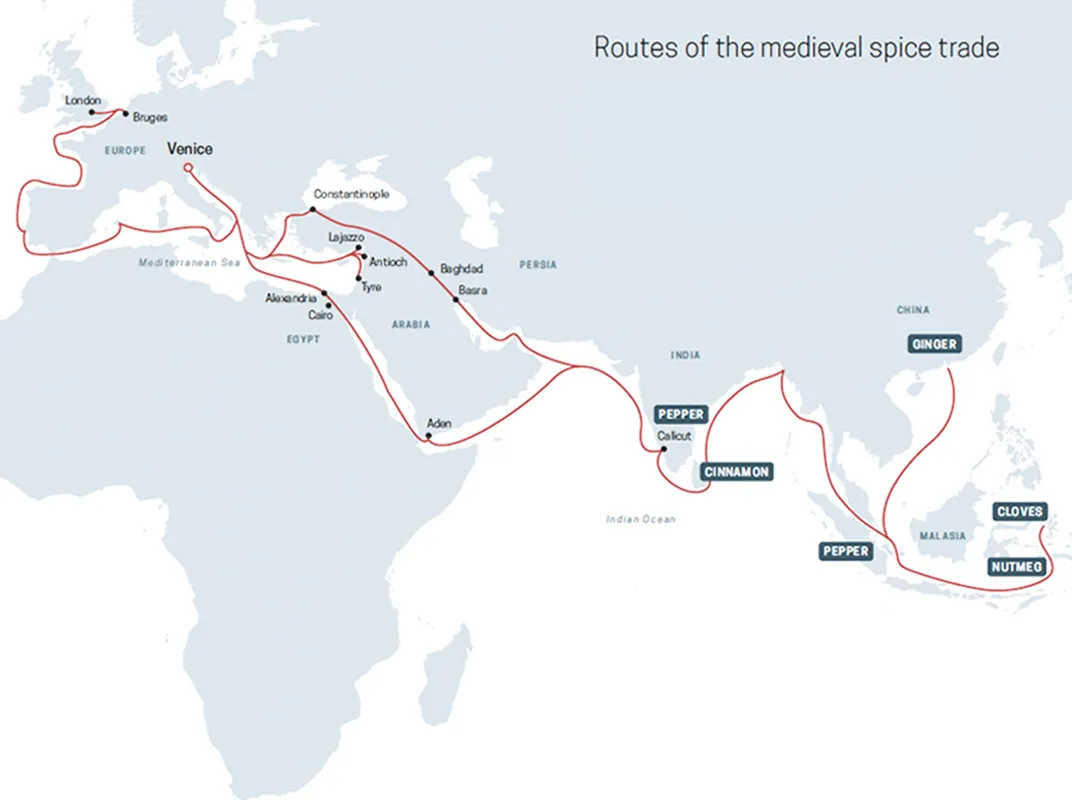
For much of the time between the 9th Century and the 16th Century, Venice was uniquely positioned to take advantage of trade routes. Venice had access to Constantinople as well as Alexandria by ship and was able to unload goods onto the European mainland. This allowed them to sell goods throughout Europe. Venice built a powerful navy in order to protect their merchants from pirates in the Mediterranean Sea. This turned Venice into a vital link between the spice and silk trade of Asia and Medieval Europe where those goods were so valuable. The Smithsonian Magazine has a great article which goes into greater depth on this subject.

Image provided by the Smithsonian Magazine

Wealth Produces Art

One thing that always seems to be the case throughout history, is that where there is great wealth, there is great art. The vast trading empire of Venice was creating an amazing amount of wealth amongst its merchants. That wealth created a market for artwork, since having great artwork is generally a way that many wealthy people demonstrate that they are wealthy and successful. There are a number of famous renaissance artists from Venice, including Giovanni Bellini, Vittore Carpaccio, Giorgione, and Titian.

Palazzo Cavalli-Franchetti

We typically think of painting when we think of art. But art is evident throughout Venice. You see it in the architecture, the stonework and the ironwork on buildings. You see it in the statues and even in the beauty of the gondolas that seem to glide through the canals.

Gondolas take around 6 months to build and cost around 40,000 Euro.

The Architecture of Venice

As was just about everything in Venice, the architecture of Venice was influenced by its trading partners. Because Venice was trading with people throughout Europe and into the Byzantine Empire, a new form of architecture emerged in Venice. It is known as Venetian Gothic and it is found throughout Venice and has elements of Gothic architecture such as pointed arches, rib vaults and tracery as well as elements of Byzantine architecture such as the use of domes and veneers. These elements created a unique style that can be seen throughout Venice.

The domes at St Mark’s Basilica are examples of Byzantine influence in Venetian architecture

The vast majority of buildings are obviously not as adorned as St. Mark’s Basilica, but even the typical homes in Venice have a certain flair to them. There are a number of Juliet balconies, windows featuring tracing and pointed arches, and a lot of lovely doors. There are also window boxes with flowers everywhere. It all leads to a style that is positively Venetian.

The Doors of Venice

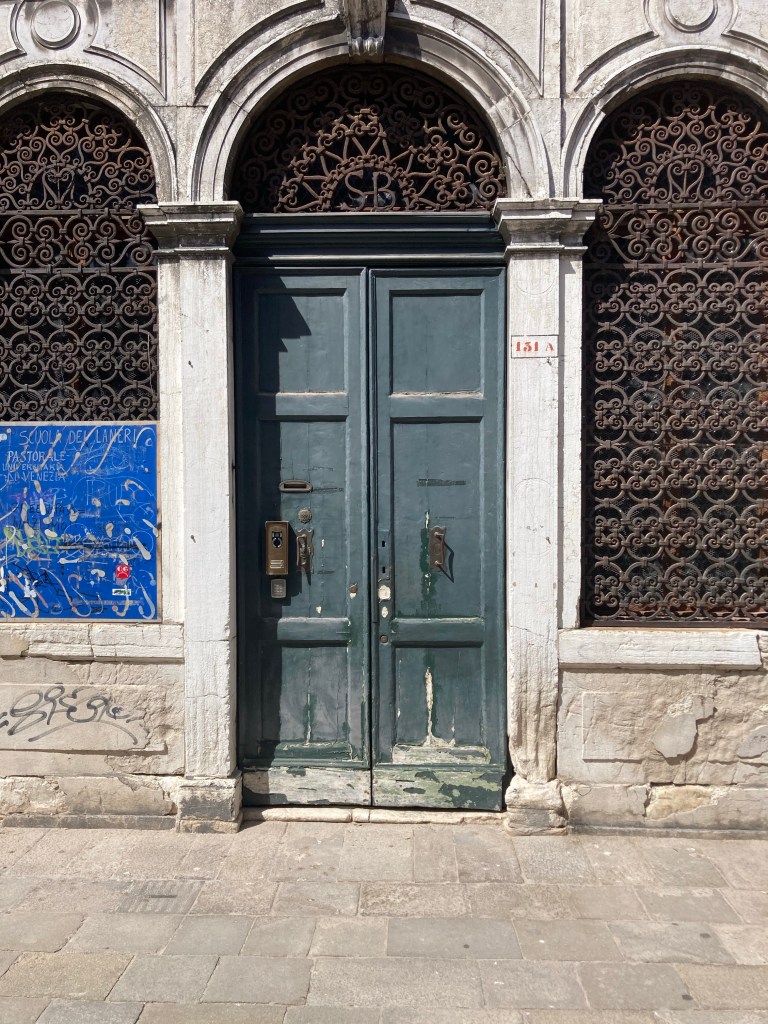
One of my favorite things about Venice is the doors. They all seem to be unique to the buildings. A lot of them are wooden and very worn with time. Often you see them like in the below picture, with beautiful stonework and ironwork surrounding the doorframe.

Other times, you see doors which are not quite as worn, but instead are truly unique pieces of art, like this beautiful metal door. This door also has beautiful stonework surrounding it as well as some really interesting brickwork.

Below is another example of great stonework and brickwork surrounding the door. Also, this door is a gorgeous piece of woodwork. Another thing I’ve noticed about Venetian doors is that not always is the lock and door pull where you would expect them which is interesting. Venetian doors also tend to all have letter slots.

Beautiful Door with Inscription over it meaning “Year of our Lord 1904″

Venetian Statues

If you walk around enough in Venice, you will undoubtably come across a few statues. Many of the campos in Venice feature a statue dedicated to a historical figure of Venice. From the limited amount of time I spent in Venice, it seemed that the majority of these statues were fairly recent, being from the 19th Century or newer. However, in my opinion, they fit in nicely to their surroundings, even if they are recent additions to the plazas they inhabit.

The Monument to Daniele Manin was erected in 1875 and was sculpted by Luigi Borro.

The above statue is a bronze statue of Daniele Manin, who was born in Venice and an important leader who helped to reunify Italy. It is the featured statue in Campo Manin, obviously named for the Daniele Manin.

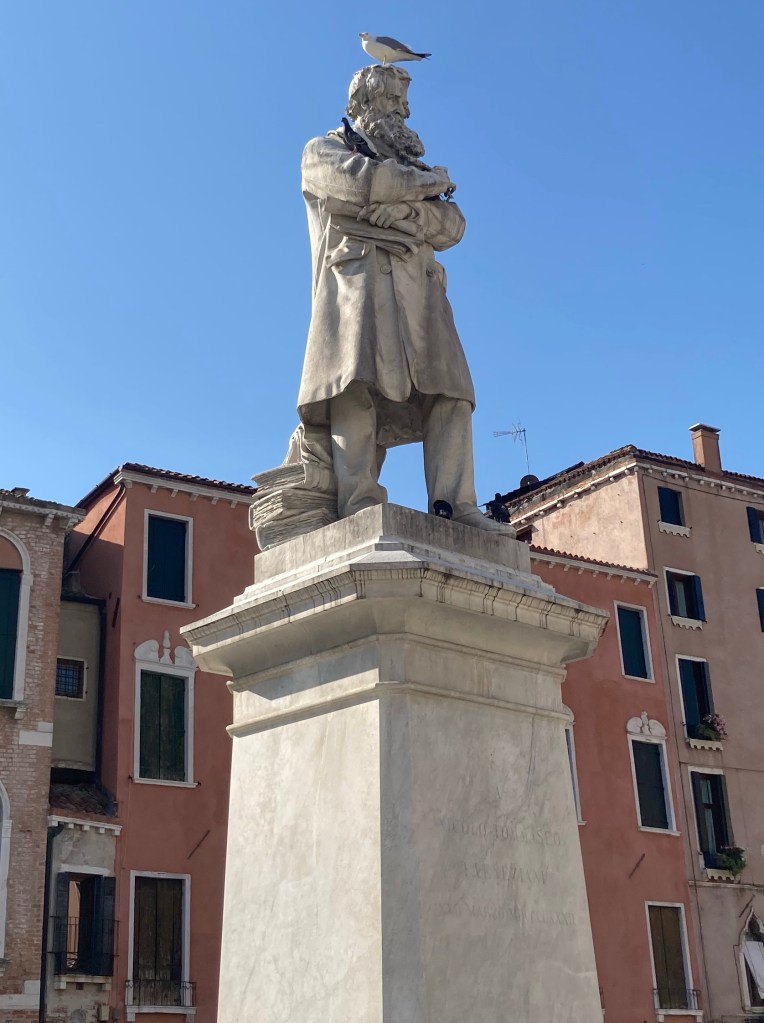
Monument to Niccoló Tommaseo built in 1882 by Francesco Barzaghi

The statue above, is a built out of Carrara marble. It was a monument built to Niccoló Tommaseo who was known as a scholar and an Italian patriot. This particular statue has a funny nickname, because as the sculptor was carving the statue, it began to have structural issues. In order to keep it from falling over, he carved a stack of books for Niccoló to lean on. The problem is that the stack of books looks like it’s flowing from under his overcoat, which has earned the statue the nickname “book shitter”.

The Bridges of Venice

Virtually all bridges in Venice are built with the same basic shape. The strength is created by an archway over the canal, while a walkway is a set of stairs up and a set of stairs down. Many of the bridges, especially the ones that are built over smaller canals are built with stone and brick.

Both of these bridges are typical of Venetian bridges. Arched at the bottom and stairs on top.

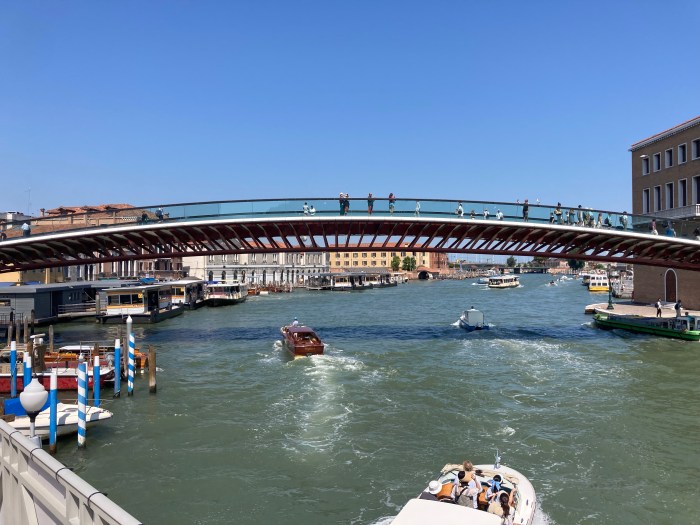
The bridges that are built over the Grand Canal are longer and require a more modern structural design. The most modern example is the Constitution Bridge that was opened in 2008 and is unique in Venice for it’s steel and glass construction and modern design.

Artistic Touches

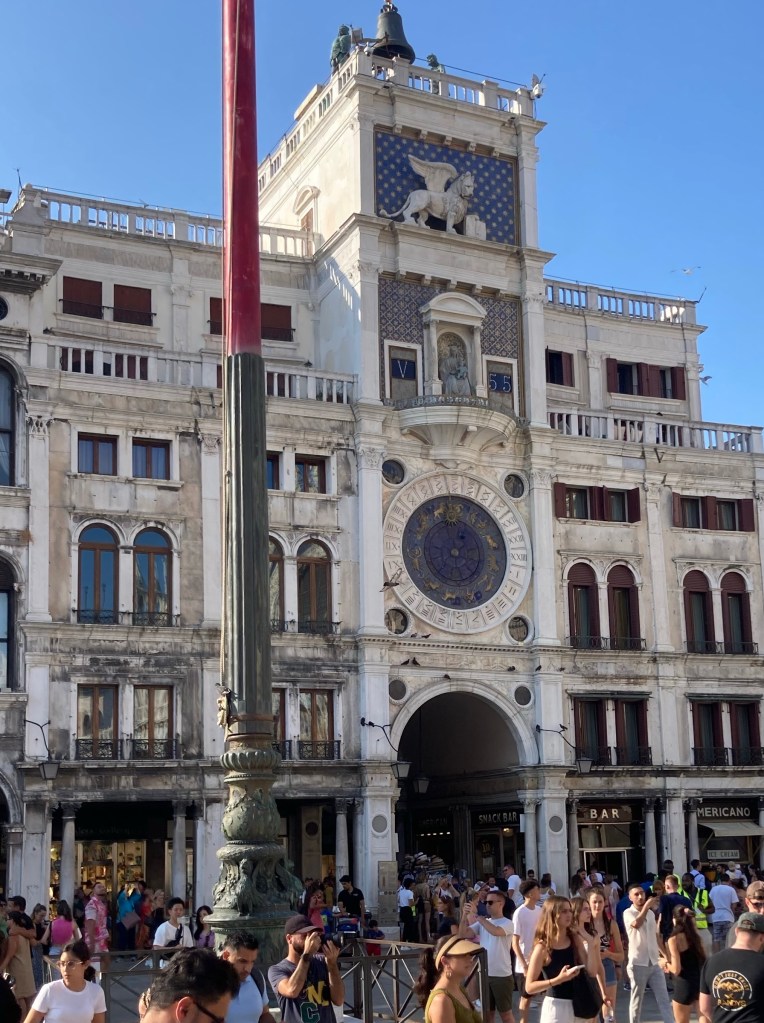
There is a certain flair to much of what you run across in Venice, you’ll see it in door frames, window frames, as well as architectural sculptures. You’ll also see it in the detail of the three flagpoles in the Piazza San Marco. The bronze bases were sculpted by Alessandro Leopardi in 1505. The flagpoles are spaced out in front of the St. Marks Basilica and are strikingly beautiful.

St Mark’s Clocktower is also a great example of the style of Venice. It’s an beautiful white stone structure, with the Lion of St Mark near the top. Below that is the Virgin with Child and then the clockface itself. This clocktower was built as a replacement for an older clocktower in the late 15th Century.

St Mark’s Clocktower

St. Mark’s Basilica itself takes the details to extremes. There are details everywhere. Just one small section of the basilica demonstrates the details. There are multiple columns and a stone archway. The door itself has intricate ironwork while the head of the doorframe is an intricate Byzantine design. The most stunning part, however is the mosaic half-dome which depicts the moment that St Mark’s body was carried into the Basilica. It is adorned in 24 carat gold leaf. Seemingly every inch of the Basilica is covered in detail like this.

This mosaic half dome over a door to St Mark’s Basilica is stunning.

Ironwork of Venice

Venice has some amazing Ironwork that can be found around the city. Mostly you will see it in gates, fences and balconies, but you will also see it on lamp posts.

Ironwork on the doors as well as on lamps are everywhere in Venice

The most typical places that you see this ironwork is as window grills or as door protections. I’m sure that the original purpose of this was for security, however they do tend to be very beautiful and add a certain flair to an already beautiful city.

Window Grille from our AirBnB looking out to a courtyard

The Canals of Venice

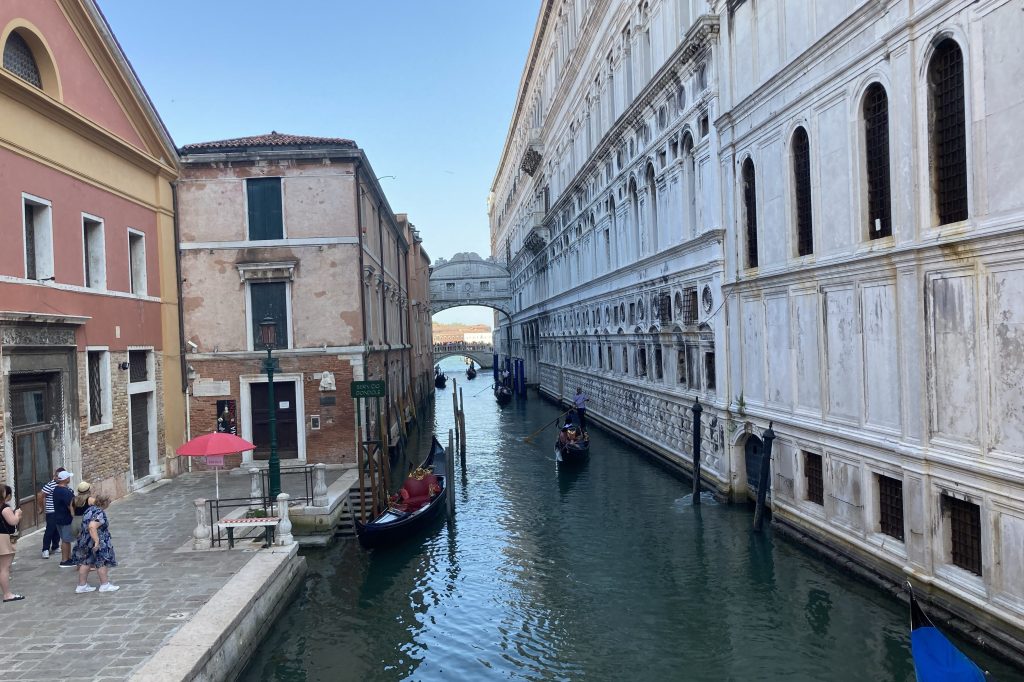
Canals aren’t necessarily art themselves, but in reality they are the parts of Venice that weren’t forced to become solid ground. They are, in a sense, the absence of development. But they are also the main thoroughfares that are the lifeblood of Venice. They are the roads that deliver the goods that feed the city as well as transport citizens and tourists alike around the city.

The canals, themselves, are semi-manmade. Obviously, since Venice was built in a marsh, the water was there naturally. But the wooden pilings that were placed in the marsh to create the solid ground on which Venice’s buildings were built determine the edge of that water. Also, there is a significant amount of maintenance on the canals that maintain the depth of those canals.

The canals are quintessentially Venice and are usually the first things that people think of when they picture the city. They are more a result of public works, much as any street in the world is, but there is just something uniquely beautiful about these canals. I believe that beauty is a result of how well the canals fit in with their surroundings.

Centuries of Artisans create a Single Masterpiece

In the end, what Venice has become is the result of centuries of hard work by thousands upon thousands of hard working Venetian citizens. Great cities take time to evolve. Venice was a city built in the marsh because of the need for security of its citizens. It developed slowly but steadily into a trading empire and it’s citizens became wealthy. As the city developed, they continued to make improvement after improvement, whether it be public works projects like bridges and canals, architectural and building projects, or artisan projects like statues, doors and ironwork.

In the end what is left is a single masterpiece that people from around the world visit and admire. It is one of the world’s great cities and should be experienced at least once in a lifetime.

Window boxes on Juliet balconies are common.