Year End Review 2022

2022 was the year that we got into travel hacking. It was out of a bit of desperation that we started looking into it as a way to reduce the expense of a trip I promised to take Emma on when she graduated from high school. The power of travel credit cards turned out to be much greater that I had anticipated when I started and now it’s become a way of life for us. We love to travel and if we spend less on each trip, then we can do it more often.

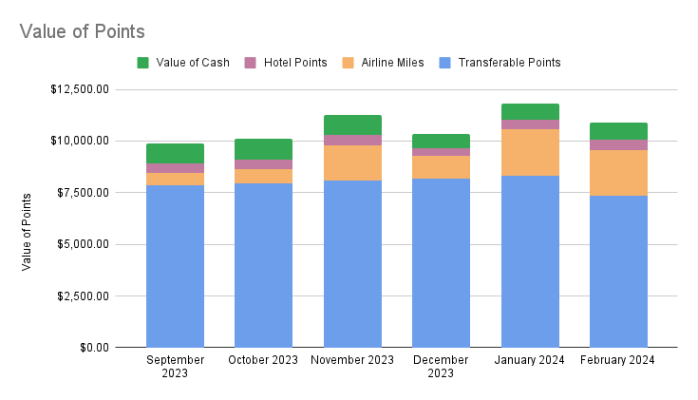
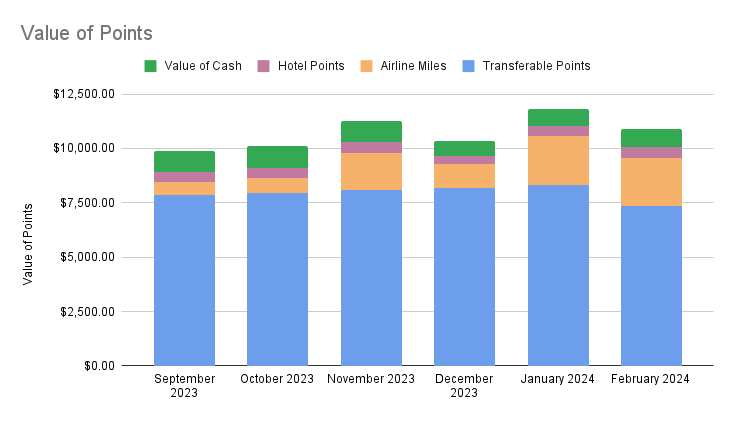
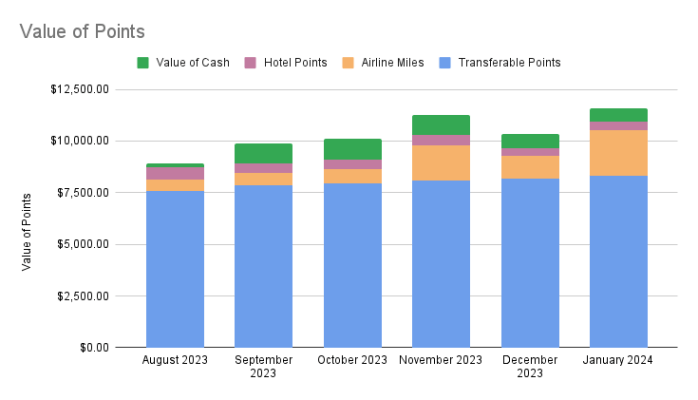
We didn’t take any trips using points and miles in 2022, it was mostly just a year of accumulating points and then booking the flights and hotels that we would be using in 2023. As you can see in the chart below, most of year was accumulating points and the dips were when we redeemed those points and miles for hotels or flights.

SignUp Bonuses – The Main Fuel of Travel Hacking

Nothing manages to pile up more points in this hobby than signup bonuses. It’s the fuel that makes travel hacking work. It’s also, essentially gambling with the credit card companies. The credit card companies are gambling that they can get you to sign up for their card, and you will begin to pay them interest and you are gambling that you won’t. It’s really a gamble on your self-control. They want you to pay them exorbitant interest rates and you want their points and miles. It’s very important that you have self-control because you need to win this gamble every time otherwise you won’t be saving any money with points and miles, you’ll be paying ridiculous amounts of fees and interest to the credit card companies.

Now this is going to sound ridiculous, but it’s really not – We signed up for 8 credit cards in 2022. Each of them had minimum spend requirements to reach the bonus. They were:

  • Citi Premier Card (Me)- $4,000 spend in 3 months, 80,000 Citi Thank You Points
  • United Explorer Card (Me) – $3,000 spend in 3 months, 60,000 United Miles
  • United Explorer Card (Jenn) – $3,000 spend in 3 months, 60,000 United Miles
  • United Explorer Business (Jenn’s Business) – $5,000 spend in 3 months, 75,000 United Miles
  • Marriott Bonvoy Boundless (Jenn) – $5,000 spend in 3 months, 5 – 50,000 point free night certificates
  • Marriott Bonvoy Boundless (Me) – $1,000 spend in 3 months, 3 – 35,000 point free night certificates
  • World of Hyatt (Me) – $3,000 spend in 3 months, 30,000 World of Hyatt points
  • Ink Unlimited (Jenn’s Business) – $7,500 spend in 3 months, 90,000 Chase Ultimate Reward Points (earned in 2023)

So we earned 7 signup bonuses in 2022, and that accounted for 660,000 of the 839,000 points and miles we earned for the year. There were also a total of 70,000 points and miles we earned from referral bonuses to each other. So 87% of the points and miles we earned in 2022 were because of signup bonuses in one way or another. That’s why they are important.

Complete Chart of Spending for the Year

As you can see from the above chart, we spent over $62,000 in 2022 on credit cards, which just seems ridiculous, but we charge everything we can, which is pretty much anything besides house and car payments. Virtually everything is payable by credit card now including all utilities, streaming services, cell phone plans and insurance, in addition to the normal things like gas, groceries, dining and shopping. And when you total everything up and realize that you are getting almost a 15% return on all spending, it’s really hard not to want to process all payments through a credit card.

What did these points buy?

Credit CardPts EarnedPts UsedTPG Value of Used PtsAct Value of Used PtsExp Pt Value (Act Pt Value)
Citi Thank You Points110,48690,000$1,530$1,4401.7 cpp (1.6 cpp)
United Miles257,620221,600$2,881$5,1101.3 cpp (2.3 cpp)
Marriott Bonvoy417,961369,000$2,952$1,680.8 cpp (.45 cpp)
World of Hyatt42,37841,000$697$7631.7 cpp (1.9 cpp)
Totals839,008721,600$8,060$8,9931.1 cpp (1.2 cpp)
TPG means “The Points Guy” and the values in that column is based on published valuations on the Points Guy website. “CPP” stands for cents per point.

So obviously, just collecting points does you no good. You have to spend those points wisely if you want to make the most of the spending that you have. In 2022, we had a very specific goal in mind and we burned our points as fast as we earned them. We were planning and booking a trip to Europe for the summer of 2023. It had been a promise that we made to Emma a few years back that we would let her pick a trip when she graduated and that bill was coming due. It’s primarily how I got into this hobby, because I was staring at a more that $10,000 upcoming bill I didn’t really want to pay. Jenn and I also celebrated our 25th Anniversary on a trip to Cabo San Lucas so all of that was booked using these points. Here’s what we redeemed points on:

  • 2 Round Trip tickets from Chicago to San Jose del Cabo – 40,000 Citi points (transferred to Turkish to book United) – saved around $800
  • 2 Nights at All-Inclusive Hyatt Ziva Los Cabos – 43,000 Hyatt Points (had to buy 2,000 points) – saved $763
  • 4 One-way tickets to Zurich on United – 132,000 miles – saved around $2,300
  • 4 One-way tickets from Rome to Stockholm – 50,000 Citi points (transferred to Avianca LifeMiles to book SAS) – saved around $630.
  • 4 One-way tickets from Stockholm to Chicago – 89,600 United miles, saved around $2,800
  • 2 Nights in Zurich Marriott, 2 – 50,000 point Marriott Certificates used, saved around $900
  • 3 Nights, 2 Rooms in AC Stockholm Hotel near Stockholm, 3 – 50,000 point certificates and 3 – 35,000 point certificates used, $780 saved

All in all, the total saved on those two trips by using points was a little less than $9,000 which was a little better than the slightly more than $8,000 that those points were “worth”. Obviously the “savings” is debatable because there are so many ways to book, that it is nearly impossible to say that flight would have cost this or that hotel would have cost that. I’m doing my best to be honest with these numbers, but they aren’t exactly gospel.

Booking with Points Changes Travel Style

When you begin to book vacations with points instead of money, your travel style changes a little. Had we booked the trip to Europe with money I think our vacation would have been considerably different than what it ended up being.

One Way is OK

The thing that I think changes the most when you are traveling on points is that one way flights are perfectly fine when paying with points. I find it completely inexplicable that airlines charge almost the same amount for a one-way flight as they do for a round trip flight. It’s bonkers. I just looked at a February flight to Zurich on United and round trip they were charging a little less than $1,100 but one-way it was over $950.

Award flights, however, aren’t like that, they are priced individually. What this means is that there isn’t an incentive to fly back from the place you arrived, and that changes your travel itinerary. Our plan, before we got into points and miles, was that we would fly into Munich, stay for a little more than a week and fly home.

However, once we were into points and miles, there was no incentive to fly home from where we started, we simply looked for a place to arrive, a place to leave from and then connected the dots. What we ended up with was a trip that started in Zurich, then went to Munich, Venice, Rome and Stockholm before coming home. That is a much more interesting travel itinerary then just Munich and back.

Hotel Stays are a Little Different

For the most part, hotel stays for me are hotel stays. I’m not someone who needs a first class experience when I’m staying in a hotel, I just need a comfortable bed, a TV and a clean shower. I would like a decent coffee maker in the room, but that’s asking way too much of hotel chains. However, when you sign up for hotel co-branded credit cards, they like to give you free night certificates instead of points. This usually creates a situation where you try to maximize the redemption of the certificate by getting the highest priced hotel room that the certificate allows for instead of just getting the hotel room that works best for you.

We didn’t really like to play this game, and ended up using 6 certificates in Stockholm (2 rooms, 3 nights) at way less then their value simply because it was a nice hotel and they offered breakfast. We actually could have booked more expensive rooms closer to the city center because our certificates would have covered it, but Jenn loves a free breakfast. This hotel just worked better for us and on paper, it looks like a bad redemption, but it was what we wanted and what we needed.

Points just don’t feel Like Cash

When you are paying with cash, you have a tendency to horde it as much as possible. The reason is simple, the money you would spend on this vacation could be used on remodeling the house, getting a new dishwasher, buying clothes, etc. When you are paying with airline miles and hotel points, it’s pretty easy to go the extra mile knowing that’s what the points are for. It’s a lot easier to plan on a more expensive experience if you know that those miles and points can’t be used for something more practical.

5/24 and the Importance of Owning a Business

If you look at the list of 8 cards that we applied for in 2022, you will notice that 4 of them were mine, 2 were Jenn’s and 2 were for Jenn’s business. We are blessed to have a business that we can open up credit cards under, and that is because there are business credit cards and there are personal credit cards and if you don’t have a business, you don’t have access to business credit cards. Some of those cards are really good. The last card Jenn signed up for the year was Chase Ink Unlimited card which had a bonus of 90,000 ultimate reward points for $7,500 in spending in 3 months and it’s a $0 annual fee. That is a great deal, and if you don’t have a business, you are shut out.

As many people will tell you though, you can call just about any side hustle a business, even if you don’t make money. I now have a business and I have no revenue, although I plan to eventually, which makes me eligible for business cards. I just set up a checking account through my bank and picked a business name, and now I can get business credit cards. It doesn’t seem to matter that I probably won’t be earning any revenue for a while.

The other reason why business cards are important is that they don’t count against your personal 5/24 score (some do but most don’t). Chase has a rule that they don’t accept applications for new credit cards if you have opened at least 5 new personal credit card accounts in a 24 month period. This only really matters if you want Chase credit cards (and probably Capital One cards), so if you don’t care, then you are free to ignore this statistic. However, after one year, my 5/24 count is 4, and Jenn’s is 2 because she had 2 business cards and even though she had opened 4 accounts only 2 counted against her 5/24 number.

Looking Forward to 2023

2023, for us, is about finally being able to take advantage of all of these rewards that we accumulated in 2022. It’s when the fun stuff begins. Jenn and I have a trip to Mexico and we have our family trip to Europe coming in 2023. I am also looking forward to taking the knowledge that I gained in 2022 and really leveraging what I’ve learned into more points and miles and more great trips in the future. Travel hacking has really changed the way we do trips and I can’t wait to see what the future has in store.

Points Check December 2023

That’s a wrap for 2023 and it was a great year for us. We went on our first international trip as a family and primarily used points and miles that we earned in 2022 to book those trips. Jenn and I were able to celebrate our 25th wedding anniversary in Cabo San Lucas, and the whole family took a pretty epic trip to Europe where we visited Zurich, Munich, Venice, Rome and Stockholm over two weeks. The cost savings from using those points and miles made those great trips possible for us.

We also booked a couple of trips for next year using points primarily earned in 2023. Jenn will be going on a girls trip to Playa Del Carmen with her mom and her sister. We have also booked a spring break trip with the kids to Costa Rica. I’m also looking into a couple of other trips for 2024, so I imagine we will be pretty busy.

Besides that, our points and miles balances grew dramatically in 2023, which should allow us a better flexibility when booking future trips.

Those AAdvantage Miles Were Gone Before We Knew it

We’ve obviously continued to earn miles on signup bonuses and December was no different. This month, Jenn earned a 75,000 point bonus on her AAdvantage Aviator Red card. This might be the easiest bonus in the points and miles world since she earned 60,000 AAdvantage miles simply by making one purchase and another 15,000 miles by naming our son as an authorized user and making a purchase on the authorized user card (I don’t get why Barclays does this, but it’s practically a free 75,000 AAdvantage mile bonus for next to no spend)

Those AAdvantage miles didn’t sit in her account very long though because we immediately used them to book those flights to Costa Rica. We were able to get 4 roundtrip tickets to Guanacaste from Moline on American Airlines for only 120,000 AAdvantage Miles and $336 which I thought was a pretty good deal. Both there and back we have an overnight layover, so we used 17,500 Marriott Bonvoy points for a hotel in Chicago on the way there and a Category 1-4 Hyatt certificate for a hotel stay at Dallas Fort Worth Airport on the way back.

Product Changing an Old Unused Citi Card

I product changed an old Citi Thank You Preferred card that I never used for a Citi Custom Cash. I couldn’t cancel the old card because it was my oldest credit card and canceling it would’ve negatively affected my credit score. The best bonus category was 2x on dining and I already have a Citi Premier that gets 3x on dining so it never got used. By switching to the Custom Cash card, I can earn 5x on by biggest spending category each month up to $500 in spending. I just need to remember to use it for just one category each month, and I failed on that for the first month. The product change process was extremely simple, I just called up Citibank and told them what I wanted. They switched it in just a matter of minutes and the cards arrived in about a week.

On to the Point check!

Our spending in December was pretty high, mainly because of Christmas, but there was also a tuition payment thrown in there. But the main amount of spending towards a bonus was on Jenn’s Citibusiness AAdvantage Platinum card, where she spent a little less than $3,500 and earned a little more than 3,600 AAdvantage miles.

Card UsedSpendPoints EarnedPoint ValuePoints Per $Return on Spend
Citi AAdvantage$1,1561,325$19.881.11.7%
Chase Ink Cash$5182,570$52.695.010.2%
World of Hyatt$3521,759$29.905.08.5%
United Business$351351$5.091.01.45%
Citi Custom Cash$305869$15.642.85.3%
Citi Premier$291694$12.492.44.3%
Wyndham Business Earner$113903$1.611.01.5%
Total$3,0998,540$147.032.84.7%

I’m still trying to dial in our non-bonus spending in the chart above, but made a couple of mistakes. First mistake was continuing to spend on my Citi AAdvantage Business Platinum Card after earning my bonus on it, since it’s a bad earning card. The second mistake was not just choosing a category for my Custom Cash card and sticking with it. The United Business card looks like a poor choice, but Jenn was getting cash back on groceries on that card, so it’s fine. Either way we finished with a return of about 4.7% on spending, and I would like that number to be consistently over 5%.

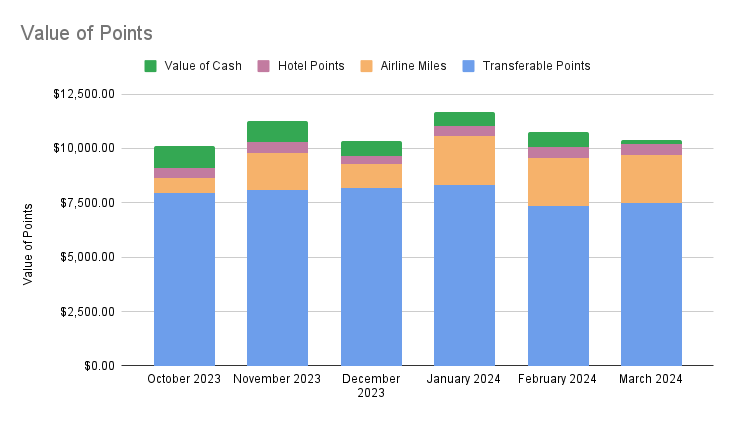
So with the Costa Rica redemption, the bonus and other earnings, we finished the month with 291,600 Chase Ultimate Reward Points, 88,400 Capital One miles, 35,900 AAdvantage miles, 31,600 Citi Thank You points, 30,900 Marriott Bonvoy points, 24,900 United miles, 15,100 Delta Skymiles, 5,500 Hyatt points, and $646 in cash back. Using the Points Guy valuations, we finished the month with $10,300 in points and miles, not too bad.

Wells Fargo Autograph Journey Could Launch Points Arms Race

Travel hackers have for years directed their efforts around four main banks – Citibank, Chase, Capital One, and American Express. You might throw Barclays in there as an honorable mention. Also in 2021, the Bilt Mastercard was launched which allowed renters to earn points by paying their rent with Mastercard. Aside from that, there are “travel cards” that are offered by US Bank, Bank of America, and Wells Fargo.

The Sweet Spot for Travel Hackers

Credit cards that offer signup bonuses as well as transfer partners are the sweet spot in travel hacking. The Bilt Mastercard has great transfer partners but they don’t really offer much in the way of signup bonuses. The travel cards from US Bank, Bank of America, and Wells Fargo offer signup bonuses, but they essentially are cash back cards that you can redeem using their travel portals. But Citibank, Capital One, Chase and American Express were the only banks to offer signup bonuses as well as the option to transfer those points to a variety of hotel and airline programs. Until now? Maybe?

Rumors About Wells Fargo

Wells Fargo launched the Autograph Card in June of 2022, which came with a 30,000 point ($300) bonus and offered a nice variety of 3x categories. It was a strong offering by Wells Fargo for a no annual fee card, but it was essentially a cash back card because they didn’t offer any transfer partners. However, as 2024 approaches, Wells Fargo is teasing a couple of things. They are teasing that transfer partners will be available soon and that a new card called Autograph Journey is coming.

Why are Transfer Partners Important?

Transfer partners are important because they often offer a significant discount over the price you can get through a travel portal. Here’s an example from a flight I’m currently researching for my own travel plans. Using the Chase Travel Portal, a flight from Chicago to Rome runs 95,608 Chase Ultimate Reward points.

However, the same flight costs 40,000 miles and $215.90 if you transfer those same Chase Ultimate Reward points to Flying Blue and book there.

Even if you chose to pay for the $215.90 fees with Ultimate Reward points by cashing out at 1 cent per point that would only cost 61,590 points instead of 95,608. That’s a significant savings simply by transferring the points and purchasing there. The other benefit is that I would always rather book a hotel or an airline ticket using that program’s own currency and website. It will most likely be easier to deal with a cancellation or a problem if you are dealing directly with the hotel or airline instead of trying to get a travel portal to resolve it with the hotel or airline.

What could the Wells Fargo Transferable currency look like?

As Summer Hull and Nick Ewen from the Points Guy confirmed, Wells Fargo intends to give points transfer options for their Autograph card as well as a new product called Autograph Journey. This could end up being anything from pathetic to amazing, but it really all hinges on who they land as transfer partners and how good the transfer rates are.

The Pathetic Option

If Wells Fargo only lands a few transfer partners or they land fairly weak transfer partners like Choice Hotels, EVA Air or Royal Orchid it’s only going to make the points mildly interesting. Also, if those points transfer at rates lower than they would from Citi, Chase, Amex, or Capital One, then Wells Fargo points won’t be as valuable as points from those other banks. This won’t move the needle for most consumers, and probably won’t create any real buzz for their products.

The Middle of the Road Option

If they put together a set of transfer partners like Capital One or Citibank along with decent transfer ratios, then you will essentially have a pretty good list of transfer partners that provide good value for their customers. This would put Wells Fargo’s consumer cards immediately on par with consumer cards from Capital One and Citibank.

The Amazing Option

The best set of transfer partners, in my opinion, is the one put together by Bilt. One huge reason is that they have Hyatt as a 1:1 transfer partner which is by far the most valuable hotel currency from a major hotel chain. The second reason is that they are the only transfer partner for American Airlines. Prior to Bilt landing that partnership, there were no transfer partners for AAdvantage miles. Considering how big American Airlines is, that makes Bilt points very interesting to people who live near places that American flies.

I mention Bilt for one reason – you can apply for the Bilt Mastercard on Wells Fargo’s website. I don’t know how tight the relationship is with Bilt, but if they are able to use the exact same transfer partner roster that Bilt has, then this will be an absolute home run. I can’t imagine many people who know a lot about points and miles who wouldn’t sign up for a Wells Fargo travel card immediately after it launched.

What This Could Mean For US Bank and Bank of America

If Wells Fargo is able to make a big enough splash with this release, that is going to put a lot of pressure on US Bank and Bank of America. Nobody likes losing market share and I can’t imagine that they wouldn’t notice if their customers begin to choose Wells Fargo over them. I would expect those banks to counter with their own transfer partners.

Both US Bank and Bank of America are well positioned to be able to take that next step. US Bank offers the Altitude Connect card and the Altitude Reserve card. Both currently offer 50,000 point bonuses and have some strong bonus categories. Bank of America has both a travel rewards and a premium rewards card with 25,000 and 60,000 point offers respectively. Bank of America also offers cobranded airline cards with Alaska, Allegiant, Spirit and Air France/KLM Flying Blue.

Both of these banks offer good travel cards and could fairly easily insert themselves into a travel rewards arms race. The only thing that is stopping either of these banks is making the necessary agreements with these airline and hotel programs and adding the necessary changes to their software and website. I would imagine those changes could take at least a year to implement.

Benefits for the Consumer

Anytime competition creeps into a space like this, then the customer will benefit. If suddenly there are 7 banks that offer signup bonuses and points that are transferable instead of 4, these banks will be competing for business. I would imagine that elevated signup bonuses could be the end result of this and that would be a nice benefit for travel hackers.

The other nice result would be the ability to choose between which package of transfer partners that you like. For example, if you live near an airport that is serviced by Delta, you might want to pick an American Express card because Amex Membership Rewards points transfer to Delta. If you have a favorite hotel chain, you might pick your travel rewards card by who transfers to that hotel’s points program. Maybe you can find one card that transfers to both your favorite airline and favorite hotel program. Having 7 menus of transfer partners would be very good for the consumer.

I’ll be keeping my eye on what Wells Fargo does here. If they release Autograph Journey with a signup bonus of at least 60,000 points and a similar menu of transfer partners to Bilt and if they have an annual fee under $100, then I’ll definitely be applying for a card. If they offer it with similar 3x categories that the Autograph card has, then it might quickly become my favorite credit card.

Wells Fargo may have just started the new points arms race, and I’m here for it.

State Department shows Dramatic Improvement in Passport Processing

In June, I wrote a post about how bad the situation had become at the State Department and their ability to process passports. My kids both needed passports for our trip to Europe and it was a frustrating experience.

When we sent in the applications, the processing times were 8 to 11 weeks and by the time the applications arrived at the State Department, it had unexpectedly grown to 10 to 13 weeks. We needed the passports within 15 weeks, which should have been enough time, but we cut it too close and I got very nervous and probably overreacted (I most certainly overreacted). Unfortunately, getting information out of the State Department is pretty much impossible and changing anything after the application is submitted literally requires help from the office of your Congressperson or Senator.

The problem that I had the last time basically revolved around one thing – it’s pretty much impossible to speed up the process once you’ve decided which level of service you are paying for. Because the expected processing times grew by 2 weeks while the applications were in the mail, it cut out all of extra time that we left. Unfortunately, I wasn’t able to switch to expedited service. The inability to change to expedited service led to the frustrating story that I had in the previous post. None of this would have been a problem if we had left them plenty of time to process the application, however.

This time my passport was expiring and I applied for it with about 16 weeks to spare. This time the State Department was showing a 7 to 10 week processing time for normal processing. I checked in a couple of times out of curiosity but I wasn’t at all worried about it.

To my absolute astonishment, they returned it to me within 3 weeks! That’s completely unexpected considering what happened last time and it appears to be an indication that the State Department hasn’t just caught up on the record numbers of passport applications that they were receiving early in the year, but they are now processing these applications at lightning speed.
Obviously, this could just be an outlier, but the fact that they dropped their expected waits to 7 to 10 weeks as well as my super quick process time indicates that the State Department is over the hump and they and people should expect better service going forward. It looks like the post-Covid passport surge is over and that’s great news for travelers!
You can find the latest expected wait times for the passport processing on the State Department website. You can also check your passport application status by going to this site.

We Booked A Trip to Costa Rica on American Airlines Miles

Booking our spring break trip this year was a different for us. This was essentially the first time that we’ve had an opportunity to book a family trip with both the experience of doing so, and the points to be flexible. When we booked our trip to Europe last summer, we didn’t have a bunch of points in various programs, and we basically had to book what we needed with the available points, and for us that meant that we had to work around United Airlines since that was where we had points.

This time it was much different, since we had significant amounts of points in Chase Ultimate Rewards and a decent amount of Capital One Venture miles. Ultimate Rewards transfers to 11 different airline programs and Capital One Venture miles transfer to 15 different airline programs (many of them overlap with Ultimate Rewards). On top of that, we also had a couple of American Airlines cards that we were working toward signup bonuses on, with no plans to use those AAdvantage miles.

What this meant was that we had a lot of different choices of ways to book flights. But we needed a destination. I was looking pretty hard at Madrid, Europe is off-peak in March and a flight from Chicago to Madrid is 34,000 Avios (transferable from Chase Ultimate Rewards) round trip and around $225 in taxes and fuel surcharges, through Iberia. That seemed like a steal to me, but there is that pesky problem of jetlag and Jenn wasn’t too thrilled about having to pay $900 for four flights (I know it honestly sounds silly, but this is apparently who we are now).

I wasn’t too excited about staying in the US, because in March you basically have Florida if you want to be warm, and that’s so overrun by drunken college students it’s hard to really enjoy it. A lot of the other places we thought about like Cancun, Punta Cana, Aruba, etc seemed to be both not really what we wanted and probably would’ve also been full of drunken college students. We wanted something different.

What About Costa Rica?

Jenn and I were having a beer at our favorite taphouse talking about spring break and I said “What about Costa Rica?” She looked at me a little strange, and said “Why Costa Rica, what’s there?” I replied “beaches, mountains, jungles, great food, it’s pretty much a tropical paradise.” Within a few minutes she was on Airbnb and somehow managed to find an absolutely gorgeous 3 bedroom Airbnb in the middle of a coffee growing region near San Jose for just $75 per night. Since Airbnb allows free cancellations, she booked it right there.

I think Jenn picked a good Airbnb
This kitchen is nicer than what we have at home
You don’t get this view in Iowa.

Now that the rental was booked it was up to me to make the airfare work.

Beating my Head Against a Wall

The Airbnb Jenn booked was only a 40 minute Uber from San Jose Airport, so that’s fantastic. I started to look at flights coming to and from San Jose from our home airport in Moline, and it was pretty clear right away that we were going to want to fly American Airlines if we wanted to leave out of Moline. They were running a special that cost around 8,000 points to San Jose and about 20,000 points coming back, and I thought, that’s pretty good, I just need to wait until we earn our signup bonuses and the points show up in our accounts.

The problem was, Jenn got her bonus from a Barclay’s card and they very specifically mention that they could take 4-6 weeks for the bonus to hit her account. I knew what I wanted but the clock was ticking and availability is never guaranteed.

When they finally hit her account the miles for those flights had increased to 11,500 miles out, and 32,000 miles back and we didn’t have enough points in our accounts for the more than 160,000 miles needed. I started shopping around and found a flight itinerary that would cost 17,500 miles through Avianca Lifemiles for the way home and keep the 11,500 mile AA flight down to San Jose.

What The Hell Am I doing?

I set Jenn up with a Lifemiles account with the intention of moving 70,000 Capital One Venture miles to Lifemiles to book the flight. The flights would have to be out of Peoria (an hour and a half drive away), since that’s where the Lifemiles flight itinerary took us.

I almost pulled the trigger and then I looked at the itinerary once again. On the way out, Moline to Charlotte to Miami, with a 7 hour overnight stay in the Miami airport before taking off to San Jose. I wasn’t thrilled about sleeping in the airport, that’s not ideal. Then on the way back, we would leave San Jose in the afternoon, stop in Guatemala for an hour then fly to Washington Dulles airport, land at 1 AM, go through customs, catch an uber to Reagan National Airport, go back through security (probably at 3 AM) and wait for a 6 AM flight to Chicago and then another flight back to Peoria, where we would have to drive an hour and a half home.

There is no way that I don’t fall asleep at the wheel coming home after that mess of a flight itinerary. That doesn’t even take into account the number of things that would have to go right just to make sure that we made it back to Peoria. It was time to call an audible, this isn’t going to work.

Let’s Try Guanacaste Airport

When I started looking at LIR airport in the north of Costa Rica, it became so much easier. The flights were more direct, less stops and prices were good. Jenn and I looked through a few choices and while we could get a slightly cheaper flight, we could find good prices for flights with just 1 stop each, and given the fact that there could be snow in March, fewer stops mean a better chance of actually getting to our destination. Each flight had long layovers, but they were long enough to get hotels so they looked great.

The outbound flight is Moline to Chicago to Guanacaste with a 17 hour overnight layover in Chicago and the return flight is Guanacaste to Dallas to Moline with a 18 hour layover in Dallas. We will be able to sleep well, staying in hotels for each and we should be able to be rested and relaxed rather than stressed and tired. Much better, but unfortunately we now have a 3 hour drive from Guanacaste airport to the Airbnb as opposed to a 40 minute drive from San Jose Airport. Oh well, we were going to rent a car anyway.

The flights cost us 120,000 AAdvantage miles and $336.24 in taxes. The cash price total for the same exact flights would have cost us $2,888.48 which means that we saved around $2,550. That means that those miles were redeemed at 2.1 cents per point which is well above the normal 1.5 cents per point for AAdvantage Miles, so I’m happy with the value we got from the points.

Land in Costa Rica as Early as Possible

Here is a little side note that I’ve learned from my research – if you are going to fly to the Guanacaste Airport, you probably want to land early if possible. At first, I was a little annoyed that I couldn’t get to Costa Rica with a 1 day flight itinerary but the more I read I’m okay with it. The reason is that Guanacaste Airport is a regional airport and while it is the best airport to go to for a variety of places in the north of Costa Rica, it’s not really close to anything.

So, what’s the big deal, right? I can drive at night. Yeah, but you probably shouldn’t. It is generally not recommended to drive in Costa Rica at night. The reason for this is that the roads are rural, curvy, unlit, and not always in great shape. It’s never a great idea to drive in an unfamiliar country at night, but with Costa Rica being so rural, it’s really not recommended. Add in the possibility of mountainous terrain with no guardrails and it could get deadly. It’s especially not recommended in the rainy season, where it can get even more treacherous.

It is also of note that it gets dark early in Costa Rica. Since it’s fairly close to the equator, the times don’t change too much from season to season but basically you can expect sunrise to be around 5:30 AM and sunset to be around 5:30 PM. That means that we will be probably cutting it a little close with the 12:30 landing and a 3 hour drive (once you figure in customs, car rental counter and probably some lunch).

Booking the Hotels

Since both the flight to Costa Rica and the flight back have overnight layovers, we needed to book a couple of hotels. We’re not that picky about where we stay, but I definitely like things to be easy and Jenn likes free breakfast if available. On the way there, in Chicago Jenn booked the Springhill Suites because it had a free airport shuttle and free breakfast, for 17,500 Marriott Bonvoy points. It would have cost $129 with cash so it comes out to .7 cents per point which is less than the .8 cents per point that Bonvoy points are typically valued at.

I booked the Hyatt Regency DFW for one reason only. It was actually at the airport. We don’t even need a shuttle, just walk from the terminal to the hotel and vice versa. We burned my 1-4 category Hyatt certificate on it and it’s only a category 2 hotel, so I definitely could have done better. It would have cost $218 for that night, so I think the fact that I get that certificate by paying a $95 annual fee for the World of Hyatt credit card makes it decent.

How Do I Feel About the Bookings

I feel pretty good about these bookings. I tend not to worry too much about maximizing hotel certificates, because I’m really not a hotel snob. I’m not sure I could tell the difference between a category 2 and a category 5 Hyatt. Jenn used a few more of her Marriott points to book another night, it almost seems like she always has Bonvoy points when we need them.

I’m pretty happy about the flight booking. We get to leave from our small home airport and still only have one stop. The stops are all long enough to relax at a hotel instead of being uncomfortable at the airport. On top of that, we got good value for our American Airline miles. I had been slow to look at American Airlines because they don’t have any transfer partners except Bilt, but I’m going to have to work a little harder to keep some AAdvantage miles around because that was a good deal.

It always feels great to get a trip booked, because now I can concentrate on what we are going to do when we are there, where we are going to eat and what we want to explore. I have read that Costa Rica is not a place to “wing it” since destinations are typically far away and roads can be unpredictable. That’s okay with me though, I like planning out the fun stuff.

Points Check November 2023

Back to an All Time High

We finally passed our previous all-time high point total of around $10,600 in value. This came primarily from earning a sign up bonus from my Citibusiness AAdvantage Platinum Select card. It offered a 65,000 point bonus for spending $4,000 in the first 3 months and I met the required spend this month. Jenn actually did the required spending on her Barclays American Airlines Aviator Red card which will earn her a 75,000 point bonus as soon as Barclays processes it. We’re actually waiting on that because we plan to book airline tickets to Costa Rica for spring break and the little delay from Barclays is annoying.

A Second Citibusiness AAdvantage Platinum Select Card

Jenn applied for the exact same card I just completed the minimum spend on – the Citibusiness AAdvantage Platinum Select card. She, however, got a better signup bonus than I did. She will receive a 75,000 AAdvantage mile bonus when she spends $6,000 in the first 6 months of having the card.

As I pointed out in the post when I applied for the card, it has a $99 annual fee which is waived for the first year. Miles earning on this card is pretty weak, in that it is 1x on most purchases, and 2x on American Airlines purchases, gas, telecommunications merchants, car rental services and cable and satellite providers. It does provide a free checked bag and priority boarding.

There is a $99 domestic companion certificate that you can earn when you spend $30,000 on the card, but seriously don’t do that. There has to be better ways of getting a cheap companion flight than that, with the only exception of maybe if you spend $30,000 on American Airlines flights.

Getting Bailed out of a Mistake

We had a hotel stay booked with Marriott that Jenn didn’t realize she booked with a non-refundable rate. When you use the Bonvoy app to book a room, there are multiple tabs for you to choose from. The prepaid option is non-refundable, and while they do have that written on there, it’s not exactly jumping out at you.

Jenn had been so used to booking things on points (which are almost always refundable, especially well in advance), that it didn’t really occur to her that the room was non-refundable. She canceled the room almost a month in advance, and after a while I asked her why they hadn’t refunded the money. She called the hotel, only to find out the room was non-refundable, but she was persistent and asked to talk to a manager, who was unavailable, of course. She called back the next day and tried again, with no luck and finally we kind of accepted the fact that there would be no refund. However, once the date for the hotel stay passed, the room was refunded to us. They never called back to let us know, they just refunded it. I guess this just goes to show that sometimes it never hurts to ask. Also, kudos to Marriott and the hotel itself, they absolutely were under no obligation to do so. That being said, it was smart of them because they will probably get more of our business now, because they were gracious in helping us fix our mistake. In the future, we will make sure to not use the non-refundable option.

Anyway, On to the Point Check

Card UsedSpendPoints EarnedPoint ValuePoints Per $Return on Spend
Citi Premier$1,4452,280$41.041.62.8%
Capital One Venture$1,0772,154$39.852.03.7%
Chase Ink Cash$5182,570$52.695.010.2%
World of Hyatt$4292,144$36.455.08.5%
Chase Ink Unlimited$395592$12.141.53.1%
Wyndham Business Earner$254729$14.942.93.2%
Delta Business Gold$107107$1.611.01.5%
Total$4,22510,576$197.102.54.7%

This month was a little disappointing in that the return on spend on our other cards dipped under 5% and I’m really trying to keep that up above the 5% mark. One of the big reasons for that, however, was the fact that my daughter’s car had about $800 of repair costs, and while that can be charged, there isn’t exactly a bonus category for it. We probably should have used the Capital One Venture card, since it is 2x everywhere, but Emma is an authorized user on the Citi Premier card and that’s what she used, for a disappointing 1x instead. Oh well. We were able to get 5x on Amazon through a World of Hyatt promo, which is nice but somehow I misunderstood the Wyndham Business Earner categories and moved our insurance there, thinking I would get 5x and it absolutely wasn’t, just a lowsy 1x on that.

Jenn got an electric car as well, which has cut our fuel consumption by about 75%. That is awesome, but I’m missing the massive amounts of Wyndham points we earned at 8x on gas.

Aside from the spending not devoted to a bonus, I spent almost $1,800 on my Citibusiness AAdvantage Platinum Select card and earned almost 1,800 AAdvantage miles and the 65,000 point bonus. Jenn spent around $1,000 on her Citibusiness AAdvantage Platinum Select card and earned around 1,000 AAdvantage miles.

All of this left us with a month-end total of 289,000 Chase Ultimate Reward Points, 88,400 Capital One Venture miles, 77,000 American Airlines miles, 48,300 Marriott Bonvoy points, 29,800 Citi Thank You points, 24,600 United Miles, 15,000 Delta miles, 3,700 Hyatt points, and $974 in cash back. If you use valuations by the Points Guy, the total value of all of these points is $11,280.

Simple Ways to Save Thousands on Flights to Europe with Avios

I’m a travel hacker. When I explain how I got a cheap trip somewhere, it sounds like a crazy conspiracy theorist explaining how the lizard people are controlling the world banks. For example, the first flight I booked on points was made with Citi Thank You Points transferred to the Turkish Airlines Miles & Smiles program to book a United Airlines flight. It was complicated, it took some research and it’s probably something that someone with limited time doesn’t want to spend their mental energy on.

Travel Hacking is Complicated, but it Doesn’t Have to Be

If you want to maximize every dollar of personal spending to earn the most points and then maximize the value of those points when you redeem them, it takes effort, lots and lots of effort. When I explain what I’m doing, sometimes I get confused looks, because travel hacking can get really complex. I do it because it interests me, its a hobby, but for many people it sounds like a lot of work.

There is a much simpler way to save significant amounts of money without putting in a ton of effort. What I’m talking about is a one new credit card per year strategy that gives you simplicity but still allows you to take advantage of points and miles.

Why One Card Per Year?

One of the things that has become annoying for us is that because we have opened so many credit cards (to earn signup bonuses) that it means that whenever Jenn reconciles our budget, she has to log into a bunch of accounts to see our spending. I believe we had some spending on 8 different cards last month. That’s a lot to keep track of, especially when you consider different usernames and passwords for each website.

If you can keep it to one card per year, it’s literally just one account, one username and one password. You’ll only get the one signup bonus, but you’ll only have to deal with one account.

Working Backwards

If you are going to use just one card per year, it’s important that you pick the right card and that starts with knowing what you want. This usually means starting with where you are planning to go. The examples that I will be talking about in this post are from the US to Europe, specifically Spain, England and Ireland.

Why those three specific countries? Well, those are the home counties of Aer Lingus, British Airways and Iberia Airlines, three of the airlines that use Avios as their award currency. Concentrating on earning miles from an airline that has a hub where you want to visit is extremely helpful. Also, checking flightconnections.com to see direct routes is a great way to get a sense of airlines that might be useful for you to concentrate on.

In this case, Aer Lingus, British Airways and Iberia Airlines have co-branded cards that are issued by Chase. Each one of those are currently offering elevated bonuses of 125,000 Avios with a fairly large spend of $20,000 in a year. That may seem like a lot, but if it’s just a one card strategy, then it’s not really a lot to spend.

Assumptions for this Example

I’m going to assume for these following examples that we have a family of four that spends $3,500 per month on a credit card. You might be thinking that’s a of credit card spend for a family, but you can charge a lot on credit cards these days. We charge our phone bill, all our utility bills, insurance, groceries, shopping, dining, hell we even charged out taxes last year. If you think credit card first, it’s really not that hard to charge a big amount each month while staying within your existing budget.

Saving Over $4,500 on Flights to Ireland

Let’s assume that your family of four wants to go to Ireland during summer vacation (in 2025 – they need to earn the points before they can spend them).

They start January 1st by getting a shiny new Aer Lingus credit card from Chase with the 125,000 Avios sign up bonus. With this card, they will earn 75,000 bonus Avios after they spend $5,000 in the first 3 months and an additional 50,000 bonus Avios when they spend a total of $20,000 in a year. In addition, they will earn a companion pass when they reach $30,000 in spending on that card in a year. The card has a $95 annual fee.

This card earns 3 points per dollar on flights with Aer Lingus, Iberia Airlines and British Airways. It earns 2 points per dollar on hotels and 1 point per dollar spent on everything else. For this example, we will assume all spending is at 1 point per dollar.

In this case, the example family will spend $42,000 in the year, all on this credit card. They will earn all 125,000 bonus Avios after the $20,000 in spending, the companion certificate when they spend $30,000 and they will also earn 42,000 Avios through normal spending in a full year. That means they will earn a total of a companion certificate and 167,000 Avios.

The family wants to fly to Dublin from Chicago in June and according to the Aer Lingus award chart, that is “in peak.” That means 20,000 Avios each way per ticket and around $285 per round trip ticket for taxes and fuel service charges. The family uses 120,000 Avios, a companion ticket (no taxes or fuel surcharges on the companion certificate) and pays $854.40 for taxes and fees.

How much does that save, though? Well, the exact same flights from Chicago to Dublin in June cost $5,492.24, in economy – not business class, economy class.

If you account for the $95 annual fee, that is a savings of $4,542.84 on a trip for four to Ireland! The only thing that this family did was put all of their spending on the Aer Lingus card and then use their points and companion certificate to book those flights instead of cash. That’s a huge return for a very small amount of effort.

Saving Over $3,000 on Flights to London

The British Airways Visa Signature Card is very similar to the Aer Lingus card. It earns 75,000 bonus Avios earned after $5,000 in spending in the first 3 months, with an additional 50,000 bonus Avios after a total of $20,000 in 12 months. When the cardholder hits $30,000 in spending in 12 months, they will receive a 50% off travel together certificate for two people. I assume that means that two people will get an award flight for the number of Avios for one flight, but will have to pay the taxes and fees on both flights. It has a $95 annual fee.

British Airways also will cover up to $600 in taxes and fees per year, but what that really means is up to to 3 times per year they will pay $100 of the fees on economy flights and $200 of the fees in a business class taxes and fees. In the example we are using, I assume that means that the family of four may deduct $100 off of their taxes and fees for their flights.

With the same earning structure as the Aer Lingus card we can say that the hypothetical family of four will earn the travel together certificate, the 125,000 bonus Avios and 42,000 Avios in normal spending for a total of 167,000 Avios.

When they go to redeem those Avios for flights, a Sunday to Sunday spring break round trip flight for 4 comes up to 200,000 and $1,359 in taxes and fuel surcharges, however because of the travel together certificate, they can take 50% off two of the flights and because of the fee credits from the British Airways credit card, they would actually pay 150,000 Avios and $1,259.00.

The cash price for the same exact flights were $4,755.20. The amount that would be saved is $3,496.20. If you take into account the $95 annual fee for the card, you end up saving a grand total of $3,401.20 for a family of four to visit Big Ben over spring break – not too shabby.

Saving Over $3,500 on a Trip to Madrid

The Chase Iberia Visa Signature card offers the same 75,000 bonus Avios after $5,000 of spending in 3 months and an additional 50,000 bonus Avios after reaching a total of $20,000 in spending in 12 months. There is an additional benefit of a $1,000 discount voucher on two tickets booked on the same flight when you spend a total of $30,000 in a calendar year. This card also comes with a $95 annual fee.

As with the other two cards, it earns 3x on flights on Aer Lingus, British Airways, and Iberia as well as 2x on hotels. All other spending would be 1x and for this example I will assume all spending will be at the 1x level.

With this card, the spending would end up identical as the previous examples with the theoretical family of 4 spending $3,500 per month or a grand total of $42,000 over the course of the year. They would earn the 75,000 bonus Avios, the additional 50,000 bonus Avios and the $1,000 discount voucher. After a year, the cardholder would have 167,000 Avios and a $1,000 discount voucher which is only good for one year after issue.

The example I’m using is for a spring break trip to Madrid, it ended up being Saturday to Monday (because of availability, sorry the kids are going to have to miss an extra day of school). Iberia gives you a variety of ways to pay combinations of points and cash but since we have the 167,000 Avios I would go with the 136,000 Avios and $910.80.

The cash price for the exact same flights was $4,594. If you take into account the $95 annual fee and the $910.80 in taxes and fees you end up with a savings of $3,588.20.

Everyone Likes Leftovers!

In all of the examples above, the example family is left with Avios and/or certificates that they weren’t able to use. In the Aer Lingus example, the family used 120,000 of the 167,000 Avios they had and used their companion certificate. This left them with 47,000 leftover Avios. In the British Airways example, the family used 150,000 of their 167,000 Avios and the companion certificate leaving them with 17,000 leftover Avios. In the Iberia example, they kept the $1,000 discount voucher and used 136,000 of the 167,000 Avios they earned. That left them with a $1,000 discount voucher and 31,000 Avios.

Doing a Second Year?

None of these cards are really compelling to keep more than 1 year, and that’s because they all are basically 1x cards, which in the points and miles world is basically as bad as you can get.

Assuming that you want to continue traveling on points, the thing to do is to cancel this card (before the annual fee is charged) and open a new credit card with a new signup bonus.

If you get any of the other credit cards that earn Avios (you can’t get another signup bonus on the card you already had due the rule that Chase will not give you another bonus within 24 months of earning a bonus on that card), you will be able to earn a new bonus and you can transfer the leftover Avios to your new account (certificates and vouchers are not transferable).

Intermediate Strategies for More Points

The easiest strategy is the one outlined above, however there are a few basic things you could do to amp the point earnings up without overcomplicating things.

Player 1/Player 2

Since we are talking about a family of four, I’m assuming two are adults, although that’s not always the case, since there are lots of single parents out there. If there are two adults then there can be what is referred to as “Player 1/Player 2” in the points and miles world. This is basically where the two adults both have separate credit card accounts but work together to earn miles (this, by the way doesn’t have to be romantic in nature, it could just be someone you like to travel with, maybe a parent, sibling or best friend).

Two Players Open Accounts Near the Same Time

Let’s take the Aer Lingus card example here. Player 1 opens an account and starts the clock on the $5,000 minimum spending in 3 months. Once the account is set up, Player 1 refers Player 2 to the same Aer Lingus card.

In this example, not only does Player 1 get the opportunity to earn the 125,000 bonus Avios but also gets a 10,000 Avios referral bonus for referring Player 2. Player 2 then also has the opportunity to earn up to 125,000 bonus Avios as well, but they will have to decide how they want to split their $42,000 annual spending (from the example at the beginning of the post) on these cards.

Method 1 – split evenly

In this case, both players would barely earn the 125,000 bonus Avios since $20,000 spend is required and each would have around $21,000 in spend. This means they would have to be very careful to make sure they got the bonuses by the end of the year.

However, being diligent would pay off and they would each earn 125,000 bonus Avios for a total of 250,000 Avios as well as Player 1 earning a 10,000 Avios referral bonus. On top of that would be the 42,000 Avios for normal spending. That would equal a grand total of 302,000 Avios and since round trip from Chicago to Dublin during the summer is 40,000 Avios and $285, that’s 7 round trip transatlantic flights for $285 each. Not too shabby.

Method 2 – Go for the Companion Pass

In this example, Player 1 would do at least $30,000 of the $42,000 total spend and Player 2 would do at least $5,000 of the total spend (in the first 3 months to earn the 75,000 Avios bonus).

Player 1 would earn the 125,000 Avios for $20,000 spend, plus the companion ticket as well as a 10,000 Avios referral bonus. Player 2 would only earn a 75,000 Avios bonus. Together, they would also earn 42,000 Avios from normal spending for a grand total of 252,000 Avios and a companion certificate.

Method 3 – Only 1 player, Churn and Burn

Let’s say in this example, you are a single parent or your significant other has less than ideal credit and can’t get approved for cards.

In this case, I would probably sign up for the Aer Lingus card, spend until I got the companion certificate (at $30,000, which at a $3,500 per month spending rate should take about 9 months). Then sign up for the British Airways card and spend the $30,000 on it in 9 months and sign up for the Iberia card.

Each nine months period in this example would earn the cardholder 155,000 Avios and the big bonus that each card offers at $30,000 in spending. Interestingly, the basic rules that Chase has is that you cannot earn a bonus on the same card more than once in a 24 month period, meaning that after you get the last bonus, you should be able to cycle back to the beginning and get the Aer Lingus bonus for a second time.

The Fine Print

This all sounds great, I mean who doesn’t want to save a huge amount of money on a trip to Europe? But there are a few things to keep in mind.

The 125,000 Avios Offer is Probably Temporary

If you are counting on this offer to be around indefinitely, it’s probably not. There almost always are offers on the three Avios cards, but the typical amount is 75,000 Avios when you spend $5,000 in the first 3 months. There have also been extended periods where the offer was a 100,000 Avios bonus after spending $5,000 in 3 months. Keep these previous offers in mind when you time out your applications for Avios cards. The big spend bonuses (ie. the companion certificates are features of the cards, not bonuses, so those should always be available after $30,000 spend in a year).

Those Avios Prices for Flights are not Guaranteed

The examples I included in this post are typical, but not guaranteed. At any time, the airlines can change the cost of those flights, including points needed, without warning. It is fairly common in the points and miles world to have your points devalued and its frustrating if you were counting on them for an important trip, so keep that in mind. Also, there is no guarantee about availability and often you might find yourself flying on less than ideal days, such as a Tuesday instead of a Saturday. If you are going to fly on points you will need to be little flexible.

You Will Need a Decent Credit Score to Get Travel Credit Cards

Travel reward credit cards, especially the ones with big bonuses, typically require higher credit scores to get than other credit cards. From what I’ve read, people seem to think that a 700 credit score is the floor for travel hacking in general, but you can definitely get some co-branded cards with a lower score than that and other cards such the Chase Sapphire Preferred card probably require higher scores than that. If you want to do any travel hacking, you’re probably going to want to keep a good handle on your credit score, and I would recommend Credit Karma for that.

Do Not Carry a Balance on these Cards!

Most cards that give travel rewards have ridiculous interest rates. Typically when I look at mine, they are always between 20%-30%. I honestly don’t care what the interest rate is because I always autopay for the full amount and I never pay that interest rate. If you carry any balance on a travel reward card, you will regret it, because it’s incredibly high.

Do Not Make Player 2 an Authorized User

We made this mistake on the first travel rewards card we applied for. By signing up your player 2 as an authorized user, it shows up as a new credit card account for the authorized user and counts on their Chase 5/24 status. This could, potentially, keep you from getting a new credit card later. That being said, if you are going to always follow a one new card per year strategy, this isn’t really an issue.

Beware of the 5/24 Rule

This is a rule that Chase has implemented to prevent travel hackers from getting too many bonuses from them. The rule is essentially this – Chase will not consider your application for a new credit card if you have opened 5 new credit card accounts in the last 24 months. One of the nice things about the strategy that I wrote about in this post, is that it should comfortably keep you under that 5/24 number.

It matters how you Apply

Depending on what links you click on, the signup bonus amounts may vary. Yes, I realize that sounds stupid, and it is, but depending on what website you start from can make a huge difference between how big your bonus actually is. That being said, Frequent Miler always has the current best offers on their website. You should always start there to check if you’re getting the best deal.

Saving with Simplicity

Having a simpler strategy for earning points and miles will not earn you the greatest possible points, but it will allow you to save significant amounts of money with a lot less effort. It’s not just about saving money, though. A lot of families, mine included, would not take a trip to Europe if the airfare was between $4,000 to $6,000. It’s just too much to spend. By saving thousands of dollars on airfare, it opens up vacations that we wouldn’t have considered before.

Keep in mind, if you could afford to drive to Florida, rent an Airbnb, and eat in restaurants while you’re there, those things are probably about the same price as they would be in Europe. The difference between the cost on those two vacations, primarily is the difference between gas and airfare. By dramatically reducing the cost of those flights, it equalizes those two destinations. This is unless, of course, you were planning to go to Disneyworld while in Florida, because then Europe is way cheaper.

A Wonderful Walk to Trevi Fountain

One of the main landmarks that we wanted to see while in Rome was Trevi Fountain. It was a good 40 minute walk from the Airbnb, which made it tempting to just grab an Uber to drive us there, but that’s not really what you want to do while in Rome, is it? The temperature was predicted to reach 107 degrees Fahrenheit that day, so walking did seem a little dangerous, but there’s plenty to drink on the way there. It was the right decision because the walk, as usual, was the best part.

View of the Castel Sant’Angelo from the Tiber River, a nearly 2,000 year old mausoleum finished in AD 139. It houses the ashes of the Emperor Hadrian.

We started our trek by leaving the Trastavere neighborhood just south of the Vatican and walking through a tunnel under the Pontifical Urban University. Once we left the tunnel, the Tiber was in view. Crossing the Tiber on the Ponte Principe Amedeo Savioa Aosta bridge, a beautiful view of the Ponte Vittoro Emanuele II bridge with the Castel Sant’Angelo in the background emerged. Once you cross that bridge into the Old Rome neighborhood, there is no denying the beauty and history of Rome.

We headed down the Via de Coronari, a narrow road only really appropriate for pedestrians. The narrow cobblestone road is about the size of an American alley. It’s lined with shops, cafes, restaurants and art galleries. It has a wonderful charm with planters along the sides and folks eating gelato.

A view of Piazza Navona with a quick Peroni to start off the journey.

We were looking for something to drink as it was already 106 degrees Fahrenheit and found just the place in Piazza Navona. We stopped for a quick drink and walked around the Piazza for a few moments before returning to our trek to Trevi Fountain.

The Pantheon was completed in AD 126 under the direction of the Emperor Hadrian.

While most of what we came across was accidental, including Piazza Navona, I deliberately went a few blocks out of the way to visit the Pantheon. The Pantheon has an enormous concrete dome and was built nearly 2,000 years ago during the reign of Hadrian. It was built as a temple to all the gods, but in the 7th century was reinvented as a church to St. Mary and the martyrs. It’s an absolute wonder of structural engineering and it still stands as the largest concrete dome in the world.

Without the portico at the entrance, I think the Pantheon would look rather strange.

We didn’t walk into the Pantheon. I would have loved to but the lines looked long and we didn’t have an unlimited amount of time. To be honest, Rome is so filled with history that if we stopped to take time at every amazing or historical place, we wouldn’t have made it more than a couple of blocks.

This is, by far, the most beautiful donut I have ever eaten.

Shortly after the Pantheon, we stopped by a pastry shop, with the idea of getting a pistachio cannoli. Somehow, I said the wrong thing and ended up with a donut filled with pistachio cream. It wasn’t what I wanted but it was delicious.

There are cascading levels with benches heading down to the fountain similar to a small theatre.

After all of our distractions, we managed to make our way to Trevi Fountain. It is every bit as beautiful as you would expect and even more crowded than I expected.

Trevi Fountain sits at one of the terminuses of the Virgin Waters aqueduct that carries water from the Alban Hills outside of Rome.

Trevi Fountain was completed in 1762 by Architect Guiseppe Pannini after being left half completed by the original architect Nicola Salvi who died in 1751. It was built at the end of one of the aqueducts that supplied Rome with water. It is made mostly of travertine stone.

The stone needed for Trevi Fountain was quarried from Tivoli, located in the hills to the east of Rome.

I can only imagine just how serene this must seem when it’s not wall to wall people, but obviously this was not the case in the middle of tourist season.

Four artists are responsible for the sculptures as well as two architects.

Across from Trevi Fountain is a beautiful Catholic Church named Santi Vincenzo e Anastasio a Fontana di Trevi. It’s a baroque church completed in 1650. Also nearby Trevi Fountain is a United Colors of Benetton which annoyed Jenn by its proximity to Trevi – hey I guess Romans like to shop for overpriced chinos close to beautiful monuments.

Santi Vincenzo e Anastasio a Fontana di Trevi Catholic Church

On our way back, we got some macaroons from Don Nino. I wish I could tell you if they were good or not, but we never actually had a chance to eat them. We ended up leaving them somewhere when we either stopped for dinner or a drink. They did look really good though.

Someday we’ll have to come back here and actually eat the macaroons instead of just buying them and depositing them in a random location.

We stopped in for a quick carry out beer at Drink Art Gallery, where I’m pretty sure I got a Carlsbad beer which seemed pretty forgettable, but the bar seemed pretty cool.

These monkeys won’t talk about how many beers I drank and don’t want to hear any more of my stories.

I really enjoyed the narrow roads where all of these nice bars and restaurants were located. It made for a calm, yet beautiful and interesting walk.

Narrow cobblestone roads are the best roads. Also, that’s a McDonald’s there! If you stop at McDonald’s in Rome you are completely incapable of making rational decisions and need to sign over a Power of Attorney to someone who can.

We also stopped at a rooftop bar called La Terrazza del Cèsari where Jenn was introduced to unpitted green olives. She loved the olives but hated the extra effort involved. The sun was unrelenting up there and we quickly finished up our drinks and left. It was beautiful, but not the best place to be when its hot.

La Terrazza del Cèsari has a view of the Temple of Hadrian and a lot of roofing tiles.

We also managed to stop for a quick drink at some sports bar called La Botticella of Poggo Giovanni, you know, typical sports bar name. They had a lot of Steelers memorabilia, which checks out, because Steelers fans will live anywhere except Pittsburgh. All joking aside, that bar had a great beer selection and if we weren’t essentially on a pub crawl at this point, I would’ve liked to stay longer.

A little scrabble graffiti by https://www.wordsbywabisabi.com
Caprese – simple and so good

We finished the evening with some pasta and antipasti from Ristorante Pizzeria Castello on Via Della Fornaci in the neighborhood where our Airbnb was. It was still really hot and the only available table was inside which was uncomfortable but the food was amazing. We had caprese, pesto pasta and cacio de pepe. Everything was typically Italian, simple, beautiful and perfectly prepared. We finished with a shot of limoncello that apparently I forgot about until I made a comment to Jenn about never trying limoncello and she laughed at me and said “Yeah, ya did.” Maybe it was delicious, I don’t know.

Cacio de Pepe pasta – I still have dreams about this pasta

This was one of my favorite days of our vacation. I honestly didn’t want to leave the air conditioned Airbnb because I knew just how hot it was going to be. We spent the morning at the Vatican and the afternoon on a nice walk to Trevi Fountain. The walk was great because we took our time and when we wanted to check out a bar, restaurant or shop, we stopped. We allowed the city to guide us instead of having a preprogrammed set of things we needed to see. I lost 10 pounds from sweating, but it was great.

Crossover at Kinnick

The court was placed near one of the endzones in order to take advantage of the stands on three sides of the court.

The Crossover at Kinnick was an exhibition game between the Depaul Blue Devils and the Iowa Hawkeyes, played on a temporary court built on the grass at the Iowa Hawkeye’s football stadium, Kinnick Stadium. It was a charity event to raise money for the Iowa Children’s Hospital. This event drew a record 55,646 fans which completely eclipsed the previous record for attendance at a women’s college basketball game which was 29,619 at the 2002 National Championship game between UConn and Oklahoma. The Crossover raised $250,000 for the University of Iowa Stead Family Children’s Hospital.

Sudden explosive Popularity of Iowa women’s Basketball

I’ve always been a Hawkeye fan, but I normally just watched the football team and the men’s basketball team. However, my daughter, Emma, played basketball from 4th grade all the way through high school. Because she was into basketball, we always seemed to find a few games per year to drive to Iowa City (about 60 miles away) and watch the Iowa women play. The team was usually pretty good and tickets were easy to come by. A lot of times, you could pick up free tickets on the day of a game, but usually tickets were 5 to 15 dollars each to buy through the University website.

The two main reasons I watch Women’s college basketball.

The games themselves were pretty well attended by women’s college basketball standards, with a few thousand fans showing up for the games. Carver Hawkeye Arena seats about 15,000 fans, which was primarily built for the popularity of men’s college basketball, so a lot of those seats were empty, to the point where they would usually put up black screens in front of the back half of seats to make the stadium feel less empty when the women were playing.

As someone who attended quite a few games across the last few years, you could feel some slow momentum building in excitement for the women’s program. The team, lead by Head Coach Lisa Bluder, was always good and well coached. We watched as Megan Gustafson give way to Monika Czinano and Caitlin Clark. With each successive year, the program kept getting better and the games better attended. They slowly went from being annual NCAA tournament participants to being final four contenders and their success brought fans, lots and lots of fans.

The World Discovers Caitlin Clark

Starting in the 2021-2022 season, the seats were starting to fill up at Carver Hawkeye Arena. They drew just shy of 140,000 fans over 17 homes games averaging over 8,000 per game which was 3rd nationally for attendance. One of the reasons for escalating attendance was Caitlin Clark. She was incredible to watch, averaging 27 points and 8 assists per game. She was the best show in town and fans were taking notice.

What she is known for is the “logo shot”. Wild, often off-balance, 35 foot jump shots fly out her hand when she gets into a rhythm. Almost, without exception, you can hear me say “don’t take that sh-” just as the ball goes through the net. These “logo shots” look selfish and ridiculous, but frankly I bet her shooting percentage on logo shots is just as good as an average uncovered guard with her toes on the 3-point line in the NCAA. In the end, they’re not selfish, because they force the defense to cover the entire half court, not just inside the 3-point arc, which leaves other players, especially centers, in one on one matchups in the lane. In fact, Clark led the NCAA in assists last season with 8.6 per game, and I think stretching the defense out to guard her is one of the reasons why she was able to create so many assists.

Watching an Iowa women’s basketball game is fun, fast-paced and high scoring. Lisa Bluder’s coaching style is basically a 40 minutes of fast breaks. But once Caitlin Clark started to put up video game numbers, folks in Iowa started to take notice. That’s when these attendance numbers started to balloon. In the 2022-2023 season, the attendance at Iowa women’s basketball games jumped to 200,569, averaging 11,143 fans. That was 2nd nationally for attendance. She was, however, still not well-known nationally, outside of women’s college basketball fans.

Late in the Big 10 season, I started to notice something different about the way Caitlin was playing. It seemed like there would be times that the team was struggling and she would just take over a game. It seemed like whenever the team was trying to find a rhythm, all of a sudden she would score 10 consecutive points and would get the team back on track. It was sort of that Michael Jordan-like determination to win.

However, when she put up 41 points, 10 rebounds and 12 assists to put the Hawkeyes over Louisville to go to the final four, the country took notice. Then she followed that up with 41 points in a huge upset win against what looked like an unbeatable South Carolina team to go to the NCAA finals. Iowa’s little secret was no longer a secret. In the NCAA finals, television viewership set a record of 9.9 million viewers for a NCAA women’s basketball game and was more than double the previous year’s viewership.

We Can’t Even Get Tickets

We had talked about getting season tickets for the last couple of years. Emma was still playing basketball, so we figured that there was no point in buying tickets because we would probably miss most of the games. Well, she graduated and figured that we would buy her season tickets this year. Before they went on sale, we put a deposit down to get a couple of season tickets, thinking that it wouldn’t be an issue.

However, between the time that we put down the deposit and the time that they decided who would get tickets, the NCAA tournament happened and Iowa women’s basketball became an absolutely huge deal, I mean massive. When the tickets became available they sold out, EVERY SINGLE HOME GAME, immediately. We were told that we didn’t get the season tickets we had put a deposit down on. As far as I’m aware, this has never happened before in women’s college basketball.

The Crossover

It was absolutely not lost on the Iowa Athletics Office that the women’s team was suddenly the hottest ticket in town. I’m sure that was part of the reason why they came up with this concept of the Crossover, being played in Kinnick Stadium. With the 70,000 seat capacity, they should have no problem giving some fans, like us, a chance to see a game in person, who were shut out of getting tickets. Obviously, an outdoor game had to be an exhibition game, but that’s okay.

Getting set up to begin the Crossover.

At first, I think they only released something like 35,000 to 40,000 seats. They were using one end of the field for the setup, which meant that a large portion of the stadium wouldn’t have a very good view of the game. They must’ve changed their minds at some point and released those seats because they ended up selling 55,000 seats out of the 70,000 seat capacity.

Half-time show featuring “Caitlin Clark” shooting.

This was obviously not just a charity event, this was their opportunity to praise last years team and hype this year’s team. Monika Czinano and McKenna Warnock came back for the game. The overwhelming focus of this game was on Caitlin Clark, though. During the half time show they even had the marching band form a giant shooter, wearing #22, shooting a basket.

The game itself, wasn’t that important, being an exhibition game, but the Hawkeyes beat the Blue Demons 94-72 with Caitlin Clark scoring 34 points. One of the most memorable moments was when Caitlin airballed a free throw, presumably because of the wind, but it was nonetheless still a little funny.

The Wave

Having never been to Kinnick, I hadn’t been able to experience the greatest tradition in college sports. The Wave is a tradition started shortly after the University of Iowa Stead Family Children’s Hospital was built in 2017. The hospital is located across the street from Kinnick Stadium and because of the height of the hospital, has a clear view of the stadium from the top few floors. After the first quarter of every Hawkeye game at the stadium, the fans and players take a minute or two to wave to the children and their families in the hospital.

The wave

It’s a sweet gesture to a bunch of kids and their families who are going through a very tough part of their lives. In this case, the game itself was a fundraiser for the hospital making it extra special. It was really great to be able to experience this tradition, in person.

Will The Crossover at Kinnick Become an Annual Event?

I hope the Crossover at Kinnick will become an annual event. We had a great time and would definitely go to another one. I think it hinges on whether the team continues their current popularity. When Clark moves onto the WNBA, I imagine that the demand for the event will wane considerably, so they might have to end or alter the event. One potential way to continue the Crossover if the popularity of the women’s team starts to fade would be a double-header event with the men’s team. Right now that’s not necessary, but I hope they are able to keep this event going into the future, because it was a fun event and it was for a great cause.

Points Check October 2023

October was a pretty dull month for us as far as accumulating points. Jenn signed up for a credit card and I continued to work toward a sign-up bonus but we didn’t manage to earn any sign-up bonuses. Our point value total inched back over the $10K threshold. That $10K threshold is pretty important to me because I believe that is where we can begin to really make good choices about how to spend those points without be subjected to using just one program or a couple of programs. The fact that more than 75% of that is in transferable points means that we really have a lot of different ways to take advantage of a lot of different programs.

Being Gimpy and a Change of Plans

We had booked a hotel in Madison with the expectation of participating in the Madison Marathon, but Jenn and I both had nagging injuries and that meant that we really were having a difficult time keeping our training up. We basically decided to switch our plans to go to Des Moines on the same weekend instead, because if we weren’t going to participate in the Madison Marathon, then I sure as hell was going to avoid the crowds associated with it. Because of that we had a change in hotel, we still used a Marriott certificate, but the second night was booked on points so there was a slight decrease in the cost of the new hotel, so we got about a thousand Bonvoy points back.

Another American Airlines Card

Jenn applied for the American Airlines Aviator Red card from Barclays. It is a personal card that at the time of application was offering a sign up bonus of 60K AAdvantage Miles when the $99 annual fee is paid and 1 purchase is made. An additional 15K AAdvantage Miles are earned when an authorized user makes 1 purchase.

The card earns 1 mile per dollar on everything except American Airlines purchases which earns 2 miles per dollar. It offers a companion ticket (domestic economy flight with $99 fee) if you spend $20,000 on the card in a year. It does offer a free checked bag, 25% off on inflight purchases and an annual $25 wifi credit on American Airlines flights.

None of that is too exciting and I definitely have no intention of spending $20K on a card that earns 1x just to earn a domestic companion ticket. This is a card that is pretty much only good for a quick charge to earn the sign up bonus, although the checked bags, wifi credit and discount on inflight purchases might be a good reason to use it when flying American Airlines. I would imagine that we will be canceling this card before we pay a second annual fee on it.

Costa Rica for Spring Break?

We have normally done spring break trips every year with the exception of last year. This was the first time that we considered flying for Spring Break. Before we got into points and miles, our trips usually involved us driving to the Gulf Coast and renting an Airbnb for a week and then driving back. Those trips generally meant 30 hours round trip in the car and an overpriced Airbnb. This time its a little different with points and we have a lot more options when booking airfare with points.

The problem with this seems to be that a spring break trip is probably going to have to be Tuesday to Tuesday because award tickets prices on the weekend during Spring Break are crazy high. Sorry, I’m not going to spend 80K miles round trip per ticket to go hang out with drunk college students in Cancun. But 30K-40K miles round trip to hang out in the jungle in Costa Rica, and my son misses two days of school? Maybe?

After talking about this with Jenn for a little while, Jenn was looking through Airbnb’s site and found a modern 3 bedroom house in coffee country within an Uber ride from the airport for $75 per night with a 4.99 rating. Nothing else in the area compared on price and quality, so she snatched it up before it disappeared, with the knowledge that its fully cancelable if we can’t make the flights work. I would prefer to book the flights first then the airfare, but with it being fully cancelable, I’m not worried about it.

Anyway, on to the Point Check!

Card UsedSpendPoints EarnedPoint ValuePoints Per $Return on Spend
Chase Ink Cash$5692,823$57.875.010.2%
US Bank Signature$5041008$10.802.02.0%
Capital One Venture$461955$17.672.13.8%
Chase Ink Unlimited$338507$10.391.53.1%
Wyndham Business Earner$1601,279$26.228.08.8%
Citi Premier$176444$7.992.54.5%
Chase Sapphire$151203$2.231.32.8%
Totals$2,3597,219$122.383.15.2%

So, looking at the chart above, I’m pretty happy. We spent a little less than $2,400 on credit cards where we weren’t trying to get a sign-up bonus and earned 5.2% back on that spending. That’s pretty good, I’ll be happy with any month we can get more than 5% back on non-signup bonus spending. This is a reminder to me to move spending off of the Chase Ink Unlimited and the US Bank Signature, because I’m pretty sure I can do better elsewhere. If I can’t find a bonus category for that spending, it should, at minimum be moved to the Capital One Venture card because it earns 2x on everything and the points are worth 1.85 cents per point, meaning that its a minimum 3.7% back.

Aside from that, I spent almost $2,300 on my Citibusiness AAdvantage Platinum Select Card, earning just shy of 2,500 points. That is a frustratingly low number of points to earn on that kind of spend but it’s okay when I’m trying to earn a sign-up bonus. It is a reminder to never use that card on anything besides with American Airlines, once the spending is completed.

At the end of the month, this leaves us with 285,800 Ultimate Rewards points, 86,400 Capital One Venture miles, 50,600 Marriott Bonvoy points, 27,500 Citi Thank You points, 24,600 United miles, 15,000 Delta Skymiles, 9,000 American Airlines miles, 3,700 Wyndham points and 1,600 Hyatt points as well as $974 in cash back. Using the valuations published by The Points Guy, this is all worth around $10,100.