United Airlines adds European Routes for Experienced Travelers

Airlines make announcements about new routes all the time, and most of them don’t interest me very much, but the latest press release about United expanding its seasonal routes in Europe piqued my interest. These new routes seem to be targeting American tourists who have been to Europe, perhaps multiple times, and are looking for something a little different than the normal European stops like Paris, London, or Rome.

The destinations they have chosen to expand to are places that would be on a bucket list for experienced travelers. They definitely speak to me personally, since each one of these are places where I would like to visit.

Glasgow, Scotland

Starting on May 8th, United will start a daily flight from Newark to Glasgow, Scotland. This is probably the least quirky of the destinations that United picked. Scotland is a destination that I could imagine someone traveling to on their first big international trip. The cultural and language similarities to the United States make it an easier trip. It would also appeal to people who didn’t want to visit a huge European city like London or Paris.

Glasgow and nearby Edinburgh are Scotland’s population and cultural centers. They are less than an hour’s train ride apart, making it easy to visit both cities on the same trip. Around Glasgow, there are also many castles to visit, such as Stirling Castle, Doune Castle, and Bothwell Castle.

You can also take the train from Edinburgh or Glasgow through the Scottish highlands. I once asked a Scotsman where he would recommend going if I were to visit Scotland and he was practically gushing about how beautiful train trips through the highlands are. I will definitely be taking his advise on that someday.

Glasgow, I believe, will appeal to more Americans as a destination than the other new destinations that were unveiled by United. The others may be a little more obscure, but they are fantastic destinations.

Bari, Italy

Have you ever found yourself dining outdoors at a restaurant in Florence or Rome and thought “I wish the food was better in Italy?” Probably not, but apparently the region of Puglia in Italy has food that puts other Italian food to shame. I’m not sure how this is possible, but I’m willing to give it a try.

Bari is located on the heel of the boot of Italy, along the Adriatic Sea. It is famous for its beaches, focaccia, pasta, and polenta.

From Bari, it’s about an hour by car to Alberobello, a UNESCO world heritage site known for its Trulli houses. These are unique structures made of limestone with conical roofs.

Bari is less of a tourist trap than other parts of Italy, such as Rome, Florence or Venice. This might make things a little more complicated for people who don’t speak Italian, but it is a great way to experience more authentic Italy than those major tourist destinations.

United will begin flying to Bari four times a week beginning May 1st, 2026.

Split, Croatia

https://www.ricksteves.com/europe/croatia/split has some fantastic information about Split

As the memory of the Yugoslav Wars that took place from 1991 to 2001 fade from memory, the Balkan countries have received more and more attention for being great tourist destinations. Split, Croatia has become a popular destination for its beautiful city as well as the crystal clear, deep blue waters of the Adriatic.

From Split, you can use ferries to go to some of the amazing islands in the Adriatic, such as Brac, Vis, Bol, Korcula and Milna. You can also take the opportunity to visit the beautiful walled city of Dubrovnik.

Croatia has been growing in popularity for a while now and its no surprise to me that United Airlines wants to capitalize on the growing popularity. It’s an absolutely beautiful country, and its been on my short list for a while.

Starting April 30th, United begins seasonal direct flights from Newark to Split.

Santiago de Compostela

Santiago de Compostela is a fairly small community in the Galicia region of Spain. It has a population of around 100,000, The reason United Airlines would be interested in bringing direct flights there, however, is because it’s where the Camino de Santiago ends.

The Santiago de Compostela Archcathedral Basilica is the end point for all of the Camino de Santiago routes.

The Camino is a unique cultural experience. It consists of hiking one of multiple routes, the most famous is the French Way which starts in France and continues across Northern Spain to Santiago de Compostela. Some of these routes take over a month to complete and others a couple of weeks. Pilgrims, however, can choose to start their journey from anywhere and an official pilgrimage is anything more than 100 kilometers that ends at the Cathedral in Santiago de Compostela. Along the way there are hotels or hostels to stay at as well as a variety of pilgrim-friendly restaurants.

We had the pleasure of spending 6 days on the Portuguese route this spring and we met so many people who had done multiple Caminos. It’s an amazing way to see the Spanish countryside and really experience Galician hospitality.

For those brave souls who wish to participate in the Camino, United Airlines will start service three times per week from Newark to Santiago de Compostela on May 22nd, 2026 and continues through September 20th.

Flights out of Newark

So the good news is that these are amazing destinations but the bad news is they all originate in Newark. The Newark Airport has had all kinds of problems and I typically try to avoid flying out of there when possible. Since Newark completed reconstruction of a runway in June, I haven’t heard of as many issues in that airport, so hopefully service out of Newark is improving.

Newark has connections to more than 100 US cities on United, so you shouldn’t have too much difficulty finding connecting flights. This should make these flights accessible for much of the United States.

Award Prices

Right now, the award pricing on these flights are fairly elevated. This isn’t a surprise, since these are new routes. In the future, I would expect some award prices of these flights to dip down to United’s saver rates of around 40,000 points one-way for a flight to Europe. If you see those saver rates on one of these flights, I would also check Singapore Airlines. Often, you can book the exact same flight, if it’s a United saver award, for only 30,500 points. For more information, I have a post about how to use the Singapore Airlines partnership.

It’s also easier to get Singapore miles since they transfer from Citi Thank You points, Chase Ultimate Reward points, American Express Membership Reward points, a Capital One Venture miles. United miles can only be transferred from Chase Ultimate Rewards.

Conclusion

These newly added seasonal routes for United add great direct flights from the United States to amazing destinations that are on the radar for people who have a little experience going to Europe and would like to try something a little different. These are all fantastic choices and would make for a great vacation. These destinations certainly have me thinking about future trips.

Testing my Limits at UTMB Nice Côte d’Azur 50k

Sign near the finish line on the Promenade des Anglais in Nice

Standing in a crowd in the starting chute, I waited for the gun signaling the beginning of the race. For the first time in my 10 years of distance running, I wasn’t sure if I would finish. This race was different than anything else I had attempted, and there was no way for me to replicate this race during training.

Several months ago, I chose to sign up for the UTMB Nice Côte d’Azur 50K trail ultramarathon. It was a way for me to celebrate my 50th birthday by doing something difficult but achievable for an aging endurance athlete. Officially, the course was 34 miles long with a total elevation gain of 7,100 feet. The longest race I had done in the past was the Quad Cities Marathon, which was 26.2 miles and had a total elevation gain of less than 500 feet. An extra 8 miles was one thing, but the difference in elevation gain was off the charts.

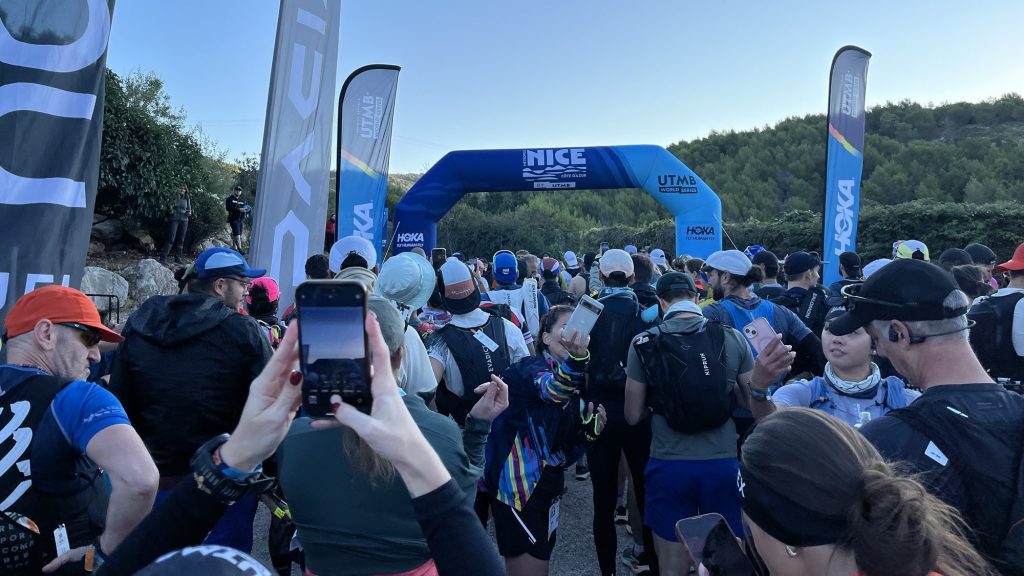
Waiting at daybreak for the race to start

My training had gone mostly according to plan; my final long run was 31 miles and around a thousand feet of elevation gain. During that training run, I did something that caused me significant pain on the top of my left foot, which appeared to be a ligament issue. It wasn’t a huge injury, but it caused me to back off my training significantly in order to allow that foot to heal up as well as possible. I didn’t want to limp through 34 miles. I hoped that the drop off in running wouldn’t affect my ability to finish.

The start of the race was broken into five waves, each 15 minutes apart. With much of the race taking place on single-track trails, it was important to get the runners spread out as soon as possible, and the starting waves helped to space those runners. I was in the fourth of five waves. When it was our turn in the chute, the Race Director tried to keep us loose by playing dance music and giving us encouragement.

Our 15 minutes expired, and we were off. The first portion of the race was mostly uphill on an asphalt road through a pine forest. I was staying true to my plan—keeping my heart rate fairly low—walking the uphills and running the downhills and flats in an effort to maintain my energy for late in the race. Virtually everyone else around me was following the same strategy.

At the end of the first mile, we passed a large wooden sign that said “Parc Naturel Departmental De La Grande Corniche”. We were entering a park perched on the bluffs overlooking the Mediterranean. We would be running through that park for the next few miles. As we continued through the park, asphalt roads made way to gravel roads and finally to a rocky hiking path.

It didn’t take long to catch a glimpse of the Mediterranean, and soon we were treated to panoramic views of the coast. Early on, there were fantastic views of Saint-Jean-Cap-Ferrat, a wealthy residential development on a peninsula to the east of Nice. It is also the start of the 20K race that would start the next day.

The next several miles were breathtaking. The path followed the bluffs overlooking the Mediterranean. Every view was amazing as we looked over multiple settlements along the coast from Nice to Monaco. There were countless yachts and sailboats along the coast as well.

The path was mostly crushed rock and comfortable to run. A number of tunnels were also carved out along this path. I honestly can’t imagine a more ideal setting for the beginning of a race; this was why I signed up for this race; it was just beautiful.

Looking down over Monaco from the trail

The UTMB Nice 50K is divided into five sections. Four aid stations are spaced approximately 11 kilometers apart, and I arrived at the first aid station in less than an hour and a half. That was a little slower than I thought I would take, but I felt good. I grabbed a couple of sugary snacks to pump up my energy and moved on to the second section.

I was worried about the second section. It was about 12 kilometers long, but had a total of more than 2,500 feet of elevation gain. It was time to find out what my legs could take.

The trail changed as well; no longer were we running on wide paths on comfortable surfaces. We had switched to narrow, single-track paths with large rocks everywhere. The next eight kilometers to Col de Madone would have a fairly gradual increase of over 1,500 feet.

Over that stretch, I had kept a fairly good pace, keeping up with the runners ahead of me. My legs were starting to feel the burn a little, but I was feeling confident. Maybe this won’t be that bad.

Once we reached Col de Madone, an official with the race instructed people to prepare themselves for the most difficult climb in the race. We were at the base of Cime du Baudon, and we needed to climb 900 feet over less than a mile. Considering I had already climbed 1,500 feet over the last 5 miles, this was going to be a challenge.

Looking up a Cime du Baudon from Col de Malone

This climb consisted of many parts where we had to use our hands to climb up on large rocks. There was also a lot of loose rock on the paths in this area, which made the footing tricky. This part of the race felt much more like an intense hike than a run. I had to take a lot of breaks to catch my breath, as did the other runners.

It became very clear to me at this point that my training in flat Iowa didn’t prepare me for this elevation change. As I neared the top, I was taking more frequent breaks, and my thighs were absolutely screaming at me to quit. I knew that at the peak, we would be nearly 4,000 feet above sea level, at the absolute highest point of the race, and we would be finishing at sea level. It becomes much more of a downhill race if I could just get to the top.

Nearly exhausted, I reached the top, and my Garmin told me that I had just completed a 52-minute mile. I can say without question that I hadn’t planned to take that long to climb Cime du Baudon, but as Mike Tyson once said, “Everyone has a plan until they get punched in the mouth.”

From the peak, the views were extraordinary. Not only were the multitude of peaks in the Maritime Alps visible, but also the Mediterranean Sea. Off in the distance, to my astonishment, I could see the runway at the Nice Airport, which was more than 10 miles away. My legs were spent, I was exhausted, but this was amazing.

View from Cime du Baudon – off in the distance, you can see the runway at Nice Airport

The next mile was a reverse of the climb up to Cime du Baudon, with a similar grade going downhill. I spent the majority of my energy trying not to fall. I mostly used my hiking poles as stabilizers as I shuffled and slid down the loose rocks. Even though I was going downhill, I took 32 minutes to go the next mile because of how steep the terrain was.

The next aid station was just around the corner in Peille. I was looking forward to filling up my water and grabbing a few snacks. Running downhill through the cobblestone streets, I was feeling energized and encouraged to have reached the end of the second section of the race.

Cobblestone steps in Peille

Those good feelings were quickly squashed when I realized I had completely run through the town and missed the aid station. I had to go back. I wasn’t sure if I had to check in at each aid station to make the race official, but I needed water anyway. I overshot the aid station by more than half a mile, and now I was going uphill, asking for directions to get to the aid station. The last thing I needed was more distance and more elevation change.

Narrow street in Peille

I got to the aid station and they seemed to be cleaning up, but they filled up my water gave me some snacks, and I was back out on the trail.

Over the next couple of sections of the race, I questioned whether I could finish the race. One thing became apparent to me: I wasn’t going to be able to run nearly as much as I had hoped. The paths were full of baseball-sized rocks, and every time that I started to get a little speed, I would land awkwardly on my foot. I just hadn’t trained for running on this type of surface, and it was punishing me.

Rocky paths slowed my progress

In the middle of this, Jenn texted me, and I grabbed my phone to text her back, then immediately tripped over one of those rocks and fell hard. It was the first of four falls I took during this run. I cut my left knee this time, brushed it off, and kept going.

It was also very apparent that at this time, I was all alone. I texted Jenn that I was pretty sure that of the people still in the race, I was in last place. With the terrain and my lack of experience on this trail, I just couldn’t move fast enough without it being dangerous.

As I inched closer to the third aid station, I had a 600 to 700-foot climb, and my quads were on fire. On the downhills and flats, I felt fine, but every time I had to climb a hill, I questioned whether or not I would be able to continue. I took my time and took breaks when I needed to, and kept putting one foot in front of the other until I was at the top of the hill with just a quick couple of miles to the aid station.

At the aid station, I filled up my water and grabbed some snacks. Jenn sent me a text message saying that I had 4 hours until the cutoff at the next aid station. Until that text, I hadn’t even considered that I was close to being disqualified, but apparently, I only made the cut-off at the third aid station by a matter of a few minutes.

Our Lady of Laghet was right next to our 3rd aid station

Hurriedly, I finished my snack and left, following a couple of women, who, after about a half mile, struggled to get down a steep slope into a dried-up creek bed. I saw this and knew I was going to need my hiking poles to get down, but realized that I didn’t have them; they were back at the aid station. So I had to return to the aid station to grab them.

For the second aid station in a row, I had to double back, each time it cost me a mile and probably at least 20 minutes. Now I knew I was in last place. That became apparent when, in a couple of miles, I started to hear noise behind me. It was the sweepers, cleaning up the course behind me. They came up behind me and told me that they were closing the course, and at first, I thought they were going to disqualify me.

They asked me if I could make it to the next aid station, and I told them I had plenty of time and I wasn’t worried about it. I was, however, annoyed by their constant presence behind me. I just wanted them to leave me alone, and they were always right behind me.

It was about this time that the 50K route merged with the 100 Mile route and the 100K route. I think the sweepers no longer were closing the course, since the other runners needed to use the course, but they continued to follow right behind me, which was beginning to get on my nerves.

I got a text message from Jenn, who was following my progress on the Live Trail app, saying that I had one big hill left. Over the next two miles, I was going to have to climb about 700 feet. However, after that, there was only about another 300 feet of climb for the remaining nine miles. I just needed to get up this last hill. With the sweepers on my tail, I continued to put one foot in front of the other, gasping for air, and my thighs on fire. Finally, I made it to the top of the hill.

I was at Plateau de la Justice, just two miles from the final aid station and around nine miles from the finish. At that moment, I realized that, barring an injury, I was going to finish. The only time I questioned whether I could continue was going uphill, and except for a little bit of elevation gain, it was all flat and downhill for the rest of the race. It was an emotional moment knowing that I was going to finish after spending the better part of the last few hours questioning whether I could.

I made it to the aid station and filled my water for the final time. I choked down some cookies, hoping the sugar would give me a boost of energy, and got back to the race.

Once I hit the aid station, I was no longer alone on the course. Somehow, I managed to catch and pass some 50K runners, and an increasing number of 100 milers were coming up from behind us.

A short while from the aid station, the trail passed through Parc du Viniagrier. This section was a steep downhill single-person switchback trail, which was full of stones. By this time, running on these stones was tearing up my feet, my whole body ached, and my legs were almost completely spent. It was also getting darker by the minute as it was now dusk.

This was a highly technical section, and I was exhausted. I needed to stay focused so I wouldn’t hurt myself. Then, while in a fairly steep section, I caught a toe on a rock and fell face-first down the hill. I managed to get my hand in front of my face and stopped myself from taking a rock to the forehead. I felt a sharp pain in my hand and got up. There was blood dripping down my hand.

I decided to continue on and hoped that it would stop bleeding on its own, which it did. All of the aches and pains were starting to multiply, and I was ready to be done. As I pushed through the natural area at Mt Boron, I was treated to an amazing view of Nice at night from about 600 feet above the city.

Mt Boron had the last natural trails left in the route, and once I climbed down an incredibly steep and long set of stairs, I was at sea level. I had just a little over two miles to go along the coast and the Marina.

Boats in the Marina at night

My pace increased, running around the Marina by streetlight, through pedestrians. Some were unaware of what was happening, and others were cheering us on. Finally, I turned along the promenade and headed into the finishers’ chute.

Heading down the promenade to the finish

I crossed the finish line in 13 hours and 40 minutes, just 20 minutes before the 14-hour cutoff. My goal was to finish in 10 hours. I didn’t care, though; I was just happy to have finished.

It was the greatest physical challenge I had ever faced, and just finishing was enough for me. I was on the edge of exhaustion so many times and just kept putting one foot in front of the other. It’s a reminder of the power of perseverance.

Getting my finishers’ medal

I spent the next several days physically recovering from the race. It took a day to get my appetite back, two for my energy to return, and over a week before I could walk without limping. But within a couple of weeks, I was already trying to find another UTMB World Series race to participate in.

UTMB World Series races are an amazing combination of extreme challenge and extreme beauty. They take place in some of the most beautiful parks and natural areas throughout the world. It’s worth every blister, scrape, and cut. As sadistic as it sounds, I can’t wait to do another.

An Evening at Klunkerkranich

I love to visit places that are a little different, so when I was trying to find a biergarten in Berlin and came across Klunkerkranich, I had to check it out. The name roughly translates to Jewelry Crane, which is an odd name, but frankly, everything about this place is a little odd.

It is a rooftop bar/cultural center located on top of the Neukölln Arcaden, a shopping mall in the Neukölln neighborhood on the south side of Berlin. It has food, several bars, and fantastic views of Berlin.

There are planters all over the rooftop at Klunkerkranich.

Finding Klunkerkranich was a challenge. I stumbled across it on Google Maps when I searched for biergartens. When we went there, I found the intersection where it was located, but couldn’t find any signs or indication of where it was. I knew it was on the rooftop, so I decided to walk into Neukölln Arcaden to see if I had to go through the mall to get there.

Honestly, I’m not exactly sure how we found it. I know we went up as far as we could inside the mall, then ended up in a stairwell going up another floor, then through a parking garage. Inside the parking structure, we saw a ramp going up an additional level, and on that ramp, we were greeted by a gentleman who was taking the entrance fee. It’s definitely not the kind of place you just stumble upon; you have to be looking for it.

The entrance fee is variable between three and nine euros, depending on what time you arrive and what cultural program is being featured that day. The cultural program on the day we arrived was an EDM DJ, and the fee was eight euros.

The ramp up to the rooftop

Walking up the ramp, you start to get the vibe of the place. There are planters along the ramp that feel like they belong in a hippie’s garden, reminiscent of reclaimed pallet boards and whimsical paint colors. Once we got to the top of the roof itself, I felt a little sensory overload. The bass from the EDM, the views of Berlin, the sound of people chatting, the colors from the flowers in the planters, as well as the countless avant-garde decorations, took me a moment to unpack.

We looked around for a little while and then went into the bar for a König Ludwig dunkel for me and a cola for Alex. We then found a picnic table where we sat and enjoyed our drinks. The best tables along the edge of the building with clear views of the city were already taken.

Seating along the edge of the building with great city views.

For a Wednesday night, there were quite a few people there, but clearly, they could handle a much bigger crowd because only about half of the area was accessible. There was a private party in one section, which I discovered when I tried to walk up there and was sternly reprimanded. Another section, called the Ostflügel (east wing), was also closed off, which I imagine they open when they are busier.

In front of the whimsical balloon statue is the guy who scolded me for trying to get into the section with the private party.

Our plan for the evening was to have a couple of drinks here while the sun set. We had already eaten, so we didn’t have any of the food that was served. Based on the reviews, the food isn’t great, so we ate before arriving. Besides, I promised Alex I would take him for ice cream. Alex and I had spent a week together at this point, and the only way I could convince him to go with me to another biergarten was to promise him ice cream afterward.

The Ostflügel section of the rooftop was closed.

Even though this didn’t look like a traditional German biergarten, it certainly had that same feel. I find Germans to be friendly in biergartens, even though they typically don’t have the reputation for liking small talk. We had a short conversation with a gentleman from an adjacent table, which was prompted by Alex falling off the back of his bench (seriously, he was the only person there not drinking, and he’s the one who fell out of his seat).

Signs pointing to different sections of the rooftop.

I wish we had a chance to visit on the weekend. I have a feeling that the vibe goes from laid-back rooftop biergarten to a more nightclub/rave vibe when it gets really busy. Even though I would definitely rather go to a biergarten than a nightclub, it would have been really interesting to visit it when people were really partying.

We waited for sundown and walked around the rooftop, looking over the city of Berlin. It was a beautiful sunset on a warm and lovely evening. We then decided to leave and worked our way back to the ground level through the parking garage, stairwell, and the mall, and back out into the city. Now we just had to find that ice cream I promised Alex.

Berlin at sunset

If you are going to Berlin, I would highly recommend going to Klunkerkranich. The views over the city alone are worth the price of admission. I really enjoyed the hippie vibes and the avant-garde art. It was a really enjoyable place to spend an evening.

Simplify Your Travel in Germany with the Deutschland Ticket

If you are traveling to Germany, you might be surprised to find out that your best public transportation option might just be a program developed for German citizens. The Deutschland Ticket or D-Ticket was first introduced in May 2023 as a joint venture between the German government and the individual regions within Germany. The original cost was 49 Euros, which was raised to 58 Euros in January 2025.

What is the Deutschland Ticket?

Deutschland Ticket is a subscription service that allows you to travel on virtually any public transportation system in Germany for one price. This eliminates the need to navigate multiple apps and ticketing systems for different public transportation systems in Germany. The service covers buses, trams, subways, and trains throughout Germany.

The Deutschland Ticket doesn’t, however, cover travel between cities. This means that long-distance buses such as Flixbus or Intercity Express (ICE), Intercity (IC), or Eurocity (EC) trains are not included. For example, when my son and I were in Germany recently, we had to purchase separate tickets for travel between Dresden and Berlin.

My Experience with the Deutschland Ticket

When I was planning our trip to Germany this summer, the plan was to spend six nights in Dresden and two nights in Berlin. We were also going to visit Saxon Switzerland National Park for a few days while staying in Dresden.

What this meant for me was that I needed to figure out how to navigate as well as purchase tickets for three separate transportation systems in Berlin, Dresden, and Saxon Switzerland National Park. That is a giant headache to deal with because if you don’t want to overspend on tickets, you need to know how much you plan to use that system. Should I get a single-day pass, a single-journey pass, or a week pass? How many fare zones do I plan to travel in? It can get overwhelming in a hurry.

For example, on the Dresden Public Transportation website, there is a map, ironically labeled “Fare Zones made easy,” showing the 21 fare zones in the Dresden Public Transportation system. That’s right, 21 zones. The prices vary depending on how many zones you plan to travel in.

Dresden Zone Map from the Dresden Public Transportation website.

I spent a considerable amount of time trying to figure out that I would need to purchase a ticket that was good for a week in two zones, plus Dresden. For a week, that would have cost almost 45 Euros per person. That also limited us to just part of the system around Dresden.

On top of that, I was going to need to buy tickets in Berlin as well as inside Saxon Switzerland National Park. I knew that the Deutschland Ticket was only 58 Euros, so it didn’t take me too long to realize that it was going to be cheaper and much simpler to just buy the D-ticket.

In practice, it was a huge relief to have the Deutschland Ticket. I didn’t spend any time worrying about whether or not my ticket was valid for any place I wanted to go. If it was public transportation, it was covered – all I needed to worry about was which train, tram, or bus to take.

This actually expanded where we traveled because we decided at the last minute to visit Meissen, which would have been in a fare zone not covered by the Dresden week pass. Having the pass meant that we actually went the full length of the train system from Meissen to the Czech border, which is about 50 miles apart. Knowing that was all covered by one ticket was incredibly valuable.

The Simplicity of the D-Ticket

The best thing about holding the Deutschland Ticket is the fact that it simplifies your experience on German public transportation. Purchasing separate tickets for each city means that you will need that city’s phone app in order to purchase tickets and view routes. If you purchase the D-Ticket, however, you can buy it on any of those apps you choose, and you only need that one app, not a different app when you visit a new city. The QR code on that app works anywhere the D-Ticket is valid.

In fact, we weren’t visiting Munich, but I already had that app on my phone, so I purchased my ticket using that app. Whenever I needed to show my ticket while I was in Dresden, Berlin, or in Saxon Switzerland National Park, I simply opened the Munich app and flashed the QR code. It really simplified things for us. Meanwhile, for routes and times, we used the transit features within Apple Maps.

The Deutschland Ticket is a Subscription Service

There are some downsides to using the D-Ticket that might keep you from wanting to use it. The negatives revolve around it being a subscription service that renews at the end of the month. While the ticket is allowed for use by tourists, it’s generally meant for use by residents. So the rules are set up for residents, not tourists.

The first issue is that it renews at the beginning of the month. This means that if you are planning a trip that starts in one month and ends in the next month, you will end up paying the 58 Euro subscription fee twice. If you are only visiting Germany for a week and have to pay 116 Euros, you might rethink the D-Ticket.

The other problem is that you really need to plan ahead. It is required that you cancel your subscription before the 10th of the previous month. For example, if you are going to Germany from October 15th to October 25th, you need to purchase the ticket between September 1st and September 9th, and then cancel the subscription before the 10th. It seems counterintuitive to cancel something before you start to use it, but once you’ve purchased the Deutschland Ticket you have that ticket for the next month.

All purchases are final, and you can purchase the Deutschland Ticket in the same month that you use it, but you won’t be able to cancel it for the first month. In other words, if you don’t plan ahead, you will be required to purchase it for two months.

Purchasing the Deutschland Ticket

The actual purchasing of the Deutschland Ticket is fairly easy. I used the MVV app which is Munich’s public transportation phone app. You can find the Deutschland Ticket subscription in the Ticketshop tab at the bottom of the screen. Once you are there, select Deutschland Ticket Subscription.

Once you get to that point, all you need to do is enter your payment method (they accept US credit cards), and complete the payment.

If you are only trying to purchase your ticket for one month, you must remember to purchase and cancel the ticket before the tenth of the previous month otherwise you will be charged for a second month.

Conclusion

The Deutschland Ticket is a great way for tourists, especially those visiting multiple German cities, to simplify their public transportation needs. You can travel on virtually all forms of public transport within cities, hold only one ticket, and use only one app.

It’s very likely it will save you money on your trip as well, since purchasing individual tickets or day/week passes can add up quickly. The biggest headache is managing the subscription. But if you make sure you understand the subscription rules and are able to purchase and cancel the subscription within the correct time period, you’ll be thankful you had it.

Points Check August 2025

August was a month when we spent considerable time preparing for our trip to Nice, France, at the end of September. Unlike most trips, this didn’t mean finalizing trip details or finding places we would like to visit. Instead, it meant training – lots and lots of painful training.

Our trip is based around participating in the Nice Côte d’Azur UTMB Ultramarathons. I will be doing the 55K, and Jenn is doing the 23K. This means that we are spending a lot of time on our feet running and preparing ourselves physically for this challenge. On the last day of the month, I completed a 31-mile training run, which destroyed me physically for about three days, so this seems like a fantastic idea.

Besides that, we used some of our points and miles to finalize the details of our trip as well as beginning to book a spring break trip. I hadn’t planned to start booking anything yet for spring break, but I came across a fantastic flight deal, and I believe in booking something when you have the opportunity.

The Beginnings of a Trip to Tenerife

After we hiked part of the Portuguese Route of the Camino de Santiago last spring break, I promised our kids a more laid-back beach vacation for the next spring break. For a couple of years, I’ve been thinking about visiting the Canary Islands during spring break, because unlike Florida, Mexico, and the Caribbean, March is the offseason for them. The weather should still be great, but there shouldn’t be crowds, and the prices should be cheaper. I really wanted to fly into Tenerife South Airport, because that is the center of beach tourism for the islands.

When I was looking for flights, it quickly became obvious that it would be cheaper to fly to somewhere in Europe and then get a separate flight from Europe to Tenerife. What we discovered was that we could fly from our home airport in Moline to London Heathrow for 19,000 American Airlines miles and $5.60. Then we could fly British Airways from London Gatwick to Tenerife South for 13,750 British Airways Avios (transferred from Chase Ultimate Rewards) and $1 each.

That meant that we could fly for a total of 32,750 points and $6.60 each, which was considerably less than the more than 40,000 points each I was seeing for similar flights on one itinerary. The bonus was that we were able to schedule a couple of nights in London, which should allow us to enjoy a taste of England while we’re getting over jet lag.

We had Emma use some of her American Airlines miles to book her flight, so we only needed to pay for 3 of the American Airlines flights, but we did need to pay for all 4 of the British Airways flights. Altogether, we spent 57,000 American Airlines miles and 55,000 Chase Ultimate Reward points transferred to British Airways to book the flight to Tenerife.

Finalizing our Trip to Nice and Dublin

After 5 nights in Nice, we will move on to Dublin for a few nights before heading home. We hadn’t, however, booked any lodging in Dublin. Booking a hotel in Dublin for a reasonable number of points was difficult. The best option was to book the Hyatt Centric Dublin, a category 5 hotel with 17,000 points per night. Because it was a category 5, I couldn’t use my category 1-4 certificate. I ended up using 34,000 Hyatt points, 9,000 from my Hyatt account, and 25,000 Ultimate Reward Points transferred to Hyatt.

This will be the fifth Hyatt brand we’ve stayed at on my Hyatt account, which means that I will hit my first Hyatt Brand Explorer reward and will earn a category 1-4 certificate with this stay. That takes a little bit of the sting away from having to use so many points for this redemption.

Citi AAdvantage Platinum Select

Jenn applied for the Citi AAdvantage Platinum Select World Elite Mastercard. That name is way too long, but it comes with an elevated 80,000 AAdvantage mile bonus after she spends $3,500 in the first three months.

It earns 2x on gas, dining, and American Airlines purchases. It has a $95 annual fee, but it is waived the first year. There really isn’t much to be excited about with this card other than the signup bonus. It does give the cardholder free checked bags and priority boarding, which is pretty standard for an airline credit card.

She signed up for this card in order to boost her American Airlines miles balance. We’ve been using American a lot more, and we find it to be extremely reasonable for flights out of our local small airport in Moline.

On to the Point Check!

Without having a signup bonus that I was working on, our spending on our regular cards was a little higher than normal, and some of it was not ideal. We used my Sapphire Preferred card on categories that weren’t earning a lot of points. In addition, I used my Citi Custom Cash on camping fees, wondering whether or not it would code as one of the 5x categories, which it did not. Oh well, it was worth a try.

I usually say that I’m happy if we earn a 5% return on our spending on cards where we weren’t earning a signup bonus, but I feel like we were a little sloppy this month, and we could’ve done better. It seems like lately we’ve been able to earn 6% to 8% on that spending, so I know we can do better than that.

Card UsedSpendPoints EarnedPoint ValuePoints Per $Return on Spend
Amex Gold$12603,351$67.022.75.3%
Sapphire Preferred$890980$20.091.12.3%
Wyndham Business Earner$7304,218$46.405.86.4%
Ink Cash$4662,335$47.875.010.3%
Citi Custom Cash$364364$6.551.01.9%
Total$3,71011,248$187.933.05.1%
This month’s spending not devoted to earning a signup bonus

Besides the spending listed above, Jenn spent a little under $2,200 on her IHG Premier Business card, earning 7,000 IHG points. It also meant she reached the second bonus threshold and an additional 60,000 points. That card had a weird double bonus, which earned 140,000 points after $4,000 in spending and another 60,000 points after an additional $5,000 in spending.

All of that leaves us with:

  • 261,800 IHG points
  • 235,500 Chase Ultimate Reward Points
  • 129,000 Amex Membership Rewards Points
  • 87,500 Wyndham Points
  • 79,100 Alaska Miles
  • 36,000 American Airlines Miles
  • 33,400 Marriott Bonvoy Points
  • 32,700 Citi Thank You Points
  • 16,700 United Miles
  • 7,800 Hyatt Points
  • 1,500 Delta Miles
  • $133 in Cash Back

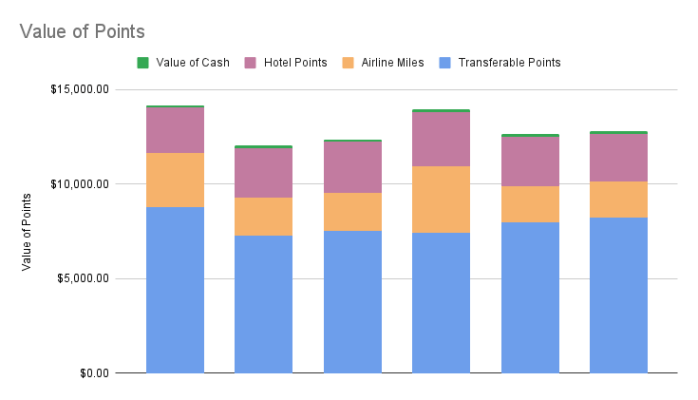
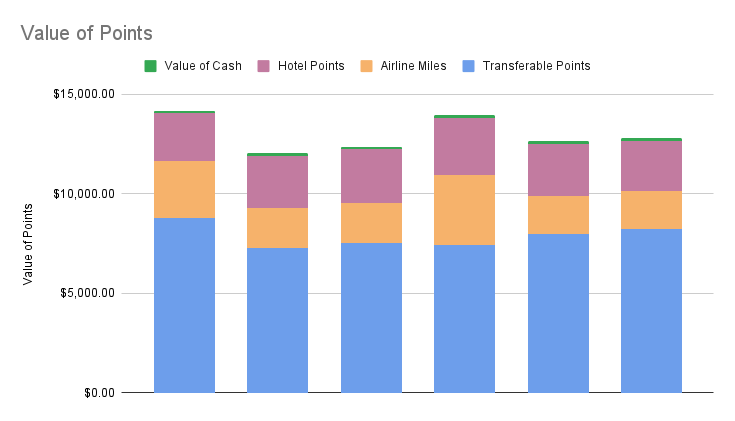
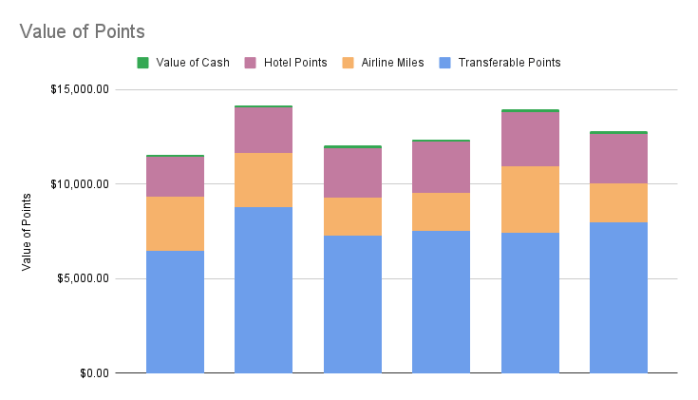
All of that together is worth, according to the Points Guy’s valuations, a little over $12,000, which is down more than $2,000 from the previous month. Most of that is due to the flights booked to Tenerife. We keep using these points to book some amazing vacations, so the dip doesn’t bother me at all. We seem to be constantly earning and burning those points, which is how it should be done. That being said, I’ll worry about my points totals later because I have a race to train for.

Berlin’s Lessons from a Troubling Past

Berlin is the epicenter of uncomfortable history. The city was the seat of power for Germany during World War I and World War II. During the Second World War, many crimes against humanity were directed from this city. It was also physically split during the Cold War.

20th-century German history forces people to confront the worst parts of humanity. This includes the history of concentration camps, persecution of vulnerable groups, and ethnic cleansing. It also forces people to confront totalitarianism and the stripping of basic human rights. It’s a history that confronts each and every individual who learns about it with the worst parts of the human experience.

Berlin could have decided to move on from its history and maybe built some small monuments or plaques to inform people of the past. Instead, the people of Berlin have built an impressive and thoughtful collection of monuments, allowing people to mourn the past and contemplate what it means for the present.

World War II Monuments

There are various monuments related to World War II in Berlin, and many of them recount the horrors related to the Holocaust and the Nazis’ campaigns of ethnic cleansing. There were three in particular that drew my attention related to the persecution of minorities by the Nazis from 1933 to 1945.

Memorial to the Murdered Jews of Europe

Completed in 2004, the Memorial to the Murdered Jews of Europe was designed by architect Peter Eisenman and artist Richard Serra. This memorial is built out of 2,711 concrete blocks of various sizes arranged in a grid pattern over an area of about 4 acres. The memorial is abstract, and your interpretation of its meaning is up to you.

Monument to the Murdered Jews of Europe

As I was walking through the memorial, it became very clear to me just how difficult it is to visualize large numbers. There were an estimated six million Jews killed during the Holocaust at the hands of the Nazis. That is a number that becomes incredibly hard to visualize. However, as I was walking among the concrete blocks, seeing 2,711 blocks, and that, if divided equally, each block would represent more than 2,000 lives lost, six million becomes an unfathomable number.

Monument to the Murdered Jews of Europe

People have commented that the design is meant to be disorienting, with the varying heights of the blocks and the fact that the ground they sit on is not flat. To me, instead, it felt like a place for reflection. Once you get into the sea of concrete blocks, the distractions of the city vanish, and you are only left with your thoughts.

Monument to the Sinti and Roma Victims of National Socialism

In the Tiergarten in Berlin is the Monument to the Sinti and Roma Victims of National Socialism. It was officially opened in October 2012 and was dedicated to the estimated 250,000 to 500,000 Sinti and Roma who were killed by the Nazis.

Monument to Europe’s Sinti and Roma Murdered under Nazism

The monument consists of a dark pool with a triangular-shaped stone, which signifies the badge the Sinti and Roma were forced to wear in the concentration camps. The monument also contains a large exhibit that describes the story of the persecution and genocide of the Sinti and Roma.

Memorial to the Homosexuals Persecuted Under Nazism.

The Memorial to the Homosexuals Persecuted Under Nazism looks like a plain concrete cube, similar to the concrete cubes in the Monument to the Murdered Jews of Europe. There is, however, a window in the concrete which, when you look inside, displays a short video of two men kissing. Every two years, the video alternates between two women kissing and two men kissing.

Memorial to Homosexuals Persecuted Under Nazism in Berlin

This monument is in Berlin’s Tiergarten and was opened in May 2008. I thought the monument was a great depiction of how members of the LGBTQ+ community had to live their lives in secrecy to avoid persecution.

Monuments to the Berlin Wall

From the end of World War II in 1945 until reunification in 1990, Berlin was essentially split in half, with the western side part of West Germany and the eastern side part of East Germany. West Berlin, however, was essentially an island as it was completely surrounded by East Germany.

Mural by Kani Alavi depicting the crowds of people who broke through the Berlin Wall the day it fell. The mural is located at the East Side Gallery

In an effort to stop people from defecting from East Berlin to West Berlin, a wall was constructed in 1961. This concrete and barbed wire wall completely encircled West Berlin. From the construction of the wall in 1961 to the fall in November 1989, a total of 171 people were killed attempting to escape East Berlin. Approximately 5,000 East Germans were successful in escaping East Berlin during that time.

East Side Gallery

Far end of the East Side Gallery

Many sections of the Berlin Wall are left standing throughout Berlin. The East Side Gallery is a large portion of the Berlin Wall painted by a series of artists. It is a large open-air art gallery with over 100 unique paintings from across the world.

Marc Engel’s Puppets in a Dropped Play

It is impressive in its size and artistic diversity. We spent a couple of hours walking along the wall, admiring the artwork.

White Crosses

Walking into the Tiergarten, we came across a series of white crosses that were placed to commemorate the people who died attempting to cross from East Berlin to West Berlin. The stories of some of the 171 East Berliners who died trying to cross the Berlin Wall are displayed on these crosses.

The White Crosses Memorial pays tribute to people who were killed trying to escape East Germany by crossing the Berlin Wall

There were over a dozen at the location we saw at the northeast corner of the Tiergarten, but there are also 8 additional crosses along the Spree River behind the Reichstag building.

Remnants of the Berlin Wall

Remnant of Berlin Wall with peace sign sits along a thin line of bricks and stone signifying the location of the wall.

Throughout Berlin, you will see reminders of the location of the Berlin Wall. In some cases, it is a piece of the wall. In others, it’s a brick line in the pavement that marks where the wall had been. It is a constant reminder to the citizens of Berlin of when and where their city had been split for the duration of the Cold War.

Much of the location of the Berlin Wall is marked by brick lines in the pavement

The city of Berlin could have chosen to completely remove all of the Berlin Wall and turn the page on a horrible part of its history. However, they left scars throughout the city as a reminder of the trauma of the past.

Addressing the Past with Clarity

In the United States, it has been 160 years since the end of the Civil War. Even after that much time, we lack a cohesive narrative about the end of a horrible chapter in our past.

Throughout much of the Old South in the United States, there are still countless monuments to Robert E. Lee. People still proudly wave Confederate flags. For some people, the teaching of the history of slavery, segregation, and the Civil Rights movement in America is labeled ‘Critical Race Theory’ and demonized. Even after more than a century and a half, we cannot come to terms with the sins of our past.

The city of Berlin addresses its past with clarity. You will not find statues in Berlin commemorating Hitler or any of his generals. Nazi flags are illegal in Germany, and you will not find many people who defend Nazi Germany. What you will find are thoughtful monuments to their victims. The message is clear to visitors and Berlin residents – we made horrible mistakes and are committed to not repeating those mistakes.

Germany does not hide from its past; it addresses it head-on. Unlike the United States, it does not confuse or excuse its immoral actions but instead addresses them with clarity. That is the best way for a society to move forward from its mistakes.

We should not shy away from things that make us uncomfortable. Discomfort is the fertile soil where wisdom grows. It is not our responsibility to bear the weight of the sins of our fathers. It is, however, our responsibility to not repeat those sins.

Exploring the Panometer Museum in Dresden

The Panometer in Dresden is a unique museum. It was built inside a former gasometer, a round structure that was used to pressurize coal gas for use in houses. Many of these structures have been converted for other purposes, and in Dresden, one was converted into a truly unique museum.

Photo of the exterior of the Panometer in Dresden courtesy of https://www.panometer-dresden.de/en/panometer-dresden/industriedenkmal/

This museum hosts incredibly large panoramic paintings created by artist Yadegar Asisi. Only one painting at a time is on display, and each painting covers the entire inside wall of the Panometer. These paintings immerse visitors in a time and place. Previous exhibits have included a panoramic view of Dresden in the 1700s and Dresden immediately following the Allied bombings in 1945.

The exhibit we visited was Amazonia, which immerses the visitor in a 1:1 scale painting of the Amazon Rainforest. This exhibit has been hosted by other panoramic museums, but has been at Dresden’s Panometer since 2024 and should continue through the end of 2025.

Exhibit explaining the process of creating a panoramic painting.

Entering the museum, we walked into a series of rooms that explained the artwork and how it was created. There was also a lot of background information about the Amazon Rainforest and its flora and fauna.

Amazonian insects are displayed in the museum area before entering the panorama.

Once we had walked through the exhibitions, we entered the Panometer itself. My first reaction was awe at the size of the painting. Each piece of art that gets displayed at Panometer is almost 90 feet tall and approximately 350 feet long. It’s absolutely massive. But it’s not just the size that’s impressive. The detail in the painting itself, especially considering the scale of the painting, is phenomenal.

Viewing Tower in the Center of Panometer

Visitors also experience sounds from the Amazon and music. The soundscape was designed by Eric Babak, who collaborates with Yadegar Asisi on these projects.

Rainforest floor in daytime lighting

In the center of the Panometer is a 50-foot-tall tower, where visitors can view the painting from various heights. Attached to the tower are a series of lights that simulate different times of the day, from moonlit night through dawn to midday. The painting reacts differently to the different kinds of lighting it’s exposed to. While daytime lighting exposes the incredible detail of the painting, the nighttime lighting hides those details, but creates an interesting glow, as it would under a full moon.

Above the rainforest canopy during dusk lighting

All of this makes for a completely immersive experience for the visitor. Instead of at an art museum where you would go to view a great work of art, this feels like a visit to the Amazon itself, without, of course, the heat, humidity, and the possibility of being eaten by a snake.

Rainforest floor at night

Viewing the work of art from the multiple levels of the tower gives the visitor many different perspectives on the same work of art. We took full advantage of the multiple viewpoints and different lighting to get the full experience. You can fully experience the Panometer in around an hour, allowing yourself plenty of time to see the art at multiple heights with different lighting.

Visiting Panometer Dresden

Panometer Dresden is about an 8-minute walk from the Dresden Reick train station. There is also a bus stop even closer than the train station. If you are driving, there is free parking in front of the building.

Tickets are 14 Euros for an adult. It costs 12 Euros for 17-20 year old students, Dresden Card holders, Dresden Pass holders, and the disabled. It is 7 Euros for children 6-16 years old. Children under the age of 6 are free.

Places to View the Art of Yadegar Asisi

Yadegar Asisi has many different panoramic art pieces on display throughout Germany.

  • The Cathedral of Monet is currently on display in Leipzig. This 360-degree panorama, inspired by Monet’s painting of the Rouen Cathedral, is scheduled to end on Jan 7th, 2026.
  • On display at Museumsinsel Berlin is the Pergamon. This art depicts the Greek City of Pergamon as it was during the reign of the Roman Emperor Hadrian in 129 AD.
  • At Panorama Berlin is The Wall. This depicts various scenes from a 25-year period centered on the Berlin Wall.
  • On display at Panorama Wittenberg360 in Wittenberg, Germany, is Luther 1517. This work depicts scenes from the life of Martin Luther and represents what Germany looked like 500 years ago.
  • At Gasometer Pforzheim, Amazonia, the same exhibit being shown in Dresden, is also on display. It is scheduled to be in Pforzheim through 2026.

Altogether, there are 6 panoramic museums in Germany displaying Asisi’s work. I think the combination of the size and the detail of the work makes it worth visiting. It also makes for a quick trip if you want to fit it in with other things. You should be able to visit any of these works of art in an hour or less, and the price is reasonable.

I don’t think that I would go out of my way to do a day trip to one of these exhibits, but if you are in one of the cities where one of these panorama museums exists, I think it’s worth a stop. It’s a great way to spend a little time if you are in the area.

Points Check July 2025

July was a fun month. Jenn and I took separate vacations. While Jenn and Emma went on a girls’ trip to Munich and Dublin with Jenn’s sister and our niece, I took our son Alex to Berlin and Dresden. It was a little strange being on separate vacations, but with us both being in Europe, texting our adventures back and forth was fun.

Alex and I wanted to do a lot of hiking in Saxon Switzerland National Park in Germany along the Czech border. Unfortunately, it rained a lot while we were there, and we only got to hike for a couple of days. Because of that, we spent more time in Dresden than we originally planned, which turned out to be great. I absolutely love Dresden and hope to return someday.

The girls enjoyed their trip as well. Between the two cities they visited, two of the girls preferred Dublin and two preferred Munich. That just goes to show that everyone has different travel preferences. I’ll get a chance to spend a little over a day in Dublin in late September, so I’ll get to see what I think soon enough.

Chase Sapphire Preferred Bonus

Back in May, I signed up for the Chase Sapphire Preferred card, which at the time had a 100,000 point bonus. This month, I finally finished the required spending on the card and received the bonus.

In the meantime, Chase has “refreshed” their Chase Sapphire Reserve card, which is the big brother of the Preferred card. The big news was that the annual fee jumped to $795 per year. At one point, this card had an annual fee of $450. A few years ago, it was increased to $550, and now with this refresh, it’s an eye-popping $795.

Each time the annual fee is increased, there are new benefits and credits added, which theoretically add value. Obviously, if you don’t use those credits, they are worthless. The list of credits is quite long, but most involve travel. In fact, the card seems to be designed for people who are very frequent travelers. It gives 8x on travel purchased through the Chase travel portal, 4x on flights and hotels not purchased through the portal, 3x on all restaurant spend, and 1x on all other spend. It has great airport lounge access benefits as well.

By contrast, the Chase Sapphire Preferred has a $95 annual fee and gets 5x on the Chase travel portal, 2x on other travel, 3x on dining, 3x on groceries, and 3x on streaming services, and 1x on everything else. There really aren’t any benefits to speak of on this card, except for the ability to transfer points to a variety of hotel and airline programs.

Personally, I’m glad I went for the Chase Sapphire Preferred. It’s a great choice for normal people. 3x on dining, groceries, and streaming services are categories in which most people spend a significant amount of money. There are good bonus categories on the Reserve card as well, but they are mostly related to travel, which is great if you travel a lot, but for people who don’t, the Preferred card makes much more sense.

Either way, it’s going to take a lot to convince me to spend $800 on an annual fee, and right now, I’m not interested.

On to the Point Check!

Our spending was a little higher than normal, mostly due to being on vacation. As much as I obviously try to reduce our vacation spending on flights and lodging, there really isn’t too much you can do about things like train tickets, bus tickets, and dining out. There’s no way I’m going to Germany without eating döner, and I’m certainly not denying Alex his currywurst. For some reason, they won’t let me pay for my döner box with Wyndham points.

We did a pretty good job of using the bonus categories of some of our credit cards, which meant that we earned a 7.7% return on spending on cards that we weren’t trying to earn a bonus. I’m pretty happy with any number over 5%, so I’m thrilled with that number.

Card UsedSpendPoints EarnedPoint ValuePoints Per $Return on Spend
Amex Gold$5331797$35.943.46.8%
Ink Cash$4492,247$46.065.010.2%
Wyndham Business Earner$4102,242$24.665.56.0%
Total$1,3926,286$106.674.57.7%
This month’s spending not devoted to earning a signup bonus

In addition to the spending on cards where we aren’t working on a bonus, I spent a little less than $3,900 on my Chase Sapphire Preferred card, earning over 7,600 Chase Ultimate Reward Points. That also put me over the required spend to earn the sign-up bonus of 100,000 points. Jenn spent a little over $2,100 on her IHG Business Card and earned almost 8,900 IHG points. She had previously earned the 140,000 point signup bonus for $4,000 spending in 3 months, but she is now just a little more than $2,000 in spending away from earning the additional 60,000 point bonus for spending a total of $9,000 in 6 months.

All of that left us with a total of:

  • 272,100 Chase Ultimate Reward Points
  • 194,600 IHG points
  • 125,500 Amex Membership Rewards Points
  • 93,000 American Airlines Miles
  • 83,300 Wyndham Points
  • 79,100 Alaska Miles
  • 33,400 Marriott Bonvoy Points
  • 32,700 Citi Thank You Points
  • 16,800 Hyatt Points
  • 16,700 United Miles
  • 1,500 Delta Miles
  • $133 in Cash Back

According to the Points Guy’s valuations, the grand total of those points, miles, and cash back is a little less than $14,200. That is an increase of around $2,600 from the previous month, mostly due to the Chase Sapphire Preferred bonus. That’s a pretty massive jump in just a month. Our total points values have increased for the last few months, so hopefully, we’re really starting to stockpile some points in programs that will really allow us to book some great vacations in the future.

Beauty and Danger on Malerweg Trail Stage Four

Stage four of the Malerweg starts in Altendorf and finishes in Neumannmühle. It is part of the Malerweg Trail (Painter’s Way), which is a series of eight point-to-point trails through Saxon Switzerland National Park in Germany. It roughly follows the path of German landscape painters who frequented the area in the 18th Century.

Building in Bad Schandau

My Son Alex and I had only planned four days of hiking while in Dresden, but because of the amount of rain that fell while we were there, we were only able to hike two days. Having read blog posts of people who had done all eight stages, stage four seemed to be one of the favorites of the eight stages.

Our day started with a train ride from Dresden to Bad Schandau. From there, we needed to take a bus from Bad Schandau to Altendorf. Once we got off the bus in Altendorf, it only took a few minutes to find the sign directing us to the Malerweg trail.

We followed the signs, and it wasn’t long before we came across a sign that said the path was under repair and that we needed to turn around to go to an alternative path. That forced us to turn around and eventually led us down a fairly steep trail with a lot of switchbacks that descended from Altendorf.

At the bottom of the hill was a campground where we missed a sign and walked another quarter mile or so before I thought that the trail didn’t seem right. My instincts told me we weren’t on the Malerweg, so we turned around and returned to the campground, where we saw the sign pointing to the Malerweg, which we had missed the first time. We had barely even started hiking, and we had already come across a closed trail and taken a wrong turn – not a great way to start.

Walking beside the sandstone pillars

From there, we started an approximately 1,000-ft ascent over the next four miles. The first part of the ascent was through prairie and woods until we reached the sandstone mountains. The early parts of the hike weren’t that scenic, but as we approached those stone cliffs, we were treated to amazing views.

Sandstone pillars next to the trail

The trail took us around a series of sandstone pillars for about 15 to 20 minutes before leading us uphill. This area has a large sandstone bluff, and the Malerweg trail continues on top of the bluff for a few miles. However, first we needed to climb from the trail up onto the sandstone bluffs.

Metal stairs on the sandstone ridge

On the ascent, the trail was varied. Often there would be metal stairs with handrails, other times, wooden steps, and sometimes you would need to climb on the rocks themselves. There were spots that I thought were fairly dangerous, and the footing was tricky, but after a while, we made it to the top of the bluffs, where we were treated to some spectacular views.

Looking down on the trail after climbing onto a bluff.

I was baffled by how dangerous the trail felt in parts. At one point, I was completely stretched out, holding onto the base of a metal railing, with my feet desperately trying to grip onto a large boulder, which was slick from the sand on top of the stone. This was precariously over what would be a fall of at least fifty feet.

View from the top of the sandstone bluffs

The baffling part, though, wasn’t the fact that I perceived it to be so dangerous; it was the number of much older Germans and German children doing this hike. Alex and I are in pretty good shape, and these German hikers were treating this trail like it’s a walk along a gentle river. As I learned on the Camino de Santiago earlier this year, when it comes to hiking, Germans are pretty hardcore.

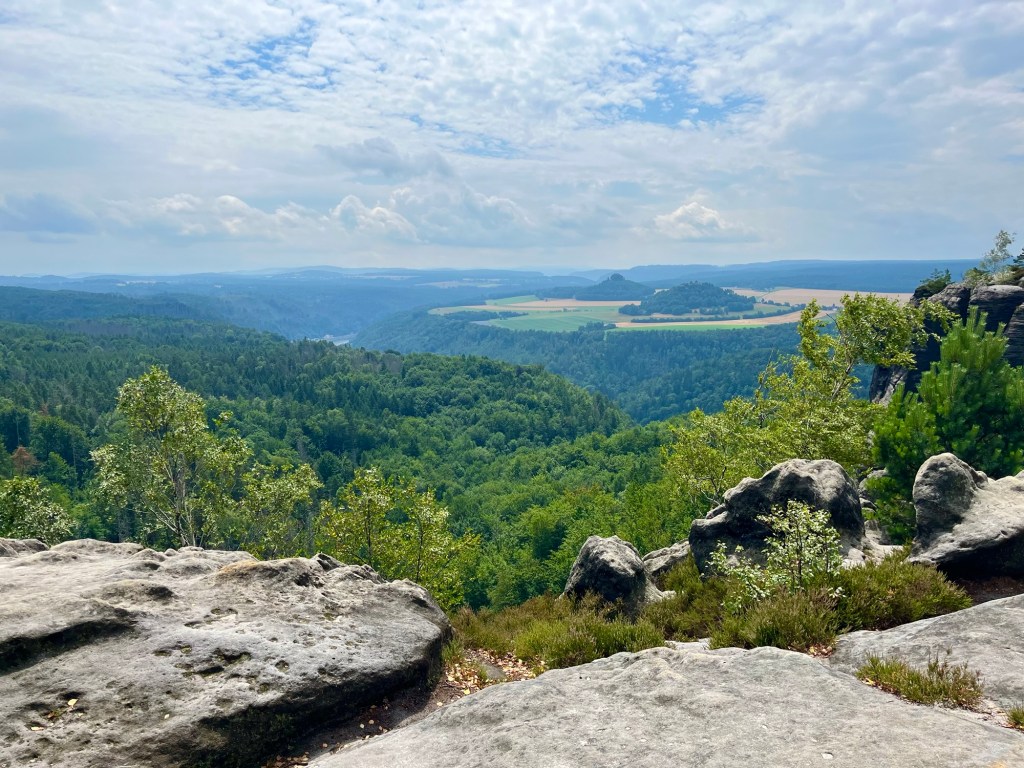
Off in the distance, you can see the channel carved by the Elbe River and across it, a plateau with farmland atop it.

For about an hour, we walked along the top of the sandstone ridge, with phenomenal views of Saxon Switzerland National Park. On occasion, we would have to climb on top of rocks formations, and sometimes we would need to descend. However, the whole time, we were enjoying breathtaking views of the Elbe River and the Elbe Sandstone Mountains.

Metal stairs poke up between rocks on the bluff

Finally, we began our descent out of the ridge and down along the edge of the sandstone pillars. We were in a pine forest, with the sandstone cliffs next to us. We were starting to get hungry and hoped to find civilization so we could stop for some food and a drink.

A railing along the edge of a steep drop-off.

While the hike had provided us with spectacular views, it hadn’t yet passed through any towns that had restaurants. This was unlike Stage Two of the Malerweg, which had plenty of opportunities to stop for a drink and a bite to eat. After about four hours and ten miles of hiking, we finally stopped at Lichtenhainer Wasserfall.

After the descent, we found this amazing tree and formation

Lichtenhainer Wasserfall is a waterfall with a beer garden and restaurant nearby. We both ordered sausages and potato salad, and enjoyed some rest by the waterfall. The food tasted great, but I couldn’t tell if it was because it was actually great or because the hiking had made me extremely hungry.

A section of the trail perched on the edge of a cliff

I had a couple of beers, including a dunkel made by Sachsisches Schmuggler, which is made in nearby Sebnitz. It hit the spot, and we were ready to head off into the woods again.

Biergarten at Lichtenhainer Wasserfall

We only had two or three miles left, so with food in our bellies, we were feeling pretty good. Unfortunately, it was only a matter of about 10 minutes before it started to completely downpour. At first, we put on our raincoats and continued on, thinking that the rain would have to break up eventually.

Lichtenhainer Wasserfall

The rain was so heavy that the raincoats were powerless to stop us from getting wet. We walked about a mile away from Lichtenhainer Wasserfall before giving up and walking back in the other direction. We really wanted to finish, but without really knowing how much further we needed to go and being completely soaked to the bone, we decided to return to Lichtenhainer Wasserfall and take the train back to Bad Schandau.

It was disappointing not to finish the rest of Malerweg Stage Four; however, I felt pretty sure that we had experienced most of the beauty of the stage, with all of the amazing views at the top of the ridge of the Elbe Sandstone Mountains. It was an absolutely amazing hike, and while I wish we had finished it, I was glad that we were able to do the parts that we did.

If you are thinking about hiking some of the Malerweg, I would highly recommend doing stage four. You should, however, keep in mind that there are parts of the trail that are very technical and sometimes dangerous. Just don’t be surprised if you get passed by a German family with a couple of grandparents and a four-year-old.

American Airlines makes Citi Thank You Points Much More Valuable

In a widely expected move, American Airlines is now a transfer partner from Citi Thank You Points. Rumors have been circulating since it was announced that American Airlines was phasing out its Barclay’s credit cards and signing an exclusive deal with Citibank. Finally, Citibank has added American Airlines to its Thank You Points transfer page, making those points much more valuable.

How This Transfer Partnership Works

People who hold a Citi Strata Premier, Citi Prestige, or Citi Strata Elite credit card can now transfer Citi Thank You Points to American Airlines AAdvantage Miles at a 1:1 ratio. Adding a coveted transfer partner makes any Citi Thank You Points much more valuable, especially since Citi is the only bank that transfers its points to American Airlines.

In addition, this also means that as long as you hold one of those cards, any points earned with a Citi credit card that earns Thank You Points, such as the Double Cash or Custom Cash, can also become AAdvantage Miles. This is because you can combine your Thank You Points and then transfer them to any of 15 airline partners or 5 hotel partners.

The reason why transferring points is so important is that in many cases, you can book hotels and flights with fewer points when you transfer them to a hotel or airline loyalty program. Even better, if what you’re looking for is actually a better deal to book with points through a travel portal, you have that option as well.

Domestic Airlines are (Mostly) Monogamous

Many international airline programs, like Air France/KLM Flying Blue, Avianca Lifemiles, and Air Canada Aeroplan, are polyamorous, allowing transfer partners from multiple bank points programs. For example, Flying Blue allows transfers from Chase, Citibank, American Express, Capital One, Bilt, and Wells Fargo. This is extremely common for international programs. Even Virgin Atlantic, despite its name, is a bit of a swinger.

Airlines based in the United States aren’t the swinging type; by comparison, they’re mostly monogamous. Delta Airlines only allows transfers from American Express Membership Rewards, American Airlines only allows transfers from Citi, and Alaska Airlines allows transfers from Bilt Rewards.

There are three airlines that, however, that aren’t exclusive. Southwest Airlines and United Airlines allow transfers from both Chase and Bilt, while JetBlue allows transfers from Citi, Chase, and American Express.

Your Airline Preferences Matter

Because of several factors, such as route networks, hub locations, award pricing, or just which airline you prefer, you should earn points that transfer to the airline that works best for you. For example, I know people who absolutely love Southwest Airlines. They fly a ton of flights out of Midway Airport in Chicago, which is an airport that isn’t far from where we live. Unfortunately, we do a lot of our flying to Europe, and Southwest Airlines doesn’t fly to Europe. We’re just not going to use it.

United Airlines flies to Europe and has a great network there, but generally, I find that it takes a lot of United miles to book a flight to Europe. Also, even though they fly out of my small home airport in Moline, the point prices for United flights out of Moline are extremely high.

Delta Skymiles is probably the most popular airline award currency in the world, but I struggle to find good value with Delta. They overcharge for one-way flights, and usually it’s difficult to find competitive pricing for round-trip tickets as well. That being said, I do occasionally find a great deal, and did recently book round-trip tickets in the summer for a little over 40,000 points each to Berlin. Unfortunately, those deals are not the easiest to find, and I don’t consistently find good value with Delta.

American Airlines, however, has a lot of great flights out of our local airport to Europe and some for extremely low prices, in points. In September, we are flying to Nice, France, from our local airport for only 19,000 AAdvantage miles each, and we were able to find a flight home from Dublin for only 19,000 miles as well. I have also seen several flights to Italy, Spain, and England for only 19,000 miles. Overall, it’s just a program that works well for us.

Those airline miles aren’t created equal either. The Points Guy does valuations each month, which look at the price of flights in miles and compare it to the price in cash for the same flights. In July 2025, the values of those domestic airline miles are:

  • Delta Skymiles- 1.15 cents per point
  • United Mileage Plus- 1.3 cents per point
  • Southwest Rapid Rewards- 1.4 cents per point
  • JetBlue TrueBlue – 1.45 cents per point
  • Alaska Airlines Mileage Plan- 1.5 cents per point
  • American Airlines AAdvantage – 1.55 cents per point

As you can see, according to the Points Guy, AAdvantage miles are the most valuable of the domestic airline currencies, so having an additional way to earn those miles is a very good thing.

This Will Shift My Focus to Citi

Lately, I’ve been concentrating on earning American Express Membership Reward Points and Chase Ultimate Rewards. That’s because they have excellent ways of earning points, and they have great transfer partners. Both have great ways of accumulating points through sign up bonuses and cards with great earning rates.

For example, we put all our internet and cell phone charges on our Chase Ink Cash card because it earns 5x in those categories. Also, as much as possible, we use our Amex Gold Card for restaurants and grocery stores because they earn 4x in those categories. Those are both great ways to accumulate a lot of points without sign up bonuses.

However, with Citi, I have a Custom Cash card which earns 5x on all spending in your top category, up to $500 in a billing cycle. This means that if you pick a category that you can come close to spending $500 on each month and only use it in that category, you can accumulate 2,500 Citi Thank You points each month without a lot of spending. I haven’t been doing that, however, because I just wasn’t that excited about accumulating Citi Thank You Points.

The partnership with American Airlines changes that. Because AAdvantage miles are very valuable to me, I will be going out of my way to earn Citi Thank You Points so I have points available to transfer to American Airlines.

Current Citi Strata Travel Credit Cards

Now that Citibank has revamped its travel cards, they are currently offering three different credit cards that all earn Citi Thank You Points: one is an entry-level card, one is a travel card, and one is a premium travel card.

Citi Strata Card

This is the entry-level travel card, and it is a pretty good starter card. It has no annual fee and is currently offering a 30,000-point welcome offer if you spend $1,000 in 3 months. For being a no annual fee card, it has tremendous bonus categories including 5x on travel through the Citi Travel Portal, 3x at supermarkets, 3x on gas and EV stations, 3x on a self-selected category, 2x on dining, and 1x everywhere else.

The downside is that it has a limited number of transfer partners (Does not allow transfers to AAdvantage), and those points transfer at a worse ratio. You could however, hold onto those points until you get a Citi credit card with a better transfer ratio, or perhaps transfer those points to a family member who holds a Citi credit card with better transfer options and have them book flights or hotels for you.

Citi Strata Premier

The Citi Strata Premier is a great travel credit card. It has a $95 annual fee and is currently offering a 60,000-point bonus if you spend $4,000 in the first 3 months. It offers 10x on hotels, attractions, and car rentals booked through the Citi Travel Portal, 3x on other air and hotel purchases, 3x on supermarkets, 3x on restaurants, 3x on gas and EV Charging stations, and 1x on everything else.

Unlike the Citi Strata Card, the Citi Strata Premier transfers to all of Citi’s partners at the best transfer rate that Citi offers. This also includes the 1:1 ratio to American Airlines. In addition, the Citi Strata Premier also offers a variety of benefits, including trip delay coverage, trip cancellation, and protection insurance, lost and damaged luggage coverage, and some car rental coverage.

Citi Strata Elite

The Citi Strata Elite is a brand-new premium credit card offering from Citibank with a $595 annual fee. It is currently offering an 80,000 point bonus when you spend $4,000 on the card in the first 3 months. It earns 12x on hotels, car rentals, and attractions booked through the Citi Travel Portal, 6x on air travel through the Citi Travel Portal, 6x on dining on Friday and Saturday nights, 3x on dining other nights, as well as 1.5x on all other purchases.

To compensate for the high annual fee, it offers $300 per year in hotel credits, $200 on an annual splurge credit, $200 Blacklane credit, a Priority Pass Select Membership, 4 American Airlines Admirals Club Lounge passes, as well as a $120 Global Entry or TSA pre-check credit.
My Favorite Strata Card

In my opinion, the Citi Strata Premier Card is the best of this group. The 3x categories of groceries, dining, and gas can help users accumulate a lot of points quickly. It has access to all of the transfer partners that the Citi Strata Elite card does, but with a $95 annual fee instead of a $595 annual fee. Also, I don’t find the credits on the Strata Elite to be enticing enough to pay an extra $500 on an annual fee. The only reason I would consider the Strata Elite is if I were a very frequent flyer, and I used those lounge passes a lot.

Being Strategic about Your Credit Card Choices

The points and miles world is extremely complicated. There are multiple banks with multiple cards, and each comes with different earning rates, benefits, and transfer partners. If you wish to turn all of your everyday purchases into great vacations, it’s important to try to be as strategic as possible.

For travel hackers who are using points to supercharge their travel, they must use the points programs that fit their travel plans the best. That really means working backwards from the destinations that you would like to visit, figuring out the best airlines that service those destinations from where they live, and then trying to figure out the best way to earn points to use with that airline. If American Airlines miles are a good fit for your travel plans, then this new partnership with Citi is a very exciting development.