Recently, the news broke that starting November 30th, 2025, Wyndham points will no longer be redeemable for Vacasa vacation rentals. Earlier this year, Casago, a vacation rental management company purchased Vacasa. Casago apparently didn’t like the arrangement with Wyndham and now has ended it.
What was the Vacasa/Wyndham Partnership?
Vacasa had a deal with Wyndham, which allowed people to rent vacation rentals that were posted on the Vacasa website with Wyndham points. Originally, they charged 15,000 Wyndham points per bedroom per night up to $500 per night, but eventually shrank that to $250 per bedroom per night. What that essentially meant was that for a one-bedroom vacation rental, if its cash rate was less than $250 per night, you could rent that for 15,000 Wyndham points per night. If it was a two-bedroom vacation rental with a cash rate under $500 per night, you could rent that for 30,000 Wyndham points per night.
View from Vacasa Jenn stayed at in Playa del Carmen
This was a tremendous deal, but it was made even better with the fact that Wyndham has one of the best/quirkiest business credit cards available. The Wyndham Business Earner card earns 5 points per dollar on utilities and 8 points per dollar at gas stations. At 8 points per dollar at gas stations, it’s not hard to imagine that someone who drives a lot could earn a ton of Wyndham points quickly. Holding that card also meant you got a 10% discount on points redemptions, making those Vacasa rentals 13,500 Wyndham points instead of 15,000 points.
For us, it was a way to quickly accumulate a lot of points that we could use for a vacation rental. We had actually booked with Vacasa using Wyndham points twice, once for a beachfront condo in Playa del Carmen and once for a condo in Nashville. Both were tremendous deals. In general, we prefer vacation rentals over hotels when they are available, and now the best method for booking them with points is no longer available.
What are the Alternatives?
Some partnerships could potentially be interesting. Hyatt has a Homes & Hideaways vacation rental program, and Choice has a partnership with Bluegreen Vacations, but both of those seem really limited in terms of properties. Marriott Homes and Villas has quite a few properties, but given the number of points needed to book a stay there, I wouldn’t even consider using points for it. I would consider paying for a Marriott Homes and Villas to earn Marriott points though.
If you can find vacation rentals through one of the bank travel portals, such as Amex Travel, Chase Travel, or Capital One Travel, you could potentially book on points that way. To be honest, though, nothing is really going to replace the Wyndham/Vacasa partnership. It was just a great way to get value for Wyndham points and rent a vacation rental for no out-of-pocket cost.
What am I to do with all these Wyndham Points?
One of the things that is painful about this is that we’ve been earning 2,000 to 3,000 Wyndham points monthly on the Wyndham Business Earner card, thinking that we would at some point book a Vacasa when we were vacationing in Mexico or the US (Vacasa doesn’t operate in Europe, where our recent vacations have been). Now we have close to 100,000 Wyndham points that would have gone a long way with Vacasa. Now what? Am I stuck with a bunch of points that are only good at places like Travelodge, Super 8, and La Quinta?
Ok, let’s be honest, Wyndham hotels aren’t typically high-end hotels. It’s known for its no-frills brands. That being said, Wyndham has been trying to expand its portfolio of hotels to include all-inclusive resorts in their Alltra brand as well as a boutique brand called the Registry Collection.
This appears to be working, as I was able to find several hotels in areas where luxury and all-inclusive hotels are typically located. There are nine all-inclusive resorts in the Riviera Maya area in Mexico alone, most of which were bookable for only 30,000 Wyndham points.
Additionally, they offer Club Wyndham, a timeshare organization that allows individuals to book select properties. Although most of those apartments will be occupied by timeshare owners, some are available for rent with cash or points.
Personally, I have a feeling we will be leaning toward an occasional all-inclusive stay. For 30,000 Wyndham points per night for many of those resorts, a couple of nights testing my liver at the pool sounds like a good use of all of those hard-earned Wyndham points.
Conclusion
The ending of the relationship between Wyndham and Vacasa is quite a bummer. There isn’t a good alternative way to book a vacation rental property at a good value using points. Since that was my primary reason for accumulating Wyndham points, I really thought long and hard about whether I would just use up what points we have left and abandon the program.
The problem with that thought is that the Wyndham Business Earner card earns 8x on gas and 5x on Utilities, which is so good that I would almost have to have no other use for the points to stop using that credit card. The earnings are too good, I just need to find a decent use for those points.
For the time being, I think we will try using them on all-inclusive resorts, and if we don’t like the quality, then we will have to use them on random hotel stays. For now, I think that’s okay, but I’m just not happy about this.
When our kids were younger, we used to do the typical Midwestern “I’m tired of the snow” Spring Break trips. This usually meant a 15-hour drive each way so that we could rent an Airbnb somewhere along the Gulf of Mexico between Gulf Shores, Alabama, and Destin, Florida. Every year, it seemed like these vacation rentals would get more expensive, the beaches more crowded, and the trips overall became less and less enjoyable.
After four years of doing that, I was bored with the same old Spring Break trips. When we got into points and miles, I started looking for more exotic ways of spending Spring Break. A couple of years ago, we took a trip to Costa Rica, where we rented a house near Grecia, a fairly small community in the Central Valley more known for agriculture than tourism. We spent the week hiking to waterfalls and on volcanoes and eating local cuisine.
One of the seven falls at the Blue Falls of Costa Rica
This year, for Spring Break, we went to Spain and Portugal to hike the Portuguese route of the Camino de Santiago. It was an amazing trip, but it was physically challenging. It resulted in Achilles’ tendon inflammation, hip bruises, and blisters. Because of that, I had to promise to plan a much more relaxed Spring Break trip; otherwise, my family might murder me.
Walking through the city walls in Valenca, Portugal.
After a couple of pretty active Spring Break vacations, we decided it was time to find a beach again, but this time, not in the United States.
Why Visit The Canary Islands?
The Canary Islands are a set of volcanic islands off the coast of Africa, near Morocco. It has been a part of Spain since the late 1400’s, when they conquered the island from the native Guanche population. While tourism is popular throughout the islands, Tenerife is the most popular island, with over 5 million annual visitors.
Jenn and I have talked about visiting the Canary Islands for a while. It’s intrigued me, since it’s a very popular destination for European travelers, but mostly unknown to American travelers. There are no direct flights between the US and the Canary Islands, even though there are seemingly endless flights between Europe and the US. It’s basically a secret to Americans.
This, however, makes it a perfect alternative to typical Spring Break destinations. It has all of the trappings of a tourist hotspot, but because Europe doesn’t have Spring Break, it’s not going to be busy. Even though it’s bit further from the US, and there are no direct flights, I thought it would make for a better trip.
Screenshot from Google Maps shows plenty of resorts and condo complexes in Playa de las Americas, Spain. From the aerial photo, this looks like any major beach town in Florida.
The weather during March is fairly similar to Florida, with high temperatures in the low to mid-70s. The climate in South Tenerife, where we are flying to, is considerably drier than Florida as well, which should mean the chances of being rained out are much smaller.
In addition to Tenerife’s beach life, it’s an Island with an active volcano, Mount Teide, which is over 12,000 feet high. Because of that volcano, Tenerife has a dramatic landscape and amazing hiking trails.
Booking the Trip
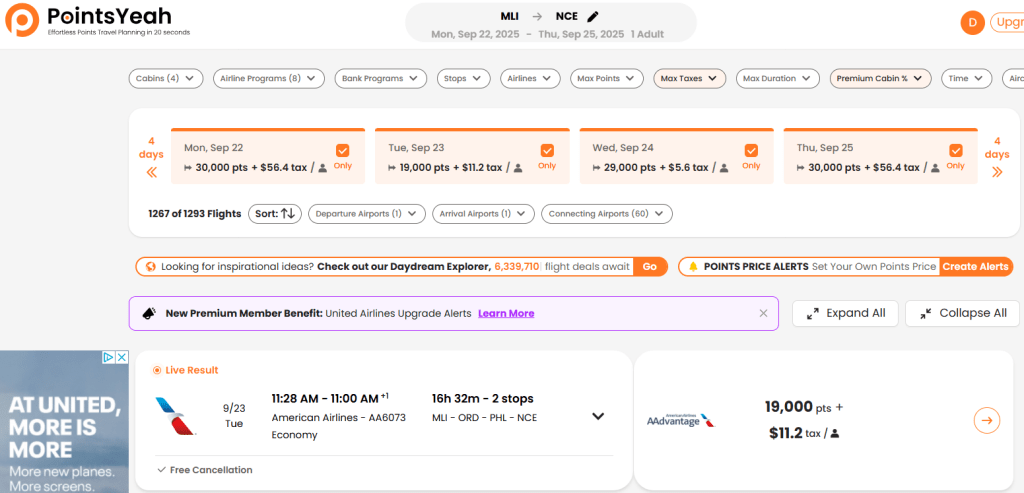
I started by searching on PointsYeah for flights from our home airport, Moline, to Tenerife, but most of the available flights were a ton of points or less than ideal. For example, the quickest itinerary included a stop in London with an airport change. I’m not thrilled about the idea of switching airports in the middle of a flight itinerary; there are just too many things that could go wrong. After searching for a while, I became convinced it would be better to book a flight to Europe and then move on to Tenerife.
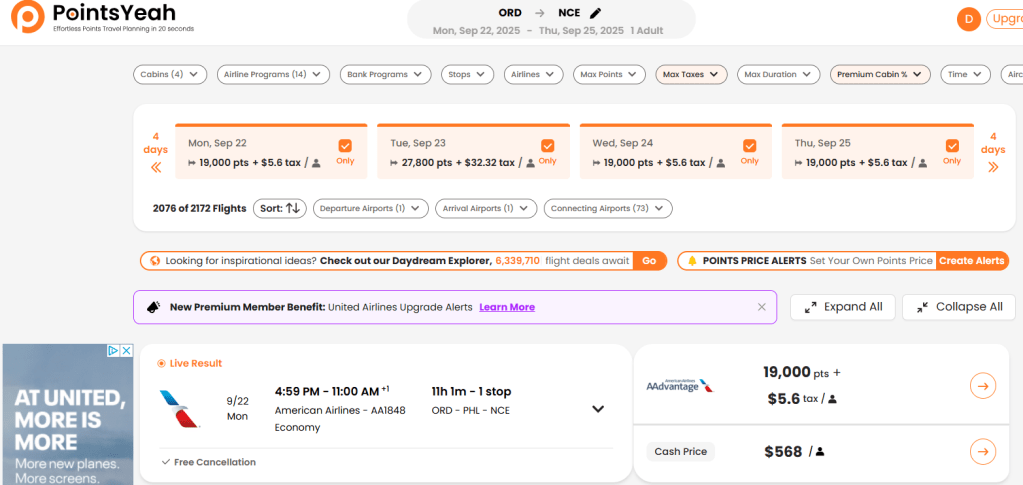
Because Tenerife had a lot of flights that arrive from all over Europe, I went looking for any flight to Europe that was inexpensive on points. I was able to find a flight on American Airlines that landed in London Heathrow for 19,000 American Airlines miles and $5.60. The total time on the flight is less than 11 hours. I was pretty happy with that.
From London Gatwick, we can fly to Tenerife South airport on a direct flight for 13,750 British Airways Avios and $1. The flight into London lands on Tuesday morning, so we decided to book the flight out for Thursday morning, to give us a couple of days in London. That is great because we are able to get to Tenerife for 32,750 points and under $7 each, and we also get a short visit to London.
For our flight back, the only thing that was comparably reasonable was a flight on American Airlines from Madrid through Chicago and back to Moline for 34,000 AAdvantage miles and around $50. We also need to get from Tenerife to Madrid, but there are direct cash flights available on Iberia Airlines for only around $50, so it’s better to pay cash than use points. We plan to fly to Madrid the morning before our flight to Moline so we can spend one afternoon and evening there.
We were able to use a couple of Hyatt category 1-4 hotel certificates to book two rooms for our first night in London (one for Jenn and me and one for the kids, since, as usual, there aren’t many hotels in Europe that accommodate families of four). While I don’t obsess about maximizing the value of those certificates, London is an extremely expensive city, so we booked the nearest hotel to the downtown that would accept those certificates. That was the Hyatt Place London City, and for that night, the rooms would have cost $300 each, which is about the maximum value you can get for one of those certificates.
For the second night, we booked a Courtyard by Marriott near the London Gatwick airport that did accommodate a family of four, which should allow us to get to the airport quickly for our morning flight to Tenerife. We used a Marriott free night certificate that is good up to 35,000. That room would have cost around $190, so I’m pretty happy with the use of that certificate as well.
We were also able to book a couple of rooms in Madrid, for the one night we plan to spend there before flying out. For that, we used Jenn’s $150 Delta Stays credit that comes with her Delta Gold Card.
Aside from that, we haven’t booked an Airbnb in Tenerife for the 5 nights we are there, but I expect, based on the prices I’ve seen, that we should be able to book something nice with a heated pool for around $900 that will accommodate the family. I also expect to spend around $200 for a car rental, again based on what I’ve seen in searches for car rentals in the Canary Islands.
Total Cost
When we put all of that together, I expect that we will spend 212,000 American Airlines miles, 55,000 British Airways Avios (transferred from Chase Ultimate Rewards), and about $1,500 to book all of our transportation and lodging. That’s really good, and we will get to experience a Spring Break-like destination without the Spring Break crowds. I’m pretty happy about that. In addition, we get to spend some time in London and Madrid as well, which is fantastic.
I looked up the total cost of the exact flight itinerary, booked through British Airways, and I was surprised to find that the itinerary with stopovers in London and Madrid was only $880 each. That’s actually a really good deal. You could completely recreate what we did without points for around $5,500. Anyone who has priced flights, car rentals, and an Airbnb in Florida might want to reconsider their trip at those prices.
We were able to book that for $1,500, but if you consider that we probably needed around $600 in credit card annual fees to make this work, you could say that we would end up spending $2,100. But wow, for a little over two thousand dollars, we have the opportunity to visit London, Madrid, and the Canary Islands. That’s pretty amazing, and it’s exactly why we’re points and miles junkies.
Now it’s just a matter of deciding where we want to stay and booking the Airbnb. Then we can dream of lying on the beach and soaking in the sun. Don’t tell the kids, but I’m definitely going to drag them on some hikes.
Airlines make announcements about new routes all the time, and most of them don’t interest me very much, but the latest press release about United expanding its seasonal routes in Europe piqued my interest. These new routes seem to be targeting American tourists who have been to Europe, perhaps multiple times, and are looking for something a little different than the normal European stops like Paris, London, or Rome.
The destinations they have chosen to expand to are places that would be on a bucket list for experienced travelers. They definitely speak to me personally, since each one of these are places where I would like to visit.
Glasgow, Scotland
Starting on May 8th, United will start a daily flight from Newark to Glasgow, Scotland. This is probably the least quirky of the destinations that United picked. Scotland is a destination that I could imagine someone traveling to on their first big international trip. The cultural and language similarities to the United States make it an easier trip. It would also appeal to people who didn’t want to visit a huge European city like London or Paris.
Glasgow and nearby Edinburgh are Scotland’s population and cultural centers. They are less than an hour’s train ride apart, making it easy to visit both cities on the same trip. Around Glasgow, there are also many castles to visit, such as Stirling Castle, Doune Castle, and Bothwell Castle.
You can also take the train from Edinburgh or Glasgow through the Scottish highlands. I once asked a Scotsman where he would recommend going if I were to visit Scotland and he was practically gushing about how beautiful train trips through the highlands are. I will definitely be taking his advise on that someday.
Glasgow, I believe, will appeal to more Americans as a destination than the other new destinations that were unveiled by United. The others may be a little more obscure, but they are fantastic destinations.
Bari, Italy
Have you ever found yourself dining outdoors at a restaurant in Florence or Rome and thought “I wish the food was better in Italy?” Probably not, but apparently the region of Puglia in Italy has food that puts other Italian food to shame. I’m not sure how this is possible, but I’m willing to give it a try.
Bari is located on the heel of the boot of Italy, along the Adriatic Sea. It is famous for its beaches, focaccia, pasta, and polenta.
From Bari, it’s about an hour by car to Alberobello, a UNESCO world heritage site known for its Trulli houses. These are unique structures made of limestone with conical roofs.
Bari is less of a tourist trap than other parts of Italy, such as Rome, Florence or Venice. This might make things a little more complicated for people who don’t speak Italian, but it is a great way to experience more authentic Italy than those major tourist destinations.
United will begin flying to Bari four times a week beginning May 1st, 2026.
As the memory of the Yugoslav Wars that took place from 1991 to 2001 fade from memory, the Balkan countries have received more and more attention for being great tourist destinations. Split, Croatia has become a popular destination for its beautiful city as well as the crystal clear, deep blue waters of the Adriatic.
From Split, you can use ferries to go to some of the amazing islands in the Adriatic, such as Brac, Vis, Bol, Korcula and Milna. You can also take the opportunity to visit the beautiful walled city of Dubrovnik.
Croatia has been growing in popularity for a while now and its no surprise to me that United Airlines wants to capitalize on the growing popularity. It’s an absolutely beautiful country, and its been on my short list for a while.
Starting April 30th, United begins seasonal direct flights from Newark to Split.
Santiago de Compostela
Santiago de Compostela is a fairly small community in the Galicia region of Spain. It has a population of around 100,000, The reason United Airlines would be interested in bringing direct flights there, however, is because it’s where the Camino de Santiago ends.
The Santiago de Compostela Archcathedral Basilica is the end point for all of the Camino de Santiago routes.
The Camino is a unique cultural experience. It consists of hiking one of multiple routes, the most famous is the French Way which starts in France and continues across Northern Spain to Santiago de Compostela. Some of these routes take over a month to complete and others a couple of weeks. Pilgrims, however, can choose to start their journey from anywhere and an official pilgrimage is anything more than 100 kilometers that ends at the Cathedral in Santiago de Compostela. Along the way there are hotels or hostels to stay at as well as a variety of pilgrim-friendly restaurants.
For those brave souls who wish to participate in the Camino, United Airlines will start service three times per week from Newark to Santiago de Compostela on May 22nd, 2026 and continues through September 20th.
Flights out of Newark
So the good news is that these are amazing destinations but the bad news is they all originate in Newark. The Newark Airport has had all kinds of problems and I typically try to avoid flying out of there when possible. Since Newark completed reconstruction of a runway in June, I haven’t heard of as many issues in that airport, so hopefully service out of Newark is improving.
Newark has connections to more than 100 US cities on United, so you shouldn’t have too much difficulty finding connecting flights. This should make these flights accessible for much of the United States.
Award Prices
Right now, the award pricing on these flights are fairly elevated. This isn’t a surprise, since these are new routes. In the future, I would expect some award prices of these flights to dip down to United’s saver rates of around 40,000 points one-way for a flight to Europe. If you see those saver rates on one of these flights, I would also check Singapore Airlines. Often, you can book the exact same flight, if it’s a United saver award, for only 30,500 points. For more information, I have a post about how to use the Singapore Airlines partnership.
It’s also easier to get Singapore miles since they transfer from Citi Thank You points, Chase Ultimate Reward points, American Express Membership Reward points, a Capital One Venture miles. United miles can only be transferred from Chase Ultimate Rewards.
Conclusion
These newly added seasonal routes for United add great direct flights from the United States to amazing destinations that are on the radar for people who have a little experience going to Europe and would like to try something a little different. These are all fantastic choices and would make for a great vacation. These destinations certainly have me thinking about future trips.
If you are traveling to Germany, you might be surprised to find out that your best public transportation option might just be a program developed for German citizens. The Deutschland Ticket or D-Ticket was first introduced in May 2023 as a joint venture between the German government and the individual regions within Germany. The original cost was 49 Euros, which was raised to 58 Euros in January 2025.
What is the Deutschland Ticket?
Deutschland Ticket is a subscription service that allows you to travel on virtually any public transportation system in Germany for one price. This eliminates the need to navigate multiple apps and ticketing systems for different public transportation systems in Germany. The service covers buses, trams, subways, and trains throughout Germany.
The Deutschland Ticket doesn’t, however, cover travel between cities. This means that long-distance buses such as Flixbus or Intercity Express (ICE), Intercity (IC), or Eurocity (EC) trains are not included. For example, when my son and I were in Germany recently, we had to purchase separate tickets for travel between Dresden and Berlin.
My Experience with the Deutschland Ticket
When I was planning our trip to Germany this summer, the plan was to spend six nights in Dresden and two nights in Berlin. We were also going to visit Saxon Switzerland National Park for a few days while staying in Dresden.
What this meant for me was that I needed to figure out how to navigate as well as purchase tickets for three separate transportation systems in Berlin, Dresden, and Saxon Switzerland National Park. That is a giant headache to deal with because if you don’t want to overspend on tickets, you need to know how much you plan to use that system. Should I get a single-day pass, a single-journey pass, or a week pass? How many fare zones do I plan to travel in? It can get overwhelming in a hurry.
For example, on the Dresden Public Transportation website, there is a map, ironically labeled “Fare Zones made easy,” showing the 21 fare zones in the Dresden Public Transportation system. That’s right, 21 zones. The prices vary depending on how many zones you plan to travel in.
I spent a considerable amount of time trying to figure out that I would need to purchase a ticket that was good for a week in two zones, plus Dresden. For a week, that would have cost almost 45 Euros per person. That also limited us to just part of the system around Dresden.
On top of that, I was going to need to buy tickets in Berlin as well as inside Saxon Switzerland National Park. I knew that the Deutschland Ticket was only 58 Euros, so it didn’t take me too long to realize that it was going to be cheaper and much simpler to just buy the D-ticket.
In practice, it was a huge relief to have the Deutschland Ticket. I didn’t spend any time worrying about whether or not my ticket was valid for any place I wanted to go. If it was public transportation, it was covered – all I needed to worry about was which train, tram, or bus to take.
This actually expanded where we traveled because we decided at the last minute to visit Meissen, which would have been in a fare zone not covered by the Dresden week pass. Having the pass meant that we actually went the full length of the train system from Meissen to the Czech border, which is about 50 miles apart. Knowing that was all covered by one ticket was incredibly valuable.
The Simplicity of the D-Ticket
The best thing about holding the Deutschland Ticket is the fact that it simplifies your experience on German public transportation. Purchasing separate tickets for each city means that you will need that city’s phone app in order to purchase tickets and view routes. If you purchase the D-Ticket, however, you can buy it on any of those apps you choose, and you only need that one app, not a different app when you visit a new city. The QR code on that app works anywhere the D-Ticket is valid.
In fact, we weren’t visiting Munich, but I already had that app on my phone, so I purchased my ticket using that app. Whenever I needed to show my ticket while I was in Dresden, Berlin, or in Saxon Switzerland National Park, I simply opened the Munich app and flashed the QR code. It really simplified things for us. Meanwhile, for routes and times, we used the transit features within Apple Maps.
The Deutschland Ticket is a Subscription Service
There are some downsides to using the D-Ticket that might keep you from wanting to use it. The negatives revolve around it being a subscription service that renews at the end of the month. While the ticket is allowed for use by tourists, it’s generally meant for use by residents. So the rules are set up for residents, not tourists.
The first issue is that it renews at the beginning of the month. This means that if you are planning a trip that starts in one month and ends in the next month, you will end up paying the 58 Euro subscription fee twice. If you are only visiting Germany for a week and have to pay 116 Euros, you might rethink the D-Ticket.
The other problem is that you really need to plan ahead. It is required that you cancel your subscription before the 10th of the previous month. For example, if you are going to Germany from October 15th to October 25th, you need to purchase the ticket between September 1st and September 9th, and then cancel the subscription before the 10th. It seems counterintuitive to cancel something before you start to use it, but once you’ve purchased the Deutschland Ticket you have that ticket for the next month.
All purchases are final, and you can purchase the Deutschland Ticket in the same month that you use it, but you won’t be able to cancel it for the first month. In other words, if you don’t plan ahead, you will be required to purchase it for two months.
Purchasing the Deutschland Ticket
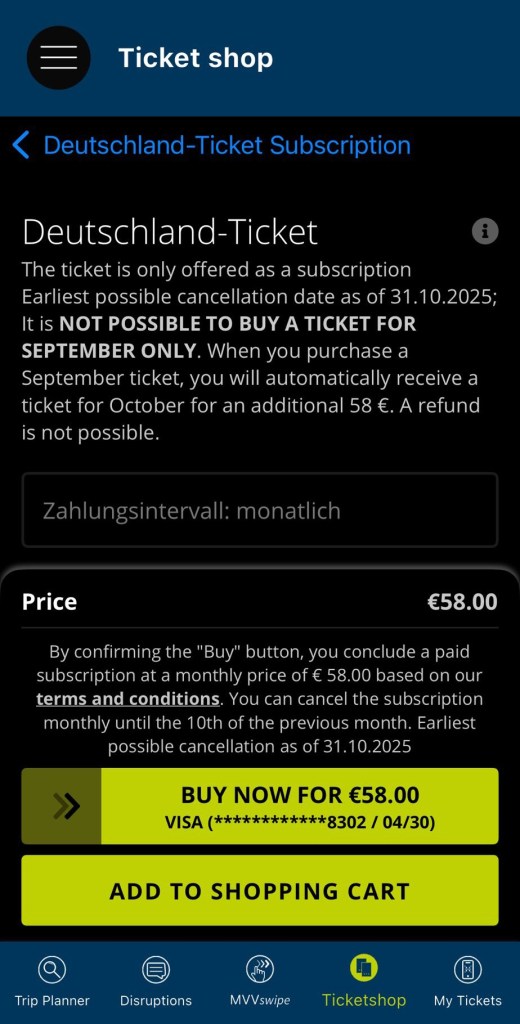
The actual purchasing of the Deutschland Ticket is fairly easy. I used the MVV app which is Munich’s public transportation phone app. You can find the Deutschland Ticket subscription in the Ticketshop tab at the bottom of the screen. Once you are there, select Deutschland Ticket Subscription.
Once you get to that point, all you need to do is enter your payment method (they accept US credit cards), and complete the payment.
If you are only trying to purchase your ticket for one month, you must remember to purchase and cancel the ticket before the tenth of the previous month otherwise you will be charged for a second month.
Conclusion
The Deutschland Ticket is a great way for tourists, especially those visiting multiple German cities, to simplify their public transportation needs. You can travel on virtually all forms of public transport within cities, hold only one ticket, and use only one app.
It’s very likely it will save you money on your trip as well, since purchasing individual tickets or day/week passes can add up quickly. The biggest headache is managing the subscription. But if you make sure you understand the subscription rules and are able to purchase and cancel the subscription within the correct time period, you’ll be thankful you had it.
In a widely expected move, American Airlines is now a transfer partner from Citi Thank You Points. Rumors have been circulating since it was announced that American Airlines was phasing out its Barclay’s credit cards and signing an exclusive deal with Citibank. Finally, Citibank has added American Airlines to its Thank You Points transfer page, making those points much more valuable.
How This Transfer Partnership Works
People who hold a Citi Strata Premier, Citi Prestige, or Citi Strata Elite credit card can now transfer Citi Thank You Points to American Airlines AAdvantage Miles at a 1:1 ratio. Adding a coveted transfer partner makes any Citi Thank You Points much more valuable, especially since Citi is the only bank that transfers its points to American Airlines.
In addition, this also means that as long as you hold one of those cards, any points earned with a Citi credit card that earns Thank You Points, such as the Double Cash or Custom Cash, can also become AAdvantage Miles. This is because you can combine your Thank You Points and then transfer them to any of 15 airline partners or 5 hotel partners.
The reason why transferring points is so important is that in many cases, you can book hotels and flights with fewer points when you transfer them to a hotel or airline loyalty program. Even better, if what you’re looking for is actually a better deal to book with points through a travel portal, you have that option as well.
Domestic Airlines are (Mostly) Monogamous
Many international airline programs, like Air France/KLM Flying Blue, Avianca Lifemiles, and Air Canada Aeroplan, are polyamorous, allowing transfer partners from multiple bank points programs. For example, Flying Blue allows transfers from Chase, Citibank, American Express, Capital One, Bilt, and Wells Fargo. This is extremely common for international programs. Even Virgin Atlantic, despite its name, is a bit of a swinger.
Airlines based in the United States aren’t the swinging type; by comparison, they’re mostly monogamous. Delta Airlines only allows transfers from American Express Membership Rewards, American Airlines only allows transfers from Citi, and Alaska Airlines allows transfers from Bilt Rewards.
There are three airlines that, however, that aren’t exclusive. Southwest Airlines and United Airlines allow transfers from both Chase and Bilt, while JetBlue allows transfers from Citi, Chase, and American Express.
Your Airline Preferences Matter
Because of several factors, such as route networks, hub locations, award pricing, or just which airline you prefer, you should earn points that transfer to the airline that works best for you. For example, I know people who absolutely love Southwest Airlines. They fly a ton of flights out of Midway Airport in Chicago, which is an airport that isn’t far from where we live. Unfortunately, we do a lot of our flying to Europe, and Southwest Airlines doesn’t fly to Europe. We’re just not going to use it.
United Airlines flies to Europe and has a great network there, but generally, I find that it takes a lot of United miles to book a flight to Europe. Also, even though they fly out of my small home airport in Moline, the point prices for United flights out of Moline are extremely high.
Delta Skymiles is probably the most popular airline award currency in the world, but I struggle to find good value with Delta. They overcharge for one-way flights, and usually it’s difficult to find competitive pricing for round-trip tickets as well. That being said, I do occasionally find a great deal, and did recently book round-trip tickets in the summer for a little over 40,000 points each to Berlin. Unfortunately, those deals are not the easiest to find, and I don’t consistently find good value with Delta.
American Airlines, however, has a lot of great flights out of our local airport to Europe and some for extremely low prices, in points. In September, we are flying to Nice, France, from our local airport for only 19,000 AAdvantage miles each, and we were able to find a flight home from Dublin for only 19,000 miles as well. I have also seen several flights to Italy, Spain, and England for only 19,000 miles. Overall, it’s just a program that works well for us.
American Airlines AAdvantage – 1.55 cents per point
As you can see, according to the Points Guy, AAdvantage miles are the most valuable of the domestic airline currencies, so having an additional way to earn those miles is a very good thing.
This Will Shift My Focus to Citi
Lately, I’ve been concentrating on earning American Express Membership Reward Points and Chase Ultimate Rewards. That’s because they have excellent ways of earning points, and they have great transfer partners. Both have great ways of accumulating points through sign up bonuses and cards with great earning rates.
For example, we put all our internet and cell phone charges on our Chase Ink Cash card because it earns 5x in those categories. Also, as much as possible, we use our Amex Gold Card for restaurants and grocery stores because they earn 4x in those categories. Those are both great ways to accumulate a lot of points without sign up bonuses.
However, with Citi, I have a Custom Cash card which earns 5x on all spending in your top category, up to $500 in a billing cycle. This means that if you pick a category that you can come close to spending $500 on each month and only use it in that category, you can accumulate 2,500 Citi Thank You points each month without a lot of spending. I haven’t been doing that, however, because I just wasn’t that excited about accumulating Citi Thank You Points.
The partnership with American Airlines changes that. Because AAdvantage miles are very valuable to me, I will be going out of my way to earn Citi Thank You Points so I have points available to transfer to American Airlines.
Current Citi Strata Travel Credit Cards
Now that Citibank has revamped its travel cards, they are currently offering three different credit cards that all earn Citi Thank You Points: one is an entry-level card, one is a travel card, and one is a premium travel card.
Citi Strata Card
This is the entry-level travel card, and it is a pretty good starter card. It has no annual fee and is currently offering a 30,000-point welcome offer if you spend $1,000 in 3 months. For being a no annual fee card, it has tremendous bonus categories including 5x on travel through the Citi Travel Portal, 3x at supermarkets, 3x on gas and EV stations, 3x on a self-selected category, 2x on dining, and 1x everywhere else.
The downside is that it has a limited number of transfer partners (Does not allow transfers to AAdvantage), and those points transfer at a worse ratio. You could however, hold onto those points until you get a Citi credit card with a better transfer ratio, or perhaps transfer those points to a family member who holds a Citi credit card with better transfer options and have them book flights or hotels for you.
Citi Strata Premier
The Citi Strata Premier is a great travel credit card. It has a $95 annual fee and is currently offering a 60,000-point bonus if you spend $4,000 in the first 3 months. It offers 10x on hotels, attractions, and car rentals booked through the Citi Travel Portal, 3x on other air and hotel purchases, 3x on supermarkets, 3x on restaurants, 3x on gas and EV Charging stations, and 1x on everything else.
Unlike the Citi Strata Card, the Citi Strata Premier transfers to all of Citi’s partners at the best transfer rate that Citi offers. This also includes the 1:1 ratio to American Airlines. In addition, the Citi Strata Premier also offers a variety of benefits, including trip delay coverage, trip cancellation, and protection insurance, lost and damaged luggage coverage, and some car rental coverage.
Citi Strata Elite
The Citi Strata Elite is a brand-new premium credit card offering from Citibank with a $595 annual fee. It is currently offering an 80,000 point bonus when you spend $4,000 on the card in the first 3 months. It earns 12x on hotels, car rentals, and attractions booked through the Citi Travel Portal, 6x on air travel through the Citi Travel Portal, 6x on dining on Friday and Saturday nights, 3x on dining other nights, as well as 1.5x on all other purchases.
To compensate for the high annual fee, it offers $300 per year in hotel credits, $200 on an annual splurge credit, $200 Blacklane credit, a Priority Pass Select Membership, 4 American Airlines Admirals Club Lounge passes, as well as a $120 Global Entry or TSA pre-check credit.
My Favorite Strata Card
In my opinion, the Citi Strata Premier Card is the best of this group. The 3x categories of groceries, dining, and gas can help users accumulate a lot of points quickly. It has access to all of the transfer partners that the Citi Strata Elite card does, but with a $95 annual fee instead of a $595 annual fee. Also, I don’t find the credits on the Strata Elite to be enticing enough to pay an extra $500 on an annual fee. The only reason I would consider the Strata Elite is if I were a very frequent flyer, and I used those lounge passes a lot.
Being Strategic about Your Credit Card Choices
The points and miles world is extremely complicated. There are multiple banks with multiple cards, and each comes with different earning rates, benefits, and transfer partners. If you wish to turn all of your everyday purchases into great vacations, it’s important to try to be as strategic as possible.
For travel hackers who are using points to supercharge their travel, they must use the points programs that fit their travel plans the best. That really means working backwards from the destinations that you would like to visit, figuring out the best airlines that service those destinations from where they live, and then trying to figure out the best way to earn points to use with that airline. If American Airlines miles are a good fit for your travel plans, then this new partnership with Citi is a very exciting development.
Aer Lingus Avios is a tremendous program that almost nobody in the points and miles community talks about. The program is great because it provides a predictably great value on award flights. It is also easy to accumulate points because of its great transfer partners. What makes it fly under the radar, however, is that it is a confusing website and is not scanned by award websites like awardtool.com and pointsyeah.com.
Not Kidding – This Website is Terrible
One of the main reasons people don’t pay attention to this program is that the website is just horrible. For instance, you would think that if you logged into the website and then went to book a flight, you would be able to toggle between paying with Aer Lingus Avios and paying with cash. You would think this because almost every other airline has this feature on their website—not Aer Lingus, however.
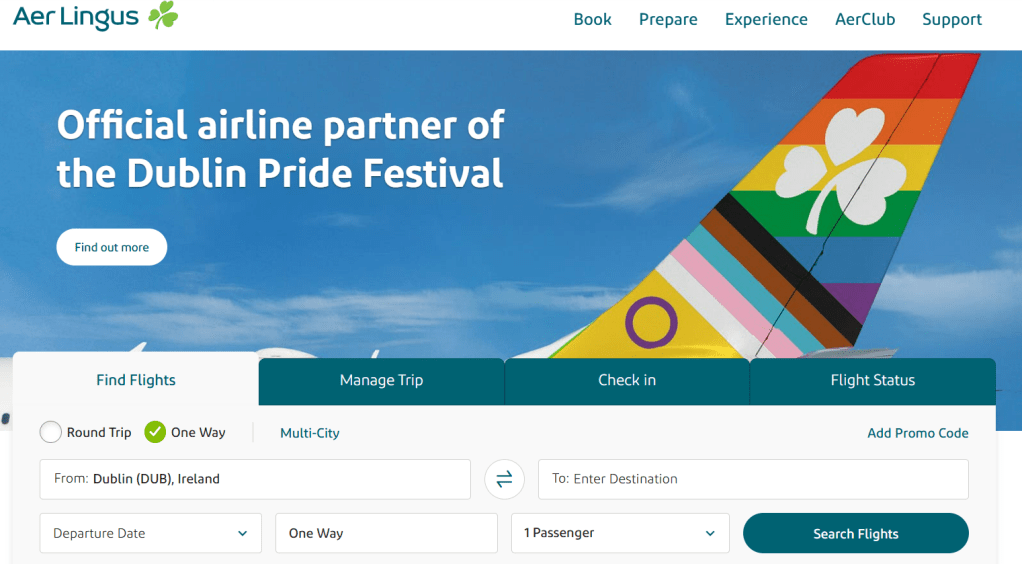
This is the normal interface for the website, but there isn’t an option to pay with points.
Instead, you need to click on the AerClub tab at the top and under the “Spend Avios” section, select “Book a Reward Flight”.
When you click on “Book an Award Flight”, you would expect it to take you to a page where you could book an award flight. Unfortunately, you need to find the little button that says “Buy a Reward Flight,” which is about halfway down the page after a bunch of information about the kinds of flights that you can book with Avios.
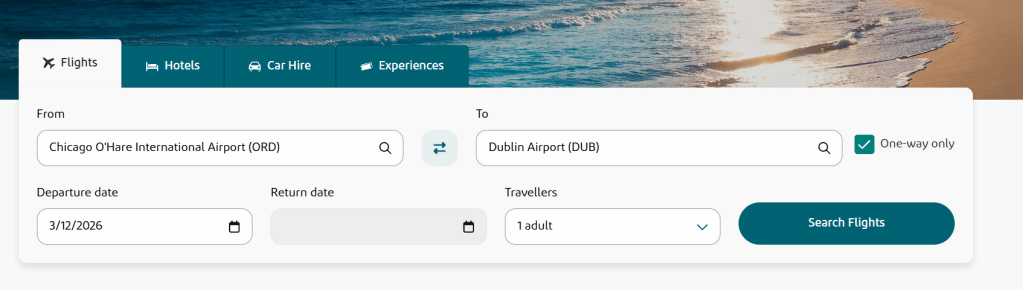
Once you do that, there will finally be an interface to allow you to search for an award flight. Just type in the airport that you wish to depart from and the airport that you want to arrive at, as well as the date, and then click the “search flights” button.
That sounds easy enough, but the problem is that for some reason, you can only search for direct flights. For instance, I can search from Chicago to Dublin. I can also search from Dublin to Edinburgh, because both of those are direct flights. What I can’t do is search from Chicago to Edinburgh, because there would be a stop in Dublin. That’s utterly insane. I cannot think of another airline website that is unable to book an award flight with a stop. It’s non-stop flights or nothing.
How A Limitation Can Be an Advantage
This limitation, though, can be used to your advantage. I am a huge fan of stopover flights and because you need to book all of the awards as separate itineraries, that makes stopovers simple.
Let’s look at the above example. I want to fly from Chicago to Edinburgh, Scotland, and do it on points. Clearly, I can’t book it as one itinerary, because the website only allows for non-stop flights. However, that does mean that I can break the two segments up into separate days and instead plan a stopover in Dublin for a day or two. Now, instead of flying directly into Edinburgh, I can stop for a day or two, visit Dublin Castle, have a couple of Guinness stouts, and adjust to the jet lag before moving on to Edinburgh. Stopovers are a fun way of getting a little extra out of a vacation.
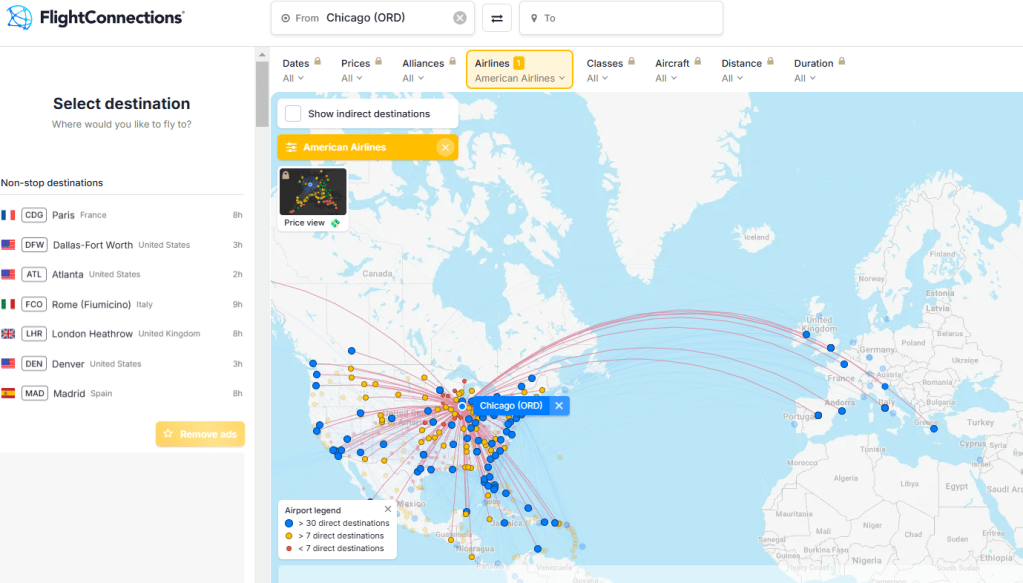
Unfortunately, that means that if you are planning to fly from America to Europe using Aer Lingus, you will need to fly from one of the few cities in North America that have a direct flight to Dublin or Shannon. There are a couple of dozen American cities that you can fly to Ireland on using Aer Lingus, and Flight Connections is a great way to find out where those airports are that connect via Aer Lingus.
Award Flights are Consistently Available at Reasonable Prices
The Aer Lingus website is clunky and hard to use, but the payoff is predictable pricing and fairly consistently available awards, at least in economy. Aer Lingus has a distance-based award chart, and they seem to release five economy seats for each flight. I have no idea how many business class awards they release, because they are always sold out. If you find one, consider yourself extremely lucky.
The points charges for economy flights within Europe are pretty good, with flights from Ireland to the UK or within Ireland costing 4,000 Avios off-peak and 4,500 peak. From Ireland to most of Europe, it is 6,500 off-peak and 7,500 at peak. When you get a little further out, like Ireland to Greece, the Canary Islands, or Croatia, it gets up to 8,500 off-peak and 10,000 peak.
The calendar for peak/off-peak is also fairly generous, with peak pricing basically being summer and a few holiday-related dates the rest of the year.
Where this program gets extremely interesting, for Americans, is the fact that you can fly to Dublin from most of the Northeast and Midwest in the US for 13,000 miles off-peak and 20,000 miles peak. For destinations in Florida, Denver, and the US West Coast, it costs 16,250 miles off-peak and 25,000 miles peak. To view the full award chart, click on this link.
What this means, at least for me, is that you can use Dublin as a great launching point for trips from the US to different parts of Europe. I’ve been promising my family a Canary Islands trip for years and haven’t pulled it off yet. Using Aer Lingus Avios, we could fly to Tenerife during spring break, for 13,000 miles to Dublin. We could stopover in Dublin for a night or two and then get back on a plane and fly to Tenerife for 8,500 Avios. That’s a total of 21,500 Avios each for a pretty great flight itinerary.
You could do the same thing and end up in Munich for 19,500 Avios with a stopover in Dublin, or go to virtually any place in Ireland or the UK for only 17,000 Avios. That’s not unheard of, but the fact that it’s available most of the time on the Aer Lingus website makes it unique. It might not be available on the exact date you want to fly, but usually within a few days of when you want to fly.
Also, if you really need to fly on a Saturday, because you really can’t do a Tuesday-to-Tuesday trip, Aer Lingus offers the same good flight prices on the weekends as they do on any other day of the week. You might need to plan ahead and book early if you want to get those flights, however.
Aer Lingus Avios are Easy to Earn
Accumulating Avios is one of the easiest things you can do in travel hacking. You can transfer points directly from American Express Membership Rewards, Bilt Rewards, Chase Ultimate Rewards points, and Wells Fargo points. You can also transfer points from Citi Thank You points and Capital One by transferring to other Avios programs and then transferring to Aer Lingus Avios. In addition, Chase has three personal credit cards: the British Airways Visa Signature Card, the Iberia Visa Signature Credit Card, as well as the Aer Lingus Visa Signature Card, which earn Avios. There are also two credit cards issued by Cardless that earn Qatar Privilege Avios. If you earn Avios in any other program, like Iberia, you can just transfer those points to Aer Lingus at a 1:1 ratio.
All of those points can be consolidated into any Avios program. That probably makes Aer Lingus, as well as British Airways, Qatar Airlines, Finnair, and Iberia (all Avios programs), the easiest programs to accumulate points in. This means that not only will it not take a ton of points to book those flights, but it’s relatively easy to get those points.
Taxes and Fuel Surcharges are Relatively High
One thing that can be a little frustrating about the Aer Lingus program is that the taxes and fuel surcharges are relatively high. They’re not high compared to other European programs like Flying Blue or Virgin Atlantic, but compared to Alaska Airlines, American Airlines, Delta, or United, those fees are pretty high. At current exchange rates, a round-trip flight to Dublin from Chicago costs $299.71 in taxes and fuel surcharges. On an identical United flight itinerary, the taxes are $50.41.
US-based programs like Alaska, American, Delta, or United are going to charge much less in taxes and fuel surcharges, but the number of points needed will typically be much higher. In the United Airlines example that I mentioned earlier, the total number of points needed was 80,000 United miles round-trip, as opposed to the 26,000 points needed with Aer Lingus. So the question is, would you rather pay 26,000 points and $300 or 80,000 points and $50? That’s really an individual decision.
Why Aer Lingus For Transatlantic Flights is Clutch
Recently, the Chase Sapphire Preferred Card had a 100,000 Chase Ultimate Rewards Points bonus. This will probably be the most popular signup bonus for 2025. Anyone who signed up for this credit card and completed the $5,000 spend in 3 months necessary to get the bonus will be sitting on at least 105,000 Chase Ultimate Reward Points.
If you have a family of four that you would like to fly to Dublin from Chicago, in an off-peak time like September, for example, you could book that with Aer Lingus for 26,000 Avios and $300 each, for a total of 104,000 Aer Lingus Avios and $1,200. Those flights currently cost around $800 each, or around $3,200 total. Since the Avios needed to book those flights transfer from Chase Ultimate Reward Points at a 1:1 ratio, that means that this one signup bonus can ultimately save $2,000 on these flights.
One credit card signup and one transfer, and you can save $2,000 on flights to Dublin. That’s pretty good.
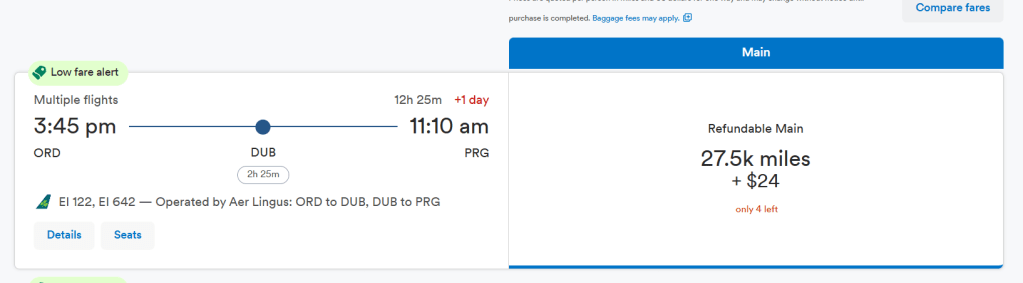
Let’s say I wanted to visit Prague in September. Alaska Air has a flight bookable with Alaska Miles (ironically, an Aer Lingus partner award) for 27,500 miles and $24. I would book that and then book a flight from Prague to Dublin using 6,500 Aer Lingus Avios and $32 as well as a flight from Dublin to Chicago for 13,000 Aer Lingus Avios and $167. That means that for 27,500 Alaska Miles, 19,500 Aer Lingus Avios, and $223, I can fly from Chicago and visit both Prague and Dublin. That’s a pretty solid itinerary for a fairly low price in points and dollars.
Don’t Overlook Aer Lingus
The Aer Lingus rewards program flies under the radar as a pretty great way to book inexpensive economy awards from the United States to Europe, especially Ireland and the UK. While the website can be a little clunky, and all of the award flights have to be booked as separate legs of direct flights, understanding the Aer Lingus program can yield amazing value.
The fact that everything has to be booked as non-stop flights means that you can add a day or two stopover in Dublin. This allows people to add an additional destination to a European vacation. Having to book separate legs could be an annoyance, or it could be a benefit. It’s really just a matter of how you look at it. That being said, 13,000 miles one-way from the northeast and midwest of the US is a deal that just amazing, and it’s basically standard with Aer Lingus.
It’s easy to overlook this program because if you are trying to find the best deal on award flights with a website like pointsyeah.com or awardtool.com you won’t find Aer Lingus awards. But don’t forget to go to Aer Lingus and see what’s available, especially if a trip to Ireland or at least a stopover would be desirable. It’s a great program that flies under the radar, so don’t ignore it.
I’ve been using points and miles to help me and my family travel for a little over three years now. In that time, I have been consuming large amounts of podcasts, blogs, and YouTube videos to learn how to maximize earning points and miles, as well as using those points and miles for maximum value. The information that I’ve gotten from these influencers has been invaluable in helping me set up my own strategies for travel, but lately, I have to admit, I’m getting annoyed.
I’m annoyed because many influencers present an unrealistic idea of what points and miles can do, especially for the average person. They also miss the point of what travel should be. I’m afraid people are paying attention to these influencers and not listening to what is best for themselves.
The Myth of Unlimited Points
There are three points and miles podcasts that I listen to on a regular basis. Every host on these podcasts takes multiple trips a year. These aren’t normal trips either; they are trips to Asia or Europe, and they fly their entire family in business class and stay in luxury hotels when they are there. They do this all on points. Listening to these conversations, the listener might think, “Maybe I can do this too?” Chances are, you can’t. These podcasters are spending millions of points per year, and that’s just not feasible for most people.
The podcasters fall into two categories: people who travel a lot for business and people with a lot of business spending. If you are a person who falls into one of these two categories, congratulations, you are going to have a lot of fun traveling on points. If you’re not, it gets considerably harder.
What really annoys me, however, are the ones who aren’t honest about this fact. I follow someone on Threads who, earlier this year, claimed that she had earned over 800,000 American Express Membership Rewards points on normal spend in three months. When pressed about it, she said that she had been getting 15x on a lot of purchases through Rakuten.
15x is pretty amazing but let’s, for the sake of argument, say that she got 20x on all her spending, which would be next to impossible, by the way. That would mean that she spent over $40,000 at 20x in 3 months to earn those points. That is not “normal” spending, and I guarantee she would have to spend way more than $40,000 to earn those points.
On one of the podcasts I listen to, a question was posed from a listener who asked how the hosts are earning all of their points. One of the hosts started talking about paying estimated taxes with a credit card, and while that will boost your point totals and help you earn signup bonuses, it doesn’t explain the number of points he must be earning to do the travel that he does.
I’m not saying that they aren’t earning a lot of points; I absolutely believe they are. However, can we be honest about how they are doing it? It’s not what they say. Here is how they are actually earning their points:
Lots of Business Spend
Many of these influencers are either owners of businesses that spend a lot of money on credit cards, or they are people who can spend and be reimbursed for expenses. This opens up the ability to earn a lot of points. This is especially true if you are a business traveler because that opens up the possibility of earning a lot of frequent flyer miles with airlines as well as lots of hotel points. It also opens up the possibility of earning status with those hotel and airline programs.
Manufactured Spend
A lot of points and miles people earn points and miles through manufactured spending. This comes in many forms, but generally it involves buying items, such as toys or gift cards, and then selling them for little or no profit. There are actually buyer’s groups that facilitate this for people who don’t actually want to handle the items themselves. There are all kinds of risks that are involved in doing this, including the fact that it’s frowned upon by credit card companies. This is probably why people don’t want to talk publicly about it. Understand, though, that there are a lot of folks doing this to boost their point totals.
Referral bonuses
For a lot of credit cards, you are offered a bonus for referring someone to apply for that card. These are generally limited to a certain number of referrals per card per year. For many of these cards, you can earn 100,000 points per year by referring applicants. If you have quite a few cards and a means to promote those referrals, like a blog or a YouTube channel, you can accumulate a lot of points and miles. However, for the average person, hounding all of your friends and family members to sign up for cards to earn a signup bonus may not make you very popular.
The Luxury Problem
Travel influencers are obsessed with luxury hotels. Hearing them talk about a Park Hyatt, a Ritz-Carlton, or an Andaz property makes me wonder if the only reason they traveled was to stay at that hotel. I understand that if you stay at a resort, you stay there because it’s the destination. But most of the time, the hotel shouldn’t be the destination.
We recently stayed in Madrid, where we used an IHG free night certificate that was good up to 60,000 points. We ended up staying at the Intercontinental Madrid, which was 59,000 points, so we maximized the value of the certificate. When we checked in, they double upgraded us because of Jenn’s status with IHG. The room was really nice, the service was great, but it was in the middle of the Financial District, and I would have preferred to be in an area with a bunch of tapas bars. In that case, maximizing the value of the certificate cost us the opportunity to be in a neighborhood that suited us better.
When we were in Amsterdam, we stayed at the Kimpton. It was a fun, quirky hotel with great service. When we checked in, they gave us $30 in bar credit because we used the Kimpton secret code, and Jenn had status with IHG. We didn’t use the credits. The reason why was simple – we were in Amsterdam! I don’t want to hang out at the hotel. I want to walk the canals and visit their bars and restaurants. We had a blast in Amsterdam, and all we did in the room was sleep.
At the end of the day, if you are out enjoying the place that you went to visit, the only thing that really matters is that you have a comfortable bed, a clean room, and a hot shower. Guess what? That’s nearly every hotel room. You don’t need to be that picky. If you have small kids and you will spend more time in the hotel because of naps, then maybe you want to be pickier, but for most people, what does it matter?
Flying in Economy is Fine
The obsession among points and miles people with flying in business class is ridiculous. Some of the comments from the folks I follow on Threads have been “I don’t care where I’m going as long as I turn left when I get on the plane,” and “Stop wasting your points on economy flights.” I mean, seriously, those are crazy statements. Are you only traveling so you can take a selfie in your lie-flat business class seat? That’s seriously weird.
I’ll tell you a little secret. When Jenn and I fly, she always wants an aisle seat, so if the seat arrangement is window, middle, aisle, I take the middle. I’m 6’2″, 220 pounds, and I can handle a 10-hour flight in the middle seat in economy just fine. The way influencers talk about economy seats, they act like they’re being stashed in the baggage hold under the plane.
Flying in economy is wasting my points? Really? At best, your business class flight costs twice the number of points that my economy class flight costs. That means that I can travel twice as often for the same number of points. The magic of flying is that I can be transported to a completely different part of the world in a matter of hours, it’s not that I can take a nap during the flight.
The Insanity of Positioning Flights
The worst part is the lengths people will go to get a business class flight. A good price on a business class flight is difficult to find. It’s so difficult that there is a term for a flight that you take to get to a business class flight. It’s called a positioning flight. In other words, you need to take a flight to get to the airport where your desired flight departs.
Typically, you want to fly a positioning flight the day before, that way if there is a delay on your positioning flight, you won’t miss the more important, business class flight. This is where, for me, the logic of doing this begins to break down.
Earlier this year, we booked flights from our home airport to Nice, France, for 19,000 American Airlines miles. Let’s say I have a friend who wants to join us there, but he wants to fly business class. He finds a business class flight from New York to Nice for an excellent price of 50,000 points. He’s going to have to book a positioning flight, which, if he’s lucky, will cost around 10,000 points, but he’ll have to get there a day early, so he also needs to book a hotel. Let’s say he books a Hyatt for 12,000 points near JFK airport. Now that a 50,000 point flight really costs him 72,000 points and a day of his time. Not only did I save 53,000 points compared to my friend, but I’ll be enjoying a latte and a chocolate croissant at a cafe in Nice while he’s on the plane.
This even gets more extreme, though. I’ve actually heard two people recently suggest that it’s easier to get a business class flight outside of the country, and you should try to take a positioning flight outside of the country. Let me get this straight: you want me to take a four-hour economy flight to Mexico, so that I can get a business class flight to Europe? Nope, nope, nope.
What is your Time Worth?
At the end of the day, many of the complaints I have are based on the amount of time required to earn the volume of points to go on luxury vacations. If you are lucky enough to earn points through large amounts of business or travel spend, then you are holding the golden ticket. However, for the rest of us, you would probably need to earn those points through some kind of manufactured spend scheme. I don’t really feel like spending my free time driving around town buying gift cards and products on sale and then posting those items on eBay.
Even if I had an unlimited amount of points, I don’t have an unlimited amount of vacation. Do I really want to waste a vacation day positioning so that I can take a business class flight? No, just get me to my destination so I can enjoy my vacation.
Know Yourself and Your Needs
Knowing yourself is important, however. If you are someone who appreciates luxury, maybe you’re willing to take fewer vacations to have that one dream vacation. That’s fine, and you shouldn’t be ashamed. It’s not for me, though. I want to experience the world, and that means that I need to make the most out of every single point that I earn.
We just got back from Spain and Portugal, where we hiked the Camino de Santiago. We ate at tapas bars and stayed in hostels. We flew in economy. Guess what? It was fantastic, and we were spending less than 50 euros per person per day, including lodging and food. It was fantastic because it was an authentic experience. We used points and miles to help us afford the flights, as well as a hotel in Madrid and one in Porto.
Points and miles have opened the world for us by lowering the cost of taking vacations. I’m proud of what we’ve done and the precious time that I’ve been able to spend with my family on those vacations – and you know what? I’ll never feel bad about turning right when I enter a plane and it wasn’t a waste of points, that’s for damn sure!
In what is becoming a new family tradition, to celebrate our niece, Zoey graduating from high school, we are going to Europe to celebrate. Well, not really we, since I’m not going, but Jenn and her sister Misty are taking Zoey and our daughter Emma to Europe this summer.
It is, however, my responsibility to do a lot of the trip planning. The parameters were fairly loose. It needed to be in mid-July. Jenn wanted to take Misty to Munich because she will absolutely love Munich, and maybe a day trip to Neuschwanstein Castle. Zoey wanted to travel to Dublin or Italy.
So, I got on my laptop and started to search on PointsYeah.com, thinking that this wouldn’t be that hard since they were pretty flexible. To my horror, there wasn’t anything that was very good. Almost everything was over 40,000 points one-way per person in economy for flights that were less than desirable. A lot of them had taxes and surcharges of well over $200 per ticket – for economy flights out of the US!
What surprised me the most was that typically you can count on Flying Blue to have flights available from Chicago throughout Europe on KLM or Air France for 25,000 points and a little over $100 each. Those deals were no where to be seen.
Flying United Airlines with Partner Miles
I was beginning to notice that United had a number of flights available for 40,000 points. I wasn’t interested at 40,000 points, but I also know that is the saver fare price for a flight to Europe and sometimes those saver fares end up on partner websites. Maybe I should check those partner sites?
Turkish Airlines
I’ve used Turkish Miles and Smiles to book United flights before. In our case, I used it to book flights to San Jose del Cabo Airport for 10,000 miles from Chicago. That is no longer a thing, because the new price after devaluation is 30,000 points. I wasn’t expecting this to be very good because the devaluation has made most of their partner awards more expensive, but I thought I should look. Sure enough, it was 55,000 miles instead of 40,000. Not worth it.
Air Canada Aeroplan
Next I checked out Air Canada Aeroplan and found the same flight for 40K points and $80 CA ($56 USD). This is the same number of points but about $50 more expensive for taxes and fuel surcharges. This might actually make sense to do, because Aeroplan transfers from Amex, Capital One, Chase and Bilt whereas United miles only transfer from Chase. So if you can’t come up with United miles, this might make some sense. 40,000 points still seemed to steep for me, though.
Avianca Lifemiles
Avianca Lifemiles does have quite a few partner redemption options and that is why it’s good to check them as well. They had the flight listed at 40,000 miles and $28.50, which is still a little more than United at 40,000 miles and $5.60. However, like Air Canada, you can transfer to Avianca Lifemiles from more programs than United does. Avianca transfers from basically everyone including Amex, Capital One, Chase, Citibank and Wells Fargo. If you’re too short on Chase points or United miles, Avianca Lifemiles might make sense.
Singapore Airlines
I had basically forgotten about Singapore Airlines. I always found it difficult to find any availability on their website when I was looking. I decided to try them anyway and yes, that flight was available. They had four tickets available at 30,500 Krisflyer miles each and $5.60 for taxes. That’s great! Singapore Airlines also transfers from Amex, Chase, Citibank and Capital One, making it easy to get enough points.
What I Ended up Booking
So obviously on the way there I booked the United flight direct from Chicago to Munich for 30,500 points transferred from Citibank and $5.60. I will be booking a connecting flight from Munich to Dublin on Aer Lingus for 7,500 Avios transferred from American Express and $53. The return flight from Dublin to Chicago was also booked on Aer Lingus with American Express Membership Rewards transferred to Avios for 20,000 points and $155. So each complete itinerary was a total of 58,000 points and $204.
When I priced out the entire itinerary as a multi-city cash flight with United Airlines it was $1,550 per ticket. That means that the 58,000 points saved around $1,350 or about 2.3 cents per point. I’m always happy to get over 2 cents per point, so I’m happy with this redemption and that wouldn’t have been possible without remembering that I could redeem Singapore Airlines Krisflyer miles for United saver award flights. In the end it saved us a total of 38,000 transferable points.
Finding United Flights on Singapore Airlines website
The only flights that will normally be available on partner sites like Singapore Airlines will be saver awards. It is also important to note that not all saver awards will be available to partner websites. If you are looking to book one of these saver awards on a partner airline, you need to find when one should be available.
The best way is to go United.com and DON’T SIGN IN. The reason that you shouldn’t sign in is that if you have a United credit card, you have access to additional award inventory. This will not be available to partner websites. You’re looking for basic saver awards.
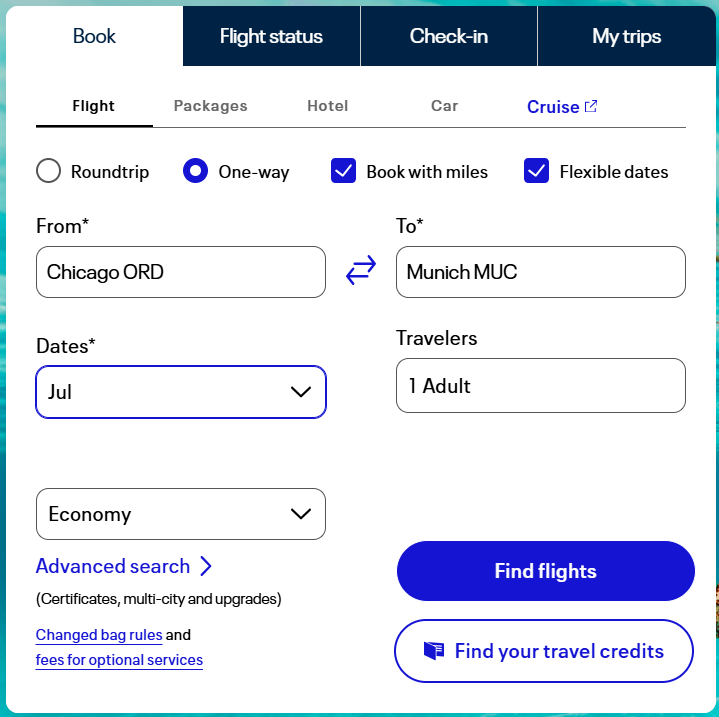
What you want to do is search for flights, but make sure you check the checkboxes for one-way, book with miles, and flexible dates. As soon as you hit search it will prompt you again to sign in – DO NOT DO IT, just click on the ‘x’ in the corner.
In this case, I see a ton of available flights for 40k + $5.60. When you look below on one specific flight, you see “Saver Award” listed for this day. Looking at this, I would assume that it’s likely that there are a ton of available flights in July from Chicago to Munich on United that I should be able to find on Singapore Airlines Krisflyer.
If you then go to the Singapore Airlines website and search for award flights from Chicago to Munich for that date, at first you won’t find anything. That’s because the default is to search Singapore Airlines flights. You need to click on the Star Alliance tab in order to find anything from United Airlines.
Not only will you find wide open availability on United for July, as was indicated by saver awards on the United website, but you also see flights for Lufthansa as well. That is because Lufthansa is also a Star Alliance member. The number of points is the same as the United flights because Singapore Airlines has a standard award chart that has North America to Europe as that number of points. The difference, however, is the amount of taxes and fees that are required to book that flight. On United, it’s $5.60 and with Lufthansa it’s $316.50 and has a stop in Frankfort. Yeah, I think I’ll take the United flight.
When To Book United on Partner Sites
So this is when things can get complicated. Earlier in this post, I mentioned four different ways to book the same United Airlines flight from Chicago to Munich. In my analysis, Singapore Airlines was the cheapest and so I booked with them. The problem is that Singapore Airlines will not be the cheapest all of the time. Each of these programs have different award charts that mean that depending on where you are flying, different programs might be the ideal for that particular flight.
Some of these award charts are regional, and some are distance based. For each of these charts, they define regions differently or they are using different cut-offs for distance. I’m not going to go into the different award charts here, but I want to show what it’s like for those of us who routinely use Chicago Ohare airport to demonstrate just how different it can be.
Chicago to:
United Airlines
Singapore Airlines
Air Canada Aeroplan
Avianca Lifemiles
Turkish Airlines
Munich
40,000 miles and $5.60
30,500 miles and $5.60
40,000 miles and $56
40,000 miles and $28.50
55,000 miles and $5.60
Tokyo
60,000 miles and $5.60
59,500 miles and $164.50
50,000 miles and $56
55,000 miles and $28.50
75,000 miles and $5.60
Cancun
20,000 miles and $47.47
19,500 miles and $47.47
12,500 miles and $98
15,000 miles and $58
30,000 miles and $47.47
Honolulu
25,000 miles and $5.60
19,500 miles and $5.60
22,500 miles and $44
25,000 miles and $15.20
10,000 miles and $5.60
Auckland
55,000 miles and $40.90
66,000 miles and $40.90
60,000 miles and $92
60,000 miles and $36.93
100,000 miles and $40.90
Denver
8,800 miles and $5.60
14,000 miles and $5.60
10,000 miles and $33
15,000 miles and $5.60
10,000 miles and $5.60
Prices for identical saver award flights on United, with the award redemption I would consider in bold and italics.
In the above chart, you will notice that even though these are identical United Airlines flights, they have wildly different prices. That is because of the award charts that each of these programs use. If you are aware of these price differences and check on multiple websites, you can save a lot of points as well as money on taxes and fuel surcharges.
In addition, these programs have different transfer partners, which might affect your decision as well. In the case of the Denver flight, the lowest price is 8,800 miles and $5.60 but the miles are United miles which only transfer from Chase. If you don’t have any United miles or Chase Ultimate Reward points, you might decide that 10,000 Turkish Miles and Smiles is better for you because you can transfer those points from Citi Thank You points or Capital One Venture miles. If all you have is American Express Membership Reward points, you might want to use Air Canada Aeroplan, even though the taxes are higher, because you can transfer to Air Canada from Amex.
Think Before You Book a United Flight
I enjoy flying United. I haven’t yet had a bad United flight. Generally the seats have been comfortable and the planes have been in good shape. I know that’s not the case for everyone, but I’ve had pretty good luck on United. That being said, I find that booking award flights with United to be generally overpriced, although I love that they don’t tack on huge fuel surcharges on their award flights.
In addition to the fact that their award prices can be elevated, the fact that their only transfer partner is from Chase makes it sometimes difficult to amass the amount of points necessary for those flights.
Understanding how and when to use partner awards for those flights can save you a ton of points and might mean the difference between being able to make the trip at all. Keep in mind, you don’t need to memorize the award charts to make this work. All you need to do is when you identify a saver award flight on United, remember that you might be able to book that flight on partners like Turkish Airlines, Singapore Airlines, etc. Then start looking for that flight on other sites and see if you can find a better deal for you. This one little trick can make a huge difference in the price of identical flights.
I am a travel hacker, and the amount of travel I do is unusual. We traveled three times last year, including a week in Canada, a week in Costa Rica, and a week and a half in Italy. I also had a extended weekend trip to Montana with my old high school friends. I do realize that this isn’t normal and it’s also a lot more than we did even a few years ago. We also did that without spending a lot of money, because of points and miles.
Most Americans, if they travel at all, probably plan just a single vacation a year. If you only travel once a year, though, you really want to make the most of it. This is where doing a little bit of travel hacking would allow you to stretch your budget and allow you to travel with a little more panache.
The average American who wants to take one trip per year, should maximize that trip as much as is possible by using a one credit card per year strategy. This gives the average traveler the ability to reduce the cost of their vacation or increase the luxury of the vacation without having to become a crazy travel hacker.
Why New Accounts are Important
Let’s say that you already have a Chase Sapphire Preferred card. It’s a great card with good earning categories and great benefits. Why would you need anything else? Well, the truth is that signup bonuses are really important to building point balances. In the case of the Chase Sapphire Preferred card, if you spent $3,000 per month on that card, you would probably earn around 4,000-4,500 points, depending on what categories most of the spending was in. That means that at the end of the year, you would have earned somewhere around 50,000 points on $36,000 in credit card spend.
The signup bonus for the Chase Sapphire right now is 60,000 points. That means that if you signed up for the card and did the above spend, you would end up with 110,000 Ultimate Reward points. For 50,000 points, you can probably eek out enough points for 2 to fly to Cancun, if you’re flexible on when you fly. For 110,000, you can fly to Cancun and stay in an All-Inclusive hotel for 2 or 3 nights. For 110,000 points you could also pretty easily fly 2 people to Europe and back, if you transferred those points to KLM/Air France Flying Blue, or Iberia/Air Lingus/British Airways/Finnair Avios. If you were only paying for one flight, you could probably get to New Zealand and back for that, but that’s a long flight in economy.
Signup Bonus Frequency
The problem is that you can’t sign up for the Chase Sapphire Card each year. Chase only allows for you to get a signup bonus on the Sapphire Card once every four years. The same is also true of the Capital One Venture Card and the Citi Strata Premier Card. The American Express Gold Card is technically for a lifetime, but apparently people do get a second bonus on that card, usually after around 7 years.
I mention these cards because they have transferable points, meaning that you can earn them as Citi Thank You points, Chase Ultimate Reward points, Capital One Venture miles or Amex Membership Reward points and you can transfer them to any of their hotel and airline partners to take advantage of their best deals.
It’s also fortunate that there are four of these cards and with the exception of the Amex Gold card, you can get an additional bonus once every four years. This means that you can signup for one of these cards, earn as many points as you want during the year, transfer the points out and either downgrade or cancel that card and move on to the next card in this group. With the exception of the Amex Gold card on the 4th year, you could rotate though those cards every year.
Work With a Friend
While solo travel can be fun, traveling with a spouse, significant other, or a friend can make trips extra special. Working together to earn points also makes for a great strategy. In the travel hacking community, they affectionately call this ‘two player mode’.
Let’s say that you’re married and your spouse will be traveling with you. Two player mode essentially works like this: You sign up for the Citi Strata Premier card. You do the required spending and earn your signup bonus, but you DO NOT add your spouse as an authorized user. Then your spouse signs up for the same card and earns the same bonus. After both of you have earned your bonuses you continue to use those cards for all of your credit card spend for the rest of the year.
In two player mode, assuming the $3,000 per month spend listed above, in addition to the 50,000 or so points you would earn on your normal spend, you would also earn two 75,000 point sign up bonuses. That would mean a total of 200,000 Citi Thank You points that can be used to vacation in a variety of places.
Citibank’s Transfer Partners
If you just used Citi Thank You points to pay for items on your card, you would get .8 cents per point for a total of $1,600 for those 200,000 points. Don’t do that. The best way to use those points to transfer to airline partners and purchase flights. Citi has quite a few transfer partners. They are:
Partner
Citi Points Used
Points Received
Aeromexico Rewards
1,000
1,000
Accor Live Limitless
1,000
500
Avianca Livemiles
1,000
1,000
Cathay Pacific
1,000
1,000
Choice Privileges
1,000
2,000
Emirates Skywards
1,000
1,000
Etihad Guest
1,000
1,000
EVA Air
1,000
1,000
Air France/KLM Flying Blue
1,000
1,000
Jetblue Trueblue
1,000
1,000
Leaders Club
1,000
200
Preferred Hotel and Resorts
1,000
4,000
Qantas Frequent Flyer
1,000
1,000
Qatar Privilege Club
1,000
1,000
Singapore Airlines
1,000
1,000
Thai Royal Orchid Plus
1,000
1,000
Turkish Airlines Miles and Smiles
1,000
1,000
Virgin Atlantic Flying Club
1,000
1,000
Wyndham Rewards
1,000
1,000
This list can be a bit overwhelming, but if you spend a little effort you can use these transfer partners for some great value. There are too many great uses of these points to discuss all of them but I’ll give you some surprising examples:
Using Turkish Airlines Miles to Fly To Hawaii on United Airlines
This is one of those bizarre combinations that works pretty well if you are flexible about when you go to Hawaii. You do this by finding saver awards to Hawaii on the United Airlines website. Once you find this then you search on the Turkish Airlines Miles and Smiles website for Star Alliance award space for the same day. Usually if saver awards are available on the United website, you will find it on Turkish Airlines for 10,000 points each way. If you used United miles, it’s probably going to be 25,000 miles.
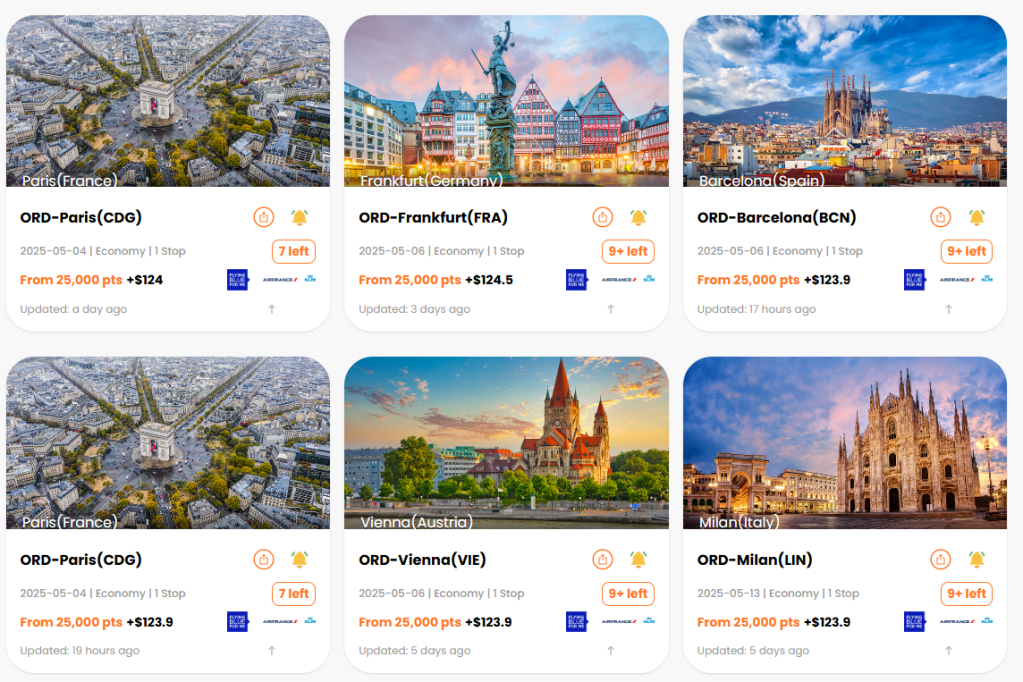
Flying Blue used to offer a lot of flights to Europe for an extremely low 20,000 points. A recent devaluation happened that has raised that price to 25,000 points. There are some great things about this program. One is that it covers both Air France, which uses Paris as its hub, and KLM, which uses Amsterdam as it’s hub, making a single platform that covers both airlines’ reward programs. The second thing is that it covers a whole lot of award flights to Europe from the United States. Using the Daydream Explorer feature in PointsYeah, I came up with a ton of 25,000 point flights to Europe in May.
However, one of my favorite things about Flying Blue is that it allows for stopovers in Paris and Amsterdam. In other words, if I’m flying from Chicago to Munich on KLM, there is going to be a stop at it’s hub in Amsterdam. I can choose to do a stopover for up to a year in Amsterdam before moving on to Munich. This allows me to book one flight to Munich, pay one fare, and stay in Amsterdam for a few days, a week, whatever I feel like doing. The bad news is that there isn’t a way to do it on the website, you’ll have to call. The worse news is that if you book with an agent on the phone, it costs 50 Euros per ticket. That being said, I’ll gladly pay 50 Euros for a stopover in Amsterdam.
East Coast to London on Virgin Atlantic
I honestly can’t believe this hasn’t dried up yet, but for some reason Virgin Atlantic offers flights from mostly JFK airport in New York to London for 6,000 points and around $70 in taxes. They also have the same prices for some flights from Washington Dulles and Boston Logan, but most are from New York to London. It seems to be too good to be true, so get it while you can, I guess.
Qatar Privilege Club for Transferring to Avios
I really like the Avios program. It is a points platform that is used by Qatar Airlines, British Airways, Iberia Airlines, Aer Lingus and Finnair. In the case of Citi, it only transfers to Qatar, but once you transfer points to Qatar you can transfer to these other programs, although it can get a little complicated, One Mile at a Time has a good explanation of how to do it.
Once you convert your Citi Thank You points to Avios, you can use them for such things as 13,000 point off peak flights from most of the eastern portion of the US to Dublin, 17,000 points from Chicago to Madrid off peak on Iberia Airlines, and 30,000 points to Helsinki from the US. These are obviously not always the prices, but they are fairly typical, and available if you are flexible.
Other Examples
There are some other transfer partners that can be very useful as well. If I were booking anything to Central America, South America, Mexico, or the Caribbean, I would start my search with Avianca Lifemiles. They consistently have competitive prices to those areas. I recently saw an example of 14,000 points and around $65 to San Jose del Cabo from Chicago.
Keep your eyes on JetBlue as well. There is a new partnership with TAP Portugal where you can get to Portugal from the United States for as low as 19,000 miles and $5.60 using JetBlue Trueblue miles. The Points Guy went into depth on this new sweet spot, and I think I’m going to have to look into that one a little more, it sounds very promising.
Citi’s Hotel Partners
While I love the choices for transferring to Airline partners, Citi’s hotel partners aren’t as exciting. You can get some value by transferring to Choice hotels at 2 Choice points per 1 Citi Thank You point. You could also transfer to Wyndham and take advantage of their partnership with Vacasa that has been a little watered down, but it’s still pretty good.
For the most part, though, the best use of Citi points will be to book flights, so I would hesitate to transfer to hotel partners in less you found a great use for those points. Of course you should never feel bad if you choose to use your points in a suboptimal way, since they’re your points and you should use them the way you want, but making the most out of your points will help stretch your vacation budget.
How Much Can This Save You?
If you are only going to take advantage of one signup bonus per year, it becomes imperative that you do everything you can to maximize the use of those points. This is where you should spend your mental energy. The good news is that there are a ton of resources on how to take advantage of these transfer partners to get the most of those points.
I suggest using PointsYeah as a good place to start. You can search a number of airline programs simultaneously so that you can choose where to transfer your points an book your flights. Also, sometimes just spending a few minutes googling for the best use of points for flights to the destination you want to go to will yield you a blog article that will be very beneficial.
So how much can you actually save doing this? Let’s look at the example of a couple in two player mode that earned 200,000 Citi Thank You points. From the examples above, probably the easiest, and most available redemption opportunities would be to book two sets of one way flights to Europe using Flying Blue. If they had a family of 4, they could book one set of flights on KLM with a stopover in Amsterdam and then head on to Munich. On the way back, they could book a flight with Air France and stop for a few nights in Paris. In this example, the family of four would spend 50,000 points and around $300 in taxes and surcharges each. Those flights probably would normally cost over a $1000 each. I would imagine that this would save the couple around $3,000 on this trip.
In the Turkish Miles and Smiles example above, booking from the US mainland to Hawaii for 10,000 points each way would mean that for 200,000 points that couple could book 10 round trip tickets. Those tickets typically cost between $600 and $1,000. So in this example it could save the couple between $6,000 and $10,000.
The amount that you save is definitely going to vary by location and airline, but it can definitely stretch that vacation budget out to save money on the flights.
A Simpler Way to Travel Hack
By using a one card per year strategy, you can reduce the cost of your vacations without putting too much of an effort into it. Juggling multiple credit cards to maximize point accumulation in bonus categories and having multiple signup bonuses per year takes work and mental energy. Most people would prefer to not have to think so hard about which credit card to swipe on every single purchase.
By signing up for one card per year, you can take advantage of the signup bonus and continue to use that card throughout the year. The key is to be smart when redeeming those points with transfer partners and Citi Thank You points have some really great transfer partners. Doing this one thing, can save you thousands of dollars per year on your travel plans. It can also be the key to unlocking vacations that you wouldn’t have considered before. Doing just a little travel hacking absolutely has the potential to open the entire world to you.
I love my local airport. It’s MLI, sometimes known as the Moline Airport or as it’s officially called, the Quad Cities International Airport. What is great about this airport is that you can pretty much roll into a parking spot 20 minutes before boarding and be alright. I personally am not brave enough to try it, but I’m certain you’d be fine. TSA normally takes less than ten minutes and you can literally park just a couple hundred feet from the front door. There are only a dozen gates, so it only takes a couple minutes to get to your gate. Whenever it’s feasible, we try to fly out of MLI. If we can’t, we generally fly out of Chicago O’hare.
On the other hand, I really hate the whole experience of going to Chicago O’hare. It’s a three hour drive and the last hour is in white knuckle traffic. Then we have to park something like a dozen miles away and take a shuttle to the airport. Getting to O’hare is usually a four hour ordeal for us and we have to leave at least two hours for security and getting to the gate. There is nothing pleasant about having to leave your house six hours before boarding.
Booking award flights out of MLI however, is a little tricky. Flying to Europe on points, we usually find the best deals on KLM/Air France Flying Blue or with either Aer Lingus or Iberia Avios. None of those airlines fly out of MLI, but they all have direct flights from Chicago O’hare to Europe. There are only three airlines that will book with points out of MLI: United, American, and Delta.
This leaves us with three choices. The first is to book with one of the European carriers and deal with the whole ordeal of driving to Chicago. This isn’t great, not only because of the way there, but generally that means we’re trying to stay awake while driving home after a seven hour time change when returning from Europe.
The second option is to book a separate award flight to get to Chicago and book with a European carrier out of Chicago. The problem with the second option is that if something happens to your first flight, such as a delay, the second flight doesn’t care that your first flight is delayed, since it’s not their fault and frankly not their problem. When I’ve done this in the past, I’ve booked a day early just so we could make sure to get there in time.
The third option is to book the whole trip with one of the American carriers that fly out of MLI. The problem with the third option is that it’s often a whole lot of points. United Airlines consistently charges a premium for flying to a small airport, and I usually just look at their prices and laugh. Delta rarely has good award prices and when you find a deal you need to book them as a round-trip ticket to get good rates. American Airlines, however, continues to surprise me with great value on award flights out of MLI, although you do have to hunt a little for them.
Punishing Myself in Style
I’ve been a distance runner for about eight years now and I’m turning 50 next year. I decided that as a challenge to myself, I would run my first 50K during my 50th year. But let’s face it, I’m a travel hacker, if I’m going to do a 50K, of course I’m going to do it with a little style.
I decided to do the 50K which is one of the UTMB ultramarathons that are taking place in Nice, France. The race in the 50K category in Nice is actually a 54K with around 7,000 feet of elevation gain. This is going to hurt – honestly it’s probably bordering on self-torture. But hey, If I’m going to torture myself, why not do it in the hills overlooking Nice, Monaco and the Mediterranean Sea, right?
Searching for Flights
Now that I knew what I wanted to do, I needed to get there. I started my search the same way that I always do, by searching on PointsYeah from Chicago to wherever I want to go, in this case the Nice Airport, NCE. Right away I noticed that American Airlines had a 19,000 mile award from Chicago to NCE.
If I see that any of the major American carriers have a cheap flight from Chicago, I instantly change it to MLI, just to see if they also have a cheap flight to the Quad City Airport. Sure enough, American tacked on an extra leg and it was still 19,000 points and $11 in taxes. I immediately jumped on that.
Flying home, the best I could find was again an American Airlines flight from NCE to MLI for 30,000 points and $130 in taxes and fuel surcharges. Honestly, that’s not bad, but I decided to look around a little bit. I went on Flight Connections and filtered down to see where American Airlines flew directly from Europe to Chicago, knowing that there are multiple flights from Chicago to MLI every day.
I then used PointsYeah to check each of these cities to MLI to see if American Airlines had any other great deals. I wound up finding a flight from Dublin to MLI for 19,000 American Airlines miles and $47. This of course means that we will have to get from Nice to Dublin, but Aer Lingus is available for 6,500 Aer Lingus Avios and $37 in taxes.
Why would we position ourselves to a different country just to fly home? Well, I always like a bargain, but this also means we can spend a day or two in Dublin. I love the idea of having a stopover like this, because it really gives you a quick sample of a city so that you can know whether or not you would like to return later. Honestly, I feel like being cheap can actually make your trips better.
What We Are Paying Vs Cash Flights
Once we book the flight with Aer Lingus, which I’ll book for 6,500 Amex Membership Rewards points transferred to Aer Lingus Avios and $37 in taxes, we will have essentially booked the entire trip for 38,000 AAdvantage miles, 6,500 Membership Rewards points and $95 in fees for each ticket.
Booking the American Airlines portion of the flights with cash would have cost $1,091 if we booked it as a multi-city flight with an open jaw (a flight itinerary where you fly back from a different city from where you landed). The cost of the Aer Lingus flight was $162 for a one way flight from Nice to Dublin. Together, the itinerary was $1,253 booking with cash. That means we got a value of 2.6 cents per point for our award flights. Considering The Points Guy values American Airlines miles at 1.65 cents per point and Amex Membership Rewards points at 2 cents per point, I’d say we did pretty well on that redemption.
Creativity and Thrift Wins Again
When we first started travel hacking, we didn’t have a lot of points to throw around for our trips. On our first trip to Europe, we had to fly back from Stockholm because that was the only flight we had enough points to book, even though we were going to be in Italy. We ended up having to book a separate flight from Rome to Stockholm to make it work. It turned out to be great though, because we got to experience Sweden for a few days. It taught me that thinking outside of the box can allow you to enhance your trips while essentially being cheap.
This time we had the points to fly back directly from Nice, but by being creative with how we booked our flights, it allowed us to retain more of our valuable American Airlines miles and we were able to tack on a side quest to Ireland. Enhancing our trip while getting great value is a win win, even though after running the 50K, I probably won’t be able to walk by the time we get to Dublin.