Points Check June 2024

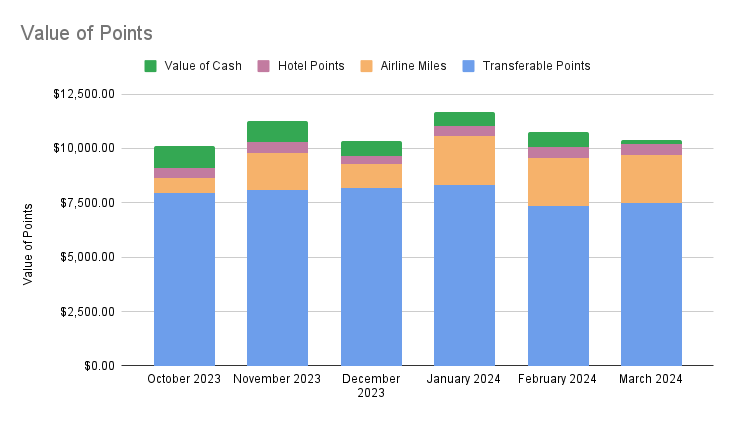
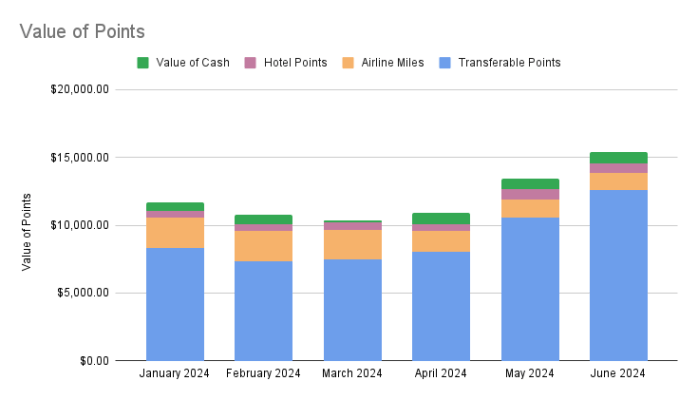
Wow, another big month of accumulating points as we continue to collect Membership Reward points from the three American Express cards that we signed up for this year. Last month Jenn earned her 130,000 point bonus on her Amex Business Gold card. This month, I earned my 75,000 point signup bonus on my Amex Gold Card. These bonuses in the last two months were the main reason why our total points valuations jumped from over $10,500 two months ago to over $15,000 now.

Hoarding Points

There is a a generally agreed upon philosophy in the points and miles community of “Churn and Burn”. It’s actually a very solid philosophy. The reason for that is because over time, points tend to lose their value. They don’t go bad like milk, but they do have a tendency to be worth less over time. For example, when we were planning our first trip to Europe, we accumulated a bunch of United miles with the hope that 240,000 points would be enough to fly round trip for four people.

This was actually the case for us on that trip, because at the time, 30,000 points one-way was actually pretty commonly available. However, if you try to use United miles to fly to Europe now, chances are that it will cost you over 40,000 points each way in economy. So if you were holding a bunch of United miles, you just saw the value of your points drop pretty significantly.

We are, against the advice of so many people, deliberately hoarding points. Why? Well, partly because of the fact that we have two kids and we are at the stage of our lives where we are unable to travel as much as we want. The other reason is that because of the kids we spend a lot of money on things like groceries, clothes, cell phones and especially car insurance that will be significantly reduced once they move out on their own.

This will eventually reverse and we will travel more, while spending and earning less. That is when we will definitely need to lean heavily on points and miles to allow us to maximize our travels. My rough goal is to save about $5,000 worth of points and miles annually until I’m eligible for retirement. It seems aggressive, however in two and a half years in the points and miles hobby, we’ve managed to accumulate $15,000 in points and miles, while still taking some pretty great trips.

A minor Redemption

We have a trip to Italy planned in November, where we were able to leave a 25 hour stopover on our flight from Chicago to Rome. The stopover is in Amsterdam, and I am very much looking forward to it. When we planned for that, I knew we would need to book a hotel. I was hoping to use our category 1-4 Hyatt certificate for the stayover. The problem was that the hotel that I really wanted to stay at was a category 5, and the only other Hyatt that made sense was a category 2.

I’m not going to burn a free night certificate on a category 2 hotel, so we went ahead and used 8,000 Hyatt points to book a room at the Hyatt Place near the Amsterdam airport. We’re going to have to take the train into the the center of Amsterdam to enjoy it, but at least we’ll be close to the airport when it’s time to catch our flight.

Capital One Spark Card Select

Jenn applied for and was accepted for the Capital One Spark Card Select. The Spark Card Select is a business card that earns an unlimited 1.5% on all purchases. It doesn’t have an annual fee and it comes with a $750 signup bonus when you spend $6,000 in the first 3 months.

One interesting wrinkle in this is that you can transfer any cash rewards to a Venture card, if you have one, at a ratio of 1 cent to 1 point. This means that if you have a Venture card, which Jenn does have, you can transfer the $750 signup bonus to the Venture card as 75,000 venture miles. The nice thing about Venture miles is that they can be transferred to any of Capital One’s many transfer partners.

This is probably not going to be a card we spend on once we hit the signup bonus. We already have a couple of 2% anywhere cards that work as a good base for any spending in non-bonus categories, so 1.5% just isn’t going to excite me much after earning the signup bonus. That being said, it doesn’t have an annual fee, so there isn’t a huge incentive to run out and cancel it either.

On to the Points Check!

Card UsedSpendPoints EarnedPoint ValuePoints Per $Return on Spend
Venture$1,2922,584$47.802.03.7%
Ink Cash$5342,651$54.355.010.2%
Wyndham Business Earner$4502,734$30.076.16.8%
Citi Custom Cash$94318$5.723.46.3%
Total$2,3708,287$137.953.55.8%
This month’s spending not devoted to earning a signup bonus

Aside from the spending in the above chart, I spent under $300 on my Amex Gold card, and under $700 on my Amex Blue Business Plus card. That spending, as well as earning the signup bonus on my Amex Gold, increased my Membership Reward points by a little less than 80,000 points. Jenn spent a little over $2,700 on her Amex Business Gold card. Some of that spending was at 14x on dining, which was part of the referral bonus to get me to sign up for the Blue Business Plus. That $2,700 in spending earned over 15,000 points, so I would imagine a decent chunk of that was part of that bonus.

After all of that, we finished the month with 279,400 Membership Reward points, 233,000 Chase Ultimate Reward points, 81,200 Venture miles, 71,400 American Airlines miles, 39,300 Citi Thank You points, 34,900 Marriott Bonvoy points, 33,000 Wyndham points, 5,000 Delta miles, 2,300 Hyatt points, 1,800 United miles, and around $800 in cash back. Using the Points Guy’s valuations, these points are worth around $15,300 – not too shabby.

Working Backwards – How To Use Points for Spain

Once people learn that I save a lot of money on vacations by using miles and points, I often get asked “What credit card should I get?” The fact of the matter is that it depends on the type and location of the vacation. Where you want to go on vacation, when, and what style of vacation matters when deciding which card to choose.

Making a rational decision really matters when you’re making these plans because earning a bunch of points that are irrelevant to your plans can be extremely frustrating and counterproductive. Also, earning points in programs that require you to use more points than other programs means that you’re working harder than necessary to achieve your goals.

What about Spain?

Spain has been on our minds lately. Jenn and I have discussed going to Spain multiple times and we just haven’t pulled the trigger. We’ve discussed doing a beach vacation to the Canary Islands or a city trip to Madrid, but lately we’ve been discussing doing a week of a pilgrimage on the Camino de Santiago de Compostela. It hasn’t worked out for us yet, but those tapas are calling me and I’m going to make it happen at some point.

Economy Flights

I’m an economy flyer. It’s not that I don’t want to fly business or first class, it’s just not that important to me. I really treat flights as a means to an end – just get me there. Look, I’d love to be more comfortable, but right now I’m trying to get a family of four across an ocean, and I don’t really feel like draining my points balances to do it. I’m not saying I won’t fly business or first class in the future, but right now it’s just not something I’m thinking about.

That being said, there are quite a few good options for economy flights to Spain. Using the Daydream Explorer feature by Pointsyeah.com, I see quite a few good choices.

Points ProgramPoint RangeTypical Tax RangeNotes
Iberia17,000 to 40,000 one-way$100-$13017,000 point is the typical off-peak price. Iberia’s hub is Madrid.
Flying Blue20,000 to 40,000 one-way$100-$17020,000 points is fairly normal, some sales go as low as 11,500 points. Hubs in Amsterdam and Paris.
Virgin Atlantic12,000 to 40,000 one-way$170-$180High fees, but 12,000 points are fairly easy to find, flights are usually KLM, Air France or Delta flights
Avianca Lifemiles20,000-30,000 one way$20-$70 (+25 booking fee)Low fees and reasonable redemption prices. Avianca is usually good for United flights. Not as frequently available as Flying Blue and Iberia.
American Airlines20,000-35,000 one-way$5-$25Low fees and reasonable redemption prices. Some flights that route through London have high taxes.
United Airlines30,000-40,000 one-way$5-$15Low fees and high redemption prices, always check Avianca first before booking a United flight.
Award availability and pricing varies wildly, these prices may not be available when you want to book a flight.

The biggest problem here is that just because pricing for award flights are good and available in certain programs right now doesn’t mean that they will be available and good later. That’s why it is best to have the ability to use points with a variety of programs. Using a credit card with the ability to transfer points to a multiple programs is a good way to help you have the most options when it’s time to redeem those points.

Airline Award Program Transfer Partners

Point ProgramCitibankChaseAmexCapital OneWells FargoBilt
Iberia (Avios)1:11:11:11:11:11:1
Flying Blue1:11:11:11:11:11:1
Virgin Atlantic1:11:11:11:11:1
Avianca Lifemiles1:11:11:11:11:1
American Airlines
United Airlines1:11:1
Transferring points from Capital One to Iberia Avios requires another step of first transferring points from Capital One to British Airways Avios and then to Iberia Avios. Transferring Citi Thank You Points requires a transfer to Qatar Avios, then to British Airways Avios and then to Iberia Avios.

I prefer to fly non-stop, if at all possible, and Chicago is our closest major airport. Most of the non-stop flights from Chicago to Madrid are on Iberia. That’s going to be my first choice. All major programs transfer to Avios, but Citi and Capital One don’t transfer directly to Iberia Avios, they both require transferring to a different Avios program and then to Iberia. That could create other annoyances that I might not want to deal with.

KLM/Air France Flying Blue is another great option, because they have a lot of flights that leave Chicago and fly to Spain with layovers in either Amsterdam (on KLM) or through Paris (on Air France). Virgin Atlantic and Avianca Lifemiles are great, but for Spain they are mostly booking partner awards, so they won’t be operating any flights to Spain. Their availability is going to be dependent on whether another airline allows them to book their flights. In other words, I would check for availability, but I wouldn’t count on them.

American Airlines sometimes has some amazing prices, but they don’t have any transfer partners so you would need to have an American Airlines card to earn those points. United Airlines usually has fairly expensive award prices, but their taxes are low and availability is good. It’s nice to have United as a backup option.

Hotels in Spain

For most hotel groups, I typically don’t consider transfer partners. The reason for this is because the transfer rates don’t make up for the fact that the points aren’t worth much. Most programs with the exception of Hyatt just aren’t worth transferring points to from one of the major bank programs.

Hotel Loyalty Program Transfer Ratios

CitibankChaseAmexCapital OneWells FargoBilt
Hyatt1:11:1
IHG1:11:1
Hilton1:2
Choice1:21:11:11:2
Marriott1:11:11:1
Wyndham1:11:1
Transfer ratios of points from major bank travel award programs to hotel loyalty programs. For example Citibank transfers 1:2 to Choice Privileges, meaning 1,000 Citi Thank You Points can be converted to 2,000 Choice Privileges points.

If you are looking at a program besides Hyatt, you’ll probably want to get a cobranded hotel credit card if you want to build up free nights and points. The list of those cards and the pros and cons of each of those cards is too exhaustive to get into in this post, but I do think its important to be thinking about those cobranded cards when considering programs other than Hyatt.

The reason why Hyatt is different, is because their points are worth more than other programs. According to the Points Guy, Hyatt points are worth 1.7 cents per point. By contrast, Wyndham is worth 1.1, Marriott Bonvoy is .85, Hilton is .6, Choice is .6 and IHG is .5 cents per point. For example, Chase Ultimate Rewards points transfer to Hyatt, Marriott and IHG at a 1:1 ratio. However, on average, you’ll spend more than three times as many Ultimate reward points booking an IHG hotel than a comparable Hyatt hotel when transferring Ultimate Reward points to those programs.

Hotels in Spanish Tourist Locations

MadridBalearic IslandsBarcelonaCanary Islands
Hyatt635311
IHG14598
Hilton6450
Choice7093
Marriott2311176
Wyndham2003
Number of hotels in/near various locations in Spain. Counts are across all brands in a program’s portfolio.

When looking at Spain specifically, the good news is that Hyatt has a lot of hotels in Spain. They especially have a large all-inclusive hotel presence in the Balearic Islands, which is a huge hot spot for Europeans to enjoy a beach vacation. Marriott also has a large number of hotels in Spain. A lot of those are in Barcelona and Madrid, which would make them a good program to use if you were looking for a more urban trip.

Potential Strategies for Earning Points for a Trip to Spain

There are a million different ways to accomplish the goal of earning points and miles to go on a vacation to Spain. I think its helpful here to explain what I would do, and why I would do it in a certain way. It doesn’t necessarily mean that this would be the optimal strategy, but I think it’s indicative of how someone should approach it.

All-Inclusive couple’s beach vacation to Mallorca

There are numerous Hyatt All-Inclusive resorts in Mallorca. Of the ones that showed up on the search that I did, there are a number of Category A resorts (15,000 points normally, 12,000 for off-peak and 18,000 for peak) and the most expensive was the Secrets Mallorca which is a Category D resort (30,000 points normally, 25,000 for off-peak, 35,000 points peak).

The best bets for available flights to Mallorca for a low amount of points is probably going to be Iberia Airlines (Avios) or KLM/Air France (Flying Blue). You can move points from Citibank, Capital One, Chase, American Express, Wells Fargo or Bilt to Iberia or KLM/Air France. This means you have a lot of choices on which credit cards you might want to sign up for.

The good news here, is that there is overlap between acquiring points for Hyatt and acquiring points for those two airline programs. Both Bilt and Chase offer transfers to all of these programs. Bilt never really offers signup bonuses, which is a big negative in this case, but they do allow you to earn points paying for rent, which nobody else allows, so if you are a renter, the Bilt card is a no-brainer. However, regardless of whether the Bilt card makes sense in your case, you’ll still probably want to sign up for a Chase card that allows you to transfer Ultimate Reward points.

In order to unlock the ability to transfer any Ultimate Reward points to partner programs you will need one of these three cards:

  • Chase Sapphire Preferred ($95 annual fee, 3x on dining, 3x online groceries, 3x on streaming services, 2x on travel)
  • Chase Sapphire Reserve ($550 annual fee, 3x on dining, 3x travel, $300 annual travel credit, Priority Pass membership)
  • Ink Business Preferred ($95 annual fee, 3x on shipping, internet, phone, cable and travel)

The typical signup bonuses for these cards are 60,000 each for the Sapphire cards and 100,000 points for the Ink Business Preferred. Once you have signed up and earned the welcome offer bonus you can refer your spouse or significant other and earn a referral bonus while they also earn a signup bonus for themselves. Once you’ve done that, then it’s just a matter of filling in the gaps with either some other cards that earn Ultimate Reward points or by getting cobranded cards. Here are some examples:

  • Ink Business Cash ($0 annual fee, $750 cash back which can also be used as 75,000 Ultimate Reward points, 5x internet, cable, phone and office supply stores)
  • Ink Business Unlimited ($0 annual fee, $750 cash back which can be used as 75,000 Ultimate Reward points, 1.5x on everything)
  • Ink Business Premier ($195 annual fee, $1,000 cash back which can be used as 100,000 Ultimate Reward points, 2x on everything)
  • World of Hyatt ($95 annual fee, 30,000 Hyatt point bonus, category 1-4 free night certificate each year on anniversary date)
  • World of Hyatt Business ($199 annual fee, 60,000 Hyatt point bonus, up to $100 off stays each year)
  • Iberia Airlines card ($95 annual fee, 75,000 Avios bonus)
  • Air France KLM World Elite Mastercard ($89 annual fee, 50,000 Flying Blue point bonus, 1.5x on everything)

I think it should be feasible to book a vacation like this for around 50,000 points round-trip per person in economy and if you wanted 6 nights in an all-inclusive, it could be another 90,000 to 180,000 points. That would mean the totals here would be 190,000 to 280,000 points. Just doing the minimum spend on two Chase Sapphire Preferred cards, with a referral bonus between spouses or significant others, would probably earn somewhere in the ballpark of 150,000 Ultimate Reward points, so it’s not too hard to pick a card or two that fills in the gaps here.

Family of four to Madrid for Spring Break

For this example, the information about the flights would basically be the same. You’ll probably find that Iberia or Air France/KLM will be the best programs to serve the Madrid Airport. From Chicago, you are likely to be able be able to book those round-trip economy flights for 50,000 points each (probably less if off peak). You would probably need to earn somewhere in the 200,000 point range just for the flights.

Instead of going with Chase as is in the first example, I would probably go with the Capital One Venture Card. Instead of a 60,000 point bonus, the Venture Card comes with a 75,000 point bonus. It also earns 2x on everything and has a 20,000 point referral bonus. Therefore, if you sign up for the Venture Card and refer your significant other and do the minimum spend, you will end up with a combined 186,000 points. An additional $7,000 in spending would get you to 200,000 points. If you need to transfer those points to Iberia, however, you will need to transfer them to British Airways Avios and then from British Airways Avios to Iberia Avios.

As far as lodging is concerned, European hotels typically don’t like to allow people to sleep four to a room so you would probably need to get two rooms. That’s not ideal, not only because it becomes twice the cost to get hotels, but also depending on the age of your kids, your sleeping arrangements might not be what your used to.

Personally, because of the two room problem, I would just get an Airbnb instead of a hotel. However, if you would like to stay at a hotel on points, I would probably be considering Marriott hotels. They have a lot of hotels in the Madrid area. In order to earn points/free nights for the stay I would go for the Marriott Bonvoy Boundless card. Most of the time they offer three free night certificates as a sign up bonus. However, it seems like about once a year they offer five free night certificates, so if you time it right and your significant other also signs up at the same time, you could end up with ten free night certificates, and that would get you five nights of two rooms per night.

Conclusion

For the most part, whenever you want to fly somewhere, looking first at an airline based in that area better is always a good choice. In this case Iberia is a perfect example. It’s hub is in Madrid and they have very good award prices to Madrid. Luckily for the points and miles hobbyist, you can pretty much transfer any of the major bank programs’ points and miles to Iberia Avios. The second best option is Air France/KLM Flying Blue which also transfers from every major program.

This gives an incredible amount of flexibility when deciding which credit cards to use, however, if you are also looking at Hyatt simultaneously, you probably want to go with a Chase credit card because it also transfers to Hyatt. I think Capital One is a better choice for the Family trip to Madrid, even with the extra headache of having to transfer the points through British Airways to Iberia. While I would do an Airbnb in Madrid, if you do actually want to split your family into two rooms at a hotel in Madrid, the Marriott Bonvoy Boundless card can be a great choice for racking up a lot of free nights quickly.

Whenever you are trying to determine the best credit card to sign up for to help out with the cost of vacation, it is always important to think about the desired destination first. Doing a little bit of analysis should help guide you to pick the right credit cards to help you get there. Once you’ve done that, it’s just a matter of executing your plan and enjoying your vacation.

Wells Fargo Launches Another Great Credit Card with Signify Business Cash

For years, Wells Fargo has been a boring bank for travel hackers. However, in the last year or so, Wells Fargo has been put the travel rewards industry on notice that they intend to compete for business in the points and miles space.

The difference is that they have added some transfer partners for their credit cards. This allows for users to redeem their rewards for value that is better than the normal cash back rate. They are also adding new credit cards to their lineup.

Why Choose the Signify Business Cash Card

There are 3 good reasons to choose the Signify Business Cash card:

  • $0 Annual Fee
  • 2% Cash Back
  • $500 Signup offer

These are all pretty boring reasons, but they are important if you are planning to maximize return on your spending. 2% cash back seems pretty boring in the points and miles world, but it’s important because it allows you to get at least 2% in categories where there are no bonus categories. This is especially true if you have a business that has to purchase supplies or parts.

Having a 2% base is especially nice if you can use a different card for purchases in other bonus categories. For example, if you also had the Wells Fargo Autograph card, you could earn 3% on gas, groceries, transit, streaming services, and phone plans. Simply pairing these two cards, could allow you to get 3% on a lot of your expenses while earning 2% on everything else.

Also, having no annual fee allows you to not use it when you want and not worry about getting the most out of the card. If you decide you want to put it aside while you work on a new credit card signup bonus, you’re not going to worry that you’re getting your money’s worth on an annual fee. In that way, a 2% card with no annual fee becomes a solid, dependable card that you can use when you want and shove it to the back of your wallet when you don’t need it.

$500 Signup Bonus

The Signify Business Cash card is currently offering a $500 signup bonus when you spend $5,000 in the first 3 months. That’s a very strong signup bonus for a card with no annual fee. The best comparison to this card, in my opinion is the American Express Blue Business Cash card that earns 2% cash back, has no annual fee and is offering a $250 statement credit on $3,000 in spending in 3 months.

It’s Not Just a Cash Back Card – There are Transfer Partners!

This is where things get a little in the weeds. By itself, the Signify Business Cash card is strictly a 2% cash back card. However, as Frequent Miler points out in their review of the Signify card, if you have either the Wells Fargo Autograph card or the Wells Fargo Autograph Journey card along with the Signify card, you can convert the cash back to Wells Fargo Reward points at 1 cent per point.

This allows you to access Wells Fargo Transfer partners, including:

  • Aer Lingus Avios
  • British Airways Avios
  • Iberia Avios
  • Qatar Privilege Avios
  • Air France Flying Blue
  • KLM Flying Blue
  • Avianca Lifemiles
  • Choice Privileges

Having these transfer partners means that you can take advantage of some of the great deals these programs have. For example, if you wanted to fly round trip from Chicago to Madrid in March 2025, the cost of that flight, in economy, using Avios, is 34,000 Avios and $228.70 (that’s not a flash sale – it’s normal off-peak pricing using Iberia Avios). In terms of the Signify card, that is essentially $340 in cash back transferred to Wells Fargo Rewards points then to Iberia Avios and $228.70. So essentially for $568.70 in cash back, you can fly to Madrid and back. That’s a really good deal, especially if you factor in the $500 signup bonus.

These transfer partners make the Wells Fargo Signify card much stronger than just a 2% cash back card. The Points Guy values Wells Fargo Reward points at 1.6 cents per point, meaning if you use the cash back from the Signify card as points, you are really earning 3.2% back as travel rewards. That’s pretty good.

Wells Fargo Active Cash is the Personal Version of Signify Cash

The Wells Fargo Active Cash card is essentially the same thing as the Signify Cash card, except that it’s a personal card. It is a 2% cash back everywhere card with no annual fee. Like the Signify card you can pool your rewards together with an Autograph or Autograph Journey Card and accumulate all of the rewards as Wells Fargo Reward points and transfer those points to their transfer partners.

The main differences here is that the Active Cash is a personal card and that the signup bonus is much lower ($200 for spending $500 in 3 months)

I expect this to Get Even Better Over Time

The transfer partners that Wells Fargo have chosen to work with initially are really good choices, but it’s a pretty limited list. Flying Blue, Avios, and Avianca Lifemiles are all really good programs that cover a lot of needs for travelers on points and miles. However, that’s a pretty short list and I imagine that Wells Fargo is trying to add more transfer partners.

As I pointed out in a previous post when Wells Fargo announced they would have transfer partners, but before they announced who the partners would be, Wells Fargo is associated with the Bilt Card, and Bilt has probably the best list of transfer partners in the points and miles space. It took a while for Bilt to build out their impressive list of transfer partners, and if Wells Fargo follows suit, this could become a very valuable transferrable points currency.

There are a few, like Air Canada Aeroplan and Emirates Skyward, that I think would be pretty easy for them to add. Some others, such as Alaska Air or American Airlines, would be amazing but I wouldn’t count on it. I would also love to see them add Hyatt, but I don’t think they will, although I would expect them to add at least one more hotel chain.

Wells Fargo Rewards Keeps Getting Better

Anything that Wells Fargo can add to their transfer partner list at this point will make Wells Fargo Reward points more valuable, and by extension, Wells Fargo credit cards. The Wells Fargo Autograph and the Wells Fargo Autograph Journey are already cards that do a great job of earning points with some really strong bonus categories.

Wells Fargo seems intent on making some cards that really appeal to the points and miles community. It looks like they definitely want to start aggressively taking some business away from Chase, American Express, Capital One and Citibank. With that in mind, and the fact that they’ve been offering transfer partners for less than a year, I expect that Wells Fargo will add new credit card offerings, and new transfer partners over time. This is absolutely a bank to keep your eyes on.

Manufacturing a Big Signup Bonus on the Amex Blue Business Plus

The American Express Blue Business Plus is a somewhat boring, but great all around credit card. It doesn’t come with a big, flashy signup bonus. However, every once in a while, American Express puts out referral bonuses that can make the signup bonus pretty sweet. A recent referral offer from American Express gave us the opportunity to get this must-have credit card and still get a decent bonus.

Why Choose the Amex Blue Business Plus

There main reasons for why the Blue Business Plus is a great option for a business credit card are:

  • No Annual Fee
  • 2x on all spending up to $50,000 in spending per year
  • Earns Membership Reward points that are transferable to 18 airline program and 3 hotel program partners

2x Membership Rewards points per dollar on all spending is great for a no annual fee card. If you are someone who uses multiple credit cards and take advantage of bonus categories to get 5x or 3x on your spending, you notice pretty quickly that not all spending will fall into a bonus category. Having a 2x card that acts as the lowest you earn can be very valuable, especially if you spend a lot in non-bonus categories.

Also, if you like to take advantage of big Amex signup bonus offers on their Gold and Platinum cards, but don’t want to pay the big annual fees for eternity, having the Blue Business Plus card gives you a no annual fee option that allows you to keep those points you earned on those big signup bonuses. This allows you to keep those points and cancel those credit cards. Keep in mind, cancelling an American Express card within 12 months from the date it was issued can cause them to take back the points.

Membership Rewards Transfer Partners

ProgramTypeTransfer Rate
Aer LingusAirline1 MR to 1 Avios
AeroMexicoAirline1 MR to 1.6 AeroMexico Reward Points
Air Canada AeroplanAirline1 MR to 1 Aeroplan Point
ANA Mileage ClubAirline1 MR to 1 ANA Mile
Avianca LifemilesAirline1 MR to 1 Lifemile
British AirwaysAirline1 MR to 1 Avios
Cathay PacificAirline1 MR to 1 Asia Mile
Delta SkymilesAirlines1 MR to 1 Skymile
Emirates SkywardsAirlines1 MR to 1 Skyward Mile
Etihad GuestAirlines1 MR to 1 Etihad Guest Mile
Flying Blue (Air France/KLM)Airlines1 MR to 1 Flying Blue Mile
Hawaiian MilesAirlines1 MR to 1 Hawaiian Mile
Iberia PlusAirlines1 MR to 1 Avios
JetBlue True BlueAirlines5 MR to 4 TrueBlue Points
Quantas Frequent FlyerAirlines1 MR to 1 Quantas Point
Qatar Airways Privilege ClubAirlines1 MR to 1 Avios
Singapore KrisflyerAirlines1 MR to 1 KrisFlyer Miles
Virgin Atlantic Flying ClubAirlines1 MR to 1 Virgin Point
Choice PrivilegesHotel1 MR to 1 Choice Privilege
Hilton HonorsHotels 1 MR to 2 Hilton Honors Points
Marriott Bonvoy Hotels1 MR to 1 Bonvoy Points

What makes Membership Rewards points so valuable is being able to take advantage of deals in any of these programs. For example, Flying Blue frequently offers flights from major US cities to Europe for 20,000 points (and around $150 taxes/surcharges) one-way in economy or 50,000 points (and around $250 taxes/surcharges) one-way in business class.

In addition, Virgin Voyages often offers points redemptions on cruises. Recently, they were offering a cruise for 120,000 points per cabin (1 or 2 people) for a seven night Mediterranean cruise leaving from Barcelona with stops in places like Ibiza, Mallorca, and Marseille. Simultaneously, there was also a 30% transfer bonus to Virgin from American Express which means that cruise could have been booked for around 93,000 Membership Rewards points.

Being able to pick and choose between programs when they are running specials is what makes flexible award currencies, such as Membership Rewards so incredibly valuable.

A Place to Keep Your Membership Rewards

American Express offers some monster signup bonuses on their cards. Recently, as Travel On Points pointed out, they offered a 300,000 point signup bonus on their Business Platinum card. That’s just enormous, with that bonus being worth $6,000.

However, the Business Platinum Card has an annual fee of $695. While there are definitely great ways of getting $700 worth of value on that card by using the credits and benefits on that card, eventually you might decide you want to dump the card to avoid that annual fee. By having the Blue Business Plus, you can keep the points you earned on your Business Platinum card in your account without having to pay an annual fee.

But the Signup Bonus for the Blue Business Plus is so Tiny

I have definitely gotten spoiled with signup offers that seem to always be north of 60,000 points. However, I knew if I was going to be trying to get big offers from American Express, I would want the Blue Business Plus in order to house those points. Unfortunately, they almost always offer 15,000 Membership Rewards points on a spend of $3,000 in 3 months – that’s just not exciting.

However, earlier this year, Jenn was given a very enticing offer from American Express. She signed up for the Business Gold card on an inflated 130,000 point offer. Since she was a Business Gold card holder, they offered her a 20,000 point referral bonus as well as 3 months of an additional 10x on dining.

Normally, credit card companies only offer referral bonuses on the same card that the cardholder has, but American Express offers referral bonuses that work if the invitee is approved for other American Express cards as well. This means that Jenn could get a referral bonus on her Business Gold card even though I was getting the Blue Business Plus.

The 20,000 point referral bonus wasn’t that unusual, but the extra 10x on dining was very interesting. Her Business Gold card already earns 4x on dining, which means that for 3 months, she will be earning 14x on every dollar spent on dining.

We don’t eat out that often, maybe a couple of times a month, but we do spend a decent amount of time at breweries. I mean, enough that most of the bartenders we see know us by name. Hey, we like beer. Anyway, breweries code as dining, so those are 14x when using her Business Gold card for the next 3 months.

All in all, lets say that over the next 3 months we spend $2,000 on dining. With the extra 10x, that is 20,000 Membership Reward Points. If you add the 20,000 point referral and the 15,000 point signup, that makes the total signup bonus 55,000 Membership Reward points. That’s pretty good for a no annual fee card, especially one with 2x transferable points on all spending.

Benefits of Working with Someone Else

This is a great example of the importance of working with someone else when earning points and miles. Experienced points and miles hobbyists refer to this as “2-player mode”. Being able to consistently refer a spouse, friend or family member, means that both of you can amass a larger amount of points that you can as an individual. This also means that you shouldn’t be an authorized user on your Player 2’s accounts.

In this case, if I was signing up for this card by myself, I would have earned a 15,000 point bonus. Since we are working in 2-player mode, Jenn will earn around 40,000 points in addition to the points that I’ve earned.

The American Express Blue Business Plus is one of those no-brainer credit cards that should be in your wallet. With 2x Membership Rewards points on all spending up to $50,000 per year and no annual fee, it’s a great card to keep around even if you don’t use it often. American Express has a tendency to give great referral bonuses from time to time, so if you can take advantage of those referral bonuses to bump up that sign up bonus, you should absolutely do so. This is one of those cards that you should have, but be patient to see if you can manufacture an elevated bonus.

Points Check March 2024

March was a pretty exciting month. We took a spring break trip to Costa Rica and had the opportunity to see just how beautiful that country is. We stayed in an Airbnb in the Central Valley near Grecia, which meant we were staying amongst the locals. That really gave us a more authentic taste of Costa Rica and was definitely not the normal touristy vacation.

We had to drive quite a bit to get to the locations that we wanted to visit, but in a week we managed to do hikes in a mountain pine forest and another by gorgeous waterfalls. We visited the only coffee farm owned by Starbucks. We also visited Poas Volcano as well as Playa Hermosa. Hey, any week you manage to visit the mountains, the beach and waterfalls in the same week is pretty good.

Costa Rica is a beautiful country and I would recommend it to anyone who is willing to go a little off the beaten path.

American Express Business Gold

Jenn applied for and was accepted for the American Express Business Gold. This is a card that we normally would ignore because of the higher annual fee and the higher required spend to earn the bonus on the card.

I have some mixed feelings about this card. The first issue for me is the $375 annual fee. We have, for the most part, gotten used to annual fees when they hand you a nice welcome bonus, but normally they have been less than $100 for us. That being said, this was an enormous 130,000 Membership Reward point bonus which The Points Guy values at 2 cents per point, so the bonus itself is worth $2,600. That definitely takes the sting out of the annual fee, especially if you plan to cancel before it renews.

The other negative here is that in order to receive this massive bonus, you must spend $10,000 in the first 3 months. That’s not easy for us, but with tax time coming and a pretty large tax bill, this shouldn’t be too hard. Making the most out of paying our taxes is becoming a annual tradition for us, last year we managed to profit $1,350 from paying our taxes.

The Amex Business Gold card earns 4x on some pretty good categories such as dining, gas and transit. It also offers 4x in some business categories such as advertising, electronics retailers, cloud system providers and cell phone service providers. In addition, it earns 3x on purchases through amextravel.com and 1x on all other purchases.

They have some monthly and annual credits, such as $155 refund for Walmart Plus membership and $20 per month for purchases at office supply stores, Grubhub, or FedEx. While I don’t think we’ll be signing up for Walmart Plus, Jenn has figured out that she can use that $20 per month by ordering takeout through Grubhub for some of our favorite restaurants so we will definitely be using those $20 Grubhub credits.

Ok, on the Points Check

Card UsedSpendPoints EarnedPoint ValuePoints Per $Return on Spend
Ink Cash$5342,651$54.355.010.2%
Capital One Venture$5191,038$19.202.03.6%
Marriott Bonvoy$4212,105$17.685.04.2%
Citibusiness AAdvantage$347347$5.381.01.6%
Wyndham Business Earner$124814$8.956.67.2%
Custom Cash$49244$4.3959.2%
Total$1,9947,199$109.963.65.5%
This month’s spending not devoted to earning a signup bonus

We actually have 3 open cards where we are working on signup bonuses, which is a little crazy so the spend on cards without signup bonuses is pretty low this month. Most of the stuff in the chart above are set up as autopay for things like insurance, cell phones, utilities, etc. The Marriott Bonvoy charges are because we were earning 5x on groceries as a promo, and once again, somehow, we accidentally spent on the Citibusiness card at 1x which is a little frustrating. All in all, though, getting 5.5% back on non-bonus spend is fine by me.

In addition to the non-bonus spend, I spent $735 on my American Express Gold card and earned a little over 1,900 Membership Reward points. Jenn spent about $2,250 on her US Bank Business Connect card and earned $46 in cash back.

We didn’t earn any bonuses this month but I would imagine that those should start to hit over the next few months and they are some pretty big ones, with a $500 cash back bonus, a 75,000 Membership Reward bonus on my Amex Gold card, and the 130,000 Membership Reward bonus on Jenn’s Amex Business Gold card. I’m looking forward to seeing our point valuations balloon as these start to hit.

The only real redemption this month was that I used the cash back that I had earned last year to pay for the rental car and some of the gas while we were in Costa Rica.

Because we used some of our cash back, and we didn’t have any bonuses hit, we ended the month with a lower total value than the previous month. We ended the month with 260,300 Chase Ultimate Reward points, 115,200 American Airlines miles, 76,300 Capital One Venture miles, 38,800 Citi Thank You points, 34,000 Marriott Bonvoy points, 25,000 United miles, 10,000 Wyndham points, 6,900 Hyatt points, 5,000 Delta Miles, 1,900 Amex Membership Reward points and $183 in cash back. All of that, according to the valuations from The Points Guy, is worth around $10,300.

Latest Vacasa/Wyndham Devaluation Stings A Bit

** On November 30, 2025, vacasa will end ITS partnership with Wyndham and this will no longer be available.**

The Vacasa/Wyndham partnership devalued again, for the second time in just 6 months. This is pretty annoying, because this partnership went under the radar for a while, and as people became aware of what a tremendous deal this was, they had to start dialing it back. Now after a second devaluation, the partnership is still pretty good but it’s just not the same fantastic deal it was before.

We have loved this program for a while and have used it a couple of times, once for a trip to Nashville, where we saved almost $1,000 by buying points and redeeming it on the rental and another where Jenn got a great deal on a Vacasa in Playa Del Carmen for a girl’s trip.

What Happened Now?

The original redemption rates for Wyndham points on Vacasa rentals was simple – 15,000 Wyndham points per bedroom, per night on any rental up to $500 per bedroom per night. In October of last year, they kept the same basic structure, but lowered the maximum redemption from $500 per bedroom per night to $350 per bedroom per night.

With the change made in October, it effectively made any rental that cost more than $350 per bedroom per night unrentable on points. The newest devaluation makes those properties rentable again, but means that any property that cost between $250-$500 per night per bedroom just got twice as expensive as it was prior to October 2023.

The new Vacasa/Wyndham redemption rates are essentially this: for any Vacasa vacation rental, it costs 15,000 Wyndham points per bedroom per night for any property that costs up to $250 per bedroom per night. For any property that costs $250-$500 per bedroom per night, that will cost 30,000 Wyndham points per bedroom per night. Any property that costs more that $500 per bedroom per night will be unavailable on points.

ExampleBefore Oct 2023Oct 2023 – March 2024After March 2024
1 Bedroom $200/Night15,000 Pts/Night15,000 Pts/Night15,000 Pts/Night
1 Bedroom $300/Night15,000 Pts/Night15,000 Pts/Night30,000 Pts/Night
1 Bedroom $400/Night15,000 Pts/NightUnavailable on Points30,000 Pts/ Night
2 Bedroom $450/Night30,000 Pts/Night30,000 Pts/Night30,000 Pts/Night
2 Bedroom $600/Night30,000 Pts/Night30,000 Pts/Night60,000 Pts/Night
2 Bedroom $900/Night30,000 Pts/NightUnavailable on Points60,000 Pts/Night
Effect of last 2 Vacasa/Wyndham devaluation on redemptions

These are All-In Prices

The $250 per bedroom per night price is the all-in price not the headline price on Vacasa’s website. They might show a headline price of $200 per night, for example, but for 5 nights it’s not going to be $1,000, it’s probably going to be closer to $1,400. This is because they charge a number of taxes and fees, which can get pretty extensive.

These fees can be state and local taxes, amenity fees, booking fees, damage waivers, etc. In my experience, these will probably cost an extra 30 to 50 percent on top of the rent itself.

I think we can all agree that fees are getting out of control as you can see below. I mean, damn, I know you have expenses and all but do you need to itemize them and make me pay one by one? Just tell me what the price is! I mean, I get it, you got an HOA, but you can include that in the price instead of charging me for an ‘Amenity Fee’? And what the hell is a ‘destination surcharge’?

How Many Properties Does This Actually Affect?

One of the bright spots about this devaluation has been that if you had a rental that you liked that normally cost $200 per bedroom per night, you have gone completely unaffected by this. There are a lot of quality vacation rentals that are under that $250 per bedroom per night range and they are the same as they ever were.

That being said, if you had your eye on a more expensive unit, you might be reevaluating your plans now.

Let’s look at the Destin Florida area for a 5 day rental in June to see the real life results of the devaluation. Let’s say you’re a family of 4 and you would prefer a 2 bedroom vacation rental, but would settle for a 1 bedroom if it had room for everyone to sleep.

The below examples are taking into account a 40% upcharge for taxes and fees. These fees vary by property, so some are higher and some are lower but in order for me to use the filters on Vacasa’s website for this chart, I had to make some assumptions.

Up to $250 per bedroom per night$250 -$350 per bedroom per night$350- $500 per bedroom per nightMore than $500 per bedroom per night
1 Bedroom25 (15,000 pts)119 (30,000 pts)129 (30,000 pts)120
2 Bedrooms323 (30,000 pts)298 (60,000 pts)94 (60,000 pts)12
3 Bedroom204 (45,000 pts)86 (90,000 pts)29 (90,000 pts)4
Example availability of Vacasa vacation rentals with room for 4 near Destin for a random summer extended weekend.

The unicorn rental is if you can find a 1 bedroom with enough sleeping space for 4, that can be rented for 15,000 Wyndham points. In this example, prior to October 2023, there would have been 273 total 1 bedroom properties rentable for under $500 per night. When the first devaluation occurred and dropped the maximum price for redemption to $350 per night, that number dropped to 144. After the March 2024 devaluation, there are only 25 such properties left at the 15,000 point level. That’s only 9% of the original available properties at that rate.

Two bedroom properties fared a little better in the devaluation than the one bedroom properties. 94 were affected by the devaluation in October and another 298 were affected by the March devaluation. In this case 45% of the two bedroom properties in this example were unaffected by these devaluations.

The three bedroom properties fared the best with 204 of the total 319 properties for a total of 64% unaffected by the devaluation.

In general, the next time that I rent a Vacasa on points I’ll most likely be renting something that is 30,000 points per night, because the unicorn 15,000 point redemption is just going to be very hard to find now. It probably means that we will be looking for a two bedroom which will probably be more comfortable for us than a one bedroom, but twice the number of points is still a bit of a kick to the gut.

Elevated Signup Bonuses as a Consolation Prize

I don’t know if Wyndham did this at the same time as the most recent devaluation to soften the blow a little bit, but current signup bonuses for Wyndham credit cards are massive right now.

Wyndham is currently offering 100,000 point bonuses on their Wyndham Reward Earner Business card and their Wyndham Reward Earner Plus (Consumer) card. They are also offering a 75,000 point bonus on their Wyndham Earner card. All of those bonuses are the largest bonuses ever offered according to Frequent Miler.

The Wyndham Reward Earner Business card is one that we hold and continue to use. Jenn signed up for this one when the bonus was only 45,000 points. The reason we continue to use it is that it has some great point earning rates. It is 8x at gas stations and 5x on utilities. I put all of our gas and utilities on it for this reason. The full 100,000 point bonus for this card is after spending $15,000 on the card within 12 months.

If you really like those Wyndham points (which we do), the Wyndham Reward Earner (Consumer version) Card has some great earning categories too. It is 6x at gas stations, 4x on groceries and 4x on dining. It is also currently offering a 100,000 point bonus after a much lower $2,000 in spending within 6 months.

If you spend a lot on gas and you like vacation rentals, these cards can rack up points for those rentals in a hurry. In addition, all 3 of the Wyndham cards offer a 10% discount on award redemptions if you are a cardholder. This means that the example of a 1 bedroom Vacasa under $250 per night isn’t actually 15,000 points per night, it’s really 13,500 points per night for cardholders. The 100,000 point bonus alone would pay for a week at those rates.

Keep in mind that if you were to maximize these redemptions at a full $250 per night per bedroom, and you had one of these credit cards to reduce the redemption to 13,500 points, you would be redeeming those points at 1.85 cents per point. If you are earning 8x on all of your gas spending, you are essentially earning 14.8% back at gas stations. That’s pretty ridiculous.

Vacasa Still Remains the Best Way to Book a Vacation Rental on Points

Even with the rapid fire devaluations, Vacasa still remains the best way to book a vacation rental on points. Marriott has it’s Homes and Villas collection which does allow for booking vacation rentals using Bonvoy points, but the rates are much higher, and I would argue the points are harder to earn.

Sure, if you are a business traveler, you might be able to earn quite a lot of Bonvoy points by staying in Marriott hotels, so Homes and Villas might be pretty attractive for your family vacation. But, if you’re not a business traveler, the ability to earn a lot of points through spending on gas and utilities on the Business Earner card or by gas, groceries, and dining on the consumer Earner card is huge.

I’m still hoping that Hyatt, IHG, or Hilton can someday begin to make their points usable at VRBO or Airbnb, but I wouldn’t count on it. That being said, as long as Wyndham keeps the amount of points needed to book a rental low as well as allow easy earning of Wyndham points, it’s going to remain a fantastic deal. There is no doubt in my mind that the Vacasa/Wyndham partnership remains the best way to use points on vacation rentals.

What’s the Best Travel Rewards Credit Card for Young Adults?

“I wish I would’ve traveled when I was young.” How many times have we all heard that lament from either 30-somethings tethered to their children or empty nesters who just lack the energy for the kind of travel they wish they could still do?

The problem with traveling when you’re young is that you’re usually pretty broke and travel isn’t cheap. Travel, however, is a great education for young adults. Travel teaches about other cultures, languages, and most importantly perspective. It also teaches skills such as communication (especially how to communicate without a common language) and self-reliance.

Our kids have grown up around travel because it was always important to us, even if it was just short trips to nearby places. It’s not surprising to me that it wasn’t long after she graduated from High School that my daughter Emma began to plan her own trips. She and her friends recently planned a trip to California for an event taking place in Anaheim.

I’m sure they’ll have a blast and while, as a parent, I’m a little nervous, I understand just how great a learning experience this can be. I also have a sneaking suspicion that this won’t be her last trip, so not only do we want to her to have the skills to travel, but if we can teach her a little about travel hacking along the way so that she can travel cheaply, that’s even better. So, of course, we’re going to help her pick the best credit cards that allow her to do the traveling that she wants to do, but for less money.

This had me doing quite a bit of thinking about what the best credit card for her, and by extension, any young traveler. A word of caution here – Emma is ridiculously careful with her money, if you are a parent of a young adult that isn’t careful with their money, then steering them into credit cards could be a really bad idea.

Building Your Credit Score

One very important thing for any young adult to do is begin to build their credit score. Start by signing up with Credit Karma or another such credit monitoring service. If travel hacking is a future that you want, you need to know, love and cherish your credit score. If you don’t, all of those awesome credit cards with the huge welcome bonuses won’t be an option for you.

There are 6 items that Credit Karma have listed that affect your credit score:

  • Payment History
  • Credit Card Usage
  • Derogatory Marks
  • Credit Age
  • Total Accounts
  • Hard Inquiries

The top 3 items there can pretty easily be maintained well simply by making your payments on time – every time and in full. However, what you should be concerned about when choosing your first or second credit card is developing your credit age.

Credit age is the average length of time that you have had your accounts open. For instance, if you only have one credit card that you’ve had for 8 months, then your credit age is 8 months. If you then get a second card, your credit age will drop to 4 months, since now you have a credit card for 8 months and one for 0 months.

Building a Solid Credit Age with a No Annual Fee Card

In the beginning this doesn’t matter that much, because you have to start somewhere, but what you really want to do at this time is get a credit card that you plan to keep – like forever. I actually have two accounts that are almost 20 years old and they work so well to hold this average up. If you pick the right card early, then you can keep that card for eternity and it can prop up this credit age stat.

This credit card should be a no annual fee card. The reason is simple, lets say you get a different credit card later that earns a huge amount of points and you start thinking that you should close that account because you don’t want to pay an annual fee on a credit card that you just don’t use any more. You either are going to have to keep paying the annual fee or take the hit on your credit score when your credit age drops. If you have a no annual fee card, you can stop using it and keep the card, no big deal.

What should a Young Traveler be Looking for in a Credit Card?

If a young person who wants to travel is looking for a credit card, there are a few things that they should be looking for:

  • No Annual Fee
  • Good Bonus Earning Categories (In categories they use)
  • Achievable Bonus With Low Spend Requirement
  • Good Transfer Partners

When it comes to good bonus earning categories, that obviously varies from person to person, but for my daughter, I know her typical spending categories are gas stations and dining. She should be looking for those categories as potential bonus categories.

As far as an achievable bonus with a low spend requirement, getting a card that earns a 60,000 point bonus is great, but if it requires a $4,000 in spend in 3 months, that might be a lot for a young adult to spend. It’s very important to know what is a reasonable amount to spend and don’t go for a card that stretches you financially to reach the sign up bonus. For our daughter, that number is probably no more than $400 per month toward a bonus, so if there is a bonus that is offered after $1,000 spending in 3 months, I think she’d be fine.

Transfer partners are really important if you want to maximize the amount of travel you can do with the points you earn from your credit card spend. By having a great menu of transfer partners to choose from, you can take advantage of any deals that pop up in a variety of programs.

With these things in mind, lets look at a few credit card options for the young traveler, all of which are offered with no annual fee.

Capital One Venture One Rewards

The Capital One Venture One Rewards card offers a generous 20,000 point bonus after only a $500 spend in 3 months. That is a good bonus offer with an achievable amount of spending.

The earning rates are 5x on hotels and rental cars, and 1.25 points per dollar everywhere else. Since I can’t imagine a young person spending a significant amount of money on hotels and rental cars, this is pretty much a 1.25x on everything card – not too exciting.

Capital One does have a great group of transfer partners including 15 airline programs and 3 hotel programs. Of the hotel programs, only Wyndham is interesting, but of there are some interesting airline partners like Avianca Lifemiles, Air France/KLM Flying Blue, Air Canada Aeroplan, British Airways Avios, and Turkish Miles and Smiles.

American Express EveryDay Card

The Amex EveryDay card has a signup bonus of 10,000 membership rewards points after spending $2,000 in the first 6 months. That’s not a great signup bonus, but the $2,000 spend over 6 months should be pretty achievable for most young adults.

This card earns 2x at grocery stores and 1x on everything else. That could be very attractive to someone who spends a large portion of their spending on groceries, but it’s not particularly exciting besides that.

American Express does pack a powerhouse of transfer partners including 11 airline partners and 3 hotel partners. The hotel partners are Marriott, Hilton and Radisson. The airline partners include Air France/KLM Flying Blue, British Airways and Iberia Avios, Virgin Atlantic and most importantly, Delta. Delta doesn’t always have the best redemptions, but they do have a ton of available flights within the US.

The Bilt Mastercard

Bilt is, well, it’s built different. Pardon the pun, but while it doesn’t offer a signup bonus, it offers a feature nobody else can – you can pay your rent with it. If you’re a renter, this card is the biggest no-brainer ever. Why? because you can earn points on what is probably your biggest expense – rent. You only earn 1x on rent, but it’s better than the 0x on rent on every other card. You must make 5 other transactions on the card each month to get the points for the rent, but still, points on rent? That’s crazy!

Aside from 1x on rent, it also earns 2x on travel and 3x on dining. Also, any spending done on rent day (1st of the month) is doubled. Which, for example, would be 6x on dining on the 1st of the month.

Bilt also has some pretty crazy rent day promos. A recent one offered up to a 150% transfer bonus (the actual transfer bonus percentage was based on your Bilt status) on the first of the month to transfer to Aeroplan. That means if you had 10,000 Bilt points and you wanted to transfer it on that day, it would show up as 25,000 miles in your Aeroplan account. The rent day promos are generally announced just a few days before rent day, so if you’re paying attention, you can get some tremendous transfer bonuses.

What’s even better is that Bilt has the best group of transfer partners of any credit card. They have 12 airline and 3 hotel partners. The quality of these partners sets them apart. Not only do they have some of the usual transfer partners like Air France/KLM Flying Blue, British Airways/Iberia/Aer Lingus Avios and Air Canada Aeroplan, but they also have United Airlines.

As far as hotels are concerned, Bilt has Hyatt, Marriott Bonvoy, and IHG. Hyatt is the big one on this list. They consistently have award stays at great redemption rates and Hyatt points are by far the most valuable of any hotel chain.

Wells Fargo autograph Card

The Wells Fargo Autograph Card currently has a 20,000 point bonus when the cardholder spends $1,000 in the first 3 months. That should be pretty achievable for anyone with any sort of normal expenses.

The Autograph Card has some solid bonus categories. They offer 3x on dining, travel, gas, transit, streaming services and phone plans. Looking through that list, that looks like a list of bonus categories that should be pretty great for young adults. I’m not sure how much the average young adult spends on travel, but I have to imagine that the rest of these categories should get used pretty heavily. This card should earn a young adult a lot of points every month.

Prior to an announcement earlier this month, I would have considered the Autograph card to be a cash back card. However, starting April 4th, 2024, Wells Fargo has added transfer partners to this card as well as to the recently launched Autograph Journey card. There are only a few at this point with Air France/KLM Flying Blue, Aer Lingus/British Airways/Iberia Avios, and Avianca Lifemiles for airline transfer partners and Choice Hotels on the hotel side.

Even though there are only 3 programs (6 airlines) in the list of airline transfer partners, they are really good ones. Also, while you might think Choice is a sub-par hotel partner, Autograph Rewards transfer to Choice at a 1:2 ratio. If just look around Choice’s website, it’s pretty common to find hotels between 10,000 points and 20,000 points per night. At that transfer ratio, that becomes 5,000 to 10,000 Autograph Rewards points. That’s a pretty good value for those points.

Wells Fargo has been indicating that these are the initial transfer partners for the Autograph Rewards program and more will be added over time. This should mean that this program should only get better throughout this year and maybe beyond.

Why are there No Citibank or Chase Cards on this List?

The main reason why I didn’t choose any Citibank or Chase credit cards for this list is that both banks require the cardholder to have a premium credit card in order to transfer points. In the case of Citibank, you can earn transferrable Citi Thank You points on a number of credit cards, but you will need to have a Citi Premier card in order to transfer those points to one of the transfer partners in their program.

In the case of Chase, the cardholder must have a Sapphire Reserve card, Sapphire Preferred Card, or a Ink Business Preferred Card in order to unlock the transfer partner benefit. Again, Chase has some great cards to earn Ultimate Reward Points, but without one of those three cards the cardholder can’t transfer those points to one of Chase’s great list of transfer partners.

All of the cards I mentioned above not only have an annual fee, but the signup bonuses on these have some elevated spending (normally something like $4,000 in 3 months) that would be likely be difficult for a young person to achieve.

So which of these Cards is the Best For Young Travelers?

The Capital One Venture One card has a great signup bonus and fantastic transfer partners. However, with all of the ongoing spend being at 1.25x, it looks like there wouldn’t be great opportunities to accumulate a lot of points after the signup bonus.

The Amex EveryDay card has a not very exciting 10,000 point bonus after $2,000 spend. It does offer 2x on groceries and 1x everywhere else, so if groceries are a big expense, this might make sense. American Express also has great transfer partners.

The Bilt Mastercard doesn’t have any signup bonus, but the fact that you can pay rent with this card makes it a great card for any renter. Once you add in the fact that they probably have the best transfer partners and some really exciting rent day specials, this just becomes a must-have card for anyone who pays rent. Hands down, if you pay rent – get the Bilt Mastercard.

If you don’t pay rent, I think the Wells Fargo Autograph Card is suddenly the best choice. Yeah, it has some limited transfer partners, but it has a great signup bonus and 3x categories that hit all the right spots for young adults. I also think the limited transfer partners issue is a temporary thing. Wells Fargo is indicating that there will be additional transfer partners and my guess is that they will roll them out one at a time going forward so to maximize the amount of press they get. This could be one of the best no annual fee cards available by the end of the year.

Conclusion

I think it’s actually pretty important that young people choose wisely when getting their first credit card. The impact on credit score of having a credit card with a really long history means that picking a credit card that you will continue you to use for a long time is very important. It’s very important to make that credit card something that you aren’t tempted to close.

Assuming that the person applying for the account likes to travel, I think the answer is pretty clear – go with the Bilt Mastercard if you pay rent and the Wells Fargo Autograph card if you don’t pay rent. Just make sure that you pay your balances in full every month, and enjoy your travels!
Points Check February 2024

We’re inching closer every day to our spring break Costa Rican adventure. Honestly, this is a trip that I probably wouldn’t have dared to do a year ago. When we first started to do international travel (it’s only been a year – we’re still newbies!), every logistical step in the process was something that we needed to examine. How long will we be waiting in customs? Is that layover long enough? How do the trains/busses/taxis work from the airport? Will we be understood if we don’t speak the local language well? Each trip that we take gives us a little more confidence in the process and our abilities to handle those logistical issues.

The biggest logistical hurdle this time is driving a rental car in a foreign country, especially Costa Rica. There are horror stories all over the internet about scams at the rental car counter. Also, driving habits apparently are a little different in Costa Rica and the roads sound like they will be questionable off the major highways.

It’s easier for us to mentally prepare ourselves for what could be stressful driving and perhaps a difficult time at the rental car facility when we don’t have to mentally prepare ourselves for the logistics of flying. I feel like there are parts of travel that we’ve started to understand pretty well and it opens up my mental energy for new experiences. This is really important when you don’t want the negatives of travel to overwhelm what I’m anticipating to be an amazing experience with waterfalls, beaches and volcanoes in Costa Rica.

Hold!!!

Jenn and I have been planning a trip for us with her parents and our good friends who live in Nashville. The biggest logistical issue for this trip was landing around the same time in Rome with us using 3 different flight itineraries. That part has been done, but we’ve only managed to book the flights to Italy, not the return flights.

However, every time I try to bring up the fact that maybe we should book the return trip, Jenn turns into Kirstin Bell from the Carvana commercial and just tells me “HOLD!” I think she’s waiting on the perfect flight home that costs something like 1,000 points in business class with a stopover in Madrid. I’m sure we’ll find something decent since it is off-peak from Europe, but she’s making me nervous. I guess there are worse things in life than getting stranded in Italy.

Anyway the flight we booked to Italy cost us 20,000 Chase Ultimate Reward points each transferred to Flying Blue plus about $90 in taxes and surcharges and $50 each to stopover in Amsterdam for a day. Stopovers are supposed to be free and I go into greater detail as to the $50 charge in this post about Flying Blue Stopovers. I would’ve paid the $50 charge anyway, but it would’ve been nice to know ahead of time.

The redemption turned out to be pretty good. The price of a comparable flight was $658 (with the $50 stopover fee included), so the 20,000 points we used reduced the cost of the flight by $518 each, meaning we got nearly 2.6 cents per point for the Chase Ultimate Reward points which are normally valued at 2 cents per point. You gotta love how great the deals have been on Flying Blue lately.

We also double booked some lodging in Costa Rica. We kept going over the logistics of landing at the Guanacaste Airport at a little past noon, going through passport control and customs, then renting a car and driving more than 3 hours to Grecia, outside of San Jose and trying to do this before dark. It gets dark in Costa Rica around 5:30 and it’s not recommended for people who aren’t familiar with the roads there to drive after dark, so we decided that maybe we should get a hotel closer to the airport and make the big drive the next day.

We ended up booking a local hotel in Playa Hermosa, which is less than 30 minutes from the airport. We booked it through Capital One travel for a little over 16,000 Capital One miles. These are redeemed at exactly 1 cent per point, which isn’t a fantastic redemption of Capital One miles, but it served it’s purpose and now we will get a little beach time while in Costa Rica, when we hadn’t planned to spend any time near the coast. We probably could have shortened our stay at the Airbnb by the day that we are in Playa Hermosa, but it feels wrong this late to change our reservation, and frankly it was only $75 per night at the Airbnb. This also ensures that we can check in at any time the next day.

A Shiny New Amex Gold Card

American Express Membership Rewards is a beloved program in the points and miles space. It has a ton of great transfer partners and has amazing opportunities to accumulate a massive amounts of Membership Rewards points very quickly with enormous signup bonuses, great bonus spend categories and other Amex offers. Up until now, I’ve avoided Amex because their cards tend to have high annual fees.

I applied for and was accepted for the American Express Gold Card. It has an annual fee of $250 and earns 4x on dining, 4x on groceries, and 3x on flights booked through Amex travel or directly through the airline. It also has $120 Uber Cash and $120 Dining Credit every month which is good at a handful of restaurants or Grubhub (so it’ll get used on Grubhub, if at all). Those credits are doled out monthly so it’s really $10 per month for Uber and $10 per month for Grubhub.

I applied with the bonus offer of 75,000 membership reward points and a 20% rebate on dining up to $250 back. The 75,000 membership reward points are awarded if I spend $6,000 in 6 months. There was also an offer for 90,000 membership rewards points without the 20% rebate, but I thought this was a way to get an Amex Gold card for essentially no annual fee, since spending $1,250 on dining for the $250 rebate is practically automatic for us and is equal to the $250 annual fee.

Anyway, On to the Point Check!

Card UsedSpendPoints EarnedPoint ValuePoints Per $Return on Spend
Citibusiness AAdvantage$1,1391,139$17.651.01.5%
Capital One Venture$7061437$26.742.04.0%
Wyndham Business Earner Card$5813,069$33.765.35.8%
Citi Custom Cash$5402,539$45.704.78.7%
Ink Cash$5312,639$54.105.010.2%
Citi Premier$491935$16.831.93.4%
Marriott Bonvoy$198995$8.365.04.2%
Total$4,18412,753$202.993.04.9%
This month’s spending not devoted to earning a signup bonus

We still haven’t managed to stop accidentally spending on our Citibusiness cards. They are practically useless for normal spend, and the problem is that when we are done with a bonus, we forget to remove them from all of the places where we’ve set up default payments. The most painful one here was when we ordered a dishwasher through Home Depot’s website and somehow managed to use that card instead of a card we are working on a bonus for. $700 worth of spending that could’ve gone toward a bonus, dammit.

Our spending was quite elevated this month because of the dishwasher and we also bought a new couch since the kids and the dog had managed to slowly kill the old one. Aside from the non-bonus spending in the chart above, Jenn spent a little less than $3,400 on her US Bank Altitude Business Connect card and earned a little more than $43 in cash back.

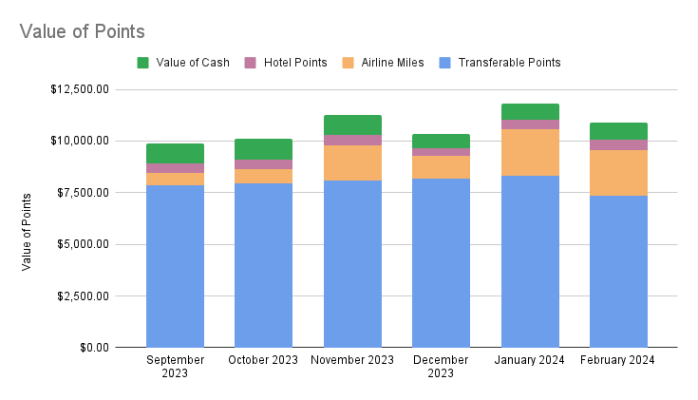
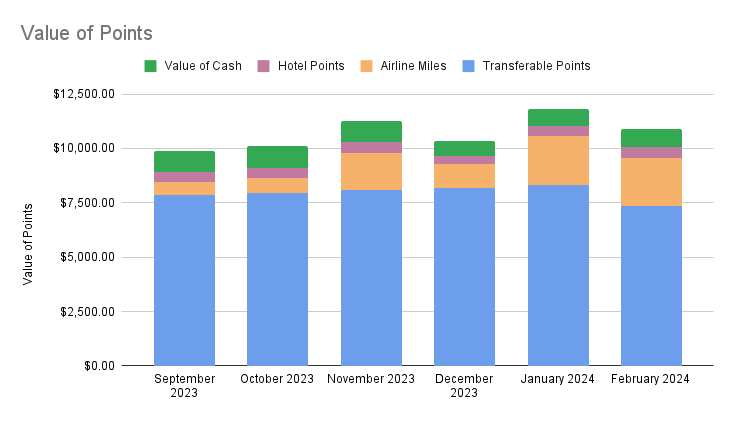
This left us with a grand total of 257,000 Chase Ultimate Reward points, 115,500 American Airlines miles, 75,100 Capital One Venture miles, 38,400 Citi Thank You points, 31,800 Marriott Bonvoy points, 24,900 United miles, 6,900 Hyatt points, 5,100 Delta miles, and $700 in cash back. According to the valuations determined by the Points Guy, these points are worth a grand total of a little less than $10,800.

Best Single Reward card – Chase Sapphire Preferred vs Amex Gold

Jenn asked what she thought was a simple question the other day – “I have a friend who is interested in getting two award flights to Germany, but doesn’t want to open a bunch of new cards, which single card should she pick?” My immediate answer was “Of course, the Chase Sapphire Preferred.” But now I’m second guessing that answer

The reason for my answer was fairly simple, Chase Ultimate Reward points transfer to a number of great airline programs many of whom serve Germany well, especially United Airlines. It’s a pretty good earning card and the transfer partners for Chase are great.

Then I questioned myself, because the Amex Gold card has tremendous points earning potential and some pretty good transfer partners as well. It’s flagship airline partner is Delta, which is not the best way to redeem points to Europe, but it could be a possibility.

Let’s run the numbers and see which of these two cards would be the best fit for a single reward card for redeeming points for two flights to Germany.

The Assumptions for this Comparison

The only categories of spending that are important for the Amex Gold and Chase Sapphire Preferred are groceries, restaurants and travel. The Chase Sapphire Preferred is 3x on dining, 2x on travel and 1x on groceries. The Amex Gold is 4x on groceries, 4x on dining and 3x on travel. Both cards earn one point per dollar on everything else.

The person we are comparing these cards for has a family of 4, and for the purpose of this comparison we will say that she spends $1,000 per month on groceries, $500 per month on dining and $2,500 on everything else, with no real spending on travel. I know $2,500 sounds like a lot, but when you figure that you can charge virtually everything, including shopping, insurance, gas, utilities, etc. that adds up quick when you have a family of 4.

Signup Bonuses

I always start with the Frequent Miler best offer page when I’m determining which credit card I want to sign up for, since it always posts the best publicly available offer. In this case, the Chase Sapphire Preferred is offering a 60,000 point bonus when the card holder spends $4,000 in 3 months. The Amex Gold is offering a 75,000 point bonus when the card holder spends $6,000 in 6 months as well as 20% back on dining up to $250 back. We are going to ignore the 20% back on dining, because that isn’t terribly common for Amex to offer that, but it is a fantastic deal. Neither one of those spend requirements will be a challenge for this card holder to reach.

Everyday Spend

So for this example, we are going to use the assumptions set earlier, $1,000 per month on groceries, $500 per month dining and $2,500 per month on everything else. The other assumption here is that she will use this card exclusively for 1 year. So which one will earn more points?

CategoryChase Sapphire PreferredAmerican Express Gold
Groceries12,00048,000
Dining18,00024,000
Everything Else30,00030,000
Signup Bonus60,00075,000
Total120,000177,000

I’m going to be honest, I thought the Amex Gold card would earn more points over the course of a year, but I didn’t think it would be that much more. The Chase Sapphire Preferred card is a very beloved card in the travel hacking world and to see it get outperformed by 57,000 points by the Amex Gold was a little shocking.

That being said, the Amex Gold does have a $250 annual fee compared to Chase Sapphire Preferred’s $95 annual fee. In the case of someone who is using it in this manner, the Amex Gold definitely is worth the extra $155 in annual fees though, which may not be the case for someone like me who churns and burns a lot of cards.

Comparing Flagship Partners

When comparing points you have to consider the most important transfer partner. In this case, Amex has Delta Airlines and Chase has United Airlines. Since the person in question here was looking for 2 tickets to Munich, with flexible dates, in the summer, let’s look to see what these points can get.

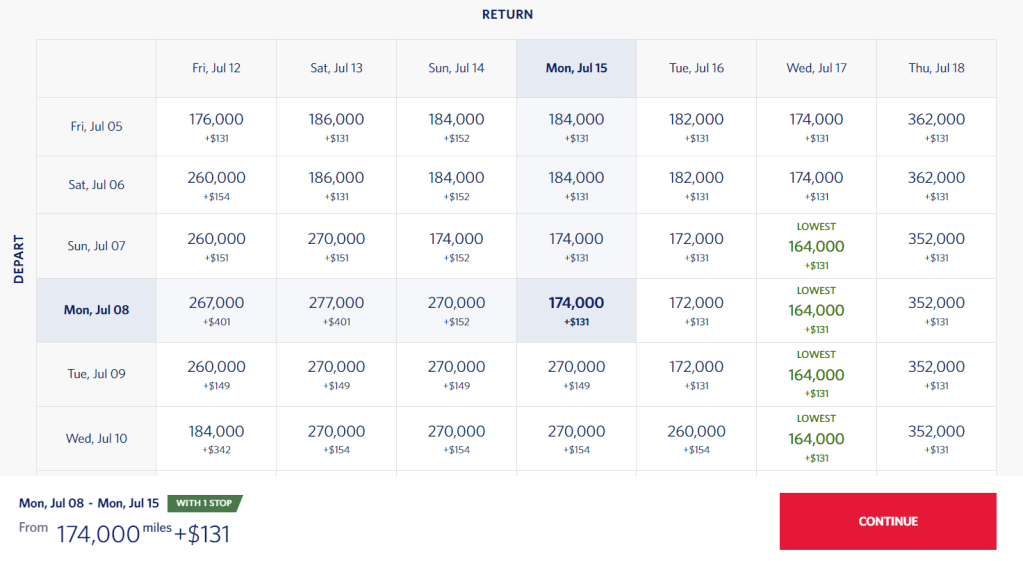
With Delta, the points calendar from Chicago to Munich in July looks like this.

The lowest available round trip is 164,000 miles. That would essentially eat up all of the points earned from the Amex Gold with one round trip ticket when the points are transferred to Delta. That’s not great.

With United Airlines, it’s a bit better with round trip tickets available in the summer for 80,000 United miles.

In this comparison, you would be better off with 120,000 Chase Ultimate Reward points than you would with the 177,000 Amex Membership Reward points, because on the flagship partners, the points go much further on United than on Delta. Neither one was able to get the cardholder to 2 roundtrip tickets to Munich, though. Luckily, those aren’t the only transfer partners for Amex and Chase.

Does Chase or Amex Have Better Airline Transfer Partners?

On the face of it, Amex has more airline partners, but as we all know, quantity doesn’t necessarily mean quality. In the chart below, Amex has 15 airline partners while Chase has 9. There are some key overlaps for trips to Europe, namely Avios, Flying Blue, Virgin Atlantic and Air Canada. Amex has Avianca Lifemiles, which I have used before, and I like due to their low taxes and fees. Chase and Amex both have JetBlue but Chase has a better transfer rate than Amex. Chase also has Southwest Airlines, which is a great partner, but it’s irrelevant for flights to Europe.

Airline PartnerTransfer RateChase Ultimate RewardsAmex Membership Rewards
Avios (Aer Lingus, Iberia, British Airways)1:1YesYes
Aeromexico1:1.6NoYes
Air Canada Aeroplan1:1YesYes
ANA1:1NoYes
Avianca Lifemiles1:1NoYes
Cathay Pacific1:1NoYes
Delta Airlines1:1NoYes
Emirates1:1YesYes
Etihad1:1NoYes
Flying Blue (KLM, Air France)1:1YesYes
Hawaiian1:1NoYes
JetBlue1:0.8,1:1Yes (1:1)Yes (1:0.8)
Quantas1:1NoYes
Singapore Airlines1:1YesYes
Southwest Airlines1:1YesNo
United Airlines1:1YesNo
Virgin Atlantic1:1YesYes

A Quick look at Pointsyeah!

We need to talk a little bit about PointsYeah. This is a fairly new website that allows you to search available airline award space across 14 different airline programs. It also shows you which transferable points transfer to those programs as they display the results of the search. It’s an unbelievable free tool that is making searching for award flights super easy. There are other tools out there like Point.me and Seats.aero, so it’s a matter of preference, but my favorite right now is PointsYeah.

Searching on PointsYeah and using flexible dates in July, I was able to find these award flights from Chicago to Munich with the dates of July 1st through July 4th:

  • 20,000 Flying Blue Miles and $105.38
  • 24,500 Avianca Lifemiles and $26.70
  • 26,500 Virgin Atlantic Miles and $149.40
  • 30,000 Iberia Avios and $231.20
  • 40,000 United Miles and $5.60
  • 63,000 JetBlue Miles and $42.80
  • 160,000 Delta Miles and $5.60

Returning, the flights from Munich to Chicago with the dates of July 8th through July 11th were:

  • 22,000 Flying Blue Miles and $223.20
  • 28,250 Iberia Avios and $237.60
  • 30,000 Avianca Lifemiles and $109.30
  • 43,900 United Miles and $124.60
  • 63,000 JetBlue Miles and $156.20
  • 160,000 Delta Skymiles and $288.21

Since there is no real penalty for booking one-way award flights, this is really like picking a first course/second course to piece together the round trip. If you are really trying to conserve points you could go with the two Flying Blue awards and pay 42,000 Flying Blue miles and $328.58 in taxes and fuel surcharges. Both Chase Ultimate Rewards and Amex Membership Rewards to Flying Blue so in this case, it wouldn’t matter if Jenn’s friend picked the Chase Sapphire or the Amex Gold. Either way it would cost a grand total of 84,000 Chase Ultimate Rewards or Amex Membership Rewards and $657.16. In either case, Jenn’s friend would have points to spare, but $657 is a lot of taxes and fuel surcharges for 2 economy tickets.

I would be tempted to go with Avianca Lifemiles both ways which would cost 54,500 miles and $136.00 in taxes and fuel surcharges round-trip. Avianca has a $25 fee for booking, so I think you would have to tack on an additional $100 for the two round trip fares. Avianca transfers from Amex Membership Rewards, and not Chase Ultimate Rewards so the total for the two flights to Munich would be 109,000 Membership Reward points and $372.00. That’s not too bad for flights in the summer.

You could also do a flight out using United miles and back using Flying Blue miles. That would only be available with Chase Ultimate Rewards, since United is a Chase partner and not an Amex partner. It would cost 62,000 Ultimate Reward points and $228.80 in taxes and fuel surcharges each. For two tickets, it would cost 124,000 Ultimate Reward points and $457.60. In this scenerio, there wouldn’t be enough Chase points available in one year, so this would have to take 13 months to earn the points for this trip instead of 12.

Disclaimer

There are a lot of factors at work here, including the fact that if you wanted to use Iberia Avios, for example, you would try to find the best times to get the best prices for those flights. I just used a random stretch of days in July, so you would most likely do better than this if you were searching over a longer period of time. There are also occasional transfer bonuses, so you can sometimes transfer points from Chase Sapphire Preferred or Amex Membership Rewards and get more than a 1:1 ratio, making your points work harder. Also, just because Flying Blue is offering great prices now doesn’t mean they will in six months, and just because United is charging 40,000 for a saver fare now doesn’t mean they won’t offer a flight for 30,000 later. Change is the only constant in miles and points.

What Wins – Chase Sapphire Preferred or Amex Gold?

In this case, I would say hands down the Amex Gold wins. This is simply because Amex, for someone with a decent amount of grocery and dining spend, earns a lot of points. This is also because with Amex Membership Rewards points, they could book the Avianca Lifemiles example or the Flying Blue example. In the Flying Blue example, they would be left with 93,000 Membership Rewards points that could be used on a different trip. In the Avianca Lifemiles example, with lower fees, they would be left with 68,000 membership rewards points after booking the trip.

With Chase Sapphire Preferred there was enough points to book the Flying Blue example and would be left with 36,000 Chase Ultimate Reward points after booking the two flights. They didn’t have quite have enough points after one year to book the United/Flying Blue combo with lower taxes and fees.

Conclusion

Honestly, I’m a little surprised that Amex Gold outperformed Chase Sapphire so easily in this comparison. That being said, this is a narrow comparison with a mid-summer trip from Chicago to Munich, these things vary wildly based on destination and timing. There are plenty of circumstances when you would be thrilled to have access to United miles or Southwest Airlines miles and you don’t have that access with Amex. However, doing this kind of search ahead of time can help you determine the best credit cards to sign up for before you potentially make a mistake.