Wells Fargo Launches Another Great Credit Card with Signify Business Cash

For years, Wells Fargo has been a boring bank for travel hackers. However, in the last year or so, Wells Fargo has been put the travel rewards industry on notice that they intend to compete for business in the points and miles space.

The difference is that they have added some transfer partners for their credit cards. This allows for users to redeem their rewards for value that is better than the normal cash back rate. They are also adding new credit cards to their lineup.

Why Choose the Signify Business Cash Card

There are 3 good reasons to choose the Signify Business Cash card:

  • $0 Annual Fee
  • 2% Cash Back
  • $500 Signup offer

These are all pretty boring reasons, but they are important if you are planning to maximize return on your spending. 2% cash back seems pretty boring in the points and miles world, but it’s important because it allows you to get at least 2% in categories where there are no bonus categories. This is especially true if you have a business that has to purchase supplies or parts.

Having a 2% base is especially nice if you can use a different card for purchases in other bonus categories. For example, if you also had the Wells Fargo Autograph card, you could earn 3% on gas, groceries, transit, streaming services, and phone plans. Simply pairing these two cards, could allow you to get 3% on a lot of your expenses while earning 2% on everything else.

Also, having no annual fee allows you to not use it when you want and not worry about getting the most out of the card. If you decide you want to put it aside while you work on a new credit card signup bonus, you’re not going to worry that you’re getting your money’s worth on an annual fee. In that way, a 2% card with no annual fee becomes a solid, dependable card that you can use when you want and shove it to the back of your wallet when you don’t need it.

$500 Signup Bonus

The Signify Business Cash card is currently offering a $500 signup bonus when you spend $5,000 in the first 3 months. That’s a very strong signup bonus for a card with no annual fee. The best comparison to this card, in my opinion is the American Express Blue Business Cash card that earns 2% cash back, has no annual fee and is offering a $250 statement credit on $3,000 in spending in 3 months.

It’s Not Just a Cash Back Card – There are Transfer Partners!

This is where things get a little in the weeds. By itself, the Signify Business Cash card is strictly a 2% cash back card. However, as Frequent Miler points out in their review of the Signify card, if you have either the Wells Fargo Autograph card or the Wells Fargo Autograph Journey card along with the Signify card, you can convert the cash back to Wells Fargo Reward points at 1 cent per point.

This allows you to access Wells Fargo Transfer partners, including:

  • Aer Lingus Avios
  • British Airways Avios
  • Iberia Avios
  • Qatar Privilege Avios
  • Air France Flying Blue
  • KLM Flying Blue
  • Avianca Lifemiles
  • Choice Privileges

Having these transfer partners means that you can take advantage of some of the great deals these programs have. For example, if you wanted to fly round trip from Chicago to Madrid in March 2025, the cost of that flight, in economy, using Avios, is 34,000 Avios and $228.70 (that’s not a flash sale – it’s normal off-peak pricing using Iberia Avios). In terms of the Signify card, that is essentially $340 in cash back transferred to Wells Fargo Rewards points then to Iberia Avios and $228.70. So essentially for $568.70 in cash back, you can fly to Madrid and back. That’s a really good deal, especially if you factor in the $500 signup bonus.

These transfer partners make the Wells Fargo Signify card much stronger than just a 2% cash back card. The Points Guy values Wells Fargo Reward points at 1.6 cents per point, meaning if you use the cash back from the Signify card as points, you are really earning 3.2% back as travel rewards. That’s pretty good.

Wells Fargo Active Cash is the Personal Version of Signify Cash

The Wells Fargo Active Cash card is essentially the same thing as the Signify Cash card, except that it’s a personal card. It is a 2% cash back everywhere card with no annual fee. Like the Signify card you can pool your rewards together with an Autograph or Autograph Journey Card and accumulate all of the rewards as Wells Fargo Reward points and transfer those points to their transfer partners.

The main differences here is that the Active Cash is a personal card and that the signup bonus is much lower ($200 for spending $500 in 3 months)

I expect this to Get Even Better Over Time

The transfer partners that Wells Fargo have chosen to work with initially are really good choices, but it’s a pretty limited list. Flying Blue, Avios, and Avianca Lifemiles are all really good programs that cover a lot of needs for travelers on points and miles. However, that’s a pretty short list and I imagine that Wells Fargo is trying to add more transfer partners.

As I pointed out in a previous post when Wells Fargo announced they would have transfer partners, but before they announced who the partners would be, Wells Fargo is associated with the Bilt Card, and Bilt has probably the best list of transfer partners in the points and miles space. It took a while for Bilt to build out their impressive list of transfer partners, and if Wells Fargo follows suit, this could become a very valuable transferrable points currency.

There are a few, like Air Canada Aeroplan and Emirates Skyward, that I think would be pretty easy for them to add. Some others, such as Alaska Air or American Airlines, would be amazing but I wouldn’t count on it. I would also love to see them add Hyatt, but I don’t think they will, although I would expect them to add at least one more hotel chain.

Wells Fargo Rewards Keeps Getting Better

Anything that Wells Fargo can add to their transfer partner list at this point will make Wells Fargo Reward points more valuable, and by extension, Wells Fargo credit cards. The Wells Fargo Autograph and the Wells Fargo Autograph Journey are already cards that do a great job of earning points with some really strong bonus categories.

Wells Fargo seems intent on making some cards that really appeal to the points and miles community. It looks like they definitely want to start aggressively taking some business away from Chase, American Express, Capital One and Citibank. With that in mind, and the fact that they’ve been offering transfer partners for less than a year, I expect that Wells Fargo will add new credit card offerings, and new transfer partners over time. This is absolutely a bank to keep your eyes on.

Manufacturing a Big Signup Bonus on the Amex Blue Business Plus

The American Express Blue Business Plus is a somewhat boring, but great all around credit card. It doesn’t come with a big, flashy signup bonus. However, every once in a while, American Express puts out referral bonuses that can make the signup bonus pretty sweet. A recent referral offer from American Express gave us the opportunity to get this must-have credit card and still get a decent bonus.

Why Choose the Amex Blue Business Plus

There main reasons for why the Blue Business Plus is a great option for a business credit card are:

  • No Annual Fee
  • 2x on all spending up to $50,000 in spending per year
  • Earns Membership Reward points that are transferable to 18 airline program and 3 hotel program partners

2x Membership Rewards points per dollar on all spending is great for a no annual fee card. If you are someone who uses multiple credit cards and take advantage of bonus categories to get 5x or 3x on your spending, you notice pretty quickly that not all spending will fall into a bonus category. Having a 2x card that acts as the lowest you earn can be very valuable, especially if you spend a lot in non-bonus categories.

Also, if you like to take advantage of big Amex signup bonus offers on their Gold and Platinum cards, but don’t want to pay the big annual fees for eternity, having the Blue Business Plus card gives you a no annual fee option that allows you to keep those points you earned on those big signup bonuses. This allows you to keep those points and cancel those credit cards. Keep in mind, cancelling an American Express card within 12 months from the date it was issued can cause them to take back the points.

Membership Rewards Transfer Partners

ProgramTypeTransfer Rate
Aer LingusAirline1 MR to 1 Avios
AeroMexicoAirline1 MR to 1.6 AeroMexico Reward Points
Air Canada AeroplanAirline1 MR to 1 Aeroplan Point
ANA Mileage ClubAirline1 MR to 1 ANA Mile
Avianca LifemilesAirline1 MR to 1 Lifemile
British AirwaysAirline1 MR to 1 Avios
Cathay PacificAirline1 MR to 1 Asia Mile
Delta SkymilesAirlines1 MR to 1 Skymile
Emirates SkywardsAirlines1 MR to 1 Skyward Mile
Etihad GuestAirlines1 MR to 1 Etihad Guest Mile
Flying Blue (Air France/KLM)Airlines1 MR to 1 Flying Blue Mile
Hawaiian MilesAirlines1 MR to 1 Hawaiian Mile
Iberia PlusAirlines1 MR to 1 Avios
JetBlue True BlueAirlines5 MR to 4 TrueBlue Points
Quantas Frequent FlyerAirlines1 MR to 1 Quantas Point
Qatar Airways Privilege ClubAirlines1 MR to 1 Avios
Singapore KrisflyerAirlines1 MR to 1 KrisFlyer Miles
Virgin Atlantic Flying ClubAirlines1 MR to 1 Virgin Point
Choice PrivilegesHotel1 MR to 1 Choice Privilege
Hilton HonorsHotels 1 MR to 2 Hilton Honors Points
Marriott Bonvoy Hotels1 MR to 1 Bonvoy Points

What makes Membership Rewards points so valuable is being able to take advantage of deals in any of these programs. For example, Flying Blue frequently offers flights from major US cities to Europe for 20,000 points (and around $150 taxes/surcharges) one-way in economy or 50,000 points (and around $250 taxes/surcharges) one-way in business class.

In addition, Virgin Voyages often offers points redemptions on cruises. Recently, they were offering a cruise for 120,000 points per cabin (1 or 2 people) for a seven night Mediterranean cruise leaving from Barcelona with stops in places like Ibiza, Mallorca, and Marseille. Simultaneously, there was also a 30% transfer bonus to Virgin from American Express which means that cruise could have been booked for around 93,000 Membership Rewards points.

Being able to pick and choose between programs when they are running specials is what makes flexible award currencies, such as Membership Rewards so incredibly valuable.

A Place to Keep Your Membership Rewards

American Express offers some monster signup bonuses on their cards. Recently, as Travel On Points pointed out, they offered a 300,000 point signup bonus on their Business Platinum card. That’s just enormous, with that bonus being worth $6,000.

However, the Business Platinum Card has an annual fee of $695. While there are definitely great ways of getting $700 worth of value on that card by using the credits and benefits on that card, eventually you might decide you want to dump the card to avoid that annual fee. By having the Blue Business Plus, you can keep the points you earned on your Business Platinum card in your account without having to pay an annual fee.

But the Signup Bonus for the Blue Business Plus is so Tiny

I have definitely gotten spoiled with signup offers that seem to always be north of 60,000 points. However, I knew if I was going to be trying to get big offers from American Express, I would want the Blue Business Plus in order to house those points. Unfortunately, they almost always offer 15,000 Membership Rewards points on a spend of $3,000 in 3 months – that’s just not exciting.

However, earlier this year, Jenn was given a very enticing offer from American Express. She signed up for the Business Gold card on an inflated 130,000 point offer. Since she was a Business Gold card holder, they offered her a 20,000 point referral bonus as well as 3 months of an additional 10x on dining.

Normally, credit card companies only offer referral bonuses on the same card that the cardholder has, but American Express offers referral bonuses that work if the invitee is approved for other American Express cards as well. This means that Jenn could get a referral bonus on her Business Gold card even though I was getting the Blue Business Plus.

The 20,000 point referral bonus wasn’t that unusual, but the extra 10x on dining was very interesting. Her Business Gold card already earns 4x on dining, which means that for 3 months, she will be earning 14x on every dollar spent on dining.

We don’t eat out that often, maybe a couple of times a month, but we do spend a decent amount of time at breweries. I mean, enough that most of the bartenders we see know us by name. Hey, we like beer. Anyway, breweries code as dining, so those are 14x when using her Business Gold card for the next 3 months.

All in all, lets say that over the next 3 months we spend $2,000 on dining. With the extra 10x, that is 20,000 Membership Reward Points. If you add the 20,000 point referral and the 15,000 point signup, that makes the total signup bonus 55,000 Membership Reward points. That’s pretty good for a no annual fee card, especially one with 2x transferable points on all spending.

Benefits of Working with Someone Else

This is a great example of the importance of working with someone else when earning points and miles. Experienced points and miles hobbyists refer to this as “2-player mode”. Being able to consistently refer a spouse, friend or family member, means that both of you can amass a larger amount of points that you can as an individual. This also means that you shouldn’t be an authorized user on your Player 2’s accounts.

In this case, if I was signing up for this card by myself, I would have earned a 15,000 point bonus. Since we are working in 2-player mode, Jenn will earn around 40,000 points in addition to the points that I’ve earned.

The American Express Blue Business Plus is one of those no-brainer credit cards that should be in your wallet. With 2x Membership Rewards points on all spending up to $50,000 per year and no annual fee, it’s a great card to keep around even if you don’t use it often. American Express has a tendency to give great referral bonuses from time to time, so if you can take advantage of those referral bonuses to bump up that sign up bonus, you should absolutely do so. This is one of those cards that you should have, but be patient to see if you can manufacture an elevated bonus.

Points Check April 2024

April had us recovering from our trip to Costa Rica, and had us planning a camping trip to Canada. Believe it or not, I’m 49 years old, love travel, live only a few hundred miles from the Canadian border and I’ve actually never been there. I don’t exactly know why, maybe I was thinking that it’s just a slightly more polite America with weird ideas about french fries. Anyway, it’s about time we hitched up the camper and found out what Canada is all aboot.

We found a little campground in a park on Lake Ontario in Hamilton, Ontario where I booked a week with full RV hookups for about $300 in July, which seems like a pretty good deal. Hamilton is a nice halfway point between Toronto and Niagara Falls. It seems like a really great place to relax as well as visit both of those places. Can’t wait to try all of those exotic, um, donuts?

Patience Pays Off (A Little)

I have a friend getting married in Montana in June. I’m meeting a group of my high school friends there, but booking an award flight there is less than ideal. The biggest reason for this is that in order to book award flights without using a ton of points, you want to be flexible with both dates and location. Obviously, for a wedding I couldn’t be flexible with either of those things since apparently I can’t get them to adjust the date and location for me.

The other reason was that I was going to be flying from a small airport to a small airport. This was definitely going to be challenging to book for a reasonable number of points. The first day I started to look, booking round-trip was going to cost about 70,000 miles. For the most part, the only options were going to be American Airlines miles or United Miles.

Generally this is the kind of redemption that is going to be better on American Airlines, because they don’t seem to punish you for flying from a small airport as much as United does. And as it turns out, this was the case here as well. I was able to book the flight home on Tuesday for 23,000 miles. After struggling to find a good deal on the flight out and waiting a few weeks, I was able to book the flight out on Friday for 22,000 miles, when American dropped the price by about 20,000 miles.

The cash price for this flight was a little over $600 so I managed to get 1.3 cents per point value for this flight, which isn’t great (The Points Guy values AA miles at 1.6 cents per point), but given then fact that I had no flexibility, I’m not mad about it.

Both of these flights are fully cancelable, so I will continue to check to see if I can find a cheaper alternate. There really isn’t any punishment for rebooking at a lower price, so if I can save a few points, why not?

Jenn Hit Her Business Connect Signup Bonus

Jenn hit the signup bonus on her US Bank Business Altitude Connect card and earned the $600 bonus. She earned an additional $100 over the time when she was reaching her spending requirement which was $6,000 over 6 months. This means she earned over 10 cents per dollar spent, which is pretty good.

On to the points Check!

Card UsedSpendPoints EarnedPoint ValuePoints Per $Return on Spend
Capital One Venture$6881,377$25.472.03.7%
Ink Cash$5292,626$53.835.010.2%
Wyndham Business Earner$2651,326$14.595.05.5%
Marriott Bonvoy$238910$7.643.83.2%
Total$1,7206,239$101.543.65.9%
This month’s spending not devoted to earning a signup bonus

Aside from the spending in the above chart. Jenn spent $725 dollars on her US Bank Business Altitude Connect card and earned $10 cash back plus the $600 signup bonus. Jenn also spent $2,300 on her Amex Gold Business Card, most of which went to the purchase of a viola for our son, after renting one for something like 8 years. Maybe we should have done that sooner. She earned over 2,600 Membership Rewards points for those purchases. I spent under $1,700 on my American Express Gold card earning 5,800 Membership Rewards points. We also earned 15,000 Chase Ultimate Reward points on a referral bonus.

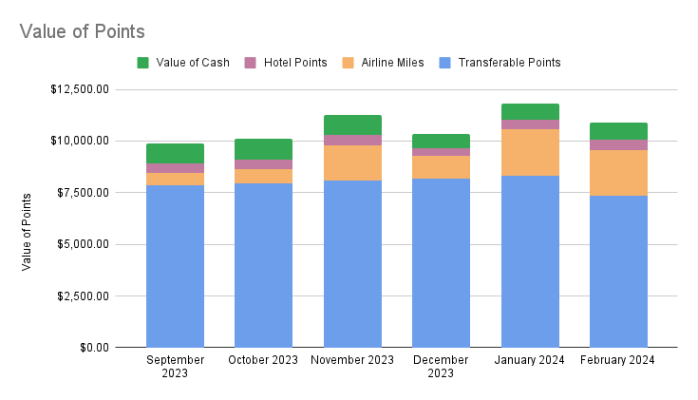
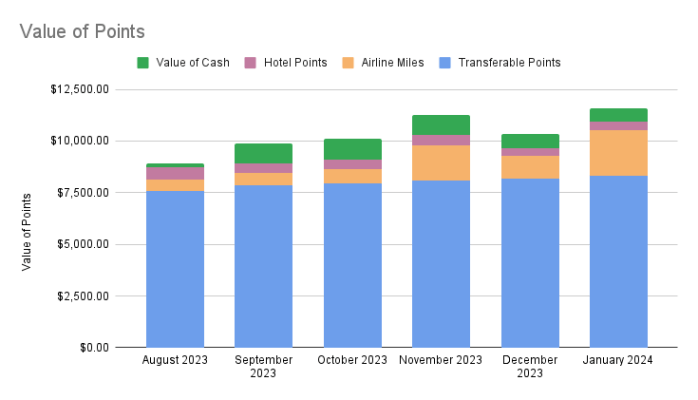
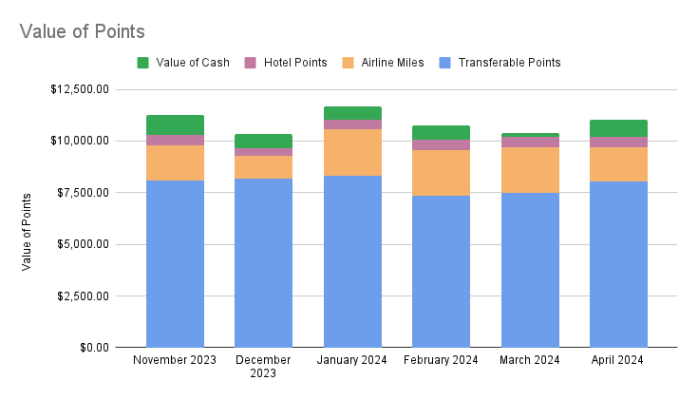
After redeeming 45,000 American Airlines miles for my flight to Montana, we are left with 277,900 Ultimate Rewards points, 80,200 American Airlines miles, 77,600 Capital One miles, 38,800 Citi Thank You points, 34,900 Marriott Bonvoy points, 25,000 United Airlines miles, 11,400 Wyndham points, 10,400 American Express Membership Rewards points, 6,900 Hyatt points, 5,100 Delta Skymiles and $790 in cash back. Using the valuations from the Points Guy, the total value of our points, miles and cash back is over $10,800.

Latest Vacasa/Wyndham Devaluation Stings A Bit

** On November 30, 2025, vacasa will end ITS partnership with Wyndham and this will no longer be available.**

The Vacasa/Wyndham partnership devalued again, for the second time in just 6 months. This is pretty annoying, because this partnership went under the radar for a while, and as people became aware of what a tremendous deal this was, they had to start dialing it back. Now after a second devaluation, the partnership is still pretty good but it’s just not the same fantastic deal it was before.

We have loved this program for a while and have used it a couple of times, once for a trip to Nashville, where we saved almost $1,000 by buying points and redeeming it on the rental and another where Jenn got a great deal on a Vacasa in Playa Del Carmen for a girl’s trip.

What Happened Now?

The original redemption rates for Wyndham points on Vacasa rentals was simple – 15,000 Wyndham points per bedroom, per night on any rental up to $500 per bedroom per night. In October of last year, they kept the same basic structure, but lowered the maximum redemption from $500 per bedroom per night to $350 per bedroom per night.

With the change made in October, it effectively made any rental that cost more than $350 per bedroom per night unrentable on points. The newest devaluation makes those properties rentable again, but means that any property that cost between $250-$500 per night per bedroom just got twice as expensive as it was prior to October 2023.

The new Vacasa/Wyndham redemption rates are essentially this: for any Vacasa vacation rental, it costs 15,000 Wyndham points per bedroom per night for any property that costs up to $250 per bedroom per night. For any property that costs $250-$500 per bedroom per night, that will cost 30,000 Wyndham points per bedroom per night. Any property that costs more that $500 per bedroom per night will be unavailable on points.

ExampleBefore Oct 2023Oct 2023 – March 2024After March 2024
1 Bedroom $200/Night15,000 Pts/Night15,000 Pts/Night15,000 Pts/Night
1 Bedroom $300/Night15,000 Pts/Night15,000 Pts/Night30,000 Pts/Night
1 Bedroom $400/Night15,000 Pts/NightUnavailable on Points30,000 Pts/ Night
2 Bedroom $450/Night30,000 Pts/Night30,000 Pts/Night30,000 Pts/Night
2 Bedroom $600/Night30,000 Pts/Night30,000 Pts/Night60,000 Pts/Night
2 Bedroom $900/Night30,000 Pts/NightUnavailable on Points60,000 Pts/Night
Effect of last 2 Vacasa/Wyndham devaluation on redemptions

These are All-In Prices

The $250 per bedroom per night price is the all-in price not the headline price on Vacasa’s website. They might show a headline price of $200 per night, for example, but for 5 nights it’s not going to be $1,000, it’s probably going to be closer to $1,400. This is because they charge a number of taxes and fees, which can get pretty extensive.

These fees can be state and local taxes, amenity fees, booking fees, damage waivers, etc. In my experience, these will probably cost an extra 30 to 50 percent on top of the rent itself.

I think we can all agree that fees are getting out of control as you can see below. I mean, damn, I know you have expenses and all but do you need to itemize them and make me pay one by one? Just tell me what the price is! I mean, I get it, you got an HOA, but you can include that in the price instead of charging me for an ‘Amenity Fee’? And what the hell is a ‘destination surcharge’?

How Many Properties Does This Actually Affect?

One of the bright spots about this devaluation has been that if you had a rental that you liked that normally cost $200 per bedroom per night, you have gone completely unaffected by this. There are a lot of quality vacation rentals that are under that $250 per bedroom per night range and they are the same as they ever were.

That being said, if you had your eye on a more expensive unit, you might be reevaluating your plans now.

Let’s look at the Destin Florida area for a 5 day rental in June to see the real life results of the devaluation. Let’s say you’re a family of 4 and you would prefer a 2 bedroom vacation rental, but would settle for a 1 bedroom if it had room for everyone to sleep.

The below examples are taking into account a 40% upcharge for taxes and fees. These fees vary by property, so some are higher and some are lower but in order for me to use the filters on Vacasa’s website for this chart, I had to make some assumptions.

Up to $250 per bedroom per night$250 -$350 per bedroom per night$350- $500 per bedroom per nightMore than $500 per bedroom per night
1 Bedroom25 (15,000 pts)119 (30,000 pts)129 (30,000 pts)120
2 Bedrooms323 (30,000 pts)298 (60,000 pts)94 (60,000 pts)12
3 Bedroom204 (45,000 pts)86 (90,000 pts)29 (90,000 pts)4
Example availability of Vacasa vacation rentals with room for 4 near Destin for a random summer extended weekend.

The unicorn rental is if you can find a 1 bedroom with enough sleeping space for 4, that can be rented for 15,000 Wyndham points. In this example, prior to October 2023, there would have been 273 total 1 bedroom properties rentable for under $500 per night. When the first devaluation occurred and dropped the maximum price for redemption to $350 per night, that number dropped to 144. After the March 2024 devaluation, there are only 25 such properties left at the 15,000 point level. That’s only 9% of the original available properties at that rate.

Two bedroom properties fared a little better in the devaluation than the one bedroom properties. 94 were affected by the devaluation in October and another 298 were affected by the March devaluation. In this case 45% of the two bedroom properties in this example were unaffected by these devaluations.

The three bedroom properties fared the best with 204 of the total 319 properties for a total of 64% unaffected by the devaluation.

In general, the next time that I rent a Vacasa on points I’ll most likely be renting something that is 30,000 points per night, because the unicorn 15,000 point redemption is just going to be very hard to find now. It probably means that we will be looking for a two bedroom which will probably be more comfortable for us than a one bedroom, but twice the number of points is still a bit of a kick to the gut.

Elevated Signup Bonuses as a Consolation Prize

I don’t know if Wyndham did this at the same time as the most recent devaluation to soften the blow a little bit, but current signup bonuses for Wyndham credit cards are massive right now.

Wyndham is currently offering 100,000 point bonuses on their Wyndham Reward Earner Business card and their Wyndham Reward Earner Plus (Consumer) card. They are also offering a 75,000 point bonus on their Wyndham Earner card. All of those bonuses are the largest bonuses ever offered according to Frequent Miler.

The Wyndham Reward Earner Business card is one that we hold and continue to use. Jenn signed up for this one when the bonus was only 45,000 points. The reason we continue to use it is that it has some great point earning rates. It is 8x at gas stations and 5x on utilities. I put all of our gas and utilities on it for this reason. The full 100,000 point bonus for this card is after spending $15,000 on the card within 12 months.

If you really like those Wyndham points (which we do), the Wyndham Reward Earner (Consumer version) Card has some great earning categories too. It is 6x at gas stations, 4x on groceries and 4x on dining. It is also currently offering a 100,000 point bonus after a much lower $2,000 in spending within 6 months.

If you spend a lot on gas and you like vacation rentals, these cards can rack up points for those rentals in a hurry. In addition, all 3 of the Wyndham cards offer a 10% discount on award redemptions if you are a cardholder. This means that the example of a 1 bedroom Vacasa under $250 per night isn’t actually 15,000 points per night, it’s really 13,500 points per night for cardholders. The 100,000 point bonus alone would pay for a week at those rates.

Keep in mind that if you were to maximize these redemptions at a full $250 per night per bedroom, and you had one of these credit cards to reduce the redemption to 13,500 points, you would be redeeming those points at 1.85 cents per point. If you are earning 8x on all of your gas spending, you are essentially earning 14.8% back at gas stations. That’s pretty ridiculous.

Vacasa Still Remains the Best Way to Book a Vacation Rental on Points

Even with the rapid fire devaluations, Vacasa still remains the best way to book a vacation rental on points. Marriott has it’s Homes and Villas collection which does allow for booking vacation rentals using Bonvoy points, but the rates are much higher, and I would argue the points are harder to earn.

Sure, if you are a business traveler, you might be able to earn quite a lot of Bonvoy points by staying in Marriott hotels, so Homes and Villas might be pretty attractive for your family vacation. But, if you’re not a business traveler, the ability to earn a lot of points through spending on gas and utilities on the Business Earner card or by gas, groceries, and dining on the consumer Earner card is huge.

I’m still hoping that Hyatt, IHG, or Hilton can someday begin to make their points usable at VRBO or Airbnb, but I wouldn’t count on it. That being said, as long as Wyndham keeps the amount of points needed to book a rental low as well as allow easy earning of Wyndham points, it’s going to remain a fantastic deal. There is no doubt in my mind that the Vacasa/Wyndham partnership remains the best way to use points on vacation rentals.

What’s the Best Travel Rewards Credit Card for Young Adults?

“I wish I would’ve traveled when I was young.” How many times have we all heard that lament from either 30-somethings tethered to their children or empty nesters who just lack the energy for the kind of travel they wish they could still do?

The problem with traveling when you’re young is that you’re usually pretty broke and travel isn’t cheap. Travel, however, is a great education for young adults. Travel teaches about other cultures, languages, and most importantly perspective. It also teaches skills such as communication (especially how to communicate without a common language) and self-reliance.

Our kids have grown up around travel because it was always important to us, even if it was just short trips to nearby places. It’s not surprising to me that it wasn’t long after she graduated from High School that my daughter Emma began to plan her own trips. She and her friends recently planned a trip to California for an event taking place in Anaheim.

I’m sure they’ll have a blast and while, as a parent, I’m a little nervous, I understand just how great a learning experience this can be. I also have a sneaking suspicion that this won’t be her last trip, so not only do we want to her to have the skills to travel, but if we can teach her a little about travel hacking along the way so that she can travel cheaply, that’s even better. So, of course, we’re going to help her pick the best credit cards that allow her to do the traveling that she wants to do, but for less money.

This had me doing quite a bit of thinking about what the best credit card for her, and by extension, any young traveler. A word of caution here – Emma is ridiculously careful with her money, if you are a parent of a young adult that isn’t careful with their money, then steering them into credit cards could be a really bad idea.

Building Your Credit Score

One very important thing for any young adult to do is begin to build their credit score. Start by signing up with Credit Karma or another such credit monitoring service. If travel hacking is a future that you want, you need to know, love and cherish your credit score. If you don’t, all of those awesome credit cards with the huge welcome bonuses won’t be an option for you.

There are 6 items that Credit Karma have listed that affect your credit score:

  • Payment History
  • Credit Card Usage
  • Derogatory Marks
  • Credit Age
  • Total Accounts
  • Hard Inquiries

The top 3 items there can pretty easily be maintained well simply by making your payments on time – every time and in full. However, what you should be concerned about when choosing your first or second credit card is developing your credit age.

Credit age is the average length of time that you have had your accounts open. For instance, if you only have one credit card that you’ve had for 8 months, then your credit age is 8 months. If you then get a second card, your credit age will drop to 4 months, since now you have a credit card for 8 months and one for 0 months.

Building a Solid Credit Age with a No Annual Fee Card

In the beginning this doesn’t matter that much, because you have to start somewhere, but what you really want to do at this time is get a credit card that you plan to keep – like forever. I actually have two accounts that are almost 20 years old and they work so well to hold this average up. If you pick the right card early, then you can keep that card for eternity and it can prop up this credit age stat.

This credit card should be a no annual fee card. The reason is simple, lets say you get a different credit card later that earns a huge amount of points and you start thinking that you should close that account because you don’t want to pay an annual fee on a credit card that you just don’t use any more. You either are going to have to keep paying the annual fee or take the hit on your credit score when your credit age drops. If you have a no annual fee card, you can stop using it and keep the card, no big deal.

What should a Young Traveler be Looking for in a Credit Card?

If a young person who wants to travel is looking for a credit card, there are a few things that they should be looking for:

  • No Annual Fee
  • Good Bonus Earning Categories (In categories they use)
  • Achievable Bonus With Low Spend Requirement
  • Good Transfer Partners

When it comes to good bonus earning categories, that obviously varies from person to person, but for my daughter, I know her typical spending categories are gas stations and dining. She should be looking for those categories as potential bonus categories.

As far as an achievable bonus with a low spend requirement, getting a card that earns a 60,000 point bonus is great, but if it requires a $4,000 in spend in 3 months, that might be a lot for a young adult to spend. It’s very important to know what is a reasonable amount to spend and don’t go for a card that stretches you financially to reach the sign up bonus. For our daughter, that number is probably no more than $400 per month toward a bonus, so if there is a bonus that is offered after $1,000 spending in 3 months, I think she’d be fine.

Transfer partners are really important if you want to maximize the amount of travel you can do with the points you earn from your credit card spend. By having a great menu of transfer partners to choose from, you can take advantage of any deals that pop up in a variety of programs.

With these things in mind, lets look at a few credit card options for the young traveler, all of which are offered with no annual fee.

Capital One Venture One Rewards

The Capital One Venture One Rewards card offers a generous 20,000 point bonus after only a $500 spend in 3 months. That is a good bonus offer with an achievable amount of spending.

The earning rates are 5x on hotels and rental cars, and 1.25 points per dollar everywhere else. Since I can’t imagine a young person spending a significant amount of money on hotels and rental cars, this is pretty much a 1.25x on everything card – not too exciting.

Capital One does have a great group of transfer partners including 15 airline programs and 3 hotel programs. Of the hotel programs, only Wyndham is interesting, but of there are some interesting airline partners like Avianca Lifemiles, Air France/KLM Flying Blue, Air Canada Aeroplan, British Airways Avios, and Turkish Miles and Smiles.

American Express EveryDay Card

The Amex EveryDay card has a signup bonus of 10,000 membership rewards points after spending $2,000 in the first 6 months. That’s not a great signup bonus, but the $2,000 spend over 6 months should be pretty achievable for most young adults.

This card earns 2x at grocery stores and 1x on everything else. That could be very attractive to someone who spends a large portion of their spending on groceries, but it’s not particularly exciting besides that.

American Express does pack a powerhouse of transfer partners including 11 airline partners and 3 hotel partners. The hotel partners are Marriott, Hilton and Radisson. The airline partners include Air France/KLM Flying Blue, British Airways and Iberia Avios, Virgin Atlantic and most importantly, Delta. Delta doesn’t always have the best redemptions, but they do have a ton of available flights within the US.

The Bilt Mastercard

Bilt is, well, it’s built different. Pardon the pun, but while it doesn’t offer a signup bonus, it offers a feature nobody else can – you can pay your rent with it. If you’re a renter, this card is the biggest no-brainer ever. Why? because you can earn points on what is probably your biggest expense – rent. You only earn 1x on rent, but it’s better than the 0x on rent on every other card. You must make 5 other transactions on the card each month to get the points for the rent, but still, points on rent? That’s crazy!

Aside from 1x on rent, it also earns 2x on travel and 3x on dining. Also, any spending done on rent day (1st of the month) is doubled. Which, for example, would be 6x on dining on the 1st of the month.

Bilt also has some pretty crazy rent day promos. A recent one offered up to a 150% transfer bonus (the actual transfer bonus percentage was based on your Bilt status) on the first of the month to transfer to Aeroplan. That means if you had 10,000 Bilt points and you wanted to transfer it on that day, it would show up as 25,000 miles in your Aeroplan account. The rent day promos are generally announced just a few days before rent day, so if you’re paying attention, you can get some tremendous transfer bonuses.

What’s even better is that Bilt has the best group of transfer partners of any credit card. They have 12 airline and 3 hotel partners. The quality of these partners sets them apart. Not only do they have some of the usual transfer partners like Air France/KLM Flying Blue, British Airways/Iberia/Aer Lingus Avios and Air Canada Aeroplan, but they also have United Airlines.

As far as hotels are concerned, Bilt has Hyatt, Marriott Bonvoy, and IHG. Hyatt is the big one on this list. They consistently have award stays at great redemption rates and Hyatt points are by far the most valuable of any hotel chain.

Wells Fargo autograph Card

The Wells Fargo Autograph Card currently has a 20,000 point bonus when the cardholder spends $1,000 in the first 3 months. That should be pretty achievable for anyone with any sort of normal expenses.

The Autograph Card has some solid bonus categories. They offer 3x on dining, travel, gas, transit, streaming services and phone plans. Looking through that list, that looks like a list of bonus categories that should be pretty great for young adults. I’m not sure how much the average young adult spends on travel, but I have to imagine that the rest of these categories should get used pretty heavily. This card should earn a young adult a lot of points every month.

Prior to an announcement earlier this month, I would have considered the Autograph card to be a cash back card. However, starting April 4th, 2024, Wells Fargo has added transfer partners to this card as well as to the recently launched Autograph Journey card. There are only a few at this point with Air France/KLM Flying Blue, Aer Lingus/British Airways/Iberia Avios, and Avianca Lifemiles for airline transfer partners and Choice Hotels on the hotel side.

Even though there are only 3 programs (6 airlines) in the list of airline transfer partners, they are really good ones. Also, while you might think Choice is a sub-par hotel partner, Autograph Rewards transfer to Choice at a 1:2 ratio. If just look around Choice’s website, it’s pretty common to find hotels between 10,000 points and 20,000 points per night. At that transfer ratio, that becomes 5,000 to 10,000 Autograph Rewards points. That’s a pretty good value for those points.

Wells Fargo has been indicating that these are the initial transfer partners for the Autograph Rewards program and more will be added over time. This should mean that this program should only get better throughout this year and maybe beyond.

Why are there No Citibank or Chase Cards on this List?

The main reason why I didn’t choose any Citibank or Chase credit cards for this list is that both banks require the cardholder to have a premium credit card in order to transfer points. In the case of Citibank, you can earn transferrable Citi Thank You points on a number of credit cards, but you will need to have a Citi Premier card in order to transfer those points to one of the transfer partners in their program.

In the case of Chase, the cardholder must have a Sapphire Reserve card, Sapphire Preferred Card, or a Ink Business Preferred Card in order to unlock the transfer partner benefit. Again, Chase has some great cards to earn Ultimate Reward Points, but without one of those three cards the cardholder can’t transfer those points to one of Chase’s great list of transfer partners.

All of the cards I mentioned above not only have an annual fee, but the signup bonuses on these have some elevated spending (normally something like $4,000 in 3 months) that would be likely be difficult for a young person to achieve.

So which of these Cards is the Best For Young Travelers?

The Capital One Venture One card has a great signup bonus and fantastic transfer partners. However, with all of the ongoing spend being at 1.25x, it looks like there wouldn’t be great opportunities to accumulate a lot of points after the signup bonus.

The Amex EveryDay card has a not very exciting 10,000 point bonus after $2,000 spend. It does offer 2x on groceries and 1x everywhere else, so if groceries are a big expense, this might make sense. American Express also has great transfer partners.

The Bilt Mastercard doesn’t have any signup bonus, but the fact that you can pay rent with this card makes it a great card for any renter. Once you add in the fact that they probably have the best transfer partners and some really exciting rent day specials, this just becomes a must-have card for anyone who pays rent. Hands down, if you pay rent – get the Bilt Mastercard.

If you don’t pay rent, I think the Wells Fargo Autograph Card is suddenly the best choice. Yeah, it has some limited transfer partners, but it has a great signup bonus and 3x categories that hit all the right spots for young adults. I also think the limited transfer partners issue is a temporary thing. Wells Fargo is indicating that there will be additional transfer partners and my guess is that they will roll them out one at a time going forward so to maximize the amount of press they get. This could be one of the best no annual fee cards available by the end of the year.

Conclusion

I think it’s actually pretty important that young people choose wisely when getting their first credit card. The impact on credit score of having a credit card with a really long history means that picking a credit card that you will continue you to use for a long time is very important. It’s very important to make that credit card something that you aren’t tempted to close.

Assuming that the person applying for the account likes to travel, I think the answer is pretty clear – go with the Bilt Mastercard if you pay rent and the Wells Fargo Autograph card if you don’t pay rent. Just make sure that you pay your balances in full every month, and enjoy your travels!

PointsYeah is a Gamechanger

I’ve only been into travel hacking for a couple of years, but I have been around long enough to know how much time can be spent trying to get a good deal on an award flight. When we were planning our first trip to Europe, United miles was the only way for us to go. It was the only program where we had accumulated enough points in order to book flights for the whole family to Europe. In some respects, that made it easier for me. Just search the United website and nothing else.

Even then, our dates were flexible and our destination was flexible to some extent. When I was checking for available award flights, I would have to make multiple searches based on different destination airports and different dates. Honestly, it didn’t take too long to do these searches, because it was all on one website, and I actually find United Airlines’s website to be pretty good.

However, as we started to venture into more transferable points, such as Capital One Venture miles and Chase Ultimate Reward points, it became much more difficult. Chase alone transfers to 11 airline programs and Capital One has 15 airline transfer partners. Even if you narrow it down to just a handful of programs that you want to check, repeating the steps that I took on United’s website on 4 or 5 other websites can get pretty annoying.

The Rise of Flight Award Search Tools

I must not have been the only person who found myself with this problem because recently there has been an explosion in the number of good online award search tools, often with very powerful and free searches. All of them have their pluses and minuses. They include:

Now, have I tried all of these websites and done a point by point comparison to determine exactly the best website to use? Hell no! I have tried a few of them, but once I started to use Pointsyeah.com I latched onto it pretty quickly. I’m a firm believer that once you’ve found a tool that works for you, there’s no sense in continuing to look for a better tool. If I have a screw to tighten and I’m holding a screwdriver that works, I don’t go run to Home Depot to see if they have a slightly better screwdriver with a better grip. I just tighten the screw and move on with my life. That being said, Pointsyeah.com is a hell of a tool.

Basic Award Searching

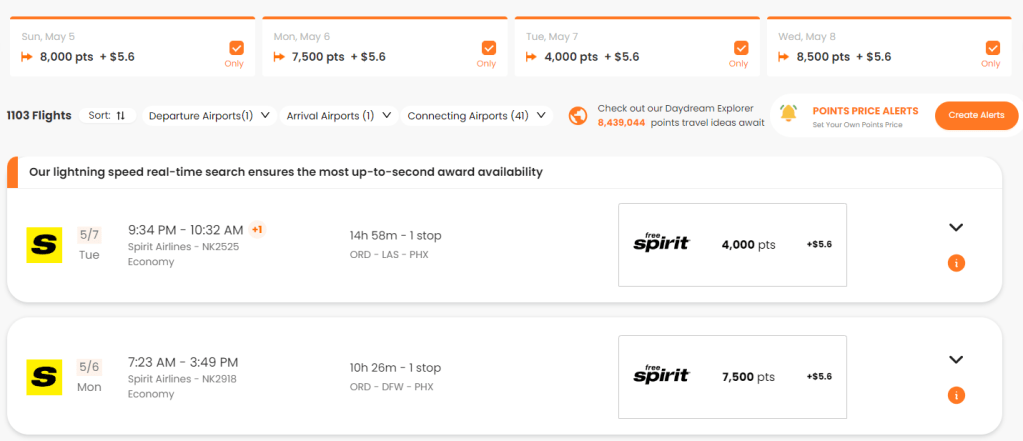
Let’s look at a scenario, where you want to visit a friend in Phoenix, and you have a little flexibility on date. You just enter into the search bar your departure airport and the arrival airport, and a date range of up to 4 days. When you click the ‘Yeah!’ button it will automatically search for awards across a variety of airline award programs.

In just a few seconds, you will be presented with the results. In this case, the best deal is with Spirit Airlines for 4,000 points and $5.60 for a one-way flight from Chicago to Phoenix.

The problem with that is, that I don’t have Spirit points, nor a desire to fly Spirit Airlines. Also, that flight is almost 15 hours with connections – no thank you. In this case, you can scroll down, or you can filter out results from Spirit Airlines altogether, since it’s not really an option.

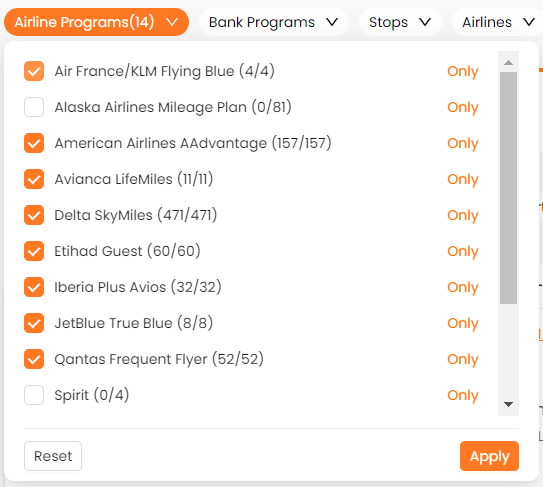
At the top of the screen, you will see a series of buttons that are preset filters. I want to filter out the airlines programs that I know I don’t have points for or transfer partners for, in this case, Alaska Airlines and Spirit Airlines. All you have to do is uncheck the boxes and click ‘Apply’ and view the new results.

This gives you another set of results, the top one being this Delta Airlines flight. The results here pack a ton of useful information into one tiny area. First, you will notice that the flight costs 8,000 Delta Skymiles and $5.60 in taxes. Secondly, you notice right above the Skymiles total you see the number of American Express Membership Rewards that are needed to transfer those 8,000 points to Delta. There is also (not on every result, but on some) a cash price listed. This is awesome, because you might just look at this flight and say that it’s cheap enough that you don’t want to waste your Skymiles or Membership Rewards points on it, you’ll just pay cash. Lastly, you can click on the down arrow to the right to expand the box to give you details about the flight itself.

But, what if you just want a direct flight? Well just go back to the top bar where all of the filters are and simply click on ‘Stops’ and then click ‘Non-stop only’. This supports multiple filters, so you will be able to search for non-stop only with the airlines that you don’t want to see already turned off.

Once you do that, you will see a number of results that fit the newly narrowed search criteria that you entered into the filters.

What is left is a series of direct American Airlines flights from Chicago to Phoenix for 8,500 points and $5.60. Perfect, now you know what to look for and can log onto the American Airlines website, search for this flight and book it.

Daydream Explorer is Awesome

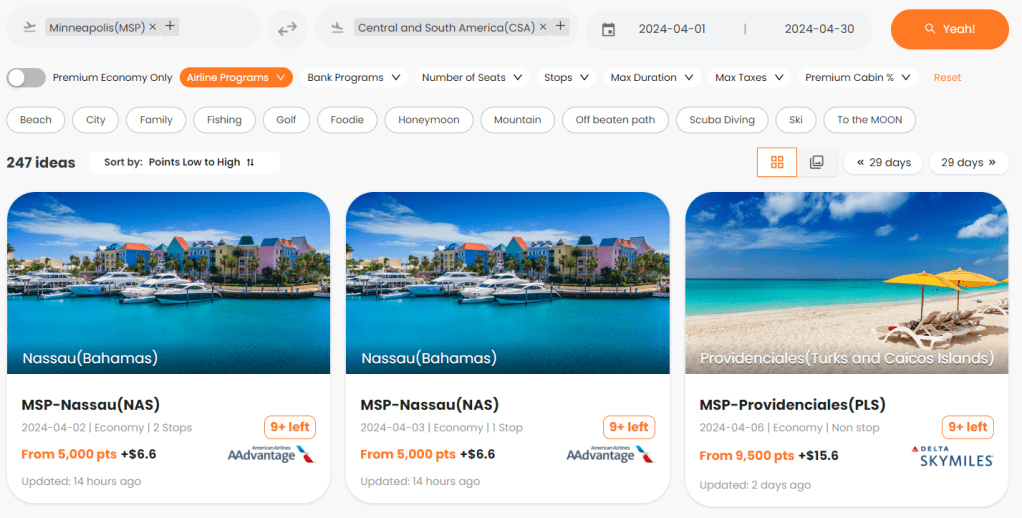
There is a new feature that PointsYeah has added recently called Daydream explorer which is like a candy store for travel junkies. Rather than searching for individual flights from airport to airport, Daydream Explorer allows you to search airport to region, region to region, airport to country, country to region, basically anything that you can think of. On top of that, it allows for super broad time ranges like a couple of months.

Imagine you’re thinking “I’d like to go to Central or South America in April” – you can search for that and just see what comes up. Let’s say you’re local airport is MSP and you want to go south in April. Just search for MSP to Central or South America from April 1st to April 30th and abracadabra a list of potential flights you could take and their prices pop up.

You will get a bunch of random results that you can sort by price, date or last update. This will allow you to browse a whole bunch of different ideas for taking a trip to Central or South America. You can also use the filters at the top to look for deals with certain airline programs or bank programs. You can even filter by number of stops or set a maximum that you’re willing to pay for taxes and surcharges.

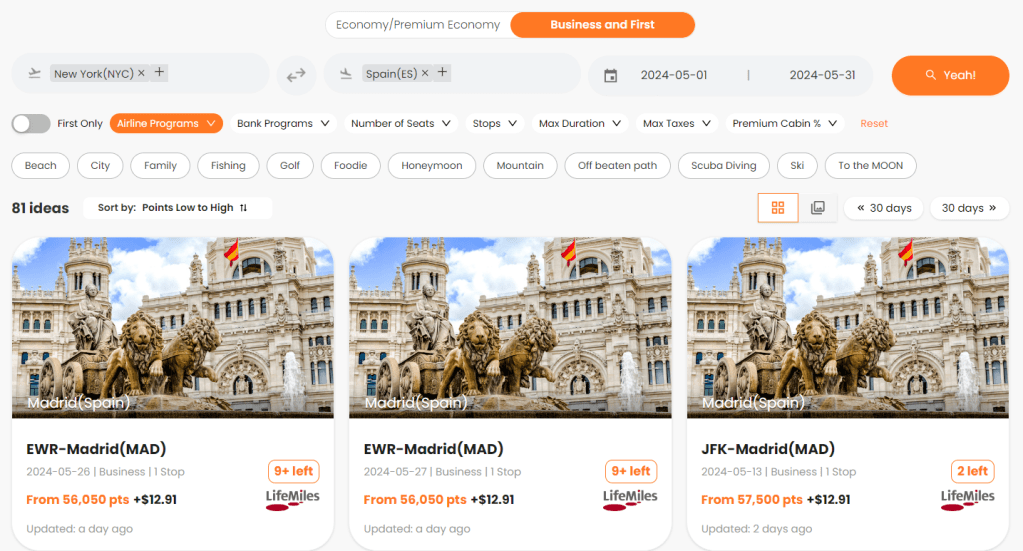
If you’re thinking that you would like to go from New York to Spain in May in business class, just put in that criteria and search again.

A group of results appear nearly instantaneously, allowing for the user to browse through and see if they find anything that they like. The results are so fast and the searches are so interesting that you can easily waste hours just window shopping potential vacations.

Let PointsYeah Send you Updates

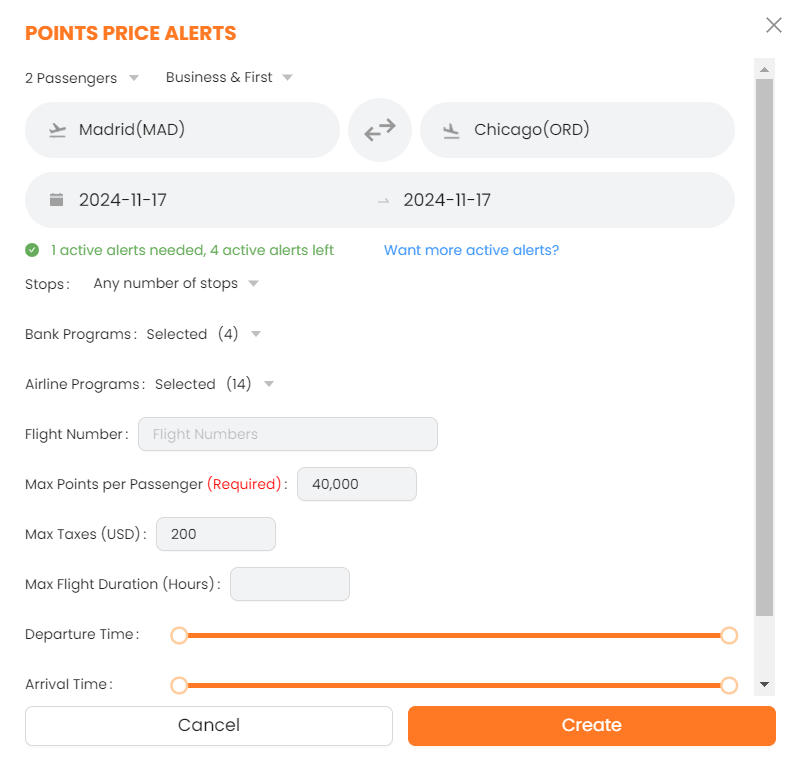
PointsYeah also has a feature called Points Price Alert. This allows you to have PointsYeah send you an email when there is a flight available within the criteria that you set.

If I would like to get notified on a specific date if business class seats become available, I can set that criteria. In this case, I’m looking to book a flight home from Europe, and I know that Iberia does occasionally have business class flights available from Madrid to Chicago for 34,000 Avios, so I want to know if those seats become available on the day that I want to fly home. I simply put in the criteria that I’m looking for.

In this case, I want two seats, under 40,000 points and $200 in taxes and fees, per seat. I set that criteria and clicked create and now I will get an email if that Iberia business class award becomes available.

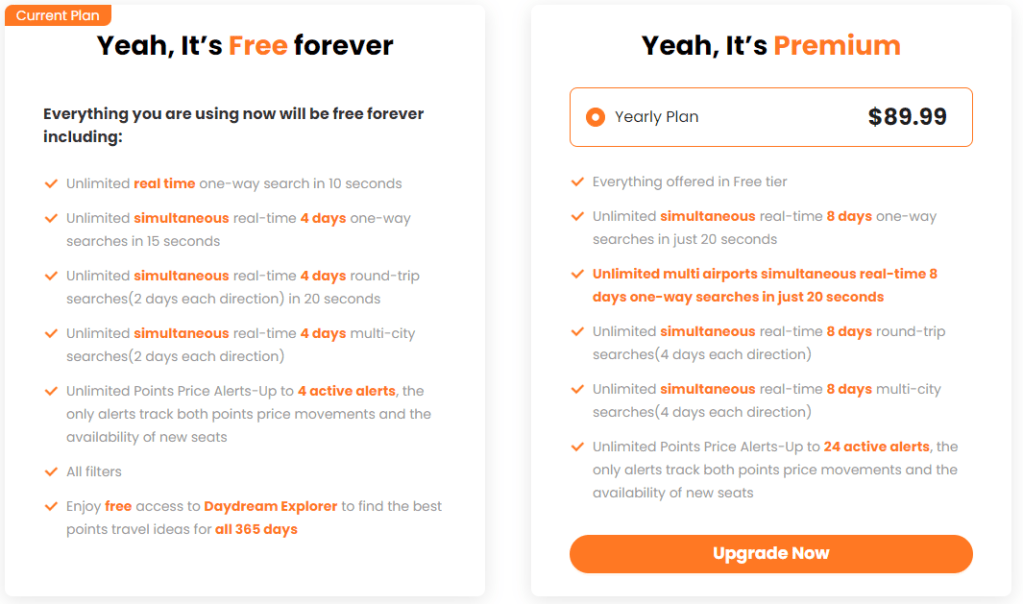
You are only allowed 4 flight alerts on a free account and each day counts as a flight alert. If you want to search this criteria but over a 4 day window, that would count as 4 searches.

Disclaimer

If you haven’t noticed, you will see on these searches that there is an updated date on these searches. The reason for this is because of how PointsYeah works.

What PointsYeah is doing is crawling the various airline websites and doing a ton of searches and saving the results. If they didn’t do this, these searches (especially the Daydream Explorer feature) would take forever because it would have to search each of those websites in real time and crunch that data (the websites would hate that as well, because it would create unnecessary traffic).

They are nice enough to let you know the last time that they searched those flights, because the older the search, the less likely it is to still exist, especially if it’s a particularly good deal. You always need to check the airlines website to see if the deals are still available. In other words, don’t transfer your Chase Ultimate Reward points to Flying Blue before you know that the flight you want to book is still available.

Free Vs Paid Account

Everything that I’ve talked about thus far is part of the free account. Why? Well I use a free account. I find it has all the features that I need right now and that’s just fine with me. However, if you want to have some additional features, you can pay for a subscription.

The main difference between the free and the paid memberships is that you can search for 8 days instead of 4 days on normal searches and you can set up as many as 24 alerts instead of the 4 that are available with the free version. The price of the paid membership is only around $8 per month, so if you find the additional alerts or the expanded date range useful, it might be worth the money.

Why I love PointsYeah

I always find it funny when people say they have a bucket list of places they want to go. The reason for that is that if I actually sat down and wrote a bucket list, it would be unbelievably long. I could probably think of at least 2 dozen places it Italy that would make that list. The biggest problem with a list like that is that the more I travel, the longer the list gets. As we visit places, we always hear about other places that we hadn’t heard of and that list just keeps growing.

What PointsYeah does for people like me, is to allow those of us with flexible places and dates, to dream a little better. Maybe you didn’t know that for 37,500 American Airlines miles and $44 you can fly from Chicago to New Zealand. Well you do now, and it only took a quick search to find out.

You might never have thought you could do that trip, but now you know whether it’s possible or not, and you did it without making multiple searches on multiple websites. Just one search gets it done. PointsYeah is an absolute gamechanger for me, I love it.

Points Check February 2024

We’re inching closer every day to our spring break Costa Rican adventure. Honestly, this is a trip that I probably wouldn’t have dared to do a year ago. When we first started to do international travel (it’s only been a year – we’re still newbies!), every logistical step in the process was something that we needed to examine. How long will we be waiting in customs? Is that layover long enough? How do the trains/busses/taxis work from the airport? Will we be understood if we don’t speak the local language well? Each trip that we take gives us a little more confidence in the process and our abilities to handle those logistical issues.

The biggest logistical hurdle this time is driving a rental car in a foreign country, especially Costa Rica. There are horror stories all over the internet about scams at the rental car counter. Also, driving habits apparently are a little different in Costa Rica and the roads sound like they will be questionable off the major highways.

It’s easier for us to mentally prepare ourselves for what could be stressful driving and perhaps a difficult time at the rental car facility when we don’t have to mentally prepare ourselves for the logistics of flying. I feel like there are parts of travel that we’ve started to understand pretty well and it opens up my mental energy for new experiences. This is really important when you don’t want the negatives of travel to overwhelm what I’m anticipating to be an amazing experience with waterfalls, beaches and volcanoes in Costa Rica.

Hold!!!

Jenn and I have been planning a trip for us with her parents and our good friends who live in Nashville. The biggest logistical issue for this trip was landing around the same time in Rome with us using 3 different flight itineraries. That part has been done, but we’ve only managed to book the flights to Italy, not the return flights.

However, every time I try to bring up the fact that maybe we should book the return trip, Jenn turns into Kirstin Bell from the Carvana commercial and just tells me “HOLD!” I think she’s waiting on the perfect flight home that costs something like 1,000 points in business class with a stopover in Madrid. I’m sure we’ll find something decent since it is off-peak from Europe, but she’s making me nervous. I guess there are worse things in life than getting stranded in Italy.

Anyway the flight we booked to Italy cost us 20,000 Chase Ultimate Reward points each transferred to Flying Blue plus about $90 in taxes and surcharges and $50 each to stopover in Amsterdam for a day. Stopovers are supposed to be free and I go into greater detail as to the $50 charge in this post about Flying Blue Stopovers. I would’ve paid the $50 charge anyway, but it would’ve been nice to know ahead of time.

The redemption turned out to be pretty good. The price of a comparable flight was $658 (with the $50 stopover fee included), so the 20,000 points we used reduced the cost of the flight by $518 each, meaning we got nearly 2.6 cents per point for the Chase Ultimate Reward points which are normally valued at 2 cents per point. You gotta love how great the deals have been on Flying Blue lately.

We also double booked some lodging in Costa Rica. We kept going over the logistics of landing at the Guanacaste Airport at a little past noon, going through passport control and customs, then renting a car and driving more than 3 hours to Grecia, outside of San Jose and trying to do this before dark. It gets dark in Costa Rica around 5:30 and it’s not recommended for people who aren’t familiar with the roads there to drive after dark, so we decided that maybe we should get a hotel closer to the airport and make the big drive the next day.

We ended up booking a local hotel in Playa Hermosa, which is less than 30 minutes from the airport. We booked it through Capital One travel for a little over 16,000 Capital One miles. These are redeemed at exactly 1 cent per point, which isn’t a fantastic redemption of Capital One miles, but it served it’s purpose and now we will get a little beach time while in Costa Rica, when we hadn’t planned to spend any time near the coast. We probably could have shortened our stay at the Airbnb by the day that we are in Playa Hermosa, but it feels wrong this late to change our reservation, and frankly it was only $75 per night at the Airbnb. This also ensures that we can check in at any time the next day.

A Shiny New Amex Gold Card

American Express Membership Rewards is a beloved program in the points and miles space. It has a ton of great transfer partners and has amazing opportunities to accumulate a massive amounts of Membership Rewards points very quickly with enormous signup bonuses, great bonus spend categories and other Amex offers. Up until now, I’ve avoided Amex because their cards tend to have high annual fees.

I applied for and was accepted for the American Express Gold Card. It has an annual fee of $250 and earns 4x on dining, 4x on groceries, and 3x on flights booked through Amex travel or directly through the airline. It also has $120 Uber Cash and $120 Dining Credit every month which is good at a handful of restaurants or Grubhub (so it’ll get used on Grubhub, if at all). Those credits are doled out monthly so it’s really $10 per month for Uber and $10 per month for Grubhub.

I applied with the bonus offer of 75,000 membership reward points and a 20% rebate on dining up to $250 back. The 75,000 membership reward points are awarded if I spend $6,000 in 6 months. There was also an offer for 90,000 membership rewards points without the 20% rebate, but I thought this was a way to get an Amex Gold card for essentially no annual fee, since spending $1,250 on dining for the $250 rebate is practically automatic for us and is equal to the $250 annual fee.

Anyway, On to the Point Check!

Card UsedSpendPoints EarnedPoint ValuePoints Per $Return on Spend
Citibusiness AAdvantage$1,1391,139$17.651.01.5%
Capital One Venture$7061437$26.742.04.0%
Wyndham Business Earner Card$5813,069$33.765.35.8%
Citi Custom Cash$5402,539$45.704.78.7%
Ink Cash$5312,639$54.105.010.2%
Citi Premier$491935$16.831.93.4%
Marriott Bonvoy$198995$8.365.04.2%
Total$4,18412,753$202.993.04.9%
This month’s spending not devoted to earning a signup bonus

We still haven’t managed to stop accidentally spending on our Citibusiness cards. They are practically useless for normal spend, and the problem is that when we are done with a bonus, we forget to remove them from all of the places where we’ve set up default payments. The most painful one here was when we ordered a dishwasher through Home Depot’s website and somehow managed to use that card instead of a card we are working on a bonus for. $700 worth of spending that could’ve gone toward a bonus, dammit.

Our spending was quite elevated this month because of the dishwasher and we also bought a new couch since the kids and the dog had managed to slowly kill the old one. Aside from the non-bonus spending in the chart above, Jenn spent a little less than $3,400 on her US Bank Altitude Business Connect card and earned a little more than $43 in cash back.

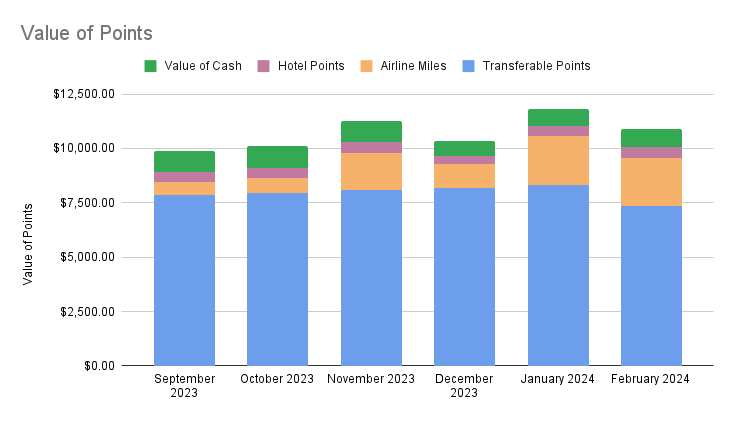
This left us with a grand total of 257,000 Chase Ultimate Reward points, 115,500 American Airlines miles, 75,100 Capital One Venture miles, 38,400 Citi Thank You points, 31,800 Marriott Bonvoy points, 24,900 United miles, 6,900 Hyatt points, 5,100 Delta miles, and $700 in cash back. According to the valuations determined by the Points Guy, these points are worth a grand total of a little less than $10,800.

Turkish Airlines Miles and Smiles is (Almost) Dead to Me

When I first got into the points and miles hobby a couple of years ago, I was listening to a Frequent Miler podcast when I heard the term “sweet spot” for the first time. What they were referring to was a route, series of routes, or region in a points program where the deals were especially good. They were talking specifically about Turkish Miles and Smiles which had a number of great sweet spots:

  • 7,500 miles in economy and 12,500 miles in business class within the United States including Hawaii (on Star Alliance Partners – usually United Airlines)
  • 10,000 miles in economy and 15,000 miles in business class within North America including the Caribbean and Mexico (on Star Alliance Partners – usually United Airlines)
  • 30,000 points in economy and 45,000 points in business class to Europe on Star Alliance Partners or Turkish Airlines.

This turned out to be the first program I that I ever used to redeem points for a flight. I had to learn how to take my Citi Thank You points, transfer them to Miles and Smiles and then use their program to book United Airlines flights. In this case, I booked Jenn and I round trip tickets from Chicago to San Jose del Cabo Mexico for 40,000 points, which was a very good deal. 10,000 miles per person one-way to Mexico was fantastic. This was a deal that wasn’t the easiest to get, but it wasn’t too hard either. It just required a little flexibility on when you took the flight.

Because of this sweet spot, I always wanted to keep some Capital One Venture miles or Citi Thank You points (Citi and Capital One transfer to Turkish 1:1) around just to make sure that I could transfer them to Miles and Smiles. It was nice to have some miles available in case we wanted to use Turkish to book flights to the Caribbean or Mexico.

Turkish Airlines Website is Frustrating

The Turkish Airlines Miles and Smiles website is notorious for having all kinds of glitches. I kept getting an error when doing an award search while writing this blog post, and based on some google searches and reddit threads, I would say this error is common and has been around for a while without being fixed.

There is also an issue where most people cannot book anyone besides themselves online the first time they use the Miles and Smiles website to book an award ticket. Most people report that they end up calling customer support the first time they book with Turkish so they can book additional passengers (I had to do this also). Travel Update wrote a blog post about how to book with Turkish, which is very informative on the subject. For the most part, if you want to book with Turkish, you probably need to be a patient person.

The Sky Is Falling!

In early February, I started to see a bunch of blog and Twitter posts about a sudden devaluation that was to take place on February 16th. I read this one by One Mile at a Time, which showed what the new award chart would look like on Turkish Airlines, and it looked bad, with rates going up in the 40%-100% range.

A favorite redemption of miles and points hobbyists was business class tickets from the US to Europe for 45,000 miles. That’s a pretty amazing price, but with the new award chart it’s going cost 85,000 miles. This was, in my mind, what I think was freaking people out the most. One of the great ways of using Citi and Capital One points – business class flights to Europe for 45,000 miles – gone.

What I hadn’t seen anyone comment on was about my favorite redemption with Miles and Smiles. What was a flight to Mexico or the Caribbean from the US going to cost in economy? I figured I would just wait until after the change and then do a quick search to find out the answer.

I wasn’t too concerned, frankly I figured if they jumped it to 15,000 each way it would still be a decent deal. Besides, I’ve seen the points and miles community overreact when it came to Delta just a few months earlier. How bad could it possibly be?

Well, As it Turns out, Pretty Damn Bad!

30,000 miles? Are you serious? My favorite sweet spot to Mexico and the Caribbean is now 3 times the amount of points as it was before! Considering that the only way flights are even available to book on Miles and Smiles is if they are a saver award from another airline, there is no way that that I would book that through Turkish, I would just book it through the other airline.

Two of the best sweet spots, business class to Europe and economy or business class to Mexico and the Caribbean are effectively dead. But is there anything still worthwhile with Turkish Miles and Smiles?

Is Any Redemption Still Decent With Turkish?

The one remaining bright spot, in my mind, is 10,000 miles for domestic flights in economy and 15,000 miles in business class. When I saw this in the chart, I thought it meant just within Turkey. However, this appears to be any domestic, Star Alliance flights within any country. In the example below, a flight from Vancouver to Montreal is 10,000 miles in economy class.

A coast to coast flight from Washington DC to San Francisco is also just 10,000 miles.

The most impressive redemption left in the Miles and Smiles program is still on flights to Hawaii from the mainland US for just 10,000 miles in economy and 15,000 in business class. This used to be 7,500 miles in economy and 12,500 miles in business class before the change. They don’t make an exception for Hawaii even though it is almost a 5,000 mile flight from the east coast of the US. I even managed to find a flight to Hawaii from my little regional airport in Moline for 10,000 miles. That shocked me.

The baffling thing is that for some reason, coming it at one tenth of the distance of the flight from Washington to Honolulu is Chicago to Toronto for 30,000 Miles and Smiles. Why 30,000? Well, that’s because since it crosses a border, it counts as a flight within North America, not a domestic flight. Because it crosses the border between the US and Canada it ends up being 3x the number of miles to redeem. It doesn’t matter in the least that this has got to be a much cheaper flight for the airline to operate.

Dynamic Pricing Vs Award Charts

Most airline award programs have gone to some sort of dynamic pricing model, where they essentially calculate the price, in miles, based on the price of the ticket or the availability of award seats on the plane. American Airlines does this, and this became apparent to me when Jenn and I were trying to book 4 seats on American Airlines, 2 seats on her account and 2 on my account for the same flight. Once I booked my 2 seats, her price went up by 5,000 points each for those same flights. I assume that happened because 2 award seats had just disappeared from inventory.

This can get a little frustrating when you check the price of a flight a couple of days in a row and they change, but at the end of the day, they follow the price, in dollars, of the same flights. The cost of the flights, in points, generally makes sense.

There are some airlines, like Turkish Airlines, that still use an award chart for their award flights. This does make their award flight prices much more predictable, but can mean that some flight prices don’t make a lot of sense, such as the low cost of the flights from the east coast to Hawaii compared to a short flight across the Canadian border. For those of us who like to make the most of our miles and points, these charts often provide us with ideas on how to stretch the value of those points.

How I will Use Turkish MIles and Smiles

Turkish Airlines used to be one of the best uses of Capital One miles and Citi Thank You Points. Because you can transfer either of those programs 1:1 to Turkish Miles and Smiles, the great deals they had for flying from the US to Turkey, Europe, Mexico, the Caribbean and within the United States made this program a favorite amongst people in the miles and points hobby.

Most of the value of the program has disappeared with the increase in award prices to Turkey, Europe, Mexico and the Caribbean. That eliminates most of the usefulness for me, but knowing that I can still fly for 10,000 miles one-way within the US on United Airlines makes it still relevant. At 10,000 miles, it won’t always be a better deal than booking with United, American or Delta, but it most likely will be on the longer US routes.

Turkish Miles and Smiles, you’re not dead to me – yet.

Flying Blue Free Stopover Isn’t Really Free

We’re planning a trip to Italy for the fall with friends and Jenn’s parents. This requires a little bit of coordination between the parties, especially since we are all booking with different methods. Remarkably, even though Jenn’s parents and our friends were flying from different airports, the last leg of their journey is on the same Delta flight from Atlanta to Rome. Now it was up to us to try to match that time to land.

The best thing to do would’ve been to use Delta and get on the same flight, but we don’t have a lot of Delta Skymiles and their only transfer partner is American Express Membership Rewards and we don’t have any Amex points. Delta was not going to work but Air France (Flying Blue) had a flight landing just 10 minutes after the Delta flight.

The Problem with Short Layovers

Unfortunately, that had an hour and 25 minute layover in Paris (CDG), and that seemed pretty risky considering we would have to go through passport control, then security, and then find our gate in a busy airport I’m not familiar with. I would put the chances of success at about 50/50. Not good enough for me – especially with Jenn’s luck (she has had delays of 2 hours, 5 hours and 8 hours respectively on her last three flights)

A little off topic here, but why in the hell do airlines offer these tight layovers? You know you all suck at getting your flights in the air on time. I once sat on the tarmac for half an hour watching two mechanics trying to fix a seat that wouldn’t recline – on a 2 hour flight. Suck it up buttercup, I got places to go and your inability to move your seat 3 inches back is not my problem. Strap yourself in and lets go!

Sorry about the rant – the other option was to arrive in Rome 3 hours later, around 3 PM. Not only would that have been a massive inconvenience for our fellow travelers, but our plan was to take a train to Florence on the first day, and when I added up all the time to get through passport control, take the commuter line to Rome Termini, transfer, then take a train from Rome to Florence, we would be getting in very late. Assuming we all only sleep a little on the plane, we might be dragging our suitcases through Florence trying to find our Airbnb with the mental acuity of a toddler on Benadryl.

The better option was to go a day early, but with timing of the flights and the fact that FCO really isn’t that close to Rome, we probably wouldn’t have gotten to enjoy the extra day in Rome, we probably would just end up sitting in a hotel room. But what if we stayed in Paris or Amsterdam on the way, instead?

Flying Blue Free Stopovers to the Rescue

A quick google search pulled up this article by One Mile at a Time that points out that indeed, Flying Blue offers free layovers. We pieced together an itinerary that flew KLM from Chicago landing in Amsterdam at 7:10 AM and a second flight that leaves Amsterdam 26 hours later which lands in Rome a mere 20 minutes after our companions. The nice thing is that since we will go through passport control in Amsterdam, and they will be going through in Rome, theoretically we should be ready to leave the airport in Rome around the same time.

Perfect, now we just had to call, and by we, I mean Jenn since the points were in her account. She wasn’t happy about that.

She was on hold for about an hour, but when she got on, the agent understood what Jenn was trying to do, and got it all booked. The process on the phone wasn’t exactly quick, but she was probably off the phone in about 15 minutes after the agent picked up.

Free Stopovers Aren’t Exactly Free

When Jenn got off the phone, she said that the taxes were higher than we expected. We looked and sure enough, the taxes were $139.70 per ticket instead of the $85.90 that is listed online. The difference worked out to be exactly 50 Euros. So it appears that the “Free Layover” is going to cost 50 Euros per ticket, unless it’s 100 Euros per call.

They do have the fact that higher issuing fees do occur by phone, but when you click on the link for an explanation, you get a dead link. So my assumption is that it costs 50 Euros per ticket, but I don’t know for sure.

Booking Stopover Online isn’t Possible, Yet

Currently there isn’t a way to book with a stopover on the website. I would assume that they might add that in the future, but for now it’s by phone only. This means that you are going to have to do a considerable amount of research on their website to pick out the flight segments that you want and then communicate this effectively to an agent who is most likely in France or the Netherlands. This can lead to confusion, which Jenn found out, when she gave my birthdate to the agent the American way, month-day-year, and the agent entered the birthdate the European way, day-month-year.

It also means that until they can add a free stopover feature to their website, you will be paying the fees associated with making an award flight redemption over the phone. My limited experience with how agile tech development is with airline point programs suggest it might take some time before you see that feature on their website. For now, prepare to pay for the stopover.

Which Cities Can you Stopover with Flying Blue?

I assume that these stopovers will only work in their hubs. I doubt that they would let you fly, say Chicago to Paris to Barcelona, then get a free stopover, then Barcelona to Paris to Munich. However, they will allow you to stop in Paris if flying from Chicago to Barcelona when the normal layover would be in Paris. So that will limit any stopovers to just Paris or Amsterdam. The article from One Mile at a Time does indicate that it should work with partner airlines booked through Flying Blue, so there are actually other possibilities besides Amsterdam and Paris, but for the most part, that’s how you would typically use them.

Stopovers can be as short as 24 hours and as long as 1 year. That offers great flexibility, but I imagine that most people are going to use this as a way to visit Paris or Amsterdam for a few days and then move on to another location. With this stopover rule, you could pretty easily put together an itinerary where you go to Amsterdam for a few days on a flight from the US, move on to another European city for a few days and stop in Paris for a few days on the way back. That’s a pretty easy way to get a sampler platter of Europe and the prices could be around 40,000 points (transferable from Citi, Amex, Chase, Capital One and Bilt), around $240 for taxes and $100 for booking by phone. That’s not too shabby.

Making Lemonade out of Lemons

For us, it was a way to make lemonade out of lemons. We didn’t want to land in Rome that late on the same day as our fellow travelers, and getting in at 3 PM the day before left us with not a lot of time to enjoy Rome. However, 26 hours in Amsterdam with the opportunity to adjust our sleep to the new time zone, sign me up. We’ll get to walk along the canals and have dinner in downtown Amsterdam and still make it into Rome right at the right time. That’s some damn good lemonade.

Points Check January 2024

Well, it’s 2024 and Jenn has already managed to go on a trip to Playa Del Carmen without me (I’m not bitter at all). She had some fun soaking up the sun with her sister and her mom in a beachside condo rented through Vacasa. It sounds like a they had a great time, while I was busy installing a dishwasher and taking care of the kids (They are 15 and 18, taking care of them usually means nagging them and tossing food at them once in a while).

For me, it’s getting to be a little too long since I’ve been I’ve taken a trip. Jenn and I have gone on weekend trips to Nashville and Des Moines, which were both great, but they were barely able to scratch the itch. I really have been wanting to get out of the country again and experience something a little different. We have a trip booked for Costa Rica in March which I hope satiates me for a little while. I’m starting to really look forward to doing a little hiking and experiencing some of the food that I hear is so amazing there.

US Bank Business Altitude Connect Card

Is it just me or does every credit card have an unnecessarily long name? Anyway, Jenn signed up for the US Bank Business Altitude Connect Card in January. It has a $95 dollar annual fee, waived for the first year. It actually has some decent earning categories, with 5x on hotels and car rentals booked through the US Bank Rewards Center. It also earns 4x on airfare, hotels, gas and EV charging stations as well as 2x on dining, and cell phone services.

Unfortunately, US Bank “points” don’t transfer so they are essentially cash back valued at 1 cent per point. Because of that I would consider this a cash back card with 5x, 4x, and 2x categories. It currently has a 60,000 point ($600) sign up bonus after spending $6,000 in 180 days. It also comes with 4 annual Priority Pass visits per year. Priority Pass lounges aren’t the best lounges, but they sure beat sitting in the terminal, so I’m always excited to have lounge passes.

Jenn earns her AAdvantage Bonus

Jenn earned her 75,000 AAdvantage mile bonus by finishing the 6,000 spend on her Citibusiness AAdvantage Platinum Select card. That bumped us over 100,000 AAdvantage miles again, and I’m pretty happy about that.

We didn’t sign up for any American Airlines cards until recently because, frankly, there isn’t a transfer partner to American Airlines except Bilt, who doesn’t offer sign up bonuses. Having transfer partners means that if you are just a little short on miles to book a flight then you can transfer some points over and book it, but without transfer partners, you either have the points or not, there’s no way to get more.

However, American Airlines offers some pretty good redemption values out of our small home airport and that’s not something that is easy to come by. United flies out of here, but their award prices to fly out of small airports are terrible, so we have to drive to Chicago. Delta flies out of here as well, but their award prices are unpredictable at best.

Because they are a good option for flying out of our home airport, I would imagine that we will continue to try to earn AAdvantage miles whenever we get an opportunity. They also have a bunch of different credit cards, so I think that finding signup bonuses shouldn’t be too difficult.

Anyway, on to the Point Check!

We said we were going to slow down a little on opening new credit card accounts this year. Because of our 5/24 status (the number of cards opened in a 24 month period), we are essentially shut out of Capital One and Chase right now. Opening fewer cards over the course of this year should open us up to all available credit cards. That means that we need to do a good job of using bonus categories to maximize points earned. That being said only about a third of our spending went toward a bonus, which is too low.

Card UsedSpendPoints EarnedPoint ValuePoints Per $Return on Spend
Capital One Venture$7241,417$26.212.03.5%
Citi Custom Cash$5762,560$46.084.48.2%
Ink Cash$5312,639$54.105.010.2%
World of Hyatt$5171,398$23.772.74.6%
Citibusiness AAdvantage$481482$7.231.01.5%
Citi Premier$372802$14.442.23.9%
Wyndham Business Earner$141810$8.915.76.3%
Chase Sapphire$133134$2.751.02.1%
Total$3,47510,242$183.482.95.3%
This month’s spending not devoted to earning a signup bonus

I’m happy with the fact that we managed to be over 5% back on our normal (not toward a signup bonus) spending, but we are still making some mistakes. I put our insurance on the wrong card (I wanted it on the Venture card for 2x transferable miles) and forgot to switch our utilities to the Wyndham Business Earner card (which gets 5x for utilities). Jenn was using my Citibusiness card for groceries at 1x instead of hers which would have been working toward a bonus. Aside from the spending in the chart above, Jenn spent $1,685 on her Citibusiness AAdvantage card, earning her 1,685 AAdvantage miles and the 75,000 mile bonus.

That left us with a total of 294,400 Chase Ultimate Rewards points, 109,700 American Airlines miles, 89,800 Capital One Venture miles, 35,000 Citi Thank You points, 30,800 Marriott Bonvoy points, 24,900 United miles, 15,000 Delta miles, 6,900 Hyatt points, 6,200 Wyndham points, and $646 in cash back. Using the Points Guy valuations, all of that is worth $11,600.